OOM PAUL'S PEOPLE (continued 3)
Reading edition
No one has ever accused him of being the fortunate victim of circumstances which carried him to the pre-eminent rank he occupies among Englishmen, although such an opinion might readily be formed from a personal study of the man. South Africa is the indolent man's paradise, and of that garden of physical inactivity Mr. Rhodes, by virtue of his pre-eminent qualifications, is king. "Almost as lazy as Rhodes" is a South Africanism that has caused lifelong enmities and rivers of blood.
He takes pride in his indolence, and declares that the man who performs more labour than his physical needs demand is a fool. He says he never makes a long speech because he is too lazy to expend the energy necessary for its delivery. He declines to walk more than an eighth of a mile unless it is impossible to secure a vehicle or native hammock-bearers to convey him, and then he proceeds so slowly that his progress is almost imperceptible. His indolence may be the result of the same line of reasoning as that indulged in by the cautious man who carries an umbrella when the sun shines, in which case every one who has travelled in the tropics will agree that Mr. Rhodes is a modern Solomon. The only exercise he indulges in is an hour's canter on horseback in the early morning, before the generous rays of the African sun appear.
Notwithstanding his antipathy to physical exertion, Mr. Rhodes is a great traveller, and is constantly moving from one place to another. One week may find him at Groote Schuur, his Cape Town residence, while the following week he may be planning a new farm in far-away Mashonaland. The third week may have him in the Portuguese possessions on the east coast, and at the end of the month he may be back in Cape Town, prepared for a voyage to England and a fortnight's stay in Paris. He will charter a bullock team or a steamship with like disregard of expense in order that he may reach his destination at a specified time, and in like manner he will be watchful of his comfort by causing houses to be built in unfrequented territory which he may wish to investigate.
So wealthy that he could almost double his fortune in the time it would require to count it, Mr. Rhodes is a firm believer in the doctrine that money was created for the purpose of being spent, and never hesitates to put it into practice. He does not assist beggars, nor does he squander sixpence in a year, but he will pay the expenses of a trip to Europe for a man whom he wishes to reconcile, and will donate the value of a thousand-acre farm to a tribe of natives which has pleased him by its actions.
His generosity is best illustrated by a story told by one of his most intimate friends in Kimberley. Several years before Barney Barnato's death, that not-too-honest speculator induced almost all of the employees of the diamond mines to invest their savings in the stock of the Pleiades gold mine in Johannesburg, which Barnato and his friends were attempting to manipulate. The attempt was unsuccessful, and the diamond miners lost all the money they had invested. Mr. Rhodes heard of Barnato's deceit, and asked him to refund the money, but was laughed at. Mr. Rhodes learned the total amount of the losses--about twenty-five thousand dollars--and paid the money out of his own pocket.
Although he has more financial patronage at his command than almost any banking house in existence, Mr. Rhodes rarely has sufficient money in his purse to buy lunch. His valet, a half-breed Malay named Tony, is his banker, and from him he is continually borrowing money. It is related that on a voyage to England he offered to make a wager of money, but found that he had nothing less valuable than a handful of loose rough diamonds in his trousers pocket.
Mr. Rhodes is an eloquently silent man. He talks little, but his paucity of words is no criterion of their weight. He can condense a chapter into a word, and a book into a sentence. The man whose hobby is to run an empire is almost as silent as the Sphinx in the land toward which that empire is being elongated. His sentences are short and curt. "I want a railroad here," or "We want this mine," or "We must have this strip of land," are common examples of his style of speech and the expression of his dominant spirit.
He has the faculty of leading people to believe that they want the exact opposite of what they really want, and he does it in such a polished manner that they give their consent before they realize what he has asked them. His personal charm, which in itself is almost irresistible, is fortified with a straight-forward, breezy heartiness, that carries with it respect, admiration, confidence, and, finally, conviction. He has argued and treated with persons ranging in intelligence and station from a native chief to the most learned diplomats and rulers in the world, and his experience has taught him that argument will win any case.
Lobengula called him "the brother who eats a whole country for his dinner." To this title might be added "the debater who swallows up the opposition in one breath." Mr. Rhodes never asks exactly what he wants. He will ask the shareholders of a company for ten million, when he really needs only five million, but in that manner he is almost certain of satisfying his needs. In the same way when he pleads with an opponent he makes the demands so great that he can afford to yield half and still attain his object. Twelve years ago Mr. Rhodes demanded the appointment of Prime Minister of the Colony, but he was satisfied with the Commissionership of Crown Lands and Works, the real object of his aim.
If Mr. Rhodes had cast his lines in America instead of South Africa, he would be called a political boss. He would be the dominant factor of one of the parties, and he would be able to secure delegates with as much ease as he does in Cape Colony, where the population is less mixed than in our country. His political lieutenants act with the same vigour and on the same general lines as those in our country, and if a close examination of their work could be made, many political tricks that the American campaigner never heard of would probably be disclosed.
One of the mildest accusations against him is that he paid fifty thousand dollars for the support that first secured for him a seat in the Cape Colony Parliament, but he has never considered it worth the time to deny the report. His political success depends in no little measure upon his personal acquaintanceship with the small men of his party, and his method of treating them with as much consideration and respect as those who have greater influence. He is in constant communication with the leaders of the rural communities, and misses no opportunity to show his appreciation of their support. Mr. Rhodes may be kingly when he is among kings, but he is also a farmer among farmers, and among the Cape Dutch and Boers such a metamorphosis is the necessary stepping-stone to the hearts and votes of that numerous people. It is not uncommon to find Mr. Rhodes among a party of farmers or transport riders each one of whom has better clothing than the multimillionaire.
When he was in the Cape Parliament Mr. Rhodes wore a hat which was so shabby that it became the subject of newspaper importance. When he is in Rhodesia he dons the oldest suit of clothing in his wardrobe, and follows the habits of the pioneers who are settling the country. He sleeps in a native kraal when he is not near a town, and eats of the same canned beef and crackers that his Chartered Company serves to its mounted police. When he is in that primeval country he despises ostentation and displays in his honour, and will travel fifty miles on horseback in an opposite direction in order to avoid a formal proceeding of any nature. Two years ago, when the railroad to Buluwayo, the capital of Rhodesia, was formally opened, Mr. Rhodes telegraphed his regrets, and intimated that he was ill. As a matter of fact he travelled night and day in order to escape to a place where telegrams and messages could not reach him. When his host suggested that he was missing many entertainments and the society of the most distinguished men of South Africa, Mr. Rhodes smiled and said: "For that reason I escaped."
Formality bores him, and he would rather live a month coatless and collarless in a native kraal with an old colony story-teller than spend half an hour at a state dinner in the governor's mansion. It is related in this connection that Mr. Rhodes was one of a distinguished party who attended the opening of a railroad extension near Cape Town. While the speeches were being made, and the chairman was trying to find him, Mr. Rhodes slipped quietly away, and was discovered discarding his clothing preparatory to enjoying a bath in a near-by creek.
Mr. Rhodes is unmarried, and throughout the country has the reputation of being an avowed hater of women. He believes that a woman is an impediment to a man's existence until he has attained the object and aim of his life, and has become deserving of luxuries. He not only believes in that himself, but takes advantage of every opportunity to impress the belief upon the minds of those around him. In the summer of 1897 a captain in the volunteer army, and one of his most faithful lieutenants in Mashonaland, asked Mr. Rhodes for a three months' leave of absence to go to Cape Colony. The captain had been through many native campaigns, and richly deserved a vacation, although that was not the real object of his request for leave. The man wanted to go to Cape Colony to marry, and by severe cross-examination Mr. Rhodes learned that such was the case.
"I can not let you go to Cape Colony; I want you to start for London to-morrow. I'll cable instructions when you arrive there," said Mr. Rhodes, and the wedding was postponed. When the captain reached London, a cablegram from Mr. Rhodes said simply, "Study London for three months."
Nowhere in South Africa is there anything more interesting than Groote Schuur, the country residence of Mr. Rhodes, at Rondebosch, a suburb of Cape Town. He has found time amid his momentous public duties to make his estate the most magnificent on the continent of Africa. Besides a mansion which is a relic of the first settlers of the peninsula, and now a palace worthy of a king's occupancy, there is an estate which consists of hundreds of acres of land overlooking both the Atlantic and Indian Oceans, and under the walls of Table Mountain, the curio of a country. In addition to this, there are a zoölogical collection, which comprises almost every specimen of African fauna that will thrive in captivity, and hundreds of flowering trees and plants brought from great distances to enrich the beauty of the landscape.
The estate, which comprises almost twelve hundred acres, is situated about five miles to the north of Cape Town, on the narrowest part of the peninsula, through which the waters of the two oceans seem ever anxious to rush and clasp hands. It lies along the northwestern base of Table Mountain, and stretches down toward the waters of Table Bay and northward toward the death-dealing desert known as the Great Karroo. From one of the shady streets winding toward Cape Town there stretches a fine avenue of lofty pines and oaks to the mansion of Groote Schuur, which, as its name indicates, was originally a granary, where two hundred years ago the Dutch colonizers hoarded their stores of grain and guarded them against the attacks of thieving natives.
Although many changes have been made in the structure since it was secured by Mr. Rhodes, it still preserves the quaint architectural characteristics of Holland. The scrolled gables, moulded chimney pots, and wide verandas, or "stoeps," are none the less indicative of the tendencies of the old settlers than the Dutch cabinets, bureaus, and other household furniture that still remains in the mansion from those early days.
The entire estate breathes of the old Dutch era. Everything has the ancient setting, although not at the expense of modern convenience. While the buildings and grounds are arranged in the picturesque style of Holland, the furnishings and comforts are the most modern that the countries of Europe afford. The library contains, besides such classics as a graduate of Oxford would have, one of the largest collections of books and manuscripts bearing on Africa in existence. In the same room is a museum of souvenirs connected with Mr. Rhodes's work of extending English empire toward the heart of the continent. There are flags captured in wars with the Portuguese, Union Jacks riddled with shot and cut by assegai, and hundreds of curiosities gathered in Rhodesia after the conquest of the natives. In this building have gathered for conference the men who laid the foundations for all the great enterprises of South Africa. There the Jameson raid was planned, it is said, and there, the Boers say, the directors of the British South Africa Chartered Company were drinking champagne while the forces of Dr. Jameson were engaged in mortal combat with those of Kruger near Johannesburg.
Surrounding the mansion are most beautiful gardens, such as can be found only in semi-tropical climates. In the foreground of the view from the back part of the house is a Dutch garden, rising in three terraces from the marble-paved courtyard to a grassy knoll, fringed with tall pines, and dotted here and there with graves of former dwellers at Groote Schuur. Behind the pine fringe, but only at intervals obscured by it, is the background of the picture--the bush-clad slopes of Table Mountain and the Devil's Peak, near enough for every detail of their strange formations and innumerable attractions to be observed. Art and Nature have joined hands everywhere to make lovely landscapes, in which the colour effects are produced by hydrangeas, azaleas, and scores of other flowers, growing in the utmost profusion. Besides the mimosa, palms, firs, and other tropical trees that add beauty to the grounds, there is a low tree which is found nowhere else on earth. Its leaves are like the purest silver, and form a charming contrast to the deep green of the firs and the vivid brightness of the flowers that are everywhere around. Undoubtedly, however, the most interesting feature of the estate is the natural zoölogical garden. It is quite unique to have in this immense park, with drives six miles in length and ornamentations brought thousands of miles, wild animals of every variety wandering about with as much freedom as if they were in their native haunts. In this collection are represented every kind of African deer and antelope. Zebra, kangaroo, giraffe, emu, pheasant, and ostrich seem to be perfectly contented with their adopted home, and have become so tame that the presence of human beings has no terrors for them.
This vast estate, which cost Mr. Rhodes several million dollars to bring to its present condition, sees but little of the former Premier of Cape Colony. His vast enterprises in the diamond fields of Kimberley and in the new country which bears his name require so much of his time that he but seldom visits it. But his inability to enjoy the product of his brain and labour does not cause the estate to be unappreciated, for he has thrown this unique and charming pleasure resort open to the public, and by them it is regarded as a national possession.
CHAPTER VIII
THE BOER GOVERNMENT--CIVIL AND MILITARY
The Constitution, or Grondwet, of the South African Republic is a modified counterpart of that of the United States. It differs in some salient features, but in its entirety it has the same general foundation and the same objects. The executive head of the Government is the President, who is elected for a term of five years. He directs the policy of the Government, suggests the trend of the laws, and oversees the conduct of the Executive Council, which constitutes the real Government. The Executive Council consists of three heads of departments and six unofficial members of the First Raad. These nine officials are the authors of all laws, treaties, and policies that are proposed to the Volksraads, which constitute the third part of the Government. There are two Volksraads, one similar in purpose to our Senate, and the other, the second Volksraad, not unlike our House of Representatives, but with far less power.
The first Volksraad consists of twenty-seven members elected from and by the burghers, or voters, who were born in the country. A naturalized burgher is ineligible to the upper House. The twenty-seven members of the Second Raad are naturalized burghers, and are voted for only by men who have received the franchise. The second House has control of the management of the Government works, telephones, mails, and mines, and has but little voice in the real government of the country. Its members are undoubtedly more progressive and have more modern ideas than those of the First Raad, and introduce many bills which would be of undoubted benefit to the country, but the upper House invariably vetoes all bills that reach them from that Raad. The First Raad receives bills and suggestions from the Executive Council or from the President himself, but refers them to a commission for investigation before any action is taken upon them. The evidence in support of proposed measures does not reach the Raad, which only concerns itself with the report of the commission. The Raad can, by motion, make a suggestion to the Executive Council that a certain measure should be formulated, but the Executive Council and the President have the authority to ignore the suggestion, leaving the First Raad without a vestige of authority. The upper House concerns itself chiefly with the questions of finance, changes in the Constitution, and the care of the natives. As the question of finance is so closely connected with almost every subject that comes before the Government, it follows that the First Raad concerns itself with practically the entire business of the Government. The popular conception is that the Second Raad, being composed of naturalized citizens, takes less interest in the affairs of the country, and can therefore be less safely trusted with their conduct than the old burghers and Voortrekkers of the upper House, who would rather declare war against a foreign power than pass a law in the least unfavourable to their own country's interests. In consequence of the Second Raad's infinitesimal powers, almost the entire law-making power of the Government is vested in the Executive Council and the First Raad. The First Raad of the Transvaal Republic is the direct successor of the democratic form of government that was established by the Voortrekkers of 1835 when they were journeying from Cape Colony to the northern lands. The Second Raad was established in 1890, in order that the Uitlanders might have representation in the government of the country. It was believed that the newly arrived population would take advantage of the opportunities thus offered to take part in the legislation of the republic, and in that way bridge over the gulf which had been formed between the two races. The Uitlanders cared little for the privilege offered to them, and so far in the history of the Second Raad less than half a score of its members have been elected by the new population.
The annual sessions of the Volksraads commence on the first Monday in May, and continue until all the business of the republic has been transacted. The members of the two Houses receive fifteen dollars a day, and seventy-five cents an hour for services extending over more than the five hours a day required by the law. The chairmen, or voorzitters, of the Raads receive seventeen dollars and fifty cents a day, and one dollar an hour for extra time.
The sessions of the Raad are held in the new million-dollar Government House in the central part of the town of Pretoria, and are open to the public except when executive business is being transacted. The Raad chambers are exquisitely fitted out with rich furniture and tapestries, the windows are of costly stained glass, and the walls lavishly decorated with carved wood and fine paintings of the country's notable men. On a lofty elevation facing the entrance to the First Raad chamber is a heavily carved mahogany desk, behind which is seated the chairman. On his right is a seat for the President, while on the right side of that are the nine chairs for the Executive Council. Directly in front and beneath the chairman's desk are the desks of the three official secretaries, and in front of these, in semicircular form, the two rows of seats and desks of the Raad members. In the rear of the chamber on either side of the entrance are chairs for visitors, while high in the left side of the lofty chamber is a small balcony for the newspaper men.
All the members of the Raad are obliged by law to wear black clothing and white neckties. This law was framed to prevent some of the rural members from appearing in their burgher costumes, and has had the effect of making of the Boer Raads a most sombre-looking body of lawmakers. Almost all members wear long frock-coats, silk hats, and heavy black boots, and when, during the recesses, they appear on the piazza of the Government Building with huge pipes in their mouths, the wisdom of the black-clothing law is not apparent. There is little formality in the proceedings of the Raads. Certain rules are necessarily followed, but the members attack a bill in much the same vehement manner as they would a lion or a panther. There is little eloquence in the taal, or dialect, that is spoken in the Raads, and the similes and metaphors bespeak the open veldt and the transport path rather than the council chamber of a nation.
The black-garbed legislators make no pretensions to dignified procedure, and when a playful member trips another so that he falls to the floor, or pelts him with paper balls, the whole Raad joins in laughter. The gaudily dressed pages--one of them is sixty-five years old and wears a long beard--are on terms of great familiarity with the members, and have become mildly famous throughout the country on account of some practical jokes they have perpetrated upon the members. It is only justice to say that these light proceedings take place only when the President is not present. When he arrives in the chamber every one rises and remains standing until the President has seated himself. He generally takes a deep interest in the subjects before the House, and not infrequently speaks at length upon measures for which he desires a certain line of action. Many of President Kruger's most important speeches have been delivered to the Raads, and so great is his influence over the members that his wishes are rarely disregarded. When he meets with opposition to his views he quickly loses his temper, and upon one occasion called a certain member who opposed him a traitor, and angrily left the chamber. A short time afterward he returned and apologized to the member and to the Raad for having in his anger used unseemly language.
One of the most disappointing scenes to be observed in Pretoria is the horde of Uitlander politicians and speculators who are constantly besieging the Raad members and the Government officials. At probably no other national capital are the legislators tempted to such a great extent as are the Boers, who, for the most part, are ignorant of the ways of the world and unfamiliar with great amounts of money. Every train from Johannesburg, the Uitlander capital, takes to Pretoria scores of lobbyists, who use all their powers, both of persuasion and finance, to influence the minds of the legislators, either in the way of granting valuable concessions for small considerations or of securing the passage of bills favourable to the lobbyists. It is no wonder that the Uitlanders declare that less than one fourth of the Raad members are unassailably honest and that all the others can be bribed. The Boer alone is not blameworthy who, having never possessed more than one hundred dollars at one time, yields to the constant importunities of the lobbyist and sells his vote for several thousand dollars.
Beset by such influences, the Raad members are naturally suspicious of every bill that is brought before them for consideration. Their deliberations are marked by a feeling of insecurity akin to that displayed by the inhabitants of a sheep-pen surrounded by a pack of hungry wolves. They fear to make a move in any direction lest their motives be misunderstood, or they play into the hands of the Uitlanders. As a consequence of this external pressure, progress in the improvement of the methods of governing the country has been slow. One of the results of the Volksraad's fearfulness is the absence of local governments throughout the republic. There are no municipalities, counties, or townships which can formulate and execute local laws. Even Johannesburg, a city of one hundred thousand population, has no municipal government, although several attempts have been made to establish one.
The Raads are burdened with the necessity of attending to all the details which govern the administration of every city, village, hamlet, and district in the entire country, and the time consumed in doing all this leaves little for the weightier affairs of state. If a five-dollar road bridge is required in an out-of-the-way place in the northern part of the republic, the Raad is obliged to discuss the matter. If an application for a liquor license comes from a distant point in the interior, the Raad is compelled to investigate its character before it can be voted upon. The disadvantages of this system are so evident that it is hardly conceivable that no remedy has been applied long ago, but the fear of local mismanagement has prevented the Raad from ridding itself of this encumbrance upon its time and patience.
Every legislature of whatever country has its idiosyncracies, and the Raad is no exception. Laws are upon the statute books of some of the American States that are quite as remarkable as some of those made by the Boer legislators. Bills quite as marvellous have been introduced and defeated in the legislatures of all countries. The Boer Volksraad has no monopoly of men with quaint ideas. The examples of Raad workmanship here given are rare, but true nevertheless:
A man named Dums, whose big farm on the border became British territory through a treaty, sued the Transvaal Government for damages, whereupon the Raad passed a law that Dums could never sue the Government for anything. The High Court sustained the law, and Dums is now a poor cab-driver in Pretoria. Another man sued the Government for damages for injuries resulting from a fall in the street. He was successful in his suit, but the Raad immediately thereafter passed a law making it impossible for any person to sue the Government for injuries received on public property.
During a severe drought in the Transvaal an American professional rain-maker asked the Raad for a concession allowing him the exclusive privilege to precipitate rain by means of explosives in the air. The Raad had a long and animated discussion on the subject, owing to the opposition of several of the less enlightened members, who declared that the project was sacrilegious. "It is a sin," they declared, "to poke your fingers in the Lord's eye to make him weep." The abiding faith which some of the Raad members have in divine guidance is illustrated by a discussion that took place in the body shortly after the Jameson raid. One member declared that "the Lord will assist us in this matter if we will only bide our time," whereupon another member rose and said, "If we do not soon get down to business and do something without the Lord's assistance, the Lord will take a holiday and let the Transvaal go to hell." A law which was in effect for almost two years made it a misdemeanour for any one to sing "God save the Queen" or "Rule Britannia" in the country. Mass meetings are prohibited in the Transvaal, but Germany and other countries with less political foment have equally stringent regulations on the same subject, so the Uitlanders' grievance on that account is nullified.
Second to that of the Volksraad, the highest power in the Government of the country is the High Court, which is composed of some of the ablest jurists in South Africa. From a constitutional standpoint the High Court has no right or power to review the acts of the Volksraad. The Constitution of the country gives supreme power to the Volksraad in all legislative matters, and when a chief justice of the High Court recently attempted to extend his jurisdiction over the acts of the Volksraad that body unceremoniously dismissed him. The purpose of that part of the Constitution which relates to the subjugation of the High Court is to prevent some influential enemy of the republic from debauching the High Court and in that way defying the authority of the Volksraad. In a country which has so many peculiar conditions and circumstances to contend with, the safety of its institutions depends upon the centralization of its legislative and administrative branches, and the wisdom of the early burghers who framed the Constitution so that the entire governing power lay in the hands of the country's real patriots has been amply demonstrated upon several occasions.
The civil and criminal laws of the country are administered throughout the different political divisions by local magistrates, called land-drosts, who also collect the revenues of the district and inform the Volksraad of the needs of the people under their jurisdiction. The land-drost is the prototype of the old-time American country squire, in that he settles disputes, awards damages, and conducts official business generally. In the majority of cases the land-drosts are aged persons who have the respect and esteem of the members of the community in which they dwell and to whom they bear the relation of fatherly advisers in all things. In Johannesburg and Pretoria the land-drosts are men of eminent station in the legal profession of South Africa, and are drawn from all parts of the country, regardless of their political or racial qualifications. All the court proceedings are conducted in the Dutch language, and none but Dutch-speaking lawyers are admitted to practise before the bar. The law of the land is Holland-Roman.
The military branch of the Government is undoubtedly the best and most effective because it is the simplest. It is almost primitive in its simplicity, yet for effectiveness its superior is not easily found. The Transvaal glories in its army, and, as every man between the ages of sixteen and sixty is a nominal member of the army, nothing is left undone to make it worthy of its glory. The standing army of the republic numbers less than two hundred men, and these are not always actively engaged. A detachment of about twenty soldiers is generally on duty in the vicinity of the Government House at Pretoria, and the others are stationed at the different forts throughout the republic. The real army of the Transvaal, however, is composed of the volunteer soldiers, who can be mobilized with remarkable facility.
The head of the army is the commandant-general, who has his headquarters in Pretoria. He is under the immediate jurisdiction of the Volksraad and the President, who have the power to declare war and direct its conduct. Second in authority to the commandant-general are the commandants, permanent officials who have charge of the military affairs of the seventeen districts of the republic. Under the old South African burgher law each commandant in any emergency "commandeers" a certain portion of men from his district.
The various districts are subdivided into divisions in charge of field-cornets and assistant field-cornets. As soon as the commandant-general issues an order for the mobilization of the volunteer army the commandants and their assistants, the field-cornets, speedily go from one house to another in their districts and summon the burghers from their homes. When the burgher receives the call, he provides his own gun, horse, and forage, and hastens to the district rendezvous, where he places himself under the orders of the field-cornet. After all the burghers of the district have gathered together, the body proceeds into an adjoining district, where it joins the forces that have been similarly mobilized there. As a certain number of districts are obliged to join their forces at a defined locality, the forces of the republic are consequently divided into different army divisions under the supervisions of the commandants.
In the event that Pretoria were threatened with attack, the order would be given to move all the forces to that city. The districts on the border would gather their men and march toward Pretoria, carrying with them all the forces of the districts through which they were obliged to pass. So simple and perfect is the system that within forty-eight hours after the call is issued by the commandant-general four army divisions, representing the districts in the four quarters of the republic and consisting of all the able-bodied men in the country, can be mobilized on the outskirts of Pretoria. It is doubtful whether there is another nation on earth that can gather its entire fighting strength at its seat of government in such a brief time.
The Transvaal Boer is constantly prepared for the call to arms. He has his own rifle and ammunition at his home, and when the call comes he need only bridle his horse--if he is so fortunate as to possess an animal so rare in the Transvaal--stuff several pounds of biltong, or dried beef, in his pockets, and commence the march over the veldt to the district rendezvous. He can depend upon his wife and children to care for the flocks and herds; but if the impending danger appears to be great, the cattle are deserted and the women and children are taken to a rendezvous specially planned for such an emergency. If there is a need, the Boer woman will stand side by side with her husband or her brother or her sweetheart, and will allow no one to surpass her in repelling the attacks of the enemy. Joan of Arcs have been as numerous in the Boer armies as they have been unheralded.
The head of the military branch of the Transvaal Government for many years has been Commandant-General P. J. Joubert, who, following President Kruger, is the ablest as well as the most popular Boer in South Africa. General Joubert is the best type of the Boer fighter in the country, and as he represents the army, he has always been a favourite with the class which would rather decide a disputed point by means of the rifle than by diplomacy, as practised by President Kruger. General Joubert, although the head of the army, is not of a quarrelsome disposition, and he too believes in the peaceful arbitration of differences rather than a resort to arms. By the Uitlanders he is considered to be the most liberal Boer in the republic, and he has upon numerous occasions shown that he would treat the newcomers in the country with more leniency than the Kruger Government if he were in power.
In his capacity of Vice-President of the republic he has been as impotent as the Vice-President is in the United States, but his influence has always been wielded with a view of harmonizing the differences of the native and alien populations. Twice the more liberal and progressive party of the Boers has put him forward as a candidate for the presidency in opposition to Mr. Kruger, and each time he has been defeated by only a small majority. The younger Boers who have come in touch with the more modern civilization have steadfastly supported General Joubert, while the older Boers, who are ever fearful that any one but Mr. Kruger would grant too many concessions to the Uitlanders, have wielded their influence against him. Concerning the franchise for Uitlanders, General Joubert is more liberal than President Kruger, who holds that the stability of the Government depends upon the exclusiveness of the franchise privilege. General Joubert believes that there are many persons among the Uitlanders who have a real desire to become citizens of the republic and to take part in the government. He believes that an intending burgher should take an oath of fidelity, and afterward be prepared to do what he can for the country, either in peace or war. If after three or four years the applicant for the franchise has shown that he worked in the interests of the country and obeyed its laws, General Joubert believes that the Uitlander should enjoy all the privileges that a native burgher enjoys--namely, voting for the candidates for the presidency and the First Volksraad.
General Joubert's name has been connected with Transvaal history almost as long and as prominently as that of President Kruger. The two men are virtually the fathers of the Boer republic. General Joubert has always been the man who fought the battles with armies, while Mr. Kruger conducted the diplomatic battles, and both were equally successful in their parts. General Joubert, as a youth among the early trekkers from Natal, was reared amid warfare. During the Transvaal's early battles with the natives he was a volunteer soldier under the then Commandant-General Kruger, and later, when the war of independence was fought, he became General Joubert. He commanded the forces which fought the battles of Laing's Nek, Bronkhorst Spruit, and Majuba Hill, and he was one of the triumvirate that conducted the affairs of the Government during that crucial time. He has been Vice-President of the republic since the independence of the country has been re-established, and conducted the affairs of the army during the time when Jameson's troopers threatened the safety of the country. He has had a notable career in the service of his country, and as a reward for his services he is deserving of nothing less than the presidency of the republic after Mr. Kruger's life-work is ended.
General Joubert is no less distinguished as a diplomatist among his countrymen than President Kruger, and many stories are current in Pretoria showing that he has been able to accomplish many things wherein Mr. Kruger failed. An incident which occurred immediately after the Jameson raid, and which is repeated here exactly as related by one of the participants of the affair, is illustrative of General Joubert and his methods of dealing with his own people. The story is given in almost the exact language of the narrator who was the eyewitness:
"Shortly after Jameson and his officers were brought to Pretoria, President Kruger called about twenty of the Boer commanders to his house for a consultation. The townspeople were highly excited, and the presence of the men who had tried to destroy the republic aggravated their condition so that there were few calm minds in the capital. President Kruger was deeply affected by the seriousness of the events of the days before, but counselled all those present to be calm. There were some in the gathering who advised that Jameson and his men should be shot immediately, while one man jocosely remarked that they should not be treated so leniently, and suggested that a way to make them suffer would be to cut off their ears.
"One of the men who was obliged to leave the meeting gave this account to the waiting throngs in the street, and a few hours afterward the cable had carried the news to Europe and America, with the result that the Boers were called brutal and inhuman. President Kruger used all his influence and eloquence to save the lives of the prisoners, and for a long time he was unsuccessful in securing the smallest amount of sympathy for Jameson and his men. It was dawn when General Joubert was won to the President's way of thinking, and he continued the argument in behalf of the prisoners.
"'My friends, I will ask you to listen patiently to me for several minutes,' he commenced. 'I will tell you the story of the farmer and the neighbour's dog. Suppose that near your farm lives a man whose valuable dogs attack your sheep and kill many. Will you shoot the dogs as soon as you see them, and in that way make yourself liable for damages greater than the value of the sheep that were destroyed? Or will you catch the dogs when you are able to do so and, carrying them to your neighbour, say to him: "I have caught your dogs; now pay me for the damage they have done me, and they shall be returned to you."'
"After a moment's silence General Joubert's face lighted up joyfully, and he exclaimed:
"'We have the neighbour's dogs in the jail. What shall we do with them?'
"The parable was effective, and the council of war decided almost instantly to deliver the prisoners to the British Government."
CHAPTER IX
CAUSES OF THE PRESENT DISSENSIONS
The politicians and the speculators have been the bane of South Africa. Ill-informed secretaries of the British Colonial Office might augment the list, but their stupidity in treating with colonial grievances is so proverbial as to admit them to the rank of natural or providential causes of dissension. Until the Boer Government came into the foreground, the politicians and speculators used South Africa as a huge chessboard, whereon they could manipulate the political and commercial affairs of hundreds of thousands of persons to suit their own fancies and convenience.
It was a dilettante politician who operated in South Africa and could not make a cat's-paw of the colonial secretary in Downing Street, and it was a stupid speculator who was unable to be the power behind the enthroned politician. And South Africa has been the victim. Hundreds of men have gone to South Africa and have become millionaires, but thousands remain in the country praying for money wherewith to return home. The former are the politicians and the speculators; the latter are the miners, the workingmen, and the tradespeople.
It is a country where the man with a million becomes a multimillionaire, and the man with hundreds becomes penniless. It is the wealthy man's footstool and the poor man's cemetery. Men go there to acquire riches; few go there to assist in making it tenable for white men. Thousands go there with the avowed intention of making their fortunes and then to return. Those who go there as came the immigrants to America--to settle and develop the new country--can be counted only by the score. Of the million white people south of the Zambezi, probably one half are mere fortune-seekers, who would leave the country the very instant they secured a moderate fortune.
These have the welfare of the country at heart only in so far as it interferes or assists them in attaining their desired goal. They would ask that Portugal be allowed to rule all of South Africa if they received the assurance that the much-sought-after fortune could be secured six months sooner. They have no conscience other than that which prevents them from stabbing a man to relieve him of his money. They go to the gold and diamond fields to secure wealth, and not to assist in developing law and order, good government, or good institutions.
The other half of the white population is composed of men and women who were born in the country--Afrikanders, Dutch, Boers, and other racial representatives, and others who have emigrated thither from the densely populated countries of Europe, with the intention of remaining in the country and taking part in its government and institutions. These classes comprise the South Africans, who love their country and take a real interest in its development and progress. They know its needs and prospects, and are abundantly able to conduct its government so that it will benefit Boer, Englishman, Dutchman, Natalian, and native.
The defects in the Government of Cape Colony and Natal are the natural results of the handicaps that have been placed on the local legislation by the Colonial Office in London, who are as ignorant of the real conditions of their colonies as a Zulu chieftain is of the political situation in England. The colonial papers teem with letters from residents who express their indignation at the methods employed by the Colonial Office in dealing with colonial affairs. Especially is this the case in Natal, the Eden of South Africa, where the dealings of the Colonial Office with regard to the Zulus have been stupidly carried on. South African men of affairs who are not bigoted do not hesitate to express their opinion that Cape Colony and Natal have been retarded a quarter of a century in their natural growth by the handicap of the Colonial Office. Their opinion is based upon the fact that every war, with the exception of several native outbreaks, has been caused by blundering in the Colonial Office, and that all the wars have retarded the natural growth and development of the colonies to an aggregate of twenty-five years. In this estimate is not included the great harm to industries that has been caused by the score or more of heavy war clouds with which the country has been darkened during the last half century. These being some of the difficulties with which the two British colonies in South Africa are beset, it can be readily inferred to what extent the Boers of the Transvaal have had cause for grievance. In their dealings with the Boers the British have invariably assumed the role of aristocrats, and have looked upon and treated the "trekkers" as sans-culottes.
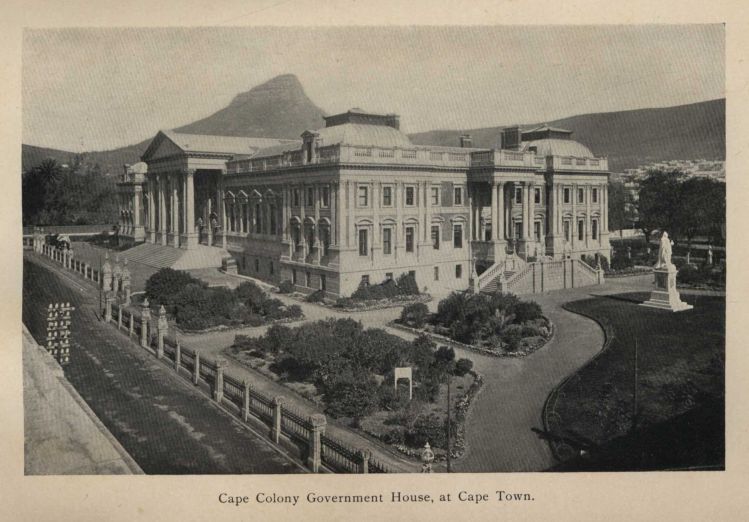
Cape Colony Government House, at Cape Town.
This natural antipathy of one race for another has given glorious opportunities for strife, and neither one nor the other has ever failed to take quick advantage. The struggle between the Boers and the British began in Cape Colony almost one hundred years ago, and it has continued, with varying degrees of bitterness, until the present day. The recent disturbances in the Transvaal affairs date from the conclusion of the war of independence in 1881. When the Peace Commissioners met there was inserted in the treaty one small clause which gave to England her only right to interfere in the political affairs of the Transvaal.
The Boer country at that time was considered of such little worth that Gladstone declared it was not of sufficient value to be honoured with a place under the British flag. To the vast majority of the British people it was a matter of indifference whether the Transvaal was an independent country or a dependency of their own Government. The clause which was allowed to enter the treaty unnoticed, and which during recent years has figured so prominently in the discussions of South African affairs, reads:
"The South African Republic will conclude no treaty or engagement with any state or nation other than the Orange Free State, nor with any native tribe to the eastward or the westward of the republic, until the same has been approved by her Majesty the Queen. Such approval shall be considered to have been granted if her Majesty's Government shall not, within six months after receiving a copy of such treaty (which shall be delivered to them immediately upon its completion), have notified that the conclusion of the treaty is in conflict with the interests of Great Britain, or of any of her Majesty's possessions in South Africa."
When the contents of the treaty were published to the Boer people, many of them objected strongly to this clause, and insisted that it gave the British too great power in the affairs of the republic, and a strenuous effort was made to have the offending clause eliminated. In the year 1883 a deputation, which included Paul Kruger, was sent to London, with a view of obtaining the abolition of the suzerainty. This deputation negotiated a new convention the following year, from which the word "suzerainty" and the stipulations in regard thereto were removed. In their report to the Volksraad, made in 1884, the deputation stated that the new convention put an end to the British suzerainty.
February 4, 1884, in a letter to Lord Derby, then in charge of British affairs, the deputation announced to him that they expected an agreement to be contained in the treaty relative to the abolition of the suzerainty. In his reply of a week later, Lord Derby made a statement upon which the Boers base their strongest claim that the suzerainty was abolished. He said:
"By the omission of those articles of the convention of Pretoria which assigned to her Majesty and to the British resident certain specific powers and functions connected with the internal government and the foreign relations of the Transvaal state, your Government will be left free to govern the country without interference, and to conduct its diplomatic intercourse and shape its foreign policy, subject only to the requirement embodied in the fourth article of the new draft, that any treaty with a foreign state shall not have effect without the approval of the Queen."
For a period of almost ten years the suzerainty of England over the Transvaal was an unknown quantity. With the exception of several Government officials, there were hardly any Englishmen in the country, and no one had the slightest interest in the affairs of the Transvaal Government. When gold was discovered in the Randt in quantities that equalled those of the early days of the California gold fields, an unparalleled influx of Englishmen and foreigners followed, and in several years the city of Johannesburg had sprung up in the veldt.
The opening of hundreds of mines, and the consequent increase in expenditures, made it necessary for the Transvaal Government to increase its revenues. Mining laws had to be formulated, new offices had to be created, hundreds of new officials had to be appointed, and all this required the expenditure of more money in one year than the Government had spent in a decade before the opening of the mines. The Government found itself in a quandary, and it solved the problem of finances as many a stronger and wealthier government has done.
Concessions were granted to dynamite, railway, electric light, electric railway, water, and many other companies, and these furnished to the Government the nucleus upon which depended its financial existence. Few of the concessions were obtained by British subjects, and when the monopolies took advantage of their opportunities, and raised the price of dynamite and the rates for carrying freight, the Englishmen, who owned all the mines, naturally objected. The Boer Government, having bound itself hand and foot when hard pressed for money, was unable to compel the concessionaries to reduce their rates.
At that period of the Randt's existence the speculators appeared, and soon thereafter the London Stock Exchange became a factor in the affairs of the Randt. Where the Stock Exchange leads, the politicians follow, and they too soon became interested in South African affairs. Then the treaty of 1883 was found in the Colonial Office archives, and next appears a demand to the Boer Government that all British residents of the Transvaal be allowed to vote. The Boers refused to give the franchise to any applicant unless he first renounced his allegiance to other countries, and, as the British subjects declined to accede to the request, the politicians became busily engaged in formulating other plans whereby England might obtain control of the country.
At that inopportune time Jameson's troopers entered the Transvaal territory and attempted to take forcible possession of the country; but they were unsuccessful, and only succeeded in directing the world's sympathy to the Boers. The Jameson raid was practically Cecil J. Rhodes's first important attempt to add the Transvaal to the list of South African additions he has made to the British Empire. The result was especially galling to him, as it was the first time his great political schemes failed of success.
But Rhodes is not the man to weep over disasters. Before the excitement over the raid had subsided, Rhodes had concocted a plan to inflict a commercial death upon the Transvaal, and in that manner force it to beg for the protection of the English flag. He opened Rhodesia, an adjoining country, for settlement, and by glorifying the country, its mineral and agricultural wealth, and by offering golden inducements to Transvaal tradespeople, miners, and even Transvaal subjects, he hoped to cause such an efflux from the Transvaal that the Government would be embarrassed in less than two years. The country which bears his name was found to be amazingly free from mountains of gold and rivers of honey, and the several thousand persons who had faith in his alluring promises remained in Rhodesia less than a year, and then returned to the Transvaal.
The reports of the Rhodesian country that were brought back by the disappointed miners and settlers were not flattering to the condition of the country or the justice of the Government. Of two evils, they chose the lesser, and again placed themselves under the Kruger Government. When revolution and enticement failed to bring the Transvaal under the British flag, Rhodes inaugurated a political propaganda. His last resort was the Colonial Office in London, and in that alone lay the only course by which he could attain his object.
Again the franchise question was resorted to as the ground of the contention, the dynamite and railway subjects having been so thoroughly debated as to be as void of ground for further contention as they had always been foreign to British control or interference. The question of granting the right of voting to the Uitlanders in the Transvaal is one which so vitally affects the future life of the Government that the Boers' concession of that right would be tantamount to presenting the country to the British Government.
Ninety-nine per cent. of the Uitlanders of the Transvaal are no more than transient citizens. They were attracted thither by the gold mines and the attendant industries, and they have no thought of staying in the Transvaal a minute after they have amassed a fortune or a competency. Under no consideration would they remain in the country for the rest of their lives, because the climate and nature of the country are not conducive to a desire for long residence. It has been demonstrated that less than one per cent. of the Uitlanders had sufficient interest in the country to pass through the formality of securing naturalization papers preparatory to becoming eligible for the franchise.
The Boer Government has offered that all Uitlanders of nine years' residence, having certain unimportant qualifications, should be enfranchised in two years, and that others should be enfranchised in seven years--two years for naturalization and five more years' resident--before acquiring the right to vote.
There is a provision for a property qualification, which makes it necessary for the naturalized citizen to own a house of no less value than two hundred and fifty dollars in renting value, or an income of one thousand dollars. The residence clause in the Transvaal qualifications compares favourably with those of London, where an Englishman from any part of the country and settling in the municipality is obliged to live two years and have certain property qualifications before acquiring the right of franchise.
In full knowledge of these conditions the Uitlanders insist upon having an unconditional franchise--one that will require nothing more than a two-years' residence in the country. The Boers are well aware of the results that would follow the granting of the concessions demanded, but not better so than the Uitlanders who make the demands. The latest Transvaal statistics place the number of Boer burghers in the country at less than thirty thousand. At the lowest estimate there are in the Transvaal fifty thousand Uitlanders having the required qualifications, and all of these would become voters in two years. At the first election held after the two years had elapsed the Uitlanders would be victorious, and those whom they elected would control the machinery of the Government. The Uitlanders' plan is as transparent as air, yet it has the approval and sanction of the English politicians, press, and public.
The propaganda which Rhodes and other politicians and stock brokers interested in the Transvaal gold mines inaugurated a short time after the Jameson raid has been successful in arousing the people in England to what they have been led to believe is a situation unequalled in the history of the empire-building. But there is a parallel case. At the same time the British Parliament was discussing the subject of the alleged injustice under which the English residents of the Transvaal were suffering, the colonial secretary was engaged in disposing of grievances which reached him from the Dutch residents of British Guiana, in South America, and which recited conditions parallel to those complained of by the Uitlanders. The grievances were made by foreign residents of English territory, instead of by English subjects in a foreign country, and consequently demanded less serious attention, but their justice was none the less patent. The three thousand native Dutch voters in British Guiana have no voice in the legislative or administrative branches of the colonial government, owing to the peculiar laws which give to the three thousand British-born citizens the complete control of the franchise. The population of the colony is three hundred thousand, yet the three thousand British subjects make and administer the laws for the other two hundred and ninety-seven thousand inhabitants, who compose the mining and agricultural communities and are treated with the same British contempt as the Boers. The Dutch residents have made many appeals for a fuller representation in the Government, but no reforms have been inaugurated or promised.
The few grievances which the Uitlanders had before the Jameson raid have been multiplied a hundredfold and no epithet is too venomous for them to apply to the Boers. The letters in the home newspapers have allied the name of the Boers with every vilifying adjective in the English dictionary, and returning politicians have never failed to supply the others that do not appear in the book.
Petitions with thousands of names, some real, but many non-existent, have been forwarded to the Colonial Office and to every other office in London where they would be received, and these have recited grievances that even the patient Boer Volksraad had never heard about. It has been a propaganda of petitions and letters the like of which has no parallel in the history of politics. It has been successful in arousing sentiment favourable to the Uitlanders, and at this time there is hardly a handful of persons in England who are not willing to testify to the utter degradation of the Boers.
Another branch of the propaganda operated through the Stock Exchange, and its results were probably more practical than those of the literary branch. It is easier to reach the English masses through the Stock Exchange than by any other means. Whenever one of the "Kaffir" or Transvaal companies failed to make both ends meet in a manner which pleased the stockholders, it was only necessary to blame the Boer Government for having impeded the digging of gold, and the stockholders promptly outlined to the Colonial Office the policy it should pursue toward the Boers.
The impressions that are formed in watching the tide of events in the Transvaal are that the Boer Government is not greatly inferior to the Government of Lord Salisbury and Secretary Chamberlain. The only appreciable difference between the two is that the Boers are fighting the cause of the masses against the classes, while the English are fighting that of the classes against the masses. In England, where the rich have the power, the poor pay the taxes, while in the Transvaal the poor have the power and compel the rich to pay the taxes. If the Transvaal taxes were of such serious proportions as to be almost unbearable, there might be a cause for interference by the Uitlander capitalists who own the mines, but there no injustice is shown to any one. The only taxes that the Uitlanders are compelled to pay are the annual poll tax of less than four dollars and a half, mining taxes of a dollar and a quarter a month for each claim for prospecting licenses, and five dollars a claim for diggers' licenses. Boer and Uitlander are compelled to pay these taxes without distinction.
The Boers, in this contention, must win or die. In earlier days, before every inch of African soil was under the flag of one country or another, they were able to escape from English injustice by loading their few possessions on wagons and "trekking" into new and unexplored lands. If they yield their country to the English without a struggle, they will be forced to live under a future Stock Exchange Government, which has been described by a member of the British Parliament as likely to be "the vilest, the most corrupt, and the most pernicious known to man."[#]
[#] The Hon. Henry Labouchere, in London Truth.
The Boers have no better argument to advance in support of their claim than that which is contained in the Transvaal national hymn. It at once gives a history of their country, its many struggles and disappointments, and its hopes. It is written in the "taal" of the country, and when sung by the patriotic, deep-voiced Boers is one of the most impressive hymns that ever inspired a nation.
THE TRANSVAAL VOLKSLIED.
The four-colours of our dear old land
Again float o'er Transvaal,
And woe the God-forgetting hand
That down our flag would haul!
Wave higher now in clearer sky
Our Transvaal freedom's stay!
(Lit., freedom's flag.)
Our enemies with fright did fly;
Now dawns a glorious day.
Through many a storm ye bravely stood,
And we stood likewise true;
Now, that the storm is o'er, we would
Leave nevermore from you
Bestormed by Kaffir, Lion, Brit,
Wave ever o'er their head;
And then to spite we hoist thee yet
Up to the topmost stead!
Four long years did we beg--aye, pray--
To keep our lands clear, free,
We asked you, Brit, we loath the fray:
"Go hence, and let us be!
We've waited, Brit, we love you not,
To arms we call the Boer;"
(Lit., Now take we to our guns.)
"You've teased us long enough, we troth,
Now wait we nevermore."
And with God's help we cast the yoke
Of England from our knee;
Our country safe--behold and look--
Once more our flag waves free!
Though many a hero's blood it cost,
May all the nations see
(Lit., Though England ever so much more.)
That God the Lord redeemed our hosts;
The glory his shall be.
Wave high now o'er our dear old land,
Wave four-colours of Transvaal!
And woe the God-forgetting hand
That dares you down to haul!
Wave higher now in clearer sky
Our Transvaal freedom's stay!
Our enemies with fright did fly;
Now dawns a glorious day.
CHAPTER X
PREPARATIONS FOR DEFENCE
Ever since the Jameson raid both the Boers and the Uitlanders have realized that a peaceful solution of the differences between the two is possible but highly improbable. The Uitlanders refused to concede anything to the Boer, and asked for concessions that implied a virtual abandonment of their country to the English, whom they have always detested. The Boers themselves have not been unmindful of the inevitable war with their powerful antagonist, and, not unlike the tiny ant of the African desert, which fortifies its abode against the anticipated attack of wild beasts, have made of their country a veritable arsenal.
Probably no inland country in the world is half so well prepared for war at any time as that little Government, which can boast of having less than thirty thousand voters. The military preparation has been so enormous that Great Britain has been compelled, according to the colonial secretary's statement to the British Parliament, to expend two and a half million dollars annually in South Africa in order to keep pace with the Boers. Four years ago, when the Transvaal Government learned that the Uitlanders of Johannesburg were planning a revolution, it commenced the military preparations which have ever since continued with unabating vigour. German experts were employed to formulate plans for the defence of the country, and European artillerists were secured to teach the arts of modern warfare to the men at the head of the Boer army. Several Americans of military training became the instructors in the national military school at Pretoria; and even the women and children became imbued with the necessity of warlike preparation, and learned the use of arms. Several million pounds were annually spent in Europe in the purchase of the armament required by the plans formulated by the experts, and the whole country was placed on a war footing. Every important strategic position was made as impregnable as modern skill and arms could make it, and every farmer's cottage was supplied with arms and ammunition, so that the volunteer army might be mobilized in a day.
In order to demonstrate the extent to which the military preparation has been carried, it is only necessary to give an account of the defences of Pretoria and Johannesburg, the two principal cities of the country. Pretoria, being the capital, and naturally the chief point of attack by the enemy, has been prepared to resist the onslaught of any number of men, and is in a condition to withstand a siege of three years. The city lies in the centre of a square, at each corner of which is a lofty hill surmounted by a strong fort, which commands the valleys and the surrounding country. Each of the four forts has four heavy cannon, four French guns of fifteen miles range, and thirty heavy Gatling guns. Besides this extraordinary protection, the city has fifty light Gatling guns which can be drawn by mules to any point on the hills where an attack may be made. Three large warehouses are filled with ammunition, and the large armory is packed to the eaves with Mauser, Martini-Henry, and Wesley-Richards rifles. Two extensive refrigerators, with a capacity of two thousand oxen each, are ample provision against a siege of many months. It is difficult to compute the total expenditures for war material by the Boer Government during the last four years, but the following official announcement of expenses for one year will serve to give an idea of the vastness of the preparations that the Government has been compelled to make in order to guard the safety of the country:
War-Office salaries . . . . . . . . . $262,310 War purposes . . . . . . . . . . . . . 4,717,550 Johannesburg revolt . . . . . . . . . 800,000 Public works . . . . . . . . . . . . . 3,650,000 ---------- $9,429,860
Johannesburg has extensive fortifications around it, but the Boers will use them for other purposes than those of self-protection. The forts at the Golden City were erected for the purpose of quelling any revolution of the Uitlanders, who constitute almost entirely the population of the city.
One of the forts is situated on a small eminence about half a mile north of the business part, and commands the entire city with its guns. Two years were consumed in building the fortification and in placing the armament in position. Its guns can rake not only every street of the city, but ten of the principal mine works as well, and the damage that their fire could cause is incalculable. Another fort, almost as strong as the one in Johannesburg, is situated a mile east of the city, and overshadows the railway and the principal highway to Johannesburg. The residents of the city are greatly in fear of underground works, which they have been led to believe were constructed since the raid. Vast quantities of earth were taken out of the Johannesburg fort, and for such a length of time did the work continue that the Uitlanders decided that the Boers were undermining the city, and protested to the Government against such a course. As soon as war is declared and the women and children have been removed from the city, Johannesburg will be rent with shot and shell. The Boers have announced their intention of doing this, and the Uitlanders, anticipating it, seek safety in flight whenever there are rumours of war, as thousands did immediately before and after the Jameson affair.
The approaches to the mountain passes on the border have been fortified with vast quantities of German and French ordnance, and equipped with garrisons of men born or trained in Europe. The approaches to Laing's Nek, near the Natal border, which have several times been the battle ground of the English and Boer forces, have been prepared to resist an invading army from Natal. Much attention has been directed to the preparations in that part of the republic, because the British commanders will find it easier to transfer forces from the port of Durban, which is three hundred and six miles from the Transvaal border, while Cape Town is almost a thousand miles distant.
But the Pretorian Government has made many provisions for war other than those enumerated. It has made alliances and friends that will be of equal worth in the event of an attack by England. The Orange Free State, whose existence is as gravely imperilled as that of the Transvaal, will fight hand-in-hand with its neighbour, just as it was prepared to do at the time of the Jameson raid, when almost every Free State burgher lay armed on the south bank of the Vaal River, awaiting the summons for assistance from the Kruger Government. In the event of war the two Governments will be as one, and, in anticipation of the struggle of the Boers against the British, the Free State Government has been expending vast sums of money every year in strengthening the country's defences. At the same time that the Free State is being prepared for war, its Government officials are striving hard to prevent a conflict, and are attempting to conciliate the two principals in the strife by suggesting that concessions be made by both. The Free State is not so populous as the Transvaal, and consequently can not place as many men in the field, but the ten thousand burghers who will answer the call to arms will be an acceptable addition to the Boer forces.
The element of doubt enters into the question of what the Boers and their co-religionists of Cape Colony and Natal will do in the event of war. The Dutch of Cape Colony are the majority of the population, and, although loyal British subjects under ordinary circumstances, are opposed to English interference in the Transvaal's affairs. Those of Natal, while not so great in numbers, are equally friendly with the Transvaal Boers, and would undoubtedly recall some of their old grievances against the British Government as sufficient reason to join the Boers in war.
In Cape Colony there is an organization called the Afrikander Bond which recently has gained control of the politics of the colony, and which will undoubtedly be supreme for many years to come. The motto of the organization is "South Africa for South Africans," and its doctrine is that South Africa shall be served first and Great Britain afterward. Its members, who are chiefly Dutch, believe their first duty is to assist the development of the resources of their own country by proper protective tariffs and stringent legislation in native affairs, and they regard legislation with a view to British interests as of secondary importance. The Bond has been very amicably inclined toward its Afrikander kinsmen in the Transvaal, especially since the Jameson raid, and every sign of impending trouble between England and the Boers widens the chasm between the English and Afrikanders of South Africa. The Dutch approve of President Kruger's course in dealing with the franchise problems, and if hostilities break out it would be not the least incompatible with their natures to assist their Transvaal and Free State kinsmen even at the risk of plunging the whole of South Africa into a civil war. W. P. Schreiner, the Premier of Cape Colony, is the leading member of the Bond, and with him he has associated the majority of the leading men in the colony. Under ordinary conditions their loyalty to Great Britain is undoubted, but whether they could resist the influence of their friends in the Bond if it should decide to cast its fortunes with the Boers in case of war is another matter.
Of such vast importance is the continued loyalty of the Dutch of the two colonies that upon it depends practically the future control of the Cape by the British Government. Being in the majority as three to two, and almost in supreme control of the local government, the Dutch of Cape Colony are in an excellent position to secede from the empire, as they have already threatened to do, in which event England would be obliged to fight almost the united population of the whites if she desired to retain control of the country. With this in mind, it is no wonder that Mr. Chamberlain declared that England had reached a critical turning point in the history of the empire.
The uncertainty of the situation is increased by the doubtful stand which the native races are taking in the dispute. Neither England nor the Boers has the positive assurance of support from any of the tribes, which outnumber the whites as ten to one; but it will not be an unwarranted opinion to place the majority of the native tribes on the side of the Boers. The native races are always eager to be the friends of the paramount power, and England's many defeats in South Africa during recent years have not assisted in gaining for it that prestige. When England enters upon a war with the Transvaal the natives will probably follow the example of the Matabele natives, who rebelled against the English immediately after Jameson and his men were defeated by the Boers, because they believed a conquered nation could offer no resistance. The Boers, having won the last battle, are considered by the natives to be the paramount power, and it is always an easy matter to induce a subjected people to ally itself with a supposedly powerful one.
The Zulus, still stinging under the defeat which they received from the British less than twenty years ago, might gather their war parties and, with the thousands of guns they have been allowed to buy, attempt to secure revenge. The Basutos, east of the Orange Free State, now the most powerful and the only undefeated nation in the country, would hardly allow a war to be fought unless they participated in it, even if only to demonstrate to the white man that they still retain their old-time courage and ability. The million and a half natives in Cape Colony, and the equal number in the Transvaal, have complained of so many alleged grievances at the hands of their respective governments that they might be presumed to rise against them, though it is never possible to determine the trend of the African negro's mind. What the various tribes would do in such an emergency can be answered only by the chiefs themselves, and they will not speak until the time for action is at hand. Perhaps when that time does arrive there may be a realization of the natives' dream--that a great leader will come from the north who will organize all the various tribes into one grand army and with it drive the hated white men into the sea.
It is impossible to secure accurate statistics in regard to the military strength of the various colonies, states, and tribes in the country, but the following table gives a fair idea of the number of men who are liable to military duty:
Dutch. English. Native. Cape Colony 20,000 10,000 177,000 Natal 7,000 5,000 100,000 Orange Free State 10,000 ...... 30,000 Transvaal 30,000 20,000 140,000 Rhodesia ...... 2,000 25,000 Swaziland and Basutoland ...... ...... 30,000 ------ ------ ------- Total 67,000 37,000 570,000
To him who delights in forming possible coalitions and war situations this table offers vast opportunities. Probably no other country can offer such a vast number of possibilities for compacts between nations, races, and tribes as is presented in South Africa. There all the natives may unite against the whites, or a part of them against a part of the whites, while whites and natives may unite against a similar combination. The possibilities are boundless; the probabilities are uncertain.
The Pretorian Government has had an extensive secret service for several years, and this has been of inestimable value in securing the support of the natives as well as the friendship of many whites, both in South Africa and abroad. The several thousand Irishmen in South Africa have been organized into a secret compact, and have been and will continue to be of great value to the Boers. The head of the organization is a man who is one of President Kruger's best friends, and his lieutenants are working even as far away as America. The sympathy of the majority of the Americans in the Transvaal is with the Boer cause, and, although the American consul-general at Cape Town has cautioned them to remain neutral, they will not stand idly by and watch the defeat of a cause which they believe to be as just as that for which their forefathers fought at Bunker Hill and Lexington.
But the Boers do not rely upon external assistance to win their battles for them. When it becomes necessary to defend their liberty and their country they reverently place their trust in Providence and their rifles. Their forefathers' battles were won with such confidence, and the later generations have been similarly successful under like conditions. The rifle is the young Boer's primer and the grandfather's testament. It is the Boers' avenger of wrong and the upholder of right. That their confidence in their rifles has not been misapplied has been demonstrated at Laing's Nek, Majuba Hill, Doornkop, and in battles with natives.
The natural opportunities provided by Nature which in former years were responsible for the confidence which the Boers reposed in their rifles may have disappeared with the approach of advancing civilization, but the Boer of to-day is as dangerous an adversary with a gun as his father was in the wars with the Zulus and the Matabeles half a century ago. The buck, rhinoceros, elephant, and hippopotamus are not as numerous now as then, but the Boer has devised other means by which he may perfect himself in marksmanship. Shooting is one of the main diversions of the Boer, and prizes are offered for the best results in contests. It is customary to mark out a ring, about two hundred and fifty feet in diameter, in the centre of which a small stuffed figure resembling a bird is attached to a pole. The marksmen stand on the outside of the circle and fire in turn at the target. A more curious target, and one that taxes the ability of the marksman, is in more general use throughout the country. A hole sufficiently deep to retain a turkey-cock is dug in a level plot of ground, and over this is placed a piece of canvas which contains a small hole through which the bird can extend and withdraw its head. At a distance of three hundred feet the bird's head is a target by no means easily hit.
Military men are accustomed to sneer at the lack of generalship of the Boer forces, but in only one of the battles in which they have engaged the British forces have the trained military men and leaders been able to cope with them. In the battle of Boomplaats, fought in 1848, the English officers can claim their only victory over the Boers, who were armed with flintlocks, while the British forces had heavy artillery. In almost all the encounters that have taken place the Boer forces were not as large as those of the enemy, yet the records show that many more casualties were inflicted than received by them. In the chief engagements the appended statistics show that the Boers had only a small percentage of their men in the casualty list, while the British losses were much greater.
MEN ENGAGED. CASUALTIES. BATTLES. British. Boer. British. Boer. Laing's Nek 400 550 190 24 Ingogo 300 250 142 17 Majuba Hill 600 150 280 5 Bronkhorst 250 300 120 1 Jameson raid 600 400 100 5
It is hardly fair to assume that the Boers' advantages in these battles were gained without the assistance of capable generals when it is taken into consideration that there is a military axiom which places the value of an army relatively with the ability of its commanders. The Boers may exaggerate when they assert that one of their soldiers is the equal in fighting ability of five British soldiers, but the results of the various battles show that they have some slight foundation for their theory.
The regular British force in South Africa is comparatively small, but it would require less than a month to transport one hundred thousand trained soldiers from India and England and place them on the scene of action. Several regiments of trained soldiers are always stationed in different parts of the country near the Transvaal border, and at brief notice they could be placed on Boer territory. Charlestown, Ladysmith, and Pietermaritzburg, in Natal, have been British military headquarters for many years, and during the last three years they have been strengthened by the addition of several regular regiments. The British Colonial Office has been making preparations for several years for a conflict. Every point in the country has been strengthened, and all the foreign powers whose interests in the country might lead them to interfere in behalf of the Boers have been placated. Germany has been taken from the British zone of danger by favourable treaties; France is fearful to try interference alone; and Portugal, the only other nation interested, is too weak and too deeply in England's debt to raise her voice against anything that may be done.
By leasing the town of Lorenzo Marques from the Portuguese Government, Great Britain has acquired one of the best strategic points in South Africa. The lease, the terms of which are unannounced, was the culmination of much diplomatic dickering, in which the interests of Germany and the South African Republic were arrayed against those of England and Portugal. There is no doubt that England made the lease only in order to gain an advantage over President Kruger, and to prevent him from further fortifying his country with munitions of war imported by way of Lorenzo Marques and Delagoa Bay. England gains a commercial advantage too, but it is hardly likely that she would care to add the worst fever-hole in Africa to her territory simply to please the few of her merchants who have business interests in the town. Since the Jameson raid the Boers have been purchasing vast quantities of guns and ammunition in Europe for the purpose of preparing themselves for any similar emergency. Delagoa Bay alone was an open port to the Transvaal, every other port in South Africa being under English dominion and consequently closed to the importation of war material. Lorenzo Marques, the natural port of the Transvaal, is only a short distance from the eastern border of that country, and is connected with Pretoria and Johannesburg by a railway. It was over this railway that the Boers were able to carry the guns and ammunition with which to fortify their country, and England could not raise a finger to prevent the little republic from doing as it pleased. Hardly a month has passed since the raid that the Transvaal authorities did not receive a large consignment of guns and powder from Germany and France by way of Lorenzo Marques. England could do nothing more than have several detectives at the docks to take an inventory of the munitions as they passed in transit.
The transfer of Lorenzo Marques to the British will put an effectual bar to any further importation of guns into the Transvaal, and will practically prevent any foreign assistance from reaching the Boers in the event of another war. Both Germany and England tried for many years to induce Portugal to sell Delagoa Bay, but being the debtor of both to a great extent, the sale could not be made to one without arousing the enmity of the other. Eighteen or twenty years ago Portugal would have sold her sovereign right over the port to Mr. Gladstone's Government for sixty thousand dollars, but that was before Delagoa Bay had any commercial or political importance. Since then Germany became the political champion of the Transvaal, and blocked all the schemes of England to isolate the inland country by cutting off its only neutral connection with the sea. Recently, however, Germany has been disappointed by the Transvaal Republic, and one of the results is the present cordial relations between the Teutons and the Anglo-Saxons in South African affairs.
The English press and people in South Africa have always asserted that by isolating the Transvaal from the sea the Boers could be starved into submission in case of a war. As soon as the lease becomes effective, Mr. Kruger's country will be completely surrounded by English territory, at least in such a way that nothing can be taken into the Transvaal without first passing through an English port, and no foreign power will be able to send forces to the aid of the Boers unless they are first landed on British soil. It is doubtful whether any nation would incur such a grave responsibility for the sake of securing Boer favour.
Both the Transvaal and England are fully prepared for war, and diplomacy only can postpone its coming. The Uitlanders' present demands may be conceded, but others that will follow may not fare so well. A coveted country will always be the object of attacks by a stronger power, and the aggressor generally succeeds in securing from the weaker victim whatever he desires. Whether British soldiers will be obliged to fight the Boers alone in order to gratify the wishes of their Government, or whether the enemy will be almost the entire white and black population of South Africa, will not be definitely known until the British troop ships start for Cape Town and Durban.
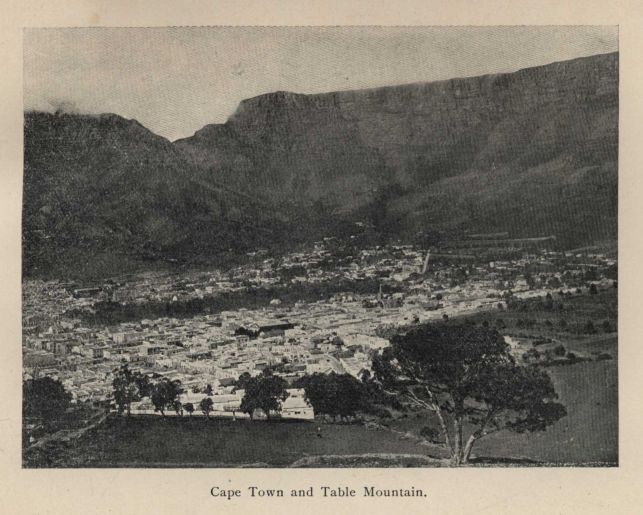
Cape Town and Table Mountain.
Whichever enemy it will be, the British Government will attack, and will pursue in no half-hearted or half-prepared manner, as it has done in previous campaigns in the country. The Boers will be able to resist and to prolong the campaign to perhaps eight months or a year, but they will finally be obliterated from among the nations of the earth. It will cost the British Empire much treasure and many lives, but it will satisfy those who caused it--the politicians and speculators.
CHAPTER XI
AMERICAN INTERESTS IN SOUTH AFRICA
An idea of the nature and extent of American enterprise in South Africa might be deduced from the one example of a Boston book agent, who made a competency by selling albums of United States scenery to the negroes along the shores of the Umkomaas River, near Zululand. The book agent is not an incongruity of the activity of Americans in that part of the continent, but an example rather of the diversified nature of the influences which owe their origin to the nation of Yankees ten thousand miles distant. The United States of America have had a deeper influence upon South Africa than that which pertains to commerce and trade. The progress, growth, and prosperity of the American States have instilled in the minds of the majority of South Africans a desire to be free from European control, and to be united under a single banner, which is to bear the insignia of the United States of South Africa.
In public, editors and speechmakers in Cape Colony, Natal, and the Transvaal spend hours in deploring the progress of Americanisms in South Africa, but in their clubs and libraries they study and discuss the causes which led to America's progress and pre-eminence, and form plans by which they may be able to attain the same desirable ends. The influence and example of the United States are not theoretical; they are political factors which are felt in the discussion of every public question and in the results of every election. The practical results of American influence in South Africa may now be observed only in the increasing exports to that country, but perhaps in another generation a greater and better demonstration will be found in a constitution which unites all the South African states under one independent government. If any corroboration of this sentiment were necessary, a statement made by the man who is leader of the ruling party in Cape Colony would be ample.
"If we want an example of the highest type of freedom," said W. P. Schreiner, the present Premier of Cape Colony, "we must look to the United States of America."[#]
[#] Americans' Fourth of July Banquet, Cape Town, 1897.
American influences are felt in all phases of South African life, be they social, commercial, religious, political, or retrogressive. Whether it be the American book agent on the banks of the Umkomaas, or the American consul-general in the governor's mansion at Cape Town, his indomitable energy, his breezy indifference to apparently insurmountable difficulties, and his boundless resources will always secure for him those material benefits for which men of other nationalities can do no more than hope. Some of his rivals call it perverseness, callousness, trickery, treachery, and what not; his admirers might ascribe his success to energy, pluck, modern methods, or to that quality best described by that Americanism--"hustling."
American commercial interests in South Africa are of such recent growth, and already of such great proportions, that the other nations who have been interested in the trade for many years are not only astounded, but are fearful that the United States will soon be the controlling spirit in the country's commercial affairs. The enterprise of American business firms, and their ability to undersell almost all the other firms represented in the country, have given an enormous impetus to the export trade with South African countries. Systematic efforts have been made by American firms to work the South African markets on an extensive scale, and so successful have the efforts been that the value of exports to that country has several times been more than doubled in a single year.
Five years ago America's share of the business of South Africa was practically infinitesimal; to-day the United States hold second place in the list of nations which have trade relations with that country, having outranked Germany, France, Belgium, Holland, and Italy. In several branches of trade America surpasses even England, which has always had all the trade advantages owing to the supremacy of her flag over the greater part of the country. That the British merchants are keenly alive to the situation which threatens to transfer the trade supremacy into American hands has been amply demonstrated by the efforts which they have made to check the inroads the Americans are making on their field, and by the appointment of committees to investigate the causes of the decline of British commerce.
American enterprise shows itself by the scores of representatives of American business houses who are constantly travelling through the country, either to secure orders or to investigate the field with a view of entering into competition with the firms of other nations. Fifteen American commercial travellers, representing as many different firms, were registered at the Grand Hotel, Cape Town, at one time a year ago, and that all had secured exceptionally heavy orders indicated that the innovation in the method of working trade was successful.
The laws of the country are unfavourable in no slight degree to the foreign commercial travellers, who are obliged to pay heavy licenses before they are permitted to enter upon any business negotiations. The tax in the Transvaal and Natal is $48.66, and in the Orange Free State and Cape Colony it amounts to $121.66. If an American agent wishes to make a tour of all the states and colonies of the country, he is obliged to pay almost three hundred and fifty dollars in license fees.
The great superiority of certain American manufactured products is such that other nations are unable to compete in those lines after the American products have been introduced. Especially is this true of American machinery, which can not be equalled by that of any other country. Almost every one of the hundreds of extensive gold mines on the Randt is fitted out wholly or in part with American machinery, and, at the present rate of increase in the use of it, it will be less than ten years when none other than United States machinery will be sent to that district. In visiting the great mines the uninitiated American is astonished to find that engines, crushing machinery, and even the electric lights which illuminate them, bear the name plates of New York, Philadelphia, and Chicago firms.
The Kimberley diamond mines, which are among the most extensive and most elaborate underground works in the world, use American-made machinery almost exclusively, not only because it is much less costly, but because no other country can furnish apparatus that will give as good results. Almost every pound of electrical machinery in use in the country was made in America and was instituted by American workmen.
Instances of successful American electrical enterprises are afforded by the Cape Town, Port Elizabeth, and Pretoria street railways, almost every rail, wire, and car of which bears the marks of American manufacture. It is a marvellous revelation to find Philadelphia-made electric cars in the streets of Cape Town, condensing engines from New York State in Port Elizabeth, and Pittsburg generators and switchboards in the capital of the Transvaal, which less than fifty years ago was under the dominion of savages. Not only did Americans install the street railways, but they also secured the desirable concessions for operating the lines for a stated period. American electricians operate the plants, and in not a few instances have financially embarrassed Americans received a new financial impetus by acting in the capacities of motormen and conductors.