Act 1 — THE MASQUE OF THE TWO STRANGERS[51]
Reading edition
THE MASQUE OF THE TWO STRANGERS[51]
CHARACTERS
Joy.
Laughter.
Song.
Dance.
Service.
Poetry.
Hope.
Joy.
Princess Douce-Cœur.
Sorrow.
Fame.
Riches.
Power.
Love.
Joy and Laughter run in laughing, chase each other round the stage and pelt each other with flowers.
Laughter [flinging herself on the ground, breathless]. Ah, it is good to run and laugh again. I am so weary of these somber days.
Joy. And I of sitting silent in the house. We used before to have such merry games, Now Douce-cœur will not even smile.
Laughter [mysteriously]. She says that she will never laugh again.
Joy. And when I called to her to come and play At hide-and-seek down in the rose-garden, She said her playing days were over now.
Laughter. It seems so strange. Only a while ago We played at ball across the laurel hedge, And when the ball fell in the fountain-court And rolled into the water, floating out To where the lilies lay half closed in sleep, 'Twas she who went in barefoot, with her dress Kilted above her knees, and laughed to feel The flicking of the golden fishes' tails. She said her pink toes looked like coral shells, And splashed the water just to see it shine Like diamonds in the sun upon my hair. A while ago she was a child with us.
Joy [sighs]. Laughter, I like not living at the Court. [Starting.] Someone is coming.
[They run and hide behind a seat. Song enters, humming to herself and twisting flowers into a garland. Joy and Laughter spring out upon her and catch hold of her hands one on each side.]
Laughter. Why, 'tis only Song. For three days now we have not heard thy voice.
Song. No, Douce-cœur says life is too sad for songs. Yet music is a gift of the high gods And like the birds I sing or I must die.
Joy [coaxingly]. Sing us a ballad while we are alone. Old Service is asleep beside the well And will not hear thee.
Song [sitting on the seat]. Well, what shall I sing? How would you like "All on an April Day?"
Joy [clapping her hands]. About the knight who rode to Amiens Town?
Laughter. Then will we sing the refrain, Joy and I.
Song [begins very softly, and, forgetting, sings louder to the end].
A lover rode to Amiens town (All on an April day); He looked not up, he looked not down But fixed his gaze on Amiens town (Sing hey!—the Lover's Way).
The cuckoo sang above his head (All on an April day); The blossoming trees were white and red, Yet still he never turned his head (Sing hey!—the Lover's Way).
The dappled grass with daisies strewn (All on an April day) Was trodden by his horse's shoon; He heeded not those daisies strewn (Sing hey!—the Lover's Way).
He wore a ragged surcoat green (All on an April day) But no device thereon was seen. Nor blazon on that surcoat green (Sing hey!—the Lover's Way).
He rode in by the Eastern Gate (All on an April day); Though poor and mean was his estate Kings have gone through that Eastern Gate (Sing hey!—the Lover's Way).
He stood by the Cathedral door (All on an April day) And watched of ladies fair a score Pass in through the Cathedral door (Sing hey!—the Lover's Way).
A knot of ribbon at his feet (All on an April day) And one swift smile, such radiance sweet Fell with the ribbon at his feet (Sing hey!—the Lover's Way).
He hid the token in his breast (All on an April day) Yet to his lips full oft he prest The ribbon hidden in his breast (Sing hey!—the Lover's Way).
A lover rode to Amiens town (All on an April day), A beggar wore a starry crown And a King rode out of Amiens town (Sing hey!—the Lover's Way).
[After the 4th verse enter Dance, who dances through the remaining verses.]
[Enter Service hurriedly.]
Service. How now, what noise is this? Thou knowest, Song, thy voice may not be heard at all, and ye children too, ye will get sent away. Sure, that ye will. Here am I sent packing off to seek for the Wise Woman Poetry. The heralds too are up and down the land with proclamations. Go in, go in; Douce-cœur is wandering with the Gray Stranger in the garden, and when she comes, may want your company.
[Enter Poetry.]
Poetry. I am the mouthpiece of the Eternal Gods, And in my voice, that down the ages rings, Men hear the ceaseless heart-beats of the world. Without me all that has been would have died And lain forgotten in a silent grave. The present echoes what I once have sung, The future holds the secrets I have read.
Service. Hail, and well met! I was but starting forth to seek thee. Thou who hast the wisdom of all time mayst help us in our hour of need; an evil spell has been cast about the Princess, and how it is to be broken, none of us know.
Poetry. Good Service, tell me all; for I presume, Despite the tender care which through her life Has shielded Douce-cœur like a ring of steel, That to her side some foe has won his way And dimmed the peaceful mirror of her soul.
Service. Yea, truly, one evening as the sun was setting a woman clad in long gray robes entered the Palace gates and meeting the Princess on the terrace walk led her down among the cypresses. They sat long together in the twilight and ever since Douce-cœur is changed. No smile curves her lips, the sunlight is gone from her face, and she goes always with veiled head, and sad unseeing eyes. I heard but now her companions are to be sent away. Joy, Laughter, Song and Dance, all to be banished. This is the Gray Woman's doing, but why, no man can say.
Poetry. The stranger in gray robes of whom ye speak Is Sorrow's self, whose other name is Pain. She comes, and when she comes none may resist. Against her none have power to bar their gates. Ye who have always cherishèd Douce-cœur And guarded her from knowledge of the World, Have left her ignorance a prey to pain. Thus night has fallen on a tender heart That never saw the shadows for the sun. Queen Sorrow, who can hide the stars of heaven, Has torn the golden veil from top to hem, And in the outer darkness Douce-cœur stands, Seeing no rift to tell of light eclipsed, Knowing no key to all the mystery.
Service. The King, her father, has sent proclamations forth that whoso can bring back the smiles to Douce-cœur's lips, the sunshine to her face, whoso can win her from the Gray Woman's side, on him shall half the kingdom be bestowed and Douce-cœur's hand in marriage. The Heralds have gone crying this abroad, and we have word three suitors are traveling here post-haste.
Poetry. I know not who these suitors chance to be But not by them may Sorrow be cast out. One only holds a mightier spell than hers, And I will send my constant messenger To seek him to the ends of all the Earth. Come to me, Child, who holdst Eternal Youth.
[Enter Hope.]
Hope. Didst call me, Poetry?
Poetry. Yea, child of my Heart, Go out into the wilderness for me. Find me the Stranger in a Pilgrim's garb Around whose head the song birds pipe their lays, Beneath whose feet the withered flowers revive. Say, "In the Court of Youth Queen Sorrow reigns And shadows lie like night on Douce-cœur's heart."
Hope. In the great Court of Youth, Queen Sorrow reigns And shadows lie like night on Douce-cœur's heart.
Poetry. Bid him come hither. Haste thee on thy way.
[Exit Hope. Trumpet music. Herald heard off. "Oyez! Oyez! Oyez!"]
Service. Here comes the Herald!
[Enter Herald repeating "Oyez! Oyez! Oyez!"]
Herald [facing audience]. Know all whom it may concern throughout this realm, that as One has come and brought darkness on the Land, to all good people is this Proclamation made. Whoso can drive the Gray Woman forth, whoso can free the Princess Douce-cœur from her spell, whoso can bring back the sunshine to the Land, unto him will be given the half of the kingdom, and the Hand of the Princess Douce-cœur in marriage. Given on this day of June. "Oyez! Oyez! Oyez!"
[Exit Herald. "Oyez! Oyez! Oyez!" dies away in the distance.]
[Music. Enter Joy, Laughter, Song and Dance, followed by Princess Douce-cœur and Sorrow.]
Sorrow. Ye children of the Court, your hour has struck. Your doom of banishment has been pronounced, For where I am there can ye never be.
Song. Douce-cœur, I pray thee hear me. Let me sing One of the old songs that we loved—may be The memory of those happy days will rise And lift the weight of sadness from thy face.
Poetry. Douce-cœur, I charge thee, listen. All the past Of Childhood calls thee in the voice of Song.
Douce-cœur. Sing if thou wilt. Those days were long ago.
Song.
I stood beside the lilac bush While all its blossoms rained on me, I watched the white wraith of a moon Turn to pale gold above the sea.
I held a wand of almond bough And waved it three times circlewise, I whispered words of faery lore With beating heart and close shut eyes.
I oped them on a forest scene Of summer-land; the open glade Lay shining like a tourmaline Set in a ring of duller jade.
I saw three queens with shining crowns Go riding by on palfreys gray; I saw three knights that followed close, And dreams were in their eyes that day.
I saw a minstrel with his harp, His cloak was green and patched and torn; I saw a hunter with his bow, I heard the winding of his horn.
I saw a bush of lavender With clouds of fluttering butterflies, Then I looked backward to the earth And broke my faery spell with sighs.
Douce-Cœur. I cannot bear thy music. In my heart No answering chords respond. The past is dead. I hear the tears of thousands in thy voice. When Sorrow speaks—I hear no tones but hers.
Sorrow. No, thou art mine, Princess. I hold thee fast.
Poetry. Douce-cœur, I bid thee raise thy heavy eyes. Dance is the eldest daughter of my heart. Born when the rhythm of the stars was voiced, The past and future meet alike in her. Let her bring back the sunshine to thy face.
Dance. With flying feet we chased the hours away. I used to make thee clap thy hands in glee And thought to go with thee along the years.
Douce-cœur. My feet are lead, but dance on if thou wilt, What can the future hold for me and thee?
[As the Dance ends, she cries:]
Ah, Sorrow, bid them cease and drive them hence. Send Joy and Laughter, Song and Dance away. Call Silence here who is thy foster-child. I am afraid of all this mocking world And fain would live alone, alone with thee.
Sorrow. Go forth, go forth into the wilderness. Here is no room for ye. Go forth into the void that lies beyond. Here I in majesty Henceforth shall reign, veiling the sun and stars to all eternity. Go forth. Let wide-eyed Silence take the place ye occupied before Where flowers ye scattered he henceforth shall strew ashes upon the floor. Twilight shall fall upon this Court of Youth now and for evermore.
[Exeunt Song, Dance, Joy, and Laughter.]
Poetry. Douce-cœur, thine eyes are bound. Thou dost but see With vision warped by her who holds thy hand. I, who have watched the web of Life unfold And hold the secrets of a million lives, Can tell thee from the heights whereon I dwell, It is not thus that thou wilt help the world. Thou canst not right the wrong with further wrong. But now thine ears are dulled; thou wilt not hear What I might teach thee.
[During this speech enter Herald who speaks to Service. Exit Herald.]
Service. Three suitors, Fame, Riches, and Power are at the gate, Princess, and claim an audience. They have banished the Gray Woman from the side of others and seek to do this for thee. With them they bring charms that have before broken the spells of Sorrow; these are beyond price but each asks in exchange thy hand in marriage as promised in the proclamation cried by the heralds.
Douce-cœur [turning to Sorrow]. What must I do?
Sorrow. Bid them approach, my child; It may be their rich gifts will pleasure thee.
[Enter Herald followed by Fame.]
Herald. Fame, Lord of the Marches of the East, salutes thee.
[Exit Herald.]
Fame. Fame am I called, Princess. I bring thee this Crown of Unfading Leaves for which men pray And toil throughout their lives—unsatisfied. It shall be thine unsought. Grant me thy hand, And thou shalt live in glamour of high destiny. Thy name shall sound in honor through the world; Thy words shall set the hearts of men aflame. Let me but place the wreath about thy head, Thus shalt thou strike this lyre with deathless notes Which shall, vibrating through the fields of space, Ring on, and on, nor ever find a goal.
Sorrow. Deaf are the ears on which thy phrases fall. With one so young what are thy spells to mine?
Douce-cœur. I see thy wreath of leaves, entwined with asps Whose forked tongues whisper "jealousy and hate." Thy harp is out of tune with Sorrow's voice.
Poetry. She is too tender for thine upward way. The solitude of those who follow thee Is not for her. Pass on, my lord, pass on.
[Enter Herald, followed by Riches.]
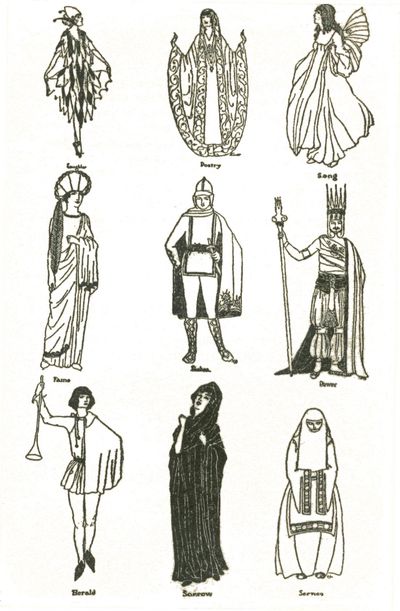
Costumes for The Masque of the Two Strangers designed at the Washington Irving High School.
Herald. Riches, Lord of the Marches of the West, salutes thee.
[Exit Herald.]
Riches. My name is Riches, and I offer thee A store of wealth exhaustless as the sand. This is the symbol of my opulence, A casket in whose depths gold never fails. Grant me thy hand, and thou, Princess, shalt gain All that the world contains of happiness. Thy palace shall be built of precious stones, And thou shalt walk on rose-leaves every day. Sorrow shall be forgotten in my arms, Nothing shall be denied thee wealth can buy. All things—all men yield to the touch of gold.
Sorrow. Blind are the eyes on which thy visions rise. My spells have turned thy glories into dust.
Douce-Cœur. The gold thou offerest me is stained with blood; Thy precious stones were won with tears and toil; The sum of all thy wealth could not reflower The arid wastes that Sorrow has laid bare.
Poetry. She is too simple for thy promises; To one who knows not Sister Poverty Thy lures, my lord, appear as idle words.
[Enter Herald, followed by Power.]
Herald. Power, Lord of the Marches North and South, salutes thee.
[Exit Herald.]
Power. My name, Princess, is Power and this my gift. My brothers brought thee fair renown and gold With freedom from the spells that Sorrow weaves. All these I offer thee. If thou accept, Together we will sway men's destinies, Together we may rule their hearts—their souls— Together turn the very universe. Our throne shall rise a monument of might, Its steps shall mount from the green land of earth, Its canopy shall scrape the stars of Heaven.
Sorrow. I have set that about her like a net Thou canst not deal with. Never yet, O Power, Hast thou been known to cut through cords of fear.
Douce-Cœur. I would not wield thy scepter for an hour. The burden of its weight would bear me down.
Poetry. She is too young, too gentle for the heights Where thou wouldst raise her. Be content, my lords; What ye have done is well, but One alone Can break the spell, and he is at the gates. Already Hope returns. He comes, he comes.
[Enter Hope running.]
Hope. The stranger comes; he whom I went to seek.
Fame. The Stranger comes whose music fills the world.
Riches. The Stranger comes, whose treasure gilds the world.
Power. The Stranger comes, whose scepter rules the world.
Poetry [to Sorrow]. Now shall thy spell be broken. Dost thou hear The measured footsteps of approaching Fate? The one who comes clad in a Pilgrim's garb Has ever proved thy silent conqueror.
Sorrow. I yield to him who is the greatest here, But those who have not met me by the way Can never know him as he may be known. They only who have trod the dark abyss May dare to stand upon the topmost height. For they whose eyes were blindfold for awhile Alone can bear that blaze of brilliant light. Thus have I brought thee more than all thy Court. Learn from his lips to see the world anew. I drew that gray veil all about thy head Thinking perchance to keep thee for my own, But thou wert made for sunlight, not for gloom. Thus do I leave thee. Fare thee well, Princess!
[Enter Love.]
Douce-cœur [starts up and tries to hold Sorrow back]. Ah, stay with me, thou art my only friend!
[Love and Sorrow look at each other, she draws her veil across her face and exit.]
Douce-cœur. Who art thou, Stranger, in a pilgrim's guise Who comest unattended, unannounced?
Love. I may not tell thee that. Thou first must learn Out of thine own heart to recall my name.
Douce-cœur. Fame, Power, and Riches brought me costly gifts Which I refused.
Love. I come with empty hands.
Douce-cœur. Thy coming caused Queen Sorrow to depart; What right hast thou to drive my friends from me?
Love. I came to bring thee swift deliverance, She laid a spell upon thee which in time Had turned thy heart to unresponsive stone.
Douce-cœur. She brought me peace and sure oblivion Of all this dark and weary world around.
Love. Art thou so sure, Princess, the world is dark?
Douce-cœur. So sure? Have I not heard the children weep? Is not my heart torn with their piteous cries? We live, and round us lies their sea of tears, A mighty sea that could engulf a realm.
Love. I met a Child outside thy Palace once. His dress was ragged, but he smiled at me, And in his hand he held a purple flower. I knew it for the magic flower of Dream. I asked him "Art thou happy?" and he said "I'm mostly hungry; sometimes I am cold; And there are stones and thorns that hurt my feet, But while my Flower lives I am quite content. And I have friends too, in the Palace there; Laughter and Dance they come and play with me." I met that Child to-day, Princess. His face Was white and pinched, and down his baby cheeks The tears were running, "See, my Flower has died, And Dance and Laughter have been sent away. Joy too is gone. Queen Sorrow reigns at Court." Even the children now can play no more. He never knew before the world was dark. Art thou so sure, Princess, the Child was wrong?
Douce-cœur. Have I not heard bereavèd mothers weep?
Love. There thou dost touch a chord in ignorance. Thou canst not guess the strength of Motherhood, The hopes, the joys, the passionate regrets. She who has borne her child close to her heart Has lit a star in Heaven that lights her way. I kneel by them in their Gethsemane And teach them how to weave immortal wreaths Out of the sweetest flowers of Memory; For them the sun still shines behind the clouds, Art thou so sure the world is wholly dark?
Douce-cœur. There echo in my ears the groans of Toil, Of those who labor on from year to year Until they sink beneath their weary lot.
Love. Toil is the destiny of man, Princess, And none may question the Supreme Decree. Perchance through toil alone man may redeem A past that is forgotten. Who can tell? And there is still some aftermath of joy In labor well achieved, some dignity In toil accomplished. If the way is hard And seeming endless, those who seek for me Will often find me singing at their side. Mine is the Brotherhood of Sympathy. But thou hast banished Song, in silence now The toilers have to go upon their way. Art thou so sure, it was all dark before?
Douce-cœur. What light is there for those who strive and fail?
Love. One only fails. He whom some term Success, He who gives heart and soul and youth and strength To an unworthy cause. Failure is he Who sacrifices me before the world, Who prostitutes the God in him for what Will turn to dust and ashes in his hand. 'Tis he alone is outcast though he thinks Himself the sun of all the universe. To those, Princess, who striving seem to fail, It is not failure, for none see the end, And they who sigh are only those who seek An earlier consummation than is just; If they cling fast to me they still behold The white star-flowers Hope plants about the world. Who knows to what fair land rough seas may lead?
Douce-cœur. Lo! over all I see the cruel hand Of Death outstretched, certain and pitiless.
Love. The hand of Death is full of tenderness. He leads men through that dark mysterious gate— That all must pass into another life— To other lives that through the cycles bring The souls of men upward from step to step, Uniting those for ever who are one. Death hushes them like children on his breast. Setting his own smile on their silent lips— That tender smile of strange triumphant peace. Death is my Brother, and I say to thee, Learn to know me, thou wilt not fear his hand.
Douce-cœur. Another hand is knocking at my heart Whose touch I know not, and I feel afraid— Afraid to listen. Yet I long to hear. Stranger, who art thou? Let me see thy face.
Love. Learn to know me and thou shalt nothing fear.
Douce-cœur. Who art thou? Let me look into thine eyes.
Love. Learn to know me and thou wilt find the Light.
Douce-cœur. Pilgrim, who art thou? Let me know thy name.
Love. Dost thou not know me, Douce-cœur?
Douce-cœur [slowly]. Thou art Love!
Love. And dost thou know the meaning of my name? Tell me thou art not fearful any more.
Douce-cœur. The darkness that was bound about mine eyes Is falling from me. In the growing light The answer to Life's riddle is made clear. I seem to stand upon a height, caught up In ecstasy of rapture near the sun. The day is dawning; far before my eyes I see the earth spread out there like a map. Shadow and sunshine traveling on the road O'ertake each other, mingle—and are one.
Fame. O Love, all hail! What is my crown to thine? Thy music is the song of all the stars Which rings through every heart attune to thine.
Riches. O Love, all hail! What is my wealth to thine? Thy treasures are the moons of happiness, Thy boundless gold the sunshine of the world.
Power. O Love, all hail! Thine is the greater rule, The force predominating. Thou alone Art the unvanquished King who conquers all.
Poetry. O Love, whose face is sought by all the world, Bid her go forth out of her Palace gates Into her kingdom that lies all around, Teach her what means to use to right the wrong And ease the burden man has laid on man. My voice that once could rouse men's sleeping souls Grows weary, and men often heed me not, Turning deaf ears that will not hear my words; 'Tis thou alone canst wind that mystic horn Which wakes alike the sleeping and the dead.
Douce-cœur. O Love, I pray thee call the children back, I am ashamed to think I drove them forth, I erred in ignorance. Forgive me, lord.
[Enter Joy, Laughter, Song and Dance.]
Love. All ye who came to battle Sorrow's spell, Be with her now. And ye who hold in fee Her happy days, go with her through the years. I all unseen will guide her destiny. And when, Princess, I come again to thee, A worshiper will follow in my train. From other lips than mine thou then shalt learn The sweetest and the tenderest tale of all.
Music. Now let us join with Song. In merry mirth Draw to a fitting close our Interlude.
Song. Sorrow reigned her little day Love has driven her far away Brought the sunshine back to Court Thus we end in merry sport.
[Exeunt All.]