PLAYMAKING
Reading edition
Shortly before the death of William Dean Howells, he related the experience that he had had of being circularized by a correspondence school that offered to teach him the art of writing fiction in a phenomenally short time at a ridiculously low rate. In this instance, there was something wrong with the mailing list, but the fact remains that in universities successful courses in writing short-stories and plays are given and the best of these courses actually have turned out writers who achieve various degrees of success financially and artistically It is plain that a brief treatise like the present one makes no such pretensions; it means merely to suggest some of the most obvious points of departure for students in the drama who wish to exercise themselves in the composition of the one-act play, much as a student of poetry will try his hand at a ballade or a sonnet without taking himself or his metrical exercises too seriously.
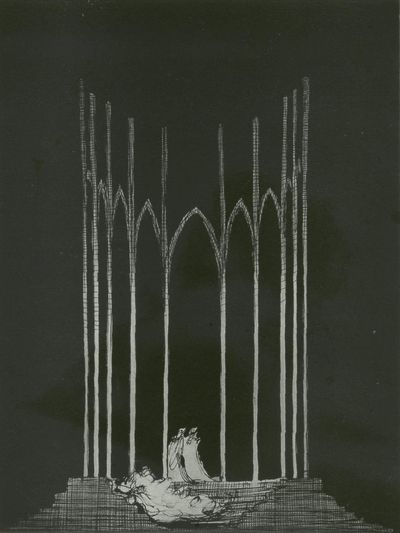
Courtesy of Theatre Arts Magazine
The Seven Princesses. Design by Robert Edmond Jones. An example of the attempt to present the essential significant structure of a setting in the simplest way conceivable and by so doing to stimulate the imagination of the spectator to create for itself the imaginative environment of the play.
In the famous Perse School in Cambridge, England, the boys begin at the age of twelve to practise playmaking as an aid to the fuller understanding of Shakespeare's dramatic workmanship, and this work is developed throughout the rest of the course. The boys, having learned that Shakespeare himself used stories that he found ready to hand, discover in their own reading a story that will lend itself to dramatization. The story is told and retold from every angle. The class is then divided up into committees to every one of which is entrusted some part of the dramatization. One little committee busies itself with the setting, another with the structure, another with the comic characters, another with the songs that are interspersed and so on. These committees prepare rough notes to be presented in class. These notes may propose an outline of successive scenes, present the part of some principal character, or the "business" (illustrative action) of some minor part. Lessons of this sort are followed by composition rehearsals, where the dramatic and literary value of the proposed plot, characterization, pantomime, and dialogue are tested, and subjected to the criticism of teacher and boys. In the next lessons, the teacher brings to bear on the special problems on which the boys are working all the criticism that his wider range of reading and experience can suggest. In the light of his suggestions the various points are debated and the boys then proceed to careful fashioning, shaping, and writing. A rehearsal of the nearly finished product is held, followed by a final revision of the text. The work then goes forward to a public performance given with all due ceremony. In the higher classes playmaking is taught more especially in connection with writing and the boys are trained to imitate the style of various dramatists. Synge was used as a model at one time for, as one of the masters of the school explained: "The style of Synge is easy to copy because it is so largely composed of a certain phraseology. The same words, phrases, and turns of sentence occur again and again. Here are a few taken at random; the reader will find them in a context on almost any page of the plays: It's myself—Is it me fight him?—I'm thinking—It's a poor (fine, great, hard, etc.) thing—A little path I have—Let you come—God help us all—Till Tuesday was a week—The end of time—The dawn of day—Let on—Kindly—Now, as in Walk out now—Surely—Maybe—Itself—At all—Afeard—Destroyed—It curse. Synge is also mighty fond of the words ditch and ewe. And there are certain forms of rhythm about Synge's prose which are used with equal frequency, and are quick and easy to catch. So far from this imitation of style being an artificial method, the fact is that once a boy of sixteen or over has read a play or two of Synge's, if he has any power of style in him, it will be all but impossible to stop him writing like Synge for a few weeks." Learning playwriting from models recalls the method of Benjamin Franklin and Robert Louis Stevenson who in their youth wrote slavish imitations of the great masters in order to form their own prose style. Of course, it is not claimed that this work at the Perse School makes playwrights, only that it gives the boys a deeper appreciation of dramatic workmanship and furnishes a new kind of intellectual game to add to the joy of school life.
The one-act plays contained in this collection are, as has been suggested in what has been said about their construction, illustrative of various kinds of workmanship. Certain of them are excellent models for those who are experimenting with playwriting. The one-act play, not nearly so difficult a form as the full-length play, offers undergraduates in school and college and inexperienced writers generally unlimited scope for experiment.