ON FOREIGN SERVICE (continued 5)
Reading edition
'Come along, boy, we've done enough harm here,' the Skipper said.
'Hadn't we better see my brother safely out of it first, sir?' I suggested, for I didn't like the Commandant's eyes or those treacherous-looking soldiers.
'Brain wave, lad! Good brain wave!—we will.'
We did see him out, tramping along through the main gateway, over a drawbridge, and took him down to where his own little brown men clustered, at the edge of the forest, waiting to see the black and green flag hoisted above the fort they hated so much.
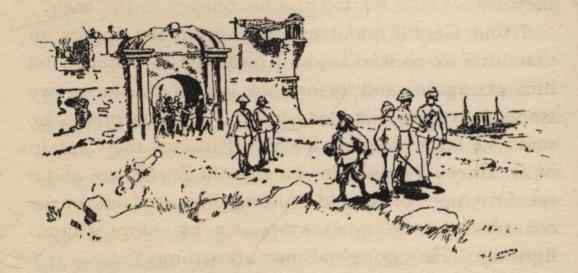
It was the most miserable walk I have ever had
It was the most miserable walk I have ever had, and I could have killed the men shouting 'Viva los Inglesas!' as they lined the wall and crowded through the gateway behind us. I feel certain that, if we hadn't been there, and the Hector lying close inshore, they'd have shot Gerald and his officers in the back.
I told Gerald about my having cut the fingers off that little ex-policeman, and implored him not to let him go again, and before we got to the forest we stopped to wish him good-bye. As I was going, he said: 'I know Captain Pelayo, Billums, the Captain of La Buena Presidente—he and old Zorilla are about the only types of the old fighting Spaniard left in the country—and he won't surrender his ship without fighting. He's got good men aboard too.'
We left old Gerald there, but I turned to watch him and the 'Gnome' disappear into the gloomy forest among their little men, before I followed the Skipper—a big lump sticking in my throat.
'I'd have asked your brother to come on board, lad,' he said, 'hang the arresting part of it and that warrant, and have taken him out of the country in safety, but I know he wouldn't; he isn't the kind of chap to leave his fellows in a hole.'
He was about right there.
The same officer who had met us took us back, and this time we were obliged to pass that hole our 9.2 had made. The pathway was almost hidden by the blocks of stone and scattered bricks which had been hurled down by the explosion, and we had to pick our way very gingerly across them, so that it was impossible not to notice the huge gap above us.
The officer waved his hands and shrugged his shoulders, 'We forget—you forget—all mucho bueno.'
'Do you expect that ship to come here, sir?' I asked him, as we pulled back to the ship.
'Don't know, lad, she should make for San Fernando first, and I'm going to stay here to see that she doesn't get there, but I've told "Old Spats" to take the Hercules to Los Angelos, in case she should attempt anything there.'
I told him what Gerald had said to me about Captain Pelayo, and asked him what he would do if she did not stop when told to do so.
'Shall we have to fight her, sir?'
'I suppose we shall,' he answered, with a wink. He looked as though he almost hoped she wouldn't stop. So should I have done but for old Gerald.
'She'll be a pretty hard nut to tackle, sir; she's got eight twelve-inch guns on a broadside.'
'Well, we've got four 9.2's and four 7.5's. Don't bother about that, she won't know how to use them.'
Still I couldn't help thinking that, unless we had the Hercules to help us, it would be a pretty hard job.
Most of us on board thought so too, that is, if it did come to a scrap, but the general opinion was that her crew could not possibly be trained, would not be able to fight her guns properly, and, if she couldn't run away, would have to surrender.
Raynor, the Engineer Sub, who knew all about her, pointed out that she was supposed to have three knots more speed than the Hector, so might be able to escape.
'Running away won't do her any good,' I said, 'or Gerald's people either.'
However, the possibility of having to fight made every one of us in the gun-room, except myself, extremely cheerful and excited, and when late in the afternoon we began to 'clear ship for action' and 'prepare for battle,' you would have thought by the way we all jumped round and got the ship in fighting trim that we were expecting to pay off old scores on some deadly enemy. It almost made me smile to hear the mids. talking now. At the back of their minds there was a feeling that perhaps the fight might be a bit more even if the Hercules came along to help, and they made quite pleasant remarks about her and her hated gun-room.
I know that I myself hoped that if it did come to a 'scrap,' old Ginger Hood would be there to share the fun.
Cousin Bob must tell you what did actually happen.
CHAPTER XIV
La Buena Presidente fights
Written by Midshipman Bob Temple
After we had had that ripping lark with those two 4.7's on shore, the insurgent President sent off a great basket of fruit—oranges, grape-fruit, melons, and bananas—every day whilst we remained off San Fernando, so we were jolly sorry to get up anchor and steam down to El Castellar.
Of course we were very sorry for Cousin Gerald's sake that we had to collar La Buena Presidente, but thought it would be splendid fun if she showed fight, and we all hoped that she'd come our way and not give those beastly Hercules' mids. a chance. Then we heard what Cousin Gerald had told Billums about her Captain being such a fine chap, and Raynor, the Engineer Sub, told us so much about her, her armour and her big guns, that though we didn't get exactly frightened, we rather felt that we'd like the Hercules' mids. to chip in with us after all.
A lot of our chaps thought that she'd simply haul down her flag directly we signalled to her to do so, but Mr. Bostock the Gunner shook his head. He'd seen a revolution out in these parts, years and years ago, and said we were wrong: 'She'll not 'aul her flag down whilst she's got men to fight the guns and shovel coal in the bunkers.'
He told us the story of the fight between the Shah and the Huascar, which was just about the same kind of show. There had been a revolution and the Huascar had joined the insurgents down the coast. She ran short of coal, and not being able to buy any, took it by force out of an English steamer, so the Shah—she was our flagship out there then—was sent after her and they had a stand-up fight. The Shah was a wooden ship with thin armour-plates along the side, and the Huascar was an iron one with turrets and very thick armour, so the English ship found herself up against too big a mouthful and got the worst of it.
'I was Captain's coxswain aboard 'er,' Mr. Bostock told us, but we sang out that he couldn't have been more than twelve years old at the time. 'Believe me or believe me not, young gen'l'men, I was Captain's coxswain, and a nice kind gen'l'man he was too. In the middle of the haction 'e sees a big round shot from the turret-ship come bobbin' along towards us—straight as a die. "Full speed astern," 'e says to me—"Full speed astern, Bostock,"—just like that—not turnin' a 'air—and full speed astern we went, and that shot just 'it the water under our bows. Another time, about 'arf a 'our arterwards, we was gettin' pretty tired of shootin' against 'er thick sides and seein' our shot bouncing off 'er armour like peas, 'e sees another round shot comin' along. "That'll just about 'it the Admiral's cabin," 'e says, "and aggravate 'im," 'e says, "if we don't 'urry along a bit. Full speed ahead, Bostock."
'Well, 'e was a wonder, was the Captain, but the leadin' seaman, who passed the order down to the engine-room, wasn't very smart about it, and though we did go full speed a-'ead, we didn't do it quick enough, and that shot just took off the life-buoy a-'angin' under our stern. Took it off without even a-damagin' the gilt scroll we' ad there, but that 'ere leadin' seaman 'ad 'is pay stopped till 'e'd paid for it—an' serve 'im right.
'Of course that was in the days of muzzle-loaders, when the shot didn't go along as smartly as they do now; but that Captain was a smart 'un—'e 'ad judgment, 'e 'ad.'
'They must have been pretty sick of life at your dodging their shots like that,' we said, laughing.
'Believe me or believe me not, but as true as I'm a-sittin' in my cabin 'ere at this moment, they started a-'easin' off two at a time, 'oping to catch us with one of them.'
'What did the Skipper do then?' we asked.
'What d'you think?' he snorted. 'There was those two great black shell comin' racin' along towards us, side by side, and 'e turns to me, as quiet as a babe unborn, and 'e says: "'Ard a starb'ard"—that's all, and our old tub turns round on 'er 'eel, just faces them two shell and 'e shoved 'er nose in between them an' they just splashed the men in the batteries a bit. We can't do nothin' like that nowadays, young gen'l'men—nothin' like that.'
'We shouldn't think we could,' we shouted, as he seized his cap and ran up on deck, for the Commander wanted him.
We cleared for action that afternoon and just before dark got under way and stood out into the open sea, past El Castellan.
This clearing for action made it certain that the Captain was doubtful whether she'd surrender without fighting, and of course made us all more excited than ever.
'If she does fight, I hope the Hercules will come and help; she'll be a bit of a handful to tackle single-handed,' Barton sang out, and Billums laughed sarcastically and said, 'I thought you'd rather die than let them help you,' which made us rather angry.
The 'Angel' and I went in to have a yarn with the fat little A.D.C. and hear what he thought about it. He was very excited, and said that Captain Pelayo would die sooner than surrender—he seemed to know him very well. That night the Captain had him taken down below in the 'tiller flat,'[#] so that he would be out of danger if anything did happen, and his being taken down there made us all feel a bit creepy.
[#] A space right aft, below the water-line, where the steering engine and emergency hand-steering mechanism are situated.
Well, nothing happened all night; we simply 'mooned' about, backwards and forwards, near the entrance, and La Buena Presidente must have been hovering round, too, waiting till it was light enough to see her way into La Laguna, for, as it grew light enough, she was sighted not five miles away, steaming leisurely in towards the entrance. Although she was painted white she looked enormous.
The Captain was called, and ran up on the fore bridge in a twinkling, and sent 'Blotchy' Smith down with a wireless message to the Hercules. He showed it to me as he passed along the upper deck, 'La Buena Presidente is eight miles off El Castellar steaming towards it. Shall prevent her entering. Come south and prevent her escaping to sea.'
'She'll be here in three hours and a half,' 'Blotchy' shouted, as he ran aft, and I felt jolly glad, but rather wished it was minutes instead of hours.
Then 'General Quarters' was sounded, and we all rushed to our stations. Mr. Bigge and I got through the back of our 9.2 turret—the for'ard starboard one just under the projecting end of the fore bridge—and when we'd reported everything 'cleared away' and had filled our 'ready' rack with more shells, we climbed out of the sighting-hood and squatted on top of the turret, whilst they trained it for'ard and aft as far as it would go and raised and lowered the long gun, to test the hydraulic machinery. It was a perfectly lovely morning, the sea like glass, and the Hector's bows seemed just to push the water aside, not even breaking the surface. It was so jolly clear that we could see thousands of jelly-fish—all the colours of the rainbow—floating past under our sponson. It really was grand, and we sat there and watched the big ship coming slowly towards us with the sun rising just behind her.
'That's bad for shooting, if it comes to a fight,' Mr. Bigge said; 'it will dazzle the "Gunlayer's" eyes.'
'I don't expect it will; do you, sir?' I asked nervously, because she was so huge, and I knew that she had so much more powerful guns than we had, that, now it came to the pinch, I was in a funk.
'Don't know,' he answered; 'we'll know in ten minutes.'
The signalmen began running about the bridge above us, we heard the Chief Yeoman's voice saying 'Hoist,' and up went three flags and the white international code pendant.
'What's that mean, sir?' I asked, as the halyards were jerked to shake out the flags.
'"Stop engines," I think,' Mr. Bigge said, squinting through his telescope to see if she took any notice.
Something did go fluttering to her masthead—she only had one mast, a tripod one, amidships—but it was the black and green flag, and a huge one at that.
'She's not going to stop,' Mr. Bigge muttered. 'The Sub was right after all. We'll have to fight her.'
I did feel so uncomfortable and horrid 'inside,' and looked to see that the sighting-hood was open so that I could crawl down into the turret again—quickly.
Every one was simply gazing at the big ship, wondering what she would do, and you couldn't hear a sound, except the hissing noise of some steam, escaping from a leaky joint near the syren fog-horn up on the foremost funnel. Just aft of our turret was the first 7.5 turret, and the 'Forlorn Hope'—just a little pale—was leaning against the side of it looking at the ship—I was jolly glad that I wasn't so fat, I felt much too big already—and the 'Shadow' slipped out of the next 7.5 turret to yarn with him and then ran back again and shut the door.
Dr. Clegg came cheerily along from under the fo'c'stle, and stopped near our turret to look at her too.
He sang out asking if we had our 'first aid' bag, and I put my head down the sighting-hood to find out.
'Yes, sir!' I shouted down—it did me good to shout.
'Just seeing that all our things are rigged,' he said, smiling at Mr. Bigge, looking along at the sunrise for a moment with a funny expression in his face before he dived down below.
'He may not see it again,' Mr. Bigge said, and I understood and felt shivery all over.
Inside my turret I could hear the Gunlayer, who had his eye to the telescopic sight, talking to the Sight Setter. 'Now don't you go a-playing none of your tricks, Bill. Tie a bit of spun yarn round your right thumb and you'll know it from your left, and won't be playing the ass with the deflection as you did at the battle practice—a-spoiling the whole ship's shooting.'
Raynor, the Engineer Sub, came along too, and went down into our turret to see if the hydraulic machinery was all right. He climbed out of the sighting-hood in a few minutes, borrowed Mr. Bigge's telescope to have a look at the white ship, told us that everything was working well, and climbed down on deck.
Then, up in the for'ard fire-control position—high up the mast—I heard the 'Angel's' voice reading off the ranges on the long range finder, 'eight thousand nine fifty—eight thousand nine hundred—eight thousand eight fifty'—and I popped my head down inside to see if our range indicator was working properly. It was, and the figures were slipping round all right. I looked up again, but he had his eyes glued to the range finder and didn't see me.
Marchant, the Inkslinger, leaned out of the 'control' position, caught sight of me, and waved his bandaged hand—he was beaming all over.
Mr. Montague, too, looked down and sang out to the fore bridge for some of the signal halyards to be hauled aside as they were fouling the range finder, and I could just see the feet of Pearson, the Assistant Paymaster, who was sitting, straddle-legs, on the top of it, doing 'spotting officer'—to spot whether shots fell short or over. I was jolly glad that I wasn't up there, and that, if it did come to a fight, I had six inches of armour to get behind.
The ship was so close now that we could see her huge guns, but she didn't seem to have cleared for action.
'Fire a port twelve-pounder!' we heard the Captain say; 'they may not have seen the signal.'
Men began running about, the Commander bellowed at them, and the little gun fired almost immediately—to leeward—away from La Buena Presidente—and we watched to see if that would have any effect.
It had. A long string of flags went jerking up the tripod mast and the international code pendant was hoisted to her yard-arm. We heard the Chief Yeoman scurrying into the chart-house to find the signal-book, and in a minute the Captain called out to the Commander, 'They refuse to stop. Keep my signal flying and fire the foremost 9.2 across her bows.' Billums was in charge of that turret.
All this time the 'Angel' had been singing out the range. It had got down to 7250 yards, and we were turning a little in towards the entrance, to prevent the ship closing too rapidly. Then round slewed Billums's long gun over the starboard bow, pointing up in the air.
The Captain sang down to him to fire as soon as he liked, and almost before he'd said it, off went the gun with a roar—back it flew—my cap went flying overboard, and the brown cordite smoke came stinging into my eyes.
'Why the dickens don't you stick your cap on properly?' Mr. Bigge snarled. 'You aren't a blooming infant,' and we watched to see where the shell would fall.
It seemed an awfully long time, and then there was a shout of 'There it is!' all along the ship, and up spouted the water a couple of cables ahead of the white ship.
Mr. Montague shouted down to know what range Billums actually had on his sights, so as to see whether the range finder was working properly or not, and then there was another shout of 'She's turning!' and I was never so relieved in my life as to see her put her helm over and run away.
The Captain roared for the Engineer Commander, and sang out, 'Tell the Hercules she's steaming seaward.'
The morning seemed to be quite lovely again, and we headed after her, smoke pouring out of all our funnels, and that leaky steam joint hissing more and more. Our bows began to break the water now, and the jelly-fish streamed past like a flash.
La Buena Presidente was covered with smoke too, and seemed to be in a jolly hurry to escape.
'She isn't going to fight after all,' I laughed, feeling awfully pleased.
'Don't know—they're getting down her rails and awnings,' Mr. Bigge said, looking through his glass.
So they were. We could see the men swarming on her quarterdeck and the awning coming off her.
I felt all shivery again, and heard the Gunlayer sing out from inside the turret, 'The longer they take about it the farther the sun'll be up, and it won't get in my bloomin' eyes so much.'
'It seems a shame to go killing people a morning like this, doesn't it?' Mr. Bigge muttered to himself, and I jolly well agreed with him.
We were buzzing along finely now, and could feel the ship shaking and throbbing.
The 'Angel' was still at the range finder, and our indicator showed 6250, when suddenly the big ship turned again—she was going at a tremendous speed—and—oh, it made my backbone feel cold—made straight for the entrance and El Castellan.
We still had our signal 'Stop Engines' flying, but there wasn't the least doubt now that she was simply going to rush past us. Clatter, clatter, came the signalmen down from the fore bridge to take shelter, everybody disappeared into their turrets, popping down the sighting-hoods like rabbits, the Captain and the Navigator came down and clambered through the top of the conning-tower, the 'Forlorn Hope,' with a grimace at me, squeezed himself into his turret and closed the armoured door, and, with my heart in my mouth, I wriggled down into mine.
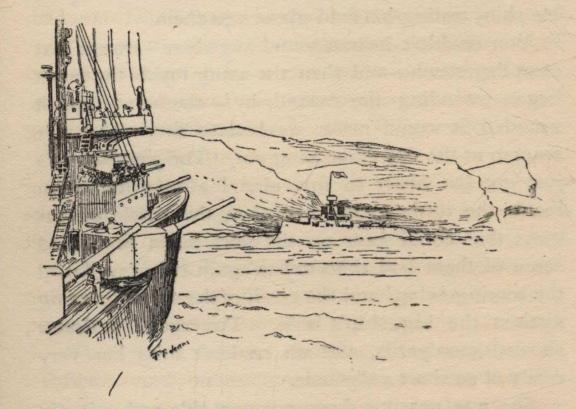
The big ship turned again
'Aren't you coming, sir?' I asked Mr. Bigge, but he shook his head. I felt a little safer inside there, and stood watching the range indicator. It was simply altering every few seconds—5400—5300—5200—there was no time to show the fifties.
Mr. Bigge sang out for me—he wanted to know something—and I popped my head out again and couldn't see the ship—she had slanted away a little, to pass along our port side—but I just caught sight of Billums sitting on the back part of the top of his turret, on the fo'c'stle, with his knees drawn up to his chin, resting his field-glasses on them.
You couldn't hear a sound anywhere—except that escaping steam—and then the gong inside the turret began sounding the 'stand by'—the next time it sounded it would mean we had to fire. The able seaman at the telephone sang out, 'The port battery's just got the order to fire, sir,' I almost fell down inside the turret again, and then the whole of our guns that could bear on the port beam fired, and some of them had time to fire again before we heard the roaring 'clap' and the crash of the shells bursting against the big ship's side. The range indicator showed 3200 yards, and we couldn't miss her very easily at so short a distance.
She was passing down our port side and going in the opposite direction, so that we had to circle round to follow her, and I knew that the starboard turrets would then come into action.
Mr. Bigge shouted down that we were turning to starboard, the bell at the telephone from the conning-tower rang, the able seaman jammed his ear against it, sang out, 'Starboard guns, stand by, sir!' and the gun's crew jumped to their proper stations.
'Remember your right hand, Bill!' the Gunlayer called out, and wedged his eye into the indiarubber sleeve of the telescopic sight.
'Train aft,' Mr. Bigge shouted down through the sighting-hood, and round we slewed.
The gun's crew was ready, the gun loaded, and the next shell lying in the loading tray, so I had nothing to do except to see that the Sight Setter kept the same range on his sights as the indicator showed, and that everything was done properly.
'We're coming "on,"' Mr. Bigge sang down. 'Stand by!'
The Gunlayer jerked out, 'I've got her, sir'—he'd spotted her through his telescope—and I just had the pluck to pop my head out for a second and caught sight of the big white ship tearing across our stern as we swung round, and then the fire-gong clanged loudly and I slipped back again.
There was a roar and a shake, men jumped about, banging and clattering—I heard the ammunition hoist rattle-rattle up to the gun, and the breech-block snap 'to,' and off she went again.
'We're hitting her!' Mr. Bigge sang out. 'Aim under her mast and bridge.'
'She's going to fire,' he shouted, a second later, and almost before he'd said it, there was a most awful roar, like a thunder-clap, and then the most appalling noise and hot glare—the whole ship shook and seemed to be tearing in pieces. The Gunlayer was cursing that he couldn't see out of his telescope, and wedged his arm along it to wipe the glass.
'That's better,' he growled, and fired again.
The range indicator, all this time, had been showing bigger ranges, and it had just showed—3650—when that same awful thunder-clap sounded a second time, and then the noise and the hot glare; the ship seemed to be breaking in pieces again, things came crashing down on deck, and she trembled as if she'd run aground. Something had struck her, somewhere close below us; a huge flame shot up just in front of the gun port, I was banged against the side, the Gunlayer came tumbling down from his sighting platform, and we could hardly breathe. I felt quite silly, too.
The Gunlayer scrambled up again and fired, but we didn't know whether he was hitting her, because she was covered with smoke and almost hidden by the spray and the smoke of shells which burst short. I began to get my breath back.
'The range indicator ain't working, sir!' the Sight Setter called out. 'It ain't altered for the last three minutes.'
I jumped across. It still showed—3650—and I tapped it to see if it had jammed, but it didn't move. Just as I was going to tell Mr. Bigge, La Buena Presidente fired again, there were those awful noises, and something came crashing down on top of our turret, bulging in the roof.
'Can't move her, sir, the turret's jammed,' the Gunlayer yelled. He sprang up through the sighting-hood—something red and slippery was dripping down through the holes in the top of the turret—and I followed him. Mr. Bigge wasn't there, but the top was covered with the twisted rails and smoking burning planks of the projecting end of the bridge—I knew it was the bridge because the stump of the semaphore was still fixed to a rail.
I didn't really realise anything or know quite what I was doing. I burnt my hands trying to pull the wreckage away, but we couldn't move it, and I had to keep my eyes down so as not to see the big ship firing—I couldn't have stayed there if I had. I knew that Mr. Bigge must have been killed, and that I was now in charge.
Then that awful thunder-clap sounded again, there was a terrific crash behind us, a huge mass of iron crashed down on the deck, and one of the men said quite calmly, 'The foremost funnel's gone, sir,' but I dare not look—I was too terrified.
We couldn't move that wreckage off the fore bridge, so I ordered the men inside the turret, and then tried to ring up the conning-tower, but couldn't make the telephone work. I tried the telephone to the transmitting station, the room below the water-line, at the foot of the foremast, which passed all messages to us from the fire-control position, on the mast above it, and I heard the Fleet Paymaster's voice at the other end. 'Please tell the Captain——' I'd just got as far as that when the ship shook and trembled again, and we could feel something crashing and bursting inside her.
I tried the telephone once more, but it wouldn't work at all. I knew that I ought to tell the Captain and ask what should be done, so I bit my lips and crept out of the turret, down the rails at the back, and jumped down on deck, but it was all covered with burning bits of wood and twisted and torn, almost red-hot, iron plates. Smoke and steam was pouring up from where the foremost funnel had been, and flames from the boiler furnaces were licking the grey paint off, but the rest of our guns, on the starboard side, were still firing very fast.
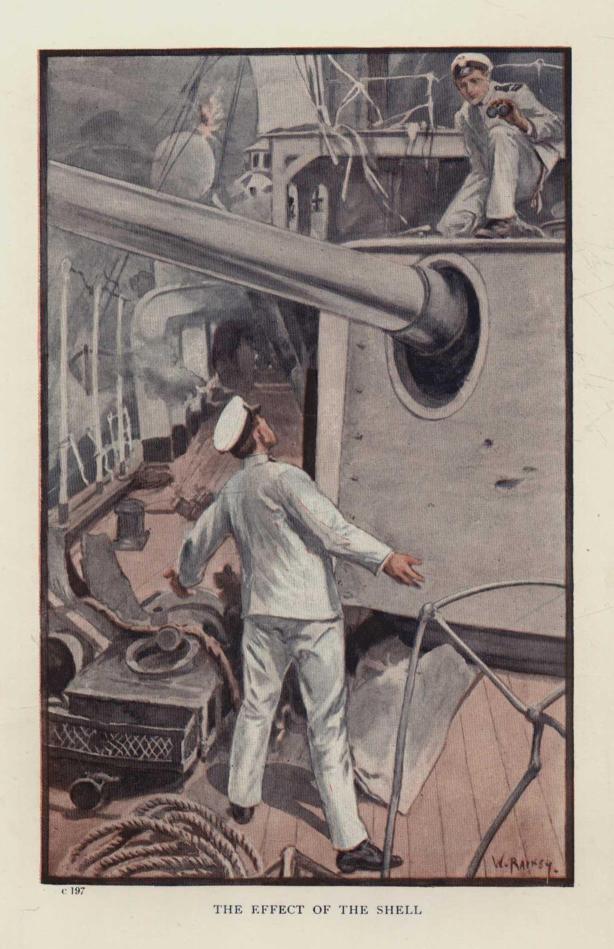
THE EFFECT OF THE SHELL
I kept my eyes down and dashed through the smoke to try and get under the fo'c'stle and nearly fell through a hole in the deck. The gangway was blocked up with wreckage. Several bodies lay underneath it, and I saw one arm sticking out, a signalman's badge on the sleeve. I ran back and had to crawl under the fallen funnel, through a gap where it had crumpled up, wondering when that next thunder-clap would come and kill me. I crawled under it, noticed that the 7.5 turret next to ours seemed out of place and the deck very uneven, saw the Shadow's face in the sighting-hood of the second 7.5 turret just as his gun fired, and darted between the funnel casings to the port side. I had to go quickly because the paint was burning on the iron plates on each side of me. That thunder-clap seemed to be awfully long in coming, and I thought that perhaps, after all, we'd beaten the huge ship and scrambled for'ard, over more smoking wreckage, towards the fo'c'stle, 'Blotchy' Smith looking out from the port for'ard 9.2 turret, very white in the face, and yelling to know how things were going.
I couldn't stop to speak to him because of the smoke pouring up from the foremost funnel hatchway, and I just put my sleeve in front of my eyes and my mouth and darted through it, under the fo'c'stle. Even then I couldn't get to the conning-tower, where the Captain was, because the whole of the shelter deck was crumpled up like paper, but the port door leading on to the fo'c'stle had been blown off, and just as I looked through it, the for'ard 9.2 fo'c'stle gun fired. I heard Billums shout, 'Hit!' and there he was still perched on top of the turret, his head bare, and his yellow hair showing.
'We're jammed! Mr. Bigge's killed! I want to tell the Captain,' I shouted, but he couldn't hear what I'd said, and only pointed over the starboard quarter. He put his hands to his mouth and shouted, 'The Hercules!'
Oh! wasn't I glad, and was just going to try and climb up to the conning-tower, when I saw O'Leary put his head out of the sighting-hood and speak to Billums. I heard Billums shout, 'Cease fire.' Then the Commander came scrambling along past me with some men, a bugler sounded 'Collision Quarters,' and I noticed, for the first time, that we had a tremendous list to starboard. The Commander bellowed at me to make myself useful, and sent me down below with a message to the First Lieutenant, so I hadn't time to ask any one what was the matter.
I could hardly find my way along the lower deck. Everything was wrecked, the mess tables and lockers were burning furiously, and I could hardly see for smoke, which poured out through great gaps in the port side. I managed to find one of the hatchways open—the cover must have been blown off—and got down into the 'bag flats,'[#] but it was worse here, pitch-dark, and water, up to my knees, was rolling from side to side. There was a sickening smell there too. As I groped my way along to try and find the for'ard hatchway leading down to the ammunition passages, where the First Lieutenant was, I saw a light and heard the Fleet Paymaster's voice. He was looking out of the fore transmitting room, and some candles were burning inside it. 'We haven't been able to make any one hear for the last quarter of an hour,' he said. 'What's gone wrong?'
[#] Narrow spaces, below the water-line and behind the upper coal-bunkers, where the men's bags are stowed.
'I don't know, sir. The ship has escaped, I think; Mr. Bigge's killed.' Mr. Perkins came along, splashing through the water, so I gave him the message and climbed up on deck again. I met Billums under the shelter deck—or rather what had been the shelter deck—and he told me that some armour-plates had been smashed in below the water-line—that was why we were heeling over so badly.
'Two shell struck almost together, drove a plate clean through the side, and killed every one in the after bag flats—Dr. Clegg, the Padré, and the whole of the 'stretcher party' aft there.' He was very sad.
'Is the "Angel" all right?' I asked, feeling perfectly miserable. He put his hand on my shoulder and led me back out on the fo'c'stle again. I knew at once that my chum was killed.
'Be brave, Bob; look up!' he said.
I looked; oh! it was awful, the topmast and the control-position had disappeared, and there wasn't anything left there, except a few bits of wire hanging down, and a copper voice-pipe sticking out by itself.
'One shell in that second broadside burst against it, Bob,' and Billums put his hand on my shoulder, very gently, to steady me; 'it must have been all over in a second. They felt no pain.'
I simply buried my face in his monkey-jacket and sobbed and sobbed.
'Pull yourself together, Bob,' he whispered, 'remember that you are an officer. They felt no pain.'
I heard the Commander bellow at Billums; he roared my name too and cursed me, sending me down to the Engineer Commander for as many stokers as he could spare.
I was too absolutely frozen to care about anything, and when I met 'Blotchy' Smith, half blubbing, and he told me that Barton had been killed in the after turret and the Forlorn Hope in his, I hardly heard what he said—I felt quite silly and 'wobbly' in my head.
I really could not tell you what happened for the next five hours—I was so dazed and numbed—but I found myself going down into a boat with a lot more of our mids., and we crawled up a ladder on board the Hercules. We huddled up in a corner of her gun-room, and they brought us something to eat, but it nearly made me sick to look at it. The Hercules mids. let us alone and didn't ask any questions, and for hours we sat there, covered with dirt and smoke, till some one led us away and made us clean ourselves. Some one lent me a pair of pyjamas, and I crawled into a hammock, but daren't shut my eyes, and had to get out and sit close to a light. I don't know how long I sat there, but one of the Hercules' doctors found me, and lifted me back into my hammock. He injected something into my arm, and was going away, but I clutched his sleeve—I couldn't be left alone—and then cried till I thought I should die.
CHAPTER XV
The Santa Cruz Fleet again
Written by Sub-Lieutenant William Wilson, R.N.
For days after that awful morning we seemed half stunned. We had left El Castellar the night before, as smart a ship and as cheery a lot of officers and men as there were in the Navy, and fifteen minutes after La Buena Presidente fired her first broadside the Hector was a complete wreck above the waterline, and was so badly holed beneath it that she only managed with difficulty to keep herself afloat and crawl back into shallow water. Fortunately one anchor and cable had not been destroyed, and we anchored under El Castellar, the Hercules anchoring as close as possible in case it should become necessary for us to abandon the ship.
She sent working parties aboard at once, and we eventually managed to make the Hector fairly water-tight, pump her dry, and get her on an even keel again. But that was not until the third day, and those three days and nights have always been like a horrible nightmare.
We could not get away from things—the stump of the foretopmast and that single copper voice-pipe, sticking out where the fore control had been, to remind us that Montague, Pearson the A.P., Marchant the cheery little Clerk, and the 'Angel' had simply disappeared—blown to pieces; the stump of the after 9.2, inside the turret of which Barton had been killed, and the wreckage of the bridge, on top of the starboard foremost turret, which had crushed poor Bigge.
It was two days before it was possible to cut a way into the wreck of the Forlorn Hope's turret and get out what remained of him and his crew, and really I don't know what we should have done had we not had to work, hour after hour, day after day, trying to make the Hector seaworthy, and ready to tackle La Buena Presidente again.
Practically everything above the level of the armour had been either completely destroyed, or so crumpled and twisted, as to be almost unrecognisable. We had not one single boat left, and the Hercules had to lend us two of theirs. The foremost funnel had fallen during the action, and the next one was so damaged that it fell overboard that same night. The fo'c'stle mess-decks, the sick-bay, the whole of the lower deck, the ward-room, and nearly all the upper cabins were now simply great blackened spaces, filled with tangled and crumpled iron bulkheads, deck plates and beams, from which every vestige of paint had been burnt off.
Our galleys had been completely destroyed, and it was impossible to do any cooking, so the Hercules cooked food for us and sent it on board till we could rig up temporary fittings.
Of Dr. Clegg and the poor little Padré, or of their stretcher party, not a trace remained. We did find a foot in the wreckage of the after magazine cooling-room, but we could not tell to whom it belonged, and it was buried at sea by the Hercules with the remains of Barton, the Forlorn Hope, and what we thought were thirty-two bodies.
Twenty-four men were missing besides these, and we sent forty-one wounded on board the Hercules to be treated there.
To think that—— No! It's no use thinking.
Strangely enough the Captain's quarters had not been damaged, nor had the gun-room and the gun-room flat; and when I first went below from that scene of desolation above to where the midshipmen's chests stood in four rows, their hammocks slung above them, and their blankets hanging down untidily, just as they had been left when 'General Quarters' had sounded, and the gun-room clock was still ticking cheerfully, I almost imagined that I had woke from some horrible dream.
I am thankful to say that the mids. were all sent on board the Hercules to get them away from the ship, and also to let the ward-room officers come down into the gun-room. Their chests were sent after them the following day, and it was the saddest thing in the world to see the four belonging to Barton, the 'Angel,' the Assistant Paymaster, and Marchant standing alone by themselves. We could not stand the sight of them, and Mr. Perkins had them taken away somewhere.
The only bright spot in those dreary days was that Ginger and I told each other that we were silly fools, and made up our stupid quarrel. His mids., too, had behaved so jolly well to mine that there was every chance of them also making friends.
The fact that La Buena Presidente had escaped did not even give me any pleasure, for Gerald's sake, because the Skipper was determined to sink her as soon as he could steam to San Fernando, off which she had anchored, and whatever she did, and however she damaged us above the water-line, she could not, in the narrow Laguna, escape our torpedoes.
I had a long yarn with my chum Navarro, the fat little A.D.C. Strangely enough he seemed quite pleased that the insurgent ship had escaped.
'It was a great fight,' he said, his eyes glistening, 'for Santa Cruz—the Santa Cruz Navy have much honour to beat the great English ship.'
'But if we'd captured or sunk her the Santa Cruz fleet would have been safe,' I said, wondering why he was not sorry that she had got away.
He shrugged his shoulders: 'Captain Pelayo is the best officer in the Navy of Santa Cruz—all men on board her belong to Santa Cruz Navy—it has much honour to Santa Cruz.'
Nobody was allowed ashore, and no boats came off to the ship, so I never heard from Gerald; but the green and black flag now flew over El Castellar, and we knew that the Commandant had at last surrendered. I thought of the 'Gnome' marching across that dirty red parade-ground with the black and green bundle under his arm, and hoped that Gerald had allowed him to hoist it himself.
In a week there was no danger of our sinking, and the Hercules went across to Princes' Town to land the wounded at the Colonial Hospital, and to telegraph home news of the engagement and request orders. I got Ginger to send a telegram to the pater to tell him that Bob and I were all right, although, as a matter of fact, I was very worried about my cousin. He had not 'bucked up' in the least. Ginger told me that he hardly spoke a word to any one, and moped all day, so I very much hoped that the change to Princes' Town, and getting away from the sight of the Hector and of that broken mast, would do him good.
Whilst the Hercules was away the Skipper got out a kedge-anchor astern, to keep us 'broadside on' to the narrow entrance, in case La Buena Presidente tried to put to sea, and each night we swept 'La Laguna' with our searchlights, and stood ready to fire our torpedoes. However, nothing happened, and when the Hercules returned with orders that La Buena Presidente was to be sunk at all costs, if she would not surrender, we almost immediately weighed anchor and steamed towards San Fernando.
Captain Roger Hill wanted to lead the way in the Hercules—as we were crippled—but the Skipper would not hear of this at any price, so with our mutilated foremast, wrecked bridge and upper works, and our two remaining funnels we started up the bay.
All our big guns, except the after 9.2 and two of the 7.5's, were fit for action, Mr. Perkins took charge in the after fire-control position, and I do not think we cared what happened to us so long as we sunk the insurgent ship, and avenged our defeat.
The Skipper did not mean to stand off and plug at La Buena Presidente, but to steer straight at her and torpedo her. In fact, if he found her still at anchor, he intended to send everybody, even the guns' crews, down below the water-line, only himself and enough people to transmit orders and fire the submerged torpedo-tubes remaining above in the conning-tower.
We went to 'General Quarters' before we were abreast Marina and the Casino, and I sat on the top of my turret with the long 9.2 cocked up in the air in front of me.
I soon spotted La Buena Presidente's tripod mast, and as we gradually drew nearer expected her to open fire any minute, but she didn't, and we crept along for another ten minutes or so. She seemed to be very low in the water, and I was wondering whether that would be due to the mirage, when a signalman, perched on the wreck of the fore bridge, shouted that she was sunk, and, sure enough, as we drew still nearer, we saw that her upper deck was all awash, and only her tripod mast, funnels, and upper works showed above water—the black and green flag hanging from her gaff.
We were too astonished to feel relieved, and anchored within a couple of cables of her.
Almost immediately the Provisional Government came off to make the most abject apologies for what had happened—they wouldn't have come, I suppose, if their ship had not sunk—and with them came Captain Don Martin de Pelayo—just such another as General Zorilla, as Gerald had told me. He wore eyeglasses, talked English, was awfully polite, and genuinely sorry for the damage he had done.
'I had my orders—you had yours,' I heard him tell the Skipper, after they had shaken hands very heartily. 'I am very sorry. We are not enemies of the English. I try to run past you without firing, but—voila!' (and he shrugged his shoulders) 'you shoot so fast and you damage my ship so much, I fear that I shall never arrive at San Fernando. Fifty times you fire—I do nothing—but then I had to fire—it was necessaire, and my guns—voila! they are very big.'
'Why did you sink her?' the Skipper asked.
He shrugged his shoulders. 'Treachery—the night after that we come in—we land our wounded—they are many—and many killed—some traitor open our valves, and in the middle of the night we sink in the mud.'
'We should have sunk you with our torpedoes, so it doesn't make any difference,' the Skipper said.
Well, that was the end of La Buena Presidente and the end to all the hopes of the insurgents. The Santa Cruz fleet could come and go where and when it pleased, land another army, and drive Gerald and the Provisional Government into the forest again, beyond the reach of their guns, and there was not the slightest chance either, whilst the fleet controlled the coast, of joining forces with the insurgents in the north and of attacking Santa Cruz itself.
That same evening our young red marine subaltern, the 'Shadow,' went mad.
He'd been very peculiar ever since that awful morning when his chum, the Forlorn Hope, had been killed, and the strain of the next few days, followed by the prospect of fighting the insurgent ship again, was too much for his brain. He went raving mad, and had to be shut up in his cabin and his marine servant shut in with him, to see that he did not hurt himself. For three days and nights, although the Fleet Surgeon tried everything to make him sleep, he did not stop shouting and knocking on the cabin bulkhead, and as his cabin was in the gun-room flat we couldn't get away from his shouting, and it got on our nerves most terribly, so much so that we were all beginning to feel jumpy ourselves. On the fourth morning he was quiet, and the Fleet Surgeon hoped he would recover, but he died early in the afternoon without having ever regained intelligence.
This had a most awfully depressing effect on us all, and, in addition, Cousin Bob was giving Ginger and me a lot of worry. Several times I had been across to the Hercules to see him, and I didn't like the look of him at all. He could talk of nothing else but that awful fifteen minutes, and of his poor little chum the 'Angel,' so that I feared that his brain, too, might be affected.
'He's young,' the Fleet Surgeon said, 'he'll get over it;' and I only prayed that he was right.
Gerald, I heard, was all this time busy mounting some of La Buena President's small guns on the walls of El Castellar and on that ridge behind San Fernando, hoping to drive off the Santa Cruz fleet if it came again and brought old Zorilla with another army. Still, even if he did drive the fleet away, he had no possible chance of bringing the revolution to a successful termination till he had destroyed it, and there was not the slightest chance of his doing that.
There had been a good deal of trouble ashore since we left San Fernando, because, as soon as the insurgent troops learnt that La Buena Presidente was to be captured by us and handed over to President Canilla at Santa Cruz, and heard of the part we had played in delaying the surrender of El Castellar, they were so bitter against the English that they burnt the Club, and would have killed the Englishmen if the Provisional Government had not, with much difficulty, prevented them doing so. Now, however, that the big ship had been sunk by treachery and El Castellar had surrendered, they, in some way or another, thought that we would again help them, and were just as keen on us as ever. The Provisional Government simply loaded us with fruit and fresh food whilst we remained at San Fernando busy trying to make the poor old wrecked and gutted Hector seaworthy. No leave was given because of the trouble ashore, so that I could not go and see Gerald, and of course, with that warrant for his arrest still lying in the Skipper's knee-hole table, he could not come and see me.
We heard that General Zorilla and the fleet were preparing for another attack on San Fernando—now that La Buena Presidente no longer could prevent them—and every day we expected to hear the guns firing from El Castellar and to see the ships steaming past it.
And one afternoon they did come; they were half-way between us and the entrance before they were sighted, and we rushed on deck to see them, very glad of any excitement to make us forget our own troubles, but we couldn't understand why we hadn't heard any firing, and how it was that Gerald had allowed the ships to slip by him without making an effort to stop them. Poor old Gerald, he'd had a good many 'ups' and 'downs,' but now it seemed to be all 'downs.'
I ran below to tell Navarro, and he was as puzzled as I was, shrugging his shoulders as he always did when he couldn't understand, or didn't care to tell what he thought.
I ran up on deck again, and on shore we could see the people running about in a scared kind of way, and the small guns on that ridge being manned. I only wished that our mids. could have fought them again.
The flagship was already abreast of El Casino, the three remaining ships, the two torpedo-boats and one wretched transport, following her.
Why only one transport, we wondered!
As we watched and waited for the small guns to fire, the torpedo-boats suddenly increased speed and came steaming quickly towards us.
'What can be their game?' we were all thinking, when there were shouts from all over the ship, 'Look at their flags! Look at their flags! The stripes are horizontal! It's the black and green flag! It's flying on the flagship as well! Look!'
There wasn't a doubt about it. Each torpedo-boat had a huge black and green flag at her masthead, and in ten minutes we could see the colour and the horizontal stripes with the naked eye, as they dashed along close to the shore. We heard hurrahing, and saw hundreds of the little brown forest-men crowding down on the beach as they passed, jumping about on the sand, wading into the sea up to their waists towards them, and waving their rifles. The shouting and the hurrahs spread along the road till the town itself was full of voices, all the bells in the place began ringing, and hundreds of black and green flags were hoisted.
'I'm blowed if they haven't become insurgents themselves,' the Skipper muttered, dropping his eyeglass in his surprise; and there couldn't be the least doubt of it, for now we could see the crews of the torpedo-boats waving their caps to the troops on the beach, and could hear the crews of the ships cheering.
Well, that pretty nearly knocked us all 'flat aback,' and we realised at once that now Gerald, with the Santa Cruz fleet to help him, would be master at sea and could do anything he liked, join forces with the insurgents in the northern province, and attack Santa Cruz itself whenever he was ready. It was so grand and so jolly unexpected that I hardly know what I felt, only awfully thankful that the revolution would be over soon, and that Gerald wouldn't be worrying them all at home.
The two torpedo-boats slowed down as they came towards us. 'Viva los Inglesas! Viva la Marina Inglesa!' their crews shouted, and then they were past and abreast the poor old La Buena Presidente, with the water running through her upper works and the top of her foremost turret just showing above the surface like the back of a whale.
They stopped, their crews stood to attention along their rails and saluted the flag that drooped over her, and suddenly burst into cheers, shouting, 'Viva El Capitaine Pelayo! Viva Pelayo! Viva la Marina Santa Cruz! Viva Presidente de Costa! Viva los Horizontals! Viva Don Geraldio!'
The last shout made me warm up all over. Good old Gerald! they hadn't forgotten him, didn't bear him any ill-will, and were proud of him too.
'I'll be able to ask him to dinner after all,' the Skipper said, twinkling and rubbing his hands. 'The Government is almost certain to recognise the Provisional Government now. Don't expect he'd come, though—wouldn't care to dine with the poor Skipper of a beaten ship.'
The ships themselves came along now, and this time they did notice us, their crews crowding behind the hammock nettings and in the gun ports to see the awful destruction La Buena Presidente had done to us. The flagship had only 'Presidente' on her stern—the 'Canilla' part had been knocked off—and she slowed down and fired seventeen guns to salute the sunken ship.
For the first time since that awful morning I felt happy, and rushed down below to tell Navarro what had happened.
He did not seem in the least depressed, and shrugged his shoulders. 'I make the guess. When you tell me El Castellar no fire guns when they pass, I had the suspic—ion. De Costa will now be Presidente—Canilla will fly.'
'What will become of General Zorilla?' I asked him. I didn't want to see the old chap go to the wall.
He raised his eyebrows. 'He never change. If Canilla tell him "fight," he will fight till he killed; but when de Costa is Presidente and tell him to fight, he also fight till he killed.'
I knew what Navarro meant, and it was just what I thought the grand old chap would do.
Well, that is what happened and how everything was changed in a single hour; the Santa Cruz Admiral came to call on the Skipper and explain matters, and the Provisional Government came off to renew their claims for Recognition. It was just as Navarro had thought. The news that their old comrades in La Buena Presidente had beaten one of the finest cruisers in the English Navy had come to the ships huddled under the breakwater at Los Angelos, expecting every hour that she'd come along and sink them, and they were so proud of her and her people, and so enraged when they heard that she'd been treacherously sunk after her glorious fight, that they hoisted the black and green flag and came along to throw in their lot with the insurgents.
The Provisional Government, as a reward for his great services, made the Admiral Vice-President and gave his job to Captain Pelayo.
This pleased the fleet even if it did not please the Admiral, who must have known that it was only done so that there'd be no chance of his altering his mind again. Gerald told me, long afterwards, that he'd been given the choice either of becoming Vice-President or of being shot.
The Hercules went off to Princes' Town to renew the Provisional Government's demand for Recognition, and came back again, two days afterwards, with the welcome news that both the British and United States Governments had granted it. This was like a weight off my chest, because Gerald now could come and go wherever he liked without fear of arrest.
The Skipper sent a private note to de Costa telling him the news, and let me go with him when he and Captain Roger Hill went ashore to communicate it officially. We could hardly get through the crowds that blocked the streets and filled the square in front of the Alcade's[#] offices, where the Provisional Government were installed; thousands of the insurgent troops surged round us cheering for all they were worth, but we got through them eventually and I spotted Gerald.
[#] Mayor.
'It's all splendid,' he said; 'won't the mater be glad? D'you know that that transport they brought is "chock-a-block" with ammunition and stores from Los Angelos?'
'I expect you'll be back at the rubber plantation soon,' I laughed, I felt so jolly happy; but Gerald only smiled and shook his head, 'Not exciting enough.'
'How about that little beast?' I asked. 'Is he safe in hospital?'
'You cruel brute!' he answered; 'you maimed him for life. He's cleared out somewhere—they let him go—no one knew him.'
I felt awfully vexed and angry about that, and implored Gerald to be careful, but he only smiled and knocked the ashes out of his pipe. He was looking as fit as a fiddle, he'd done away with the sling for his arm, and it did please me so to see him, in the same smart white riding things and polo helmet, 'bossing' it among all the other fellows, who'd put on their most gorgeous uniforms for the occasion, and were covered with huge green and black sashes.
The Skipper came up to congratulate him, and I went off to shake hands with the 'Gnome'—he hadn't put on any rotten sashes—and with José, who was squatting outside, on the steps, holding Gerald's horse. Then we went back to the Hector.
'Couldn't get your brother to dine with me,' the Skipper said, looking as if he'd been snubbed, 'he's too busy and has no clothes.'
I was very sorry, because I had so looked forward to showing him off to every one on board.
Next day we crawled across to Prince Rupert's Island, the Hercules close by, in case we wanted assistance, and people came swarming off to see us and the wreck we were. Navarro was sent ashore to the Colonial Hospital, the mids. were still kept aboard the Hercules, and the local ship-repairing yard commenced to patch us up and make it safe to find our way to Bermuda for a more thorough repair.
The black 'washer' ladies came crowding aboard, as before, and were struck all of a heap when they saw the mess we were in.
Arabella Montmorency had brought back some of the 'Angel's' washing—it had been left behind—and when I told her that he'd been killed, she burst out crying, sobbing out, 'De Good Lo'd take de pretty little boy; why He no spare him for Arabella to vash his clo's. Oh, de pretty boy, de pretty boy!' She was terribly upset about Perkins's washing too. A shell had entirely destroyed his cabin and everything in it, so that he had absolutely nothing to wear except what he stood up in.
She burst out into fresh sobs. 'Poor Massa Perkins! poor Massa Perkins!—no clo's—no vash clo's—Arabella more sooner vash for him for noddings than Massa Perkins have no clo's for Arabella to vash.'
For five weeks we remained anchored off Princes' Town, and everybody began gradually to brighten 'up' as the memory of that awful fifteen minutes and the next week of woe became less vivid, though we still had not the heart to arrange any matches with the Hercules or with Princes' Town. At first the shore people were always saying, 'Couldn't you arrange a cricket-match for this day or that?' and we'd answer, 'Ask our doctor, ask Clegg. He runs the cricket,' and then remember that he had disappeared, and that Bigge, our best bat and bowler, and Montague and Pearson, two others of our team, had also been killed. It was very difficult to forget about them.
We had plenty of news, all this time, from San Fernando, because those local steamers, which had been lying idle for the last few months, resumed their work and ran regularly up to La Laguna. Gerald even found time to write a letter and let me know that preparations were being made for the final attack on Los Angelos and Santa Cruz, but he wrote that there would be some delay as the insurgents in the northern province were not yet ready. They were exhausted, temporarily, by the effort of driving Canilla's army into the mountains and wanted rest. I knew that if Gerald was there they wouldn't get much rest, but he couldn't be in two places at once. He didn't mention the ex-policeman, so I hoped that the little brute had disappeared for good.
From Santa Cruz we heard very contradictory reports, but there was no doubt that President Canilla was making desperate efforts to defend the city, and that the batteries above Los Angelos were practising almost daily. He was issuing fiery proclamations to encourage his troops, but, in spite of them, and in spite of General Zorilla's popularity, his men were deserting in great numbers.
It was known that directly the insurgents commenced to make their final attack on the city, the Hercules was to go across to Los Angelos, to be there in case any trouble arose and she might be wanted to back up the authority of the British Minister. As the Hector was to go to Bermuda you can imagine that every one on board her was rather sorry not to be able to see the end of the revolution. Of course I was especially sorry because of Gerald. You can therefore guess how jolly pleased I was when the Skipper sent for me one morning and told me that he was transferring me to the Hercules. One of her lieutenants had been invalided home and I was to take his place.
'Tut, tut, boy!' he said; 'I chose you because I knew you'd like to keep an eye on that haughty brother of yours.'
It was jolly good of him, and when the local repairs had been completed, and the Hector was fit to steam to Bermuda, I packed my gear, was taken across to the Hercules, and, with Ginger and Cousin Bob, watched her slowly crawl past us, out through the northern entrance. The band struck up 'Rolling Home' and 'Auld Lang Syne,' and I felt rather mournful to see my old ship steaming away without me, looking, even now, very desolate and dreary with her jerry foretopmast, patched bridge and upperworks, and only her two after funnels.
I had a very jolly time aboard the Hercules with Ginger, found Cousin Bob much brighter, and Ginger and I often chuckled to see how his mids. and mine had become as thick as thieves.
CHAPTER XVI
The Attack on Santa Cruz
Written by Sub-Lieutenant William Wilson, R.N.
Ten days after the crippled old Hector had crawled away from Princes' Town, we heard of her arrival at Bermuda, and very glad we all were to know that she had reached there safely.
I heard from Gerald once or twice, and he wrote that the departure of his expedition from San Fernando was still delayed, owing to the difficulty of obtaining transports for the troops, but the Provisional Government now had an Agent at Princes' Town, who was chartering any steamer which would take the risks—a pretty penny they were charging—and he hoped to be ready in a fortnight or so to put to sea and effect a junction with the troops from the northern province in front of Los Angelos.
It was rather monotonous waiting, all this time; but at last one of the local steamers came in from San Fernando with the news that the expedition was on the point of departure, and we immediately weighed anchor and steamed across to Los Angelos, anchoring once more off the white breakwater and lighthouse at the foot of the gloomy mountains of Santa Cruz.
On shore they must have known of the imminent approach of the insurgents, because we could see them working like ants on the breakwater and wharves, piling up sand-bags to form breastworks for rifle-fire and emplacements for field-guns. Once I felt sure that I recognised Zorilla, tramping among the men and encouraging them.
That night half-a-dozen steamers, of sorts, came down the coast from the northern province of San Juan, and anchored outside us, and outside the range of the guns in the forts. How President Canilla must have raged when he saw them, and cursed his Navy for having deserted him!
They waited there till morning, then got up their anchors and stood out to sea. We guessed that they were waiting for Gerald, and, sure enough, by mid-day, the four insurgent men-of-war and the two torpedo-boats appeared from the south, escorting seven steamers; they joined forces with the other transports and steamed towards us.
'There, lad!' the Skipper said, chuckling and pointing his telescope at them. 'There's an illustration for you of the value of sea power. If those four miserable cruisers still flew the yellow and green flag, not one single transport could have moved.'
It really was a very striking example of how the possession of the cruisers and the 'Command of the Sea' had entirely altered the chances of the two sides.
If La Buena Presidente had been allowed to destroy those cruisers, whilst they flew the green and yellow flag, the same thing would, of course, have happened, but if, after she had been sunk, they had not revolted, Gerald would still be wandering about the forests, and the insurgents from the northern province would still be confined to their plains, and San Fernando and every town along the coast would still be liable at any moment to bombardment or capture by any expedition President Canilla chose to land there.
The transports anchored before they came within range of the guns above Los Angelos, but the men-of-war and the two torpedo-boats stood boldly inshore, and immediately came under a very heavy fire. We had to 'weigh' and steam off, so as not to interfere with it, but you can imagine that we stayed as close as we could, in order to see all that was going on.
The firing was very rapid, and very badly directed, the shells striking the water anywhere but near the ships, and what we noticed chiefly was the peculiar noise the long dynamite shells made—there were two dynamite guns in the forts, you remember—hissing through the air like enormous rockets, though they did not make much more noise when they struck the water than the ordinary shells. I and the rest of my mids. aboard the Hercules were, of course, authorities on shell-fire now, and most of them gave themselves tremendous airs, although Bob and one or two others changed colour, and got very white every time a shell burst anywhere near the ships—that wasn't often—and I knew pretty well that they were still suffering from nerves, and hadn't recovered from those fifteen minutes which wrecked the Hector.
The cruisers never took the trouble to reply; they knew the weak spot in the defences of Los Angelos; steamed right inshore, where the big guns in the forts, high up above their decks, couldn't touch them, and began blowing the sand-bags about in fine style.
The torpedo-boats darted in along the wharves and inside the breakwater, firing their machine guns, at point-blank range, into the crowds of troops there, and the amount of ammunition expended was enormous.
A good many rifle-bullets and a few shells from field-guns came our way, but no one was touched.
Late in the afternoon, when the firing was slacking down, one of the torpedo-boats came buzzing along quite close to us. She was on her way to the transports, and as she passed us, we saw that her funnel and some boiler-plates she'd built up on deck, round her machine gun, were pitted with bullet-marks. They looked, for all the world, like the inside of a nutmeg grater. Two bodies were lying close to the machine gun, but the rest of the crew were coiled down, resting, and not taking the least notice of them.
She went alongside one of the transports and came hurrying back. Standing just for'ard of the funnel was old Gerald, smoking his pipe. He was still in the same rig—brown boots and gaiters, white duck riding breeches, white duck Norfolk jacket, and white polo helmet—and José, with his scarlet sash, was squatting on the deck at his feet. He looked up as he went by, and nodded cheerfully as I waved to him, and he saw who I was. He was then taken alongside the flagship.
Firing did not cease till dark, but none of us thought that the green and yellow flags would be flying in the morning, and we were quite right. Los Angelos itself was deserted, and white flags as big as table-cloths were hoisted above the forts up the mountain-side.
The transports immediately went alongside the wharves and began to disgorge their ragged little brown troops; the cruisers and gunboats took up their old moorings behind the breakwater, and we anchored again outside it and just clear of the lighthouse.
You can imagine how keen we were to go ashore and see what was happening; but Captain Roger Hill was as strict as he was prim, and refused to give any leave whatever.
'If we had your Skipper—"Old Tin Eye"—here, Billums, I bet every soul would be ashore by now,' Ginger said; but I don't know, he had had a bit of a fright when our mids. fought those 4.7's, and had been much stricter ever since.
We could only hang about on deck with our telescopes and watch the little insurgents pouring out of Los Angelos, and crowding along that road, up the mountain-side, towards Santa Cruz. A long way up, at a place where it curved sharply, the yellow and green flag was still flying, and we could make out trenches and could see the wheels of some field-guns half hidden among the trees. The trenches were continued up the mountain-side, and it looked, from where we were, as if a hundred brave men, behind them, could stop a thousand.
Before nightfall Gerald's people were swarming below this line of trenches, and during the middle watch desultory firing went on continuously, but in the morning the yellow and green flag still flew there, and when we could see the little white-shirted insurgents dodging in and out among the trees, they hadn't got any nearer to the guns. Next night there was still more firing; the field-guns were booming every few minutes, their shells bursting, with a vivid glare, lower down on the mountain-side. It was most fascinating to watch, but, as Bob said, gave us a 'crick in the neck' looking up all the time.
The flags and the field-guns were still there in the morning.
'Your brother will find that a pretty awkward road to Santa Cruz,' Captain Roger Hill said, speaking to me, off duty, for the first time since I joined the ship. I bridled up and got angry at once, for he said it in such a tone as to imply, 'What the dickens can a mere rubber-planter know about war?'
'He's beaten General Zorilla once, sir; I expect he'll manage it again somehow,' I answered, as he stalked away, smiling in his superior way. I'd jolly well like Gerald to meet him and take him down a peg. He'd sized up Captain Grattan, my own Skipper ('Old Tin Eye'), and put him in his place quick enough—good chap though he was—and he'd have an easy job with Captain Roger Hill.
The Captain went over to the insurgent flagship that afternoon to see about some complaint which our Consul at Los Angelos had made, and I slipped a note for Gerald into his coxswain's hands, hoping it would get to him.
'Hope things are going all right. For goodness' sake, get Bob and myself ashore—I'm sick of this ship. Get my chum, Hood, ashore, too, if you can.—BILLUMS.'
By a bit of luck he actually was aboard, and sent me back an answer scribbled on the envelope.
'Will do my best—things are humming.—GERALD.'
The coxswain brought it back when the Captain returned, and I'd hardly read it when I was sent for.
'Ha! Hum! Mr. Wilson, I met your brother on board the flagship. He seems to be the head of the revolutionary army, and will—Hum! Ha!—be a very important man in the country if it is successful. He's asked me to let you accompany him in the advance. Ha! Hum! I've no objection. If you want to get killed, you can.'
'Thank you very much, sir,' I answered, though I jolly well wanted to kick him.
'Did he ask for Hood or my cousin, Bob Temple?' I asked, putting in a word for them.
'Ha! Hum! he did, but Mr. Hood is a valuable officer, and Mr. Temple too young. Good-morning!'
He was an irritating chap, if you like, and the amusing part of it was that he thought every one was fearfully impressed with his importance.
And Gerald sent for me too-sent the same little harbour launch which had brought me on board the Hector, after I'd been released from San Sebastian—sent it fussing out from behind the breakwater, and it waited alongside whilst I shifted into plain clothes.
'I've done my best for you both,' I said, as Ginger and Bob watched me 'change,' 'but it can't be done—very sorry—the Captain says you're a valuable officer—meaning that I'm not—and that Bob is too young.'
I filled my baccy pouch, shoved the mater's last letter into my pocket to show Gerald, and went ashore, feeling as happy as a bird and jolly important.
How the chaps did envy me!
José was waiting for me on the wharf, smiling all over his honest ugly face, and took me along with him, though it was pretty awkward 'going' because of the sand-bags scattered everywhere. The shops and warehouses along the front were simply riddled with bullets and shell marks, and some men, with a mule-cart, were searching round for bodies and dumping them into it.
We tramped along—it was so hot that the place was like an oven—and found Gerald inside an office kind of place with the black and green flag flying over it, and I knew he was happy by the way he puffed his pipe. There were a great number of officers there, many of whom I had seen before at San Fernando, and they bowed and smiled in the most friendly way; I almost felt one of them.
'Hullo, Billums! Just in time! Go inside and get some grub—you'll get no more till to-morrow,' Gerald sang out, looking up from some papers.
'Your next meal will be in Santa Cruz—with luck,' he said, coming in when I'd got through a 'fid' of tinned meat.
'Not in San Sebastian, I hope!' I answered, stuffing down the last bit.
'Don't be an ass!'
'You're not making much headway along the road, are you?' I asked presently.
'No, we aren't, and we don't mean to. That's not the main attack. I'm going over the mountain to-night—hope to be above Santa Cruz at daylight—you've got a pretty stiff climb before you.'
'But won't all the paths be defended?' I asked, jolly excited to think of what was going to happen. 'Surely old Zorilla would do that?'
'He's left one open,' Gerald winked, 'one that chap you call the 'Gnome' knows. He's going to lead us, but you'll have to wait here till it's dark.'
'What became of that black horse?' I asked him, as he was going out of the room.
'Brought it round from San Fernando, and sent it up to Zorilla yesterday. He's awfully grateful. I can't stop any longer; I must go up that road and show myself, below those trenches, before it gets too dark, or Zorilla will begin to imagine we're not intending to attack that way.'
Then I had to tramp up and down and wait for the sun to set, thinking of Gerald riding up the mountain road towards Santa Cruz, till he was close enough to those trenches we had seen to be recognised and be potted at.
At last it was dark—rather too dark, because a tremendously black thunder-cloud came sweeping in from seawards—and José came for me and took me away through narrow steep streets which were almost pitch-dark because the electric light from Santa Cruz had been cut off. There were bonfires at the street corners, but they only seemed to make the darkness greater.
We got up past the houses, well above the town, and came to a flatter piece of ground, and although it was pitch-dark, and I couldn't see anything, I knew, by the smell and the murmur of voices and rattling of rifles, that there were thousands of the little brown men all round me. We found Gerald at last, the 'Gnome,' in a great state of excitement, with him.
'We're just going on. We've a five-hour climb before us,' Gerald said—he didn't seem excited.
'It's going to be a beastly night,' I whispered—I could not help whispering, because I was so excited.
'So much the better,' he said cheerfully. 'We shan't be heard.'
Then he gave some orders very quietly, said, 'Come along;' and we four, the 'Gnome' leading the way, began climbing. I was in pretty good training, but it was all I could do to keep up with them; I hadn't nails in my boots, either, which made climbing all the more difficult.
'Hold up, old chap; you can't afford to slip,' Gerald said, clutching me as I stumbled, a few minutes after we had started, 'it's a long way to the bottom.'
I told him about my boots.
'Boots are a nuisance,' he answered; 'those little chaps of mine looted an army boot-store yesterday; they think boots make them look more like real soldiers. They've never worn boots before, and will be footsore in an hour, but they will wear them. I can't prevent them.'
I could hear them slipping and sliding behind me in the darkness. To make matters worse, after we'd been climbing for a couple of hours, the rain came down in bucketsful, drenched us to the skin, and made everything more slippery than ever.
'I'm going to take mine off,' I told Gerald when I had slipped badly again, and so I did, hanging my boots round my neck, and stuffing my socks inside them.
Presently we heard a sliding noise behind us, a rifle went bounding and clattering down, a man gave a scream, and then, far below, we heard a crash, as if the body had fallen into dry bushes.
'That's one gone over the edge,' Gerald said, quite coolly, 'I wish the others would do as you've done and take off their boots. Keep well to the right.'
I didn't like it at all, and you bet I put each foot down jolly carefully before I trusted my weight to it.
We were walking, or scrambling, up a rock path, and I knew that on our left the mountain-side sloped down very precipitously, and far below, under my feet, could hear the noise of a rushing stream; it sounded thousands of feet below.
Noise! Why, it didn't much matter what noise we made! For, although the rain had ceased nearly as quickly as it had commenced, the night and blackness was full of the noises of mountain torrents, splashing down the rocks above and below us—all round us, in fact—sluicing stones along with them, and making a great rattle.
We knew that the 'Gnome' was still plodding on ahead, for he kept calling softly back every few seconds. Then a great black gap seemed to open right out at our feet—it looked like the end of the world for blackness. My nerves were pretty jumpy—they hadn't yet recovered from that fight with La Buena Presidente—and I clutched at a rock and shivered in my wet things. We had stopped, and the 'Gnome' was taking off his boots.
'You'll have to be careful here,' Gerald said. 'Lean well to the right and get a good grip before you put your weight on your feet. Come on!'
I heard the 'Gnome' scrambling round something, sending stones flying down into space, Gerald disappeared, and I followed with my heart in my mouth.
'Dig your toes in and get a good grip,' he sang out, and I stuck them into a ledge and a little crack I felt, skinning them, I know, and worked my way along. My shoulders were hanging over that black pit below, and I had that awful feeling that I wanted to let go and fall down. I dare not move hand or foot, but just as I was beginning to sweat with fear, Gerald caught me by one hand and pulled me round.
'That's the worst bit, Billums; we shall lose some of them here.'
I couldn't answer—my jaws were chattering so much. I was trembling all over.
No! I certainly hadn't quite got over that terrible fifteen minutes while the poor old Hector was being shattered.
I followed him in a second or two, but we had barely gone twenty paces before we heard some one slipping at that corner we had just passed; there was a scream—it sounded again hundreds of feet below us—then absolute silence, while I waited, with my ears tingling, for the crash.
At last it came up to us out of the darkness, just like the noise a plum would make if you threw it on the ground. I dug my bare heel among the stones and clutched some bushes.
'Come along!' Gerald whispered nervously, but stopped again because there were more screams from that awful corner. He groped his way back. 'I'll make them join their belts together and form a line round there,' he said, as the 'Gnome,' José, and I waited shivering for him.
'Don Geraldio, mucho bueno,' the 'Gnome' muttered under his breath.
My brother's voice sounded again after what seemed like half an hour, 'I had to go round that blessed corner place, Billums, but I've got a dozen belts fixed together and men holding them on each side, so it's pretty safe now.'
I myself wouldn't have gone round that corner, or whatever it was, for anything in the world.
We scrambled on, and the rain came tumbling down; in five minutes the path we were in was a raging torrent, and my naked feet slipped back one step for every three I made. They were getting tender now—very tender.
'We're past the worst part, put your boots on again,' Gerald sang out, and I tried to do so, but they were so wet and my feet so swollen that they wouldn't go on, so I had to do without them.
'What's the time?' I asked Gerald presently, when we'd halted to let the column close up. 'Is it safe to light a match?'
'My goodness, no! Zorilla's people would see us for miles; he has watchers all over the hills. Whatever time it is I'm afraid we shall be late.'
We were late too, and by the time it was light enough to see my wretched feet—and wasn't I jolly glad to begin to see anything—it was half-past two, and we still had a long climb before us. But we went much faster now, and began edging away to the right, bearing round a tremendous mountain shoulder that loomed up over our heads.
'On the other side is Santa Cruz,' Gerald whispered. That was exciting enough, if you like. He was busy hurrying on his men, who now began slipping past us, going on ahead. They looked pretty well exhausted, and most of them had done as I had done—hung their boots round their necks; but in spite of their being soaked to the skin, and in spite of their tremendous climb, they were cheerful enough, and their eyes were flashing all right—at the prospect of sacking Santa Cruz, I expect. The officers looked much more weather-beaten than they did.
Then we went on again, and I asked Gerald whether we had lost many men during the night, but he didn't know. We were walking through coarse grass that cut my feet and made them smart like the mischief, so I stuck my socks on. That eased things a little.
'We can see Santa Cruz from here—in daylight,' Gerald whispered presently, as we reached the top, and I knew by the waver in his voice that he was—at last—excited; I know that the blood went tingling to my ears at the mere thought of being so near the city.
The men were thrown out in a single line; we stopped to get them into something like order, and as they marched into position they threw themselves down on the wet ground, clutching their beloved rifles feverishly, and looking down through the gloom and the mist to where Santa Cruz lay at our feet. That long line of little crouching men with their glittering eyes all trying to pierce the dim light and see the city they'd heard so much about and come so many miles to capture, was the most extraordinary sight.
As I looked at them I couldn't help thinking what an awful fate was waiting for Santa Cruz if they should get out of hand and sack it. They were more than half-savages, and their officers, standing there among them, didn't look as if they could control them once they began to see 'red.'
'Is everything all right?' I asked Gerald, who had come back out of the mist from where the far end of the line extended, out of sight, and he nodded cheerfully, so I didn't mind being wet through and hungry, and longed for him to give the signal to rush down to the city below us. Poor old Zorilla! I couldn't help feeling sorry for him.
Presently he did give a sign, the officers drew their swords, and the whole crouching mob sprang to its feet, and we began scrambling and sliding downhill. It was a jolly sight easier work than scrambling up, but we made the dickens of a noise.
In a quarter of an hour we could smell the city, and then the faint outlines of the old cathedral tower showed up, the fierce little men drawing in their breath with a hissing sound as they pointed it out to each other. Suddenly, right under our feet, I recognised San Sebastian—we were looking down on top of it and on those short saluting guns along the parapet.
As I pointed it out to Gerald there was the crack of a rifle and then another, then hundreds of bullets came flying past, hitting the ground in front of us and whizzing overhead. Gerald's men sank to the ground behind us, and I could hardly see them among the brown rocks.
The 'Gnome' came waddling along—out of breath—Gerald told me to lie down, and he and the 'Gnome' and about a hundred men crept forward to reconnoitre. I crawled after them, and caught up with my brother just as he was looking round a big boulder.
'Look there!' he whispered, 'down to the left!'
I peered through the dim light, and there, drawn up between us and San Sebastian, on some level ground, I saw several regiments of regulars. A few companies, already extended, were lying down and firing up at us, some were deploying as rapidly as they could, and others were crowding into San Sebastian and lining the walls. Four field-guns came bumping along out of the mist and began unlimbering and a little group of horsemen galloped up behind them.
'There's old Zorilla!' we both sang out. You couldn't possibly mistake him and his black horse.
'He's too late,' Gerald whispered excitedly. 'We'll rush 'em.'
He got up and back we climbed to where we'd left our men. Bullets were spluttering and splashing all round us, but no one was hit. Gerald collected some of the officers and jabbered away to them in Spanish. I saw their tired eyes begin flaming.
'Look here, Billums!' he said, turning to me. 'Would you mind hurrying down in front of those chaps on the left? I'm going to take the right of the mob—I'm going straight for the guns—but you cut along to the left and try and get into San Sebastian. Shout, wave your arms, but keep going, and they'll follow all right. Here, take my polo helmet, that'll make you all the more like me. It's all right; Zorilla won't get his chaps to stand when they see we mean things.'
Off he ran to his part of the line.
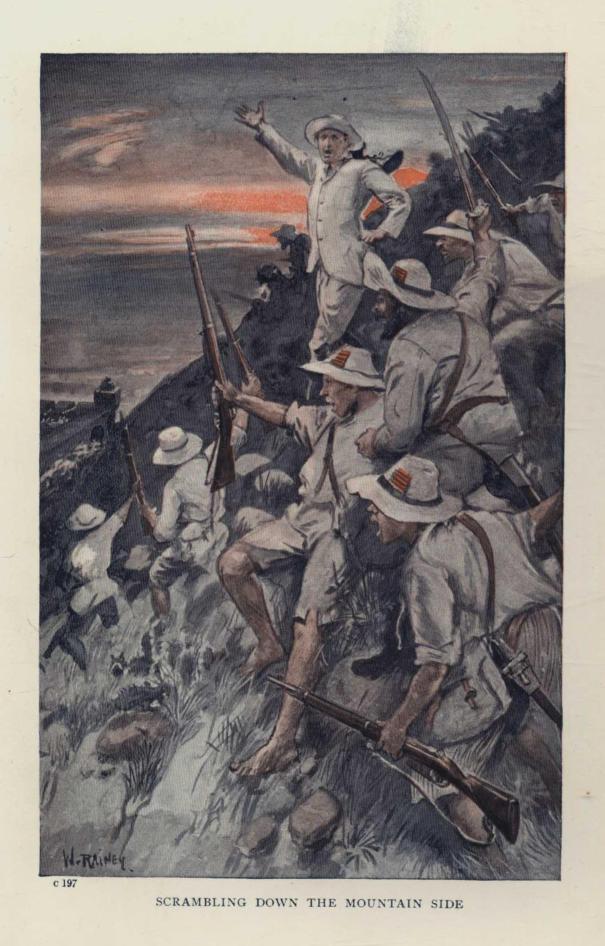
SCRAMBLING DOWN THE MOUNTAIN SIDE
My aunt! that was fun, if you like. I went across to the left and began halloaing; the officers began shouting, 'Viva los Horizontales!' and before I could say 'Jack Robinson' the whole of those little brown chaps and I were scrambling down the mountain-side straight for San Sebastian, yelling blue murder.
My old boots were knocking up against each other and against my back, but I jammed Gerald's polo hat firmly on and slid and scrambled, and ran and slid again. The field-guns fired once or twice, there was an appalling triumphant shrieking noise behind me—you couldn't call it a cheer, it was much too savage for that—and Gerald was right. Zorilla's infantry could not stand the torrent of brown forest-men dashing down the mountain-side on top of them, and, just as I was wishing that I had a stick or a stone—anything, in fact—in my hand, they fired a volley and began running and racing back to the town and behind the walls of San Sebastian.
The mule-drivers unhitched the mules from the guns and galloped madly along after them—helter-skelter—dodging behind the walls, and then streaming along the road towards the city itself.
We were after them like smoke, and just as some of them dashed across the drawbridge and tried to close the heavy iron doors, we rushed in.
They didn't show fight, I should think they didn't; it was only the backs of them we saw as they tumbled over themselves to escape, throwing away their rifles and clambering through the embrasures of those saluting guns.
Well, that was how I paid my second visit to San Sebastian—a bit of a change from my first visit, wasn't it?
I dashed out again to help Gerald and, as I turned round the walls, along he came and old Zorilla with him. The poor old chap was mopping some blood off his forehead, and though he did look so forlorn he bowed to me in quite a friendly way. I gave his hand a jolly good hard grip.
It turned out that only a very few of his men round those guns had made any stand, and that Gerald had simply swept through them, driven them back under the walls of the fort, and the old man had surrendered. The little brown men were rushing like a pack of hounds after the retreating regulars, and Gerald's officers were trying to stop them. They did manage to bring some back, but couldn't stop the rest, who went careering along towards Santa Cruz, till fifty or sixty regulars, braver than the others, or perhaps unable to run any farther, faced round, formed up across the road, and began firing at them, when back they came grinning and smiling like spaniels who have been ranging too far ahead and know they deserve a hiding. A lot of them scrambled up the mountain-side to fetch their beloved boots, which they had dropped before they began charging down.
'The revolution is finished,' Gerald said quite quietly, and began loading his pipe; but his fingers shook a little, and I knew that he was fearfully excited, although he did his best to conceal the fact. He had the field-guns brought into the fort, and stuck them through some vacant embrasures, where they could command the road leading down to the city. Then he began to get his chaps into some kind of order again.
'Would you like to hoist the flag, Billums? You can if you like,' he said; and you bet I would. Some one—the 'Gnome' it was—brought along a roll of black and green bunting; we climbed up to the flagstaff on top of the walls, and hitching it to the halyards I hauled it up, hand over hand. You should have seen Gerald's chaps yelling and dancing about, and heard them shouting, 'Viva de Costa!' 'Viva los Horizontals!' and 'Viva Don Geraldio!' I need hardly tell you which were the loudest shouts, but old Gerald never moved a muscle, and took them all as a matter of course.
I stood on top of the wall and smiled down on them, and never had had a jollier spree. It was quite light now—a most beautiful calm morning, the air crisp and fresh—and the top edge of the ridge we'd just climbed down was a rosy red.
Whatever the weather had been it wouldn't have made much difference to me; I felt simply glorious, and thought of old Ginger, down aboard the Hercules, keeping his morning watch and trying to prevent the men from making too much noise over the Captain's head and waking him.
It was grand to be alive! I managed to get on my boots, though they wouldn't go on over my socks, then I took my coat off and shook some of the water out of it, for I was still as wet as a rat. Any number of weird noises were coming up from the city.
'They'll come and attack us, I suppose; won't they?' I asked Gerald, but he only smiled and said something to General Zorilla, who smiled too, rather sadly, and shook his head.
Then I thought of that room place with the barred iron door where I'd been shut up, and took Gerald over to have a good look at it, but he'd had it opened already, and quite a number of 'plain clothes' people were standing about, not quite knowing what to do, but highly delighted with themselves. They had just been released. I showed him those three graves, although they were not very distinct now as grass had already grown over them. It was a happy time if you like, and I was getting more hungry every second.
Half an hour later a carriage came driving furiously up the road towards San Sebastian, and two civilians and an officer jumped down. They came up very humbly to Gerald and spoke to him. I knew their news was good, because Gerald's face twitched so much, and directly he called out something in Spanish, every one inside and outside the fort began shouting and yelling with delight.
'Canilla has vanished,' he told me; 'the place is empty, and they're going to hoist the black and green flag over the cathedral tower as soon as they've sewn one together.'