ON FOREIGN SERVICE (continued 4)
Reading edition
Every one who came along I half expected to be he, and little José, I think, did so too, standing close to Gerald, just like a cat, with a machete in his hand. Gerald saw it once, and made him throw it away, but he picked it up again when Gerald wasn't looking.
The 'Gnome' appeared from somewhere, and I saw that my brother was very glad to see him—he came across to me, and we bowed, and I squeezed his hand. He was sent away along that stream with some men he'd brought. 'Come and finish our game of billiards, Billums,' Gerald sang out. Honestly I don't know whether he was showing off, or was nervous, or whether he did really want to finish it, but we heard a heavy carriage splashing through that stream, and the new President—de Costa himself—appeared. They both went into the Casino and, I was thankful to see, into an upstairs room, where they couldn't be shot at. I went with them and sat down in a chair—their voices seemed to be floating away somewhere—and the next I know was that little José was pulling at my sleeve, it was just getting light, very heavy firing was going on close by, yells and shrieks were coming from the forest, and men were running noisily along the road beneath the window. Gerald wasn't there.
I sprang up and followed José. The Casino was empty, and, as I dashed out, a window, above me, broke and fell in little pieces at my feet. I heard bullets flying everywhere.
I looked down towards the stream, and people were lying on the road, beyond the ford, firing in our direction. José pulled me back behind the Casino, and we ran along the shore, waded through the stream as it flowed over the sands, and got behind our people. Gerald wasn't there either, only the 'Gnome,' in his big hat, waddling backwards and forwards.
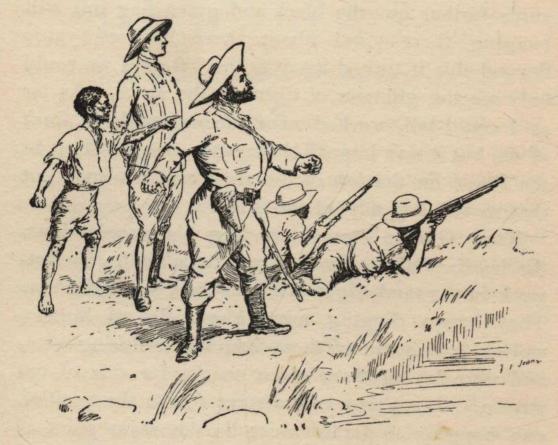
William Wilson and the Gnome
'Geraldio? Don Geraldio?' I asked, and he stopped a moment to point away up stream.
He was trying to stop the shooting, because there was nobody in sight, although bullets were flying past all the time, and very heavy firing was going on further inland. He managed to stop it presently, and then I had time to look round.
Just across the stream was the little wall under which the ex-policeman had been sitting last night. It enclosed the garden of a small bungalow, and one side of it ran along the road, and the other along the stream. It was light enough for me to see the road running up to the Casino, about a hundred and fifty yards further on—the black and green flag was still hanging there—and about three hundred yards beyond this it turned away to the left, and we could only see the glimmer of light on the water. As far as I could tell, we had none of our people in front of us, but it was impossible to make out anything in the forest, on the left of the road, and it turned out that we still had a lot of chaps there.
The 'Gnome' was extending his people down the beach, making them scrape up a kind of breastwork in the sand, right down to the edge of the sea. They began digging away like a lot of hungry wolves, and some of them had found fishing nets, and were laying them down on the far side of the stream. I suppose one always thinks the position one happens to be in must be the main point of attack, and I wished to goodness that Gerald would come along, for I didn't like the way the chaps lying in the road kept looking back. I guessed that what Gerald had expected last night had happened, and that Zorilla had turned at last, and thought what a grand old chap he must be, after all his bad luck, to be able to make his disheartened, half-starved troops attack us.
CHAPTER X
The Fight round the Casino
Written by Sub-Lieutenant William Wilson, R.N.
Well, if Zorilla intended to try and cut his way past us into San Fernando, I'd learnt enough about the old man to know that it would be jolly hard work to stop him, and it struck me that the little chaps, on each side of me, were not placed in a very good position to defend the road and the beach, and that the 'Gnome,' however plucky a chap he was, did not seem at all certain what to do.
The good sleep which I had had must have cleared my brain. Whatever was the cause, I seemed to realise, all at once, exactly what ought to be done. Of course I was tremendously excited, but I tried to calm myself by imagining that this was only a sham-fight, and to think what would be the natural thing to do.
It was all very well to make our little chaps lie down behind the ford and behind the stream where it trickled down the beach, but, however deep it was farther inland, it was so shallow here that it hardly covered one's boots and wouldn't stop a cat. To stop where we were, and leave that bungalow garden wall, on the enemy's side, unoccupied, was perfectly silly, and I looked about to see if there was not something we could use to barricade the road itself.
I saw those empty wagons standing in front of the Casino, and knew that if we only pulled them across the road and put some of our chaps behind them, it would be grand.
First of all, for that bungalow wall, I thought, and, almost before I knew what I was doing, I found myself dashing across the stream, and looking over it to see if it would be any use to make the little chaps fire over it. But for the giant palms and ferns, in the garden, I could see right along the road, and fellows behind it could easily sweep the road with rifle-fire. I called José, and he came, then the 'Gnome' came, stood on tip-toe, looked over, and knew exactly what I meant. I seized a machete, jumped over the wall, and began lopping down the palms, and in a minute he'd sent thirty or forty chaps to help me, and began bringing riflemen over to line the wall—he made some climb on the roof of the bungalow, too, where they could get even a better field of fire.
Now for those wagons, I thought, and began trotting down the road towards the Casino, hoping that the others would come along as well, but only José panted after me, singing out 'No, no!'
'No, Señor, no!' the Gnome shouted, but I wasn't going back, for another idea came to me. How about the top of the Casino itself?
I got up to the Casino, dashed in, and ran upstairs—I knew that there must be a way to the roof, as there were railings all round it, and it was flat. I found a staircase leading up there, and was on top in a jiffy, José following me and pulling me down to my knees, because, directly my head had shown above the railings, there were yells from the edge of the forest, and bullets came splattering against the house. I wriggled myself to the edge and looked down, really only wanting to see whether it commanded the road properly, but—my eye!—beyond that corner, three hundred yards further along, collecting there, as far back as I could see, were hundreds of cavalry, and the woods were thick with infantry.
I beckoned to José, and he crawled across and looked too; his face got almost white when he saw what I had seen.
I heard the people at the ford opening fire. 'Señor! Señor!' José cried, and pointed down into the road at our feet, and I saw there, right below us, twenty or thirty regulars streaming across the road from the forest to the front of the Casino—the leading ones were already springing up the steps.
We were down off that roof like redshanks, and as we got down to the first floor we heard them clambering up the main staircase. We raced down the corridor and saw the first of them. They saw us and yelled. I fired my revolver in their faces and dashed into a back bedroom, José slamming the door behind us. I knew there was a verandah outside, and we jumped out, swarmed down a supporting pillar—like monkeys—and swung off back along the beach, the soldiers firing at us from the verandah we'd just left. I split one of the knees of my riding breeches, I ran so fast.
I didn't run so fast entirely on account of those bullets, but because I wanted to let the 'Gnome' know what I had seen round that corner. José told him, pointing up the road.
They had commenced firing at us now from the Casino; one of our chaps kneeling in the road dropped his rifle and fell backwards, the 'Gnome's' big hat spun round and fell on the ground. He picked it up, put a finger through a bullet-hole, and stuck it on again. He didn't look frightened, but muddled—he didn't seem to know what to do.
My aunt! it was all clear enough to me—now.
All that heavy firing, away on the left, where my brother had gone, was merely Zorilla's bluff, just a piece with his pretending to fall back on El Castellar, in the night, and he meant to make his real attack along the road. As soon as his cavalry were ready he'd launch them along the beach and across the ford, and simply gallop into San Fernando, clearing the way for his infantry.
Oh, why wouldn't Gerald come and tell us what to do!
'Geraldio! Don Geraldio!' I shouted to José, pushing him to the left, and he understood, and bolted along the edge of the stream in among the trees where our little men were swarming.
We couldn't stay where we were, for the regulars simply rested their rifles on the verandah and the window ledges and fired point-blank at us. Several of our chaps, lying across the road, had been hit already, and although the 'Gnome' brought more men and made them form a double line, with fixed bayonets, ready to spring to their knees directly they were wanted, they were terrified and kept turning to look backwards. Every second I expected to see the cavalry come thundering round that bend in the road, and I knew that we couldn't possibly stop them. Our own chaps behind the low wall were certainly potting at the regulars in the Casino, but they didn't even aim properly, they were too frightened, simply popping up over the wall and firing haphazard.
Three more of our men were hit, the 'Gnome' couldn't make any more fill their places, and I knew that, in a few minutes, those who were there would creep back among the trees. The 'Gnome' stood in the middle of the road, behind them, one hand on his sword-hilt and the other on his revolver holster, as brave as a lion, but I could see that he hadn't an idea what to do.
I knew, I knew well enough, that we couldn't stop the cavalry, but if we could only capture the Casino and occupy that flat roof before they charged, we might possibly check the advance of his infantry till Gerald came back. I couldn't explain all this to the 'Gnome,' who stood there looking stupid, with bullets flicking all round him.
Oh, why wouldn't Gerald come and lead them!—I couldn't.
I heard the sound of a horse galloping towards us—from behind—from San Fernando way. Some one in white was coming along as hard as his horse could go. Gerald at last, I thought, and my heart thumped with joy, but it wasn't, it was Seymour. As he leapt off his horse it fell in the road, dead, and before it had finished shuddering, half-a-dozen chaps were fighting to take cover behind it.
'For God's sake, help!' I said, jumping towards him. 'Zorilla's cavalry is all round that bend—the woods are full of his infantry—they're firing at us from the windows of the Casino, and I can't make a soul understand.'
'Where's your brother?' he said, out of breath.
'Over to the left—there's been very heavy firing there—I've sent to tell him.'
'I've come on to tell him there's a pom-pom coming along the road—Jones and Richardson are bringing it—it will be here in half an hour.'
Half an hour! Good God! In half an hour all would be over.
'We must capture the Casino,' I said, trembling with despair. 'They've only about twenty men there at present. Tell him—tell that chap,' pointing to the 'Gnome', who was kicking and cuffing some of the little men, squirming on their bellies and fighting each other to get behind two dead men who lay in the road.
'Right you are, old chap,' and Seymour shouted to him.
I saw his face clear, he dashed off, and in a couple of minutes had got hold of some men—those who were lining the beach—harangued them, and then we all rushed along the shore to the Casino. We were hidden, a little, by that bungalow and the garden, but I saw several hit before we got into the open, and then a dozen fell. Seymour was in front of me with a machete in his hand, I was a good second, and the 'Gnome' and thirty or forty natives were close behind us. We poured over the verandah into the billiard-room, but not a sign of any one was there, and all the regulars were upstairs. Seymour yelled something, and some of our fellows began firing up through the ceiling, bringing the plaster down in clouds. I and some others dashed for the main staircase, but, at the top, the regulars were gathered, and were firing down.
It was the most appalling din—rifles firing, mirrors and glasses smashing, and wood-work splintering all round us. Our men wouldn't face the stairs.
'There's a back staircase,' I heard Seymour yell, and I went after him. We clattered up and burst on those chaps from the rear. There was a scuffle, Seymour shouted down for our people to stop firing, and in five minutes there wasn't a living regular in the house. Most of them had escaped by sliding down from the verandah, and had run back into the forest again, shooting at any one who went near a window.
'On the roof!' I heard Seymour shouting, and rushed back to find him leaning on the banisters—the excited little brown men, thirsting for more blood, crowding up the stairs, past him. He looked awfully white.
'What's the matter?' I yelled.
'Shot through the stomach—make these chaps line the roof.'
I saw the 'Gnome' dashing from room to room, placing his men at the windows, and I rushed up to the roof, pushing all the chaps in front of me, and made them lie down along the four edges, shoulder to shoulder with their rifles pointing over the concrete ledge—across the beach at the rear of the house, back towards the stream where Seymour's dead horse was lying, across the road in front of the Casino, and, on the fourth side, right along the road and round that bend in it. The cavalry men were still clustered there, and they were so numerous that I couldn't see the end of them among the trees; some were dismounted, so that Zorilla evidently was not ready yet.
'Fire! Fire!' I yelled, pointing towards them, but the little chaps seemed numbed and frightened at the sight of them and wouldn't fire. I suppose they were overawed by the sight of the cavalry, or perhaps they knew there would be no escape from that house if Zorilla's people won, and feared to anger them. Perhaps, too, as no bullets were coming at them they didn't want to draw their fire. Whatever it was I couldn't get them to shoot, so I seized a man's rifle, kicked him out of the way—pulled back the bolt to see if it was loaded—leant it against the edge, aimed right in among the cavalry, and fired. I saw a horse fall down in a heap, and his rider extricate himself, looking this way and that to see where the bullet had come from. I fired again and again—there was a stir among them—the little chaps on either side of me bucked up and began to let off their rifles—the cavalry began fidgeting, crowding and jostling together—more horses fell—there was a sudden turning of the horses' heads, and they all began to retire. My little chaps squealed with delight, the little fellow whose rifle I'd bagged, seized it, imploring me with his black eyes to let him have a turn, and I crawled away, breathing freely again, for the cavalry had all retired behind the next bend in the road, and I knew that they were not yet ready to charge. But we had drawn a tremendous fire from the infantry in the woods, and we could not see any one to aim at.
Then I thought of Seymour, and jumped down the stairs to see what I could do for him. He was still leaning on the banisters—deadly pale. 'The cavalry have retired. We've time for a breather. Show me where you are hit.'
He pointed just below the middle of his stomach, and I knew what was the only thing I could do, for Dr. Clegg had been teaching us 'first aid' ever since we left Gibraltar. I tore a sheet off a bed, tore it in strips, and wound them round his stomach as tightly as I could. 'For God's sake, fetch me a drink,' he gasped, but Dr. Clegg had said: 'If any of you get shot through the stomach, throw your water-bottle and biscuits away and lie down. It's your only chance.'
'No, not a drop!' I said, and wanted him to lie down—he wouldn't. 'I'll go on the roof. I can help there.'
I carried him up, very gently, and laid him down in the middle—with the little men's naked feet and their yellow soles and toes all round him. I got a mattress, too, and made him lie on it.
'I can just see that bend in the road,' he said; 'I can manage all right; get those wagons across the road.'
I had forgotten them. I ran below, slipped on the stairs—they were wet with blood—steadied myself, and got down to the ground floor. The 'Gnome' was there, tying a table-napkin round the arm of a native. He smiled at me.
'Wagons!' I shouted, pointing through the doorway to where they stood. He knew what I meant, dropped the napkin, roared to his men, and they began pouring out from the lower rooms. We ran across the road under a very heavy fire, got hold of the wheels of one, and, shoving for all we were worth, pushed it into the middle of the road. The man next me fell, shrieking, and clutched my feet; I shook him off, and we rushed back for another wagon, and were just getting a 'move' on it when I heard yells of 'Yuesencia! Yuesencia!' The little chaps on the roof who were lining that side of the Casino began shouting, 'Don Geraldio! Don Geraldio!' and I saw Gerald galloping up to the ford and the few men who still lined that garden wall. I shouted out 'Hurrah!' we all shouted, and then came a roaring noise from the road, the clatter of horses' hoofs, and round the bend thundered the cavalry. They were coming along the beach too, their lances and pennons lowered—and my fellows on the roof began firing like 'billy loo.'
'One more push—shove altogether!' I yelled. The front wheels were on the road, but the rear ones stuck fast, and the 'Gnome' and his men dashed back to the Casino.
Before I could follow them, Zorilla's cavalry were on top of me. I dodged to the rear of the first wagon as they swept round it. Over it went, there was a jumble of horses and men, and I was dashed to the ground, my right leg jammed down by a horse. Troopers tried to cut at me or get me with their lances, but they were swept along by those coming behind them. The horse which was pinning me down half struggled to its feet, I drew my leg away, and huddled under the wagon as they thundered along the road to the ford.
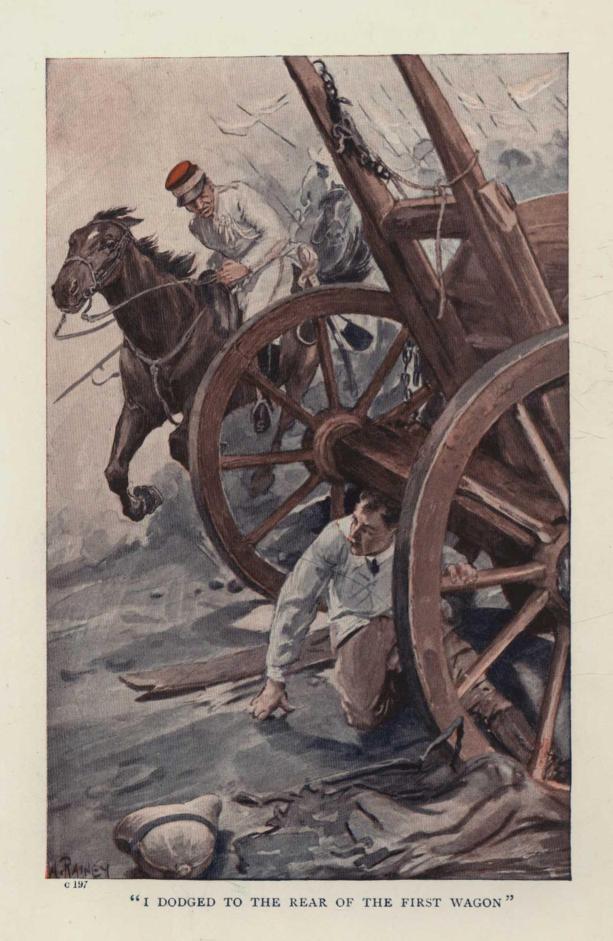
"I DODGED TO THE REAR OF THE FIRST WAGON"
I'd been knocked a bit 'silly,' and the next I know I was hobbling up the stairs to the roof with my right leg giving me 'gyp,' and the little brown chaps firing like mad.
'Look! Look!' Seymour cried, leaning on his elbows and pointing towards San Fernando.
Oh! My God! The cavalry had swept clean across the stream and were dashing madly along the road and beach, but behind them they left a trail of dead and wounded men and horses. I saw some riderless horses dashing backwards and forwards, and then had to lie down because the firing was so heavy. I hadn't seen Gerald, and there seemed to be no one alive at the ford.
'The infantry are advancing now,' Seymour told me, but it was that cloud of cavalry galloping towards San Fernando that I couldn't take my eyes off—there must have been five hundred of them, and we could hear the noise they made though they were a mile away.
'D'you hear that?' Seymour cried; 'Jones and Richardson have started firing.'
Hear! Why, I jumped to my feet and yelled with delight, for the 'pom—pom—pom—pom,' 'pom—pom—pom,' 'pom—pom—pom' and the 'crack—crack—crack' of the little one-pound shells bursting, told me what had happened.
'Keep down, you fool!' Seymour shouted. Bullets were shrieking past, chipping against the concrete every second, and Zorilla's infantry were coming down the road and through the trees, in close order, sweeping past the Casino towards the ford.
My aunt! how we shot! I'd never heard any noise like the noise of the firing that went on then, and I wonder, now, how many of those rifles were properly aimed.
The Casino seemed to be trembling and shaking, my little chaps began scrambling in the bottom of their bags for cartridges, and I knew that they were running short of ammunition, but then they began shrieking with joy, because the infantry couldn't stand the fire from Gerald's chaps along the stream, and we saw them dodging back again from tree to tree, and clearing away from the road—a tall gaunt officer, on horseback, trying to stem the retreat and turn them round again.
Even at that distance I recognised him. It was General Zorilla, but he couldn't make them face the stream again, and they swept past him out of sight.
'The cavalry are broken!' Seymour cried joyfully, and, turning my head, I saw them coming back again, the pom-pom shells knocking up little spurts of dust and smoke among them, and some of Gerald's people at the side of the road firing point-blank at them. They were having an awful time, horses and men coming down every second, and as a horse fell, it brought down others behind it, in a heap of struggling bodies and legs, the little white-shirted men darting out from the trees with their machetes to kill the wretched troopers before they could get to their feet.
Those still on horseback came nearer and nearer, the leading ones were almost up to the ford, and I could see them lying down on their horses' necks, their arms raised in front of their heads, as Gerald's people crowded to the side of the road to fire at them; they burst through the stream and came flying past the front of the Casino, many horses riderless, their flanks streaming with blood from sharp spurs, and their blood-shot eyes almost sticking out of their heads. We could hear the sobbing noise they made in their distress—poor brutes, they were absolutely foundered.
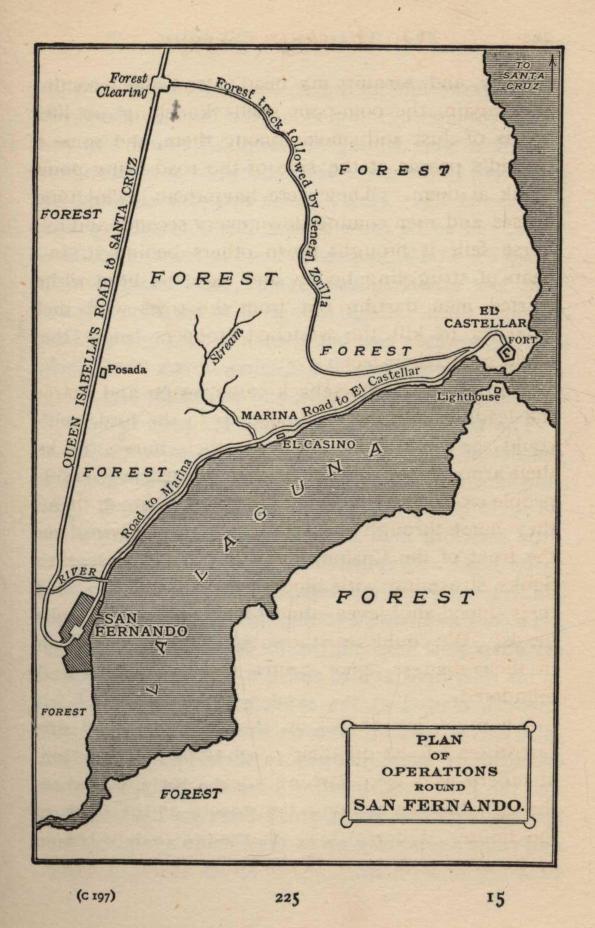
PLAN OF OPERATIONS ROUND SAN FERNANDO.
Those of my chaps, on the roof, who had any cartridges left let off their rifles at them again, and at others who were lashing their poor tired brutes through the sand, along the beach, at the back of the house. I don't think that more than a couple of hundred got back beyond that bend in safety. One, a powerful-looking native, half-nigger, was the last to come struggling along the beach. Hundreds of bullets were hitting the sand all round him and splashing in the water beyond, but he seemed to bear a charmed life. He'd thrown away his rifle and his lance, and as he came to that line of Gerald's people across the beach, he put his hand in front of his face, bent low over his horse's neck, and charged right through them. I felt jolly glad to see him safe and coming towards us, but then one of my own little chaps ran out from the Casino, down the beach, knelt down, raised his rifle, and waited for him.
The trooper saw him, struck his poor beast with the flat of his sword, and made one gallant effort to ride him down, but the horse was so exhausted that he could hardly raise a trot in that loose sand. The little kneeling man fired, and the horse plunged on to its head and rolled over, the trooper slipping to his feet and jumping clear. With a yell he grabbed his sword and rushed at the little man, and I thought my chap was finished, but he had another cartridge in his rifle, fired again, and the big trooper slithered forward, clawed at the sand, and was dead. I felt jolly sorry, but the men on the roof, watching with bloodthirsty eyes, jumped to their feet and yelled, and the little man, bending over the body, pulled off the big trooper's boots, stuck them on his own feet, and came awkwardly up to the Casino again, his face beaming with pride.
I felt rather sick, and looked round. Seymour was on his knees.
'We've won,' he cried, with a wild look in his eyes. 'I've done my bit, too.' He raised himself to his feet, and would have fallen if I hadn't caught him and lowered him on his mattress.
I heard shouts of 'Don Geraldio!' 'Viva los Horizontals!' and looking over into the road, saw dear old Gerald stalking along smoking his pipe, making big strides over dead men and horses, and José, in his red sash, leading his horse behind him. I ran down to meet him as he came up the steps.
'We've won, Gerald!' I sang out.
'You've made a beastly mess of the Casino, Billums; I hope no one has collared the mater's bag,' was the only thing he said.
Well, that finished the 'Two Days' Fight' as it was called; Gerald's chaps were too worn out and too short of ammunition to follow Zorilla immediately, and gave him time to withdraw, with the remnant of his people, along the road to El Castellar.
Jones and Richardson came along presently with their two pom-poms and five or six hundred riflemen they had brought from San Fernando. They were awfully full of 'buck.'
'We frightened those cavalry chaps with our shells, and these little brownies stopped them with their rifles,' they told us, as we all carried Seymour down from the roof and put him in his buggy, which turned up from somewhere or other.
They took him back—very slowly and gently—to San Fernando, and intended to take him on board the Hector.
'Thank God, you came!' I said. 'You were just in time.'
He smiled wildly, wanted to say something, but didn't, and was taken away.
And now came the saddest of all things, for the wounded began to creep out of the forest and make their way to the Casino or be carried there—hundreds of them—and there wasn't a piece of lint or a bandage in the place. They simply squatted down and waited—for what I don't know. I got a good many of them water from the Casino well, and they were very grateful, but I couldn't do anything else.
I missed Gerald, went in search of him in the Casino, heard the noise of splashing water, and found him having a cold bath, José standing by to rub him down.
'Only thing which keeps me awake, Billums,' he laughed. 'I've given my chaps a couple of hours' sleep, and shall follow Zorilla as soon as those field-guns you took into San Fernando come along. I've sent for them.'
'They don't seem to be going to sleep yet,' I said, for there was any amount of noise outside and shouting of 'Viva Don Geraldio! Viva los Inglesas!'
'They want me, I expect,' he said; 'chuck us a towel, Billums,' and, winding it round him, he went out. He still had a nasty scar on the right arm—where that bit of shell had hit him a month ago.
'Tidy your yellow mop a bit,' I sang out, 'it's all over your eyes,' so he smoothed it back and went out on the balcony overlooking the road.
My aunt! there must have been thousands of the little brown men and their black-bearded officers there, and they made a tremendous noise, shouting, 'Viva Yuesencia Don Geraldio!'
I was looking out from behind a door, and you bet I was proud of old Gerald. Wouldn't the mater have just loved to see him there, the only white-skinned chap among them, and wouldn't the old pater have grinned and chuckled to think he'd been the father of him. I could just imagine him patting Gerald's naked shoulder and tipping him a sovereign.
There were more yells.
'Come out, Billums, they want you!'
I went cold all over.
'Come out, you ass! Take your hat off too—let 'em see your straw thatching.'
I went and stood beside him, and it was the proudest thing that ever happened to me; it was nothing but a sea of brown heads and white hats, rifles and bayonets, and then they yelled and waved their hats—even those of the wounded who could stand, stood up and shouted, 'Viva los Hermanos!'[#]
[#] Hermanos = brothers.
When the noises stopped a bit, I sang out, 'Gracias! Gracias! Muchas Gracias!'—about the only Spanish words I knew. They cheered more than ever.
'Quite effective show, that,' Gerald smiled cynically, as he went back to dress, 'you and I standing there by the side of the insurgent flag. They love anything like that.'
I hadn't really noticed the flag—I'd been much too nervous.
'That little fiend of yours tried his tricks on again last night, tried to knife me,' he said presently.
'And you killed him?'
'I took away his knife and boxed his ears,' he told me, lighting his pipe with one of my last matches. 'It's a treat to get a decent match, Billums, I hate those "stinkerados"[#] we get in this confounded country.'
[#] 'Stinkerados' is a term applied to the ordinary foul-smelling Spanish sulphur matches.
'Confounded country!' I answered angrily. 'You seem to be risking a good deal for it. I wished to goodness you'd killed the beast."
'My dear Billums, I'd fight on either side so long as I could get a bit of excitement—so long as I could boss the show.'
'I wish to goodness I could chip in with you,' I told him. 'I don't even boss the gun-room—not properly, the Commander thinks.' Oh, bother the Hector! I remembered that my leave was up at noon. 'Bother it all, Gerald, I've got to keep the "afternoon" watch, and see that a boat doesn't shove off with the fenders over its side, and listen respectfully whilst the Commander bellows at me that a man hasn't got his chin-stay down, and that I'm an incompetent, useless fool. It's nearly ten o'clock now and I must be off.'
He got me a horse, and I left him, his worn-out little brown chaps, and his wounded, and shoved off back to San Fernando, galloping along the beach, and learnt then what an unsuccessful cavalry charge meant; for the shore was strewn with dead and dying horses, dead men, rifles, swords, lances, and, more conspicuous than anything else, the red blankets they'd thrown away in their retreat. The tide, too, had risen and was half covering some of the bodies with sand, as if it wanted to hide the horrid sight and wipe out all traces of that awful morning's work.
I was looking about me for something to take back for the mater, and had passed any number of ordinary swords, which were not worth the trouble of dismounting, but at last saw one with a very elaborate hilt and sword-knot, lying close to a body stretched face downwards in the sand, so jumped off and picked it up. The uniform on the body was that of an officer, and out of curiosity I turned the head round with my foot. Ugh! It was Zorilla's black A.D.C., the chap who had been so impressed with our after 9.2 gun that day we anchored off Los Angelos. I scrambled back into the saddle with his sword and rode on, shuddering and thinking a lot of things which I couldn't write down, without you laughing at me.
Presently, as I got a bit more chirpy, and began looking round again, I saw a little chap trudging along ahead of me, splashing through the edge of the sea where the sand was firmer. Something about him seemed familiar, and as I overtook him he looked round, gave a yelp of fright, and bolted, drawing a machete out of his belt. It was the little brute, and I dug my heels into the horse and was after him like a shot. I simply rode him down—he couldn't run fast in the loose sand—and at last turned, holding up the machete to protect himself. I was jolly glad that he'd lost his revolver, for I had lost mine somewhere. I meant to kill him, and I saw that he knew it, and that he couldn't be springy on his feet in the sand, and struck at him for all I was worth with the A.D.C.'s sword, meaning to beat down his guard and get at his head, but the horse swerved when he saw the sword flash, and the blade only came down on the back of the hand which held the machete and lopped the fingers clean off, the machete falling down. I wrenched the horse round and went at him again, and was just going to finish him when, I'm sorry to say, something inside me wouldn't let me kill him now that he couldn't defend himself, and, like the ass I am,—how I cursed myself for it afterwards—I jumped off and tried to stop the bleeding. He thought me a fool, I know, and so I was.
Then I made him step out alongside me, and was so angry with myself for being so soft-hearted that I prodded him in the back when he wouldn't go fast enough.
But the miserable brute, with his bleeding stumps, was nearly dead with fright and could hardly put one foot in front of another, so at last I swung him up in front of me, and took him into San Fernando like that, riding up to the Cuartel de Infanteria, where a 'red-cross' flag was flying, and handing him over to the people there, trying to explain that he was a prisoner.
My Christopher! the look he gave me when I went away!
I left my horse at the barracks, walked down to the shore, stood on that jetty, and waved my arms about till one of the Hector's signalmen spotted me, and the skiff was sent in to take me off.
I had just time to change into uniform, and get a bit of grub in the gun-room, before the 'Forlorn Hope,' who'd kept the 'Forenoon' watch and wanted his lunch, sent down an indignant message to know when I was going to relieve him, so up I went, buckling on my sword-belt, and tramped up and down the quarterdeck for four hours. I'm certain that I could never have stopped awake had not Cousin Bob, the 'Angel,' and young Marchant walked alongside me and made me tell them all that had happened ashore.
When I went down below again, I showed the black A.D.C.'s sword to Navarro, and told him, as well as I could, all that had happened. He was very depressed, chiefly because he was so fond of old Zorilla, but didn't seem to worry in the least about the black A.D.C., and made me keep the sword.
He shrugged his shoulders when I told him about not killing that little ex-policeman, and said, 'Till he die he always make revenge,' which made me think myself more of an ass than ever for not having killed him when I had the chance.
CHAPTER XI
San Fernando attacked from the Sea
Written by Captain Grattan, R.N.
Much to my relief, young Wilson came off in time to keep his afternoon watch, none the worse for his extremely exciting forty-eight hours' leave, and directly he had told me that all fighting had ceased, I sent Watson, my Fleet Surgeon, and my young Surgeon, Clegg, ashore to help patch up the wounded, giving them as many chaps as they wanted to take to help them, and writing a polite note to the New President's Secretary informing him of the fact. I knew that every doctor would be wanted, because the fighting had been very severe and all that morning we had seen streams of wounded men dragging themselves back from Marina along the road by the sea. Already one Englishman, a man named Seymour, had been brought off to the ship, badly wounded, but he died as he was being hoisted on board, so his friends took the body ashore again.
I went ashore, myself, soon afterwards, and found everybody at the Club. A cheery lot of chaps they were, in spite of their pal's death, and when the little Secretary, who had heard that I had come ashore and followed me there, bowed himself in half and said, 'The President is much gratitude for the guns,' they yelled with delight.
'The hydraulic machinery you brought from Princes' Town,' they roared. 'We couldn't have managed without it—just came in the nick of time,' and then bundled my little friend into the next room. They told me that the whole of General Zorilla's artillery had been captured, and, before I went back to the ship, drove me down to have a look at it—four field-guns of French manufacture, four English field-guns, and two 4.7's on field carriages.
'Those English guns don't seem to have done much work,' I suggested, screwing my eyeglass in very hard, 'do they?' and they explained that they'd been busy polishing them up ever since they'd been brought in—that was why they looked so new.
It struck me that, now the insurgents—or I suppose I should say Gerald Wilson—possessed all these guns and had knocked Zorilla so hopelessly, they had only to capture El Castellar to make themselves safe from the Santa Cruz Navy. Once they had captured it, the guns there would prevent any cruisers passing through the narrow entrance, and they could sit still and wait till that big cruiser, La Buena Presidente, came along and made them masters of the sea.
I told my friends, the Englishmen, about that little 'accident' down at El Castellar with our 9.2, and they were highly amused—everything seemed to amuse them that day. A most cheery lot they were, and when I wished them good-bye, before getting into my boat, and asked them what they actually had done with the hydraulic machinery I had brought them, they were more amused than ever, and I left them enjoying some little joke they had.
Old 'Spats' sent me a wireless signal from the Hercules next day to tell me that La Buena Presidente, flying the black and green flag, had put into Madeira to coal, but had been refused permission. If that was the case, she'd have a good deal of trouble to arrange for colliers to meet her at sea, and it might be many weeks before she arrived here.
Things went along remarkably peaceably for the next few days, my two doctors were up to their necks in work ashore, and hardly had time to come aboard and ask after my gout, and we heard that Gerald Wilson had driven Zorilla and his army into El Castellar and was investing it.
Then, one fine morning, along came the whole of the Santa Cruz fleet, cruisers, gunboats, and torpedo-boats, escorting half-a-dozen tramp-steamers filled with troops.
They anchored close to El Castellar—we could see their smoke plainly enough—and began firing—shelling Wilson's trenches, we presumed. Of course we all thought they'd do the natural thing—land their troops there, drive off the insurgents, join hands with all that was left of Zorilla's army—about two thousand infantry—and come marching along the seashore under cover of the ships' guns. This was evidently what Wilson's brother thought, for we could see his people streaming out from San Fernando, along the road to Marina, towards El Castellan.
Well, I suppose I'm a bit of a fool, but when I was a youngster I should have been mad to have missed anything like that, so I sent for the Commander, and told him he could give leave to the mids. and as many of the officers as he could spare. Most of them were already crowding on the fore bridge and up in the fore fire-control position, trying to see the Santa Cruz ships through their telescopes, but they clambered down in a twinkling, and cleared ashore in less than half an hour.
'Don't get into mischief or there'll be the dickens to pay,' I sang out to them, and, of course, immediately afterwards regretted letting them go.
They had been gone about two hours, and we'd seen them driving or walking out towards El Castellar, when the firing ceased, and it was reported to me that the fleet and transports were standing towards us.
I went along to my spare cabin, which I had given up to fat little Navarro (Zorilla's A.D.C.) whilst he was aboard, with his broken thigh, and told him what was happening. He was very excited, and craned his neck out of his scuttle to see the advancing ships.
In an hour they were abreast the Hector, and steamed slowly past. First their flagship, the Presidente Canilla, then the still smaller cruiser, San Josef, the old-fashioned torpedo gunboat, Salvador, the rakish Estremadura, an armed steam yacht, and the Primero de Maie, looking like a Gosport ferry steamer. They were steaming at about seven knots, but even at that speed the Primero de Maie and the Salvador could not keep station. Although I had a marine guard on the quarterdeck, my fat Subaltern of Blue Marines—the Forlorn Hope—flourishing his sword, and the bugler sounding an Admiral's salute, as the flagship crawled past, she took not the slightest notice of us, and we were all intensely amused to see the officers on her fore bridge gazing everywhere except in our direction, absolutely pretending to ignore the fact that we were there at all.
When you remember that barely seven weeks ago my ship had towed the whole five of them out from behind the breakwater of Los Angelos, it was all the more funny.
They fired a few shells into the town as they went past it, not more than three hundred yards from the shore, and I wondered whether my humorous friends at the Club were laughing quite so heartily. Half a mile astern of them came the two old-fashioned French torpedo-boats and the first of the transports, crowded with blackamoors, with yellow and green stripes in their hats, hooting and hissing as they passed close to us, though their officers, standing up amidships, took off their hats and bowed to make up for their men's rudeness. I took off mine and swept it to the deck in the most approved Spanish fashion.
Three more little transports lumbered by chock-a-block with troops, and the whole armada anchored at the head of the bay, about two miles beyond the town, and immediately began lowering their boats. My Sub was terribly put out. 'I'm afraid they've caught my brother napping this time, sir,' he said to me. 'He must have rushed all his troops out there early this morning, and look, sir, you can see them hurrying back again. They'll be too late.' I proceeded to give him a little lecture on the advantages of possessing the 'Command of the Sea.' 'A very neat illustration, my boy, right in front of your eyes. Canilla moves his troops about by sea—dumps them here and there, wherever he likes, whilst your brother, uncertain where he's going to land 'em, runs his chaps off their legs, backwards and forwards.'
'It's jolly hard luck, sir,' he answered, not relishing my short course of instruction on strategy.
In half an hour we saw three or four boats crowded with troops make for the shore, saw the black ragamuffins jumping into the shallow water, scrambling up the beach and lining the top of it, whilst more boats came along from the transports. They went to and fro so rapidly that, before the insurgents could get back to San Fernando, they must have had nearly a thousand men ashore. At last some insurgents began to pour out of the town along the beach, but directly they came in view, the cruisers began to fire at them, their shells bursting right among them on the beach, and the road, and among the trees behind it. The insurgents scattered like smoke.
Presently we heard a good deal of rifle firing from the same spot, and Wilson sang out, very excitedly, 'They're still there, sir; I can see them crawling along the beach, and there are others in the woods. The regulars are firing rifles at them now, sir.'
However, regular troops were being landed in such numbers, and we could see that they had already begun to push their way towards the town so determinedly, that I thought there was every likelihood of San Fernando being captured within an hour or two, and wished to goodness I had not allowed all those officers of mine to go ashore.
I had just sent for the Commander, to see what could be done about recalling them, when suddenly two loud reports of guns fired from somewhere behind the town made me jump—they sounded so close, and were so unexpected—and two spouts of water leapt up among the anchored ships close under the bows of the Presidente Canilla. I guessed at once that they came from those two 4.7 guns I had seen ashore, and smiled to see my Sub's face brighten. We all looked through our telescopes again to see what would happen. 'Bang! Bang!' the reports knocked against our ears, the two guns had fired again, and two more water-spouts sprang up just beyond the flagship. The noise came from the back of the town, but I'm hanged if I could see the guns, though I searched the whole of that tree-covered ridge most carefully.
I turned my glass on the ships and saw that they were all in confusion, their crews running about like ants, and then a spurt of flame shot out from the fo'c'stle of the flagship, and a large shell screamed and shrieked over the town. The other cruisers began firing too, their shells dropping all over the place, but very seldom bursting. One struck a patch of swamp, and sent the mud flying up in fine style.
The two shore guns fired again, and this time I did see the thin brownish smoke for a second, but a moment later couldn't see the guns themselves.
'The flagship's got one aboard, sir!' several people shouted. She was covered with smoke for twenty or thirty seconds, but when it cleared away we could not see what damage had been done, and she still fired the big gun on her fo'c'stle and the little ones on one side of her battery. She was searching that ridge, trying to find those guns, but was making execrable shooting.
'They're going back to their boats, sir!' Wilson shouted, and turning my glass on the shore, I saw the ragamuffins hurrying down as fast as they'd scampered up half an hour ago, clustering at the edge of the water, and wading out towards the boats. I watched one boat-load pulling like blazes back to its transport, and, just as it got alongside, these two guns fired again and, simultaneously, I saw two black gaps appear in the transport's side. One spout of water sprang up on the lee side, so I knew that one shell must have gone clean through her, but the other evidently burst aboard, for smoke poured up from amidships.
These transports didn't do much waiting for boats then, they simply slipped their cables and got under way, steaming farther out from the shore—the boats pulling frantically after them.
The cruisers, too, weighed their anchors and hauled off in a hurry. In fact, they were in so much confusion, and in such a hurry, that the Estremadura, whilst trying to avoid being rammed by the flagship, ran 'slap' into the little Primero de Maie, and when they separated, we saw that her stem was twisted, and that the little gunboat had a big gap in her side. She suddenly fell over to starboard, and was so evidently sinking that I sent the Commander away in the picket-boat to help save life. By the time he'd reached her, only her one mast and the top of her funnel could be seen, and the water was thick with little black heads.
The other ships left most of the 'save life' business to the picket-boat, and steamed off, firing wildly all the time, though as we who were near could not see those two shore guns, they certainly couldn't, and hadn't a chance of hitting them.
The whole flotilla steamed very slowly along the opposite shore, waiting there a little while for their boats, but those two guns soon picked up the range again, and quickened their retreat, actually having the cheek to fire once or twice at them when the Hector was in the direct line of fire, the shells going right over my ship.
The cruisers and transports got out of range presently, and again waited for those of their boats which were still pulling desperately after them.
One wretched boat, crowded with soldiers, had taken a short cut past the town, and as it came towards us, we saw that it was under a heavy rifle-fire from the shore, bullet splashes jumping up all round it.
The men were pulling frantically, ran the boat under our side—the side away from the town—where they were safe—and stopped to take breath. I recognised the officer standing in the stern-sheets—the smart chap who had put old 'Spats' and myself into our seats in Santa Cruz Cathedral. He recognised me too, and, taking off his hat, sung out, 'Permis—sion, Yuesencia, to stay.'
'Tut! tut! boy! Stay as long as you like,' I called down, and pointed to the gangway. 'Come on board and have a drink.'
He got his boat alongside, and was up the ladder in a twinkling. I took him down below. He was very excited, and kept shrugging his shoulders and spreading out his hands.
'Nous sommes trahis—trahis! Before that we depart from Los Angelos, ze guns of ze forts make plusieurs coups—bang!—bang!—bang! We all up jump—we ask pourquoi they do so? They tell us General Zorilla has won une grande bataille—los insurrectos sont vaincus complètement—allez!—allez!—San Fernando est le votre. Nous sommes trahis—trahis! Nous arrivons à El Castellar—what we find? El General? Oui! Mais l'armée?—where is it? L'artillerie—all gone—peuf! We are brave—we advance—et quoi!' he shrugged his shoulders till I thought he'd dislocate them. 'You see what arrive—and they leave me en arrière—behind. Peuf! Nous sommes trahis!'
I tried to soothe him, praised his great courage, and sent the picket-boat, which had already brought back the few people from the sunken gunboat who had not got aboard their own ships, to tow him and his boats down to the transports. I knew that the insurgents would not fire on her when she was protected by the steamboat's White Ensign, and as we had helped them several times, we might as well do the Government troops a good turn—once in a way. Then I went ashore myself—the smoke of the gallant armada smudging the opposite side of the bay as it steamed back to El Castellar. I went ashore in uniform, too—Perkins, my First Lieutenant, coming with me, and the Comfort, my coxswain, following at a respectful distance behind.
I was doing my best to work myself into a temper, for I wanted to know what the dickens the Provisional Government and Mr. Gerald Wilson meant by firing over my ship, but I'd hardly got ashore, before Mr. Gerald Wilson came galloping past—on his way back along the coast—and I forgot about the shells over my ship, and sung out, 'Beaten 'em again! Good lad! Good lad!'
'I hope he didn't hear the "good lad" part,' I said to Perkins, as Wilson galloped on. 'Afraid I wasn't very angry with him.'
'I don't think you were,' he said, smiling. I really don't think I was.
We met hundreds of the insurgents pouring back through the town, sweating like pigs, but wild with enthusiasm at the defeat of the Government troops, shouting 'Viva los Inglesas' as they passed us on their long march back to El Castellar.
'I don't see how we helped 'em to-day,' I said to Perkins, who was hobbling along on his game leg beside me.
'Nor do I, sir, but they seem jolly pleased.'
I found de Costa and his blooming Provisional Government—they were all bows and scrapes and hand-spreading.
'I want to know how you had the confounded impertinence to fire over my ship?' was what I said to the little Secretary.
I don't know what he repeated, and for a minute there was terrible consternation among them. They all—theoretically—grovelled in the dust before me. But then they began to smile.
'His Excellency the Presidente will take you to see ze two gons,' the Secretary told me, and I think there was a twinkle in his eye.
He did take us, I, de Costa, and his Secretary driving solemnly in one carriage, Perkins and the rest of the Provisional Government crowding into another. We rattled through the lanes, along which Gerald Wilson had driven me, and stopped on top of the ridge. Here we got out, and had to tramp along it.
'You will see a sur-prise,' the Secretary bowed—I'm certain that now there was a twinkle in his eye.
We tramped along for a hundred yards or so, turned round a bit of a cocoa plantation, and there, behind a slope, was the first gun, and sitting on the top of one wheel was Bob Temple, and on the other, young Sparks—the 'Angel' they called him—both as black as my hat, swilling kola bitters,[#] whilst my young clerk, Marchant, with his hand bound up in a blood-stained handkerchief, and half-a-dozen other mids. were lying on the slope, most of them doing the same. Twenty or more ragamuffins were standing by with baskets full of more bottles of kola, and trays of pastry, and the ground was littered with empty brass cylinder cases.
[#] Kola bitters is a sweetish pink aerated water.
So it was they who'd fired over the Hector, was it! and I wished to goodness that I could look impressive and angry when I wanted to.
They'd sprung to attention when they saw me, and the only thing I could say was, 'Tut! tut! disgraceful!—go on board at once—your leave's stopped for ever—tut! tut!' and as they picked up their coats and obeyed me, I stalked away to the other gun, fifty yards farther along.
Well, the rest of my beauties were there, but I'd had time to fix my eyeglass, and had worked up a fierce glare—I can glare much more successfully behind an eyeglass.
Mr. Bostock, my Gunner, was with them, too, in plain clothes, looking very sheepish, and trying to put one foot on the ground between two brass cylinders which would roll together.
'You ought to have known better, Mr. Bostock,' I said.
'Beg you pardon, sir,' he muttered humbly, 'but it was like this. I 'appened to stroll up 'ere, arter the firing began—just to 'ave a look, sir—and I sees the young gen'l'men 'aving a bit of a spree.'
'And you helped them—you ought to be ashamed of yourself.'
'Well, sir, it was like this, sir, I didn't want the young gen'l'men to disgrace 'emselves in front of all this kittle cattle, so I just stays 'ere, sir, to see they do the drill proper, sir.'
'Well, go aboard and report yourself to the Commander. I'll see you to-morrow.'
'Viva los Inglesas! Viva la Marina Inglesa!'[#] yelled the ragamuffins, as I solemnly marched back to the carriage, and drove back, trying to avoid the eyes of de Costa and his Secretary, who were tittering and grinning delightedly.
[#] Hurrah for the English Navy.
'Hi, lad! Get in here,' I called to Marchant, as we overtook the boys from the first gun. 'What's the matter with your right hand?'
'Jammed it in the breech-block, sir. They let me do cartridge number,' he answered proudly.
'Bad?' I asked.
'One finger's nearly off, I'm afraid, sir.'
'Tut! tut!' I said. 'You won't be much use for writing, boy, not for some weeks.'
'I'm afraid not, sir—I'm very sorry, sir.'
Dear, dear! If all this got known, I knew I should get into a terrible row at the Admiralty—it was very tiresome.
When I got aboard I sent for my steward.
'How many can I ask to dinner to-night, please, Mobbs?'
'We might do eight, sir,' he allowed, after a time.
'Give my compliments to Mr. Bostock when he comes aboard, and ask him to give me the pleasure of his company at dinner to-night, the same to Mr. Marchant and the five senior midshipmen when they come aboard.'
'Very good, sir,' he said, much annoyed, 'but it won't be what we call a 'igh-class dinner, sir.'
'Tut! tut! That doesn't matter, Mobbs. We'll not grumble,' I told him, as he went away to consult the cook, scratching his head in despair.
We didn't grumble, and I made the Comfort stand behind young Marchant and cut up his meat for him—it was about the only job he was fit for—and we finished the evening in poor little Navarro's cabin trying to cheer him.
He was very down on his luck—poor little chap.
CHAPTER XII
How We fought the Four Point Sevens
Written by Midshipman Bob Temple
You must hear about that lark we had at San Fernando—the day the Santa Cruz fleet steamed up from El Castellar with the transports.
The Angel and I were perched on top of the for'ard fire-control position, watching the ships shelling Cousin Gerald's troops at the entrance, near the fort, but though we could hear the guns plainly enough, and sometimes see their flashes, the ships themselves only looked like black specks under a cloud of smoke.
Mr. Montague, the Gunnery Lieutenant, who was in the control position beneath us, kept on craning his neck round the edge of the sloping iron plate we were squatting on and singing out, 'Don't you two midshipmen fall off! You'd probably kill the Captain and make a nasty mess on the deck, so be careful.'
'Right, sir,' we sang out, and jammed our feet against one of the foremast backstays, and made ourselves as snug as sparrows on a water-spout.
'I think we should land on the shelter deck and bounce off on top of the for'ard turret, don't you?' I said, as my chum and I looked down.
'Wouldn't old "Bellows" (the Commander) be in a rage if we splodged his best enamel paint!' he said, and we jolly well knew that he'd roar out for Billums, curse him, and tell him he didn't know how to boss the 'Pigstye' (our name for the gun-room) and keep discipline.
'Try one of their caps,' the 'Angel' whispered, 'and see where it falls,' so I crouched over the edge just under which several of the mids. in the control position were crowded together, watching the ships, and whanged off two of their caps, sending them whizzing down on deck.
One fell right at old Bellows's feet.
I hadn't time to scramble back before he spotted who'd done it, and roared for me to come down at once. He was going to make me take them up again when the Captain sang out that we could all go ashore, and you should have seen all those chaps swarming down the mast to get into plain clothes.
Young Marchant wanted awfully badly to stick to the 'Angel' and me when we did get on shore, and we told him he could if he didn't talk. It was jolly kind of us, and he was awfully grateful.
There weren't any of Cousin Gerald's troops left in the town by this time, we only saw a few frightened-looking old men and women about, and not a horse or a cart was to be had—not even a mule—for love or money, so we had to start footing it, on our flat feet, out along the sea road, towards the fighting. On our way we passed the stable where General Zorilla's black horse—the one Billums had captured—was kept, and popped our heads in to see how he was going on. He hadn't been sent back to Zorilla, because that foot was still too lame to do any work.
But long before we got to Marina and the Casino, where Billums had fought that battle from the top of the roof, we saw the fleet coming along the coast towards us, and some of the insurgents coming back, too, as fast as they could.
We guessed at once what would happen, and that the regulars would be able to land long before enough insurgents gathered to prevent them doing so. We were jolly frightened.
'I wonder what's become of those two 4.7's we helped put together?' the 'Angel' said, and we both wondered, because they were the only guns Cousin Gerald had which might be of any use in driving off the fleet. We were hurrying back to the town with Marchant and a lot more mids., when an Englishman overtook us, so we called out and asked him. He pointed to the ridge behind San Fernando and galloped on.
It was awfully hot, and by the time we did get into the streets and across the square we were sweating like pigs, the leading ship was hardly a mile behind us, and though we tried to hurry along those lanes leading to the ridge, they were so crowded with women and children carrying things and looking back over their shoulders at the cruisers, that we only pushed our way along very slowly. Then a mule-cart came rattling along, the driver yelling out and driving straight through the crowd as if he were on a fire-engine.
'Come on! Let's run!' we shouted, and doubled along behind the cart. At the top of the ridge it stopped, half-a-dozen chaps, who were waiting there, pounced on it, opened the back, and lugged out some 4.7 shells. Then we knew the guns couldn't be far off.
'Come on!' we shouted. 'Here's a go!' and each got hold of a shell and tramped along after the grinning natives. We found the guns just behind the top of the ridge, dumped down our shells, and doubled back for more, meeting young Marchant staggering along with one under each arm.
We burst out laughing, because he'd shipped such a funny, excited 'death or glory' look on his face. 'Go it, young Inkslinger!' we yelled, and rushed along to the cart. Two fresh wagons had come along with some more shells and cartridge-boxes, more men too, and it was as good as a gun-room 'scrap.' Officers were shouting and yelling, the soldiers were panting and running backwards and forwards, and the Hector's gun-room jolly well took a leading part, unlocking the cartridge-boxes, slinging out the brass cylinders of cordite—the beauties—and keeping things humming. Even some of the women chipped in, dropping their bundles and children, and carrying shells to the guns.
The ships were passing the town now—we could just see them by popping our heads over the top of the ridge—and they fired off a few rounds. We heard the shells bursting in the town, not anywhere near us, but the noise was enough for most of the native soldiers, who dropped whatever they were carrying and grovelled on the ground.
The rest of them were more plucky, and carried on unloading the wagons, but by the time they were empty, and all the ammunition had been carried across to the guns, the fleet had anchored two miles below us and past the town. Almost immediately the troops began coming ashore from the transports, and the insurgent officers worked themselves into a tremendous state of excitement, gesticulating and pointing down to the cruisers, and getting their two guns' crews round the guns. We thought that they would open fire in a minute, so climbed up the slope between them, and lay there to watch what would happen. What did happen was that a shell came along and burst in some trees close by, making a most beastly noise, and when we looked round, both the guns' crews were squirming on their bellies. 'Why the dickens don't you open fire?' we yelled, and Barton and Sarah Jane jumped down and began kicking them. They pulled an officer out from under one of the guns and shook him, singing out, 'Fire! Fire! Bang! Bang!'
'Mucho malo! mucho malo!' was all he could jolly well say, he was shaking all over, and when another shell came lolloping along over our heads, he bolted under the gun again like a rabbit.
'On the word "action," officers hide under their guns,' the 'Angel' laughed.
The troops were simply pouring ashore all this time, and though we couldn't actually see them land, on account of the trees near the sea, we were in an awful funk, because hardly any of Cousin Gerald's men had got back to the town yet.
We tried to make those cowardly brutes fire, but they wouldn't; they were afraid of the ships spotting them, I suppose, or perhaps they were afraid of the guns bursting or doing something like that.
'Come on, you chaps,' the 'Angel' sang out, 'let's show 'em the way. We'll do it ourselves.'
We tumbled down from the slope, threw off our coats, Barton rushed away to the second gun, with Blotchy Smith, Sarah Jane, Young Lawson, and four more, singing out that he bet us a sardine supper in the gun-room that his gun made first hit, and the 'Angel' and I, the Inkslinger and the rest, rolled up our sleeves, pushed the natives out of the way, and fell in behind the gun.
Oh! it was a lark if you like.
The 'Angel' stood on the trail and squinted through the telescopic sight, I lugged open the breech, somebody jammed in a shell, the Inkslinger pushed in a brass cylinder after it, I whanged the breech-block back with a bang, hung on to the firing lanyard, and shouted out 'ready!' whilst the rest of them tried to train the gun, the 'Angel' singing out all the time, 'right,' 'right a little,' 'stop, you idiots,' 'left.'
'Do let me fire the first shot,' the Clerk squeaked.
'Get out of it, Inkslinger!' I yelled. 'Get another cylinder.' The 'Angel' sang out, 'stand by!' and then 'Fire!' I gave the lanyard a tug, and off she went, and off went Barton's gun as well. We cheered; the grass and stuff flew up in front of the muzzle; the gun jumped back and slid forward again, and we dashed up the slope to see where the shots had gone. We were just in time to see the water shoot up in two great splashes, just short of their biggest ship, and then we dashed at the gun again, slung the breech open, hauled out the smoking cylinder, one of the mids. shoved in another shell, and the Ink-slinger, white with excitement, shoved in the cylinder. I shut the breech too quickly, and caught his hand.
'Pull it out,' we yelled, and he did, just giving a yelp, and wrapping his handkerchief round it. Then I locked the breech and we fired again, 'Missed 'em—both of you,' a gruff voice sounded behind us, and there was Mr. Bostock, the Gunner, standing with his hands in his pockets, and looking vexed.
We jolly well thought that we'd have shells coming all round us, but they didn't, though the ships started easing off quickly enough, and their shells banged about all over the town. The native gun-crews had cleared out altogether—they were so terrified.
'You ain't doin' no credit to the Royal Navy,' Mr. Bostock snorted, lighting his old pipe, when we'd fired twice more and not hit anything; 'maybe you never learned the drill.' This of course was meant nastily.
'Come and help,' we sang out, and he did, showing us where we were muddling things. It was the training gear which bothered us, and he showed us that we hadn't slacked it away enough.
'You can't do nothing afore you number off,' he snorted again, and then took his pipe out of his mouth, and roared, 'Gun's crew, fall out!' We jumped back. 'Gun's crew, at'shun!' Then he gave us our proper numbers. 'Gun's crew, number off! 'Ere, fall out, Mr. Marchant. Yer 'and's bleeding; what 'ave yer bin and done with yer 'and?'
'It don't hurt, I can manage all right,' the ass sang out.
'Who closed the breech?' he yelled.
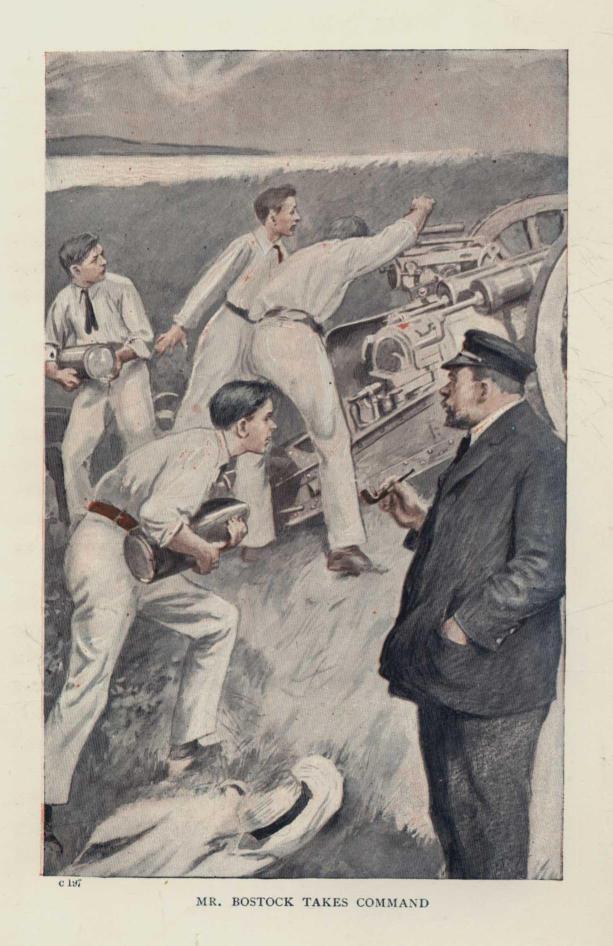
MR. BOSTOCK TAKES COMMAND
'I did,' I said; 'I closed it too quickly.'
'Silly ass, don't meddle; you takes too much on yerself. Just give Mr. Marchant the firing lanyard, and take on 'is job—and be nippy with 'em cylinders.'
So I had to do the hard work, and wasn't the Ink-slinger proud to do the actual firing!
'Gun's crew, fall in!' Mr. Bostock roared again.
We jumped to the gun and took up our proper stations, and fired twice whilst he watched the result.
'You ain't 'it nothin' yet,' he growled. 'Cease firin'; you're a disgrace. Fall out.'
He went for the 'Angel' like anything about his telescopic sight, put it right for him, and then stalked off to Barton's gun, but he'd done everything properly, so back he came. ''Ere! get down off there—I'll take a shot,' and the 'Angel' didn't like it a little bit when he slung him off the trail. We rather wished he hadn't come and spoilt our fun.
Well, that shot got the biggest cruiser amidships somewhere, and we were so jolly pleased that we didn't mind anything. The ships had found out now that we were perched on top of the ridge, but I'm certain they never spotted us, because nothing came really close, and most of the shots went overhead, and we heard them bursting amongst the trees in the forest beyond the stream.
You bet your life we were full of buck when the cruisers began to get under way, and then Mr. Bostock told us to aim at the nearest transport, and, after a few misses, we both hit her together and that did the trick—it jolly well saved Cousin Gerald, and San Fernando too—because the troops began embarking again, though the ships went off so quickly that a lot of the boats had to pull after them.
We saw the Hector's picket-boat dashing to where the little gunboat sank, and then you know exactly what happened, the whole fleet cleared off, and we followed them as best we could, till they got out of range, or, rather, till we had no more ammunition left. But long before that the proper guns' crews and their officers came doubling back, and wanted to carry on with the job, though we wouldn't let them, and they stood behind us grinning and capering, shouting 'Viva los Inglesas!' whenever we nearly hit a ship. Mr. Bostock didn't worry his head any more after the transports had begun to move off, coiled up close to Barton's gun and had a snooze.
'It's done me a power of good,' he said—'just like Ladysmith, only them Boers was always firin' back.'
You can guess how dirty we were by this time, and we were sweating like anything—our tongues feeling as if they didn't belong to us, and we would have given anything for a drink.
One of the natives was sucking at a bottle of kola, and it looked so jolly appetising that the 'Angel' bagged it, drank it, and then had a grand idea.
He tapped the bottle—opened his mouth—pointed to all of us (we all opened our mouths)—sang out 'mucho bueno'—and then pointed down to the town.
The officer whom we had hauled from under the gun—he was brave enough now, and stood with his feet wide apart, twirling his moustaches and scowling fiercely—understood what my chum meant, and sent all his men down to the town, whilst we went on with their job, and in twenty minutes or so, just after we'd fired the last shot, they came back with dozens of bottles of kola and trays of buns and cakes of all sorts.
''Aving a stand easy?' Mr. Bostock sang out, waking because the guns weren't firing, and he chipped in, and we all had a grand feed.
Wasn't that kola bitters good, that's all! and in the middle of it along came the Captain, the First Lieutenant, the New President and his boss men and fairly nabbed us. What made the Captain so angry was that we'd fired once or twice right across the Hector. It was the 'Angel's' fault—he was so excited.
We were jolly frightened, because he glared at us from the eyeglass eye, although he couldn't keep the other from twinkling, and he ordered us back to the ship at once and stopped our leave for ever.
The New President was smiling all over; I don't think he'd smiled very often lately—he didn't look as if he had—and then we tramped back down the lane, giving young 'Inkslinger' a bit of help, because his hand was awfully painful and he was as pale as a ghost. They caught us up in their carriages, and the Captain gave him a lift and took him aboard in his own galley, a very great honour.
'He introduced me to the President—he called me his Secretary,' he told us, full of buck, when we got on board.
The 'Angel' and I rushed off to find Billums and tell him what we'd done.
'That makes up for that silly ass newspaper "business" at Princes' Town,' he said, and was jolly pleased. It made a lot of difference to the gun-room when he was in a good temper, and he'd been beastly ever since that forty-eight hours' leave.
The 'Angel' and I didn't dine with the Captain that night, because we were so junior, and only the five senior mids. and the Inkslinger were asked. We were rather glad because we always felt terrified in his cabin.
Next day we heard that the transports had gone off in such a hurry that more than three hundred troops were left behind, and had, of course, surrendered to Cousin Gerald. The rest were landed down at El Castellar, brought General Zorilla's army up to nearly four thousand men, and in a couple of days he began marching along the coast towards us again, the fleet steaming along with him.
Cousin Gerald had to fall back, because he had very little ammunition left and his men couldn't stand the shells from the ships.
It was fearfully worrying, because every day we saw the cruisers and those two rotten torpedo-boats getting nearer and nearer to Marina and that Casino place which Billums had defended. With our telescopes we could still see the black and green flag on it very clearly if there was any breeze to blow it out.
Then one horrid evening we saw that the ships were shelling the Casino itself, and we were all frightfully worried and afraid that, even now, after all we'd done, General Zorilla would win.
The Captain wouldn't let anybody go on shore, so we got very little news; but that day two of the Englishmen came off from the Club, and made us more miserable than ever. They told us that Cousin Gerald had hardly any ammunition left at all, and that the New President and the Provisional Government were packing up and standing by, to fly into the forest again. They thought that the town would be captured in a day or two, and wanted to be taken on board of us, if that happened. They'd helped the insurgents too much to stay there in safety when once the Government troops came along. Everything was just as bad as it could be, and we were awfully miserable.
I do believe that the fat little A.D.C. in the Captain's spare cabin was sorry for Cousin Gerald. We often went in to talk to him and cheer him up, and he always had Billums's cigarette case near him, and was awfully grateful for anything we did for him.
'When the revolution finish, you two come and stay with me—at Santa Cruz—I will show you the bull-fight,' he often said, and, you bet, we promised to go.
One morning the cruisers were only four miles away, and a great yellow and green flag hung over the Casino, so we knew that things were pretty black for Cousin Gerald, who, for all that, must have been hanging on like grim death, because all that day and throughout the night rifle firing went on, and in the dark we could see the shells bursting among the trees.
We hardly slept at all, fearing that Cousin Gerald would have to fall back on the town, and feeling horrid because we'd used up all his 4.7 ammunition, and he wouldn't be able to prevent the fleet shelling him out of it.
The 'Angel' and I went up to the bridge before daylight and found Billums there—he hadn't turned in at all.
'There's been a great deal of firing for the last hour,' he said, his face all drawn and tired-looking, 'but it died away all of a sudden. I don't know what to make of it—it didn't seem to get any nearer—I'm very much afraid Gerald has surrendered or taken his chaps inland.'
He groaned, and we waited and waited—not a sound coming from shore—till it became light enough to see the land.
Our eyes ached with trying to look farther than we could. Still there was no firing. This was strange, because generally at daybreak there'd been any amount of firing, as, in the dark, the people often got very close to each other, or lost themselves, without knowing it, and then fired point-blank at each other when the light showed them up.
'What has happened?' Billums groaned again.
Then it was light enough for us to see where Cousin Gerald's men had been last night—but there weren't any ships near there—then presently, as we saw farther and farther along, the Casino showed up under the trees—still no ships near the shore.
'Look, sir! Look!' a Yeoman of Signals, who was using the big telescope, sung out, and pulled Billums across to it.
'Hurrah!' he shouted; 'there's a black and green flag flying over it.' In a minute we could see it with our own telescopes, and knew that Cousin Gerald must have recaptured it during the night. Every one 'started cheering and shouting, and woke up the Commander, who was furious, but then joined in because the Captain came up with his greatcoat over his pyjamas, and chuckled and cheered too.
Well, we all stood there watching, seeing farther and farther along the shore every minute—not a sign of the ships—till we could actually see the high land at the entrance, near El Castellar, with a great cloud of smoke beyond it, out to sea.
'They've chucked it,' the Captain chuckled, and we all burst out cheering. You should have seen us all there—fat Dr. Watson in his pyjamas, the Forlorn Hope and the Shadow in theirs—the Shadow shivering and his teeth chattering,—Mr. Perkins as red as a lobster, and even the Padré had come up in a nightgown, and had been in such a hurry that he'd forgotten his wig, and stood there as bald as a coot, all except a little tuft of hair that stood up by itself, and made him look like that advertisement of a hair-restorer. Nearly every one was up on the bridge. Then the church bells in San Fernando began ringing like mad, and we could hear the people, ashore, cheering.
Wasn't it grand? though nobody could imagine why the fleet had gone away.
'I expect the Provisional Government are unpacking their bags,' the Captain said to Dr. Watson, as they went below. 'They'll be asking for Recognition again. They ought to get it this time.'
We rushed off and told Billums what we had heard, because we knew that if the Government at home did recognise the Insurgent Government, Cousin Gerald wouldn't be punished for chipping in.
We did so hope they would.
CHAPTER XIII
Bad News for Gerald Wilson
Written by Sub-Lieutenant William Wilson
Later on in the morning, after all those things had happened about which that young ass of a cousin of mine has just told you, and after the Santa Cruz Navy and the transports had disappeared, a boat came pulling off to the ship with a note from old Gerald.
'DEAR BILLUMS—The whole "caboodle" has shoved off home—haven't an idea why, but they were in such a hurry that they left behind them a grand lot of ammunition—the very thing we wanted. Old Zorilla has gone back without his black horse—never mind. There's a report that a white flag is flying over El Castellar. I'm just off to see. GERALD.'
I read it out to the gun-room. Wasn't it grand for old Gerald? He'd just about swept the board.
I thought I'd show the letter to the Skipper, and did so—he was jolly pleased.
'Tut, tut, boy! I'll tell "Old Spats,"' he chuckled, and sent for a signalman, but had hardly spoken before one came tearing in with a 'wireless' message from the Hercules—she was still at Princes' Town.
'La Buena Presidente put into San Josef two days ago, after carrying out target practice, and, under shelter of Punta Rejos, coaled from a collier. She is flying the insurgent flag.'
'Now we know, lad! That's the reason the Santa Cruz fleet cleared off, lad! They've heard about her. She'll be off the coast any day, and they're flying back under the guns of Los Angelos.'
He sent the signalman back with his message for Captain Roger Hill.
'Tut, tut, boy! I'll be able to ask your brother to dinner in a few days, I hope—that is, if he isn't too big a swell—makes me feel a worm—p'r'aps he won't come—hope he will.'
He pointed his telescope towards the shore. 'Look at those black and green flags flying over the town. The Provisional Government are unpacking their bags again, I expect, and if they demand Official Recognition they'll probably get it.'
'I hope they will, sir,' I said, and went below. You can guess how jolly cheerful I felt, and how I blessed La Buena Presidente and the people who'd coaled her.
I knew how awfully happy the news would make them at home, so I got permission to send a telegram to tell them that Gerald was safe. It went to the Hercules by 'wireless,' and I jolly well hoped that some one on board her would pay for it to be telegraphed to England. I did so wish that old 'Ginger' and I hadn't parted 'brass rags,' and that I could have asked him to send it.
That afternoon the Captain sent for me; he'd shipped a sea-boot face, and I knew that something had gone wrong.
'I've just had that signal, lad,' he said, and handed it to me.
'From Captain, Hercules, to ditto, Hector.—The following signal has been received from the Admiralty: "The cruiser known as La Buena Presidente, flying the unrecognised flag of the insurgent Provisional Government, left San Josef on the 22nd. She is to be arrested as soon as possible, and handed over to the Government at Santa Cruz. Force is to be employed if necessary. Steps are to be taken to inform the Government Authorities that she will not be allowed to afford any assistance to the insurgents."
'Identical orders have been received by the Governor of Prince Rupert's Island from the Foreign Office.'
'That's a bit of a knock-out for your brother, I'm afraid,' he said sadly.
I don't know what I answered, I'd never been so miserable in my life; this simply turned everything upside down again, and whatever Gerald did now, he could never hope to win—things were too hopelessly against him. The possession of La Buena Presidente was the insurgents' only chance of success, and without her they could do nothing. I knew that Gerald was too proud to escape from the country, and he'd probably end by being killed in some rotten little action or shot against the wall, between those saluting guns, in San Sebastian. The only bright thing at all, on that miserable day, was a 'wireless' from dear old Ginger. 'Have sent your telegram home.' I wished he was here, I'd have banged him on the chest, made up that silly row on the spot, and we'd have talked over things.
The Provisional Government did come aboard, later on, smiling all over, the New President's unhealthy face looking happy for the first time, and his little Secretary bobbing about as if he were on springs. They came to formally demand Recognition from the Foreign Powers, and of course the Captain passed on the demand, by 'wireless,' to the Hercules for her to transmit to London.
Neither the Captain nor any one else had the heart to tell them the bad news, so they all went ashore as cheerful as crickets, fully expecting a favourable reply.
'I'll let you know as soon as the reply comes,' the Captain sent his coxswain to tell me, and I waited all the rest of that wretched day, wandering about like a lost sheep. I couldn't even turn in at night, and spent most of it on the bridge waiting for the reply to be telephoned up from the wireless room.
The answer came at last, and it seemed to blotch out the last hope.
'The existence of the Provisional Government cannot be recognised.'
'Don't send it ashore till the morning,' the Skipper muttered; 'bad news will keep. The Government are evidently anxious to make up for their slackness in allowing the insurgents to get hold of that ship in English waters, and I'm afraid no Provisional Government can expect to last long now that we have to hand her over to the Santa Cruz people.'
Next morning we weighed and steamed slowly down the bay of La Laguna, past the Casino where the great fight had been, and anchored under El Castellar. The green and yellow flag was still flying over it, and they had made no attempt to cover up the hole my for'ard 9.2 gun had made in the walls. Every now and then we heard rifle shots, and saw parties of the little insurgents running about among the trees beneath the fort, so knew that Gerald was still investing it.
The Captain sent for me.
'I'm going ashore, boy! going to see the Commandant of that fort and you can come with me. Have to inform him about our Government's decision and about La Buena Presidente. I don't like the job, boy, that I don't.'
In half an hour we were alongside a small jetty, built below the fort, and had landed in white uniform, helmets, and swords. An officer and a couple of black soldiers came running down a zigzag path to meet us, the officer saluting and bowing and the two black chaps presenting arms.
'El Commandante?' the Skipper said, shipping his 'tin eye,' and pointing up to the fort.
'He will have much honour,' the officer bowed.
'Thank goodness some one knows a bit of English,' I heard the Skipper mutter as we followed him. My aunt! but it was hot, and the Skipper was sweating like a bull as he walked up that blazing path. The stones under our feet seemed to burn through the soles of our boots, and the withered palm and cactus leaves, stuck in between the rocks, looked as if they'd never known what rain was or a breeze either—they were covered with a thick white dust.
The officer didn't sweat, he looked as dry and shrivelled as the leaves themselves, and as if he hadn't had a drink or a square meal for weeks; his uniform was dirty and torn. Across the flap of his revolver holster there was a long furrow, made, probably, by a bullet, and, to judge by its appearance, within a few hours, but he gave you the impression that he'd never known anything else except war and forest fighting, and that one bullet, more or less, didn't matter.
'Pretty swanky!' the Skipper grunted, taking off his helmet and wiping his forehead.
'I no savvy,' the officer said, and then 'tumbled' to it and smiled for a second, his yellow leathery face looking as if it would crack.
As we reached the top we passed any number of ox bones and skulls, and the smell was pretty unpleasant. It looked as if they'd been thrown over the walls. Then we passed inside the fort, through a small iron door in the thickness of the wall, not that part of the wall which our 9.2 had damaged, but round a corner, and it struck me that we had been purposely taken this way, so as not to see the hole.
As we entered, we found ourselves in a great square red-tiled parade-ground. There were open thatched sheds all round two sides of it, and a dozen or more soldiers were hurriedly pouring out from under them to form a guard of honour. A couple of antiquated 'smooth bores' lay on the ground with their trunnions smashed, in the centre was a broken-down well, and the whole place was littered with rubbish, old clothes, bones, and empty ammunition boxes. We'd hardly had a look round when who should come across, from some buildings on the far side, but old Gerald, a grey-haired, sunburnt, and bent-backed officer talking very fast to him. For a second I wondered whether he was a prisoner, but then I saw my friend the 'Gnome' and several others of Gerald's officers. The 'Gnome' recognised me at once, showed his white teeth, smiled, pointed up to a flagstaff where that green and yellow flag hung, and then to a roll of green and black bunting which he was carrying under his arm, and I knew at once that Gerald was there to accept the surrender of the place, and that my bandy-legged chum was going presently to hoist the insurgent flag.
Poor old Gerald! He looked so splendidly English, in his white riding-gear and polo-hat, and so proud, that I hated to meet him and tell him the awful news.
He introduced the Skipper, and then me, to the weather-beaten Commandant.
'I no speak the English,' he said, bowing.
'We're just arranging the terms of surrender,' Gerald told the Skipper. 'You've come in the nick of time, because the Commandant won't trust himself in de Costa's hands. They are old enemies, and I cannot persuade him.'
Oh! Fancy having arrived at this very moment to spoil all poor old Gerald's hopes.
I saw the Skipper ship his 'sea-boot' face again, and felt certain that he was wondering whether it was possible to let things go on as they were, and not tell the news.
He 'tut-tutted,' screwed in his eyeglass, took off his helmet, and ran his fingers through his long hair, as he always did when worried, and then burst out with, 'Wilson, I've bad news for you—very sorry, lad, very sorry; the fleet and the transports cleared out because that cruiser of yours, La Buena Presidente, may be here at any minute, and, very sorry, lad, but I've got to capture her and give her up to the people at Santa Cruz. Our Government won't recognise the insurgent Provisional Government, and I'm ordered to inform the Commandant. That's why I'm here now.'
I could hardly bear to look at Gerald.
He caught his breath for a moment, and his grand jaw tightened the least little bit as he said slowly, 'We shall have to make a fresh start, Captain Grattan.'
'What shall I do?' the Skipper asked him. 'You'd better explain to the Commandant.'
That struck me as being too much to ask of Gerald, but he only tightened his jaws a little more, and began jabbering away in Spanish to the Commandant, whose tired, hungry-looking eyes opened out with pleasure and cunning, so that I knew that my brother had told him everything, and knew perfectly well that there would be no surrender. It wouldn't help old Gerald much now, even if he did get possession of the fort, because that cruiser, whose coming we'd been longing for so much and now so dreaded, would, after we'd handed her over to the Santa Cruz Navy, batter down its walls with the utmost ease.
If I'd been Gerald I'm hanged if I would have told him the truth, and would have taken my chance with the fort. Oh! wasn't it cruel luck?
'The Commandant thanks you for the information,' Gerald said, turning to the Skipper, 'and under the new circumstances will not surrender El Castellar.'
We saw the Commandant speak to the officer who had met us, and he must have passed the news round, for, in a minute or two, a couple of hundred ragged half-starved soldiers surged out from under those thatched huts, swarmed round us, and began shouting out, 'Viva los Inglesas!' 'Viva la Marina Inglesa!' The brutes—they'd have cut our throats, ten minutes ago, with the greatest pleasure. I saw the 'Gnome's' hand go to his revolver, for they jolly well looked as if they wanted to cut his throat and the other officers'—he was bristling with anger.