ON FOREIGN SERVICE (continued 2)
Reading edition
I sat down on my cartridge-box and wondered what the dickens 'Old Tin Eye' was doing and what had become of Bob and the Angel, smoked one of my pal's cigarettes, examined the cigarette case—it was an oxydised silver one with black enamel work, probably made in Paris—and watched some black convicts with chains round their ankles filling in three graves under the wall opposite.
Phew! there might have been four if I hadn't remembered about the 9.2's and the thirty kilometres. I shivered and felt jolly sick, and wished to goodness I was back again in the Hector's gun-room.
CHAPTER IV
The Rescue of the Sub
Written by Midshipman Bob Temple
'Cut along to the Club and find the Skipper,' Billums had sung out as we slid down from that window at the Hotel de L'Europe, and when we jumped to the pavement we saw all the soldier chaps—dozens of them—pouncing on him. They didn't pay any attention to us, and it was no good stopping there, so my chum, the Angel, and I scooted away as fast as we could go.
We wormed our way round the corner, out of the square all right, and then we lost ourselves, and were wedged in among an awful crowd of people, carts and mules, cavalry and artillery all jumbled up together, jostling and shoving and cursing. We could hardly move at all, or see where we were going.
We did get along presently, and kept looking down the side streets to try and see all those flags over the Club gate, but we'd forgotten exactly which turning it was. We'd work our way to the outside of the crowd and dart down a side street, looking for the flags and those two sentries, and dart back again into the main street, holding on to each other so as not to get separated, and push and push till we got to the next side street. It was awfully hot work; we couldn't find it and I simply felt terrified about Billums, when we ran into those four Hercules mids. whom we'd upset in the morning. I'd never been so glad to see any one before.
'Hello! Coal lighters! What's the hurry?' they sang out. 'Looking for coal?'
We didn't mind that in the least.
'Where's the Club?' we gasped. 'Quick! tell us! Our Sub's been arrested, and we want to find our Skipper.'
'We've just come from there,' they shouted. 'My aunt! what a lark! Come along!' and they turned back and all six of us pushed our way along. It was hot work, if you like.
'What's he been up to?' one of them asked me.
'They think he's an insurgent; he is just like his brother who is one.'
We saw the flags almost directly, dashed through the gateway into the Club, the Hercules mids. after us, and saw Mr. Perkins sitting under a punkah trying to get cool.
'Where's the Captain, sir?' we asked.
'Don't know! Was here ten minutes ago.'
We hunted everywhere—he wasn't in the Club—and ran back to Mr. Perkins.
'The Sub's been arrested, sir; they're half-killing him. They think he's his brother and have carried him off. What can we do?' Mr. Perkins whistled and scratched his head.
That big German man who had been playing billiards with cousin Gerald in the morning was sitting close by and jumped up, 'What you say? Gerald Wilson caught?'
'No,' we both piped out, 'not Gerald, his brother Bill, our Sub; they've collared him at the hotel near the cathedral.'
'Phew! that's awkward! Something must be done at once. They'd shoot Gerald Wilson if they caught him, and they may shoot his brother.' He spoke very rapidly.
'What can be done?' Mr. Perkins asked, his red face getting quite white.
'I'll drive you to the British Minister—it's a long way out of the town—he's gone there, I know—that's the only thing we can do—you'll have to wait till my carriage comes.'
We did wait, waited for half an hour—it seemed hours, and though Mr. Perkins stood us lemon squashes and cakes we were much too worried to eat anything. The Hercules mids. waited about—the greedy pigs—till Mr. Perkins had to order some for them too, and they finished the whole lot of cakes, ours as well as theirs. Then the big German called us, and he and Mr. Perkins and we two drove away. It was a quarter to three and Mr. Macdonald would be expecting us in a quarter of an hour—whatever should we do I The Angel and I couldn't keep our feet still—we felt so awful—because we could have walked faster than the carriage went in the crowded streets. When we turned down a side street, the nigger driver lashed the horses into a gallop, we got out into the country, and presently pulled up at a big white house with the Union Jack flying above it.
Oh! It was so comforting to see it.
Out we jumped, the German hurried us through a courtyard, a black footman in livery led us through a lot of beautiful cool rooms into a garden with palms and fountains, and we saw a whole crowd of people—English ladies too—sitting in the shade. We forgot to be shy, we were so frightened, caught sight of Captain Grattan and Captain Roger Hill, and, without waiting, simply ran up to them through all the ladies, and told them all about it.
'Tut, tut, tut, tut,' our Captain said, jumping out of his chair and screwing in his eyeglass. 'Tut, tut, that's serious. Come this way,' and he took us in to the British Minister—a big tall chap with a nose like a hawk and great bushy eyebrows, dressed in white duck clothes. We had to tell our story again, clutching each other; he made us so frightened, looking at us so fiercely. You couldn't tell from his face what he thought of it, but he told the Captain that he'd change into uniform and take us to the President right away.
'It's serious,' he said. 'Gerald Wilson is too openly mixed up in politics to claim our protection, and things may go badly with his brother.'
We felt so jolly relieved that something was at last going to be done that we did have some tea then, the ladies crowding round the Angel and helping him, though they weren't so keen on me—they never are, which is a jolly good thing. 'If I'd a face like a girl's they'd fuss round me too,' I told the Angel, and he was beastly rude and called me 'Old Pimple Face,' and made them all laugh at me. I could have kicked him.
The Minister was back again before we'd finished stuffing, and then hurried us away—he and the Captain in one carriage, and Mr. Perkins and we two in another.
We drove as fast as ever we could back to the town, and the soldiers we passed looked as if they'd like to shoot us. They scowled so much that I was jolly glad that the Minister was in his gorgeous gold braid uniform and the Captain and Mr. Perkins were in theirs. We had to pass close to San Sebastian, and we told Mr. Perkins that that was probably where Billums had been taken. 'Mr. Macdonald told us they take all the revolutionary people there.'
Just as we'd told him this, we heard a scrappy kind of a volley from inside the walls.
'Good God!' Mr. Perkins nearly jumped off his seat, his red face turning quite yellow; 'they're shooting people already. Why can't we go faster?' I almost blubbed.
We were back again in the city now, the streets simply filled with soldiers, leaning up against the walls, trying to find a little shade and some of them shouting rudely at us as we passed.
At last we stopped opposite some big iron gates through which soldiers were coming and going in hundreds. The sentries there wouldn't let the Minister pass through at first, till an officer came along. Then we all got out and walked in, following the Minister, who stalked along, head and shoulders taller than any of the officers standing about, and pushed his way into a big room crowded with very excited people, most of them officers, half of them niggers and the other half not much lighter. They left off chattering as we appeared, and bowed and clicked their heels when they saw the Minister, but didn't look at all pleased.
'They hate us English,' I heard the Minister tell the Captain. 'Most of us favour the Vice-President's party, though only Gerald Wilson has been fool enough to do so openly.'
We stuck very closely to him whilst officers and orderlies kept on streaming in and out of a small door leading into another room. Most of their uniforms were jolly smart—either white with yellow facings or khaki with white facings. Cavalry officers had a light-blue striped cotton tunic fitting very tightly and very bulging khaki riding-breeches. They looked awful dandies, and all wore stiff white shirts with cuffs although it was so hot—the blacker they were and the more like niggers, the more stiff white cuffs they showed.
What the Angel and I noticed chiefly about the infantry officers was that they didn't seem to worry so much whether their clothes fitted them, and they nearly all wore patent-leather 'Jemima' boots, with the elastic generally worn out and quite loose round the ankles.
'The President is not here—won't be here for some time—he's gone to San Sebastian,' the Minister said in a low voice.
You could never tell whether he was worried about it or not—his voice and his face never changed. 'We shall have to wait. He's a fiery little chap—thinks he is the Napoleon of the west, and loves to show off before us Europeans. He'll be in a pretty bad temper to-day. He meant to arrest the Vice-President, de Costa, as he left the cathedral, but he and his friends got wind of it and left by a side door; smuggled away as priests or nuns, some say, and have slipped through his fingers. He meant to "scotch" the revolution which is coming, and he's failed badly, so he'll be a pretty handful to tackle.'
'Well, he might be able to tackle him,' the Angel whispered, and we both thought that he looked perfectly grand in his uniform. Then there was a great clatter outside; we could hear officers calling their men to attention; trumpets were blown, all the officers in the room took their cigarettes out of their mouths, stood bolt-upright, and in came the President just as we'd seen him in the procession. Every one made a lane for him to pass into the room beyond, and he spotted us, but hardly took any notice of the Minister's salute or of our Captain's either, which made the Angel and me very angry, though we were really too frightened at his very cruel-looking eyes to be angry.
Several people followed him—all very gorgeously dressed—covered with medals and with green and yellow sashes over their shoulders, and the last to come in was the little A.D.C. from Los Angelos with the big spurs and the curved sword.
The Minister spoke to one of them, who seemed to be doing 'orderly' officer, but he only shrugged his shoulders, went into the little room. We heard a few fierce words and back he came, shrugging his shoulders all the more.
'He says the President is too busy to see me,' the Minister told the Captain, who was gradually getting angry at being treated like this. Then there was another commotion, and in came the grand-looking old Governor of Los Angelos and the black A.D.C. He seemed to be a friend of the Minister, for he stopped and shook his hand, bowed and yarned quite pleasantly. He too went into the other room.
'I've told him that I must see the President,' the Minister said, and we waited again, though even he wasn't successful, and came back shrugging his shoulders and spreading out his hands, his great sword clanking along the floor.
The Minister's face never altered the slightest bit. 'He refuses to see me—will only receive the senior foreign Minister—that is the Comte de Launy, the Frenchman. It's no use waiting here any longer—we must go and find him—it will take an hour.'
His voice never altered in the slightest degree, but the Captain was 'tut tutting' and polishing his eye-glass, whilst Mr. Perkins was bubbling over with wrath.
As we went out we saw the officers all sneering at us, but the Governor sang out something very angrily, and they stood to attention and he himself bowed us out. We were jolly glad to get out, I can tell you, because it was such a horrid feeling to have all these strange fierce-looking officers all round us without being able to understand a word they said, and to feel certain that they'd like to murder us.
'Well, the old Governor's a gent, isn't he?' the Angel whispered.
We drove back to the Residence—I was feeling awfully sick with funk about Billums—and there we were left whilst the Captain and the Minister drove away again to find the Frenchman.
It was long after four o'clock; Mr. Macdonald would be on his way down to Los Angelos, and we hadn't the least idea how we should get back; but we didn't want to go back so long as old Billums was shut up in San Sebastian, and might be shot any minute.
There were only three ladies there now, the Minister's wife and her two daughters, and they did their very best to cheer us up. The Angel was in great form—he always was when ladies were about—and sang his rotten songs; but as I couldn't sit still, I wandered out into the courtyard, and fed some goldfish in one of the fountains. It was fairly cool there, and every time I heard wheels I ran to the gateway, but they didn't come back till nearly six o'clock, and when I rushed out, hoping to see Billums with them, there was only a dried-up little man in another gorgeous uniform—the French Minister.
'No good, Temple,' the Captain said, looking awfully serious.
'He won't let him go till his brother surrenders—does it to humiliate us.'
'What are you going to do now, sir?' I asked him, but he didn't answer.
They all three drove away again, and Mr. Perkins told me that they were going to collect all the foreign Ministers, and intended to see him in a body.
Then he and we two mids. had to do more waiting—it was terrible. The sun went down, it got dark quite suddenly, and we couldn't help thinking of the awful road down the mountains to Los Angelos and how we were going to get down there at night.
The Minister's wife gave us some dinner and tried to be jolly, but I couldn't be, and couldn't eat anything. She and the girls were pretty nervous too, because, all the time we were pretending to have dinner, there were noises as if a riot was going on in the town. We were all fidgeting, and the black men-servants in their scarlet liveries were very jumpy. You could see by the way they moved about that they were frightened too.
The Minister's wife made them close the big windows and that drowned a good deal of the noise, and I couldn't see the dark creepy shadows of the palms outside and felt less uncomfortable. She kept on saying, 'I wish your father would come back,' and, just as we were going to have some coffee, we heard the banging of rifles. The black footman dropped his tray, and all of them simply trembled. It was no use to sit any longer at the table, the two girls began to cry, and then it was our turn to do something to help.
The firing sometimes seemed to be coming our way, so we three went round the garden and made sure that all the gates were locked—a jolly creepy job it was out there in the dark, and I jumped every time I heard a rifle go off. The servants were all standing about, whispering and looking frightened, which made it all the more horrid; so, to give them something to do, we sent them to close all the shutters, though we couldn't get them to go into the street to close some there, and had to do that ourselves. Then we made the three ladies come into the drawing-room, lighted all the lamps, and tried to cheer them up. The Angel played the piano, and Mr. Perkins, who hates singing, bellowed out some sea-songs and made them join in the choruses. That wasn't much of a success, so he scratched his funny old head and did a few tricks. One was to stand straight upright and then sit down on the floor without bending his knees, and he did it so jolly well that it nearly shook the ornaments off the mantelpiece, and the bump frightened them all. Then he showed them how he could fall flat on his chest without bending his knees, and did it, but banged his chin hard on the polished floor, so that wasn't quite a success either.
We couldn't think of any other tricks.
Nine o'clock came, and ten o'clock—there was no firing now—and half-past ten came before we heard several carriages coming towards the house, and went out into the courtyard to the street gate.
The Minister, the Captain, the tall German, who turned out to be the German Minister, and was in a grand-looking uniform, the little Frenchman, four or five others, and the United States Minister in ordinary evening dress, got down, and then several ladies, closely wrapped up, came in too.
All the Ministers disappeared into another room by themselves, only the Captain and the ladies coming into the drawing-room. He was saying 'tut, tut' all the time, and all we could get out of him was, 'We've been treated like children—tut, tut—by a miserable half-bred savage—he won't listen to us.'
'A lot of firing going on in the city, isn't there, sir?' Mr. Perkins asked.
'Only a few drunken soldiers letting off their rifles,' he grunted, and then he was sent for, and a few minutes afterwards a man-servant came in to ask the Minister's wife to speak to her husband. She went out, and we could hear her speaking to him, and back she came looking very pale. 'Captain Grattan' (that was our Captain) 'has asked us to stay on board the Hector, my dears; we are going down with him to-night.'
She tried to look cheerful, but they and we knew what that meant—that it wasn't safe for them in Santa Cruz any longer—and the girls began to cry again. All three of them went away to get ready.
'Phew! Great smokes,' Mr. Perkins whistled, 'it's come to a pretty pass—that ass of a Sub has stirred up a hornets' nest, if you like.'
'It wasn't his fault, sir,' I said; 'he couldn't help it.'
Just then the Captain and the Ministers trooped in. They looked as though they'd come to some decision which pleased them, and it made the Angel and me feel more happy about poor old Billums up there in San Sebastian. We both wondered whether he'd had any dinner, and what he thought had become of us—all this time. Some more ladies came in, all wrapped up in furs because the night was very cold, and in the middle of all the hubbub we heard a lot of cavalry coming along. They stopped outside the house, and a moment later the Governor of Los Angelos, with his two A.D.C.'s, came in. Weren't we pleased to see him, that's all! There was more bowing and scraping, coffee was handed round, and we two edged alongside the little A.D.C. who had talked English in the gun-room yesterday. He recognised us then and said, smiling, 'We take you to Los Angelos to-night—the señoras and the señoritas also—we have many horse soldiers—the road it has much danger.'
'How about Billums—William Wilson—our Sub?' we asked, 'up in San Sebastian.'
He smiled, and pulled out—what d'you think?—old Billums's cigarette case—I knew it jolly well—and said, 'I give him my—he give me him,' but shut up like an oyster, shrugged his shoulders, and shook his head when we asked him if Billums was coming with us. That made us miserable again, and we went out to see what the cavalry escort were like. They had dismounted, and were swaggering into the courtyard, looking absolute villains, most of them niggers, their carbines and bandoliers over their shoulders, revolvers in their belts, and swords, which clanked and rattled whenever they moved. The servants were giving them cigarettes and some food, but, for all that, they didn't seem at all friendly, and the whites of their eyes showed up under the swinging lanterns, and made them look more like brigands than ever. The Angel palled up to them and made them show him their rifles, but I felt too frightened and only hoped that the Governor was coming with us. The carriages drove up, all the ladies came out and were put into them, the dear old Governor of Los Angelos handing them in and bending down to kiss our Minister's wife's hands in such a jolly manner that the Angel and I could have hugged him.
We felt that he could be absolutely trusted, and weren't we jolly glad again when his horse was led up and he and part of the escort rode away with the ladies.
In the last carriage the Captain, Mr. Perkins, and we two mids. were stowed, and away we went after them with the two A.D.C.'s bobbing behind on their horses and the rest of the escort, leaving the Ministers all standing together under the lamp which lit up their faces and all their beautiful gold lace.
'They don't look very "sniffy," do they?' I whispered to the Angel, 'I should if I was letting my wife go away like this.'
'Not if you'd got those uniforms on and had a Frenchman or a German or a Dutchman watching you,' he whispered.
I expect he was right.
The Governor came clattering back on his great horse to see that we'd started, and then went on ahead again, the black A.D.C. bumping along after him.
You can imagine what a row we made, and how, as we got into the streets, all the shutters of the windows were thrown back and people peered at us from behind the bars; dogs, too, flew out and barked from every doorway. It was a wonderful night—a big moon and millions of stars, the tops of the mountains showing up all round us. Jolly cold it was, too, and the Angel and I were glad to snuggle together under a rug.
We seemed to go a long way round, skirting the city, and though sometimes at street corners pickets and patrols challenged us, they were quite satisfied. Presently we passed close to a great shadowy building high up on our right. It had a funny little tower at one corner, and we recognised the shadow at once—it was San Sebastian.
The Angel and I squeezed each other to buck ourselves up, and kept our eyes on it all the time. It looked most awfully gloomy, and it seemed horrid to think that only twelve hours ago Billums had driven past it with us, and now he was inside and we were going back without him.
'What will he think of us?' I gulped. 'Poor old Billums!'
Well, we got on to the main road, left the city behind us, and presently began to go downhill. Mr. Perkins went to sleep soon, his jolly red face rolling from side to side as the carriage bumped, and the Captain snuggled down in the other corner, and we knew when he went to sleep, because his eyeglass fell out, and he didn't 'tut, tut,' and put it back.
We didn't go to sleep for a long time—we were too miserable and cold—and watched the troopers riding on each side of us with their blankets over their shoulders, and every half-mile or so, flaming fires at the side of the road, with soldiers sitting round them. We could hear them challenging the carriages in front, but when we got up to them, they only stared at us, or called out to the escort, and wrapped their blankets round them more closely. There was a huge nigger chap riding on my side of the carriage, and both he and his wretched thin horse seemed nearly asleep. I watched him bobbing and lurching from side to side in his saddle, waking up with a start whenever his poor brute stumbled, and then must have gone to sleep, because the next I remember was finding that we were going past rows of houses—pitch dark, with not a sound coming from them—and knew that we'd got down to Los Angelos.
I was colder than ever, because the Angel had all the rug, but the smell of the sea was grand.
We drove down to the wharf where we'd landed in the morning. The carriages all stopped—I could hardly stand when I got out because my legs were so cramped—and two of our barges were waiting for us, their mids. holding up lanterns and singing out to let us know where they were.
The cavalry escort clattered away, the old Governor kissed the hands of all the ladies as he helped them into the boats, the two A.D.C.'s, looking frightfully sleepy, clicked their heels and bowed, the Captain said, 'Tut, tut,' a good many times and shook the Governor by the hand, the Angel and I managed to get hold of the fat A.D.C. and shake his hand, and off we all went.
It was simply splendid to be in a boat again and to hear the oars go 'click, click' in the rowlocks, and when we'd got round the end of the breakwater to see the lights of the Hector and Hercules. The other chaps who had gone back before us had taken orders for the two barges to wait in, all night, if necessary; that was why we'd found them there.
The Angel and I were both of us dead tired, and went down below to turn in, but there was a lot of scurrying up above; we heard the Gunnery Lieutenant sent for, and the Captain's Clerk was turned out. Evidently something exciting was going to happen, so we ran up on deck again and, peeping down the ward-room skylight, saw our Captain and the Captain of the Hercules, the Commander, and most of our senior officers all sitting round the table, which was littered with papers and confidential books.
We stole away, because the officer of the watch whacked us over the back with his telescope, and were undressing in the gun-room flat when the bugler sounded the 'officers' call' and 'both watches fall in.' We heard 'Clear lower deck' being shouted along the mess decks and bugles sounding aboard the Hercules, so instead of undressing we shifted into uniform, whilst every one else tumbled out of their hammocks and shifted into theirs. We all clattered up on deck.
'Everybody aft' was piped, and the men came streaming through the dark battery door into the glare of the group light on the quarterdeck, buttoning up the tops of their trousers and stuffing their flannels down them.
The master-at-arms reported 'Lower deck cleared, sir,' to the Commander, he reported to the Captain, and the Captain, standing on the top of the after 9.2 inch turret, coughed, said 'tut, tut,' a good many times, and then told the men that Billums had been collared because he was so much like his brother, who'd mixed himself up in politics, that the President was going to keep him till Gerald surrendered, and that all the foreign Ministers were agreed that steps had to be taken jolly quickly to get him out of San Sebastian.
The men were as quiet as lambs, waiting for the exciting part and to know what he intended doing. You couldn't hear a sound. 'I want you to clear for action—now—do it quickly—I'm going to take the Hector inside the breakwater at daylight, whilst Captain Roger Hill'—he called him 'Old Spats,' but corrected himself—'gets under way in the Hercules and prepares to tackle the forts. They've got some—you've seen them—up on the hill above the town—but won't give us much trouble. If Mr. Wilson is not at the landing-stage at noon, the foreign Ministers will be, and they and all the Europeans who wish will come aboard this ship. That being the case, I shall then—acting under the Ministers' orders—take possession of the five Santa Cruz cruisers and gunboats inside and shall tow them out.'
You could feel the men getting excited, and then he gave several more 'tut, tuts,' and told us that a revolution had started, and that, as the revolutionary people came from both the provinces to the north and south, and the mountains separated them and made it impossible for them to combine successfully by land, the only way they could do so was by the sea, and as long as the President had his cruisers and gunboats he could prevent them doing so, and keep the upper hand.
'If we capture his ships, the insurgents can do what they like,' and he finished up with, 'There are ladies aboard—we couldn't leave them in Santa Cruz—so work quietly. Carry on, Commander!' We dug out like smoke, turning the boats in and filling them with water, getting down davits and rails, lashing the rigging, and working hard till daylight came.
Then all us mids. scrambled down below to get some hot cocoa and bread and butter, and were up on deck again in a jiffy, for the buglers sounded 'cable officers,' which meant that we were just going to weigh anchor, and we didn't want to miss any of the fun.
The Hercules, cleared for action, just astern of us, was looking awfully grim, her long guns simply bristling over the sides, and white ensigns lashed in her rigging.
Petty Officer O'Leary came up to ask about Billums—he was very worried about him—and, just as we began to steam ahead, a cloud of smoke shot out from one of the forts above the town.
'They're going to fight,' I sang out, not quite certain that I wasn't frightened.
But O'Leary growled, and said, 'No such luck, sir, anyway, that's only the sunrise gun—late as usu'l, sir.'
'General quarters' was sounded—we could hear it too aboard the Hercules—and we all had to rush to our stations. Mine was in the starboard for'ard 9.2 turret, and you may bet your life that directly we'd cleared it away, and had things ready inside, I got my head jammed outside the sighting hood to see what was going on.
We headed straight inshore, and then made a wide sweep round the lighthouse and the end of the breakwater.
As we turned, the white forts about the town came into view, and we tried to get our gun to bear on them, but though we gave it extreme elevation, cocking it up in the air, we couldn't elevate it nearly enough.
Mr. Bigge, the lieutenant in charge of my turret, was very angry about it, but of course nothing could be done. That was why the Hercules was steaming backwards and forwards, far enough outside the breakwater for her guns to bear.
As we crept up to the town, I kept my telescope glued on the forts, but couldn't see any sign of life in them.
'They aren't going to fight, sir, are they?' I asked Mr. Bigge, and he didn't think they were, which was very disappointing—one doesn't mind being fired at when one is inside a turret.
On the port side—the breakwater side—we were now right alongside the Santa Cruz Navy—miserable dirty little ships when you saw them close to us. Their people were awake and on deck, but hardly bothered to look at us, and were fishing over the side, smoking cigarettes, and spitting in the water, some of them washing clothes and hanging them up in the rigging. They did hoist their colours—the vertical green and yellow stripes—after a time, but that was the only thing they did. Not very exciting, after all we had been hoping for, was it?
Just before we got up to the end of the breakwater we'd dropped a kedge anchor made fast to our biggest wire hawser, and as we went along we paid the hawser out astern. Then when we'd got just beyond the landing-stage we dropped an anchor, and there we were in a pretty close billet, not enough room to turn, but our kedge ready to haul us out stern first, and everything as snug as a tin of sardines. We were not a hundred yards from the wharves where that guard of honour had been yesterday, but only a few people and some mules were moving sleepily about, and a lonely-looking sentry leant against a great pile of cocoa bales and yawned.
Well, we'd taken them by surprise right enough, and there was nothing to do but to wait till noon and see what happened. It was a jolly long wait, and I don't really know whether I wanted most to see Billums come off, or to capture the cruisers if he didn't. I know that all the other chaps didn't want him to come off. Outside the breakwater the Hercules still steamed backwards and forwards, with her guns trained on the forts in case anything happened, and during the forenoon got down her top-masts and wireless gear. This made her look all the more ferocious, and our Commander began bellowing and cursing 'that he'd have to do the same and spoil all his paint-work.' It took us a couple of hours, but it was much better than doing nothing, and later on in the morning crowds of people came down on the wharves to look at us, and watch us working. My eye! but it was appallingly hot in there.
At about ten o'clock the forts began to show signs of life, hoisting yellow and green flags and training their guns round and round. They had two dynamite guns in one of them—so the books said—and we felt as though they couldn't possibly miss us if they had fired. That sounded far too exciting—dynamite seemed rather unpleasant—-but the Gunnery Lieutenant's 'Doggy' brought the news that none of the guns in the fort could be depressed enough to hit us, which was rather a relief—really—though the others didn't think so. The cruisers, too, began to get up steam, let down their gun ports, and ran their guns out. We could see them being loaded, and then they were trained on us, which was very exciting when you remember that they were only fifty yards away.
Directly they had the cheek to do this our port guns were trained on them—the foremost 9.2 on one, the port for'ard 9.2 on another, two of the 7.5's on a third, and so on, with orders to fire directly the Santa Cruz ships fired.
Of course these poor little things wouldn't have stood a chance, but they kept their crews at their guns, and if they'd only been able to let off one broadside it would have swept our decks. This made it jolly interesting for all of us who were getting down the topmasts and had to work in the open.
I had never thought about how Billums or the Ministers were coming off, and when at seven bells the first and second barges were called away, you can imagine how excited I was, because the second barge was mine. They lowered us into the water, planked a Maxim gun in the bows, revolvers and cutlasses were served out to the crew, and I had my dirk and revolver.
The Commander bellowed down that we were to go inshore, lie off the steps at the landing-place, and wait for Billums or the Ministers.
I was in white uniform with a white helmet, and it was so boilingly hot that, though the men only had on straw hats, flannels, and duck trousers, they sweated under their cutlass belts before they'd pulled half-way inshore.
As we got close to the wharf it was more exciting still, because the people crowding there and the soldiers began shouting and jeering at us, shaking sticks and throwing stones—not to hit us, but to splash us. They weren't brave enough to do any more, because they could see all the starboard twelve-pounders on board the Hector trained on them. I felt jolly important, and when Blotchy Smith—the midshipman of the first barge and a pal of mine—sang out for me to 'lay on my oars,' we bobbed up and down only about ten yards away and pretended we didn't see them.
We waited and waited; eight bells struck aboard the Hector, there wasn't a sign of any one coming, and the black ruffians on the wharf became more irritating than ever. Several lumps of mud and dirt had been thrown into the boats, and one had struck my clean helmet, but I still pretended not to notice anything. It got so bad soon that Blotchy Smith sang out to me to train my Maxim on the crowd, and you would have laughed if you'd seen the brutes clearing away.
Then the Hector signalled across that carriages could be seen coming down the road from Santa Cruz, and after another long wait we heard the mob ashore groaning and hooting, and a lot of cavalry and several carriages came clattering and rattling along the wooden wharves.
You can guess how we wondered whether it was Billums coming or only the Ministers. It wasn't Billums, for we saw all the foreign Ministers, and knew that they would not have come with him.
Some soldiers made a way for them, and then we had to pull backwards and forwards, taking them and a lot of Europeans—Mr. Macdonald among them—off to the ship, and afterwards go back for their luggage.
'Well, we'll have a bit of a "dust up" after this, sir,' my coxswain said, and that was about the only comfort.
The Angel told me afterwards that when the Ministers got on board their wives came up and made asses of them, they were so jolly pleased to see them, but they'd all been sent below by the time my boat had been hoisted in. Then we had to collar the cruisers.
Well, even that was disappointing, because they never made any resistance, the officers simply shrugged their shoulders when we hauled their colours down and hoisted our own white ensigns, and ordered their men to pull ashore. You couldn't really blame them, because our 9.2 shells would have blown them to smithereens; but, for all that, it was very tame.
By half-past one we'd got hawsers aboard their flagship, the Presidente Canilla, and by three o'clock hawsers had been passed from her to the others, and we simply went astern, hauling on our kedge anchor till we were clear of the breakwater, and then steamed astern with the whole of the Santa Cruz Navy coming along after us like a lot of toy ships on the end of a string. It looked perfectly silly, and the last one—a gunboat as big as a decent Gosport ferry-boat—fouled the end of the breakwater till our chaps aboard of her shoved her off, and along she came after the rest of them. By five o'clock we and the Hercules had anchored, and all the prizes as well.
It was a jolly tame ending to all the excitement, and we all wondered what we should do next to make them give up Billums. The A.P. said that we should probably land and take possession of the Custom House.
He bucked us up a good deal, but not even that came off, because before we finished making everything shipshape for the night, out puffed the port launch, flying a huge white flag in her bows and the yellow and green ensign in the stern, bringing out our friend the Governor and his two A.D.C.'s. They came along to make complete apologies, and say that Billums should be given up next morning. He brought a letter from the President simply grovelling to the various Ministers and imploring them and the merchants to come ashore again. Wasn't that grand, although, you know, we couldn't help feeling that we'd been rather playing the bully?
When it got dark, the Angel, and I, and Mr. Bostock, the Gunner, with half-a-dozen hands, were sent aboard one of the ships, the Salvador, an old torpedo-gunboat kind of affair, to keep watch through the night. We had revolvers served out to us in case any chaps from shore tried to play the idiot; but they didn't, and we simply sat down under an awning with our coat-collars turned up, and took it in turns to keep watch, or, if we were all awake, got Mr. Bostock to tell us tales of Ladysmith.
In the morning we all went back to the Hector, and at five minutes past ten o'clock old Billums came along in the port launch, the Governor bringing him off and making more apologies. Billums was glad to get back again—he wanted a shave and a clean collar most awfully—and you can guess how jolly glad we were to have him. The Commander bellowed at him that he'd make him pay for all the paint-work which had been spoilt by clearing for action, but it was only his way—he couldn't help it—and the Hercules gun-room sent a signal, 'Sub to ditto. We are all jolly glad to get you back,' which was nice of him, though his beasts of mids. didn't join in with the signal—just like them.
Well, the Ministers and the merchants went ashore jolly pleased with themselves, but they left all the ladies on board, as they thought it wiser for them to go to Prince Rupert's Island with us till things had quieted down in Santa Cruz.
We gave Billums a rousing good sing-song, till the Commander ordered us to chuck it, and was appallingly rude to him; and next morning we left the Santa Cruz Navy for its own people to take back behind the breakwater, and shoved off for Prince Rupert's Island.
You should have seen the Angel looking after the Minister's two daughters! It was too asinine for words, and I told him so. He said I was jealous, and we jolly nearly came to punching each other's heads about them.
CHAPTER V
Gerald Wilson captures San Fernando
Written by Sub-Lieutenant William Wilson
Those thirty-six hours in San Sebastian are over and done with, and I shouldn't care to go through them again. They were the longest hours I have ever spent, and they, at any rate, taught me what it does feel like to be a prisoner, and to look through an iron gateway and envy everything outside it, and everybody. The other chaps—insurrectos they all were—had been jolly decent to me, although I could not understand their lingo, and the way they settled down and took things as a matter of course was simply extraordinary. Even when two more were dragged out the morning I was released, and shot against that parapet, the others only shrugged their shoulders and simply smoked cigarettes all the harder. You could only imagine that they were but half-civilized, had known no other way of carrying on the politics of the Republic, and were so used to violence and murder that, when their turn came to go 'under,'they simply bowed to the inevitable, their only consolation being that probably in another few weeks or months, if luck favoured their party, that same stuffy room would be crowded with President's men, and quite possibly the same villainous-looking firing-party would just as cheerfully prop them up against that wall and shoot them down. These same miserable-looking convicts, whom I'd seen with chains round their ankles, would almost certainly be there to dig fresh graves.
Of course, all those hours I wondered what our chaps were doing to bail me out, but didn't worry much—I knew things would come right in the end—and of course they did.
But I did worry about Gerald and what his hare-brained adventures would lead him to. He had always been getting into trouble at home, and that was why the pater and mater had shipped him out to Santa Cruz, though they little thought that he'd take a leading part in a revolution, and the poor old mater would be fearfully worried when she heard about it. It was jolly to know that an Englishman, and my own brother, was such a boss among these fierce, blood-thirsty, half-Spanish people, but that wouldn't be much comfort to the mater if he was stuck up against the parapet of San Sebastian, which would certainly be his fate if he ever fell into the clutches of the President.
It was my chum of the cigarette case who actually fetched me down and took me aboard the Hector. Even whilst I was trying to thank him, the Commander began bellowing that 'He'd make me pay for the paint he'd spoilt clearing for action and housing the topmasts.' He was as rude as it was possible to be, but every one else—'Old Tin Eye' included—was all right, and Ginger signalled congratulations from the Hercules.
Of course my adventure was known all over Princes' Town before we'd anchored more than an hour or two, and reporters from the local papers and Reuter's Agent came bustling on board for more details, but were told nothing, except that I'd been arrested by mistake, and that, as a hint to the President to let me out again, 'chop, chop,' one or two of the Santa Cruz gunboats had been seized. We had all been ordered to give no political information to anybody, but you may imagine that their ears were rigged out for something more exciting than that, and you can jolly well guess who gave it to them—the Angel backed up by Cousin Bob. They saw their way to getting a cheap 'blow out' at the Savannah Hotel, and actually had the cheek to tell the two local reporters that if they'd stand them a dinner there, they would tell them all they knew about it.
They had put their names down in the leave book for the late boat and went ashore, but of course I had no idea what their game was. I had turned in early, and they woke me, by knocking at my cabin and asking if they could come in.
I switched on my light, and there they were, in their best blue suits, grinning from ear to ear.
They both began talking twenty to the dozen. 'We've given you such a "leg up"—we've had a topping feed at the Savannah, and you'll see all about it in the papers to-morrow!'
'All what?' I asked.
'All about you fighting dozens of soldiers, knocking them over, and of our trying to rescue you.'
'We put in a lot of extras to make it look better,' Bob squeaked.
'We told them all about knocking over the rotten Hercules mids., and about you being so like Cousin Gerald.'
'What!' I sang out, sitting up in my bunk. 'You blessed idiots, what rot have you been up to? You know you had orders not to speak of it.'
'We didn't say a word about politics, not a word,' Bob said rather nervously. 'It's quite all right; we never mentioned politics.' The Angel added, 'We didn't tell them the real way you escaped.'
'Out with it! What did you tell them, you fools?'
They were backing out of the cabin—rather sulky—but I yelled for them to come back. 'Now, none of your tomfoolery. What did you tell them?'
'Well, we gave ourselves a bit of a leg up too,' the Angel began, looking down his nose as good as gold.
'It really was all a joke,' Bob interrupted, 'it was their fault if they believed it. We told them that we waited till night under the walls of San Sebastian, wriggled over the parapet, and found your dungeon.'
'We told them that we'd whistled "Rule, Britannia!"—very softly—till—we—heard—you—whistle back,' the Angel stuttered out, choking with laughter, 'and that the sentry was asleep, and we only had to knock him down—and gag him—steal the key—open the door—all of us crawling away again over the walls and tramping it on our flat feet down to Los Angelos.'
'You don't mean to tell me that they believed all that rot?'
'We think they did—wasn't it a joke?' Bob said—he was beginning to see that I didn't think it a joke. 'We gave them the key of the dungeon—an old brass key we'd found on the armourer's bench before we went ashore.'
'It was the key of the bread-room that was broken yesterday,' the Angel gurgled, when he could stop laughing. 'And we said we'd all swum off to the ship in the dark.'
I wasn't in the humour to see how it was funny, and sent them out of it. 'If anything does come out in the papers, I'll beat you both,' I told them.
'Well, the feed was worth a hiding, and the joke too,' Bob mumbled, as they went away—thank goodness the Angel was no relation of mine and had no mother or sister who could write snorters to me, so he didn't dare to be rude.
You can guess how angry I was next morning, when the wretched local papers did come aboard, and saw in big letters: 'Romantic Escape of British Naval Officer—Plucky Middies effect Rescue,' and underneath it was the silliest nonsense you could possibly read. Honestly, even now I don't know whether it was put in as a joke, and whether, instead of Bob and the Angel pulling the reporters' legs, they were pulling ours. Angry! I was too angry to speak!
They described me as Sub-Lieutenant William Wilson, the celebrated United Service half-back, and the brilliant naval officer, specially appointed to command the Hector's gun-room by the Lords of the Admiralty as a mark of their appreciation of my services! Angry! My blessed potatoes! I sent for my dear cousin and the Angel and gave them six of the best over the gun-room table—as hard as I could lay it on—the first three for making their Sub look a fool, and the last three for disobeying the Captain's orders. I know which were the hardest whacks, and I didn't care a biscuit what Bob's sister, Daisy, thought or wrote. They went away muttering that the dinner was worth it—every time—which was meant to be rude, because they both had got it into their noddles that they'd actually given me a 'leg up,' and couldn't see that they'd only made a laughing-stock of me.
First of all the Commander sent for me on the quarterdeck. He had Perkins there as a witness, and before I ever had a chance of saying anything, bellowed out, 'You're the "brilliant naval officer," are you? You're a fool, and an idiot, and a useless idiot. You can't keep order in the gun-room, and the sooner you get out of the ship the better.' He bellowed till the maintopmen, painting masts and yards up aloft, left off painting to listen to him. He didn't ask me to speak, so I didn't—said not a word—which made him almost apoplectic with rage, his ugly red face getting perfectly crimson. Every time he stopped for breath, Perkins kept on trying to tell him that perhaps it wasn't my fault, which sprung him off again, and at last he turned round and cursed him for interfering.
Perkins twisted round on his heel and hobbled off, but the Commander called for him to come back, and he did, his jolly face all tightened out.
'Did you hear the Commander curse me on the quarterdeck?' he asked very quietly.
'I did, sir,' I said; and he turned to the Commander, 'Very well, I shall see the Captain about it. I'm not going to stand any more of it.'
You should have seen the Commander's face. His mouth opened, and he looked as if he would willingly have murdered the two of us, then he bounced off the quarterdeck, and into his cabin just inside the battery, and banged the door, like the childish bully he was. As he didn't come out again, I went below.
Then the Skipper sent for me. He was grinning all over his face: 'Those two boys have made a fool of you, Wilson; tut! tut! stop their leave—whack 'em both.'
'I've beaten them, sir, already,' I told him, 'and given them six apiece—as hard as I could,' and explained to him that I had no idea why they went ashore.
'Tut! tut! no harm done; they got their dinner all right; tell 'em to lunch with me, tut! tut!—if they can sit down—I'd have done it myself for a good dinner—thirty years ago.'
Old Ginger and I had arranged to go for a walk together that afternoon, to shake up our livers, and I was not particularly keen, after what had happened, to ask leave from the Commander, but I screwed up my courage and did so, and was flattened aback when he said, 'Very good, Wilson. Come and have "chow" with me in the ward-room to-night—celebrate your release.'
That was the rotten, or rather the irritating, part about him. After he'd been as rude as a fishwife, and long before you'd got over bubbling with anger at the sight of him, he'd come up as if nothing had happened and take the wind out of your sails.
Of course I had to say 'Yes,' although at the time I'd have much preferred to take him on with bare knuckles and punch his head to relieve my feelings.
Old Ginger met me at the Governor's steps, where we landed, and we had a fifteen-mile walk as hard as we could go—tearing along till we hadn't a dry rag between us.
Fifteen miles in that climate takes more out of you than twice the distance in England, so you can guess we were pretty well 'done' by the time we got back to the landing-steps.
Whilst we waited for our boats we sat under the shade of the fruit market and watched the niggers—all as cheerful as sand-boys—unloading a cargo of cocoa-pods from a small schooner. The washer-ladies were coming ashore, too, from the Hector and Hercules, cackling like hens because of the huge bundles of clothes they'd got. Perkins's friend, Arabella de Montmorency, was the first to waddle up the steps, grinning from ear to ear, and carrying a huge bundle. 'The good Lo'd be praised,' she sang out to a buck-nigger waiting for her, 'Massa Perkins pay Arabella the three shilling and tuppence—Massa Perkins know Arabella good vash-lady—no black trash for Massa Perkins. I pray de good Lo'd keep Massa Perkins in His strong hand.' She went back into the boat for more washing, but the other washer-ladies had bagged it, and there was a fine row. All their men friends joined in shouting, and yelling, and shaking their fists at each other, and we hoped to see a good free-fight, but the Sikh policeman on duty stepped majestically forward, said a few sharp words, and they all burst out laughing, Arabella waddling away with her man carrying the disputed bundle, and trying to look dignified, telling everybody: 'Arabella no black trash—Arabella vash for de British naval officah.'
It was too funny for words, Ginger and I were simply doubled up with laughter, when I felt some one touch my shoulder, and, looking round, saw a thick-set native chap, as brown as leather—like those soldier chaps we'd seen on the wharf at Los Angelos—in a blue striped cotton vest, which showed his lumpy chest muscles through it, and a pair of loose cotton drawers, his brown legs and feet naked. He was bowing and holding a broad Spanish grass hat in front of him with one hand. 'William Wilson,' he kept on saying.
'What is it, old cock? me William Wilson—all light—belong ploper. What's your game?'
His face beamed, and he pulled a dirty crumpled letter from under his vest and handed it to me.
It was addressed to me in Gerald's handwriting, and I tore it open, his face beaming again as he pointed a thin brown finger first to the address, and then circled it round my face, saying, 'William Wilson.' It was the only English he seemed to know. I read:
'DEAR OLD BILLUMS—Sorry to have cleared out so hurriedly the other day—just managed to give them the slip in time—heard news of your adventure and the Navy business—wish you chaps would collar the lot of them, for good. Keep a look-out for that little chap who was shadowing me; he'll try and get even with one of us. Tell the mater I'm having a ripping time—better than planting—will pay better than planting if our side wins. Tell her those socks she made me are A1. Look out for yourself—you're too much like me for this corner of the world. Don't send an answer.—GERALD.'
The nigger was still beaming and bowing, and he pointed to my hair. I'm jiggered if he hadn't spotted me by it.
That was a funny go, if you like, and I was jolly glad to know that Gerald was all right. It didn't worry me a ha'penny candle about that detective chap—I'd be only too jolly glad to see his ugly face and smash it. Ginger and I thought that the little messenger must have come in one of the many trading-schooners which slipped across from the mainland at night when the land breeze sprung up. We gave him all the small change we had in our pockets, and he smiled, and bowed, and disappeared among the merry crowd round us. He couldn't speak a word of English except my name, and my Chinese pidgin-English wasn't a success.
This was the only excitement and the only news I got from Gerald for several weeks. In the meantime the Hector and the Hercules carried out the gunnery practices which had been interrupted at Gibraltar, returning to anchor off Princes' Town every Thursday night till Monday morning, so we managed to get in a good many football matches. Ginger and I borrowed grounds and had some more gun-room matches as well, but they didn't smooth things over, rather the reverse, for when we beat the Hercules at rugby by a try, which, they swore, wasn't one, matters went from bad to worse. There actually was some doubt about it, for Perkins had been referee (we couldn't get any one else) and couldn't keep up with the ball on account of his game leg. We had to separate the two teams in the pavilion, and after that my mids. seldom came back to the ship from a tennis party, picnic, or dance, or anything in fact, without having some furious tale to spin.
Old Ginger and I pretty nearly washed our hands of them and let them go their own way.
There was no regular news from Santa Cruz all this time, because the President had closed the Telegraph Company's office, but the Pickford and Black steamers still called at Los Angelos twice a month before coming to Princes' Town, and they brought news of what was going on.
As it chiefly came from Santa Cruz, it was from the President's point of view, and if it was at all correct, most of de Costa's people were already in San Sebastian or flying in front of the President's invincible troops.
Our fat friend, Mr. Macdonald, appeared at the Princes' Town Club one day when I happened to be there, and he, too, gave me anything but cheering news. Nearly every week, he told me, the guns of San Sebastian fired a salute in honour of another victory over the insurrectos. 'They're not showing fight anywhere; the President's troops are scouring the provinces and driving them from place to place, whilst his cruisers and gunboats scour the coast and prevent any arms or ammunition being smuggled ashore.' This made me jolly nervous about Gerald, and very miserable too, for he also had told me that Gerald's rubber plantation had been entirely destroyed in revenge for his taking up arms. It may have served him right, but it was beastly hard luck on the pater, who had bought the place for him.
Of course we seemed to be in the thick of everything, because Prince Rupert's Island was only fifty-two miles from the nearest point on the coast of Santa Cruz, and, as it was the centre of all the foreign trade of the Republic, the revolution, which was going on there, was practically the only thing talked about. By listening to the English merchants and officials talking at the Club we got to know quite a lot about the military position and the chances of the two parties.
You see the Republic of Santa Cruz stretches for almost a hundred and fifty miles along the eastern shore of South America, and is made up of three big provinces.
Starting from the south, there was the province of Leon, with its vast swamps, forests of mahogany, and other valuable trees, and its rubber and cocoa plantations. It was on the northern border of this province that Gerald had his plantation.
The capital and centre of its trade was San Fernando, situated at the top of a narrow inlet of the sea called La Laguna. Most of this trade was in the hands of Europeans, and the town itself was held for the President by a General Moros with about a thousand troops. From what we heard, he didn't worry much about anything, except to loot the Custom House occasionally or take bribes from the merchants and captains of trading-ships. The President always had a 'down' on this province, and hindered its trade as much as he could without stopping it altogether; and, after his old General had had a 'picking' at San Fernando, every ship had to stop at the narrow mouth of La Laguna and pay more dollars. The President had a pretty modern fort there—El Castellar—to make them heave to if they forgot to stop, and directly the revolution started he had given orders that no ships whatever were to be allowed to pass, so you can pretty well imagine how the English merchants cursed. Then northward of the province of Leon came the towering mountain ranges and plateaus of Santa Cruz, arid, and scorched, and dusty, rising almost precipitously from the forests of Leon, and falling again in terrific ridges and chasms into the northern province of San Juan, the eastern slopes falling into the sea as we had seen at Los Angelos. The mineral wealth—copper, gold, and silver—of the Republic was in these mountains, and they absolutely cut off the southern province of Leon from any communication with the northern province of San Juan. There were mountain paths and dangerous mule-tracks, but what I mean is that no armies could possibly assist each other across them, and old Canilla could sit up in Santa Cruz, at the top of his mountain, and jolly well choose his own time to crush any rising in the provinces spread out at his feet, and, so long as his Navy was loyal, could prevent any insurgents from one province getting to the other by sea.
However, there was one thing 'up against' the President. The province of San Juan bred all the cattle and live-stock of the Republic, and he was obliged to keep a big army down in the northern plains to guard them. Once the insurgents got the upper hand in San Juan he would have to depend entirely on importing cattle from the neighbouring Republics or from Prince Rupert's Island—not so much to feed his troops, but Santa Cruz itself.
Now you will have a rough idea how the land lay, and can understand that, so long as his Navy was loyal to him and prevented the two insurgent provinces on either side of him from combining, the President would be cock of the walk.
That was the opinion of nearly every one in Princes' Town, and, though they all favoured the insurgents and wanted them to win, they'd shake their heads and say that old Gerald's chances were pretty bad.
Then came news, from Santa Cruz, that there'd been a great battle fifty miles or so to the north'ard of San Fernando, and that de Costa's insurgent troops had been defeated with great slaughter. There was a rumour going through the Club that Gerald had been killed, but I couldn't find how it had started.
'Don't you worry. All my eye!' my chum 'in the know' said; 'de Costa isn't such a fool as to try a pitched battle yet. Wait for another six months. The President is only trying to bluff the people who are finding the money to keep his end up.' Then he told me something more about that big armoured cruiser La Buena Presidente.
He had an idea that de Costa's people were trying to get hold of her. 'If they do,' he said, 'she can simply wipe the floor with all Canilla's rotten old tubs, and his game will be finished in a couple of months.'
I couldn't help worrying about Gerald and the mater—when she heard the news—for she thought he was still tapping his rubber trees. It may have been because of that, but I played abominably against the Prince Rupert's Island team that afternoon. It was fearfully hot, the sweat seemed to make my eyes all hazy; my fingers were all thumbs, I fumbled my passes, and if I did gather them properly, could think of nothing except to get rid of the ball quickly, without passing forward. I was playing centre three-quarters, so messed up the whole of our attack and we lost badly. The Angel at 'half kept looking at me with a puzzled face, wondering what was wrong, and all our chaps were shouting themselves hoarse, 'Buck up, Wilson,' but nothing would go right, and directly after the match I trudged down to the Governor's steps by myself, to smoke a pipe and wait for our boat.
You know what it feels like to have lost the game for your side; so I wanted to be alone, slung my heavy sweater over my back, with the arms tied round my neck, put on my coat over it, and sat down where old Ginger and I had sat that time before.
I smoked and watched a crowd of niggers hustling round me unloading a lighter which had come ashore from one of Pickford and Black's steamers lying off in the harbour—she had come in from Los Angelos that morning—and had just taken off my straw hat to light another match inside it, when I heard a naked footstep behind me, a fierce kind of a grunting hiss, and something struck my shoulder.
I was on my feet and had turned in a second, and there was that little brute who had been shadowing Gerald, and had nabbed me up at Santa Cruz. He had a long knife in his hand, and I knew him at once, although he was dressed as a coolie, by the scar on his forehead—the one my pipe had made.
I had hold of his wrist in a jiffy, but it was all oily. He wriggled himself free, I made another grab at him, but he was like an eel, and bolted through the crowd of niggers. It was all done so quickly that no one seemed to have noticed him, and, though I dashed after him, I lost sight of the little beast. Something warm began trickling down inside my jersey, and I gave up following him to see what damage had been done. The knife had made a gash in the skin over my left collar-bone, and I was bleeding like a pig. Like an ass, I must have fainted, for when I woke up my head was resting in the huge lap of Arabella de Montmorency, who was pinching up the skin near the gash; there were crowds of jabbering niggers all squashing round me; the tall grave Sikh policeman had his notebook out, and I heard her chattering away: 'The good Lo'd be praised. He send Arabella to sab de life of de British naval officah—some black trash hab done dis—no buckra niggah from Princes' Town—oh, de pretty yellow hair.'
Luckily for me Dr. Clegg and the rest of the football team came up and rescued me, or the old 'washa-lady' would probably have kissed me.
Of course I was all right directly, and Dr. Clegg stitched me up when we got aboard, but I was on the sick list for a week. The knife had cut clean through the knot in the sleeves of my sweater, and this had probably saved my life. Strangely enough, when I got on board, there was a letter waiting for me from my friend the fat A.D.C., telling me, in very bad English, that Pedro Mendez—that was the name of the ugly brute—had been dismissed the police force for bungling Gerald's arrest, and had left Santa Cruz burning to be revenged on us both. The letter and the ex-policeman had probably come across together in the Pickford and Black steamer which I'd been watching.
It was awfully decent of my A.D.C. chum to have taken all this trouble to warn me, because it must have been jolly hard work for him to write a letter in English.
He signed himself Alfonso Navarro, and I shouldn't forget his 'tally' in a hurry. It wasn't his fault that the letter had been a bit late, and it didn't make me the less grateful.
The Angel and Bob, pale with excitement, came rushing into my cabin directly Dr. Clegg had finished with me, and of course they wanted to see the letter. Bob wanted the stamps and begged the envelope. He gave a whoop. 'Look at that, Billums—on the back—it's in French!'
Scrawled in pencil very hurriedly was Votre frère est blessé seulement dans le bras droit.
Phew! then there had been a battle after all, and I felt sick all over, because it struck me that my brother might have been captured, otherwise how would the A.D.C. know? And if he was captured, I knew it meant San Sebastian and a firing-party.
It was mail day too; I had to write home, and it was jolly difficult not to tell the mater what I'd heard about Gerald. I couldn't tell her about the little brute either—only about my having done so badly at football.
It was lucky I didn't say anything about Gerald, because three days later—Dr. Clegg still kept me in my bunk—one of our boats brought off another note to me.
'One of those nigger kind of chaps gave it me, sir,' the coxswain of the boat said. 'Didn't seem to talk English—nothing but your name, sir. He cleared out directly he'd got rid of it.'
I thought of Gerald's messenger and thought it must be from Gerald, though it wasn't in his handwriting. It was from Gerald, for all that, and I soon knew why the handwriting was so funny, for he wrote:
'We've had a bit of a scrap—got a bit of a shell in my right arm. Learning to write with my left—don't tell the mater. We got a bit of a hiding—my fault—I'm all serene barring the arm. You'll hear news, important news soon.—GERALD.'
Well, he wasn't a prisoner, which was the great thing, and I felt jolly cheerful again.
'Wouldn't it be ripping if we could get some leave and go over there and chip in?' Bob and the Angel said, their mouths and eyes wide open.
Of course that was what we all wanted to do, and wondered all this time why the English Government allowed the President to go on stopping our trade. It was jolly galling to all of us to see the fleet of local British steamers lying in Princes' Town harbour doing nothing, simply because the President up at Santa Cruz wanted to punish the insurgents. The English merchants were grumbling furiously, and wanting to know what use the Hector and Hercules were if they weren't to be used to protect their trade. Everybody was saying that it was a thousand pities that more people hadn't followed Gerald's example and gone in for the revolution 'bald headed.' In fact, Gerald had become a popular hero, and you can imagine how proud it made me. But then I got rather a nasty jar. The Captain sent for me, and I found him in his cabin with a lot of papers in front of him. He tut, tutted and hummed and hawed a good deal, and then burst out with: 'Look here, Wilson, you'd better give that brother of yours the tip to keep clear of Princes' Town or an English man-of-war. I've got orders to arrest him if I can get my hands on him. Look at this!' and he showed me a big document beginning,
'Whereas it has been represented to us by our Minister resident in Santa Cruz in the Republic of Santa Cruz that a person, Gerald Wilson—known as Don Geraldio—being a British Subject, has taken up arms against the Government of Santa Cruz Republic, that Government being at present on terms of friendship with his Britannic Majesty's Government, all law-abiding subjects of his Britannic Majesty are hereby warned, on pain of being indicted for felony, to abstain from affording any assistance to the aforesaid Gerald Wilson.'
I got very red in the face, and then came to the part,
'The utmost endeavour is to be made to arrest the aforesaid Gerald Wilson should he enter British Territory.'
That was roughly what I read, though I can't remember now the actual words, but it was so full of legal phrases that it made me feel cold all over. It seemed so beastly cold-blooded too, as if he hadn't already done more actually for old England than all the rest of us English out here put together.
'Well, boy, give him the tip to keep clear—that's all,' the Skipper said, screwing his eyeglass in and running his fingers through his long hair.
'I can't, sir,' I told him. 'I don't know where he is. He's wounded too, sir.'
Then I told him about the letters I'd received and how I'd got them.
'Well, well, boy, I can tell you. Tut, tut! Read that—I got it from our Minister this morning—brought across in a trading-schooner. You're not to speak of it till the news comes out.'
He was simply bubbling with pleasure, and handed me another paper.
'Received reliable news that General Moros abandoned San Fernando yesterday—insurgents, under Don Geraldio, occupied it immediately—Vice-President de Costa has formed a Provisional Government there. General Zorilla, Governor of Los Angelos, left Santa Cruz hurriedly this morning to take command of President's army in the south.'
That, then, was the important news Gerald had written to me to expect. I simply felt hot and cold all over with excitement and the pride of imagining him, with his yellow hair and his arm in a sling, head and shoulders above every one else, marching into San Fernando at the head of his troops; and to have the fierce old Governor of Los Angelos on his track—their best fighter—even that was simply glorious.
'Surely, sir, he won't be arrested if the insurgents win?'
The Skipper shrugged his shoulders. 'Those are my orders, whether he's a hundred Generals rolled into one, or even the President himself, so you'd better give him the tip.'
I went away feeling very proud of Gerald, but very upset about the other thing. It did seem such jolly hard lines after he'd risked everything to help the side that was friendly to Englishmen, and had made a great name for himself in the country, and made all these half-civilized people respect all Englishmen because of him. I was worrying about this in my cabin, and how I could manage to warn him, when Ginger came banging at the door.
'Look here, Billums, old chap, I've just come across from the Hercules. This has got to stop. D'you know what has happened now? One of your chaps in your picket-boat has smashed up our steam pinnace, rammed her whilst she was trying to get alongside the Governor's steps—cut her down to the water—did it on purpose.'
I had heard about it in the morning; Bob, who was running the picket-boat, had told me. Her pinnace had tried to get alongside before our boat, neither would give way, because the two mids. disliked each other so much, and there'd been a collision.
'It was your boat's fault, Ginger; she cut across our bows. I've reported it to the Commander.'
'Be blowed for a yarn. Our Padre was in the boat and said it was done on purpose—the whole boat's crew said it was. The mid. tried his best to get out of the way, and had his engines full speed astern. It was done on purpose, I tell you.'
'It wasn't,' I said, getting angry with Ginger. 'It was your confounded mid. who tried to cut across our bows, our Engineer Commander was in the boat and told me so. The picket-boat has had to be hoisted in with her stem smashed in. D'you mean to say you don't believe me?'
'Well, if it comes to that, d'you mean to say you don't believe me?' Ginger jerked out.
'No, I'm hanged if I do! you've got hold of the wrong end of the stick,' I said hotly.
'But, my dear chap, the Padre said——'
'I don't care a hang for your Padre—our Engineer Commander——'
'Then you won't take any notice of it?' Ginger was getting excited now.
'None,' I said, 'except to report your mid.'
'You won't cane your chap?'
'No, I'm hanged if I will. It was young Bob Temple, he's too stupid to try and do a thing like that. Your boat was simply poaching—I'm hanged if I'll cane him.'
Ginger's face looked as angry as mine felt, and he burst out with: 'Thank goodness, I haven't got a cousin aboard my ship, and ain't in love with his sister!'
Well, that finished me, and I swung off that if he thought that was why I didn't cane him he was welcome to think so for the rest of his blooming existence.
'All right,' he muttered angrily, 'I'll not trouble to try and patch things up again.'
'I hope you jolly well won't. If your chaps want to cut across our bows, tell 'em to look out—that's all.'
'You absolutely refuse?' he said very coldly.
'Absolutely,' I answered, just as icily, holding the door curtain back.
'All right; sorry to have troubled you,' and Ginger had gone up on deck before I could think of anything more, and I knew that we'd jolly well parted 'brass rags' at last—after all the times we'd sworn that we'd never let the gun-room quarrels make any difference to us.
I wanted to rush off to the Hercules and make it 'up' on the spot, but that beastly remark about Bob being my cousin—and the other thing—simply set me tingling all over, and I'd see him in Jericho first. If he thought that every time our midshipmen had a row, mine were to go to the wall, he was jolly well mistaken.
There was bound to be a row about the damaged boats, and there was—a regular Court of Inquiry—and a lot of hard swearing on both sides, the only result of which was that Ginger and I—we'd been glaring at each other all the time—got badly snubbed for not keeping better control over our gun-rooms.
Well, all this, coming directly after the worry about Gerald, made me feel pretty bad-tempered. I wanted Ginger to yarn with more than any one, but that was 'finish,' and, as my shoulder wasn't quite all right yet, I had nothing to do but wander about the ship like a caged monkey.
Every one knew about San Fernando in two or three days, and by the time my shoulder was all right and I could go ashore—you bet I kept my eyes skinned to see that chap who'd knifed me—news began coming pretty regularly from that town, brought by small sailing-boats which managed to get through at night—and most of it was pretty bad news.
Gerald and the insurgents had certainly got possession of San Fernando, but El Castellar, the strong fort at the narrow inlet to the bay, was still in the hands of the President, and still stopped all trade. Not only that, but, worse still, the Santa Cruz gun-boats slipped up there and amused themselves by bombarding the defenceless town. The whole Insurgent army didn't possess anything even as big as a field-gun, so the gunboats could fire away in comfort as long as their ammunition lasted. We heard that the warehouses and offices along the sea-front had already been practically destroyed by shell-fire. As these nearly all belonged to English firms, whose headquarters were at Princes' Town, the whole colony was in an uproar; and, much to our joy, our Skipper was ordered—from home—to take the Hector up to San Fernando and report on the state of affairs. You can imagine how excited we all were, and how I looked forward to seeing old Gerald bossing round in his General's uniform.
That chum of mine ashore—the man who seemed to be 'in the know'—came up to me in the Club, the day before we were to sail, and made me introduce him to the Skipper. 'I want him to take a few things to San Fernando for me,' he told me. 'I've got some machinery for one of our estates—it's been lying on the wharves for the last six weeks, and they can't get on without it.'
I didn't hear what passed between them, but knew that the Skipper was in such high spirits that he'd have done anything for anybody just then. And so it turned out, for that evening a lighter came alongside, and I had the job of hoisting in four large crates of hydraulic machinery, some boxes of shafting, and dozens of smaller crates. The Commander was furious, but the Skipper had said 'yes,' and although his jolly face fell when he saw how 'chock-a-block' the battery deck was, with all these packing-cases, he wouldn't go back on his word.
After we'd finished I was getting a bit of supper in the gun-room when O'Leary came knocking at the door and wanting to speak to me. He wouldn't come in. 'Beg pardon, sir, but I wants to 'ave a word with you, private like.'
'What is it?' I asked, taking him into my cabin.
He carefully pulled the curtain across, and then said in a half-whisper, 'We let down one of they small crates rayther 'eavy like, sir, and started one of the boards, sir.'
'That doesn't matter,' I said.
'Eh, but it do, sir! I banged 'im in again, but not afore I'd seen inside it—a hammunition box—sir—the same as what we've got for our twelve-pounder.'
My aunt! that made me all jumpy.
'Are you quite certain?' I gasped.
'As certain as I'm astanding 'ere, sir. That ain't no bloomin' 'ydraulic machinery—they boxes marked "shafting" be guns, sir, that's what they be.'
Hundreds of things rushed through my head.
'Did any one else see it?' I asked, and was jolly glad when he shook his head.
'N'ary a one, sir; I covered 'em up too quick; and I ain't going to tell no one neither, sir, for I 'ears your brother is takin' a leadin' part in this 'ere revolution, and maybe he'll be wantin' a goodish deal o' 'ydraulic machinery before he's through with it. That's why I tells you, sir. I couldn't keep it all to myself—in my chest—without tellin' some one.'
My brain was so hot that I couldn't think properly.
'Don't mention it to a soul; I'll think over it,' I told him.
'No, that I won't, sir; good-night, sir;' and O'Leary left me.
Well, if he was correct, and it was ever found out, the Skipper would get in an awful row; if any one found out that I knew about it, it would mean the 'chuck' for me, and if I told what I knew, and it turned out to be true, old Gerald wouldn't get his guns.
You can pretty easily guess what I did—kept as mum as a mummy—and how I gloated over all that jumble of boxes and packing-cases and the long boxes marked 'shafting for hydraulic machinery' when I walked through the battery next morning on my way to the bridge.
As we passed under the stern of the Hercules I saw Ginger on watch, and I was just going to wave to him when I remembered that we'd parted 'brass rags' and didn't. I wished to goodness that we hadn't quarrelled.
All that watch, as we drew nearer and nearer to the mainland, I kept on thinking of these crates and boxes, frightened lest any one else should have any suspicion about them, and couldn't help remembering the words in that document which the Skipper had shown me, 'All law-abiding subjects of his Britannic Majesty are hereby warned to abstain from affording assistance to the aforesaid Gerald Wilson, on pain of being indicted for felony.'
'Felony' has a jolly nasty sound about it. And there was another thing. Suppose Gerald came off to the ship when we anchored at San Fernando. Well, they couldn't arrest him unless he actually came aboard, and I determined to stay on deck all the time, and warn him off before he could get alongside. I'd tell all the watch-keeping lieutenants, and the 'Forlorn Hope' and the 'Shadow' too, for they kept watch in harbour.
CHAPTER VI
The Hector goes to San Fernando
Written by Captain Grattan, R.N., H.M.S. 'Hector'
As the English merchants in Prince Rupert's Island were kicking up no end of a fuss about the stoppage of their trade with Santa Cruz, I received orders from home to take my ship to San Fernando and report on the state of affairs there; so one morning I left old 'Spats' comfortably anchored off Princes' Town and toddled across. Young Wilson—my Sub-Lieutenant—has told you about that fort at the entrance to La Laguna, the fort which had been firing on our merchant steamers and stopping all trade to San Fernando, at the head of the bay, fifteen miles farther on, and as we steamed towards the gap in the high cliffs which marked the entrance, all of us on the bridge were anxious to know whether the insurgents had managed to capture it yet. We could see the little white lighthouse on the port side, the rambling white walls of the fort itself, perched high in the air, on the starboard side, and presently the yeoman of signals reported that a small cruiser, lying close inshore, was flying the Government colours—you could tell them because the stripes were vertical—so we guessed that it still remained in the President's hands.
The heat, however, was so great that the glare from the water and the mirage from the baking rocks made it difficult to see anything distinctly, and it was not till we drew nearer that we made out a large yellow and green flag, hanging limply down over the fort itself. That settled the question.
In another quarter of an hour we were passing through the entrance, when—well, I couldn't believe it myself, and I saw it, so can hardly expect you to believe it—the miserable sons of Ham in that fort had the colossal cheek to fire a shot across my bows.
'Accident, my dear boy!' I told Wilson, who was officer of the watch; 'of course it was an accident; but I'm blowed if, before we'd got a cable length past the entrance, a second shot didn't come along and make as neat a furrow across my fo'c'stle deck-planks as you'd see anywhere. It scattered the stokers and bandsmen basking under the awning, and I quite enjoyed their little obstacle-race into the shelter of the battery.'
'My dear boy, they don't mean it; but just put your helm hard a-port and go full speed astern starboard—if you please. Give 'em back a 9.2 common,[#] please, Commander; they've only fired by accident, but accidents are bound to happen sometimes in the best-regulated ships.' Round we swung on our heels—we just had room—and I dropped my eyeglass to laugh more easily, because that little cruiser—one of those piffling little things I'd towed out of Los Angelos six weeks ago—had hauled down her flag, and was scurrying off as fast as she could go. The poor idiots who'd had their little accident in the fort thought, I suppose, that we were running away, so didn't ease off again, and by the time Montague, my Gunnery Lieutenant, had reported the for'ard 9.2 cleared away, and the fo'c'stle awning had been furled, we'd turned and were coming back past the fort. 'Have your accident, Montague—as soon as you like; but I'll only give you one, so don't miss.'
[#] 'Common' = common shell, A thin-walled shell with a heavy bursting charge.
His accident was quite a success, and when the smoke of the bursting shell had cleared away, there was a hole in the walls through which even my coxswain could have steered the galley without breaking an oar, and that yellow and green monstrosity was being hauled down with a run.
Angry! Rather not! I can't afford to get angry; it's bad for my gout; I'd had my accident, and proceeded on my way quite ready to apologise for my gross carelessness directly they apologised for theirs. I suppose I should have had to be angry if that shell, or whatever it was, had killed any of my people—except my coxswain, and then I should have blessed them, for he was the most exasperating idiot I'd ever known.
An hour later we came up to San Fernando—a miserable deserted-looking collection of dingy white walls and warehouses, fizzling in the awful heat, and, 'pon my word, there was another dirty little cruiser there at anchor, with the yellow and green ensign flying, calmly potting at the town—firing a gun every other minute. We could not see what damage she was actually doing, but the white walls along the sea-front were riddled with holes, and that was good enough for me.
'Front row of the stalls, old chap,' I told my navigator, and though he'd have walked about on his head, or shaved it, if he thought it would please me, he hadn't a sense of humour, and looked puzzled. 'As close to her as you can,' I explained, 'between her and the town;' and there we dropped anchor, and awaited the next item on the programme. It was jolly lucky for her that she didn't have any accidents. We hadn't been comfortably anchored for more than five minutes before dozens of black and green flags were hoisted over the town, people began to venture out into the front street, and I had hardly gone below, when one of the signalmen came running down. 'A boat's pulling this way, sir, from shore, sir, with a black and green flag flying.'
My coxswain—I called him the 'Comfort' because he was such a nuisance to me—pulled my cap out of my hands and gave it me, seized my telescope from under my arm, rubbed the bright part up and down his sleeve, and handed it back, gave me two right-hand kid-gloves from the table, and I was ready to receive anybody, the Insurgent Provisional Government, or the Queen of Sheba, on my quarterdeck. A clumsy white boat, with a huge ensign, came wobbling off, very careful to keep us between her and the little cruiser. The crew were rowing atrociously, each man pulling the time that suited him best, and it occurred to me that perhaps the Provisional Government might possibly accept the services of the Comfort for their official barge. Then they were near enough for me to see that there was a white man there, among several dark-skinned people, under the stern awning—a white man with yellow hair and his right arm in a sling, my Sub's brother, as sure as life. I looked round and saw Wilson himself, the colour of a sheet, trying to attract the boat's attention, and looking piteously at me, 'Here! Hi! give me a megaphone—some one!' I sung out. A dozen people fell over one another to get one, and I shouted through it, 'Lay on your oars,' and when my Sub's brother had made them stop, I sang out, 'Is that Gerald Wilson aboard?'
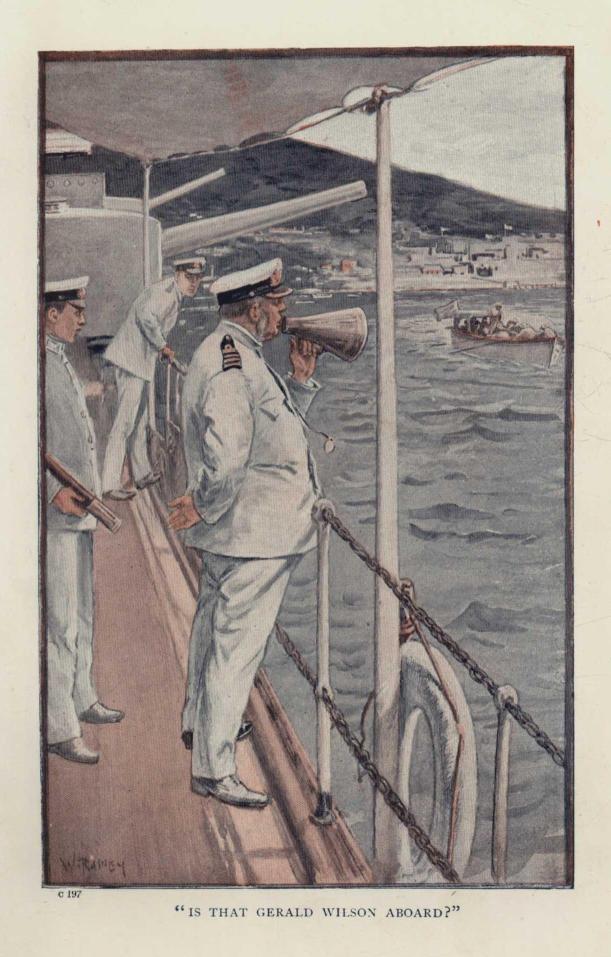
"IS THAT GERALD WILSON ABOARD?"
'Yes,' he shouted, putting his head out from under the awning. 'Then, for goodness' sake, don't come aboard my ship, or I'll have to arrest you. I've got your warrant on board. You can come alongside, but don't leave your boat.'
'Thank you,' he shouted; and it amused me to see my Sub's face. I believe that he was even grateful enough to stop the mids. doing physical drill early in the morning over my head on the quarterdeck. The Provisional Government—for that it actually was—did manage to get alongside, and the first man to tramp up the ladder was the Vice-President—de Costa himself. I recognised him at once from having seen him in the cathedral at Santa Cruz. Poor chap, he had on a black frock-coat and beautifully brushed tall black hat—in that awful heat too. No wonder, if it was necessary, as head of the Provisional Government, to wear it, that he looked ten years older than when I saw him last.
His face looked more yellow and flabby, and his black eyes more shifty than ever. He bowed, and I bowed, and then he waved his secretary at me—a little chap in another frock-coat and silk hat who followed him. The little chap's patent-leather boots were giving him trouble, and he came along the quarterdeck on his toes, like a cat walking along a wall covered with broken glass. Fortunately he could speak a little English, and whilst his boss was mopping his forehead, he said, 'Presidente de Costa thank you for coming,' almost breaking himself in half, he bowed so low. Four or five more chaps came along, every one of them with an enormous black and green rosette in his coat. These were soldiers—two of them niggers—and very mild-looking soldiers they were, just the sort you'd imagine would hang about at headquarters, and get soft jobs where there weren't many bullets flying round. However, I was wrong in thinking so.