Introductory material
Reading edition
OLD VIOLINS
PRELUDE
What is the secret of the violin? Why is it that when a great violinist appears all the other soloists have to take a back seat?
The answer is: the fascination of the violin is the fascination of the soul unveiled.
No instrument—the human voice hardly excepted—provides such a rare vehicle for the emotions—is in such close touch with the molecular vibrations of thought and with the psychic waves of feeling. But whilst the violin equals the voice in sensibility and expression, it far transcends it in compass, variety, and durability.
Consider the singular completeness and perfection of this instrument as a sort of physical and vibratory counterpart of the soul. The four strings no doubt limit and define its compass, and only in the quartet and collectively, is it capable of extended effects of complex harmony; but as a tone-producing instrument and within its limits it is perfect—every gradation of sound between tone and semitone is attainable, and for no other instrument can this be claimed.
Next I observe that the violin possesses a trinity in unity of power which invests it with a quite singular and felicitous completeness of its own:—
(1) Accent—and in staccato passages almost the accent of percussion.
(2) Sustained sound—to a degree far beyond the capabilities of the human voice.
(3) Modified tone—and in such refinement of gradation, that the melting lines of the spectrum can alone supply us with a parallel or analogy.
Your piano possesses accent, but once strike a note, soft or loud, and it passes beyond your control.
The piano has little sustained and no modified tone.
Your organ has accent and sustained tone, but in a very imperfect sense modified tone; and a brief survey of all musical instruments now in use will convince the student of acoustics that nowhere but in the violin do we find to anything like the same degree, that trinity in unity of power summed up in accent, sustained sound, modified tone.
But the half has not yet been revealed. The trinity of power in the violin is placed under the immediate control of two hands—of ten fingers, each hand functioning differently. The hand on the finger-board is engaged in pressing the strings; the other hand wields the bow, and not only sets the strings in vibration, but drives, tears, plunges, caresses, checks, prolongs, magnetises and regulates, in an altogether marvellous fashion, the outpourings of sound, which are in reality the outpourings of the musician’s soul,—and further:
Has it ever occurred to you, my reader, how differently the same piece of music, or, for the matter of that, the same violin, sounds in the hands of two different players?
A few of Paganini’s solos were written down, and Sivori, who passed as his only pupil, was in the habit of playing some of them; yet no one was ever wrought to frenzy or melted into a passion of tears by that elegant performer. I have often heard him. The gentlemen in the orchestra remained calm, and listened with admiration and approval. But when Paganini played, the drummer on one occasion so shook with excitement that he was utterly incapable of playing his part at all, and Professor Ella, then a violinist at the first desk, went up and did it for him, whilst the other violinists were so lost in wonder that they could hardly concentrate their attention sufficiently to come in at the “tutti.”
When Paganini raised his bow on high, it came down on his four strings with a crash. What made it sound like thunder? It was the thunder in his soul! When his violin wailed with sweetness long drawn out, why did the tears roll down the faces of hardened orchestral veterans, and even great virtuosi like Lindley and Dragonetti? Why did the people just go off into fits of laughter when a comic vein seized the prodigious Maestro in the midst of his variations on the Carnival de Venise?
I have heard Wieniawski play his since much hackneyed “Legende”—it may have been somewhere in the sixties. I never heard anything so weird—spirit voices in the twilight—the wail of lost souls—one positively saw ghosts. I have heard the “Legende” a hundred times since by Neruda, Nachez, Sarasate, and I know not how many more, but I have never again seen ghosts.
What was it? It was the mystery of touch. The language of touch is but half understood, but the language of touch is the language of soul, and the perfection of touch is reached when a sensitive finger controls a vibrating string or nerve and sends its own psychic thrill along the waves of sound or sensibility.
The same no doubt is true of the pianoforte touch, though in a less degree, because a percussive touch can never have the power of a sustained and modified pressure.
Recent science has thrown some curious sidelights upon this same sense of touch. It affirms that the trained fingers of the blind actually acquire from exercise, practice, and adaptation, new nerve-cells filled with grey matter exactly similar to the thinking and feeling grey nerve matter of the brain—in fact, the fingers of the sensitive musician have the power of thought and emotion delegated to them; and just as thinking matter is not confined to brain cells, but extends all down the medulla oblongata, which responds to stimulus, even when the head is cut off—so we now know that brain cells may be acquired, I had almost said cerebrated, and used even by the fingers.
Now, supposing we bring these thinking, pulsating finger-tips and wed their subtle pressure to waves of sound, who shall say that these special sound waves may not be so impregnated with brain waves as that sound thus charged with soul may convey through the auditory nerve to other souls the passion, the emotion, the sorrow, the joy, and whatever else is generated in the heart and brain of the musician? ’Tis not more inconceivable than thought-reading.
This goes far to account for the personal fascination which players exercise through their art. Their soul waves becoming brain waves, float out, charged with whatever is in the musician; and if there is nothing in the musician, as not unfrequently happens, they float out charged with nothing!
The witchery of the violin for collectors is perhaps more difficult to explain. Very often these fanciers don’t play, and still more often they seem to have an objection to other people stringing up their treasures and playing on them. It is the construction, not so much the sound of the violin, that deprives the collector of his senses; but we ought to be very thankful to these monomaniacs, for without them there would be few masterpieces still extant; through them the violin goes into a period of Devachan, or enforced rest. At all events, it cannot be worn out, or chipped, or rubbed, or trifled with by repairers whilst in the collector’s cabinet.
All the finest violins are known and carefully stalked—the health of their owners watched; and when the time comes, they either find their way to the open market or are picked up briskly by the great dealers, sometimes for fabulous sums. Mr Hill of Bond Street thinks nothing of a thousand pounds for a really fine specimen of Strad.
Watch the collector exhibiting his treasures to a select company after lunch. You will soon see he is not the daft creature whom the uninitiated who only want to hear the fiddle are apt to suppose. He knows the influence which that old Gasparo or Maggini had upon the Cremona school. He marks with admiration the emergence of the Amati and Guarnerii from the Brescian models; for him even the quaint long ∫ ∫’s of the old makers stand in lovely contrast with the more graceful but still pointed sound-holes of Joseph or more rounded ones of the great Antonius. To him that ancient viola cut down from a larger-sized model of viol now extinct, and placed side by side with an Amati tenor, is as interesting as the study of comparative anatomy to a scientist.
Then your collector is never tired of dwelling on the perfection of those forms which slowly emerged as the survival of the fittest in that exciting quest for the sensitiveness, sweetness, and sonority of tone which occupied the lifelong meditations of Nicolo Amati and Stradivari. Anon he will call your attention excitedly and sympathetically to the grace of the curves, the surface never flat or board-like, but full of a variety of levels like the satiny surface of a fine human body. You might almost believe that a whole system of muscle—a very living organism—lay beneath the “back” and belly, which to his eyes are alive with swelling and undulating grace;—and then think of the varnish like a sheet of thin jasper, at once shielding from decay, whilst revealing as years roll on the transparent filaments of the mottled maple or sycamore and the pine, and crossed between the fibres with millions of tiny rays which betray the desiccated cells—now fit for resonance—through which the sap once flowed!
But I must not anticipate matter which more properly belongs to violin manufacture. I only wish to affirm, in justification of the existence of players, hearers, and collectors alike, that the violin charm has its own rationale.
I may perhaps be pardoned if I close this prelude with some words which I used before the Royal Institution in 1872.
“The violin is perennial. It grows old with its perpetual youth. There is no reason why it should ever wear out. It sings over the graves of many generations. Time, that sometimes robs it of a little varnish, has no power over its anointed fabric.
“The hard durable substance steeped in silicate-like varnish has well-nigh turned to stone, but without sacrificing a single quality of sweetness or resonance.
“The violin is the only fossil which still lives, and lives with a fulness of life and a freshness that contrasts quaintly enough with the fleeting, sickly, and withering generations of man. Even should mishap bruise or break its beauty it can be endlessly restored. It is never fit for death; it survives a thousand calamities; nay, even when cut up and dismembered, its several parts, scattered through a dozen workshops and three hundred years, live on with a kind of metempsychosis in new forms, and still cling strangely to their individuality, so that men taking up a patchwork violin say, ‘It is fine—the front is poor, the head is tame, but see here is a Stradivarius back!’
“Thus human in its power and pathos, superhuman in its immortal fabric, the violin reigns supreme, the king and queen of all instruments—and, in the hands of a Paganini, a Joachim, an Ernst, or a Sarasate, the joy and wonder of the civilised world.”
CHAPTER I
VIOLIN GENESIS
To me it has always appeared unimportant and not very interesting to answer the question, “Were or were not the ancients—by which we usually mean Babylonians, Egyptians, or Greeks and Romans—acquainted with the fact that stretched strings could be set in tonal vibration by means of horse-hair, reed, or some other fibre?” They knew most things, and how much they knew we are only now beginning to discover.
At one time we thought that even the Romans did not know that water rose to its level, but they were well acquainted with the fact.
We pride ourselves upon the triumphs of modern surgery, but we now find that the Egyptians were also great surgeons and operated successfully for calculus.
The wonders of electric telegraphy are doubtless of modern origin, but the Greeks were at least aware of the attractive properties of amber, which they called “Electron,” though they made no use of electricity, and they may very likely have been acquainted with the principle of rubbing, as they certainly were of plucking, a string in tension to produce a sound—without ever elaborating the idea in an instrument for musical purposes.
Both Fêtis and Vidal deny that any instrument of the viol tribe existed in antiquity, apparently on the slender grounds that the few fragments of pottery, papyrus, or mural decoration known to us have not yet revealed the fact. I think it probable that these savants are wrong. Like the use of the wheel, bow and arrows, bow and string for drilling holes, the bow or something like it employed for musical purposes is likely, on a priori grounds alone, to be of immense antiquity, and at least as old as the knowledge of percussion instruments such as the drum, or of wind instruments such as the pan-pipes.
I don’t lay any great stress upon pictures of stringed instruments with something like a bridge taken to prove the existence of a bow, especially if the bow happens to be absent—a guitar has a bridge but no bow, so has the zither and the bandoline, which are plucked with the fingers or a plectrum. The much-talked-of Canino Vase (fig. 103, vol. iii. of Micali’s Storia Degli Antichi Popoli Italiani), showing apparently a sort of instrument with apparently a sort of bow, has been held by some to be conclusive that something like the violin tribe was known to the Etruscans. Possibly! Personally I am not satisfied that it is a musical instrument at all which is figured on that same vase—it might be anything, from a rattle or a torch to a broom or a dust-pan. The strongest point in its favour as a musical instrument is not the rough image on the vase, but the fact that a musician, astronomer, and doctor, by name Chiron, is seated beside it.
We probably see the descendants of any such instruments as may have existed in those times in the Ravanastron, which has been recognised by some as the oriental precursor of the occidental fiddle.
Altogether, I think that, from the musical point of view, too much time, and a surplus of barren antiquarian lore, have been bestowed on the origin of the viol tribe.
Our business begins not even with the building up of the viol out of the Rebek, Crouth, and Rotta (see “Music and Morals,” p. 382), but with the emergence of the violin tenor, violoncello, and double-bass out of that confused, tentative, and often grotesque crowd of viols and viol da Gambas, specimens of which are still exhibited behind glass in our Art Museums and Loan Collections. We have little to do with them. They are of no more living account than the Egyptian mummies in the British Museum. A few retain a gleam of practical importance for the violin collector, because they have been cut down for tenors or otherwise used up during the last three hundred years by violin makers: the others remain of interest to musicians only; like the bones of fossil crocodiles, they are curious studies in the comparative anatomy, not of reptiles, but of musical instruments, that is all.
No, it is with the distinct evolution of the violin, by which I mean the violin tenor, violoncello, and double-bass types, from the nondescript, dusky, tubby, ungainly machines, muffled in sound and dubious in form, that for me at least begins the history and the interest of the violin tribe.
The genius of these elect types is inseparably connected with song—sacred song.
Viols were used in churches to play chants in unison with the monks’ voices (probably also to assist their defective musical ear). When the singing-schools of Italy arose and divided the voice into treble, alto, tenor, and bass, a suitable viol was told off as the companion of each voice. Soon after this the modern divisions, the octave and the discovery of the perfect cadence, laid the foundation of the art of modern music (Monteverde, 1570). The violin emerged.
The endless discussions as to exactly when the violin proper made its appearance, or the tenor proper, or when the viol da Gamba got modified into the current violoncello size and shape, will probably continue to agitate those whose minds have a special aptitude for such researches. A very general statement will probably satisfy general readers, and even special lovers of the violin.
The name of Duiffoprugcar haunts this dim transition period, and although the violins extant under his name have all been discredited, and not always distinguished from Vuillaume’s clever forgeries, I remember one of the first judges in Europe, who was certainly quite alive to the tricks of the trade, showing me a reputed Duiffoprugcar (hung and labelled in the South Kensington Museum), which he then believed to be genuine. It had lost the tubby characteristics of the viol tribe; it was, in fact, an early Brescian violin, linen-lined, but its claim to be a Duiffoprugcar was withdrawn.
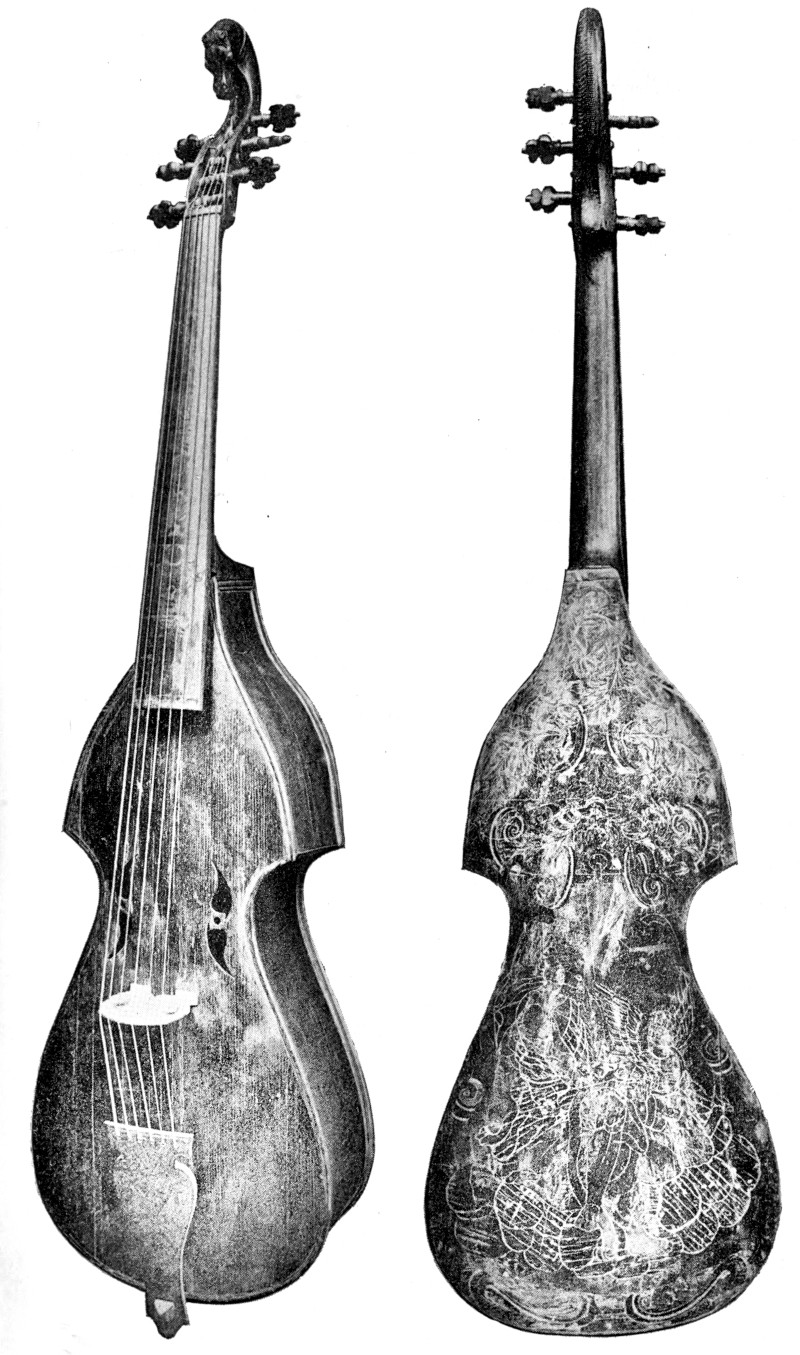
Duiffoprugcar was born in 1514 at Fussen, in the Bavarian Tyrol. He was an inlayer and mosaic worker. He is now known to have visited Paris, and to have worked at Lyons. There is a fine portrait of him etched by the engraver Wariot in 1562, and a curious viol is extant by him, with a map of Paris inlaid at the back, once owned by Vuillaume, and within recent years secured for the Brussels Conservatoire Museum by its intelligent curator, Mr Victor Mahillon. Mr Donaldson’s beautiful viol da Gamba is the only other known specimen of his work. There is no evidence that Duiffoprugcar ever made what we should call a violin, and very good negative evidence to the contrary. In a curious old print exhibiting his portrait, a copy of which is owned by Messrs Hill, amongst the various viols represented no such instrument as the violin appears.
It is easy to see how inevitable was the differentiation of the violin tribe from the first moment that a vocal quartet came to be conceived of. First the viol is selected to double a part, next a viol is made in a modified way to suit the part, and very soon the modification assumes the forms and proportions known as violin, viola, and violoncello.
But in the early days of violin genesis the instrument was quite subordinate to the voice; it only gradually conquered its independence with the emergence of the string trio and string quartet. It would happen thus:—
Two people would meet to sing, and the missing tenor or bass voice would be supplied by a viola; or three would meet who could not sing at all, when it would occur to them that the vocal parts might be played instead, and with even more accuracy perhaps than the very average voices would attain to.
The instrumental trio and quartet thus at once came into being.
Next, music would be written independently for such combinations, and the voices would be egged out altogether, and presently the treble or violin would show a tendency to throw the others into the shade, and at last be thought worthy of a solo all to itself, and thus the independent position of the instrument would quickly be established.
All attempts to date exactly the stages of this differentiation of the violin tribe are likely to be misleading.
You cannot say exactly when perspective was discovered or rediscovered by the Italian painters, it developed gradually; and so the violin developed gradually, born of new musical needs and new musical knowledge.
In the midst of the old chaotic world of viol noises that preceded it, the struggle to displace the old viol players and the slow disappearance of the whole clumsy craft is aptly summed up in the words of one who lived at the moment of transition. He writes—
“In former days we had the viol in Ere the true instrument had come about; But now we say, since this all ears doth win, The violin hath put the viol out.”
CHAPTER II
VIOLIN CONSTITUTION
One of the subtle charms of the violin is that it may be called bisexual.
It unites in itself and welds together the masculine and feminine qualities.
Its very fabric is bisexual. The soft, easily moved vibrations of the swelling front are controlled, checked, and yet excited by the slower and harder pulsations of the maple back. The porous deal and the close-grained maple or sycamore thus thrill together, and each supplies the deficiency of the other, both blending in harmonious and sympathetic union, the ribs welding the back and the belly into an organic whole, whilst the sound-post, poetically called by the French the soul of the violin (l’âme du violon), collects the quick and slow vibrations, and fusing them, produces the subtle resultant of violin tone.
That tone is the offspring of neither back nor front, nor ribs alone, but of all these differently vibrating surfaces, collected and made musical in the “soul,” and poured forth as the breath of life from the ∫ ∫ holes as out of the very mouth and nostrils of the violin. Surely the children of the violin are nothing but the sweet and subtly compounded sounds that it utters.
The bisexual figure holds good even to the bow and strings. The bow is the male and the strings are the female elements. They can only vibrate when touched—swept into a tempest of emotion or caressed into tender whispers.
They wait and pine for this magic touch, and long for their own fulfilment. They are so sensitive that they respond to the lightest feathery kiss of the powdered and anointed horse-hair—they murmur, they sigh, they scream, they weep, they laugh, but only when smitten, coaxed or agonised, sometimes almost torn, at others calmly and masterfully swept; whilst the finger-tips, pressing out the vibrations and generating those magnetic thrills which go forth charged with the musician’s very thought and feeling, aid and abet the masculine power of the bow. They are its ministers; without them the might of the bow itself would be impotent; without them the very strings would be unable to yield their infinite variety of tone and inflection of meaning. Yes, certainly the violin is of all instruments the most human, personal, and sympathetic, for the violin is truly bisexual.
It is also a miracle of art, strength, and simplicity—we may say at once, as light as a feather and as strong as a horse. It is composed of thin sheets or slips of wood, only about a fragment of an inch thick; but, by the simplest and soundest mechanical construction, these are so put together as to resist a strain of about a hundredweight upon the belly, neck, and tailpiece, from the tension of the four strings.
Six sycamore ribs and twelve internal blocks and linings suffice to hold the back and belly together.
The neck carries the ebony finger-board and lifts its characteristic scroll or head—so expressive that makers can almost be recognised by its physiognomy.
The neck is let solidly into the ribs and fastened against the lower part of the belly. When firmly glued it is extremely difficult to detach it, and once only in my experience has the neck of a violin proved unequal to support the enormous pull made upon it by the strings.
It was in Ceylon. The heat was intense and moist. I had borrowed a violin for experimental purposes in one of my lectures at Colombo. In the middle of an attempted passage the neck quietly doubled up; the strings fell in a loose cluster. The glue had liquefied, and the whole fiddle came to pieces in my hands. What no time nor wear and tear had been able to effect had been suddenly achieved by the peculiar hothouse, vapour-bath treatment of the tropics.
The early viol-makers no doubt at first selected their wood empirically; but it soon became an established rule to take a soft wood for the belly and a hard wood for the back. If all were soft, the sound would be muffled and tubby; if all were hard, the sound would be metallic and light; neither must the thickness of back and front be uniform—each must be thicker towards the middle, but how thick or how thin must depend upon the relative densities of the wood. The problem was to find the relative densities which would best vibrate together—a cunning connoisseur in timber can judge of these densities even by the feel of the wood. Of course the densities will affect the tone yielded by the wood when set in vibration, and it is difficult to believe that Stradiuarius and his school were unacquainted with some exact technical method of testing the acoustic properties of these woods.
Monsieur Savart’s experiments with specimen strips of Stradiuarius backs and bellies showed that in most cases tested there was the difference of one tone between the belly and the back. A 1717 and a 1708 Strad back both yielded a F♯, a 1724 and a 1690 Strad bellies gave the interval, so that Stradiuarius worked his backs and bellies on some regular principle. On examining specimens of Joseph Guarnerius, it was found that his best were made with only a full tone between back and belly; but occasionally the interval was greater.
The sound-bar is a subtly proportioned strip of pinewood running nearly all the way down the middle of the belly inside. The increasing tension of the modern pitch has made it necessary to strengthen all the old violin sound-bars, as the increasing demands for execution have compelled the lengthening of all their necks.
It is needless to say that the sound-bar readjustment is a delicate surgical operation, more difficult than the substitution of a long violin neck for a short one, for the neck no more affects the tone than the screws in the head. But any blundering with a sound-bar is fatal to the nervous system of the violin; the wolf may suddenly be evolved—that horrid dull growl which sets the teeth on edge, and which, once generated within the violin, is so difficult to diagnose or to cure. The best old masters finished everything inside their violins as carefully as the purfling and the joinings which would meet the eye, and this although a century might elapse before those tiny smooth blocks in the angles, or that carefully-cut close lining of wooden strips fitting neatly to the bellies as a glove to the hand, might chance to be seen at all.
Many forgeries have thus been rudely unmasked, the forger only having troubled to make clean the outside of the cup and platter, whilst within you find the dead men’s bones of his slovenly dishonesty. He worked only to sell, and to sell by deception (not because he cared for his craft or respected his instrument), and his works do follow him! But as Mr Lowell says—
“Men as worked thorough is the ones that thrive, But bad work follers you as long as yer live; Yer can’t get rid on it, just as sure as sin, ’Tis allers askin’ to be done agin.”
The finger-board is of black ebony; in the old fiddles it was often inlaid. There need be little said about it except that the old masters would be puzzled to know what a player could want with our long finger-boards, and still more would they have been puzzled could they have heard the extraordinary and complex effects we manage to produce with our extended compass and phenomenal shifts, in spite of the absence of frets to measure intervals.
The Finger-board must be kept smooth and even, or it will not be possible to “stop” fifths or any other chord in tune. You will notice in old finger-boards the strings have worn deep channels, which of course mar the vibration. The height of the strings above the finger-board is to some extent a matter of fancy, and of course depends on the height of the bridge. A child or young girl would soon be discouraged with attempting to press strings raised too high above the finger-board, and of course the higher you ascend the harder must be the pressure. On the other hand, if the strings are too close down, the touch is no doubt light to your heart’s content; but you cannot get a sufficiently full vibration, and your tone will suffer.
The Bridge! I had almost said the asses’ bridge, for indeed thereby hangs a tale. The hard-wood bridge, with its whimsical perforated visage, and its two slender feet clinging closely to the smooth belly of the violin, has been sometimes treated with scant courtesy by writers, and even makers do not all seem fully alive to its importance. I notice repairers will send you back your violin with a bran-new bridge, and no apology, if they happen to have mislaid or broken yours. But the bridge not only exercises the most important and indispensable functions of carrying the four strings under a combined pressure of seventy pounds, but it is in closer and more intimate contact with the instrument than any other of its appendages. It is so squeezed upon the wood as to be almost pressed into it, far more so than the finger-board or the tailpiece, or even the blocks and linings. It is charged with the primary vibrations from the strings and the secondary vibrations of the belly, ribs, and back; nothing goes on in that wondrous air column enclosed in the violin walls without the bridge taking cognisance of it, and possibly hindering or aiding and abetting its successful exit from the sound-holes.
I am aware that I have been thought fanciful in this matter, but an experience of many years has convinced me that it is not easy to get a bridge that suits a violin perfectly, and most dangerous to trifle with the close and quasi marital relations which exist between the violin and its bridge. I dislike new bridges. I love old ones; and why, when all the rest happens to be old, is the bridge alone to bring the raw sap of youth to vex the mellow and desiccated repose of melodious age?
The position of your bridge, like that of your soundpost, the adjusting of your screws, the thickness of your strings, belongs rather to the management than to the constitution of the violin.
The only further details fit to be noted here seem to be the button supporting the tailpiece, which has a character of its own, in its size, material, and fixture; and the far less important tailpiece, to which we may add the purfling and other occasional inlaying.
The Tailpiece, of course, is strictly indispensable, but it does not much matter what it is made of, or how it is decorated.
The Purfling, although occasionally resisting damage to the outlying edge, is chiefly ornamental, and consists of three thin strips of wood—two ebony or whalebone, and one of white wood—glued together and inlaid.
In the purfling we have the last survival of the inlaying as applied to musical instruments. You will notice that the further you go back the more elaborately inlaid are the viols and violins. It was thought that the instrument, which was little more in those days of rudimentary music than a toy, might fitly be exploited to show off the conceit of artists and the skill of cabinet-makers; but as music developed and tone was reckoned all-important, every detail likely to interfere with this new development gradually disappeared, till in the hands of the Cremonese makers the faint memory of all the gorgeous mother-of-pearl, ebony, ivory, gold and silver embossing, survives only in the narrow three thin lines of the purfling which strike the contour of the instrument and give piquancy to its form.
And thus the perfect sounding violin, though denuded of all superfluous decoration and meretricious adornment, yet remains a miracle of art—“a thing of beauty and a joy for ever.”
CHAPTER III
VIOLINS AT BRESCIA
The violin proper is an Italian creation. It comes from the north of Italy. Stainer, it is true, is an early maker, and he bore a German name, but his date is after all 1621-83, whilst that of Maggini is 1590-1632; and if you visit the frontier village of Absam, near the town of Hall, where he lived, you will observe that he dwelt on the high-road between the Tyrol and Italy, and that his training, his talent, and his market were Italian.
But Brescia was really the home of the violin, and there is possibly something in the heavy salt seasoning of the Tyrolean pines which specially favours that peculiar resonance, sensitiveness, and durability for which the Brescian and Cremonese schools are famous.
The name of Gasparo di Salò (Bertolotti was his real name), now chiefly famous for his double-basses and violas, must ever be revered by students as the master of the great Maggini, who was in reality the father of the violin, in the sense of having clearly, at once and for ever, differentiated the instrument as a distinct type.
Salò is a lovely spot on the shores of the lake of Garda, in the province of Brescia, and about twenty miles from the big town. It was early famed for its culture. Foreigners went there for the sake of its schools, and the Corporation records show that sacred music especially flourished there. It is now certain that Gasparo migrated thence to Brescia and worked in that town. Maggini was as certainly his pupil. This is proved by a legal document, dated 1602, which has lately been discovered, bearing the joint signatures of Gasparo and Maggini, who is termed his “garzone,” or apprentice.
Gasparo’s share in violin-making proper could not have been very great, as the earliest violin orchestral music appeared in Italy in 1608, and Gasparo died in 1610 or thereabouts—a fact which, taken in connection with the extreme rareness of any Gaspardian instruments which can be called violins, seems to argue that the piccolo violino which was presently going to be master of the situation was only just creeping up.
I have seen and played on one very fine Gasparo violin, the property of Lord Amherst—D and A strings rich and pure, 1st and 4th rather muffled, but on the whole the tone is mellow and powerful.
This almost unique Gasparo violin is still bulgy, but a great improvement on the old viol build; the head is long and quaint-looking, but lacks that finish and character which later masters put into their scrolls. Gasparo’s basses are still much sought after, and Dragonetti possessed more than one.
A giant specimen, known as the Duke of Leinster’s bass, may still be seen at the South Kensington Museum, and I exhibited it at the Royal Institution in 1872. His work is heavy and lacks refinement, but his tone is grand and full-bodied.
Gio. Paolo Maggini was the child of his father’s old age, and born at Botlicino, near the town of Brescia, which afterwards became the family headquarters.
Brescia was at this time a strongly fortified place, and a print as late as 1764 probably gives us a fair notion of what it looked like between 1560 and 1632.
Swift brooklets ran down the streets, and outside the walls were spreading woodlands and ploughed fields. It boasted of a splendid brick palace, the Broletta, and a massive belfry of rough stone (Torre del Popolo), a Castello, and an old Duomo; the streets were adorned with frescoes. The Cathedral of San Pietro de Dom was famous for its music, and had an organ and full orchestra. The viol-makers and the monks were then, as they have since been, in intimate relations, and it was a couple of monks who befriended Gasparo when he was down in the world in health and fortune, and sadly needed it.
The princes of Italy at this time (1512-1630) were great patrons of art, letters, and especially music. Brescia in 1600 was under Venetian rule. The town or fortress was from its very position constantly in the midst of wars and rumours of wars, and was appropriately famed amongst other things for its manufactory of swords and armour.
It is surprising how little military commotions seem to have affected, either at Brescia or at Cremona, the manufacture of musical instruments. There seems to have been an uninterrupted line of viol and cither and lute makers at Brescia from 1300 and onwards.
But when it is remembered that war does not interrupt the functions of religion or diminish the importance of the clergy (nay, often enhances both), we can understand that the musical instrument makers might have been as much in demand, in the stormiest times of the Visconti and Medici, as druggists, soothsayers, or mountebanks; and they probably made impartially for friend or foe—for any one, in fact, who could afford to pay.
Up to within the last few years very little was known of this man Gio. Paolo Maggini—Magino or Magicino. As he put only the name and place, but not the date, on his labels (all dated Magginis are therefore frauds), it is not easy to assign fixed dates to any of his instruments, and the personal information to be squeezed out of them is of the meagrest description. He worked in Brescia; few of his instruments survive. His violas are as rare as Gasparo’s violins, but he distances all other makers in the attention that he gave to that newfangled and suspiciously regarded instrument, the true violin.
His handwriting, some of which survives, would lead one to suppose that his education was very moderate, but the signatures of illustrious princes of this period are no better. Recently, however, the State Archives of Brescia have revealed some interesting gleams of information which enable us to show him in his workshop with one apprentice, Franchino, and a young wife, aged nineteen, Maddalena Anna, who brought him a dowry, and afterwards children.
A picture of his house in the Contrada del Palazzo, Vechio del Podesta, lies before me. It has but two storeys, and the family lived upstairs, surrendering the ground floor to the violin business.
In a woodcut by Jost Anian, Zurich (1539-91), we have an authentic picture of such easy, leisurely, calm workers as Maggini.
There is the rude substantial bench, the tools, the glue-pot, the planks and the wood in blocks, bits of fiddles and strips of timber hung up on the walls; the aproned artificer is carefully trying a lute as he sits on his three-legged stool.
What simplicities! Were we to enter in imagination the studios in which the greatest pictures in the world were being painted about this time, the same meagre appliances and absence of superfluous luxury would doubtless have greeted our eyes.
But our gorgeous modern studios hung with the spoils of the East, and iridescent with precious pottery and curiously worked metals, our modern workshops with their exquisite mechanical appliances and all sorts of labour-saving machines, somehow fail to rival in quality of production those old masters who sat on three-legged stools, ground their own pigments, made their own glue and varnish, and chopped and chiselled their own wood.
If you consider Maggini’s period (1560-1632) you will see how exactly the direction of his genius was conditioned by the demands of his age.
The singing-schools of Naples had resulted in a call for stringed instruments in increased numbers, but the old viols were seen to correspond ill to the altered times, and the need for an instrument which would render leading melodies effectively was felt just in proportion as such melodies became multiplied with the rise of vocal music, sacred and profane.
Most writers on the violin seem to have a passion for cutting up a maker’s life into periods, as though a man could rise one morning and say, “Go to now, let us enter upon period number three, in which the back shall be sloped so, and the belly brought down thus, and the curve of the bouts tilted, contracted, or elongated thus.” All that can be safely said is, after such and such a time Maggini or Amati dropped or adopted this or that feature as a rule, and we may infer that a maker came under such and such influences, and so forth.
Now I come to speak of Maggini, I will trace roughly but clearly what may be called his continuous development, rather than any so-called three periods.
Naturally at first the pupil made like his master Gasparo. His violins suggested big viols on a small scale. They had a heavy look; they were of large size, which makes the sides seem lower than they are, for in reality the ribs are not higher than those of the Amati.
The heads look rough, because, with the reduced size, no increase of refinement or delicacy has yet been reached; now, they are cut without symmetry; now, the fluting of the scroll is not smoothed, even the grooves for the purfling are not neat, nor is the purfling itself sharp.
Maggini’s early backs, sides, and bellies are cut on the slab—that is, across the grain.
Then Gasparo’s sound-holes have got narrower in the hands of his pupil, and Gasparo has probably got credit for some of the improvements of Maggini, as there can be little doubt that some violins labelled Gasparo are the work of his pupil, just as early Stradivari violins are in existence signed Nicolo Amati.
If I may hazard the remark, in my opinion Maggini did not copy so long or so seriously the work of Gasparo as did Stradivari copy Nicolo. The reason is obvious. The stride between Gasparo and Maggini is far greater than that between the late Nicolo and the Strad. By the time Nicolo died the violin had already risen to that supreme and independent individuality and dignity which it has never since lost.
Stradivari got the violin all ready made; it was Maggini’s glory to have assisted at the individualisation of the “King” type.
Presently we become aware that Gasparo is dead and buried. The Maggini bellies now cease to be cut on the slab, but show the long parallel grain lines of the wood as in the Amatis; the art of wood selection for sonority and sensitiveness seems already to have reached the 1650 Cremona level. The sound-holes are more delicate, but still a little quaint; they are invariably bevelled inwards, a practice entirely discarded by the Cremona masters.
Sir Joseph Chitty’s, and Mr Sternberg’s, and the Dumas’ tenors are good specimens of Maggini’s first independent work illustrating the above characteristics. The Dumas family were friends of Beethoven, and enthusiastic admirers of Maggini’s work. They possessed at least one valuable “chest” of his instruments. A chest is described by an old writer as “a large hutch with several compartments and partitions in it, each lined with green baize” (we have since gone heavily into velvet and plush).
There are only about eight violas or tenors of Maggini’s known; they do not vary in their proportions.
The model of the Dumas viola is of the master’s most arched type—a feature much exaggerated by Stainer and his followers. It is, like almost all this master’s specimens, adorned with double purfling, set close to the edge, with the usual Maggini bevel at the corner joints. These corners give it a special physiognomy; they are short, and make no appeal to the eye like the later Cremonas. The tenor’s ∫ ∫ holes are upright, short, and broad; they are higher than in the same maker’s violins, the top curves as usual larger than the bottom ones, the back and belly both in two pieces; the bass bar and blocks inside have been strengthened; the rough tooth of the well-known Brescian plane has left its mark on the wood inside. The Dumas tenor is in exquisite condition; the varnish is unlike the old Gasparo brown, it glows with rich golden tints. Its type is admirably defined; no one in looking at this tenor can say, “This is a little violoncello,” or “This is a big violin.” It is a distinct viola type, and it set the type for all succeeding violas. The Cremona makers worked on it, but they did not re-create the tenor; they could not.
The Dumas-Maggini violin is in equally fine condition; it looks so new that some have supposed that, although eighty years before Stradivari, it must be a copy made by Strad of the older master, but it is absolutely authentic and genuine.
Before Maggini died, we notice that a very high standard of finish has been reached, unknown to him in his earlier days, or, as for the matter of that, to any of his predecessors. Observe the improved purfling, the bouts and mitres cut with clear intention, but never so marked in physiognomy as the Amatis, the sound-holes quite as sharp as theirs; but, above all, the arching has at last come down—this true hint, so early given, was not at once adopted by Maggini’s Cremonese successors. Stradivarius at last fixed it and regulated it in a model from which no later maker has found it safe to depart with the exception of Duke and Klotz, who obstinately adhered to the Stainer high bellies with deep side grooves.
Maggini’s later varnish runs out of the old Gasparo brown into orange and golden yellow, as luscious as anything to be found in a Joseph or a Strad.
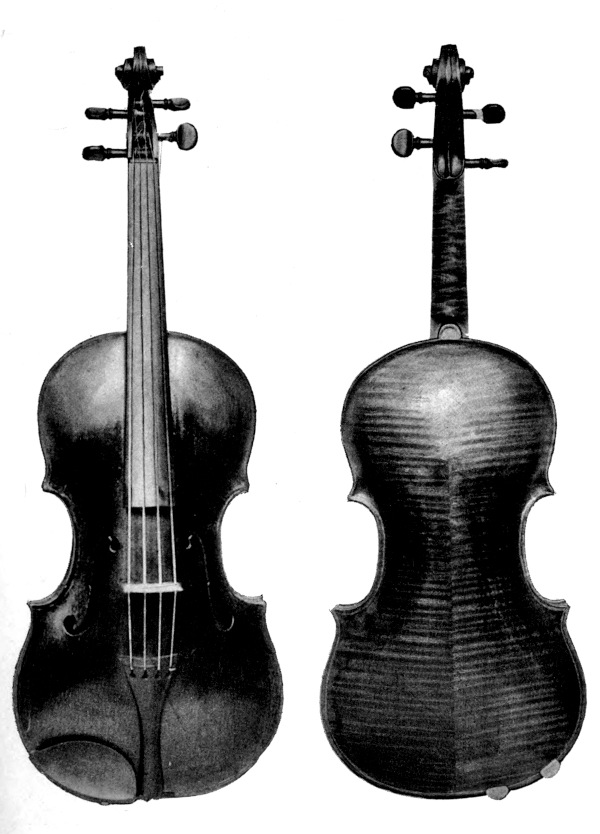
Although Maggini adhered to his double purfling, there are specimens of his work in exhibitions without it; and at least one curiously but not carelessly made instrument is known where the purfling at the back is neither double nor even inlaid, but merely drawn sharply in black lines. A very fine single-purfled violin, formerly in the collection of Prince Caraman Chimay, now in the possession of Mr Antonietti, possesses an unrivalled tone of the Maggini timbre. Many of his violins retain the old taste for other inlaid ornamentation. He does not run into maps and portraits, but a graceful clover-leaf pattern is often found at top and bottom of his backs, twisted, as it were, out of the purfling, and a sixfold trefoil sometimes occupies the centre of the back; but an acute observer has noted that there is no instance of the central trefoil combined with the clover-leaf pattern.
Not less remarkable than this great maker’s definition of the violin and viola types was his conception of the violoncello. The Maggini ’cello is not the son of the double-bass, but the father of the tenor. It is much more like a large tenor than like a small double-bass; the proportions are, as it were, enlarged from the tenor, not reduced from the flat-backed bass. Maggini’s bent was entirely in the direction of the smaller violoncello pattern.
The early and even the later Cremona ’cellos were too large, and there is very little doubt that the powerful influence of Maggini can be traced in the evolution of those perfect but moderately sized Strad ’cellos which date mostly after 1700.
The tone of Maggini is full, mellow, and plaintive, rather than biting like Stainer, bell-resonant like Strad, or soft and sensitive like Nicolo Amati; but great players like Vieuxtemps, Ole Bull, Leonard, and De Beriot have found him sufficient, and if more have not extolled Maggini, it may be on account of the rareness and inaccessibility of his instruments.
It has been said by a competent authority that not more than fifty extant Magginis are known, and in England at present (1897) about thirty violins, ten violas, and but two violoncellos and one double-bass.
Maggini died at the comparatively early age of fifty-one. All researches made in the archives of S. Lorenzo, his parish church, have failed to reveal the date of his death, and the worst of it is that the registers of that church prior to 1700 have disappeared.
We hear plenty about his wife, Anna Foresti, who died 1651, aged fifty-eight, and was buried in a neighbouring parish.
It is more than probable that Maggini himself was a victim to the plague which raged at Brescia in 1632, and that he was hastily interred, or, dying at the Pest House, no official note of his death may have been taken. At any rate, in 1632, the year of the plague, his son describes himself as “filius quondam Johannis Pauli”—the son of the late Gio. Paolo.
His last income-tax return is dated 1626, and he was dead in 1632, so he must have died at latest in 1632, and therefore could not have been more than fifty-one. Maggini was doubtless well off, owned considerable property in and out of town, was the father of six children, and, what was of far more importance, the father of the modern violin.
CHAPTER IV
VIOLINS AT CREMONA
Cremona! Amati! two words making melody with their very syllables, and a deeper harmony still for the lover of music, from the association of ideas which they excite.
With the assumed immigration of makers from Brescia—the emergence of the Amati family (the name of Amati is not found in the Brescian archives), and their final residence at Cremona—begins the classic period of the violin.
Cremona, ancient city of strife, which, owing to its very situation (κρι μόνος, “high rock” and “alone”), was the battle-point of the middle ages from the days of the old Goths and Lombards down to quite modern times; Cremona, with its stately cathedral so little known or visited, yet possessing two of the finest red lions couchant, supporting portico columns of one of the noblest cathedral façades in Italy; Cremona, with its antiquated back streets, its drowsy quiet life gliding on apart from the beaten thoroughfares of travel—truly, Cremona town is a place to set one dreaming!
I have narrated elsewhere my pilgrimage to the place which so ungratefully forgets almost the very tradition of the Amati, Stradivari, and Guarnerii, whose fabrics alone have given it a musical immortality, and whose names are hung up high like the stars, which no discords of the middle ages, sieges, or brawls can ever reach.
Let us now try and come face to face with these immortal makers.
Andrea Amati (père) settled at Cremona, and made violins from 1520-46. He brought with him his brother Nicolo (not the great Nicolo, afterwards master of Stradivari, Italian, or Stradiuarius, Latin).
Andrea Amati had two sons, Antonio and Geronimo, who made violins jointly as well as separately. When Antonio married, the fiddles of neither seemed to improve. The brothers ceased for a time at least to work together (there being, it is said, a period in which there are no joint reductions); but as there are much later violins bearing their joint names, it has been assumed that they again collaborated. If we trust some of these late labels—the brothers being born about 1555-56, and one of the joint violins being dated 1687—it would follow that the venerable artificers were still making violins at the age of 136 years, which beats Stradivari himself, who only worked till he was ninety-three.
Geronimo, according to one writer’s account of his labels, went even one better, for there is a Geronimo violin dated 1698; so if this Geronimo, brother of Antonio, was born about 1556, which is tolerably certain, he went on working even longer than Moses, with his eye undimmed and his natural strength unabated, down to the age of 148!
The confusion has arisen from confounding Geronimo, brother of Antonio, with Geronimo, son of the great Nicolo (born 1649, died 1740). But if there exists a signed Geronimo and Antonio dated 1698, which seems very doubtful, it would be certainly easier to believe that, as the demand for Italian instruments by makers of repute had well set in before 1700, the late Antonio and Geronimo label was stolen from the old workshops—the last two figures of 16—being filled in, and the label clapped on to cover the fraud; whilst any Geronimo violin dated 1698 would be by Geronimo, son of Nicolo; or at most, one made up by some enterprising pupil out of the débris of the elder Geronimo’s workshop—perhaps about the time that Nicolo the Great, son of Geronimo and grandson of Andrea, was working with his pupils, Stradivari and Andrea, Guarnerii, and his own son, the younger Geronimo or Girolamo Amati.
But with this Geronimo Amati, son of Nicolo (born 1649), and a certain Don Nicolo Amati, an Italian priest, we need not trouble ourselves beyond recording their names.
A good deal has been said about Andrea Amati and his violins. He was certainly the founder of the family, but not much is known about him except that he probably, almost certainly, acquired from Brescia the Maggini type, and that his violins are somewhat smaller, arched in the belly, with a varnish that runs out of the Brescian brown into the mellow and brilliant gold and ruddy tints common to the Cremona varnish; the later Amatis have a tendency to revert to the browner hue.
That Andrea made some choice violins for Charles IX. of France—twenty-four violins, twelve large, twelve small pattern, known as “les petits violons du roi”—there can be no doubt, but they disappeared from Versailles in the political disturbances about 1790. The arms of France, we are told, were painted on the backs, and they are said to have been of beautiful workmanship.
A ’cello, “Andrea Amati Cremonentis faciebat, 1572,” was sold amongst some others belonging to Sir William Curtis, May 1827. This is known as the “Bridge’s viollo.” Its history is romantic, it having been presented by Pope Pius V. to Charles IX. of France, and surnamed the “King.”
The Amati characteristic, which culminates, along with other qualities of sonority, in the great Nicolo, 1596-1684, is sweetness of tone; but a certain want of power is noticeable, especially on the fourth string. The “A” is beautiful, the “E” soft and delicate, and the third very full and round—qualities which are also conspicuous in the brothers Geronimo.
But if Amati tone is of cabinet, not concert quality, its quality is of a kind unequalled for charm and sensitiveness, and although not loud, some violins made by the brothers have a considerable carrying power.
The Amati heads or scrolls retained a certain simplicity and antique Brescian look even after the finish and form of the body of the violin had left the Brescian school far behind. The double purfling of Brescia is also gone, but the brothers purfled very beautifully, with a bend of perfect regularity and smoothness.
The violins of Antonio are better than his brother’s, but the joint violins are the best, and have been oftenest forged.
The brothers indeed made excellent violas, but, as the fashion then was, too large. They have been sometimes cut down. Sir Frederick Gore Ousely once had a fine specimen, which I remember playing upon many years ago at Tenby—tone very full and mellow.
Richard Blagrove, a brother of Henry Blagrove, the admirable early Monday Popular violinist, was a viola player, and used a reputed Amati, but it was really a Gagliano. Many of us (1897) can remember how richly it contributed to the triumph of a quartet, of which Joachim, Riess, and Piatti were often the other members.
Her late Majesty the Queen had a fine painted Amati, unfortunately cut down; and Miss Seton’s Geronimo Amati is a rare specimen, and from the MS. of Ascenzio, a priest at Madrid, we learn that it was a favourite violin of Charles IV. of Spain.
Geronimo, after separating from Antonio, reduced the arching of his bellies, but, singularly enough, without improving his tone-power. The over-arching of the early makers and scooped side-curves are generally supposed to be a vice in acoustics finally overcome by the gentle natural curve and flatter models of Nicolo, but it is perhaps possible to ride a theory too hard. I have certainly played on instruments deeply grooved, with rounded bellies, powerful Dukes and piercing Stainers, which, according to the orthodox theory, had no business to sound as loud as they did. It is well known that in both these Amati makers the late Cremona flat curve is conspicuous by its absence; and whilst I do not for a moment deny that the flatness of the Stradivari model is preferable, I think the superiority of the late Cremona tone may be due to a good many other things beside that. It will always be a question whether the man who makes possible the last perfection of an art or the man who actually achieves it is really the greater genius. Pietro Perugino or Raffaello in painting; Chaucer or Shakespeare in literature; Handel or Beethoven in music; Gasparo and Maggini or Stradivari in violin-making; but popular opinion generally plucks the blossom without troubling itself much about the roots, and the prices fetched by the finest Strad and the finest Gasparo, or even Nicolo Amati, practically settle the question as regards the violin-makers. £400 is an unusual price for a fine Nicolo (£250 is nearer the mark, 1898); £1000 is not an uncommon figure for a good Strad, and his finest specimens command £2000 (1898).
Nicolo, the great son of Geronimo, was born in 1596, and died close upon the seventeen hundreds, in 1684. Nicolo was quite aware that he resumed in himself the fine qualities of his distinguished family and improved upon them. It is true he did not trouble himself much with his grandfather Andrea, whom he probably regarded as a worthy old gentleman quite out of date. There could have been little in those small, almost three-quarter size, brown varnished, and sweet but feeble-sounding violins to attract the aspiring grandson; but there were qualities in the somewhat larger models of the famous brothers, Geronimo and Antonio, which set his hand and head agoing, when as a boy he fell to copying and carving backs and bellies, and twisting ribs and throwing scrolls, in his father’s little workshop at Cremona, opposite the west front of the Saint Dominic Church.
Nicolo the Great doubtless followed and imitated his father Geronimo, but wishing to miss nothing, and perhaps labouring under a sense of obligation or merely out of genuine affection, his labels embody an immortal acknowledgment of indebtedness to both masters. They run thus:—“Nicolaus Amatus Cremonem Hieronymi Fil, ac Antonij Nepos fecit, 1677.” (The italics are mine.)
Nicolo the Great’s smaller patterns made in his father’s workshop are not unfrequently to be met with, and can be picked up for between £80 and £100, or even less.
But as we watch his dates, the touch of Nicolo very soon becomes distinctive. On the death of his father and uncle he found himself in possession of a workshop which inherited a great name, but which was destined to transmit to future generations the greatest violin names in the world. Among the pupils of Nicolo in 1653 sat the brothers Guarneri, Andrea Guarnerius having witnessed the marriage of his master Nicolo and signed the register; and by the side of Andrea Guarnerius sat a young man named Antonio Stradivari, or, as we usually call him, Stradiuarius.
Most of the Nicolo violins before 1645 are of the smaller pattern, but after this date down to 1684, the year of his death, the eye of a connoisseur will notice an increase in size, a finish in workmanship, and a more delicate purfle (never double). The model is still somewhat high in back and belly, but with an increasing tendency to get flatter; the side-grooving is less pronounced, whilst the corners are noticeably drawn out into finer points full of character, arresting the eye, lightening as it were the model, and giving the whole physiognomy of the instrument a grace and piquancy hitherto unattempted.
The sound-holes of Nicolo are pointed and somewhat narrow; the scroll is cut a little too flat for the later taste, but passes as the century wanes into a somewhat larger and bolder style. The wood seems to be chosen almost as much for its mottled or fine-grained beauty as for its acoustical properties.
The early Nicolo varnish is of brownish Brescian type, but later on it glows with the rich amber tints of Cremona, and those dragon-blood stains which give to some Strads and Josephs such warm and generous tints like the sunlit dashes of mellow red on a ripe nectarine.
Mr Somers Cocks (1898) has a most glorious Amati violoncello, “one of the finest ever seen or heard,” so said to me a distinguished connoisseur. Mr Marshall Bulley’s violoncello, a Jerome (the younger) Amati, is also a rare gem of tone and workmanship.[1]
The grand Amati violin pattern runs some of the Stradivari violins very hard, and is evidently the model on which the 1700-35 Strads are “calqué,” as the French say. The side-grooving, generally held to interfere with the volume of tone, whilst supposed by some to add to its sweetness, has not disappeared as in the Strad grand model, but it has become less pronounced. The tone is lovely and sensitive, and the Nicolo is truly delightful to handle. It is par excellence the lady’s violin.
The one before me, where the varnish still remains, melts into light orange with clear golden gleams in it. If Joseph is the strong male, Nicholas or Nicolo certainly belongs to the softer and more yielding sex. The tone is most delicate, and of ravishing sweetness. It seems to leap out almost before the horse-hair has feathered the strings. It continues to sing on like a vibrating silver bell, as if intoxicated with itself, long after the bow has ceased its contact. In the sweet Nicolo the lover finds no bars, no obstacles; it is won almost before ’tis wooed (Plate V.).
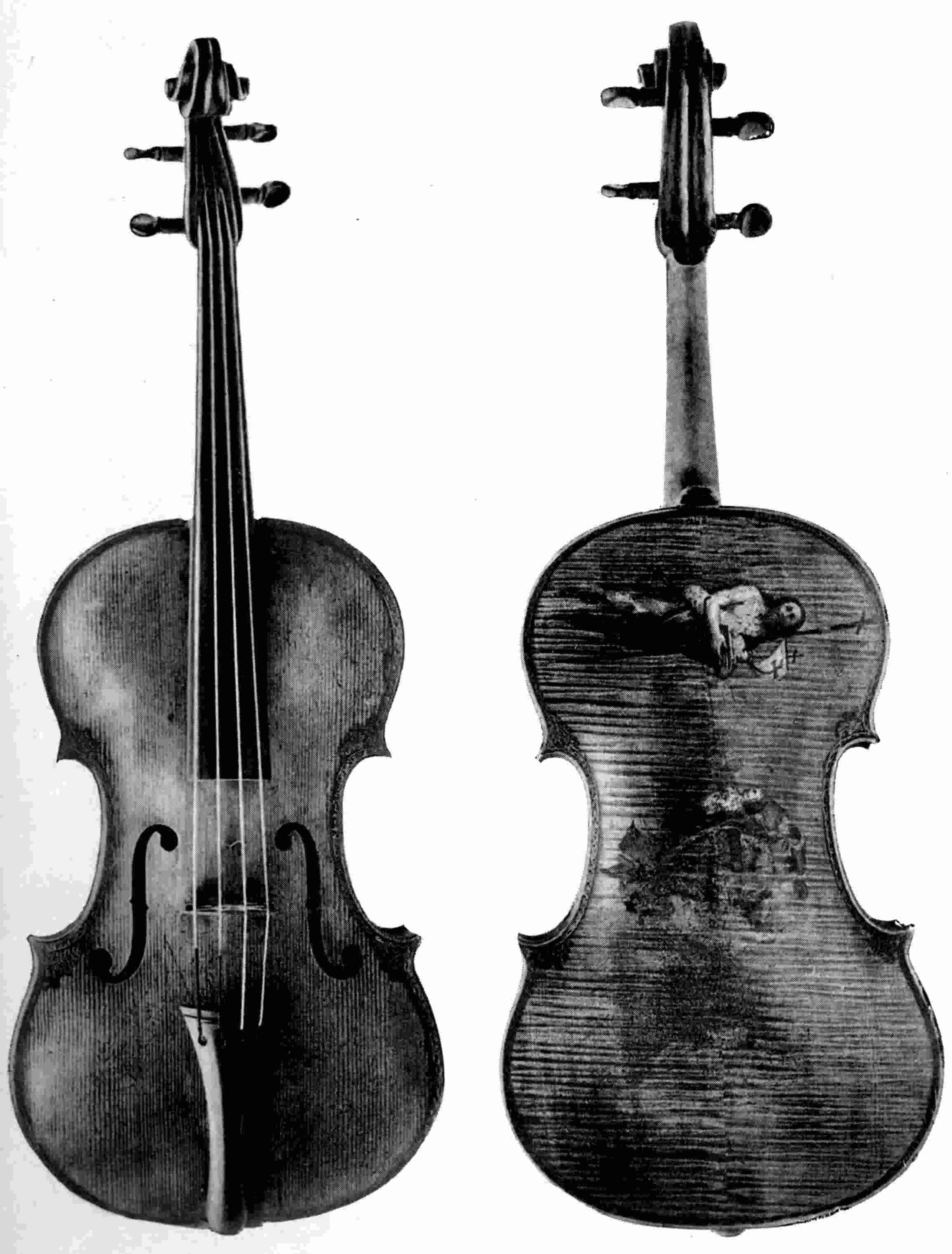
We are interested to know that in his own time Nicolo’s work was carefully imitated, if not forged; whilst his supremacy over one of his best pupils, Francesco Rugereo, Rugieri, or Rugerius, was clearly acknowledged; for we find that a certain Tomaso Antonio Vitali, who seems to have bought a violin with a Nicolo label inside, and paid twelve doubloons (or about £12, 10s.) for it, complained bitterly that on removing the false label he had discovered the name of Ruggeri underneath it. The aggrieved Tomaso thereupon applied to his liege sovereign, the Grand Duke of Modena, for summary redress, avowing that he had given a higher price because the violin had a label of Nicolo, “who,” he adds, “was a maker of great repute in his profession, but now it was proved to be only a violin by Rugerius the pupil, a maker of less credit.” The violin, he said, was scarce worth to him more than three doubloons; the petitioner therefore prayed the Duke for redress. Whether he got it or not was no doubt very important to him, but of very little consequence to us. The fact that he made the application is the point.
The Guarnerii family must have made violas or violins as the sand of the sea in number, if the frequency of their labels may be taken as any guide; and in truth they were a long-lived and industrious family, and doubtless made a good many instruments, chiefly violins. But the reputation of Andrew and Peter, and above all the great Giuseppe (Joseph) del Gesù, led to the early fabrication of pseudo Josephs, and labels in numbers far beyond what all the great makers of Cremona together could have produced.
Andrea Guarneri (Andrew Guarnerius) the apprentice, as we have seen, was one of the witnesses to the great Nicolo Amati’s marriage in 1641, and Nicolo enters his pupil’s name in the church register as aged fifteen, which gives us the year of his birth, 1626. He worked on till 1698; in 1652 he married, and two of his sons, Giuseppe (not the great Giuseppe, his nephew) and Pietro, worthily sustained and improved upon their father’s reputation.
Many of the violins of Andrea Guarneri are of the smaller Nicolo pattern, but somewhat inferior, and not always well finished. The wood of his rare ’cellos, however, although plain in appearance, can boast of singularly fine acoustic qualities.
There is a well-known ’cello now (1897) belonging to Miss Theobald, of his finest workmanship.
Giuseppe, second son of Andrea Gianbattista Giuseppe, born 1666 to 1739, as distinguished from Del Gesù or “Jesus” Giuseppe, struck out a freer line of work. His narrow-waisted boldly-curved instruments, with their Brescian-looking sound-holes set low down, his rich, almost too profusely rich, varnish and fine wood, but not over-finished workmanship, give his violins quite a characteristic appearance, and in power of tone they are superior to his father’s. But next to the great Giuseppe del Gesù, Pietro Guarneri is the flower of the family, and most sought after by amateurs.
The grain of his bellies is often wide, the distance between the sound-holes is conspicuous, the sound-holes themselves are rounder and less Brescian, the scrolls are beautifully cut, and the varnish is superb, from golden tints to pale red, which has thrown some writers into rhapsodies about setting suns and the colours of the rainbow.
Passing over a lesser Pietro, son of the lesser Giuseppe, son of Andrea, who worked at Mantua, we come to the one man who, with the exception of the great Nicolo, is worthy to measure swords (or bows) with Stradivari. He came, singularly enough, from a side branch, and not in direct descent from Andrea or any violin-maker, being the son of one John Baptist Guarnerius, and was born at Cremona in 1683.
The father of the great Giuseppe was the son of one Bernardo Guarnerius, who was a cousin of Andrea, and therefore the great Joseph was nephew of Andrea Guarnerius, just as the great Nicolo was the nephew of Andrea Amati; but a distinguished fact separates our Giuseppe from all his illustrious kinsfolk, and it is this, that his father, Bernardo, does not seem to have been a violin-maker at all, so the young Giuseppe owed his teaching most probably to his uncle and cousins.
Most writers have speculated blindly enough upon his distinctive appendage “del Gesù” some talking about the Jesuits or a supposed religious bent. This is one of the many cases where sapient antiquaries, in seeking for recondite origins, neglect the simplest facts and ignore the easiest explanations. What can be more simple than for the great Giuseppe, conscious of his superiority to Gianbattista, son of Andrea Guarneri, as well as anxious to distinguish himself from Gianbattista, his father, and coming after both, though preferred before them, should call himself the “del Gesù” or Jesus, who followed after the John Baptist of the family? So far from indicating any particular reverence for religion, the assumption of this bold title seems to me to partake more of a certain irreverent levity; and if, as tradition says, the great Giuseppe or Joseph was somewhat of a free liver, and perhaps even a sceptic, he may have had small scruples in so lightly treating sacred names and subjects.
The question as to who may have been his master, and the influence (or otherwise) of Stradivari upon him, has also been involved, as I think, in needless mystery.
Since Del Gesù worked at Cremona and must have been, as a cousin and nephew, a good deal with his uncle and cousins, Andrea, Giovanni, and Pietro, who lived there, it is no great stretch of fancy to suppose that when he showed the family bent for violin-making, he should have been apprenticed to study the art with his cousin Giuseppe, son of Andrea, in which case he must have lived next door to where Stradivari was working all through his finest period; and though Giuseppe’s violins are rightly said to be in the style of his cousin’s Gianbattista, and he may have drawn his early inspirations from his cousin, it is impossible to suppose that so able a man could be in daily contact with and yet wholly insensible to the influence of the greatest maker who ever lived. Why, he not only worked next door to Strad, but probably met him every afternoon at the neighbouring café, and was doubtless often about his shop, year in year out.
Of course the differences in the work of the two great masters are obvious. The massive, bold, and original lines and less scrupulous finish of Joseph the Great, the powerful (almost brutally powerful) scroll, the loud trumpet-like imperious tone, all mark the masculine as contrasted with the sweeter and more feminine qualities of the gentler, bell-like Strad. The fact also before alluded to, that between the back and the belly of the Strad there is usually but one note, whilst between the back and belly of the Giuseppe del Gesù there are sometimes more, all prove sterling and distinct originality, as Rafael was distinct from Perugino or Michael Angelo from Leonardo da Vinci. But enough; for to draw these comparisons before describing the master may seem like putting the cart before the horse.
So let us now, without further ado, locate the great violin shops at Cremona and peep into workshop No. 6, in the Piazza S. Domenico, now Piazza Roma.
In about 1540, Andrea Amati had set up his modest establishment, trained his sons, and taken apprentices, bequeathing to Nicolo his plant and pupils.
Stradivari and the early Guarnerii then worked together, cheek by jowl; by-and-by Stradivari migrated to No. 5, next door, and the Guarnerii with Giuseppe del Gesù, who died in 1745, the latest and greatest of that family (surviving Stradiuarius, who died in 1737, eight years), then set up at No. 6.
As I have had occasion to remark elsewhere, these three names, Amati, the Guarnerii, Stradivari, there be none like them; these three shops opposite the big Church of S. Domenico, now demolished, there never were nor will be three such violin shops.
Here were made, in long, quiet years of peaceful labour, between 1560 and 1760, in steady and friendly rivalry, all the greatest violins in the world.
The Giuseppe del Gesù on which Paganini played, now in the Town Hall in Genoa, the Stradiuarius on which Ernst, now Lady Hallé (1898), plays, Canon Percy Hudson’s violoncello, Joachim and Wilhelmj’s “Strads,” the Alard, the Betts, the Dolphin, the Messie, the Pucelle, the Tuscan, the Fountaine, the Rode, and the Viotti—these be the wonders of the violin world.
But in following the development of the Guarnerii family into the seventeen hundreds, the position of Giuseppe del Gesù, the king of the Guarneri, must be clearly defined before we describe the rise and progress of Stradivari, who ran parallel with, and who, in the estimation of most violinists, seems to combine in himself, the ne plus ultra of all violin perfection.
Nothing about Giuseppe Guarneri del Gesù is more remarkable than the determined way in which, after examining the Amati types, he deliberately went back to the Brescian Gasparo and Maggini models for inspiration. The time had come when powerful tone was wanted. The Amatis were sensitive, sweet, and weak; in the larger and more massive Brescians Giuseppe found the suggestion of what he was destined to make perfect. If only he could add their volume to the Amati sensitiveness—an hour more or less spent on the cutting of corners or neater purfling—what did it matter? Strength, power, was what he wanted, and the sentiment is thrown off in the bulldog type of his head or scroll, in the thickness of his boards so much criticised, in the boldness rather than the grace and delicacy of his curves.
He tried many experiments: flat make, full make, sound-holes cut almost perpendicularly, shortened, slanting, and sometimes disproportionately long. He was watching the effect on the volume and quality of tone, and when he had in his own way conquered that secret of grand sonority, whether empirically or by calculation, then, and not till then, his workmanship improves.
He was like a man who had no time to think of the delicate cooking till he had stayed his main appetite. His frequent habit of cutting the wood upon the cross, à contre sens, as in the case of Mr Alfred Gibson’s instrument (1897), a superb specimen of Del Gesù, shows up the coruscations of the grain, and brings out each pore and vein by the agate-like varnish—not agate-like in the sense of the French chippy varnish, but in its clear crystalline depth and transparency. Del Gesù’s varnish is never clotted, but is laid on thoroughly, yet with a light hand. Mr Ruskin used to say that Sir Joshua Reynolds’ touch was so light that he could paint on a gossamer veil; Del Gesù’s brush is also as light as a feather. Some of Del Gesù’s later violins, dating from about 1740, after the death of Stradivarius, are amongst his finest. The one used by Professor Sauret, and the other lent to Mr Ludwig by Mr Frazer, are particularly fine, and belong to this period. Paganini’s Joseph, now in the Town Hall at Genoa, Alard’s, in the Museum of the Conservatoire of Music, Turin, and Vieuxtemps’, now in the possession of Maurice Sons, also belong to this great period.
The life of Joseph Guarnerius is more or less enveloped in mystery. It seems, for instance, utterly impossible to get at the truth about the so-called prison fiddles. Whenever a Joseph or a presumed Joseph which is not up to Joseph’s standard comes into the market, it is dubbed a Del Gesù prison-fiddle.
The story runs that Giuseppe, being a somewhat reckless person, got into trouble and was locked up for many years, during which time the gaoler’s daughter got him any wood she could find, and he made these inferior pot-boiling fiddles, which she disposed of for such moderate sums as she was able.
I prefer to put this legend wholly aside. Del Gesù may not have held sacred things in high estimation, and he may have been somewhat of a free liver—this rests on the authority of Carlo Bergonzi’s grandson, who was not even a contemporary of Del Gesù—still he may have got the gossip from Bergonzi, his own father, who was Stradivari’s pupil, and doubtless a rival maker; and tongues may wag when interests are or seem to be opposed, and stories will come forth finely variegated when there is an extraordinary absence of reliable facts, as there undoubtedly is in the case of Del Gesù.
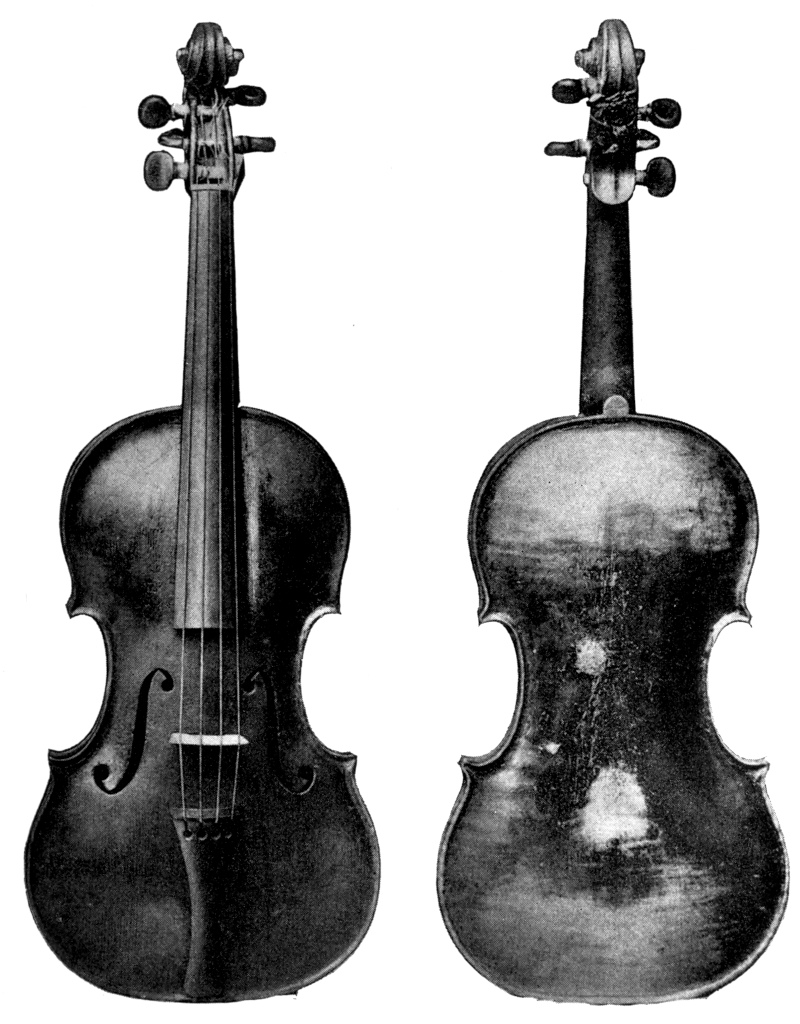
There is, however, no direct evidence whatever that Del Gesù was for years in prison and that he died there, as says the legend; but Canon Bazzi of Cremona has lately unearthed one Girolamo Guarneri who did die in prison in 1715, and the names of two very different men, one illustrious and the other obscure, have before now got mixed up, to the detriment of the illustrious one.
Something similar is said to have happened to the great Athanasius, whose name has been confounded with that of the obscure Pope Anastasius, in whose presence a creed was recited by one Bishop Victricius, and the confession of faith thus recited by command of Anastasius now passes as the creed of Saint Athanasius, since it emphasises the Trinitarian doctrine chiefly connected with the name of that illustrious doctor.
A Giuseppe del Gesù is much more difficult to find than a Strad—his output, as compared to that of Stradivarius, is as one to six; his life was shorter, and his working career probably more erratic. But he is placed on a level with the immortal Antonio by some who know how to handle him, and the prices of his wares have already reached four figures.
CHAPTER V
VIOLINS AT CREMONA—continued
There is something inexorable about the concensus of posterity.
Individuals may chafe under it, and writers may try to reverse its verdict. You even have crazes for the revival of neglected poets, painters, and musicians, but you will never succeed in pushing from their pedestals the great gods whom posterity has once decided to bow down to.
De Beriot may choose to play on a Maggini, and Paganini may prefer his Joseph, but even Maggini, Nicolo Amati, and Giuseppe Guarnerius, who stand round as it were saluting one another, leave Stradivari apart by himself like a Colossus on a mountain, and yet no one, not the greatest connoisseur, is able to say exactly why. When so many esteem individual violins above some Strads, and when Joseph del Gesù is held to run the magic master very hard, still Strad stands apart upon his mountain for all men to look up to and wonder at. And why? We can only say it is the way with all the greatest; there is something of the mystery of heaven about the incommunicable touch; the true aureole forms about no head to order, and the lonely seats are kept for the mighty.
Antonio Stradivari or Stradiuarius was born in 1644, and died, in his ninety-third year, in 1737. We get the date of his death from the register, and the date of his birth is fixed by a violin label (1736) in his own handwriting, in which he states that he was ninety-three years old when he made the instrument.
Stradiuarius married at the age of twenty-three a woman of twenty-seven, who had been a widow for three years, whose maiden name was Ferraboschi, and he adopted her one little girl. By her he had six children, some of whom died before him. His second wife, whom he married several years later, bore him five children, two of whom died before him—so that in all Stradivari had eleven children. None of them seemed to have inherited their father’s genius; only Omobono and Francesco Stradivari made even decent fiddles, and so far maintained the great name as to succeed at first in selling their wares at their father’s prices. The buyers probably hoped that at least the wood might have been selected by Stradivari père, and much of it probably was; and if there was the chance of getting a spare rib or back or belly with a touch of the master upon it, it was surely worth a little speculation.
Antonio Stradivari and Andrea Guarneri, as stated before, were young garzoni or apprentices together in the workshop of the great Nicolo Amati—sat on the same work bench, used the same tools, and doubtless discussed the same problems.
In and out of that shop ran, no doubt, the boy Giuseppe Guarneri to see his uncle Andrea. He must have always found Stradivari there; and when, later on, Giuseppe imbibed a taste for fiddle-making, and became himself the great Del Gesù, it is hard, I insist upon it, to believe that what must have been a lifelong acquaintance with the mighty Stradivari should have had no influence whatever in forming his ideas and methods.
There is no mention of the youthful Stradivari having accompanied Andrea Guarneri to the wedding of his master, Nicolo Amati; Andrea was doubtless the older pupil, and Antonio Stradivari was taken on later.
“If thou wouldst teach, learn; if thou wouldst create, first copy.” It is generally held that for some years, roughly between 1660-70, Stradiuarius simply made up, blocked out, drew, glued, mixed varnish, and worked generally, but without signing his own name to any fiddles. He was learning; but in 1660 he begins to sign his name, not from pride, but because his master made him do so. From before that date to about 1670, which brings us to within fourteen years of Nicolo Amati’s death, he made what are sometimes called Amati Strads.
At this time Antonio followed closely the violins of the early Nicolo rather than the grand Amati pattern, but he appears to have followed his master’s developments continuously, slowly, but surely.
There exists a Stradivari violin with a label Nicholai Amati (anno 1667), and about that date (when he married) Antonio seems to have left his master’s workshop, but still continued closely to copy Nicolo, and many violins of his between 1660 and 1670 pass as Amatis, whilst others are called Amati Strads, and some are apparently joint productions.
When Stradiuarius married (about 1667) and left Nicolo Amati, he set up round the corner in the same street as the brothers Guarnerii, and almost next door to them, in the square opposite the great Church of S. Domenico. From about this time connoisseurs notice a great improvement in Stradivari’s technique; but up to 1672 at least, remaining a close copyist of Amati, he doubtless kept on terms of the closest intimacy with Nicolo, now in his decline, and benefited by the abundance of orders flowing in for Amati violins which the old master was unable to execute.
From 1660 to 1684 was a period of great activity, perhaps haste; even some pot-boiling Stradivari violins may then have been made as the young family increased. Antonio’s wood is often plain about this time, and not up to the best taste and selection of his master, but he evidently remained his right-hand man to the end; and when Nicolo died, at the ripe age of eighty-eight, he left all his tools and his plant not to his son Girolamo, then about thirty-five, but to Antonio Stradivari, then just forty years old.
In 1680, four years before the death of Nicolo, Antonio had so far prospered as to be able to buy his house (which I visited in 1880), at 1 Piazza Roma, for about £800. Desiderio Arisi, a Cremonese, has left an interesting MS. in which he speaks of “his intimate friend Antonio Stradivari.” The MS. is dated 1720, or seventeen years before the death of Stradivari.
Arisi alludes to a point of great interest which early excited my attention and curiosity—the many-sidedness of the man. “In Cremona,” writes Arisi, “is also living my intimate friend Antonio Stradivari, an excellent maker of all kinds of musical instruments.” Indeed, he could make anything that was in demand, and he did; he could “fancy-purfle” to order, inlay, make fiddles in odd shapes, or with a twist in the curve here or there, or longer or shorter for experiment, or big or small.
The Marquis Carlo dal Negro of Genoa owned a Stradivari harp in 1820. The master was not above making mandolines and lutes to order. Messrs Hill own a perfectly plain Stradivari guitar in fine condition. It is of exquisite close-grained wood. I have often wanted to hear the sound of that guitar. I noticed a Stradivari cithern in the South Kensington Loan Collection with an elaborately carved female head of great beauty. I did not wonder that he who could carve such scrolls could carve a head or anything else.
There are, or were, within the present century, other gems of workmanship, some of which it is to be feared have perished, children’s fiddles, instruments made with small figures, flowers, arabesques. Everything that comes from his hand is finely accurate in drawing. Sometimes his decoration is merely painted in black, sometimes ivory, ebony, or mother-of-pearl is used, but everything Stradivari did was perfectly done; he qualified himself to the nth, as mathematicians say, for each branch of his art.
In these days one man draws, another blocks out, another inlays, another finishes. Stradivarius did all, and did all consummately well. His heads and arabesques are worthy of Cellini, his inlaying of the finest Florentine marqueterie; his scrolls and curves are of Pheidian beauty; his varnishing is his own.
On the death of Amati, Stradiuarius and the Guarnerii had the Cremona market to themselves, and whilst the competition was quite wholesome, there is no reason to suppose that their rivalry was other than a friendly one. They had all been brought up together, they had worked as boys together, they had doubtless lent each other tools, touched up each other’s backs and bellies, varnished each other’s ribs, criticised each other’s scrolls from boyhood; and now that the Cremona violin was in the ascendant, and kings and nobles from Spain, France, Germany, Saxony, and even England were anxious for Cremona fiddles, there was a market for them all.
The bitterness of competition is not always due to rival makers, but often to over-production; and such a thing as over-production of fiddles in those days was unknown. Nay, the orders that came in could not be executed fast enough. Music walked faster than the instruments could follow it. When the King of Poland wanted a Strad violin he knew his man, and sent his Capelmeister Voleme to Cremona, with orders to stop there and bring back the twelve violins ordered for the court orchestra. “So,” says Arisi, “Voleme arrived in 1715 on the 10th June, and remained there three months, and when all the instruments were ready he took them with him to Poland.”
But at this time Stradivari was at his zenith. “There is not in the world,” writes Lorenzo Giustiniani, a Venetian nobleman, to the great artificer in 1715, “a more skilled maker of musical instruments than yourself, and as I wish to preserve a record of such an illustrious man and famous artist, I trouble you with this letter to ask whether you feel disposed to make me a violin of the highest quality and finish that you can bestow upon it.”
But we must not anticipate.
After the death of the illustrious Nicolo Amati, this patient pupil, this careful copyist, this accurate and tireless student and experimentalist, begins to assert his strong individuality. His scroll departs from the feminine Amati type, and becomes striking and independent, his sound-holes recline more, his corners are pronounced, his middle bout curves are prolonged, his varnish is almost fancifully varied from rich gold to soft velvety red. His wood is now invariably chosen with the utmost care, and as he made chiefly for the nobility, royalty, and the higher clerical dignitaries, he was not only on his mettle, but he could afford to work just as he chose.
In 1682, Michele Monzi, a rich Venetian banker, sent him an order for a chest of violins, altos and ’cellos, which were to be presented to our King James II. They were so much liked that his Majesty ordered a viol di gamba of Stradiuarius in 1686.
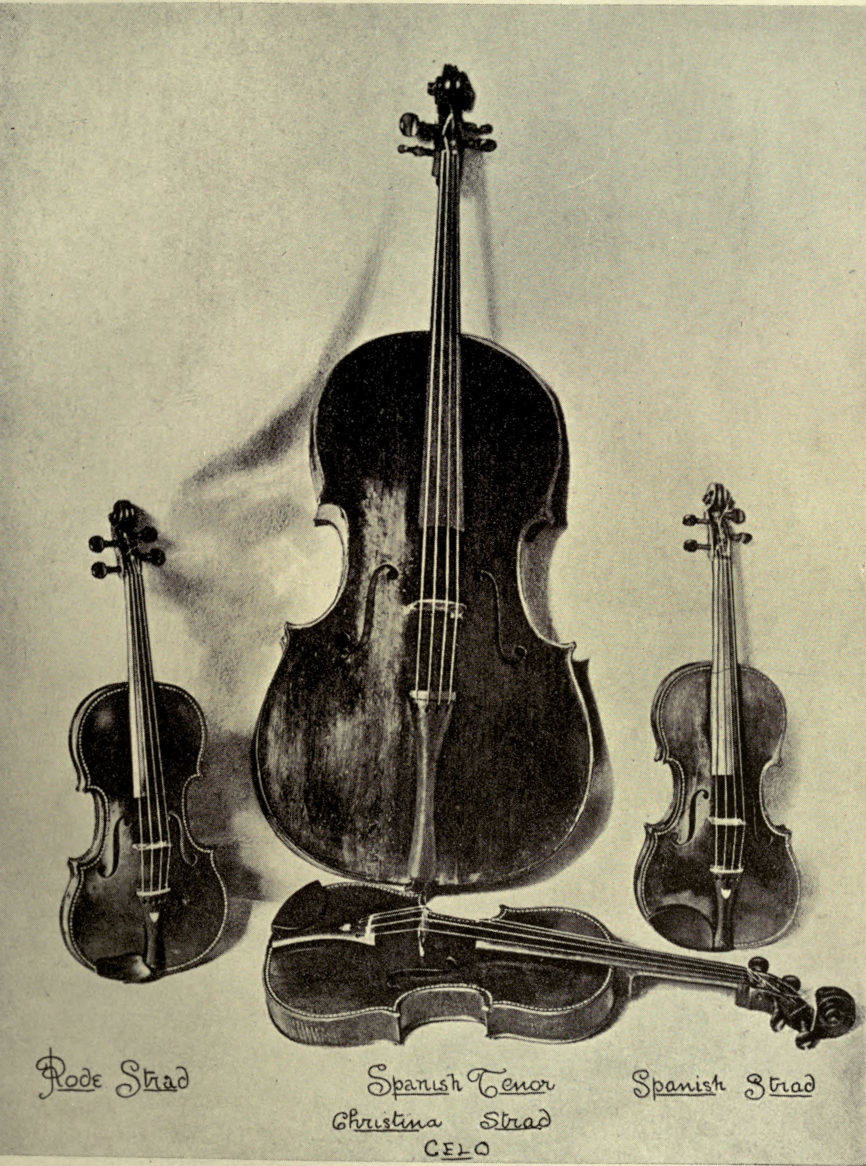
Rode Strad — Spanish Tenor — Spanish Strad Christina Strad CELO
In 1685, Cardinal Orsini, afterwards Pope Benedict XIII., had ordered a violoncello and two violins of him, besides making him “one of his private attendants,” an honorary title, but equivalent to appointing Stradiuarius instrument-maker to the Cardinal Archbishop. We commend this fact to his Holiness Pope Leo XIII. (1897), who has lately placed the violin on his index expurgatoritus of instruments, as being too frivolous for the solemnities of divine service! Yet Pius IX. was a pretty good fiddler.
In 1687 Stradivari makes his famous set of instruments for the Spanish Court, inlaid with ivory, with a scroll-work running round the sides. One of these rarities—a violin—found its way into the hands of Ole Bull, the famous violinist. It has been since sold in England to Dr Charles Oldham of Brighton. The tenor is, I believe, in existence. When last in the market, it had lost its ivory purfling, which has since been exquisitely replaced by Messrs Hill.
There are extant several very small violins made evidently to order about this period. The fallacy of different sizes for different ages from childhood upwards is one which will always smile to makers and those acute persons who teach the violin and buy their pupils’ instruments, which of course have to be changed as the children grow up, for larger and larger ones. I have always protested against this. A child of eight had much better play the violin like a violoncello (at the age of seven, as I did myself) than be given a small one; but when I was eight I could hold a full-sized violin to my chin—not quite in the correct position, no doubt, but near enough. Thus from the very first, when at six or seven years of age, I played the violin like the violoncello, I never had to unlearn my intervals in stopping the strings. The brain learns intervals. An habitual tenor player never plays the violin quite in tune, and vice versâ; and so every time a larger violin is placed in the pupil’s hands, the brain is bothered with the narrower stopping learned in the preceding period. Still, no one can regret the exquisite cabinet, almost toy specimens, made by the Amati and Guarnerii as well as by Strad. Artistically they are gems; musically, fallacies. I have never got anybody to agree with me about not using dwarf fiddles. Joachim, I believe, contended that for a child to use a large fiddle stiffens his muscles. I don’t believe it; it certainly did not stiffen mine. I believe I am also in a minority in my partiality for old bridges. Neither theory is, in fact, “good for trade.”
In 1690 Stradivari executed a celebrated order for the Prince of Tuscany, through the Marquis Bartholomeo Aribati. Of these chefs-d’œuvre the Marquis writes: “I assure you the Prince has accepted your instruments with more pleasure than I could expect. The players in the orchestra are unanimous in expressing appreciation. They declare your instruments to be quite perfect; they all say they never heard a violoncello with such a tone as yours. My having brought to the knowledge of such a person as his Highness your great skill will doubtless procure you many orders from his exalted house”—and then follow more orders for two tenors. On this occasion, we learn, from the relics of Stradivari in the possession of the Marquis della Valle, that the great violin-maker characteristically enough made the most beautiful cases for the royal instruments, decorating them profusely with armorial bearings and symbols appropriate to each instrument.
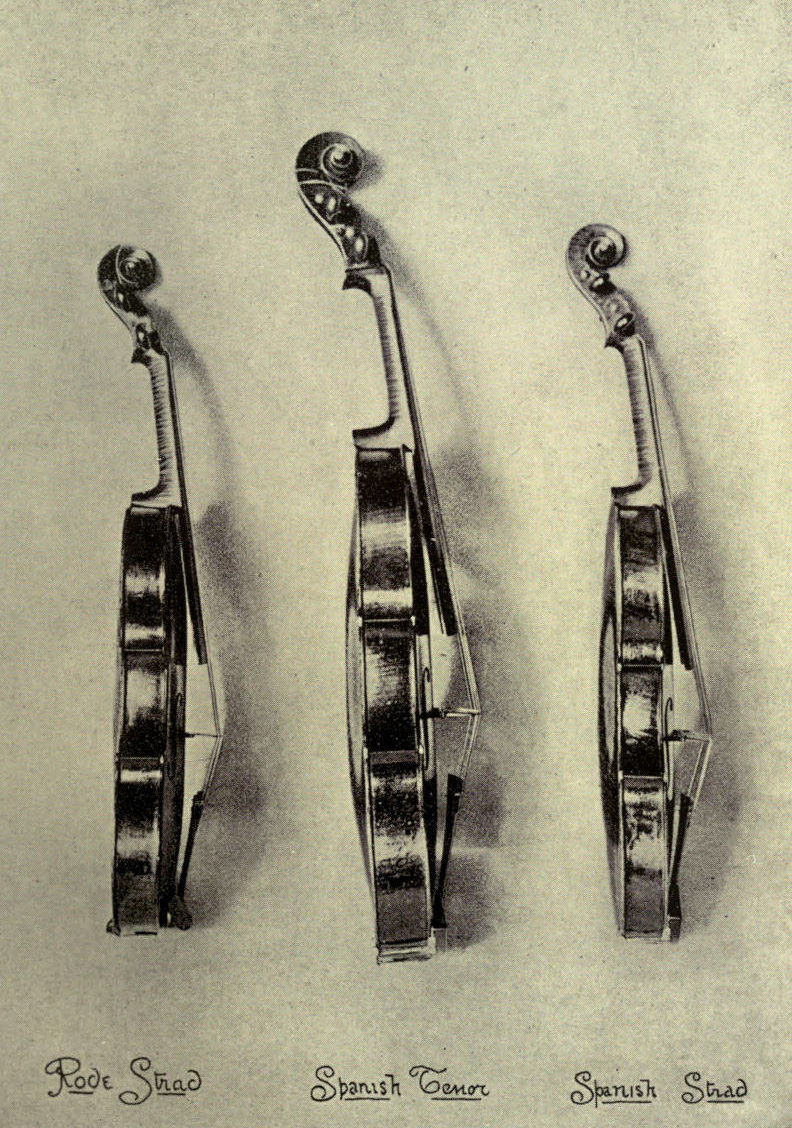
Rode Strad — Spanish Tenor — Spanish Strad
The order was given in 1684, but the instruments were not handed in till 1690. The Grand Duke, it seems, came back for more, as there was found amongst his instruments a violin of the grand pattern bearing the later date, 1716.
I cannot forbear to call attention to the exquisite chromo-lithographs of the Tuscan violin, and the lucid description and history of this last-named famous masterpiece, in Messrs Hill’s handsome monograph. He declares it to be in the very finest preservation still, with an unbroken and authentic record, and to possess all the noblest qualities of the incomparable master. It is on the very verge of his great period, bearing the date 1690, and was bought by Mr David Ker in 1794. The Tuscan viola and violoncello are still in the Institute at Florence, and I advise all lovers of Cremona who get the chance to go and inspect them.
The only other point of great general interest before the year 1700, when Stradivarius enters on his golden period, is the deliberate manufacture of a certain number of violins on a pattern distinct from the Amati, and from any patterns adopted by himself before 1686-1694, or after 1700. These instruments are known as long Strads, and they seem to be a sort of constructional or experimental link between the smaller Amati pattern and the grand Strad pattern of 1700-37—a model evidently suggested by the grand Nicolo, but not adopted by the cautious Strad till some years after Nicolo’s death.
From 1694 to 1700 Stradivari not only went out of his way to make long Strads, which not only looked longer because they were narrower and pinched in, but actually were longer—i.e. 14-inch, as compared to the 1690 13-inch Strad. In other respects also he walked through his own traditions. Having mastered all violin lore, he was evidently at last trying a series of daring experiments to settle in his own mind once and for ever certain problems of tone.
We have known painters trifle with colour in the same way. Gainsborough would paint his blue boy, and Whistler symphonies in green, mauve, or anything else unexpected, and Turner would recreate the light that never was on sea or land; but in reality it was no trifling, but study in arrangement of colour. So you can have study in construction, empirical ventures, and a testing of tone problems, whether in sound or colour.
As Stradivari mused and carved, and glued and varnished, year after year, his meditations might run thus: “Flatten the belly—thicker here or there according to wood, density of fibre; air column restrained by narrow width, as in the long pattern, but same cubic inches of air allowed for in length or height of ribs, only differently defined by different shapes of instruments. Enlarge width, thin planks, but try different thicknesses; see how different densities of wood go together. Try old seasoned wood for back, newer for belly, or vice versâ; if wood hard, thin it; if soft, thicken it; try effect of higher ribs on flat curves; lower the ribs on more bulgy curves and grooved sides. What did Nicolo aim at with his grand pattern? Adopt his width and size, and flatten his belly. Try and save his sweetness (did the grooves give that?) with the flatter back and belly, which gives louder tone, adopting the mathematical curve of nature, suggested by the vibration of a string; certainly that gives power. Is a joined back, or a back in one piece, best or indifferent? That would depend on wood attainable. How would it be to patch bits of precious wood if inter-congenial? That generally succeeds. A good secret that, but an open one—wanted always the patcher!”
This idea of patching was certainly one of the most inspired thoughts that ever occurred to him. He seems to have kept wood of the finest acoustic properties for his best orders. He had favourite planks; we can trace one of these by a stain that runs through the grain, and the wood crops up again and again in some of his best fiddles.
The plank must have been known to his pupils, for the remains of it were worked up after his death.
“Now for the sound-bar,” ponders Stradivari; “thick or thin, according to the density or elasticity of the back and belly. And its position? A little transverse, of course—slightly diagonal to be in the line of vibration. Study effect on power of different strings by placing it a fraction of an inch one way or another; place it slightly aslant for experiment. And the varnish?” But that will call for a few separate paragraphs by-and-by.
I have tried to indicate the kind of observation and meditation, demanding unlimited time, patience, and love, which Stradivari devoted for the better part of a century to his art, and without which those Cremona chefs-d’œuvre, the Dolphin, the Messie, Tuscan, Betts, and Pucelle Strads, could never have come forth.
I have alluded to Strad’s taking late to the large Amati pattern for violins, inclining for some time to the small size. I do not know that any one has yet noticed that in violoncellos Strad reversed this order of work, making his early violoncellos large, and diminishing their size. As he reached his golden period he probably felt that the demands made by virtuosity and tone-power were quite alike consistent with a larger type of violin and a smaller and more manageable size of violoncello.
The violinist is well aware of the value of Strad’s golden period, which will cost him gold; for, after about 1700, a fine Strad will be worth to him from £1000 and upwards, according to its condition.
The long apprenticeship was at last over, and in 1700 the master had reached the ripe age of fifty-six, an age at which so many have achieved their greatest work. He was at the acme of his power, experience, and fame; no one could teach him anything now, and apparently he had nothing to learn. He could at last wield his tools as a Millais or a Tadema wields his brush, a Flaxman his pencil, a Canova his chisel, or as a Mozart or Wagner handles his score. He knew what he wanted, and he could do it, and do it with a spontaneous ease and joy which seems even now to smile to us from the saucy corners of his bouts, the free daring curves of his grand pattern, and the lightly tossed and lifted scrolls.