Introductory material (continued 2)
Reading edition
No one has failed to notice the masterful ease, the emancipation from all mannerism, the cool defiance of precedent and uniformity, and even symmetry, which characterises his great period from 1700 to 1730.
The violins are not all alike. Strad knew that the secret was not merely in the pattern or shape; he could vary his curves, and yet produce masterpieces, because he knew all about the air column, the wood densities, and the proportions and quantities which should be combined for the requisite result, and he could mix them differently like a master colourist. He no more treated every violin as if it had the same constitution than does a physician treat every human body alike; it is not so much nitrogenous or carbonaceous food, and so much liquid, but it is these and other things used in proportion, according to your digestion and temperament, which will produce in that instrument, your body, the harmony of health; and how close is the analogy between the constitution of a violin and that of a human body—how varied is the texture, the tissue, quality, fibre, and density of the component parts of each—I have endeavoured to point out as succinctly as I could.
So, in the grand period, the grand pattern Strads are all made with a trained, almost inspired instinct, according to those laws which govern the tone qualities aimed at; but the fiddles are by no means alike to look at. They have the charm of imaginative variety, combined with the unity of supreme excellence.
To this great period belongs the Dolphin Strad, so called, it is said, from the melting and almost iridescent tints of the varnish. To me, however, the violin almost suggests the life, freedom, and elegant poise of that graceful fish whose name it bears. The beauty and acoustic properties of the Dolphin wood are quite special, and can easily be compared with other violins of the same period, some of which are much plainer to look at, and somewhat different in form, and though very charming, hardly so bell-like in tone.
The last time I had the privilege of touching the Dolphin Strad was at my lecture on violins before the Royal Institution in 1880. I shall never forget its ringing notes and its exquisite sensibility. It seemed anxious to speak before it was spoken to; when touched, it seemed to do all for itself like magic. Instead of the player showing it off, it shows off the player; he begins to feel he has nothing to learn in tone production. It is almost like sitting at those ingeniously contrived pianos that make elaborate music, and you merely have to put your hands on a dummy keyboard, press the keys, and appear to be playing, and then you roll off Chopin and Mendelssohn perfectly, though you can scarce play your scales! Since then Vuillaume’s sound-bar has been replaced with a stronger one by Messrs Hill. It seemed to me quite perfect before, but I suppose one must bow to experts in such matters.
The best opinion limits the number of instruments which Strad made to about two thousand, only eight hundred of which at most are known to be extant. Compared with any other maker except Vuillaume, both as regards output and survival of work, Strad probably bears the palm.
An elaborate description, a careful portraiture of every known Strad, together with its history, as far as recoverable, I must leave for some more gifted and industrious recorder. I believe Messrs Hill are preparing the most complete monograph on Stradivari which has ever yet or is ever likely to appear, and I only wish I could dip into their MS. and steal a few pages. It will certainly, when it appears, be a monumental work, and there is no time to lose, as many of these gems are known to have been destroyed, others dismembered, whilst some are at the bottom of the sea. There are, however, a few more famous specimens, which are of such unique interest that they cannot be passed over even in so general a survey as this.
Mr Croall (1897) of Edinburgh is the happy owner of M. Artôt’s Strad, varnished dark red, quite perfect, and one of the finest known for tone; it is dated 1716. Lady Hallé still plays on Ernst’s violin, bought for £500, and presented to her by the Earl of Dudley and some others. I shall never forget the wonderful effects elicited from it by the great magician Ernst in his palmy days, nor can I understand the statement recently made that its tone is difficult to elicit. I have heard the faintest vanishing whisper of its strings on the Covent Garden stage when, as a boy, I was seated up in the top gallery at one of Benedict’s monster season concerts early in the fifties.
A romantic interest attaches to two Stradivari violins which have come down to us in absolutely perfect condition: one is called the Messie, the other the Pucelle or the Virgin.
The Messie was secured by Vuillaume after the death of that remarkable man Luigi Tarisio, to whom further on I devote a special section. It bears date 1716.
Tarisio would never let it be seen till Vuillaume possessed it; it had then never been touched or played upon. He lengthened the neck, but, without inserting his new neck, he fixed it to a block placed outside the ribs. Count Cozio de Salabue had bought it in 1760, but never allowed it to be played upon.
Tarisio bought it after the Count’s death, and at his own death in 1854 it passed to Vuillaume, and was exhibited (No. 91) in the South Kensington Loan Exhibition of 1872, and for the first time unveiled beneath glass to the gaze of admiring thousands.
When I first saw the Messie I could not believe my eyes. It was covered throughout and uniformly with thick rich red-brown varnish, laid on with a firm brush, level and lavish. It seemed to have left the workshop only the day before; the anointed glitter of the fresh varnish was upon it, it looked hardly dry. It is of the grand pattern, but not heavy and massive like some of the great Del Gesù’s, but beautiful as a Pheidian carving, full of a certain special grace and elegance. One “∫” is a shade lower than the other—a practice so common with Strad, especially in his later period, that it must have been intentional, his artistic eye not tolerating even the suggestion of mechanical uniformity. The Greeks worked similarly, no two sides of their Corinthian capitals ever quite matching.
The “Messiah” back is in two pieces, the corners are absolutely unrubbed, and completely covered with varnish—of no other specimen can this be said. The head is light and graceful, “the scroll,” as I have elsewhere observed, thrown off like a ribbon lightly curled about the finger, and drawn in, one side of the scroll cut a little lower than the other; the lines of the scroll are picked out with thick black paint; only faint traces of this remain in other violin heads. The black outline was artistically conceived, as it called full attention to the scroll curve, always so characteristic a part of violin physiognomy.
As the Messiah recently bought by Mr Crawford of Edinburgh for £2000 has now been played upon, it seems a pity that the world should not sometimes be allowed to hear its voice; and I venture to say that a well-advertised concert, in which two of our finest violinists should be invited to play on the Messiah and the Pucelle—i.e., each player upon each instrument once, thus giving four solos, so that the audience might hear the same violins under different fingers—would be an epoch in the musical world. The announcement would doubtless pack St James’s or any other London hall.
The Pucelle or Virgin is the last Stradivari violin I have space to notice. The “Virgin” is so called because its interior organism had, up to the time when it came into M. Vuillaume’s hands, not been interfered with—i.e., the inside bass bar had never been touched. All the old violins have had these bars strengthened, and their necks lengthened, to meet the strain of the modern high-pitch tension of the strings on the belly, and the lengthened finger-board which the development of advanced virtuosity demands.
These readjustments the Pucelle owes to Vuillaume. She is in fine preservation otherwise, although her varnish is a good deal rubbed in places. Her contour, so fanciful are even good judges, is by some considered more graceful than that of the Messiah, but less graceful by others. To me there seems to be little to choose between them; each is a distinct conception.
The Virgin’s varnish is of a rich soft brown and yellow tone, rather contrasting with the Messiah’s bright red. The head is stronger and less graceful than that of some Strads (the Dolphin’s, for instance); the Virgin’s back is in two parts, the belly is a little higher than that of the Messiah. The only vestige of repair about her is where the chin has rubbed into the purfling, which has accordingly been renewed. The corners are somewhat fancifully cut, running straight out in the top bouts, and hanging away in the lower bouts; there is a rather marked indentation of the curve beneath them.
The Virgin is labelled 1709, and she reached Paris in 1840 (of course it is a Tarisio violin); it has been owned by Mons. le Roy, a banker, and passed to his heir, Mons. Glanday. She is now the property of a member of the same family, and is very jealously guarded by her owner.
In vain does imagination seek to recover the image of the great maker as he lived and moved and had his being through ninety-three years of shower and shine. Undisturbed by petty sieges and local disturbances and changes of administration, sought for and admired impartially by the friends and the foes of his country, he wrought out calmly his own matchless ideal.
Violins have no politics, and the great republic of Art dominates the ages, and comprehends whilst it survives the rise and fall of dynasties and empires.
I sometimes seem to see the grand old man standing at the door of his modest but comfortable house—a tall, thin, perhaps rather gaunt figure, most likely not a man of many words, carrying on for ever mental processes connected with his subtle handicraft, seldom seen without a chisel in his hand.
Behold him just risen from his stool, or come round to superintend or criticise a carelessly cut scroll of Bergonzi, his best pupil; and before he goes up into that almost sacred attic, open to the air, at the top of the house, where hang the varnished fiddles and anointed strips a-drying, he mutters a rebuke or rectifies a curve.
The old man comes to the door, and stands for a moment looking down the street. He wears his woollen nightcap and his inevitable leather apron; he salutes the neighbours as they pass, but they do not stop to speak to him, they know he has no leisure for that. Only later, at the café-cabaret, it may be, he will chat with Joseph Guarnerius, and exhort him to more refinement; or tell his sons they will never uphold the reputation of the firm if they do not work harder; and as it is known that the master detests interruptions at home, in those moments of rare leisure when he emerges with the regularity of clockwork to sip his vino or sirop or coffee, Capelmeister A. or Padre B. or Monsignor C. may surprise him for a chat, and inquire timidly when the violoncello or quartet of violins ordered are likely to be ready, and get for reply something too enigmatic or oracular to be of any service; so patrons or patrons’ emissaries had to sit down at Cremona and wait on the master’s convenience for the masterpieces that could be got nowhere else.
His prices seem to have been altogether moderate, but we must remember that the value of money was far greater in those days, a sovereign going then nearly as far as five go now.
He sold his violins for £10 (= £40); the original price of his violoncellos and violas does not seem to be known.
Although he had a large family, he must have made, if not inherited, money, for there seems to have been a proverb current at Cremona, “As rich as Stradivari.”
Some years ago, fresh from my visit to the house of Stradivari, then still standing in the Piazza Roma, Cremona, I gave a full description of the great maker’s entourage, which I need not here repeat; but a single paragraph may serve better than anything that I can now write, at the distance of over a decade, to place the reader in the atmosphere in which Antonio Stradivari worked for more than half a century.
I stood in the open loft at the top of his house where still in the old beams stuck the rusty old nails upon which he hung up his violins. And I saw out upon the north the wide blue sky, just mellowing to rich purple, and flecked here and there with orange streaks prophetic of sunset. Whenever Stradiuarius looked up from his work, if he looked north his eye fell on the old towers of S. Marcellino and S. Antonio, if he looked west the Cathedral with its tall campanile rose dark against the sky, and what a sky! full of clear sun in the morning, full of pure heat all day, and bathed with ineffable tints in the cool of the evening when the light lay low upon vinery and hanging garden, or spangled with ruddy gold the eaves—the roofs and frescoed walls of the houses.
Here, up in the high air, with the sun his helper, the light his minister, the blessed soft airs his journeymen, what time the work-a-day noise of the city rose and the sound of matins and vespers was in his ears, through the long warm days worked Antonio Stradivari.
Before the time came for the busy hand to fail, Antonio ceased to sign all the violins that he made; but, with an old man’s natural pride, he continued to sign a few down to the year of his death, registering the number of his years in each case, and it is from one of the latest of these, dated 1736, that we know his age.
He sank quietly to rest, evidently worn out naturally and nobly, if not with his eye quite undimmed and his natural strength unabated, certainly still full of marvellous vigour, unpalsied senses, and undulled perception.
When the Chapel of the Rosary in the Church of S. Domenico, opposite to which he had lived all his life, was pulled down, his funeral tablet was rescued, and it is now in the Town Hall at Cremona; but where are his ashes? Are they in the present family vault of the Stradivaris, in the Campo Santo of Cremona, or in the parish of S. Matthew? I was unable to ascertain. The tablet bears the following simple inscription:—“Sepolcro di Antonio Stradivari E svoi Eredi, Anno 1729.”
Many of his family had preceded him to the grave, both of his wives and six of his eleven children, his last wife dying only nine months before him, a significant and painful event in a life so regular and uneventful, and one which may not unnaturally have hastened his own end. None of the family seem to have been buried in the S. Domenico vault, but in one belonging to Signor Francesco Vitani, in the parish of S. Matthew; so it may be Antonio lies there.
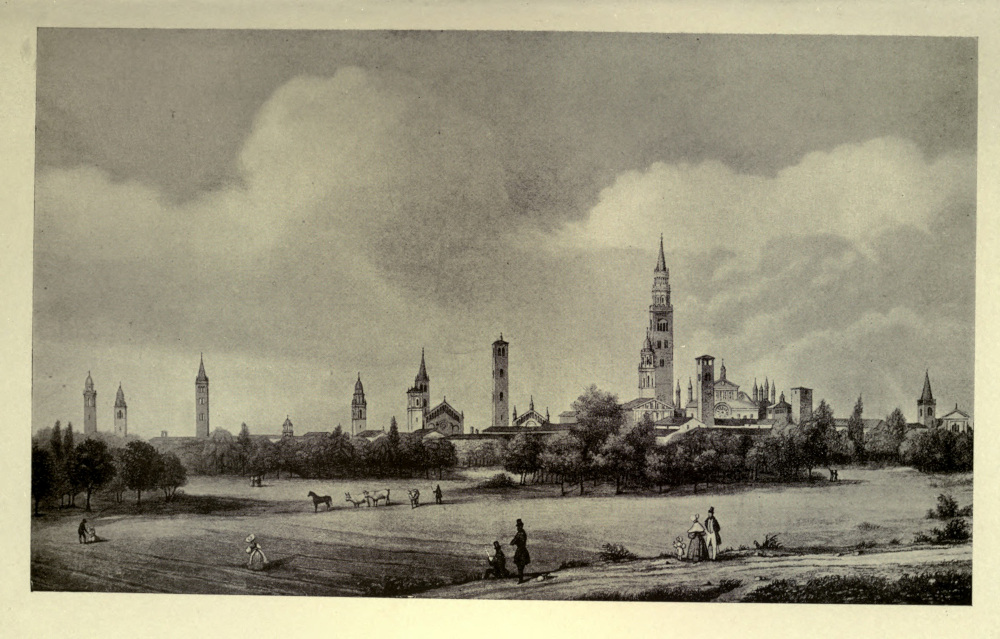
The Church of S. Domenico was pulled down several years ago; the house of Stradiuarius was destroyed only recently. The Piazza S. Domenico is now the Piazza Roma, and when an average Cremonese is asked about Stradivari, he thinks of the fashionable avocat of that name, who appears to spend his time chiefly at Milan, and may possibly resent the notion that a man in good society should ever have had ancestors connected with fiddle-making. Sic transit.
The achievements in violin-making up to the first quarter of the eighteenth century are clearly summed up in the names of Antonio Stradivari and Giuseppe (del Gesù) Guarneri.
It would be an interesting and thorny question to debate whether any variations of importance or additions in excellence have since been noticeable, and of course we naturally look to the best Cremonese makers, who followed these giants of tone-power and sweetness.
The name of Carlo Bergonzi at once stands out as worthy, if not to be bracketed with that of the two mighty men, at least to receive their mantle and reflect something of their lustre. Carlo Bergonzi was Stradivari’s favourite pupil; he lived next door, and afterwards occupied Stradivari’s own house with his son.
He finished many of his master’s late violins, and issued some others after his death collected from the débris of the great man’s workshop; and Stradivari left him all his tools and plant.
He worked at Cremona between 1720-47 or 50, and followed at first Stradivari’s example; for as Antonio made his early fiddles on the pattern of Nicolo Amati, so did Bergonzi closely copy the grand Strad pattern. But later on, and before the death of the old man, Bergonzi conceived the ambition of attempting to weld the power of Giuseppe Guarnerius with the round, bright, bell-like sweetness of the Stradivari. To what extent he succeeded must be left to the judgment and decision of connoisseurs, but the grand quality for which his violins are increasingly appreciated is, no doubt, their powerful sonority; that he clearly saw must be the indispensable quality for all violins of the future.
The old tinkling days were over; the feeble, scraping, and muffled viol tone was a thing of the past. The instrument had finally emerged from the cloister, was no longer to be a mere adjunct to the voice in dim sacristies and cathedral choirs; its sphere henceforth was to be out in the wide, wide world, its triumphs were to be won in the concert room, the opera house, and the grand musical arenas of solo virtuosity.
And so, undoubtedly, what Bergonzi aimed at was body of tone and carrying power, and he won it. This dominant idea has modified even his pattern. He looks bold and loud. Yet is the pattern not Guarneri, but Stradivari modified. Notice the larger breadth of the top curve, a certain bold angularity about the bouts, and a freer development of the lower part of the violin as well; the sound-holes set lower and nearer to the purfling, and the flat model which Stradivari discovered to be favourable to loudness. The scroll is also characteristic—flatter in some places than that of his master, but made to look bold and full of self-assertion by reason of the strongly-defined and prominent curl of the ear, which stands out and at once challenges attention.
The whole build is massive. The Bergonzi will outlast the Strad; it will be the survival, if not of the fittest, of the strongest. The very varnish is laid on with a lavish hand, to allow for wear and tear; it is even clotted in places, and is said in some specimens to have cracked and become scurfy. It is of a red Cremona brown, velvety, and quite the right sort.
Until within the last few years Bergonzi has not received his dues; the scarcity of his instruments may in part account for this; but in France, and especially in England, he is now fully recognised and much sought after. There are, however, only about sixty authentic instruments of his known. His working life was but about twenty-five years. Two notable Bergonzi violins are those in the possession of Miss Eissler and Signor Simonetti. There is a famous Bergonzi double-bass of singularly fine quality now in possession of Mr I. Sears of Boston. In Count Cozio de Salabue’s collection there were two very fine Bergonzi violins, dated 1731 and 1733.
There were five other Bergonzis—a son and grandsons; they all made fiddles, but they were of no account, and were far surpassed by some other makers who themselves belong to the decline period of the Cremona school.
Although I have called Bergonzi Stradivari’s best pupil, it would be very unfair to ignore the merit of Lorenzo Guadagnini (1695-1740), the only one of that name who poses as a pupil of Stradivari. He was born at Piacenza, but lived at Cremona till about 1740. In about 1795 he removed to Milan after leaving his master at Cremona, but returned to die in his native town. His make is bold, his model flat, his varnish not so rich as his master’s, his head original, but without the grace of Antonio.
His son, Giovanni Battista, born at Piacenza, 1711-1786, made violins which are almost more highly esteemed than his father’s. He imitated Stradivari perhaps more closely than his father, but Count Cozio de Salabue, who thought very highly of him and bought several instruments from him, is careful to mention that Giovanni Battista Guadagnini prided himself upon being no mere copyist. In fact, the Guadagnini in the hands of Mr Willy Hess is quite equal to the best of Lorenzo’s work. He was always changing his place of residence, and wandered from Piacenza to Milan, and at last to Turin, where he died. His own explanation was that the envy of rivals made each town too hot for him, but his neighbours said that his frequent migrations were due to his own hot temper. There were seven Guadagninis who made violins between 1695 and 1881, but of these the first two, father and son, alone need be taken account of.
It has been the fashion to separate the Italian makers into schools according to the place at which they happened to live—the Milanese, the Venetian, the Neapolitan, the Bolognese, etc.; but it is much more important to notice the influences under which the chief makers worked than to identify them with special towns.
A Cremonese who works at Venice but carries the Cremonese traditions with him, is still a Cremonese, and belongs to the Cremona school.
Thus, the “mighty Montagnana,” as the novelist Charles Reade called him, made Cremona violins and violoncellos at Venice. He worked between 1700-40 as a pupil of Stradivari, and survived his master only three years. But he came to him when the Cremona art was already perfected, and studied the finest models, assisting in all probability at the very manufacture of the most wonderful instruments in the world. With such a training, on his arrival at Venice he easily took the lead and kept it, and to this day his instruments, especially his matchless violoncellos—alas! too few in number—are little if at all inferior to the best of Antonio.
Montagnana’s outline is by no means a servile copy, of Stradivari. It is flattened at top and bottom, and seems to the eye less graceful; but in his selection of wood, his glorious varnish, the relative thickness of his slabs, and in the cunning knowledge of those fibre densities in back and belly which are likely to sound well together, he is second to none.
Montagnana no doubt embodies and transplants to Venice the Cremona secrets. As I noticed in the case of Bergonzi, Montagnana, owing to the paucity of his instruments as well as to the splendour of his contemporaries, Strad and Giuseppe Guarneri, has not until lately received the honour which is due to him. He suffers, too, from having often been labelled Guarnerius or Bergonzi, makers who had the vogue of the day. These frauds are now being unmasked, and the few great successors of the Cremona giants, Bergonzi, Montagnana, Guadagnini, and Balestrieri (very fine in Guadagnini’s style, flat, big build, powerful tone), and Storioni, have at last a chance of taking their proper places and fetching their prices.
When we come to Lorenzo Storioni (1769-99) we come to the last maker of importance who can with any show of plausibility be called even a second or third rate master of Cremona. Storioni’s model was Joseph Guarnerius, but he copied him more in his rough work than in his great qualities. In his varnish we notice the singular change which came over the Cremona varnish after about 1760. Up till then all the Cremona violins have the Cremona varnish; after that time it simply disappears. Why is it? This interesting problem I shall have to consider in my chapter on Cremona varnish.
Storioni’s instruments are not much esteemed in England as yet, but are thought a good deal more of in Italy.
I may here fitly mention the Gagliano family, who are associated with the Neapolitan school, but really derive their importance from Cremona. Alessandro Gagliano, the first of the name, was distinguished for his very fine red varnish, 1695-1730. A violin remarkable for its tone is the Gennaro Gagliano that has been used by Mr Otto Peiniger for solo purposes during many years.
Alessandro Gagliano was actually in early life a bonâ fide pupil of Stradivari. Finding himself, no doubt, unmercifully overshadowed by the prestige of the immortal workshops in the square of S. Domenico at Cremona, and being a person of native enterprise, Alessandro Gagliano migrated to the South, carrying with him the Cremona craft, and founded the so-called Neapolitan school. His model was, of course, the approved flat one of the golden age, 1700-37, but his scroll is small and rather mean, the ∫ ∫ are set low down, and the work is sometimes lacking in finish. It is in the varnish of Alessandro Gagliano that we see some connection with Stradivari, his varnish very often being fine in colour and of the right texture.
Attempts have been made to classify the various towns in which Italian violins were made during the Cremona period into schools, which is about as profitable an occupation as the attempts to divide the work of individual makers into distinct periods—one period runs into another, and one school runs into another.
Roughly speaking, you find but two influences—the Cremona, i.e., the Nicolo, the great Giuseppe and greater Antonio influence with its flat form, gentle curves, and red and yellow varnish; and the German, i.e., the Stainer model, of which I shall presently speak, with its elongated form, arched belly, deep side-grooves, and brown-yellow varnish.
Some fine Venetian and Milanese makers like Montagnana and Serafino inclined to Stainer, whilst the Roman and Neapolitan adhered more to the Cremona type; but Stainer himself learnt at Cremona, and all the best men like Tecchler (Rome) and Gagliano (Naples) who went South copied either Stradivari or Giuseppe Guarnerius. The Milanese school, on account of the great importance of the capital, naturally attracted good makers like Grancino, Testore (pupil of Grancino), and Pietro Giovanni Mantegazza (1687-1720).
Venice, Florence, and Bologna can also boast of a few respectable names, but I prefer, for the sake of completeness, to treat them later more in catalogue style, for the guidance of the student, and not to mix them up with the great central figures which have formed the subject, and I hope absorbed the attention, of the reader of this section.
CHAPTER VI
VIOLINS IN GERMANY
Of course, by this time, “every schoolboy,” to use Macaulay’s famous phrase, knows that most things—including, alas! violins—can be made in Germany faster and cheaper than anywhere else; and if we trust to German writers like Dr Schebek, we might almost believe that viols, not to say the violin, originated in Germany.
I am quite willing to leave the viol origin an open question. If, on the one hand, Albert Dürer and his father-in-law both made violins and dated back to 1500, Benvenuto Cellini tells us that long before 1500 his father made the finest Italian viols at Florence; and an ingenious writer has now unearthed a print by Maso Fineguerra, the father of engraving about 1460, in which Thalia is represented playing on a small violin pochette or kit—which, by the way, has rather upset the idea that the kit was a reduced violin, but seems to show, on the contrary, that the violin followed the kit instead of the kit following the violin, the kit being in reality a small violin. It is thus triumphantly argued by Mr Fleming that even the predecessor of, and every suggestion of, the violin came from Italy; but in his ardour he fails to notice that although an Italian print shows a woman playing on a kit, the kit she plays on might all the same have been “made in Germany.”
If I see an English picture with a tomahawk and a boomerang, I do not assume at once that the objects depicted were necessarily “made in England.”
But, as far as this book is concerned, such questions are of quite secondary importance. It is sufficient to notice that the first instruments possessing the distinctive features of what we call the viola and the violin, as distinguished from the viol tribe, came from Brescia and Cremona; and that the greatest, if not the earliest, German maker, Jacobus Steiner or Stainer, is commonly reputed to have studied at Venice, or, as some say, learnt his art under Nicolo Amati at Cremona.
As we approach the great figure of Stainer we are in the presence of a man who stands only second in popular estimation to the greatest of the Cremona masters. Indeed, so great a musician and eminent an authority as Sir John Hawkins writes in 1776: “The violins of Cremona are exceeded [sic] only by those of Stainer a German whose instruments are remarkable for a full and piercing tone.” The popularity of an English maker, Duke, who followed the German Stainer model, and whose fiddles were all the rage when good Sir John wrote, may have a little blinded his eyes to the Cremona chefs-d’œuvre—few of which, if any, he had ever seen. But it is no small tribute to the power of the German that for at least a hundred years he retarded the due recognition of the Cremonas and gave a faulty direction to the violin pattern throughout England, France, and Germany.
The arguments in favour of Stainer having visited Cremona in his early life rest a good deal on romance—the story of his having been a pupil of the great Nicolo, whose daughter he is said to have refused to marry, is unreliable. Whether he went home or stayed at home and married the village belle whom he appears first to have compromised, and who bore him seven daughters and one son after marriage and one daughter before, it matters very little to us.
Poems and novels have been written about this unhappy child of genius, but, as far as I can gather, the only reliable facts seem to be these, and they have been quite recently unearthed and sifted by Herr Ruf, who died at Hall in 1877:—
Jacob Steiner or Stainer was undoubtedly born at Absam, a village not far from Hall. The townlet lay on the high-road between the Tyrol and Italy, and doubtless nothing that went on in the northern cities of Lombardy was long in finding its way to Hall, for mules and pedlars constantly carried all sorts of merchandise—viols, and violins, and lutes amongst other things—to and fro. The great argument against Steiner ever having received early instruction at Cremona seems to be that he affected the tubby raised bellies and deep side-grooves of the old German viols; but it must be remembered that if as a boy he came under Nicolo Amati’s influence, it was at a time when Nicolo himself approached far more nearly the raised viol form than he did later on when his own model improved. The Steiner pattern is therefore consistent with all these theories:—
Firstly, that Steiner adopted the raised pattern which he found at Cremona, and which was then common throughout the violin-making world; that, returning early to Absam, he adhered to it, and, perhaps from motives of national pride, accentuated it Germano more.
Secondly, that he visited Cremona later, when his own model was already formed, and was too proud to alter it.
Thirdly, that German he was, and German he remained, and never went to Cremona at all.
All these questions, upon which much ink and paper have been spent, remain more interesting to the antiquarian than to the collector. Still, an indescribable interest and a deep human pathos seem to cling about the meagre facts of this remarkable man’s life.
Stainer’s popularity was so enormous that ten times the number of violins he could ever have made have been attributed to him, and his name has been forged quite as often as that of the great Stradivari.
Stainer married in 1645, and was appointed one of the Archducal servants, 1669; he advanced rapidly in favour, became violin-maker to the Emperor’s court, and was turning out instruments as fast as he could make them, forming such admirable pupils as Klotz and Albani, when he fell a victim to the odium theologicum.
Heretical books were found in his possession, or heretical opinions were expressed by him, or both. He was, in fact, a Lutheran, and a Lutheran in Absam was far too near to the preserves of Mother Church, and very soon, like a hawk on a pheasant run, he was shot down. Stainer was also miserably in debt, and perhaps somewhat litigious, as people of genius and independence of character are wont to be.
In 1677, having got out of prison, Jacobus petitioned the Emperor Leopold, whose protégé and employé he had been, and who was a great musical amateur, for money. Leopold lost his opportunity; unlike Ludwig of Bavaria, who won for himself an easy immortality by supplying Wagner with funds, Leopold turned a deaf ear to the immortal violin-maker.
Stainer seems to have dragged on a wretched existence for six years longer, overburdened with care and debt. The attentions of his wife and eight daughters did not prevent him from going mad with worry and want; nay, a helpless and incompetent family may even have contributed to this so unhappy close of a splendid but blighted career.
They show even now at Absam the bench to which the wretched man is said to have been bound when his paroxysms came on. He died in 1683, not only insane but insolvent. His wife died in great poverty six years afterwards, in 1689.
There seems no room in this sad life-story for his sentimental retreat into a monastery on account of his inconsolable grief for the death (?) of his wife. Had she been such an inestimable blessing, we might have expected her to have kept her gifted husband alive, managed his household more thriftily, rescued him from his debts, moved the hearts of his great patrons, or at least saved him from going mad.
But, on the other hand, eight daughters were doubtless a trial to a couple who seemed always hard up; and the one son, born in 1657 and dying in infancy, as we learn from a tombstone in the Pilgrims’ Church at Absam, deprived the great artificer of a coadjutor who might have been interested in building up the firm, and, perhaps, brought into it those business faculties without which the most brilliant abilities in every department of life so often make shipwreck.
A certain Marcus Stainer, whose reputed date is about 1665-69, and who called himself citizen and violin-maker, it is difficult to connect with the illustrious Jacob, although he has been called his brother, and some say he was a monk and actually assisted Jacob Stainer in the workshop.
The great violinist Tartini is said to have possessed two of this man’s instruments, called Peter and Paul.
Veracini, another eminent soloist, is said to have lost both of them in a shipwreck.
Herr von Reimer possesses a violin with label “Markus Steiner Burger und Geigenmacher, anno 1659” (not a very clerical label, by the way), and that is all that can be ascertained about this other Stainer; for of an Andreas Stainer, 1660, nothing but the name is known.
So everything tends to keep the ill-fated genius Jacob apart. Alone he remains as the one important rival of the Cremonese school; alone he stands at the head of all the Germans. Genuine Stainer instruments are rare; Stainer labels, copies, and forgeries are innumerable, and one of the greatest curses of the fiddle market.
The general look of a Stainer is so distinct from that of any maker except such as copied him, that it must arrest the attention of even a casual observer.
The Stainer belly is much higher than the back, the rise is kept up through half its length; the varnish is yellow (or as in the Elector Stainers), with a sort of pale-rose flush in it.
The early pattern, deep Amati side-grooves, the long-shaped, beautifully thrown end of the scroll, sometimes a lion’s head carved with the art of a Stradivari, the narrow purfling lying close to the sides of the strong, roundly moulded edges, the circular-topped sound-holes rather shorter than the Cremonese, peg-box often dark brown, contrasting with the palish-yellow belly—such are the leading characteristics of the great Jacob.
His earlier specimens bear varnish something akin to the Amatis; they are also of the smaller pattern. A good example of them is one in the possession of Mr Russell of Bedale, Yorkshire, dated 1645.
Jacob’s finest type may be seen in the famous Elector Stainer; of these he is said to have made twelve, one for each of the Electors. The popular legend refers them to his Benedictine monastery, but there is no shadow of proof that he ever was there at all; perhaps, however, if one Markus Stainer who is reputed to have made Peter and Paul was a monk, he may have been a Benedictine monk, and as the obscure Guarneri who did get locked up seems to be responsible by transference for the great Joseph del Gesù’s legendary incarceration, so Monk Markus may do duty for J. Stainer’s reputed sojourn and residence in a Benedictine monastery. It matters very little when the Elector Stainers were made; most connoisseurs are agreed that the two quite authentic “survivals of the fittest” are miracles of workmanship, beauty, and the perfection of Stainer tone.
The Stainer tone! What is there about that tone, which for 150 years so fascinated the musical world as to dull the perceptions of so experienced a professor as Sir John Hawkins to the more exquisite timbre of the finest Cremonas? No one but myself is responsible for the following conjecture.
Perhaps there is less tonal difference between the early Amati and the later Strad than between the early Amati and the full-blown Stainer; and it may have been the sharp, pungent contrast—the type of tone that was quite new, as it were an original creation—which at once arrested and held the ear of that epoch. For, after all, musicians in the seventeenth century were only beginning to be cultivated in the delicate appreciation of tone nuances. The proof of this would not be far to seek. It is quite notorious, though to us amazing, that the differences between the Amati, the Strad, the Guarnerius, and the Bergonzi or Ruggerius, should not have been more clearly apprehended. When, for instance, a man—an orchestral leader, too—had bought a Ruggerius and paid for a Joseph, we do not find that he was dissatisfied with it until he discovered that the label was false. The superb qualities of the great Joseph have been appreciated only since the Strad craze; but the world-wide cult of Strad dates from Tarisio, who began his work of violin exploration and discovery in 1827, dying only in 1854. But any tyro would be arrested by the clear, sharp, biting tone of Stainer. A violinist in the orchestra could make his Stainer cut through all the first fiddles, and once the taste for that sort of tone was excited, it would be to the ear what curry, or vinegar, or quinine bitter, or absinthe is to the palate. The Stainer tone is a sort of drastic, stinging stimulant to the ear, almost an intoxication; and the ear that has been once caught by it craves for it, and misses it even in the loud richness of Joseph, the exquisite velvety timbre of Amati, or the superb ringing brightness of the great Antonio.
Thus, in his own original way, Stainer met the crying want of his age for loud and piercing tone. He was the very antipodes of the tubby, muffled sound of the old viols. With a bound he reached the opposite pole. The coarse ears of the multitude were at once tickled and “grisé,” as the French say, by his wiry intensity; and soloists soon found that it was an immense help to wield a novel and stinging timbre which, without any special gift of theirs, awakened attention like the roll of a drum, or the blast of a cornet, or the tinkle of a triangle.
These considerations alone, in my opinion, account for the popularity of Stainer in all ages; the bulk of hearers belong to the musically untrained, who like pungency, and desire above all to have their ears tickled.
Just in proportion as music developed and the musical ear got trained to higher and higher refinement, so that specialities of tone became a cult for the ear, as specialities of colour for the eye, just in that measure did the great and subtle qualities of the Cremona school emerge, whilst the rage for Stainer, Klotz, and Duke declined.
I have no wish to disparage these last-named fine artificers. The increasing rarity of their instruments, and the really splendid qualities which we grant ungrudgingly to the best of them, must always make them much prized, and I fully expect that in a few years there will be a revival of the Stainer craze, and that his violins may then touch Cremona prices. I shall be very glad if they do; it will mean that at last we shall get something like a definite sifting of this great master’s best specimens, and that in this shaking in auction rooms, and in the cabinets of collectors, the forged parasites and impudent copies which have for years sailed under false colours—labels (libels, I mean)—will fall off into the limbo of violin refuse and other things “made in Germany.”
The best pupils and followers of Stainer were Klotz and Albani; but as it became the fashion to dub every one who made respectable violins in Germany about that time, and showed traces of the Stainer model, “pupils” of the great man, modern writers have grown properly cautious about dogmatising.
If all Stainer’s reputed pupils had really worked with him, they ought certainly to have married his eight daughters and relieved him of some of his heavy family responsibilities.
Sebastian Klotz or Kloz (1675) and his son Mathias (1696-1709) made excellent violins, and some prefer the son’s to the father’s. There were, besides, four other Klotz, relationship uncertain. Sebastian of Mittenwald visited Florence and Cremona; but although when he returned to his native town he announced his intention of making a second Cremona of Mittenwald, he and his family adhered mainly to the Stainer model, and reproduced very successfully the Stainer tone. Vidal says that his sons inundated Germany with false Stainers. Of the great violin manufactory which, on the suppression of the Mittenwald Fair in the seventeenth century, is said to have revived the commercial prosperity of the town, no trace now remains; but it is certain that, whilst the Klotz family lived and worked, a pretty steady stream of pseudo- (or scuola) Stainers poured forth from Mittenwald till about the year 1750.
The Albani family, like the Tecchler, stand midway between the Cremona and the Absam school, but Albani père (1621-73) was certainly Italian, though he was born and lived at Botzen, in the Italian Tyrol, where he made German fiddles in the Italian style and for the Italian market, although his son Joseph was also bitten with the Cremona model. Albani’s violins pass for Italian; they are varnished red, and rival the Amati tone, and the Joseph Albanis are more highly esteemed than the violins of Albani père.
It is further significant of Albani’s popularity in Italy, that the most accomplished maestro and composer of the early part of the eighteenth century, Corelli, played on an Albani. This appears certain from an examination made by Mr Arthur Hill of the will of the late William Corbet, who had a large collection of rare fiddles, and disposed of them in his will, where mention is made of an Albani fiddle, which he left with the memorandum that it had belonged to Corelli. This is a very interesting example of a carefully excavated fact, and does Mr Arthur Hill great credit.
Tecchler, also called a pupil of Stainer, is perhaps most esteemed for his violoncellos, the best of which run the Strad ’cellos very hard. A very fine Tecchler ’cello is in the possession of Mr E. W. Hennell (1898), and there are several others in this country. Tecchler seems to have made few, if any, violins, which is strange, as his master made few, if any, violoncellos; he worked in Rome between 1695 and 1735. His instruments are sometimes rather cumbrous; his varnish is yellow, like Stainer’s.
The subsequent history of “violins made in Germany” is, to say the least, very mixed; nothing so good as Stainer was done there before him, and nothing equal to him has been done there since.
The golden age of German violin-making begins and ends with Jacobus Stainer.
CHAPTER VII
VIOLINS IN FRANCE
Italy and Germany have to look back to their golden age, but it seems as if France and England had to look forward.
France and England have never yet gone beyond a doubtful silver age, but there is good reason to think that the manipulation and alchemy of time, whilst thinning out by wear and tear and loss the older gems, will not only transform the Piques and Lupôts, and perhaps the Vuillaumes and Chanots, but also the Banks, Forsters, and Fendts, and probably the Dukes and Hills, into golden quality, with very advanced prices; and so, instead of being, like Artemus Ward’s future, behind them, they may still be found to have their future before them.
The French work contemporaneous with the Cremona period is not nearly so interesting, nor do the makers appear to have been nearly so capable as the men who followed them towards the close of the seventeen hundreds. This is no doubt accounted for by the streams of violins pouring out of the Italian and German workshops, the superior reputation of Cremona, which drew at once the patronage of the Spanish and French Courts, and perhaps the small demand for stringed instruments in France compared with the huge demand in Italy and throughout Germany.
So there was a poor market as yet for French work.
In Italy, in the luxurious little Duchies and Principalities, as well as in the churches, and in Germany in the small Electorates, each of which supported its band and gave an indirect impetus to the churches, Reformed and Roman Catholic, violin-making flourished, and so it came to pass that Italy and Germany made for all the world.
The Cremona period in France can boast of but two considerable names, Jacques Boquay (1705-30) and Pieray (1700-25). Boquay worked on the early Cremonese model, which had already been left behind by the modified forms of Stradivari (1700 great period). His violins have not yet reached a high selling figure, but may possibly rise; they are by no means scarce; his varnish is reddish-brown, transparent, warm and soft. He reverted to the Jerome Amati type, arching even a little more than Jerome.
The quality of his tone is good, but it lacks power, which in these advanced days tells against him except for cabinet playing.
Claude Pieray (1700-25) worked in Paris, and followed the later Amati contour, but he was far enough removed from the Cremonese influence to follow a line of his own. Whilst varying, some think capriciously, the thickness of his wood, and not always securing the best quality of wood, he varnished pale red, and turned out a small and large pattern; but he evidently inclined to the larger pattern of the late Amati Strad.
A violin of Pieray’s was advertised in the sale of Tom Britton, the musical coal-heaver, as “a very beautiful violin, and as good as a Cremona,” which shows that even at that date the Stainer influence, then so strong in England, had not dimmed the fame of Cremona. However, it would of course have been absurd to compare him to Stainer, the affinity between Pieray and Amati being too obvious.
But the really great silver-gilt if not golden age of French violin-making dawned with Lupôt (1736-58), was extended by Pique (1788-1822), Vuillaume (1798-1875), Chanot (1801), Gand (1802), and Aldric (1792-1840), famous for his varnish; and Fent,[2] an admirable copyist, whose violins often sell as Lupôt’s copies of Strad.
The labours of these great French disciples of Cremona, copyists and occasional forgers as they were, are sufficient to decide for ever the superiority of the Strad model over all others. Their lives were chiefly occupied in reproducing the unique Antonio minutely without attempting the least modification of the ultimate Cremona form, which he had defined.
The firm of Lupôt, immortalised by Nicolas Lupôt (1758-1824), dates back to 1696 or somewhat earlier. The father and grandfather of Nicolas Lupôt resided at different times at Plombiers, Luneville, and Orleans, but Nicolas was born at Stuttgart in 1758. He returned to Orleans in 1770.
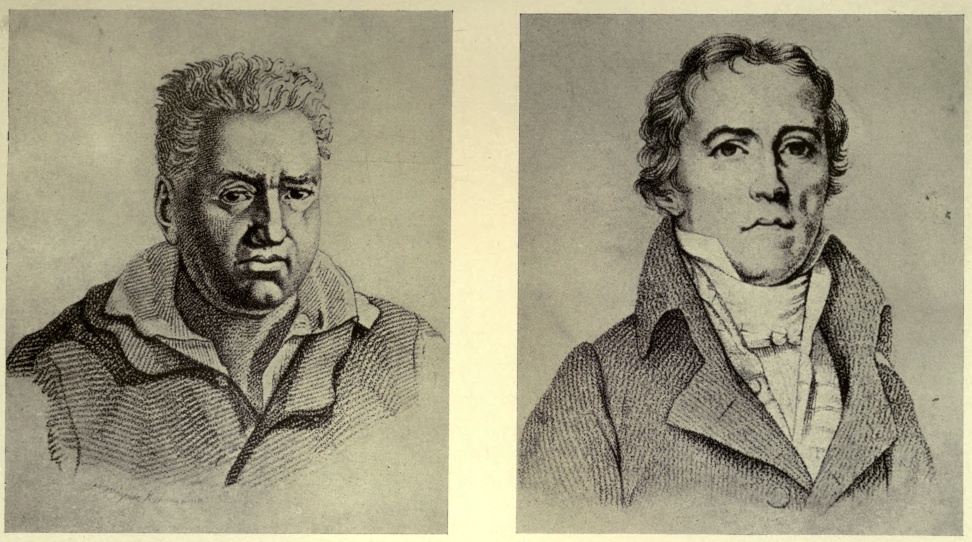
F. TOURTE - N. LUPOT
Nicolas Lupôt was a man of great discernment, and not carried away with the fashion of the times. Although during the first twenty years of his life he must have seen and heard the German model of Stainer extolled, neither his own work nor yet his father’s show any leaning towards it. His eye was enamoured with the Stradivari grand pattern, and his best violins are such loving and faithful copies of the great Antonio that many amateurs and some professional judges have been deceived by them. But Lupôt never got rid of the glassy, chippy French varnish, and although his warm orange tints are generous and the varnish has been laid on with a lavish hand, the rubbing bare by time of a Lupôt is very different from that fading away upon the fibres of a Strad, where always a subtler film protecting the wood seems to linger, a sort of mist of varnish to the end.
But Nicolas Lupôt was a great workman, and, as Hamlet modestly puts it, “indifferently honest”—that is, honest as violin copyists go. He did not imitate, he copied, and varnished throughout; he never aged his copies prematurely, or tried to take in buyers; he reverenced his great Cremona model too much to palm off his own work as those of the master. Of course his violins have rubbed since and aged since, but they have aged and rubbed honestly, and are every year increasing in value, and distinctly mellowing in tone and sensitive quality. The moment Nicolas Lupôt arrived in Paris, early in this century, his talents were recognised; orders flowed in, and he remained and remains without a rival in the French school.
He was appointed maker to the Paris Conservatoire, which involved the manufacture of the annual prize violin to be presented to the gold medallist of the year, and to this academic privilege we are doubtless indebted for some of his finest efforts. A violin which would annually at the time be associated with one of the chief musical events of the year, and come under the criticism of all musical Paris, would certainly call forth the mettle of one who admittedly “took the cake,” but was not without formidable rivals.
One of these rivals was Pique. He was in the habit, it is said, of buying Lupôt’s fiddles unvarnished, varnishing them, and labelling them with his own name. He had better have left the varnishing alone and contented himself with a fraudulent label. It is surprising that he should have stooped to such a device. Pique is quite a considerable person, second only to Lupôt as a maker. He must have been influenced by commercial considerations, but his dishonesty is a great tribute to the superior popularity and merit of Lupôt. Still Pique was so clever that he could have afforded to be honest.
François Gand, who entered as Lupôt’s pupil in 1802, was much beloved by his master. He became his best pupil, married his daughter, and succeeded to his business in the Rue Croix des Petits Champs in 1824.
Time has invented a new industry—the art of repairing—which François Gand raised to a veritable fine art (Mennégand, Kolliker, Rambeaux and W. Ebsworth Hill have since rivalled him). Pique would join and split mutilated grain in such a way that, without the aid of a microscope, the patch or closed fissure cannot be spotted. He would spend days over mending a crack; it became with him a sort of passion of ingenuity.
It was almost worth breaking a fiddle to have it mended by Gand, and his exquisite skill and profound knowledge as a repairer no doubt gave rise to the common but risky notion that an old violin was improved by being mended, as some surgeons pretend that a skilful operation will not only prolong life, but positively improve the constitution. The firm of Gand and Bernadel is still of high standing in Paris. The violins of François are useful and solidly built, but lack altogether the Italian grace and finish of his master, Lupôt.
Pique (1788-1822) is by some held to have run Lupôt very hard as a copyist of Stradivari. Pique avoids at once the error of the vulgar copyist, who cannot refrain from emphasising the peculiarities of his model, and the sin of the brazen forger, who bakes and rubs, treats with acids, and simulates the cracks and the wear and tear of time. But Pique had some conscience. He may have passed himself off as Lupôt, but at least he never posed as Stradivari.
Those conversant with Pique’s instruments observe a very high and conscientious finish throughout. Spohr, the violinist and composer, played for many years on a Lupôt, and was never tired of extolling both Lupôt and Pique. Pique died in 1822, two years before Lupôt, and his violins improve every year, and will by-and-by fetch prices second only to those of Lupôt, which are already up to £200 (1897).
A Vignette of J. B. Vuillaume.
If I were to seek for an appropriate pendant to the figure of William Ebsworth Hill in London, I could not find a better one than Jean Baptiste Vuillaume of Paris. Yet the two men were very different;—the careful, neat, systematic enthusiast, with a shrewd eye to business, and the dreamy worker always apparently in the midst of a chaos of material, out of which he alone could select at a moment’s notice what he required; the ready purveyor of whatever sort of article happened to be wanted, and the careless distributor of his wares, who forgot what he owed his customers, and kept them waiting for months; the clever copyist, the reverent repairer, the ingenious brain for ever evolving new sorts of bows, fiddle shapes, screws; and the idolater of the old forms, who had so firmly grasped the truth that violins and all that belonged to them had culminated at Cremona before the middle of the eighteenth century, that he never aspired to invent anything new or alter anything old;—the Parisian, who made many fiddles, and died rich; the Londoner, who made few fiddles, but repaired innumerable antiques, and died with but a moderate competence. The force of contrast could go no further; nay, you can look at the two men’s faces, and see the secret of their characters writ plain enough.
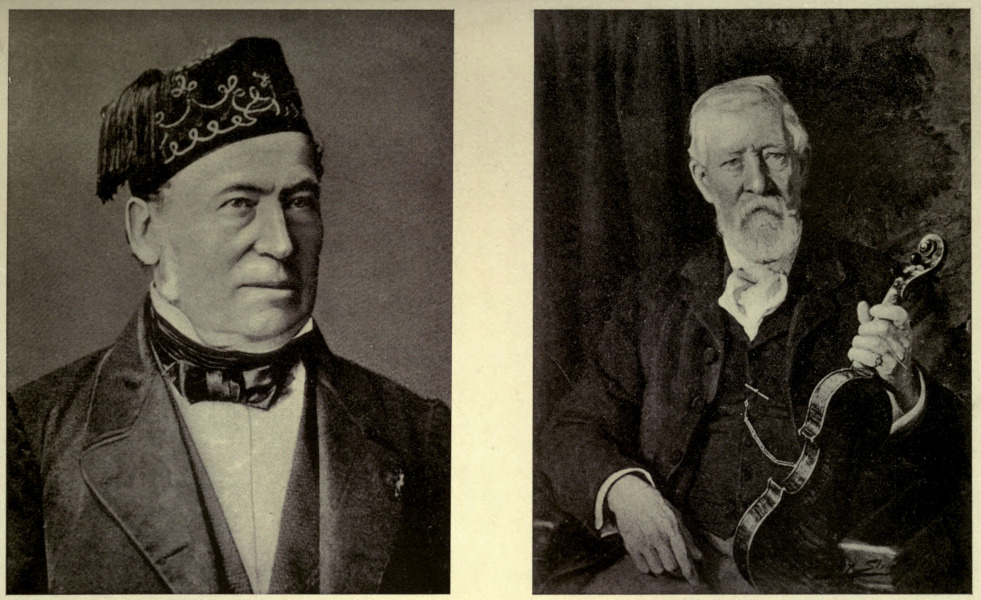
J. B. VUILLAUME - WILLIAM EBSWORTH HILL
I can remember old Hill’s dreamy gaze, peering at me with screwed-up eyes through his spectacles. You were nothing in particular to him, duke or pauper; it was your fiddle that gave you the importance or the reverse in his eyes. But look at Jean Baptiste Vuillaume’s portrait—it lies before me as I write: the jaunty embroidered and tasselled velvet skull-cap, the well-arranged black satin tie, the well-cut coat, the grave sharp look and keen eye, not dreaming at all, but taking everything in at a glance; the mouth a little aslant, as we often see it in men of speculative and ingenious minds; the firm fine nose, and the strong quiet face, but a face that betrays a mind ever alert, capable of dominating its owner’s gifts, his customers, and the market generally, whilst the man was genuinely devoted to the art and craft which made him great, and rich, and famous. Yes, the two great connoisseurs might well hang side by side in twin frames, for they are two types, united by a like enthusiasm and speciality of craft and knowledge, but differently interesting, variously unique each in his own way.
Both were hereditary violin-makers, and the tendency—I had almost said the cult—was born and bred in the blood.
Vuillaume was early saturated, in his father’s workshop at Mirecourt, with all the secrets and arts of the trade, long before he served his apprenticeship. But Paris drew the young fellow, then only nineteen, with an irresistible magnetism.
Victor Hugo, that typical Parisian of Parisians, has somewhere described the Frenchman’s inborn love of his capital, the centre to him of life, art, pleasure, movement, industry, and invention. So to Paris must your Jean Baptiste go. But to whom?—to whom but Chanot (Francis), incomparable worker, copyist, forger, suitable adept, indeed, for such a bright novice.
With Chanot, Vuillaume remained till 1821, when he went over to Lété, the organ-builder, who also dabbled in fiddles, and was glad to have at his beck and call as a foreman such a specialist, with all the experience of Mirecourt and the craft of Chanot at his back; in fact, he lost no time in taking the young man into partnership, and the partner throve so well that he married in 1828, being then just thirty years old.
Things ran smoothly with Vuillaume; his wife did not drink, or abuse him, or waste his money. His home was happy, and, in the sunshine of domestic peace, his talents expanded in the direction of that growing market which was created by the taste for old fiddles, excited by Tarisio, and supplied by the not always scrupulous skill of Chanot.
But Vuillaume went one better than Chanot. Chanot’s trick was to produce such deceptive copies or patch with counterfeit backs and bellies of his own—or to forge downright a whole antique, to be foisted upon some unwary but ill-informed enthusiast. But Vuillaume, to his honour be it said, soon discerned that the world at large could not be won by fraud, but that men were the slaves of imagination and sentiment. This timely and philosophic discovery made him famous and wealthy, almost at a bound. He loved the old Italian fiddles; he had the best opportunities of seeing them; his admirable technique enabled him to copy them accurately—to counterfeit the wear and tear, even the cracks and worm-holes, the inlaying, the rubbed varnish, the old wood; and for about five pounds, or even less, he proposed to provide people with new fiddles, which looked like old ones worth fifty or a hundred pounds.
The device succeeded beyond the dreams of avarice. Orders poured in faster than they could be executed. Just look at the old man’s face. Can you not see the shrewdness, betrayed by that slight pucker in the lip, which discovered and worked this now familiar tendency of human nature to possess what seems, if you can’t afford to buy what is really good? It is the secret of cheap art, shoddy satsuma, coarse blue china, common silks, oleographs, and sham Palais Royal jewellery galore—every bazaar reeks with it; whilst the biggest warehouses are not above selling a made-up wine that deceives the palate, a walking-stick not ebony, only paint or stain, and furniture not really inlaid, but ditto ditto. So Vuillaume began early those amazing copies, chiefly of Stradiuarius, which even now deceive the innocent, and for a moment may even puzzle a connoisseur. Well, it was no doubt shoddy, but shoddy of the best sort; shoddy raised to a fine art, like those roses so subtly made out of silk or cambric that we might easily pop them into water to prevent them from fading.
This new-found copying industry was a delight as well as a profit to the clever French craftsman.
He loved a Cremona; he copied it as men copy the old masters again and again, till they know every touch of the immortal workman, and revel in its reproduction.
“I have completed,” remarked Vuillaume in his declining years, “three thousand instruments, all sold, all paid for, and the money spent, and it affords me great satisfaction.”
Like Ebsworth Hill, Jean Baptiste loved to do it all himself. Every instrument was varnished carefully by his own hands, and many are made throughout by him.
But what is the actual merit of Vuillaume’s violins? Fine work, yes; admirable counterfeits, yes; but the great expectations raised by the appearances are unfortunately not always answered by the tone. His best are good, and will run into forty pounds, perhaps more; but his worst are dear at five pounds. Nor can Vuillaume pretend to rival in power his great French predecessors, Pique or Lupôt, who copied, but without registering the defects of age, accident, and decay, which are so cleverly reproduced in Vuillaume’s typical specimens.
It is an exaggeration to say that Vuillaume baked his fiddles; but he treated the wood chemically in various ways, besides reproducing cracks and even worm-holes; and this artificial age put upon his planks not only fails to carry the mellowness and timbre of wood grown naturally old, but seems actually to impair instead of improving its quality, and this is but too apparent as the instruments recede in time farther and farther from the hand of the too cunning artificer.
There are, however, a few fine quartets of instruments, one of which, made for the Comte de Chimay, was lately exposed to public view in Messrs Hill’s windows in Bond Street. These are varnished equally throughout, and no attempt at aging the wood or tampering with the surface is visible. The work throughout is charming and finished, as in the best Cremonese models, and the only wonder is, that as everything about them is so good, the tone is not better; still, everything is relative. But Vuillaume claims to be judged by a high standard, and so we judge him.
Vuillaume’s ingenious brain was ever devising improvements and novelties, but few of them have turned out successes.
He made a violin tenor, but it never came into use, it being too cumbrous. He made a steel bow; but, although hollow, it was found to be too heavy. He made a sourdine tailpiece which acted on the bridge, but it has never superseded the usual simple dummy contrivance. He made a self-hairing bow, which is still sold by Mr Withers; but most violinists prefer to pay a small sum and get their bows haired, just as most men prefer to get themselves shaved—it is less trouble, and does not cost much.
Apart from his undoubted finish as a workman, and skill as a copyist, Jean Baptiste Vuillaume’s title to fame will rest largely on his connection with Tarisio. As we have seen, he not only dealt with him living, but bought all the violins found in the bedroom along with the peasant carpenter’s lifeless body.
His possession of the Messie, which he kept in a glass case, and never allowed any one to touch, was a source of great anxiety to him during the Paris Commune in 1870.
He writes to Madame Alard, his daughter, who married the celebrated violinist of that name: “In my last I spoke to you of Alard’s violin and my Messie, and of certain valuables I have here. I do not know what to do with them, for if one survives, one will be able to recover the valuables when the hubbub is over; and some sous can be buried, but violins cannot be buried.” And again: “Where ought I to place all these in case of pillage?”
He referred chiefly to his violins, and old medals received in the Paris Exhibition from 1827 to 1855, and the Great Exhibition medal in London, 1851.
Later on we are relieved by reading: “I have found quite a safe hiding-place protected from fire, et puis à la grace de Dieu!”
All went well with the treasures, and in 1875, when he died, the Messie fell to the joint share of his only two children, Jeanne and Claire. Jeanne (Madame Alard) bought out Claire’s interest for five hundred pounds, the violin at that time being valued at one thousand. In 1890 Messrs Hill bought it for Mr R. Crawford for the unprecedented figure of two thousand pounds, the largest sum ever given by a dealer for a single instrument. Mr Charles Reade valued it at six hundred, but that was several years ago, when a first-class Strad could be obtained for about three hundred and twenty pounds. Prices have run up since then, and (like “Charley’s Aunt”[3] as we write) are “still running”!
Down to the end of his life Vuillaume was a great dealer, and he hurried over to London when quite an old man to attend the sale of Mr Gillot’s fiddles. He mistook the date, and arrived a day after the sale. He came into Mr Hill’s shop in Wardour Street, and gave vent to his disappointment. Mr Hill, whom he always visited when in London, had bought several instruments, and had a second deal with Vuillaume then and there, much to the Frenchman’s gratification. It is interesting to catch this glimpse of the two greatest dealers and artificers of the age face to face for one moment, and in such friendly and characteristic relations.
CHAPTER VIII
VIOLINS IN ENGLAND
It is an amusing fact that hardly a Continental writer on musical instruments, M. Vidal excepted, has thought it worth while to give any reasoned account of the English viol and violin-makers who have occupied such a distinguished place in the history of the art.
I heard the other day of an American school atlas which left out all the islands in the world as unimportant details calculated to confuse the minds of young students. England, of course, being a small island, was one of the first to disappear.
The names of Barak Norman, Banks, Forster, and Duke may be somewhat confusing, but we must risk the mention of them just for the sake of an approximate completeness.
The fact is, that in Queen Elizabeth’s time the English were really almost a musical people. Whether the viols came across from the Low Countries or Germany or from Italy has never seemed to me a matter of much importance. Undoubtedly the viol and its descendants is cloisteral, and that means Italian, since all the arts along with Christianity spread from the great Italian centres—Rome, Florence, Milan, Brescia; and in Elizabeth’s time Italian influence is as marked in English music as it is in the Shakspearian drama, or in these gorgeous brocades, silks, and tapestries that still dazzle us behind glass at the South Kensington Museum, or in such Elizabethan gems of Renaissance architecture as Knole and Hatfield, which seem to touch as with the glory of a foreign world the palatial seats “of our old nobility.”
Modern music rises in Elizabeth’s reign with Monte Verde and the discovery of the octave and the perfect cadence.
Along with it rise the Italian singing-schools of Naples; whilst the viols, improved to meet the new demands, culminate in the Brescian, Maggini and the Cremonese Amati patterns (the very word Madrigala, the hymn of the Mother of God, is Italian and cloisteral), and the viols which accompanied such part-songs were doubtless of Italian origin.
But, for all that, the viols were genuinely naturalised and acclimatised in England, and for a short time it seemed as if England were even going to lead the art of viol manufacture.
The father of Galileo the astronomer declared in 1583 that the best lutes were at that time made in England, and we know that lute-making and viol-making so invariably went together that in France and Italy the violin-maker is to this day called a “lutier”; and J. J. Rousseau remarks, a little loosely perhaps: “The viol passed from the Italians to the English, who first began to compose and play harmonised pieces for it, and who imparted the knowledge to other kingdoms.”
Mace, an old writer and quite a musical expert (1676), mentions the viols of Ross (1598) and Smith (1633) as “old instruments” in his day. But the movement did not go on, and I cannot for a moment doubt that what checked the rise of music and the manufacture of musical instruments in this country was that same Puritan craze which snubbed art, smashed the stained glass, and mutilated our cathedrals throughout the land.
Viols had by this time crept out of the cloister and joined hands with the frivolous Rebek, used at fairs and pothouses. At all events, in Cromwell’s time and the “Barebones-praise-God period,” everything that savoured of festivity was tabooed, and the fury against art seemed part and parcel of all sincere religion, according to the masses at least.
To Cromwell’s honour be it set down that he was personally no such extremist, and that he, moreover, saved for us Raffael’s cartoons; but still music in any of its secular forms was mightily discouraged by the Puritans, whilst in its higher religious form it was associated with Prelacy and Papacy, and we have to wait for that reaction in favour of the world, the flesh, and the devil, which marked the Restoration, and which also made provision for the more innocent as well as the more perilous delights of music in the home, the concert room, the theatre, and the sanctuary.
In Charles I.’s band (1625) there were “eleven violins and four viols,” so at last the violin was creeping up; but not until Charles II.’s restoration did the full-fledged violin come in with a rush of “four-and-twenty” fiddlers, over whom presided no less a person than the immortal Thomas Purcell, who, in a brief span of life, achieved his almost Mozartian fame, and died at the early age of twenty-seven, just ten years younger than the incomparable Wolfgang Amadeus.
The King had no doubt got his notion of fiddle bands from Louis XIII.’s “petits violons du roi”; and from the French Court, our “merrie monarch” borrowed a good many other ideas of a less respectable and harmless character.
The King was so seriously addicted to music that he could hardly hear a sermon and never eat his dinner without the solatium of his four-and-twenty fiddlers.
“They played before him at his meals,” writes Anthony Wood in the diary of his life, “as being more airy and brisk than the viols”; and the grave Evelyn much resents the invasion of the upstart “petit violon” and its profane intrusion. He writes in 1662: “One of his Majesty’s chaplains preached, after which, instead of anthem or solemn wind music accompanying the organ, was introduced a concert of twenty-four violins between every pause, in the French fantastical light way, better suiting a tavern or a playhouse than a church.”
’Tis an ill wind that blows nobody and nothing any good, and we cannot doubt that his Majesty’s royal mistresses, like the Duchess of Cleveland (Barbara Palmer), the Duchess of St Albans (Nell Gwynn, the actress), the mother of the Duke of Monmouth (Lucy Walters), the Duchess of Portsmouth (Louise de Querouaille, a French girl), greatly favoured all the more frivolous diversions with which secular music, and especially the new-fangled violin, were associated.
These ladies were bound to be musical, as music undoubtedly delighted the “merrie monarch,” and flattered his jaded tastes by its frequent novelty and emotional excitations.
The revellers at Whitehall soon attracted to the capital the greatest violin players from foreign parts. The supremacy of the new violin pattern was achieved, and the rage of virtuosity began.
Even John Evelyn succumbed to the witchery of Thomas Balzar, a Swede, who arrived in 1656. He seems to have been the Paganini of the period, and electrified the Court. Evelyn calls him “incomparable”; he played off at sight the most amazing difficulties with ravishing sweetness and “improvements”; he played a full concert on his single instrument, so that the rest flung down their violins, acknowledging the victory. As to worthy Mr Paul Wheeler and Mr Mell, who were the Spohrs and De Beriots of their day, they had to hide their diminished heads.
We are not surprised to hear after this that his Majesty installed the great Balzar as director of his twenty-four violins, retained his services at court, and buried him in the cloisters of Westminster Abbey.
It will be convenient to focus our attention on English violin-making about this time, for doubtless the arrival of these foreign players, and the popularity of the king’s band, gave a great impetus to our native manufacture. The supply of foreign violins, for which there was now a growing demand abroad—i.e., in England and France—began to give out as the century waned. There were plenty of old viols, but no old violins to fall back upon; the violin was a new product; and, as the court set the fashion, we should naturally expect the English viol-makers would be wide awake to the importance of supplying the new want, and such was the case.
The Brescian and Cremonese fiddles were hardly known in England, and what the Italians made were chiefly for home consumption.
As the English were great viol-makers in Elizabeth’s time, we may ask: Why did they allow the Italians to take the lead in violins? Why is the English school of violins at least fifty, and the best English violins a hundred years later than the early Cremona chefs-d’œuvre? Why is Nicolo Amati’s date 1596-1684, whilst W. Forster is 1713-1801, Duke 1769, and Banks 1795? The answer is not far to seek: the fact that violin manufacture was checked by the Puritan movement in England, whilst its progress in Italy was steady and continuous, enabled the Italians to steal a march upon us which turned us into pupils, and pupils afar off too, when we resumed the industry. I do not say that the superior climatic conditions and generally the art atmosphere of the small Italian courts must not also be taken into account; but when attention was called to improved tonal quality, and a timbre, power, and sensibility undreamed of by the old viol-makers became de rigueur, in response to the demands of virtuosity and the advance of the musical art, Italy was bound to win; such Tyrolean woods, such varnish, such sun, such sentiment, as was required for the perfect evolution of the violin, could hardly be found outside Italy. Both Spain and Germany confessed to the fact, nor could England put it aside. Accordingly, the highest praise that was ever given to an English maker was given to Benjamin Banks (1727-95), who was called “The English Amati”; but to this day no one has ever been called “The English Stradivari”!
Passing by Aireton (died in 1807), who copied Amati, but used yellow varnish; Henry Jay (1744-77); the famous kit-makers (the kit is a tiny instrument with normal neck and finger-board, used chiefly by dancing-masters), the Kennedys, father and son (1730-1870), most prolific but mediocre fabricators, chiefly of violins and tenors; Panormo and Parker, the two first excellent eighteenth-century makers; we make special mention of John Rayman, one of, if not the earliest, English violin-maker. “An extraordinary Rayman” was amongst the violins owned by Britton, the musical coal-heaver. Urquhart was also a maker of exceptional originality.
Pamphilon (1685) was a fair and excellent workman, high model, moderate tone, with quite splendid varnish. “Peter Walmsley, at Ye Golden Harp in Piccadilly,” good copyist of Stainer and an excellent maker, we are bound to notice on account of his early date and more solid reputation.
“Barak Norman” worked and sold fiddles at St Paul’s Churchyard (1683-1740). His label runs thus, with a ✠ and crown above it, similar to the labels of Del Gesù, some of which he may have seen: “Barak Norman and Nathaniel Cross, at the Bass Viol in S. Paul’s Churchyard, London, fecit 1702.”
Mr Walter Brooksbank of Windermere had one of the Cross viol da gamba, in which, after the style of the early bell founders, the instrument is supposed thus to speak for itself. “Nathaniel Cross wrought my back and belly” (the scroll and sides being by Barak Norman).
Meares, about whom little to speak of is known, except that he was probably a pupil of Rayman’s, is reputed to have taught Barak Norman.
Meares is known to have adopted the Brescian model. He was probably the earliest English maker of violoncellos. He retains some of the decorative use of purfling, which rapidly went out as the new violins came in. He runs his purfle into his monogram with attendant flourishes. Meares made at first chiefly viols, after that tenors of excellent quality.
His violins are much esteemed. He was a close copyist of Maggini.
Three of his viols were exhibited in the South Kensington Loan Collection of 1872, but one of them, dated 1690, had been cut down.
It remained for Stradiuarius, in the dawning year of the eighteenth century, to discover and fix the model of the bass viol that needed no cutting down.
The musical world owes a debt of eternal gratitude to the Forster family; there were four of them.
“Great-grandfather John (1683), maker of spinning-wheels and violins.
“Grandfather William, the Forster, commonly called ‘Old Forster.’
“Father William, No. 2, who also made spinning-wheels.
“William, No. 3 (1764-1824).”
His sons, the two brothers William (1733-1824), and Simon Andrew (1731-1869).
The second Forster (1739-1807), William, called “Old Forster,” bears off the palm.
Born in the north, a native of Brampton, he made his market, like his father, out of the spinning-wheel industry of Cumberland, but he was a many-sided man, a great repairer of viols, and afterwards a maker of violins, the greatest maker in the north—the greatest maker in all England.
He commended his violins to the public by playing on them himself. He was not beneath playing at country dances and on village greens.
We may be sure he never lost an opportunity of parting, for a consideration, with the violin he played upon—since naturally, people would often be seized with a desire to possess themselves of an instrument which they had heard discourse such excellent music and to the purpose.
Indeed, I have sometimes known professors in these days who would so cunningly play to their pupils that they have been able to palm off for considerable sums quite inferior instruments.
How much more easy must it have been for the man who made them, and made none but the best, and played them on occasions when his purchasers’ spirits were high and their dispositions yielding, to dispose of his exceptional wares.
About 1759 Forster seems to have concluded that Cumberland was played out, and, sighing for new worlds to conquer, he came south. He was quite a young man, but in the great whirlpool of London, as it was even then, he seems to have sunk so low as cattle-driving, but that is in itself a tribute to his versatility and pluck. Presently he sets up in the Commercial Road, East, but finding there neither demands for spinning-wheels nor fiddles, takes to gunstock-making, till he at last “strikes ile” with one Beck, of Tower Hill, and there makes such fiddles that Beck grows fat while Forster remains lean.
Unable to get his wages raised, he leaves Beck in 1762, and sets up at Duke’s Court, a site now occupied by the National Gallery.
For about ten years Forster adopted the high Stainer pattern, then so popular in England, and attracted the patronage of amateurs like Colonel West. Afterwards he set up in St Martin’s Lane, and then went to 348 Strand. He had by this time attracted the attention of royalty, and the Duke of Cumberland, George III.’s son, is said even to have once dined with him off black pudding.
Old Forster’s versatility and enterprise is still further shown by his opening communications with the great Joseph Haydn, and it is chiefly to him that England owes the introduction and publication of Haydn’s immortal Symphonies.
The shrewd old man doubtless saw the profit which lay hid in a scheme which would popularise the greatest writer for stringed instruments who ever lived, and he had not miscalculated.
The same cleverness which prompted him to give the English a dose of the Stainer model when Stainer was the rage, prompted him to revert to the later Amati grand pattern as he reached his ripe maturity. He also changed his varnish before the close of his life, and is said to have found the secret of solving amber with the assistance of the chemist Delaporte, who invented some stuff known as the Verins Martin.
Amongst his patrons were George III., who, as Prince of Wales, was fond of playing the violoncello, probably one of “Old Forster’s,” and who, when he asked Haydn, who had been listening to him, how he thought he played, received the altogether diplomatic reply, “Vy, your ’ighness do play like a Brince.”
Peter Pindar (Dr Walcot) and Bartolozzi the engraver were also amongst Forster’s patrons. He made but four double-basses, and his tenors and ’cellos are thought better of than his violins. They are steadily rising in value. He died in the same year as Haydn (1808). His son William already suffered much from the foreign competition, which was just beginning to tell, the duty which protected the English manufactures having been removed.
William made some very good instruments, but they do not equal his father’s; and he made a great deal of rubbish for the trade besides.
There was no doubt a certain erratic vein in the Forster family, which in Old Forster took the shape of amazing versatility and profitable enterprise, but which in his son and grandson degenerated into speculative eccentricity. The son went in for buying grocery, and invested in other bad businesses. The grandson turned out very unmanageable, but clever and many-sided; he worked for a time with Thomas Kennedy, but got away from him and went in for play-acting, sometimes taking a turn in the orchestra at the violoncello desk. He made about fifteen instruments altogether, two or three of which only approached the Forster high level. He died in 1824, suddenly, whilst still quite a young man.
His brother Simon made a large number of violins—tenors and ’cellos; they are those signed S. A. Forster, but they do not rank very high. He was the first to write a history of the violin, and has deserved well of all succeeding writers, who quote him with a touching simplicity of faith, as though, forsooth, because the first, he must needs be the best authority.
At the name of Benjamin Banks all tenor and ’cello players lift their hats; for although the later importation into England of Cremonas has somewhat obscured our countryman’s fame, his splendid work—even surpassed, as some think, by his sons James and Henry—is bound to hold the market again; and a name extolled by the great virtuoso Lindley, whose favourite instrument was a Banks, is not likely to be neglected by Lindley’s successors, even though they may be the happy possessors of Stradivari basses.
Benjamin Banks (1727-1795) was a contemporary of Old Forster (1713-1801), but there is no reason to suppose that the two artificers ever met or materially interfered with each other; for Banks worked at Salisbury, whilst Forster worked in London, and no express trains bore fiddles or fiddle-buyers swiftly to and fro in those days.
Benjamin Banks copied Nicolo Amati very closely; but Mr Sandys speaks of a rare long-shaped violoncello of his quite of the Stainer pattern, with the round-topped Stainer sound-holes. This was none other than the great Lindley’s famous instrument which so nearly escaped destruction in a coach accident. The passengers had a bad shaking and a bad spill, and Lindley and his violoncello among them; but the rare enthusiast, in the midst of the confusion, had but one thought. He flew to his ’cello-case, and was found seated in a ditch, quietly playing away to assure himself that his beloved was uninjured.
Mr Lucas had an excellent Benjamin Banks violin, but Banks tenors and violoncellos are more esteemed. Banks made no double-basses; his varnish is yellow-brown, of excellent quality, but badly laid on, that on his bellies being often clotted, so that, in technical parlance, it is said to kill the grain.
The Earl of Pembroke, who presumably knew no better, ordered a violoncello of Banks to be made entirely out of an old cedar-tree, which had been blown down in his lordship’s park (Wilton). It was, as might have been foreseen, a great failure in tone. Of course Banks made it “right enough,” and pocketed the money, but it is doubtful whether the Earl ever got his money’s worth.
I remember a very carefully made violin, all of silver, another expensive freak of ignorance and eccentricity; doubtless it sounded like a tin kettle, and was musically of no use whatever. Some of us may have heard an ingenious itinerant violinist playing on a tin biscuit-box with similar results.
Benjamin’s scrolls are not very elegant, but that does not affect his tone. Benjamin had a very good idea of his own importance, and probably, too, a suspicion of the extent to which his name would be taken in vain after his death. He tried to make this more difficult by not only varying his labels in about four different ways, but also stamping his instruments in several places with his own peculiar seal, B.B.
Benjamin’s sons fell far below their father, but the old man left quite a number of white unvarnished instruments in a cellar when the business was sold, all of which were duly completed and sent forth with his name, to which, however, they have but a partial right; for, as his sons worked with him, it is by no means certain that every fiddle in Bank’s shop at the time of his death was made by Benjamin père.
Duke (1754-69) was remarkable as having largely contributed to create in England the Stainer furore which so confused the judgment of amateurs in this country, and retarded for at least fifty years the triumph of the Stradivari grand pattern. In reality the best Dukes are on the Amati pattern, but they are few in number, and though there are innumerable fraudulent Dukes about, a real Duke is seldom seen. The fraudulent Dukes exaggerate the high bellies and deep grooving of the earlier Amati, and thus pass for Stainer pattern. Duke’s varnish is also of a yellow or yellow-brown hue. It is not likely that Duke’s reputation will increase, though the rarity of genuine Dukes and the plentiful number of counterfeits may still run up a few real specimens to fancy prices.
I cannot close this brief survey of the old English makers without a mention of Bernard Fendt (1756-1832). He was originally a Swiss cabinet-maker, but coming to London, went into business with Thomas Dodd, for whom, and with whom, he began to make violins. Fendt soon got hold of another cabinet-maker, a compatriot, and Dodd took him also into the business. These two clever artificers soon raised Dodd’s business to great prosperity, and Dodd thus had the honour of putting his own name in their violins. All he had done, however, was to varnish them, but he did that superlatively well, so that Dodd’s varnish became as famous as Dodd’s bows.
Fendt afterwards left Dodd and worked for John Betts, who was famous for his imitations of Amati, which he said paid better than making fiddles with his own name in them. Many of his best imitations were made by Fendt, who has thus created the reputation of two makers besides himself. His son, who died only in 1851, would have equalled his father had he not been seduced by the vicious practice of prematurely aging his violins, thus pandering to the taste for old fiddles at the expense of the fiddles themselves—for it is notorious that such frauds do not improve by age.
A Vignette of W. E. Hill.
Dark—yes, to my eyes very dark; but the light in William Ebsworth Hill’s old shop in Wardour Street was good enough for him; a greater glare might have flouted those hundreds of old brown fiddles, and dusty débris of fiddles, which that very moderately sized establishment was hung, lined, strewn, and littered o’er with.
So the dim light, relieved on foggy days with a casual gas-jet, or even a candle-end, seemed better than the garish sunlight for that dusky brood—even as the moonbeam, according to Sir Walter Scott, touched the grey ruins of Melrose more tenderly than the light of day.
There were no electric lamps in those days (in 1870), consequently no patent asbestos appliances for converting the impure London gas into a specious and blazing rival.
Mr Hill tried to do too much. In his back shop he conducted repairs, and frequently brought his “repairs” into the front shop. I have seen him there, behind the counter, busy with gouge, knife, or scraper. When customers or applicants for advice arrived—some with cheap German fiddles which they fondly believed to be rare specimens of Cremona, others with their own good, bad, and indifferent instruments to be done up—they were received one and all with the same mild and tolerant inattention, born not of incivility, but of abstraction. Such as knew Mr Hill in those days, knew the nearest approach we shall perhaps ever see to the great Cremona makers. I do not say that any of Mr Hill’s work (barring his exquisite repairs and carving) is likely to rank with theirs; he was an admirable maker, but he very soon left off making. When the duty on foreign violins was removed there poured into England a continuous stream of fiddles, which entirely swamped the demand for new ones of English make. Mr Hill, following the market, turned his attention to repairing and dealing; but the art and craft atmosphere, the knowledge, the familiarity with violin constitution, the infallible intuition and single-minded love of the violin for its own sake, as a thing of beauty, wonder, mystery, more than enough to monopolise a lifetime of devotion—this is what made Mr Ebsworth Hill the spiritual heir of the grand old fiddle-makers. “Why,” he said to me once, “talk about not knowing the touch of this or that maker? I know the sort of tools Stradivari or Joseph used. I can see the mark of a special favourite knife here or gouge there. I know which way he used to cut and slice, and how he held his tool for such and such a kind of finish. I can see ’em at work, and the handling of one is no more like another’s than the touch of one painter is like another’s.”
When you took a fiddle in to show Mr Hill, you had to wait Mr Hill’s good time; he seldom answered immediately he was spoken to, but would look up dreamily through his spectacles without laying down his file or knife, and let off some such dogmatic and oracular sentence as: “You want to know how I can tell a fiddle. Well, I don’t know how I can tell; and there are days when I don’t trust my judgment—days I can’t see, for instance. I leave off looking at fiddles for a day or two; and when I come back I take up this fiddle and that, and just at first I can’t see anything—those fiddles tell me nothing; it’s a peculiar state of mind—just as a player or a surgeon’s hand gets out, so a judge’s eye gets out. I know exactly when I see and when I can’t see, and when I can’t see I hold my tongue; and I know exactly how much I can see, but I don’t tell everybody.” The casual visitor could make very little of old Hill at first. There was a curious sort of inner otherwhereness—to coin a word—about him. Some people found him very trying indeed. You never knew whether he heard what you said; but when at last he favoured you with a remark, you discovered that he had not only heard your words, but that he had accurately gauged you.
His action was often unexpected and sometimes alarming. I one day entered his shop with a friend who had a fiddle which he much prized, and indeed it was a really valuable instrument, but needed overhauling.
We both stood in front of the counter, and old Hill was bending over a scroll that he was fitting on to a new neck. I addressed him on behalf of my friend, but he took no notice whatever; he remained absorbed in his delicate adjustments; and no Prince of the blood would have fared any better than we did until he had finished what he was about. Again I mentioned my friend’s name: “Mr —— has brought you his fiddle to look at by my advice. Perhaps you can tell him what ought to be done.” Hill looked up, nodded, eyed my friend through his spectacles with cold interest, and then resumed his work. I had to rouse him a second time before he seemed to grasp the fact that my anxious friend had taken his precious Cremona from its case and was standing with it in his hand ready for the magician’s inspection.
At last Hill laid down his tool, and taking the instrument in his hands, gave it one quick glance and a couple of taps; he then deliberately looked in its astonished owner’s face, tore off the finger-board, loosened the neck, and drove a knife under the belly. The fiddle was soon in pieces, and he threw the loose fragments aside in a heap, took up his repairs again, and said he would attend to the matter by-and-by, and the gentleman need not stop; and we got no more out of old Hill that day, who immediately became reabsorbed in his work.
I shall never forget the rueful and amazed look with which my poor friend beheld the tearing to pieces of his Cremona, but I touched him on the arm, and seeing that Hill was in no mood for talk, got him out of the shop, assuring him that it was all right, and that the great repairer had shown more interest than usual in his valuable instrument, or he would never have torn it to pieces then and there; and with such words I strove to comfort my perplexed and anxious friend.