Introductory material (continued 3)
Reading edition
I am bound to add that although Hill kept him waiting several months, when the fiddle came back its owner was more than satisfied, and declared that he then heard his Cremona for the first time.
Mr William Ebsworth Hill came of a family of violin-makers and violin-players. Joseph Hill, who was born 1715, was proud to trace his descent from the “Mr Hill” mentioned in Pepys’ Diary as being employed to alter his lute and viall.
Joseph was a prolific and excellent violin-maker, and carried on business in the early part of the eighteenth century at the sign of the Harp and Flute in the Haymarket.
He had five sons; all made violins and three played professionally, whilst the other two, like the present four brothers Hill in Bond Street, followed their father’s vocation alone. The third son, Lockey Hill, was the father of Henry Lockey Hill, who became in his turn the father of William Ebsworth Hill, known in the middle of this century as Mr Hill of Wardour Street. Hill’s father, Henry Lockey, an excellent violin-maker, died in 1835. The Hills seem prolific in sons, and Lockey left four sons. Henry distinguished himself as an admirable quartet player, and well do I remember the splendid tone of his Barak Norman tenor at Willis’ Rooms as far back I think as 1848, when, with Sainton, Piatti, and Cooper—one of the best, as it was almost the earliest string quartet cast in London—he assisted in delighting and educating a select public in the mysteries of chamber music, which has been since so freely expounded by Ella’s Musical Union and the Monday Popular Concerts.
Berlioz always spoke of Henry Hill in terms of the highest praise; he even went so far as to say that he considered him one of the first performers in Europe.
It is seldom that a tenor player ever comes in for direct commendation. He acts as a sort of go-between to violoncello and violin; but his individual efforts, although so important to the combined effect, are usually lost sight of between the grand work of the bass and the brilliant lead and musical embroideries of the first and second violins.
There are too few concertos or strong parts written for the poor tenor, the Cinderella of the establishment, which is regrettable when one thinks of the glorious violas of Maggini and the Amati. Mr Hill’s Barak Norman is now the property of Mr Doyle.
William Ebsworth Hill, our great repairer, connoisseur, and dealer all in one, was born in 1817. He was educated at the Borough Road School, under the well-known Dr Lancaster, but it is certain that he went early to the bench, for at the age of fourteen we find him employed in cutting bridges in his father’s workshop.
For this purpose he used only a bradawl and a knife, and towards the end of his life he returned to bridge-cutting, and has left many beautiful specimens. His sons have a collection of two hundred, and no two of the same pattern; they have also reverently preserved under glass his simple tools. He worked with extraordinary rapidity, equalled by his fastidious finish. He preferred the commonest tools, so only they were of the finest metal. He used to scorn the mechanical labour-saving appliances which now enable workmen to turn out hundreds instead of dozens of fiddles, and he heartily despised artificers who needed an elaborate plant before they could produce anything decent. A good maker, he was wont to say, could make a fiddle “with a knife and fork.” Mr Hill’s skill in bridge-making on one occasion misled so eminent a judge as Monsieur Fétis, of the Brussels Conservatoire. In 1851, the Prince Consort having expressed a wish to hear a concert of old instruments, a viol d’amore which was to be played by Ebsworth’s brother, Henry Hill, required a new bridge, which Ebsworth very quickly made. I remember hearing Hill perform on this viol d’amore with seven strings, at one of Monsieur Julien’s Popular Concerts at the old Surrey Gardens. The elaborate arpeggios were most fascinating, and unlike anything I ever listened to before or have ever heard since. In due time the viol d’amore, which had been lent by the Brussels Conservatoire, was returned, and Monsieur Fétis, who was the Principal, and engaged at that time in writing his valuable monograph on Stradivari, was very much bent upon hunting up old bridges. He happened to pitch upon the viol d’amore bridge, which he declared to be a highly interesting specimen of the artistic work of the great Cremona period. Mr Alfred Hill, one of Ebsworth Hill’s sons, happened to be at Brussels, and his attention was called to Monsieur Fétis’ eulogium on the antique viol d’amore bridge. “That,” says Mr Alfred to Monsieur Victor Mahillon the curator, “is not an old bridge; it was cut by my father.” An incredulous smile overspread the worthy curator’s face, which was quickly changed into a look of apologetic admiration and surprise when Mr Hill, junior, turning up the bridge, pointed to “W. E. Hill” stamped upon it.
Ebsworth Hill’s father died in 1835, and not long afterwards Ebsworth, wishing to perfect himself in the technique of his art, went to study under the accomplished maker Charles Harris, of Oxford.
About 1838 he set up for himself in St George’s Road, Southwark.
Mr Woolhouse, the well-known collector, was one of his earliest patrons; but his fame soon spread, and he found he had more work than he could well manage. He was also much resorted to as one of the few men whose judgment on a violin admitted of no appeal, and who could be trusted to give an honest opinion.
From Southwark, Hill went to Wardour Street, which for many years was as much the violin quarter in London as the Rue Croix des Petits Champs is in Paris. It was there, when I was little more than a boy, that I first made Mr Hill’s acquaintance. I used to take him my fiddles, and I was always drawn to the young boys, his sons, who frequented their father’s shop, and had the profoundest sense of his importance and ability. It is not too much to say that Arthur, Alfred, William, and Walter Hill have enjoyed unique opportunities from their earliest childhood, and have not failed to qualify themselves assiduously for the high position that the firm of Hill & Sons now holds in the violin world.
The boys inherited violin tendencies. They were steeped from childhood in violin tradition. They had special chances for seeing, handling, and diagnosing most of the great violins now extant. No time or money was spared by their father on the boys’ education, and certainly no boys ever made a better use of their privileges.
Alfred and Walter went to Mirecourt, to study all that could be taught in the most scientific and celebrated workshop in the world.
Arthur stayed at home and kept his eye in, being always in close attendance on his father, and never missing an opportunity of acquiring a new fact, or a fiddle, old or new, which was likely to bring grist to the mill or credit to the firm.
From what has been said it may have been inferred, and not erroneously, that Ebsworth Hill was not, financially speaking, a business man—though he did all his own business. For years everything that came into the shop passed through his hands; he made every repair, doctored every fiddle, adjusted every screw, regulated or replaced every sound-bar and sound-post, and even strung the fiddles for his clients with his own hand—in short, he did or closely superintended everything; division of labour, to the extent to which it is now carried, being a thing unknown in those early days.
That such a system could not bring in large profits was obvious. Hill had many bad debts; his memory for fiddles was infallible, but his memory for accounts shocking, and he was cheated right and left.
His fame was so widespread that orders poured in which could not be executed; and when the old man’s apparently inexhaustible powers of work began to give out, the sons, who had watched proceedings for years and slowly qualified themselves for every department, came in and broke up the one-man system—not before financially confusion was becoming worse confounded. They trained their workmen, distributed the work, kept proper accounts for the first time, and in a few years built up what is, perhaps, when considered in all its branches, the largest individual violin-dealing industry in the world.
Mr Hill was a man of striking appearance: thin, spare, with light hair, and moustache early gone grey; blue-grey eyes, very keen; a thoughtful face, often lighted up with a whimsical smile—for the man was full of humour, though mostly of a genial sort.
He was very much more of an all-round man than people who merely conversed with him on violins would suppose. Highly educated, in the usual sense of the word, he was certainly not; but he had a great acquaintance with human nature, and an extraordinary insight into character.
His sly remarks on men and their manners, including their morals, were a perpetual feast to all who were admitted to his intimacy. In his own special line he was without a rival. He did not always say what he knew, but he never said what he did not know.
He was frequently appealed to in doubtful cases, but was greatly opposed to litigation, and it was difficult to extract from him any opinion likely to lead to it.
Once in the witness-box he was what the lawyers call a dangerous customer. His manner was perfectly quiet, assured, and straightforward. He was absolutely decided, and would never budge from his opinion, and under pressure of cross-examination often raised a laugh at the expense of counsel.
His sons have treasured many of his wise and witty sayings. On one occasion he refused to sell to a customer who already owed more than he could pay. Hill remarked dryly when the gentleman had left the shop, “That man’s complaint is wind in the pockets.” Of an amateur who was proud of showing off his style on his fiddles, Hill, looking up from his work, would say with a comical twinkle, “Hark, now, he’s doing the lovely.”
The manner was often worth more than the matter.
His memory was as extraordinary as Tarisio’s. On one occasion a claim was brought against a railway company for sixty pounds’ damage to the belly of a violoncello. The company demanded a valuation, and damages to be assessed by Hill. The claimant at last angrily submitted. Hill reported on the instrument, which he repaired for about thirty shillings. Five pounds he thought would be very liberal damages. The owner was furious, and would not even accept fifteen guineas. Mr Hill was at last called up, and made the following unpleasant statement: “This instrument does not belong to this man at all. It is one of the instruments belonging to her Majesty, and used by the members of the private band.” The soi-disant owner was perfectly dumbfounded, but was obliged to confess that he had actually borrowed the instrument when employed as deputy in the Queen’s Band several years before, and had never restored it. Mr Hill had only seen it once before.
A violin, said to be by F. Panormo, was sold as such by a dealer in Pentonville Road. It came into Hill’s hands many years afterwards, who was asked to take it in part payment for another violin. He said: “This fiddle was not made by Panormo; it was made by my father about the year 1812 for my brother Henry, and owing to the difficulty of getting good foreign wood, my father made the back and ribs from English maple. It could not possibly have a good tone, but I should like to have it, and will allow £10 for it.” Mr Hill immediately proceeded to remove the belly. On the inside was written in pencil, “Made for my son Henry in the year 1812.”
Mr Hill led an extremely abstemious life. His only relaxations were reading and long walks on Sundays. Towards the close of his life he found himself surrounded by his sons, superintending a large staff of workmen, and his workshops at Hanwell, adjoining his country home, are well known. For some years before he died the direction of affairs had practically passed into the hands of his sons, whom he had so admirably trained to succeed him, and to them is entirely due the present great commercial prosperity of the firm.
William Ebsworth Hill sank gradually from senile exhaustion of brain power, and died in 1895, aged seventy-seven.
CHAPTER IX
VIOLIN VARNISH
When a true chemist enters a laboratory fitted up with the usual mysterious tubes, crucibles, “baths,” and general apparatus for distillation, and his nose scents the aroma of gums, spirits, essential oils, and what not, he experiences an atmospheric sensation which enthuses him for his work. What the odour of stables is to the lover of horses, or the smell of paint to the artist, that is the laboratory aroma to the chemist.
I have no insight into crucibles, and I don’t like smells. The proportion of subtle weights and measures, avoirdupois or troy, are beyond me; the disputations of science and the general incapacity of scientists to agree about mixed problems puzzles and sometimes “impatients” me, as the French say.
In wading through various treatises on Cremona varnish I regret to say I have experienced vague emotions of annoyance and perplexity which I would fain conceal from the reader. I should like to pose as the clear exponent of the famous Cremona secret, or hold some one fixed opinion, buttressed by arguments weighty enough to confound all opponents, and based upon the “triumphs of modern research.” The triumph of modern research seems to me to consist in the discovery that we have as yet failed to discover the Cremona varnish, as, although we may speculate about it and at moments seem to come very near the mark, as yet we cannot make the stuff, or, at all events, apply it in Cremona fashion to our new fiddles.
It may be consoling, but not very satisfactory, to reflect that no one has mixed it or applied it in Cremona fashion since about 1750; but that fact only serves to whet the curious appetite, and each writer braces himself for renewed disquisitions, visits workshops, and scrapes bits off Cremonas when he can, perhaps dabbles himself with gums and alcohol, and pumps fiddle-makers with a view to wringing the secret out of the Cremona sphynx.
So entirely mixed is the whole subject that the violin world can’t even decide in what the proper functions of the varnish consist. One maintains that it is merely for the preservation of the wood, another that it greatly affects the tone, and the third that it is chiefly decorative.
To me it seems almost a truism to say that the varnish is good for all three purposes: that it preserves the wood is certain, though exactly how is open to discussion; that it affects the tone is equally certain, though exactly how is still a moot point; that it is decorative is obvious, though taste in the colouring has varied with each school of makers as much as some makers have varied with themselves.
For my part, after reading a dozen disquisitions on the Cremona varnish, and inspecting hundreds of fiddles for a quarter of a century, I applaud the courage and reticence of Mr George Hart, who, in his valuable book on old violins, gives just five pages on Italian varnish, with an intelligent description of its various appearances, a brief quotation from the inimitable writer Charles Reade, and not a single recipe.
As I am not writing for violin-makers, but only for collectors, I shall certainly not rush in where authorities like Mr Hart fear to tread, and shall content myself with a few probable suppositions and a few more generally descriptive remarks.
Some authorities maintain that the wood should be first saturated with oil before the colouring varnish is applied, a practice which has a tendency to clog the pores, so that until some age has been put on and the wood has become desiccated and shaken free from the grosser oily particles, the vibrations are stifled and the tone consequently dull.
Others declare that the sizing of oil should not penetrate the wood far, but leave it free to desiccate by itself, and merely act as a sort of veneer for the colour varnish which has got to be spread over the transparent oil covering. The wood, in fact, has to be sized first and varnished afterwards. Taking this view, the process would be something of this kind: The white belly is cut from fine pine which has been six or seven years drying in the sun, but never exposed to rain and waits patiently for its anointing. A stick of that resinous gum beloved of artists, gamboge yellow, from Gamboga, Siam, or China, is then powdered and dissolved in pure alcohol; sloes are sometimes added, or when a yellow ground is not desired, sandarak and the long resinous tears of benzoin are treated with pure alcohol. When the back, belly, and ribs are thoroughly dry, the colouring, like a flavouring to taste, is added.
The chief colouring ingredients appear to be of two kinds of sandal-wood, one yielding red orange tints, from Calcutta, and the other a deeper red, from the Coromandel Coast. An alcoholic solution of these is mixed with essential oil of turpentine, freely oxydised (or exposed to the air) and laid on the perfectly dry surface in successive layers, each layer being allowed to dry separately.
The colour coating thus lies like an agate film over the oil sizing, and through the top varnish as through coloured glass may be seen—dyed orange, or red, or brown—all the delicate curls and fibres of the wood, shown up as by a kind of Röntgen rays by the oil size.
We are told that the resins used may be divided into hard and soft, and that of these the soft, such as mastic and dammar, are the best, because the most elastic and friendly to the waves of vibration. The mastic and dammar resins seem to unite, in the greatest perfection, the three essential properties most suitable for varnish—elasticity, solidity, and transparency.
The Cremonese are said to have used nothing but the soft resins. The much-talked-of, old-fashioned dragon’s blood, a resinous gum from the Draconian Draco, does not seem now to be commonly forthcoming. The Calami Draco of Borneo has taken its place. The old dragon’s blood has been much talked about, and credited with giving a certain splendid sanguineous flush to some of the rare Cremonese bellies upon which the judicious amateur dotes.
And now, what is amber varnish? The usual answer is, there is no such thing. Certainly it was never used by Stradivari, for it is said the secret of fusing that hard gum was only discovered by Martin the chemist in 1737, the year of Stradivari’s death. On the other hand, I hear that amber has been found in the varnish of Giuseppe del Gesù—by what analysis I do not know. The usual way of rubbing a violin and smelling the surface has always seemed to me to furnish a most unreliable test. One saith, “I smell benzoin”; or another, “I smell mastic”; and a third, “I smell amber”; and a fourth, “I smell nought”; and this battle of olfactory organs is like to go on, as saith the poet—
“As long as man has passions, As long as life has woes”;
or, as we may say—
“As long as man has nose.”
So here I desire to take my leave of this thorny subject, and with a sense of relief I abandon crucibles to the expert, and oils and resins to the disputatious, merely reminding our collectors for practical purpose that the Brescian varnish is soft and brown, but without the magical Cremonese transparency; the Cremona is amber-coloured (early) or (later) light red orange, and sometimes velvety brown, and very soft and glossy as it rubs away.
The Venetian varnish of many shades is very clear; the Stainer, yellow-brown, with a subtle roseate flush at times; the normal German, brown and muddy; the French, Cremonese in colour, but glassy and chipping rather than soft and glossy. Some of the English varnish is remarkable, that of Dodd even approximating closely to the Cremona school, etc.
On the whole, the best solution of the Cremona mystery seems to me that it was probably no mystery at all, which also best accounts for the disappearance of the varnish towards the middle of the eighteenth century. It is absurd to suppose that the varnish used by at least one hundred makers for more than one hundred years (for Italian violins from 1550 to 1660 up to 1740 all have it) could have been a secret; it was probably the ordinary varnish of commerce, superseded by the quicker and more convenient spirit-varnishes which came in and thrust it out of the market, and these ready-made compounds proved excellent for furniture which is not prized for its resonant or variously tinted qualities, but they unfortunately put out of court the kind of varnish best suited for violins—the yielding, soft, elastic oil varnish; and the very ingredients, e.g. dragon blood (of the liliaceæ trees), ceased to be in demand, and consequently disappeared from the Italian markets.
The materials being now absent, the varnish was differently composed. The trick of mixing it got lost along with the stuff to be mixed, and the Cremonese secret, once an open secret, lapsed and lapsed, as it seems, most irrecoverably.
At one time every one knew how the ancient war-galleys were rowed; how the Pyramids were built; how Stonehenge was poised; how the Medicean poisons were distilled, and how the old masters mixed their colours; now no one knows.
Of the Cremona varnish it must be written, as we have to write of these unexplained disappearances of the lost and missing—
“Gone, and made no sign.”
CHAPTER X
VIOLIN STRINGS
“To scrape the inside of a cat with the outside of a horse” is far from an accurate or exhaustive description of violin playing, nor can I understand why violin strings are called cat-gut at all, since they are made from the intestines of the sheep, goat, or lamb, and have absolutely nothing to do with pussy.
I can only suppose that the frightful and melancholy tones habitually elicited by inexperienced players may have reminded people of the nocturnal cat sufficiently to credit that maligned animal with providing part of the mechanical apparatus for their production.
Of late years a great deal has been said about the extreme importance of the strings, of adapting the player to the fiddle’s constitution, etc. I freely admit that some players with very strong hands, like Lindley and Dragonetti, can manage thicker strings with effect better than people with weaker muscles. I also admit generally that it would be a mistake to string a sensitive old Nicolo Amati with thick strings, which a robust Joseph or Bergonzi might be able to bear; that a raw new fiddle to be rubbed down in the orchestra will also take to thick strings; and that it is pretty obvious, as every player knows, that one cannot stop fifths in good tune if the strings are not relatively well proportioned.
It is also a truism that it is best to buy the best strings, and that false strings are abominable. But I do not go much beyond this, and I would say about strings what I say about bows, that bad workmen always complain of their tools, and that, as Paganini was able—although as a mere trick—to discourse excellent music with a tobacco-pipe or a reed, so his admirers were often surprised to notice that he would go into the concert room with his strings very much out of condition.
Practically I do not suppose that one violinist in fifty uses a string-gauge; he soon learns to judge sufficiently by the eye what his fingers want, what his tone requires, and what his violin exacts.
Still, in these days of analysis and detail, there being nothing left untalked about, writers have fastened quite within the last thirty years on the strings; but I have often noticed that players who fuss most over these details, which are doubtless of importance, are those who are least able to avail themselves of the perfect conditions which they seek. Perfect gut, rosin by rule, and an exquisitely poised bow, no more make a fiddler than scientific sanitation makes a healthy subject. I cannot too persistently urge that the violinist bends conditions to the magic of his will and his skill.
His business is to qualify himself, and then get the best fiddle, bow, and strings that he can. This ought he to do, and not to leave the others undone.
There is no reason to suppose that any advance in the manufacture of gut-strings has been made since the seventeenth century. Even a work by Le Roy, dated 1570, gives the best recipe yet known for the detection of false strings.
“It is needful,” he says, “to prove them between the hands in the manner set forth in the figure” (which we reproduce); and he goes on to explain what everybody now knows—that if two lines only appear, the string is true; if more, false. But he fails to add that such a rough test only holds good for the thinner and simpler woven cords. In Doni’s book (1647) we find such subtleties as these: “There are many particulars relating to the construction of instruments which are unknown to modern artificers, as, namely, that the best strings are made when the north (and the worst when the south) wind blows”—a suggestive hint relating to the acknowledged importance of atmospheric, perhaps magnetic, and at any rate climatic, conditions.
How do we make our strings?
Putting aside mature sheep and goats, we kill our young Italian lamb in September. We open him at once, and take the intestine whilst still warm; stretch it on an inclined plane; scrape it and clean it thoroughly without delay. We then steep it for about fifteen hours in cold water, with a little carbonate of soda, and then substitute tepid water for a few hours more.
Now we are ready to remove the fibrous or muscular membrane from between the peritoneal and mucous membrane. This is done by women, who scrape it with a cane. The precious selected membranes are then soaked in jars containing an ammoniacal solution; they are then rubbed through the fingers three times a day, treated with permanganate of potash, cleaned, sorted, cut, and split; and, finally, the threads are spun—three or four thin threads for first violin strings, three or four thicknesses for the second, six or seven for “D” string. Double-bass strings take up to eighty-five threads. Further twistings, soakings, and polishings take place, into which we need not enter, and the strings are finally dressed with olive oil and then coiled.
I have gone into these details to show with what care and complex elaboration string manufacture is carried on.
The false string is due to inequalities, lumps, and varieties of texture in the gut; and if only the defective part can be distributed either near the head or the tailpiece, outside the vibratory length, your false string becomes true. This is why the experiment of reversing the string, putting tail portion headwise or vice versâ, will sometimes remedy the defect.
For the fourth or silver string the gut or silk (which is used) is wrapped with pure silver, or copper, or alternate silver and copper wire. The beautiful French patent silver fourth, as smooth as polished steel, is incomparably best for solo playing; it is also thinner, in my opinion too much thinner, than the mixed silver and copper fourths, which are very serviceable for rougher orchestral work.
The vice of silver strings is to rise (and of gut strings to fall) with heat; but if your screws are in perfect order, and you are expert enough, you will remedy either by a rapid subtle twist during a bar’s rest, or a quick nipping the head of the peg between the first and third joint of your left-hand forefinger. I have seen Sarasate tune two pegs thus in the course of a very brief “tutti.”
Mr Hart may be accepted as a final authority on the relative merits and the different schools of violin strings at present in the market, and his dicta substantially agree with my own experience. Of course he gives the palm to the Italian strings, which is largely due to the good climatic conditions, which enable their manufacture to be carried on in the open air and sunlight of that favoured clime.
In Rome strings are yellowish, hard, and brilliant, and a little rough in finish.
The Neapolitans are smooth, soft in texture, and whiter in appearance.
The Paduans polished, durable, and frequently “false.” Strings “made in Germany” (Saxony), as a set off against the swarms of trade German fiddles, rank next to Italian.
The French rank third. Their larger strings are better than their seconds, which are often brittle; their patent first accribelles, made of silk, are hard and brilliant, but not comparable, in my opinion, to a fine Roman gut “E” string.
The English make a good, serviceable, dull green looking string, durable, uneven, and not unfrequently false. To my mind, English strings are only fit for rank-and-file orchestral fiddling, but not good enough for the loader. Mr Heron Allen, who has given great attention to such details, says that the best strings in the market are imported from Signor Andrew Ruffini of Naples, but I have always had a weakness for Roman strings.
Too great caution, however, cannot be used in buying strings. Never buy from any but the best firms; they can’t afford to keep “job lots, going vera chep”—these may be bought up by provincial houses and retailed to an undiscerning public.
Notice that small “job lot” people do not know how to keep their strings—or, I should rather say, they keep them too long and too dry.
It does not follow that even the best strings will turn out successes if they have been kept too long or too dry.
I once ordered £1 worth of Roman “E” strings for myself, and another £1 worth for a friend. They all arrived as dry and brittle as mummy wood; they all snapped as I put them on. In about a week I got a furious letter from my unfortunate friend who had trusted me—all his strings had snapped.
I have but one counsel to give. Take the best firm’s advice and pay the best firm’s price—if you can afford it. Always keep a couple of tested, i.e. stretched “E” lengths in your case. If you are a soloist this will save you some annoyance and delay should your “E” string go in the middle of a performance.
So far, then, and no further, need I discuss violin strings; but there are two other violin adjuncts not important enough to call for a separate chapter. I allude to the mute and the chin-rest. The mute is occasionally fixed on the bridge to give the sound that singular faint far-off twang like the whisper of a ghostly violin. The mute has the singular property of making the violin abnormally sensitive for the time. The mute is made of wood, metal, or vulcanite; personally, I much prefer the metal mute—it does the business more thoroughly. It is not a good practice to use the mute habitually while practising to subdue the sound. The violin really resents the use of the mute at all, but will put up with it for a short time (just as a good horse will not resent a spur or a bearing-rein in moderation). For a minute or two after the removal of the mute the violin does not quite recover its tone; some of the particles in its wood have been exposed to a different or eccentric vibration by the dominating mute, and the full tonal vibration is not immediately recoverable. It is as though you had put a man in boots with leaden soles for a time, and then suddenly freed him; he would not at once regain his full suppleness of movement.
Quite within the last thirty years the cult of chin-rests has become almost universal. When I was a boy people held the violin honestly under their chins, and a few used a silk pocket handkerchief. I much prefer it to this day; but something between the chin and the violin is no doubt good for the protection of old instruments already too much rubbed by centuries of beards and bristles.
I have nothing to say against the various velvet, vulcanite, and ebony fixed substitutes for the homely pocket-handkerchief, except that in my eyes they are extremely ugly, and to my chin extremely uncomfortable; but I may be very much out of date, and in such minor matters “chacun à son goût,” or, as Pepys would say, “there’s an end on’t.”
CHAPTER XI
VIOLIN BOWS
He who wields the violin bow aright wields the wand of a magician. If ever mortal could call the spirits from the vasty deep, it is the virtuoso who throws into sympathetic vibrations the cords of a Cremona.
The wood of his wand, from the forests of Fernambuc or Pernambuco, choice and seasoned, and delicately graduated and tapering, receives through the varying pressure of his five fingers the waves of his personal magnetism.
The back of his thumb will often touch even the hairs which are in direct contact with the strings, and therefore the psychic and emotional vibrations of the artist’s soul are wedded closely to the physical pulses of sound which throb in the agitated air column of the Cremona, and flow forth in the air waves (like light and heat), filling space with their musical magnetism, and seeking only the medium of kindred spirits and suitable organisms to utter through the vibrating human nerve tissues of others the open secrets of the player’s soul.
No Mesmer, or magician of the East, controls a more subtle force than does the violinist, who, face to face with his audience, lifts his tapering wand and rules therewith the
“Tides of music’s golden sea setting towards eternity.”
By those who indite exhaustive historical or constructive treatises on the violin—the bow, like the violin, has been treated archæologically—we have been led up to ancient monuments and shown bows (or things supposed to be bows) on vases, sculptured frescoes, missals and other monkish manuscripts. We have been sent out to wild islands and continents, and introduced to the Ravanastron bow of ancient Ceylon; the bow of the Moorish rebab; the ninth, eleventh, twelfth, and thirteenth century viol bows of Europe—all more or less primitive, with sometimes gut for hair, or hair loose, hair limp, and with no means of regulating its tension except by the introduction of the fingers to press the hair or tighten it for a moment.
In Paul Veronese’s Marriage at Cana (Versailles) this is well shown. Paul himself was a viol player, and apparently held his bow chiefly by the hair for this same regulative purpose.
C. Simpson (the division “viol”), 1667, gives a somewhat more advanced viol bow, in which the hand splits the difference between wood and hair and rests on both (Fig. iii). Of course, when held to the chin, this clumsy finger regulation of the hair tension would be less convenient to manage, and hence we come upon the eighteenth century with a strip of notched metal (Fig. iv.) and a movable sliding nut.
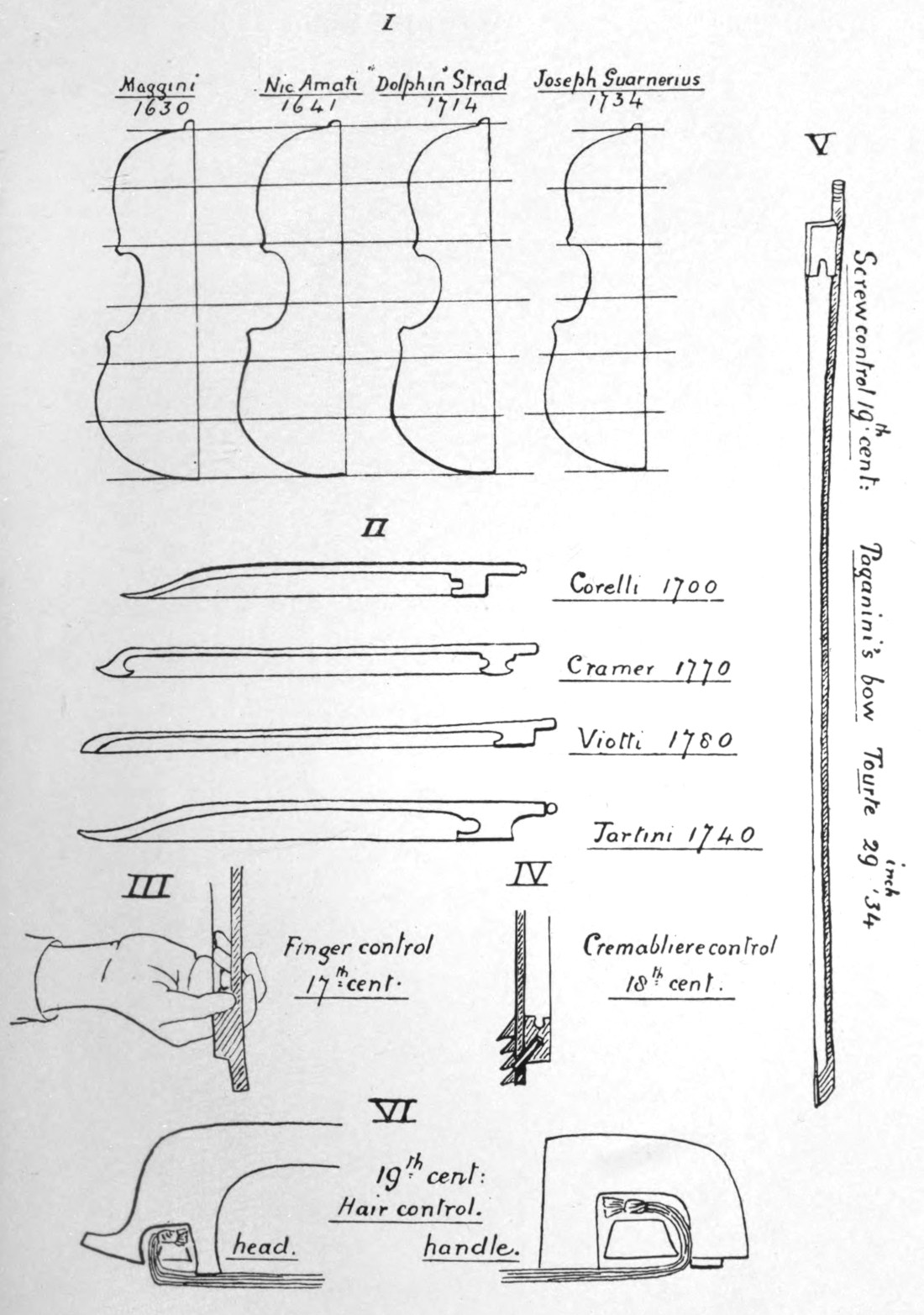
I Maggini, 1630 — Nic Amati, 1641 — Dolphin Strad, 1714 — Joseph Guarnerius, 1734
II Corelli, 1700 — Cramer, 1770 — Viotti, 1780 — Tartini, 1740
III Finger control, 17th cent.
IV Cremabliere control, 18th cent.
V Screw control 19th cent.: Paganini’s bow Tourte 29 inch ’34
VI 19th cent.: Hair control. head. handle.
As for our purpose the violin proper began in the eighteenth century with the emergence of its true type from the viol tribe, so for our purpose the violin bow begins with the emergence of the violin. A glance at the bows of Corelli (1700), Cramer (1770), Viotti (1780), and Tartini (1740) (Fig. vi.) will show the evolution in the direction of the Tourte bow; and although Tourte (1740) is generally credited with substituting the screw for the crémaillère, it will be noticed that Corelli’s bow (1700) has already got the screw. But is the Corelli bow authentic, or in reality a bow subsequent to 1740, the earliest working date of Tourte père?
With François Tourte, the younger son, culminated the art of violin bow making. He is the Stradivari of the bow. We give his portrait, but father and son were both master-workers. Although the Stentor (Fig. vi.) bow’s head has superseded, for some reason, the more rounded form of François Tourte, nothing has been done since in advance of Tourte, and “after Tourte” is still the greatest recommendation a bow can have.
It is easy to see what called forth François Tourte. He came in answer to a need. He doubtless heard of Tartini and examined his bow. It was comparatively short and cumbrous. Forty years afterwards Viotti comes to Paris, and with him dawns a new era in violin playing. Refinements and delicacies of tone, upper shifts and varieties of execution, various styles of bowing, dealing with staccato, arpeggio, and rubato, methods varied and brought to perfection, demanded qualities of balance, lightness, and elasticity which would have been quite thrown away on the old sawing and scraping school of the seventeenth century. The very Cremona violins, beginning to mature as the century waned, called aloud for a suitable and sympathetic companion to caress, excite, charm, draw from them their sweetest tones and most vigorous powers.
François Tourte was rescued from the clock-making business, to which he had been early apprenticed, by the sheer bent of his own genius. His brother, who worked with his father, was not the genius, and, as is often the case, the father failed to see which of the two sons was to carry on the fame of the house, and there may have been jealousies and disputes besides. The poor stuff given François to work upon when, after eight years of watch-making, he was allowed to enter the parental workshop a little, suggests that he was the male Cinderella of the family.
He had to deal with strips of old sugar-barrels and fashion them into bows, which he sold for about fifteen-pence each. But as soon as he got a free hand he experimented with all kinds of wood, and arrived at the conclusion that the only wood suitable for his purpose was Fernambuc wood. It combined stiffness and lightness, but was very difficult to obtain, on account of so many ports being in those disturbed times blockaded. Fernambuc wood was only imported for dyeing purposes, and the price had risen in Paris to five francs a pound. Then, as only pieces with straight grain were required, whole trees might be cut up in search of a few likely strips. This accounts for the high prices of Tourte bows, even when first produced.
They were doubtless largely labours of love with this matchless artificer, who could neither read nor write. The nut would be often made of tortoise-shell, jewelled with mother-of-pearl, and gleaming with a gold screw button. These cost £12, and would now fetch, if ever they came into the open market, fancy prices. His bows, mounted in silver with ebon nuts, sold for three guineas, and now fetch £30.
Tourte père originated the backward bend of the bow, which is not cut but artificially bent by heat; but both the father’s and the eldest son’s bows are held to be now too short for the strain of execution put upon them by modern players—not so François Tourte’s, and all bows made “after Tourte.”
He fixed the proportions—length, between 29·134 inches and 29·528 inches. The weight of the bend is nicely poised with the gold, tortoise-shell, or ebon of the nut; in each is a small wedge, as may be seen in Fig. viii., which nips the hairs and keeps them flat. The fine selection of hairs, 150 to 200 (modern exigencies require more, or up to 250), the careful flattening of it out, the preference for live hair, or hair combed out and not taken from dead horses who may have lain some time in the shambles; above all, the exquisitely graduated thicknesses, now held to be de rigueur, all characterise the intuitive genius of Tourte.
I say advisedly “intuitive genius,” for Tourte had no education but that of a watch-maker. This may, indeed, have given him his fine sense of delicate and exact proportions, but it is still remarkable that examinations of the diameter of Tourte bows in different places give uniform results. The bows swell or taper in the same place, and as the air columns in the violins of Strad give the same note, so do the bows of Tourte yield the same proportions, which it has not been found safe or expedient to depart from.
Violin bows may be smaller or larger, i.e. shorter or longer, as far as I can see, without any detriment to Tourte’s principle; children, women, and exceptionally long armed men may have to use them, but the proportions, the wood, the balance, even the mechanique, must be left as Tourte left them—perfect.
The one point in mechanique in which the invention of F. B. Vuillaume may be thought to have improved upon Tourte is in his fixed nut for viola, tenor, or violoncello bows. This consists of a metal nut, which alone is moved by the screw up and down inside the main nut, which remains rigid; thus the length of the hair exposed for playing always remains the same.
The only other original maker of the first rank and excellence, who has been nicknamed the English Tourte, was John Dodd. He was born in 1752, and lived chiefly at Kew, and there he was buried. He was always out at elbows, even when his reputation was at its height. Poor Dodd had his friends and admirers. He was his own worst enemy; he was undersized in stature, and walked with a shuffling gait. He wore his clothes until they were in rags, and a broad-brimmed hat somehow gave him an additionally dilapidated air.
I am afraid he drank, for although his habits were said to be regular, the most regular of them all was his four daily visits to the public-house, where he consumed what to less experienced topers seemed an immoderate quantity of a drink called “pearl.”
When the old fellow was known to be excessively hard up, kind Mr Richard Platt, a musical professor of the town, and Dr Sellé, who has given us some of the above details, came to the rescue. But the bow-maker tired them all out, and ended at last in the Richmond Workhouse.
I will not say whether he can be exactly cited as a frightful example of the degrading effects of liquor, for he died of bronchitis at the altogether respectable age of eighty-four.
Indeed, he had his qualities; no bribe or stress of want could make him swerve from his sense of what was due to his art.
His wood is as magnificent as his workmanship. He doubtless had his secret, but it was possibly one that he could not impart. He would take no apprentice, for fear he should learn the trick; and whether he could or could not teach it, he refused £1000 offered him by some one who wanted to learn it. Dodd’s bows are not very uncommon; he died only in 1836, and, strange to say, these true musical wands do not run into a five-pound note yet (1898).
John Dodd the bow-maker must not be confounded with Thomas Dodd the fiddle dealer and varnisher, who employed Fendt and Lott to make the fiddles. John Dodd the bow-maker was the brother of Thomas Dodd. John lived in Blue Bell Alley, Mint Street, Southwark, before he went to Kew, but the rustic suburbs suited his habits, and as he had acquired a European reputation before he died, it little mattered where he lived.
Vuillaume of Paris made excellent bows, and even founded a school of bow-making. Many bows that don’t sell as his are stamped “d’après Vuillaume,” “scuola de,” which is certainly more respectable than a forged label to which violin dealers do so commonly resort.
Vuillaume’s hollow steel bows have never “caught on,” though good players have used them now and again. But then a good player can use any bow, and whilst a good bow is a luxury, a real violinist will be able to perform very respectably with a bad one. It is said that Paganini on one occasion excited the wonder and enthusiasm of his audience by performing on his instrument with a long churchwarden clay pipe, and at another time with a rush!
It would be unfair even in a sketch like this, which only professes to seize the salient point of general interest to collectors and amateurs, not to mention Jacques Lafleur (1760-1832), an admirable imitator of Tourte.
Lupôt, brother of the great violin-maker (1774-1837), was the first to line with metal the groove in the underside of the nut, to prevent wear and tear of the ebony or tortoise-shell.
Domminique Peccate (1810-74) is also thought to have almost rivalled Tourte. He was originally a barber, and transferred the delicacy of hand required in tonsorial operations to the fine adjustments and elegant tapering and octagonal proportions of violin bows.
Peccate went to Vuillaume in 1826, stayed with him eleven years, and then became foreman to François Lupôt. He ended his life at Mirecourt, where he began it; latterly he worked entirely on his own account.
We have now among us one James Tubbs, whose bows are already known throughout the world owing to their attractive appearance and good balance. Time will alone decide Tubbs’ position in the scale of bow-makers, for time alone will determine the question of “last,” “warp,” and flexibility, and general endurance of efficiency.
On rosin, about which pages have been unnecessarily written, I have but one word to say—get it pure. You can do this by confining yourself to the best shops, or those who deal with them. Go to Hill, Chanot, Hart, Withers, and Vuillaume.
Some ignorant people talk of rosin as “greasing the bow.” Smooth horsehair or greased horsehair is, of course, useless. It is not the absence but the presence of friction which sets the strings in vibration; it is the surface of the horsehair, roughened by infinitesimal particles of rosin, which prevents the horsehair touching the string with a continuous pressure, so that it receives in reality a succession of tiny shocks. This is what renders the succession of vibrations so rapid as to sound continuous.
Without rosin, the violin, in spite of strings and bow, and the art of all Cremona, would be mute.
To average rosiners let me give a word of advice, early given me by my old master, Ouri, pupil of Frank Mori: “Don’t rub the horsehair down smooth with long sweeps, but powder the rosin off into the hair with quick rubs and a light hand; in this way you avoid rubbing the oleaginous particles of the gum into stickiness.”
I notice that the best players use plenty of rosin and never let the bow get thirsty. I remember the matchless violinist Remenye taking up my violin and bow and calling aloud for rosin. “Why, you have no rosin on; you cannot expect the violin to speak without.” Yet I thought my bow had plenty of rosin on, but it was not enough for Remenye, who powdered it away in clouds. But please to remember that, however thirsty the bow may be, the violin does not require to drink, and the habit of smothering and smearing its beautiful smooth belly with thin glutinous dust is a most vile one, and worthy only of third-rate second violins at fourth-rate music halls. These musical galley-slaves may not have time to clean up; you of the Stradivari and the Amati violins and the Tourte and the Dodd bows ought to have, or you are no fit guardian of such treasures.
CHAPTER XII
VIOLIN TARISIO
This extraordinary man, originally an obscure Italian carpenter, at once created and answered that demand for Italian violins which followed both in England, and to a great extent in France, the rage for the German, and especially German of the Stainer and Klotz pattern.
Luigi Tarisio, like W. Forster, eked out the scanty income which he derived from making tables and benches for the peasants by playing dance music on a very poor fiddle at village routs.
He wandered from place to place, what time the vintages were being gathered in, and the simple folk, who turned out in their Sunday finery for a little relaxation and merriment, doubtless regaled the Italian carpenter with open-hearted hospitality, whilst he, in return, mended their benches and fiddled for them at the vineyard cabarets.
Our Charles Mathews has given in his delightful autobiography interesting glimpses of that free, open-air, open-hearted life; for he also, for a time, lived amongst these rustics of a favoured clime, enjoying their simple pleasures, and contributing in his own peculiar way, by his histrionic gifts and a somewhat free-handed distribution of coin, to their revels and their needs.
Luigi Tarisio soon began to be dominated by the spell of his violin; he got to notice other violins, to repair them all in the way of trade, to possess them, not always very honestly, pitting his own growing knowledge of their merits against the ignorance or necessity of their owners. Gradually Tarisio the carpenter and Tarisio the fiddler seemed to be merged in Tarisio the cunning repairer and Tarisio the still more knowing buyer.
He bought chiefly by exchange, for money he had little or none; but he began in the early years of this nineteenth century to lead that nomad life—as it seemed to outsiders, the life of a common pedlar—which enabled him to glide without suspicion into half the sacristies and convents in Italy.
Wherever he went, bag on shoulder, and basket of tools in hand, his cry was not “knives to grind,” nor “shoes to mend,” but “violins to repair.”
He usually had with him a decoy violin or two, in the shape of common fiddles in good playing order; and over a glass of lemonade or a bottle of wine, in some local café or monasterial domicile of priest or cathedral musician, the cunning Tarisio would view with unaffected pity the miserable old battered Cremonas which were then lurking in a thousand ecclesiastical nooks, split as with the “wolf,” ill-adjusted, ill-strung, and generally out of sorts, and whipping out his common fiddle in perfect order, would play a few notes on each, so manifestly to the disadvantage of the Cremona that an exchange was soon effected, and Tarisio would decamp with an Amati, a Strad, a Joseph or Bergonzi treasure, which, after a little clever mending, might be worth a fortune; and in this way he possessed himself, often for a few francs, of instruments which now fetch over £1000 in the open market—if ever they get there.
Tarisio, with the infallible instinct of a born collector and connoisseur, in a few years was able to gauge accurately the merits of the different great Italian makers. He knew exactly where to rank the Amatis, and how to separate the qualities of the great Nicolo from those of Andrea; he understood the supreme excellence of Antonio and the power of Giuseppe, and all other grades of merit of which even the admirers of the Cremona school in England seemed entirely ignorant of. All Amatis at that time were lumped together, and Stradivari and Giuseppe Guarneri were hardly known at all.
But Tarisio knew all this, and a good deal more, before he tossed his heavy bag of old violins one day over his shoulder and set out, they say, on foot, or anyhow else he could, for Paris; for what market was there in Italy for such priceless Cremonas when their owners were prepared to give them up for fiddles worth from five to twenty shillings?
But why did Tarisio go to Paris? He probably judged wisely that the Stainer craze, and the huge crop of common violins then being made in Germany, would have killed his market nearer home. Then he must have heard when a boy how Napoleon I. had ransacked the art treasures of Italy, and how, under the advice of the cultivated Marquis d’Avèze, who had narrowly enough escaped the guillotine in 1793, the great conqueror had inaugurated a high Art Exhibition for the people.
The famous bronze-gilt horses from S. Marco, Venice, the Dying Gladiator, the Apollo Belvedere, the Cupid and Psyche from Rome, and Raffaello’s Transfiguration itself, had been carried in triumphant procession through the streets of Paris, and installed in a vast hall for the benefit and instruction of the people. Of course a rage for everything Italian was the result, and the shrewd Tarisio may have thought, why not a rage for old Italian fiddles?
One day in the year 1827 there arrived at the shop of M. Aldric, at that time a famous violin dealer in Paris, a travel-worn man in ragged clothes, who had begged and fiddled his way for days and weeks across country. He carried a huge dustman’s sack over his shoulder. He seemed to M. Aldric a very poor sort of pedlar, grimy and unkempt enough to claim kinship with the man who had “used somebody’s soap sixteen years ago, since when he had used no other.”
The fashionable violin dealer was at first inclined to show him the door, but probably something in Tarisio’s independent manner betrayed that indefinable quality we call character, and, more in amusement or out of pity than with any serious intent to make a deal, M. Aldric allowed the pedlar to empty his sack of fiddles on his counter. It is easy to imagine his astonishment at what he saw; but he seems to have kept up his indifferent manner, not supposing the poor creature before him could be in the least aware of the treasures he sought to dispose of.
M. Aldric was soon undeceived.
He quickly found the tables turned upon him.
The clever French tradesman was conversing with the greatest violin connoisseur that the world has ever seen, or in all human probability ever will see, for no one can ever again have Tarisio’s opportunities, even should he unite in himself Tarisio’s extraordinary qualities.
Now, the pedlar, with all his enthusiasm and self-sacrifice, was a man of exceeding cunning, and had that tact, quickness, affability, and bonhomie which is well known to tourists in Italy, and has often proved so fatal to the amateur of old laces, pottery, and objects de vertu, or to such as may have tried to do a little fancy collecting as they passed through the Italian towns, and haggled over bargains in small curiosity-shops and market-places. So, with due astuteness, the shrewd carpenter had not brought his best wares on this his first visit; he had come on a voyage of discovery, and only produced a small pattern Nicolo Amati, and half a dozen Maggini, Ruggerii, and such-like. He had with him no Strad, no Joseph, not even a grand pattern Nicolo, but he had brought enough.
M. Aldric, concealing his emotion, and fervently hoping the shabby man did not know the value of his wares, offered him a small sum for the lot, which Tarisio refused, doubtless with those picturesque invocations of horror to the Virgin and all the Saints which seem necessary to the Italian who attempts to convey to a “screw” the mingled indignation and pity excited in his generous and artistic breast by a mean offer.
Tarisio was certainly disappointed; but he forgot that he himself had to create the market; and so at last he left, with his empty bag indeed, but with his ragged pockets far from full.
Back to Italy, back to his monasteries and cabarets, a little dazzled; but, with unabated energy, he recommenced his search.
He was now beginning to be known far and wide as a clever repairer and a convenient dealer. As his stock of good, bad, and indifferent fiddles increased he could offer a greater selection, and readily parted with the worst ones, nicely done up, to his ignorant and confiding but not over-wealthy Italian patrons.
When next he journeyed to Paris he met with a different reception. Vuillaume, Thibaut, and Chanot the elder opened their privileged doors to him, and especially Vuillaume had the acumen to see that in Tarisio he had lighted upon what gold-diggers call a veritable “pocket,” and gave him higher and higher prices for the harvest of Amatis, Strads, Guarneri, and Bergonzis which now flowed steadily into Paris through this odd medium.
Tarisio was far more than a connoisseur and dealer; he was a singular and most whole-hearted enthusiast. As the novelist Charles Reade (who was himself a great fiddle dealer and knew Tarisio) has well said, “The man’s whole soul was in his fiddles. He was a great dealer, but a greater amateur. He had gems by him which no money would buy from him.” Mr Reade then goes on to relate how once, when a splendid equipage rolled by him in Paris, the carpenter remarked, “He would sooner possess one Strad than twenty such carriages.” He would stalk the back or the belly of a valuable fiddle until he recovered the whole, just as the Roman antiquary stalked the fragments of the Hercules Farnese, finding the trunk in one place and the head in a ditch miles away.
Chanot had stumbled upon the cracked belly of a Strad violin in Spain. Ortega, the fiddle-maker, had sold the remainder, ribs and back, to a Spanish lady, fitting them nicely with a brand-new back made by himself! The precious belly caught Tarisio’s eye in the shop window, and he at last worried Chanot into parting with it for 1000 francs. Off went Tarisio to Madrid, extracted from the bewildered Ortega, who had sold the patched Strad, the required information, interviewed the donna who possessed the patched Strad, and who, after the fashion of the high-born Spaniard, at once said, “Sir, the instrument is at your disposition,” which only meant that she would part with it for a consideration, or what she considered to be the good round sum of 4000 francs. This was a mere bagatelle for such a treasure, which, refitted with its own belly by Vuillaume, is now known as the Spanish Bass.
It was sold for £800, and exhibited in the south Kensington Collection of 1872 (No. 188).
On one occasion, says Charles Reade, Tarisio was crossing the Bay of Biscay with his famous Spanish Bass. The ship rolled; Tarisio clasped his treasure tightly and trembled. It was a terrible gale, and for one whole day they were in real danger. “Tarisio spoke of it to me,” continues his friend, “with a shudder. ‘Ah! my poor Mr Reade,’ he exclaimed, ‘the Bass of Spain was all but lost!’” As to Tarisio also being lost, that did not seem to matter so much!
It is not too much to say that, with hardly a memorable exception, all the great Cremonese and Brescian fiddles, which now command such prix fous, have passed through the cunning hands of Luigi Tarisio the pedlar, and most of them have at one time been benefited by the tender and artistic skill of Vuillaume, his great patron.
When Tarisio, who by this time wore a decent coat, and no longer carried Cremonas in a sack on his back, visited England in 1851, he was received by the whole trade as a person of rare quality, as indeed he was.
Mr John Hart took him to see Mr Goding’s unique collection. As one by one the owner took his treasures out of a glass cabinet, before ever he had got within two paces of Tarisio, he was amazed at hearing their names called out. A glance was sufficient. Tarisio had had them all through his hands—the “King” Guarnerius, Lafont’s Guarnerius, the matchless Bergonzi, the Marquis de la Rosa’s Amati, Ole Bull’s Guarnerius, the famous Serafino ’cello, called the Beauty—all of which might never have reached Mr Goding had it not been for the enterprise and indomitable energy of the Italian carpenter who now stood before him.
Barring a narrow circle of dealers, it may seem strange that so remarkable a man should not have been more widely known and esteemed during his lifetime; but we can well understand that the restricted circle of dealers amongst whom he moved, did not find it to their interest to place their special Cremona “pocket” within reach of the wealthy amateurs out of whom they themselves were busy making their market.
Tarisio, had he been dealer first and enthusiast second, might have done better financially; but he did not do badly, and he wanted little except the privilege of handling Cremonas to the end of his life and dying in their good company.
He did both. Although there was a strain of geniality about Tarisio, he never seemed to unbend except in the company of fellow-enthusiasts; and as he was too cautious to give himself away to Italians, from whom he was gradually securing the spoils which built up his fortune, fame, and immortality, the only people who really knew Tarisio were the few foreigners like Vuillaume, the Chanots in France, John Hart the dealer and Charles Reade the novelist in England.
In his own land he remained to the end nothing but the quiet, unobtrusive repairer and occasional dealer in dilapidated fiddles.
It seems he had removed to Milan, where he was quite safely hidden, along with his fiddles, up in an attic at the top of a second-class restaurant in the Via Legnano Porta Tegnaglia.
No one was ever allowed to enter his room. He locked himself in, and he locked himself out. They saw him going up and down the staircase, and that is all they saw of him.
One day in 1854 Tarisio dragged himself up those stairs for the last time. Whether he had any premonition of his end, none may know—certainly no one was with him when he died—only it was noticed that he locked himself in, but came out no more; nor had he gone down to the restaurant for any of the necessaries of life.
At last the neighbours thought it time to ascertain what was taking place in that mysterious attic. They seemed to have watched his strange movements closely, but their efforts to find out who he was and how he lived had been hitherto fruitless, as he made a point of carrying on his particular and nomadic business at a distance from his abode. They were not going to be baulked any longer, so they knocked, but there was no answer.
At last they broke open the door, and a strange and piteous sight burst upon them. There, on a squalid couch, lay the pedlar, quite dead.
Around him all seemed chaos—piles of fiddle-boxes, fiddles in and out of cases, tenors, ’cellos, violins in pieces and violins whole. Half a dozen Strads there; a Gasparo (afterwards Mr Bennett’s), a Ruggieri (Mr T. R. Bradson’s); about a hundred Italian fiddles, by different makers.
Here, too, was found the “Messie” or “Messiah.”
These trophies created little enthusiasm at the time, but to the joy of the relatives, two nephews, who had been hunted up with difficulty by the municipal authorities, a sealed packet was found containing valuable securities and a considerable amount of gold.
The rest is matter of common history.
The instant his friend and patron Vuillaume heard of the magician’s death he hurried to Milan, and visited the nephews at their farmhouse.
“Where are the fiddles?”
“At Milan; but we have six here.”
On the spot Vuillaume opened the cases. The first contained a splendid Strad, the second a Joseph del Gesù, the third a Carlo Bergonzi, the fourth and fifth two Guadagninis, and the last the famous Messiah, preserved by Count Cozio de Salabue, intact until 1824, when it was bought by Tarisio.
Vuillaume came to terms with the nephews for these six, and then lost not a moment in visiting the famous attic at Milan, where he found 246 more, which he bought at once for £3166, leaving the astonished heirs no doubt laughing in their sleeves, under the impression that the gobe-mouche of a Frenchman had been nicely hi-diddle-diddled by the wily Italians.
When we remember that a couple only of these gems would realise now more than the sum Vuillaume paid for the lot, we may well remember the proverb, “He laughs best who laughs last.”
A Vignette of Paganini.
I have advisedly steered clear in this collector’s volume of violin-players and violin-music, excepting in so far as they acted or reacted in any way upon the violin and its progress towards perfection. From this point of view, the growth of music appears to be responsible for the definition and survival (as the fittest) of the violin, violoncello, and double bass; and virtuosity is certainly responsible for the lengthening of the violin-neck and finger-board, the strengthening of the sound-bar to resist an increased string-tension, and the lengthening of the bow. But virtuosity can claim nothing more than these trifling details. The Strad pattern of 1684 to 1700 has remained completely unaffected by the feats, vagaries, or demands of soloists.
In this the grand pattern violin stands out in sharp and singular contrast to the old grand pianoforte. The imperious demands of Liszt and Thalberg, Rubinstein and his followers, have compelled a series of improvements in strength, sonority, delicate mechanism, and sensibility, undreamed of by the old firms, and only perfected by the later Erards, Broadwoods, Collards, and Steinways. But not a single substantial improvement has been made in the violin since the last one left the hand of the great Antonio at Cremona, and not even a trifling modification of any sort has been adopted or applied to the grand violin of the golden period for at least a century. The excuse then for introducing the name and portrait of Paganini into this book is not because he reacted in the least degree upon the art of violin-making, but because he accepted it as an absolutely finished art, and asked for nothing which he found not in Strad and Joseph.
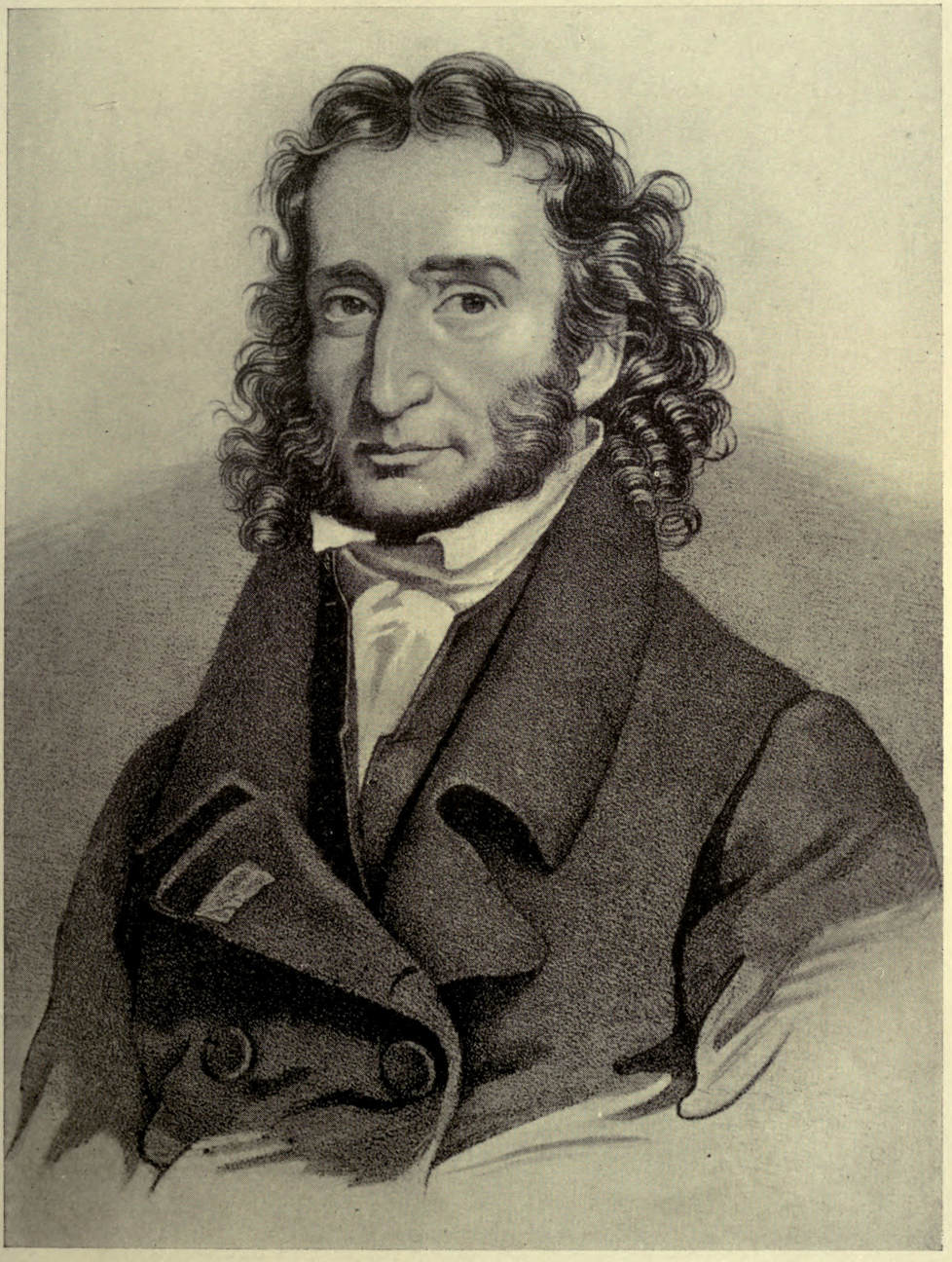
NICOLO PAGANINI
Now this is important and interesting, because Paganini was the greatest of all players in this culminating century of the musical art—a man admittedly unsurpassed in the opinion of violin experts like John Ella, Cipriani Potter, Onry, and others, who, for forty years after his death, listened to all the phenomenal violinists of an age which boasts of Ernst, Joachim, Wieinawski, and Sarasate and Ysaye. As it has not been possible to produce the face and figure of any of these great old makers, with the one exception of Lupôt, who belongs at best to the silver age, I have thought it worth while to glorify their work by reproducing the grand though eccentric face and figure of the one man who has invested their chef-d’œuvres with that romantic glamour, that almost unearthly prestige which the violin alone amongst instruments can lay claim to.
Paganini’s favourite violin, a Joseph Guarnerius, lies in its case under glass to this hour, open for all eyes to inspect, in the Town Hall at Genoa, his native town, to which he has bequeathed it. His dying directions, that no one should ever play upon it, recall Shakespeare’s curse upon those who should move his bones. The great musician’s orders have not been quite so scrupulously observed as those of the immortal bard of Avon. In “My Musical Life” will be found my “Homage à Paganini,” together with a woodcut of Danton’s very fine bust, given to me by John Ella, who played in the orchestra among the violins when first Paganini visited England.
Nothing is so ephemeral as the fame of an orator, actor, or musician, unless they leave books or music behind them. Henceforth the phonograph may do something to give future generations some idea of the fascination which lived and died with them; but no phonograph will ever give us even a faint echo of Siddons’ declamation or Paganini’s playing; these are alike buried with the generation which they charmed and electrified. But in Leigh Hunt’s description of Paganini’s performance we have something like a pictorial phonograph, if I may hazard the hibernianism, of the “Pale Musician’s” mighty personality and power. Somewhere between the forties and fifties, I remember, as a very young boy, standing awestruck before a thin, gaunt, dislocated wax effigy of Paganini in an ill-fitting dresscoat, with wild dreamy eyes and arm uplifted high—just as Leigh Hunt describes him—before his bow came down like a crash of thunder on the strings; but let the lively and graphic essayist who heard him, speak for himself:—
“Paganini, the first time I saw and heard him, and the first time he struck a note, seemed literally to strike it, to give it a blow. The house was so crammed that, being among the squeezers in the standing-room at the side of the pit, I happened to catch the first glance of his face, through the arm akimbo of a man who was perched up before me, which made a kind of frame for it; and there, on the stage in that frame, as through a perspective glass, were the face bent and the raised hand of the wonderful musician, with the instrument at his chin, just going to commence, and looking exactly as I described him—
—‘His hand, Loading the air with dumb expectancy, Suspending ere it fell a nation’s breath, He smote, and clinging to the serious chords, With godlike ravishment drew forth a breath So deep, so strong, so fervid thick with love, Blissful yet laden as with twenty prayers, That Juno yearned with no diviner soul To the first burthen of the lips of Jove. Th’ exceeding mystery of the loveliness Sadden’d delight, and with his mournful look Dreary and gaunt, hanging his pallid face ’Twixt his dark flowing locks, he almost seem’d Too feeble, or to melancholy eyes One that has parted with his soul for pride And in the sable secret lived forlorn.’
To show the depth and identicalness of the impression which he made upon everybody, foreign or native, an Italian, who stood near me, said to himself after a sigh, ‘O Dio!’ and this had not been said long when another person in the same manner exclaimed, ‘O Christ!’ Musicians pressed forward from behind the scenes to get as close to him as possible, and they could not sleep at night for thinking of him.”
CHAPTER XIII
VIOLINS AT MIRECOURT, MITTENWALD, AND MARKNEUKIRCHEN
Mirecourt
Mirecourt in Lorraine has the glory of being associated from so early a date as 1566 with the Cremona workshops.
Andrew Amati, who made six small fiddles for Charles IX. about that time, employed Nicolas Renauld of Nancy, who was a pupil of the celebrated Mirecourt lutist Tywersus, to assist him in finishing these important court orders, which did so much to establish the supremacy of the “petit violon” over the crowd of competing viols which then held the popular ear, and, as we have seen, died very hard.
The great princes of Lorraine occupied a castle of pleasure called Ravenel, at a short distance from Mirecourt.
These accomplished noblemen, touched with Florentine culture, often made excursions into Lombardy, and delighted in the refinements of the Italian princedoms and duchies.
They brought back with them pictures, ironwork, laces, musical instruments.
Tywersus, their private lute-maker, was deeply influenced by the work and models of the early Amatis, and from the school of Tywersus came Nicolas Renauld, Jean Medard, and Nicolas Medard. When Amati left Paris, whither he had gone to present his violins in person to Charles IX., he left behind him Nicolas Renauld, who slipped into the lucrative post of luthier to his French Majesty, and we find his friend and co-worker Medard installed in the same fat office under the Grand Monarque, Louis XIV., who, with his expensive mistresses, certainly spared no money or patronage to secure those who could in any way minister to the extravagant court pomp and artistic amusements of the Pompadour and the Petit Trianon.
Meanwhile Mirecourt, in the heart of the Vosges mountains, with easy access to the grand timbers of their ancient forests, within beck and call of Lombardy, and in close touch with the great Italian fiddle-makers, Mirecourt long held supremacy as one of, if not the most important mart of fiddle manufacture.
It shared with Mittenwald and Markneukirchen the honour of supplying that rapidly growing violin market which was now springing up, and whilst Cremona made largely for home consumption and a few foreign courts, Mirecourt undertook the more modest but equally useful duty of multiplying Cremona school violins, which circulated far and wide throughout the French provinces, and frequently reached our own shores; indeed the fiddles often passed for Cremonas.
The popularity of these Cremona replicas brought on that inevitable deterioration in quality which always follows over-rapid production and cheap wares, and at one time Mirecourt, in spite of its elaborate industry, was fast becoming a byword for bad fiddles. Happily the danger was seen and speedily checked, and Mirecourt now stands out as perhaps the greatest and most excellent emporium of modern violin manufacture.
All who wish to know what can be known, go to Mirecourt, just as people who study art go to Rome and Florence, or people who study the fashions go to Paris.
To Mirecourt we owe Rambaux, who was born there in 1802 and died there only in 1870.
Francis and George Chanot both came from there.
The Lupôt family are claimed as natives of Mirecourt, although the greatest of them, Nicolas, whose violins run some of the finest specimens of Cremona very hard, was a native of Stuttgard. His father was a Frenchman, and came from Mirecourt. All his traditions belong to Mirecourt, and these, as we all know, he carried with him to Paris, where he died in 1824, and was succeeded by Gand.
The names of Maucotel, Medard, Menegand, Silvestre, and Deragay, and above all Vuillaume, must always shed an imperishable lustre upon the little town in the Vosges mountains.
Every one of the Vuillaumes, eight in number, including the immortal Jean Baptiste, were born at Mirecourt. Two settled at Brussels, three at Paris, but all the others lived and died at Mirecourt.
William Ebsworth Hill was careful to send his sons to this celebrated school of violin art, and we may be sure that they did not come away until they had possessed themselves of everything that Mirecourt had to teach the violin maker or the connoisseur.
M. Thibouville Lamy of Mirecourt, who has trade branches in Paris and London, manufactures a violin at about 3s. 10d. cost price, selling at about 4s. 6d.; but Markneukirchen probably leads in cheapness and quantity, if not quality, turning out quite playable fiddles for the modest figure of £1 to £2, 10s.
The best Mirecourt fiddles will fetch from £6 to £10.
The Grand and Bemardel prices range from £16 to £20.
The ever-increasing demands for “trade fiddles” of all kinds, as distinguished from the solo violins reserved for the use of virtuosi, has called forth an abundance of fair makers beyond the limits of Mirecourt, Mittenwald, and Markneukirchen.
In England it is enough to mention such names as Hill & Sons; Duncan of Glasgow; the Chanots, London and Manchester; the late Furber, London; in Paris, Bernardel, Silvestre, Germain, Audinot, and Chardon; in Vienna, Zach, Bittner, Lembök, Voigt, Guttermann, Rampfler; in Munich, Sprenger; in Frankfort-on-Maine, Lenk; in Breslau, Liebich; in Brussels, Darche; in Lille, Hel; in Milan, Marchetti; in Turin, Bros. Guadagnini; in Cremona, Ceruti; and for further general information the reader may consult the tolerably exhaustive catalogue index of makers at the end of this volume, for the bulk of which I am indebted to the studious and admirable labours of Miss Stainer. Her booklet is entitled “Violin Makers,” and it forms one of the music primers of an educational series issued by Novello & Co.
Mittenwald.
In old days Mittenwald, quaintest of Bavarian towns, with its frescoed houses and its picturesque river-side, for it is on the banks of the dear Isar, overshadowed by the Wetterstein and Kurwändel mountains, was a town of considerable importance from very early days as the halting-place for the Romans on their way to the Danube.
It long retained its peculiar caravanserai character, which resulted in the establishment of the handy mart or Mittenwald fair, for which in more recent times the place was chiefly famous. After the removal of the fair to Bozen, the importance of Mittenwald began to decline; trade and commerce suddenly seemed to have made unto themselves wings, until one Matthias Klotz, who in his boyhood is said to have been apprenticed to no less a person than the great Nicolas Amati, settled at Mittenwald, and wrote up outside his house: “Matthias Klotz, Geigen Macher, im jahr 1684.” The prime hazel and maple, to be found in the Wetterstein hills, is of splendid quality, and the woods, then close up to the town, were full of old trees.
Thither, before the days of Matthias, was wont to come a dreamy, ill-regulated sort of person, who excited the curiosity, and perhaps ridicule, of the villagers by tapping their trees with a hammer and then putting his ear close to the wood to hear the sound.
They thought he was mad, and he did go mad from worry and want, but the sanest thing he ever did was to tap those trees and listen to the sound.
His name was Jacob Stainer.
Matthias Klotz was only nineteen when he came to Mittenwald, but by this time the Mittenwalders, who had heard how the eccentric tramp with the hammer had gone back to Absam and made the place famous by his fiddles, were prepared to receive the young workman with favour and hospitality, for they hoped he might do something of the kind for Mittenwald.
They were not mistaken. One year before Klotz arrived at Mittenwald, Stainer had died incoherent and insane at Absam, and now that the greatest of German makers was dead, Mittenwald was soon destined to become noted in its turn for its fiddles.
It is generally affirmed that Klotz was a pupil of Stainer. Certainly his relations with Nicolas Amati are not very well defined. The probabilities are that he was a pupil of both—in the sense of being familiar with their work. The fact that his violins are sometimes mistaken for Stainer, points to the strong Absam influence which was upon him—it could hardly be otherwise—whilst the tendency noticeable in the fiddles of his son Sebastian, who certainly did visit Cremona, to bring down the model flatter than was fashionable at this time, indicates that the firm at all events reflected the later Amati model of Nicolas, who died the very year Klotz came to Mittenwald.
Had Matthias or Sebastian Klotz attended to the methods either of Stainer or Amati more carefully, they would have observed that wood cut in spring with the sap in it was not calculated to last like the drier autumn timber. Whether from haste or ignorance, the Klotz wood, especially that used by Matthias and Sebastian, is sometimes found to be worm-eaten, but Sebastian’s fiddles are much esteemed. His brothers, George and Egidius, and his nephew, Joseph, son of Egidius, all made fiddles of the same type—varnish running from yellow to brown, and laid on rather more lavishly than was the habit of Matthias, founder of the firm.
The Mittenwald industry, although now less prolific than that of Markneukirchen, preceded it in point of time, and undoubtedly it was through Bavarian Mittenwald that the Cremona influence reached Saxony.
Master Reiter, whose teacher was Johan Vauchel of Wurzburg, is now the most prominent Mittenwald maker, and Herr Neuner, who was a pupil of Vuillaume, directs the school and factory. The school instructs about twenty boys, and is under Government.
Out of eighteen hundred Mittenwalders, three hundred are fiddle-makers.
The place provides from fifteen to twenty thousand instruments per annum, including zithers and guitars. I will not say that Herr Reiter, who is an artist versed in the old secrets and the old enthusiasms, is personally responsible for the “trade fiddles” that annually pour from the Mittenwald workshops. He himself has made comparatively few fiddles, but he supervises them all, and remarked to a visitor the other day, “I, Master Reiter, never let one go out of my hands that has not been thoroughly tested, and I have sent out into the world, to Russia, to America, Athens, and where not, some two hundred violins and twenty-five ’cellos, besides having repaired some four hundred others.”
Markneukirchen.
Quiet resting-places, secluded valleys of the Tyrol, mountains of Saxony!—Mittenwald, Markneukirchen, Mirecourt; sleepy Italian towns!—Brescia, Cremona, once provincial villages like Mirecourt, far from the stir of mighty cities!—such retreats seem to have been ever favourable to the development of violin manufacture. Something, too, of simple and almost naïve religious sentiment has entered into the production of the earlier violins, most of which were, after all, chiefly intended for the sanctuary, Catholic or Protestant.
The arts and craftsbook of the Worshipful Guild of Violin-makers of Markneukirchen, 1677 to 1772, has lately been unearthed and translated by the many-sided and indefatigable Heron Allen, and it throws a kind of sudden flashlight upon the origin of an industrial centre which has since become one of the most famous emporiums of violins “made in Germany.”
Here we read how a mere handful of masters and workmen went out from kith and kin into a wilderness—some would say a paradise—for the sake of worshipping God in their own way—that is to say, the new reformed Lutheran way. They settled, to the number of sixty-six, about the year 1627, at the retired and mountainous village of Markneukirchen. The old book which records their uneventful annals begins characteristically enough with, “In the name of the Holy Trinity, Amen”; and then follow the names of twelve families, the principals being Reicher, Hans George, Polles, Gaspar, Schönfeldes, and Gaspar Hopf; and from this modest nucleus, emigrants, chiefly from Graslitz, grew the famous Guild, which by-and-by was responsible for scattering abroad violins innumerable, labelled with every known name, and of quality good, bad, and indifferent; for it is a notable peculiarity of the Markneukirchen makers that, whilst they were compelled by the rules of the Guild to produce diploma instruments and others of recognised quality, the cost of production has got down as low as about four shillings, and a very playable instrument, labelled Stradivari, is actually sold for a sum not much above that astonishing cost price.
Many of these workers were all-round men, and did not confine themselves to fiddle-making. Thus, Carl Frederick Jacob was carpenter, locksmith, and general instrument maker; one Andrea Gher, 1587, was a schoolmaster; whilst Gasper Reichel was a barber. Gottfried Pitz was admitted to the Guild on easy terms, because he had served his country as a cavalry soldier.
The master-workers were mostly people of some substance. They had to pay a tax of one florin on being admitted to mastership; but sons of a master were admitted on a reduced fee of five florins.
Most of the masters were expected to have a decent house, with a room large enough to entertain the Guild with their wives at a banquet on their installation. As this cost some money—there were various ways of lightening the burden when the candidate happened to be a desirable addition to the Guild—he was allowed to pay in instalments, or part was remitted by favour. A popular means of effecting economy was to propose to marry the daughter of a master; that at least staved off payment. The apprentices often got in cheap that way.
Hans Adam Narlitzer, who “intended” to marry a master’s daughter, was admitted on reduced terms, on the understanding that, if the match did not come off, he was to pay up in full.
One Kretchman also “intended” to marry the youngest daughter of Hans Martin Schönfeldes; also Johann Christian Envel, in 1761, had “half a mind” to marry the youngest daughter of Reichel, and was admitted for ten thalers; but in case he could not make up his mind to marry the girl, or any other master’s daughter, he would have to pay thirty-one thalers. In no case is it recorded that any of these gentlemen failed to marry as per contract; the masters’ daughters probably took very good care of that, or would have sufficient influence to suppress the fact of their rejection.
With the spread of the Reformed opinions, there at first arose a certain demand for violins in the new churches; but the rigid Lutherans soon smelled the odour of abuse and reversion to Romanism, and discouraged any approach to ornate services, or an over-supply of instrumental accompaniment. A decree that the violins used in Church should be reduced in numbers naturally spread consternation throughout the little country town; but the growing demand for stringed instruments of good quality for secular bands soon counteracted the effect of sectarian bigotry and clerical parsimony; and when one Joseph Haydn, bandmaster to Prince Esterhazy in Vienna, practically founded the modern orchestra with its symphony, and created the modern oratorio and quartet, the demand for violins and basses led to a prodigious development of the Markneukirchen industry; and as the masters not only had ready access to the best Cremonese models, but were surrounded by some of the finest maple timber in the world, felled in forests full of seasoned trees hundreds of years old, the fame of the Markneukirchen makers soon spread throughout Europe.
At Mittenwald a similar community flourished, and the crop of German instruments made, and still made, by these enterprising artificers have flooded all the orchestras of the world, providing them with samples of every maker, from Gaspar and Maggini to Stradivari, the Guarneri, Bergonzi, and Guadagnini. The Mittenwald makers owed their inspiration chiefly to Egidius Klotz, pupil of the great Stainer. They were as famous for their fine hazel-fir timber as the Markneukircheners were for their maple; it was also through the Mittenwalders that the Cremona methods filtered readily into the more northern region—Markneukirchen, Prague, Nuremburg, Wurzburg, and Franken.
The increased demand for instruments resulted necessarily in a tendency to deterioration, which did not escape the attention of the Guild, and rigid rules were drawn up, called “Beneficent Mandates for the Suppression of Abuses.”
Every master had to prove himself equal to producing one masterpiece as a sample of his skill, though it was freely admitted that a cheap demand involved a cheap type of instrument, which could not be expected to rival the diploma standard of tone and finish.
The quaint record of the Markneukirchen arts and craftsbook ends with the year 1772, and with the words “Deo Gloria.” Since that date the names of Reichel, Schuster, and Paulus have all been en evidence at various European Exhibitions as medallists and exhibitors of distinction; but, after a great fire in 1840, a good many families left the town, and thus the old centre became like a flower that had overblown itself, and began to obey the inevitable law by which a mature centre distributes itself gradually, losing as it were its own central wealth in its circumference, as the seeds of the dandelion get blown abroad over all lands.
CHAPTER XIV
VIOLIN TREATMENT
The notion that the more a fiddle is knocked about the better it is, is similar to the theory that the more you knock about a horse the better he goes.
A good horse will take a great deal of spoiling, and so will a good fiddle. Your well-bred beast, even when broken down, if you turn him out to grass and attend to his ailments, will recover marvellously, and so will a violin, if you glue him up, readjust his nervous system, keep him dry, and coax him a bit.
The delusion that a fiddle is all the better for being maltreated is due to this:—Many people observe that their old, battered, disorganised fiddles, which went into the skilful repairer’s hands sounding like tin kettles, come out with the true Cremona timbre; but that, my deluded friend, is not in consequence, but in spite of the knocking about to which your favourites have been exposed.
The fiddle-doctor has attended to your violin’s internal economy, and gently healed its bruises, killed the wolf or fiddle stomach-ache from which it was suffering, glued tight the rattling back, ribs, belly, fixed the loose sound-bar, and readjusted your Cremona’s very soul (l’âme du violon), which is the sound-post and so it fares well; but remember, ’tis better to keep a fiddle in repair and use than allow it to get out of both, and go a mere wreck to the workshop.
I am not forgetting, when I say “use,” that the incessant and continued playing upon an instrument is said to result in its getting what Joachim calls “played out,” and that collectors have been great benefactors by withdrawing choice instruments from wear and tear, giving them thus long periods of suspended animation; but, as a general rule, so long as a violin lasts—and how long it will last is still a vexed question—fair wear and tear and attention is just as good for a fiddle as work, exercise, and cleanly habits are good for man and beast.
Neglect is never good; knocking about is never good!
Lay it to your heart, O young player!
What is that precious thing committed to your care? You have brought it home from the auction-room—your Amati. There was a conspiracy to keep down the bidding. An influential dealer wanted to buy it cheap, having already half sold it in advance for twice as much as he meant to give; he went up to £40 at the auction and stopped, but you were the dark horse and made another bid; he winked at the auctioneer, supposing it to be a bogus bid; the man with the hammer paused and looked at the dealer, who shook his head; for once the dealer had been too clever and lost his Amati for a £5 note. It was knocked down to you.
You get it home; there is something wrong about it; the timbre of the A string is unequal—sweet, but too weak—it has a crack in one rib.
You don’t expect a trumpet-sound like that of a Joseph, or quite the bell-like ring of a Strad, but you do mean to have a quality like the ripple of water—a round, soft, and incomparably sensitive and intime tone, not to be surpassed by Strad and never reached by Stainer.
Of course your early Nicolo has got to be overhauled. He has got a crack—perhaps more than one. Why, he is already more than two hundred years old, and may have a mark of the young Stradivari’s chisel about him. Of what attention is he not worthy! Take him to a subtle violin medicine-man, who will at a glance see what he has got to deal with, and will sit down before him and think!
He will then take him up, handle him, tap him, pull him to pieces with excessive care and reflection. When you get him back, you may still be not quite satisfied, but wait. Your treatment has to begin where the fiddle-doctor’s ends.
The convalescent home comes after the hospital—your house is the convalescent home.
The glue must dry; the changed sound-post must grow to the newly-directed strain and tension of the vibrating boards; the refixed flanks must learn to deal with the air column, and the filled-up crack, by constantly thrilling with the rest, must have time to forget that it ever was a crack!
Be not impatient. Play upon it gently at first, and by-and-by draw out its tone; lay it aside and watch that no harm comes to it; let it lie open, with a soft silken wrapper on the strings—near, not too near the fire; it must not get hot, but, like good claret, just the temperature of a comfortably warm room.
Think of it in winter as you would think of your pet canary; don’t let it get chilled at night; let it be in your own bedroom, or wherever there is an atmosphere and temperature fit for a well-cared-for “human.”
’Tis half human; ’tis caressed by your hand; it lies close to your cheek; ’tis breathed on by you when you press it, in moments of rare inspiration and musical trance, between your chin and your left breast, where its vibrating back actually feels the pulses of your own heart. The waves of sound that you generate from it are saturated with the magnetism of your touch; the trembling pressure of your fingers comes from the shaking of your own life-blood as it beats in the mysterious valves of the heart, and seems to mingle with those more than atmospheric, those psychic waves which travel out upon the air in a flow of magic sound conveying your inmost self to the inmost selves of others!
So this half-human thing must live with you and be cared for by and fare with you, and be kept in good humour.
See that no clot of dirt be in its case, no speck of rosin to vex and fret the smooth amber-coloured back. Take it out lovingly; polish it with soft handkerchief; keep it shining wherever the varnish still shows up, and scrupulously clean elsewhere.
The vile notion that a coat of rosin does good, and may be left with advantage like a festering mass on the belly underneath the strings, is a most grievous delusion!
Why suffer the corrosion of the varnish with a foreign substance to remain there more than on any other part of the wood?
Rosin is for the strings, not for the belly, and the strings are for friction, and are intended to be scraped through and worn out and replaced, but the belly is for vibration and is never intended to wear out.
Your rosin is life to the strings, enabling them to speak, but ’tis death to the wood, stifling its pores and striking it dumb!
Never touch your violin with oil, or spirit, or colouring. Only a skilled repairer can venture to do that, and even he will not always be wise.
I have seen really good old instruments too much cleaned or daubed over ruthlessly with muddy brown varnish, much, as Ruskin says, he saw men with knives and mops of paint at Venice scraping away and splashing over with raw blue the vast old faded skies of Paul Veronese!