OLD MAN SAVARIN STORIES
Reading edition
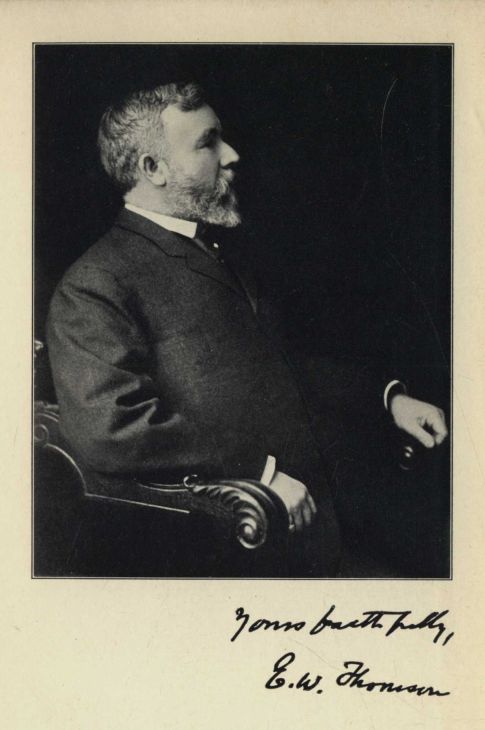
Portrait of the Author—Edward William Thomson
Old Man Savarin Stories
Tales of Canada and Canadians
BY
EDWARD WILLIAM THOMSON
F.R.S.L. (United Kingdom) F.R.S. (Canada)
ILLUSTRATED BY CHARLES W. JEFFERYS
TORONTO :: :: :: S. B. GUNDY
PUBLISHER IN CANADA FOR HUMPHREY MILFORD
COPYRIGHT, 1917 BY GEORGE H. DORAN COMPANY
PRINTED IN THE UNITED STATES OF AMERICA
TO SIR A. T. QUILLER-COUCH WHO "GAVE ME THE GOOD WORD" IN SEASON
"I'VE A FRIEND OVER THE SEA"
My thanks are here due to Messrs. T. Y. Crowell & Co., N. Y., for liberty to include in this volume sundry stories from "Old Man Savarin"; to the American Baptist Publication Society, Philadelphia, for liberty to include "Dour Davie's Drive," and "Petherick's Peril"; to the University Magazine, Montreal, for liberty to include "Miss Minnely's Management"; to the Century Company, N. Y., for liberty to include "The Swartz Diamond."
E. W. THOMSON
CONTENTS
The Canadian Abroad
Privilege of the Limits
The Waterloo Veteran
John Bedell, U. E. Loyalist
Old Man Savarin
Great Godfrey's Lament
McGrath's Bad Night
Shining Cross of Rigaud
Dour Davie's Drive
Petherick's Peril
Little Baptiste
Red-Headed Windego
The Ride By Night
"Drafted"
A Turkey Apiece
The Swartz Diamond
Boss of the World
Miss Minnely's Management
ILLUSTRATIONS
Portrait of the Author . . . . . . . . . Frontispiece
He knocked the two of them over with the post
Old John marched in full regimentals
Dey's fight like dat for more as four hours
We stood looking at my father's white face
My leg is broke
Back and forward they dashed
Baptiste and Jawnny looked at the place in the wildest terror
Absalom sprang up, staggered, shouted
OLD MAN SAVARIN STORIES
THE CANADIAN ABROAD
When the croon of a rapid is heard on the breeze,
With the scent of a pine-forest gloom,
Or the edge of the sky is of steeple-top trees,
Set in hazes of blueberry bloom,
Or a song-sparrow sudden from quietness trills
His delicate anthem to me,
Then my heart hurries home to the Ottawa hills,
Wherever I happen to be.
When the veils of a shining lake vista unfold,
Or the mist towers dim from a fall,
Or a woodland is blazing in crimson and gold,
Or a snow-shroud is covering all,
Or there's honking of geese in the darkening sky,
When the spring sets hepatica free,
Then my heart's winging north as they never can fly,
Wherever I happen to be.
When the swallows slant curves of bewildering joy
As the cool of the twilight descends,
And rosy-cheek maiden and hazel-hue boy
Listen grave while the Angelus ends
In a tremulous flow from the bell of a shrine,
Then a faraway mountain I see,
And my soul is in Canada's evening shine,
Wherever my body may be.
PRIVILEGE OF THE LIMITS
"Yes, indeed, my grandfather wass once in jail," said old Mrs. McTavish, of the county of Glengarry, in Ontario, Canada; "but that wass for debt, and he wass a ferry honest man whateffer, and he would not broke his promise—no, not for all the money in Canada. If you will listen to me, I will tell chust exactly the true story about that debt, to show you what an honest man my grandfather wass.
"One time Tougal Stewart, him that wass the poy's grandfather that keeps the same store in Cornwall to this day, sold a plough to my grandfather, and my grandfather said he would pay half the plough in October, and the other half whateffer time he felt able to pay the money. Yes, indeed, that was the very promise my grandfather gave.
"So he was at Tougal Stewart's store on the first of October early in the morning pef ore the shutters wass taken off, and he paid half chust exactly to keep his word. Then the crop wass ferry pad next year, and the year after that one of his horses wass killed py lightning, and the next year his brother, that wass not rich and had a big family, died, and do you think wass my grandfather to let the family be disgraced without a good funeral? No, indeed. So my grandfather paid for the funeral, and there was at it plenty of meat and drink for eferypody, as wass the right Hielan' custom those days; and after the funeral my grandfather did not feel chust exactly able to pay the other half for the plough that year either.
"So, then, Tougal Stewart met my grandfather in Cornwall next day after the funeral, and asked him if he had some money to spare.
"'Wass you in need of help, Mr. Stewart?' says my grandfather, kindly. 'For if it's in any want you are, Tougal,' says my grandfather, 'I will sell the coat off my back, if there is no other way to lend you a loan'; for that wass always the way of my grandfather with all his friends, and a bigger-hearted man there never wass in all Glengarry, or in Stormont, or in Dundas, moreofer.
"'In want!' says Tougal—'in want, Mr. McTavish!' says he, very high. 'Would you wish to insult a gentleman, and him of the name of Stewart, that's the name of princes of the world?' he said, so he did.
"Seeing Tougal had his temper up, my grandfather spoke softly, being a quiet, peaceable man, and in wonder what he had said to offend Tougal.
"'Mr. Stewart,' says my grandfather, 'it wass not in my mind to anger you whatefer. Only I thought, from your asking me if I had some money, that you might be looking for a wee bit of a loan, as many a gentleman has to do at times, and no shame to him at all,' said my grandfather.
"'A loan?' says Tougal, sneering. 'A loan, is it? Where's your memory, Mr. McTavish? Are you not owing me half the price of the plough you've had these three years?'
"'And wass you asking me for money for the other half of the plough?' says my grandfather, very astonished.
"'Just that,' says Tougal.
"'Have you no shame or honor in you?' says my grandfather, firing up. 'How could I feel able to pay that now, and me chust yesterday been giving my poor brother a funeral fit for the McTavishes' own grand-nephew, that wass as good chentleman's plood as any Stewart in Glengarry. You saw the expense I wass at, for there you wass, and I thank you for the politeness of coming, Mr. Stewart,' says my grandfather, ending mild, for the anger would never stay in him more than a minute, so kind was the nature he had.
"'If you can spend money on a funeral like that, you can pay me for my plough,' says Stewart; for with buying and selling he wass become a poor creature, and the heart of a Hielan'man wass half gone out of him, for all he wass so proud of his name of monarchs and kings.
"My grandfather had a mind to strike him down on the spot, so he often said; but he thought of the time when he hit Hamish Cochrane in anger, and he minded the penances the priest put on him for breaking the silly man's jaw with that blow, so he smothered the heat that wass in him, and turned away in scorn. With that Tougal Stewart went to court, and sued my grandfather, puir mean creature.
"You might think that Judge Jones—him that wass judge in Cornwall before Judge Jarvis that's dead—would do justice. But no, he made it the law that my grandfather must pay at once, though Tougal Stewart could not deny what the bargain wass.
"'Your Honor,' says my grandfather, 'I said I'd pay when I felt able. And do I feel able now? No, I do not,' says he. 'It's a disgrace to Tougal Stewart to ask me, and himself telling you what the bargain wass,' said my grandfather. But Judge Jones said that he must pay, for all that he did not feel able.
"'I will nefer pay one copper till I feel able,' says my grandfather; 'but I'll keep my Hielan' promise to my dying day, as I always done,' says he.
"And with that the old judge laughed, and said he would have to give judgment. And so he did; and after that Tougal Stewart got out an execution. But not the worth of a handful of oatmeal could the bailiff lay hands on, because my grandfather had chust exactly taken the precaution to give a bill of sale on his gear to his neighbor, Alexander Frazer, that could be trusted to do what was right after the law play was over.
"The whole settlement had great contempt for Tougal Stewart's conduct; but he wass a headstrong body, and once he begun to do wrong against my grandfather, he held on, for all that his trade fell away; and finally he had my grandfather arrested for debt, though you'll understand, sir, that he was owing Stewart nothing that he ought to pay when he didn't feel able.
"In those times prisoners for debt wass taken to jail in Cornwall, and if they had friends to give bail that they would not go beyond the posts that wass around the sixteen acres nearest the jail walls, the prisoners could go where they liked on that ground. This was called 'the privilege of the limits.' The limits, you'll understand, wass marked by cedar posts painted white about the size of hitching-posts.
"The whole settlement wass ready to go bail for my grandfather if he wanted it, and for the health of him he needed to be in the open air, and so he gave Tuncan Macdonnell of the Greenfields, and Æneas Macdonald of the Sandfields, for his bail, and he promised, on his Hielan' word of honor, not to go beyond the posts. With that he went where he pleased, only taking care that he never put even the toe of his foot beyond a post, for all that some prisoners of the limits would chump ofer them and back again, or maybe swing round them, holding by their hands.
"Efery day the neighbors would go into Cornwall to give my grandfather the good word, and they would offer to pay Tougal Stewart for the other half of the plough, only that vexed my grandfather, for he wass too proud to borrow, and, of course, every day he felt less and less able to pay on account of him having to hire a man to be doing the spring ploughing and seeding and making the kale-yard.
"All this time, you'll mind, Tougal Stewart had to pay five shillings a week for my grandfather's keep, the law being so that if the debtor swore he had not five pounds' worth of property to his name, then the creditor had to pay the five shillings, and, of course, my grandfather had nothing to his name after he gave the bill of sale to Alexander Frazer. A great diversion it was to my grandfather to be reckoning up that if he lived as long as his father, that was hale and strong at ninety-six, Tougal would need to pay five or six hundred pounds for him, and there was only two pound five shillings to be paid on the plough.
"So it was like that all summer, my grandfather keeping heartsome, with the neighbors coming in so steady to bring him the news of the settlement. There he would sit, just inside one of the posts, for to pass his jokes, and tell what he wished the family to be doing next. This way it might have kept going on for forty years, only it came about that my grand-father's youngest child—him that was my father—fell sick, and seemed like to die.
"Well, when my grandfather heard that bad news, he wass in a terrible way, to be sure, for he would be longing to hold the child in his arms, so that his heart was sore and like to break. Eat he could not, sleep he could not: all night he would be groaning, and all day he would be walking around by the posts, wishing that he had not passed his Hielan' word of honor not to go beyond a post; for he thought how he could have broken out like a chentleman, and gone to see his sick child, if he had stayed inside the jail wall. So it went on three days and three nights pefore the wise thought came into my grandfather's head to show him how he need not go beyond the posts to see his little sick poy. With that he went straight to one of the white cedar posts, and pulled it up out of the hole, and started for home, taking great care to carry it in his hands pefore him, so he would not be beyond it one bit.
"My grandfather wass not half a mile out of Cornwall, which was only a little place in those days, when two of the turnkeys came after him.
"'Stop, Mr. McTavish,' says the turnkeys.
"'What for would I stop?' says my grandfather.
"'You have broke your bail,' says they.
"'It's a lie for you,' says my grandfather, for his temper flared up for anybody to say he would broke his bail. 'Am I beyond the post?' says my grandfather.
"With that they run in on him, only that he knocked the two of them over with the post, and went on rejoicing, like an honest man should, at keeping his word and overcoming them that would slander his good name. The only thing pesides thoughts of the child that troubled him was questioning whether he had been strictly right in turning round for to use the post to defend himself in such a way that it was nearer the jail than what he wass. But when he remembered how the jailer never complained of prisoners of the limits chumping ofer the posts, if so they chumped back again in a moment, the trouble went out of his mind.
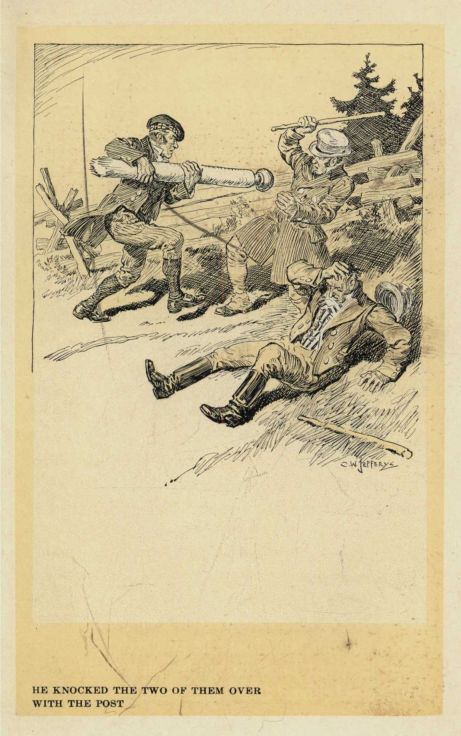
HE KNOCKED THE TWO OF THEM OVER WITH THE POST
"Pretty soon after that he met Tuncan Macdonnell of Greenfields, coming into Cornwall with the wagon.
"'And how is this, Glengatchie?' says Tuncan. 'For you were never the man to broke your bail.'
"Glengatchie, you'll understand, sir, is the name of my grandfather's farm.
"'Never fear, Greenfields,' says my grandfather, 'for I'm not beyond the post.'
"So Greenfields looked at the post, and he looked at my grandfather, and he scratched his head a wee, and he seen it was so; and then he fell into a great admiration entirely.
"'Get in with me, Glengatchie—it's proud I'll be to carry you home'; and he turned his team around. My grandfather did so, taking great care to keep the post in front of him all the time; and that way he reached home. Out comes my grandmother running to embrace him; but she had to throw her arms around the post and my grandfather's neck at the same time, he was that strict to be within his promise. Pefore going ben the house, he went to the back end of the kale-yard which was farthest from the jail, and there he stuck the post; and then he went back to see his sick child, while all the neighbors that came round was glad to see what a wise thought the saints had put into his mind to save his bail and his promise.
"So there he stayed a week till my father got well. Of course the constables came after my grandfather, but the settlement would not let the creatures come within a mile of Glengatchie. You might think, sir, that my grandfather would have stayed with his wife and weans, seeing the post was all the time in the kale-yard, and him careful not to go beyond it; but he was putting the settlement to a great deal of trouble day and night to keep the constables off, and he was fearful that they might take the post away, if ever they got to Glengatchie, and give him the name of false, that no McTavish ever had. So Tuncan Greenfields and Æneas Sandfield drove my grandfather back to the jail, him with the post behind him in the wagon, so as he would be between it and the jail. Of course Tougal Stewart tried his best to have the bail declared forfeited; but old Judge Jones only laughed, and said my grandfather was a Hielan' gentleman, with a very nice sense of honor, and that was chust exactly the truth.
"How did my grandfather get free in the end? Oh, then, that was because of Tougal Stewart being careless—him that thought he knew so much of the law. The law was, you will mind, that Tougal had to pay five shillings a week for keeping my grandfather in the limits. The money wass to be paid efery Monday, and it wass to be paid in lawful money of Canada, too. Well, would you belief that Tougal paid in four shillings in silver one Monday, and one shilling in coppers, for he took up the collection in church the day pefore, and it wass not till Tougal had gone away that the jailer saw that one of the coppers was a Brock copper,—a medal, you will understand, made at General Brock's death, and not lawful money of Canada at all. With that the jailer came out to my grandfather.
"'Mr. McTavish,' says he, taking off his hat, 'you are a free man, and I'm glad of it.' Then he told him what Tougal had done.
"'I hope you will not have any hard feelings toward me, Mr. McTavish,' said the jailer; and a decent man he wass, for all that there wass not a drop of Hielan' blood in him. 'I hope you will not think hard of me for not being hospitable to you, sir,' says he; 'but it's against the rules and regulations for the jailer to be offering the best he can command to the prisoners. Now that you are free, Mr. McTavish,' says the jailer, 'I would be a proud man if Mr. McTavish of Glengatchie would do me the honor of taking supper with me this night. I will be asking your leave to invite some of the gentlemen of the place, if you will say the word, Mr. McTavish,' says he.
"Well, my grandfather could never bear malice, the kind man he was, and he seen how bad the jailer felt, so he consented, and a great company came in, to be sure, to celebrate the occasion.
"Did my grandfather pay the balance on the plough? What for should you suspicion, sir, that my grandfather would refuse his honest debt? Of course he paid for the plough, for the crop was good that fall.
"'I would be paying you the other half of the plough now, Mr. Stewart,' says my grandfather, coming in when the store was full.
"'Hoich, but YOU are the honest McTavish!' says Tougal, sneering.
"But my grandfather made no answer to the creature, for he thought it would be unkind to mention how Tougal had paid out six pounds four shillings and eleven pence to keep him in on account of a debt of two pound five that never was due till it was paid."
THE WATERLOO VETERAN
Is Waterloo a dead word to you? the name of a plain of battle, no more? Or do you see, on a space of rising ground, the little long-coated man with marble features, and unquenchable eyes that pierce through rolling smoke to where the relics of the old Guard of France stagger and rally and reach fiercely again up the hill of St. Jean toward the squares, set, torn, red, re-formed, stubborn, mangled, victorious beneath the unflinching will of him behind there,—the Iron Duke of England?
Or is your interest in the fight literary? and do you see in a pause of the conflict Major O'Dowd sitting on the carcass of Pyramus refreshing himself from that case-bottle of sound brandy? George Osborne lying yonder, all his fopperies ended, with a bullet through his heart? Rawdon Crawley riding stolidly behind General Tufto along the front of the shattered regiment where Captain Dobbin stands heartsick for poor Emily?
Or maybe the struggle arranges itself in your vision around one figure not named in history or fiction,—that of hour grandfather, or his father, or some old dead soldier of the great wars whose blood you exult to inherit, or some grim veteran whom you saw tottering to the rollcall beyond when Queen Victoria was young and you were a little boy.
For me the shadows of the battle are so grouped round old John Locke that the historians, story-tellers, and painters may never quite persuade me that he was not the centre and real hero of the action. The French cuirassiers in my thought-pictures charge again and again vainly against old John; he it is who breaks the New Guard; upon the ground that he defends the Emperor's eyes are fixed all day long. It is John who occasionally glances at the sky with wonder if Blucher has failed them. Upon Shaw the Lifeguardsman, and John, the Duke plainly most relies, and the words that Wellington actually speaks when the time comes for advance are, "Up, John, and at them!"
How fate drifted the old veteran of Waterloo into our little Canadian Lake Erie village I never knew. Drifted him? No; he ever marched as if under the orders of his commander. Tall, thin, white-haired, close-shaven, and always in knee-breeches and long stockings, his was an antique and martial figure. "Fresh white-fish" was his cry, which he delivered as if calling all the village to fall in for drill.
So impressive was his demeanor that he dignified his occupation. For years after he disappeared, the peddling of white-fish by horse and cart was regarded in that district as peculiarly respectable. It was a glorious trade when old John Locke held the steelyards and served out the glittering fish with an air of distributing ammunition for a long day's combat.
I believe I noticed, on the first day I saw him, how he tapped his left breast with a proud gesture when he had done with a lot of customers and was about to march again at the head of his horse. That restored him from trade to his soldiership—he had saluted his Waterloo medal! There beneath his threadbare old blue coat it lay, always felt by the heart of the hero.
"Why doesn't he wear it outside?" I once asked.
"He used to," said my father; "till Hiram Beaman, the druggist, asked him what he'd 'take for the bit of pewter.'"
"What did old John say, sir?"
"'Take for the bit of pewter!' said he, looking hard at Beaman with scorn. 'I've took better men's lives nor ever yours was for to get it, and I'd sell my own for it as quick as ever I offered it before.'
"'More fool you,' said Beaman.
"'You're nowt,' said old John, very calm and cold, 'you're nowt but walking dirt.' From that day forth he would never sell Beaman a fish; he wouldn't touch his money."
It must have been late in 1854 or early in 1855 that I first saw the famous medal. Going home from school on a bright winter afternoon, I met old John walking very erect, without his usual fish-supply. A dull round white spot was clasped on the left breast of his coat.
"Mr. Locke," said the small boy, staring with admiration, "is that your glorious Waterloo medal?"
"You're a good little lad!" He stooped to let me see the noble pewter. "War's declared against Rooshia, and now it's right to show it. The old regiment's sailed, and my only son is with the colors."
Then he took me by the hand and led me into the village store, where the lawyer read aloud the news from the paper that the veteran gave him. In those days there was no railway within fifty miles of us. It had chanced that some fisherman brought old John a later paper than any previously received in the village.
"Ay, but the Duke is gone," said he, shaking his white head, "and it's curious to be fighting on the same side with another Boney."
All that winter and the next, all the long summer between, old John displayed his medal. When the report of Alma came, his remarks on the French failure to get into the fight were severe. "What was they ever, at best, without Boney?" he would inquire. But a letter from his son after Inkermann changed all that.
"Half of us was killed, and the rest of us clean tired with fighting," wrote Corporal Locke. "What with a bullet through the flesh of my right leg, and the fatigue of using the bayonet so long, I was like to drop. The Russians was coming on again as if there was no end to them, when strange drums came sounding in the mist behind us. With that we closed up and faced half-round, thinking they had outflanked us and the day was gone, so there was nothing more to do but make out to die hard, like the sons of Waterloo men. You would have been pleased to see the looks of what was left of the old regiment, father. Then all of a sudden a French column came up the rise out of the mist, screaming, 'Vive l'Empereur!' their drums beating the charge. We gave them room, for we were too dead tired to go first. On they went like mad at the Russians, so that was the end of a hard morning's work. I was down,—fainted with loss of blood,—but I will soon be fit for duty again. When I came to myself there was a Frenchman pouring brandy down my throat, and talking in his gibberish as kind as any Christian. Never a word will I say agin them red-legged French again."
"Show me the man that would!" growled old John. "It was never in them French to act cowardly. Didn't they beat all the world, and even stand up many's the day agen ourselves and the Duke? They didn't beat,—it wouldn't be in reason,—but they tried brave enough, and what more'd you ask of mortal men?"
With the ending of the Crimean War our village was illuminated. Rows of tallow candles in every window, fireworks in a vacant field, and a torchlight procession! Old John marched at its head in full regimentals, straight as a ramrod, the hero of the night. His son had been promoted for bravery on the field. After John came a dozen gray militiamen of Queenston Heights, Lundy's Lane, and Chippewa; next some forty volunteers of '37. And we boys of the U. E. Loyalist settlement cheered and cheered, thrilled with an intense vague knowledge that the old army of Wellington kept ghostly step with John, while aerial trumpets and drums pealed and beat with rejoicing at the fresh glory of the race and the union of English-speaking men unconsciously celebrated and symbolized by the little rustic parade.
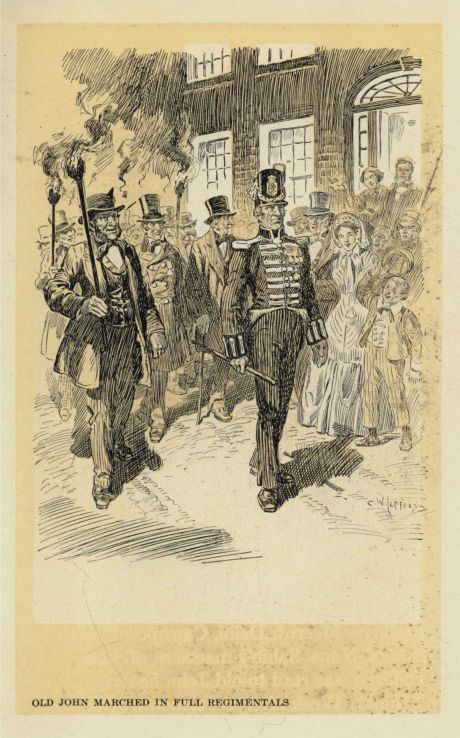
OLD JOHN MARCHED IN FULL REGIMENTALS
After that the old man again wore his medal concealed. The Chinese War of 1857 was too contemptible to celebrate by displaying his badge of Waterloo.
Then came the dreadful tale of the Sepoy mutiny—Meerut, Delhi, Cawnpore! After the tale of Nana Sahib's massacre of women and children was read to old John he never smiled, I think. Week after week, month after month, as hideous tidings poured steadily in, his face became more haggard, gray, and dreadful. The feeling that he was too old for use seemed to shame him. He no longer carried his head high, as of yore. That his son was not marching behind Havelock with the avenging army seemed to cut our veteran sorely. Sergeant Locke had sailed with the old regiment to join Outram in Persia before the Sepoys broke loose. It was at this time that old John was first heard to say, "I'm 'feared something's gone wrong with my heart."
Months went by before we learned that the troops for Persia had been stopped on their way and thrown into India against the mutineers. At that news old John marched into the village with a prouder air than he had worn for many a day. His medal was again on his breast.
It was but the next month, I think, that the village lawyer stood reading aloud the account of the capture of a great Sepoy fort. The veteran entered the post-office, and all made way for him. The reading went on:—
"The blowing open of the Northern Gate was the grandest personal exploit of the attack. It was performed by native sappers, covered by the fire of two regiments, and headed by Lieutenants Holder and Dacre, Sergeants Green, Carmody, Macpherson, and Locke."
The lawyer paused. Every eye turned to the face of the old Waterloo soldier. He straightened up to keener attention, threw out his chest, and tapped the glorious medal in salute of the names of the brave.
"God be praised, my son was there!" he said. "Read on."
"Sergeant Carmody, while laying the powder, was killed, and the native havildar wounded. The powder having been laid, the advance party slipped down into the ditch to allow the firing party, under Lieutenant Dacre, to do its duty. While trying to fire the charge he was shot through one arm and leg. He sank, but handed the match to Sergeant Macpherson, who was at once shot dead. Sergeant Locke, already wounded severely in the shoulder, then seized the match, and succeeded in firing the train. He fell at that moment, literally riddled with bullets."
"Read on," said old John, in a deeper voice. All forbore to look twice upon his face.
"Others of the party were falling, when the gate was blown to fragments, and the waiting regiments of infantry, under Colonel Campbell, rushed into the breach."
There was a long silence in the post-office, till old John spoke once more.
"The Lord God be thanked for all his dealings with us! My son, Sergeant Locke, died well for England, Queen, and Duty."
Nervously fingering the treasure on his breast, the old soldier wheeled about, and marched proudly straight down the middle of the village street to his lonely cabin.
The villagers never saw him in life again. Next day he did not appear. All refrained from intruding on his mourning. But in the evening, when the Anglican minister heard of his parishioner's loss, he walked to old John's home.
There, stretched upon his straw bed, he lay in his antique regimentals, stiffer than At Attention, all his medals fastened below that of Waterloo above his quiet heart. His right hand lay on an open Bible, and his face wore an expression as of looking for ever and ever upon Sergeant Locke and the Great Commander who takes back unto Him the heroes He fashions to sweeten the world.
JOHN BEDELL, U. E. LOYALIST[1]
[1] The United Empire Loyalists were American Tories who forsook their homes and property after the Revolution in order to live in Canada under the British Flag. It is impossible to understand Canadian feeling for the Crown at the present day without understanding the U. E. Loyalist spirit, which, though Canadians are not now unfriendly to the United States, is still the most important political force in the Dominion, and holds it firmly in allegiance to the Crown.
"A renegade! A rebel against his king! A black-hearted traitor! You dare to tell me that you love George Winthrop! Son of canting, lying Ezra Winthrop! By the Eternal, I'll shoot him on sight if he comes this side!"
While old John Bedell was speaking, he tore and flung away a letter, reached for his long rifle on its pins above the chimney-place, dashed its butt angrily to the floor, and poured powder into his palm.
"For Heaven's sake, father! You would not! You could not! The war is over. It would be murder!" cried Ruth Bedell, sobbing.
"Wouldn't I?" He poured the powder in. "Yes, by gracious, quicker'n I'd kill a rattlesnake!" He placed the round bullet on the little square of greased rag at the muzzle of his rifle. "A rank traitor—bone and blood of those who drove out loyal men!"—he crowded the tight lead home, dashed the ramrod into place, looked to the flint. "Rest there,—wake up for George Winthrop!" and the fierce old man replaced rifle and powder-horn on their pegs.
Bedell's hatred for the foes who had beaten down King George's cause, and imposed the alternative of confiscation or the oath of allegiance on the vanquished, was considered intense, even by his brother Loyalists of the Niagara frontier.
"The Squire kind o' sees his boys' blood when the sky's red," said they in explanation. But Bedell was so much an enthusiast that he could almost rejoice because his three stark sons had gained the prize of death in battle. He was too brave to hate the fighting-men he had so often confronted; but he abhorred the politicians, especially the intimate civic enemies on whom he had poured scorn before the armed struggle began. More than any he hated Ezra Winthrop, the lawyer, arch-revolutionist of their native town, who had never used a weapon but his tongue. And now his Ruth, the beloved and only child left to his exiled age, had confessed her love for Ezra Winthrop's son! They had been boy and girl, pretty maiden and bright stripling together, without the Squire suspecting—he could not, even now, conceive clearly so wild a thing as their affection! The confession burned in his heart like veritable fire,—a raging anguish of mingled loathing and love. He stood now gazing at Ruth dumbly, his hands clenched, head sometimes mechanically quivering, anger, hate, love, grief, tumultuous in his soul.
Ruth glanced up—her father seemed about to speak—she bowed again, shuddering as though the coming words might kill. Still there was silence,—a long silence. Bedell stood motionless, poised, breathing hard—the silence oppressed the girl—each moment her terror increased—expectant attention became suffering that demanded his voice—and still was silence—save for the dull roar of Niagara that more and more pervaded the air. The torture of waiting for the words—a curse against her, she feared—overwore Ruth's endurance. She looked up suddenly, and John Bedell saw in hers the beloved eyes of his dead wife, shrinking with intolerable fear. He groaned heavily. flung up his hands despairingly, and strode out toward the river.
How crafty smooth the green Niagara sweeps toward the plunge beneath that perpetual white cloud above the Falls! From Bedell's clearing below Navy Island, two miles above the Falls, he could see the swaying and rolling of the mist, ever rushing up to expand and overhang. The terrible stream had a profound fascination for him, with its racing eddies eating at the shore; its long weeds, visible through the clear water, trailing close down to the bottom; its inexorable, eternal, onward pouring. Because it was so mighty and so threatening, he rejoiced grimly in the awful river. To float, watching cracks and ledges of its flat bottom-rock drift quickly upward; to bend to his oars only when white crests of the rapids yelled for his life; to win escape by sheer strength from points so low down that he sometimes doubted but the greedy forces had been tempted too long; to stake his life, watching tree-tops for a sign that he could yet save it, was the dreadful pastime by which Bedell often quelled passionate promptings to revenge his exile. "The Falls is bound to get the Squire, some day," said the banished settlers. But the Squire's skiff was clean built as a pickerel, and his old arms iron-strong. Now when he had gone forth from the beloved child, who seemed to him so traitorous to his love and all loyalty, he went instinctively to spend his rage upon the river.
Ruth Bedell, gazing at the loaded rifle, shuddered, not with dread only, but a sense of having been treacherous to her father. She had not told him all the truth. George Winthrop himself, having made his way secretly through the forest from Lake Ontario, had given her his own letter asking leave from the Squire to visit his newly made cabin. From the moment of arrival her lover had implored her to fly with him. But filial love was strong in Ruth to give hope that her father would yield to the yet stronger affection freshened in her heart. Believing their union might be permitted, she had pledged herself to escape with her lover if it were forbidden. Now he waited by the hickory wood for a signal to conceal himself or come forward.
When Ruth saw her father far down the river, she stepped to the flagstaff he had raised before building the cabin—his first duty being to hoist the Union Jack! It was the largest flag he could procure; he could see it flying defiantly all day long; at night he could hear its glorious folds whipping in the wind; the hot old Loyalist loved to fancy his foeman cursing at it from the other side, nearly three miles away. Ruth hauled the flag down a little, then ran it up to the mast-head again.
At that, a tall young fellow came springing into the clearing, jumping exultantly over brush-heaps and tree-trunks, his queue waggling, his eyes bright, glad, under his three-cornered hat. Joying that her father had yielded, he ran forward till he saw Ruth's tears.
"What, sweetheart!—crying? It was the signal to come on," cried he.
"Yes; to see you sooner, George. Father is out yonder. But no, he will never, never consent."
"Then you will come with me, love," he said, taking her hands.
"No, no; I dare not," sobbed Ruth. "Father would overtake us. He swears to shoot you on sight! Go, George! Escape while you can! Oh, if he should find you here!"
"But, darling love, we need not fear. We can escape easily. I know the forest path. But—" Then he thought how weak her pace.
"We might cross here before he could come up!" cried Winthrop, looking toward where the Squire's boat was now a distant blotch.
"No, no," wailed Ruth, yet yielding to his embrace. "This is the last time I shall see you forever and forever. Go, dear,—good-bye, my love, my love."
But he clasped her in his strong arms, kissing, imploring, cheering her,—and how should true love choose hopeless renunciation?
* * * * *
Tempting, defying, regaining his lost ground, drifting down again, trying hard to tire out and subdue his heart-pangs, Bedell dallied with death more closely than ever. He had let his skiff drift far down toward the Falls. Often he could see the wide smooth curve where the green volume first lapses vastly on a lazy slope, to shoulder up below as a huge calm billow, before pitching into the madness of waves whose confusion of tossing and tortured crests hurries to the abyss. The afternoon grew toward evening before he pulled steadily home, crawling away from the roarers against the cruel green, watching the ominous cloud with some such grim humor as if under observation by an overpowering but baffled enemy.
Approaching his landing, a shout drew Bedell's glance ashore to a group of men excitedly gesticulating. They seemed motioning him to watch the American shore. Turning, he saw a boat in midstream, where no craft then on the river, except his own skiff, could be safe, unless manned by several good men. Only two oars were flashing. Bedell could make out two figures indistinctly. It was clear they were doomed,—though still a full mile above the point whence he had come, they were much farther out than he when near the rapids. Yet one life might be saved! Instantly Bedell's bow turned outward, and cheers flung to him from ashore.
At that moment he looked to his own landing-place, and saw that his larger boat was gone. Turning again, he angrily recognized it, but kept right on—he must try to rescue even a thief. He wondered Ruth had not prevented the theft, but had no suspicion of the truth. Always he had refused to let her go out upon the river—mortally fearing it for her.
Thrusting his skiff mightily forward,—often it glanced, half-whirled by up-whelming and spreading spaces of water,—the old Loyalist's heart was quit of his pangs, and sore only with certainty that he must abandon one human soul to death. By the time that he could reach the larger boat his would be too near the rapids for escape with three!
When George Winthrop saw Bedell in pursuit, he bent to his ash-blades more strongly, and Ruth, trembling to remember her father's threats, urged her lover to speed. They feared the pursuer only, quite unconscious that they were in the remorseless grasp of the river. Ruth had so often seen her father far lower down than they had yet drifted that she did not realize the truth, and George, a stranger in the Niagara district, was unaware of the length of the cataracts above the Falls. He was also deceived by the stream's treacherous smoothness, and instead of half-upward, pulled straight across, as if certainly able to land anywhere he might touch the American shore.
Bedell looked over his shoulder often. When he distinguished a woman, he put on more force, but slackened soon—the pull home would tax his endurance, he reflected. In some sort it was a relief to know that one was a woman; he had been anticipating trouble with two men equally bent on being saved. That the man would abandon himself bravely, the Squire took as a matter of course. For a while he thought of pulling with the woman to the American shore, more easily to be gained from the point where the rescue must occur. But he rejected the plan, confident he could win back, for he had sworn never to set foot on that soil unless in war. Had it been possible to save both, he would have been forced to disregard that vow; but the Squire knew that it was impossible for him to reach the New York shore with two passengers—two would overload his boat beyond escape. Man or woman—one must go over the Falls.
Having carefully studied landmarks for his position, Bedell turned to look again at the doomed boat, and a well-known ribbon caught his attention! The old man dropped his oars, confused with horror. "My God, my God! it's Ruth!" he cried, and the whole truth came with another look, for he had not forgotten George Winthrop.
"Your father stops, Ruth. Perhaps he is in pain," said George to the quaking girl.
She looked back. "What can it be?" she cried, filial love returning overmasteringly.
"Perhaps he is only tired." George affected carelessness,—his first wish was to secure his bride,—and pulled hard away to get all advantage from Bedell's halt.
"Tired! He is in danger of the Falls, then!" screamed Ruth. "Stop! Turn! Back to him!"
Winthrop instantly prepared to obey. "Yes, darling," he said, "we must not think of ourselves. We must go back to save him!" Yet his was a sore groan at turning; what Duty ordered was so hard,—he must give up his love for the sake of his enemy.
But while Winthrop was still pulling round, the old Loyalist resumed rowing, with a more rapid stroke that soon brought him alongside.
In those moments of waiting, all Bedell's life, his personal hatreds, his loves, his sorrows, had been reviewed before his soul. He had seen again his sons, the slain in battle, in the pride of their young might; and the gentle eyes of Ruth had pleaded with him beneath his dead wife's brow. Into those beloved, unforgotten, visionary eyes he looked with an encouraging, strengthening gaze,—now that the deed to be done was as clear before him as the face of Almighty God. In accepting it the darker passions that had swayed his stormy life fell suddenly away from their hold on his soul. How trivial had been old disputes! how good at heart old well-known civic enemies! how poor seemed hate! how mean and poor seemed all but Love and Loyalty!
Resolution and deep peace had come upon the man.
The lovers wondered at his look. No wrath was there. The old eyes were calm and cheerful, a gentle smile flickered about his lips. Only that he was very pale, Ruth would have been wholly glad for the happy change.
"Forgive me, father," she cried, as he laid hand on their boat.
"I do, my child," he answered. "Come now without an instant's delay to me."
"Oh, father, if you would let us be happy!" cried Ruth, heart-torn by two loves.
"Dear, you shall be happy. I was wrong, child; I did not understand how you loved him. But come! You hesitate! Winthrop, my son, you are in some danger. Into this boat instantly! both of you! Take the oars, George. Kiss me, dear, my Ruth, once more. Good-bye, my little girl. Winthrop, be good to her. And may God bless you both forever!"
As the old Squire spoke, he stepped into the larger boat, instantly releasing the skiff. His imperative gentleness had secured his object without loss of time, and the boats were apart with Winthrop's readiness to pull.
"Now row! Row for her life to yonder shore! Bow well up! Away, or the Falls will have her!" shouted Bedell.
"But you!" cried Winthrop, bending for his stroke. Yet he did not comprehend Bedell's meaning. Till the last the old man had spoken without strong excitement. Dread of the river was not on George; his bliss was supreme in his thought, and he took the Squire's order for one of exaggerated alarm.
"Row, I say, with all your strength!" cried Bedell, with a flash of anger that sent the young fellow away instantly. "Row! Concern yourself not for me. I am going home. Row! for her life, Winthrop! God will deliver you yet. Good-bye, children. Remember always my blessing is freely given you."
"God bless and keep you forever, father!" cried Ruth, from the distance, as her lover pulled away.
They landed, conscious of having passed a swift current, indeed, but quite unthinking of the price paid for their safety. Looking back on the darkling river, they saw nothing of the old man.
"Poor father!" sighed Ruth, "how kind he was! I'm sore-hearted for thinking of him at home, so lonely."
Left alone in the clumsy boat, Bedell stretched with the long, heavy oars for his own shore, making appearance of strong exertion. But when he no longer feared that his children might turn back with sudden understanding, and vainly, to his aid, he dragged the boat slowly, watching her swift drift down—down toward the towering mist. Then as he gazed at the cloud, rising in two distinct volumes, came a thought spurring the Loyalist spirit in an instant. He was not yet out of American water! Thereafter he pulled steadily, powerfully, noting landmarks anxiously, studying currents, considering always their trend to or from his own shore. Half an hour had gone when he again dropped into slower motion. Then he could see Goat Island's upper end between him and the mist of the American Fall.
Now the old man gave himself up to intense curiosity, looking over into the water with fascinated inquiry. He had never been so far down the river. Darting beside their shadows, deep in the clear flood, were now larger fishes than he had ever taken, and all moved up as if hurrying to escape. How fast the long trailing, swaying, single weeds, and the crevices in flat rock whence they so strangely grew, went up stream and away as if drawn backward. The sameness of the bottom to that higher up interested him—where then did the current begin to sweep clean? He should certainly know that soon, he thought, without a touch of fear, having utterly accepted death when he determined it were base to carry his weary old life a little longer, and let Ruth's young love die. Now the Falls' heavy monotone was overborne by terrible sounds—a mingled clashing, shrieking, groaning, and rumbling, as of great bowlders churned in their beds.
Bedell was nearing the first long swoop downward at the rapids' head when those watching him from the high bank below the Chippewa River's mouth saw him put his boat stern with the current and cease rowing entirely, facing fairly the up-rushing mist to which he was being hurried. Then they observed him stooping, as if writing, for a time. Something flashed in his hands, and then he knelt with head bowed down. Kneeling, they prayed, too.
Now he was almost on the brink of the cascades. Then he arose, and, glancing backward to his home, caught sight of his friends on the high shore. Calmly he waved a farewell. What then? Thrice round he flung his hat, with a gesture they knew full well. Some had seen that exultant waving in front of ranks of battle. As clearly as though the roar of waters had not drowned his ringing voice, they knew that old John Bedell, at the poise of death, cheered thrice, "Hurrah! Hurrah! Hurrah for the King!"
They found his body a week afterward, floating with the heaving water in the gorge below the Falls. Though beaten almost out of recognition, portions of clothing still adhered to it, and in a waistcoat pocket they found the old Loyalist's metal snuff-box, with this inscription scratched by knife-point on the cover: "God be praised, I die in British waters! JOHN BEDELL."
OLD MAN SAVARIN
Old Ma'ame Paradis had caught seventeen small doré, four suckers, and eleven channel-catfish before she used up all the worms in her tomato-can. Therefore she was in a cheerful and loquacious humor when I came along and offered her some of my bait.
"Merci; non, M'sieu. Dat's 'nuff fishin' for me. I got too old now for fish too much. You like me make you present of six or seven doré? Yes? All right. Then you make me present of one quarter dollar."
When this transaction was completed, the old lady got out her short black clay pipe, and filled it with tabac blanc.
"Ver' good smell for scare mosquitoes," said she. "Sit down, M'sieu. For sure I like to be here, me, for see the river when she's like this."
Indeed the scene was more than picturesque. Her fishing-platform extended twenty feet from the rocky shore of the great Rataplan Rapid of the Ottawa, which, beginning to tumble a mile to the westward, poured a roaring torrent half a mile wide into the broader, calm brown reach below. Noble elms towered on the shores. Between their trunks we could see many whitewashed cabins, whose doors of blue or green, or red scarcely disclosed their colors in that light.
The sinking sun, which already touched the river, seemed somehow the source of the vast stream that flowed radiantly from its blaze. Through the glamour of the evening mist and the maze of June flies we could see a dozen men scooping for fish from platforms like that of Ma'ame Paradis.
Each scooper lifted a great hoop-net set on a handle some fifteen feet long, threw it easily up stream, and swept it on edge with the current to the full length of his reach. Then it was drawn out and at once thrown upward again, if no capture had been made. In case he had taken fish, he came to the inshore edge of his platform, and upset the net's contents into a pool separated from the main rapid by an improvised wall of stones.
"I'm too old for scoop some now," said Ma'ame Paradis, with a sigh.
"You were never strong enough to scoop, surely," said I.
"No, eh? All right, M'sieu. Then you hain't nev' hear 'bout the time Old Man Savarin was catched up with. No, eh? Well, I'll tol' you 'bout that." And this was her story as she told it to me.
* * * * *
"Der was fun dose time. Nobody ain't nev' catch up with dat old rascal ony other time since I'll know him first. Me, I'll be only fifteen den. Dat's long time 'go, eh? Well, for sure, I ain't so old like what I'll look. But Old Man Savarin was old already. He's old, old, old, when he's only thirty; an' mean—baptême! If de old Nick ain' got de hottest place for dat old stingy—yes, for sure!
"You'll see up dere where Frawce Seguin is scoop? Dat's the Laroque platform by right. Me, I was a Laroque. My fader was use for scoop dere, an' my gran'fader—the Laroques scoop dere all de time since ever dere was some Rapid Rataplan. Den Old Man Savarin he's buyed the land up dere from Felix Ladoucier, an' he's told my fader, 'You can't scoop no more wisout you pay me rent.'
"'Rent!' my fader say. 'Saprie! Dat's my fader's platform for scoop fish! You ask anybody.'
"'Oh, I'll know all 'bout dat,' Old Man Savarin is say. 'Ladoucier let you scoop front of his land, for Ladoucier one big fool. De lan's mine now, an' de fishin' right is mine. You can't scoop dere wisout you pay me rent.'
"'Baptême! I'll show you 'bout dat,' my fader say.
"Next mawny he is go for scoop same like always. Den Old Man Savarin is fetch my fader up before de magistrate. De magistrate make my fader pay nine shillin'!
"'Mebbe dat's learn you one lesson,' Old Man Savarin is say.
"My fader swear pretty good, but my moder say: 'Well, Narcisse, dere hain' no use for take it out in malediction. De nine shillin' is paid. You scoop more fish—dat's the way.'
"So my fader he is go out early, early nex' mawny. He's scoop, he's scoop. He's catch plenty fish before Old Man Savarin come.
"'You ain't got 'nuff yet for fishin' on my land, eh? Come out of dat,' Old Man Savarin is say.
"'Saprie! Ain't I pay nine shillin' for fish here?' my fader say.
"'Old—you pay nine shillin' for fish here wisout my leave. But you ain't pay nothin' for fish here wis my leave. You is goin' up before de magistrate some more.'
"So he is fetch my fader up anoder time. An' de magistrate make my fader pay twelve shillin' more!
"'Well, I s'pose I can go fish on my fader's platform now,' my fader is say.
"Old Man Savarin was laugh. 'Your honor, dis man tink he don't have for pay me no rent, because you'll make him pay two fines for trespass on my land.'
"So de magistrate told my fader he hain't got no more right for go on his own platform than he was at the start. My fader is ver' angry. He's cry, he's tear his shirt; but Old Man Savarin only say, 'I guess I learn you one good lesson, Narcisse.'
"De whole village ain't told de old rascal how much dey was angry 'bout dat, for Old Man Savarin is got dem all in debt at his big store. He is grin, grin, and told everybody how he learn my fader two good lesson. An' he is told my fader: 'You see what I'll be goin' for do wis you if ever you go on my land again wisout you pay me rent.'
"'How much you want?' my fader say.
"'Half de fish you catch.'
"'Monjee! Never!'
"'Five dollar a year, den.'
"'Saprie, no. Dat's too much.'
"'All right. Keep off my lan', if you hain't want anoder lesson.'
"'You's a tief,' my fader say.
"'Hermidas, make up Narcisse Laroque bill,' de old rascal say to his clerk. 'If he hain't pay dat bill to-morrow, I sue him.'
"So my fader is scare mos' to death. Only my moder she's say, 'I'll pay dat bill, me.'
"So she's take the money she's saved up long time for make my weddin' when it come. An' she's paid de bill. So den my fader hain't scare no more, an' he is shake his fist good under Old Man Savarin's ugly nose. But dat old rascal only laugh an' say, 'Narcisse, you like to be fined some more, eh?'
"'Tort Dieu. You rob me of my place for fish, but I'll take my platform anyhow,' my fader is say.
"'Yes, eh? All right—if you can get him wisout go on my land. But you go on my land, and see if I don't learn you anoder lesson,' Old Savarin is say.
"So my fader is rob of his platform, too. Nex' ting we hear, Frawce Seguin has rent dat platform for five dollars a year.
"Den de big fun begin. My fader an Frawce is cousin. All de time before den dey was good friend. But my fader he is go to Frawce Seguin's place an' he is told him, 'Frawce, I'll goin' lick you so hard you can't nev' scoop on my platform.'
"Frawce only laugh. Den Old Man Savarin come up de hill.
"'Fetch him up to de magistrate an' learn him anoder lesson,' he is say to Frawce.
"'What for?' Frawce say.
"'For try to scare you.'
"'He hain't hurt me none.'
"'But he's say he will lick you.'
"'Dat's only because he's vex,' Frawce say.
"'Baptême! Non!' my fader say. 'I'll be goin' for lick you good, Frawce.'
"'For sure?' Frawce say.
"'Saprie! Yes; for sure.'
"'Well, dat's all right den, Narcisse. When you goin' for lick me?'
"'First time I'll get drunk. I'll be goin' for get drunk dis same day.'
"'All right, Narcisse. If you goin' get drunk for lick me, I'll be goin' get drunk for lick you'—Canadien hain't nev' fool 'nuff for fight, M'sieu, only if dey is got drunk.
"Well, my fader he's go on old Marceau's hotel, an' he's drink all day. Frawce Seguin he's go cross de road on Joe Maufraud's hotel, an' he's drink all day. When de night come, dey's bose stand out in front of de two hotel for fight.
"Dey's bose yell an' yell for make de oder feller scare bad before dey begin. Hermidas Laronde an' Jawnny Leroi dey's hold my fader for fear he's go 'cross de road for keel Frawce Seguin dead. Pierre Seguin an' Magloire Sauve is hold Frawce for fear he's come 'cross de road for keel my fader dead. And dose men fight dat way 'cross de road, till dey hain't hardly able for stand up no more.
"My fader he's tear his shirt and he's yell, 'Let me at him!' Frawce he's tear his shirt and he's yell, 'Let me at him!' But de men hain't goin' for let dem loose, for fear one is strike de oder ver' hard. De whole village is shiver 'bout dat offle fight—yes, seh, shiver bad!
"Well, dey's fight like dat for more as four hours, till dey hain't able for yell no more, an' dey hain't got no money left for buy wheeskey for de crowd. Den Marceau and Joe Maufraud tol' dem bose it was a shame for two cousins to fight so bad. An' my fader he's say he's ver' sorry dat he lick Frawce so hard, and dey's bose sorry. So dey's kiss one anoder good—only all their close is tore to pieces.
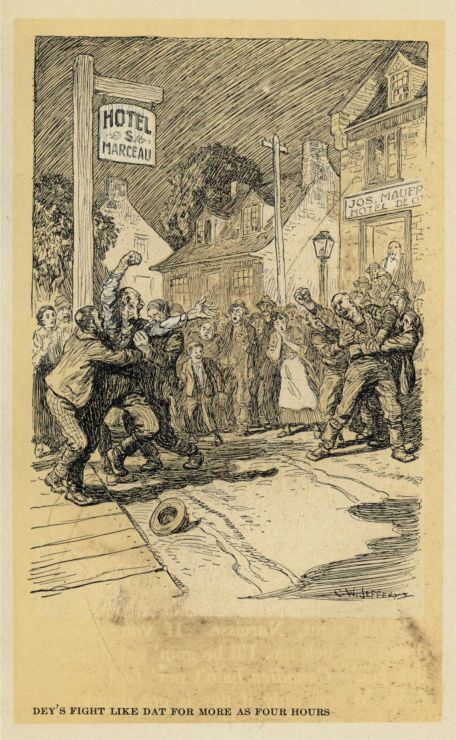
DEY'S FIGHT LIKE DAT FOR MORE AS FOUR HOURS
"An' what you tink 'bout Old Man Savarin? Old Man Savarin is just stand in front of his store all de time, an' he's say: 'I'll tink I'll fetch 'him bose hup to de magistrate, an' I'll learn him bose a lesson.'
"Me, I'll be only fifteen, but I hain't scare 'bout dat fight same like my moder is scare. No more is Alphonsine Seguin scare. She's seventeen, an' she wait for de fight to be all over. Den she take her fader home, same like I'll take my fader home for bed. Dat's after twelve o'clock of night.
"Nex' mawny early my fader he's groaned and he's groaned: 'Ah—ugh—I'm sick, sick, me. I'll be goin' for die dis time, for sure.'
"'You get up an' scoop some fish,' my moder she's say, angry. 'Den you hain't be sick no more.'
"'Ach—ugh—I'll hain't be able. Oh, I'll be so sick. An' I hain' got no place for scoop fish now no more. Frawce Seguin has rob my platform.'
"'Take de nex' one lower down,' my moder she's say.
"'Dat's Jawnny Leroi's.'
"'All right for dat. Jawnny he's hire for run timber to-day.'
"'Ugh—I'll not be able for get up. Send for M'sieu le Curé—I'll be goin' for die for sure.'
"'Misère, but dat's no man! Dat's a drunk pig,' my moder she's say, angry. 'Sick, eh? Lazy, lazy—dat's so. An' dere hain't no fish for de little chilluns, an' it's Friday mawny.' So my moder she's begin for cry.
"Well, M'sieu, I'll make de rest short; for de sun is all gone now. What you tink I do dat mawny? I take de big scoop-net an' I'll come up here for see if I'll be able for scoop some fish on Jawnny Leroi's platform. Only dere hain't nev' much fish dere.
"Pretty quick I'll look up and I'll see Alphonsine Seguin scoop, scoop on my fader's old platform. Alphonsine's fader is sick, sick, same like my fader, an' all de Seguin boys is too little for scoop, same like my brudders is too little. So dere Alphonsine she's scoop, scoop for breakfas'.
"What you tink I'll see some more? I'll see Old Man Savarin. He's watchin' from de corner of de cedar bush, an I'll know ver' good what he's watch for. He's watch for catch my fader go on his own platform. He's want for learn my fader anoder lesson. Saprie! dat's make me ver' angry, M'sieu!
"Alphonsine she's scoop, scoop plenty fish. I'll not be scoop none. Dat's make me more angry. I'll look up where Alphonsine is, an' I'll talk to myself:—
"'Dat's my fader's platform,' I'll be say. 'Dat's my fader's fish what you catch, Alphonsine. You hain't nev' be my cousin no more. It is mean, mean for Frawce Seguin to rent my fader's platform for please dat old rascal Savarin.' Mebby I'll not be so angry at Alphonsine, M'sieu, if I was able for catch some fish; but I hain't able—I don't catch none.
"Well, M'sieu, dat's de way for long time—half-hour mebby. Den I'll hear Alphonsine yell good. I'll look up de river some more. She's try for lift her net. She's try hard, hard, but she hain't able. De net is down in de rapid, an' she's only able for hang on to de hannle. Den I'll know she's got one big sturgeon, an' he's so big she can't pull him-up.
"Monjee! what I care 'bout dat! I'll laugh me. Den I'll laugh good some more, for I'll want Alphonsine for see how I'll laugh big. And I'll talk to myself:—
"'Dat's good for dose Seguins,' I'll say. 'De big sturgeon will pull away de net. Den Alphonsine she will lose her fader's scoop wis de sturgeon. Dat's good 'nuff for dose Seguins! Take my fader platform, eh?'
"For sure, I'll want for go an' help Alphonsine all de same—she's my cousin, an' I'll want for see de sturgeon, me. But I'll only just laugh, laugh. Non, M'sieu; dere was not one man out on any of de oder platform dat mawny for to help Alphonsine. Dey was all sleep ver' late, for dey was all out ver' late for see de offle fight I told you 'bout.
"Well, pretty quick, what you tink? I'll see Old Man Savarin goin' to my fader's platform. He's take hold for help Alphonsine, an' dey's bose pull, and pretty quick de big sturgeon is up on de platform. I'll be more angry as before.
"Oh, tort Dieu! What you tink come den? Why, dat Old Man Savarin is want for take de sturgeon!
"First dey hain't speak so I can hear, for de Rapid is too loud. But pretty quick dey's bose angry, and I hear dem talk.
"'Dat's my fish,' Old Man Savarin is say. 'Didn't I save him? Wasn't you goin' for lose him, for sure?'
"Me—I'll laugh good. Dass such an old rascal.
"'You get off dis platform, quick!' Alphonsine she's say.
"'Give me my sturgeon,' he's say.
"'Dat's a lie—it hain't your sturgeon. It's my sturgeon,' she's yell.
"'I'll learn you one lesson 'bout dat,' he's say.
"Well, M'sieu, Alphonsine she's pull back de fish just when Old Man Savarin is make one grab. An' when she's pull back, she's step to one side, an' de old rascal he is grab at de fish, an' de heft of de sturgeon is make him fall on his face, so he's tumble in de Rapid when Alphonsine let go de sturgeon. So der's Old Man Savarin floating in de river—and me! I'll don' care eef he's drown one bit!
"One time he is on his back, one time he is on his face, one time he is all under de water. For sure he's goin' for be draw into de culbute an' get drown' dead, if I'll not be able for scoop him when he's go by my platform. I'll want for laugh, but I'll be too much scare.
"Well, M'sieu, I'll pick up my fader's scoop and I'll stand out on de edge of de platform. De water is run so fast, I'm mos' 'fraid de old man is boun' for pull me in when I'll scoop him. But I'll not mind for dat, I'll throw de scoop an' catch him; an' for sure, he's hold on good.
"So dere's de old rascal in de scoop, but when I'll get him safe, I hain't able for pull him in one bit. I'll only be able for hold on an' laugh, laugh—he's look ver' queer! All I can do is to hold him dere so he can't go down de culbute. I'll can't pull him up if I'll want to.
"De old man is scare ver' bad. But pretty quick he's got hold of de cross-bar of de hoop, an' he's got his ugly old head up good.
"'Pull me in,' he say, ver' angry.
"'I'll hain't be able,' I'll say.
"Jus' den Alphonsine she's come 'long, an' she's laugh so she can't hardly hold on wis me to de hannle. I was laugh good some more. When de old villain see us have fun, he's yell: 'I'll learn you bose one lesson for this. Pull me ashore!'
"'Oh! you's learn us bose one lesson, M'sieu Savarin, eh?' Alphonsine she's say. 'Well, den, us bose will learn M'sieu Savarin one lesson first. Pull him up a little,' she's say to me.
"So we pull him up, an' den Alphonsine she's say to me: 'Let out de hannle, quick'—and he's under de water some more. When we stop de net, he's got hees head up pretty quick.
"'Monjee! I'll be drown' if you don't pull me out,' he's mos' cry.
"'Ver' well—if you's drown, your family be ver' glad,' Alphonsine she's say. 'Den they's got all your money for spend quick, quick.'
"M'sieu, dat scare him offle. He's begin for cry like one baby.
"'Save me out,' he's say. 'I'll give you anything I've got.'
"'How much?' Alphonsine she's say.
"He's tink, and he's say, 'Quarter dollar.'
"Alphonsine an' me is laugh, laugh.
"'Save me,' he's cry some more. 'I hain't fit for die dis mawny.'
"'You hain't fit for live no mawny,' Alphonsine she's say. 'One quarter dollar, eh? Where's my sturgeon?'
"'He's got away when I fall in,' he's say.
"'How much you goin' give me for lose my big sturgeon?' she's ask.
"'How much you'll want, Alphonsine?'
"'Two dollare.'
"'Dat's too much for one sturgeon,' he's say. For all he was not feel fit for die, he was more 'fraid for pay out his money.
"'Let him down some more,' Alphonsine she's say.
"'Oh, misère, misère! I'll pay de two dollare,' he's say when his head come up some more.
"'Ver' well, den,' Alphonsine she's say; 'I'll be willin' for save you, me. But you hain't scooped by me. You's in Marie's net. I'll only come for help Marie. You's her sturgeon'; an' Alphonsine she's laugh an' laugh.
"'I didn't lost no sturgeon for Marie,' he's say.
"'No, eh?' I'll say mysef. 'But you's steal my fader's platform. You's take his fishin' place. You's got him fined two times. You's make my moder pay his bill wis my weddin' money. What you goin' pay for all dat? You tink I'll be goin' for mos' kill mysef pullin' you out for noting? When you ever do someting for anybody for noting, eh, M'sieu Savarin?'
"'How much you want?' he's say.
"'Ten dollare for de platform, dat's all.'
"'Never—-dat's robbery,' he's say, an' he's begin to cry like ver' li'll baby.
"'Pull him hup, Marie, an' give him some more,' Alphonsine she's say.
"But de old rascal is so scare 'bout dat, dat he's say he's pay right off. So we's pull him up near to de platform, only we hain't big 'nuff fool for let him out of de net till he's take out his purse an' pay de twelve dollare.
"Monjee, M'sieu! If ever you see one angry old rascal! He not even stop for say: 'T'ank you for save me from be drown' dead in the culbute!' He's run for his house an' he's put on dry clo'es, and' he's go up to de magistrate first ting for learn me an' Alphonsine one big lesson.
"But de magistrate hain' ver' bad magistrate. He's only laugh an' he's say:—
"'M'sieu Savarin, de whole river will be laugh at you for let two young girl take eet out of smart man like you like dat. Hain't you tink your life worth twelve dollare? Didn't dey save you from de culbute? Monjee! I'll tink de whole river not laugh so ver' bad if you pay dose young girl one hunder dollare for save you so kind.'
"'One hunder dollare!' he's mos' cry. 'Hain't you goin' to learn dose girl one lesson for take advantage of me dat way?'
"'Didn't you pay dose girl yoursef? Didn't you took out your purse yoursef? Yes, eh? Well, den, I'll goin' for learn you one lesson yourself, M'sieu Savarin,' de magistrate is say. 'Dose two young girl is ver' wicked, eh? Yes, dat's so. But for why? Hain't dey just do to you what you been doin' ever since you was in beesness? Don' I know? You hain' never yet got advantage of nobody wisout you rob him all you can, an' dose wicked young girl only act just like you give dem a lesson all your life.'
"An' de best fun was de whole river did laugh at M'sieu Savarin. An' my fader and Frawce Seguin is laugh most of all, till he's catch hup wis bose of dem anoder time. You come for see me some more, an' I'll tol' you 'bout dat."
GREAT GODFREY'S LAMENT
"Hark to Angus! Man, his heart will be sore the night! In five years I have not heard him playing 'Great Godfrey's Lament,'" said old Alexander McTavish, as with him I was sitting of a June evening, at sundown, under a wide apple-tree of his orchard-lawn.
When the sweet song-sparrows of the Ottawa valley had ceased their plaintive strains, Angus McNeil began on his violin. This night, instead of "Tullochgorum" or "Roy's Wife" or "The March of the McNeils," or any merry strathspey, he crept into an unusual movement, and from a distance came the notes of an exceeding strange strain blent with the meditative murmur of the Rataplan Rapids.
I am not well enough acquainted with musical terms to tell the method of that composition in which the wail of a Highland coronach seemed mingled with such mournful crooning as I had heard often from Indian voyageurs north of Lake Superior. Perhaps that fancy sprang from my knowledge that Angus McNeil's father had been a younger son of the chief of the McNeil clan, and his mother a daughter of the greatest man of the Cree nation.
"Ay, but Angus is wae," sighed old McTavish. "What will he be seeing the now? It was the night before his wife died that he played yon last. Come, we will go up the road. he does be liking to see the people gather to listen."
We walked, maybe three hundred yards, and stood leaning against the ruined picket-fence that surrounds the great stone house built by Hector McNeil, the father of Angus, when he retired from his position as one of the "Big Bourgeois" of the famous Northwest Fur Trading Company.
The huge square structure of four stories and a basement is divided, above the ground floor, into eight suites, some of four, and some of five rooms. In these suites the fur-trader, whose ideas were all patriarchal, had designed that he and his Indian wife, with his seven sons and their future families, should live to the end of his days and theirs. That was a dream at the time when his boys were all under nine years old, and Godfrey little more than a baby in arms.
The ground-floor is divided by a hall twenty-five feet wide into two long chambers, one intended to serve as a dining-hall for the multitude of descendants that Hector expected to see round his old age, the other as a withdrawing-room for himself and his wife, or for festive occasions. In this mansion Angus McNeil now dwelt alone.
He sat out that evening on a balcony at the rear of the hall, whence he could overlook the McTavish place and the hamlet that extends a quarter of a mile further down the Ottawa's north shore. His right side was toward the large group of French-Canadian people who had gathered to hear him play. Though he was sitting, I could make out that his was a gigantic figure.
"Ay—it will be just exactly 'Great Godfrey's Lament,'" McTavish whispered. "Weel do I mind him playing yon many's the night after Godfrey was laid in the mools. Then he played it no more till before his ain wife died. What is he seeing now? Man, it's weel kenned he has the second sight at times. Maybe he sees the pit digging for himself. He's the last of them."
"Who was Great Godfrey?" I asked, rather loudly.
Angus McNeil instantly cut short the "Lament," rose from his chair, and faced us.
"Aleck McTavish, who have you with you?" he called imperiously.
"My young cousin from the city, Mr. McNeil," said McTavish, with deference.
"Bring him in. I wish to spoke with you, Aleck McTavish. The young man that is not acquaint with the name of Great Godfrey McNeil can come with you. I will be at the great door."
"It's strange-like," said McTavish, as we went to the upper gate. "He has not asked me inside for near five years. I'm feared his wits is disordered, by his way of speaking. Mind what you say. Great Godfrey was most like a god to Angus."
When Angus McNeil met us at the front door I saw he was verily a giant. Indeed, he was a wee bit more than six and a half feet tall when he stood up straight. Now he was stooped a little, not with age, but with consumption,—the disease most fatal to men of mixed white and Indian blood. His face was dark brown, his features of the Indian cast, but his black hair had not the Indian lankness. It curled tightly round his grand head.
Without a word he beckoned us on into the vast withdrawing room. Without a word he seated himself beside a large oaken centre-table, and motioned us to sit opposite.
Before he broke silence, I saw that the windows of that great chamber were hung with faded red damask; that the heads of many a bull moose, buck, bear, and wolf grinned among guns and swords and claymores from its walls; that charred logs, fully fifteen feet long, remained in the fireplace from the last winter's burning; that there were three dim portraits in oil over the mantel; that the room contained much frayed furniture, once sumptuous of red velvet; and that many skins of wild beasts lay strewn over a hard-wood floor whose edges still retained their polish and faintly gleamed in rays from the red west.
That light was enough to show that two of the oil paintings must be those of Hector McNeil and his Indian wife. Between these hung one of a singularly handsome youth with yellow hair.
"Here my father lay dead," cried Angus McNeil, suddenly striking the table. He stared at us silently for many seconds, then again struck the table with the side of his clenched fist. "He lay here dead on this table—yes! It was Godfrey that straked him out all alone on this table. You mind Great Godfrey, Aleck McTavish."
"Well I do, Mr. McNeil; and your mother yonder,—a grand lady she was." McTavish spoke with curious humility, seeming wishful, I thought, to comfort McNeil's sorrow by exciting his pride.
"Ay—they'll tell hereafter that she was just exactly a squaw," cried the big man, angrily. "But grand she was, and a great lady, and a proud. Oh, man, man! but they were proud, my father and my Indian mother. And Godfrey was the pride of the hearts of them both. No wonder; but it was sore on the rest of us after they took him apart from our ways."
Aleck McTavish spoke not a word, and big Angus, after a long pause, went on as if almost unconscious of our presence:—
"White was Godfrey, and rosy of the cheek like my father; and the blue eyes of him would match the sky when you'll be seeing it up through a blazing maple on a clear day of October. Tall, and straight, and grand was Godfrey, my brother. What was the thing Godfrey could not do? The songs of him hushed the singing-birds on the tree, and the fiddle he would play to take the soul out of your body. There was not white one among us till he was born.
"The rest of us all were just Indians—ay, Indians, Aleck McTavish. Brown we were, and the desire of us was all for the woods and the river. Godfrey had white sense like my father, and often we saw the same look in his eyes. My God, but we feared our father!"
Angus paused to cough. After the fit he sat silent for some minutes. The voice of the great rapid seemed to fill the room. When he spoke again, he stared past our seat with fixed, dilated eyes, as if tranced by a vision.
"Godfrey, Godfrey—you hear! Godfrey, the six of us would go over the falls and not think twice of it, if it would please you, when you were little. Oich, the joy we had in the white skin of you, and the fine ways, till my father and mother saw we were just making an Indian of you, like ourselves! So they took you away; ay, and many's the day the six of us went to the woods and the river, missing you sore. It's then you began to look on us with that look that we could not see was different from the look we feared in the blue eyes of our father. Oh, but we feared him, Godfrey! And the time went by, and we feared and we hated you that seemed lifted up above your Indian brothers!"
"Oich, the masters they got to teach him!" said Angus, addressing himself again to my cousin. "In the Latin and the Greek they trained him. History books he read, and stories in song. Ay, and the manners of Godfrey! Well might the whole pride of my father and mother be on their one white son. A grand young gentleman was Godfrey,—Great Godfrey we called him, when he was eighteen.
"The fine, rich people that would come up in bateaux from Montreal to visit my father had the smile and the kind word for Godfrey; but they looked upon us with the eyes of the white man for the Indian. And that look we were more and more sure was growing harder in Godfrey's eyes. So we looked back at him with the eyes of the wolf that stares at the bull moose, and is fierce to pull him down, but dares not try, for the moose is too great and lordly.
"Mind you, Aleck McTavish, for all we hated Godfrey when we thought he would be looking at us like strange Indians—for all that, yet we were proud of him that he was our own brother. Well, we minded how he was all like one with us when he was little; and in the calm looks of him, and the white skin, and the yellow hair, and the grandeur of him, we had pride, do you understand? Ay, and in the strength of him we were glad. Would we not sit still and pleased when it was the talk how he could run quicker than the best, and jump higher than his head—ay, would we! Man, there was none could compare in strength with Great Godfrey, the youngest of us all!
"He and my father and mother more and more lived by themselves in this room. Yonder room across the hall was left to us six Indians. No manners, no learning had we; we were no fit company for Godfrey. My mother was like she was wilder with love of Godfrey the more he grew and the grander, and never a word for days and weeks together did she give to us. It was Godfrey this, and Godfrey that, and all her thought was Godfrey!
"Most of all we hated him when she was lying dead here on this table. We six in the other room could hear Godfrey and my father groan and sigh. We would step softly to the door and listen to them kissing her that was dead,—them white, and she Indian like ourselves,—and us not daring to go in for the fear of the eyes of our father. So the soreness was in our hearts so cruel hard that we would not go in till the last, for all their asking. My God, my God, Aleck McTavish, if you saw her! she seemed smiling like at Godfrey, and she looked like him then, for all she was brown as November oak-leaves, and he white that day as the froth on the rapid.
"That put us farther from Godfrey than before. And farther yet we were from him after, when he and my father would be walking up and down, up and down, arm in arm, up and down the lawn in the evenings. They would be talking about books, and the great McNeils in Scotland. The six of us knew we were McNeils, for all we were Indians, and we would listen to the talk of the great pride and the great deeds of the McNeils that was our own kin. We would be drinking the whiskey if we had it, and saying: 'Godfrey to be the only McNeil! Godfrey to take all the pride of the name of us!' Oh, man, man! but we hated Godfrey sore."
Big Angus paused long, and I seemed to see clearly the two fair-haired, tall men walking arm in arm on the lawn in the twilight, as if unconscious or careless of being watched and overheard by six sore-hearted kinsmen.
"You'll mind when my father was thrown from his horse and carried into this room, Aleck McTavish? Ay, well you do. But you nor no other living man but me knows what came about the night that he died.
"Godfrey was alone with him. The six of us were in yon room. Drink we had, but cautious we were with it, for there was a deed to be done that would need all our senses. We sat in a row on the floor—we were Indians—it was our wigwam—we sat on the floor to be against the ways of them two. Godfrey was in here across the hall from us; alone he was with our white father. He would be chief over us by the will, no doubt,—and if Godfrey lived through that night it would be strange.
"We were cautious with the whiskey, I told you before. Not a sound could we hear of Godfrey or of my father. Only the rapid, calling and calling,—I mind it well that night. Ay, and well I mind the striking of the great clock,—tick, tick, tick, tick, tick,—I listened and I dreamed on it till I doubted but it was the beating of my father's heart.
"Ten o'clock was gone by, and eleven was near. How many of us sat sleeping I know not; but I woke up with a start, and there was Great Godfrey, with a candle in his hand, looking down strange at us, and us looking up strange at him.
"'He is dead,' Godfrey said.
"We said nothing.
"'Father died two hours ago,' Godfrey said.
"We said nothing.
"'Our father is white,—he is very white,' Godfrey said, and he trembled. 'Our mother was brown when she was dead.'
"Godfrey's voice was wild.
"'Come, brothers, and see how white is our father,' Godfrey said.
"No one of us moved.
"'Won't you come? In God's name, come,' said Godfrey. 'Oich—but it is very strange! I have looked in his face so long that now I do not know him for my father. He is like no kin to me, lying there. I am alone, alone.'
"Godfrey wailed in a manner. It made me ashamed to hear his voice like that—him that looked like my father that was always silent as a sword—him that was the true McNeil.
"'You look at me, and your eyes are the eyes of my mother,' says Godfrey, staring wilder. 'What are you doing here, all so still? Drinking the whiskey? I am the same as you. I am your brother. I will sit with you, and if you drink the whiskey, I will drink the whiskey, too.'
"Aleck McTavish! with that he sat down on the floor in the dirt and litter beside Donald, that was oldest of us all.
"'Give me the bottle,' he said. 'I am as much Indian as you, brothers. What you do I will do, as I did when I was little, long ago.'
"To see him sit down in his best,—all his learning and his grand manners as if forgotten,—man, it was like as if our father himself was turned Indian, and was low in the dirt!
"What was in the heart of Donald I don't know, but he lifted the bottle and smashed it down on the floor.
"'God in heaven! what's to become of the McNeils! You that was the credit of the family, Godfrey!' says Donald with a groan.
"At that Great Godfrey jumped to his feet like he was come awake.
"'You're fitter to be the head of the McNeils than I am, Donald,' says he; and with that the tears broke out of his eyes, and he cast himself into Donald's arms. Well, with that we all began to cry as if our hearts would break. I threw myself down on the floor at Godfrey's feet, and put my arms round his knees the same as I'd lift him up when he was little. There I cried, and we all cried around him, and after a bit I said:—
"'Brothers, this was what was in the mind of Godfrey. He was all alone in yonder. We are his brothers, and his heart warmed to us, and he said to himself, it was better to be like us than to be alone, and he thought if he came and sat down and drank the whiskey with us, he would be our brother again, and not be any more alone.'
"'Ay, Angus, Angus, but how did you know that?' says Godfrey, crying; and he put his arms round my neck, and lifted me up till we were breast to breast. With that we all put our arms some way round one another and Godfrey, and there we stood sighing and swaying and sobbing a long time, and no man saying a word.
"'Oh, man, Godfrey dear, but our father is gone, and who can talk with you now about the Latin, and the history books, and the great McNeils—and our mother that's gone?' says Donald; and the thought of it was such pity that our hearts seemed like to break.
"But Godfrey said: 'We will talk together like brothers. If it shames you for me to be like you, then I will teach you all they taught me, and we will all be like our white father.'
"So we all agreed to have it so, if he would tell us what to do. After that we came in here with Godfrey, and we stood looking at my father's white face. Godfrey all alone had straked him out on this table, with the silver-pieces on the eyes that we had feared. But the silver we did not fear. Maybe you will not understand it, Aleck McTavish, but our father never seemed such close kin to us as when we would look at him dead, and at Godfrey, that was the picture of him, living and kind.
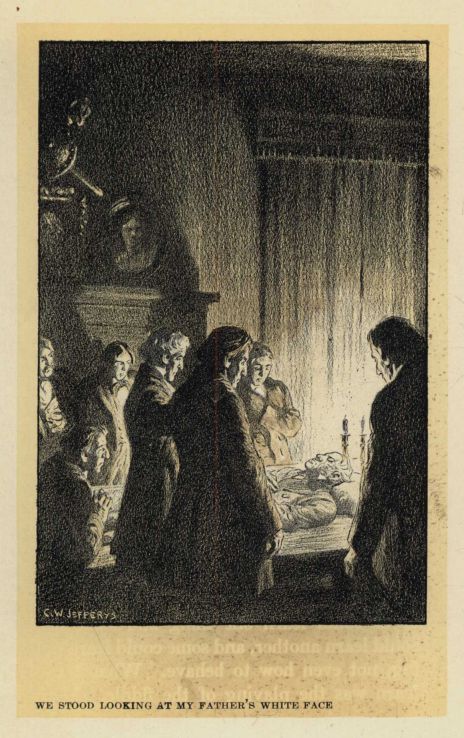
WE STOOD LOOKING AT MY FATHER'S WHITE FACE
"After that you know what happened yourself."
"Well I do, Mr. McNeil. It was Great Godfrey that was the father to you all," said my cousin.
"Just that, Aleck McTavish. All that he had was ours to use as we would,—his land, money, horses, this room, his learning. Some of us could learn one thing and some of us could learn another, and some could learn nothing, not even how to behave. What I could learn was the playing of the fiddle. Many's the hour Godfrey would play with me while the rest were all happy around.
"In great content we lived like brothers, and proud to see Godfrey as white and fine and grand as the best gentleman that ever came up to visit him out of Montreal. Ay, in great content we lived all together till the consumption came on Donald, and he was gone. Then it came and came back, and came back again, till Hector was gone, and Ranald was gone, and in ten years' time only Godfrey and I were left. Then both of us married, as you know. But our children died as fast as they were born, almost,—for the curse seemed on us. Then his wife died, and Godfrey sighed and sighed ever after that.
"One night I was sleeping with the door of my room open, so I could hear if Godfrey needed my help. The cough was on him then. Out of a dream of him looking at my father's white face I woke and went to his bed. He was not there at all.
"My heart went cold with fear, for I heard the rapid very clear, like the nights they all died. Then I heard the music begin down stairs, here in this chamber where they were all laid out dead,—right here on this table where I will soon lie like the rest. I leave it to you to see it done, Aleck McTavish, for you are a Highlandman by blood. It was that I wanted to say to you when I called you in. I have seen himself in my coffin three nights. Nay, say nothing; you will see.
"Hearing the music that night, down I came softly. Here sat Godfrey, and the kindest look was on his face that ever I saw. He had his fiddle in his hand, and he played about all our lives.
"He played about how we all came down from the North in the big canoe with my father and mother, when we were little children and him a baby. He played of the rapids we passed over, and of the rustling of the poplar-trees and the purr of the pines. He played till the river you hear now was in the fiddle, with the sound of our paddles, and the fish jumping for flies. He played about the long winters when we were young, so that the snow of those winters seemed falling again. The ringing of our skates on the ice I could hear in the fiddle. He played through all our lives when we were young and going in the woods yonder together and then it was the sore lament began!
"It was like as if he played how they kept him away from his brothers, and him at his books thinking of them in the woods, and him hearing the partridges' drumming, and the squirrels' chatter, and all the little birds singing and singing. Oich, man, but there's no words for the sadness of it!"
Old Angus ceased to speak as he took his violin from the table and struck into the middle of "Great Godfrey's Lament." As he played, his wide eyes looked past us, and the tears streamed down his brown cheeks. When the woful strain ended, he said, staring past us: "Ay, Godfrey, you were always our brother."
Then he put his face down in his big brown hands, and we left him without another word.
McGRATH'S BAD NIGHT
"Come, then, childer," said Mrs. McGrath, and took the big iron pot off. They crowded around her, nine of them, the eldest not more than thirteen, the youngest just big enough to hold out his yellow crockery bowl.
"The youngest first," remarked Mrs. McGrath, and ladled out a portion of the boiled cornmeal to each of the deplorable boys and girls. Before they reached the stools from which they had sprung up, or squatted again on the rough floor, they all burned their mouths in tasting the mush too eagerly. Then there they sat, blowing into their bowls, glaring into them, lifting their loaded iron spoons occasionally to taste cautiously, till the mush had somewhat cooled.
Then, gobble-de-gobble-de-gobble, it was all gone! Though they had neither sugar, nor milk, nor butter to it, they found it a remarkably excellent sample of mush, and wished only that, in quantity, it had been something more.
Peter McGrath sat close beside the cooking-stove, holding Number Ten, a girl-baby, who was asleep, and rocking Number Eleven, who was trying to wake up, in the low, unpainted cradle. He never took his eyes off Number Eleven; he could not bear to look around and see the nine devouring the corn-meal so hungrily. Perhaps McGrath could not, and certainly he would not,—he was so obstinate,—have told why he felt so reproached by the scene. He had felt very guilty for many weeks.