OLD MAN SAVARIN STORIES (continued 2)
Reading edition
Twenty, yes, a hundred times a day he looked in a dazed way at his big hands, and they reproached him, too, that they had no work.
"Where is our smooth, broad-axe handle?" asked the fingers, "and why do not the wide chips fly?"
He was ashamed, too, every time he rose up, so tall and strong, with nothing to do, and eleven children and his wife next door to starvation; but if he had been asked to describe his feelings, he would merely have growled out angrily something against old John Pontiac.
"You'll take your sup now, Peter?" asked Mrs. McGrath, offering him the biggest of the yellow bowls. He looked up then, first at her forlorn face, then at the pot. Number Nine was diligently scraping off some streaks of mush that had run down the outside; Numbers Eight, Seven, Six, and Five were looking respectfully into the pot; Numbers Four, Three, Two, and One were watching the pot, the steaming bowl, and their father at the same time. Peter McGrath was very hungry.
"Yourself had better eat, Mary Ann," he said. "I'll be having mine after it's cooler."
Mrs. McGrath dipped more than a third of the bowlful back into the pot, and ate the rest with much satisfaction. The numerals watched her anxiously but resignedly.
"Sure it'll be cold entirely, Peter, dear," she said, "and the warmth is so comforting. Give me little Norah now, the darlint! and be after eating your supper."
She had ladled out the last spoonful of mush, and the pot was being scraped inside earnestly by Nine, Eight, Seven, and Six. Peter took the bowl, and looked at his children.
The earlier numbers were observing him with peculiar sympathy, putting themselves in his place, as it were, possessing the bowl in imagination; the others now moved their spoons absent-mindedly around in the pot, brought them empty to their mouths, mechanically, now and again, sucked them more or less, and still stared steadily at their father.
His inner walls felt glued together, yet indescribably hollow; the smell of the mush went up into his nostrils, and pungently provoked his palate and throat. He was famishing.
"Troth, then, Mary Ann," he said, "there's no hunger in me to-night. Sure, I wish the childer wouldn't leave me the trouble of eating it. Come, then, all of ye!"
The nine came promptly to his call. There were just twenty-two large spoonfuls in the bowl; each child received two; the remaining four went to the four youngest. Then the bowl was skilfully scraped by Number Nine, after which Number Seven took it, whirled a cup of water artfully round its interior, and with this put a fine finish on his meal.
Peter McGrath then searched thoughtfully in his trousers pockets, turning their corners up, getting pinches of tobacco dust out of their remotest recesses; he put his blouse pocket through a similar process. He found no pockets in his well-patched overcoat when he took it down, but he pursued the dust into its lining, and separated it carefully from little dabs of wool. Then he put the collection into an extremely old black clay pipe, lifted a coal in with his fingers, and took his supper.
It would be absurd to assert that, on this continent, a strong man could be so poor as Peter, unless he had done something very wrong or very foolish. Peter McGrath was, in truth, out of work because he had committed an outrage on economics. He had been guilty of the enormous error of misunderstanding, and trying to set at naught in his own person, the immutable law of supply and demand.
Fancying that a first-class hewer in a timber shanty had an inalienable right to receive at least thirty dollars a month, when the demand was only strong enough to yield him twenty-two dollars a month, Peter had refused to engage at the beginning of the winter.
"Now, Mr. McGrath, you're making a mistake," said his usual employer, old John Pontiac. "I'm offering you the best wages going, mind that. There's mighty little squared timber coming out this winter."
"I'm ready and willing to work, boss, but I'm fit to arn thirty dollars, surely."
"So you are, so you are, in good times, neighbor, and I'd be glad if men's wages were forty. That could only be with trade active, and a fine season for all of us; but I couldn't take out a raft this winter, and pay what you ask."
"I'd work extra hard. I'm not afeard of work."
"Not you, Peter. There never was a lazy bone in your body. Don't I know that well? But look, now: if I was to pay you thirty, I should have to pay all the other hewers thirty; and that's not all. Scorers and teamsters and road-cutters are used to getting wages in proportion to hewers. Why, it would cost me a thousand dollars a month to give you thirty! Go along, now, that's a good fellow, and tell your wife that you've hired with me."
But Peter did not go back. "I'm bound to have my rights, so I am," he said sulkily to Mary Ann when he reached the cabin. "The old boss is getting too hard like, and set on money. Twenty-two dollars! No! I'll go in to Stambrook and hire."
Mary Ann knew that she might as well try to convince a saw-log that its proper course was up-stream, as to protest against Peter's obstinacy. Moreover, she did think the offered wages very low, and had some hope he might better himself; but when he came back from Stambrook, she saw trouble ahead. He did not tell her that there, where his merits were not known, he had been offered only twenty dollars, but she surmised his disappointment.
"You'd better be after seeing the boss again, maybe, Peter dear," she said timidly.
"Not a step," he answered. "The boss'll be after me in a few days, you'll see." But there he was mistaken, for all the gangs were full.
After that Peter McGrath tramped far and wide, to many a backwoods hamlet, looking vainly for a job at any wages. The season was the worst ever known on the river, and before January the shanties were discharging men, so threatening was the outlook for lumbermen, and so glutted with timber the markets of the world.
Peter's conscience accused him every hour, but he was too stubborn to go back to John Pontiac. Indeed, he soon got it into his stupid head that the old boss was responsible for his misfortunes, and he consequently came to hate Mr. Pontiac very bitterly.
After supping on his pipeful of tobacco-dust, Peter sat, straight-backed, leaning elbows on knees and chin on hands, wondering what on earth was to become of them all next day. For a man out of work there was not a dollar of credit at the little village store; and work! why, there was only one kind of work at which money could be earned in that district in the winter.
When his wife took Number Eleven's cradle into the other room, she heard him, through the thin partition of upright boards, pasted over with newspapers, moving round in the dim red flickering fire-light from the stove-grating.
The children were all asleep, or pretending it; Number Ten in the big straw bed, where she lay always between her parents; Number Eleven in her cradle beside; Nine crosswise at the foot; Eight, Seven, Six, Five, and Four in the other bed; One, Two, and Three curled up, without taking off their miserable garments, on the "locks" of straw beside the kitchen stove.
Mary Ann knew very well what Peter was moving round for. She heard him groan, so low that he did not know he groaned, when he lifted off the cover of the meal barrel, and could feel nothing whatever therein. She had actually beaten the meal out of the cracks to make that last pot of mush. He knew that all the fish he had salted down in the summer were gone, that the flour was all out, that the last morsel of the pig had been eaten up long ago; but he went to each of the barrels as though he could not realize that there was really nothing left. There were four of those low groans.
"O God, help him! do help him! please do!" she kept saying to herself. Somehow, all her sufferings and the children's were light to her, in comparison, as she listened to that big, taciturn man groan, and him sore with the hunger.
When at last she came out, Peter was not there. He had gone out silently, so silently that she wondered, and was scared. She opened the door very softly, and there he was, leaning on the rail fence between their little rocky plot and the great river. She closed the door softly, and sat down.
There was a wide steaming space in the river, where the current ran too swiftly for any ice to form. Peter gazed on it for a long while. The mist had a friendly look; he was soon reminded of the steam from an immense bowl of mush! It vexed him. He looked up at the moon. The moon was certainly mocking him; dashing through light clouds, then jumping into a wide, clear space, where it soon became motionless, and mocked him steadily.
He had never known old John Pontiac to jeer any one, but there was his face in that moon,—Peter made it out quite clearly. He looked up the road to where he could see, on the hill half a mile distant, the shimmer of John Pontiac's big tin-roofed house. He thought he could make out the outlines of all the buildings,—he knew them so well,—the big barn, the stable, the smoke-house, the store-house for shanty supplies.
Pork barrels, flour barrels, herring kegs, syrup kegs, sides of frozen beef, hams and flitches of bacon in the smoke-house, bags of beans, chests of tea,—he had a vision of them all! Teamsters going off to the woods daily with provisions, the supply apparently inexhaustible.
And John Pontiac had refused to pay him fair wages!
Peter in exasperation shook his big fist at the moon; it mocked him worse than ever. Then out went his gaze to the space of mist; it was still more painfully like mush steam. His pigsty was empty, except of snow; it made him think again of the empty barrels in the cabin.
The children empty too, or would be to-morrow,—as empty as he felt that minute. How dumbly the elder ones would reproach him! and what would comfort the younger ones crying with hunger?
Peter looked again up the hill, through the walls of the store-house. He was dreadfully hungry.
"John! John!" Mrs. Pontiac jogged her husband. "John, wake up! there's somebody trying to get into the smoke-house."
"Eh—ugh—ah! I'm 'sleep—ugh." He relapsed again.
"John! John! wake up! There is somebody!"
"What—ugh—eh—what you say?"
"There's somebody getting into the smoke-house."
"Well, there's not much there."
"There's ever so much bacon and ham. Then there's the store-house open."
"Oh, I guess there's nobody."
"But there is, I'm sure. You must get up!"
They both got up and looked out of the window. The snow-drifts, the paths through them, the storehouse, the smoke-house, and the other white-washed out-buildings could be seen as clearly as in broad day. The smoke-house door was open!
Old John Pontiac was one of the kindest souls that ever inhabited a body, but this was a little too much. Still he was sorry for the man, no matter who, in that smoke-house,—some Indian probably. He must be caught and dealt with firmly; but he did not want the man to be too much hurt.
He put on his clothes and sallied forth. He reached the smoke-house; there was no one in it; there was a gap, though, where two long flitches of bacon had been!
John Pontiac's wife saw him go over to the store-house, the door of which was open too. He looked in, then stopped, and started back as if in horror. Two flitches tied together with a rope were on the floor, and inside was a man filling a bag with flour from a barrel.
"Well, well! this is a terrible thing," said old John Pontiac to himself, shrinking around a corner. "Peter McGrath! Oh, my! oh, my!"
He became hot all over, as if he had done something disgraceful himself. There was nobody that he respected more than that pig-headed Peter. What to do? He must punish him of course; but how? Jail?—for him with eleven children! "Oh, my! oh, my!" Old John wished he had not been awakened to see this terrible downfall.
"It will never do to let him go off with it," he said to himself after a little reflection. "I'll put him so that he'll know better another time."
Peter McGrath, as he entered the store-house, had felt that bacon heavier than the heaviest end of the biggest stick of timber he had ever helped to cant. He felt guilty, sneaking, disgraced; he felt that the literal Devil had first tempted him near the house, then all suddenly—with his own hunger pangs and thoughts of his starving family—swept him into the smoke-house to steal. But he had consented to do it; he had said he would take flour too,—and he would, he was so obstinate! And withal, he hated old John Pontiac worse than ever; for now he accused him of being the cause of his coming to this.
Then all of a sudden he met the face of Pontiac looking in at the door.
Peter sprang back; he saw Stambrook jail—he saw his eleven children and his wife—he felt himself a detected felon, and that was worst of all.
"Well, Peter, you'd ought to have come right in," were the words that came to his ears, in John Pontiac's heartiest voice. "The missis would have been glad to see you. We did go to bed a bit early, but there wouldn't have been any harm in an old neighbor like you waking us up. Not a word of that—hold on! listen to me. It would be a pity if old friends like you and me, Peter, couldn't help one another to a trifling loan of provisions without making a fuss over it." And old John, taking up the scoop, went on filling the bag as if that were a matter of course.
Peter did not speak; he could not.
"I was going round to your place to-morrow," resumed John, cheerfully, "to see if I couldn't hire you again. There's a job of hewing for you in the Conlonge shanty,—a man gone off sick. But I can't give more'n twenty-two, or say twenty-three, seeing you're an old neighbor. What do you say?"
Peter still said nothing; he was choking.
"You had better have a bit of something more than bacon and flour, Peter," he went on, "and I'll give you a hand to carry the truck home. I guess your wife won't mind seeing me with you; then she'll know that you've taken a job with me again, you see. Come along and give me a hand to hitch the mare up. I'll drive you down."
"Ah—ah—Boss—Boss!" spoke Peter then, with terrible gasps between. "Boss—O, my God, Mr. Pontiac—I can't never look you in the face again!"
"Peter McGrath—old neighbor,"—and John Pontiac laid his hand on the shaking shoulder,—"I guess I know all about it; I guess I do. Sometimes a man is driven he don't know how. Now we will say no more about it. I'll load up, and you come right along with me. And mind, I'll do the talking to your wife."
Mary Ann McGrath was in a terrible frame of mind. What had become of Peter?
She had gone out to look down the road, and had been recalled by Number Eleven's crying. Number Ten then chimed in; Nine, too, awoke, and determined to resume his privileges as an infant. One after another they got up and huddled around her—craving, craving,—all but the three eldest, who had been well practised in the stoical philosophy by the gradual decrease of their rations. But these bounced up suddenly at the sound of a grand jangle of bells.
Could it be? Mr. Pontiac they had no doubt about; but was that real bacon that he laid on the kitchen table? Then a side of beef, a can of tea; next a bag of flour, and again an actual keg of sirup. Why, this was almost incredible! And, last, he came in with an immense round loaf of bread! The children gathered about it; old John almost sickened with sorrow for them, and hurrying out his jackknife, passed big hunks around.
"Well, now, Mrs. McGrath," he said during these operations, "I don't hardly take it kindly of you and Peter not to have come up to an old neighbor's house before this for a bit of a loan. It's well I met Peter to-night. Maybe he'd never have told me your troubles—not but what I blame myself for not suspecting how it was a bit sooner. I just made him take a little loan for the present. No, no; don't be talking like that! Charity! tut! tut! it's just an advance of wages. I've got a job for Peter; he'll be on pay to-morrow again."
At that Mary Ann burst out crying again. "Oh, God bless you, Mr. Pontiac! it's a kind man you are! May the saints be about your bed!"
With that she ran out to Peter, who still stood by the sleigh; she put the baby in his arms, and clinging to her husband's shoulder, cried more and more.
And what did obstinate Peter McGrath do? Why, he cried, too, with gasps and groans that seemed almost to kill him.
"Go in," he said; "go in, Mary Ann—go in—and kiss—the feet of him. Yes—and the boards—he stands on. You don't know what he's done—for me. It's broke I am—the bad heart of me—broke entirely—with the goodness of him. May the heavens be his bed!"
"Now, Mrs. McGrath," cried old John, "never you mind Peter; he's a bit light-headed to-night. Come away in and get a bite for him. I'd like a dish of tea myself before I go home." Didn't that touch on her Irish hospitality bring her in quickly!
"Mind you this, Peter," said the old man, going out then, "don't you be troubling your wife with any little secrets about to-night; that's between you and me. That's all I ask of you."
Thus it comes about that to this day, when Peter McGrath's fifteen children have helped him to become a very prosperous farmer, his wife does not quite understand the depth of worship with which he speaks of old John Pontiac.
Mrs. Pontiac never knew the story of the night.
"Never mind who it was, Jane," John said, turning out the light, on returning to bed, "except this,—it was a neighbor in sore trouble."
"Stealing—and you helped him! Well, John, such a man as you are!"
"Jane, I don't ever rightly know what kind of a man I might be, suppose hunger was cruel on me, and on you, and all of us! Let us bless God that he's saved us from the terriblest temptations, and thank him most especially when he inclines our hearts—inclines our hearts—that's all."
SHINING CROSS OF RIGAUD
I
When Mini was a fortnight old his mother wrapped her head and shoulders in her ragged shawl, snatched him from the family litter of straw, and, with a volley of cautionary objurgations to his ten brothers and sisters, strode angrily forth into the raw November weather. She went down the hill to the edge of the broad, dark Ottawa, where thin slices of ice were swashing together. There sat a hopeless-looking little man at the clumsy oars of a flat-bottomed boat.
"The little one's feet are out," said the man.
"So much the better! For what was another sent us?" cried Mini's mother.
"But the little one must be baptized," said the father, with mild expostulation.
"Give him to me, then," and the man took off his own ragged coat. Beneath it he had nothing except an equally ragged guernsey, and the wind was keen. The woman surrendered the child carelessly, and drawing her shawl closer, sat frowning moodily in the stern. Mini's father wrapped him in the wretched garment, carefully laid the infant on the pea-straw at his feet, and rowed wearily away.
They took him to the gray church on the farther shore, whose tall cross glittered coldly in the wintry sun. There Madame Lajeunesse, the skilful washerwoman, angry to be taken so long from her tubs, and Bonhomme Hamel, who never did anything but fish for barbotes, met them. These highly respectable connections of Mini's mother had a disdain for her inferior social status, and easily made it understood that nothing but a Christian duty would have brought them out. Where else, indeed, could the friendless infant have found sponsors? It was disgraceful, they remarked, that the custom of baptism at three days old should have been violated. While they answered for Mini's spiritual development he was quiet, neither crying nor smiling till the old priest crossed his brow. Then he smiled, and that, Bonhomme Hamel remarked, was a blessed sign.
"Now he's sure of heaven when he does die!" cried Mini's mother, getting home again, and tossed him down on the straw, for a conclusion to her sentence.
But the child lived, as if by miracle. Hunger, cold, dirt, abuse, still left him a feeble vitality. At six years old his big dark eyes wore so sad a look that mothers of merry children often stopped to sigh over him, frightening the child, for he did not understand sympathy. So unresponsive and dumb was he that they called him half-witted. Three babies younger than he had died by then, and the fourth was little Angélique. They said she would be very like Mini, and there was reason why in her wretched infancy. Mini's was the only love she ever knew. When she saw the sunny sky his weak arms carried her, and many a night he drew over her the largest part of his deplorable coverings. She, too, was strangely silent. For days long they lay together on the straw, quietly suffering what they had known from the beginning. It was something near starvation.
When Mini was eight years old his mother sent him one day to beg food from Madame Leclaire, whose servant she had been long ago.
"It's Lucile's Mini," said Madame, taking him to the door of the cosey sitting-room, where Monsieur sat at solitaire.
"Mon Dieu, did one ever see such a child!" cried the retired notary. "For the love of Heaven, feed him well, Marie, before you let him go!"
But Mini could scarcely eat. He trembled at the sight of so much food, and chose a crust as the only thing familiar.
"Eat, my poor child. Have no fear," said Madame.
"But Angélique," said he.
"Angélique? Is it the baby?"
"Yes, Madame, if I might have something for her."
"Poor little loving boy," said Madame, tears in her kind eyes. But Mini did not cry; he had known so many things so much sadder.
When Mini reached home his mother seized the basket. Her wretched children crowded around. There were broken bread and meat in plenty. "Here—here—and here!" She distributed crusts, and chose a well-fleshed bone for her own teeth. Angélique could not walk, and did not cry, so got nothing.. Mini, however, went to her with the tin pail before his mother noticed it.
"Bring that back!" she shouted.
"Quick, baby!" cried Mini, holding it that Angélique might drink. But the baby was not quick enough. Her mother seized the pail and tasted; the milk was still almost warm. "Good," said she, reaching for her shawl.
"For the love of God, mother!" cried Mini, "Madame said it was for Angélique." He knew too well what new milk would trade for. The woman laughed and flung on her shawl.
"Only a little, then; only a cupful," cried Mini, clutching her, struggling weakly to restrain her. "Only a little cupful for Angélique."
"Give her bread!" She struck him so that he reeled, and left the cabin. Then Mini cried, but not for the blow.
He placed a soft piece of bread and a thin shred of meat in Angélique's thin little hand, but she could not eat, she was so weak. The elder children sat quietly devouring their food, each ravenously eyeing that of the others. But there was so much that when the father came he also could eat. He, too, offered Angélique bread. Then Mini lifted his hand which held hers, and showed beneath the food she had refused.
"If she had milk!" said the boy.
"My God, if I could get some," groaned the man, and stopped as a shuffling and tumbling was heard at the door.
"She is very drunk," said the man, without amazement. He helped her in, and, too far gone to abuse them, she soon lay heavily breathing near the child she had murdered.
Mini woke in the pale morning thinking Angélique very cold in his arms, and, behold, she was free from all the suffering forever. So he could not cry, though the mother wept when she awoke, and shrieked at his tearlessness as hardhearted.
Little Angélique had been rowed across the great river for the last time; night was come again, and Mini thought he must die; it could not be that he should be made to live without Angélique! Then a wondrous thing seemed to happen. Little Angélique had come back. He could not doubt it next morning, for, with the slowly lessening glow from the last brands of fire had not her face appeared?—then her form?—and lo! she was closely held in the arms of the mild Mother whom Mini knew from her image in the church, only she smiled more sweetly now in the hut. Little Angélique had learned to smile, too, which was most wonderful of all to Mini. In their heavenly looks was a meaning of which he felt almost aware; a mysterious happiness was coming close and closer; with the sense of ineffable touches near his brow, the boy dreamed. Nothing more did Mini know till his mother's voice woke him in the morning. He sprang up with a cry of "Angélique," and gazed round upon the familiar squalor.
II
From the summit of Rigaud Mountain a mighty cross flashes sunlight all over the great plain of Vaudreuil. The devout habitant, ascending from vale to hill-top in the county of Deux Montagnes, bends to the sign he sees across the forest leagues away. Far off on the brown Ottawa, beyond the Cascades of Carillon and the Chute à Blondeau, the keen-eyed voyageur catches its gleam, and, for gladness to be nearing the familiar mountain, more cheerily raises the chanson he loves. Near St. Placide the early ploughman—while yet mist wreathes the fields and before the native Rossignol has fairly begun his plaintive flourishes—watches the high cross of Rigaud for the first glint that shall tell him of the yet unrisen sun. The wayfarer marks his progress by the bearing of that great cross, the hunter looks to it for an unfailing landmark, the weatherwise farmer prognosticates from its appearances. The old watch it dwindle from sight at evening with long thoughts of the well-beloved vanished, who sighed to its vanishing through vanished years; the dying turn to its beckoning radiance; happy is the maiden for whose bridal it wears brightness; blessed is the child thought to be that holds out tiny hands for the glittering cross as for a star. Even to the most worldly it often seems flinging beams of heaven, and to all who love its shining that is a dark day when it yields no reflection of immortal meaning.
To Mini the Cross of Rigaud had as yet been no more than an indistinct glimmering, so far from it did he live and so dulled was he by his sufferings. It promised him no immortal joys, for how was he to conceive of heaven except as a cessation of weariness, starvation, and pain? Not till Angélique had come in the vision did he gain certainty that in heaven she would smile on him always from the mild Mother's arms. As days and weeks passed without that dream's return, his imagination was ever the more possessed by it. Though the boy looked frailer than ever, people often remarked with amazement how his eyes wore some unspeakable happiness.
Now it happened that one sunny day after rain Mini became aware that his eyes were fixed on the Cross of Rigaud. He could not make out its form distinctly, but it appeared to thrill toward him. Under his intent watching the misty cross seemed gradually to become the centre of such a light as had enwrapped the figures of his dream. While he gazed, expecting his vision of the night to appear in broad day on the far summit, the light extended, changed, rose aloft, assumed clear tints, and shifted quickly to a great rainbow encircling the hill.
Mini believed it a token to him. That Angélique had been there by the cross the little dreamer doubted not, and the transfiguration to that arch of glory had some meaning that his soul yearned to apprehend. The cross drew his thoughts miraculously; for days thereafter he dwelt with its shining; more and more it was borne in on him that he could always see dimly the outline of little Angélique's face there; sometimes, staring very steadily for minutes together, he could even believe that she beckoned and smiled.
"Is Angélique really there, father?" he asked one day, looking toward the hill-top.
"Yes, there," answered his father, thinking the boy meant heaven.
"I will go to her, then," said Mini to his heart.
Birds were not stirring when Mini stepped from the dark cabin into gray dawn, with firm resolve to join Angélique on the summit. The Ottawa, with whose flow he went toward Rigaud, was solemnly shrouded in motionless mist, which began to roll slowly during the first hour of his journey. Lifting, drifting, clinging, ever thinner and more pervaded by sunlight, it was drawn away so that the unruffled flood reflected a sky all blue when he had been two hours on the road. But Mini took no note of the river's beauty. His eyes were fixed on the cloudy hilltop, beyond which the sun was climbing. As yet he could see nothing of the cross, nor of his vision; yet the world had never seemed so glad, nor his heart so light with joy. Habitants, in their rattling calèches, were amazed by the glow in the face of a boy so ragged and forlorn. Some told afterward how they had half doubted the reality of his rags; for might not one, if very pure at heart, have been privileged to see such garments of apparent meanness change to raiment of angelic texture? Such things had been, it was said, and certainly the boy's face was a marvel.
His look was ever upward to where fibrous clouds shifted slowly, or packed to level bands of mist half concealing Rigaud Hill, as the sun wheeled higher, till at last, in mid-sky, it flung rays that trembled on the cross, and gradually revealed the holy sign outlined in upright and arms. Mini shivered with an awe of expectation; but no nimbus was disclosed which his imagination could shape to glorious significance. Yet he went rapturously onward, firm in the belief that up there he must see Angèlique face to face.
As he journeyed the cross gradually lessened in height by disappearance behind the nearer trees, till only a spot of light was left, which suddenly was blotted out too. Mini drew a deep breath, and became conscious of the greatness of the hill,—a towering mass of brown rock, half hidden by sombre pines and the delicate greenery of birch and poplar. But soon, because the cross was hidden, he could figure it all the more gloriously, and entertain all the more luminously the belief that there were heavenly presences awaiting him. He pressed on with all his speed, and began to ascend the mountain early in the afternoon.
"Higher," said the women gathering pearly-bloomed blueberries on the steep hillside. "Higher," said the path, ever leading the tired boy upward from plateau to plateau,—"higher, to the vision and the radiant space about the shining cross!"
Faint with hunger, worn with fatigue, in the half-trance of physical exhaustion, Mini still dragged himself upward through the afternoon. At last he knew he stood on the summit level very near the cross. There the child, awed by the imminence of what he had sought, halted to control the rapturous, fearful trembling of his heart. Would not the heavens surely open? What words would Angélique first say? Then again he went swiftly forward through the trees to the edge of the little cleared space. There he stood dazed.
The cross was revealed to him at a few yards' distance. With woful disillusionment Mini threw himself face downward on the rock, and wept hopelessly, sorely; wept and wept, till his sobs became fainter than the up-borne long notes of a hermit-thrush far below on the edge of the plain.
A tall mast, with a shorter at right angles, both covered by tin roofing-plates, held on by nails whence rust had run in streaks,—that was the shining Cross of Rigaud! Fragments of newspaper, crusts of bread, empty tin cans, broken bottles, the relics of many picnics scattered widely about the foot of the cross; rude initial letters cut deeply into its butt where the tin had been torn away;—these had Mini seen.
The boy ceased to move. Shadows stole slowly lengthening over the Vaudreuil champaign; the sun swooned down in a glamour of painted clouds; dusk covered from sight the yellows and browns and greens of the August fields; birds stilled with the deepening night; Rigaud Mountain loomed from the plain, a dark long mass under a flying and waning moon; stars came out from the deep spaces overhead, and still Mini lay where he had wept.
DOUR DAVIE'S DRIVE
Pinnager was on snow-shoes, making a bee-line toward his field of sawlogs dark on the ice of Wolverine River. He crossed shanty roads, trod heaps of brush, forced his way through the tops of felled pines, jumped from little crags into seven feet of snow—Pinnager's men called him "a terror on snow-shoes." They never knew the direction from which he might come—an ignorance which kept them all busy with axe, saw, cant-hook, and horses over the two square miles of forest comprising his "cut."
It was "make or break" with Pinnager. He had contracted to put on the ice all the logs he might make; for every one left in the woods he must pay stumpage and forfeit. Now his axemen had done such wonders that Pinnager's difficulty was to get his logs hauled out.
Teams were scarce that winter. The shanty was eighty miles from any settlement; ordinary teamsters were not eager to work for a small speculative jobber, who might or might not be able to pay in the spring. But Pinnager had some extraordinary teamsters, sons of farmers who neighbored him at home, and who were sure he would pay them, though he should have to mortgage his land.
The time was late February; seven feet of snow, crusted, on the level; a thaw might turn the whole forest floor to slush; but if the weather should "hold hard" for six weeks longer, Pinnager might make and not break. Yet the chances were heavily against him.
Any jobber so situated would feel vexed on hearing that one of his best teams had suddenly been taken out of his service. Pinnager, crossing a shanty road with the stride of a moose, was hailed by Jamie Stuart with the news:
"Hey, boss, hold on! Davie McAndrews' leg's broke. His load slewed at the side hill—log catched him against a tree."
"Where is he?" shouted Pinnager furiously.
"Carried him to shanty."
"Where are his horses?"
"Stable."
"Tell Aleck Dunbar to go get them out. He must take Davie's place—confound the lad's carelessness!"
"Davie says no; won't let any other man drive his horses."
"He won't? I'll show him!" and Pinnager made a bee-line for his shanty. He was choking with rage, all the more so because he knew that nothing short of breaking Davie McAndrews' neck would break Davie McAndrews' stubbornness, a reflection that cooled Pinnager before he reached the shanty.
The cook was busy about the caboose fire, getting supper for fifty-three devourers, when Pinnager entered the low door, and made straight for one of the double tier of dingy bunks. There lay a youth of eighteen, with an unusual pallor on his weather-beaten face, and more than the usual sternness about his formidable jaw.
"What's all this, Davie? You sure the leg's broke? I'd 'a thought you old enough to take care."
"You would?" said Davie grimly. "And yourself not old enough to have yon piece of road mended—you that was so often told about it!"
"When you knew it was bad, the more you should take care."
"And that's true, Pinnager. But no use in you and me choppin' words. I'm needing a doctor's hands on me. Can you set a bone?"
"No, I'll not meddle with it. Maybe Jock Scott can; but I'll send you out home. A fine loss I'll be at! Confound it—and me like to break for want of teams!"
"I've thocht o' yer case, Pinnager," said Davie, with a curious judicial air. "It's sore hard for ye; I ken that well. There's me and me feyther's horses gawn off, and you countin' on us. I feel for ye, so I do. But I'll no put you to ony loss in sendin' me out."
"Was you thinking to tough it through here, Davie? No, you'll not chance it. Anyway, the loss would be the same—more, too. Why, if I send out for the doctor, there's a team off for full five days, and the expense of the doctor! Then he mightn't come. Wow, no! it's out you must go."
"What else?" said Davie coolly. "Would I lie here till spring and my leg mendin' into the Lord kens what-like shape? Would I be lettin' ony ither drive the horses my feyther entrustit to my lone? Would I be dependin' on Mr. Pinnager for keep, and me idle? Man, I'd eat the horses' heads off that way; at home they'd be profit to my feyther. So it's me and them that starts at gray the morn's morn."
"Alone!" exclaimed Pinnager.
"Just that, man. What for no?"
"You're light-headed, Davie. A lad with his leg broke can't drive three days."
"Maybe yes and maybe no. I'm for it, onyhow."
"It may snow, it may——"
"Aye, or rain, or thaw, or hail; the Lord's no in the habit o' makin' weather suit ony but himsel'. But I'm gawn; the cost of a man wi' me would eat the wages ye're owing my feyther."
"I'll lose his team, anyhow," said Pinnager, "and me needing it bad. A driver with you could bring back the horses."
"Nay, my feyther will trust his beasts to nane but himsel' or his sons. But I'll have yer case in mind, Pinnager; it's a sore needcessity you're in. I'll ask my feyther to send back the team, and another to the tail of it; it's like that Tam and Neil will be home by now. And I'll spread word how ye're needin' teams, Pinnager; it's like your neighbors will send ye in sax or eight spans."
"Man, that's a grand notion, Davie! But you can't go alone; it's clean impossible."
"I'm gawn, Pinnager."
"You can't turn out in seven feet of snow when you meet loading. You can't water or feed your horses. There's forty miles the second day, and never a stopping-place; your horses can't stand it."
"I'm wae for the beasts, Pinnager; but they'll have no force but to travel dry and hungry if that's set for them."
"You're bound to go?"
"Div you tak' me for an idjit to be talkin' and no meanin' it? Off wi' ye, man! The leg's no exactly a comfort when I'm talkin'."
"Why, Davie, it must be hurting you terrible!" Pinnager had almost forgotten the broken leg, such was Davie's composure.
"It's no exactly a comfort, I said. Get you gone, Pinnager; your men may be idlin'. Get you gone, and send in Jock Scott, if he's man enough to handle my leg. I'm wearyin' just now for my ain company."
As Davie had made his programme, so it stood. His will was inflexible to protests. Next morning at dawn they set him on a hay-bed in his low, unboxed sleigh. A bag of oats supported his back; his unhurt leg was braced against a piece of plank spiked down. Jock Scott had pulled the broken bones into what he thought their place, and tied that leg up in splints of cedar.
The sleigh was enclosed by stakes, four on each side, all tied together by stout rope. The stake at Davie's right hand was shortened, that he might hang his reins there. His water-bucket was tied to another stake, and his bag of provisions to a third. He was warm in a coon-skin coat, and four pairs of blankets under or over him.
At the last moment Pinnager protested: "I must send a man to drive. It sha'n't cost you a cent, Davie."
"Thank you, kindly, Pinnager," said Davie gravely. "I'll tell that to your credit at the settlement. But ye're needin' all your help, and I'd take shame to worsen your chances. My feyther's horses need no drivin' but my word."
Indeed, they would "gee," "haw," or "whoa" like oxen, and loved his voice. Round-barrelled, deep-breathed, hardy, sure-footed, active, gentle, enduring, brave, and used to the exigencies of "bush roads," they would take him through safely if horses' wit could.
Davie had uttered never a groan after those involuntary ones forced from him when the log, driving his leg against a tree, had made him almost unconscious. But the pain-sweat stood beaded on his face during the torture of carrying him to the sleigh. Not a sound from his lips, though! They could guess his sufferings from naught but his hard breathing through the nose, that horrible sweat, and the iron set of his jaw. After they had placed him, the duller agony that had kept him awake all night returned; he smiled grimly, and said, "That's a comfort."
He had eaten and drunk heartily; he seemed strong still; but what if his sleigh should turn over at some sidling place of the rude, lonely, and hilly forest road?
As Davie chirruped to his horses and was off, the men gave him a cheer; then Pinnager and all went away to labor fit for mighty men, and the swinging of axes and the crashing of huge pines and the tumbling of logs from rollways left them fancy-free to wonder how Davie could ever brace himself to save his broken leg at the cahots.
The terrible cahots—plunges in snow-roads! But for them Davie would have suffered little more than in a shanty bunk. The track was mostly two smooth ruts separated by a ridge so high and hard that the sleigh-bottom often slid on it. Horses less sure-footed would have staggered much, and bitten crossly at one another while trotting in those deep, narrow ruts, but Davie's horses kept their "jog" amiably, tossing their heads with glee to be traveling toward home.
The clink of trace-chains, the clack of harness, the glide of runners on the hard, dry snow, the snorting of the frosty-nosed team, the long whirring of startled grouse—Davie heard only these sounds, and heard them dreamily in the long, smooth flights between cahots.
Overhead the pine tops were a dark canopy with little fields of clear blue seen through the rifts of green; on the forest floor small firs bent under rounding weights of snow which often slid off as if moved by the stir of partridge wings; the fine tracery of hemlocks stood clean; and birches snuggled in snow that mingled with their curling rags. Sometimes a breeze eddied downward in the aisles, and then all the undergrowth was a silent commotion of snow, shaken and falling. Davie's eyes noted all things unconsciously; in spite of his pain he felt the enchantment of the winter woods until—another cahot! he called his team to walk.
Never was one cahot without many in succession; he gripped his stake hard at each, braced his sound leg, and held on, feeling like to die with the horrible thrust of the broken one forward and then back; yet always his will ordered his desperate senses.
Eleven o'clock! Davie drew up before the half-breed Peter Whiteduck's midwood stopping-place, and briefly explained his situation.
"Give my horses a feed," he went on. "There's oats in this bag. I'll no be moved mysel'. Maybe you'll fetch me a tin of tea; I've got my own provisions." So he ate and drank in the zero weather.
"You'll took lil' drink of whiskey," said Peter, with commiseration, as Davie was starting away.
"I don't use it."
"You'll got for need some 'fore you'll see de Widow Green place. Dass twenty-tree mile."
"I will need it, then," said Davie, and was away.
Evening had closed in when the bunch of teamsters awaiting supper at Widow Green's rude inn heard sleigh-bells, and soon a shout outside:
"Come out, some one!"
That was an insolence in the teamsters' code. Come out, indeed! The Widow Green, bustling about with fried pork, felt outraged. To be called out!—of her own house!—like a dog!—not she!
"Come out here, somebody!" Davie shouted again.
"G' out and break his head one of you," said fighting Moses Frost. "To be shoutin' like a lord!" Moses was too great a personage to go out and wreak vengeance on an unknown.
Narcisse Larocque went—to thrash anybody would be glory for Narcisse, and he felt sure that Moses would not, in these circumstances, let anybody thrash him.'
"What for you shout lak' dat? Call mans hout, hey?" said Narcisse. "I'll got good mind for broke your head, me!"
"Hi, there, men!" Davie ignored Narcisse as he saw figures through the open door. "Some white man come out. My leg's broke."
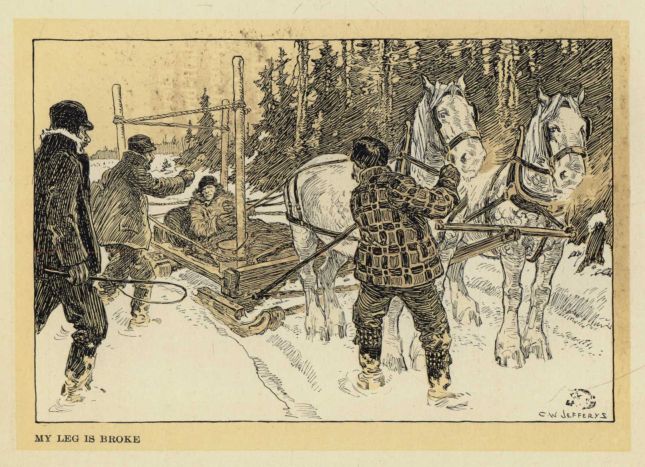
MY LEG IS BROKE
Oh, then the up-jumping of big men! Moses, striding forth, ruthlessly shoved Narcisse, who lay and cowered with legs up as a dog trying to placate an angry master. Then Moses carried Davie in as gently as if the young stalwart had been a girl baby, and laid him on the widow's one spare bed.
That night Davie slept soundly for four hours, and woke to consciousness that his leg was greatly swollen. He made no moan, but lay in the darkness listening to the heavy breathing of the teamsters on the floor. They could do nothing for him; why should he awaken them? As for pitying himself, Davie could do nothing so fruitless. He fell to plans for getting teams in to Pinnager, for this young Scot's practical mind was horrified at the thought that the man should fail financially when ten horses might give him a fine profit for his winter's work.
Davie was away at dawn, every slight jolt giving his swollen leg pain almost unendurable, as if edges of living bone were griding together and also tearing cavities in the living flesh; but he must endure it, and well too, for the teamsters had warned him he must meet "strings of loadin'" this day.
The rule of the long one-tracked road into the wilderness is, of course, that empty outgoing sleighs shall turn out for incoming laden ones. Turn out into seven feet of snow! Davie trusted that incoming teamsters would handle his floundering horses, and he set his mind to plan how they might save him from tumbling about on his turned-out sleigh.
About nine o'clock, on a winding road, he called, "Whoa!" and his bays stood. A sleigh piled with baled hay confronted him thirty yards distant. Four others followed closely; the load drawn by the sixth team was hidden by the woodland curve. No teamsters were visible; they must be walking behind the procession; and Davie wasted no strength in shouting. On came the laden teams, till the steam of the leaders mingled with the clouds blown by his bays. At that halt angry teamsters, yelling, ran forward and sprang, one by one, up on their loads, the last to grasp reins being the leading driver.
"Turn out, you fool!" he shouted. Then to his comrades behind, "There's a blamed idyit don't know enough to turn out for loading!"
Davie said nothing. It was not till one angry man was at his horses' heads and two more about to tumble his sleigh aside that he spoke:
"My leg is broke."
"Gah! G'way! A man driving with his leg broke! You're lying! Come, get out and tramp down snow for your horses! It's your back ought to be broke—stoppin' loadin'!"
"My leg is broke," Davie calmly insisted.
"You mean it?"
Davie threw off his blankets.
"Begor, it is broke!" "And him drivin' himself!" "It's a terror!" "Great spunk entirely!" Then the teamsters began planning to clear the way.
That was soon settled by Davie's directions: "Tramp down the crust for my horses; onhitch them; lift my sleigh out on the crust; pass on; then set me back on the road."
Half an hour was consumed by the operation—thrice repeated before twelve o'clock. Fortunately Davie came on the last "string" of teams halted for lunch by the edge of a lake. The teamsters fed and watered his horses, gave him hot tea, and with great admiration saw him start for an afternoon drive of twenty-two miles.
"You'll not likely meet any teams," they said. "The last of the 'loading' that's like to come in soon is with ourselves."
How Davie got down the hills, up the hills, across the rivers and over the lakes of that terrible afternoon he could never rightly tell.
"I'm thinkin' I was light-heided," he said afterward. "The notion was in me somehow that the Lord was lookin' to me to save Pinnager's bits of children. I'd waken out of it at the cahots—there was mair than enough. On the smooth my head would be strange-like, and I mind but the hinder end of my horses till the moon was high and me stoppit by McGraw's."
During the night at McGraw's his head was cleared by some hours of sound sleep, and next morning he insisted on traveling, though snow was falling heavily.
"My feyther's place is no more than a bittock ayont twenty-eight miles," he said. "I'll make it by three of the clock, if the Lord's willin', and get the doctor's hands on me. It's my leg I'm thinkin' of savin'. And mind ye, McGraw, you've promised me to send in your team to Pinnager."
Perhaps people who have never risen out of bitter poverty will not understand Davie's keen anxiety about Pinnager and Pinnager's children; but the McAndrews and Pinnagers and all their neighbors of "the Scotch settlement" had won up by the tenacious labor and thrift of many years. Davie remembered well how, in his early boyhood, he had often craved more food and covering. Pinnager and his family should not be thrown back into the gulf of poverty if Davie McAndrews' will could save them.
This day his road lay through a country thinly settled, but he could see few cabins through the driving storm. The flagging horses trotted steadily, as if aware that the road would become worse the longer they were on it, but about ten o'clock they inclined to stop where Davie could dimly see a long house and a shed with a team and sleigh standing in it. Drunken yells told him this must be Black Donald Donaldson's notorious tavern; so he chirruped his horses onward.
Ten minutes later yells and sleigh-bells were following him at a furious pace. Davie turned head and shouted; still the drunken men shrieked and came on. He looked for a place to turn out—none! He dared not stop his horses lest the gallopers, now close behind him, should be over him and his low sleigh. Now his team broke into a run at the noises, but the fresh horses behind sped faster. The men were hidden from Davie by their crazed horses. He could not rise to appeal; he could not turn to daunt the horses with his whip; their front-hoofs, rising high, were soon within twenty feet of him. Did his horses slacken, the others would be on top of him, kicking and tumbling.
The cahots were numerous; his yells for a halt became so much like screams of agony that he took shame of them, shut his mouth firmly, and knew not what to do. Then suddenly his horses swerved into the cross-road to the Scotch settlement, while the drunkards galloped away on the main road, still lashing and yelling. Davie does not know to this day who the men were.
Five hours later David McAndrews, the elder, kept at home by the snowstorm, heard bells in his lane, and looked curiously out of the sitting-room window.
"Losh, Janet!" he said, most deliberately. "I wasna expeckin' Davie; here he's back wi' the bays."
He did not hurry out to meet his fourth son, for he is a man who hates the appearance of haste; but his wife did, and came rushing back through the kitchen.
"It's Davie himsel'! He's back wi' his leg broke! He's come a' the way by his lone!"
"Hoot-toot, woman! Ye're daft!"
"I'm no daft; come and see yoursel'. Wae's me, my Davie's like to die! Me daft, indeed! Ye'll need to send Neil straight awa' to the village for Doctor Aberdeen."
And so dour Davie's long drive was past. While his brother carried him in, his will was occupied with the torture, but he had scarcely been laid on his bed when he said, very respectfully—but faintly—to his father:
"You'll be sendin' Neil oot for the doctor, sir? Aye; then I'd be thankfu' if you'd give Aleck leave to tak' the grays and warn the settlement that Pinnager's needin' teams sorely. He's like to make or break; if he gets sax or eight spans in time he's a made man."
That was enough for the men of the Scotch settlement. Pinnager got all the help he needed; and yet he is far from as rich to-day as Davie McAndrews, the great Brazeau River lumberman, who walks a little lame of his left leg.
PETHERICK'S PERIL
Each story of the Shelton Cotton Factory is fifteen feet between floors; there are seven such over the basement, and this rises six feet above the ground. The brick walls narrow to eight inches as they ascend, and form a parapet rising above the roof. One of the time-keepers of the factory, Jack Hardy, a young man about my own age, often runs along the brick-work, the practice giving him a singular delight that has seemed to increase with his proficiency in it. Having been a clerk in the works from the beginning, I have frequently used the parapet for a footpath, and although there was a sheer fall of one hundred feet to the ground, have done it with ease and without dizziness. Occasionally Hardy and I have run races, on the opposite walls, an exercise in which he invariably beats me, because I become timid with increase of pace.
Hopelessly distanced last Wednesday, while the men were off at noon, I gave up midway, and looking down, observed the upturned face of an old man gazing at me with parted lips, wide eyes, and an expression of horror so startling that I involuntarily stepped down to the bricklayer's platform inside. I then saw that the apparently frightened spectator was Mr. Petherick, who had been for some weeks paymaster and factotum for the contractors.
"What's the matter, Petherick?" I called down. He made no answer, but walking off rapidly, disappeared round the mill. Curious about his demeanor, I descended, and after some little seeking found him smoking alone.
"You quite frightened me just now, Petherick," said I. "Did you think I was a ghost?"
"Not just that," he replied.
"Did you expect me to fall, then?"
"Not just that, either," said he. The old man was clearly disinclined to talk, and apparently much agitated. I began to joke him about his lugubrious expression, when the one o'clock bell rang, and he shuffled off hastily to another quarter.
Though I puzzled awhile over the incident, it soon passed so entirely from my mind that I was surprised when, passing Petherick in the afternoon, and intending to go aloft, he said, as I went by:
"Don't do it again, Mr. Frazer!"
"What?" I stopped.
"That!" he retorted.
"Oh! You mean running on the wall," said I.
"I mean going on it at all!" he exclaimed. His earnestness was so marked that I conceived a strong interest in its cause.
"I'll make a bargain with you, Mr. Petherick. If you tell me why you advise me, I'll give the thing up!"
"Done!" said he. "Come to my cottage this evening, and I'll tell you a strange adventure of my own, though perhaps you'll only laugh that it's the reason why it sickens me to see you fooling up there."
Petherick was ready to talk when Jack and I sat down on his doorsteps that evening, and immediately launched into the following narrative:
I was born and grew to manhood near the highest cliffs of the Polvydd coast. Millions of sea-fowls make their nests along the face of those wave-worn precipices. My companions and I used to get much excitement, and sometimes a good deal of pocket money, by taking their eggs. One of us, placing his feet in a loop at the end of a rope and taking a good grip with his hands, would be lowered by the others to the nest. When he had his basket full they'd haul him up and another would go down.
Well, one afternoon I thus went dangling off. They paid out about a hundred feet of rope before I touched the ledge and let go.
You must know that most of the cliffs along that coast overhang the water. At many points one could drop six hundred feet into the sea, and then be forty or fifty feet from the base of the rock he left. The coast is scooped under by the waves, and in some places the cliff wall is as though it had been eaten away by seas once running in on higher levels. There will be an overhanging coping, then—some hundred feet down—a ledge sticking out farther than that of the top; under that ledge all will be scooped away. In some places there are three or four such ledges, each projecting farther than those above.
These ledges used to fall away occasionally, as they do yet, I am told, for the ocean is gradually devouring that coast. Where they did not project farther than the upper coping, the egg-gatherer would swing like a pendulum on the rope, and get on the rock, if not too far in, then put a rock on the loop to hold it till his return. When a ledge did project so that one could drop straight on it, he hauled down some slack and left the rope hanging. Did the wind never blow it off? Seldom, and never out of reach.
Well, the ledge I reached was like this. It was some ten feet wide; it stuck out maybe six feet farther than the cliff top; the rock wall went up pretty near perpendicular, till near the coping at the ground; but below the ledge, the cliff's face was so scooped away that the sea, five hundred feet below, ran in under it nigh fifty feet.
As I went down, thousands of birds rose from the jagged places of the precipice, circling around me with harsh screams. Soon touching the ledge, I stepped from the loop, and drawing down a little slack, walked off briskly. For fully a quarter of a mile the ledge ran along the cliff's face almost as level and even in width as that sidewalk. I remember fancying that it sloped outward more than usual, but instantly dismissed the notion, though Gaffer Pentreath, the oldest man in that countryside, used to tell us that we should not get the use of that ledge always. It had been as steady in our time as in his grandfather's, and we only laughed at his prophecies. Yet the place of an old filled fissure was marked by a line of grass, by tufts of weeds and small bushes, stretching almost as far as the ledge itself, and within a foot or so of the cliff's face.
Eggs were not so many as usual, and I went a long piece from my rope before turning back. Then I noticed the very strange conduct of the hosts of sea-fowls below. Usually there were hundreds, but now there were millions on the wing, and instead of darting forth in playful motions, they seemed to be wildly excited, screaming shrilly, rushing out as in terror, and returning in masses as though to alight, only to wheel in dread and keep the air in vast clouds.
The weather was beautiful, the sea like glass. At no great distance were two large brigs and, nearer, a small yacht lay becalmed, heaving on the long billows. I could look down her cabin stairway almost, and it seemed scarcely more than a long leap to her deck.
Puzzled by the singular conduct of the sea-birds, I soon stopped and set my back against the cliff, to rest while watching them. The day was deadly still and very warm.
I remember taking off my cap and wiping the sweat from my face and forehead with my sleeve. While doing this, I looked down involuntarily to the fissure at my feet. Instantly my blood almost froze with horror! There was a distinct crack between the inner edge of the fissure and the hard-packed, root-threaded soil with which it was filled! Forcibly I pressed back, and in a flash looked along the ledge. The fissure was widening under my eyes, the rock before me seemed sinking outward, and with a shudder and a groan and roar, the whole long platform fell crashing to the sea below! I stood on a margin of rock scarce a foot wide, at my back a perpendicular cliff, and, five hundred feet below, the ocean, now almost hidden by the vast concourse of wheeling and affrighted birds.
Can you believe that my first sensation was one of relief? I stood safe! Even a feeling of interest held me for some moments. Almost coolly I observed a long and mighty wave roll out from beneath. It went forth with a high, curling crest—a solid wall of water! It struck the yacht stern on, plunged down on her deck, smashed through her swell of sail, and swept her out of sight forever.
Not till then did my thoughts dwell entirely on my own position; not till then did I comprehend its hopelessness! Now my eyes closed convulsively, to shut out the abyss down which my glance had fallen; shuddering, I pressed hard against the solid wall at my back; an appalling cold slowly crept through me. My reason struggled against a wild desire to leap; all the demons of despair whispered me to make an instant end. In imagination I had leaped! I felt the swooning helplessness of failing and the cold, upward rush of air!
Still I pressed hard back against the wall of rock, and though nearly faint from terror, never forgot for an instant the death at my feet, nor the utter danger of the slightest motion. How long this weakness lasted I know not; I only know that the unspeakable horror of that first period has come to me in waking dreams many and many a day since; that I have long nights of that deadly fear; that to think of the past is to stand again on that narrow foothold; and to look around on the earth is often to cry out with joy that it widens away from my feet.
(The old man paused long. Glancing sidewise at Jack, I saw that his face was pallid. I myself had shuddered and grown cold, so strongly had my imagination realized the awful experience that Petherick described. At length he resumed his story:)
Suddenly these words flashed to my brain: "Are not two sparrows sold for a farthing? And one of them shall not fall on the ground without your Father. Fear not, therefore; ye are of more value than many sparrows." My faculties were so strained that I seemed to hear the words. Indeed, often yet I think that I did truly hear a voice utter them very near me.
Instantly hope arose, consciously desperate indeed; but I became calm, resourceful, capable, and felt unaccountably aided. Careful not to look down, I opened my eyes and gazed far away over the bright sea. The rippled billows told that a light outward breeze had sprung up. Slowly, and somewhat more distant, the two brigs moved toward the horizon. Turning my head, I could trace the narrow stone of my footing to where my rope dangled, perhaps three hundred yards distant.
It seemed to hang within easy reach of the cliff's face, and instantly I resolved and as instantly proceeded to work toward it. No time remained for hesitation. Night was coming on. I reasoned that my comrades thought me killed. They had probably gone to view the new condition of the precipice from a lower station, and on their return would haul up and carry off the rope. I made a move toward it. Try to think of that journey!
Shuffling sidewise very carefully, I had not made five yards before I knew that I could not continue to look out over that abyss without glancing down, and that I could not glance down without losing my senses. You have the brick line to keep eyes on as you walk along the factory wall; do you think you could move along it erect, looking down as you would have to? Yet it is only one hundred feet high. Imagine five more such walls on top of that and you trying to move sidewise—incapable of closing your eyes, forced to look down, from end to end, yes, three times farther! Imagine you've got to go on or jump off! Would you not, in an ecstasy of nervous agitation, fall to your knees, get down face first at full length, clutch by your hands, and with your shut eyes feel your way? I longed to lie down and hold, but of course that was impossible.
The fact that there was a wall at my back made it worse! The cliff seemed to press outward against me. It did, in fact, incline very slightly outward. It seemed to be thrusting me off. Oh, the horror of that sensation! Your toes on the edge of a precipice, and the implacable, calm mountain apparently weighting you slowly forward.
(Beads of sweat poured out over his white face at the horror he had called before him. Wiping his lips nervously with the back of his hand, and looking askant, as at the narrow pathway, he paused long. I saw its cruel edge and the dark gleams of its abysmal water.)
I knew that with my back to the wall I could never reach the rope. I could not face toward it and step forward, so narrow was the ledge. Motion was perhaps barely possible that way, but the breadth of my shoulders would have forced me to lean somewhat more outward, and this I dared not and could not do. Also, to see a solid surface before me became an irresistible desire. I resolved to try to turn round before resuming the desperate journey. To do this I had to nerve myself for one steady look at my footing.
In the depths below the myriad sea-fowl then rested on the black water, which, though swelling more with the rising wind, had yet an unbroken surface at some little distance from the precipice, while farther out it had begun to jump to whitecaps, and in beneath me, where I could not see, it dashed and churned with a faint, pervading roar that I could barely distinguish. Before the descending sun a heavy bank of cloud had risen. The ocean's surface bore that appearance of intense and angry gloom that often heralds a storm, but, save the deep murmur going out from far below my perch, all to my hearing was deadly still.
Cautiously I swung my right foot before the other and carefully edged around. For an instant as my shoulder rubbed up against the rock, I felt that I must fall. I did stagger, in fact, but the next moment stood firm, face to the beetling cliff, my heels on the very edge, and the new sensation of the abyss behind me no less horrible than that from which I had with such difficulty escaped. I stood quaking. A delirious horror thrilled every nerve. The skin about my ears and neck, suddenly cold, shrank convulsively.
Wild with fear, I thrust forward my head against the rock and rested in agony. A whir and wind of sudden wings made me conscious of outward things again. Then a mad eagerness to climb swept away other feeling, and my hands attempted in vain to clutch the rock. Not daring to cast my head backward, I drew it tortoise-like between my raised shoulders, and chin against the precipice, gazed upward with straining of vision from under my eyebrows.
Far above me the dead wall stretched. Sidewise glances gave me glimpses of the projecting summit coping. There was no hope in that direction. But the distraction of scanning the cliff-side had given my nerves some relief; to my memory again returned the promise of the Almighty and the consciousness of his regard. Once more my muscles became firm-strung.
A cautious step sidewise made me know how much I had gained in ease and security of motion by the change of front. I made progress that seemed almost rapid for some rods, and even had exultation in my quick approach to the rope. Hence came freedom to think how I should act on reaching it, and speculation as to how soon my comrades would haul me up.
Then the idea rushed through me that they might even yet draw it away too soon, that while almost in my clutch it might rise from my hands. Instantly all the terrors of my position returned with tenfold force; an outward thrust of the precipice seemed to grow distinct, my trembling hands told me that it moved bodily toward me; the descent behind me took an unspeakable remoteness, and from the utmost depth of that sheer air seemed to ascend steadily a deadly and a chilling wind. But I think I did not stop for an instant. Instead a delirium to move faster possessed me, and with quick, sidelong steps—my following foot striking hard against that before—sometimes on the point of stumbling, stretched out like the crucified, I pressed in mortal terror along.
Every possible accident and delay was presented to my excited brain. What if the ledge should narrow suddenly to nothing? Now I believed that my heels were unsupported in air, and I moved along on tip-toe. Now I was convinced that the narrow pathway sloped outward, that this slope had become so distinct, so increasingly distinct, that I might at any moment slip off into the void. But dominating every consideration of possible disaster was still that of the need for speed, and distinct amid all other terrors was that sensation of the dead wall ever silently and inexorably pressing me outward.
My mouth and throat were choked with dryness, my convulsive lips parched and arid; much I longed to press them against the cold, moist stone. But I never stopped. Faster, faster, more wildly I stepped—in a frenzy I pushed along. Then suddenly before my staring eyes was a well-remembered edge of mossy stone, and I knew that the rope should be directly behind me. Was it?
I glanced over my left shoulder. The rope was not to be seen! Wildly I looked over the other—no rope! Almighty God! and hast thou deserted me?
But what! Yes, it moves, it sways in sight! it disappears—to return again to view! There was the rope directly at my back, swinging in the now strong breeze with a motion that had carried it away from my first hurried glances. With the relief tears pressed to my eyes and, face bowed to the precipice, almost forgetful for a little time of the hungry air beneath, I offered deep thanks to my God for the deliverance that seemed so near.
(The old man's lips continued to move, but no sound came from them. We waited silent while, with closed eyes and bent head, he remained absorbed in the recollection of that strange minute of devoutness. It was some moments before he spoke again:)
I stood there for what now seems a space of hours, perhaps half a minute in reality. Then all the chances still to be run crowded upon me. To turn around had been an attempt almost desperate, before, and certainty, most certainly, the ledge was no wider where I now stood. Was the rope within reach? I feared not. Would it sway toward me? I could hope for that.
But could I grasp it should I be saved? Would it not yield to my hand, coming slowly down as I pulled, unrolling from a coil above, trailing over the ground at the top, running fast as its end approached the edge, falling suddenly at last? Or was it fastened to the accustomed stake? Was any comrade near who would summon aid at my signal? If not, and if I grasped it, and if it held, how long should I swing in the wind that now bore the freshness and tremors of an imminent gale?
Again fear took hold of me, and as a desperate man I prepared to turn my face once more to the vast expanse of water and the nothing beyond that awful cliff. Closing my eyes, I writhed around with I know not what motions till again my back pressed the cliff. That was a restful sensation. And now for the decision of my fate! I looked at the rope. Not for a moment could I fancy it within my reach! Its sidewise swayings were not, as I had expected, even slightly inward—indeed when it fell back against the wind it swung outward as though the air were eddying from the wall.
Now at last I gazed down steadily. Would a leap be certain death? The water was of immense depth below. But what chance of striking it feet or head first? What chance of preserving consciousness in the descent? No, the leap would be death; that at least was clear.
Again I turned to the rope. I was now perfectly desperate, but steady, nerved beyond the best moments of my life, good for an effort surpassing the human. Still the rope swayed as before, and its motion was very regular. I saw that I could touch it at any point of its gyration by a strong leap.
But could I grasp it? What use if it were not firmly secured above? But all time for hesitation had gone by. I knew too well that strength was mine but for a moment, and that in the next reaction of weakness I should drop from the wall like a dead fly. Bracing myself, I watched the rope steadily for one round, and as it returned against the wind, jumped straight out over the heaving Atlantic.
By God's aid I reached, touched, clutched, held the strong line. And it held! Not absolutely. Once, twice, and again, it gave, gave, with jerks that tried my arms. I knew these indicated but tightening. Then it held firm and I swung turning in the air, secure above the waves that beat below.
To slide down and place my feet in the loop was the instinctive work of a moment. Fortunately it was of dimensions to admit my body barely. I slipped it over my thighs up to my armpits just as the dreaded reaction of weakness came. Then I lost consciousness.
When I awakened my dear mother's face was beside my pillow, and she told me that I had been tossing for a fortnight in brain fever. Many weeks I lay there, and when I got strong found that I had left my nerve on that awful cliff-side. Never since have I been able to look from a height or see any other human being on one without shuddering.
So now you know the story, Mr. Frazer, and have had your last walk on the factory wall.
He spoke truer than he knew. His story has given me such horrible nightmares ever since that I could no more walk on the high brickwork than along that narrow ledge of the distant Polvydd coast.
LITTLE BAPTISTE
OTTAWA RIVER
Ma'ame Baptiste Larocque peered again into her cupboard and her flour barrel, as though she might have been mistaken in her inspection twenty minutes earlier.
"No, there is nothing, nothing at all!" said she to her old mother-in-law. "And no more trust at the store. Monsieur Conolly was too cross when I went for corn-meal yesterday. For sure, Baptiste stays very long at the shanty this year."
"Fear nothing, Delima," answered the bright-eyed old woman. "The good God will send a breakfast for the little ones, and for us. In seventy years I do not know Him to fail once, my daughter. Baptiste may be back to-morrow, and with more money for staying so long. No, no; fear not, Delima! Le bon Dieu manages all for the best."
"That is true; for so I have heard always," answered Delima, with conviction; "but sometimes le bon Dieu requires one's inside to pray very loud. Certainly I trust, like you, Memere; but it would be pleasant if He would send the food the day before."
"Ah, you are too anxious, like little Baptiste here," and the old woman glanced at the boy sitting by the cradle. "Young folks did not talk so when I was little. Then we did not think there was danger in trusting Monsieur le Curé when he told us to take no heed of the morrow. But now! to hear them talk, one might think they had never heard of le bon Dieu. The young people think too much, for sure. Trust in the good God, I say. Breakfast and dinner and supper too we shall all have to-morrow."
"Yes, Memere," replied the boy, who was called little Baptiste to distinguish him from his father. "Le bon Dieu will send an excellent breakfast, sure enough. If I get up very early, and find some good doré (pickerel) and catfish on the night-line. But if I did not bait the hooks, what then? Well, I hope there will be more to-morrow than this morning, anyway."
"There were enough," said the old woman, severely. "Have we not had plenty all day, Delima?"
Delima made no answer. She was in doubt about the plenty which her mother-in-law spoke of. She wondered whether small André and Odillon and 'Toinette, whose heavy breathing she could hear through the thin partition, would have been sleeping so peacefully had little Baptiste not divided his share among them at supper-time, with the excuse that he did not feel very well?
Delima was young yet,—though little Baptiste was such a big boy,—and would have rested fully on the positively expressed trust of her mother-in-law, in spite of the empty flour barrel, if she had not suspected little Baptiste of sitting there hungry.
However, he was such a strange boy, she soon reflected, that perhaps going empty did not make him feel bad! Little Baptiste was so decided in his ways, made what in others would have been sacrifices so much as a matter of course, and was so much disgusted on being offered credit or sympathy in consequence, that his mother, not being able to understand him, was not a little afraid of him.
He was not very formidable in appearance, however, that clumsy boy of fourteen or so, whose big freckled, good face was now bent over the cradle where la petite Seraphine lay smiling in her sleep, with soft little fingers clutched round his rough one.
"For sure," said Delima, observing the baby's smile, "the good angels are very near. I wonder what they are telling her?"
"Something about her father, of course; for so I have always heard it is when the infants smile in sleep," answered the old woman.
Little Baptiste rose impatiently and went into the sleeping-room. Often the simplicity and sentimentality of his mother and grandmother gave him strange pangs at heart; they seemed to be the children, while he felt very old. They were always looking for wonderful things to happen, and expecting the saints and le bon Dieu to help the family out of difficulties that little Baptiste saw no way of overcoming without the work which was then so hard to get. His mother's remark about the angels talking to little Seraphine pained him so much that he would have cried had he not felt compelled to be very much of a man during his father's absence.
If he had been asked to name the spirit hovering about, he would have mentioned a very wicked one as personified in John Conolly, the village storekeeper, the vampire of the little hamlet a quarter of a mile distant. Conolly owned the tavern too, and a sawmill up river, and altogether was a very rich, powerful, and dreadful person in little Baptiste's view. Worst of all, he practically owned the cabin and lot of the Larocques, for he had made big Baptiste give him a bill of sale of the place as security for groceries to be advanced to the family while its head was away in the shanty; and that afternoon Conolly had said to little Baptiste that the credit had been exhausted, and more.
"No; you can't get any pork," said the storekeeper. "Don't your mother know that, after me sending her away when she wanted corn-meal yesterday? Tell her she don't get another cent's worth here."
"For why not? My fader always he pay," said the indignant boy, trying to talk English.
"Yes, indeed! Well, he ain't paid this time. How do I know what's happened to him, as he ain't back from the shanty? Tell you what: I'm going to turn you all out if your mother don't pay rent in advance for the shanty to-morrow,—four dollars a month."
"What you talkin' so for? We doan' goin' pay no rent for our own house!"
"You doan' goin' to own no house," answered Conolly, mimicking the boy. "The house is mine any time I like to say so. If the store bill ain't paid to-night, out you go to-morrow, or else pay rent. Tell your mother that for me. Mosey off now. 'Marche, donc!' There's no other way."
Little Baptiste had not told his mother of this terrible threat, for what was the use? She had no money. He knew that she would begin weeping and wailing, with small André and Odillon as a puzzled, excited chorus, with 'Toinette and Seraphine adding those baby cries that made little Baptiste want to cry himself; with his grandmother steadily advising, in the din, that patient trust in le bon Dieu which he could not always entertain, though he felt very wretched that he could not.
Moreover, he desired to spare his mother and grandmother as long as possible. "Let them have their good night's sleep," said he to himself, with such thoughtfulness and pity as a merchant might feel in concealing imminent bankruptcy from his family. He knew there was but one chance remaining,—that his father might come home during the night or next morning, with his winter's wages.
Big Baptiste had "gone up" for Rewbell the jobber; had gone in November, to make logs in the distant Petawawa woods, and now the month was May. The "very magnificent" pig he had salted down before going away had been eaten long ago. My! what a time it seemed now to little Baptiste since that pig-killing! How good the boudin (the blood-puddings) had been, and the liver and tender bits, and what a joyful time they had had! The barrelful of salted pike and catfish was all gone too,—which made the fact that fish were not biting well this year very sad indeed.
Now on top of all these troubles this new danger of being turned out on the roadside! For where are they to get four dollars, or two, or one even, to stave Conolly off? Certainly his father was away too long; but surely, surely, thought the boy, he would get back in time to save his home! Then he remembered with horror, and a feeling of being disloyal to his father for remembering, that terrible day, three years before, when big Baptiste had come back from his winter's work drunk, and without a dollar, having been robbed while on a spree in Ottawa. If that were the reason of his father's delay now, ah, then there would be no hope, unless le bon Dieu should indeed work a miracle for them!
While the boy thought over the situation with fear, his grandmother went to her bed, and soon afterward Delima took the little Seraphine's cradle into the sleeping-room. That left little Baptiste so lonely that he could not sit still; nor did he see any use of going to lie awake in bed by André and Odillon.
So he left the cabin softly, and reaching the river with a few steps, pushed off his flat-bottomed boat, and was carried smartly up stream by the shore eddy. It soon gave him to the current, and then he drifted idly down under the bright moon, listening to the roar of the long rapid, near the foot of which their cabin stood. Then he took to his oars, and rowed to the end of his night-line, tied to the wharf. He had an unusual fear that it might be gone, but found it all right, stretched taut; a slender rope, four hundred feet long, floated here and there far away in the darkness by flat cedar sticks,—a rope carrying short bits of line, and forty hooks, all loaded with excellent fat, wriggling worms.
That day little Baptiste had taken much trouble with his night-line; he was proud of the plentiful bait, and now, as he felt the tightened rope with his fingers, he told himself that his well-filled hooks must attract plenty of fish,—perhaps a sturgeon! Wouldn't that be grand? A big sturgeon of seventy-five pounds!
He pondered the Ottawa statement that "there are seven kinds of meat on the head of a sturgeon," and, enumerating the kinds, fell into a conviction that one sturgeon at least would surely come to his line. Had not three been caught in one night by Pierre Mallette, who had no sort of claim, who was too lazy to bait more than half his hooks, altogether too wicked to receive any special favors from le bon Dieu?
Little Baptiste rowed home, entered the cabin softly, and stripped for bed, almost happy in guessing what the big fish would probably weigh.
Putting his arms around little André, he tried to go to sleep; but the threats of Conolly came to him with new force, and he lay awake, with a heavy dread in his heart.
How long he had been lying thus he did not know, when a heavy step came upon the plank outside the door.
"Father's home!" cried little Baptiste, springing to the floor as the door opened.
"Baptiste! my own Baptiste!" cried Delima, putting her arms around her husband as he stood over her.
"Did I not say," said the old woman, seizing her son's hand, "that the good God would send help in time?"
Little Baptiste lit the lamp. Then they saw something in the father's face that startled them all. He had not spoken, and now they perceived that he was haggard, pale, wild-eyed.
"The good God!" cried big Baptiste, and knelt by the bed, and bowed his head on his arms, and wept so loudly that little André and Odillon, wakening, joined his cry. "Le bon Dieu has forgotten us! For all my winter's work I have not one dollar! The concern is failed. Rewbell paid not one cent of wages, but ran away, and the timber has been seized."
Oh, the heartbreak! Oh, poor Delima! poor children! and poor little Baptiste, with the threats of Conolly rending his heart!
"I have walked all day," said the father, "and eaten not a thing. Give me something, Delima."
"O holy angels!" cried the poor woman, breaking into a wild weeping. "O Baptiste, Baptiste, my poor man! There is nothing; not a scrap; not any flour, not meal, not grease even; not a pinch of tea!" but still she searched frantically about the rooms.
"Never mind," said big Baptiste then, holding her in his strong arms. "I am not so hungry as tired, Delima, and I can sleep."
The old woman, who had been swaying to and fro in her chair of rushes, rose now, and laid her aged hands on the broad shoulders of the man.
"My son Baptiste," she said, "you must not say that God has forgotten us, for He has not forgotten us. The hunger is hard to bear, I know,—hard, hard to bear; but great plenty will be sent in answer to our prayers. And it is hard, hard to lose thy long winter's work; but be patient, my son, and thankful, yes, thankful for all thou hast.
"Behold, Delima is well and strong. See the little Baptiste, how much a man! Yes, that is right; kiss the little André and Odillon; and see! how sweetly 'Toinette sleeps! All strong and well, son Baptiste! Were one gone, think what thou wouldst have lost! But instead, be thankful, for behold, another has been given,—the little Seraphine here, that thou hast not before seen!"
Big, rough, soft-hearted Baptiste knelt by the cradle, and kissed the babe gently.
"It is true, Memere," he answered, "and I thank le bon Dieu for his goodness to me."
But little Baptiste, lying wide awake for hours afterwards, was not thankful. He could not see that matters could be much worse. A big hard lump was in his throat as he thought of his father's hunger, and the home-coming so different from what they had fondly counted on. Great slow tears came into the boy's eyes, and he wiped them away, ashamed even in the dark to have been guilty of such weakness.
In the gray dawn little Baptiste suddenly awoke, with the sensation of having slept on his post. How heavy his heart was! Why? He sat dazed with indefinite sorrow. Ah, now he remembered! Conolly threatening to turn them out! and his father back penniless! No breakfast! Well, we must see about that.
Very quietly he rose, put on his patched clothes, and went out. Heavy mist covered the face of the river, and somehow the rapid seemed stilled to a deep, pervasive murmur. As he pushed his boat off, the morning fog was chillier than frost about him; but his heart got lighter as he rowed toward his night-line, and he became even eager for the pleasure of handling his fish. He made up his mind not to be much disappointed if there were no sturgeon, but could not quite believe there would be none; surely it was reasonable to expect one, perhaps two—why not three?—among the catfish and doré.
How very taut and heavy the rope felt as he raised it over his gunwales, and letting the bow swing up stream, began pulling in the line hand over hand! He had heard of cases where every hook had its fish; such a thing might happen again surely! Yard after yard of rope he passed slowly over the boat, and down into the water it sank on his track.
Now a knot on the line told him he was nearing the first hook; he watched for the quiver and struggle of the fish,—probably a big one, for there he had put a tremendous bait on and spat on it for luck, moreover. What? the short line hung down from the rope, and the baited hook rose clear of the water!
Baptiste instantly made up his mind that that hook had been placed a little too far inshore; he remembered thinking so before; the next hook was in about the right place!
Hand over hand, ah! the second hook, too! Still baited, the big worm very livid! It must be thus because that worm was pushed up the shank of the hook in such a queer way: he had been rather pleased when he gave the bait that particular twist, and now was surprised at himself; why, any one could see it was a thing to scare fish!
Hand over hand to the third,—the hook was naked of bait! Well, that was more satisfactory; it showed they had been biting, and, after all, this was just about the beginning of the right place.
Hand over hand; now the splashing will begin, thought little Baptiste, and out came the fourth hook with its livid worm! He held the rope in his hand without drawing it in for a few moments, but could see no reasonable objection to that last worm. His heart sank a little, but pshaw! only four hooks out of forty were up yet! wait till the eddy behind the shoal was reached, then great things would be seen. Maybe the fish had not been lying in that first bit of current.
Hand over hand again, now! yes, certainly, there is the right swirl! What? a losch, that unclean semi-lizard! The boy tore it off and flung it indignantly into the river. However, there was good luck in a losch; that was well known.
But the next hook, and the next, and next, and next came up baited and fishless. He pulled hand over hand quickly—not a fish! and he must have gone over half the line! Little Baptiste stopped, with his heart like lead and his arms trembling. It was terrible! Not a fish, and his father had no supper, and there was no credit at the store. Poor little Baptiste!