ROBERT C. BENCHLEY (continued 3)
Reading edition
But there was a time, beginning with the Oscar Wilde era, when no unprotected thought was safe.
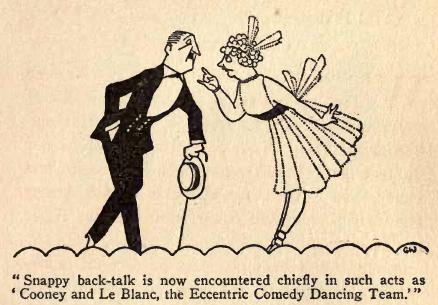
It might be seized at any moment by an English Duke or a Lady Agatha and strangled to death. Even the butlers in the late 'eighties were wits, and served epigrams with cucumber sandwiches; and a person entering one of these drawing-rooms and talking in connected sentences—easily understood by everybody—each with one subject, predicate and meaning, would have been looked upon as a high class moron. One might as well have gone to a dinner at Lady Coventry's without one's collar, as without one's kit of trained paradoxes.
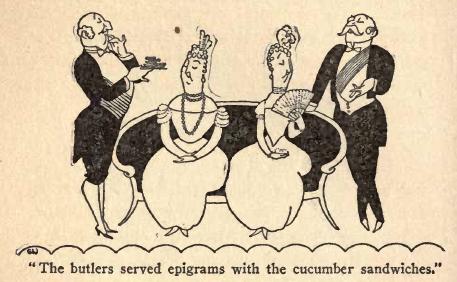
A late Autumn afternoon in one of these semi-Oscar Wilde plays, for instance, would run something like this:
SCENE—The Octagon Room in Lord Raymond Eaveston's Manor House in Stropshire.
LADY EAVESTON and SIR THOMAS WAFFLETON are discovered, arranging red flowers in a vase.
SIR T.: I detest red flowers; they are so yellow.
LADY E.: What a cynic you are, Sir Thomas. I really must not listen to you or I shall hear something that you say.
SIR T.: Not at all, my dear Lady Eaveston. I detest people who listen closely; they are so inattentive.
LADY E.: Pray do not be analytical, my dear Sir Thomas. When people are extremely analytical with me I am sure that they are superficial, and, to me, nothing is more abominable than superficiality, unless perhaps it is an intolerable degree of thoroughness.
(Enter Meadows, the Butler)
MEADOWS (announcing): Sir Mortimer Longley and Mrs. Wrennington,—a most remarkable couple,—I may say in announcing them,—in that there is nothing at all remarkable about them.
(Enter Sir Mortimer and Mrs. Wrennington)
MRS. W.: So sorry to be late, dear Lady Eaveston. But it is so easy to be on time that I always make it a point to be late. It lends poise, and poise is a charming quality for any woman to have, am I not right, Sir Thomas?
SIR T.: You are always right, my dear Mrs. Wrennington, and never more so than now, for I know of no more attractive attribute than poise, unless perhaps it be embarrassment.
LADY E.: What horrid cynics you men are! Really, Sir Thomas, one might think, from your sophisticated remarks that you had been brought up in the country and had seen nothing of life.
SIR T.: And so I have been, my dear Lady Eaveston. To my mind, London is nothing but the country, and certainly Stropshire is nothing but a metropolis. The difference is, that when one is in town, one lives with others, and when one is in the country, others live with one. And both plans are abominable.
MRS. W.: What a horrid combination! I hate horrid combinations; they always turn out to be so extremely pleasant.
(Enter Meadows)
MEADOWS (announcing): Sir Roland Pinshamton; Viscount Lemingham; Countess Trotski and Mr. Peters. In announcing these parties I cannot refrain from remarking that it has always been my opinion that a man who intends to get married should either know something or nothing, preferably both.
(Exit Meadows)
COUNTESS T.: So sorry to be late, my dear Lady Eaveston. It was charmingly tolerant of you to have us.
LADY E.: Invitations are never tolerant, my dear Countess; acceptances always are. But do tell me, how is your husband, the Count,—or perhaps he is no longer your husband. One never knows these days whether a man is his wife's husband or whether she is simply his wife.
COUNTESS T. (lighting a cigarette): Really, Lady Eaveston, you grow more and more interesting. I detest interesting people; they are so hopelessly uninteresting. It is like beautiful people—who are usually so singularly unbeautiful. Has not that been your experience, Sir Mortimer?
SIR M.: May I have the pleasure of escorting you to the music-room, Mrs. Wrennington?
(Exeunt omnes to music-room for dinner)
Curtain.
It is from this that we have, in a measure, been delivered by the court-room scenes, and all the medical dramas. But the paradox still remains intrenched in English writing behind Mr. G.K. Chesterton, and he may be considered, by literary tacticians, as considerable stronghold.
Here again we find our commonplaces shaken up until they emerge in what looks like a new and tremendously imposing shape, and all of them ostensibly proving the opposite of what we have always understood. If we do not quite catch the precise meaning at first reading, we lay it to our imperfect perception and try to do better on the next one. It seldom occurs to us that it really may have no meaning at all and never was intended to have any, any more than the act of hanging by your feet from parallel bars has any further significance than that you can manage to do it.
So, before retiring to the privacy of our personal couches, let us thank an all wise Providence, that the drama-paradox has passed away.
XVIII
SHAKESPEARE EXPLAINED
Carrying on the System of Footnotes to a Silly Extreme
PERICLES
ACT II. SCENE 3
NOTES
XIX
THE SCIENTIFIC SCENARIO
Sooner or later some one is going to come out and say that the movies are too low-brow. I can just see it coming. Maybe some one has said it already, without its having been brought to my attention, as I have been very busy for the past two weeks on my yearly accounts (my accounts for the year 1920, I mean. What with one thing and another, I am a bit behind in my budget system).
And whenever this denouncement of the movies takes place, the first thing that is going to be specifically criticized is the type of story which is now utilized for scenarios. How can a nation hope to inject any culture in the minds of its people if it feeds them with moving-picture stories dealing with elemental emotions like love, hate, and a passion for evening-dress? Scenarios to-day have no cultural background. That's the trouble with them. They have no cultural background.
Now, if we are to make the movies count for anything in the mental development of our people, we must build them of sterner stuff. We must make them from stories and books which are of the mind rather than of the body. The action should be cerebral, rather than physical, and instead of thrilling at the sight of two horsemen galloping along a cliff, we should be given the opportunity of seeing two opposing minds doing a rough-and-tumble on the edge of a nice problem in Dialectics or Metaphysics.
I would suggest as a book, from which a pretty little scenario might be made, "The Education of Henry Adams." This volume has had a remarkable success during the past year among the highly educated classes. Public library records show that more people have lied about having read it than any other book in a decade. It contains five hundred pages of mental masochism, in which the author tortures himself for not getting anywhere in his brain processes. He just simply can't seem to get any further than the evolution of an elementary Dynamic Theory of History or a dilettante dabbling with a Law of Acceleration. And he came of a bright family, too.
I don't go in much for scenario writing myself, but I am willing to help along the cause of better moving-pictures by offering herewith an outline for a six-reel feature entitled "THE EDUCATION OF HENRY ADAMS; or WHY MINDS GO WRONG."
CAST OF CHARACTERS
Henry Adams.
Left Frontal Brain Lobe.
Right Frontal Brain Lobe.
Manservant.
Crowd of Villagers, Reflexes, Complexes, and Mental Processes.
The first scene is, according to the decorated caption: "IN THE HARVARD COLLEGE STUDY OF HENRY ADAMS, SCION OF AN OLD NEW ENGLAND FAMILY, THE NIGHT BEFORE THE BIG CEREBRAL FUNCTION OF HIS YOUNG MANHOOD."
Henry Adams, a Junior, is discovered sitting at his desk in his room in Holworthy Hall. He has a notebook on the Glacial Period and Palæontology open in front of him. He is thinking of his Education. (Flash-back showing courses taken since Freshman year. Pianist plays "Carry Me Back to Old Virginie.") He bites his under lip and turns a page of his notes.
Caption: "DOES TRANSCENDENTALISM HOLD THE KEY?... I WONDER...."
(Fade-out showing him biting his upper lip, still thinking.)
The second scene is laid in Rome.
Caption: "HERE, AFTER A YEAR'S WANDERING THROUGH THE HAPPY, SMILING LANDS OF EUROPE, COMES YOUNG HENRY ADAMS IN HIS SEARCH FOR EDUCATION. AND NOW, IN THE SHADOW OF ANCIENT ROME, HE FINDS PEACE, BUT NOT THAT PEACE FOR WHICH HE SOUGHT."
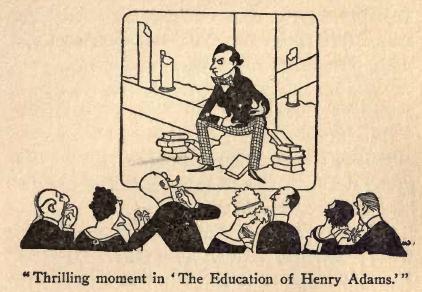
He is discovered sitting on a rock among the ruins of the Capitol, thinking. He tosses a pebble from one hand to another and scowls. The shadows deepen, and he rises, passing his hand across his brow. (Flash-back showing the Latin verbs which govern the dative case. Pianist plays: "The March of the Jolly Grenadiers.")
He walks slowly to the Museo Nazionale, where he stands pondering before a statue of Venus, thinking about Roman art and history—and about his Education.
Caption: "CAN ALL THIS BE FITTED INTO A TIME-SEQUENCE? CAN RIENZI, GARIBALDI. TIBERIUS GRACCHUS, AURELIAN, ANY OF THESE FAMOUS NAMES OF ROME, BE ADAPTED TO A SYSTEMATIC SCHEME OF EVOLUTION? NO, NO ... A THOUSAND TIMES, NO!"
He sinks down on a rock and weeps bitterly.
The next scene is in England and our hero is found sitting at a desk in his study in London. He is gazing into space—thinking.
Caption: "AND SO, ALL THROUGH THE LONG, WEARY SUMMER, HENRY ADAMS SAT, HEAD IN HAND, WONDERING IF DARWIN WAS RIGHT. TO HIM THE GLACIAL EPOCH SEEMED LIKE A YAWNING CHASM BETWEEN A UNIFORMITARIAN WORLD AND HIMSELF. IF THE GLACIAL PERIOD WERE UNIFORMITY, WHAT WAS CATASTROPHE?... AND TO THIS QUESTION, THE COOL OF THE SUMMER'S EVENING IN SHROPSHIRE BROUGHT NO RELIEF."
He rises slowly and goes to the book-shelves, from which he draws a copy of "The Origin of Species." Placing it before him on the desk he turns the pages slowly until he comes to one which holds his attention.
Close-up of page 126, on which is read: "It is notorious that specific characters are more variable than generic....
Feet
Palæzoic strata (not including igneous beds)57,154
Secondary strata13,190
Tertiary strata2,400"
The book drops to the floor from his nerveless fingers and he buries his head in his arms, sobbing. (Music: "When You and I Were Young, Maggie.")
"TWENTY YEARS AFTER ... HENRY ADAMS IS NO LONGER YOUNG, BUT IN HIS HEART LIES STILL THE HUNGER FOR EDUCATION. GOING FORWARD, EVER FORWARD, HE REALIZES AS NEVER BEFORE THAT WITHOUT THOUGHT IN THE UNIT, THERE CAN BE NO UNITY. THOUGHT ALONE IS FORM. MIND AND UNITY FLOURISH OR PERISH TOGETHER."
(Allegorical flash-back showing Mind and Unity perishing together.)
The hero is now seen seated in a Morris chair in Washington, touching his finger-tips together in a ruminative manner. Arising slowly, he goes to the window and looks out over Lafayette Square. Then he lights a cigar and goes back to his chair. He is pondering and attempting to determine when, between 3000 B.C. and 1000 A.D. the momentum of Europe was greatest, as exemplified in mathematics by such masters as Archimedes, Aristarchus, Ptolemy and Euclid.
(Flash-back showing the mathematical theories of Archimedes, Aristarchus, Ptolemy and Euclid. Music: "Old Ireland Shall Be Free.")
Rising from his chair again, he paces the floor, clenching his hands behind his back in mute fury.
Caption: "GOD HAVE MERCY ON ME! I CAN SEE IT ALL—I HAVE NEVER BEEN EDUCATED!"
NEXT WEEK: BERT LYTELL IN "SARTOR RESARTUS" A SMASHING SIX-REEL FEATURE BY TOM CARLYLE
XX
THE MOST POPULAR BOOK OF THE MONTH
NEW YORK CITY (including all Boroughs) TELEPHONE DIRECTORY—N.Y. Telephone Co., N.Y. 1920. 8vo. 1208 pp.
In picking up this new edition of a popular favorite, the reviewer finds himself confronted by a nice problem in literary ethics. The reader must guess what it is.
There may be said to be two classes of people in the world; those who constantly divide the people of the world into two classes, and those who do not. Both classes are extremely unpleasant to meet socially, leaving practically no one in the world whom one cares very much to know. This feeling is made poignant, to the point of becoming an obsession, by a careful reading of the present volume.
We are herein presented to some five hundred thousand characters, each one deftly drawn in a line or two of agate type, each one standing out from the rest in bold relief. It is hard to tell which one is the most lovable. In one mood we should say W.S. Custard of Minnieford Ave. In another, more susceptible frame of mind, we should stand by the character who opens the book and who first introduces us into this Kingdom of Make-Believe—Mr. V. Aagaard, the old "Impt. & Expt." How one seems to see him, impting and expting all the hot summer day through, year in and year out, always heading the list, but always modest and unassuming, always with a kindly word and a smile for passers-by on Broadway!
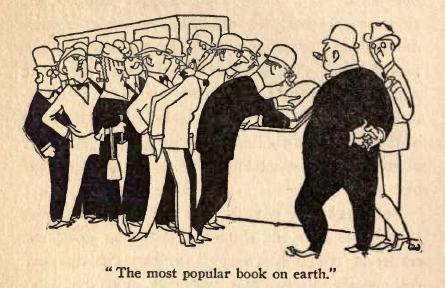
It is perhaps inaccurate to say that V. Aagaard introduces us to the book. He is the first flesh-and-blood human being with whom the reader comes in contact, but the initial place in the line should technically go to the A. & A.A. Excelsior Co. Having given credit where credit is due, however, let us express our personal opinion that this name is a mere trick, designed to crowd out all other competitors in the field for the honor of being in the premiere position, for it must be obvious to any one with any perception at all that the name doesn't make sense. No firm could be named the A. & A.A. Co., and the author of the telephone directory might better have saved his jokes until the body of the book. After all, Gelett Burgess does that sort of thing much better than any one else could hope to.
But, beginning with V. Aagaard and continuing through to Mrs. L. Zyfers of Yettman Ave., the reader is constantly aware of the fact that here are real people, living in a real city, and that they represent a problem which must be faced.
Sharp as we find the character etching in the book, the action, written and implied, is even more remarkable. Let us, for instance, take Mr. Saml Dreyslinger, whose business is "Furn Reprg," or Peter Shalijian, who does "pmphlt bindg." Into whose experience do these descriptions not fit? The author need only mention a man bindg pmphlts to bring back a flood of memories to each and every one of us—perhaps our old home town in New England where bindg pmphlts was almost a rite during the long winter months, as well as a social function of no mean proportions. It is the ability to suggest, to insinuate, these automatic memories on the part of the reader without the use of extra words that makes the author of this work so worthy of the name of craftsman in the literary annals of the day.
Perhaps most deft of all is the little picture that is made of Louise Winkler, who is the village "sclp spclst." One does not have to know much medieval history to remember the position that the sclp spclst used to hold in the community during the Wars of the Roses. Or during Shay's Rebellion, for that matter. In those days, to be a sclp spclst was as important a post as that of "clb bdg stbls" (now done for New York City by Mr. Graham). People came from miles around to consult with the local sclp spclst on matters pertaining not only to sclps but to knt gds and wr whls, both of which departments of our daily life have now been delegated to separate agencies. Then gradually, with the growth of the trade guild movement, there came the Era of Specialization in Industry, and the high offices of the sclp spclst were dissipated among other trades, until only that coming strictly under the head of sclp speclzng remained. To this estate has Miss Winkler come, and in that part of the book which deals with her and her work, we have, as it were, a little epic on the mutability of human endeavor. It is all too short, however, and we are soon thereafter plunged into the dreary round of expting and impting, this time through a character called J. Wubbe, who is interesting only in so far as he is associated with M. Wrubel and A.N. Wubbenhorst, all of whom come together at the bottom of the column.
The plot, in spite of whatever virtues may accrue to it from the acid delineation of the characters and the vivid action pictures, is the weakest part of the work. It lacks coherence. It lacks stability.
Perhaps this is because of the nature of the book itself. Perhaps it is because the author knew too well his Dunsany. Or his Wells. Or his Bradstreet. But it is the opinion of the present reviewer that the weakness of plot is due to the great number of characters which clutter up the pages. The Russian school is responsible for this. We see here the logical result of a sedulous aping of those writers such as Tolstoi, Andreief, Turgenief, Dostoiefsky, or even Pushkin, whose metier it was to fill the pages of their books with an inordinate number of characters, many of whom the reader was to encounter but once, let us say, on the Nevsky Prospekt or in the Smolny Institute, but all of whom added their peculiar names (we believe that we will not offend when we refer to Russian names as "peculiar") to the general confusion of the whole.
In practice, the book is not flawless. There are five hundred thousand names, each with a corresponding telephone number. But, through some error in editing, the numbers are all wrong. Proof of this may be had by the simple expedient of calling up any one of the subscribers, using the number assigned by the author to that name. (Any name will do—let us say Nicholas Wimpie-Haxlem 2131.) If the call is put in bright and early in the morning, the report will come over the wire just as the lights are going on for evening of the same day that "Harlem 2131 does not answer." The other numbers are invariably equally unproductive of results. The conclusion is obvious.
Aside from this point the book is a success.
XXI
CHRISTMAS AFTERNOON
Done in the Manner, if Not the Spirit, of Dickens
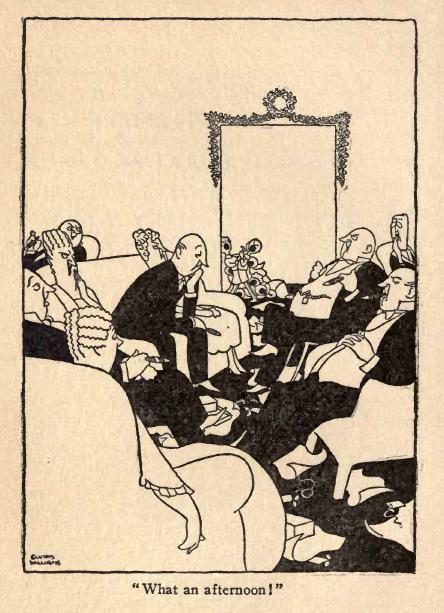
What an afternoon! Mr. Gummidge said that, in his estimation, there never had been such an afternoon since the world began, a sentiment which was heartily endorsed by Mrs. Gummidge and all the little Gummidges, not to mention the relatives who had come over from Jersey for the day.
In the first place, there was the ennui. And such ennui as it was! A heavy, overpowering ennui, such as results from a participation in eight courses of steaming, gravied food, topping off with salted nuts which the little old spinster Gummidge from Oak Hill said she never knew when to stop eating—and true enough she didn't—a dragging, devitalizing ennui, which left its victims strewn about the living-room in various attitudes of prostration suggestive of those of the petrified occupants in a newly unearthed Pompeiian dwelling; an ennui which carried with it a retinue of yawns, snarls and thinly veiled insults, and which ended in ruptures in the clan spirit serious enough to last throughout the glad new year.
Then there were the toys! Three and a quarter dozen toys to be divided among seven children. Surely enough, you or I might say, to satisfy the little tots. But that would be because we didn't know the tots. In came Baby Lester Gummidge, Lillian's boy, dragging an electric grain-elevator which happened to be the only toy in the entire collection which appealed to little Norman, five-year-old son of Luther, who lived in Rahway. In came curly-headed Effie in frantic and throaty disputation with Arthur, Jr., over the possession of an articulated zebra. In came Everett, bearing a mechanical negro which would no longer dance, owing to a previous forcible feeding by the baby of a marshmallow into its only available aperture. In came Fonlansbee, teeth buried in the hand of little Ormond, which bore a popular but battered remnant of what had once been the proud false-bosom of a hussar's uniform. In they all came, one after another, some crying, some snapping, some pulling, some pushing—all appealing to their respective parents for aid in their intra-mural warfare.
And the cigar smoke! Mrs. Gummidge said that she didn't mind the smoke from a good cigarette, but would they mind if she opened the windows for just a minute in order to clear the room of the heavy aroma of used cigars? Mr. Gummidge stoutly maintained that they were good cigars. His brother, George Gummidge, said that he, likewise, would say that they were. At which colloquial sally both the Gummidge brothers laughed testily, thereby breaking the laughter record for the afternoon.
Aunt Libbie, who lived with George, remarked from the dark corner of the room that it seemed just like Sunday to her. An amendment was offered to this statement by the cousin, who was in the insurance business, stating that it was worse than Sunday. Murmurings indicative of as hearty agreement with this sentiment as their lethargy would allow came from the other members of the family circle, causing Mr. Gummidge to suggest a walk in the air to settle their dinner.
And then arose such a chorus of protestations as has seldom been heard. It was too cloudy to walk. It was too raw. It looked like snow. It looked like rain. Luther Gummidge said that he must be starting along home soon, anyway, bringing forth the acid query from Mrs. Gummidge as to whether or not he was bored. Lillian said that she felt a cold coming on, and added that something they had had for dinner must have been undercooked. And so it went, back and forth, forth and back, up and down, and in and out, until Mr. Gummidge's suggestion of a walk in the air was reduced to a tattered impossibility and the entire company glowed with ill-feeling.
In the meantime, we must not forget the children. No one else could. Aunt Libbie said that she didn't think there was anything like children to make a Christmas; to which Uncle Ray, the one with the Masonic fob, said, "No, thank God!" Although Christmas is supposed to be the season of good cheer, you (or I, for that matter) couldn't have told, from listening to the little ones, but what it was the children's Armageddon season, when Nature had decreed that only the fittest should survive, in order that the race might be carried on by the strongest, the most predatory and those posessing the best protective coloring. Although there were constant admonitions to Fonlansbee to "Let Ormond have that whistle now; it's his," and to Arthur, Jr., not to be selfish, but to "give the kiddie-car to Effie; she's smaller than you are," the net result was always that Fonlansbee kept the whistle and Arthur, Jr., rode in permanent, albeit disputed, possession of the kiddie-car. Oh, that we mortals should set ourselves up against the inscrutable workings of Nature!
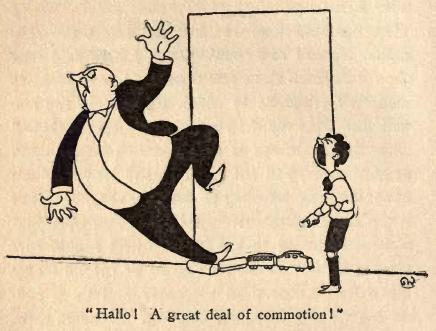
Hallo! A great deal of commotion! That was Uncle George stumbling over the electric train, which had early in the afternoon ceased to function and which had been left directly across the threshold. A great deal of crying! That was Arthur, Jr., bewailing the destruction of his already useless train, about which he had forgotten until the present moment. A great deal of recrimination! That was Arthur, Sr., and George fixing it up. And finally a great crashing! That was Baby Lester pulling over the tree on top of himself, necessitating the bringing to bear of all of Uncle Ray's knowledge of forestry to extricate him from the wreckage.
And finally Mrs. Gummidge passed the Christmas candy around. Mr. Gummidge afterward admitted that this was a tactical error on the part of his spouse. I no more believe that Mrs. Gummidge thought they wanted that Christmas candy than I believe that she thought they wanted the cold turkey which she later suggested. My opinion is that she wanted to drive them home. At any rate, that is what she succeeded in doing. Such cries as there were of "Ugh! Don't let me see another thing to eat!" and "Take it away!" Then came hurried scramblings in the coat-closet for over-shoes. There were the rasping sounds made by cross parents when putting wraps on children. There were insincere exhortations to "come and see us soon" and to "get together for lunch some time." And, finally, there were slammings of doors and the silence of utter exhaustion, while Mrs. Gummidge went about picking up stray sheets of wrapping paper.
And, as Tiny Tim might say in speaking of Christmas afternoon as an institution, "God help us, every one."
XXII
HAIL, VERNAL EQUINOX!
If all that I hear is true, a great deal has been written, first and last, about that season which we slangily call "Spring"; but I don't remember ever having seen it done in really first-class form;—that is, in such a way that it left something with you to think over, something that you could put your finger on and say, "There, there is a Big, Vital Thought that I can carry away with me to my room."
What Spring really needs is a regular press-agent sort of write-up, something with the Punch in it, an article that will make people sit up and say to themselves, "By George, there must be something in this Spring stuff, after all."
What sort of popularity did Education have until correspondence schools and encyclopedias began to give publicity to it in their advertisements? Where would Music be to-day if it were not for the exhortations of the talking-machine and mechanical-piano companies telling, through their advertising-copy writers, of the spiritual exaltation that comes from a love of music? These things were all right in their way before the press-agent took hold of them, but they never could have hoped to reach their present position without him.
Of course, all this has just been leading up to the point I want to make,—that something more ought to be written about Spring. When you consider that every one, including myself, agrees that nothing more should be written about it, I think that I have done rather well to prove as much as I have so far. And, having got this deep into the thing, I can't very well draw back now.
Well then, Spring is a great season. Nobody will gainsay me that. Without it, we should crash right from Winter into Summer with no chance to shift to light-weight underwear. I could write a whole piece about that phase of it alone, and, if I were pressed for things to say, I myself could enlarge on it now, making up imaginary conversation of people who have been caught in balbriggans by the first sweltering day of summer. But I have so many more things to say about Spring that I can't stop to bother with deadwood like that. Such literary fillerbusting should be left to those who are not so full of their subject as I am.
In preparing for this article, I thought it best to look up a little on the technical side of Spring, about which so little is known, at least by me. And, would you believe it, the Encyclopedia Britannica, which claims in its advertisements not only to make its readers presidents of the Boards of Directors of any companies they may select, but also shows how easy it would be for Grandpa or Little Edna to carry the whole set about from room to room, if, by any possible chance they should ever want to, this same Encyclopedia Britannica makes no reference to Spring, except incidentally, along with Bed Springs and Bubbling Springs.
This slight of one of our most popular seasons is probably due to the fact that Spring is not exclusively a British product and was not invented by a Briton. Had Spring been fortunate enough to have had the Second Earl of Stropshire-Stropshire-Stropshire as one of its founders, the Britannica could probably have seen its way clear to give it a five-page article, signed by the Curator of the Jade Department in the British Museum, and illustrated with colored plates, showing the effect of Spring on the vertical and transverse sections of the stamen of the South African Euphorbiceæ.
I was what you might, but probably wouldn't, call stunned at not finding anything about the Season of Love in the encyclopedia, for without that assistance what sort of a scientific article could I do on the subject? I am not good at improvising as I go along, especially in astronomical matters. But we Americans are not so easily thwarted. Quick as a wink I looked up "Equinox."
There is a renewed agitation of late to abolish Latin from our curricula. Had I not known my Latin I never could have figured out what "equinox" meant, and this article would never have been written. Take that, Mr. Flexner!
While finding "equinox," however, I came across the word "equilibrium," which is the word before you come to "equinox," and I became quite absorbed in what it had to say on the matter. There were a great many things stated there that I had never dreamed before, even in my wildest vagaries on the subject of equilibrium. For instance, did you know that if you cover the head of a bird, "as in hooding a falcon" (do you remember the good old days when you used to run away from school to hood falcons?) the bird is deprived of the power of voluntary movement? Just think of that, deprived of the power of voluntary movement simply because its head is covered!
And, as if this were not enough, it says that the same thing holds true of a fish! If you should ever, on account of a personal grudge, want to get the better of a fish, just sneak up to him on some pretext or other and suddenly cover its eyes with a cloth, and there you have it, helpless and unable to move. You may then insult it, and it can do nothing but tremble with rage.
It is little practical things like this that you pick up in reading a good reference book, things that you would never get in ten years at college.
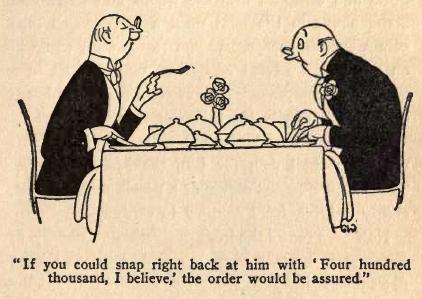
For instance, take the word "equites," which follows "equinox" in the encyclopedia. What do you know about equites, Mr. Businessman? Of course, you remember in a vague way that they were Roman horsemen or something, but, in the broader sense of the word, could you have told that the term "equites" came, in the time of Gaius Gracchus, to mean any one who had four hundred thousand sesterces? No, I thought not. And yet that is a point which is apt to come up any day at the office. A customer from St. Paul might come in and, of course, you would take him out to lunch, hoping to land a big order. Where would you be if his hobby should happen to be "equites "? And if he should come out in the middle of the conversation with "By the way, do you remember how many sesterces it was necessary to have during the administration of Gaius Gracchus in order to belong to the Equites?" if you could snap right back at him with "Four hundred thousand, I believe," the order would be assured. And if, in addition, you could volunteer the information that an excellent account of the family life of the Equites could be found in Mommsen's "Römisches Staatsrecht," Vol. 3, your customer would probably not only sign up for a ten-year contract, but would insist on paying for the lunch.
But, of course, this has practically nothing to do with Spring, or, as the boys call it, the "vernal equinox." The vernal equinox is a serious matter. In fact, I think I may say without violating any confidence, that it is the initial point from which the right ascensions and the longitudes of the heavenly bodies are measured. This statement will probably bring down a storm of ridicule on my head, but look at how Fulton was ridiculed.
In fact, I might go even further and say that the way to seek out Spring is not to trail along with the poets and essayists into the woods and fields and stand about in the mud until a half-clothed bird comes out and peeps. If you really want to be in on the official advent of Spring, you may sit in a nice warm observatory and, entirely free from head-colds, proceed with the following simple course:
Take first the conception of a fictitious point which we shall call, for fun, the Mean Equinox. This Mean Equinox moves at a nearly uniform rate, slowly varying from century to century.
Now here comes the trick of the thing. The Mean Equinox is merely a decoy, and, once you have determined it, you shift suddenly to the True Equinox which you can tell, according to Professor A.M. Clerk's treatise on the subject, because it moves around the Mean Equinox in a period equal to that of the moon's nodes. Now all you have to do is to find out what the moon's nodes are (isn't it funny that you can be as familiar with an object as you are with the moon and see it almost every night, and yet never know that it has even one node, not to mention nodes?) and then find out how fast they move. This done and you have discovered the Vernal Equinox, or Spring, and without spilling a dactyl.
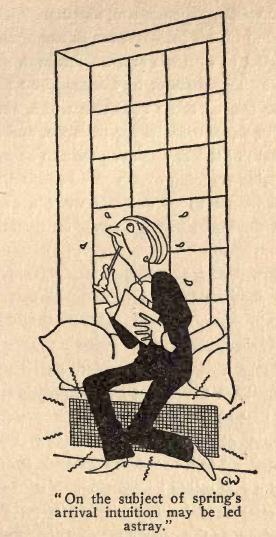
How much simpler this is than the old, romantic way of determining when Spring had come! A poet has to depend on his intuition for information, and, on the subject of Spring's arrival, intuition may be led astray by any number of things. You may be sitting over one of those radiators which are concealed under window-seats, for instance, and before you are aware of it feel what you take to be the first flush of Spring creeping over you. It would be obviously premature to go out and write a poem on Youth and Love and Young Onions on the strength of that.
I once heard of a young man who in November discovered that he had an intellectual attachment for a certain young woman and felt that married life with her would be without doubt a success. But he could never work himself up into sufficient emotional enthusiasm to present the proposition to her in phrases that he knew she had been accustomed to receive from other suitors. He knew that she wouldn't respond to a proposal of marriage couched in terms of a real estate transaction. Yet such were the only ones that he felt himself capable of at the moment under the prevailing weather conditions. So, knowing something of biology, he packed his little bag and rented an alcove in a nearby green-house, where he basked in the intensified sun-warmth and odor of young tube roses, until with a cry, he smashed the glass which separated him from his heart's desire and tore around the corner to her house, dashing in the back door and flinging himself at her feet as she was whipping some cream, and there poured forth such a torrent of ardent sentiments that there was really nothing that the poor girl could do but marry him that afternoon.
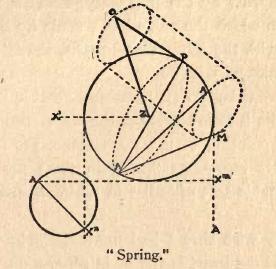
In fact, if you want to speak astronomically (some people do), you may define Spring even more definitely. Since we are all here together, and good friends, let us take the center of the earth as origin, and, once we have done this, the most natural fundamental axis is, obviously, the earth's rotation. The fundamental plane perpendicular to it is the plane of the equator. That goes without saying.
Now, here we go! Coördinates referred to in this system are termed equatorial, and I think that you will agree with me that nothing could be fairer than that. Very well, then. Since this is so, we may define Spring by the following geometric representation in which the angle ZOP, made by the radius vector with the fundamental plane, shows a springlike tendency.
This drawing we may truthfully entitle "Spring," and while it hasn't perhaps the color found in Botticelli's painting of the same name, yet it just as truthfully represents Spring in these parts as do the unstable sort of ladies in the more famous picture.
I only wish that I had more space in which to tell what my heart is full of in connection with this subject. I really have only just begun.
TABLOID EDITIONS
THE AMERICAN MAGAZINE
What I Have Made Myself Learn About You
Being An Account of How One Business Man Made the Little Things Count. Do You?
My business (rubber goods) was in a bad way. Somehow I couldn't seem to make it return enough to pay my income tax with. My wife and I were frankly upset.
At last one morning she came to me and said: "Fred, the baby will soon be seven months old and will have to have some sort of vocational training. What are we to do?"
That night was the bluest night I have ever spent. I thought that the end had come. Then, suddenly, the thought struck me: "Why not try character-selling?"
This may sound foolish to you. That is because it is foolish. But it did the trick.
I began to sell my personality. Every man that came into my store I took aside and showed him different moods. First, I would tell him a funny story, to prove to him that I was more than a mere business automaton. Then I would relate a pathetic incident I had seen on the street a week or two ago. This disclosed my heart. Then I did a fragment of a bare-foot dance and sketched a caricature of Lloyd George, to let him see that I was a man of the world. After this, I was ready to sell him what he came in for, and he would go away carrying a very definite impression of my personal characteristics—and some of my goods, in a bundle.
A week of selling rubber-goods in this manner, and I was on the vaudeville stage, earning $250 a week. How much do you earn?
Interesting People
A Man Who Made Good With Newts
Some day, if you ever happen to be in Little Falls, turn to your right and you will see a prosperous-looking establishment run by Ira S. Whip, known throughout Little Falls as the newt king. Starting in with practically nothing but two congenial newts, Mr. Whip has, in the past ten years, raised no less than 4,000 of these little lizard-like animals, all of which had to be thrown away, as there is practically no market for pet newts except for incidental rôles in gold-fish tanks. But Mr. Whip did what he set out to do, and that counts for a lot in this life. Can you say as much?
The Man Who Made Good
The story of a man who made good
Lorrie Wetmore sat disconsolately in the fountain in Madison Square Park. He was lonely. He was a failure.... Yes, he was. Don't contradict me. He was a terrible failure. And, as I said before, early in this story, he was lonely.
"I have fallen down on the job," he murmured to Admiral Farragut's statue. "I have not made good."
Suddenly a kind hand rested on his shoulder. He turned to face the pansy-trainer, who keeps the flower-beds in the Park in touch with the seasons.
"Don't give in, my boy," said the old man. "Remember the words of Henley, who instituted the famous Henley Regatta and so made a name for himself: 'I am the master of my Fate. I am the Captain of my Soul.'"
"By George," murmured Lorrie to the statue of Salmon P. Chase, "I can make good, and I will make good!"
And, with these words, he climbed out of the fountain and made his way resolutely across the square to the great store of Marshall Field and Co. (Advt.)
In seven weeks he was a member of the firm.
Are You Between the Ages of 7 and 94?
If so, what this eminent growth specialist says here applies directly to you and to your family
Every man, woman and child between the ages of 7 and 94 is going through a process of growth or metamorphosis, whether they know it or not. Are you making the most of this opportunity which is coming to you (if your age falls within the magic circle given above) every day of your life? Do you realize that, during this crucial period, you have it in your power to make what you will of yourself, provided only that you know how to go about it and make no false steps?
As you grow from day to day, either mentally, morally, or physically, you can say to yourself, on awakening in the morning:
"To-day I will develop. I will grow bigger, either mentally, morally or physically. Maybe, if it is a nice, warm day, I will grow in all three ways at once."
And, sure enough, when evening finds you returning home from the work of the day, it will also find you in some way changed from the person you were in the morning, either through the shedding of the dry epidermis from the backs of your hands (which, according to one of Nature's most wonderful processes, is replaced by new epidermis as soon as the old is gone), or through the addition of a fraction of an inch to your height or girth, or through some other of the inscrutable alchemies of Nature.
Think this over as you go to work, to-day, and see if it doesn't tell you something about your problem.
How I Put Myself on the Map
It was seven o'clock at night when I first struck New York. I had come from a Middle Western town to make my fortune as a writer, and I was already discouraged. I knew no one in the Big City, and had been counting on my membership in the National Geographic Society to find me friends among my fellow-members in town. But I soon discovered that the fraternity spirit in the East was much less cordial than in my home district, and I realized, too late, that I was all alone.
With a few coins that my father had slipped into my hand as I left home, I engaged a tiny suite at the St. Regis and there set about my writing.
The first 10,000 manuscripts which I sent out, I now have. (I am at present working them over into a serial for the Saturday Evening Post weekly, from which I expect to make $25,000). But that is beside the point. For the purposes of the present narrative, I was a failure. The manager of the hotel was pressing me for my rent, which was already several hours overdue. I had not tipped the chamber-maid since breakfast. I sat looking out at my window, staring at the squalid wall of the Hotel Ritz. I had met New York face to face—and I had lost.
No, not lost! There was still one chance left I sat down and, with feverish haste, wrote out a glowing account of my failure. I spared no detail of my degradation, even to taking fruit from the hotel table to my room.
Then I began to fabricate. I told how I had overcome all these handicaps and had made a success of myself. I lied. I said that I was now drawing down $200,000 a year, but that I had never forgotten my old friends. It was a good yarn, but it took me a long while to make it up. And when, at last, it was ready, I sent it to the American Magazine.
This is it!
How Insane Are You?
Following is a test used in all State Hospitals to determine the fitness of the inmates for occasional shore leave. Try it on yourself and see where you get off.
TEST NO. 1
If you really are the reincarnation of Learning, write something here ... but if you are being hounded by a lot of relatives whom you dislike, ring and walk in. Then, granting all this, how does it come about that you, a member of the Interstate Commerce Commission, wear no collar?... Ha, ha, we caught you there! But otherwise, write any letter beginning with w in this space. Yes, there is the space,—what's the matter with you? Go back and look again.... You win. Now, in spite of what the neighbors say, give three reasons for not giving three reasons why this proves that you are sane, or, as the case may be.
HARPER'S MAGAZINE
Through the Dobrudja with Gun and Camera
There was a heavy mist falling as we left Ilanlâc, rendering the cozbars (native doblacs) doubly indistinguishable. This was unfortunate, as we had planned on taking many photographs, some of which are reproduced here.
Our party consisted of seven members of the Society: Molwinch, young Houghbotham, Capt. Ramp, and myself, together with fourteen native barbudos (luksni who are under the draft age), a boat's crew, two helpers, and some potted tongue. Lieut. Furbearing, the Society's press-agent, had sailed earlier in the week, and was to join us at Curtea de Argesh.
Before us, as we progressed, lay the Tecuci, shimmering in the reflected light of the sun (sun). They were named by their discoverer, Joao Galatz, after his uncle, whose name was Wurgle, or, as he was known among the natives, "Wurgle." From that time (1808) until 1898, no automobile was ever seen on one of the Tecuci, although many of the inhabitants subsisted entirely on what we call "cottage-cheese."
The weevils of this district (Curculionidæ) remarkable for their lack of poise. We saw several of them, just at sundown, when, according to an old native legend, the weevil comes out to defy the God of Acor, his ancient enemy, and never, not even in Castanheira, have I seen weevils more embarrassed than those upon whom we came suddenly at a bend in the Selch River.
Early morning found us filing up the Buzeau Valley, with the gun-bearers and bus-boys in single-file behind us, and a picturesque lot they were, too, with their lisle socks and queer patch-pockets. In taking a picture of them, I walked backward into the Buzeau River, which delayed the party, as I had, in my bag, the key with which the potted tongue cans were to be opened.
We were fortunate enough to catch several male puffins, which were so ingenuous as to eat the carpet-tacks we offered them. The puffin (Thalassidroma buleverii), is easily distinguishable from the more effete robin of America because the two birds are similar in no essential points. This makes it convenient for the naturalist, who might otherwise get them mixed. Puffins are hunted principally for their companionable qualities, a domesticated puffin being held the equal—if not quite—of the average Dobrudjan housewife in many respects, such as, for instance, self-respect.
It was late in the afternoon of the third day, when we finally reached Dimbovitza, and the cool llemla was indeed refreshing. It had been, we one and all agreed, a most interesting trip, and we vowed that we should not forget our Three Days in the Dobrudja.
Dead Leaves
"Ain't you got them dishes done up yet, Irma?"
A petulant voice from what, in Central New England, is called the "sittin' room," penetrated the cool silence of the farm-house kitchen. Irma Hathaway passed her hand heavily before her eyes.
"Yes, Ma," she replied wearily, as she threw a cup at the steel engraving of "The Return of the Mayflower" which hung on the kitchen wall. She wondered when she would die.
A cold wind blew along the corridor which connected the kitchen with the wood-shed. Then, as if disgruntled, it blew back again, like a man returning to his room after a fresh handkerchief. Irma shuddered. It was all so inexplicably depressing.
For eighteen years the sun had never been able to shine in Bemis Corners. God knows it had tried. But there had always been something imponderable, something monstrously bleak, which had thrown itself, like a great cloak, between the warm light of that body and the grim reality of Bemis Corners.
"If Eben had only known," thought Irma, and buried her face in the soapy water.
Some one entered the room from the wood-shed, stamping the snow from his boots. She knew, without looking up, that it was Ira.
"Why hev you come?" she said softly, lifting her moist eyes to him. It was not Ira. It was the hired man. She sobbed pitifully and leaped upon the roller-towel which hung on the door, pulling it round and round like a captive squirrel in a revolving cage.
"It ain't no use," she moaned.
And, through the cadavers of the apple-trees in the orchard behind the house, there rattled a wind from the sea, the sea to which men go down in ships never to return, telling of sorrow and all that sort of thing.
"Fate," some people call it.
To Irma Hathaway it was all the same.
June, July, August
Tulips, crocuses and chard, And the wax bean In the back yard. And the open road to the land of dreams, With the heavy swirl Of the singing streams. Oh! boy!
Unpublished Letters of Mark Twain
With a foreword by Albert Bigelow Paine[1]
FOREWORD
This letter from Mark Twain to Mr. Horace J. Borrow of Hartford has recently been called to my attention by a niece of Mr. Borrow's who now lives in Glastonbury. I have no reason to believe that the lady is a charlatan, in fact, I have often heard Mark Twain speak of Mr. Borrow in the highest terms.
Mr. Horace J. Borrow Hartford, Connecticut
Dear Mr. Borrow: Enclosed find check for ten dollars ($10) in payment of my annual dues for the year 1891-2.
Yours truly, (Signed) S.L. CLEMENS.
Highways and By-Ways in Old Fall River
The chance visitor to Fall River may be said, like the old fisherman in "Bartholomew Fair," to have "seen half the world, without tasting its savor." Wandering down the Main Street, with its clanging trolley-cars and noisy drays, one wonders (as, indeed, one may well wonder), if all this is a manifestation so much of Fall River as it is of that for which Fall River stands.
Frankly, I do not know.
But there is something in the air, something ineffable in the swirl of the smoke from the towering stacks, which sings, to the rhythm of the clashing shuttles and humming looms, of a day when old gentlemen in belted raglans and cloth-topped boots strolled through these streets, bearing with them the legend of mutability. Perhaps "mutability" is too strong a word. Fall Riverians would think so.
And the old Fall River Line! What memories does that name not awaken in the minds of globe-trotters? Or, rather, what memories does it awaken? William Lloyd Garrison is said to have remarked upon one occasion to Benjamin Butler that one of the most grateful features of Fall River was the night-boat for New York. To which Butler is reported to have replied: "But, my dear Lloyd, there is no night-boat to New York, and there won't be until along about 1875 or even later. So your funny crack, in its essential detail, falls flat."
But, regardless of all this, the fact remains that Fall River is Fall River, and that it is within easy motoring distance of Newport, which offers our art department countless opportunities for charming illustrations.
The Editor's Drawer
Little Bobby, aged five, saying his prayers, had come to that most critical of diplomatic crises: the naming of relatives to be blessed.
"Why don't I ask God to bless Aunt Mabel?" he queried, looking up with a roguish twinkle in his blue eyes.
"But you do, Bobby," answered his mother.
"So I do," was his prompt reply.
Little Willy, aged seven, was asked by his teacher to define the word "confuse." "'Confuse' is what my daddy says when he looks at his watch," said Willy. The teacher never asked that question again. At least, not of Willy.
Little Gertrude, aged three, was saying her prayers. "Is God everywhere?" she asked.
"Yes, dear, everywhere," answered her mother.
"Everywhere?" she persisted.
"Yes, dear, everywhere," repeated her mother, all unsuspecting.
"Then He must be like Uncle Ned," said the little tot.
"Why, Gertrude, what makes you say that?"
"Because I heard Daddy say that Uncle Ned was everywhere," was the astounding reply.
THE SATURDAY EVENING POST
THE LAST MATCH
By Roy Comfort Ashurst
Slowly the girl in the green hat approached the swinging door of the hotel.
She was thinking.
A man more versed in the ways of womankind than Ned Pillsbury might, perhaps, have perceived that she was also glancing surreptitiously upwards through the dark fringe of lashes which veiled her brown gypsy eyes, but Ned was not a trained observer in such matters. To him, as he sat in the large, roomy leather chair in the lobby, the only reaction was
(Continued on page 49)
ARE YOU SURE OF YOUR CRANK-SHAFT?
The answer to this question is the answer to the peace of mind with which you operate your motor. Whether you are the operator of an automobile, or one of those intrepid spirits to whom the world-war has given the vision of flying through the air at 175 miles an hour, you need to give pause and say to yourself:
"Just how much faith can I put in my crank-shaft?"
And if it is a Zimco crank-shaft, made in the factory of a thousand sky-lights, you may be sure that it will stand the test.
Zimco crank-shafts have that indefinable quality which gives them personality among crank-shafts. You know a Zimco when you see one and you feel that it is an old friend. It does everything but speak. And that its host of friends do for it.
Let us send you free our handsome little booklet on "After-the-War-Problems."
(Continued from page 8)
one of amazement that there could be such a beautiful person alive in this generation.
Ned was a young man of great possibilities, but few probabilities. Born in the confusion of an up-state city, and educated in the hub-bub of a large college, on whose football team he had distinguished himself in the position of left-halfback, he had never been so fortunate as to receive that quiet instruction in dark brown eyelashes and their potentialities which has been found to be so highly essential to the equipment
(Continued on page 107)
INTRODUCING THE 7-TON GARGANTUA TRUCK
This important announcement is made by the Gargantua Company with a full realization of its significance. We realize that we are creating a new thing in trucks.
The Gargantua combines all the qualities of the truck with the conveniences of a Fall River boat. Its transmission system has been called "The Queen of Transmissions." The efficacy of its bull-pinions in the tractor attachment has been the subject of enthusiastic praise from bull-pinion experts on all continents.
The Gargantua is the result of a dream. Henry L. McFern (now president of the Gargantua Co.), was the dreamer. Mr. McFern wanted something that would revolutionize the truck business, and yet still be a truck. He gave it the thought of all his waking hours. His friends called him a "dreamer," but Henry McFern only smiled. When first he brought out the model of the Gargantua it was called "McFern's Folly," but Henry McFern only smiled the more. And when the time came for the test, it was seen that the "dreamer" of South Bend had given the world a new Idea.
(Continued from page 49)
of a man of the world to-day. He knew that women were strange creatures, for this popular superstition reaches even to the recesses of the most exclusive of male retreats, but further than that he was uninformed. He had, it is true, like many another young man, felt the influence of certain pairs of blue eyes
(Continued on page 113)
I AM THE STRENGTH OF AGES
¶I have sprung from the depths of the hills.
¶Before the rivers were brought forth, or even before the green leaves in their softness made the landscape, I was your servant.
¶From the bowels of the earth, where men toil in darknesss, I come, bringing a message of insuperable strength.
¶From sun to sun I meet and overcome the forces of nature, brothers of mine, yet opponents; kindred, yet foes.
¶I am silent, but my voice re-echoes beyond the ends of the earth.
¶I am master, yet I am slave.
¶I am Woonsocket Wrought Iron Pipe, "the Strongest in the Long Run." (Trademark.)
Send for illustrated booklet entitled
"The Romance of Iron Pipe."
(Continued from page 107)
which had come into his life during the years when he was in susceptible moods, but such occurrences were not the result of any realization on his part of their significance. They were in the same category of physical phenomena as includes measles or chicken-pox, for example,—the direct result of a certain
(Continued on page 125)
WHY WORRY OVER CHISEL TROUBLES?
"You've got the right kind of chisel there. I see it's a Blimco. I've always found that Blimco chisels stand up longer under everyday usage, and I tell my foremen to see to it that the men always have their Blimcoes and no other. I have tried the others, but have always come back to the Blimco. I suppose it is because the Blimco is made by master-workmen, supervised by experts and sold only by dealers who know the best tools. When you see a Blimco in a dealer's window, you may know that that dealer is a man of discrimination. The discriminating workman always uses a Blimco. 'The Chisel of Distinction.' Clip this coupon and send it NOW for our instructive booklet 'Chiselling Prosperity'."
(Continued from page 113)
temporary debility which renders the patient susceptible to infection.
Ned Pillsbury was therefore somewhat overcome by the vision of the girl with the green hat, and suffered from that feeling of pioneering emotion which must have affected Mr. Balboa who, according to the poet, stood "silent on a peak in Darien" survey-
(Continued on page 140)
MAKE YOUR PISTON-RINGS WORK FOR YOU
Why should you persist in being ashamed of your piston-rings?
Why should you make your wife and daughter suffer the humiliation which comes from knowing that you are using an inferior make?
"Emancipator" Piston-Rings cost more than ordinary piston-rings, but they are worth it. They are worth more even than we ask.
What would it mean to you to know that you were not losing steam power because of a faulty piston-ring? Wouldn't it be worth a few extra dollars?
Napoleon once said that an army marches on its stomach.
If this has any relation to piston-rings, we fail to see it. But it has as much relation to piston-rings as a matter of price does when steam economy is at stake.
"Emancipator" Piston-Rings bring twice the power with one-half the trouble. That's why we call them "Emancipator."
Ask your grocer about "Emancipators." He will tell you to ask your garage-man. In the meantime, let us send you our catalog.
(Continued from page 125)
ing the Pacific. He was aware of a strange exaltation coursing through his veins, and before he knew it, he was on his feet and pushing through the revolving door in the compartment behind the green hat.
(Continued on page 156)
YOU, MR. LEATHER-BELTING-USER!
What is your problem?
Do you wake up in the morning with green spots before your eyes? Are you depressed? Does the thought of a day's work with an unsatisfactory belting weigh upon your mind, bringing on acidosis, hardening of the arteries, and a feeling of opposition to the League of Nations?
If so, let us tackle your problem for you.
We have built up a service department which stands alone in its field. For sixteen years we have been making it the perfect institution that it is to-day.
Bring your belting troubles to Mr. Henry W. Wurlitz, who is at the head of our service department, and he will set you right. He will show you the way to a Bigger, Better, Belting outlook.
(Continued from page 140)
"I beg your pardon," he said softly, as they emerged on the street, "but did you drop this flask?"
She turned quickly and faced him. There was a twinkle in her dark brown eyes as she answered him:
(To be continued)