ROBERT C. BENCHLEY (continued 2)
Reading edition
B is Mrs. Lucas, who breathes hard and says nothing, but clanks her cards down with finality, seeming to say: "That for you!" She got me nervous.
X, my partner, used to be a good friend of mine. And, so far as I am concerned, I would be perfectly willing to let bygones be bygones and be on friendly terms again.
In utilizing the expert's method of description, I shall improve on it slightly by also indicating the conversation accompanying each play, a feature which is of considerable importance in a game.
B deals, and finally makes it three diamonds, after X has tried to bid hearts without encouragement from me. I pass as a matter of principle, not being at all sure of this bidding proposition.
I lead, with a clear field and no particular object in view, the 8 of diamonds. It looks as uncompromising as any card in my hand. "Leading trumps," says X with a raising of the eyebrows. "What do you know about that!" I exclaim. "I had forgotten that they were trumps. I must be asleep. Like the old Irishman when St. Peter asked him where he came from, and he said: 'Begorra—'" A cuts this story short by playing the 3 of diamonds; X, with some asperity, discards the 3 of spades, and B takes the trick with the 10-spot. Silence.
"That story of the Irishman and St. Peter," I continue, "was told to me by a fellow in Buffalo last week who had just come from France. He said that while he was in a place called 'Mousong,' or 'Mousang,' he actually saw—"
"Your play," says X. "Oh, I beg your pardon," I say, "whose jack of spades is that?" "Mine," says B, drumming on the table with her finger nails and looking about the room at the pictures. Having more poor diamonds than anything else in my hand, and aiming to get them out of the way as soon as possible to give the good cards a chance, I play the 5 of diamonds.
"What, trumping it? Have you no spades?" shouts A. I can see that I have him rattled; so, although, as a matter of fact, I have got plenty of spades, I smile knowingly and sit tight. These smart Alecs make me sick, telling me what I should play and what I should not play. A accepts the inevitable and plays his 2-spot. X, considerably cheered up, plays the 4 and says: "Our trick, partner." I pick up the cards and mix them with those already in my hand, reverting, for the time, to poker tactics. This error, alone among all that I make during the game, is unobserved.
"Well, I suppose that you people are all excited over that new baby up at your house," I say pleasantly to A, just to show him that I can be gracious in victory as well as in defeat. "Let's see, is it a boy or a girl?"
"It's your lead!" he replies shortly.
"I beg your pardon," I say; "I certainly must be asleep to-night." And, as my thumb is on the 5 of diamonds, I lead it.
"Here, here!" says A, "wasn't it the 5 of diamonds that you trumped in with just a minute ago?" That man has second-sight. As a matter of fact, I suspect that there is something crooked about him. "Yes, it is," corroborates B in her longest speech of the evening. X says: "Where is that trick that we took?" And then it is discovered that it has found its way into my hand, from which it is disentangled with considerable trouble and segregated. As for me, I pass the whole thing off as a joke.
"I saw in the paper this morning," I began when the situation has become a little less complicated, "where a woman in Perth Amboy found a hundred dollars in the lining of an old lounge in—"
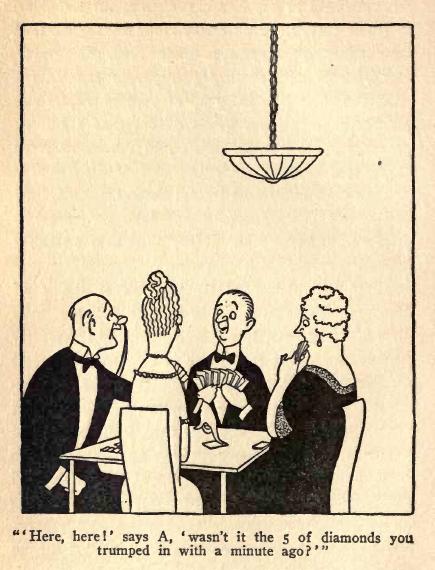
"It's your lead, if you don't mind," says A very distinctly. "You have made only one false start out of a possible three. Try again." I pretend not to hear this sarcasm, and, just to show him that there is life in the old dog yet, I lead my ace of spades.
"Look here, my dear sir!" says A, quite upset by now. "Only one hand ago you refused spades and trumped them. That revoking on your part gives us three tricks and we throw up the hand."
"Fair enough," I retort cheerfully, "three is just what you bid, isn't it? Quite a coincidence, I call it," and with that I throw my cards on the table with considerable relief. Nothing good could have come of this hand, even if we had played until midnight.
From all sides now arose the familiar sounds of the post-mortem: "I had the jack, 10, 9, and 7, all good, but I just couldn't get in with them.... If you had only led me your king, we could have set them at least two.... I knew that Grace had the queen, but I didn't dare try to finesse.... We had simple honors.... As soon as I saw you leading spades, I knew that there was nothing in it," etc., etc.
But at our table there was no post-mortem. Not because there had been no death, but there seemed to be nothing to say about it. So we sat, marking down our scores, until Dora came up behind me and said: "Well, dear, how is your game coming on?"
As no one else seemed about to speak, I said: "Oh, finely, I'm getting the hang of it in no time."
My partner muttered something about hanging being too good, which seemed a bit uncalled for.
And so I went through the evening, meeting new people and making new friends. And, owing to Dora's having neglected to teach me the details of score keeping, I had to make a system up for myself, with the result that I finished the evening with a total of 15,000 points on my card and won the first prize.
"Beginner's luck," I called it with modest good nature.
IX
FROM NINE TO FIVE
One of the necessary qualifications of an efficient business man in these days of industrial literature seems to be the ability to write, in clear and idiomatic English, a 1,000-word story on how efficient he is and how he got that way. A glance through any one of our more racy commercial magazines will serve nicely to illustrate my point, for it was after glancing through one of them only five minutes ago that the point suggested itself to me.
"What Is Making Our Business Grow;" "My $10,000 System of Carbon-Copy Hunting;" "Making the Turn-Over Turn In;" "If I Can Make My Pencil Sharpenings Work, Why Can't You?" "Getting Sales Out of Sahara," etc., are some of the intriguing titles which catch the eye of the student of world affairs as he thumbs over the business magazines on the news-stands before buying his newspaper. It seems as if the entire business world were devoting its working hours to the creation of a school of introspective literature.
But the trouble with these writers is that they are all successful. There is too much sameness to their stuff. They have their little troubles at first, it is true, such as lack of coördination in the central typing department, or congestion of office boys in the room where the water cooler is situated; but sooner or later you may be perfectly sure that Right will triumph and that the young salesman will bring in the order that puts the firm back on its feet again. They seem to have no imagination, these writers of business confessions. What the art needs is some Strindberg of Commerce to put down on paper the sordid facts of Life as they really are, and to show, in bitter words of cynical realism, that ink erasers are not always segregated or vouchers always all that they should be, and that, behind the happy exterior of many a mahogany railing, all is not so gosh-darned right with the world after all.
Now, without setting myself up as a Strindberg, I would like to start the ball rolling toward a more realistic school of business literature by setting down in my rough, impulsive way a few of the items in the account of "How We Make Our Business Lose $100,000 a Year."
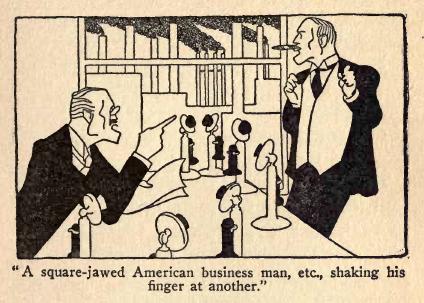
All that I ask in the way of equipment is an illustration showing a square-jawed, clean-cut American business man sitting at a desk and shaking his finger at another man, very obviously the head of the sales department because it says so under the picture, who is standing with his thumbs in the arm-holes of his waistcoat, gnawing at a big, black cigar, and looking out through the window at the smoke-stacks of the works. With this picture as a starter, and a chart or two, I can build up a very decent business story around them.
In the first place let me say that what we have done in our business any firm can do in theirs. It is not that we have any extraordinary talents along organization lines. We simply have taken the lessons learned in everyday trading, have tabulated and filed them in triplicate. Then we have forgotten them.
I can best give an idea of the secret of our mediocrity as a business organization by outlining a typical day in our offices. I do this in no spirit of boasting, but simply to show these thousands of systematized business men who are devoting themselves to literature that somewhere in all this miasma of success there shines a ray of inefficiency, giving promise of the day that is to come.
The first part of the morning in our establishment is devoted to the mail. This starts the day off right, for it gives every one something to do, which is, I have found, a big factor in keeping the place looking busy.
Personally I am not what is known as a "snappy" dictator. It makes me nervous to have a stenographer sitting there waiting for me to say something so that she can pounce on it and tear it into hieroglyphics. I feel that, mentally, she is checking me up with other men who have dictated to her, and that I am being placed in Class 5a, along with the licensed pilots and mental defectives, and the more I think of it the more incoherent I become. If exact and detailed notes were to be preserved of one of my dictated letters, mental processes, and all, they might read something like this:
"Good morning, Miss Kettle.... Take a letter, please ... to the Nipco Drop Forge and Tool Company, Schenectady ... S-c-h-e-c—er—well, Schenectady; you know how to spell that, I guess, Miss Kettle, ha! ha!... Nipco Drop Forge and Tool Company, Schenectady, New York.... Gentlemen—er (business of touching finger tips and looking at the ceiling meditatively)—Your favor of the 17th inst. at hand, and in reply would state that—er (I should have thought this letter out before beginning to dictate and decided just what it is that we desire to state in reply)—and in reply would state that—er ... our Mr. Mellish reports that—er ... where is that letter from Mr. Mellish, Miss Kettle?... The one about the castings.... Oh, never mind, I guess I can remember what he said.... Let's see, where were we?... Oh, yes, that our Mr. Mellish reports that he shaw the sipment—I mean saw the shipment—what's the matter with me? (this girl must think that I'm a perfect fool) ... that he shaw the sipment in question on the platform of the station at Miller's Falls, and that it—er ... ah ... ooom ... (I'll have this girl asleep in her chair in a minute. I'll bet that she goes and tells the other girls that she has just taken a letter from a man with the mind of an eight-year-old boy).... We could, therefore, comma,... what's the matter?... Oh, I didn't finish that other sentence, I guess.... Let's see, how did it go?... Oh, yes ... and that I, or rather it, was in good shape ... er, cross that out, please (this girl is simply wasting her time here. I could spell this out with alphabet blocks quicker and let her copy it) ... and that it was in excellent shape at that shape—er ... or rather, at that time ... er ... period. New paragraph.
"We are, comma, therefore, comma, unable to ... hello, Mr. Watterly, be right with you in half a second.... I'll finish this later, Miss Kettle ... thank you."
When the mail is disposed of we have what is known as Memorandum Hour. During this period every one sends memoranda to every one else. If you happen to have nothing in particular about which to dictate a memorandum, you dictate a memorandum to some one, saying that you have nothing to suggest or report. This gives a stimulating exchange of ideas, and also helps to use up the blue memorandum blanks which have been printed at some expense for just that purpose.
As an example of how this system works, I will give a typical instance of its procedure. My partner, let us say, comes in and sits down at the desk opposite me. I observe that his scarfpin is working its way out from his tie. I call a stenographer and say: "Take a memo to Mr. MacFurdle, please. In re Loosened Scarfpin. You are losing your scarfpin."
As soon as she has typed this it is given to Mr. MacFurdle's secretary, and a carbon copy is put in the files. Mr. MacFurdle, on receiving my memo, adjusts his scarfpin and calls his secretary.
"A memo to Mr. Benchley, please. In re Tightened Scarfpin. Thank you. I have given the matter my attention."
As soon as I have received a copy of this typewritten reply to my memorandum we nod pleasantly to each other and go on with our work. In all, not more than half an hour has been consumed, and we have a complete record of the negotiations in our files in case any question should ever arise concerning them. In case no question should ever arise, we still have the complete record. So we can't lose—unless you want to call that half hour a loss.
It is then almost lunch time. A quick glance at a pile of carbons of mill reports which have but little significance to me owing to the fact that the figures are illegible (it being a fifth-string carbon); a rapid survey of the matter submitted for my O.K., most of which I dislike to take the responsibility for and therefore pass on to Mr. Houghtelling for his O.K.; a short tussle in the washroom with the liquid-soap container which contains no liquid soap and a thorough drying of the hands on my handkerchief, the paper towels having given out early in the morning, and I am ready to go to lunch with a man from the Eureka Novelty Company who wants to sell us a central paste-supply system (whereby all the office paste is kept in one large vat in the storeroom, individual brushfuls being taken out only on requisitions O.K.'d by the head of the department).
Both being practical business men, we spend only two hours at lunch. And, both being practical business men, we know all the subtleties of selling. It is a well-known fact that personality plays a big rôle in the so-called "selling game" (one of a series of American games, among which are "the newspaper game," "the advertising game," "the cloak-and-suit game," "the ladies' mackintosh and over-shoe game," "the seedless-raisin and dried-fruit game," etc.), and so Mr. Ganz of the Eureka Novelty Company spends the first hour and three-quarters developing his "personality appeal." All through the tomato bisque aux croutons and the roast prime ribs of beef, dish gravy, he puts into practice the principles enunciated in books on Selling, by means of which the subject at hand is deferred in a subtle manner until the salesman has had a chance to impress his prospect with his geniality and his smile (an attractive smile has been known to sell a carload of 1897 style derbies, according to authorities on The Smile in Selling), his knowledge of baseball, his rich fund of stories, and his general aversion to getting down to the disagreeable reason for his call.
The only trouble with this system is that I have done the same thing myself so many times that I know just what his next line is going to be, and can figure out pretty accurately at each stage of his conversation just when he is going to shift to one position nearer the thing he has to sell. I know that he has not the slightest interest in my entertainment other than the sale of a Eureka Central Paste Supply System, and he knows that I know it, and so we spend an hour and three-quarters fooling the waiter into thinking that we are engaged in disinterested camaraderie.
For fifteen minutes we talk business, and I agree to take the matter up with the directors at the next meeting, holding the mental reservation that a central paste supply system will be installed in our plant only over my dead body.
This takes us until two-thirty, and I have to hurry back to a conference. We have two kinds of "conference." One is that to which the office boy refers when he tells the applicant for a job that Mr. Blevitch is "in conference." This means that Mr. Blevitch is in good health and reading the paper, but otherwise unoccupied. The other kind of "conference" is bona fide in so far as it implies that three or four men are talking together in one room, and don't want to be disturbed.
This conference is on, let us say, the subject of Window Cards for display advertising: shall they be triangular or diamond-shaped?
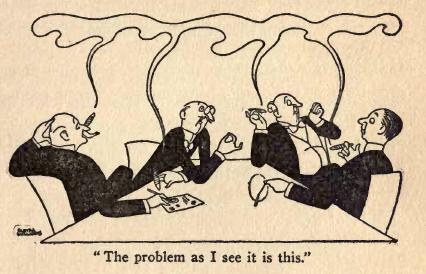
There are four of us present, and we all begin by biting off the ends of four cigars. Watterly has a pile of samples of window cards of various shapes, which he hangs, with a great deal of trouble, on the wall, and which are not referred to again. He also has a few ideas on Window Card Psychology.
"It seems to me," he leads off, "that we have here a very important question. On it may depend the success of our Middle Western sales. The problem as I see it is this: what will be the reaction on the retina of the eye of a prospective customer made by the sight of a diamond-shaped card hanging in a window? It is a well-known fact in applied psychology that when you take the average man into a darkened room, loosen his collar, and shout "Diamonds!" at him suddenly, his mental reaction is one in which the ideas of Wealth, Value, Richness, etc., predominate. Now, it stands to reason that the visual reaction from seeing a diamond-shaped card in the window will...."
"Excuse me a moment, George," says MacFurdle, who has absorbed some pointers on Distribution from a book entitled "The World Salesman," "I don't think that it is so important to get after the psychology of the thing first as it is to outline thoroughly the Theory of Zone Apportionment on which we are going to work. If we could make up a chart, showing in red ink the types of retail-stores and in green ink the types of jobber establishments, in this district, then we could get at the window display from that angle and tackle the psychology later, if at all. Now, on such a chart I would try to show the zones of Purchasing Power, and from these could be deduced...."
"Just a minute, Harry," Inglesby interrupts, "let me butt in for half a second. That chart system is all very well when you are selling goods with which the public is already familiar through association with other brands, but with ours it is different. We have got to estimate the Consumer Demand first in terms of dollar-and-a-quarter units, and build our selling organization up around that. Now, if I know anything about human nature at all—and I think I do, after being in the malleable-iron game for fifteen years—the people in this section of the country represent an entirely different trade current than...."
At this point I offer a few remarks on one of my pet hobbies, the influence of the Gulf Stream on Regional Commerce, and then we all say again the same things that we said before, after which we say them again, the pitch of the conversation growing higher at each repetition of views and the room becoming more and more filled with cigar smoke, Our final decision is to have a conference to-morrow afternoon, before which each one is to "think the matter over and report his reactions."
This brings the day to a close. There has been nothing remarkable in it, as the reader will be the first one to admit. And yet it shows the secret of whatever we have not accomplished in the past year in our business.
And it also shows why we practical business men have so little sympathy with a visionary, impractical arrangement like this League of Nations. President Wilson was all right in his way, but he was too academic. What we practical men in America want is deeds, not words.
X
TURNING OVER A NEW LEDGER LEAF
New Year's morning approximately ninety-two million people in these United States will make another stab at keeping personal and household accounts for the coming year.
One month from New Year's there will be approximately seventy-three of these accountants still in the race (all started). Of these, sixty will be groggy but still game and willing to lump the difference between the actual balance in their pockets and the theoretical balance in the books under the elastic heading "General Expenses" or "Incidentals," and start again for February. The remaining thirteen, who came out even, will be either professors of accounting in business schools or out and out unreliable.
This high mortality rate among amateur accountants is one of the big problems of modern household efficiency, and is exceeded in magnitude only by the number of schemes devised to simplify household accounting. Every domestic magazine, in the midst of its autobiographical accounts of unhappy marriages, must needs run a chart showing how far a family with an income of $1,500 a year can go without getting caught and still put something aside for a canary. Every insurance company has had prepared by experts a table of figures explaining how, by lumping everything except Rent and Incidentals under Luxuries and doing without them, you can save enough from the wreckage of $1,200 a year to get in on their special Forty-Year Adjournment Policy.
Those publications which cannot get an expert to figure out how much you ought to spend per day will publish letters from young housewives showing how they made out a budget which in the end brought them in more money than they earned and had the grocer and electric light company owing them money.
The trouble with all these vicarious budgets is that they presuppose, on the part of the user, an ability to add and subtract. They take it for granted that you are going to do the thing right. Now, with all due respect to our primary and secondary school system, this is absurd. Here and there you may find some one who can take a page of figures and maul them over so that they will come out right at the bottom, but who wants to be a man like that? What fun does he get out of life, always sure of what the result is going to be?
As for me, give me the regular method of addition by logic; that is, if the result obtained is twelve removed from the result that should have been obtained, then, ergo, twelve is the amount by which you have miscalculated and it should, therefore, be added or subtracted, as the case may be, to or from the actual result somewhere up in the middle of the column, so that in the end the thing will balance. And there you are, with just the same result as if you had worked for hours over the page and quibbled over every little point and figure. There is no sense in becoming a slave to numerical signs which in themselves are not worth the paper they are written on. It is the imagination that one puts into accounting that makes it fascinating. If free verse, why not free arithmetic?
It is for the honest ones, who admit that they can't work one of the budget systems for the mentally alert, that the accompanying one has been devised.
Let us take, for instance, a family whose income is $750,000 a year, exclusive of tips. In the family are a father, mother and fox terrier. The expenses for such a family come under the head of Liabilities and are distributed among six accounts: Food, Lodging, Extras, Extras, Incidentals and Extras. For this couple I would advise the following system:
Take the contents of the weekly pay envelope, $14,423.08 (if any one is mean enough to go and divide $750,000 into fifty-two parts to see if I have got it right, he will find that it doesn't quite come to eight cents, but you certainly wouldn't have me carry it out to any more places. It took me from three yesterday afternoon until after dinner to do what I did). Take the contents of the envelope and lay them on the kitchen table in little piles, so much for meat, so much for eggs, so much for adhesive plaster, etc., until the kitchen table is covered. Then sweep it all into a bag and balance your books.
Balancing the books is another point in the ideal system which often makes for trouble. Sticklers for form insist that the two sides of the page shall come out alike, even at the expense of your self-respect. It is the artificiality of this that hurts. No matter how much you spend, no matter how much you receive, at the bottom of the page they must add up to the same thing, with a double red line underneath them to show that the polls are closed.
But since this is the accepted way of doing the thing, we might just as well concede the point and lay our plans accordingly. First take the sum that you have left over in the household exchequer at the end of the mouth. Put it, or its equivalent in check form, on the table in front of you. Then, working backward, find out how much you have spent since the first of the month. This sum is the crux of the whole system. Divide it into as many equal parts as you have accounts. For instance, Food, Rent, Clothes, Insurance and Savings, Operating Expenses, Higher Life. If you can't divide it so that it comes out even, tuck a little bit on the Higher Life account. And, as the student of French says," Voilà" (there it is)!
Perhaps you have wondered what I meant by "Higher Life." I have. It might be well to state it here so that we can all get it clear in our minds. Under the "Higher Life" account you can charge everything that you want to do, but feel that you can't afford. If you want to take in an inconsequential theatrical performance and can't quite square it with your conscience, figure it out this way: By going to that show you will become so disgusted with the futility of such things that you will come out of the theater all aglow with a resolve to do a man's work in the world just as soon as you have caught up with your sleep. Surely that comes under "Advancement" or "Higher Life."
Insurance budget helps always include under "Advancement" money spent for lectures. Now, it may be that I have drifted away from the big things in life since I moved out into the country, but somehow I can't just at this moment recollect standing in line at a box office for a lecture. But then, my home life is very pleasant.
Lectures would be a very convenient heading, nevertheless, to have in your budget. Then, any little items that slip your attention during the month you can group under lectures and mark off ten paces in your advancement chart.
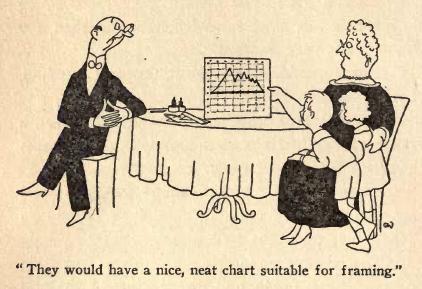
By way of outlining beforehand just what you can spend on this and that (and it is usually on "that") it might be well to take another family with a representative income. Let us say that there are four in the family and that the income is about $1,000 per year too small. If such a family would sit down some evening and draw a chart showing father's earning capacity with one red line and the family spending capacity with one black line, they would not only have a pleasant evening, but they would have a nice, neat chart all drawn and suitable for framing.
There is one little technical point that the amateur accountant will do well to remember. It gives a distinction to the page and shows that you are acquainted with bookkeeping lore. It is this: Label your debit column "credits" and your credit column "debits." You might think that what you receive into the exchequer would be credited and your expenses debited, but that is where you miss the whole theory of practical accounting. That would be too simple to be efficient. You must wax transcendental, and say, "I, as an individuated entity, am nothing. Everything is all; all is everything." There is a transcendent Account, to which all other accounts are responsible, and hence money turned over to the Cinnamon Account is not credited to that account, but rather debited to it, for Cinnamon hereby assumes the responsibility for the sum. As money is spent for Cinnamon, its account is credited, for it is relieved of that responsibility. Don't start wondering where the responsibility finally settles or you will throw something out of its stride in your brain.
Some people profess to scoff at the introduction of bookkeeping into the running of the household. It is simply because they never tasted the fascination of the thing.
The advantage of keeping family accounts is clear. If you do not keep them you are uneasily aware of the fact that you are spending more than you are earning. If you do keep them, you know it.
XI
A PIECE OF ROAST BEEF
Personally, I class roast beef with watercress and vanilla cornstarch pudding as tasty articles of diet. It undoubtedly has more than the required number of calories; it leans over backward in its eagerness to stand high among our best proteins, and, according to a vivid chart in the back of the cookbook, it is equal in food value to three dried raisins piled one on the other plus peanut-butter the size of an egg.
But for all that I can't seem to feel that I am having a good time while I am eating it. It stimulates the same nerve centers in me that a lantern-slide lecture on "Palestine—the Old and the New," does.
However, I have noticed that there are people who are not bored by it; in fact, I have seen them deliberately order it in a restaurant when they had the choice of something else; so I thought that the only fair thing I could do would be to look into the matter and see if, in this great city, there weren't some different ways of serving roast beef to vary its monotony.
Roast beef is not the same price in all eating-places. What makes the difference? What does a diner at the Ritz get in his "roast prime ribs of beef au jus" that makes it distinctive from the "Special to-day—roast beef and mashed potatoes" of the Bowery restaurant?
To answer these questions I started out on a tour of the representative eating-places of some of our best known strata of society, and, whatever my conclusions are, you may be sure that they are thoroughly inexpert.
First, I tried out what is known as the Bay State Lunch, so called because on Thursdays they have a fishcake special. It is one of the hundreds of "self-serving" lunchrooms, where you approach the marble counter and give your order in a low tone to a man in a barber's coat, and then repeat it at intervals of one minute, each time louder and each time to a different man, until you are forced to point to a tub of salmon salad and say, "Some of that," for which your ticket is punched and you are allowed to take your portion and nurse it on the over-developed arm of a chair.
Here the roast beef shot through the Punch and Judy arrangement in the wall, a piece of meat about as large around as a man's-size mitten, steeping in its own gravy and of a pale reddish hue. The price was twenty cents, which included a dab of mashed potato dished out in an ice-cream scoop, a generous allowance of tender peas, two hot tea-biscuits and butter to match.
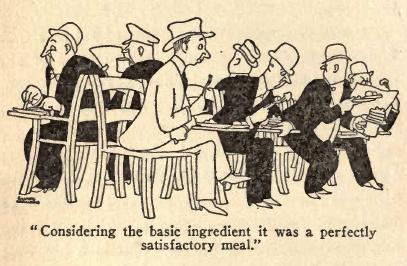
Considering the basic ingredient, it was a perfectly satisfactory meal, and I felt that twenty cents was little enough to pay for it, especially since it was going in on my expense account.
For the next experiment I went to a restaurant where business men are wont to gather for luncheon, men who pride themselves on their acumen and adherence to the principles of efficiency. The place has a French name and its menus are printed on a card the size of a life insurance company's complimentary calendar, always an ominous sign. The roast beef here was served cold, with a plate of escarole salad (when I was a boy I used to have to dig escarole out of the front lawn with a trowel so that the grass could have a chance) for seventy-five cents.
The meat bulked a little larger than at the Bay State Lunch, but when the fat had been cut away and trimmed off the salvage was about the size of a boy's mitten. As for the taste, the only difference that I could detect was that one had been hot and the other cold.
And, incidentally, the waiter had some bosom friends in the next room who fascinated him so that it was all I could do to make him see that if he didn't come around to me once in a while, just as a matter of form, there would be no way for me to tip him. Beef and salad, plus tip, ninety cents.
That evening I ambled up the Bowery until I came to the Busy Home Restaurant. On a black-board in front was written, "Roast Beef, Mashed Potatoes and Coffee, 10 Cents." My old hunger again seized me. I said to myself: "Look here! Be a man! This thing is getting the best of you." But before I knew it I was inside and seated at an oilcloth-covered table, saying, in a hoarse voice, "Roast beef!"
The waiter was dressed in an informal costume, with his shirt-sleeves rolled up and a mulatto apron about his waist, but he smiled genially when he took my order and was back with it in two minutes. The article itself was of the regulation size, cut somewhat thinner, perhaps, and bordering on the gray in hue, but undoubtedly roast beef. It, too, had an affinity for its own gravy and hid itself modestly under an avalanche of mashed potatoes. A cup of coffee was also included in the ten cents' initial expense, but I somehow wasn't coffee-thirsty that night, and so didn't sample it. But I did help myself to the plate piled high with fresh bread which was left in front of me. All in all, it was what I should call a representative roast beef dinner. And I got more than ten cents' worth of calories, I know.
But so far I had kept below the Fourteenth Street belt in my investigations. Roast beef is a cosmopolitan habit, and knows no arbitrary boundaries; so I went uptown. Into one of the larger of our largest hotels, one which is not so near the Grand Central Station as to be in the train-shed, and yet not so far removed from it as to be represented by a different Assemblyman. Here, I felt, would be the test. Could roast beef come back? Surrounded by glittering chandeliers and rich tapestries, snowy table linen and silver service, here was the chance for the ordinary roast beef to become a veritable dainty, with some character, some distinctive touch that should lift it above all that roast beef has ever meant before. I entered the dining-room, in high hopes.
Clad in a walking suit of virile tweed, I considered myself respectably dressed. Not ostentatiously respectable, mind you, but, since most of the other diners were in evening dress, rather distingué, I thought.
But apparently the hotel retainers weren't trained to look through a rough exterior and find the sterling qualities beneath. They looked through my rough exterior all right, but they didn't stop at my sterling qualities. They looked right through to the man behind me, and gave him the signal that there was a seat for him.
Not to be outdone, however, I got my place in the sun by cleverly tripping my rival as he passed me, so that he fell into the fountain arrangement, while I sat down in the seat pulled out for him by the head waiter. And, once I was in, there was nothing for them to do but let me stay.
After I had been there a few minutes a waiter came and put on a fresh table cloth. Five minutes later another man placed a knife and spoon at my plate. Later in the evening a boy with a basket of rolls wandered by and deposited one on my table with a pair of pincers. Personally, I was rather glad that it was working out this way, for it would make my story all the better, but I might have really been in a hurry for my dinner.
It wasn't long, as the crow flies, before one of the third assistant waiters unloosened enough to drop round and see if there was anything else I wanted besides one roll and a knife and spoon. I looked over the menu as if I were in a pretty captious mood, and then, with the air of an epicure who has tasted to the dregs all the condiments of Arabia and whose jaded palate refuses to thrill any longer, I ordered "roast beef."
It was billed as "90 (.80)," which didn't strike me as being very steep, considering the overhead expense there must be in keeping little knots of waiters and 'bus-boys standing round doing nothing in the further corner of the room.
The waiter wasn't very enthusiastic over my order, and something saved me from asking him if they threw in "a side" of mashed potatoes with the meat. He seemed to expect something more, even after I had ordered potatoes, so I suggested an artichoke. That cheered him up more than anything I had done that evening, and he really got quite fratty and said: "A little salad, sir?" Again I imitated a man who has had more experience with salads than any other three men put together and who has found them a miserable sham.
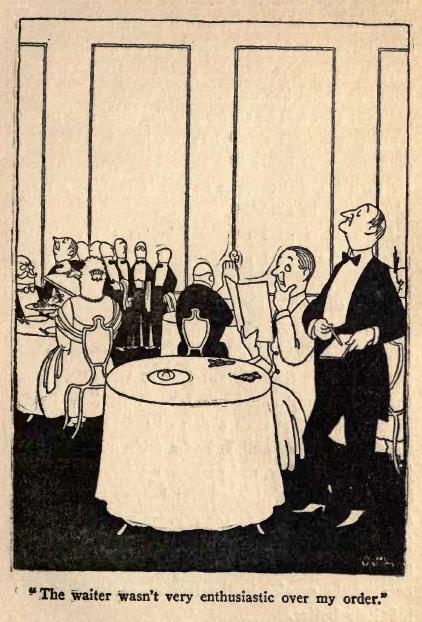
"No; that will be all for now," I said, and turned wearily away. I wanted to tell him that I had a dinner coat at home that looked enough sight better than his, but there is no use in making a scene when it can be avoided.
During the next twenty minutes the orchestra played once and I ate my roll. Then the roast beef came.
On a silver platter, with a silver cover, it was placed before me under the best possible scenic conditions. But the thing that met my gaze when the cover was lifted might just as well have been the same property piece of roast beef that was keeping company with a dab of mashed potato in the Bay State Lunch. It had a trifle more fat, was just a shade pinker, and perhaps a micrometer could have detected a bit more bulk; but, so far as I was concerned or so far as the calories were concerned, it was the same. I won't say that it was the same as the Roast Beef Special of the Bowery Restaurant, because the service in the Bowery Restaurant was infinitely better.
As a fitting garniture to such a dish, there was a corsage of watercress draped on the corner of the salver. At any rate, it could be said for it that it was not intoxicating, and so could never cause any real misery in this world.
I nibbled at my roast beef, but my spirit was broken. I had gone through a week of self-denial, ordering roast beef when I craved edibles, eating at restaurants while my family waited for me at home, and here was the result of my researches: Roast beef is roast beef, and nothing can prevent it. From the ten-cent order of the Busy Home Restaurant, up through to the piece I was then eating, it was the same grim reality, the only justification for a difference in price being a silver salver or a waiter in a tuxedo.
"But," I said to myself, "eighty cents isn't so much, at that. Besides, I have heard the orchestra play one tune every half-hour, and have had a kind word from one of the chargés d'affaires of the waiter's staff."
This quite reconciled me, until my check was brought. There, added to the initial expense of eighty cents, was the upkeep, such as "Cover, 25c." "Potatoes, 30c." And to this must be added the modest fee of twenty cents to the waiter and ten cents to the hat-boy who gave me the wrong hat. Total expense for one piece of roast beef, $1.70.
These investigations may not prove to be much of a contribution to modern science or economics. I doubt if they are ever incorporated in any textbook, even if it should be a textbook on this very subject. But I must take credit to myself for one thing: Not once throughout the whole report have I alluded to the Tenderloin District.
XII
THE COMMUNITY MASQUE AS A SUBSTITUTE FOR WAR
With War and Licker removed from the list of "What's Going on This Week," how will mankind spend the long summer evenings? Some advocate another war. Others recommend a piece of yeast in a glass of grape-juice. The effect is said to be equally devastating.
But there is a new school, led by Percy Mackaye, which brings forward a scheme for occupying the spare time of the world which has, at least, the savor of novelty. It presents the community masque as a substitute for war. Whenever a neighborhood, or county, feels the old craving for blood-letting and gas-bombing coming on, a town meeting is to be called and plans drawn up for the presentation of a masque entitled "Democracy" or "From Chrysalis to Butterfly." In this simple way, one and all will be kept out in the open air and will get to know each other better, thus relieving their bellicose cravings right there on the village green among themselves, without dragging a foreign nation into the mess at all. The slogan is "Fight Your Neighbors First. Why Go Abroad for War?"
The community masque idea is all right in itself. There certainly can be no harm in dressing up to represent the Three Platoon System, or the Spirit of Machinery, and reciting free verse to the effect that:
"I am the Three Platoon System. Firemen I represent, And the clash and clang of the Hook and Ladder Company."
No one could find fault with that, provided that those taking part in the thing do so of their own free will and understand what they are doing.
The trouble with the community masque is not so much with the masque as with the community. For while the masque may be a five star sporting extra hot from the presses of Percy Mackaye, the community is the same old community that has been getting together for inter-Sunday School track-meets and Wig and Footlight Club Amateur Theatricals for years and years, and the result has always been the same.
Let us say, for instance, that the community of Wimblehurst begins to feel the lack of a good, rousing war to keep the Ladies' Guild and the men over thirty-five busy. What could be more natural than to call in Mr. Mackaye, and say: "What have you got in the way of a nice masque for a suburban district containing many socially possible people and others who might do very well in ensemble work?"
Something entitled "The March of Civilization" is selected, because it calls for Boy Scout uniforms and a Goddess of Liberty costume, all of which are on hand, together with lots of Red Cross regalia, left over from the war drives. The plot of the thing concerns the adventures of the young girl Civilization who leaves her home in the Neolithic Period accompanied only by her faithful old nurse Language and Language's little children the Vowels and the Consonants. She is followed all the way from the Neolithic Age to the Present Time by the evil spirit, Indigestion, but, thanks to the helpful offices of the Spirits of Capillary Attraction, and Indestructibility of Matter, she overcomes all obstacles and reaches her goal, The League of Nations, at last.
But during the course of her wanderings, there have been all kinds of sub-plots which bring the element of suspense into the thing. For instance, it seems that this person Indigestion has found out something about Civilization's father which gives him the upper hand over the girl, and he, together with the two gunmen, Heat and Humidity, arrange all kinds of traps for the poor thing to fall into. But she takes counsel with the kind old lady, Self-Determination of Peoples, and is considerably helped by the low comedy character, Obesity, who always appears at just the right moment. So in the end, there is a big ensemble, involving Boy Scouts, representatives of those Allies who happen to be in good standing in that particular month, seven boys and girls personifying the twelve months of the year, Red Cross workers, the Mayor's Committee of Welcome, a selection of Major Prophets, children typifying the ten different ways of cooking an egg, and the all-pervading Spirit of the Post-Office Department, seated on a daïs in the rear and watching over the assemblage with kindly eyes and an armful of bricks.
This, then, is in brief outline, "The March of Civilization," selected for presentation by the Community Council of Wimblehurst. It is to be done on the edge of the woods which line the golf-course, and on paper, the thing shapes up rather well.
Considerable hard feeling arises, however, over the choice of the children to play the parts of the Vowels and the Consonants. It is, of course, not possible to have all the vowels and consonants represented, as they would clutter up the stage and might prove unwieldy in the allegretto passages. A compromise is therefore effected by personifying only the more graceful ones, like S and the lower-case f, and this means that a certain discrimination must be used in selecting the actors. It also means that a great many little girls are going to be disappointed and their mothers' feelings outraged.
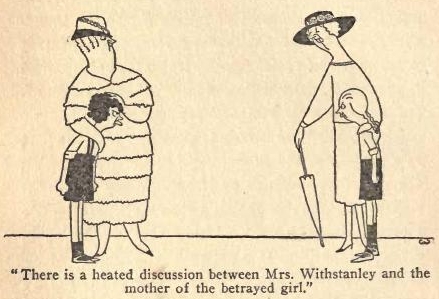
Little Alice Withstanley is chosen to play the part of the Craft Guild Movement in Industry, showing the rise of coöperation and unity among the working-classes. She is chosen because she has blonde hair which can be arranged in braids down her back, obviously essential to a proper representation of industrial team-work as a moving force in the world's progress. It so happens, however, that the daughter of the man who is cast for Humidity has had her eyes on this ingénue part ever since the printed text was circulated and had virtually been promised it by the Head of the House Committee of the Country Club, through whose kindness the grounds were to be used for the performance. There is a heated discussion over the merits of the two contestants between Mrs. Withstanley and the mother of the betrayed girl, which results in the withdrawal of the latter's offer to furnish Turkish rugs for the Oriental Decadence scene.
Following this, the rougher element of the community—enlisted to take part in the scenes showing the building of the Pyramids and the first Battle of Bull Run—appear at one of the early rehearsals in a state of bolshevik upheaval, protesting against the unjust ruling which makes them attend all rehearsals and wait around on the side hill until their scenes are on, keeping them inactive sometimes from two to three hours, according to the finish with which the principals get through the prologue and opening scenes showing the Creation. The proletariat present an ultimatum, saying that the Committee in charge can either shorten their waiting hours or remove the restrictions on crap-shooting on the side-hill during their periods of inaction.
There is a meeting of the Director and his assistants who elect a delegation to confer with the striking legionaries, with the result that no compromise is reached, the soviet withdraws from the masque in a body, threatening to set fire to the grass on the first night of the performance.
During the rehearsals the husband of the woman who is portraying Winter Wheat is found wandering along the brookside with her sister cereal Spring Wheat, which, of course, makes further polite coöperation between these two staples impossible, and the Dance of the Food Stuffs has to be abandoned at the last moment. This adds to the general tension.
Three nights before the first performance the Director calls every one to a meeting in the trophy room of the Club-house and says that, so far as he is concerned, the show is off. He has given up his time to come out here, night after night, in an attempt to put on a masque that will be a credit to the community and a significant event in the world of art, and what has he found? Indifference, irresponsibility, lack of coöperation, non-attendance at rehearsals, and a spirit of laissez-faire in the face of which it is impossible to produce a successful masque. Consideration for his own reputation, as well as that of the township, makes it necessary for him to throw the whole thing over, here and now.
The Chairman of the Committee then gets up and cries a little, and says that he is sure that if every one agrees to pull together during these last three days and to attend rehearsals faithfully and to try to get plenty of sleep, Mr. Parsleigh, the coach, will consent to help them through with the performance, and he asks every one who is willing to coöperate to say "Aye." Every one says "Aye" and Mr. Parsleigh is won over.
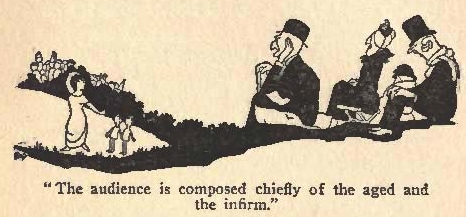
As for the masque itself, it is given, of course; and as most of the able-bodied people of the community are taking part, the audience is composed chiefly of the aged and the infirm, who catch muscular rheumatism from sitting out-of-doors and are greatly bored, except during those scenes when their relatives are taking part. The masque is hailed as a great success, however, in spite of the fact that the community has been disrupted and social life made impossible until the next generation grows up and agrees to let bygones be bygones.
But as a substitute for war, it has no equal.
XIII
CALL FOR MR. KENWORTHY!
A great many people have wondered to themselves, in print, just where the little black laundry-studs go after they have been yanked from the shirt. Others pass this by as inconsequential, but are concerned over the ultimate disposition of all the pencil stubs that are thrown away. Such futile rumination is all well enough for those who like it. As for me, give me a big, throbbing question like this: "Who are the people that one hears being paged in hotels? Are they real people or are they decoys? And if they are real people, what are they being paged for?"
Now, there's something vital to figure out. And the best of it is that it can be figured out by the simple process of following the page to see whether he ever finds any one.
In order that no expense should be spared, I picked out a hotel with poor service, which means that it was an expensive hotel. It was so expensive that all you could hear was the page's voice as he walked by you; his footfalls made no noise in the extra heavy Bokhara. It was just a mingling of floating voices, calling for "Mr. Bla-bla, Mr. Schwer-a-a, Mr. Twa-a-a."
Out of this wealth of experimental material I picked a boy with a discouraged voice like Wallace Eddinger's, who seemed to be saying "I'm calling these names—because that's my job—if I wasn't calling these—I'd be calling out cash totals in an honor system lunchery—but if any one should ever answer to one of these names—I'd have a poor spell."
Allowing about fifteen feet distance between us for appearance's sake, I followed him through the lobby. He had a bunch of slips in his hand and from these he read the names of the pagees.
"Call for Mr. Kenworthy—Mr. Shriner—Mr. Bodkin—Mr. Blevitch—Mr. Kenworthy—Mr. Bodkin—Mr. Kenworthy—Mr. Shriner—call for Mr. Kenworthy—Mr. Blevitch—Mr. Kenworthy."
Mr. Kenworthy seemed to be standing about a 20 per cent better chance of being located than any of the other contestants. Probably the boy was of a romantic temperament and liked the name. Sometimes that was the only name he would call for mile upon mile. It occurred to me that perhaps Mr. Kenworthy was the only one wanted, and that the other names were just put in to make it harder, or to give body to the thing.
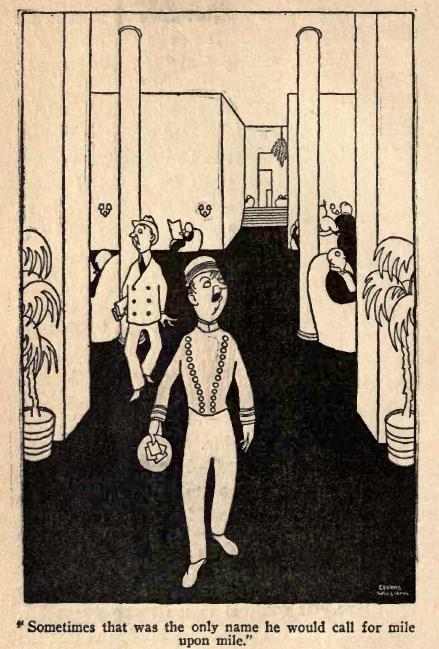
But when we entered the bar the youth shifted his attack. The name of Kenworthy evidently had begun to cloy. He was fed up on romance and wanted something substantial, homely, perhaps, but substantial.
So he dropped Kenworthy and called: "Mr. Blevitch. Call for Mr. Blevitch—Mr. Shriner—Mr. Bodkin—Mr. Blevitch—"
But even this subtle change of tactics failed to net him a customer. We had gone through the main lobby, along the narrow passage lined with young men waiting on sofas for young women who would be forty minutes late, through the grill, and now had crossed the bar, and no one had raised even an eyebrow. No wonder the boy's voice sounded discouraged.
As we went through one of the lesser dining-rooms, the dining-room that seats a lot of heavy men in business suits holding cigarettes, who lean over their plates the more confidentially to converse with their blond partners, in this dining-room the plaintive call drew fire. One of the men in business suits, who was at a table with another man and two women, lifted his head when he heard the sound of names being called.
"Boy!" he said, and waved like a traffic officer signaling, "Come!"
Eagerly the page darted forward. Perhaps this was Mr. Kenworthy! Or better yet, Mr. Blevitch.
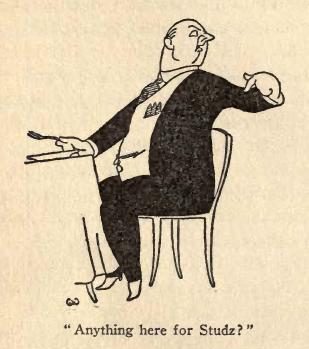
"Anything here for Studz?" said the man in the business suit, when he was sure that enough people were listening.
"No, sir," sighed the boy. "Mr. Blevitch, Mr. Kenworthy, Mr. Shriner, Mr. Bodkin?" he suggested, hopefully.
"Naw," replied the man, and turned to his associates with an air of saying: "Rotten service here—just think of it, no call for me!"
On we went again. The boy was plainly skeptical. He read his lines without feeling. The management had led him into this; all he could do was to take it with as good grace as possible.
He slid past the coat-room girl at the exit (no small accomplishment in itself) and down a corridor, disappearing through a swinging door at the end. I was in no mood to lose out on the finish after following so far, and I dashed after him.
The door led into a little alcove and another palpitating door at the opposite end showed me where he had gone. Setting my jaw for no particular reason, I pushed my way through.
At first, like the poor olive merchant in the Arabian Nights I was blinded by the glare of lights and the glitter of glass and silver. Oh, yes, and by the snowy whiteness of the napery, too. "By the napery of the neck" wouldn't be a bad line to get off a little later in the story. I'll try it.
At any rate, it was but the work of a minute for me to realize that I had entered by a service entrance into the grand dining-room of the establishment, where, if you are not in evening dress, you are left to munch bread and butter until you starve to death and are carried out with your heels dragging, like the uncouth lout that you are. It was, if I may be allowed the phrase, a galaxy of beauty, with every one dressed up like the pictures. And I had entered 'way up front, by the orchestra.
Now, mind you, I am not ashamed of my gray suit. I like it, and my wife says that I haven't had anything so becoming for a long time. But in it I didn't check up very strong against the rest of the boys in the dining-room. As a gray suit it is above reproach. As a garment in which to appear single-handed through a trapdoor before a dining-room of well dressed Middle Westerners it was a fizzle from start to finish. Add to this the items that I had to snatch a brown soft hat from my head when I found out where I was, which caused me to drop the three evening papers I had tucked under my arm, and you will see why my up-stage entrance was the signal for the impressive raising of several dozen eyebrows, and why the captain approached me just exactly as one man approaches another when he is going to throw him out.
(Blank space for insertion of "napery of neck" line, if desired. Choice optional with reader.)
I saw that anything that I might say would be used against me, and left him to read the papers I had dropped. One only lowers one's self by having words with a servitor.
Gradually I worked my way back through the swinging doors to the main corridor and rushed down to the regular entrance of the grand dining-salon, to wait there until my quarry should emerge. Suppose he should find all of his consignees in this dining-room! I could not be in at the death then, and would have to falsify my story to make any kind of ending at all. And that would never do.
Once in a while I would catch the scent, when, from the humming depths of the dining-room, I could hear a faint "Call for Mr. Kenworthy" rising above the click of the oyster shells and the soft crackling of the "potatoes Julienne" one against another. So I knew that he had not failed me, and that if I had faith and waited long enough he would come back.
And, sure enough, come back he did, and without a name lost from his list. I felt like cheering when I saw his head bobbing through the mêlée of waiters and 'bus-boys who were busy putting clean plates on the tables and then taking them off again in eight seconds to make room for more clean plates. Of all discouraging existences I can imagine none worse than that of an eternally clean plate. There can be no sense of accomplishment, no glow of duty done, in simply being placed before a man and then taken away again. It must be almost as bad as paging a man who you are sure is not in the hotel.
The futility of the thing had already got on the page's nerves, and in a savage attempt to wring a little pleasure out of the task he took to welding the names, grafting a syllable of one to a syllable of another, such as "Call for Mr. Kenbodkin—Mr. Shrineworthy—Mr. Blevitcher."
This gave us both amusement for a little while, but your combinations are limited in a thing like that, and by the time the grill was reached he was saying the names correctly and with a little more assurance.
It was in the grill that the happy event took place. Mr. Shriner, the one of whom we expected least, suddenly turned up at a table alone. He was a quiet man and not at all worked up over his unexpected honor. He signaled the boy with one hand and went on taking soup with the other, and learned, without emotion, that he was wanted on the telephone. He even made no move to leave his meal to answer the call, and when last seen he was adding pepper with one hand and taking soup with the other. I suspect that he was a "plant," or a plain-clothes house detective, placed there on purpose to deceive me.
We had been to every nook of the hotel by this time, except the writing-room, and, of course, no one would ever look there for patrons of the hotel. Seeing that the boy was about to totter, I went up and spoke to him. He continued to totter, thinking, perhaps, that I was Mr. Kenworthy, his long-lost beau-ideal. But I spoke kindly to him and offered him a piece of chocolate almond-bar, and soon, in true reporter fashion, had wormed his secret from him before he knew what I was really after.
The thing I wanted to find out was, of course, just what the average is of replies to one paging trip. So I got around it in this manner: offering him another piece of chocolate almond-bar, I said, slyly: "Just what is the average number of replies to one paging trip?"
I think that he had suspected something at first, but this question completely disarmed him, and, leaning against an elderly lady patron, he told me everything.
"Well," he said, "it's this way: sometimes I find a man, and sometimes I can go the rounds without a bite. To-night, for instance, here I've got four names and one came across. That's about the average—perhaps one in six."
I asked him why he had given Mr. Kenworthy such a handicap at the start.
A faint smile flickered across his face and then flickered back again.
"I call the names I think will be apt to hang round in the part of the hotel I'm in. Mr. Kenworthy would have to be in the dressy dining-room or in the lobby where they wait for ladies. You'd never find him in the bar or the Turkish baths. On the other hand, you'll never find a man by the name of Blevitch anywhere except in the bar. Of course, I take a chance and call every name once in so often, no matter where I am, but, on the whole, I uses my own discretion."
I gave him another piece of chocolate and the address of a good bootmaker and left him. What I had heard had sobered me, and the lights and music suddenly seemed garish. It is no weak emotion to feel that you have been face to face with a mere boy whose chances of success in his work are one to six.
And I found that he had not painted the lily in too glowing terms. I followed other pages that night—some calling for "Mr. Strudel," some for "Mr. Carmickle," and one was broad-minded enough to page a "Mrs. Bemis." But they all came back with that wan look in their eyes and a break in their voices.
And each one of them was stopped by the man in the business suit in the downstairs dining-room and each time he considered it a personal affront that there wasn't a call for "Studz."
Some time I'm going to have him paged, and when he comes out I shall untie his necktie for him.
XIV
FOOTBALL; COURTESY OF MR. MORSE
Sunday morning these fine fall days are taken up with reading about the "40,000 football enthusiasts" or the "gaily-bedecked crowd of 60,000 that watched the game on Saturday." And so they probably did, unless there were enough men in big fur coats who jumped up at every play and yelled "Now we're off!" thus obstructing the view of an appreciable percentage.
But why stop at the mention of the paltry 50,000 who sat in the Bowl or the Stadium? Why forget the twice 50,000 all over the country, in Chicago, St. Louis, San Francisco, Atlanta, who watched the same game over the ticker, or sat in a smoke-fogged room listening to telegraphic announcements, play by play, or who even stood on the curbing in front of a newspaper office and watched an impartial employee shove a little yellow ball along a black-board, usually indicating the direction in which the real football was not going. Since it is so important to give the exact number of people who saw the game, why not do the thing up right and say: "Returns which are now coming in from the Middle West, with some of the rural districts still to be heard from, indicate that at least 145,566 people watched the Yale-Princeton football game yesterday. Secretary Dinwoodie of the San Francisco Yale Club telegraphed late last night that the final count in that city would probably swell the total to a round 150,395. This is, or will be, the largest crowd that ever assembled in one country to watch a football game."
And watching the game in this vicarious manner isn't so bad as the fellow who has got tickets and carfare to the real game would like to have it. You are in a warm room, where you can stretch your legs and regulate your remarks to the intensity of your emotions rather than to the sex of your neighbors. And as for thrills! "Dramatic suspense" was probably first used as a term in connection with this indoor sport.
The scene is usually some college club in the city—a big room full of smoke and graduates. At one end is a scoreboard and miniature gridiron, along which a colored counter is moved as the telegraph behind the board clicks off the plays hot from the real gridiron. There is also an announcer, who, by way of clarifying the message depicted on the board, reads the wrong telegram in a loud, clear tone.
Just as the crowd in the football arena are crouching down in their fur coats the better to avoid watching the home team fumble the kick-off, the crowds two and ten hundred miles away are settling back in their chairs and lighting up the old pipes, while the German-silver-tongued announcer steps to the front of the platform and delivers the following:
"Yale won the toss and chose to defend the south goal, Princeton taking the west."
This mistake elicits much laughter, and a witty graduate who has just had lunch wants to know, as one man to the rest of the house, if it is puss-in-the-corner that is being played.
The instrument behind the board goes "Tick-ity-tick-tick-tickity."
There is a hush, broken only by the witty graduate, who, encouraged by his first success, wants to know again if it is puss-in-the-corner that is being played. This fails to gain.
"Gilblick catches the kick-off and runs the ball back to his own 3-yard line, where he is downed in his tracks," comes the announcement.
There is a murmur of incredulity at this. The little ball on the board shoots to the middle of the field.
"Hey, how about that?" shout several precincts.
The announcer steps forward again.
"That was the wrong announcement," he admits. "Tweedy caught the kick-off and ran the ball back twenty-five yards to midfield, where he is thrown for a loss. On the next play there was a forward pass, Klung to Breakwater, which—"
Here the message stops. Intense excitement.
"Tickity-tickity-tick-tickity."
The man who has $5 on the game shuts his eyes and says to his neighbor: "I'll bet it was intercepted."
A wait of two triple-space minutes while the announcer winds his watch. Then he steps forward. There is a noisy hush.
"It is estimated that 50,000 people filed into the Palmer Stadium to-day to watch Yale and Princeton in their annual gridiron contest," he reads. "Yale took the field at five minutes of 2, and was greeted by salvos and applause and cheering from the Yale section. A minute later the Princeton team appeared, and this was a signal for the Princeton cohorts to rise as one man and give vent to their famous 'Undertaker's Song.'"
"How about that forward pass?" This, as one man, from the audience.
The ball quivers and starts to go down the field. A mighty shout goes up. Then something happens, and the ball stops, looks, listens and turns in the other direction. Loud groans. A wooden slide in the mechanism of the scoreboard rattles into place, upside down. Agile spectators figure out that it says "Pass failed."
Every one then sinks back and says, "They ought not to have tried that." If the quarterback could hear the graduates' do-or-die backing of their team at this juncture he would trot into the locker building then and there.
Again the clear voice from the platform:
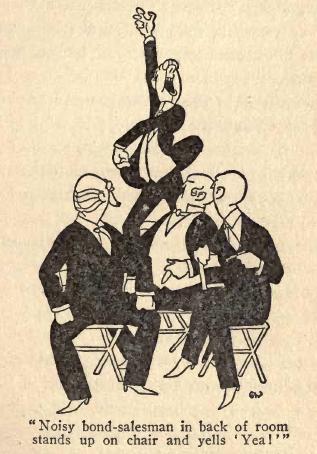
"Tweedy punts—" (noisy bond-salesman in back of room stands up on a chair and yells "Yea!" and is told to "Shut up" by three or four dozen neighbors) "to Gumble on his 15-yard line. Gumble fumbles."
The noisy bond-salesman tries to lead a cheer but is prevented.
Frightful tension follows. Who recovered? Whose ball is it? On what line? Wet palms are pressed against trouser legs. How about it?
"Tick-tickity-tick-tickity-tickity-tickity."
You can hear the announcer's boots squeak as he steps forward.
"Mr. A.T. Blevitch is wanted on the telephone," he enunciates.
Mr. A.T. Blevitch becomes the most unpopular man in that section of the country. Every one turns to see what a man of his stamp can look like. He is so embarrassed that he slinks down in his seat and refuses to answer the call.
"Klung goes around right end for a gain of two yards," is the next message from the front.
The bond-salesman shouts "Yea!"
"How about that fumble?" shouts every one else.
The announcer goes behind the scenes to talk it over with the man who works the Punch-and-Judy, and emerges, smiling.
"In the play preceding the one just announced," he says, "Gumble fumbled and the ball was recovered by Breakwater, who ran ten yards for a touchdown—"
Pandemonium! The bond-salesman leads himself in a cheer. The witty man says, "Nothing to it."
There is comparative quiet again, and every one lights up the old pipes that have gone out.
The announcer steps forward with his hand raised as if to regulate traffic.
"There was a mistake in the announcement just made," he says pleasantly. "In place of 'touchdown' read 'touchback.' The ball is now in play on the 20-yard line, and Kleenwell has just gone through center for three yards."
By this time no one in the audience has any definite idea of where the ball is or who has it. On the board it is hovering between midfield and second base.
"On the next play Legly punts—"
"Block that punt! Block that punt!" warns the bond-salesman, as if it were the announcer who was opposing Legly.
"Sit down, you poor fish!" is the consensus of opinion.
"Legly punts to Klung on the latter's 25-yard line, where the first period ends."
And so it goes throughout the game; the announcer calling out gains and the dummy football registering corresponding losses; Messrs. A.T. Blevitch and L.H. Yank being wanted on the telephone in the middle of forward passes; the noisy person in the back of the room yelling "Yea" on the slightest provocation and being hushed up at each outbreak; and every one wondering what the quarterback meant by calling for the plays he did.
In smaller cities, where only a few are gathered together to hear the results, things are not done on such an elaborate scale. The dummy gridiron and the dummy announcer are done away with and the ten or a dozen rooters cluster about the news ticker, most of them with the intention of watching for just a few minutes and then going home or back to the office. And they always wait for just one more play, shifting from one foot to the other, until the game is over.
About a ticker only the three or four lucky ones can see the tape. The rest have to stand on tip-toe and peer over the shoulders of the man in front. They don't care. Some one will always read the results aloud, just as a woman will read aloud the cut-ins at the movies. The one who is doing the reading usually throws in little advance predictions of his own when the news is slow in coming, with the result that those in the back get the impression that the team has at least a "varied attack," effecting at times a field goal and a forward pass in the same play.
A critical period in the game, as it comes dribbling in over the ticker, looks something like this:
YALE.PRINCTON.GAME....CHEKFMKL.......KLUNG.GOES. AROUND.LEFT.END.FOR.A.GAIN.OF.YDS.....A.FORWARD. PASS.TWEEDY.TO.KLUNG.NETS..... (Ticker stops ticking).
Murmurs of "Come on, there, whasser matter?"
Some one suggests that the pass was illegal and that the whole team has been arrested.
The ticker clears its throat. Br-r-r-r-r-r-r-r-r-r-r
The ticker stabs off a line of dots and begins:
"BOWIE.FIRST.RACE..MEASLES. FIRST..13.60..AND.. 6.00.WHORTLEBERRY.SCND.PLACE.3.80..EMMA GOLDMAN, THIRD..TIME.1.09.4.5.NON.START.PROCRASTINATION. UNCLE TOM'S CABIN"
A few choice remarks are passed in the privacy of the little circle, to just the effect that you would suspect.
A newcomer elbows his way in and says: "What's the good word? Any score yet?" and some one replies: "Yes. The score now stands 206 to 0 in favor of Notre Dame." This grim pleasantry is expressive of the sentiment of the group toward newcomers. It is each man for himself now.
Br-r-r-r-r-r-r-r-r-r-r-r-r-r-r-r-r!
"Here she comes, now!" whispers the man who is hanging over the glass news terminal, reading aloud: "Yale-Princeton-Game-Second Quarter (Good-night, what became of that forward pass in the first quarter?) Yale's-ball-in-mid-field-Hornung-takes-ball-around-left-end-making-it- first-down-Tinfoil-drops-back-for-a-try-at-a-field-goal. (Oh, boy! Come on, now!)"
"Why the deuce do they try a field goal on the first down?" asks a querulous graduate-strategist. "Now, what he ought to do is to keep a-plugging there at tackle, where he has been going—"
Br-r-r-r-r-r-r-r-r-r-r-r-r-r-r-r-r-r!
"Bet he missed it!" offers some one with vague gambling instincts.
"..INS.NEEDLES..1¼..ZINC..CON..4½..WASHN.. THE CENSUS.OFFICE.ESTIMATES.THE CONSUMPTION.OF COTTON.WASTE.IN.THE.MFGR.OF.AUTOMBLE.HOODS.AS. 66.991.059 LBS..INCLUDING.LINTERS.AND.HULL FIBER.."
And just then some one comes in from the outside, all fresh and disagreeably cheery, and wants to know what the score is and if there have been many forward passes tried and who is playing quarter for Yale, and if any one has got a cigarette.
It is really just the same sort of program as obtains in the big college club, only on a small scale. They are all watching the same game and they are all wishing the same thing and before their respective minds' eyes is the picture of the same stadium, with the swarm of queen bees and drones clinging to its sides. And every time that you, who are one of the cold and lucky ones with a real ticket, see a back break loose for a long run and hear the explosion of hoarse shouts that follows, you may count sixty and then listen to hear the echo from every big city in the country where the old boys have just got the news.
XV
A LITTLE DEBIT IN YOUR TONNEAU
Motorists, as a class, are not averse to public discussion of their troubles. In fact, one often wonders how some of them ever get time to operate their cars, so tied up do they seem to be with these little experience-meetings, at which one man tells, with appropriate gestures, how he ran out of gas between Springfield and Worcester, while another gives a perfect bit of character acting to show just how the policeman on the outskirts of Trenton behaved.
But there seems to be one phase of the motorist's trials which he never bares to the public. He will confide to you just how bad the gasoline was that he bought at the country garage; he will make it an open secret that he had four blow-outs on the way home from the country-club; but of one of his most poignant sorrows he never speaks. I refer to the guests who snuggle in his tonneau.
Probably more irritations have arisen from the tonneau than from the tires, day in and day out, and yet you never hear a man say, "Well, I certainly had an unholy crew of camp-followers out with me to-day—friends of my wife." Say what you will, there is an innate delicacy in the average motorist, or such repression could not be.
Consider the types of tonneau guests. They are as generic and fundamental as the spectrum and you will find them in Maine and New Mexico at the same time.
There is the first, or major, classification, which may be designated as the Financially Paralyzed. Persons in this class, on stepping into your machine, automatically transfer all their money troubles to you. You become, for the duration of the ride, whether it be to the next corner or to Palm Beach, their financial guardian, and any little purchases which are incidental to the trip (such as three meals a day) belong to your list of running expenses. There seems to be something about the motion of the automobile that inhibits their ability to reach for their purses, and they become, if you want to be poetical about it, like clay in the hands of the potter. Whither thou goest they will go; thy check-book is their check-book. It is just like the one great, big, jolly family—of which you are the father and backer.
Such people always make a great to-do about starting off on a trip. You call for them and they appear at the window and wave, to signify that they see you, and go through motions to show that just as soon as Clara has put on her leggings they will be down. Soon they appear, swathed in a tremendous quantity of motor wraps and veils (you can usually tell the guests in a car by the number of head-veils they wear) and get halfway down the walk, when Clara remembers her rain-coat and has to swish back upstairs, veils and all. Out again, and just as they get wedged into the tonneau, the elderly guest wonders if there is time for some one to run in again and tell Helma that if the Salvation Army man comes for the old magazines she is to tell him to come again to-morrow. By the time this message is relayed to Helma Garcia one solid half-hour has been dissipated from the cream of the morning. This does not prevent the guests from remarking, as the motor starts, that it certainly is a heavenly day and that it couldn't have been better if it had been ordered. Knowing the type, you can say to yourself that if the day had been ordered you know who would have had to give the order and pay the check.
From that time on, you are the moneyed interest behind the venture. Meals at road-houses, toll charges, evening papers, hot chocolates at the country drug store, hair net for Clara, and, of course, a liberal injection of gasoline on the way home, all of these items and about fourteen others come in your bailiwick. The guests have been asked out for a ride, and "findings is keepings." If you have money enough to run a car, you probably have money enough to support them for a day or so. That's only fair, isn't it?
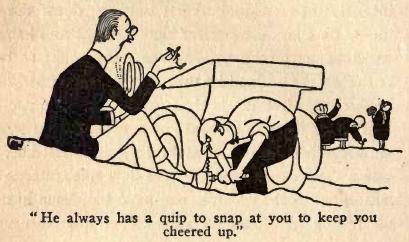
Under a sub-head (a), in this same category, come the guests who are stricken with rigor mortis when there are any repairs to be made about the machine. Male offenders in this line are, of course, the only ones that can be dealt with here; putting on a tire is no job for women and children. But the man who is the life of the party in the tonneau throughout the trip, who thinks nothing of climbing all over the back of the car in imitation of a Roman charioteer, will suddenly become an advocate of the basic eight-hour working day which began just eight hours before, whenever there is a man's work to be done on one of the tires. He will watch you while you work, and always has a good word to say or a quip to snap at you to keep you cheered up, but when it comes to taking off his coat and lending a hand at the jack he is an Oriental incense-holder on the guest-room mantel. He admits in no uncertain tones, that he is a perfect dub when it comes to handling machinery and that he is more apt to be in the way at a time like this than not. And maybe he is right, after all.
We next come to the class of tonneau-freight who are great believers in what Professor Muensterberg called "Auto-Suggestion." These people, although not seated in the driver's seat, have their own ideas on driving and spare no pains to put their theories in the form of suggestions. In justice to the Great Army of the Unemployed known as "guests" it must be admitted that a large percentage of these suggestions emanate from some member of the owner's family and not from outsiders. It is very often Mrs. Wife who is off-side in this play, but as she is usually in the tonneau, she comes under the same classification.
There are various ways of framing suggestions to the driver from the back seat. They are all equally annoying. Among the best are:
"For heaven's sake, George, turn in a little. There is a car behind that wants to pass us."
"Look out where you're going, Stan."
"Henry, if you don't slow down I'm going to get out and take the train back home."
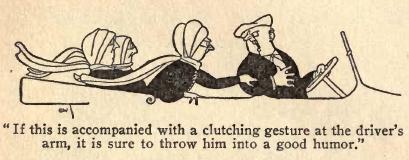
If this is accompanied by a clutching gesture at the driver's arm it is sure to throw him into a good humor for the rest of the trip, so that a good time will be had by all present.
Although guests are not so prone to make suggestions on the running of the car as are those who, through the safety of family connection, may do so without fear of bodily assault from the driver, nevertheless, a guest may, according to the code, lean over the back of the seat and slip little hints as to the route. Especially if one of them be entrusted with a Blue Book does this form of auto-suggestion become chronic.
"It says here that we should have taken that road to the right back there by the Soldiers' Monument," informs the reader over your shoulder. Or—
"Somehow this doesn't seem like the right road. Personally, I think that we ought to turn around and go back to the cross-roads."
If it is Mrs. Wife in the tonneau who has her own ideas on the route, you might as well give in at her first suggestion, for the risk that she is right is too great to run. If she says that she would advise taking the lane that runs around behind that school-house, take it. Then, if it turns out to be a blind alley, you have the satisfaction of saying nothing, very eloquently and effectively. But if you refuse to take her suggestion, and your road turns out to be even halfway wrong, you might as well turn the wheel over to your little son and go South for the winter, for you will never hear the ultimate cry of triumph. Your season will practically be ruined. I can quote verbatim from the last affair of this kind:
(Voice from the tonneau): "Albert, I think we ought to have taken the road at the left."
"No, we hadn't."
"I'm sure of it. I saw a sign which said: 'Paxton' on it."
"No, you didn't."
"Well, you wait and see."
"I'm waiting."
There is a silence for ten minutes, while the car jounces along a road which gets narrower and rockier.
(Voice from the tonneau): "I suppose you think this is the way to Paxton?"
"I certainly do."
"Oh, you make me sick!"
Silence and jounces.
Sudden stop as the road ends at a silo.
"I beg your pardon [addressed to a rustic], which is the road to Paxton?"
"Paxton?"
"Yes."
"The road to Paxton?"
"Yes."
"Well, you go back over the rud you just come over, about three mile, till you come to a rud turnin' off to the right with a sign which says 'Paxton.'"
(Voice from the tonneau, beginning at this point and continuing all of the way back, all the rest of the day and night, and until snow falls): "There! what did I tell you? But, oh no, you know it all. Didn't I tell you"—etc., etc.
On the whole, it would seem that the artists who draw the automobile advertisements make a mistake in drawing the tonneau so roomy and so full of people. There should be no tonneau.
XVI
A ROMANCE IN ENCYCLOPÆDIA LAND
Written After Three Hours' Browsing in a New Britannica Set
Picture to yourself an early spring afternoon along the banks of the river Aa, which, rising in the Teutoburger Wald, joins the Werre at Herford and is navigable as far as St. Omer.
Branching bryophytu spread their flat, dorsi-ventral bodies, closely applied to the sub-stratum on which they grew, and leafy carophyllaceæ twined their sepals in prodigal profusion, lending a touch of color to the scene. It was clear that nature was in preparation for her estivation.
But it was not this which attracted the eye of the young man who, walking along the phonolithic formation of the river-bank, was playing softly to himself on a double curtail, or converted bass-pommer, an octave below the single curtail and therefore identical in pitch and construction with the early fagotto in C.
His mind was on other things.
He was evidently of Melanochronic extraction, with the pentagonal facial angle and strong obital ridges, but he combined with this the fine lines of a full-blooded native of Coll, where, indeed, he was born, seven miles west of Caliach Point, in Mull, and in full view of the rugged gneiss.
As he swung along, there throbbed again and again through his brain the beautiful opening paragraph of Frantisek Palacky's (1798-1876) "Zur böhmischen Geschichtschreibung" (Prague, 1871), written just after the author had refused a portfolio in the Pillersdorf Cabinet and had also declined to take part in the preliminary diet at Kromerice.
"If he could believe such things, why can not I?" murmured the young man, and crushed a ginkgo beneath his feet. Young men are often so. It is due to the elaterium of spring.
"By Ereshkigal," he swore softly to himself, "I'll do it."
No sooner had he spoken than he came suddenly out of the tangle of gymnosperms through whose leaves, needle-like and destitute of oil-glands as they were, he had been making his way, and emerged to a full view of the broad sweep of the Lake of Zug, just where the Lorze enters at its northern extremity and one and a quarter miles east of where it issues again to pursue its course toward the Reuss. Zug, at this point, is 1,368 feet above sea-level, and boasted its first steamer in 1852.
"Well," he sighed, as he gazed upon the broad area of subsidence, "if I were now an exarch, whose dignity was, at one time, intermediate between the Patriarchal and the Metropolitan and from whose name has come that of the politico-religious party, the Exarchists, I should not be here day-dreaming. I should be far away in Footscray, a city of Bourke County, Victoria, Australia, pop. (1901) 18,301."
And as he said this his eyes filled with tears, and under his skin, brown as fustic, there spread a faint flush, such as is often formed by citrocyde, or by pyrochloric acid when acting on uncured leather.
Far down in the valley the natives were celebrating the birthday of Gambrinus, a mythical Flemish king who is credited with the first brewing of beer. The sound of their voices set in motion longitudinal sound waves, and these, traveling through the surrounding medium, met the surface separating two media and were in part reflected, traveling back from the surface into the first medium again with the velocity with which they approached it, as depicted in Fig. 10. This caused the echo for which the Lake of Zug is justly famous.
The twilight began to deepen and from far above came the twinkling signals of, first, Böotes, then Coma Berenices, followed, awhile later, by Ursa Major and her little brother, Ursa Minor.
"The stars are clear to-night," he sighed. "I wonder if they are visible from the dacite elevation on which SHE lives."
His was an untrained mind. His only school had been the Eleatic School, the contention of which was that the true explanation of things lies in the conception of a universal unity of being, or the All-ness of One.
But he knew what he liked.
In the calm light of the stars he felt as if a uban had been lifted from his heart, 5 ubans being equal to 1 quat, 6 quats to 1 ammat and 120 ammats to 1 sos.
He was free again.
Turning, he walked swiftly down into the valley, passing returning peasants with their baa-poots, and soon came in sight of the shining lamps of the small but carefully built pooroos which lined the road.
Reaching the corner he saw the village epi peering over the tree-tops, and swarms of cicada, with the toothed famoras of their anterior legs mingling in a sleepy drone, like many cichlids. It was all very home-like to the wanderer.
Suddenly there appeared on a neighboring eminence a party of guisards, such as, during the Saturnalia, and from the Nativity till the Epiphany were accustomed to disport themselves in odd costumes; all clad in clouting, and evidently returning from taking part in the celebration.
As they drew nearer, our hero noticed a young woman in the front rank who was playing folk-songs on a cromorne with a double-reed mouth-piece enclosed in an air-reservoir.
In spite of the detritus wrought by the festival, there was something familiar about the buccinator of her face and her little mannerism of elevating her second phalanx. It struck him like the flash of a cloud highly charged by the coalescence of drops of vapor. He approached her, tenderly, reverently.
"Lange, Anne Françoise Elizabeth," he said, "I know you. You are a French actress, born in Genoa on the seventeenth of September, 1772, and you made your first appearance on the stage in L'Ecossaise in 1788. Your talent and your beauty gave you an enormous success in Pamela. It has taken me years to find you, but now we are united at last."
The girl turned like a frightened aardvark, still holding the cromorne in her hand. Then she smiled.
"Weenix, Barnaby Bernard (1777-1829)," she said very slowly, "you started business as a publisher in London about 1797."
They looked at each other for a moment in silence. He was the first to speak.
"Miss Lange, Anne," he said, "let us go together to Lar—and be happy there—happy as two ais, or three-toed South American sloths."
She lowered her eyes.
"I will go with you Mr. Weenix-Barney," she said, "to the ends of the earth. But why to Lar? Why not to Wem?"
"Because," said the young man, "Lar is the capital of Laristan, in 27 degrees, 30 minutes N., 180 miles from Shiraz, and contains an old bazaar consisting of four arcades each 180 feet long."
Their eyes met, and she placed her hands in his.
And, from the woods, came the mellow whinnying of a herd of vip, the wool of which is highly valued for weaving.
XVII
THE PASSING OF THE ORTHODOX PARADOX
Whatever irreparable harm may have been done to Society by the recent epidemic of crook, sex and other dialect plays, one great alleviation has resulted. They have driven up-stage, for the time being, the characters who exist on tea and repartee in "The drawing-room of Sir Arthur Peaversham's town house, Grosvenor Square. Time: late Autumn."
A person in a crook play may have talked underworld patois which no self-respecting criminal would have allowed himself to utter, but he did not sit on a divan and evolve abnormal bons mots with each and every breath. The misguided and misinformed daughter in the Self and Sex Play may have lisped words which only an interne should hear, but she did not offer a succession of brilliant but meaningless paradoxes as a substitute for real conversation.
Continuously snappy back-talk is now encountered chiefly in such acts as those of "Cooney & LeBlanc, the Eccentric Comedy Dancing Team."
And even they manage to scrape along without the paradoxes.