Front matter
Reading edition
Transcriber’s note: A few typographical errors have been corrected. They appear in the text like this, and the explanation will appear when the mouse pointer is moved over the marked passage.

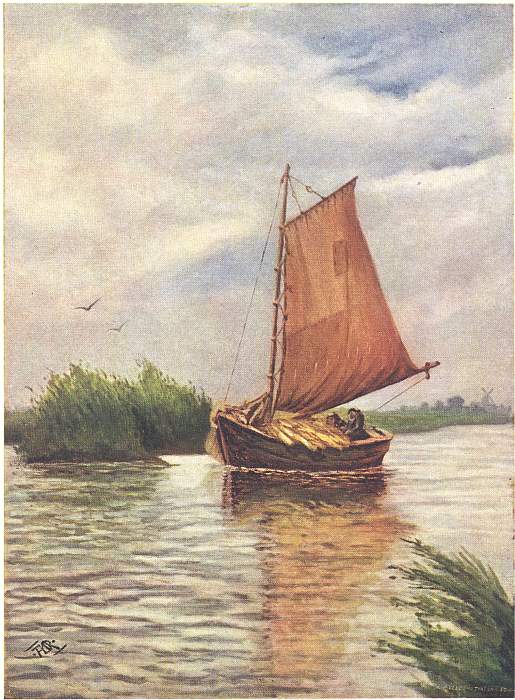
THE CANAL AT MONNIKENDAM
Odd Bits of Travel with Brush and Camera
by
CHARLES M. TAYLOR, Jr.
Author of “Vacation Days in Hawaii and Japan” and “The British Isles Through an Opera Glass,” Etc., Etc.
Profusely Illustrated by the Author
Philadelphia
GEORGE W. JACOBS & CO.
103 and 105 South Fifteenth Street
Copyright, 1900, by George W. Jacobs & Co
TO MY WIFE
Preface.

N almost every walk of life, even among artists and photographers, we find those who are enthusiasts, and who work with such ardor and perseverance as to overcome all difficulties; while there are others who seem to desire the hard and rough places smoothed down, and the obstacles removed from their pathways. In writing this volume, it has been my purpose to enlist the attention of both of these classes, and to bring before the ardent worker as well as the ease-loving, but no less interested, follower of art, places and scenes that afford unusual attractions for the brush and camera.
It might truthfully be said that in one’s city may be found innumerable subjects of interest to both the amateur and professional artist; but change of food, scene and atmosphere is beneficial to both mind and body, and it is ofttimes wise to pass to new scenes and broader fields of observation.
The places described herein are not linked together by proximity of location and follow no regular line of travel; but are selected from various lands and from among widely differing peoples, for the sole purpose of locating scenes that teem with paintable and photographic subjects. I have endeavored to select nooks and corners where the artist and photographer will have suitable accommodations, and where the country with its fresh, pure air, and wholesome food may build up the health, while at the same time an opportunity is afforded for filling the portfolio with delightful bits of scenery and characteristic figure studies. It has also been my aim to tell of countries and places comparatively easy of access, and where those of limited means may find satisfactory accommodations.
At times I digress in my pictorial descriptions and offer some Bits of personal experience that have befallen me upon my journeys, which I trust may prove of interest and perhaps be of service to others travelling through the same places. It is with these purposes in view that the following pages have been written, and my hope is that they may serve to guide other lovers of the beautiful to some of the attractive spots and fascinating views which I have attempted to describe in these Odd Bits of Travel.
Philadelphia, 1900.
C. M. T., Jr.
CONTENTS
PAGE
Scenes of the Present and Relics of the Past
Passing Vessels—The Ocean—Sudden Changes—Taking Photographs—The Landing-Stage at Liverpool—New Brighton—In the Country—Liverpool by Night—Salvationists—Old Taverns—Chester—An English Home—Relics—The Cathedral—The River Dee—Leamington—The River Leam—Warwick Castle—An Old Mill—Through Kenilworth, Coventry and Stoneleigh—“The King’s Arms”—Nature’s Pictures 15
Lights and Shadows of London Life
The Shadow Side—The Slums—The City by Night—Vice and Misery—“Chinese Johnson’s” Opium Den—The “Bunco” Man—An English Guard—“The Grand Old Man”—Caution to Tourists—Great Cities by Night—The Seven Dials—Derby Day—The Tally-Ho—Old Robin Hood Inn—Epsom Hill—The Races—Exciting Scenes—Side Shows—The Close of the Day 57
Scenes in the Gay Capital
Dover to Calais—Paris—-The Gay Capital by Night—Boulevards—Life in the Streets—Champs Élysées—Place de la Concorde—Arc d’Etoile—Place Vendome—Louvre—Opera House—Palais Royal—Church of the Invalides—Versailles—Notre Dame—Jardin Mabille—The Madeleine—The Pantheon—The Banks of the Seine—French Funeral Ceremonies—La Morgue—Pere Lachaise 83
Antwerp and the City of Windmills
From Paris to Antwerp—Along the Route—Thrifty Farmers—Antwerp—Dogs in Harness—The River—Old Churches—Chimes—An Inappreciative Listener—Steen Museum—Instruments of Torture—Lace Industry—Living Expenses—Hospitality—The City of Windmills—Watery Highways—A City of Canals—The Maas River—The Houses on the Canals—Travel by Boat—Novel Scenes—Costly Headgear—Dutch Costumes—Powerful Draught Horses—No Bonbons—Chocolate Candy—In the Market-Place—The Belle of the Market—Photographs—Wooden Shoes—Drawbridges—Blowing the Horn—Ancient Relics—The Sword of Columbus 101
A City of Many Islands
Amsterdam—The People of Holland—Amstel River—Merry Excursionists—Interesting Institutions—Origin of the City—Source of Prosperity—A Cousin to Venice—Ninety Islands—Beams and Gables—Block and Tackle—Old Salesmen—Street Markets—Haarlem—Railway Travel at Home and Abroad—Ancient Buildings—Historic Associations—In the Canal—Groote Kerk—The Great Organ—Picturesque Subjects—Zandvoort—Eau de Cologne—The Beach—Dutch Sail Boats—Seamen—Hooded Chairs—Peddlers—Music in Holland and Germany—Gypsies—We Meet an Artist—Hospitality—A Banquet 127
Excursions To Broek and the Island of Marken
A Charming Journey—Fellow-Passengers—National Costumes—The Children—A Lovely Landscape—Holstein Cattle—Windmills—Irrigation—Farmers—A Typical Dutch Village—Washing-Day—The Red, White and Blue—Suppose a Bull Should Appear—A Brilliant Picture—Drawing the Canal Boat—Honesty and Cleanliness—A Thrifty and Industrious People—Farming and Cheese-making—As Evening Falls—Scenes for an Artist—Dead Cities of Holland—Monnikendam—Behind the Age—City Lamps—Houses and People—The Island of Marken—An Isolated Wonderland—First Impressions—Rare Holidays—The Family Doctor—Absence of the Men—The Fishing—Healthy and Industrious Population—The Women of Marken—Pretty Girls—They Will not be Taken—A Valuable Experience—Photographs 149
The Ancient Town of Monnikendam
Marken Homes—Beds in the Wall—Family Heirlooms—An Ancient Clock—Precious Treasures—Quaint Customs—Betrothed Couples—The Hotel—Its Interior—A Lack of Patrons—Costumes of a By-gone Age—Farewell to Marken—Remote Districts—Monnikendam—Ancient Houses—Hotel de Posthoorn—The Postman of the Past—A Difficult Stairway—We Stroll about the Town—Our Retinue—In Front of the Hotel—Such Curious Children—Supper—We Visit the Shops—Pantomime—A Novel Experience—They Cannot Understand—No Candles—We Attract a Crowd—The Clothing Store—A Marken Suit—“Too High”—Bargaining—A Stranger to the Rescue 177
Old Customs and Quaint Pictures
Segars and Tobacco—Row Boats—“Gooden Morgen”—The Zuyder Zee—By Candle Light—Total Darkness—The Town by Night—Women and Girls—Shoes and Stockings—The Shuffling Man—Streets and Sidewalks—The Town Crier—The Daily News—A Message to the People—Draught Dogs—Milkmaids—The Barber Shop—Drug Stores—Horretje—A Street Auction—Selling Curios—They Leave their Shoes at the Door—An Old Grist Mill—The Holland Draught Girl 205
A Dutch Cheese-making District
A Cheese-making Country—Edam Cheese—A Picturesque Inn—An Interesting Interior—A Thrifty Farmer—At Sunrise—In the Cow Stable—The Pretty Maid—Stall and Parlor—The Cheese Room—The Process of Making Cheese—“I Have Listened and Listened”—A Trip to Volendam—A Fine Country Road—A Charming Day—Muzzled Dogs—The Only Street—A Multitude of Children—Gay Decorations—A United People—As a Hen and Her Brood—Their Wealth is Their Health—In Sunday Dress—Stalwart Men and Sturdy Women—A Higher Type—“I Have Enough”—Fishermen—The Anchorage—A Volendam Suit 233
Volendam Sights, and the Oldest Town on the Rhine
Church is Out—The Promenade—“Every Man is a Volume”—An Old Suit—His Sunday Clothes—“Let Him Have It”—An Obedient Son—The Silver Buttons—The Last Straw—An Uncommon Action—The Hotel—An Artist’s Resort—An Unfinished Painting—Good-bye—The Ancient City of Cologne—The Cathedral—Within the “Dom”—A Wonderful Collection—Foundation of the Town—History—Vicissitudes—Public Gardens—Eau de Cologne—The Palace of Brühl 255
Along the Banks of the Rhine
Bonn—The Birthplace of Beethoven—The Museum—Monument—A Famous Restaurant—College Students—Beer Mugs—Special Tables—Affairs of Honor—Königswinter—Magnificent Views—Drachenfels—The Castle—The Dombruch—Siegfried and the Dragon—A Desecrated Ruin—The Splendor of the Mountains—Many Visitors—View from the Summit—The Students’ Chorus—German Life—A German Breakfast—The Camera—Old Castles and Lofty Mountains—Legends of the Rhine—The Waters of the Rhine—Vineyards 283
From Bingen on the Rhine To Frankfort-on-the-Main
Vast Vineyards—Bingen—The Hotel—The Down Quilt—A German Maid—Taverns—The Mouse Tower—Rüdesheim—Niederwald—The Rheingau—The National Monument—The Castle of Niederburg—Wine Vaults—The River—Street Musicians—A Misunderstanding—Frankfort-on-the-Main—The Crossing of the Ford—A Free City—Monument of Goethe—History—A Convocation of Bishops—The City Monument of Gutenberg—The House in which Rothschild was Born—Luther 313
A Prussian Capital and a Fashionable Resort
We Start for Berlin—Mountain and Valley—Harvesters—Villages—A Great City—Unter den Linden—Kroll Theatre and Garden—The City Streets—The Brandenburg Gate—Potsdam—The Old Palace—Sans Souci—Ostend—A Fashionable Watering-Place—The Promenade—The Kursaal—On the Beach—Bathing Machines—Studies for an Artist—The Race-Course—Sunday—The Winning Horse—Fickle Dame Fortune—The English Channel—A Bureau of Information—Queenstown—An Irish Lass—The Last Stop—The End of the Journey 333
List of Illustrations.
PAGE
Canal at Monnikendam (Frontispiece)
We feel the heart throbs of old Neptune 17
She proves to be a Barkentine under full sail 22
The sailors in the rigging are swaying to and fro 26
Amongst these are two typical products of the British Isles 30
This is a fine field for the student of human nature 35
Wayside Inn, New Brighton 39
Typical English houses with their massive thatched roofs 43
Suburban residence 48
White Hall Horse Guards’ Barracks 65
A short run of an hour 74
The chalky cliffs of Dover 79
The largest and handsomest Gothic church in the Netherlands 106
The place is intersected everywhere by canals 112
In many cases the balconies of residences overhang the water 117
The belle of the market 123
The Amstel River 132
Wicker chairs offer rest to the weary pedestrian 141
The flat landscape is varied by herds of cattle 152
Most of the houses have a canal at the back 156
The blue stream finds its outlet in the river 161
All persuasions accomplish naught 165
One old woman is fascinated with the camera 170
We walk along the narrow streets 176
Sheep, grazing upon the green pasture lands, form a homelike scene 182
Hotel de Posthoorn 187
De Hooflstraat, Monnikendam 193
There is a young man whose walk is all his own 200
The streets and sidewalks are kept scrupulously clean 204
The whole place is a succession of quaint and picturesque houses 208
A street auction 213
At the farthest end of the street stands an old windmill 217
A beautifully shaded walk just outside the town 221
Land and water 228
A good road for the bicycle 232
This strange looking highway runs lengthwise through the town 241
The houses are roofed with red tiles 245
The delicate lace caps frame smiling faces 254
As the congregation draws nearer we halt before the foremost group 258
Every man is a volume if you know how to read him 263
Goeden dag. Tot weerziens 267
Palace of Brühl 276
Lovely walks, and bowery avenues 282
Not far off stands the statue of the artist 287
The great peak known as the Drachenfels, or Dragon Rock 293
How noble and defiant is the appearance of these venerable fortresses 302
Every turn of the river presents a different view 306
Now we behold the little church surrounded by picturesque houses 311
Approaching Bingen we see vineyards covering the mountain side 315
Thousands of fashionably dressed people appear upon this promenade 338
There are many odd and fantastic sights here 342
One’s portfolio might soon be filled with interesting subjects 346
Many typical Irish characters come aboard our vessel 350
Several small boats are floating at our side 355
Beyond is all abyss, Eternity, whose end no eye can reach 359
Scenes of the Present and Relics of the Past.
Scenes of the Present and Relics of the Past.
Passing Vessels—The Ocean—Sudden Changes—Taking Photographs—The Landing Stage at Liverpool—New Brighton—In the Country—Liverpool by Night—Salvationists—Old Taverns—Chester—An English Home—Relics—The Cathedral—The River Dee—Leamington—The River Leam—Warwick Castle—An Old Mill—Through Kenilworth, Coventry and Stoneleigh—“The King’s Arms”—Nature’s Pictures.

E sight a steamer on our leeward side. A passing vessel is a great excitement on an ocean voyage. From the time when she first appears, a tiny speck on the distant horizon, every one is on deck watching her as she slowly climbs into full view, then draws nearer and nearer to our floating palace. How companionable she seems in the vast waste around us. We wonder to which line she belongs; what is her name; her speed, and whither she is bound: and now that she is within hailing distance, we await eagerly the result of the usual interchange of questions and answers by means of small flags and a certain code of signals, well understood throughout the nautical world. The following are some of the questions asked: “To what line do you belong?” “What is your port?” “Have you seen any icebergs?” “Met any wrecks?” “Are you a tramp?” and so on, until both sides are satisfied, then away she speeds on her course, while the passengers and sailors on both ships gaze at one another through their glasses until they are lost in the distance. The excitement is over, and we all return to our former occupations, or stand looking idly out to sea until once more there is a cry: “A sail! A sail!” and we begin to hope that she too is coming our way. Straining our eyes through the powerful field-glasses, we perceive that she is coming toward us, and will probably cross our line. Larger and larger she appears as she steadily advances, until she attracts the attention of every one on deck. She is now quite close to us, and proves to be a Barkentine under full sail. We shout a greeting to the crew, and wave our handkerchiefs as she passes, and the sailors smile in return and take off their caps.
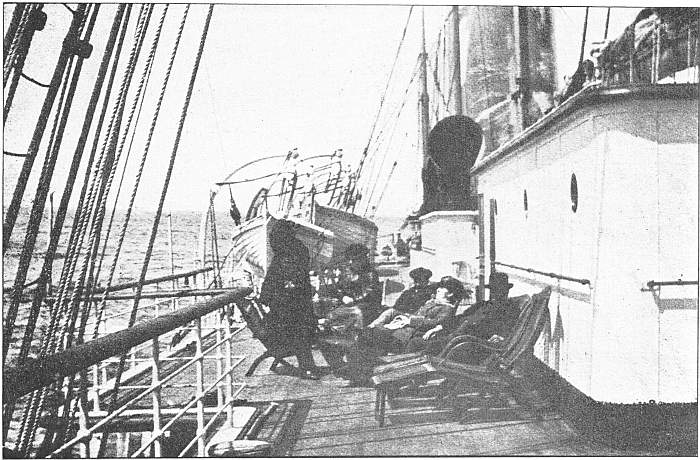
“We feel the heart throbs of old Neptune.” (See page 16.)
The ocean air is delightful and invigorating, the sky a perfect azure, and the translucent waves with their foamy edges stretch away in long beautiful curves. We feel the heart throbs of old Neptune, as the waters plash softly over the steamer’s sides, and we speed steadily forward, with the rush and swish of the sea sounding in our ears with a wild sweet melody all its own. To fall asleep on deck amid these charming conditions is delightful indeed. But how quickly the scene changes. Suddenly a shrill whistle from the Quartermaster summons all hands to the deck. Orders are rapidly given in quick sharp tones: “Aloft. Take sail in.” “Aye, aye, sir,” is the swift response, in a twinkling the sure-footed sailors are up among the yards, perched in seemingly impossible places, reefing the flapping sails in preparation for the coming storm. Dark clouds above are reflected in gloomy waves below, and heaving billows surround us, uniting with a furious wind that seems bent on the destruction of our noble ship. The sailors in the rigging are swaying to and fro, and the panic-stricken passengers in the cabins are telling each other with pale faces that belie their words that they are not afraid, for there is no danger; yet they listen anxiously for every sound from above, and will not allow their dear ones to move beyond reach of their hands. There is no music now in the rushing of the waves or the flapping of the sails. Old Neptune in his angry moods is not a desirable companion. But nothing lasts forever, and from storm and night and black despair the flower of hope arises, for there comes a lull, followed by a furious blinding onslaught, and then the spirit of the hurricane calls his followers and flies up, away, somewhere beyond our ken: the captain’s face relaxes from its tense expression, and he looks proudly around his good ship which has come out victor in the struggle with the elements. One by one, the passengers appear on deck, the purple clouds, after a final frown of disapproval at things in general, break into smiles, life on shipboard resumes its everyday attitude, and all goes “merry as a marriage bell.” Life is full of contrasts. This is a picture for which neither brush nor camera is ready. He who would paint it must draw it from its recess in his memory, or from some sheltered nook on shore, and be cool and calm enough to follow his favorite occupation in spite of the consciousness that life and death are struggling for mastery in yonder thrilling scene that will make him famous if he can but truly portray it upon his canvas.
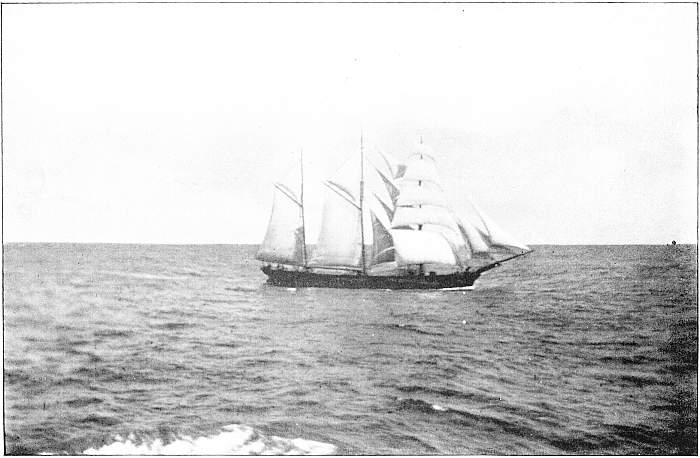
“She proves to be a Barkentine under full sail.” (See page 16.)
But there are many tableaux and picturesque situations here, very tempting to the traveller who carries with him his sketch book or camera, and I entertain my companions as well as myself by photographing many a little group both comical and interesting in the world around us. I invite our friends to the lower deck, where I wish to take pictures of some of the steerage passengers. Amongst these are two typical products of the British Isles—one a robust Irishman of shillalah fame, and the other a bonny boy from Scotland. I make known to them my desire to have their photographs, whereupon the quick witted Irishman, without doubt knowing the quality of his face, which is one of the ugliest I have ever seen, begins at once to bargain with me for the privilege of transferring it to my camera. It is true I could have stolen a march on him by a snap shot, and he been all unconscious of the act, but wishing to keep up the comedy I asked at what price he values his face. He replies that if I will take up a collection from the passengers around us, he will accept that as full pay. My friends of the cabin enter into the spirit of the play, and quite a goodly sum finds its way into the horny hand of the Hibernian athlete, who now, with a broad smile of satisfaction, intimates that he is ready to be “taken.”
These pictures too join the gallery of our yesterdays. Swift has truly said: “It is the talent of human nature to run from one extreme to another.” The long voyage is over, and all hearts rejoice in the sight of land, and now we are upon the landing stage at Liverpool, amidst the throng of excited passengers, all moving hither and thither in search of baggage which seems hopelessly lost in the confusion of trunks, porters, policemen, drays and ubiquitous small boys. This is a fine field for the student of human nature. Here are groups of inexperienced travellers looking anxiously about them, wondering how it is possible to extricate their belongings from the indistinguishable mass before them, and laboring under the dread that when found, a fierce and merciless custom-house official will seize upon trunks and boxes, and deaf to all protestations, dump the contents, from a shoe to a hat, upon the floor, to the everlasting confusion of the owners and the amusement of the spectators. The cool indifference of those who have crossed the ocean many times is in marked contrast to these panic-stricken, and really pitiable creatures.
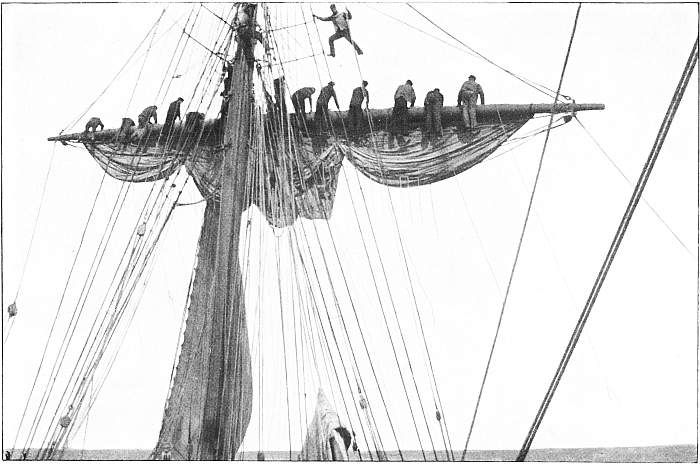
“The sailors in the rigging are swaying to and fro.” (See page 19.)
Then there is the “happy-go-lucky” youth, who finds all this tumult a great joke, and who wanders carelessly about, with the serene confidence that “things” will turn out all right; which they generally do. Here is the fashionable mother with her pretty daughters who evince a charming delight in everything that happens; the fussy mama who is sure that her baggage has not come ashore, or that the officers of the custom-house are in league against her; children separated from parents or nurses, shrieking wildly in their terror, while others, more venturesome and curious, are in every one’s way. Porters elbow their way through the crowd, cabmen shout in stentorian tones, policemen watch the masses, and now and then in sharp curt tones call a delinquent to order. A placid looking old gentleman with silvery hair and dignified demeanor stands in the midst of a picturesque party of young people, evidently his grandchildren. They all look so happy that it seems contagious, for the troubled countenances of their neighbors break into sympathetic smiles as they glance at this joyous family group. Every shade of human expression may be observed in this motley throng, and he who has eyes to see will find many a charming tableau, many a pathetic scene or diverting situation that would enrich a sketch book, or prove a valuable addition to the collection made by the ready camera. The various changes of expression are worth studying, for where “luxuriant joy and pleasure in excess” appear at one moment, the next may behold an angry frown, and a struggle as if for life amid the surging tide of humanity.
“Now one’s the better—then the other best Both tugging to be victor, breast to breast Yet neither conqueror, or is conquered.”
Taking a small steamer which plies between Liverpool and New Brighton, one may for a few cents, after a half hour’s ride, land at an attractive and much frequented watering-place upon the bank of the Mersey River, opposite Liverpool. This resort is the pleasure-ground of the middle classes, and is well worth a visit. Upon a holiday many thousands flock to its shores which remind one of Vanity Fair, where numerous phases and conditions of life are represented. Here is the indefatigable and annoying travelling photographer with his “Four for a shilling. Take you in two minutes. Ladies and gentlemen, step in and see the finest pictures to be found in this country. Bridal groups a specialty.”
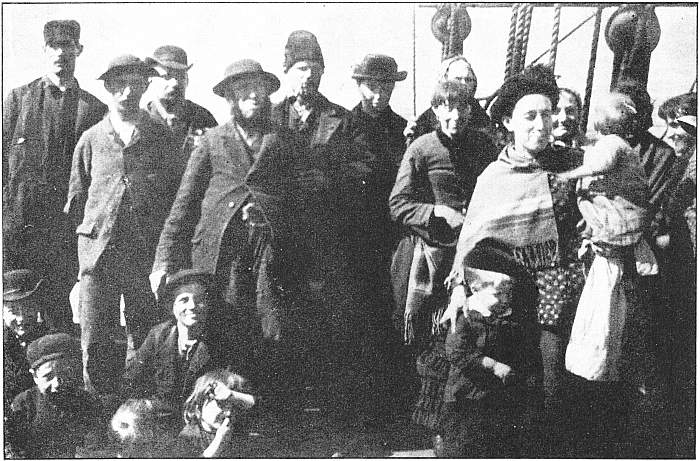
“Amongst these are two typical products of the British Isles.” (See page 23.)
Here are games of all kinds, pony and donkey riding, and all the shows to be found at the popular seashore resort. The “merry-go-round” is in full swing, with a crowd of spectators, among them many wistful children, watching the prancing camels and gaily caparisoned horses. The music here is quite inspiring, and the numerous small boys and maidens who lack the necessary pennies for this ravishing entertainment gaze at their more fortunate companions with woe-begone countenances. Strains less animated, but more melodious attract us to a fine dancing hall, where the older lads and lasses are tripping about in a lively manner. The light dresses, colored ribbons and happy faces make a pretty picture. Along the beach are beautiful views, worthy of a master hand, while out in the country the typical English houses with their massive thatched roofs and lovely surroundings of trees, lawns and gardens fair, cannot fail to captivate the artist’s eyes.
A stroll through the streets and byways of Liverpool at night is a sad but interesting experience. Alas for the misery and crime and want that exist in all the great cities! Girls, young and pretty, but no longer innocent, may be seen in scores in every locality: children with poverty and depravity written on their faces boldly address one at the street corners: men and women, with sharp, pinched features and misery and despair in their voices, beseech one for alms, or with fierce cunning lie in wait for the unwary. Sick at heart and with inexpressible pity we wend our way from one point to another. Vice, crime, want, suffering meet our eyes on every side: and the old hopeless cry: Why must these things be? rises up again in our souls. Through the whole night long upon the curb stones, at the corners, lounging against the windows and doors of closed houses or shops, this lower stratum of life appears with its atmosphere of dusky gloom. When the daylight dawns upon the city, it seems to shrivel up and shrink into the mouths of the yawning black cellars and foul alleys whose very breath is a deadly poison. There are dozens of taverns scattered about the city, and within these rooms or stalls are partitioned off where sin may be screened from public view, for even those dyed deepest in crime sometimes fall so low that they dare not carry on their nefarious operations in the face of their everyday companions. These dens are countenanced by the authorities, and one may find within them criminals of every grade who prey upon each other for their sustenance: but in the long run, it is the proprietor who comes out with a substantial bank account.
Beggars, peddlers, musicians, singers of both sexes, and itinerant vendors of all kinds jostle each other in these haunts of sin, and great caution should be exercised in visiting them, for in certain localities, crimes of the most brutal character are of daily, I might say hourly occurrence. I would suggest that the tourist should at such times depend for safety upon the company of a first-class detective.
Let praise be given where it is due. The Salvationists of Europe have by their indefatigable labors reclaimed thousands of these men and women from their lives of sin and misery. You will meet these untiring workers everywhere, exhorting, praying, pleading with fallen humanity. These noble bands of Christians enter fearlessly the most loathsome hovels, and, wrestling with filth and disease, in many cases come off victorious. They have been known to wash the clothing and cleanse the houses of fever-stricken families, and supply wholesome food and care for helpless infants, defied at every step by a drunken son or father. They fear nothing, knowing that their cause is God’s cause, and that in the end Almighty Goodness shall win an eternal conquest.
It is customary throughout England to close all the saloons on Sundays until noon, after which time they open their doors, and remain open till midnight as upon week-days.
Of the many cities whose haunts I have visited at night, I think that without exception, unless it be London, Liverpool leads in depravity and vice.
The country from Liverpool to Chester abounds in attractive scenery, local in character and possessing the additional charm of novelty for the American tourist. Along the route are scattered a number of old taverns, such as “The Horn,” “The Green Tree,” and similar names. Dismounting from bicycle or trap, the traveller who enters one of these ancient landmarks will find everything in “apple pie order”: the floor clean and shining like a bright new dollar just launched from the mint. He will sit at a table within one of the three stalls on either side of the little room, and the landlord’s wife will bring him a bumper of “good auld Al,” the effect of which will prove lasting and beneficial, if it corresponds with my experience.
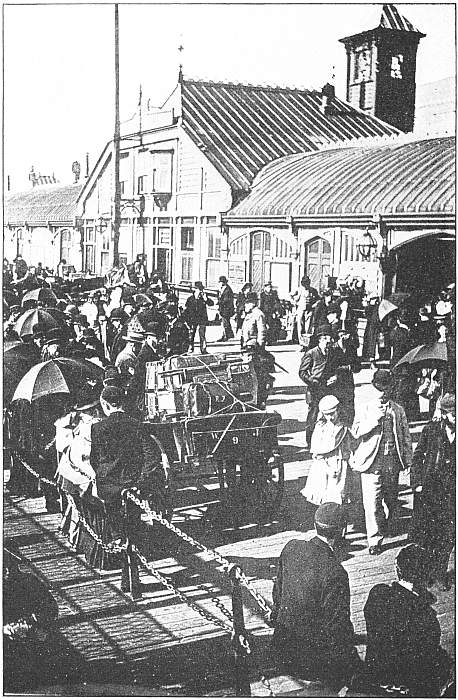
“This is a fine field for the student of human nature.” (See page 24.)
Chester, oldest of English cities, is full of quaint residences and other ancient buildings. The old wall which surrounds the town is the only one in Great Britain which has been preserved entire. It forms a continuous ring, although in some places the earth has climbed so far above its base, that it appears no higher than a terrace. Its rugged outer parapet is still complete, and the wide flagging forms a delightful promenade, with a fine view of the surrounding country. The earliest date which we find upon the wall is A. D. 61, when it was erected by the Romans. Twelve years later, Marius, king of the Britons, extended the wall. The Britons were defeated under it in 607, and after a lapse of three centuries, it was rebuilt by the daughter of Alfred the Great. It has a long and eventful history, and the old Cathedral whose edge it skirts, is one of the largest and most ancient in England. The sculptures in this magnificent edifice are worn smooth by the hand of time. The stained glass windows are marvels of art, the groined arches, dreamy cloisters, and antique carving upon seats and pews fill one with admiration mingled with awe. There are many fine mosaics here, and specimens of wood from the Holy Land. Costly gems adorn the choir; here too is a Bible whose cover is inlaid with precious stones. The massive Gothic pillars are still in a perfect state of preservation, as well as the numerous ancient monuments and relics of the past. The vast size of the Cathedral is a perpetual source of wonder to the stranger, who, wandering among its curious historic mementos, gazing upon its storied nave, transepts and choir, and upon the Bible scenes pictured in these glorious windows, feels that he has been transported by some magician’s hand into an age long buried in the past. The Cathedral is said to have been founded in the year 200. Its height within, from floor to the lofty dome lighted by these exquisite windows is from sixty to one hundred feet. The Church of St. John the Baptist rivals the Cathedral in antiquity, but it is now a picturesque ruin covered with moss and ivy.
Chester itself contains many antiquities that are to be found nowhere else in the world. The houses, dating back to 1500, or even earlier, are of every degree of shade and color, with little windows with diamond-shaped panes, and gable ends facing the streets whose sidewalks are on a level with the second stories. Everything here seems to belong to the past, excepting the fine, modern station, ten hundred and fifty feet long, with its projecting iron roofed wings for the protection of vehicles waiting for passengers from the trains. This station is one of the longest in England. The famous Chester Rows are public passages running through the second stories of the houses facing the four principal streets. These arcades are reached by flights of steps at the corners of the streets, and contain some very attractive shops. The old timber-built houses of Chester with their curious inscriptions are all preserved in their original ancient style, and nowhere in England can the artist or photographer find a more interesting spot, or one richer in ancient and mediæval relics than this little town.
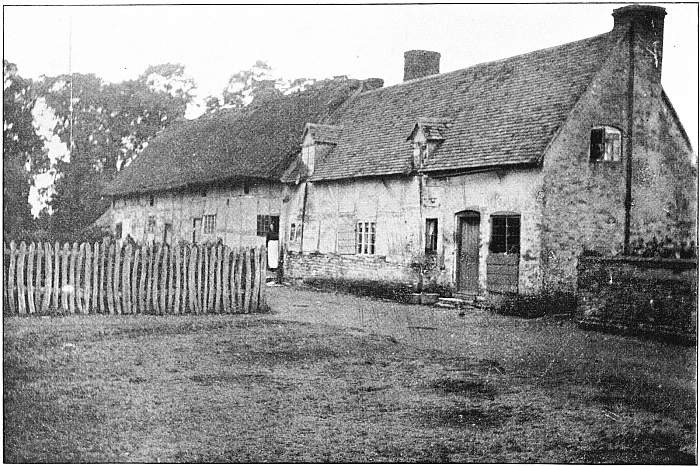
“Wayside Inn, New Brighton.” (See page 31.)
The quaint old taverns carry one back, back, to the life of the past. Drop in at the Bear & Billet Inn some day, or The Falcon Inn, and yield yourself up to the charming mediæval atmosphere of the place. Seat yourself at the little table beside the window, and look out upon the same scene which your English ancestors looked upon more than two hundred years ago. The landlord’s wife will bring you a foaming tankard of ale. It is the same tankard from which your forefathers quenched their thirst, and if you are of a contented, philosophical temperament, you will experience the same comfort and enjoyment as they, in this truly English beverage. If you are not fired with enthusiasm by this old-time picture, wend your way to the banks of the River Dee, where you may paint the greens in every variety of light and shade, with one of the picturesque old farmhouses which abound here in the foreground, and some “blooded” cattle resting quietly beneath the wide-spreading branches of the trees. Or here is the single wide arch of Grosvenor Bridge crossing the river, with a span of two hundred feet. This is one of the largest stone arches in Europe. Or here is a bit of the old wall skirting the water, and the charming picture of the Old Bridge, which dates back to the thirteenth century; and here too are the vast mills of the Dee, associated with the history and traditions of eight hundred years. With its surrounding country, and the succession of lovely gardens bordering the Dee, surely Chester is one of the choice spots in England for the lover of the quaint and beautiful. Within the pretty residences of the suburbs may be found all the comforts and recreations of a happy prosperous family life, united with genuine English hospitality, and a cordial welcome for the stranger. The owner of one of these charming homes orders up his cart, and insists upon taking us for a drive through this delightful locality, and for miles and miles our hearts and eyes are captivated by lovely landscapes and enchanting bits of scenery. We wind up with a cup of good hot tea, thinly cut buttered bread, and other dainties.
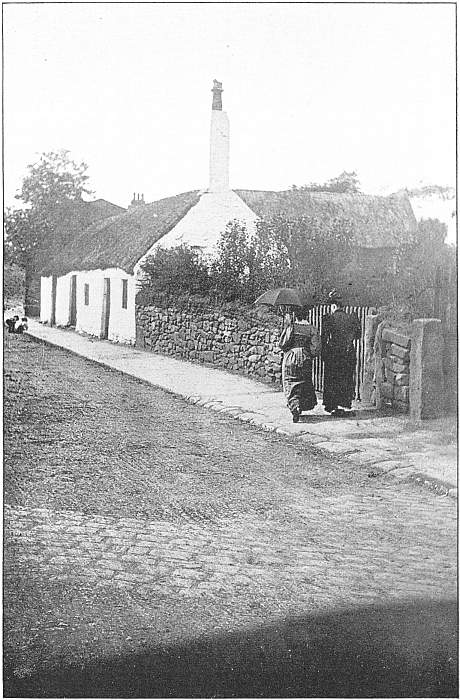
“Typical English houses with their massive thatched roofs.” (See page 31.)
A decided change from the ancient and mediæval associations of Chester is the prosperous city of Leamington, a watering-place situated on the Leam River, a tributary of the Avon. The natural mineral springs discovered here in 1797 have proved the source of great benefit to this town, as the springs are highly recommended by physicians, and many invalids resort thither. But as health is not our object in coming, we do not follow the popular custom, but proceeding to the banks of the River Leam, engage one of the many small boats which may be hired, and drift leisurely down the stream with the current, revelling in the wealth of beauty which surrounds us. Hundreds of lovely nooks disclose themselves to our eager eyes—typical English scenes—and as we float along life assumes an ideal aspect under the witchery of this picturesque river. Here are old farmhouses in the foreground, with their richly cultivated fields stretching away for hundreds of acres, and here are velvet lawns, with their dainty high-bred air, surrounding noble homes, stately and silent. Now a group of merry children dance about the water side, and a great Newfoundland dog dashes wildly into the stream after a ball or stick, swimming gallantly out until he seizes his prize. How the children scream and run away as he rushes joyously up to them, shaking the spray over their dresses and into their faces. Oh fair River Leam! these lofty elms and giant oaks that look down upon your waters love you, and we too, strangers from a foreign shore, here yield our tribute of loving praise for the happy hours we owe to you, lingering often, reluctant to leave some especially charming spot where the branches of the trees overhang the stream, and touch our faces with soft caressing fingers.
“Nature was here so lavish of her store, That she bestowed until she had no more.”
This scene too fades as we board one of the many tram-cars, and in a few moments are carried to the very gateway of the world-renowned Warwick Castle, which occupies a commanding position, overlooking the Avon. This ancient pile is artistically poised, and presents grand effects of color, light and shade. Upon the payment of a shilling for each person, the massive iron doors which for centuries have guarded this stately and historic stronghold, open as if by magic, and a passageway cut through the solid rock leads us to an open space, where we have a fine view of the magnificent round towers and embattled walls. A visit of two hours gives us opportunity to climb to the top of the ancient towers which for ages have loomed up as monuments of power and defiance in the face of the enemy. We are impressed with the vast size of the castle. The view from the towers and the windows is beautiful and romantic. In the spacious courtyard there are magnificent old trees and soft velvety turf, and the hand of time has colored towers and battlements a rich brown hue that blends harmoniously with the ivy creeping in and out wherever it can find a place.
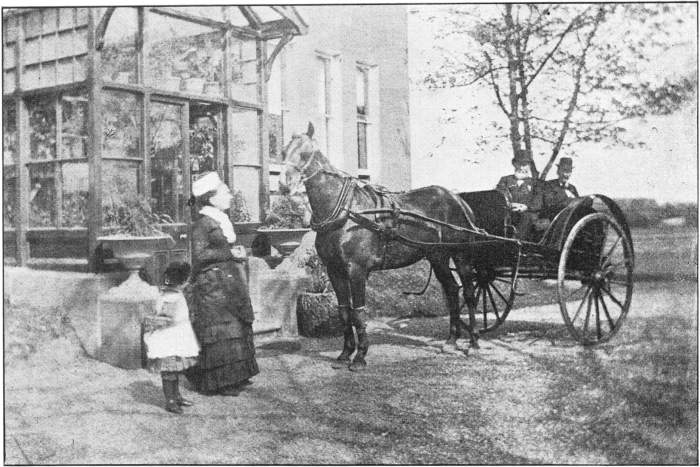
“Suburban residence.” (See page 42.)
The gardens slope down to the Avon, from whose banks there is a picturesque view of the river front of the castle, and here as well as in the park we see some fine old cedars of Lebanon, brought from the East by the Warwick Crusaders. In the main castle we enter a number of the apartments which are furnished in a style of regal splendor. The Great Entrance Hall, sixty two feet long and forty wide, is rich in dark old oak wainscoting, and curious ancient armor; and shields and coronets of the earls of many generations, as well as the “Bear and Ragged Staff,” of Robert Dudley’s crest are carved upon its Gothic ceiling. The Gilt Drawing-room contains a rare collection of the masterpieces of great artists. This room is so called from the richly gilded panels which cover its walls and ceiling. In the Cedar Drawing-room are wonderful antique vases, furniture and other curios, which would well repay a much longer inspection than we can give them. But all the rooms in this magnificent old feudal castle are filled with the finest specimens of works of ancient art in every line. The paintings alone fill us with despair, for they line the walls in close succession, and the artists’ names are Murillo, Rubens, Rembrandt, Vandyke, Sir Peter Lely, Guido, Andrea del Sarto, and many others of like celebrity. What an opportunity for those who have the time to linger in this atmosphere of lofty genius!
Many beautiful old shade trees surround the castle, and the restful silence inspires one with the desire to be alone and yield himself up to the spirit of the place, hallowed by such wealth of associations and the presence of immortal art.
A short distance from the castle, and outside the Warwick enclosure, stands an old mill upon the bank of the Avon. This ancient and picturesque structure was originally built for the purpose of grinding wheat, but the all-observing eye of the artist quickly discovered in it a mission of a higher order, and for years it has posed as the central figure in the romantic landscapes portrayed by the brush of the painter or the camera of the photographer.
Taking a drag and driving through Kenilworth, Coventry and Stoneleigh, will give one delightful views of some of the most beautiful portions of England. The roads are macadamized, and in good condition. This is a fine farming country, and here we see the typical English farmhouses, built of brick and stone, surrounded by well-cultivated fields, stretching away into a peacefully smiling landscape. The fields are separated by green hedges, and the whole scene is one that can hardly be surpassed throughout “Merrie England.”
From these lovely quiet homes, we pass through roads bordered with wild flowers to the ruins of one of the most magnificent castles in Great Britain. It is hardly necessary to say that Kenilworth is inseparably associated with Sir Walter Scott, and his graphic descriptions of the scenes and events that have taken place here in the days of its glory. This castle, one of the finest and most extensive baronial ruins in England, dates back to about 1120 A. D. It covered an area of seven acres, but is now a mass of ivy-covered ruins, from which one can form but a faint idea of its appearance in the height of its prosperity. Yet the hand of nature has invested it with another kind of beauty, and in place of the pomp and majesty of power, the brilliant pageants of the court of Queen Elizabeth, we behold the clinging robe of ivy, the daylight illuminating the gallery tower in place of the hundreds of wax torches which flashed their lights upon the royal cavalcade, and a little country road where once a stately avenue led to the tower, and listened to the court secrets, lovers’ vows and merry badinage uttered within its shades. The castle has passed through many changes, and experienced stormy days as well as those of prosperity and luxury, but the pen of Scott has immortalized it on the summit of its glory, and though the ages may cast their blight upon its visible form, it will ever live in the soul of the artist, the poet, the lover of beauty, as a scene of splendor, of sorrowful tragedy, of magnificent design.
But a few steps beyond the Kenilworth grounds is an old English inn—The King’s Arms. It is so picturesque and romantic-looking, that I feel like rechristening it: “The Entire Royal Family.”
Let us enter its hospitable doors and enjoy its old-time atmosphere and many curious attractions. Here the artist is in his element, for on every side are quaint corners, cozy nooks, and relics for which the lover of the antique would give a fortune; while outside the windows the beautiful English landscape beams upon one with inviting smiles. The landlady, with her cheerful bustling air and broad accent, imparts a pleasant thrill of anticipation, which is more than realized upon the appearance of the savory chops,—grown on the neighboring hillside, whose rich green pasturage is a guarantee for the flavor and quality of the meat,—the delicious hot cakes, and the unfailing tankard, or if one prefers it, the cup of fragrant tea. And so we sit and refresh the inner man, while the soul revels in the world of beauty around us, and picture after picture passes before the mental vision, connecting these scenes with famous historic characters, or wonderful events of legendary lore. So lovely are these views, that one could gaze for hours, and never weary of the “living jewels dropp’d unstained from heaven,” for this picturesque country possesses a peculiar freshness, as though free from the touch of care and the hand of time, like the fair maiden who has received from the fountain of youth the gift of eternal life and beauty.
Lights and Shadows of London Life.
Lights and Shadows of London Life.
The Shadow Side—The Slums—The City by Night—Vice and Misery—“Chinese Johnson’s” Opium Den—The “Bunco” Man—An English Guard—“The Grand Old Man”—Caution to Tourists—Great Cities by Night—The Seven Dials—Derby Day—The Tally-Ho—Old Robin Hood Inn—Epsom Hill—The Races—Exciting Scenes—Side Shows—The Close of the Day.

S nature derives much of its charm from the intermingling of light and shade, so in life there are many scenes of sharp contrast, and we often have a deeper appreciation of its beauties after beholding the reverse side of the picture. Some one has said: “In actions of life, who seeth not the filthiness of evil, wanteth a great foil to perceive the beauty of virtue.”
What better opportunity of studying this phase of life can there be, than in the faces of those whose existence is passed amid associations of suffering, want and crime; who not only witness, but experience all these in their different shades and degrees.
Take with me a walk through the worst portions of the greatest metropolis in the world, and observe a few of the pictures in the localities where humanity is born and nourished in misery, filth and sin. Guarded by three of England’s best paid detectives, I follow closely in their footsteps, not daring to speak lest I rouse in his lair the slumbering lion of passion and revenge. From street to street we pass, viewing the wretched tenementstenements, and more wretched inmates huddling together over a faint spark of fire, or vainly trying to impart to their little ones some of the natural warmth which still exists in their bodies, in spite of hunger, cold and fatigue. The crumbs from the tables of the rich would be a lavish feast to these poor creatures. Clean water is as great a stranger to their stomachs as to their bodies; loathsome rags cover their emaciated forms, and the destroyer drink has left his signet upon their countenances. A little farther on is the vile dance house into which the inhabitants of this neighborhood crawl for the lowest stage of their degradation. A motley throng is assembled here, and the sound of a violin mingles with shrill laughter and drunken oaths.
I am guarded so carefully that many times I am hurried away from a scene more quickly than I wish, the officers fearing that our presence may create a disturbance among these reckless characters. We enter a low saloon in a cellar dimly lighted by an old oil lamp: the atmosphere is gruesome, and one of the detectives warns me that the men who frequent this haunt are desperate fellows who would not hesitate to stab me for the sake of my clothing. Old and grizzled habitués line reeking walls, with depravity written upon every countenance, and I fully realize that my life would not be worth a moment’s purchase here should my attendants forsake me.
Now we are in a long narrow alley, as black as Erebus, which gives one the feeling of being in a subterranean passage upon some mysterious mission. In a few minutes a light appears ahead—a dull glimmering bluish light, like that which is supposed to hover above graveyards—and we pause in front of a small frame house of two stories. A knock upon the door brings to the threshold a little dried up, wizened Chinaman, made feeble by long dissipation, who in his broken language makes us welcome. The place is “Chinese Johnson’s” opium den. How can I describe the scene that is before me? In this room are many small dirty cots filled with unconscious human beings, willing victims of the pernicious drug—a loathsome spectacle—and here on a small couch sits the proprietor of the establishment. This is his throne of state, and here he can smoke with impunity the deadly drug, which has no perceptible effect upon his depraved body. We are glad to end this experience and banish from our minds the unattractive picture of the Chinaman in his elysian fields.
We are not the only ones who have the privilege of viewing these scenes. Any one who desires and possesses the necessary courage may invade the haunts and dens of the lower world, and be profited by the lessons here learned; but he must exercise great caution. The studies are not only for the brush and camera: they are food for the thoughtful mind which can apply the wisdom thus gained, and seek in these conditions for the solution of knotty problems. One can better appreciate, by reason of this contrast, the blessings of his own life; of purity, honesty and contentment as opposed to ignorance, poverty and vice.
This evening, fatigued in mind and body by my experience in the slums of London, I enter the Holborn Restaurant, hoping to enjoy a good dinner, and at the same time be entertained by the delightful music of skilled musicians. I seat myself at a table on the second floor, and supposing myself free from intrusion, yield myself up to the charming melody, when a good-looking and well-dressed man approaches, and with many apologies asks if the seat opposite me is engaged. I assure him that I do not lay claim to ownership of any portion of the Holborn, and that I can speak only of the chair upon which I am sitting. Upon this he takes the opposite place and gives to the waiter an order for quite an extravagant supply of the dainties enumerated on the bill of fare. During the time intervening between the giving of the order and its delivery, no conversation passes between us, but I have an unpleasant consciousness of his presence, and occasionally feel his eyes resting upon me. The appearance of the epicurean repast seems to impart the confidence he requires, and he addresses me with the remark that I must pardon him for staring at me so impolitely, but he is sure he has met me before. Am I not an American? to which I assent. “Are you a New Yorker?” is the next interrogation from this experienced catechiser. He can readily perceive that I am an American by my foreign accent.
To the last question I also respond in the affirmative, and may heaven forgive the falsehood. “Ah,” he says, “do you frequent the races at Sheepshead Bay?” “Yes, generally,” I reply. (I have never seen the place.) “It is there, then, that I have met you. Were you not there last summer?” “Many times.” (Another breach of truth.) “Will you kindly give me your name?” follows as a matter of course. I reach my hand into my pocket and draw out a card upon which is engraved simply my name, and extending it toward him, remark: “My name is Charles M. Taylor, Jr., and I am associated with Mr. ——, one of the chief detectives at Scotland Yard. My present mission is to look up some ’Bunco’ men from New York who have headquarters in London. Here is my card.” But the stranger does not take the card. He glances hastily at his watch, and rising hurriedly, says: “It is nine o’clock. I did not know it was so late. I must be off, as I have an important engagement.”
As he pushes back his chair, I quickly call a waiter, and tell him to collect the money for this gentleman’s order, as I do not wish to be held responsible for it. He pays for the meal which he has not touched, and in his haste to depart forgets his manners, for he does not wish me “good-night.”
Did he think I was a tender lamb? This hurts my pride somewhat. I am sorry, however, that I was obliged to deceive him so.
One evening while discussing matters in general with an English friend, born and bred in the city of London, we touch upon the order and unswerving obedience of the soldiers, policemen and good citizens who dwell under the dominion of her gracious Majesty, the Queen, in the great metropolis; and my friend cites as an example, the guards who patrol nightly the White Hall Horse Guards Barracks, as adhering so strictly to their line of march that they will not turn out of their way one inch for any person or obstacle in their direct course. I accept the wager of a dinner at the Holborn to be given by me if I do not succeed in inducing one of these guards to move out of his line of march. Selecting a dark night for the one in which to make good my assertion, I approach the barracks, and espy the guard with bayonet at “Carry arms,” making a “bee line” toward me. I walk in his direction with head bent low, and come so close that there would be a collision were it not for the stern and firmly-uttered “Halt” that comes from his lips. I halt face to face with this noble specimen of humanity, standing fully six feet one in his boots, and as straight as “Jack’s bean pole.” “Sir,” I say, “you are in my way, will you please move out?” He makes no response. “Will you please step aside and allow me to pass?” No response. “Come, my good fellow,” I continue in persuasive tones, “I have made a wager that you will move out of line for me, and if you do I will share the bet with you.” No reply. But I see in the immovable countenance an inflexible determination to do his duty which all the bribes in Christendom will not be able to change. I feel that death only can prevent his obedience to orders. “Well,” I conclude, “you are a good fellow, and the power you serve, be it queen, emperor, or president, is to be envied for having such a faithful subject. I respect your obedience to law and order. Good-night.” No response. It is needless to say that I pay the forfeit willingly, and my friend and I enjoy a good dinner at the Holborn.
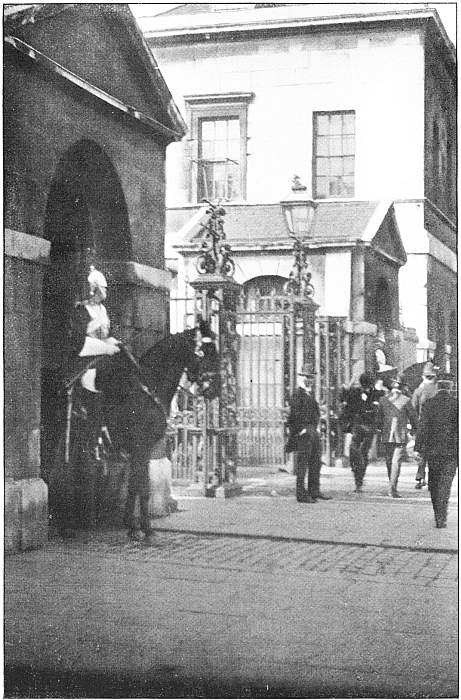
“White Hall Horse Guards’ Barracks.” (See page 63.)
Strolling one morning about London, with nothing better to do than to take in “odd bits” that come in my way, I observe a large crowd of citizens assembled opposite the entrance to Parliament, and going up to a policeman, I ask what has happened, or is about to happen? But the officer looks perfectly blank, and can give me no information whatever. I bethink suddenly of my remissness and the rules governing information sought from guards, cab-drivers, and omnibus whips in the city of London, and straightway putting my hand in my pocket, I produce several pennies which I give him for a mug of “Half and Half.” A change comes over his countenance, his vanished senses quickly return, and with a courteous smile he remarks that Gladstone is expected to appear in Parliament for the first time after an illness of some weeks. And this obliging “cop” not only gives me the desired information, but escorts me to a good position in the crowd, just in time to behold the “Grand Old Man,” who, holding his hat in his hand, bows smilingly in response to the enthusiastic greetings which come from every side. He walks briskly along, and as he comes close to me, moved by an irresistible impulse, I step out from the throng, and extend my hand, saying: “I am an American, who wishes to shake the hand of the man who has so bravely fought a hard battle.” The proud old face looks pleasantly into mine, his hand meets mine with a cordial grasp, and replying that he is glad to meet an American, Gladstone passes on to the scene of his many conflicts and victories.
The tourist who is bent on seeing the various sections of a great city, and especially those localities which are best observed by night, should be very cautious in visiting the haunts of vice and poverty: such for example as the old Seven Dials of London, as it used to be. I have had many unpleasant and untold encounters, and been placed in situations, not only trying, but extremely dangerous, while attempting to explore these hidden regions unattended and alone. Experience has taught me that it is best to go “well heeled,” that is accompanied by the best informed and most expert detectives, as what they may charge for their services is cheap in comparison with a mutilated head or body. One’s own ready wit and shrewdness are all very well in some cases, but there are times when these fail, and the man at the other end, drunken, brutal, and excited, will make you wish you had “let sleeping dogs lie.”
It is well for travellers and others to visit the slums of large cities by night. Here is food for comparison and reflection, and from these may perhaps arise a different feeling from that with which we are accustomed to regard the poor wretches who have lacked the advantages of birth, education and environment.
In company with four detectives, I visited the “Seven Dials” of London, and the experience of those nights spent in scenes of horror, vice and degradation would fill volumes. Picture to yourself a small narrow street, with low wooden houses of two stories on either side. There are dim glimmering lights at intervals of about fifty feet. The hour is two o’clock in the morning, as one tourist attended by four officers wends his way through an atmosphere filled with dread and horror. We enter some of the houses which present scenes of indescribable squalor and confusion. A perfect bedlam of tongues reigns here. Men and women hurl abusive epithets at each other, from windows and doors, as well as from one end of the street to the other. The entire neighborhood enters into the quarrel, and the transition from words to blows is sudden and fierce. The street is filled in an instant with ragged, and almost naked beings, whom one can hardly call human, and the battle which ensues with clubs, knives and fists is beyond imagination. Cut heads, broken limbs, bruised bodies, bleeding countenances appear on every side, and it is quite evident that many are scarred for life. The sight is loathsome, yet it makes one’s heart ache. Such scenes are of frequent occurrence in the slums of nearly every large city, where drink and depravity count their victims by thousands. In these vile abodes are the haunts of the thief, the smuggler, the fallen, and the pictures once seen, are indelibly impressed on the memory, with the long train of reflections awakened by such sights, and the inevitable query: Why is not something done to render such scenes impossible in this age of civilization?
At last the great Derby Day has arrived, and the whole atmosphere is filled with the importance of the occasion. The sprinkling rain does not dampen the ardor and enthusiasm of the true Englishman, for I am told that the races have never been postponed on account of the weather. After breakfast we stroll to the street corner where stands our tally-ho in readiness for the day’s excursion. Having engaged our seats the previous day, we take our places and start forth, drawn by four spirited horses under the guidance of an experienced driver. The whip is cracked, the horn sends forth its musical signal, and away we go amid the cheers and applause of numerous spectators. Swiftly we roll over the well paved streets, and the high spirits of the company, accompanied by the frequent winding of the horn, render the ride extremely pleasant. The race-course is about eighteen miles out of London, and our road is through a beautiful portion of the country. Every lane and avenue is thronged with people, walking, driving, or on bicycles, but all going to the Derby. We stop for refreshment at the old Robin Hood Inn, an ancient hostelry, established, we are told, in 1409. Here we have a beverage, supposed to be soda water or milk, but which is in truth a stronger concoction, to brace us for the mental and physical strain of this exciting day. “All aboard,” cries the coachman, and there is a general scramble for places. At last we are all seated, and proceed on our way, changing horses when half the distance is covered.
We take the main thoroughfare within three miles of the Epsom grounds, and now a wonderful sight bursts upon us. Thousands of pedestrians of both sexes and every age are flocking toward the race course: hundreds of carriages, vans, dog carts, tally-hos, vehicles of every description throng the road. Enormous trains are constantly arriving, bearing their thousands to the Downs, now covered with a vast moving mass. London empties itself on this all-important day, and proceeds to Epsom by every possible means of locomotion. The grand stand, a handsome and commodious structure, is quickly filled to overflowing. There are numerous other stands. The appearance of the Downs, with the countless booths and the waving multitude which cover it as far as the eye can reach, is a spectacle that cannot fail to thrill the soul of the most phlegmatic. No other event in England can concentrate such an amount of interest and excitement as is found on the scene of the Derby. Every one is in high spirits: young and old, men, women and children all seem merry and happy, laughing, singing, dancing along on this one great day of the year. Behold the party on our right. A large wagon contains ten or more men and women, who are singing and laughing in great glee, and who invite us to join them. Here a group of a half dozen men with musical instruments at their sides are singing to their own accompaniment. The dust rises in clouds, and we are covered from head to foot with it as with a garment: we all wear veils pinned around our heads to protect our eyes.
At last we reach Epsom Hill, and here we pay two guineas for the admission of our party and conveyance. We are also entitled to a place anywhere on the hill which overlooks the race-course. Our horses are picketed after being taken from the wagon, and our two attendants spread before us a most sumptuous repast. Coaches of every kind are so thickly jumbled together that for a vast distance the hill seems covered with a coat of dark paint.
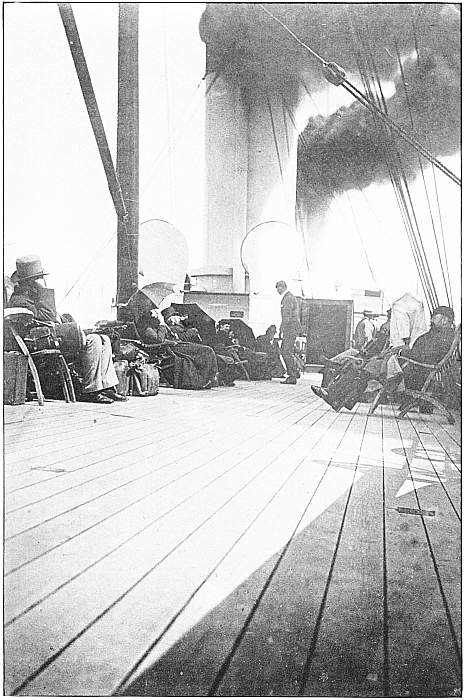
“A short run of an hour.” (See page 83.)
Thousands and thousands of men, women and children are assembled upon this hillside, while tens of thousands fill the stands and encircle the race-course. It is estimated that no less than from one hundred thousand to one hundred and fifty thousand persons are massed together at these races.
The race-course is not like those in the United States, but is a sodded strip extending about half a mile in a straight line. The ringing of a bell announces the commencement of the races, and the mass of humanity surges to and fro in great excitement. Now is the book-maker’s time, and he passes hither and thither, shouting his offers to the enthusiastic multitude, who accept or reject his propositions with eagerness or scorn, corresponding with their knowledge or ignorance of the horses ventured. Gambling and betting are at their height: vast sums of money change hands at the conclusion of the races, and many inexperienced as well as reckless ones leave the field at night ruined men. Meanwhile the confusion is indescribable.
But these sounds drop away, and silence prevails as five slender well-shaped racers appear, ridden by jockeys, but when the wild mad race begins in which each endeavors to outdo the others, the excitement and tumult know no bounds: shouts, groans, cheers fill the air, and every eye is strained along the course: one could readily believe that a whole world of mad spirits has been let loose to fill the air with their hoarse discordant sounds.
As the winning horse reaches the goal, a placard of large dimensions, on which his number is conspicuously painted, is raised within full view of the swaying crowd. The shouts and cheers burst forth afresh, and jubilee and pandemonium mingle their extremes in a scene to be imagined only by those who have experienced it.
As the first excitement cools, bets are paid, and accounts squared. Again the bell rings: another race, and a repetition of the previous scene, and so it continues for several hours.
But the racing is not the sole attraction, as is evidenced by the crowds surrounding the refreshment booths and side tents, where for a small fee one may see the Fat Woman, the Skeleton Man, or the Double-Headed Boy; or listen to the colored minstrels who charm the soul with plantation melodies; or have his fortune told in the gypsy tent by a dark-eyed maid in gorgeous attire, who will tell of a wonderful future which is “sure to come true.” Or you may have your photograph taken on the spot, and finished while you wait. Here is a phonograph representing a variety entertainment, and the little group around it are laughing heartily at the jokes of the “funny man,” the ventriloquist, and the story-teller. Here are fine bands of musicians, and dozens of oddities, and curious tricksters: and the whole forms one grand panorama of human life, the counterpart of which is to be seen nowhere else in the world.
At five o’clock, the horses are harnessed to our tally-ho, and with smiling but dusty and sunburned faces we bid farewell to the scene of gayety and start for home. Every road and byway in the surrounding country is swarming with people, and the scale of pleasure, disappointment, grief, hilarity and fatigue is reflected in the countenances of riders and pedestrians. Here is a group, overheated, weary, dejected, trudging slowly along the way, interchanging scarcely a word with each other: here a merry party, filled with life, singing, laughing, recounting the events of the day, as they wander on, arm in arm. Now a little lame boy smiles in our faces from the tiny cart which his sister pushes cheerily forward, and now a gay belle dashes by in a carriage drawn by fast horses, holding the ribbons and whip in correct style, while her companion leans back, indolently enjoying the situation.
The countenances of the men tell various tales, as the triumphs or failures of the day are expressed in their faces. Some few wear a stolid, impassive air, while others talk, talk, talk, as though they have never had an opportunity till now. As we ride along amid the stupendous throngs, many thoughts are aroused, and many a picture is put away in the recesses of memory to be brought forth and pondered over on a future day.
With the shades of night the curtain falls upon a scene of such magnitude that the brain is weary of contemplating it, and is glad to find temporary forgetfulness in “tired nature’s sweet restorer.” And so ends the great Derby Day.
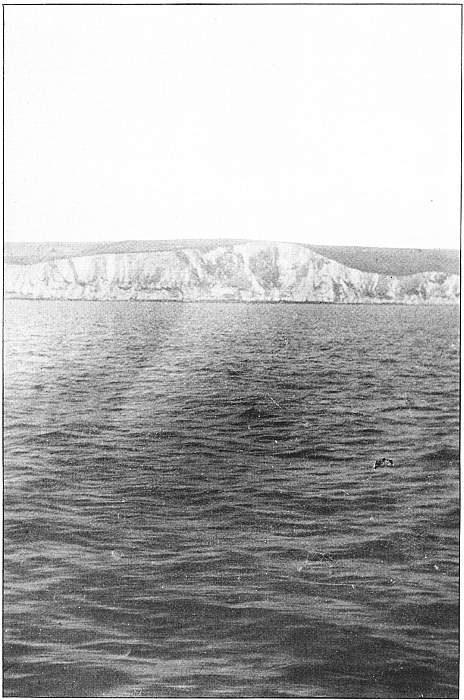
“The chalky cliffs of Dover.” (See page 83.)
Scenes in the Gay Capital.
Scenes in the Gay Capital.
Dover to Calais—Paris—The Gay Capital by Night—Boulevards—Life in the Streets—Champs Élysées—Place de la Concorde—Arc d’Etoile—Place Vendome—Louvre—Opera House—Palais Royal—Church of the Invalides—Versailles—Notre Dame—Jardin Mabille—The Madeleine—The Pantheon—The Banks of the Seine—French Funeral Ceremonies—La Morgue—Pere Lachaise.
E travel from London to Dover by train, thence by steamer to Calais. The chalky cliffs of Dover with their high precipitous sides are a pleasant and restful farewell picture of the shores of old England. A short run of an hour or more lands us amid scenes so different from those of the past few weeks that we feel that the magician’s wand has again been exercised and the “Presto, change,” has transported us to a region of maliciously disposed genii, who will not understand us, or allow us to comprehend their mysterious utterances; and the transformation scene is complete as we enter Paris, the home of the light, the gay, the fantastic.
Let the lover of the bright, the gay, the jovial, visit the broad boulevards of Paris by night, especially the Avenue des Champs Élysées, which seems to be the favorite promenade of the populace. Upon both sides are groves of trees, brilliantly illuminated by myriads of colored lights, and here amid these bowers is to be found every variety of entertainment for the people. Games of chance are played in the gay booths, Punch and Judy shows attract crowds of children, wonderful feats of horsemanship are performed, singers in aërial costumes draw many to the Cafés Chantants, and the lights of innumerable cabs and carriages flit to and fro in every direction like will-o’-the-wisps. Here is fine military music, as well as exhibitions of skillful playing on almost every known instrument.
The wide boulevards are long, straight and marvels of beauty, with their lovely gardens, handsome houses, and fine shops.
There are strong contrasts in the lives of those one sees upon these streets under the gaslight. I think Dante’s three realms are pretty clearly represented along the avenues of Paris, beneath the starry dome of heaven, and within these gayly decorated booths and cafés. Here may be seen the high and the low, the rich and the poor, the grave and the gay, the innocent and the hardened in guilt, the adventurer and his unsuspecting victim. And this heterogeneous throng, this careless pleasure-loving crowd, may be seen drifting from one point to another till the cock crows the warning of approaching dawn. The streets of Paris by night afford abundant material for the artist, the photographer, the poet, author and clergyman; as well as the adventurer. Here indeed, if anywhere, one may
“read the human heart, Its strange, mysterious depths explore. What tongue could tell, or pen impart The riches of its hidden lore?”
The Place de la Concorde is the most beautiful square in Paris. From its centre are magnificent views of the grand boulevards and many of the handsome public buildings, and here are the great bronze fountains marking the historic spot upon which stood the guillotine during the French Revolution. The lovely walks, the sparkling waters, and the statues and monuments, the obelisk, the merry strollers, and picturesque tableaux seen at every turn are positively enchanting. Up the broad vista of the Champs Élysées the eye rests upon the wonderful Arc d’Etoile, one of the most conspicuous monuments in Paris. It stands in the Place d’Etoile, one of the most fashionable sections of the city, and is surrounded by elegant residences and pleasant gardens. From this point radiate twelve of the most beautiful avenues in Paris, and from the summit of the arch one can see for miles down these grand boulevards. The magnificent arch of triumph, commenced in 1806 by Napoleon, was not finished until 1836. It is a vast structure, rising one hundred and fifty feet from the ground. The great central arch is ninety feet high and forty-five feet wide, and is crossed by a spacious transverse arch. Upon the outside of the arch are groups of splendidly executed statuary, representing scenes of conquest and allegorical figures. A spiral staircase leads to the platform on top, where one beholds this superb prospect which well deserves its world-wide celebrity.
We come upon the Place Vendome through the Rue de la Paix, and here stands the great historic column, erected by the first Napoleon in commemoration of his victories over the Russians and Austrians. The monument is constructed of twelve hundred pieces of cannon, captured in the campaign of 1805. Upon the pedestal and around the shaft which is one hundred and thirty-five feet high, are bas-reliefs representing warlike implements and the history of the war from the departure of the troops from Boulogne to its end on the famous field of Austerlitz.
In front of the central entrance to the court of the Tuileries, in the Place du Carrousel, is the Arc de Triomphe du Carrousel, also erected by Napoleon I., in 1806, in imitation of the triumphal arch of Severus at Rome. In the garden of the Tuileries, with its old-time atmosphere, its statues, fountains and pillars, its groves and terraces, its historic ruins, its lovely flower-beds, we find a quaint and charming picture of a past age; yet when these groves and paths resound with the hum of human voices, when the many chairs and benches are filled with joyous human beings, the link between the past and present is established, and we are in one of the favorite resorts of the Parisians of to-day.
Between the Tuileries and the Louvre is Napoleon’s triumphal Arc du Carrousel—or rather between the courtyards of the two famous piles, which now form one continuous structure of magnificent architectural design, whose façade is adorned with Corinthian columns, elaborate sculptures and lofty pavilions. Groups of statuary, representing the most distinguished men of France, allegorical figures, floral designs and other decorations on a vast scale ornament these magnificent pavilions. The space enclosed by the old and new Louvres and the Tuileries is about sixty acres.
Some of the most beautiful of the architectural designs of the Louvre were completed by Napoleon I.,—to whom it owes much of its restoration,—from the drawings of Perrault, the famous author of Bluebeard, and the Sleeping Beauty.
We cross a square and quickly find ourselves in the garden of the Palais Royal, once the Palais Cardinal, and the home of Richelieu. The ground floor of the palace is occupied by shops. The garden which is enclosed by the four sides of the square, is about a thousand feet long and nearly four hundred feet wide. Here is a quadruple row of elms, also long flower-beds, shrubbery, a fountain and some statues. A military band plays here in the afternoon, but the garden presents the gayest scene in the evening, when it is brilliantly illuminated, and the chairs under the elms, as well as the long walks are filled with gay pleasure-seekers.
There is a magnificent opera house near the Grand Hotel, whose vast exterior is ornamented with beautiful statuary, medallions, gilding and other rich decorations.
In the Church of the Invalides we find the tomb of Napoleon I., who in his will expressed a desire that his ashes might rest on the banks of the Seine, in the midst of the French people whom he had loved so well. The open circular crypt is beneath the lofty dome, whose light falls upon it through colored glass, and with a wonderful effect. The pavement of the crypt is a mosaic, representing a great crown of laurels, within which are inscribed the names of Napoleon’s most important victories; and twelve colossal figures symbolizing conquests, surround the wreath. The sarcophagus rests upon the mosaic pavement within the crypt, which is twenty feet in depth. This is an enormous block of red sandstone, weighing more than sixty tons, which surmounts another huge block supported by a splendid rock of green granite. The scene is solemn and grandly impressive, the faint bluish light from above, producing an effect wholly indescribable. In the higher of the two cupolas, directly over the crypt, is a painting, with figures which appear of life-size even at this great distance, of Christ presenting to St. Louis the sword with which he vanquished the enemies of Christianity.
Here is Versailles, with its “little park of twelve miles in extent, and its great park of forty,” with its beautiful fountains and grottos, its wonderful groves and flower-beds. Here are velvety lawns adorned with fine statuary, green alleys, shrubberies and terraces, in which art and nature are so cunningly intermingled that they are often mistaken for each other. The fountains are representations of mythological characters, and the figures are carried out in their immediate surroundings. Apollo is in his grotto, served by seven graceful nymphs: while close by the steeds of the sun-god are being watered by tritons. Again, the basin of this god appears surrounded by tritons, nymphs and dolphins, with Neptune and Amphitrite in the centre, reposing in an immense shell.
Latona, Apollo and Diana are represented by a fine group: the goddess is imploring Jupiter to punish the Lycian peasants who have refused her a draught of water, while all around her, in swift answer to her appeal, are the peasants, some partially transformed, others wholly changed into huge frogs and tortoises, condemned here to an endless penalty of casting jets of water toward the offended deity.
Here is the famous old cathedral of Notre Dame de Paris with which Victor Hugo has made the world familiar. This grand Gothic structure was commenced in the twelfth century, and finished in the fourteenth. We view its exterior from a position facing the fine west façade, with its wonderful rose window between the huge square towers. The three beautiful portals are ornamented with rich sculptures and imposing statuary. These doors form a succession of receding arches, dating from the early part of the thirteenth century. The central portion is a fine representation of the Last Judgment. The interior is vast and impressive with its vaulted arches and long rows of columns. The ancient stained glass of Notre Dame is represented by three magnificent rose windows. From the summit of the tower there is a glorious view of the Seine and its picturesque banks and bridges: indeed one of the loveliest views in Paris.
Another famous and beautiful edifice is the Madeleine, or church of St. Mary Magdalene, which stands in an open space not far from the Place de la Concorde. It is in the form of a Grecian temple, surrounded by Corinthian columns, and the flight of twenty-eight steps by which one approaches the church, extends across its entire breadth. The great bronze doors are adorned with illustrations of the ten commandments. Within, the walls and floors are of marble richly ornamented, and the side chapels contain fine statues, and paintings of scenes from the life of Mary Magdalene. The high altar is a magnificent marble group representing angels bearing Mary Magdalene into Paradise. This whole interior is indescribably beautiful, and to enter into its details one would require a volume. From this sublime spectacle we pass to the Church of St. Genevieve, the protectress of the city of Paris, familiarly known as the Pantheon. This also is a magnificent structure, with three rows of beautiful Corinthian columns supporting its portico. The handsome pediment above this portico contains a splendid group of statuary in high relief, representing France in the act of distributing garlands to her famous sons. The central figure is fifteen feet in height. The edifice is in the form of a Greek cross, surmounted by a majestic dome, two hundred and eighty feet high.
Within the church the spacious rotunda is encircled by Corinthian columns which support a handsome gallery, and he who ascends to the dome will have an opportunity of observing closely the wonderful painting, covering a space of thirty-seven hundred square feet, which represents St. Genevieve receiving homage from Clovis, the first Christian monarch of France, Charlemagne, St. Louis, and Louis XVIII., while the royal martyrs of the French Revolution are pictured in the heavenly regions above. In the gloomy vaults below we behold the tombs of a number of eminent men, among them those of Rousseau, Voltaire, and Soufflot, the architect of the Pantheon. In the middle of the vaults is an astonishing echo. The roll of a drum here would sound like the thunder of artillery; a board dropped upon the pavement is like the report of a cannon, and the reverberations are repeated over and over again as though these subterranean spirits are loth to resign the opportunity of speech so seldom afforded them.
The tourist in Paris rarely fails to spend at least one evening in the Jardin Mabille; that is the male tourist, who is curious to behold life in all its phrases, and whom the fame of the garden attracts as the candle draws the moth. This is a pretty spot, with bowery paths, gay flowers, sparkling fountains, arbors and sheltered corners where lovers and others may enjoy tête-à-têtes undisturbed, and refreshments may be ordered to suit purses of all dimensions. There is a good orchestra on the brilliantly illuminated stand, and here the soubrette is in the height of her glory, while the better class of the visitors are as a rule, only spectators. There is some pretty gay dancing here, but order is preserved. On certain nights fine displays of fireworks attract many spectators. But the great feature is the dance, and the proprietors generally employ some girls distinguished by peculiar grace, beauty, or other characteristics who serve as magnets to the light and pleasure-loving throngs.
But why attempt to give even a faint idea of the innumerable attractions of the city whose abundant resources bewilder the tourist whose time is limited. It teems with life. It is overflowing with beauty, passion and love. Wandering along its gay boulevards, whether in the bright sunshine, or beneath the starry vault of night, with picturesque mansions or gay shops on either side, or amid the bowery paths and bewitching avenues, the gardens, statues, music and laughter, one feels that he is in an enchanted land, where high and low, rich and poor share alike in the universal beauty and happiness.
The charming banks of the Seine offer endless attractions. Here are many beautiful bridges, from which one may have picturesque views of the lovely gardens and palaces. These bridges are handsomely ornamented with statuary, bronzes, and reliefs, and bear interesting inscriptions. Floating bathing establishments are to be seen along these banks, and swimming schools for both sexes. Here are also large floats or boats capable of accommodating at least fifty women, who wash their clothing in the Seine. It is quite interesting to watch these robust girls and women, as they pat and slap the heaps of muslin with the large paddles provided for this purpose.
When a death occurs in a family of the middle class in Paris, it is customary to drape the whole lower story of the house with black, and place the body of the deceased in the front room. Holy water is placed at the head, also candles and a crucifix, and any one may enter and view the body, or sprinkle it with holy water, and offer a prayer for the soul of the departed.
The men who pass a house so distinguished reverently uncover their heads: they also take off their hats on the appearance of a funeral, and remain so until the procession has passed.
For him who is interested in such sights, the morgue presents a curious but sad attraction. Here lie on marble slabs, kept cool by a continuous stream of water, the bodies of unknown persons who have met their death in the river or by accident. Their clothing is suspended above their heads, and any one may enter and view these silent rows. After a certain period, if not identified, they are buried at the public expense. I behold many pathetic sights here, as broken-hearted relatives find their worst fears realized and lost and erring ones are recognized. Sad, sad are the pictures to be seen at the morgue. Here is a fair young girl, of not more than twenty years, resting peacefully upon her marble bed, her troubles in this world over forever. Her body was found yesterday floating on the Seine.
“One more unfortunate Weary of breath, Sadly importunate, Gone to her death. “Touch her not scornfully; Think of her mournfully, Gently and humanly; Not of the stains of her, All that remains of her Now is pure womanly. “Make no deep scrutiny Into her mutiny Rash and undutiful: Past all dishonor, Death has left on her Only the beautiful.”
Pere Lachaise, once an old Jesuit stronghold, is now the largest cemetery in Paris. It is said that there are more than eighteen thousand monuments here. The older part is much crowded, and we find here famous names connected with every age and profession.
Here is a granite pyramid, here one of white marble, and here the love of a nation commemorates with flowers the grave of a man whose resting-place no lofty monument marks, but who “lives forever in the hearts of the French people.” Here a monument whose sides exhibit bas-reliefs of the fable of the fox and stork, and the wolf and lamb, is surmounted by the figure of a fox carved in black marble. This is the tomb of Lafontaine. The little Gothic chapel yonder is the tomb of Abelard, whose effigy lies upon the sarcophagus within, and beside it is that of Heloise. This double monument is very lovely, although the signs of neglect and decay are plainly visible.
The military chiefs of Napoleon’s day sleep in this cemetery, and here lie the mortal remains of St. Pierre, the author of Paul and Virginia, of the great painter, David, of Pradier, the sculptor, the actress Rachel, and hundreds of others with whose names we are all familiar. The grounds are picturesque with winding paths, and cypress groves, and wreaths and flowers everywhere testify to the loving remembrance in which the dead are held by the living. The elevated position of Pere Lachaise gives one a fine view of the city. The grounds when first laid out in 1804, covered upward of forty acres; they now extend over more than two hundred acres, and it is said that $25,000,000 have been expended in monuments since this cemetery was opened.
Antwerp and the City of Windmills.
Antwerp and the City of Windmills.
From Paris to Antwerp—Along the Route—Thrifty Farmers—Antwerp—Dogs in Harness—The River—Old Churches—Chimes—An Inappreciative Listener—Steen Museum—Instruments of Torture—Lace Industry—Living Expenses—Hospitality—The City of Windmills—Watery Highways—A City of Canals—The Maas River—The Houses on the Canals—Travel by Boats—Novel Scenes—Costly Headgear—Dutch Costumes—Powerful Draught Horses—No Bonbons—Chocolate Candy—In the Market-Place—The Belle of the Market—Photographs—Wooden Shoes—Drawbridges—Blowing the Horn—Ancient Relics—The Sword of Columbus.

HE country between Paris and Antwerp is delightful, and very different from the lovely landscapes of England. Farms, towns, villages, all present a novel aspect, and the people speak a language very strange to our ears. The great fields along the road are not fenced in but are only distinguished from one another by the difference in the appearance of the crops. In England, as I have said, there are beautiful hedges everywhere separating the fields and meadows.
Here are strong men and women working side by side in the fields. Here are buxom country lasses, rope in hand, one end of which is attached to the horns of the leader of a herd of cattle. These are glowing pictures, and the clean farmhouses, fields and roads are abundant evidences of the industry and thrift of the people.
Antwerp may well be termed a city of charms and fascinations. It is the most attractive and interesting town in Belgium, and at the same time one of the strongest fortresses in Europe. Our first impression of this place is of clean orderly streets, paved with the square Belgian blocks which endure so well the wear and tear of constant travel. The houses and shops are of a quaint, ancient style of architecture, and very picturesque effect. During the middle ages, Antwerp was a very important, as well as wealthy city, and its splendid docks, its wonderful cathedral, its magnificent paintings all testify that a period of exceptional prosperity has been granted to it in the past.
A strange sight are the heavy freight wagons, with their broad wheels and various loads, drawn by large powerful dogs. In many cases the dogs, of which there are sometimes two or three, are strapped under the body of the wagon by a kind of leather harness, or, if the owner be too poor, rope is substituted. A man or woman assists in drawing the load, which is frequently so massive as to appear disproportioned to the combined strength of man and beast. The dogs are bred and trained for their peculiar vocation, and are never allowed to shirk their part of the burden imposed upon them. Should they attempt to do so, they are quickly recalled to their duty by a small whip, hence the maximum result may be obtained from their labor. Their muscular limbs show plainly that they possess great strength and endurance. Large powerful draught horses with well defined muscles are also used. These horses must weigh fully from twelve to sixteen hundred pounds, and when four or six are harnessed abreast, tons of merchandise may be moved in one load. Antwerp, a city of about 260,000 inhabitants, is one of the greatest seaports of Europe, having splendid facilities for ships of every size, and huge warehouses for the landing and storage of immense quantities of merchandise. It is finely situated on the Schelde, which is at this point one third of a mile wide and thirty feet deep, and serves as an outlet for the commerce of Germany as well as Belgium. The town was founded in the seventh century, and has passed through many vicissitudes, attaining the summit of its glory under the Emperor Charles V., about the close of the fifteenth century. At that period it is said that thousands of vessels lay in the Schelde at one time, and a hundred or more arrived and departed daily. Its decline began under the Spanish rule, when the terrors of the Inquisition banished thousands of its most valuable citizens, who sought refuge in other countries, especially in England, where they established silk factories, and assisted greatly in stimulating the commerce of the country. After scenes of war and frightful devastation, varied by brief seasons of prosperity, the tide of success once more returned to the old harbors about 1863, and since then its commerce has increased in a greater ratio than that of any other European city. The Flemish population predominates, and its characteristics are those of a German town.
We enjoy many lovely views along the river frontage, where dozens upon dozens of ships lining the banks, offer a variety of pictures to the lover of water scenes, besides the fine prospect of the town from the river.
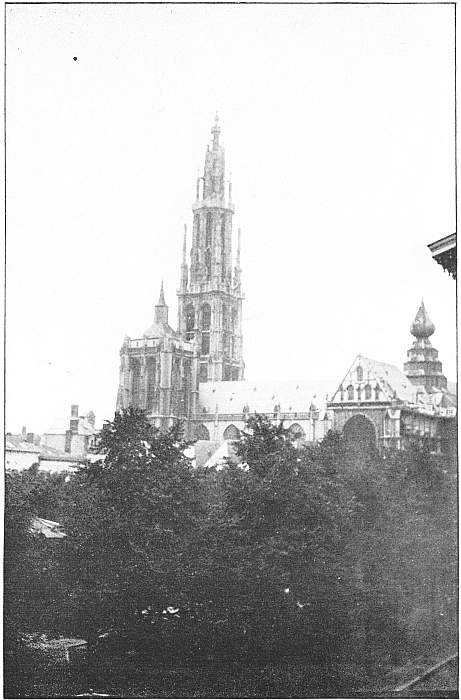
“The largest and handsomest Gothic church in the Netherlands.” (See page 107.)
That the Cathedral is the first attraction for the tourist goes without saying, and those are well repaid who climb far up into its magnificent spire, even beyond the great group of bells that captivate the soul with their wonderful sweetness and melody. At a height of four hundred feet, the vast prospect spread out before one is indescribably beautiful. This Cathedral, the largest and handsomest Gothic church in the Netherlands, was begun in 1352, but was not completed until about 1616. The chimes consist of ninety-nine bells, the smallest of which is only fifteen inches in circumference, while the largest weighs eight tons. The chimes are rung every fifteen minutes, a musical reminder that the soul of man, no matter what his occupation, should be elevated by continual aspiration toward the living God. Oh, these beautiful chimes! What wondrous harmony they peal forth, and what a multitude of loving thoughts they gather up and waft hourly to the very gates of heaven!
A stranger in the town, and a traveller, made the remark to me that these bells must be very annoying, ringing at such short intervals, and especially at night. “It is worse than a swarm of mosquitoes,” he said, “for one can escape the attentions of these insects by placing a net over his couch, but the piercing sounds of these monstrous bells penetrate one like the chill of zero weather.” This reminded me of a man who shared our compartment in one of the French railway cars, who interrupted my enthusiastic remarks on Westminster Abbey, its exquisite associations, and the sacred atmosphere which impressed all who came within its hallowed walls, by an eager question regarding the luncheon to be served an hour later.
The interior of the Cathedral impresses one with its grand simplicity, and the long vistas of its six aisles present a fine effect. Here is Rubens’ famous masterpiece, the Descent from the Cross, and his earlier painting, the Elevation of the Cross, both magnificent works, remarkable for the easy and natural attitudes of the figures. The high altarpiece is an Assumption by Rubens, in which the Virgin is pictured in the clouds surrounded by a heavenly choir, with the apostles and other figures below.
There are many other paintings here; also stained glass windows, both ancient and modern. The tower is an open structure of beautiful and elaborate design, from which lovely views may be seen during the journey to its summit.
Another interesting landmark is the “Steen” originally forming part of the Castle of Antwerp, but in 1549 Charles V. made it over to the burghers of Antwerp. It was afterward the seat of the Spanish Inquisition. It is now occupied by the Museum van Oudheden, a collection of ancient and curious relics from the Roman times till the eighteenth century. Within this building one may view the identical instruments of torture so mercilessly used by the Spanish inquisitors in the name of religion. It would not be difficult to photograph these diabolical inventions, for many of them are quite free from the surrounding objects, and not encased. In this collection we see also specimens of antique furniture, and a variety of ornaments, coins, costumes, tapestry curtains, ancient prints and engravings, and many other objects well worthy of observation.
In Antwerp we have the opportunity of seeing some exquisite laces and embroideries. A visit to one of the many establishments here cannot fail to interest the stranger. At one of the shops we are conducted to a room in which a dozen girls are at work upon a delicate piece of lace. They have been engaged upon this masterpiece for about three months, and the proprietor tells us that as much more time will be required to finish it. The design is a huge web, in the centre of which is the sly spider apparently watching the victims who have strayed beyond the line of safety. A number of handsome and rare specimens of this valuable handwork are exhibited in the shop window, and one’s desire to possess them may be satisfied by a moderate expenditure of money.
Antwerp is the city of Rubens. We find his tomb in the beautiful church of St. Jacques, rich in carvings and noble paintings, not far from the fine altarpiece painted by his hand. He lies in the Rubens Chapel, and here too are monuments of two of his descendants. The house in which the illustrious artist died stands in a street named for him, and in the Place Verte, formerly the churchyard of the Cathedral, stands a bronze statue of Rubens, thirteen feet in height upon a pedestal twenty feet high. At the feet of the master lie scrolls and books, also brushes, palette and hat; allusions to the talented diplomatist and statesman, as well as to the painter.
One need not feel alarmed as to his expenses in this charming old town, for comfortable accommodations and good board may be enjoyed at less than moderate rates. I love this dear city, not only for its magnificent Cathedral, its rare paintings, its picturesque surroundings; but also for the remarkable hospitality of its people, their genial manner, their smiling faces. Their candor and honesty win the admiration and the heart of the tourist, and the stranger is quickly at home, and able to enjoy most fully the many attractions which the place affords.
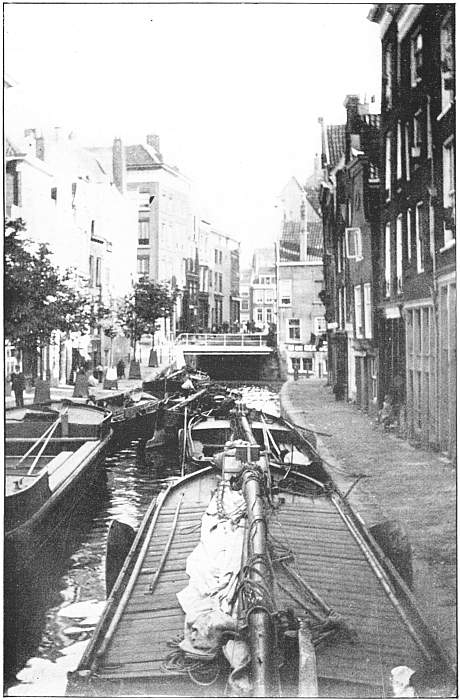
“The place is intersected everywhere by canals.” (See page 113.)
But the time has come to bid it adieu; we take the train and in two hours find ourselves in the ever quaint and picturesque town of Rotterdam, fitly named the “City of Windmills.”
Comfortable quarters may be found here at the Maas Hotel. Rotterdam, whose population is something over two hundred thousand, is the second city in commercial importance in Holland. Among its numerous attractions are art galleries, parks, gardens, the markets, bridges and canals, without mentioning the many windmills which wave their arms in blessing over the city. The place is intersected everywhere by canals, all deep enough for the passage of heavily laden ships, and with such names as the Oude Haven, Scheepmakershaven, Leuvehaven, Nieuwe Haven, Wynhaven, Blaak, and Haringvliet.
Our hotel is situated upon the bank of the Maas River, and our windows overlook this body of water, which is in reality a highway. Instead of wagons drawn by strong muscular horses, however, barges, schooners, sail boats, and every kind of small craft, overflowing with fruits, vegetables and other produce, traverse the river as well as the canals. Looking over these watery roads, the mind is confused by the hundreds of boats which seem inextricably mingled in one great mass, and appear to form a blockade as far as the eye can reach. Rotterdam might fitly add to its title of “City of Windmills,” that of the “City of Canals.” Houses, stores and other buildings are built directly upon the banks, and in fact, the foundations of these form the sides of the canals. In many cases the balconies of residences overhang the water, and passages are made beneath, by means of which produce, freight and other articles are conveyed to and from the buildings by boats, much as the wagons deliver goods in our cities from the streets to the houses.
All these novel sights impress the visitor with the great difference between the manners and customs of this nation and our own; the result of the peculiar environment of the two countries. A stroll about the city affords abundant opportunity for interesting observations. Here one sees hundreds of Dutch women in their costly headgear of gold and silver, heirlooms of many generations. These head ornaments sometimes cover the entire scalp, and have curious filigree additions extending over the ears and temples. The head is first covered with a scrupulously clean and beautiful lace cap, upon which the gold or silver ornament is placed. These heirlooms are valued beyond all price, and I have handled some which are two hundred years old, and which are held as sacred charges to be transmitted to posterity.
As we traverse the streets of this quaint city, we feel indeed that fashion has stood still here for many years. The custom is universal throughout Holland for the natives of the different provinces, as Volendam, Marken, Brock, etc., to wear in public, and especially when travelling, the costume peculiar to their own province, and it is by no means uncommon to see many odd and quaintly dressed women in close proximity to one another, each one representing by some peculiarity, a different province or section of the country. For instance; when I see the skirt of blue homespun made in full folds, and worn with a jacket of striped red and white, and the peaked bonnet trimmed with red and white tape, I know that the wearer is a native of the island of Marken. These various costumes, all gay and picturesque, are the source of great pleasure to the stranger, and add new life and interest to his travels in this country.
Here also we notice the huge, powerful draught horses, with their massive hoofs and shaggy legs, drawing strange looking wagons laden with curious boxes and furniture. The wooden shoes worn by the working classes also attract our attention and many other novel sights and customs give us the impression that we have chartered one of Jules Verne’s original conveyances and wandered off to a country not located on this earthly planet.