Front matter (continued 3)
Reading edition
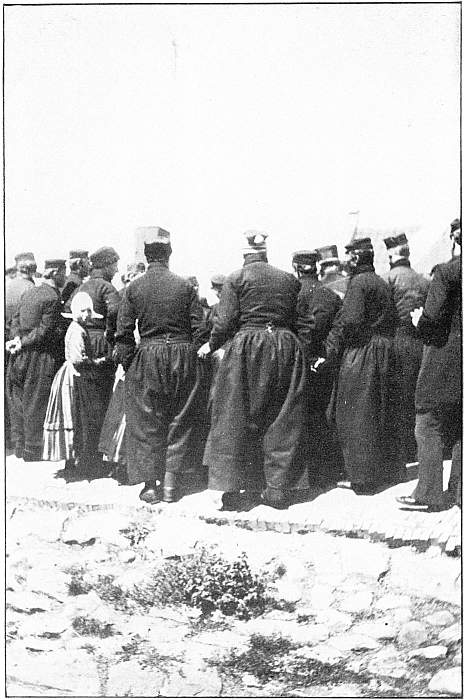
“As the congregation draws nearer, we halt before the foremost group.” (See page 256.)
Meanwhile I stand before them watching the varying expressions and wondering if there is any prospect of obtaining my desire. At last one man says hesitatingly that he has an old suit at home that he no longer wears, and if we will accompany him to his house, a few doors away, he will show it to us. We turn and follow him, and a score or more of the people follow us. What must an old suit look like in this thrifty community where the men and women never discard anything until it is utterly hopeless as regards service?
A suit which one of these is willing to dispose of must indeed be a peculiar object. I wonder if it has that “ancient and fish-like smell,” described by Shakespeare. The fates forbid! Perhaps it is a relic of a beloved father or grandfather, handed down as a family heirloom. We enter the house, still surrounded by curious spectators, and our obliging friend takes from a closet a carefully-wrapped bundle, which upon being opened discloses a worn and aged suit: unfortunately its age does not add to its beauty or value as in the cases of old masterpieces in art, as a painting by Murillo or Rembrandt. The clothes are old, dirty, and faded, and only fit for the receptacle of the ragman, but they do not fail to serve their purpose, for while this young athlete holds them out, with an expression of pride and pleasure, a sudden thought fills me with hope. The suit which this young man wears is of the highest type of the Volendam fashion, and is quite new. The flannel blouse with its gay undervest showing at the chest, and the baggy brown velveteen trousers form an ideal specimen of the costume of these people. I must have this suit. No other will answer my purpose. Without preliminaries, I boldly propose to him to sell me the suit he wears, and put on the old one until he can procure another. His countenance falls, and with a look of positive fear, he draws back, shaking his head and repeating: “Nee. Nee. Nee.”
Then he moves farther away, as though in terror lest I then and there strip him of his garments. He cannot sell the suit, he says, especially as the wedding festivities of one of his neighbors are so soon to take place. In a corner of the room, quietly smoking a clay pipe, sits the old father, watching without a word the little drama taking place before him. As the boy reiterates his refusal, the man talks to him in expostulatory tones, and as we learn, says: “The gentleman from America is a good man. Let him have the suit: you shall have another.” At this advice the son, though looking rather sulky, yields, and withdrawing to the adjoining room, exchanges the suit he wears for the old one, and returns with the desire of my heart rolled up and wrapped in a clean paper. The evidence of good will on the part of the parent, and the obedience of the son charm me even more than the possession of the coveted garments. The boy is a noble lad. As we are about leaving, I suddenly espy the silver coin buttons which are such an ornament to the dress, and which are considered a mark of distinction, when worn by old or young. They are rare and valuable decorations, being buttons made of coins, and held together by a link, as our sleeve-buttons. They are worn in the bands of the trousers and shirts, serving the purpose of suspenders.
The coins are brilliantly polished and present a striking appearance. They are generally heirlooms, and some of them are of very ancient date.
In general they are cherished as treasures beyond price: these worn by the boy are exceedingly rare, and are more than a hundred years old, having belonged to his great-grandfather. The outer and larger coins are three guilder pieces, the smaller ones one guilder.
To ask for these is indeed the “last straw,” and when the father requests his son to put them in the bundle with the clothing, he bursts into tears, and his hands tremble as he gives them to me.
For this final test of obedience I thank him heartily, and bestow upon him a liberal reward for the sacrifice, together with much praise. As he looks at the guilders with which I have filled his hand, his countenance brightens, and the rainfall is changed into radiant sunshine. The neighbors look on this scene with surprise, and many of them declare that this is a very uncommon occurrence in Volendam, as they have never known any one heretofore to dispose of family heirlooms to a foreigner. It is unnecessary to say that I also value the coins beyond price, and treasure them for their association, and the interesting picture which they never fail to bring before me.
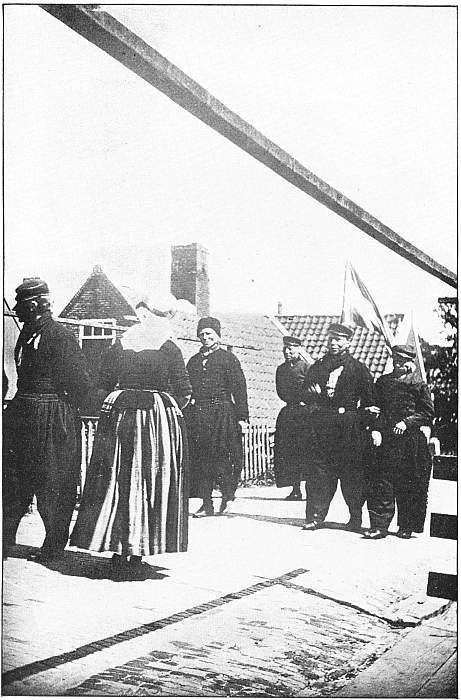
“Every man is a volume if you know how to read him.” (See page 256.)
There is but one hotel in the place, and thither we resort. It is a small building without pretensions, containing about ten rooms, of no great size, but clean and comfortable. We learn that board and accommodations may be had here for four guilders (one dollar) a day. This hotel has entertained artists from all parts of the world. The good-natured landlord will do everything in his power to make his guests comfortable. In the general sitting-room or parlor, there is abundant evidence that these efforts have been appreciated in the beautiful paintings presented to him by some of the most famous artists of our day. He is a loyal upholder of art and artists. His daughter, a fresh looking maiden, is so much pleased when I say that I too, am an artist and photographer, that she insists upon taking me up to the third floor to see the fine view from the windows which overlook the Zuyder Zee. She also shows me a room which was fitted up for a lady artist from New York. Here is an unfinished picture upon the easel, of an old Volendam woman, in her fancy cap and bright colored homespun costume.
This secluded spot offers many attractions for both brush and camera in interesting studies of figures and landscape, as well as charming water scenes. We would gladly spend a longer time amid these delightful pictures, but it is impossible, so we take our departure amid a hundred good wishes, and as we drive away, the inhabitants who have gathered from all parts of the town to see the queer Americans, call after us: “Goeden dag,” and “Tot weerziens,” (Until we meet again). A dozen or more children run by the side of the carriage shouting and laughing for a considerable distance. And so we bid farewell to a hearty and attractive people and their quaint surroundings.
Let us take a somewhat hasty glance at Cologne, the oldest city on the Rhine, and one of the largest towns in the Rhenish Province of Prussia. We cannot afford to miss this town, were it only on account of the great Cathedral whose lofty towers rise heavenward to a height of five hundred and twelve feet. How one longs to find himself within these sacred walls, to stand and gaze upon the wondrous arches, pillars, and dome, the stained glass and statues, the frescoes and carving, the work of an endless succession of artists and artisans. Next to St. Peter’s at Rome, this Cathedral is the largest church in the world. It stands upon the old Roman camping ground, and more than six centuries have passed since its foundations were laid. The name of its architect is unknown, and even the original designs have been forgotten. Its interior is four hundred and thirty feet long and one hundred and forty feet broad. The portion appropriated to divine service covers an area of seventy thousand square feet. It is useless to attempt to describe this vast structure whose buttresses, turrets, gargoyles, canopies and tracery are innumerable and bewildering. The Gothic arches and countless pillars form a grand perspective. There are seven chapels which present a wealth of paintings, and relics. In the Chapel of the Three Magi is a marvellous casket of crystal, whose cover is set with precious stones, which is said to contain the skulls of Caspar, Melchior and Balthazar, the three Wise Men from the East who followed the star to the cradle of the infant Christ.
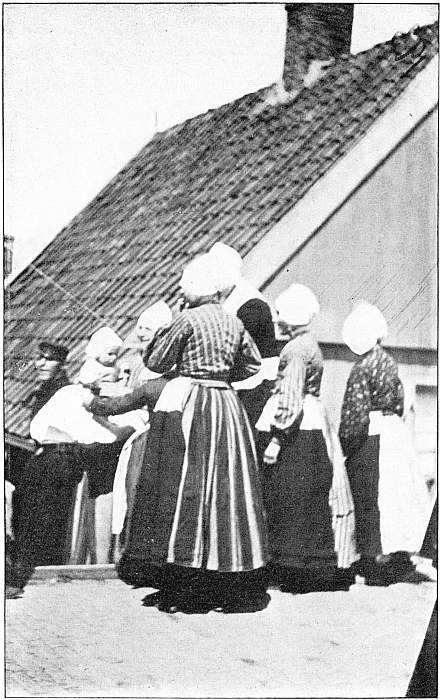
“Goeden dag. Tot weerziens.” (See page 266.)
In the great treasury of the Cathedral are untold treasures. Here are silver censers, paintings set in diamonds, shrines of silver, and rare and priceless relics of every description, besides gold and silver chalices, fonts, and other church vessels, and a collection of magnificent vestments.
Many are the vicissitudes through which this wonderful structure has passed, since its commencement in 1248. At times it seemed abandoned to ruin, then again the work was taken up and vast sums of money contributed, and the masterpiece of Gothic architecture was carried on toward completion, until once more the money was exhausted. It seems as though the old legend of the architect who sold his soul to the devil in exchange for the plan of the edifice must have some foundation, for tradition relates that Satan was finally outwitted by the architect, and in revenge vowed that the Cathedral should never be finished, and the architect’s name be forgotten. Immense fortunes have been expended upon it by monarchs and others of the faithful. The great southern portal alone cost half a million dollars: the bells in the south tower, the largest of which was cast in 1874, from the metal of French guns, weighs twenty-five tons. The combined efforts of twenty-eight ringers are required to set it in motion. The next two in point of size, cast in 1447 and 1448, weigh respectively eleven and six tons. The magnificent stained glass windows were contributed by famous and royal donors, such as the Emperor Frederick III., Archbishop Von Daun, Archbishop Von Hessen, King Lewis I. of Bavaria, Emperor William I., and many others. A number of these were executed as far back as 1508.
Few structures can compete with this in beauty, grace and elegance of form. How solemn is the atmosphere within these ancient walls! How impressive the picture of this apparently boundless interior! In one of the great pillars is a flight of one hundred steps, which leads to a gallery extending across the transept, and still nearly forty steps higher one reaches the gallery which makes the tour of the whole Cathedral, and upon this one has a beautiful view of the city of Cologne, the Rhine and the surrounding country. Within the church there is a corresponding gallery, from which the visitor may observe the interior decorations, and from the loftiest gallery of all, there is a vast and delightful panorama which includes river and country as far as the eye can see. What can be more beautiful than this scene? Where can one find a grander, more solemn atmosphere than within these walls where the spirits and the hands of men have worked for ages? Where can he experience more lofty aspirations toward
“The glorious Author of the universe Who reins the minds, gives the vast ocean bounds, And circumscribes the floating worlds their rounds”?
The city of Cologne was founded by the Ubii at the time when they were compelled by Agrippa to migrate from the right to the left bank of the Rhine, (B. C. 38). In A. D. 51, Agrippina, daughter of Germanicus, and mother of Nero, founded here a colony of Roman veterans which at first was called Colonia Agrippinensis, and afterward Colonia Claudia Agrippina. In 308 Constantine the Great began a stone bridge over the Rhine to Deutz. From the end of the fifth century Cologne belonged to the Franks and was long occupied by the Ripuarian kings. Charlemagne raised the bishopric which had been founded here in the fourth century to an archbishopric, the first archbishop being the imperial chaplain Hildebold who built the oldest cathedral church, and presented to it a valuable library which still exists.
“The noble city has passed through many vicissitudes, and it was not until after 1815 under Prussian rule that it began to enjoy a degree of permanent prosperity. The rapid progress of its steamboat and railway systems, and the enterprise of the citizens, many of whom possess great wealth, have combined to make Cologne the centre of the Rhenish trade, and one of the most considerable commercial cities in Germany.”
The town is built with long narrow streets curving in semicircles toward the river. Its sidewalks have the peculiarity of frequently dwindling away until only a few feet in width. The great Cathedral tower may be seen for miles, reaching far above the surrounding buildings. Cologne is a city of legends and relics: old and historic buildings dating back many centuries are scattered in all directions, and here the visionary, the lover of myth and legend, can find abundant food for his imagination. The great and valued possessions of the city are the bones of the eleven thousand virgins. This is the legend: Fourteen hundred years ago, St. Ursula and eleven thousand virgins went on a pilgrimage to Rome, and returning were all slain by the Huns. Their bones were gathered together and brought to Cologne, where they were buried, and later the church of St. Ursula, now nearly nine hundred years old, was built over their tomb. Within this church the bones of the virgins are enclosed in stone caskets, with apertures through which they may be seen. The skulls are covered with needlework and ornamented with pearls and precious stones.
Among other relics, is also to be found here the alabaster vase or rather one of the vases, in which the Saviour turned the water into wine at the marriage in Cana. The vase or jar is evidently a very ancient article: it is much cracked, and one handle is broken off. There are many points of interest in this old city, for here are museums, gardens, galleries and churches, and always the picturesque river with its countless views and pleasure trips.
If one is weary of these legendary stories, or even of sightseeing itself, let him rest with me in one of the many public gardens, listening to the charming music of a good orchestra.
There are skilled musicians in these gardens, and their selections are always well rendered. No loud or idle conversation is indulged in during these recitals. Should any such breach of good manners occur, the transgressors are requested to observe the rule of the garden, and if the offence is repeated, they are ejected from the premises. The Germans, being such lovers of good music, tolerate no other in their gardens. There is no admission fee, but the expenses are supposed to be met by the sale of beer, wine, pretzels and Frankfurt sausages.
Before leaving Cologne I must not forget to mention the refreshing perfume which has made this city famous all over the world. The celebrated Eau de Cologne is said to have been invented by Jean Antoine Marie Farina of Domodossola in the year 1709. One could almost bathe in the perfume here for the money it would cost to filter our muddy Philadelphia water. There is an enormous quantity of it manufactured, and almost every store seems to have it for sale.
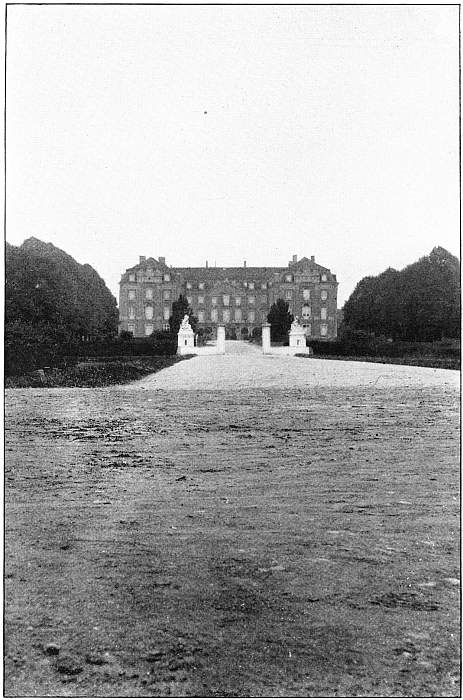
“Palace of Brühl.” (See page 277.)
A short distance from Cologne, or Köln as the Germans call it, is the almost forsaken station of Brühl. I would advise the tourist to alight here, and take a close view of the imperial palace known as the Palace of Brühl, a handsome building erected about the year 1725. As we advance toward the beautiful and spacious grounds, it is not difficult to imagine the magnificent structure looming up in the distance as the home of royalty. The approach to the palace is studded with marble statues, and the palace itself is a classic example of the French and German rococo style of architecture; from it radiate many lovely walks and bowery avenues which are adorned with fine statuary. Here too are velvet lawns, noble trees and glowing flower beds, and should one wish to view the interior of this elegant palace, he will find that some of the rooms are open to visitors.
Our stay within is necessarily brief. Retracing our steps to the station, we take the train, and are carried swiftly toward the old town of Bonn.
Along the Banks of the Rhine.
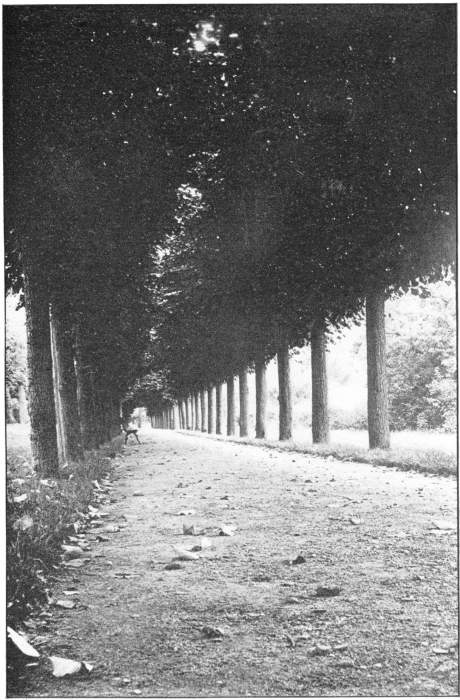
“Lovely walks and bowery avenues.” (See page 277.)
Along the Banks of the Rhine.
Bonn—The Birthplace of Beethoven—The Museum—Monument—A Famous Restaurant—College Students—Beer Mugs—Special Tables—Affairs of Honor—Königswinter—Magnificent Views—Drachenfels—The Castle—The Dombruch—Siegfried and the Dragon—A Desecrated Ruin—The Splendor of the Mountains—Many Visitors—View from the Summit—The Students’ Chorus—German Life—A German Breakfast—The Camera—Old Castles and Lofty Mountains—Legends of the Rhine—The Waters of the Rhine—Vineyards.

HIS town like its sister cities is of ancient foundation, having been one of the first Roman fortresses on the Rhine. It is the seat of a university which attracts students from all parts of the world. It is a prosperous looking place with pleasant villas on the river banks, and ancient picturesque houses. There are lovely shaded walks in the public gardens, and a fine view from the Alte Zoll, but the chief interest of the town for us lies in the fact that it is the birthplace of Beethoven. In a small unpretentious house the great musician was born in 1770, and here were composed many of those wonderful harmonies which have thrilled the souls of lovers of music all over the world. The room in which this noble genius first saw the light of day is in the top of the house, a garret ten feet by twelve in size, and contains no furniture whatever: nor is it necessary to remind those who enter it, by aught save the wreath of green which lies peacefully upon the floor, that the spirit whose earthly tabernacle dwelt here breathed forth the fire of heaven.
“Creative genius. From thy hand What shapes of order, beauty rise, Where waves thy potent, mystic wand, To people ocean, earth and skies.”
In an adjoining room are stored some pieces of furniture which belonged to Beethoven, and the piano used by him in the composition of some of his most famous sonatas. Some of the ladies of our party are permitted to play upon this sacred instrument. Do they hope to be inspired by the magic spell of the master’s touch still lingering among the keys? The dwelling has been purchased by lovers of the celebrated composer, and fitted up as a Beethoven Museum. Not far off stands the statue of the artist and the monument dedicated to him.
Before leaving Bonn, we visit the famous restaurant which is the nightly resort of the students during the college term. The spacious rooms composing this café communicate with each other by a wide and lofty doorway. The furniture consists of bare wooden tables, a long counter, and dozens of shabby chairs which look as if they have seen hard service. The corpulent and jovial proprietor informs us that these rooms are filled to overflowing with both gay and serious students every night in the week, and that here, notwithstanding the ofttimes boisterous merriment, questions of grave import are often discussed, together with all the current topics of interest; and that speeches are made brilliant enough for publication in the daily papers. Here the young orator first tests his powers, and in all his future career, he will find no more critical audience than this composed of his fellow-students. Here too are nights given up to fun and jollity, to college songs and wild and reckless mirth, when there is not a serious countenance among the crowd.
“He cannot try to speak with gravity, But one perceives he wags an idle tongue; He cannot try to look demure, but spite Of all he does he shows a laugher’s cheek; He cannot e’en essay to walk sedate, But in his very gait one sees a jest That’s ready to break out in spite of all His seeming.”
Hundreds of voices make the roof ring with tuneful harmony: choruses, glees and comic ballads follow each other, interspersed with jokes and puffs at pipes and sips of beer, for the German student is a
“Rare compound of oddity, frolic and fun, To relish a joke and rejoice at a pun.”
Pounds of poor tobacco are smoked, and gallons of good beer consumed at these gatherings, and the landlord is always on the side of the boys when there is any trouble, and rejoices in all their collegiate honors and their success in every other line.
Upon the shelves above the tables are long rows of individual beer mugs, with the owners’ names or crests conspicuously painted in gay colors upon them. These mugs vary in capacity from a pint to two quarts, and the host assures me gravely that many of the students drain even the largest ones nine or ten times in the course of an evening. I ponder, as he speaks, upon the wonderful power of expansion of the human stomach which performs this feat.
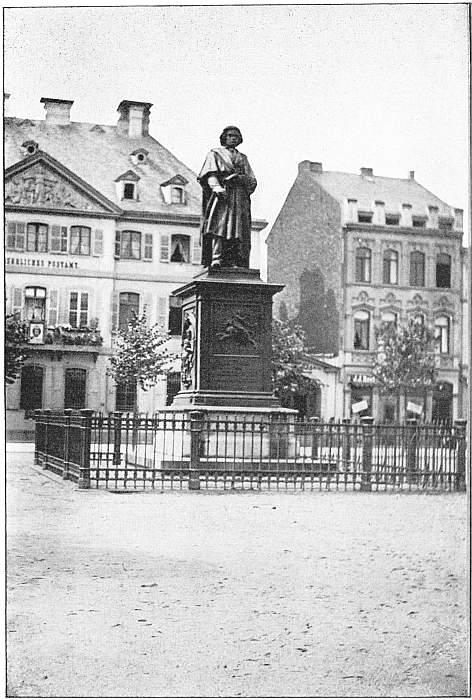
“Not far off stands the statue of the artist.” (See page 284.)
As a natural consequence of this enormous appetite for beer, one sees in the restaurants in many of the German cities an especial table constructed with a deep semicircular curve in the side, which allows the corpulent guest to drink his favorite beverage in comfortable proximity to the bottle. Such as these must have been in Shakespeare’s mind, when he wrote: “He was a man of an unbounded stomach.”
The deep cuts and scars upon the faces of many of the students, are matters of great pride with them, as evidences of the number of “affairs of honor” in which they have been engaged. They look with scorn upon the fellow collegian whose countenance does not display one or more of these signs of bloody combat, and are always ready to seize an occasion of this kind for the exhibition of their bravery or their skill at arms. Sometimes these duels are a result of the silliest arguments, at others they are sought by deliberate insult given by the one who wishes to fight. A glance is sometimes sufficient for a sanguinary meeting.
Will they ever learn that no stain can ever be washed out with blood, no honor redeemed by the sword, no moral bravery displayed by an encounter of this kind? It is falling to the level of the brute, with perhaps a little more skill evinced in the choice of the weapons of warfare. It cannot but detract from the dignity of the human being, and this is true to a far greater extent in the case of those who entertain themselves by witnessing such unnatural sports as prize fights, cock fights, and most degrading of all, but thank heaven a rare sight in civilized countries, the bull fight;—all relics of barbarism.
Let us leave this unpleasant subject, however, and allow ourselves to be spirited away to a veritable fairy land of beauty, and quaint legendary associations. The little town of Königswinter nestles at the foot of the Seven Mountains, from which there are innumerable views of the Rhine and the surrounding country. A halo of romance surrounds this region, and in the many excursions from this point, the lover of the weird and visionary will find his every step accompanied by imaginary maidens of rare grace and beauty, brave knights, crafty priests, wild huntsmen, cruel dragons, super-human heroes, and all the wonderful personages of legendary lore. The town is a thriving, modern looking place of about thirty-five hundred inhabitants, excluding the floating population of tourists who throng the hotels and scatter themselves among the private families.
We arrive here early in the afternoon, and establish ourselves in a comfortable and attractive hotel. The day is clear and pleasant, and desiring to make good use of the hours of daylight before us, we determine to make the ascent of the Drachenfels. There are a number of different routes or paths, by which one may reach the summit of this mountain on foot; or, should the tourist prefer to ride, he can use the Mountain Railway which approaches the top in a line almost straight. Protected by stout shoes, carrying wraps, and armed with long and strong wooden staffs, we walk slowly along the mountain road, pausing at intervals to gaze upon the beautiful scenes which surround us in every direction. The great peak known as the Drachenfels or Dragon rock, in which from the river a vast cavern may be seen, owes its name to the numerous legends which are connected with it. In the cave, it is said, lived a terrible monster who daily demanded of the people the sacrifice of a young maiden, who was bound and decorated with flowers, and placed near the entrance to his lair. Siegfried slew the dragon and by bathing in his blood, became invulnerable. The maiden whose life he thus saved was Hildegarde, the beautiful daughter of the Lord of Drachenfels, whom he afterward married and bore to the castle whose crumbling and picturesque ruins seem to cling to the lofty crag, fifteen hundred feet above the Rhine. This castle was once a mighty stronghold of the robber chieftains; its foundation is associated with Arnold, Archbishop of Cologne at the beginning of the twelfth century, who in 1149 bestowed it upon the Cassius Monastery at Bonn. It was held as a fief by the counts of the castle.
Henry, Count of Drachenfels, furnished the chapter of the Cathedral of Cologne with the stone for its construction from a quarry which from this fact still bears the name of Dombruch, or cathedral quarry. In the Thirty Years’ War the half-ruined castle was occupied by the Swedes, but was besieged and taken from them by Duke Ferdinand of Bavaria, Elector of Cologne, who completed its destruction.
The cliff is now surmounted by a beautiful new castle, the Drachenburg, built in 1883 for the Baron von Sarter. It is in the Gothic style, and is elaborately decorated with frescoes and stained glass. The upper part of the mountain is covered with trees below the cliff, the lower part with grapevines, while along the banks of the Rhine at its foot are picturesque cottages, nestling among trees and vines. The Drachenfels is the loftiest of the Seven Mountains, and its summit commands one of the finest prospects on the Rhine. In the ruins of the old castle, ingenious and progressive man has seen fit to ignore sentiment, and thrust a modern restaurant, where in spite of his shocked sensibilities, the weary traveller may in return for German marks, rest and refresh himself with sparkling wine which is famous for its fine quality and flavor, while the cool breezes fan his brow and soothe his excited brain.
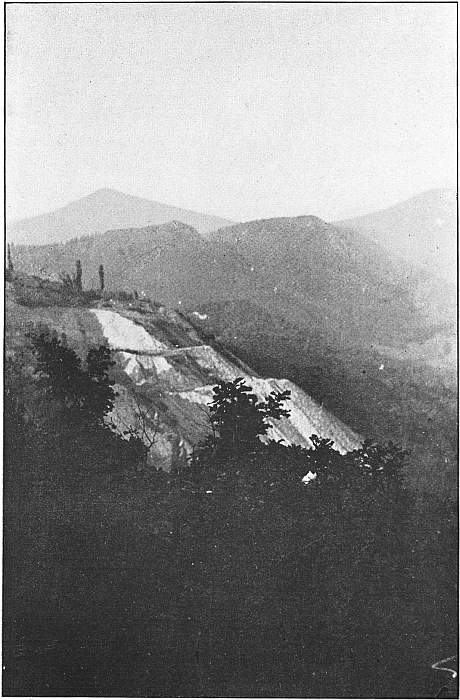
“The great peak known as the Drachenfels, or Dragon Rock.” (See page 291.)
One lingers long, dazzled by the splendor of this superb view. Mountains and valley, river and islands unite in a glorious picture which entrances the soul, and thrills the heart with gladness; while the pure, bracing mountain air, laden with the perfume of the grape, fills the lungs with “a perpetual feast of nectar’s sweets.”
Many tourists surround us, and we hear a perfect babel of tongues: French, English, German and other languages greet our ears, assuring us that visitors from all parts of the world are enjoying this magnificent panorama with us.
What a pity the camera will not encompass the wonderful scene.
“The castled crag of Drachenfels Frowns o’er the wide and winding Rhine, Whose breast of waters broadly swells Between the banks which bear the vine; And hills all riched with blossom’d trees, And fields which promise corn and wine; And scatter’d cities crowning these, Whose fair white walls along them shine, Have strew’d a scene which I should see, With double joy wert thou with me.”
Several of the Siebengebirge are visible toward the east, the basaltic heights sloping toward the Rhine. Just below are Rhöndorf, Honnef, Rheinbreitbach, Unkel, and Erpel; on the left bank of the river are Remagen and the Gothic church on the Apollinarisberg, with the heights of the Eifel and the ruin of Olbrück Castle on a height of 1,550 feet. In the neighborhood are Oberwinter, the islands of Grafenwerth and Nonnenworth and the beautiful ruins of Rolandseck with its surrounding villas and gardens. To the right, one may behold Kreuzberg, Bonn and even the city of Cologne in the distance.
It seems as though one could gaze upon this scene of grandeur and beauty forever. As twilight falls, the picture receives a new and entrancing sublimity. “The weary sun hath made a golden set,” and silently the sparkling stars appear, one by one, while the deepening shadows blend the scene into a vast harmonious whole which seems to draw the soul up to the very threshold of heaven.
We descend the mountain rather silently, unwilling to break the impression made by our journey, and slowly through the gloom make our way back to the hotel.
While sitting upon the porch in the evening, surrounded by the majestic watch towers of the Rhine, and expatiating on the pleasures of the day, we suddenly hear a rich full chorus, harmoniously sung by at least one hundred male and female voices. The singers are invisible, and the notes seem to float out from one of the neighboring mountain caves. We all listen with delight to the sounds, which now approaching nearer, convince us that the singers are not the denizens of another world, but are beings of flesh and blood like ourselves. In the distance we can discern a procession of gay and jovial students with their sweethearts at their sides. The young men are carrying lighted torches and lanterns which illuminate them and the road, and are merrily singing the popular glees and college songs as they wend their way to the boat landing close by.
The party is returning from a German students’ picnic, and as they board the little steamer, which immediately leaves her moorings, the air is rent by cheer after cheer, and we hear the gay laughter and happy voices long after the boat has disappeared from our eyes down the silent flowing river. Such is the German student life, and such is the character of the German people: not averse to pleasure, sociable, jovial, kind and happy.
We rise early this morning, and partake of a good German breakfast; and of what do you suppose a good German breakfast consists? Dishes of greasy sausage or bacon swimming in its own gravy, kale or saurkraut, onions and hot sauces, potatoes soaked in lard; black bread which has also been soaked in lard to save the expense of butter: and all this washed down with innumerable mugs of beer or Rhine wine, with a “thank heaven” when the unsavory repast can no longer offend our eyes or olfactories? No, my dear friend; our breakfast is a most agreeable contrast to the picture just drawn. We are served with deliciously cooked steak and chops, and the connoisseur of any nationality would not disdain these meats or the daintily prepared chicken, coffee and fresh rolls. The eggs are fresh and not underdone: one can find no fault with the butter or the sweet new milk, and it is with a feeling of great satisfaction that we rise from the table at the close of the meal, and exclaim that we have had a breakfast “fit for a king.”
A small steamer with an upper deck waits at the landing to convey passengers and a limited amount of freight from Königswinter to Bingen. It is ten o’clock when we step on this attractive little boat with our numerous wraps and parcels. We are well laden, for the camera occupies one hand, and is always ready for an unexpected shot at some picturesque figure, group, building or landscape. And I will here say to the tourist who wishes to illustrate his notes, that it is best to keep camera and sketch book handy, for you little know what fine opportunities are missed while you are stopping to unstrap your needed friend. Let your sketching outfit hang over your shoulder, and as to the camera, have one which will respond to your touch within five seconds, or you will lose many a scene of beauty which otherwise would rejoice the hearts of friends at home. We are much amused at the bulky apparatus of a friend, which is always carried neatly strapped in its box, while mine hangs over my shoulder, ready to snap instantly to a demand upon it. The difference in the result of the two methods is that I have a collection of many valuable pictures, while our friend spends most of his time strapping and unstrapping his camera. The day is chilly and threatening, and as we leave the landing, we find ourselves in a heavy fog, much to my disappointment, for I have anticipated great pleasure in seeing and photographing the many beautiful ruins of old castles and the landscape along our route. However as the mist lightens now and then, I “shoot” away here and there with as much ardor as the circumstances will allow: not idly or carelessly, as the enthusiastic amateur, reckless of plates and results, but at unquestionably fine points, such as lofty castles and picturesque mountains, half fearing sometimes that in spite of my precautions the longed-for view will prove but a blur upon my plate. It is bold indeed to attempt to capture such sublime pictures with such faulty exposures.
The country around Königswinter is extremely beautiful. Upon both sides of the Rhine rise the lofty peaks of the wooded mountains, with in almost every case a ruined castle upon the summit. How noble and defiant is the appearance of these venerable fortresses with their eventful histories and wonderful legends. Here near Remagen within full view of the river is the church dedicated to St. Apollinaris, at one time a great resort for pilgrims. It is said to be beautifully decorated with ancient and modern works of art; the view from the church tower so charmed the artist who first ornamented it that he painted his portrait upon the tower that his eyes might forever look upon the mountains and valleys and follow the winding course of the glistening river. Near the church, at the foot of the mountain, is the celebrated Apollinaris fountain, whose waters are bottled and sent to all parts of the world for their medicinal properties.
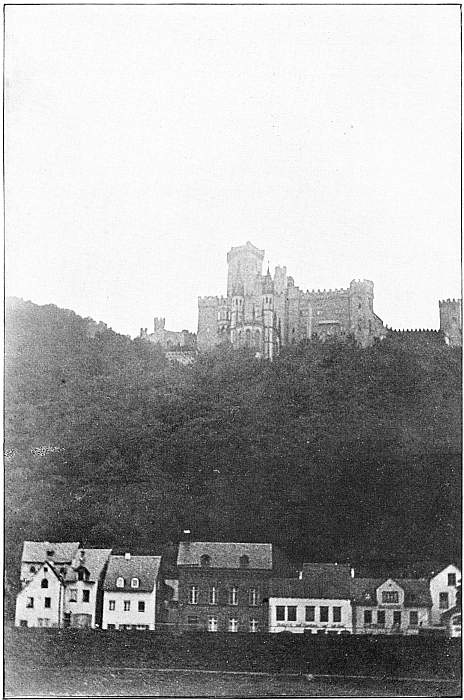
“How noble and defiant is the appearance of these venerable fortresses.” (See page 300.)
At times the blue breaks through the clouds, and then the pictures are surpassingly lovely. The castles in their sorrowful majesty are very imposing: they are generally built of stone, are of fine architectural design, and are frequently the centre of charming old gardens, or are embowered in trees and shrubbery. Here they stand year after year, looking down upon the ever youthful river. Some of them are occupied, while others are desolate ruins.
“High towers, fair temples, Strong walls, rich porches, princely palaces, All these (oh pity), now are turned to dust, And overgrown with black oblivion’s rust.”
One can hardly realize the grandeur of this scenery. Every turn of the river presents a different view: it is an ever varying kaleidoscope of natural beauty. Now we behold the mountains with their masses of foliage reaching to the very summits; now the charming village amid its vineyards, with its odd little church surrounded by picturesque frame houses with plain roofs and quaint gables. While sitting silently on deck gazing upon the old castles and ever changing scenes which border this beautiful body of water, I hear solemn tones proceeding from the belfry of an old church, and behold a little procession of mourners slowly following the hearse which is bearing the remains of some loved relative or friend to their final resting-place;—a pathetic little group walking sadly along through the drenching rain from the church to the burying ground.
One is compelled to notice here the numerous signs with huge letters emblazoned upon them, informing the passers-by that here are bottled popular waters of medicinal qualities. The tottering establishments are, I observe, close to the water’s edge, and whether or not the Rhine contributes the greater part in the composition of these famous waters is an open question. However it may be, the waters, or mineral springs, of genuine virtue or otherwise, are the source of a considerable profit in this region. Water as a beverage is seldom used by the Germans, for the light Rhine wines are to be had in perfection at a trifling cost.
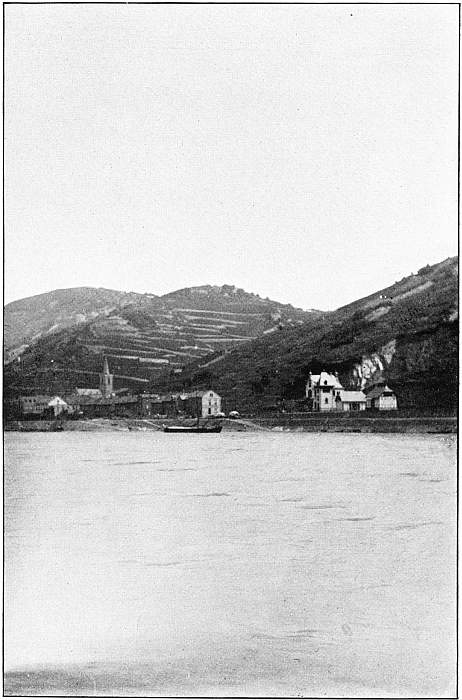
“Every turn of the river presents a different view.” (See page 303.)
We glide along, passing island and vineyard, and castle crowned height, with now and then a wide curve in the river, which looks with its smiling face to-day much as it did centuries ago when the old strongholds reared up their piles of masonry in regal splendor, and noble retinues defiled down the narrow mountain paths to the water’s edge.
“Thou, unchanged from year to year Gayly shalt play and glitter here; Amid young flowers and tender grass, Thine endless infancy shalt pass; And, singing down thy narrow glen, Shall mock the fading race of men.”
From Bingen on the Rhine to Frankfort-on-the-Main.
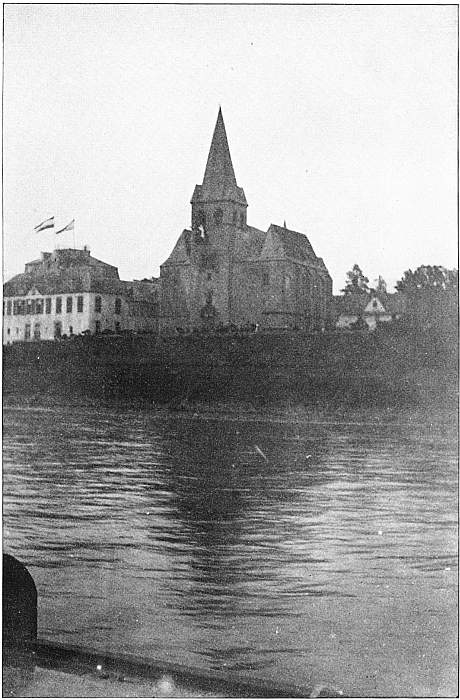
“Now we behold the little church surrounded by picturesque houses.” (See page 303.)
From Bingen on the Rhine to Frankfort-on-the-Main.
Vast Vineyards—Bingen—The Hotel—The Down Quilt—A German Maid—Taverns—The Mouse Tower—Rüdesheim—Niederwald—The Rheingau—The National Monument—The Castle of Niederburg—Wine Vaults—The River—Street Musicians—A Misunderstanding—Frankfort-on-the-Main—The Crossing of the Ford—A Free City—Monument of Goethe—History—A Convocation of Bishops—The City—Monument of Gutenberg—The House in which Rothschild was Born—Luther.

FTER leaving Königswinter, we pass vast vineyards on both sides of the Rhine, and as we approach Bingen we see them covering the whole mountain-side. Among the vines may be seen what seem like steps encircling the mountain to its very summit, but which in reality are roads or paths through the vineyard. The sturdy and prolific vines grow close to these walks. In this section of the country the greatest care is given to grape culture, hence in Bingen is to be found the finest wine made in the country. In this region are located great breweries and wine vaults extending into the mountain-sides for hundreds of feet. On arriving at Bingen we proceed at once to the Victoria Hotel, a quiet house situated at a convenient distance from both railroad station and steamboat landing. The charges are moderate, and the accommodations good.
Upon entering our sleeping apartment, I observe upon the beds huge fluffy quilts stuffed with soft feathers, and forming a pile at least two feet in thickness, which covers the entire surface from bolster to footboard. This ominous appearance fills me with strange forebodings and wondering thoughts. I say to myself: “God made the country, and man made the town, but who on earth has manufactured these monstrous counterpanes, and for what purpose?” Surely not for ornament, for they are the most unsightly objects I have ever beheld in the line of needlework, and look as if intended to smother hydrophobia patients. But as few dogs are seen hereabout, this does not seem probable. The appearance of a smiling innocent-faced chambermaid interrupts my meditations. She informs me that these great masses of feathers are used to keep the body warm at night. I conclude from this that the Germans are a cold-blooded people, since such a slaughter of the “feathery tribe” is necessary to maintain their normal temperature when in a state of repose. As night advances, I summon up courage to crawl under this fluffy mountain, and in a few moments feel as if a great loaf of freshly-baked bread is lying upon me. The heat is intense, and makes me think of “Eternal torments, baths of boiling sulphur, vicissitudes of fires.” I cast it off, and as the nights are chilly, soon find myself too cool. But I will not allow the enemy to return and overpower me, for there is much to be seen hereabout on the morrow, and I know that overgrown spread would absorb all the strength reserved for the occasion. Placing my steamer rug upon the bed, I am soon oblivious to all surroundings and happy in a land of pleasant dreams.
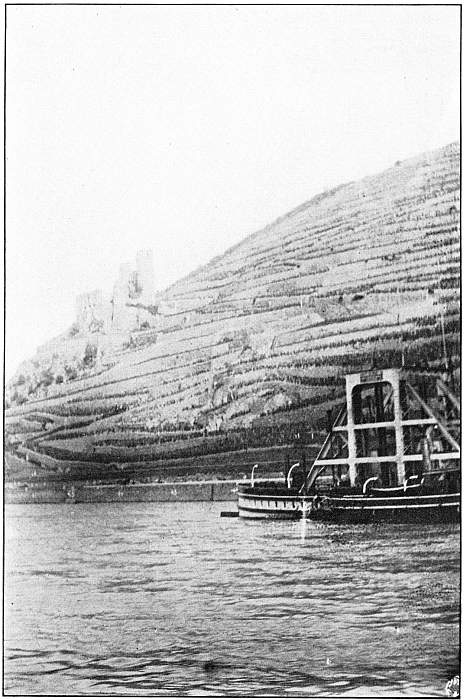
“Approaching Bingen we see vineyards covering the mountain side.” (See page 313.)
This house is indeed delightfully located in the midst of a beautiful country. Bingen is a lovely town at the entrance of the romantic Nahe valley, looking out upon mountain, glen and river on every side, upon lofty castles and vine-embowered cottages. Quaint narrow streets and ancient buildings, whose history is buried in the distant centuries, tempt the lover of the picturesque to linger in this neighborhood. The place was known to the Romans, who erected a castle here, which was destroyed by the French in 1689, but which has been restored and extended. There is a beautiful view from the tower, and footpaths ascend to it both from the Nahe and the Rhine.
Here are old historic taverns, whose floors are composed of large slabs of stone. The primitive chairs and tables are of rude workmanship, and devoid of paint or style, but heavy and strong enough to support the weary travellers who resort thither.
We wander about, revelling in nature’s enchanting pictures, and rejoicing in the mysterious atmosphere of the dense forests, which form the background. The smiling river, with its silver sheen beneath the moon, or its golden reflections of the setting sun, is ever an inspiration and a suggestion for some new trip or point of vantage. Yes, here are scenes for the artist, and pictures ready for the camera. Here too, on a quartz rock in the middle of the Rhine is the Mouse Tower which is said to owe its name to the well-known legend of the cruel Archbishop Hatto of Mayence.
In the year 914, a protracted rain ruined the harvest in this region, and a terrible famine ensued among the poor people, who in their distress finally applied to the archbishop, as his granaries were overflowing with the harvests of former years. But the hard-hearted prelate would not listen to them. At last they wearied him so with their importunities, that he bade them assemble in an empty barn, promising to meet them on a certain day and quiet their demands.
Delighted with the prospect of relief, the people gathered on the appointed day in such numbers that the barn was soon filled. The archbishop ordered his servants to fasten all the doors and windows so that none could escape, and then set fire to the building, declaring that they were as troublesome as rats, and should perish in the same way.
The following day, when the bishop entered his dining-room, he found that the rats had gnawed his recently finished portrait from the frame, and it lay in a heap of fragments on the floor. While he stood gazing at it a messenger burst into the room with the news that a great army of fierce looking rats were coming toward the castle. Without a moment’s delay the archbishop flung himself on a horse and rode rapidly away followed by thousands of rats all animated by the revengeful spirits of the starving population he had burned. He had scarcely dismounted and entered a small boat on the Rhine, when the rats fell upon his horse and devoured it. Rowing to his tower in the middle of the Rhine, he locked himself in, thinking he had escaped his voracious foes; but the rats boldly swam across the Bingerloch, and gnawed thousands of holes in the tower, through which they rushed to their victim. Southey in his ballad, thus describes their entrance into the tower:
“And in at the windows, and in at the door, And through the walls, helter-skelter they pour, And down from the ceiling, and up from the floor, From the right and the left, from behind and before, From within and without, from above and below, And all at once to the bishop they go. “They have whetted their teeth against the stones, And now they pick the bishop’s bones; They knawed the flesh from every limb, For they were sent to do judgment on him.”
This is the old legend; but now comes the searcher after truth with the information that the tower was in reality erected in the middle ages as a watch tower, and the name is derived from the old German “musen,” to spy. These ruins were again converted into a station for signalling steamers, which in descending the Rhine are required to slacken speed here when other vessels are coming up the river.
Taking one of the small steamboats which run from Bingen to the opposite bank, we land at the little town of Rüdesheim which lies at the base of the mountain. This old town is one of the most famous on the river, not only for its wines but for the legend of the beautiful Gisela, who was commanded by her father to become a nun in fulfillment of his vow made in Palestine during the crusade against the Saracens. The maiden had a lover, and finding that no entreaties could save her from her fate, Gisela leaped from a tower into the river, and the fishermen declare that her spirit still lingers about the Bingerloch, and her voice is often heard amid the rushing torrent.
The first vineyards here are said to have been planted by Charlemagne, who observed that the snow disappeared earlier from the hills behind the town than from other regions in the neighborhood. The Rüdesheimer Berg is covered with walls and arches, and terrace rises above terrace, to prevent the falling of the soil.
We drive to the top of this charming hill whose sunny slopes are clothed with vineyards. Upon the summit, as on most of the others in the neighborhood, there is a hotel with grounds prettily laid out, and here one may remain and enjoy the pure air and enchanting views, for a day, a week, or for the whole season.
Here, too, is the National Monument, in describing which I will copy the words of my guide book:
“The National Monument on the Niederwald, erected in commemoration of the unanimous rising of the people and the foundation of the new German Empire in 1870-71, stands upon a projecting spur of the hill (980 feet above the sea level; 740 feet above the Rhine), opposite Bingen, and is conspicuous far and wide. It was begun in 1877 from the designs of Professor Schilling of Dresden, and was inaugurated in 1883 in presence of Emperor William I. and numerous other German princes. The huge architectural basis is seventy-eight feet high, while the noble figure of Germania, with the imperial crown and the laurel-wreathed sword, an emblem of the unity and strength of the empire, is thirty-three feet in height. The principal relief on the side of the pedestal facing the river, symbolizes the ‘Wacht am Rhein.’ It contains portraits of King William of Prussia and other German princes and generals, together with representatives of the troops from the different parts of Germany, with the text of the famous song below; to the right and left are allegorical figures of Peace and War, while below are Rhenus and Mosella, the latter as the future guardian of the western frontier of the empire. The fine reliefs on the sides of the pedestal represent the departure and the return of the troops.”
We visit many of the most noted breweries and wine vaults in the neighborhood. Those of Herr J. Hufnagel are the largest in this section of the country. They are cut in the base of the mountain, and extend inward many hundred feet. Here the choice wines are stored, many of the enormous casks containing upwards of twenty thousand quarts. Hundreds of barrels and hogsheads are seen; in fact every nook and corner of the vault is filled, and so extensive is this subterranean apartment, that avenues are made from one part to another, and along these we walk, the guide bearing a lamp to light the way.
After visiting these great storerooms, we are invited to the hotel of the proprietor, which is close by, and on the porch we are served with an enjoyable lunch flavored with choice German wine.
There is a beautiful drive along the river bank, and if one is tired, he may stop at one of the inviting restaurants in this neighborhood, and while resting and refreshing himself, look out at the tourists and others passing along the wide airy street, or as is a common custom, he may have his luncheon served upon the porch, from which there is a delightful and extended view of the Rhine. With plenty of shade and comfortable chairs, and the beautiful river before us, how swiftly the time passes! Sometimes, in consequence of our ignorance of the language, laughable mistakes are made in the ordering of our meals, which seem to increase the jollity of both the waiters and our party. On one of these occasions, while eating our luncheon in the open air, a band of eight or ten street musicians station themselves upon the porch but a few feet from us. They are healthy, hearty-looking men, but contrary to our previous experience in this country, they play the most inharmonious airs. We endure this for a short time, then as the discordant sounds become more and more annoying, we bestow upon the leader a number of small coins, and entreat them to begone. They evidently misunderstand us, and think, from our liberal contribution, that we appreciate their efforts, for they continue their playing with increased vigor and—discord. We do not wish to leave our pleasant quarters, so resign ourselves to the situation. After repeating their repertoire, which seems endless, with profuse smiling bows and thanks they leave us at last to the peaceful enjoyment of the day.
The Niederberg is a massive rectangular castle whose three vaulted stories, belonging to the twelfth century, were joined to the remains of a structure of earlier date. It was originally the seat of the Knights of Rüdesheim, who were compelled to become vassals of the Archbishop of Mayence for brigandage.
At Rüdesheim begins the Rheingau, which is the very “vineyard” of this country. Here every foot of ground is cultivated, and the grape is the monarch of the land. All the hillsides are covered with the vines, and here in the midst of the verdure appears the picturesque villa of the planter or wine merchant. It is a rich and beautiful region.
From Bingen and Rüdesheim we go to Frankfort-on-the-Main. This town which has witnessed the coronation of many of the German emperors, is noted for its ancient legends, and to one of these it is said it owes its name. This is the story: Charlemagne, having penetrated into the forests to wage war against the Saxons, was once compelled to retreat with his brave Franks. A heavy fog lay over the country which was unknown to him. Fearing that his little army would be cut to pieces if he lingered, and unable to see more than a few feet ahead of him, Charlemagne prayed to the Lord for help and guidance. The next moment the heavy fog parted, and the emperor saw a doe leading her young through the stream. He instantly called to his men, and they forded the river in safety. The fog closed behind them and hid them from the pursuing enemy.
In commemoration of his deliverance, Charlemagne called the place Frankford (the ford of the Franks), and the city which grew up shortly afterward retained the name.
This, one of the important cities of Germany, is said to have been a small Roman military station in the first century, A. D.
It is first mentioned as Franconoford and the seat of the royal residence in 793; and the following year Charlemagne held a convocation of bishops and dignitaries of the empire here. The town attained such a degree of prosperity that in 876, at the death of Lewis the German, it was looked upon as the capital of the east Franconian Empire. On the dissolution of the empire in 1806, Frankfort was made over to the Primate of the Rhenish Confederation, and in 1810 it became the capital of the grand-duchy of Frankfort.
It was one of the four free cities of the German Confederation, and the seat of the Diet from 1815 to 1866, in which year it passed to Prussia. To-day we find it a handsome city of two hundred and twenty-nine thousand inhabitants, with beautiful streets, stately houses surrounded by lovely gardens, and fine stores, parks, monuments and many attractions for the tourist. Here are churches, theatres, libraries and museums, and an opera house which will accommodate two thousand spectators.
In the Rossmarkt stands the monument of Gutenberg, which consists of three figures, Gutenberg in the centre with Fust and Schoffer on either side, upon a large sandstone pedestal. On the frieze are portrait heads of celebrated printers, and in the niches beneath are the arms of the four towns where printing was first practiced: Mayence, Frankfort, Venice and Strassburg. Around the base are figures representing Theology, Poetry, Natural Science and Industry. This monument was erected in 1858.
This is the birthplace of Goethe, and here is the house in which the poet was born, with its inscription recording that event, (August 28, 1749). The handsome monument of Goethe, erected in 1844, twelve years after his death adorns the Goethe-Platz. The pedestal of the monument bears allegorical figures in relief in front, while on the sides are figures from the poems of the great writer.
There are twenty-three thousand Jews in Frankfort, and in the quarter to which these people are limited, we are shown the house in which the Senior Rothschild was born. It is an unassuming brick building of three stories, in good repair. As I gaze upon this modest dwelling, I think of the man who from such unpromising beginning, became the founder of the greatest financial firm the world has known.
There is a stone effigy of Luther not far from the Cathedral, in memory of a tradition that the great reformer preached a sermon here on his journey to Worms. It is true that these associations are to be found in almost every European town; but none the less are we impressed as we stand before the monuments of the great ones of the earth—the men who have left their indelible marks—“footprints on the sands of time “—which the years have no power to efface. These men must have truly lived.
“He most lives Who thinks most, feels the noblest, acts the best.”
The Cathedral of Frankford is a conspicuous edifice towering above the other buildings, quaint and picturesque in spite of a lack of harmony in many of its details. From the platform of the tower, one may have a beautiful view of the city, with its thick border of trees, and of the fields and meadows beyond along the shining waters of the Main. This Church of St. Bartholomew was founded by Lewis the German in 852, and was rebuilt in the Gothic style 1235-39. The different portions represent various periods. The tower, left unfinished in 1512, now three hundred and twelve feet high, was completed from the designs of the architect which were discovered in the municipal archives.
A Prussian Capital and a Fashionable Resort.
A Prussian Capital and a Fashionable Resort.
We Start for Berlin—Mountain and Valley—Harvesters—Villages—A Great City—Unter den Linden—Kroll Theatre and Garden—The City Streets—Ostend—A Fashionable Watering Place—The Promenade—The Kursaal—On the Beach—Bathing Machines—Studies for an Artist—The Race Course—Sunday—The Winning Horse—Fickle Dame Fortune—The English Channel—A Bureau of Information—Queenstown—An Irish Lass—The Last Stop—The End of the Journey.
HE journey from Frankfort to Berlin is through a pleasant and interesting country. For many miles we look from the car windows upon an undulating landscape: hills and valleys follow each other in rapid succession as our train dashes along at the rate of a mile a minute. Now and then we pass men and women in the fields; and now young girls with bare feet and short skirts busily raking the hay,—true pictures of “Maud Muller on a summer day.” And here is a whole group of “nut brown maids” laughing merrily at their work, while over in a corner of the field is the belle of the countryside listening shyly to the stalwart young harvester who stands on the border of the adjoining meadow.
“Her tresses loose behind Play on her neck and wanton with the wind; The rising blushes which her cheeks o’erspread Are opening roses in the lily’s bed.”
Now we pass the harvesters at rest, sitting under the green trees and hedges with their dinner pails beside them. It is a pleasant, peaceful picture. Here is a picturesque village with quaint looking houses, and a little gurgling brook in the foreground. An echo from the distant mountain answers the shrill whistle of our engine and we can see the silvery cloud of smoke that follows us wander off to the right, then fade away in misty fragments. In many of these settlements, there are shaded nooks where tables and chairs are placed, and here the villagers are sipping their beer, in happy social converse.
The young people wave their hands and caps to us as we pass, and with their bright costumes animate the lovely scenes which, although so close to each other, are of such different character. At last we reach Berlin, and our great iron horse stands puffing in the station, defying man to detect upon him any sign of exhaustion.
In this large city entertainment can be found for people of every kind and taste. The street known throughout the world as Unter-den-Linden is a splendid avenue, one hundred and sixty-five feet in width, and takes its name from the double row of linden trees with which it is ornamented. It is the busiest portion of the city, contains handsome hotels, beautiful palaces, large shops, and many fine statues of celebrated men.
The first day or two after your arrival in the city, engage a carriage and take in the general appearance of the city, its parks and suburbs; then visit the art galleries, museums, palaces and churches until the brain becomes accustomed to the bewildering array of subjects which demand attention. Stroll quietly along Unter-den-Linden stopping now and then at one of the many stores which line this beautiful avenue. At one end of this thoroughfare is the celebrated Brandenburg Gate, a sort of triumphal arch. It is a fine structure, two hundred feet wide and seventy-five feet high, supported by Doric columns. There are five entrances, the central one being reserved for the passage of members of the royal family.
The Kroll Theatre and Gardens are a popular resort for the people of Berlin. These gardens are illuminated every evening by thousands of electric lights, arranged in various designs, as flowers, harps and other graceful forms, and this illuminated scene is the centre of a gay throng of pleasure seekers, who promenade the paths, or sit about in groups listening to the music of the fine orchestras stationed at each end of the spacious grounds. The entertainment is not over until a very late hour.
There are a number of these gardens throughout the city, which are not, as may be supposed, frequented by the lower classes of the people, but by persons of every rank in society. One can hardly appreciate this scene without having passed an evening amid its light-hearted crowds. Here may be seen officers of many honors, with conspicuous gold and silver badges, mingling with the groups gathered around the tables, or sauntering up and down the garden walks, as well as the private soldier in his regimentals happily quaffing his beer with his sweetheart by his side. Title and rank here as well as elsewhere throughout Germany, are honored and respected by all classes, and the salute is gracefully made whenever one of the army or navy men meets his superior officer.
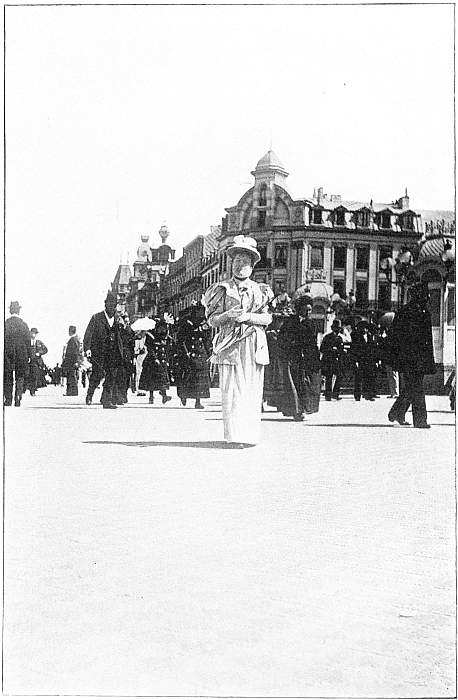
“Thousands of fashionably dressed people appear upon this promenade.” (See page 343.)
Berlin with its life and gayety, its grandeur and simplicity, its hospitality and good cheer, captivates our hearts, and we enter joyously into the many diversions it offers; as we sit among the honest and kind-hearted people, we feel the charm of their social atmosphere and wonder why other nations do not allow themselves more time for relaxation and the simple pleasures which abound here.
The Friedrichs-Strasse is the longest street in the city: it is well laid out, and contains many handsome stores. Wilhelms-Strasse is a beautiful avenue, and is considered the most aristocratic street in Berlin, as it contains the palaces of princes, ministers and other distinguished personages. A handsome square opens from this avenue, ornamented with flower-beds and fine statuary.
The museums here are called the Old Museum and the New Museum; they are connected by a passage gallery. The entrance to the Old Museum is adorned by handsome statuary, and the grand portico is beautifully painted with allegorical and mythological subjects: within, the walls are decorated with frescoes representing barbarous and civilized life, and in the great rotunda are ancient statues of gods and goddesses. From this one passes to the Gallery of Gods and Heroes, the Grecian cabinet, the Hall of the Emperors, and that of Greek, Roman and Assyrian sculptures. But it is vain to attempt a description of this vast collection of paintings, and other works of art in the short space I have to devote to the subject. To appreciate a collection of this kind, one should visit it in person.
The Thiergarten is a great park, two miles long, beautifully laid out, and containing many splendid old trees, rustic paths, and artificial ponds and streams. The grounds are ornamented with statuary, and the fine zoölogical collection is in good condition and well arranged. But we must leave fascinating Berlin, and pass on to other scenes.
Now we reach Ostend on the coast of Belgium, one of the most fashionable watering-places of Europe. During the season it attracts thousands of visitors, especially from Belgium and Holland. It was originally a fishing station, but was enlarged by Philip the Good, and fortified by the Prince of Orange in 1583. In the early part of the seventeenth century it sustained one of the most remarkable sieges on record, holding out against the Spanish for a period of three years, and finally surrendering only at the command of the States General.
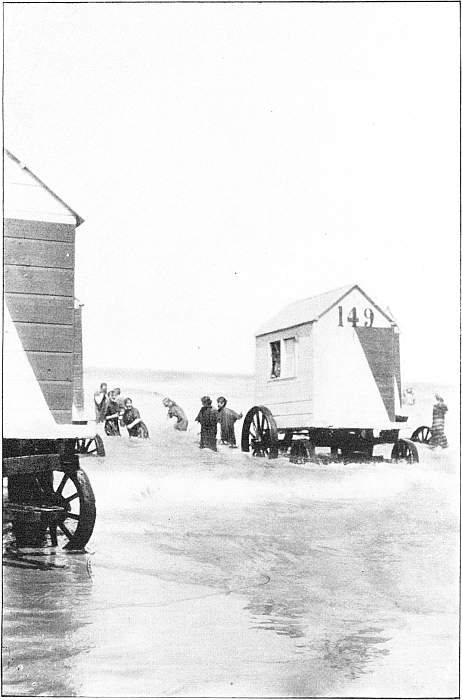
“There are many odd and fantastic sights here.” (See page 347.)
To-day promenades take the places of the old fortifications, and handsome residences stand where the simple sturdy fisherfolk once dwelt in their cottages. The tide of fashion rolls where a simple people lived their daily life of care and toil. Here congregate people of every nation, the old and the young; and the cosmopolitan character of the promenade is a source of great entertainment to the stranger. As we approach the Digue or chief promenade, which is elevated fully a hundred feet above the beach, we are struck with the beauty of this grand esplanade, a hundred feet wide and extending miles along the shore. On the city side are many handsome buildings; residences, hotels, cafés and some stores. These buildings occupy a space fully a mile in length, but the promenade with its tiled pavement skirts the sea for many miles. Chairs and benches are placed at convenient intervals for the use of the public, and every day, especially in the afternoon, thousands of fashionably dressed people appear upon this walk, rejoicing in the opportunity to display elaborate gowns; some by strolling to and fro before the benches and chairs, and others by more ostentatiously driving by in handsome equipages, with coachmen and footmen in appropriate livery.
Yet it is delightful to sit here on a clear evening, listening to the harmonious melody of the sea, as it mingles its voice with the strains of a fine orchestra, and watching the merry throng passing and repassing. The silent night afar out on the glistening waters seems like a brooding spirit.
“Thou boundless, shining, glorious sea, With ecstasy I gaze on thee; And as I gaze, thy billowy roll Wakes the deep feelings of my soul.”
We extend our walk and take in the Kursaal, a handsome structure of marble and iron built upon the side of the promenade. It covers a large area, and within its walls, the sounds of choice music are constantly heard. Dances, concerts and many other forms of entertainment keep this fashionable resort in a whirl both day and night. On many of these occasions the dressing is the most important feature of the affair. The people who resort thither are families of considerable wealth, and can, when they choose, run to extremes in paying court to Dame Fashion.
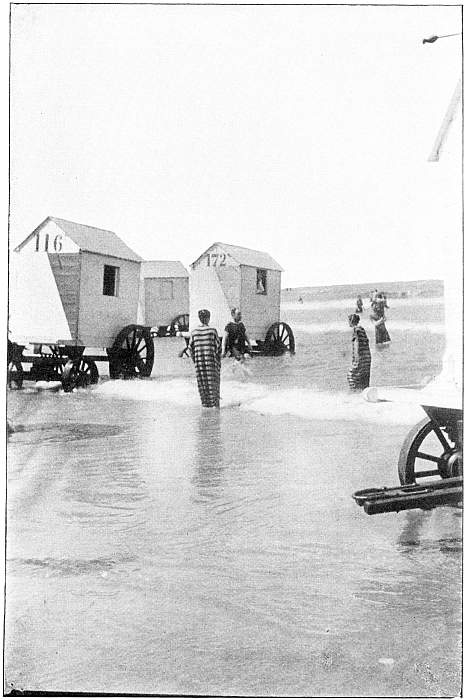
“One’s portfolio might soon be filled with interesting subjects.” (See page 347.)
Let us descend about noon, by the long low steps, from the promenade to the beach below, and here we will find a long unbroken line of wagons facing the sea. These wagons have large numbers painted conspicuously on their backs: upon one side is a window with a curtain carelessly drawn, and a pair of strong shafts is attached to each vehicle. The stranger will wonder what on earth these unsightly things are designed for, and why they thus mar the beauty of the beach. Have patience; inexperienced stranger, and you will see these inanimate wagons suddenly break ranks and now one, now another be hauled rapidly forward, some to the water’s edge, others into the ocean up to the hubs. In explanation of this I would state that when the bathing hour arrives, a horse is attached to each wagon, and the occupant or occupants, when it reaches the water’s edge, open the door and spring forth a nymph and her companions, in their scant bathing robes, ready for the plunge. The costumes of both men and women are not such as find favor with fastidious mortals, and many of the scenes witnessed on this beach would not be tolerated at any of our American watering-places.
It is quite common for men, women and children to remove their shoes and stockings and wade ankle deep in the surf.
However, there are many odd and fantastic sights here, and many pretty tableaux on the beach which would delight the eyes of an artist, and I often think that one’s portfolio might soon be filled with interesting subjects.
As the races are to be held this afternoon at the Course, a mile beyond the Kursaal, and just off the promenade, we wend our way thither. The race-course is similar to those in England and France. As the appointed hour approaches, a throng of fashionable people seat themselves upon the grand stand, until every place is filled, and even the aisles are crowded with the élite of Ostend.
I forgot to mention the fact that the day is Sunday, but this seems to make little difference to these gayety-loving people.
The horses start, and now betting and excitement go hand in hand.
“Some play for gain: to pass time, others play For nothing; both do play the fool.”
I have the peculiar good fortune on this occasion, of predicting the winning horse a number of consecutive times in my conversation with one of our party who sits beside me. These lucky guesses attract the attention of a stranger who is on my other side, and considering them as so many evidences of remarkable judgment or knowledge, he resolves to profit thereby. Accordingly before the next running, as the horses walk slowly before the spectators and the judges’ stand, the man quietly asks me to name the winner in the next race. I quickly make a choice and mention the horse’s name. The stranger bids me good-day and hastens away to place his “pile” with some bookmaker on the identical horse which I have named.
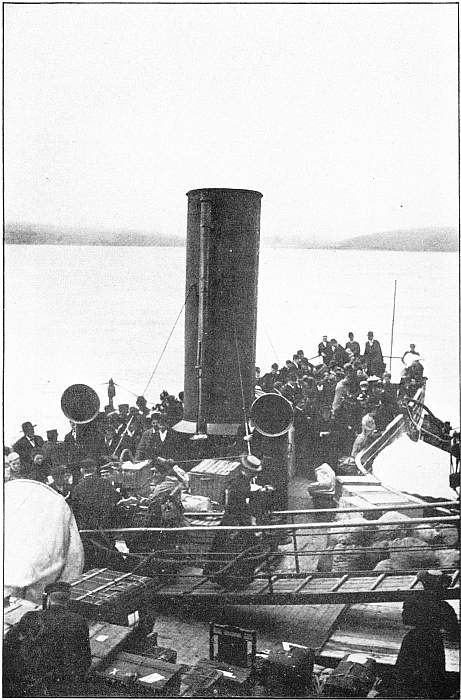
“Many typical Irish characters come aboard our vessel.” (See page 353.)
With a rush of spirit and courage the noble animals fly over the course, and every jockey seated in a saddle looks determined to win. Faster and faster they urge the flying steeds with spur and voice, and the animals themselves, with distended nostrils and steaming breath dash past the judges’ stand in frenzied effort. The merry jingle of the bell proclaims that the goal is reached: the great sign-board with the winner’s name upon it is visible to all. What has become of my luck? And what has become of the stranger who relied on my judgment a few moments ago? My horse has lost. Goodness! I feel as though I have committed a crime, and I am very sure that Dame Fortune receives from me in private a score of epithets, not the most complimentary in the world for her unprincipled desertion. I feel sure that if I had my instantaneous camera, or pencil handy, this disappointed man’s face would make a foreground in the picture that would surely be a “winner.”
We leave Ostend on the steamer La Flandre. The schedule time is 10:40 A. M. We go on board amid shouts of kindly farewell from our friends on shore. As it is a clear bright day with a delightful salt breeze, there is much pleasure in sitting on deck and enjoying the view. The English Channel is generally a turbulent body of water, noted for its many victories over the unfortunates who trust themselves in its power, but to-day it is mild and calm, probably plotting mischief to the next boat load of passengers that shall come its way.
Indescribable confusion reigns in our hotel, at Liverpool, for more than a hundred of its guests are on the point of sailing for America. Innumerable packages, grips, umbrellas and walking sticks line the corridors. Every one is moving to and fro in hot haste. One lady asks me if I know at what hour the steamer on which she has taken passage will sail: another wants information in regard to her steamer: a man with perspiration trickling down his face begs me to tell him how to send his five trunks and other baggage to the landing stage. These and many more annoying and importunate people make life a burden to me. I do not know why they choose me to share in their misery. Do I look like a walking bureau of information, I wonder! If I do, I shall learn how to change my expression. But in truth the faces of these bewildered people are a study, and I am genuinely sorry for them.
The steamer cuts loose from her moorings, and moves gracefully out into the great ocean. As we approach Queenstown, we observe the small farms and dwellings close to the edge of the water. Then the lighthouse and the forts which guard the entrance to the harbor come into view, and now we drop anchor and wait for passengers and the mails. A little steam tug becomes visible, and as she draws nearer, we learn that she is bearing the mails and passengers to our ship. At last she is close beside us, and when made fast, the transfer takes place. Now is the time for the camera or sketch book, for many typical Irish characters come aboard our vessel, with strange, half-frightened faces, and their worldly belongings carried on their backs, or clutched tightly in their hands. Among the group I notice a middle-aged woman with a young pig nestling peacefully under her arm. Whether it is a pet, or simply a piece of live stock to begin housekeeping with in the new country, I cannot say, but with a contented expression on both faces, Bridget and her pig disappear into the special quarters which are reserved for the emigrants. This whole scene is very interesting. The old-fashioned black glazed oilcloth bag and trunk play a conspicuous part in the picture, and here and there are seen bundles tied in red bandanna handkerchiefs and carried on the end of a stick, which is slung over the shoulder, while the corduroy knee breeches, woollen stockings, heavy shoes and pea-jackets with caps to match give us a fine representation of the Irishman on his native heath.
Several small boats are floating at our side: from one of these a rope is thrown to a sailor on our deck, and a bright and comely Irish girl climbs nimbly up, hand over hand, and stands among the cabin passengers. With quick, deft movements she pulls up a basket filled with Irish knickknacks, such as pipes, crosses, pigs, spoons and forks made of bog-wood; these, with knit shawls and similar articles, she displays on deck, and it would be difficult to find a prettier, wittier, more attractive specimen of old Ireland’s lasses than this. By means of her ready tongue she disposes of all her wares, and when the whistle warns all hands to leave the deck, she glides gracefully down the rope, and settling herself in her little boat, pulls for the shore.
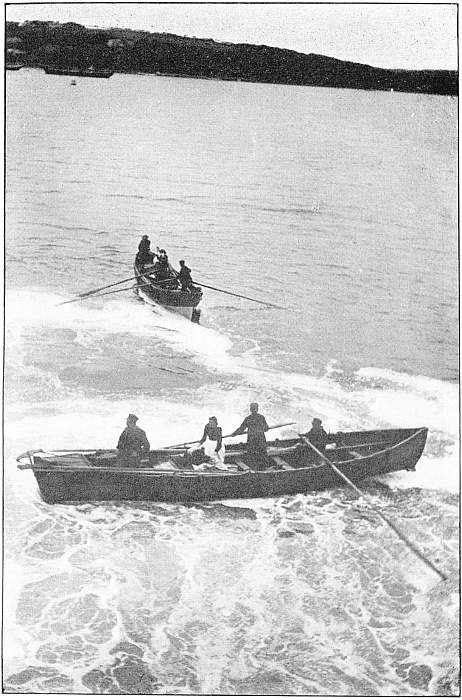
“Several small boats are floating at our side.” (See page 354.)
This is our last stop until we reach New York. The anchor is pulled up, and away we go steaming on our homeward voyage. The little steam tug runs along beside us for a time, then the whistles of both vessels blow a farewell to each other, and our little comrade gradually fades from our sight.
Suddenly a heavy fog comes up, and the incessant blowing of the fog-horn is a tiresome sound: but the wind follows up the mist and scatters it far and wide, and now we have the boundless prospect of the ocean before us.
“Strongly it bears us along in smiling and limitless billows, Nothing before and nothing behind but the sky and the ocean.”
As we gaze upon it day after day, its beauty and grandeur grow upon us more and more. I can think of no better words than those of Childe Harold which so beautifully express the thoughts the scene inspires.
“Roll on, thou deep and dark blue ocean, roll. Ten thousand fleets sweep over thee in vain; Man marks the earth with ruin—his control Stops with the shore; upon the watery plain The wrecks are all thy deeds, nor doth remain A shadow of man’s ravage, save his own, When, for a moment, like a drop of rain, He sinks into thy depths with bubbling groan, Without a grave, unknelled, uncoffined and unknown.”
Then, as if by magic, the huge waves lessen in their angry murmurs, the surface becomes quiet and calm; evening creeps on, and the glow from a descending sun illuminates the scene. As I look upon this beautiful and restful picture, I think how true the words:
“Beyond is all abyss, Eternity, whose end no eye can reach.”
The reading of this book has no doubt been a pleasure and a profit to you. Then why not recommend it to your friends? You will find cards on the inside of the back cover to assist you.
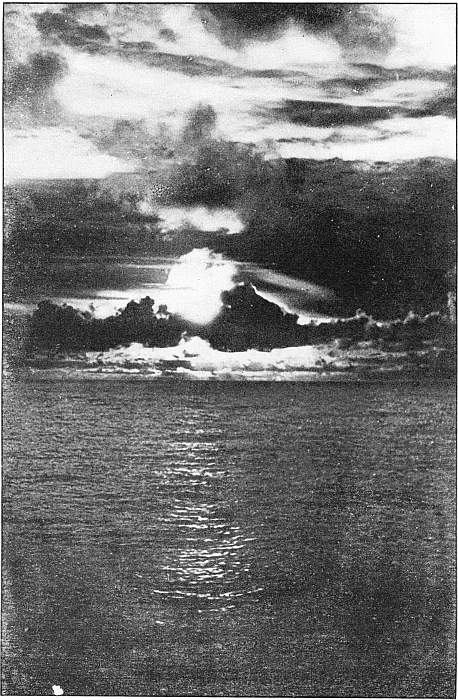
“Beyond is all abyss, Eternity, whose end no eye can reach.” (See page 358.)
BY THE AUTHOR OF ODD BITS
The British Isles through an Opera Glass
By CHARLES M. TAYLOR, Jr.
Author of “Vacation Days in Hawaii and Japan.” With 48 full-page illustrations, principally from photographs. Crown 8vo, about 350 pages, deckle edge paper, cloth jacket, in box, $2.00.
What is said of “The British Isles”
Mr. Taylor has the knack of making the story of his journeyings entertaining to the public. The usual descriptions of time-worn scenes give place to charming personal narrative, and a wealth of incident and episode gives to the book an exceptional interest. The fine half-tones of English scenes liberally scattered through the work greatly enhance its charm.—The Philadelphia Call.
It is a record of a pleasant tour by the less frequented paths of travel, not only in England, but in Scotland and Ireland. The author takes little from the guide books and their familiar histories, but notes many interesting details that attracted his own attention. Furthermore he has illustrated his book with a large number of photographs, both of places and people, that are quite out of the common run, and the pictures alone would suffice to give the volume distinction.—The Philadelphia Times.
The book is all the eye could wish, and as we turn the pages quickly from one to another of the forty-eight beautiful photographic illustrations a veritable panorama passes before us. The author is enthusiastic over what he saw in the British Isles, and he is evidently desirous of sharing his pleasure with those who have not been privileged to see for themselves.—The Philadelphia American.
It is a luxurious volume that records the interesting travels of one who knows how to pen vivid word pictures of places where those who love travel would like to be.—The Bookseller.
Mr. Taylor traveled through the British Isles with an observing eye, a ready note-book, and a camera which he used with discreet intelligence. The narrative is brightly written and abounds in anecdote, while the personal point of view is ever present and adds a touch of piquancy. The volume is beautifully made, and the photographs, about fifty in number, are particularly well reproduced in half-tones—The Philadelphia Press.
For sale by all booksellers, or sent post-paid upon receipt of the price by the publishers
GEORGE W. JACOBS & CO.
103-105 South Fifteenth Street Philadelphia, Pa.
BY THE AUTHOR OF ODD BITS
Vacation Days in Hawaii and Japan
By CHARLES M. TAYLOR, Jr.
With over 100 half-tone illustrations, principally from photographs. Crown 8vo. 361 pages, gilt top, uncut edges. With unique cover design. Price, $2.00.
What is said of “Vacation Days”
Mr. Taylor is a keen observer, who penetrated beyond the beaten track of the usual tourist, and his sketches of Home Life, Natural Beauties and Every-day scenes, have individuality and charm.—Literary News.
The narrative is written in a clear, easy style, with an aptitude for giving just that kind of information concerning everyday life which people miss too often in books of travel.—Philadelphia Press.
A very interesting feature of the book is the numerous pictures from photographs taken by the author of “Japanese people,” men, women and children, engaged at their ordinary vocations, also pictures of Japanese scenery, shops, living rooms and temples. These illustrations are remarkable for their realism.—Indianapolis Journal.
The book recounts the incidents of a recent tour through Hawaii and Japan. The special value of the narrative is that it covers points of interest in these specially interesting countries not usually recorded in the guide books and ordinary books of travel.—-The Philadelphia Call.
A four months’ trip through Hawaii and Japan is narrated in this compact and entertaining volume. Mr. Taylor applies systematic methods to his sight-seeing. He is an appreciative observer as well. He was not content with well beaten paths and hence his record is clear, picturesque and fresh.—The Philadelphia Ledger.
Two conspicuous merits this capital travel book has over the average in its class; it describes new grounds and scenes, and the narrative ripples along with the ease and liveliness of a brook. Without professing to be specially instructive, Mr. Taylor conveys a great amount of information such as we all enjoy when told in this pleasant way, blending the matter of fact with the entertaining.—The Philadelphia American.
For sale by all booksellers, or sent post-paid upon receipt of the price by the publishers
GEORGE W. JACOBS & CO.
103-105 South Fifteenth Street Philadelphia, Pa.