Front matter (continued 2)
Reading edition
Wishing to purchase some bonbons, we enter a candy shop and ask the fair maid behind the counter to put up a pound of this confection: our amazement is great when she replies that this form of sweetmeat is not to be found in Rotterdam. “What,” I exclaim, “no sweets for the sweet girls of Holland?” “No, only chocolate candy.” And this indeed is the only kind of bonbon to be had in Rotterdam. The sweet chocolate is moulded into various shapes. It is delicious, excelling in purity and flavor that which is made in any other part of the world.
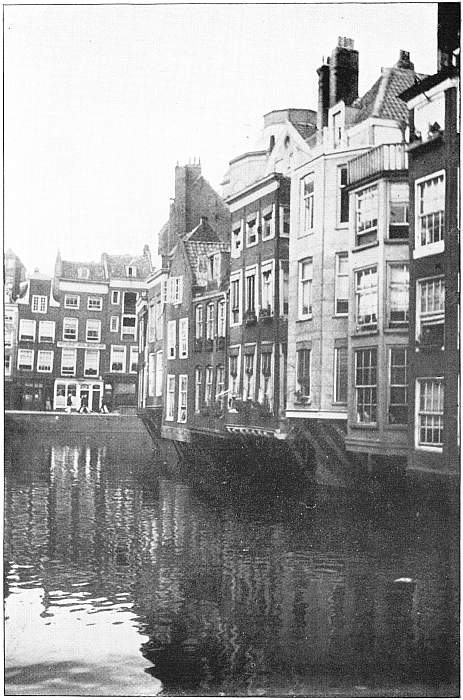
“In many cases the balconies of residences overhang the water.” (See page 114.)
Our guide is very attentive and energetic; and anxious to show us everything of interest about the town, he conducts us through the numerous market-places. At one of these some amusement is excited by my photographs and sketches of the market people and the buyers. The market man stands beside his wares with a happy, good-natured face that seems to say that the cares and worries of this world affect him not at all. The whole scene is like some vividly colored picture, and I think as I look upon it that this life bears with it pleasures of which we of the outside world know nothing. Apparently the people of this country possess the rare blessing of contentment with the lot which God has bestowed upon them.
An old man and woman are particularly anxious for me to photograph their daughter, who they assure me is the belle of the market. This assertion, I think, may be true without much compliment to the girl, for a homelier set of human beings it would not be easy to find. After some preliminaries relating to posing and keeping back the curious country people who crowd closely around me and the camera, I finally succeed in making a good picture of the Belle of the Rotterdam Market, with her father and mother on either side. They are all as proud as Punch of this performance, and seem quite “set up” by the occasion.
One day being near to a manufacturer of the wooden shoes worn by the peasants, our party of four slips within the shop, and are fitted after trying on at least a dozen pairs, to the apparent delight of Meinherr. It is necessary to wear a heavy woollen stocking to secure comfort in these shoes. The ordinary American stocking would soon be rubbed into holes by the hard surface of the shoe. Indeed it is quite a feat to be able to walk rapidly and gracefully in this clumsy footwear.
Over many of the watery streets of the city drawbridges are built, which are opened at intervals to allow the streams of boats to pass. The incessant blowing of a trumpet or horn similar to that of the tally-ho notifies the watchman of the approach of boats. This sound may be heard at all hours of the day or night in any part of the city, and is at first, especially at night, rather disturbing to the stranger, but like other annoyances which are inevitable, the exercise of a little patience and endurance will enable one to eventually like the trumpet, or else to become as deaf to them as old “Dame Eleanor Spearing.”
I know of no place in which the lover of the antique, whether he is a collector of ancient coins, jewels, china, furniture, or a seeker after rare curios and relics, can experience greater delight than in this old city of Rotterdam. Here are hundreds of shops, whose proprietors devote their whole lives to the accumulation of such objects, and it is needless to say that their stock is rich and unique, and possesses abundant variety. We visit a number of these establishments, and I succeed in gathering up a large assortment of old swords which please my fancy. One of these is said to have been owned by Christopher Columbus(?). The shopkeeper vouches for the truth of the statement, and as I am willing to believe it, in the absence of proof to the contrary, I label it as the sword of the great navigator who added a new hemisphere to our globe. The remaining swords have been the personal property of lords, generals or other warlike celebrities, and again I take comfort in the thought that if the records are not truthful, it is a minor consideration when taking into account the moderate prices which I have paid for the articles.
The artist will find in Rotterdam a wealth of material both for figure subjects, and odd and picturesque bits of landscape. Here too are wonderful interiors, with all the quaint associations of a bygone age. Here are scenes on the canals, the bridges, and the ever changing life on the river. By all means visit Rotterdam if you desire original studies for your sketch book.
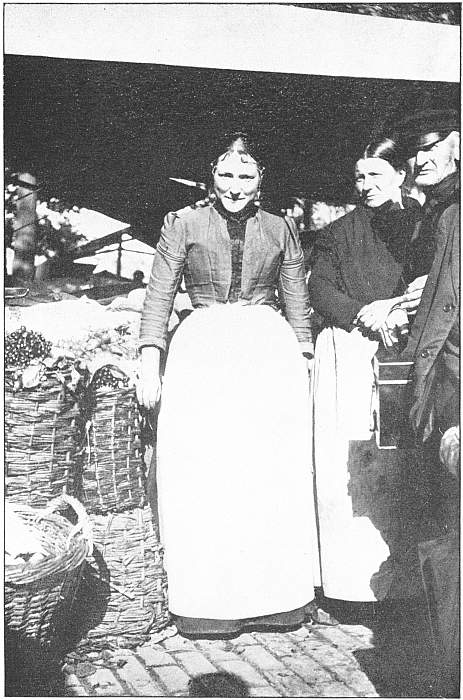
“The belle of the Market.” (See page 119.)
A City of Many Islands.
A City of Many Islands.
Amsterdam—The People of Holland—-Amstel River—Merry Excursionists—Interesting Institutions—Origin of the City—Source of Prosperity—A Cousin to Venice—Ninety Islands—Beams and Gables—Block and Tackle—Old Salesmen—Street Markets—Haarlem—Railway Travel at Home and Abroad—Ancient Buildings—Historic Associations—In the Canal—Groote Kerk—The Great Organ—Picturesque Subjects—Zandvoort—Eau de Cologne—The Beach—Dutch Sail Boats—Seamen—Hooded Chairs—Peddlers—Music in Holland and Germany—Gypsies—We Meet an Artist—Hospitality—A Banquet.

MSTERDAM, the commercial capital of Holland, is but a short ride from Rotterdam, and like all the other “dam” cities of this region, possesses many attractions of its own, besides being the centre or hub from which radiate trips to many picturesque towns and other points of interest.
These irreverent sounding terminations do not by any means imply that the cities so called are steeped in wickedness and crime. On the contrary they are remarkable as being towns of exceptional purity and honesty, possessing churches, libraries and schools which bear witness to the good and loving aspirations of a conscientious Christian people.
The natives of Holland are kind and peaceable in disposition, and fair in their dealings with one another. They are personally very attractive on account of the natural simplicity of their everyday lives, and the high principle of honor and morality upon which they conduct their business transactions. They train their children in accordance with these principles, and the visitor cannot fail to appreciate their virtues, and rest securely in the confidence that he will receive fair and courteous treatment from both young and old.
The Amstel River, viewed from the windows of our hotel, presents a beautiful picture. Upon the opposite bank are handsome residences, of substantial, square and regular architecture, while in slow, calm motion on the river may be seen boats of every description, many of them with a cargo of human beings; and the gay national flags and other brilliant bunting floating in the fresh breeze have a gala appearance as the boats steam or row past our hotel. Merry songs and happy laughter drift back to our ears, and it seems as though we have at last reached a land exempt from the cares and sorrows of the everyday world.
The Dutch people are as a class happy and satisfied, with a cheerful manner, and a cordial and genuine welcome.
Amsterdam is indeed a great city, with numberless points of interest for the visitor, without mentioning its museums, art galleries, theatres, libraries, churches and other institutions; its botanical garden, university, parks and tramways.
The town was founded by Gysbrecht II., Lord of Amstel, who built a castle here in 1204, and constructed the dam to which it owes its name. In the fourteenth century it began to increase in importance, becoming at that time a refuge for the merchants who were banished from Brabant. At the close of the sixteenth century, when Antwerp was ruined by the Spanish war, and many merchants, manufacturers, artists and other men of talent and enterprise fled from the horrors of the Inquisition to Holland, Amsterdam nearly doubled its population, and the conclusion of peace in 1609, and the establishment of the East India Company combined to raise the town within a short time to the rank of the greatest commercial city in Europe. Its population in 1890, excluding the suburbs, was 406,300.
Amsterdam is generally at first sight compared with Venice, which it certainly resembles in two points. Both cities are intersected by numerous canals, and the buildings of both are constructed upon piles; but there the similarity ends. There are wide, bustling thoroughfares in Amsterdam, traversed by wagons and drays which could have no place in the city of gondolas and ancient palaces.
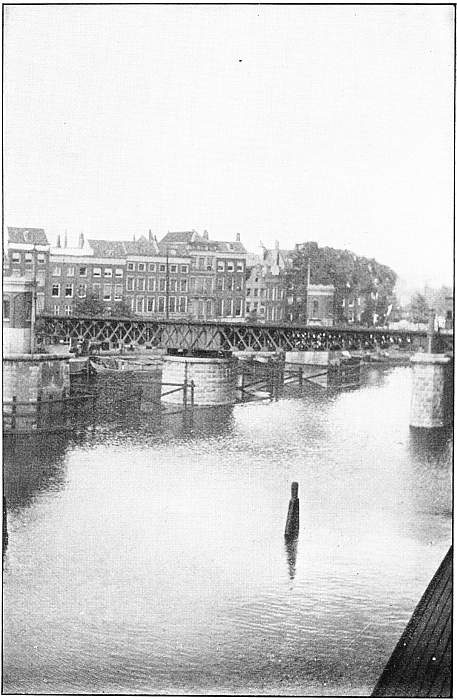
“The Amstel River.” (See page 128.)
The canals, or Grachten, which intersect Amsterdam in every direction, are of various sizes, and divide the city into ninety islands; and these are connected by nearly three hundred bridges. There are four principal, or grand canals, which are in broad, handsome avenues, bordered with trees, and with sidewalks for pedestrians. The other canals intersect these and serve to connect one part of the town with another, as short streets cross wide highways and main thoroughfares in other places. Rows of fine-looking houses line the banks of these watercourses, and as all the buildings are constructed on foundations of piles, the old quotation of “a city whose inhabitants dwell on the tops of trees like rooks,” is not without considerable truth. The quaint old architecture of the stores and houses is of itself a source of great interest to the visitor. We have seen so many pictures of these odd gabled and tiled roofs overhanging the windows, that at first one has the impression of awakening from a dream to its reality. Remarkable order and cleanliness prevail everywhere, adding to this feeling, for the wear and tear of daily living do not seem to affect the almost immaculate atmosphere of the place. Windows are as clear as crystal, and the woodwork of the houses everywhere looks as if freshly scrubbed and sanded. Projecting from the attic windows of many buildings may be seen a pole or beam, from which hangs a block and tackle used to hoist furniture and other heavy or bulky articles from the sidewalk to the upper stories. These things are not carried up the winding stairway, as with us, scratching and defacing the walls and paint, as well as the furniture, and resulting in much vexation and the utterance of unseemly swear words. All this is avoided by the methods of the people of Holland, and the citizens of America would profit by adopting them, if only as a means of avoiding the temptation to express one’s feelings in violent and irreligious language.
Among the thousand and one attractions of this interesting city, the curious-looking old junks, or salesmen and women stationed at various points on the streets, are not unworthy the notice of the photographer or artist. Their wares consist of old scrap iron, rusty saws, perhaps toothless, hammers without handles, nails of every size, files, beds and other articles of furniture apparently dating back to scriptural ages. Such markets, where odds and ends of every imaginable kind are gathered into piles and sold to the poorer classes of the people, seem to be sanctioned by the authorities, and sometimes present a very active and thriving appearance. They are not unpicturesque in their odd combinations of color, attitude and expression.
The great windmills along the canal, with their huge revolving arms, and the boats with their loads of merchandise; the peasant women with their quaint costumes and elaborate yet funny head-dresses; the tall Dutch houses with their red and yellow brick fronts and lofty tiles and gables, the beautiful avenues of elms along the grand Grachten, the vast docks, with forests of masts, and countless ships from all parts of the world, and products of every country, the wonderful dikes, all form a succession of views of charming variety and individual beauty that are fascinating to the newcomer.
Many short trips may be taken from here either by boat or train, and he who would fill his portfolio with quaint and lovely pictures, will find his enthusiasm aroused, no matter in which direction he may venture, or whether his expedition be on land or water. Interesting localities are always within easy reach, and the moderate rate for transportation and accommodation render all points accessible to the traveller whose purse is of the most slender dimensions.
Take with me the trip to Haarlem and Zandvoort. Proceeding to the Central Railroad Station, we purchase tickets which entitle us to the short ride in the usual compartment car. And here one may note the difference between railroad travel throughout England and on the Continent, and the American system. Instead of having one car into which passengers of all kinds, black and white, rich and poor, merchants and emigrants crowd as in free America, European trains are divided into three sections, viz: first, second and third class. Although the more general experience is that the second class compartments are quite as comfortable, clean and attractive as the first class compartments, the price of the latter is nearly double that of the former, and the fare of the second class nearly double that of the third. In many sections of England, Scotland and Germany, the third class accommodations are by no means unpleasant: but do not take third class tickets when travelling in Ireland, for should you do so, it is more than probable that just as you are waxing into lofty enthusiasm over the romantic and beautiful scenery around you, Paddy with his wife and progeny, several pigs, and whatever other small live stock can be conveniently or inconveniently dragged along, will be planted by your side, or roam about you in such unpleasant proximity as to change all your romantic visions into the most unromantic prose.
Here we are in the quaint old town of Haarlem, famous in past years for its tulips, and now noted for its well-kept gardens and avenues, as well as for the curious old houses of brick and stone which are the delight of all the visitors to Holland. These lofty steeples and rows of ancient and picturesque houses have looked down upon many generations, and witnessed scenes of suffering and endurance that have been registered on the pages of history; for like Leyden, Haarlem sustained a long siege during the war for independence, and stories of the heroism of both men and women have come down through the long centuries to tell us of experiences of which these ancient structures, stately and silent, give no sign. So well cared for are the old buildings, that one can readily imagine that they will appear as they do to-day for many centuries to come.
How we enjoy this historic old place! The very air we breathe seems laden with odors of the past. The flower-beds are wonderfully attractive, with their gay colors and delicious fragrance. Whole fields of tulips, hyacinths, lilies, and other brilliant blooming plants in every shade of color are to be seen here, and this town supplies many of the largest gardens of Europe with roots. The Spaarne River winds through the town, which possesses the characteristic cleanliness of the other cities of Holland.
While driving along the bank of the canal here, our attention is attracted by the sound of loud, shrill cries which seem to come from the water. “What!” I say, “do the lurking spirits of the slain thus make themselves known to the living? Are there still lingering ‘pale gliding ghosts, with fingers dropping gore’?” Whatever it may be, dead or living, ghost or mortal, I bid the driver halt, and alighting, hasten to the edge of the canal. Looking into the dark muddy water, I see a lad of about twelve years, just able to keep his head above the stream, and screaming lustily for help. A young man reaches the spot at the same moment, and plunges instantly into the canal to the rescue of the boy who is too much frightened and exhausted to give any account of himself.
The “Groote” market is in the middle of the town, and here is to be seen one of the finest old buildings in this part of the country. This is the ancient meat market, built in 1603, of brick and stone, and quaint and picturesque enough to charm the soul of an artist with an irresistible desire to carry it home upon his canvas.
In the market-place also stands the Groote Kerk, an imposing and lofty structure, dating back to the end of the fifteenth century, with its tower of two hundred and fifty-five feet adding grace and beauty to the edifice. The interior will more than repay one for the time spent in examining it. The old walls are whitewashed to hide the ravages of time and cover the scars, many of which, history tells us, are the results of the Spanish siege. Here are odd and elaborate carvings, crude, primitive benches, and the crossbeams forming the ceiling alone would convince one of the antiquity of this relic of the middle ages. The organ, constructed in 1735, was for many years looked upon as the most powerful in the world, and still ranks as one of the largest instruments in existence. It contains four keyboards, sixty-four stops, and five thousand pipes, the greatest of which is fifteen inches in diameter, and thirty two feet in length. We endeavor to persuade the rector to allow us to play upon this wonderful instrument, but he is beyond flattery, coaxing or bribery; faithfully adhering to the rigid rules, which decree that recitals shall be held only on certain regular days. How we long to hear the voice of this noble masterpiece which has uplifted the soul of man, and bidden him look to God in his times of tribulation, or fill this lofty dome with joyous notes of praise and thanksgiving in days of peace and prosperity. I think of the stories these old walls could tell of the cruelties of the Spanish intruders; for here are marks too deep for paint to conceal, or time to efface. But one could write interminably of these old towns with their quaint and glowing pictures. At every turn a new and attractive scene presents itself, and we reluctantly tear ourselves away, only half satisfied, and proceed to Zandvoort, a somewhat fashionable resort on the coast of the Noord Zee. At the railway stations and on the streets one can buy the Cologne water in small glass bottles which is so popular throughout Holland, and which is sold much as peanuts and pretzels are sold in our country. The quality is excellent, and the price is so moderate that the use of this perfume is really carried to excess by tourists, who find that it not only refreshes one after the fatigue of a journey, but cleanses the face from dust and cinders.
We alight at a small unpretentious station, the terminus of this railroad, and walk a short distance to the beach. The pure salt air seems like a delightful tonic. This is a beautiful coast, sloping gradually to the water which is very deep. With the white sand for a carpet, we wander on for miles, feasting our eyes upon the lovely scene which at every turn presents a new attraction. Here are old Dutch sail boats drawn up on the beach, and the picture is enhanced by the groups of sailors waiting for the tide. Their blue homespun jackets, rugged faces and not ungraceful attitudes are very suggestive to the artist.
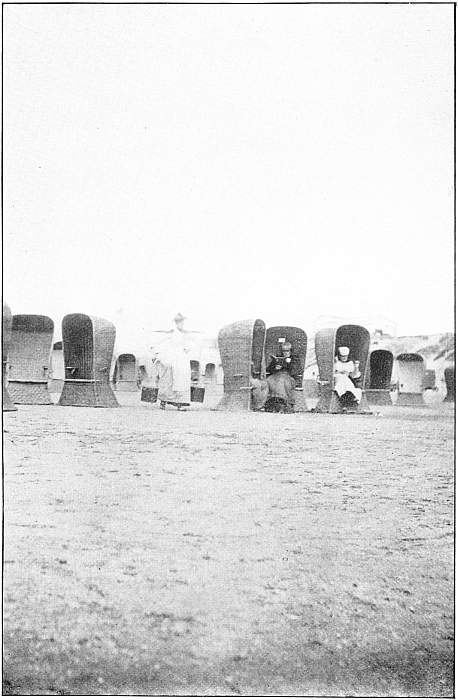
“Wicker chairs offer rest to the weary pedestrian.” (See page 140.)
The season seems to be either early or late, for the people along the shore are scant in number. Fresh looking wicker chairs, with large comfortable seats and sheltering hoods, stand in front of the hotels and at the water’s edge, and at a trifling cost, offer rest to the weary pedestrian, and protection to the shy lovers who seek to escape the embarrassing gaze of the public. Here is the ubiquitous and persevering fruit and cake or sandwich vendor, with basket suspended from the shoulder, pausing before the chairs, or waylaying passers-by with importunities to purchase grapes, plums, candies and various other dainties. Close by us is a band of musicians with stringed instruments, who charm us with their delightful melodies. Their music is superior to that which greets the ear in the streets of Philadelphia. In truth, in Holland and Germany, one rarely hears anything but good music from these bands of itinerant players, and operatic selections of the higher class are frequently heard at the popular beer gardens of these countries.
A short distance off are the wagons of a gypsy encampment, and the quick witted members of these roving tribes gain a livelihood by fortune telling. We are told that they are always to be found here during the summer season, and are quite popular among the young and the credulous, who willingly exchange their silver for a glimpse into the future, and the wonderful predictions of fame and fortune made by these glib tongued southerners. Their gay dresses, in some of which are displayed all the colors of the rainbow, are beautiful in effect: and now I discover in one of the great hooded chairs a lady artist, with a well covered canvas, upon which she is painting the portrait of a handsome gypsy girl, while the wagons and the sea form a beautiful background. I enter into conversation with her, and learn that she is from Amsterdam, and is filled with enthusiasm for the charms of this country. She says: “If one will but open his eyes, he will see delightful pictures in every corner of the province.” And it is true. Nature has indeed been lavish in her gifts to Holland. Here are scenes and subjects unlimited in number, and indescribably attractive.
The citizens of Amsterdam are most kind and hospitable. As an instance of their cordiality I mention a sumptuous banquet given in our honor by a townsman Mr. L——, who says we must not return home without a glimpse of the social life of the city. The banquet is held at the largest and most popular banqueting hall (Maison Couturier), and besides our host and his family, a few intimate friends and some young people are present. At the appointed hour we are driven to a spacious and handsome building, and are conducted to a beautiful apartment with most attractive surroundings. The first floor of this hall is elegantly furnished, and lit by electric lights. Flowers, palms, and other tropical plants adorn the halls and rooms. After a cordial welcome from our host, we are led to the banqueting hall, where we are dazzled by the light and beauty around us, and delighted by the artistic effect. Covers are laid for sixteen guests. Flowers, plants and fruits are picturesquely arranged, and even the electric lights exhibit various glowing designs. The feast is prepared under the direction of an experienced chef, and here we speedily become aware that the city of Amsterdam is not one whit behind the great centres of the world in this line of achievement. After many toasts to Amsterdam and its people have been responded to, the hospitalities are concluded with one to “America and its beautiful women,” and we take our departure after three hours most delightfully spent in social intercourse with our friends. Upon this occasion four languages, French, Dutch, German and English are fluently spoken.
Excursions to Broek and the Island of Marken.
Excursions to Broek and the Island of Marken.
A Charming Journey—Fellow-Passengers—National Costumes—The Children—A Lovely Landscape—Holstein Cattle—Windmills—Irrigation—Farmers—A Typical Dutch Village—Washing-Day—The Red, White and Blue—Suppose a Bull Should Appear—A Brilliant Picture—Drawing the Canal Boat—Honesty and Cleanliness—A Thrifty and Industrious People—Farming and Cheese-making—As Evening Falls—Scenes for an Artist—Dead Cities of Holland—Monnikendam—Behind the Age—City Lamps—Houses and People—The Island of Marken—An Isolated Wonderland—First Impressions—Rare Holidays—The Family Doctor—Absence of the Men—The Fishing—Healthy and Industrious population—The Women of Marken—Pretty Girls—They Will not be Taken—A Valuable Experience—Photographs.
BEAUTIFUL trip is that to Broek. We take the small steamer that lies in the river a short distance from our hotel, the Amstel, and after a sail of three-quarters of an hour, are landed at an insignificant station on the opposite shore. Here a little car with bare wooden seats running lengthwise, and a queer looking engine waits for passengers from the boat. And now we ride through a picturesque farming country, passing numerous small stations. This road terminates at Edam, but we do not go that far. Our fellow-passengers are most interesting. Many of the women wear their gold heirlooms with the finely embroidered caps which are so quaint and becoming, and all wear the customary wooden shoes.
The men have rugged brown faces, and sinewy arms: some of them wear the heavy wooden shoes, others slippers, while a number are barefooted. How they all stare at us, and it is just as impossible for us to withdraw our eyes from them. We are novel sights to each other. I wonder what they think of our appearance. Their faces are impassive, but ours must surely express wonder, admiration and a strong desire on the part of one at least, to capture these studies in color and figure that surround us on every side.
The children, with their rosy cheeks and round healthy forms, seem merry and happy, although none of them are sociable or talkative with us. They look at us in amazement. This is a delightful ride over a smooth velvety road, with rich pasture land on either side. Now we pass great dikes which hold back the waters from these fertile fields; and now short canals with their little boats, on which perhaps the Dutch vrow in her snowy cap and gold head-dress is seated beside her husband who smokes his pipe with a meditative air. The flat landscape is varied by innumerable herds of cattle, principally of Holstein breed, with the great white bands encircling the bodies, which reminds me of the story of the Yankee who used this band for a foundation upon which to paint his sign: “The finest milk and cream in the world within. Price two cents per quart.”
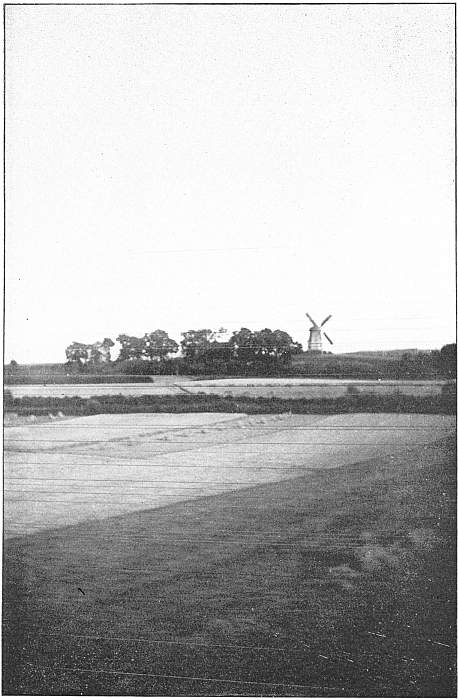
“The flat landscape is varied by herds of cattle.” (See page 153.)
Hundreds of windmills may be seen with their long wings gracefully moving at the touch of a gentle breeze, in perfect harmony with the surrounding landscape. These mills have been used for many centuries in Holland, which is their mother country, and serve for draining the land, or for manufacturing purposes. They are placed upon a substantial foundation of brick or stone, and their enormous sails describe a circle of over a hundred feet in diameter: some run saws that cut through logs of great thickness, while others are huge grain mills. The smaller windmills are made of wood like those seen in some portions of our own country. The system of irrigation by means of windmills is very complete in Holland, thus it is that we see everywhere such beautiful fertile fields. Many of the farms in this locality employ three or four, and even more windmills for this purpose.
We see many farmers, with their wives and children, working in the fields, and they all stop for an instant as our train passes, to shout a merry greeting. Here a milkmaid in her snowy cap passes along the road. Flocks of sheep stand in the shadow of the trees, and armies of quacking ducks emerge from a marshy pool and spread themselves across the green.
The average speed of our antediluvian express is from five to seven miles an hour, but it is perfectly satisfactory to these deliberate people; and as to ourselves, we are enjoying everything too much to wish it shortened by one minute. We arrive, however, at Broek, which is celebrated as one of the cleanest towns in the world. It contains about sixteen hundred inhabitants, and its narrow streets are paved with yellow bricks which are kept scrupulously clean. The small frame houses have tiled roofs, and with their flower gardens, present an orderly appearance. The whole atmosphere of the place is one of primitive simplicity. Some of the buildings are painted white, some green, and others of a variety of hues. They all wear an indescribable air of repose: and it is said that the front doors are not opened from the beginning to the end of the year, except on the occasion of a wedding or a funeral. The gardens are veritable curiosities, with their old-fashioned flower-beds, and box-bushes cut into various fantastic shapes, and all so diminutive that one feels as though he has fallen upon an animated edition of the Noah’s Ark of his childish days.
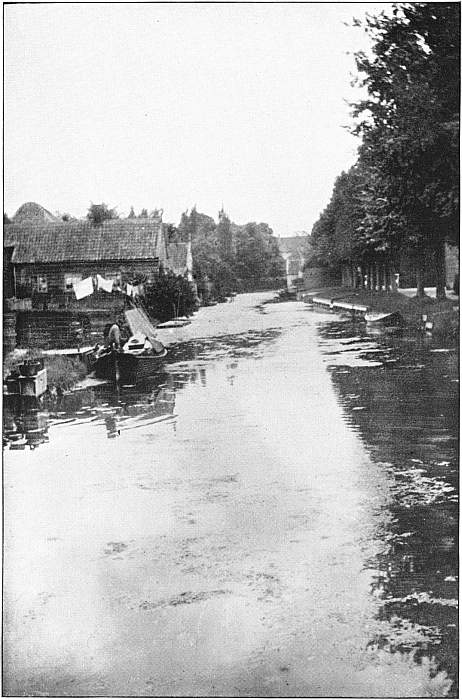
“Most of the houses have a canal at the back.” (See page 157.)
Most of the houses have a canal or small stream at the back, and close by, upon a washing-day, the garments of the family may be seen flying in the breeze, displaying to the stranger the prevailing colors of the community, which are red, white and blue. Red predominates, however, since red flannel is universally worn by the middle and lower classes in Holland. I think of the fine bull which we saw but a short time ago, grazing so peacefully in the meadow, and wonder what effect this exposure of tantalizing color would have upon his equanimity. Should he be let loose among the back gardens of Broek upon a washing-day, the order of this immaculate village would certainly receive a shock. For once in the history of the place, things would be topsy-turvy, and the excitement would doubtless surpass anything previously seen in this peaceful town.
What beautiful and picturesque combinations are here! The varying shades of green and blue, mingled with harmonious tints of yellow, produce a scene for the impressionist, while the effect is enhanced by the streams and canals which wind in and out with many a turn and twist, apparently for the sole purpose of adding to the attraction of this quaint and unique locality.
Occasionally we see a canal boat of larger size drawn by a buxom Dutch maiden and her brother; or not infrequently it is the old man and his wife, and sometimes the entire family all strenuously tugging the stout rope which is securely fastened to the bow of the boat, while the dilapidated old craft, laden with merchandise or produce creaks slowly on its way, breaking the placid surface of the water with a soft musical plash.
Honesty and truthfulness are unmistakably impressed upon the faces of all whom we meet in this section. The people hereabouts do not possess the shrewd business capacity of our Wall Street brokers, but they are mild and pleasant, with a wholesome appearance of health and good appetite. They are individually as clean and orderly as is their village. Water is as cheap here as in America, but in this place there seems to be an extravagance in the use of it which far exceeds that of the same class in our country.
There are no beggars or idlers here. The people are so thrifty and industrious that no portion of the day is wasted. Every one seems to have an appointed task, even the small children, whom we see feeding the ducks and pigs. All are engaged in some useful occupation.
Farming and cheese-making are the principal industries, although other branches of business, such as stock-raising, fishing, boat-making, and the manufacture of wooden shoes, are carried on to some extent.
Our visit to the village naturally attracts some attention, as foreigners are rarely seen in these out of the way corners.
As evening steals upon us, the scene grows indescribably lovely, for the sun in his descent illumines the whole landscape with vivid gleams of many colors. The blue stream which finds its outlet in the larger river, changes its sombre hue to one of dazzling gold, which throws out rich reflections of clouds and foliage. A fairy-like transformation seems to have taken place in the streets and houses; and, as we leave the village and the shades of night fall about us, my thoughts are with the artist, the photographer, the impressionist, who would feel the most exquisite delight in such an opportunity; for he who could do justice to this landscape either with brush or camera, would produce a picture worthy of place among the noblest works of art.
We have heard so much of the “Dead cities of Holland,” and especially of the secluded life on the island of Marken, that we determine to see for ourselves what this term really signifies. On our way thither, we pass through the old town of Monnikendam, in which we behold many strange and curious sights. People and buildings impress us with the idea that “Father Time” has forgotten this place altogether in his rounds of cutting down and making place for newcomers. The ancient and picturesque houses look as though coeval with Time himself; but in truth they are only mediæval; it is the people who have stood still. The present age has no place in their lives.
The population of the town numbers about twenty-three hundred, and this is largely made up of children, judging from the appearance of the streets. The main street is wide and attractive, but the side streets are narrow, and all are paved with hard bricks placed edgewise. At night the town is lighted by lamps balanced upon rude posts: coal is generally used for fuel, but some of the residents use gasoline, which also serves for light. The houses are primitive in construction, and the people seem odd and inquisitive, but simple and economical in dress and habit. As we expect to return in a short time, we direct our course without delay to the Island of Marken.
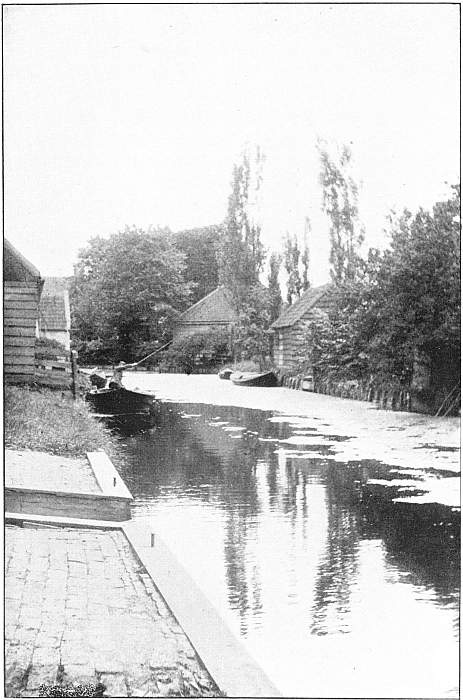
“The blue stream finds its outlet in the river.” (See page 159.)
A good-sized yacht lies at anchor in the Zuyder Zee, beside the banks of Monnikendam. The captain is a full-blooded “Markenite,” born and bred on the island. Having made arrangements with him, we go on board and are soon on our way to the strange city: our hearts beat more quickly, and all eyes are eagerly strained toward it, when the distant island appears in the direction of our yacht’s bow. After an hour’s sail, we come to anchor in the harbor of this secluded wonderland. As we approach the town, the view from our boat seems to justify the title which has been given to it of “the Dead City.” It lies away from everything and everybody, and save the deep sea which surrounds it, and which supplies its inhabitants with food, the island of Marken has for centuries known no association outside its own boundaries.
No news is carried to or from this isolated region. At rare intervals an islander, by temperament more adventurous or enterprising than his fellows, makes the daring undertaking of a visit to Monnikendam, or the bolder flight to Amsterdam, although there are but few instances on record of such a reckless proceeding as the last. The place has a population of about thirteen hundred souls, and one may form an idea of the health of its inhabitants from the fact that one doctor, without an assistant, is the family physician for all the people on the island, and we are told that calls upon his professional attention are not sufficiently frequent to keep the cobwebs from forming on his medicine chest.
The Dutch language is spoken here, and it is so rare to find any one who understands English, that it is necessary to bring an interpreter as well as guide in visiting this secluded spot. The inhabitants look upon us as though we have dropped from the clouds, or sprung suddenly out of the earth. It is unfortunate that we have come here on Monday, for on this day the men of the island go off in their fishing boats, and do not return till Saturday night. Only the old and crippled are left with the women and children. Sunday is the one day in the week which the men may spend with their wives and sweethearts. Fishing is the sole means of subsistence here. The native inhabitants are industrious and economical, but of a low type of intellect, rarely if ever displaying interest in literary attainments. Health and good appetites seem to be their chief characteristics, and a more law-abiding, innocent and virtuous people it would be difficult to find. The women are large, muscular and well shaped, and appear fully able to protect and care for their households in the absence of the men.
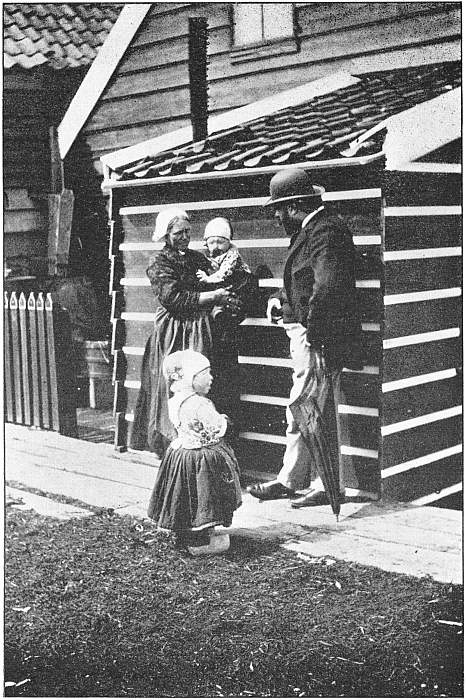
“All persuasions accomplish naught.” (See page 168.)
I am quite anxious to capture, by camera, not by force of arms, some of these rare types of strength and beauty, and observing two pretty young girls standing in the doorway of one of the houses, both perfect specimens of physical health, I think this an opportunity not to be neglected. What a fine picture they present with their erect forms, their firm round arms, rosy cheeks and bright eyes! They are well proportioned, and looking at their smiling faces one can readily understand that a physician in a locality whose residents are represented by such glowing life as that which is now before me, may easily find time to be absent from his duties a year or two.
Fired with enthusiasm, I approach the girls who are talking to a couple of old women, and am about to make a “snap shot” of the group, when suddenly perceiving my intention, they fly into the house like frightened deer, to the amusement of the old women, and the grief of the writer. Determined not to be outdone, for now this picture beyond all others is the desire of my heart, I enter the house and learn that the young damsels have sought refuge in the loft, and are hiding, ostrich like, with their heads buried in a mass of clothing. All my persuasions, aided by those of the older women, accomplish nought, even the liberal offer of silver guilders is not sufficient to move these obdurate maids, and I am obliged to relinquish my desire. However, I have made a valuable discovery, and that is that it is better under some circumstances not to ask for the privilege, but to resort to strategy. I request one or more of our party to engage the proposed subject in conversation, while I retire to a suitable distance with my camera, focus the group, then fire away. This plan succeeds admirably, and my collection increases steadily and satisfactorily.
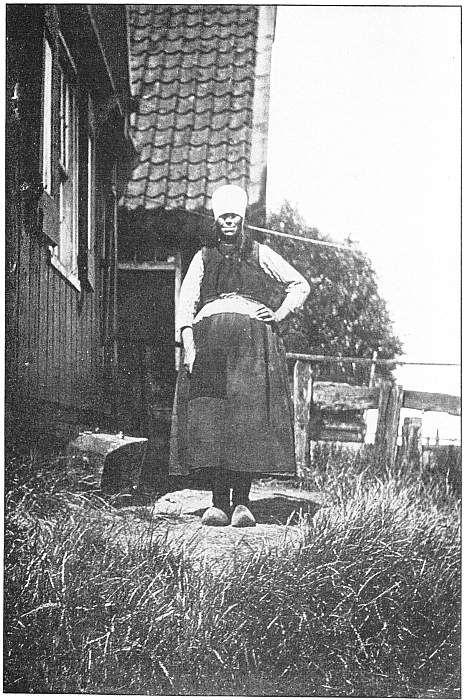
“One old woman is fascinated with the camera.” (See page 171.)
However, upon better acquaintance with the townspeople and the repeated assurances of our skipper, who speaks some English, that our purpose is an innocent one, we are allowed to photograph the whole town freely, and all its valuable possessions. Occasionally a guilder slipped quietly into the hand of one of the older women opens a new vein of good fortune, for they insist that “the gentleman shall be allowed to take the picture;” whether it be an old-fashioned interior with its quaint belongings, or a pretty maid too shy to hold her head up properly. One old woman is so fascinated with the camera that she asks me to take picture after picture of her homely wrinkled countenance. At first I do so to her extreme delight, but finally I only pretend to take her picture, and the last bewildering poses and bewitching smiles are all wasted upon an unimpressionable plate.
The Ancient Town of Monnikendam.
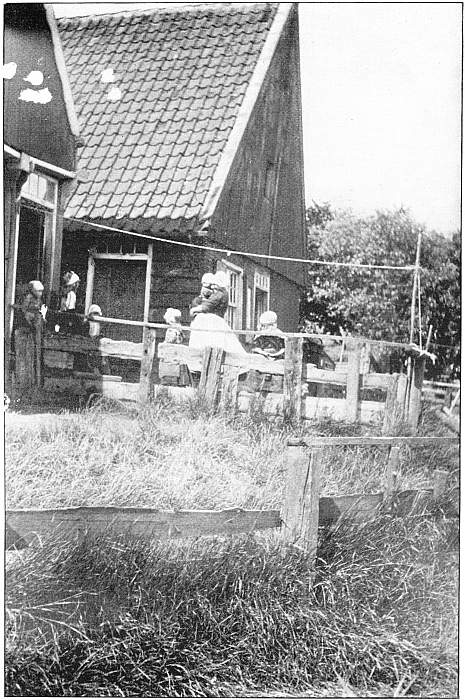
“We walk along the narrow streets.” (See page 177.)
The Ancient Town of Monnikendam.
Marken Homes—Beds in the Wall—Family Heirlooms—An Ancient Clock—Precious Treasures—Quaint Customs—Betrothed Couples—The Hotel—Its Interior—A Lack of Patrons—Costumes of a By-gone Age—Farewell to Marken—Remote Districts—Monnikendam—Ancient Houses—Hotel de Posthoorn—The Postman of the Past—A Difficult Stairway—We Stroll about the Town—Our Retinue—In Front of the Hotel—Such Curious Children—Supper—We Visit the Shops—Pantomime—A Novel Experience—They Cannot Understand—No Candles—We Attract a Crowd—The Clothing Store—A Marken Suit—“Too High”—Bargaining—A Stranger to the Rescue.

E walk along the narrow streets, some of which are paved with little footways, and now and then visit one of the whitewashed frame houses with their red tiled roofs. These houses are built after one pattern, and resemble each other so closely in their crude architecture, that a stranger might easily make a mistake, and enter the wrong door, without having previously taken anything stronger than a glass of water. The interior consists of four small rooms, which are kept scrupulously clean and orderly. One of these is used as a living-room, and one as dining-room and kitchen. The beds of the family are simply close, dark recesses in the wall, in which there are bunks or shelves, and on these the mattresses and bed clothing are placed, the occupants mounting by means of wooden steps to this ill-ventilated and most uninviting resting-place. We shudder as we glance into these dismal closets, and feel a touch of nightmare at the thought of sleeping in one of them.
In every house there seems to be reserved a special apartment, as a storage-place for the family heirlooms, and here are preserved articles which have been handed down from generation to generation for centuries. Dolls of various primitive shapes, broken and torn, with black, dusty clothing; clocks long since arrested in their career by age or accident; chairs of rude manufacture, with perhaps a broken leg or back; watches and jewelry of ancient design; odd furniture and pieces of china, besides other relics which would be useful only in an exhibition of the antique. All these things are sacred in the eyes of their owners, who would as soon think of parting with one of their children as of allowing one of these treasures to pass out of the family.
At one of the houses I see stored among the heirlooms a clock, which the owner informs me has been in the family for two hundred and fifty years. I do not doubt the assertion, for it looks as though the dust of a thousand years has silently but steadily accumulated upon its venerable face. I am about with my handkerchief to brush off some of this precious dust, in order to see the wood and brass in their peculiar coloring and design, but am quietly stopped by the hand of my host.
There is a noticeable rivalry between the different families in regard to these treasures which are placed carefully away, as if too sacred for the light of day, and are shown to the visitor much as the guide employed in the mint allows one to touch a piece of gold or silver in the early process of coinage. Each family tries to outdo the others in its collection, and in the ancient appearance of the hoard. It is amusing to watch their faces, when exhibiting the wonders: they seem very uneasy if the stranger offers to touch one of the pieces, as though in terror lest it should thus lose some of those precious particles which enhance its value.
At another house I am allowed, as a great favor, to examine one of the dolls, and really the anxiety shown until the owner has placed it once more in its place in his collection is ludicrous. The most delicate human being, or a piece of frail egg-shell china could not be more tenderly handled.
These people are quite as quaint in appearance as in their customs. The old-time costume of the island is worn as in other parts of Holland, but here there is an intensity of ancientness, if I may use the expression, which must be seen in order to be fully appreciated. They really seem the remnants of a dead era, and in all their ways display a want of experience of the outside world, a lack of that perception which the men and women of to-day seem to inhale with the very atmosphere, which is truly astonishing. The marriage and betrothal customs are especially peculiar. We learn that an engaged couple cannot wed until five years have elapsed since the announcement of the betrothal; and should a death occur in either family in the meantime, it is considered such an ill omen that the engagement is broken off altogether: at the end of a year, however, a new engagement may be entered into, and after a second long period of waiting the wedding is consummated.
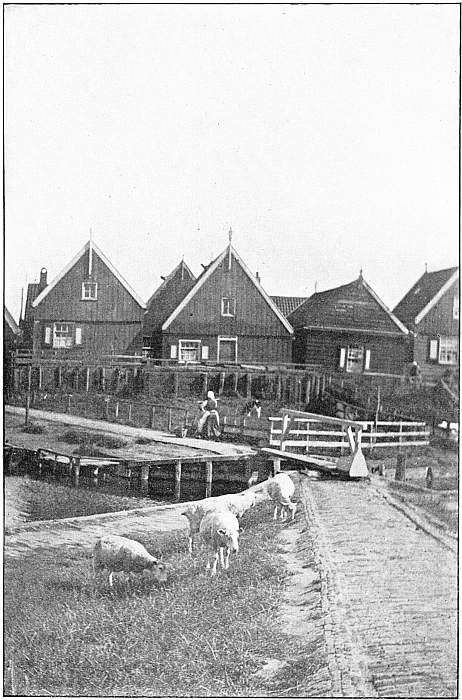
“Sheep, grazing upon the green pasture lands, form a homelike scene.” (See page 185.)
There are many rigid rules of etiquette connected with these engagements; for instance: should the young lover, upon each meeting, neglect to impress a kiss upon the cheek of every member of the family of his fiancée, the contract is annulled. One can readily believe almost any statement regarding these strange people who seem like a peculiar race stranded upon a desert island. Still from ocular demonstration, we feel very certain that notwithstanding these stringent rules, there is no lack of weddings among the young people, for there is an overwhelming number of children upon the island.
Marken boasts of a hotel, and the owner and landlord tells us as he stands proudly upon its stoop, that this bold enterprise issued from his fertile brain, and that he is looking for a rich return for his venture. I respond with as much enthusiasm as I can gather upon this occasion, but fear he would receive but cold comfort from the true state of my mind on the subject. The building consists of six rooms which he pronounces quite modern. On the lower floor are a kitchen, ten feet by ten, and a dining-room, twelve by fourteen, which also serves as a barroom, sitting-room and smoking den, all rolled into one. Here the guests are supposed to reach the acme of ease and comfort. A bare wooden table and six chairs comprise the furniture of the room, and there is nothing else visible save the snowy muslin curtains which hang at the windows. Upstairs are three bedrooms, scantily furnished; here too the windows are curtained. The freshness of these rooms and their surroundings gives us the impression that they have never been occupied since the erection of the hotel a year ago, by any one of greater importance than the myriads of flies and mosquitoes which cling in lazy groups to the walls and ceilings. My sympathy goes out to these ignorant creatures who do not seem to have strength enough to get away, and seek their nourishment in other quarters.
We find tolerably comfortable accommodations here, and view things very philosophically on account of the curious and interesting life by which we are surrounded. The men and women in their odd costumes are rare pictures. The clothing worn here is of a style worn hundreds of years ago, and there is no consciousness on the part of its wearers that there is anything unusual in its appearance. “Where ignorance is bliss, ’tis folly to be wise,” and it is more than probable that they will continue to wear this antediluvian garb for centuries to come.
Much of the washing is done in the little canal which flows through the town, and this is easily accomplished, as linen is not worn to any great extent, as in other places, and the coarse homespun garments are cleansed by a very simple process.
Sheep, grazing upon many of the green pasture lands, form a homelike, peaceful scene which is very attractive. The air is fresh, yet balmy, imparting tone and vigor to the sturdy natives.
At last we bid adieu to this stationary spot upon the earth’s surface, wondering if an earthquake or any other startling event will ever happen here to rouse it from its lethargy, and compel it to take its place in the march of the ages. If not, it will remain as of old, a boon to the artist, an infinite source from which he may draw quaint, ideal and most original studies of a people and an era whose counterpart has long since vanished from our everyday world.
In our travels in the northern portion of Holland, and away from the larger cities, as Amsterdam and Rotterdam, which are more visited by tourists, we find that our letters of credit extend over an astonishing space of time, for a little money goes a long way among these people. The regions seem to be too remote for the regular tourist, and as there is no great influx of capital from that source, there is no inducement for the people to change their simple and primitive mode of living, hence honesty, frugality and contentment reign here, and the visitor may enjoy to its full extent, the beautiful country and the pure, innocent life of its inhabitants.
The quaint and simple town of Monnikendam lies some fifteen or sixteen miles north of Amsterdam, and here is a rich and rare scene of ancient associations. Eyes, ears and brain are almost bewildered by the exquisite strangeness of our surroundings. Here are houses with the date of their birth inscribed over the doorways, and the odd designs of bygone centuries still clinging to their walls.
These ancient dates and the rich beauty of these aged tenements impress us with a feeling of awe, and we walk softly as we pass the hallowed ground upon which so many lives have risen, passed their little day, then vanished to make place for the next players. Of the two hotels which the town supports, we choose the oldest, the Hotel de Posthoorn, which derives its name from the fact that at an early date the building was used as a post office station. In those days the postman carried a horn, which he blew when approaching a station, as a notice to the townfolk to have their mail ready for collection, that he might not be detained, as his route was long and wearisome.
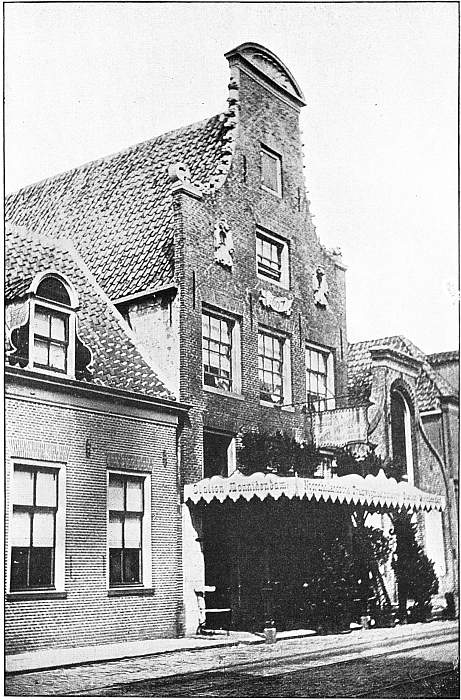
“Hotel de Posthoorn.” (See page 186.)
We are conducted to the second floor of the hotel by a steep and narrow stairway, which requires much ingenuity in the ascent, as the steps are constructed at such a peculiar angle that it is difficult to balance one’s self upon them. We reach the top as gracefully as possible under the circumstances, and find two pleasant communicating rooms overlooking the main street. Rooms, beds and all our surroundings are wonderfully clean, and filled with an atmosphere of the past, which is very charming. The rates charged here are seven dollars a week for each person, and this includes meals and attendance: the latter simply a pleasant fiction, with no meaning whatever.
The sheets upon our beds are of homespun linen of good quality, but emitting such an odor of antiquity, that there is no doubt whatever in our minds that they are heirlooms of many generations, and we wish that this genuine, ancient and unpleasant smell could be scattered abroad, or adulterated in some way, even to the extent of a pair of modern sheets, for concentrated age is more attractive in sights than in odors.
Our hotel bears the date 1697 upon a fancifully carved tablet above the middle window, but the Stadhuis Tower is still older, dating back to 1592. The proprietor, his wife and daughter are pleasant, hospitable people, who make our stay with them, both comfortable and enjoyable. Before supper we stroll about the town, which consists of a main or central avenue, with small narrow streets diverging from it. As we walk along, a little crowd, composed chiefly of children, follows us closely. These young people stare at us, and laugh as though we are a freshly imported menagerie. On our return, we sit in front of the hotel where some chairs and small tables are placed for the convenience of those who wish to rest and sip their glass of beer or genuine Holland gin in the open. The favorite beverages in Holland are beer, porter and gin, the latter of an excellent quality, and genuinely “old.”
We are soon surrounded by a group of children, who watch our motions and by words and gestures freely express their wonder and amusement at the odd-looking stranger people. They seem greatly surprised that we do not understand their language: not even such simple phrases as “Goeden avond,” (Good-evening), or “Ja,” (Yes), and “Nee,” (No). When I make them understand that in English yes and no are the same as their ja and nee, they laugh immoderately, and repeat in their own broad accents, yes and no, as if greatly amused.
After supper, which consists of cold fish, coffee, cheese, boiled potatoes and tea with a private nip of the real ancient Holland gin, we walk out again without a guide, to do some shopping. We have a funny experience, as we are compelled to resort to pantomime in making the various purchases. Entering a “general” store in search of candles, we at first ask for them in English: the good-natured shopwoman smiles and shakes her head. I repeat the word “candles,” at the same time going through the motion of striking a match on the counter, and holding it up to the end of my forefinger. This strange proceeding attracts the attention of a young man and woman, who draw near the counter, followed by several other members of the family, but I cannot make them comprehend. We then try the French language, but this also proves a failure, so we are obliged to depart without our candles, although I am confident they have them somewhere in the store.
Scene after scene of this kind is gone through with in the different shops, and now our curious actions have attracted a large crowd of people who follow close at our heels, wondering what we will do next, and thinking, no doubt, that we are a very good kind of free show. Such strange beings rarely visit their isolated town, and they are certainly enjoying their opportunity to its full extent. When we stop to look into a shop-window, they stop too, and follow our example like very shadows. The expression of wonder and merriment depicted on the countenances of both young and old is a fine study for an artist.
As we saunter leisurely along, we espy a clothing store, which we enter, and find half-a-dozen men lounging about with long clay pipes in their mouths, and their hands in the pockets of their baggy trousers. Their faces wear a peaceful, contented expression, which changes to a look of surprise as we approach them, and they scan our attire, as something wholly different from anything to which they are accustomed. The gaping throng outside besieges the doorway. As the men still gaze curiously at us, I draw near the one who appears to be the proprietor of the establishment, and in pantomime, aided by English, interspersed with a little French, ask for a Marken suit of clothes. The man laughs and looks perplexed; his companions also shake their heads in token that they do not understand. With serious countenances and widely-opened eyes, they follow the motions of my lips and hands. Uttering slowly the words: “Marken suit,” I point to my own trousers, coat and vest. Their eyes follow my hands, first to my trousers, then to my coat and vest. It is a difficult position; but what a treat to watch their puzzled countenances, now smiling, now with a look of actual pain in their efforts to understand.
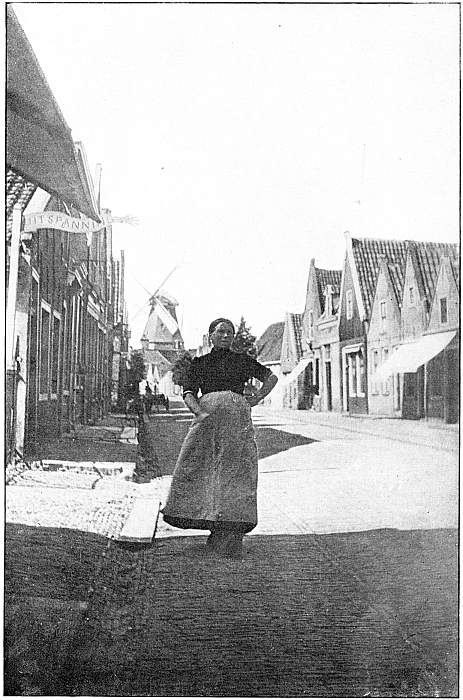
“De Hooflstraat, Monnikendam.” (See page 190.)
At last my perseverance and their attention are rewarded, and the storekeeper takes from a shelf a dusty bundle, and carefully unfolds it. Within the bundle is a Marken suit: yes, the very kind I wish to possess, an entire woman’s dress. I am anxious to purchase it at any reasonable figure. The garment is passed to us for inspection. We nod in indication that it is just what we desire. Now for the tug of war; the price. “Combien? Combien?” Finally thirty guilders is named as the price set upon the dress. We motion, “Too high,” and I point to the ceiling. The six weary men all look up in the direction of my finger: they smile, and think it is a good joke, and look at me as though saying: “What next?” They laugh heartily at my vain endeavors. Alas! How can I make them understand? “Fifteen guilders,” I say. The proprietor seems to understand. “Nee. Nee. Ik kan het niet doen.” (No. No. I cannot do it.)
After long deliberation, still holding the cherished suit in his hands, he turns to his companions, and seems to ask their opinion. Several shake their heads and utter: “Nee. Nee,” others say: “Ja. Ja.” One suggests twenty-five guilders as the price; another twenty guilders. The bargaining goes on without drawing any nearer to a conclusion, when to our relief a gentleman enters the shop who understands the language of these people. He has learned from the outsiders that some Americans are in the store trying to buy a suit of clothes. Through the kindness of this stranger, matters are speedily adjusted, and the sale effected, as he speaks both Dutch and English fluently. We purchase the complete suit for fifteen guilders, or about six dollars in the currency of the United States.
These suits are rarely made for sale, but only when needed for immediate use. The natives of the island make them for personal wear, or for each other. Every man and woman generally owns two suits: one to wear every day, and one for Sundays.
As we move toward the door to take our departure, after spending three-quarters of an hour over this transaction, we perceive that the throng around the door has increased in numbers. What an assemblage! And we are the curiosities. I count them, and find there are thirty men, women and children, all full of excitement at the presence of strangers in Monnikendam. One young girl is so shy and timid, that as we advance toward her on our way out, she starts and runs hurriedly away, and gazes at us from a distance of some twenty feet, as though we are dangerous animals.
We make several other purchases; partly because we desire the articles, but chiefly on account of our enjoyment of this novel mode of shopping.
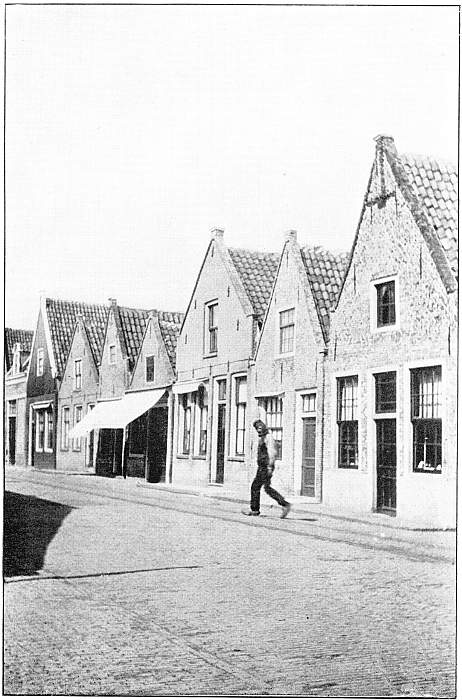
“There is a young man whose walk is all his own.” (See page 211.)
Old Customs and Quaint Pictures.
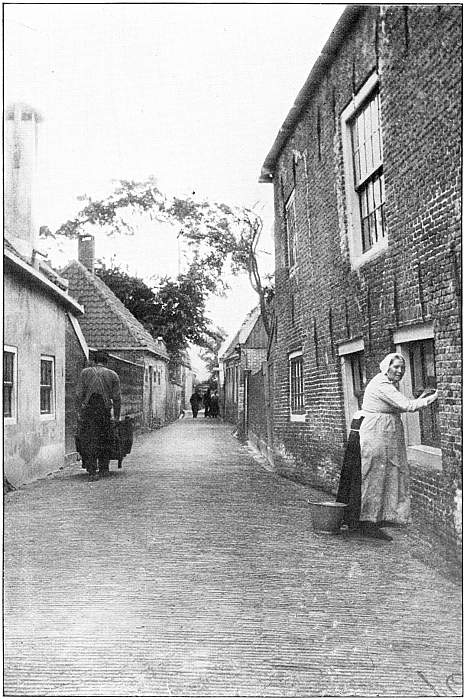
“The streets and sidewalks are kept scrupulously clean.” (See page 211.)
Old Customs and Quaint Pictures.
Segars and Tobacco—Row Boats—“Goeden Morgan”—The Zuyder Zee—By Candle Light—Total Darkness—The Town by Night—Women and Girls—Shoes and Stockings—The Shuffling Man—Streets and Sidewalks—The Town Crier—The Daily News—A Message to the People—Draught Dogs—Milkmaids—The Barber Shop—Drug Stores—“Horretje”—A Street Auction—Selling Curios—They Leave their Shoes at the Door—An Old Grist Mill—The Holland Draught Girl.

N Holland, segars and tobacco of very good quality are sold at low prices: it is not uncommon to buy two segars for one cent (United States currency) and should you be detected smoking an article costing more than a penny, you are immediately stamped as a wealthy and extravagant personage. This reputation is easily acquired in a town of such thrifty habits as Monnikendam, and here my fondness for a good smoke lays me open to both charges.
A row boat may be hired for twenty cents a day, if you do your own rowing; with a man to row, the charge is forty cents. We find it convenient to hire a man, who also serves as guide and interpreter, and who rows us to many lovely nooks and out-of-the-way spots, which we would otherwise miss seeing.
The inhabitants of the town are kind and hospitable, and we are charmed with their good, honest countenances. We are always greeted with a pleasant “Goeden morgen,” or “Goeden avond,” or it may be: “Hoe staat het leven?” (How are you?), when we pass them on the street.
The country about here is principally farm land, with rich and abundant pasturage. A short distance from us is the placid Zuyder Zee, with its shining waters stretching eastward for miles. From its picturesque banks may be seen boats of every size and kind, from the tiniest row boat to craft of many tons’ burden, and it is interesting to observe from this point the busy life upon the water, as produce, farm implements and merchandise are carried to and fro.
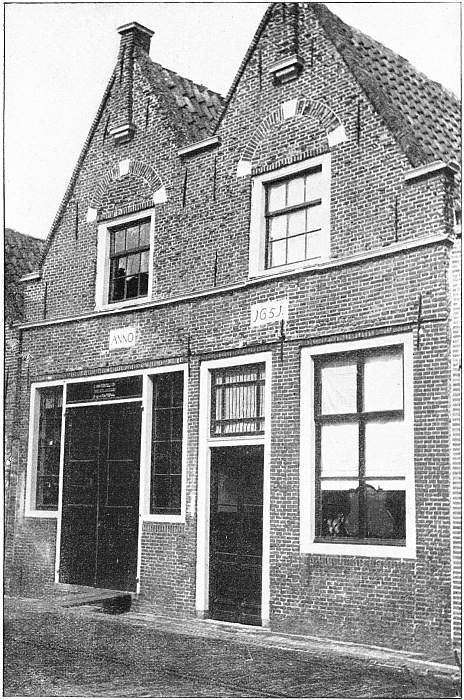
“The whole place is a succession of quaint and picturesque houses.” (See page 216.)
As I sit writing in my room, by the light of a homemade candle, I now and then pause in my occupation to look around with an ever increasing wonder, at the dark old furniture over which the light casts a ghostly gleam. The spirit of the past seems lurking in the corners, with their long forgotten history, and around yonder ancient cupboard and brass trimmed chest of drawers. I can almost feel upon my shoulder the touch of the hand which has carried this quaint old candlestick in those olden days, and in imagination, hear the rustle of her gown as she stands behind me waiting for her own. It is ten o’clock, and I walk to the window and draw aside the curtain, curious to see the life that is abroad in the town at this hour. To my astonishment there are no signs of life of any kind. The town lies in total darkness. There is not a glimmer of light anywhere, save the dim glow from a lantern dangling carelessly by the side of a pedestrian who moves slowly and quietly along the sidewalk. There is no other evidence of any living thing. Even the frogs and crickets, which enliven a night scene at home, are not heard here. Dead silence prevails, while
“Night, sable goddess, from her ebon throne, In rayless majesty now stretches forth Her leaden sceptre o’er a slumbering world.”
Even the stars are slumbering, or their sparkle has been engulfed by this all-devouring darkness. The light of my candle seems out of harmony with the peaceful repose around me: with a half-guilty feeling I extinguish it, and wrapping myself in sheets of Holland linen, am soon slumbering with the rest of the world.
In the morning, when seated at the breakfast table, my first question to our host is as to the reason for such all-pervading darkness, and the absence of the townspeople from the streets at night. He tells me that it is so rare for any one to be abroad after nine o’clock in the evening, that the street lamps, of which there are but few, are never lighted. At ten o’clock every one is supposed to be at home and in bed.
The women and girls of this and the neighboring towns are thrifty and industrious. When resting after their daily labors, whether at noon or in the evening, they will invariably take from their deep side-pockets a ball of thread or yarn, and with the short knitting needle, or the long ones of steel, continue their work on an unfinished stocking, cap or other article of wearing apparel.
The prevailing foot-covering for men, women and children is a heavy woolen stocking; this fits the foot snugly, and protects it from the hardness of the clumsy wooden shoe or clog as it is called. These shoes are carved from a single block of wood: when they are worn and shabby they are painted black, and a strap is placed across the instep. They are of all sizes, but only one style or pattern. In the larger cities, however, such as Rotterdam, one can obtain from the manufacturers a painted wooden shoe, with buttons and stitches carved upon it as ornaments. But this variation is found only in men’s shoes. In Holland the ordinary American slipper is frequently worn by both men and women.
The clatter of the wooden shoes is at first an unpleasant sound, especially when several persons are walking together, but the ear soon becomes accustomed to it, as to all other odd noises. There is a young man in this place, who walks with a peculiar shuffle, all his own. He is so strange looking altogether that I snap my camera on him one day as he innocently passes by me. The peculiar sound of his walk has taught me to know that he is coming long before his figure is visible. I sometimes feel like telling him in the words of Byron, that
“He has no singing education, An ignorant, noteless, timeless, tuneless fellow.”
The streets and sidewalks are kept scrupulously clean, as the women of each household scrub not only their sidewalks, but half-way across the street in front of their dwellings. One may thus imagine what a charming and inviting place this is for the pedestrian.
In this peaceful town where the golden rule is not simply a precept to frame and hang upon the wall, it is not necessary to employ officials with such high sounding but meaningless titles as “Street Commissioner,” “Director of the Highways,” etc., etc. No, here each individual possesses sufficient honor and self-respect to accomplish his own share of municipal work, to the benefit and comfort of the whole community.
There is one very ancient custom still existing here which interests and entertains us greatly. This is the old fashion of employing a town crier, who after beating a brass disk which is suspended by a cord from his shoulder, calls out in a loud, clear voice, the news of the day, events in foreign lands, transfers of property, sales and auctions which have already taken place or are to occur in the near future, lost and found articles and the like. For instance: he walks a distance of a block or two, then stops in the middle of the street, beats the brass disk vigorously with a small striker, and casting his head heavenward, utters the phrases which have been prepared and given to him in stereotyped tones. Thus the town receives its news, and the crier keeps those who never stir from their homes as well as the business men of the city informed of the most prominent events of their own and other countries. What better method could be employed in the absence of newspapers? The community is kept in touch with the outside world and with its own members by means of this odd and ancient custom.
“A street auction.” (See page 220.)
I have the pleasure of a personal association with the crier. Our party is so much annoyed by the continual staring of the people, who seem unable to become accustomed to our appearance in the town, and who follow us constantly day and evening when we walk upon the streets, that I decide to try some means to stop it. The proprietor of the hotel, at my request, adds another sentence to the daily bulletin; it runs as follows: “The three Americans now stopping at the Posthoorn Hotel must not be annoyed by the good people of this town. It is not good manners to stare at them and follow them, and it is unpleasant to these strangers.”
The day following my request, I listen anxiously for the voice of the crier, and his appearance in our neighborhood. Here he comes; and the message is rolled forth in sonorous tones. I seek the landlord and ask him if the notice is to be circulated throughout the town; and he replies in the affirmative. In justice to the inhabitants, I must state that they heed the request, and hereafter go on their way without undue excitement or comment when we appear among them; much to our own comfort and enjoyment.
Few horses are seen upon these streets: wagons are drawn by two, three, or four huge draught dogs, trained for this purpose. Men are also frequently harnessed to wagons, as well as women, and sometimes a woman and dog will appear together drawing a load of merchandise.
Milk is delivered by buxom young girls who carry on their shoulders a strong wooden yoke: from the ends of this the milk pails are suspended by ropes. Vegetables and other provisions are delivered in the same manner. The milkmaid passes from door to door, rapping on each with the ancient brass knocker, and serving her customer with the milk as it is served with us.
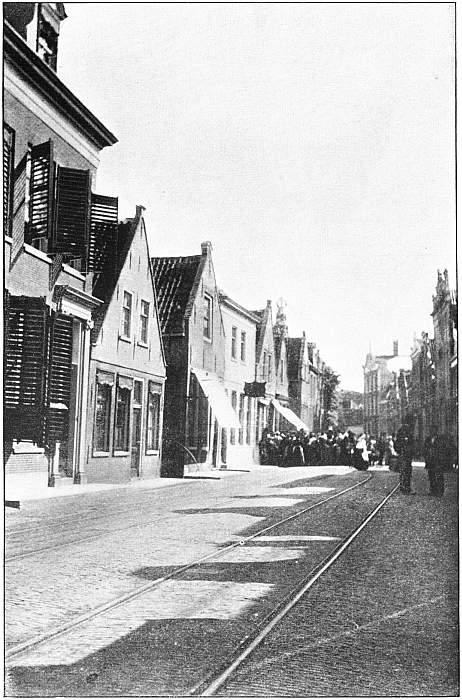
The whole place is a succession of quaint and picturesque houses. The shapes are various, and the heavy red-tiled roofs and many gables have a charming effect as they stand in rows on either side of the street. Each house seems to possess an individual style of its own, and many are so old that they lean quite out of the perpendicular.
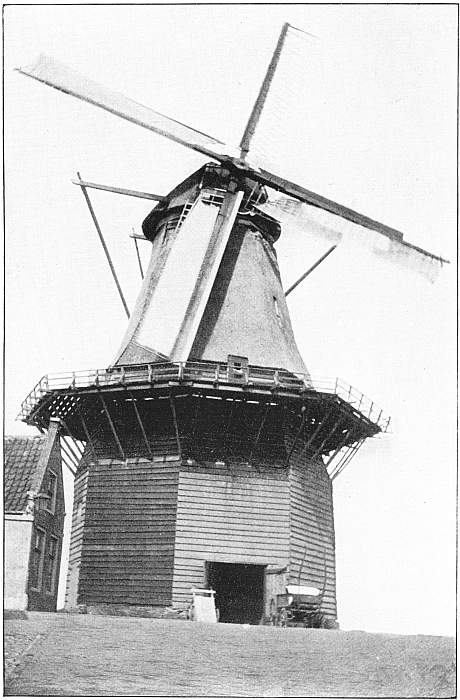
“At the farthest end of the street stands an old windmill.” (See page 223.)
While travelling in Holland one is constantly confronted with a sign in the form of a wooden arm stretched from a doorway, with a brass disk suspended from it containing the words:
Hier scheert en snyd men het haar,
which signifies that here one can be shaved and have his hair cut: in other words, it is the sign of a barber, who in America designates his calling by the gayly-colored pole. The brass disks in front of these places are polished to a high state of brilliancy, and being suspended so that they swing loosely in the breeze, they cast dazzling reflections in all directions which cannot fail to attract the attention of the passer-by. Another advertisement which differs greatly from those in our country is that of the drug store. While with us huge glass vases and globes of different colors are displayed in the window of the apothecary, in Holland a wooden head of a man in great agony, with protruding tongue, indicates that here the sufferer can find relief and medicine for all his aches and pains. This head is conspicuously placed over the entrance to the drug store.
Another odd custom in this strange country is that of placing a large screen called a “Horetje” in the front windows of private houses, or on the first floors. The screen is sometimes shaped like a fan, sometimes it is heart-shaped or oval, and is intended to protect the person seated at the door or window from the idle gaze of the pedestrian. Indeed it often hides a charming picture of maiden grace and modesty.
One day as I am sitting at the door of the hotel attempting to sketch some of the picturesque houses in the neighborhood, with many wondering eyes directed toward my canvas, I notice a crowd of people beginning to gather a short distance off. I do not see the centre of attraction, but seizing my camera, which is my constant companion, together with pencils and brushes, which are as close friends as Robinson Crusoe and his man Friday, I hasten to the scene of action, feeling that probably something is going to happen which will add a new page to my experience. It is true: something interesting is about to take place; and that is a street auction, a common occurrence in this town. The auctioneer, perched above the heads of his audience upon an old wooden box, is calling out his sales in Dutch. The articles which he is about to dispose of to the highest bidders are dress goods, linen and wearing apparel. Much persuasion is necessary before a sale is effected, as the strong desire of the customers to obtain bargains is met by an equally strong determination on the part of the auctioneer to sell his stock at good prices. A funny sort of a seesaw is the result, which is the source of much merriment among the spectators. I join in some of these outbursts from pure sympathy, as most of the time I do not understand either the jokes or allusions. A lively business is frequently carried on at these auctions; but whether the purchaser really obtains more for his money than by the ordinary method of buying I cannot ascertain. I presume they think they have some advantage, or they would not flock to the sales in such numbers.
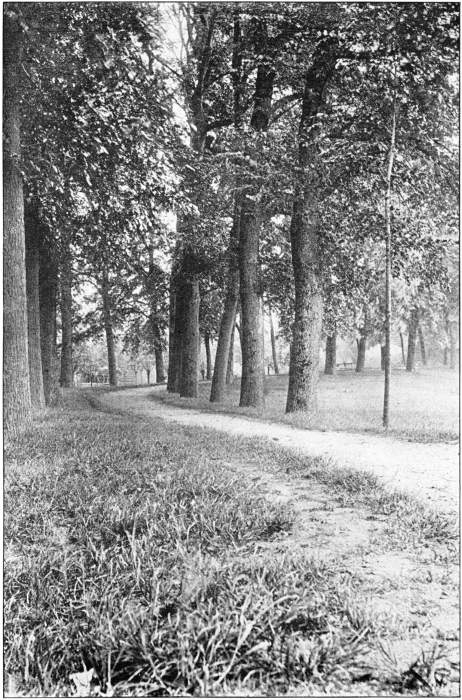
“A beautifully shaded walk just outside the town.” (See page 224.)
An active branch of business here is the sale of curios, antique silverware, china, gold, jewels, and bric-a-brac; in fact ancient articles of every description.
As we walk down the Main street, admiring the clean highway and lovely old houses on either side of us, we observe many pairs of wooden shoes lying in front of the different residences near the doorways, and upon inquiry learn that when one person goes to call upon another, he leaves his heavy wooden shoes outside the door, and enters in his stocking feet.
At the farthest end of the street stands an old windmill with its huge arms moving slowly and regularly in harmony with the gentle breeze which blows across the Zuyder Zee. As we draw nearer, we see that it is an ancient grist mill, and here is the owner, who invites us in to view the interior, and with whom we have a pleasant chat in our own colloquial style, adopted since our arrival in this city. Dozens of windmills can be seen from this point, and, as I have already said, they are used for many different purposes. The foundation story is the home of the family, and in a number of these you will find quaint, delightful pictures of old Dutch interiors, with their odd chairs and dressers, ancient clocks and brass bound chests, old-fashioned china, and tiled fireplaces.
There is a beautifully shaded walk just outside the town, encircling the whole city. Large trees here protect Monnikendam from the heavy wind and rain storms which come from the Zuyder Zee, when old Neptune rises in one of his dreadful tantrums. We enjoy this lovely walk, but what do we not enjoy in this town which surely has bound us by some magic spell; for the longer we stay here, the more loath we are to leave its borders.
One day we take a boat and direct our course along one of the canals, on which there is considerable traffic. Here we behold the pitiable sight of two young girls, harnessed like mules, and attached to a lead rope, pulling inch by inch, and foot by foot, a large canal-boat filled with merchandise.
I can imagine no harder work than this, for the poor creatures are exposed to the intense heat of the sun, with no protection against its direct rays, and they have a long slow journey before them, ere the heavily-laden boat making its progress foot by foot shall reach its destination. The toil of the factory girl in America is play when compared with that of the draught girl in Holland.
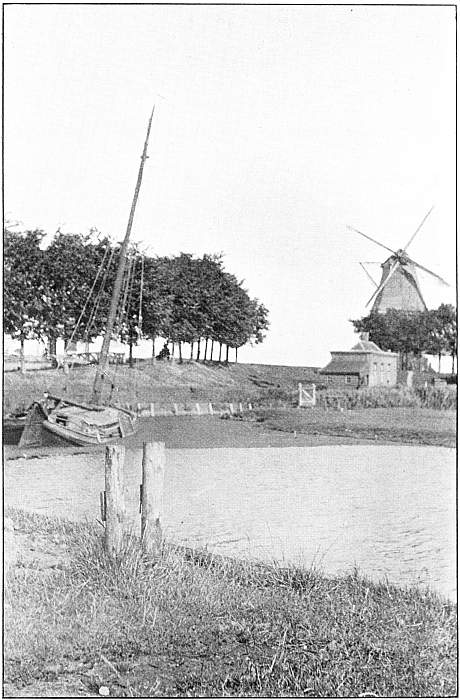
“Land and water.” (See page 224.)
A Dutch Cheese-making District.
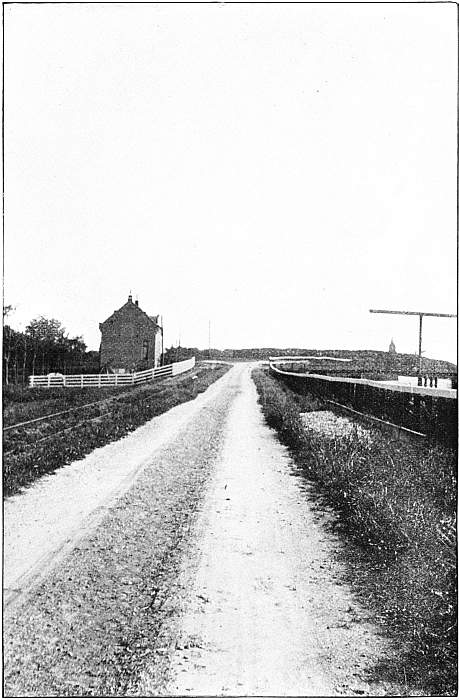
“A good road for the bicycle.” (See page 239.)
A Dutch Cheese-making District.
A Cheese-making Country—Edam Cheese—A Picturesque Inn—An Interesting Interior—A Thrifty Farmer—At Sunrise—In the Cow Stable—The Pretty Maid—Stall and Parlor—The Cheese Room—The Process of Making Cheese—“I Have Listened and Listened”—A Trip to Volendam—A Fine Country Road—A Charming Day—Muzzled Dogs—The Only Street—A Multitude of Children—Gay Decorations—A United People—As a Hen and Her Brood—Their Wealth is Health—In Sunday Dress—Stalwart Men and Sturdy Women—A Higher Type—“I have enough”—Fishermen—The Anchorage—A Volendam Suit.

O-DAY we take the train for Edam, of world-wide fame as a cheese-making centre. This town, situated about five miles north of Monnikendam, abounds in beautiful old trees which protect it from the heat of the sun, and render it very attractive. All of these towns seem to possess individual interest, and the traveller is constantly surprised in this region by new and unexpected scenes: but the imprint of truth and honesty upon the faces of the dwellers in every town, village and settlement in Holland is observed as the common bond of union, and leads us to understand the happiness and prosperity for which this region is justly celebrated.
It is hardly necessary to say that many cheese factories are scattered throughout this section of the country. At one of these factories, located on the bank of the canal, we see a large barge being loaded with five thousand of the delicious Edam cheeses, intended for foreign markets. We stop for rest and refreshment at one of the many inns on the way. This house is a fine subject for an artist. The room in which our meal is served is in itself a masterpiece. The floor, composed of large stone flags, is spotlessly clean, and the walls are covered with odd pieces of china, evidently associated with family history: the woodwork is as white as soap and sand can make it, and the windows are as clear as crystal. In a corner stands the old Dutch clock, with the moon, now nearly full, represented above its time-worn face, and on one side is the dark dresser, rich in ancient plates, and other quaint old-fashioned crockery. The table at which we sit is covered with a snowy cloth of homespun linen, and the blue and white dishes with the stories upon them which have been thus told for unknown ages almost charm us into forgetfulness of our luncheon itself, until a healthy cheerful country girl appears, and with deft movements and smiling face places before us the appetizing cheese, delicious bread, freshly churned butter, and new milk as well as buttermilk. For this but a trifling charge is made, but we feel that a glimpse into this quaint old Dutch interior, the sight of these brass-bound chests and claw-footed chairs, and the picture of the cheerful Holland maid are worth many times the cost of the meal.
We are much entertained by our visit to a thrifty farmer whose home is about a mile from Monnikendam. This well-to-do personage owns a large dairy farm, and learning that we are interested in this subject, invites us to be present at sunrise to witness the process of cheese-making. An early hour finds us on the way, and in good time a rap on the door of the farmhouse brings us into the presence of a bright middle-aged Dutch vrow, who with a cherry “Goeden morgen” bids us enter. We are first ushered into the parlor, which is a room of considerable size, immaculately clean, with comfortable chairs and sofas placed in various corners, and a supply of delft ware and shining brass candlesticks that fill our hearts with longing. In a few moments we are invited to the adjoining room, which we suppose to be the kitchen or dining-room, but to our surprise find ourselves in the cow-stable, a spacious, well lighted apartment, about seventy feet long and fifteen feet wide. A row of stalls runs along one side of the room, and here stand as many of the genuine, full blooded Holstein cattle. They are handsome creatures, looking as sleek and clean as those which take the premiums at the state and county fairs at home. Here they stand, patiently awaiting the appearance of the milkmaid; not however the milkmaid, “all forlorn” of nursery rhyme, but in truth
The pretty maid with dress so clean, With shining pail and face serene, Who milks the cows with happy smile, And sings her joyous songs the while.
The stalls are as sweet, clean and orderly as is the parlor which we have just left, and snowy curtains hang above the windows over them, the only apparent difference between the stable and the parlor being that the cattle stand upon fresh, fragrant straw, instead of a clean carpet. From the stable we are conducted to an adjoining building, which is the cheese factory, and to the room in which are assembled the farmer, his wife and two servants. Everything is in readiness: the fresh milk is poured into a huge iron kettle which stands upon the floor, and which is capable of holding about twenty gallons: a small quantity of rennet is put into the milk, and in perhaps twenty minutes a kind of sieve is passed quickly to and fro through the curdled mass. These sieves or curd-knives have handles by which they are held while the blades are drawn from side to side, cutting the curd into myriads of tiny cubes. Then the farmer’s wife rolls up her sleeves, exposing to view a pair of round, shapely arms which would be the pride of a city belle, and dips both hands and arms deep in the floating mass. She presses, and kneads and rolls this thickening body until it assumes the consistency of dough: the whey is bluish in color, and as thin as water. This is drained off, and water is poured over the mass several times, until the cheese is thoroughly cleansed of all the floating particles. It is now ready to be placed in five pound moulds made of wood: the moulds are put into a powerful press which shapes the cheese, and extracts any lurking remnants of water. After about eight hours in the press, the cheeses are salted and placed on shelves to dry. Now for a month it is necessary to turn them every day, and after that, every other day for a month. They are also sponged with lukewarm water and dried in the open air, and the final process is a thin coat of linseed oil. It is a tedious operation; great care is necessary to keep the chamber in which they are shelved perfectly clean and dry, and of an even temperature. At last the articles are ready for shipment to all parts of the world. This is an enormous industry: in North Holland alone, we are informed that twenty-six million pounds of cheese are produced per annum.
The portion of the process witnessed by us occupies about an hour and a half: these cheeses are worth from the farmer’s hands fifty or sixty cents apiece.
There is a little boy ten or twelve years of age about here who seems to derive great pleasure from our society, although he cannot understand one word of English. One day, after sitting quietly for a long time, while we are conversing together, he repeats impatiently in his own language: “I have listened and listened to your talk, and I cannot understand one word. I do not think you are talking sense at all.”
Alas, poor child! You are not the only one who has listened and listened, trying in vain to find a gleam of intelligence in the foreigner’s gibberish. Ignorance of the language of a nation causes it to appear to one like a vast sealed volume, which he knows only by the pictures on the title page.
I have written at length of the Island of Marken, one of the most noted of the “Dead cities of Holland,” and now, let us take a peep at the sister city of Volendam, which lies four miles north of Monnikendam. As we do not wish to visit this place when all the men are off on their fishing expeditions, we choose for our excursion a clear bright Sunday, a day on which the men will surely be at home, and their sea horses at anchor in the harbor.
Procuring a large carriage and a powerful horse, a difficult thing to obtain at short notice, we direct our driver to jog along slowly that we may enjoy the beauty of the surrounding country. We drive over a fine road, level and well ballasted; a good road for the bicycle: in fact all the roads of Holland, city and country, are kept in perfect condition. It is a charming day, and the balmy atmosphere and the refreshing breeze which sweeps over the Zuyder Zee have a soothing effect upon mind and body. This would be a great country for invalids, and those who seek rest and change from the demands of fashion and social life. There is no fashion here; only pure air and lovely peaceful beauty everywhere, with good wholesome food and kind hearts to extend a cordial welcome to the weary stranger. Added to this is the very moderate cost of a sojourn in this delightful region.
Occasionally we pass a small cart or wagon drawn by dogs, the driver a young girl who is comfortably seated in the vehicle, now and then administering to the animals, by means of a short stick, reminders not to lag on the way. These dogs are not the ordinary house dog which is seen in our country; but are powerful and muscular creatures, as perhaps I have already said, and so cross and savage when roused, that to secure the safety of the persons near them they are closely muzzled. Being ignorant of their peculiar traits, one day while admiring a couple of fine draught dogs which are resting near a wagon, I approach them too closely; my enthusiasm is suddenly cooled as one of them springs viciously at me, striking me heavily on the chest, and he certainly would have chipped a good sized piece of flesh from my body had his muzzle not prevented this catastrophe. Hereafter I keep a distance of many feet between me and these animals, and others of their species.
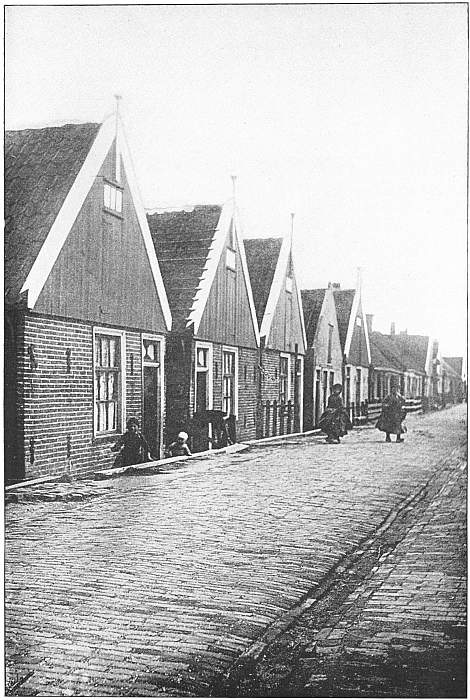
“This strange looking highway runs lengthwise through the town.” (See page 243.)
After a lovely drive of an hour, we arrive at the old town which is as wonderful and interesting as its sister city. It too is built upon the banks of the Zuyder Zee. We stand upon the only street in the place, which in appearance resembles the back bone of a whale, with small brick houses on either side. This strange looking highway runs lengthwise through the town. The street is narrow: horses and dogs are never seen upon it, but there are hundreds of children, who gather in great throngs around our horse, wondering at the strange animal, and declaring him to be a huge dog, for many of them have never seen a horse before. Our appearance is also a great event to them, and the visit creates as much excitement on one side as the other. It is a “red letter day” for both the townspeople and ourselves.
The houses are roofed with red tiles, which exhibit many different shapes and styles, and we perceive numerous flags floating from the windows, and decorations of gay bunting. Upon asking the reason of this festive appearance in the isolated and usually quiet city, we are informed that they are in honor of a wedding which is to take place within a few days. A wedding in this town is an occasion of great rejoicing, and every household enters into the spirit of the entertainment with enthusiasm, as the whole community resembles one large family, and from the least to the greatest, they are all well known to each other. The affairs of one are the affairs of all, hence a single marriage becomes the festive occasion of the entire population. This is not strange when one recollects that the people have no other means of entertainment, such as theatres, concert halls or libraries, whist or euchre parties. They have nothing save the individual happenings in the domestic lives of the different families.
A woman whose children are sitting quietly upon the curb stone near us, looks hurriedly around the door of her house, and seeing the commotion which our arrival excites, calls anxiously for her “kids” to come to her protecting arms, in mortal fear lest one of her brood should be carried off by these strange and unexpected visitors. As I look around, and behold the robust and muscular physiques of both men and women, I think any one would be daring indeed who would attempt to carry off a child or any other possession from these people in opposition to their wills.
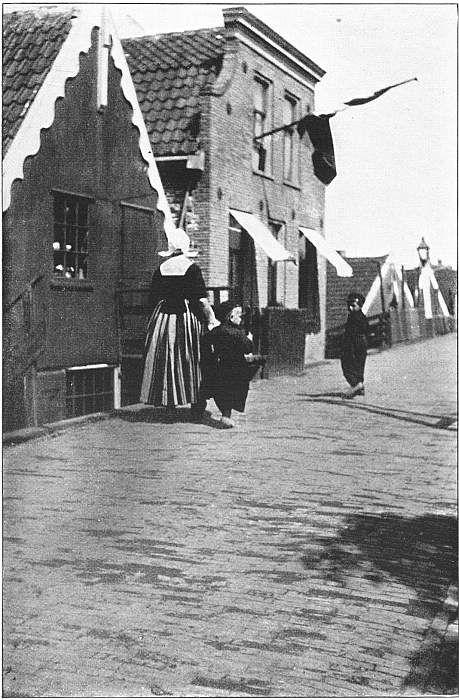
“The houses are roofed with red tiles.” (See page 243.)
The women and children here are richly endowed with the blessings of health and strength. The whole population of thirteen hundred people employ but one doctor, who has time to grow rusty in his profession, so few are the demands upon his skill. I suggest to him on the occasion of a meeting, that he adopt the Chinese plan of remuneration, that is that the people pay him an annuity as long as they are well, and that when they are sick, they be entitled to his services gratis.
The natives of Holland are not inclined to excesses of any kind, and they thus enjoy the full benefit of naturally sound constitutions, and are able to transmit to their children perfect, unimpaired health. As we stroll along this backbone of a street without name or pretensions, we stop at many of the doorways to talk with the residents, and soon become impressed with the hospitality of the people, who are arrayed in all the glory of their Sunday finery, and appear at the fronts of their homes happy in the consciousness that they as well as all their surroundings are in “apple pie order.” We are as much interested in them as they are in us, and that is saying a great deal.
The great, stalwart fellows with their broad shoulders and rugged faces are indeed true types of all that is brave and manly. A loose shirt and baggy trousers, with a small cloth cap is the ordinary costume of the men, many of whom wear wooden shoes; leather slippers are also worn. The women are equally brave and strong in appearance, and as large in proportion as the men. Their sturdy forms and healthy faces are rare models for the artist’s brush. Their dress is of homespun linen, generally dyed blue, and is composed of several pieces; sometimes these are of various colors combined in a picturesque and effective arrangement. The head-dress is of lace and is pretty and becoming: indeed many of our fashionable belles might greatly improve their appearance by adopting the charming coiffure of these pretty and apparently unconscious Holland girls and women. These people represent a higher type of humanity than the inhabitants of Marken: their intelligence and refinement are more marked, but they have the sunny temperaments and contented dispositions characteristic of the Hollanders, and though ignorant of the customs of the outside world, and limited in their lives to a narrow sphere, they are a happy and satisfied people. They seem in that happy state of mind, so rarely possessed, in which they can say I have enough. Happiness consists not in possessing much, but in being content with what we possess. He who wants little always has enough.
These men, like those in the neighboring Island of Marken, obtain their livelihood by fishing. They leave their homes in small boats or yachts every Monday morning, and do not return until late Saturday night, allowing them but one day in the week, Sunday, to spend in their homes. Close by us is the anchorage, so called from the fact that dozens of fishing boats anchor within its harbor. I suppose that fully a hundred of these yachts are lying there now, and, shifting from side to side as the wind stirs the waters of the Zuyder Zee, present the appearance of a city of masts in a hurricane.
As we wander about it occurs to me that I should like to become the possessor of one of the odd and picturesque suits of clothing worn here; especially one of the better kind of the men’s suits, for I know that this quaint and ancient dress would be interesting to a number of friends far away in dear America. Filled with the idea, I stop many of the natives, and through our good and genial friend Mr. L—— inquire if it is possible to purchase from one of them a suit of clothing, and suggest that if they have none themselves to sell, perhaps one of their comrades would part with a suit in exchange for my bright guilders. We talk to a great many men, but receive the same answer from all: that is that each possesses but two suits; a best or Sunday suit, and a week-day or fishing suit, neither of which it is possible to sell for any price that I may offer. I ask again if there is not some one else among the men who may be willing to oblige me, and learn that most of the men and women are in church, but that if we will wait until the service is over, we can talk with them, and may succeed in our quest.
Volendam Sights and the Oldest Town on the Rhine.
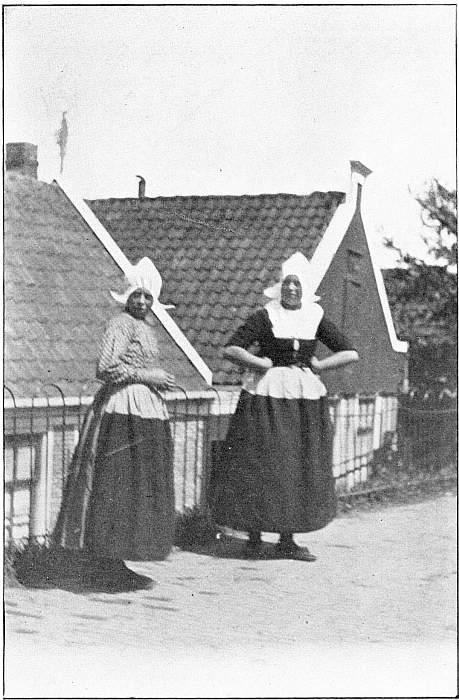
“The delicate lace caps frame smiling faces.” (See page 256.)
Volendam Sights and the Oldest Town on the Rhine.
Church is out—The Promenade—Every man is a Volume—An Old Suit—His Sunday Clothes—“Let him have it”—An Obedient Son—The Silver Buttons—The Last Straw—An Uncommon Action—The Hotel—An Artist’s Resort—An Unfinished Painting—Good-bye—The Ancient City of Cologne—The Cathedral—Within the “Dom”—A Wonderful Collection—Foundation of the Town—History—Vicissitudes—Public Gardens—Eau de Cologne—The Palace of Brühl.
ITHIN a short time we perceive a large number of people slowly advancing in our direction. Church is over, and it is customary after the service for every one to promenade up and down this street. Here friends and relatives greet each other, exchange items of local interest and have their little gossips over family affairs. The sight is one long to be remembered. The round weather-beaten faces of the men, as they roll along in true sailor fashion, the merry chattering women and girls in their picturesque costume, the children running hither and thither, and the gayly decorated houses that line the long street are worthy the brush of an artist.
Truly these people seem to practice the Golden Rule, for no one appears to be thinking of himself, but every one cares for the comfort and happiness of his family, friends or neighbors. The delicate lace caps of the women frame smiling faces, and the maidens in their quaint homespun gowns look as though they are a part of a play at one of our theatres. As the congregation draws nearer, we halt before the foremost group, and having attracted their attention by our novel appearance, ask through our friend Mr. L——, the oft-repeated question about the suit of Volendam clothes, which we are anxious to carry home to show our friends in America. In an instant they all shake their heads in the negative, looking very serious at the idea of such a proposition. Their manly and straightforward manner charms me. I look into the open countenances, in which there is much individuality, and say to myself: it is as true here as in the great cities of the world that Every man is a volume if you know how to read him. There is a story in the heart of each one of these sturdy fishermen, whether it has seen the light of day or not, and many a noble deed and heroic action that in another town would receive a medal of honor, or at least the applause of the public, passes here as a common incident of everyday life. These people do not live for show: the only medals which they wear, and which they transmit to their children are the records of pure, honest lives which are proudly handed down from one generation to another.