UNUSUAL METHODS OF PROPAGATING NUT TREES
Reading edition
Dr. Robert T. Morris, New York City
With the exception of the chestnut and the almond, much difficulty has been experienced in propagating most of the nut trees of temperate latitudes by budding or by grafting. This appears to be largely due to the slow formation of callus which is to make new cell connection between the cambium layers of host and of guest. In southern regions of the United States the union occurs much more readily than in the north. My experiments have been made chiefly with reference to developing methods of propagating nut trees in the north. All of the usual methods common among nurserymen have been practically failures, but certain unusual methods seem to promise success.
One unusual method which was suggested at last year's meeting by our member Mr. J. F. Jones, has given a good proportion of catches. This consists in using wood which is more than one year old for scions. Some of the scions of shagbark hickory from wood four, five, and even six years of age have caught. The chief difficulty has consisted in starting the buds of this old wood (latent buds) before vigorous sprouts from the stock diverted all the sap. It has been necessary to give much attention to the removal of these vigorous stock sprouts. I seem to have made the observation that if a small side branch from old wood carries a large terminal bud, this bud will start promptly when old wood constitutes the rest of the scion.
A method which I employed for the first time this year, which appears to have resulted in securing union between stock and scion, has been employed between different species of hickory trees. It belongs among the inarching methods in classification. It seemed probable that if a scion were to be supplied with sufficient water to prevent drying out, in advance of granulation-cell connection, we might meet with success.
The first line of experimentation with this idea in mind was conducted last year. The scion when grafted upon the stock was deprived of its top bud, and a small test tube filled with water and fitted with a rubber cap was adjusted over the site previously occupied by the top bud. This in practical working really did keep the cells of the scion alive and in good condition for a long time, but there was always a tendency for the water to become impure because of the growth of various algae and other microbes. Evidently the water when used in this way helped to furnish a balance between the negative and the positive sap pressures which occur under changing conditions of barometer and temperature, and which are influential in the matter of cellular repair. The introduction of germicides into the water of the test tube prevented the development of adventitious organic life, but at the same time seemed to interfere with normal cell activity at the junction of stock and scion.
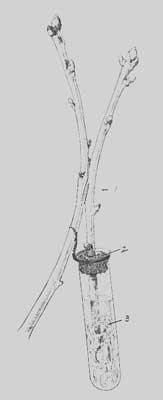
Dr. Morris's march method of grafting with balanced aquarium. 1. Point of union to be covered with grafting wax after binding with raffia. 2. Loose plug of moss to lessen evaporation. 3. A living water plant.
The "aquarium" is made out of an ordinary large test tube. Any small bottle would do as well.
This method served a purpose in advancing our knowledge of the subject, but not enough grafts caught to encourage me greatly. Following out the same line of thought, I began this year by making union between stock and scion according to inarch principles. The scion instead of remaining attached to its parent plant, according to former inarching method, had been transferred to the stock, leaving two or three inches of scion free below the point of grafting, as illustrated in the drawing. The proximal part of the scion was then inserted into a test tube containing water. In this case, as with placing the test tube at the top of the scion, difficulty was found in preventing the growth of microörganisms in the water. The addition of benzoate of soda, borax, boracic acid, and sulphate of copper, while preventing the development of microörganisms, seemed also to be objectionable to the physiologic processes of the plant. It occurred to me that the principle of the balanced aquarium might be applied, and acting upon this idea specimens of a pond weed (Utricularia) were introduced into the test tubes. This seemed to settle the water question completely, but it was well along in the summer before I made grafts and applied this principle. From one to four leaves, or parts of leaves, were left upon grafts which were applied to stocks according to this new inarching method. All of these leaves remained green until autumn, and fell with other autumn leaves of the stock. Two specimens which I have cut away for examination seemed to show a very good union between stock and scion.
I am presenting a description of the new inarching method promptly, before obtaining more extensive statistics, in order that members of this society may apply it experimentally next spring. Should it succeed according to present promise, it will allow nurserymen at least two months of grafting season, and they will not have to rush their work. In addition it will perhaps open up a method of grafting which may be employed freely with nut trees in the northern states.
Another unusual method for propagating nut trees consists in facilitating the development of adventitious buds from the roots of some particularly desirable tree. I do not know at the present time how many species of nut trees will develop adventitious root buds, as my experiments have been confined to roots of the shagbark hickory, beech, and hazel. Segments of roots of these three species when placed in sand, allowing an inch or so to protrude, will develop adventitious buds if they are kept warm and moist. Various lengths of root segments have been employed, ranging from two or three inches up to two or three feet. The beech and hazel will apparently start adventitious buds from almost any sort of root segment; but in the shagbark hickory, adventitious buds started best upon root segments which were more than six inches in length and more than half an inch in diameter.
Hazels may be propagated in an unusual way from the cuttings of branches, very much like roses, if these cuttings are placed in sand and kept warm and moist, although they do not strike nearly so readily as rose cuttings. I have not given much attention to this experiment in its practical bearing, but have simply observed that hazel cuttings will strike roots if they are particularly well cared for.
Experiments with hickories and with walnuts from branch cuttings were a failure, but they remained alive so well and formed such good callus, that I believe someone with steam-heated hot-house beds at his disposal may by experimentation succeed in propagating some of these trees by cuttings, particularly from herbaceous growth of the year, in August. As an amateur plant physiologist I foresee what the more scientific plant physiologists may do for this subject.
One unusual method for propagating nut trees may perhaps be described more correctly as a method for propagating unusual nut trees, and it opens a vista of distant horizon in horticulture. The discovery was due to an accident, and I claim no credit beyond recognizing the significance of an odd phenomenon.
Three years ago some pistillate chinkapin flowers which had been covered with paper bags, were left unpollenized because I did not have pollen enough to go round. The bags were left in place because I was busy with other things. When these bags were removed at the end of about three weeks, it was found that the flowers had set a full complement of nuts without having received pollen. These nuts continued to develop and were fertile. Some of them presented a peculiarity in growth of the cotyledons and germ, both of which grew and protruded beyond the involuere before the nuts were ripe, indicating that the germ had not come to a state of rest during its usual period in the nut. This freak appeared in only eight of the nuts, a larger number having normally resting germs.
In all of these nuts it seemed to me we were probably dealing with parthenogenesis. In order to make sure that no pollen had been carried in by any sort of insect, I made check experiments last year, covering pistillate flowers so carefully that there could be no question about their having received no pollen. It was found that the chinkapin would develop nuts freely in this way, and that the bitternut hickory, shagbark hickory, and pignut (Hicoria glabra) would develop nuts sparingly in this way.
I speak of the matter as parthenogenesis in advance of microscopic examination of the ovules,—which will be made next year; but parthenogenesis seems to be the most likely explanation. If this is the case, the embryo has not been formed by the conjugation of two gametes, as generally occurs in the algae and higher plants. It is possible that the embryo in the unpollenized chinkapins does not originate from the female gamete at all, but that it originates from a formative budding of other cells in the ovule. We can speak of parthenogenesis only when the embryo originates from a female gamete alone, i. e., without fusing of protoplasmic mass of the female gamete with protoplasmic mass of the male gamete.
Some of the nuts which I am calling parthenogens have developed plants this year. The chief peculiarity to be observed is great disparity in size between plants of the same age from the same parent tree. Some of them grow very much more rapidly than the average plant of the species, and others less rapidly when subjected to similar conditions of soil, temperature and moisture.
We assume in biology that one of nature's objects in having two sexes is to prevent early senescence of the allotment of protoplasm for a species, and to avoid undue intensification of characteristics of one parent. This is apparently nature's device for maintaining a mean type. For man's purposes we may now make artificial selection of individual plants which represent intensification of desirable characteristics of one parent. The growing of trees from unfertilized ovules will apparently open an entirely new field in horticulture, and no one can prophesy the result of selection of trees which present intensification of desirable characteristics of a single parent through several successive generations.