Front matter (continued 4)
Reading edition
?South Dakota: County unknown: Fort Mackenzie, Missouri River, 6-8 mi. below Cedar Island (Stejneger, 1944:15).
Tennessee: Lake: Mississippi River (Parker, 1948:29). Pickett: Obey River at Eagle Creek Ford (Shoup, Peyton and Gentry, 1941:75).
Wisconsin: Crawford: Pepin: Mississippi River (Breckenridge, 1944:183; Pope and Dickinson, 1928:82).
Trionyx muticus calvatus Webb Gulf Coast Smooth Softshell
Plate 47
Trionyx muticus calvatus Webb, Univ. Kansas Publ. Mus. Nat. Hist., 11:519, 1 fig., 2 pls., August 14, 1959.
Type.—Holotype, UI 31071, hatchling, sex undetermined, alcoholic; obtained from Pearl River, Roses Bluff, 14 miles northeast Jackson, Rankin County, Mississippi, by William F. Childers on August 25, 1952.
Range.—Southeastern United States from the Florida Parishes of Louisiana eastward to the western end of the panhandle of Florida; rivers of the Gulf Coast drainage from the Escambia River drainage, Florida, westward to Louisiana and Mississippi including the Pearl River drainage. The eastern extent of geographic range is not known (see map, Fig. 22).
Diagnosis.—Juvenal pattern of large circular spots, often ocellate; no stripes on dorsal surface of snout; pattern on dorsal surface of limbs of fine markings, not in contrast with ground color; pale postocular stripes having thick black borders approximately one half width of pale stripe on adult males.
Description.—Plastral length of smallest hatchling, 3.0 centimeters (TU 17301); of largest male, 11.8 centimeters (KU 47118); of largest female, 18.0 centimeters (TU 13473).
Juvenal pattern of dusky, circular spots, some ocellate, lacking short lines and streaks; number of spots variable; some spots on carapace of hatchlings may have maximum diameter of three millimeters (TU 17301); pale rim of carapace having dusky, ragged, inner border; juvenal pattern on adult males absent or usually evident, at least posteriorly (TU 17306.1).
Dorsal surface of snout lacking pale stripes just in front of eyes; pale postocular stripe having thick, black borders on adult males, but narrower, dusky or blackish borders on juveniles and large females; lower border of postocular stripe usually in contact with dusky postlabial line; no other markings on side of head; pattern on dorsal surface of soft parts of body of closely approximated, fine markings that are not in contrast with ground color, over-all coloration grayish; occasionally few larger and more contrasting markings, especially on hind limbs and anteriolateral surface of forelimbs.
Underparts whitish, lacking markings, occasional black flecks or dusky marks posteriorly along ventral edge of carapace (TU 17306.3).
Surface of carapace smooth in adult males; large females lacking prominences posteriorly in center of carapace or in nuchal region; anterior edge of carapace smooth in both sexes, but occasionally having regularly spaced furrows or wrinkles on hatchlings.
Comparisons.—T. m. calvatus can be distinguished from T. m. muticus by the absence of pale stripes on the snout just in front of the eyes, in having pale postocular stripes that have thick, black borders on adult males, and in having a juvenal pattern of large, circular spots that are often ocellate and three millimeters in diameter (no short lines).
Remarks.—I have not seen specimens of calvatus from the Tombigbee-Alabama river drainage; presumably Cook's record (1946:185) from Lowndes County, Mississippi, represents this subspecies.
It is still not certain that calvatus occurs in streams that drain into Lake Pontchartrain, Louisiana; TU 17236 from the Amite River that lacks a diagnostic character is questionably referred to calvatus (Webb, 1959:524). As mentioned previously T. s. asper shows little evidence of intergradation with T. spinifer in the Mississippi River drainage; asper is present in streams of the Lake Pontchartrain drainage. T. m. calvatus presumably shows a corresponding relationship with T. m. muticus in the Mississippi River drainage. There are no specimens that indicate intergradation between calvatus and muticus; calvatus is expected in streams that drain into Lake Pontchartrain, Louisiana. Probably calvatus occurs eastward in the Apalachicola drainage system.
Specimens examined.—Total, 38 as follows: Florida: Escambia: KU 47116, 50852, 50854-55, 50835-36, TU 13473, 16682, 17301, 17302 (2), Escambia River, 2 mi. E, 1 mi. N Century.
Louisiana: East Baton Rouge: TU 17236, Amite River, "near" Baton Rouge. Washington: TU 13795, Bogue Chitto River, Enon; TU 17303 (5), TU 17304 (4), Pearl River, "near" Varnado. No data: TU 17305.
Mississippi: Lawrence: KU 47117-19, TU 16956, USNM 7655, Pearl River within 4 mi. of Monticello; TU 17306 (4), Pearl River, 9 mi. S Monticello. Marion: USNM 95133-34, Pearl River, Columbia. Perry: MSC uncatalogued (3), 3 mi. SE New Augusta. Rankin: UI 31071, Pearl River, Roses Bluff, 14 mi. NE Jackson.
Records in the literature.—Mississippi: Forrest: no data. Jones: Crawford Bridge. Lowndes: Columbus, Lake Park (Cook, 1946:185).
NATURAL HISTORY
Habitat
Most writers who describe the general habitat of soft-shelled turtles mention large rivers and streams having some current, and large permanent, quiet bodies of water having soft mud or sand bottoms, but note the general avoidance of temporary water. The impermanence of water in the ponds and "charcos" of headwaters of streams may preclude the presence of softshells from these otherwise suitable habitats. Seemingly, soft-shelled turtles are not restricted to particular local situations or microhabitats in a continuous aquatic environment as are some kinds of fish, which seem to be more or less confined to riffle areas or deep holes. Certain activities of softshells such as burying themselves in soft sand in shallow water or seeking crawfish and other food over a gravel-rock substrate or one that is débris-laden, are best carried on in different habitats. Repeated observations of turtles that are probably engaged in a specific activity in a restricted area may lead to erroneous general conclusions regarding the over-all preference for a specific habitat. Perhaps this accounts for Conant's statement (1951:156) that "In the lower portion of the Scioto River [Ohio] it appears that the present species [muticus] is abundant while spinifer is almost entirely absent."
Cagle (1954:181) wrote that softshells "inhabit the extreme headwaters and smaller tributaries." Other statements in the literature indicate the variety in kinds of habitat. In Louisiana, Beyer (1900:44) mentioned spinifer as abundant "in all inland waters, preferring, however, such bayous which have sloping and sandy banks upon which they are fond of sunning themselves." Viosca (1923:41) reported soft-shelled turtles as characteristic "of the large silt-bearing rivers … such as the Pearl, Amite, Mississippi and Atchafalaya." Cagle and Chaney (1950:386) wrote that spinifer in Louisiana was found in greatest abundance in streams having some current, but that individuals were also common in quiet areas; the habitats recorded were: False River—a lake of clear water supporting an abundance of submerged vegetation, the shallow ends having mats of water hyacinth; Lakes Iatt and Bistineau—cypress swamps having clear or muddy water; Caddo Lake—a large lake having a light oil film on the surface of the water, and vegetation toward the shore consisting of cattails, water lilies and water hyacinths, and along the bank of cypress and willow trees; Caddo Lake Spillway—muddy with swift current; Sabine River—swift current, traps set in quieter backwater areas or near cypress logs in river; Lacassine Refuge—traps set in inlets and coves of ship channel having vegetation of water hyacinth, alligator grass, and along bank, saw grass, cypress knees and snags. Stejneger (1944:59) reported spinifer taken in barrow pits in Mississippi.
In Southern Illinois, Cagle (1942:160) recorded spinifer in drainage ditches (normally having several feet of water and a lush growth of aquatic vegetation) that connect inland swamps to the Mississippi flood-plain but dry up periodically, and in Elkville Lake, an artificial lake having much aquatic vegetation in shallow areas (op. cit.:157). Myers (1927:339) recorded a spinifer from Indiana from a "tiny brook." In east-central Illinois P. W. Smith (1947:39) recorded spinifer in mud-bottomed dredge ditches, lakes, ponds, small streams and rivers, whereas muticus was found to prefer rivers having clean, sandy bottoms and was not taken from lakes or small streams. This restriction in habitat preference of muticus is again emphasized by Smith and Minton (1957:346) who wrote that in Illinois and Indiana, muticus "generally avoids lakes and minor streams." Weed (1923:48), however, recorded muticus (and spinifer) from Meredosia Bay, Illinois, presumably a broad, shallow, muddy ox-bow lake of the Illinois River.
In Minnesota, spinifer has been taken from the Mississippi River, which is described as fairly swift having a fluctuating water level, sandy islands, mud banks, a bed of pebbles and large boulders, and abundant crawfish (Breckenridge, 1955:5). In Michigan, Edgren (1942:180) recorded spinifer from a "very small muck-bottomed lake." Evans and Roecker (1951:69) recorded spinifer from Long Point, Lake Ontario, which is a "broad sand spit, straight on the lakeward side but irregular with wet flats and lagoons on the bayside."
In Kansas, Brumwell (1951:207-08) found "mostly young [muticus] … in the old ponds left during flood stages of the Missouri River" … and spinifer occasionally … "in the backwaters where stagnant ponds had been formed." In southcentral Kansas, Burt (1935:321) reported muticus from "a sandbar at junction of a small creek and Medicine River" … and … a "shallow sand-bottomed, algae-filled pasture streamlet." The same author reported spinifer from a "sand-bottomed prairie streamlet" … and … "an alga-filled pool near a stream." Burt (loc. cit.) remarked that "No ecological differences in general habitat and field behavior of mutica and spinifer are evident in Kansas." Clarke (1958:21) observed spinifer in Long Creek (Osage County, Kansas), which is a winding stream, characterized by numerous deep holes alternating with rocky riffles, and having high and wooded banks, and mostly mud bottom but occasional rock bottom.
Marr (1944:490) mentioned a spinifer that was obtained on the bank of a small, mud-bottomed stream in the Texas panhandle, and Linsdale and Gressitt (1937:222) recorded spinifer from irrigation canals in Baja California.
In southern Florida, ferox occurs in all fresh-water habitats (Duellman and Schwartz, 1958:272). Carr (1940:107) reported ferox as widely distributed in streams, lakes, big springs and canals. Judging from the numbers of turtles, "the larger canals in the Everglades must represent something like an optimum habitat" (Carr, 1952:417). Wright and Funkhouser (1915:119) wrote that in the Okefinokee Swamp, ferox was especially abundant where the water is deep and the bottom soft, and the species was found wherever there were alligators. Deckert (1918:31) wrote that young ferox were taken in springs and brooks near Jacksonville, Florida. Marchand (in Carr, 1952:417-19) observed ferox while water-goggling in Florida and noted that individuals buried themselves in deep water in white sand, mud or bubbling mud-sand springs, sometimes where there was vegetation overhead. Neill (1951:16) collected ferox in marshes, "prairies," flood-plain lakes, lagoons, ox-bow lakes, mangrove swamps, rivers, creeks, calcareous spring runs, man-made lakes and lime sinks. The same author (loc. cit.) reported taking agassizi (= asper) in large muddy rivers, clear "blackwater" streams, calcareous spring runs, creeks, marshes, lagoons, ox-bow lakes, flood-plain lakes, lime sinks, man-made lakes, and smaller ponds. Crenshaw and Hopkins (1955:16), however, stated that in the area where T. ferox and T. spinifer asper overlap, "asper is nearly always an inhabitant of fluviatile situations whereas ferox is equally closely confined to non-fluviatile lakes and ponds"; in the region of sympatry, Schwartz (1956:8) reported ferox from "a moderately fast, blackwater stream [Combahee River, South Carolina]."
Carr (1952:417) wrote that ferox is not uncommon near the mouths of streams in brackish waters, where the tide must occasionally take it to sea, and cited Conant, who told of an individual found at sea in Bahaman waters; Carr (1940:25) listed ferox as occasional in the marine-littoral, mangrove swamps, as did Neill (1951:16). Neill (1958:26-27) mentioned his observance of ferox at the mouth of the Pithlachascotee River, Pasco County, Florida, where the water is sufficiently saline to favor the growth of oysters, and added that commercial fishermen had told him that these turtles are sometimes netted with loggerhead sea turtles (Caretta) in the Indian River. Neill (op. cit.:5-6) also noted the presence of ferox on Meritt Island, which supports an extensive saltwater herpetofauna, off the coast of Brevard County, Florida. Löding (1922:47) recorded spinifer from Fig Island, Mobile County, Alabama, which is probably a marine or brackish water habitat. Cagle and Chaney (1950:386) obtained one spinifer in a brackish marsh of the Sabine Wildlife Refuge, Louisiana; the poor trapping returns here (one Trionyx and one Pseudemys in 408 trap-hours) suggest that fresh-water species are not abundant in brackish habitats. Neill (1958:26-27) has summarized the occurrence of soft-shelled turtles in marine and brackish habitats.
My own observations indicate a variety of habitat preferences; the term "relatively clear" refers to waters in which visibility extends four to six inches below the surface at night using a head-light.
Individuals of spinifer have been taken in large, deep rivers having a moderate to swift current, relatively clear water, mostly sand and clay bottoms, and emergent débris intermittent along the shoreline; the banks may be steep and of mud having a sparse growth of herbs (Black Warrior River, south of Tuscaloosa, Alabama), or of low extensive, sandy bars and beaches (Escambia River, near Century, Florida, Pl. 50, Fig. 1). A juvenile spinifer was taken by hand among rocks in quiet water behind a rocky shoal in the large, deep-channeled Ocmulgee River (near Hawkinsville, Georgia). Several individuals of spinifer were seen in the Flint River (near Bainbridge, Georgia), which had a swift current in a wide, deep channel, sandy or sand-silt banks, few brush piles along shore and many oölitic, submergent snags on an otherwise sandy bottom; the water was exceedingly clear and permitted water-goggling (this habitat has been obliterated by a dam on the Apalachicola River). A large female spinifer was taken on a set line from the bottom of one of several deep holes (approximately seven feet) that were connected by shallow areas or riffles (near headwaters of Escambia River—Escambia Creek, Escambia County, Alabama). Two large females of spinifer (one escaped) were taken on a trotline set in a large, deep, isolated barrow pit near the Escambia River (near Century, Florida); there was no aquatic vegetation, the water was slightly turbid, and the substrate was of a sand-silt or mud.
In Arkansas, spinifer has been taken in large deep rivers having relatively clear water, a moderate current, steep banks four to 15 feet high, and a substrate of mud with few rocks (one taken on trotline, escaped; Black River, near Black Rock, Lawrence County). Two spinifer were taken (trotline and hoop-net) from a smaller (approximately 50 feet wide) turbid river having a swift current, débris along the shoreline, and mud-gravel banks (Petit Jean Creek, Yell County). Several spinifer and muticus were taken from the White River (Marion County) having a sand-gravel or bed rock bottom and clear water; individuals were collected by hand in shallow water (approximately 31/2 feet deep) as they lay on the bottom in the main channel where the current was moderate to swift or in a quiet-water side channel having submergent vegetation.
Lake Texoma, an impoundment on the Red River, having a fluctuating water level with no permanent stand of aquatic vegetation, a mud-rock or sand-silt bottom, and turbid water (Pl. 49, Fig. 1) is a suitable habitat for spinifer and muticus. T. spinifer is found in large rivers having relatively clear water, moderate currents, emergent logs and débris, and mud or sand banks (Little River, McCurtain County, Oklahoma, Pl. 48, Fig. 1), or small, shallow, turbid creeks having sand-gravel channels of pools connected by riffle areas (Mayhew Creek, Choctaw County, Oklahoma).
Three spinifer were taken from the Llano River (near Llano, Texas) in a period of low water level in hoop-nets set in a large quiet-water pond about four feet deep and having patches of rushes encroaching into the water from the shore. The river bed of sand, gravel and large boulders consisted of narrower, swift-water channels, small pools and riffles, and large ponds.
Individuals of T. s. emoryi have been taken in large ponds having little or no current, turbid, deep water, and clay or sand-gravel banks (Río Purificación, Padilla, Tamaulipas). Two emoryi were collected from a large pond (Río Sabinas, near Sabinas, Coahuila), which was connected to an adjoining one by riffle areas and had little or no current, relatively clear, greenish water, clay or mud banks, a sand-gravel bottom, and was flanked by brush and large cypress trees. A few emoryi were trapped in hoop-nets that were set in the Río Mesquites, a stream in central Coahuila approximately 20 feet wide and six feet deep, flanked by dense stands of Phragmites, and having a moderate current, relatively clear, pea-green water and a mud-sand substrate with some gravel; the stream enlarged in some places to form quiet-water coves (Pl. 48, Fig. 2). One adult male emoryi was taken from a crystal-clear, dendritic, pond (El Mojarral, near Cuatro Ciénegas, Coahuila), having shallow areas averaging about two feet but several deep holes—in one of these at the west end of the pond the water was being emitted under pressure from an underwater cavern and "bubbling" at the surface; the vegetation consisted of scattered patches of water-lilies and stonewort; the bottom was a soft mud-marl, and in some places was carpeted with shells of small gastropods. This habitat corresponds to that of the type locality of T. ater (Pl. 49, Fig. 2); see description in Webb and Legler (1960:26). The water of the ponds is warm; at 8 p. m. on July 31, 1959, the temperature of the water at the type locality of ater was 29° C., and the air was 27° C.
An immature female spinifer was taken on a trotline in a swift, clear, cold-water habitat having mud banks and an abundance of brush piles (Little Tennessee River, Monroe County, Tennessee). T. spinifer occurs also in large ox-bow lakes having relatively clear water, extensive mats of submerged vegetation, a soft mud bottom, and several emergent stumps and fallen logs (Lake Concordia, Concordia Parish, Louisiana); alligator grass and cypress trees encroached to the shoreline.
Locality data of some individuals of spinifer, hartwegi, asper, pallidus and emoryi that were examined indicated that turtles were captured in ponds, bayous, sloughs, lakes, impoundments, rivers and creeks, indicating habitation of essentially all permanent waters.
A juvenile of hartwegi was seen by Mr. Wendell L. Minckley on a gravel bar jutting into a small, shallow creek having a mud-gravel bottom (Carnahan Creek, Pottawatomie County, Kansas); the impounding of the Big Blue River by the Turtle Creek Dam will obliterate this habitat. Mr. J. Knox Jones, Jr. reported seeing a large softshell in a narrow, shallow, clear sandy creek in Holt County, Nebraska.
T. s. emoryi occurs in large rivers having generally turbid waters, a moderate to swift current and mud or sand bottoms such as the Río Grande; this habitat corresponds to that of large rivers in the western parts of the range of T. s. pallidus (Red and Washita) and T. s. hartwegi (Canadian and Cimarron). These last-named rivers, in periods of low water level, often have shallow, clear, flowing water in parts of the river bed. T. s. emoryi has also been taken from small creeks having bottoms of rocks and large boulders (Black River Village, Eddy County, New Mexico; field notes of Sydney Anderson and Kenneth Shain, June 12-14, 1958).
I received a hatchling T. s. guadalupensis that was obtained in a clear, shallow-water stream (Hondo Creek, Bandera County, Texas, on April 12, 1958). The larger streams and rivers known to be inhabited by guadalupensis are generally clear having greenish-tinted waters. The geographic distribution of guadalupensis indicates that that subspecies occurs principally in those waters that drain the limestone-mantled, Edward's Plateau off the Balcones Escarpment; the headwaters are characterized by clear, calcareous streams having occasional travertine deposits. It is probably this type of habitat to which Agassiz's statement (1857:408) of "clear, bold and rocky streams" refers.
There are a few specimens whose locality data indicate a tolerance of brackish-water habitats. An adult male spinifer was obtained at Delacroix Island, St. Bernard Parish, Louisiana, a locality said to have exceedingly brackish waters (Dr. George H. Bick, St. Mary's College, Notre Dame, Indiana); this adult male (TU 16170) is unique in having a mottled and blotched pattern. Another adult male (spinifer, TU 16071) was obtained in shallow water in Lake Pontchartrain at the mouth of Tchefuncta Creek; the salinity at the time of capture was recorded as 1.7 (datum from Dr. Royal D. Suttkus, Tulane University), indicating only slightly brackish water. Two spinifer (USNM 100409-10) and one muticus (USNM 100406) were taken at Berwick Bay, near Morgan City, St. Mary's Parish, Louisiana; the waters at this locality are probably brackish. The tolerance of brackish waters doubtless facilitates the dispersal of these turtles along coastal marshes and swamps, and into adjacent drainage systems. The greater number of records in the literature pertaining to ferox suggest that this species may be more tolerant of brackish and marine waters than are spinifer or muticus.
In summary, T. ferox occurs in all fresh-water habitats, but chiefly in lentic habitats in the northern part of its range where it and T. s. asper are sympatric. T. ferox possibly is more tolerant of brackish and marine waters than are the subspecies of spinifer and muticus.
The subspecies of T. spinifer occur in all fresh-water habitats. In the southern part of the geographic range, which overlaps that of T. ferox, T. s. asper occurs principally in running-water habitats. T. s. pallidus and T. s. asper are tolerant of brackish-water habitats. T. s. guadalupensis, known at present only from rivers and streams, occurs principally in river systems that drain the Edward's Plateau of southcentral Texas. T. ater is confined to crystal-clear ponds in central Coahuila.
The subspecies muticus occurs in large rivers and streams throughout its geographic range, but is known from lakes and impoundments principally in the southern part of its range (the northernmost record is from Reelfoot Lake, Obion County, Tennessee); there is only one record of muticus from a small, shallow, headwater creek (Reno County, Kansas), and only one from a lentic habitat (Meredosia Bay, Illinois) in the northern part of its range. T. muticus calvatus is known at present only from rivers and streams.
The seemingly greater restriction of muticus to running-water habitats suggests less vagility than in spinifer (Netting, 1944:86).
Size and coloration are adaptations to habitat. Soft-shelled turtles of large size are best adapted to mesic, essentially continuous swampy or marshy habitats, whereas small size is an adaptation to less continuous, semi-isolated habitats. A turtle of the maximum size attained by ferox in the habitat of emoryi would, in a general way, probably be more conspicuous and exposed to its enemies, both in the aquatic environment and during overland excursions; perhaps the kind and amount of food would be insufficient. In any event, small size is correlated with the more arid habitats of the southwest, and large size with mesic ones in the southeast. T. ferox, the largest species, and the smallest population of T. spinifer (resembling muticus) both occur in the southernmost part of the range of the genus. This situation does not support the corollary of Bergmann's Rule, that pertains to some groups of terrestrial reptiles, in which those subspecies occurring farther north, or in cooler climates during their season of activity, tend to be smaller.
Within the species spinifer, the emoryi group of subspecies are pallid having whitish dots on the carapace and lack extensive black pigmentation; these features seem to confer protective coloration on the inhabitants of arid, essentially sandy or muddy habitats having sluggish, turbid waters, whereas the more contrasting patterns of the spinifer group of subspecies eastward seem more suited to existence in clearer, swifter waters.
The occurrence of the two clines, spinifer-hartwegi and pallidus-guadalupensis, in the species spinifer are notable in that the former occurs mostly in one large continuous drainage system, that of the Mississippi, and shows no sharp break in the one character distinguishing the two subspecies whereas populations composing the pallidus-guadalupensis cline are separated into several river drainages, and show a relatively sharp break in several characters at the Brazos-Colorado river divide. This situation seemingly supports the thesis that clines are maintained by some sort of parallel gradient in ecological or geological conditions. It is notable that streams draining the Edward's Plateau (inhabited by guadalupensis) differ in quantity (more) and quality (especially CO_{3}—, Ca++, and Mg++ ions) of their solutes, and probably pH (higher) from those farther east (Hubbs, 1957:102). The gross difference in habitats mentioned above (sandy, turbid, sluggish streams in the west vs. clear, swift streams in the east) may affect the differentiation recognizable in the spinifer-hartwegi cline.
Daily and Seasonal Activity
Diurnal Habits
Softshells bask on débris in the water or on banks close to the water; basking presumably raises the bodily temperature. In general in the southeastern and southwestern United States, I have seen softshells basking only rarely but once saw six at one time close together on logs in Bowie Creek, Hattiesburg, Mississippi (species undetermined). Surface (1908:122) saw spinifer in rows on rocks or logs in tributaries of the Ohio River. Duellman and Schwartz (1958:271-72) stated that ferox basks on banks or beds of aquatic vegetation. Deckert (1918:31) mentioned large ferox "sunning in shallow water at edge of pond." Minton (1944:447) wrote that muticus and spinifer sun on steep mud banks (Wabash River). Cahn (1937:180) stated that muticus (in Illinois) basks on banks at the water's edge but seldom on logs, and suggests that muticus is less prone to leave the water than spinifer. According to Carr (1952:438), muticus never basks on logs or rocks. In Ohio, Conant (1951:159) mentioned spinifer as occasionally basking upon a log or rock, or sometimes on steep clay banks of streams. On banks, quick escape is facilitated by directing the head toward the water, thus eliminating the time that it would take to turn around on land (Conant, loc. cit.; Newman, 1906:129). Evermann and Clark (1920:593) mentioned spinifer as basking on sandy or grassy shores, and large boulders. Muller (1921:181) wrote that muticus basks four to ten feet from the water's edge on gently sloping sand and mud shores of small islands in the Mississippi River (near Fairport, Iowa). Muller stated that basking usually occurs in the morning, up until 2 p. m., and that beaches with a northern exposure were preferred; he observed 37 turtles within a 50-foot stretch of beach. In captivity, hatchlings bask on wire-mesh supports.
I have frequently observed softshells floating at the surface of the water, a habit previously mentioned by Surface (1908:122) and Pope (1949:305, 311). Individuals of Pseudemys and, to a lesser extent, Graptemys also float at the surface; those kinds of turtles and softshells at least, often appear at the surface of the water, seemingly as a result of an inquisitiveness, following repeated disturbances that cause submergence.
Newman (1906:131) described the active pursuit of food: "They crawl or swim along the bottom, thrusting their snouts under stones and into masses of aquatic vegetation, occasionally snapping up a crayfish or larva that they have succeeded in dislodging. They do not tear up their food, but swallow it whole, using the forefeet to assist in forcing it down." Surface (1908:123) suggested that softshells may feed "upon insects which may be found floating on the water," and I have had captives take insects from the surface of the water. Carr (1940:107) also wrote that ferox and numerous gars in the Tamiami Canal, often at the mouths of the tributary ditches, snap at each other furiously as floating bits of food are washed in from the Everglades. Another habit that has been mentioned as an aid in acquiring food (Breckenridge, 1944:186; Conant, 1951:156; Hudson, 1942:101) is burrowing just below the surface in a soft bottom in shallow water, to ambush passing fish, or other food. Presumably all kinds of softshells do this in both shallow and deep water of lakes or rivers having a suitable substrate; spinifer and muticus have been reported to burrow in shallow waters (no observations in deep water) by Agassiz (1857:333), Cahn (1937:180, 189), Conant (1951:159) and Weed (1923:48). Marchand (in Carr, 1952:417-19) noted that ferox burrows in deep water, and mentioned that in areas of bare white sand a group of fish invariably surrounds them, and one can locate buried softshells by observing these particular schools of fish. No mention was made of the turtles attempting to catch the fish. Other associations of soft-shelled turtles and fish have been described. Kirtland (in DeKay, 1842:7) observed several large bass that closely followed large numbers of turtles floating at the surface. Newman (1906:131) reported the observations of fishermen in Lake Maxinkuckee that large-mouth black bass stay not far away from swimming softshells; the same author also mentioned the observations of Jacob Reighard, who suggested that bass may be feeding upon minnows that he noticed following softshells. Seemingly some sort of commensalistic relationship exists whereby fish acquire food that is dislodged by grubbing and scurrying of softshells. Probably food is pursued on occasion from a buried position, but this habit probably is not executed specifically for obtaining food. Newman (op. cit.:129) was of the opinion that burrowing in shallow water is a habit to facilitate "warming up."
Marchand (loc. cit.) also wrote of other notable underwater observations on ferox in Florida. He commented on this turtle's inquisitiveness in deep water and unconcern upon being touched or even upon being handled to some degree. Calf-deep in soft mud, he noted a turtle that "emerged from the mud of the bottom, headed up toward shore, circled, and when about three feet above the bottom dived suddenly and completely disappeared." Marchand wrote that some areas on the bottom (Crystal Springs), which are rooted up by the burrowing of softshells, are bare and soft, and assume a characteristic, easily recognized, appearance.
Cahn (1937:180, 189) stated that the burrowing process consists of "flipping" the loose sand or silt over the back, whereas Conant (1951:159) described the process as a rapid lateral movement of the body. My observations of captives agree essentially with Conant's observations. The initial movement, directed at a slight angle, is principally with the forelegs although complemented by lateral movements of the body. When the turtle is approximately half buried, it makes rapid lateral movements of the body, which completely bury the turtle and orient its body in a horizontal position.
Behavior and Adaptations
Some characteristics of softshells that are often mentioned in the literature are: extreme shyness or wariness, ferociousness as captives, dazzling speed and agility on land and in water, and great dependence on aquatic environment. Certainly they are wary; and this wariness may account, in part, for the scarcity of observations of basking, and statements attesting to their great speed on land. To my mind, their reported ferociousness and savage disposition as captives is overrated; of the many softshells that I have collected, only a few attempted to bite. The extensibility of their long neck does warrant more careful handling than needs to be employed with other species. Holbrook (in Hay, 1892:145) even wrote that they "will sometime leap up and give a loud hiss," and Newman (1906:130) wrote that "they hiss violently and thrust out the head." Wright and Funkhouser (1915:120) reported a captive ferox that "could jump forward practically its own length." I have been bitten by individuals of Kinosternon, Sternothaerus, Pseudemys and Graptemys, and cannot support the contention that softshells are more prone to bite than those species, a view shared by LeConte (in DeKay, 1842:7); many softshells on initial capture will tend to withdraw the head completely for a short time. Newman (loc. cit.) also wrote that recently captured specimens exude a thick, yellow, semi-fluid resembling yolk of an egg from the inguinal glands; the substance, however, is odorless but "undoubtedly homologous with the emission of the inguinal glands of the musk and snapping tortoises." Perhaps there is a difference in aggressiveness associated with geographic location, the age of the turtle or individual temperament.
Smith (1956:159), referring to muticus, wrote that they are the best swimmers of all fresh-water turtles, and perhaps of any turtles. Corresponding statements of other authors attesting to their speed and agility (including spinifer and ferox) in water and on land are based principally on the published comments of Muller (1921:181), who observed that females disturbed while laying eggs "about fifty feet from water … covered the distance faster than a man can run." Cahn (1937:180) also stated that muticus on a "level, unobstructed sand beach … can outrun a man," and (op. cit.:181) can "capture fish with ease"; Cahn supported the latter statement by relating his observation of a muticus that captured a small brook trout in a large tank. Smith (op. cit.:162) wrote that spinifer is "said to overtake bass." Doubtless they are good swimmers and they do scurry rapidly on land.
Published statements relating to the strictly aquatic existence of softshells especially muticus, are based on recognition of "its drastic adaptations to aquatic existence" (Carr, 1952:428); these adaptations presumably include pharyngeal respiration and the marked depression of body form. Pharyngeal respiration was demonstrated for muticus and spinifer (Gage, 1884; Gage and Gage, 1886), and was considered the principal type of aquatic respiration (some dermal and some cloacal) in Trionyx spinifer asper by Dunson (1960). Cloacal bursae (anal respiration) are lacking in trionychids (Smith and James, 1955:88). Accessory pharyngeal respiration is meaningful in light of the information furnished by Agassiz (1857:282-83), who found that Trionyx has a smaller lung capacity (weight of body in ounces/capacity of lungs in cubic inches = 16.9) than do some other genera (Pseudemys, 2.8; Testudo, 2.7; Terrapene, 1.1); corresponding values for more aquatic species were Chelydra, 9.3 and Kinosternon, 16.0. Cahn (1937:181), however, wrote that he has demonstrated pharyngeal respiration in individuals of Pseudemys, Chrysemys and Sternothaerus, and Allen and Neill (1950:13) suggested that it occurs in Macroclemys. More conclusive data are required to detect a positive correlation between small lung capacity, pharyngeal respiration, and degree of restriction to an aquatic habitat.
The depressed, soft-margined carapace of softshells has been mentioned as an adaptation to facilitate burrowing in soft sand or mud, and more suited for concealment than for speed in aquatic locomotion (Carr, 1952:429; Smith, 1956:162). Nielsen (1951:264-65), commented that in various lotic invertebrates, dorsoventral flattening of the body was no commoner than in lentic invertebrates; he wrote that a dorsoventral flattening is a disadvantage to an animal in a strong current and is an adaptation "probably … not to withstand the current directly, but to avoid it by seeking shelter in narrow crevices." Probably another aid to concealment, mentioned by Williams and McDowell (1952:272), is the plastral hinge.
Concealment of softshells is not enhanced by growths of algae on the carapace. Proctor (1958:637-38) reported that the common, epizoöphytic alga of chelonians, Basicladia, has never been reported from Trionyx; the same author recorded a large amount of filamentous algae, principally Stigeoclonium, but the algae could be easily wiped from the turtle, and Vinyard (1955:64) recorded an alga, Dermatophyton radians, attached to the skin of the legs of Trionyx. I noted a small patch of greenish scum growing near the insertion of the neck on a softshell (spinifer from Lake Texoma); cursory examination by Dr. R. H. Thompson, disclosed one of the colonial ciliate protozoans (resembling Opercularia) with enmeshed green or blue-green algae. Evermann and Clark (1920:592) mention a spinifer from Lake Maxinkuckee, Indiana, having a growth of Opercularia, covering the plastron.
Movement
The reported proclivity of softshells for a strictly aquatic existence has been over-emphasized; they are no more confined to aquatic habitats than some chelydrids (including kinosternids). In fact, there is a general parallel in habits between members of the two families, namely, a tendency toward a bottom-dwelling existence, and a burrowing habit. The alligator snapping turtle (Macroclemys) is probably the most aquatic fresh-water turtle in the United States. The common snapping turtle and some kinosternids are known to migrate overland. Kinosternids and trionychids bask frequently, and trionychids have been observed moving overland. Cox (1894:50) reported a spinifer attempting to climb a narrowly-stepped, 12-foot dam on Mud Creek at Ravenna, Nebraska; the turtle failed after repeated struggles, once reaching a height four inches shy of the brim before tumbling back into the water. Duellman and Schwartz (1958:271) commented that adults of ferox are often seen on roads bordering canals, and informants have told me verbally of similar observations. Conant (1930:61) reported an individual of ferox that was "… walking across the main street in Venice [Sarasota County, Florida]." Softshells will travel overland in search for suitable nesting sites; Newman (1906:130) wrote that spinifer will climb "steep railway embankments with considerable ease, in order to reach a sand pit some fifty yards from the water."
From an analysis of species-composition of large reservoirs and lakes and their adjacent smaller ponds in southern Illinois, Cagle (1942:162) concluded that softshells "travel overland far less often than do …" other species, but that they are "probably the first to move as the water level falls." On the basis of further observations in the same region, Cagle (1944:15) wrote that softshells rarely move overland, and once trapped in a pool of water, they bury themselves and remain there. He related instances of several individuals having been dug from dried mud where the last remnants of a water pool had evaporated and he concluded that the home range is probably confined to one body of water. That fluctuations in water level affect the movement of softshells is suggested by Mr. William E. Brode's comment that a commercial fisherman trapped numerous softshells in the Pearl River, south of Monticello, Mississippi, in unbaited hoop-nets in late May and June when the water level was receding after heavy rains.
The meager data available concerning the aquatic movements of softshells indicate that individuals wander but little. Breckenridge (1955:6, table 1) found that among 30 recaptured turtles that had been marked, the greatest distance traveled was 600 yards over a two-year interval; after a three-month interval one originally captured 30 miles distant, moved only 200 yards. The statement of a professional turtle trapper mentioned by Breckenridge (loc. cit.) and data previously presented (see page 436), to the effect that over-trapping results in increasingly diminished returns, tends to support the idea that there is little aquatic movement in soft-shelled turtles.
Breckenridge (loc. cit.) mentioned methods of marking softshells and found that notching the edge of the carapace with a leather punch was satisfactory; the notches healed but were discernible as shallow sinuses. The same author mentioned a tattooing device (mentioned also by Cagle, 1939:171), but no turtles so marked were ever recognized as recovered. Tagging with a radioactive isotope and detection with suitable instruments should prove applicable to turtles (see Karlstrom, 1957).
Nocturnal Habits
Anderson (1958:212) wrote that hatchlings (muticus) leave nests within the first three hours after sunset, and are active on the surface of the sand at night. Muller (1921:183) reported hatchlings (muticus) leaving nests at night or early in the morning. Lagler (1954) stated that spinifer is nocturnal. To my knowledge there are no other published statements concerning nocturnal activity of soft-shelled turtles. I have noted them at night on only four different occasions. In two instances (Clear Fork Brazos River, Texas, and Lake Concordia, Louisiana), the turtles were resting immediately below the surface of the water on submerged branches, as one would expect Pseudemys and Graptemys to do. Another individual was seen swimming near the surface (Ocmulgee River, 11/2 mi. S Jacksonville, Georgia); this observation possibly represents nocturnal activity, or inquisitiveness owing to the disturbances caused by the motor of the boat and/or our head lights. A final observation tends to support the view of nocturnal habits. My field notes record at least four softshells collected by hand, and a few other seen in a shallow (approximately four feet deep), quiet, clear water side channel of the White River (Cotter, Arkansas); the turtles were seen resting and slowly moving on the bottom or swimming.
Seasonal Occurrence
The length of the season of activity increases with decrease in latitude. Aquatic species in general have longer periods of activity than terrestrial species at the same northern temperate latitudes. The southernmost populations of all species of softshells may be active throughout the year, assuming temperature to be the limiting factor.
There are few published statements relative to the length of the annual period of activity; all records refer to spinifer. In Lake Maxinkuckee, northern Indiana, Newman (1906:128) wrote that individuals were first seen in early April on the lake shore in a weak condition with neck and legs extended, and were easily captured. Lesueur (1827:262) wrote that spinifer in Indiana appears toward the end of April. Observations of Evermann and Clark (1920:592) in Lake Maxinkuckee, and Butler (1894:224) in east central Indiana concurred in finding that of all kinds of turtles there, softshells appeared last in spring and disappeared first in fall. Evermann and Clark found small softshells, benumbed or dead, along the shore as early as March 18 and also late in fall. The earliest observation for large softshells was April 29, and the latest was September 7; Butler found that these turtles rarely appear before April 15 and sometimes not until May 1. Cahn (1937:191) stated that softshells in Illinois hibernate toward the end of October and emerge in May or the latter part of April; the same author mentioned that in southern Illinois the species might remain sluggishly active all winter. In Ohio, Conant (1951:160) wrote that individuals were collected every month from March to October, and one was even taken in December, 1929, in northwestern Ohio. Wright (1919:8) mentioned observing softshells on April 20 and September 20 (presumably these were the earliest and latest observations of them) in Monroe and Wayne counties, New York. Blatchley (1891:34) listed dates of early and late activity as March 19 and December 11 for Vigo County, Indiana. Webster (1936:22) recorded the earliest and latest dates of collection of spinifer in central Oklahoma as June 10 and November 8.
Moore and Rigney (1942:80) found an individual of muticus under six inches of ice in water about one foot deep on January 31, 1940 (Cimarron River, Payne County, Oklahoma).
The published information suggests that the length of the normal annual period of activity of spinifer in latitudes of about 40° and 43° is approximately five months, from April into September, depending upon the weather. There are numerous published statements to the effect that the period of hibernation is passed under a shallow covering of mud in deep water. Evermann and Clark (op. cit.:593) found a softshell (presumably in a quiescent state) on September 6 that was "buried up to its eyes in mud at the edge of Lost Lake." Softshells possibly hibernate in shallow water or in soft mud flats. Conant (loc. cit.) found that captives would not hibernate in a pond in a zoo having a bottom of leaves.
Food Habits
Previous authors, most of whom allude to published statements preceding their own, characterize soft-shelled turtles as carnivorous and mention such food items as crawfish, insects, worms, snails, clams, frogs, tadpoles, fish, and occasional vegetable matter. Stockwell (1878:403) wrote that the relative lengths of portions of the digestive tract indicate "a purely carnivorous diet."
In an examination of the contents of 11 stomachs of spinifer from Michigan, Lagler (1943:304) found that crawfish (47%) and insects (52%), principally burrowing mayfly naiads (Hexagenia), and dragonfly naiads, comprised the bulk of the diet with cryptogams, vegetable débris, snails and fish remains present in small amounts. Breckenridge (1944:186) wrote that 18 specimens of spinifer in Minnesota contained 44 per cent crawfish, 29 per cent aquatic insects, 8 per cent fish, and 19 per cent unidentified material. Surface (1908:123) found crawfish in the only two stomachs of specimens he examined from Pennsylvania. Penn (1950) summarized the results of those authors, and estimated that crawfishes comprised 58 per cent (46% by volume) of the diet of softshells. In Indiana, three stomachs examined by Newman (1906:131) in late June contained: 1) nine crawfish, 2) four crawfish, 22 dragonfly naiads, 3) nine dragonfly naiads, few plant buds. Neill (1951a:765) found crawfishes in the stomachs of five spinifer from the Savannah River, Georgia. Evermann and Clark (1920:595) wrote that spinifer in Lake Maxinkuckee feeds principally on crawfishes. Shockley (1949:257) mentioned bottom organisms and small fishes as food. Clark and Southall (1920:16) stated that "Its principal food, to judge from a few specimens examined, consists of crayfishes."
Cahn (1937:183) wrote that the food of muticus in Illinois consists principally of crawfish, fish, frogs, tadpoles, larger insect larvae and nymphs, and aquatic mollusks. The kinds of fish eaten were Notropis heterolepis, N. spilopterus, N. hudsonius, Lepomis machrochirus, Morone chrysops, Perca flavescens, Catostomus commersonnii, and Hypentelium nigricans; Cahn (loc. cit.) also stated that the mollusks eaten by muticus are both gastropods and small, thin-shelled bivalves. In regard to the feeding habits of spinifer in Illinois, Cahn (op. cit.:193) listed the following items in decreasing order of abundance as revealed by examinations of stomachs: crawfish, minnows, fry of larger fish, frogs, tadpoles, earthworms, insects (often beetles), and mollusca (Pisidium, Viviparus, planorbids). The kinds of fish mentioned were: Notropis heterodon, N. heterolepis, N. hudsonius, Catostomus commersonnii, Lepomis humilis, L. macrochirus, Semotilus atromaculatus, Notemigonus crysoleucas, Umbra limi, and Micropterus salmoides. Cahn (loc. cit.) also found the remains of a six-inch brook trout (Salvelinus) in the stomach of a 13-inch spinifer from Wisconsin.
Agassiz (1857:399) found larvae of neuropterous insects in the stomach of one specimen of muticus, and fragments of Anodonta and Paludina (= Campeloma) in the stomach of one ferox. The expanded crushing surfaces of the jaws in some large individuals of ferox may be an adaptation to mollusc-feeding (Schmidt and Inger, 1957:36). Surface (1908:123) found spinifer to have fragments of beetles in one of two specimens examined, and large quantities of corn in another from Ohio. Webb and Legler (1960:27) reported 23 chrysomelid beetle larvae (Donacia) in one specimen of T. ater. Evermann and Clark (1920:595) reported several spinifer taken on hooks baited with grasshoppers in water 14 feet deep in Lake Maxinkuckee, Indiana. Hay (1892:144) wrote of muticus that "If there are potatoes growing near the water the turtles find their way to them and devour the stems, of which they are very fond." Wright and Funkhouser (1915:123) stated that young ferox in the Okefinokee Swamp feed on fish and frogs, and according to the natives, larger specimens take waterfowl, a statement that Smith (1956:159) was probably reiterating when he mentioned that the diet included "perhaps young birds." Parker (1939:88) wrote that of two spinifer from Reelfoot Lake, Tennessee, one contained coleopteran remains, and the other an aquatic beetle and two large tipulid larvae. Wied-Neuwied (1865:54) wrote that Lesueur found worms, snails, remains of Paludina (= Campeloma), fruits and even hard nuts in stomachs of muticus.
Holbrook (in Hay, 1892:145) mentioned that spinifer feeds on fish and such reptiles as it can secure. There are no published statements known to me that report reptiles in the diet of American softshells. Carr (1952:425) erroneously cited Strecker (1927:9) and attributed "a young lined snake" to the diet of T. s. emoryi; Strecker, however, referred to Kinosternon flavescens. In conjunction with raising softshells on turtle farms, Mitsukuri (1905:261) mentioned that first and second year-old turtles (Trionyx sinensis) must be transferred to separate ponds or they will be eaten by adults; perhaps corresponding cannibalistic tendencies exist in confined, natural habitats in American softshells.
Captives eat essentially the same things that free-living individuals do, plus scraps of meat (Strecker, 1927:9; Gloyd, 1928:135; Pope, 1949; Conant, 1951:156, 160). Lagler (1943:303) mentioned a young spinifer that fed on water fleas (Daphnia) and canned fish. Conant (op. cit.:160) wrote that no captive was observed to take vegetable matter.
Food, mostly in intestines, of two adult females of T. s. emoryi collected on June 12-14, 1959, from the Río Grande at Lajitas, Brewster County, Texas, was examined. One female, KU 51961, contained little food and mostly plant fragments; because the stomach or intestine was not full of plant fragments, this food probably was ingested incidentally to the few insects present. Another female, KU 51955, contained insects, which were identified by Dr. George W. Byers, Department of Entomology, University of Kansas, as follows: 1) Coleoptera, Dryopidae, genus Helichus, most numerous, 350 to 400 individuals; 2) Coleoptera, Scarabaeidae, genus Phyllophaga, one individual; 3) Odonata, Coenagrionidae, fragments, probably one individual; 4) Hymenoptera, Sphecidae, subfamily Bembicinae, one individual; 5) Ephemeroptera; fragments of naiad; and 6) a few plant seeds, pieces of slender roots, weed stems and a couple of fragments of tree bark. The scarab and wasp probably fell into the water and were eaten.
Table 6. Kinds of Insects Found in Stomachs and Intestines of 11 Specimens of Trionyx m. muticus (Eight Adult Males and Three Immature Females, 9.0 to 12.5 cm. in Plastral Length) From Douglas County, Kansas. Frequency of Occurrence (Approximate Number of Individual Insects/Number of Stomachs in Which Found) Is Given for Each Item Listed. Fragments of Insects Represent Adults Unless Otherwise Noted.
Food Item Frequency
Orthoptera
Locustidae 1
Ephemeroptera
Unknown (naiad)
Odonata
Anisoptera (naiad) 3/3
Zygoptera (naiad) 4/2
Plecoptera
Unknown (naiad) 2/1
Homoptera
Cicadellidae 20/7
Hemiptera
Lygaeidae 1
Neuroptera
Corydalidae (Corydalis larva) 1
Trichoptera
Hydropsychidae? (incl. 18 larvae and 4 pupae) 23/9
Unknown (incl. 1 larva) 4/4
Lepidoptera
Noctuidae? (larvae) 2/1
Pyralidoidea (larva) 1
Unknown 1
Coleoptera
Carabidae (incl. 1 larva) 3/3
Cerambycidae? 1
Chrysomelidae 1
Cicindelidae (larva) 1
Elateridae (larva) 1
Hydrophilidae? (larvae) 4/2
Scarabaeidae (incl. Phyllophaga) 9/6
Diptera
Anthomyiidae 1
Asilidae 1
Bibionidae (Bibio) 5/2
Calliphoridae (puparium) 1
Empididae 1
Mycetophilidae 1
Tipulidae (incl. Tipula bicornis and T. triplex?) 9/4
Unknown (5 muscoid, 3 acalyptrate, and 1 cyclorrhaphous types) 9/4
Hymenoptera
Apoidea 1
Formicidae (incl. Camponotus) 11/4
Ichneumonidae (one questionable) 4/3
Tenthredinidae 1
Unknown (small wasps) 3/2
Food from the digestive tracts of 11 specimens of T. m. muticus from the Kansas River at Lawrence, Douglas County, Kansas, were examined (Table 6). The turtles (KU 55296-306, eight adult males and three immature females, ranging in plastral length from 9.0 to 12.5 cm.) were collected in June, 1958, by Mr. Robert R. Patterson. All turtles were caught on hook and line in a period of about four or five hours at dusk. Patterson frequently fished below the bridge at Lawrence and observed that heads of softshells were often seen there about dusk and that the turtles seemed to prefer a rather shallow, quiet-water area of swirls and eddies for feeding. The stomachs, and to a lesser degree, the intestines, were nearly full. Some turtles contained plant fragments, principally elm seeds. The kinds of food in this sample were also identified by Dr. Byers and were mostly insects, the most frequent item being trichopterans; many of the insects eaten undoubtedly fell into the water. The remains of spiders were found in four stomachs and crawfish fragments in five.
Stomachs of two adults of muticus from Lake Texoma, Oklahoma, were opened. The stomach of one (OU 27593) was full of naiads of the burrowing mayfly Hexagenia; that of the other female (OU 27594) contained exoskeletal remains of crawfish. The two specimens were drowned in gill nets between the hours of 11 a. m. and 7 p. m., on July 10, 1954; the intact condition of the mayfly naiads indicated recent feeding.
The species of American softshells are mainly carnivorous. The presence of vegetable matter (mentioned in previous paragraphs) in the digestive tracts of many specimens and True's statement (1893:152) that soft-shelled turtles include a variety of vegetable matter in their food indicates omnivorous habits. Duellman and Schwartz (1958:272) stated that ferox is omnivorous and Carr (1952:430) made a similar statement for spinifer. The diet seems to be determined by the food supply available, which may vary seasonally or with adverse conditions such as flooding; under normal environmental conditions, however, vegetable matter probably is ingested incidentally to other food. There is no indication of a preference in food habits according to species and subspecies. Most of the food seems to be obtained by active foraging that is triggered primarily by movement of the prey; the sense of smell is probably secondary.
Reproduction
Size of males at Sexual Maturity
Elsewhere (1956:121) I have shown that males of spinifer from Lake Texoma, Oklahoma, and scattered localities in Texas and Louisiana are sexually mature when they reach a plastral length of 9.0-10.0 centimeters. Adult males have distinct, convoluted, non-pigmented vasa deferentia and elongate testes, the maximal measurements of which are about 10 by 30 millimeters. Testes of hatchlings are approximately 4.0 by 0.4 millimeters (TU 13698.12, plastral length 3.2 cm., measured with ocular micrometer). I am not aware of seasonal changes in size of the testes.
In reading the discussion that follows, it is well to remember that males having the cloaca extending beyond the posterior edge of the carapace are regarded as sexually mature. As an indication of geographic variation in spinifer, I have listed the measurements of the 10 smallest males for only those subspecies of which there are numerous records (Table 7). Corresponding data for T. muticus muticus are also listed for comparison.
Table 7. Size at Sexual Maturity of the 10 Smallest Males of T. m. muticus and Selected Subspecies of T. spinifer. The Extremes Precede the Mean (in Parentheses).
Species and Subspecies Plastral length (cm.)
T. s. spinifer 8.8-10.3 (9.6)
T. s. hartwegi 9.6-10.5 (10.2)
T. s. pallidus 9.1-11.2 (10.5)
T. s. guadalupensis 9.3-10.8 (10.1)
T. s. emoryi 8.2-9.0 (8.8)
T. m. muticus 8.2-9.2 (8.7)
The data indicate that the size at which sexual maturity is attained in emoryi (about 8.0-9.0 cm.) is less than in any other subspecies of T. spinifer (about 9.0-10.0 cm.), and, more importantly, corresponds to that of T. m. muticus. Although the mean for T. s. spinifer is slightly less than in the remaining subspecies, I doubt that there is any significant difference according to subspecies in the size at which sexual maturity is attained in the subspecies spinifer, hartwegi, asper, pallidus and guadalupensis. The corresponding size in T. m. muticus and T. s. emoryi heightens the morphological resemblance between these forms. The only sexually mature male of T. ater, which morphologically resembles emoryi and muticus, is 9.5 centimeters in plastral length. I do not know the size at which T. ferox attains sexual maturity. The smallest sexually mature individual examined by me was 12.0 centimeters; probably ferox attains sexual maturity at a larger size than spinifer or muticus. The relative size of attainment of sexual maturity in ferox, spinifer, and muticus corresponds to the maximum size of the three species; ferox is the largest species and muticus is the smallest (Table 2).
Size of Females at Sexual Maturity
Breckenridge (1955:6) wrote that the development of the mottled pattern "undoubtedly indicates a stage in the attainment of sexual maturity"; I have mentioned (1956:121) that the mottled pattern is apparent on females before sexual maturity is attained. To my knowledge females have no external characters which appear at the time of attainment of sexual maturity.
Sexually mature individuals of ferox have been described in various terms: 311/4 pounds (Goff and Goff, 1935:156); six pounds, lengths of carapace 101/2 and 13 inches (Hamilton, 1947:209); greatest width of head 31/2 inches (Wright and Funkhouser, 1915:120). A 101/2 inch carapace presumably represents the smallest turtle and corresponds to a plastron approximately 22.0 centimeters in length. There is no other information available concerning size at sexual maturity in T. ferox.
There is little published information concerning the size at sexual maturity in T. spinifer. Cahn (1937:193) wrote that spinifer in Illinois "must attain a carapace length of about 24 centimeters [plastral length approximately 18.0 cm.] before the females become sexually mature"; this statement is the basis for Smith's mentioning a length of 91/2 inches (1956:162). Evermann and Clark (1920:595) recorded the lengths of carapace of some females (presumably all adult) from Lake Maxinkuckee, Indiana, as 11, 113/4, 121/2, and 13 inches; the smallest measurement corresponds to a plastral length of approximately 21.0 centimeters.
The data concerning reproduction presented in succeeding paragraphs is based principally upon examinations of turtles in the TU collections; I am indebted to Dr. Fred R. Cagle for permission to dissect these turtles. Females are regarded as sexually mature when they have oviducal eggs or corpora lutea or ovarian follicles exceeding 15 millimeters in diameter. Hatchlings of spinifer have ovaries that measure approximately 6.0 × 0.3 millimeters, and straight oviducts 0.2 millimeters in width (TU 5988, plastral length 3.5 cm. measured with ocular micrometer). In the size at which sexual maturity is attained there seems to be much individual variation as well as geographic variation.
Females of T. s. emoryi from the Río Grande in the Big Bend region of Texas are sexually mature when the plastron is approximately 16.0 centimeters (16.2 cm., KU 51960), and are the smallest adult females of spinifer that I have seen; these females are representative of the population from which the smallest adult males of spinifer are known and which is unique in showing sexual differences in coloration. A female (TU 3697), having a plastral length of 16.0 centimeters, which was obtained in the Río Grande near Eagle Pass, Texas, in mid-July, is immature; the ovaries are compact having the largest follicles 2.5 millimeters in diameter, and the oviduct is wrinkled and convoluted but only six millimeters wide. Of three females of emoryi from the Pecos River, Terrell County, Texas, having plastrons 17.4, 18.3 and 18.8 centimeters in length and obtained on June 11, the largest and smallest are immature, and internally resemble TU 3697. TU 14453.2 (18.3 cm.) is sexually mature having large corpora lutea and enlarged ovarian follicles. KU 53754, from the Río Salado in central Coahuila, México, having corpora lutea and a plastral length of 20.3 centimeters, is sexually mature.
Females of T. s. guadalupensis, measuring 14.5, 15.7, 16.3, 16.5, 16.8, 17.0, 19.0, and 20.0 centimeters in plastral length and obtained from June to September, are immature. The female measuring 19.0 centimeters indicates the approach of sexual maturity in having swollen and convoluted oviducts seven to ten millimeters in width, but compact ovaries having the largest follicles 4.0 millimeters. The other guadalupensis whose measurements are given above have oviducts that do not exceed four millimeters in width, and ovarian follicles that do not exceed two millimeters in diameter. TU 10187, obtained in July, plastral length 19.5 centimeters, is sexually mature having corpora lutea and enlarged follicles. Two other guadalupensis, 21.5 and 22.0 centimeters (Pl. 42, top), having ovaries with enlarged ovarian follicles (the largest in one, only 11 mm.) are considered sexually mature.
Concerning the subspecies pallidus, females (all collected in June or July) measuring 15.7, 16.3, 17.3, 17.5, 18.7, 19.5, 20.8 and 21.3 centimeters in plastral length are immature having solid, compact ovaries with the largest follicles not exceeding two millimeters in diameter; oviducts are straight not exceeding three millimeters in greatest width, except those turtles measuring 17.3 and 21.3 centimeters in which the oviducts are swollen and convoluted and, respectively, five and eight millimeters in greatest width. The smallest sexually mature pallidus is 19.8 centimeters in length; recorded lengths of other adult females are 23.5, 26.8 and 30.5 centimeters.
Of especial interest are three large female pallidus, measuring 24.8, 27.5, and 28.0 centimeters, which appear to be immature; two of these (TU 13303-04) are from the Sabine River, collected in July, and the other specimen is without data (presumably from the Sabine River). The oviducts are large, swollen and convoluted, resembling those in sexually mature individuals. The ovaries, however, are relatively solid and compact having approximate measurements of 125 × 6 millimeters (TU 13303) and 85 × 10 millimeters (TU 13304), and follicles not exceeding five millimeters in diameter.
Females of spinifer from the lower Mississippi Valley of Louisiana having plastral lengths of 15.0, 15.5, 16.7, 17.5, 18.0, 19.5, 20.0, 20.4, and 20.8 centimeters are considered immature; the ovaries are compact and solid having follicles not exceeding three millimeters in diameter, and the oviducts, swollen and convoluted in the larger individuals, do not exceed six millimeters in width. The ovaries of the specimen 19.5 centimeters in length mentioned immediately above had been removed prior to my examination; the oviducts, however, were relatively straight and only five millimeters in width. Three females 23.0, 25.5, and 25.8 centimeters in length are sexually mature. TU 5518, measuring 21.5 centimeters in length and obtained in June, indicates the onset of sexual maturity in having large convoluted oviducts, but the ovaries are solid, compact, measuring 85 × 13 millimeters, and the largest follicles are only 4.5 millimeters. A larger turtle (TU 13080), 24.5 centimeters, obtained in July, has juvenal ovaries (largest follicles five mm.); the oviducts are enlarged and convoluted as in adult females.
Of two T. s. asper collected from the Escambia River in June and July, one 18.0 centimeters in plastral length is immature, whereas the other, 27.0 centimeters long, is adult. A female T. s. hartwegi, measuring 20.7 centimeters, is adult having enlarged follicles and corpora lutea (TTC 719, Pl. 36, bottom).
In summary, females of all subspecies of spinifer, except some emoryi, may be sexually mature when the plastron is 18.0 to 20.0 centimeters in length; probably all physiologically normal females are adult when 22.0 centimeters long. In general, females are sexually mature at a plastral length of approximately 20.0 centimeters, a measurement that corresponds to a length of carapace of approximately 28.0 centimeters or about 11 inches. Females representative of that population of emoryi inhabiting the Río Conchos and the Río Grande in the Big Bend region of Texas are adult when the plastron is approximately 16.0 centimeters in length, and are thus the smallest sexually mature females of the species spinifer. Oviducts are large (at least eight mm. in width, undistended), swollen and convoluted prior to the first ovulation.
Of interest are the large females (for example, TU 13303, plastral length 28.0 cm.) that seemingly have immature, relatively small, ovaries (the oviducts are large and convoluted as in adult females). Possibly such ovaries represent a regression and are in senile turtles, but I am inclined to believe that the development of these ovaries has been arrested probably owing to hormonal unbalance, and that they have never been functional.
The size of adult females of T. ater is unknown but probably approximates that of T. spinifer or is slightly less. Females of ater 15.5 and 17.2 centimeters in length are immature; the largest female, the holotype, is 18.3 centimeters in length, and was not dissected.
Females of T. muticus are sexually mature when smaller than T. spinifer. Two turtles, 13.8 and 14.0 centimeters in length, have large convoluted oviducts about 10 millimeters in width and ovarian follicles nine to twelve millimeters in diameter, and seem to be near sexual maturity. The smallest sexually mature female (subspecies muticus) is TU 14436, measuring 14.4 centimeters in plastral length and having oviducal eggs. Recorded lengths of other adult females are 16.3, 16.5, 17.2 (subspecies muticus), and 18.0 centimeters (subspecies calvatus). Two females having plastral lengths of 17.5 (subspecies muticus) and 16.0 centimeters (subspecies calvatus) seem sexually immature. These turtles collected in April and May have ovarian follicles not exceeding three millimeters in diameter.
Sexual Activity
Observations by Mitsukuri (1905:263), Conant (1951:160) and Legler (1955:98), constitute the extent of our knowledge concerning courtship and copulation. Legler observed a male spinifer and a female muticus in captivity; the male was the aggressor, following at the rear or above the female, and at times nipping at the anterior part of her carapace. During these movements, the posterior edge of the female's carapace was turned up slightly whereas that of the male was turned down; the turtles frequently surfaced to breathe. Occasionally the female followed the male. On the bottom the male crawled onto the female's carapace from the rear, remaining in a somewhat posterior position as described by Conant (loc. cit.), and seemingly not clasping the female with his feet. Copulation probably occurs in this position; Mitsukuri (loc. cit.) mentioned that copulation in Trionyx sinensis occurs at the surface of the water. The male remains in the coital position for approximately 15 seconds and then slowly drifts to one side and swims away. Legler observed five coital unions in one-half hour, each preceded by courting movements.
Legler's observations indicate that the courtship patterns of muticus and spinifer are similar, and that interspecific matings are possible. I have not noted any hybrid.
Risley (1933:689) mentioned differential movements of the sexes of Sternothaerus odoratus in conjunction with the breeding cycle. Such movements are revealed by trapping procedures that yield deviations from the expected 1:1 sex ratio. That differential sexual movements probably occur in Trionyx is indicated by my trapping 17 males in a group of 19 spinifer in hoop-nets in Lake Texoma in the period June 14-July 12, 1954. On June 24-26, 1959, a field party from the University of Kansas collected 15 softshells in hoop-nets at the mouth of the Río San Pedro, near Meoquí, Chihuahua; all turtles were males. On June 17-18, 1959, the same expedition trapped 11 males in a group of 13 turtles in the Río Conchos, near Ojinaga, Chihuahua. Earlier, June 12-14, 1959, 39 softshells were trapped in the Río Grande near Lajitas, Brewster County, Texas. Of these turtles, however, 19 were adult males and 20 were females; eight females were adult (sexually mature) all having oviducal eggs (Fig. 23). One of the two females from Ojinaga, KU 51174, is sexually mature (plastral length, 16.5 cm.) having oviducal eggs; the other is immature (plastral length, 8.0 cm.). The only softshell taken on June 21, 1959, 8 mi. N and 16 mi. W Ojinaga, KU 51173 (plastral length, 16.3 cm.) is a female having oviducal eggs. The two females from Lake Texoma are immature (plastral lengths, 9.8 and 12.4 cm.).
The results of trapping may indicate that females frequent shallow water for a short time before the period of deposition of eggs, but disperse to deep water after such periods or between them. The movements of immature females probably approximate those of adult males; the absence of immature females in the Meoquí series, and near absence (only one) in the Ojinaga series perhaps is due to fortuitous collecting methods or to slightly different diurnal movements between adult males and immature females. Females approaching sexual maturity and those sexually mature but not having oviducal eggs ready for deposition possibly remain relatively sedentary in deep water; such females possibly represent those absent in the 13.0-15.9 size group (Fig. 23). Certainly, factors other than those pertaining to egg deposition may cause mature egg-laden females to live in shallow water, or explain the deviations from the expected 1:1 ratio.
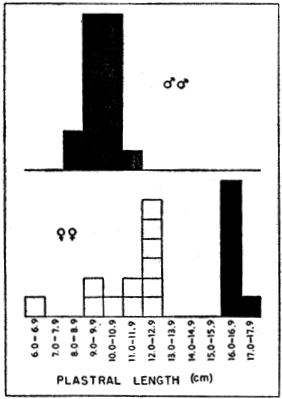
Fig. 23. Size distribution of 39 Trionyx spinifer emoryi (19 males and 20 females) collected in the period June 12 through June 14, 1959, from the Río Grande, near Lajitas, Brewster County, Texas. Solid squares represent sexually mature specimens. Females approaching sexual maturity or those not ready for egg deposition (13.0-15.9 cm. size group) are possibly sedentary in deep water.
One of the immature softshells (KU 51979, plastral length, 9.7 cm.) of the series from Lajitas is considered to be a female. It combines characteristics of both sexes. It resembles a male in having a carapace gritty to the touch, in having prominent white dots posteriorly and in not having a faint mottled and blotched pattern as do females of the same size. The postocular and postlabial markings are mostly yellow (female), but a small patch of the postocular stripe near the junction with the pale ventral coloration laterally is tinted with orange (male); the morphological characters and secondary sexual difference in coloration of this series of softshells has been mentioned on page 512. The tail is short and pyramidal resembling that of a female. Internally, there are a pair of ovaries and oviducts; KU 51979 is functionally a female. An over-production of androgens probably is responsible for the external masculine characteristics (orange color, gritty carapace and absence of mottling on carapace).
Deposition of Eggs
Concerning T. ferox, Wright and Funkhouser (1915:122-23) wrote that deposition of eggs occurred in June and July in the Okefinokee Swamp on the sandy parts of the islands or in sandy fields in places exposed to the direct rays of the sun. The same authors recorded a gravid female taken on June 22 (op. cit.:120), and a nest with eggs on June 26. Harper (1926:415) reported egg-laying in June in the Okefinokee Swamp. Goff and Goff (1935:156) found a female in search of a nesting site crawling toward a cleared area within a hammock at 11 a. m. on May 19, about 25 yards from the western shore of Lake Griffin, Florida. Carr (1940:107) stated that eggs in Florida "are laid from March to July 10. One individual laid her eggs on a block of ice which we had buried in the sand." Hamilton (1947:209) observed deposition of eggs near Fort Myers, Florida, in "a sandy roadbed slightly above the cypress swamp and ditch levels on either side of the road." … either in … "the ruts formed by cars or the slope of the roadbed"; dates of deposition of eggs recorded are March 30 at 11 a. m. in bright sun, and March 31 (from context, the date given as March 21 is considered an error) at 5 p. m. following a heavy rain. The daily temperatures at the time of Hamilton's observations "averaged 85° F., the first really warm spell of the season."
Eigenmann (1896:262) reported egg-laying of spinifer in sand and gravel in June and July at Turkey Lake (= Lake Wawasee), Indiana. A turtle was seen digging a nest on June 26, and fresh nests of eggs were found on June 27 and July 9. Hedrick and Holmes (1956:126) wrote that a clutch of eggs of spinifer in Minnesota was found about ten inches deep in sand about one foot from the river; a steep gravel bank was also cited as a favorite nesting site. Surface (1908:123) stated that eggs of spinifer in Pennsylvania are laid in May, and the young hatch in August. Gehlbach and Collette (1959:142) found eggs of spinifer on June 19 on a sand bank 15 feet from the edge of the Platte River in Nebraska. Breckenridge (1944:187) wrote that spinifer in Minnesota nests on sandy beaches from June 14 to July 6. Cahn (1937:193) stated that deposition of eggs in Illinois occurs in "June or early July: earlier in the southern part of the state, later in the northern portion." Force (1930:38) mentioned a gravid female from Oklahoma obtained on May 20. Evermann and Clark (1920:593) were of the opinion that spinifer began laying about mid-June and continued until perhaps late July at Lake Maxinkuckee, Indiana; a female opened on June 14 had oviducal eggs, and the first nest was found on June 18. Nests were usually at the edge of an abrupt ascent in sand; one nest was found in black, mucky soil (op. cit.:595). Newman (1906:128) wrote that spinifer in the same lake nests later than the other species of turtles, as a rule not earlier than the middle of June (but as early as June 10, op. cit.:132), and rarely later than the middle of July; he observed deposition of eggs on June 22. Sites of deposition of eggs were mostly in soft sand not more than six feet from water; other sites found by Newman (op. cit.:132-33) were a sandy, abandoned road bed separated from the shore by a strip of tall grass, a rock pile (the eggs being dropped into crevices and sand packed around them), among roots of a tree (the eggs being deposited between the roots and under them in a very irregular fashion), and in clay "so hard packed that one could scarcely break it with the fingers." Natural nest sites in hard clay and a rock pile seem incongruous with nesting habits of softshells. I note that Newman's study was not begun until 1902 (op. cit.:127), and it was that year that the water level of the lake was high, flooding the surrounding lowlands (Evermann and Clark, 1920:49-53). Perhaps some of the nests found by Newman were old and not natural because of conditions resulting from the receding water level.
Newman (op. cit.:134-35) mentioned that in small sandy areas nests were frequently in contact and overlapped; he found one nest containing nine small eggs contiguous with 23 large eggs. Breckenridge (1944:187) reported a nest of 56 eggs of two slightly differing sizes, and probably from two females. Evermann and Clark (1920:594) discovered "probably 10 or 12 nests in a distance of a few yards" and mentioned one nest containing 25 eggs "that evidently belonged to two different sets … In the bottom were 10 eggs that looked old … and … separated from them by sand, were 15 other eggs."
Nesting sites of muticus were mentioned by Muller (1921:181) on one of several small islands having "gently sloping sand and mud shores, and interior areas of open sand and densely growing willows" in the Mississippi River, near Fairport, Iowa. The same author wrote that the egg-laying season is from late June to early July, and that the female selected a place 10 to 60 feet inland "with an unobstructed view of the open water." Farther north on the Mississippi River near Dubuque, Iowa, Goldsmith (1945:447) found that muticus preferred "clean, somewhat level sandbars and sandy shores free from trash, weeds … and exposed to open view." The same species, however, may "make unsatisfactory nests … in any place they can find sand, even in the weeds and bushes … when the river is high, covering the sandy plots …" Sometimes nests, which were "seldom nearer than six feet or more than twenty-five feet from water …," were submerged by a rise in water level. In Missouri, Hurter (1911:251) found that individuals of muticus came "… out on the sandbars in the Mississippi River to deposit their eggs … At the end of May up to the middle of June …" Cahn (1937:182) wrote that the nesting season of muticus is early July near Meredosia, Illinois. Anderson (1958:212, Fig. 1) found nests of muticus along the Pearl River in Louisiana on an open sandbar (not in gravel, fine sand or silt), whereas nests of Graptemys were confined to the landward margin of the sandbar.
The onset and length of the breeding season seems to be geared to the climatic conditions under which the species occurs, and, as would be expected, begins earlier and lasts longer in southern latitudes than in northern latitudes. The period of deposition of eggs in T. ferox (Florida) is from late March to mid-July, whereas that of northern populations of spinifer and muticus (southern Great Lakes region) is usually from mid-June to mid-July.
Seemingly there is little difference between species in preference of nesting sites; a sandy substrate is probably preferred. Gravid females of ferox and spinifer may wander overland some distance and select places where the view of the water is obstructed by vegetation; both species may wander little and nest in full view of the water. Concerning muticus, it is of interest that of the many nests discovered by Anderson (loc. cit.) on an open sandbar, all were those of muticus and none was a nest of spinifer. The nests of muticus mentioned by Muller (loc. cit.) and Goldsmith (loc. cit.) were on open sandbars. On June 4, 1953, six clutches of eggs were found on an open sandbar of the Escambia River, Florida; all hatchlings from those eggs that were successfully incubated were muticus. On June 1, 1954, three nests were found on an open sandbar of the same river (Pl. 50); the temperature within the nests at 6:30 a. m. was approximately 25° C. Two nests were dug in a sand substrate on the level portion of the bar (Pl. 51, Fig. 1). The third clutch of eggs was deposited in a sand-gravel substrate at the brim of the incline from the shore (approximately 30 degrees and about five feet above the water); the eggs of this clutch were arranged rather symmetrically (Pl. 51, Fig. 2). Unfortunately, most of the eggs from these three clutches failed to hatch. Although the data are far from conclusive, I have the impression that muticus limits its sites of egg deposition to the open regions of sand bars and does not lay inland where it must traverse vegetated areas unless preferred nesting sites are submerged or otherwise unsatisfactory. Females of spinifer may utilize open sandbars for deposition of eggs but not areas where muticus occurs. In areas where both muticus and spinifer occur, the latter probably lays farther inland or on the landward margins of sandbars.
Excavation of nests has been observed in ferox (Hamilton, 1947:209), muticus (Muller, 1921:181-82; Goldsmith, 1945:448), and spinifer (Newman, 1906:132-33; Cahn, 1937:191-92; Breckenridge, 1960:284). Turtles leaving the water are cautious, usually stopping and extending the neck to its greatest length, holding the head high, and sometimes returning to the water for a short time. Depending on the condition of the substrate and wariness of the female, nest construction may begin immediately, or several holes may be dug and then abandoned. The excavation on level ground or a slight incline is made by means of the hind feet (Muller mentions digging with the forefeet; I agree with Pope, 1949:321, and Conant, 1951:264, who consider Muller in error); the forefeet are firmly planted and not moved during the excavation, deposition of eggs or the filling of the nest cavity. The hind feet are used alternately; cloacal water may be used to facilitate digging or to provide a suitable substrate for the eggs. Cahn mentioned that some sand may be flung four or five feet, and that during the digging the head is held high. Breckenridge (loc. cit.) reported that sand was thrown a distance of ten feet. The nest may be completed in 16 minutes (Cahn, loc. cit.) or less than 40 minutes (Newman, loc. cit.). Breckenridge recorded 17 eggs laid in six minutes, Cahn recorded 12 eggs laid in eight minutes, and Hamilton recorded four eggs laid in three minutes. The hind feet are used to arrange the eggs and are used alternately to fill the nest cavity; sometimes a little sand is scraped in before all the eggs are deposited. Muller recorded the nest cavity as five inches in diameter and ten inches deep, the finished nest appearing "as a small crater … about a foot in diameter, or where the surface is covered with pebbles, as a circular area of clear sand." Goldsmith reported that the nest cavity was six to nine inches in depth, and that after deposition and filling with sand "By certain twisting movements with all four legs, she drags the plastron around over the sand, making a perfect camouflage." Newman found the nest flask-shaped having a depth of about six inches, and diameters of about three inches at the bottom and one and one-half inches in the neck. Hamilton described a flask-shaped nest, the entrance of which would "barely permit the passage of an egg … the bottom, at a depth of five inches, being about the width of a quart milk bottle." Cahn related that the "hole descended at an angle of about 60°," and the eggs thus rolled down an inclined plane.
Possibly the nests of ferox and spinifer differ from those of muticus in being flask-shaped. A nest of spinifer was reported by Gehlbach and Collette (loc. cit.) as having a neck three inches across, a depth of six inches and a width of five inches at the bottom. The nests of muticus that I discovered on the Escambia River were not flask-shaped; the eggs were five to seven inches below the surface. Evermann and Clark (1920:594) reported eggs of spinifer "generally at a depth of four to ten inches," and Breckenridge (loc. cit.) found the topmost eggs about five inches below the surface. There may be behavioral differences between ferox and spinifer and muticus. Hamilton (loc. cit.) mentioned that ferox proceeded with its reproductive duties even when he stood only a few yards away. Muller (op. cit.:181) found that muticus would run to the water if disturbed, without completing deposition of eggs; the same behavior was described by Cahn (op. cit.:191) for spinifer. Newman (1906:133) wrote that spinifer will abandon nesting activities if surprised before egg deposition begins, but will wait to cover the eggs if interrupted while laying eggs. Goldsmith (1945:448) found that an observer did not disturb females of muticus when they were laying eggs (females "could be approached and even touched"), but that, in the presence of an observer, they would scurry toward the water without covering the eggs and would not return to cover them. Turtles frightened in the process of the construction of the nests would not return to complete the original nest. Harper (1926:415) wrote that ferox, after completing nesting activities, will crawl a few feet from the nest and scuffle up the surface, presumably to decoy predators that might otherwise destroy the eggs; this observation has not been corroborated by other authors. Harper (op. cit.:416) recorded the observation of Allen Chesser, who says that females, after egg deposition, often "… bury themselves, before they go ter the water, an' stay there ten er twelve hours."
Reproductive Potential
Estimates of reproductive potentials are subject to variation of one kind or another. Counts of oviducal eggs or those in nests may be misleading, as in some individuals one or more eggs may have been deposited previously. Mitsukuri (1905:263), Newman (1906:135), Muller (1921:182), and Cahn (1937:183) have mentioned that the number of eggs per clutch corresponds to the size of the female. Females of northern populations may have larger clutches than females of the same size from southern populations.
Table 8. Records in the Literature Pertaining to Number and Size of Eggs of Three American Species of Trionyx.
Species Number of eggs per clutch; oviducal (o), nest (n); ave. = average Size of eggs; ave. = average Authority and remarks
ferox 24 mm. Agassiz (1857, pl. 7, fig. 20); nat. size.
22 (n) ave. 31 mm. Wright and Funkhouser (1915:120)
some (o) 32 mm. "
20 (o) ave. 25 mm., and 12 gms. Goff and Goff (1935:156)
17 (o) ave. 27 mm. Hamilton (1947:209)
21 (o) "
7 (o) " (egg deposition probably interrupted)
spinifer 29 mm., 26.5 mm. Agassiz (1857, pl. 7, figs. 20 and 23, respectively); nat. size.
9, 12, 17, 18, 27 and 32 Eigenmann (1896:263); northern Indiana
9 to 24, ave. 18 Newman (1906:135); northern Indiana
about 30 (n), 4 (n), 3 (n) 1.09 × 1 inch Evermann and Clark (1920:593-94); northern Indiana
21 (n and o) (o) and some (n) .93 × .93 inches; rest of (n) 1.07 × 1.07 inches "
32 (o) ave. 11/4 inches Force (1930:38); Oklahoma
9, 12, 13, 15, 17, 19, 19, 21, 22, 23, and 25; ave. 18 ave. 28.3 mm. (217 eggs) Cahn (1937:193); Illinois
12 (o), 26 (o), 24 (n), and 30 (n) 22.0 to 28.5 mm. Breckenridge (1944:187); Minnesota
21 (o) 24 to 27.8 (ave. 25.6 mm.) × 25.8 to 29 (ave. 27 mm.) Conant (1951:160); Michigan
22 (n), 22 or 23 (n) Hedrick and Holmes (1956:126); Minnesota
25 (n) ave. 24 × 25.2 mm. Gehlbach and Collette (1959:142); Nebraska
17 (n) Breckenridge (1960:284); Minnesota
muticus about 22 mm. Agassiz (1857, pl. 7, fig. 21); nat. size.
21 about 20 mm. Hurter (1911:249); Missouri
4, 12, 13, 16, 21, 22, 26, and 33, all (n); ave. 22 ave. 2.3 cm. and 7 gms. Muller (1921:182); Iowa
18 to 22, maximum 31 ave. 22.6 mm. (116 eggs) Cahn (1937:183); Illinois
93 from 5 nests, ave. 18.6; 10, 10, 16, 17, 17, 19, 21, 21, 22, 22, 31, all (n), ave. 18.7 variable—largest ca. 13/8 inches, smallest less than one inch. Goldsmith (1945:449); Iowa
Additional records of size of clutch are provided by data from dissected females (Table 9). All females were collected from May through September from localities south of latitude 36.5°. The number of eggs includes those in both oviducts, and the number of ovarian follicles those in both ovaries. The number and range in size of only the largest group of follicles is listed; in some instances the size of follicles formed a graded series, and the designation of a group was arbitrary.
Table 9. Length, Number of Oviducal Eggs, and Condition of Ovaries in Adult Females of T. spinifer and T. muticus.
Species Size of female (plastral length, cm.) Eggs (total) Ovarian follicles (total)
Number Size (mm.)
muticus 14.4 6 14 15-18
16.3 9 4 15-17
16.5 …… 3 16
16.5 3 4 14-18
17.2 …… 13 14-21
27.0 …… 25 18-21
spinifer 16.2 7 4 16-20
16.2 7 5 18-20
16.2 7 1 18
16.3 6 5 16-18
16.3 4 5 15-19
16.8 6 1 18
17.3 3 2 17
18.3 …… 13 19-20
19.5 …… 2 17
19.8 …… 4 20
20.7 …… 11 15-18
21.5 …… 6 8-11
22.0 …… 13 11-14
23.5 8 12 20-24
25.5 11 several 18-22
25.8 13 ? 18-21
26.8 10 5 18-20
30.5 13 5 20-21
16 16 16-21
11 19 15-20
17 23 18-22
17 22 14-20
8 15 18-22
Published data (Table 8) indicate that the average number of eggs per clutch for the three American species is about 20, although the number of eggs may exceed 30 in spinifer and muticus. Except for those of ferox, most of these records are based on observations in northern latitudes (approximately 40°). My examination of females from southern latitudes (below 36.5°) reveals no oviducal egg count greater than 17 and an average number of eggs per clutch of 9.6 per spinifer (Table 9); that of muticus is 7.3, as based on data given in Table 9 as well as on egg-nest counts of 15, 6, 6, 6, 6, 5, 9, 8, and 8. Ovarian follicles larger than 15 millimeters in diameter are arbitrarily considered to comprise the next clutch that will be deposited in the current season. Follicles of this size possibly are retained until the following year or some may undergo regression; some of the included follicles may not be representative of the succeeding egg complement. The average number of follicles of the most enlarged groups is 9.0 for spinifer and 10.5 for muticus. Females in northern latitudes probably have a greater reproductive potential than those in southern latitudes if it is assumed that there is only one laying per season for an individual; the maximum number of eggs laid at any one time probably does not exceed 35. There is an indication that larger females deposit more eggs than smaller females (Table 9). Muller (1921:184) mentioned two double eggs (each having two yolks) in the complement of 33, indicating an abnormally large number and excessive crowding of eggs in the oviducts. Simkins (1925:188) also mentioned some eggs of a clutch (form and locality unknown) that were five or six millimeters larger (about 31-32 mm.) than the rest, and which "invariably bore twins." The largest number of eggs in a single nest mentioned by Simkins is 22. If the presence of double-yolked eggs is indicative of crowding of eggs in the oviducts, the egg complements of 22 and 33 indicate the approximate maximal number of eggs per clutch. In the species spinifer, the average size of sexually mature females is slightly smaller at some places in the south than in the north. Therefore, smaller clutches are to be expected in the south.
Many of the females collected in June or July contained corpora lutea four to eight millimeters in diameter in addition to enlarged ovarian follicles. Presumably the corpora lutea indicate clutches deposited earlier in the current season, and the enlarged follicles represent clutches to be deposited in the current season. One female of muticus (OU 27593) obtained on July 10, contains oviducal eggs, ovarian follicles 15-17 millimeters in diameter, and corpora lutea of different sizes that exceed the number of oviducal eggs; possibly this female was capable of laying three clutches each season. Corpora lutea, representing ovulation points of eggs in the oviducts, are approximately eight millimeters in diameter. In order to establish definitely the reproductive potentials of any species of turtle, it is desirable to know the approximate size of ovarian follicles that are retained by sexually inactive females, and the rate of regression of the corpora lutea. The data suggest that, in southern populations at least, two and possibly three clutches of eggs are deposited in the annual breeding season. Mitsukuri (in Cagle, 1950:38) found that T. sinensis deposited four groups of eggs each season.
It is suggested that the seasonal reproductive potential of northern populations (averaging about 20 eggs per clutch, and probably one clutch per season) is less than that for southern populations (averaging about 10 eggs per clutch, but three clutches per season). But owing to variation, there may be no great discrepancy between the actual potentials of northern and southern populations.
Eggs
The eggs of Trionyx are white and spherical having a brittle shell. Some eggs are occasionally abnormal in shape and size; overcrowding of eggs in the oviducts may result in small, irregular-shaped eggs, or large double-yolked eggs. Presumably enlargement of the eggs occurs in the oviducts and within a short period after deposition prior to complete hardening of the brittle shell; therefore some eggs in the oviducts are smaller than those in nests.
The data concerning ferox (Table 8) suggest that the maximum size of eggs is 31 to 32 millimeters, whereas oviducal eggs are slightly smaller, about 25 to 27 millimeters. Eggs of spinifer from northern latitudes (most from approximately 40°, Table 8) also vary in size, oviducal eggs being as small as 22 millimeters in diameter and the maximal size about 29 millimeters. Average extreme measurements (in mm.) of oviducal eggs (number of eggs in parentheses) from females taken in latitudes of 33 degrees or less are: 25 × 29 (11), 29 × 30 (11), 28 × 30 (13), 28 × 30 (10), 29 × 30 (5), 29 × 29 (8), 25 × 26 (17), 29 × 30 (5), and 28 × 29 (8). The average size of these eggs is slightly larger than the oviducal eggs of which measurements are given in Table 8, and suggest larger eggs from more southern latitudes. Eggs of muticus are smaller than those of spinifer (Cahn, 1937:183) or ferox; the average size of eggs from nests found in Iowa and Illinois is 22 to 23 millimeters (Table 8). Nine oviducal eggs from a female obtained in Lake Texoma, Oklahoma, averaged 22 × 23 millimeters. The largest eggs of muticus are from the southernmost locality; eight eggs from a nest found along the Escambia River, Florida, averaged 26 × 27 millimeters.
In general, the data suggest that at each laying slightly smaller eggs but larger numbers are laid by females in northern latitudes, whereas larger but fewer eggs are laid by females from farther south.
Incubation and Hatching
Length of the incubation period seems to depend upon conditions of heat and moisture, and, in general, to be geared to the prevailing climatic conditions. Goff and Goff (1935:156) artificially incubated some eggs of ferox at temperatures varying from 82.3 to 89.2° F., and found that the incubation period was 64 days. Muller (1921:184) wrote that the period of incubation of eggs of muticus (natural nests at temperatures about 90°., op. cit.:182, and artificial nests) in Iowa is from 70 to 75 days. Breckenridge (1944:187) stated that spinifer makes nests in Minnesota from June 14 to July 6, and cited reports that indicate hatching in September. Hedrick and Holmes (1956:126) discovered a nest of eggs in Minnesota on September 5; the eggs were artificially incubated and some hatched on October 29. Eigenmann (1896:263) found eggs as late as September in northern Indiana that "contained young which would have been ready to hatch about a month later." Cahn (1937:193) wrote that spinifer in Illinois lays in June or early July and that "young-of-the-year are taken in late August and September." Some recently deposited eggs of muticus (as indicated by fresh turtle tracks, Pl. 50, Fig. 2) that I obtained on June 1 were artificially incubated and hatched on August 4, indicating an approximate incubation period of 65 days. Dr. Paul K. Anderson in the course of field work on the Pearl River, Louisiana (1958:211), found that eggs collected on June 13 from a nest excavated three to five days before, hatched on August 15, indicating an incubation period of approximately 67 days. Eggs collected on May 17 to 25 (three clutches) hatched on August 4 to 6, indicating an incubation period of approximately 77 days. In any latitude the incubation period probably is at least 60 days. Eigenmann (loc. cit.), however, mentioned empty nests that were found in July; this indicates early hatching or more probably the action of predators.
In northern latitudes eggs or young turtles may over-winter in the nest if deposition is late in the season. In northern Indiana Evermann and Clark (1920:595) found a nest on November 16 that contained "well-formed young" and believed that the turtles would have wintered in the nest. Conant (1951:160) was of the opinion that most eggs probably hatch in early fall, but that some do not hatch until spring.
The hatching of eggs of muticus has been described by Muller (1921:183). According to him, the forelimbs first emerge through the shell and enlarge the opening. There is an "egg tooth below the flexible proboscis" but "it does not seem to be used in escape from the eggs, and is dropped a week after hatching." Hatchlings burrow almost straight upward through the sand leaving the egg shell below the surface and a hole in the sand about an inch in diameter. Muller found that young turtles emerge from the nests in the night or early morning and always go downhill probably influenced in their movements by the open sky and sloping beach. Anderson (1958:212-15) found that hatchlings of muticus leave nests within the first three hours after sunset and travel a direct route to the water. He discovered that hatchlings are active on the surface of the sand at night and generally show a positive reaction to light (moonlight, flashlight), whereas, in daytime, there is a negative reaction to bright sunlight (causing the turtles to bury themselves in sand). Anderson believed that the positive response to light at night is not correlated with the water-approach behavior of hatchlings, but that movements to water are possibly influenced by a negative reaction to dark masses of environment (such as shadows formed by landward forests).
Age and Growth
Goff and Goff (1935:156) found that hatchlings of ferox average 8.82 grams (extremes, 8.50 to 9.25); one of these, UMMZ 76755, is illustrated in Plate 31. Muller (1921:184) recorded measurements of five hatchlings of muticus; the average measurements (in cm., extremes in parentheses) were: length of carapace, 3.54 (3.43 to 3.67); width of carapace, 3.20 (3.10 to 3.25); length of plastron, 2.54 (2.47 to 2.60). I recorded measurements of 32 hatchlings (three clutches combined) of muticus on August 16; the turtles hatched on August 4 to 6 from eggs collected along the Pearl River, Louisiana. The average measurements (in mm., extremes in parentheses) of the 32 turtles were: length of carapace, 41.3 (34.0 to 45.0); width of carapace, 38.6 (31.0 to 40.0); length of plastron, 30.1 (25.0 to 32.0). These turtles have circular umbilical scars averaging approximately two millimeters in diameter. The smallest hatchling that I have seen measures 21.0 millimeters in plastral length (T. m. muticus, INHS 3458). There are no data to indicate a difference in size of hatchlings among the American species of soft-shelled turtles. The average plastral length of most hatchlings probably is 28.0 to 30.0 millimeters.
Owing to the lack of a horny epidermal covering of the carapace and plastron, soft-shelled turtles are not so well suited to studies of age and growth as are the "hard-shelled" species, which have visible impressions of growth annuli on the epidermal scutes. Mattox (1936:255) found annular rings in the long bones of specimens of Chrysemys and suggested that it is tenable to correlate the number of rings with the age of the turtle.