Front matter (continued 2)
Reading edition
spinifer emoryi, p. 510
White spots sometimes indistinct on carapace, or few, small spots present on posterior half of carapace; tubercles on anterior edge of carapace equilateral and wartlike or conical; mottled and blotched pattern usually contrasting; pale rim less than three times wider posteriorly than laterally
spinifer pallidus, p. 522
17. Carapace having evidence of more than one dark marginal line, and scattered, black spots or ocelli
spinifer asper, p. 502
Carapace having only one, dark, marginal line
18
18. Carapace having small black spots, lacking large interrupted ocelli
spinifer hartwegi, p. 497
Carapace having small black spots interspersed among larger, interrupted ocelli
spinifer spinifer, p. 489
19. Carapace having pattern of dusky spots, sometimes short lines
20
Carapace lacking pattern of dark spots or lines, having a mottled and blotched pattern
21
20. Pattern of circular spots, lacking short lines or bacilliform marks; spots sometimes slightly ocellate; no pale stripes on snout
muticus calvatus, p. 539
Pattern of dots, or dots and short lines; pale stripes on snout, at least just in front of eyes
muticus muticus, p. 534
21. Mottled and blotched pattern usually contrasting; ill-defined, blackish blotch absent behind eye
muticus muticus, p. 534
Mottled and blotched pattern usually not contrasting; ill-defined, dark blotch may be present behind eye
muticus calvatus, p. 539
Systematic Account of Species and Subspecies
Trionyx ferox (Schneider) Florida Softshell
Plates 31 and 32
Testudo ferox Schneider, Naturg. Schildkr., p. 330, 1783 (based on Pennant, Philos. Trans. London, 61 (Pt. 1, Art. 32): 268, pl. 10 [figs. 1-3], 1772).
Trionyx ferox Schwartz, Charleston Mus. Leaflet, No. 26:17, pls. 1-3, May, 1956.
Testudo mollis Lacépède, Hist., Nat. Quadr. Ovip. Serp., 1:137, pl. 7, 1788.
Testudo (ferox?) verrucosa Schoepff, Hist. Testud., Fasc. 5 (Plag. M):90, pl. 19, 1795.
Testudo bartrami Daudin, Hist. Nat. Rept., 2:74, pl. 18, fig. 2, 1801.
Trionyx georgicus Geoffroy, Ann. Mus. Hist. Nat., Paris, 14:17, August, 1809.
Mesodeca bartrami Rafinesque, Atlan. Jour., Friend Knowledge, Philadelphia, 1 (No. 2, Art. 12):64, Summer, 1832.
Trionyx harlani Bell in Harlan, Medic. Phys. Research, p. 159, 1835.
Type.—Holotype, British Museum (Natural History) 1947.3.6.17; original number 53A, presumably that of Royal Society; stuffed adult female and skull; obtained from the Savannah River, Georgia, by Dr. Alexander Garden.
Range.—Southern South Carolina, southeastern Georgia, and all of Florida except the Keys and perhaps the western end of the panhandle (see map, Fig. 18).
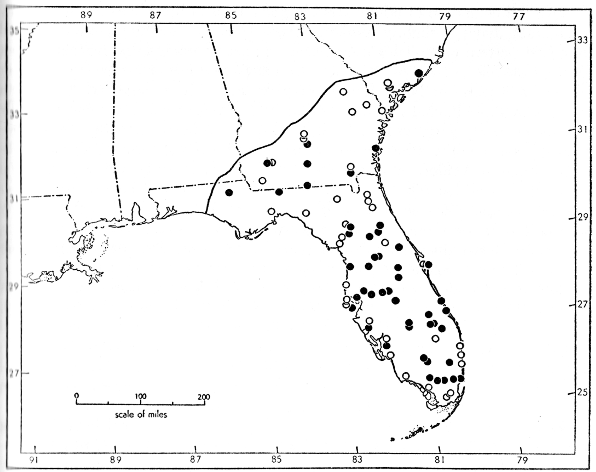
Fig. 18. Map of southeastern United States showing geographic distribution of Trionyx ferox.
Diagnosis.—Marginal ridge present; longitudinal rows of tubercles that resemble ridges on carapace of hatchlings; plastron often extending farther forward than carapace in adults; plastral area dark slate or gray in hatchlings; juvenal pattern of large slate or blackish blotches (often with pale centers) on a pale background; pale outer rim of carapace (absent on adults) narrow, not separated from ground color of carapace by distinct, dark line.
Size large; head wide; carapace relatively long and narrow; snout short; greatest width of skull at level of quadratojugal; often no suture between hypoplastra and hyoplastra; callosities on epiplastron and preplastra usually lacking.
Description.—Plastral length of smallest hatchling, 2.9 centimeters (UMMZ 95613), of largest male, 26.0 centimeters (AMNH 63642), of largest female, 34.0 centimeters (UMMZ 38123).
Septal ridges present; over-all coloration of carapace and plastron, and soft parts of body of hatchlings slate or blackish; carapace having blackish, circular blotches, usually fused at margin, often with pale centers on buff background forming coarse reticulum; pale, narrow rim of carapace not separated from ground color by dark marginal line; pale rim, coincident with marginal ridge, absent from anteriormost nuchal region; longitudinal rows of tubercles on carapace resembling ridges; undersurface blackish, usually having posterior part of carapace pale with irregular blackish marks; blackish soft parts of body dorsally having large, pale markings, most consistent of which are postocular mark that may contact orbit, postlabial mark that curves around angle of jaws, inverted Y on top of snout, and one or two streaks on side of neck.
Over-all coloration of adults grayish, paler than in hatchlings; carapace gray sometimes having slightly darker, large, irregular markings; mottled and blotched pattern on females not contrasting; sex of many large individuals not distinguishable on basis of pattern on carapace; pale rim of carapace obscure or absent; soft parts of body dorsally gray or brownish on large adults of both sexes, sometimes having slightly paler, large markings; small adult males usually having contrasting pattern on head; surface of carapace smooth (not "sandpaper") on adult males; undersurface whitish, throat often grayish; well-defined marginal ridge; anterior edge of carapace laterally to region of insertion of forelimbs studded with low, flattened tubercles resembling hemispheres, never conical; carapace usually having blunted tubercles, best developed anteriorly and posteriorly on midline, but sometimes linearly arranged, resembling ridges, especially at margins; anterolateral parts of plastron often extending farther forward than corresponding parts of carapace.
Range in length (in cm.) of plastron of ten largest specimens of each sex (mean follows extremes), males, 17.0-26.0, 20.0; females 23.3-34.0, 27.9; ontogenetic variation in PL/HW, mean PL/HW of specimens having plastral lengths 6.5 centimeters or less, 3.52, and exceeding 6.5 centimeters, 4.87; ontogenetic variation in CL/CW, mean CL/CW of specimens having plastral lengths 8.0 centimeters or less, 1.18, and exceeding 8.0 centimeters, 1.30; mean CL/PCW, 2.01; mean HW/SL, 1.44; mean CL/PL, 1.26.
Jaws of some skulls that exceed 75 millimeters in basicranial length having expanded alveolar surfaces; greatest width of skull usually at level of quadratojugal (72%); ventral surface of supraoccipital spine narrow proximally, usually having medial ridge; foramen magnum rhomboidal; opisthotic-exoccipital spur absent (82%), sometimes indicated by ridge (16%); distal part of opisthotic wing tapered, not visible in dorsal view; lateral condyle of articular surface of quadrate larger than medial articular surface, not tapered posteriorly; maxillaries in contact above premaxillaries; usually a combination of seven neurals, seven pairs of pleurals, and contact of seventh pair of pleurals (56%), often eight pairs of pleurals (31%); angle of epiplastron forming approximate right angle; often no suture between hypoplastra and hyoplastra; callosities on preplastra and epiplastron usually lacking.
Variation.—Crenshaw and Hopkins (1955:19) stated that in specimens from Lake Okeechobee and southward the carapace is wider relative to the width of the head, and Neill (1951:19) quoted Allen's observations that ferox from southern Florida "average larger and darker than those collected farther north."
Carr (1952:417) reported that the pale reticulum on the carapace is yellowish olive, the markings on head are yellow on an olive ground color, some markings more orange, and the plastron slate gray. Duellman and Schwartz (1958:271) mentioned that the carapace of hatchlings is edged in orange grading to yellow posteriorly and has a pattern of bluish-black blotches on a dull brown background, whereas the carapace is dull brown or blackish on adults. Neill (op. cit.:18) wrote "that the head stripes and the marginal ring of the 'carapace' are orange rather than yellow (yellow at the time of hatching, however)."
The transition from the dark coloration of hatchlings to the paler coloration of adults is gradual and subject to individual variation. The loss of dark color ventrally occurs first on the plastral area, then the hind limbs, forelimbs, posterior part of carapace and last on the neck and throat. The soft parts of the body dorsally are gray or dark gray, and do not become so pale as the ventral surface. The smallest specimen that I have seen displaying the dark features of the hatchlings is a male, 7.7 centimeters (UMMZ 100673); a female, 9.5 centimeters (UMMZ 110987), is the smallest specimen having a whitish plastral area. The change from dark to pale coloration on the ventral surface occurs at a size of 8.0 to 9.0 centimeters. The largest specimens I have seen having indistinct, dusky blotches of the underside of the carapace are a female, 11.3 centimeters (UMMZ 100836), and a male, 16.0 centimeters (UMMZ 106322). A contrasting pattern on head and limbs, and a dark throat are still evident in a female 19.2 centimeters (UMMZ 106302).
Comparisons.—Trionyx ferox can be distinguished from all other species of the genus in North America by the presence of a marginal ridge, longitudinal ridges of tubercles on the carapace of juveniles (less evident in adults), and the unique juvenal pattern and coloration. The lack of a juvenal pattern and a smooth surface on the carapace (not gritty like sandpaper) distinguish adult males from those of T. spinifer. Most adults of both sexes can be distinguished from spinifer and muticus by the extension of the plastron farther forward than the carapace (developed to a slight degree in some specimens of T. s. emoryi). Both sexes of all ages can be distinguished from muticus by the presence of knoblike tubercles on the anterior edge of the carapace, and septal ridges.
T. ferox is the largest species in North America; the maximum size of the plastron in adult males is approximately 26.0 centimeters (16.0 in spinifer) and of adult females, 34.0 centimeters (31.0 in spinifer). The head is wider in ferox than in muticus and most subspecies of spinifer (closely approached by asper, guadalupensis, emoryi and T. ater). The carapace is narrower in ferox than in muticus and most subspecies of spinifer (closely approached by emoryi and T. ater). The snout is shortest in ferox, but almost as short in T. s. emoryi and T. ater. T. ferox has proportionately the longest plastron in relation to length of carapace.
Most skulls of ferox differ from those of muticus and spinifer in having the greatest width at the level of the quadratojugal (as do some T. s. asper; see account of that subspecies). In the skull, ferox resembles spinifer but differs from muticus in having the 1) ventral surface of the supraoccipital spine narrow proximally, and usually having a medial ridge, 2) foramen magnum rhomboidal, 3) distal part of opisthotic wing tapered, 4) lateral condyle of articular surface of quadrate not tapered posteriorly, and larger than medial articular surface, and 5) maxillaries in contact above premaxillaries. T. ferox resembles muticus but differs from most individuals of spinifer in lacking a well-developed opisthotic-exoccipital spur. T. ferox resembles spinifer but differs from muticus in having the epiplastron bent at approximately a right angle; ferox differs from both muticus and spinifer in lacking a callosity on the epiplastron and probably in the more frequent fusion of the hyoplastra and hypoplastra.
Remarks.—The early taxonomic history of Trionyx ferox has been discussed in detail by Stejneger (1944:27-32), who explained that Dr. Alexander Garden of Charleston, South Carolina, sent a description and specimen of T. ferox to Thomas Pennant, and at the same time sent another specimen with drawings to a friend, John Ellis, in London. Pennant presented one of the specimens and drawings and the description to the Royal Society of London in 1771; the description was published in 1772 and included Garden's drawings. Because two specimens were involved the possibility exists that the description (text, drawings and type specimen) is a composite based on two specimens.
I have not seen the type. Garden's original description (in Pennant, 1772:268-271) leaves little doubt that the text subject is a large adult female of ferox (see especially the statements, "fore part, [of carapace] just where it covers the head and neck, is studded full of large knobs, [and] The under, or belly plate, … is … extended forward two or three inches more than the back plate, …"). I am indebted to Mr. J. C. Battersby, British Museum (Natural History), Department of Zoology (Reptiles), for information concerning the type and for comparing it with the text description and three figures published by Pennant. The carapace of the type is approximately 16 inches long, 131/2 inches wide, and has low, flattened, knoblike tubercles along the anterior edge. Some inaccuracies on the part of the artist (such as five claws on both feet on the right side of Fig. 3, and four claws on the left front foot of Fig. 2 are evident), and slight changes in the proportions of the type would have occurred after death and preservation. It is the opinion of Mr. Battersby that the type, text description and three figures represent one specimen. Figures 1 and 2, dorsal and ventral views respectively, probably represent the same specimen from life; the neck is withdrawn and the tail tip is visible in dorsal view, but concealed beneath the posterior edge of the carapace in ventral view. Presumably the same specimen (probably drawn from dried and stuffed animal) is depicted in Figure 3 (dorsal view); the neck is fully extended and a large part of the thick, pyramidal tail is visible in dorsal view. British Museum (Natural History) 1947.3.6.17 is considered a holotype. The three figures published by Pennant have been duplicated by Schoepff (1795:Pl. 19) and Duméril and Bibron (1835:482). To my knowledge, the holotype was first specifically designated as the "(Type.)" of T. ferox by Boulenger (1889:259). The skull of the holotype is figured by Stejneger (1944:Pl. 5).
Garden did not list a specific locality for the two specimens that he sent to London, but did mention that the turtle was common in the Savannah and Altamaha rivers (of Georgia), and rivers in east Florida. Boulenger (loc. cit.) stated that the locality of the holotype was "Georgia." Baur (1893:220) restricted the type locality to the "Savannah river, Ga." Neill (1951:17), who believed T. ferox to be absent from the Savannah River, changed the type locality of ferox to east Florida. Schwartz (1956:8) reappraised the status of softshells in Georgia and Florida and reëstablished the Savannah River (at Savannah), Georgia, as the type locality of T. ferox.
Pennant failed to use binomial nomenclature when he published the type description of Garden. The first name-combination (Testudo ferox) was proposed by Schneider (1783:220).
Lacépède (1788:137, Pl. 7) referred to Garden's description in Pennant only as "The Molle" but on a folded paper chart entitled "Table Méthodique des Quadrupèdes ovipares," which is inserted after an introduction of 17 pages, listed T. mollis; this name is again listed on another folded chart, entitled "Synopsis methodica Quadrupedum oviparorum," which is inserted between pages 618 and 619 under the genus Testudo. The illustration (Pl. 7) was taken from Pennant (Duméril and Bibron, loc. cit.). The type locality has been designated "(following Stejneger, 1944) as eastern Florida" by Schmidt (1953:108).
Bartram failed to use a binomial name with his description of "the great soft shelled tortoise," which appeared in his Travels (1791:177-179, Pl. 4 and unnumbered plate between pages 282 and 283) and two editions of a French translation (1799 and 1801, 1:307); see Harper (1940). Recently, Bartram's Travels has been placed on the Official Index of Rejected and Invalid Works in Zoological Nomenclature, Opinion 447 (see Hemming, 1957). Bartram's description of a soft-shelled turtle has provided the basis for the proposal of at least three name-combinations. The first was Testudo (ferox?) verrucosa proposed in 1795 by Schoepff; it appeared simultaneously in The Historia Testudinum and in a German translation, Naturgeschichte der Schildkröten (see Mittleman, 1944:245). Stejneger (1944:26) listed the type locality as eastern Florida. Daudin (1801:74), also referring to Bartram's description in his Voyage (French translation), proposed the name Testudo bartrami; Harper (op. cit.:717) restricted the type locality of T. bartrami from "Halfway pond," east Florida, to southwestern Putnam County between Palatka and Gainesville, Florida. Rafinesque (1832:64-65), relying on the authenticity of the illustrations in Bartram's Travels that depict a soft-shelled turtle having five claws on each of the hind feet, tubercles on the sides of the head and neck, and ten scales in the middle of the carapace (presumably inaccuracies or a composite on the part of the artist), referred to Bartram's description as a new genus, Mesodeca bartrami, a name which Boulenger (1889:245, footnote) referred to as "mythical." Geoffroy (1809a:18-19) considered Bartram's description the basis for the recognition of a second species of Chelys (binomial nomenclature not employed), and Duméril and Bibron (loc. cit.) suggested that the description was based partly on a "Chelyde Matamata." The descriptive comments of Bartram are not clearly applicable to Testudo ferox Schneider; Trionyx ferox, however, is the only species of soft-shelled turtle known to occur in the region of Bartram's observations (east Florida), and the type locality was restricted to Putnam County, Florida, by Harper. The name-combinations, Testudo (ferox?) verrucosa Schoepff, Testudo bartrami Daudin, and Mesodeca bartrami Rafinesque are junior synonyms of Testudo ferox Schneider.
Schweigger (1812:285) referred ferox to the genus Trionyx following the description of that genus by Geoffroy in 1809. Testudo ferox was listed as a synonym by Geoffroy in the description of Trionyx georgicus (1809a:17); Duméril and Bibron (1835:432) mentioned that the specific characters of georgicus were taken from Pennant. The name Trionyx georgianus presumably appears for this taxon in Geoffroy's earlier-published synopsis (1809:367). T. georgicus was listed as occurring in rivers of Georgia and the Carolinas; the type locality was restricted by Schmidt (op. cit.:109) to the Savannah River, Georgia. The two specific names georgicus and georgianus are regarded as substitute names and junior synonyms of T. ferox.
Geoffroy (1809a:14-15) also described Trionyx carinatus, a name-combination that hitherto has been considered a synonym of Trionyx ferox. There is no indication from the description that carinatus is applicable to ferox. Most comments pertain to a description of the bony carapace and plastron, which Geoffroy depicts in Plate 4. It is a young specimen judging from the small and isolated preneural; the seventh pair of pleurals is unusual in being fused (no middorsal suture), and the neurals seem large in proportion to the size of the pleurals. The anterior border of the carapace is described as having tubercles. Geoffroy listed Testudo membranacea and Testudo rostrata as synonyms of carinatus. Fitzinger (1835:127) listed T. membranacea, T. rostrata and T. carinatus as synonyms of Trionyx javanicus (= T. cartilagineus), which was also described by Geoffroy (op. cit.:15). Duméril and Bibron (op. cit.:478, 482) considered carinatus to be the young of spinifer (ferox as synonym). Gray (1844:48), however, referred T. membranacea and T. rostrata to the synonymy of T. javanicus, but considered T. carinatus to be a synonym of T. ferox (op. cit.:50), an interpretation followed by all subsequent authors. Trionyx carinatus is questionably listed as a synonym of ferox by Stejneger (1944:27). Duméril and Bibron (op. cit.:482) wrote that the young type of carinatus is in the museum at Paris. Dr. Jean Guibé informs me in letter of September 24, 1959, that the type of Geoffroy's T. carinatus cannot be found in the Natural History Museum at Paris. For the present, T. carinatus is considered a nomen dubium. According to Stejneger (1944:27), Trionyx brongniarti Schweigger is a substitute name for T. carinatus.
I am unable to add anything to Stejneger's (op. cit.:32) account of Trionyx harlani; the mention of its occurrence in east Florida indicates that it is indistinguishable from Testudo ferox Schneider.
T. ferox was considered to be indistinguishable from Lesueur's Trionyx spiniferus (described in 1827), until Agassiz (1857:401) pointed out the differences between the two species. However, Agassiz (op. cit.:402, Pl. 6, Fig. 3) regarded juveniles of T. spinifer asper as the young of ferox. Consequently, the geographic range of ferox, as envisioned by Agassiz, extended from Georgia and Florida west to Louisiana. Neill (1951:15) considered all American forms conspecific. Crenshaw and Hopkins (1955) and Schwartz (1956) demonstrated that ferox is a distinct species.
Fitzinger (1843:30) designated the species ferox as the type species of his genus Platypeltis as follows: "Platypeltis. Fitz. Am[erica]. Platypelt. ferox. Fitz. Typus." If populations of soft-shelled turtles that are referable to Testudo ferox Schneider are considered to comprise a distinct genus by future workers, Platypeltis Fitzinger, 1835, is available as a generic name with Testudo ferox Schneider, 1783, as the type species (by subsequent designation).
Trionyx ferox in the northern part of its range is sympatric with T. spinifer asper. In the region of overlap, the two species are nearly always ecologically isolated; ferox inhabits lentic waters, whereas T. s. asper is partial to lotic waters (Crenshaw and Hopkins, op. cit.:16). There is no evidence of intergradation or hybridization.
Many characters of Trionyx ferox that are lacking in other North American forms are shared with some Asiatic softshells, such as the large size, longitudinal rows of tubercles that resemble ridges on the carapace, and the marginal ridge. It is thought that, of the living softshells in North America, ferox is more closely allied to Old World forms of the genus than to muticus or spinifer.
Carr (1940:107) recorded ferox from Okaloosa County, Florida, in the western end of the panhandle, whereas Crenshaw and Hopkins (1955:16) list the known westward extent of range as Leon and Wakulla counties. AMNH 6933 from west of the Apalachicola drainage in Washington County, Florida, tends to substantiate Carr's record, which is not included on the distribution map.
Specimens examined.—Total 144, as follows: Florida: Alachua: UMMZ 64178, 100969; USNM 10545, 10704, "near" Gainesville; UMMZ 56599, Levy Lake. Brevard: AMNH 12878, Canaveral. Broward: UMMZ 109441, Hugh Taylor Birch State Park; USNM 109548, 22 mi. WNW, 6 mi. SSE Fort Lauderdale. Collier: USNM 86828, Tamiami Trail, "near" Birdon. Dade: AMNH 50936, UMMZ 10183, 110981, Miami; USNM 84079, 86942, 15 mi. from (west) Miami, Tamiami Trail; UMMZ 111371, 19 mi. W, 1.3 mi. S Miami; UI 28984, 35 mi. W. (Miami) Tamiami Trail; AMNH 69932-33, UMMZ 101582, 101584, 104024, 40-45 mi. W Miami, Tamiami Trail. Glades: UMMZ 100836, mouth of Kissimmee River. Hendry: UMMZ 106302, 10.2 mi. SE Devil's Garden; UMMZ 106303-04, 106321-22, 30 mi. S Clewiston, near Devil's Garden. Hernando: TU 13624, 0.5 mi. S Citrus Co. line on US Hwy. 19. Highland: AMNH 65537, 71618, Archbold Biol. Stat., Lake Placid; AMNH 65622, Hicoria. Hillsborough: TU 13960, Hillsborough River, ca. 20 mi. NE Tampa; USNM 51184, Tampa; USNM 71156, Plant City. Indian River: USNM 55316, Vero Beach; USNM 59318, Sebastian. Lake: UMMZ 36072, USNM 20189, 029210, 029339, 38123, Eustis; UMMZ 76754-56, Lake Griffin. Lee: UMMZ 102276, 14 mi. SE Punta Gorda. Leon: CNHM 33701, USNM 95767, Lake Iamonia; USNM 103736, Silver Lake. Marion: AMNH 8294-95, UMMZ 95613 (4), USNM 52476-83, 100902-04, Eureka; AMNH 63642, near Salt Springs. Martin: TNHC 1292, 8.4 mi. N Port Mayaca. Okeechobee: AMNH 57379-84, Lake Okeechobee; AMNH 5931-32, Kissimmee Prairie. Orange: USNM 51421, 56805, Orlando; KU 16528. Osceola: USNM 029448, 029450-64, 029467-68, 029470, 029474-75, Kissimmee. Palm Beach: UMMZ 54101, Palm Beach; USNM 73199, Delray Beach. Pinellas: USNM 51417-20, St. Petersburg. Polk: AMNH 25543, Lakeland; UMMZ 112380, 6.7 mi. S Lake Wales; USNM 60496, 60532, 60534, 61083-87, Auburndale. Putnam: USNM 4373, 7651, Palatka; USNM 26035, ponds "near" Welaka. Sarasota: USNM 61352, Lake Myakka. Sumpter: UMMZ 71791, Bushnell. Volusia: UMMZ 100673, Lake Helen. Washington: AMNH 6933, Washington. County unknown: AMNH 4758; USNM 8899, St. John's River: USNM 59727-28, Lake Okeechobee, "near" mouth Taylor's Creek; USNM 84080.
Georgia: Baker: SM 2083, USNM 029619, 38980-81, 70398, Mimsville. Berrien: USNM 62217, Banks Mill Pond. Charlton: AMNH 69934, Okefinokee Swamp, SW Billy's Island; UMMZ 90010, east edge Okefinokee Swamp; USNM 84603, Okefinokee Swamp, Chesser's Island. Irwin: USNM 56804. Lowndes: UMMZ 67706, 10 mi. S Valdosta. McIntosh: USNM 19621, Darien.
South Carolina: Charleston: USNM 9670, Charleston.
No Data: AMNH 22750; USNM 71608-09.
Records in the literature.—Florida: Alachua: 10 mi. ENE Gainesville (Schwartz, 1956:18). Brevard: Merritt Island (Neill, 1958:6). Broward: Fort Lauderdale (Schwartz, op. cit.:19). Charlotte: (Carr, 1940:107). Clay: Green Cove Springs (Brimley, 1910:18); St. John's River (Crenshaw and Hopkins, 1955:21); Doctor's Inlet (Schwartz, op. cit.:18). Collier: Royal Palm Hammock (Crenshaw and Hopkins, op. cit.:20); 11.2 mi. E Monroe Station (Schwartz, op. cit.: 19). Columbia: (Carr, loc. cit.). Dade: Paradise Key (Schwartz, loc. cit.); Homestead (eggs, Stejneger, 1944:43). Duval: 4-10 mi. S Jacksonville (Deckert, 1918:31). Glades: ca. 8 mi. SW Okeechobee State Park. Lake: Alexander Springs (Schwartz, op. cit.:18). Lee: 18 mi. S Fort Myers (Conant, 1930:63); 6 mi. SE Fort Myers (Hamilton, 1947:209). Levy: Gulf Hammock (Schwartz, loc. cit.); Brownson (Stejneger, op. cit.:42). Monroe and Okaloosa (Carr, loc. cit.). Okeechobee: 6 mi. E Kissimmee River; state hwy. 78 "near" Okeechobee-Glades co. line. Palm Beach: SW part of Lake Okeechobee, near Clewiston; Milton Island Cove (Schwartz, loc. cit.). Pasco: mouth Pithlachascotee River (Neill, op. cit.:26). Pinellas: Belleair (Brimley, loc. cit.); Seminole (Conant, loc. cit.); 5 mi. E Clearwater (Schwartz, op. cit.:19); Gulf Port (Stejneger, op. cit.:43). Polk: Lake Shipp, near Winter Haven (Telford, 1952:185). Sarasota: 15 mi. E Sarasota (Conant, loc. cit.); Venice (Conant, op. cit.:61). Taylor: "near" Foley. Wakulla: "near" Crawfordville (Crenshaw and Hopkins, op. cit.:15).
Georgia: Baker: 5 mi. NW Newton, 5 mi. W Newton, 4 mi. N Newton. Ben Hill: 6 mi. E Fitzgerald (Crenshaw and Hopkins, 1955:15). Bulloch: 14 mi. SE Statesboro (Schwartz, 1956:19). Decatur: "near" Bainbridge (Crenshaw and Hopkins, loc. cit.). Emanuel: "near" Midville. Evans: 8 mi. NE Manassas, Tattnall County. Ware: Laura Walker State Park (Schwartz, loc. cit.). Wilcox: 3 mi. SE Forest Glen (Crenshaw and Hopkins, op. cit.:19).
South Carolina: Beaufort: 7 mi. NE Gardens Corner (Schwartz, 1956:19). Chatham: Savannah River at Savannah (Schwartz, op. cit.:8-9). Colleton: 5 mi. from Whitehall, Combahee River (Schwartz, op. cit.:19).
Trionyx spinifer Lesueur Spiny Softshell
Range.—In Canada, southern Ontario and Quebec; in the United States, northwestern Vermont and western New York south to northern Florida, east to central Montana, eastern Wyoming and Colorado, and New Mexico; introduced into the Colorado River system of California, Nevada, Arizona and New Mexico; in México, the northern part of the states of Tamaulipas, Nuevo León, Coahuila, and eastern Chihuahua (see map, Fig. 19).
Diagnosis.—Juvenal pattern uniform tan or brownish lacking markings, having whitish dots or spots, or having well-defined, blackish ocelli or spots; surface of carapace "sandpapery" in adult males; conical projections (in some subspecies) along anterior edge of carapace in large females; contrasting pattern of blackish marks on pale background (in some subspecies) on dorsal surface of limbs of adult males.
Opisthotic-exoccipital spur well-developed; epiplastral callosity, when present, not covering entire surface.
Description.—Septal ridges present; external and proportional characteristics variable (see accounts of subspecies); range in length of plastron (cm.) of ten largest specimens of each sex (mean follows extremes), males, 13.8-16.0, 14.4; females, 26.0-31.0, 28.0.
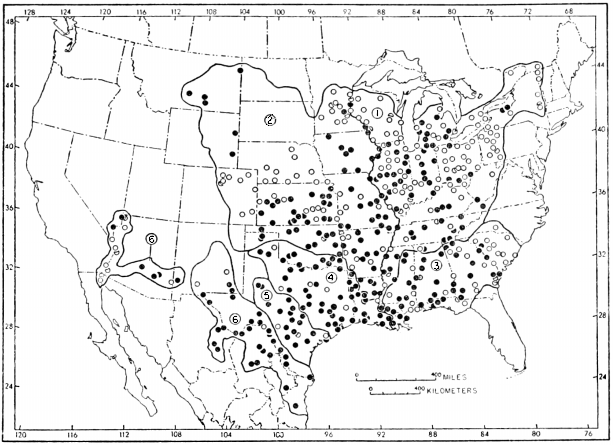
Fig. 19. Geographic distribution of Trionyx spinifer.
Guide to subspecies:
T. s. spinifer
T. s. hartwegi
T. s. asper
T. s. pallidus
T. s. guadalupensis
T. s. emoryi
Greatest width of skull usually at level of squamosal (74%); foramen magnum rhomboidal; ventral surface of supraoccipital spine narrow proximally, usually having medial ridge; opisthotic-exoccipital spur well-developed (66%); distal part of opisthotic wing tapered, not visible in dorsal view; lateral condyle of articular surface of quadrate larger than medial articular surface, not tapered posteriorly; maxillaries in contact above premaxillaries (88%); usually a combination of seven neurals, seven pairs of pleurals and contact of seventh pair of pleurals (83%); angle of epiplastron approximately 90 degrees; callosities when present on epiplastron not covering entire surface; hyo-hypoplastral suture usually present.
Comparisons.—Trionyx spinifer can be distinguished from T. ferox and T. muticus by the presence of any one of the characters mentioned in the "Diagnosis." Both sexes and all sizes of T. spinifer resemble ferox but differ from muticus in having septal ridges. Most individuals of T. spinifer (except some large females) resemble muticus but differ from ferox and large females of ater in having a pale outer rim that is separated from the ground color of the carapace by a distinct (spinifer) or dusky (muticus) dark line. Large females of the subspecies spinifer, hartwegi, asper and pallidus may have enlarged conical projections along the anterior edge of the carapace and, unless these projections are considerably worn, are readily distinguished from large females of ferox (flattened, knoblike prominences), and muticus and ater (smooth surface, no prominences). Large females of the subspecies guadalupensis and emoryi resemble muticus and ater, and to some extent ferox, in having low, scarcely elevated prominences along the anterior edge of the carapace. Some females of emoryi resemble ferox in that the plastron extends farther forward than the carapace.
T. spinifer is intermediate in size between ferox (larger) and muticus (smaller); the maximum size of the plastron in adult males is approximately 16.0 centimeters (14.0, muticus; 26.0, ferox), and of females, 31.0 centimeters (21.5, muticus; 32.5, ferox). The head for all subspecies of spinifer is proportionately narrower than in ferox but wider than in muticus.
In the skull, spinifer more closely resembles ferox than muticus, but differs from both ferox and muticus in usually having a well-developed opisthotic-exoccipital spur. Skulls of spinifer resemble those of muticus but differ from those of ferox in being widest at the level of the squamosal. Skulls of spinifer resemble those of ferox but differ from those of muticus in having the 1) ventral surface of the supraoccipital spine narrow proximally, and usually having a medial ridge, 2) foramen magnum rhomboidal, 3) distal part of opisthotic wing tapered, 4) lateral condyle of articular surface of quadrate not tapered posteriorly, and larger than medial articular surface, and 5) maxillaries in contact above premaxillaries. T. spinifer resembles ferox but differs from muticus in having the epiplastron bent at an approximate right angle. T. spinifer differs from ferox in having an epiplastral callosity, and from muticus in that the callosity does not cover the entire surface of the epiplastron. The hyo-hypoplastral suture is present more often in spinifer and muticus than in ferox.
Remarks.—Gray (1869:221) proposed the generic name Callinia as a new name for Aspidonectes as understood by Agassiz (1857:403). Gray referred Trionyx spiciferus (= spiniferus) Lesueur to Callinia. Stejneger (1907:514) designated Trionyx spiniferus Lesueur as the type species of Callinia. If Trionyx spiniferus Lesueur is considered to be generically distinct from other soft-shelled turtles, Callinia Gray, 1869, is available as a generic name with Trionyx spiniferus Lesueur, 1827, as the type species by subsequent designation.
Geographic variation.—T. spinifer is the most variable and widespread species of the genus in North America. Size of ocelli on the carapace decreases from east to west on turtles inhabiting waterways of the Upper Mississippi River drainage. The most impressive gradient, geographically oriented from western Louisiana to southwestern Texas is seen in each of several features: decrease in size of tubercles on the anterior edge of the carapace, reduction in contrast of pattern on the dorsal surface of limbs and side of head, change in pattern on the dorsal surface of the snout, and increase in the size of white spots on the carapace. But the gradient in size of white spots is reversed in T. s. emoryi, which has small white spots on the carapace. Some of the characters at the western terminus of this geographical gradient are shared with T. ater and muticus. Those subspecies comprising the emoryi group also show proportional characters that correspond closely with those of T. ferox.
On the basis of tuberculation and pattern on carapace, side of head, dorsal surface of limbs and snout, Trionyx spinifer may be divided into six subspecies.
Trionyx spinifer spinifer Lesueur Eastern Spiny Softshell
Plates 33, 34, and 52
Trionyx spiniferus Lesueur, Mém. Mus. Hist. Nat. Paris, 15:258, pl. 6, December, 1827.
T[rionyx] s[pinifer] spinifer Schwartz, Charleston Mus. Leaflet, No. 26:11, May, 1956.
Trionyx ocellatus Lesueur, Mém. Mus. Hist. Nat. Paris, 15:261, December, 1827.
Apalone hudsonica Rafinesque, Atlan. Jour., Friend Knowledge, Philadelphia, 1(No. 2, Art. 12):64, Summer, 1832.
Trionyx annulifer Wied-Neuwied, Riese Nord-Amerika, 1(pt. 3):140, 1838.
Tyrse argus Gray, Cat. Tort. Croc. Amphis. Brit. Mus., p. 48, 1844.
Aspidonectes nuchalis Agassiz, Contr. Nat. Hist. United States, 1(pt. 2):406, 1857.
?G[ymnopus] olivaceus Wied-Neuwied, Nova Acta Acad. Leopold.-Carol., 32:55, pl. 5, 1865.
Type.—Lectotype, Museum d'Histoire Naturelle, Paris, No. 8808; large stuffed female obtained by C. A. Lesueur from the Wabash River, New Harmony, Posey County, Indiana (Pl. 52).
Range.—Northeastern United States and extreme southeastern Canada in tributaries flowing into the Mississippi River from the east, and the St. Lawrence River drainage; extreme southern Quebec and Ontario, Canada, east through southern Great Lakes region to Wisconsin, and south through New York, western Pennsylvania and Illinois to Tennessee and western Virginia (see map, Fig. 19).
Diagnosis.—Juvenal pattern of large, thick-bordered black ocelli, often 9-10 millimeters in diameter in center of carapace on adult males, and 2-3 millimeters in diameter on hatchlings (mean OD/PL, Michigan, .066); only one dark marginal line separating pale rim of carapace from dorsal ground color.
Description.—Plastral length of smallest hatchling, 2.7 centimeters (UMMZ 89950, INHS 3143); of largest male, 14.5 centimeters (UMMZ 72512); of largest female, 31.0 centimeters (UMMZ 40866).
Carapace olive, having large ocelli in center but smaller ocelli or spots at sides; ocelli often interrupted; pale rim of carapace not four or five times wider posteriorly than laterally, separated from darker ground color of carapace by one dark marginal line; large females often having remnants of ocelli at sides of carapace on mottled and blotched background; pattern on snout of pale, dark-bordered stripes that unite forming acute angle in front of eyes; well-defined dark markings in subocular and postlabial region; pattern contrasting with ground color on side of head; postlabial stripe interrupted, diffuse; pale postocular stripe having blackish borders interrupted, not uniting with postlabial stripe; dorsal surface of soft parts of body having contrasting pattern, largest blackish marks on hind limbs; elongate tail of adult males having pale dorsolateral bands with well-defined lower blackish borders; underparts whitish, often having blackish marks, except in center of plastral area; dark marks on webbing of limbs, palms and soles; dark streaks often coincident with digits; small conical tubercles on anterior edge of carapace on adult males; conical or equilateral tubercles on anterior edge of carapace of large females; accessory knoblike tubercles in nuchal region and in middle of carapace posteriorly on large females.
Ontogenetic variation in PL/HW, mean PL/HW of specimens having plastral lengths 7.0 centimeters or less, 4.09, and exceeding 7.0 centimeters, 5.50; ontogenetic variation in CL/CW, mean CL/CW of specimens having plastral lengths 8.5 centimeters or less, 1.12, and exceeding 8.5 centimeters, 1.21; mean CL/PCW, 2.02; mean HW/SL, 1.30 (including subspecies hartwegi); mean CL/PL, 1.39.
Variation.—Variant individuals include: UMMZ 72512, an adult male, having some ocelli seven millimeters in diameter that are almost solid spots; UMMZ 89659 having postocular and postlabial stripes connected on right side of head; UMMZ 95615, 52948, 54402 having inner dark borders of pale stripes on snout represented by short dashes and dots (a ragged line connecting anterior margins of orbits on 54402); UMMZ 52948, 89659 having interrupted, black marginal lines on carapace with ends of some segments oriented inward and overlapping portion of adjacent segments; UMMZ 81699, female having plastral length of 19.0 centimeters, lacking conspicuous tubercles on anterior edge of carapace; UI 2403, CNHM 92204 having extensive dark mottling and marbling on throat and neck, undersurface of limbs and posterior portion of carapace.
Comparisons.—T. s. spinifer can be distinguished from all other subspecies of T. spinifer by the presence of large black ocelli (diameter 9-10 mm. on adult males, 2-3 mm. on hatchlings) in combination with only one dark marginal line. T. s. spinifer resembles asper in having ocelli or dots on the carapace but differs from asper in having only one dark marginal line and larger ocelli. T. s. spinifer differs from hartwegi only in the large size of the ocelli. T. s. spinifer resembles hartwegi and asper but differs from pallidus, guadalupensis and emoryi in having blackish spots and ocelli on the carapace and lacking whitish dots. T. s. spinifer resembles hartwegi, asper, and pallidus and differs from guadalupensis and emoryi in having conical or knoblike tubercles on the anterior edge of the carapace on large females.
T. s. spinifer differs from the subspecies asper, guadalupensis and emoryi in having a relatively narrower head, and from emoryi in having a relatively wider carapace. T. s. spinifer resembles hartwegi and asper but differs from the other subspecies in having the carapace widest at a plane approximately one-half way back on the carapace. The subspecies spinifer and hartwegi have longer snouts than pallidus, guadalupensis, and emoryi. T. s. spinifer differs from asper but resembles all the other subspecies in having a relatively longer plastron.
Remarks.—Lesueur's description of Trionyx spiniferus (1827:258-261, Pl. 6) seems to be based mostly, if not entirely, on a large female (length of carapace, 13 inches), which was "Le plus grand des individus observes …" (op. cit.:258); an accompanying illustration depicting the dorsal surface of the bony carapace is unusual in lacking neurals (Pl. 6, E). Duméril and Bibron (1835:481) mentioned eight or nine additional specimens that Lesueur sent to the Museum of Natural History in Paris. Dr. Jean Guibé informed me under letter dated September 24, 1959, that a larger stuffed female, bearing catalog number 8808 is regarded as the holotype, and that there are seven additional specimens (1949, 4143, 8807, 8809-12) in the museum at Paris. All turtles were obtained by Lesueur from the Wabash River. To my knowledge no specimen that was available to Lesueur has been specifically designated as a type. Because the description seems to be based on one specimen, undoubtedly No. 8808, this specimen has been regarded as the holotype. However, Lesueur referred to several specimens and did not mention a type in the original description; consequently I prefer to regard No. 8808 as a lectotype.
Lesueur also described Trionyx ocellatus (op. cit.:261-263) as a variety of T. spiniferus having ocelli, or parts thereof, on the carapace and mentioned three specimens. The total number of specimens that were available to Lesueur is unknown. One young alcoholic specimen having ocelli is in the British Museum (Natural History) (Gray, 1855:69). The same letter from Dr. Guibé stated that a specimen in the Museum of Natural History, Paris, No. 6957, having a carapace 17 centimeters in length, conforms to the characters of ocellatus as mentioned by Lesueur, and was obtained from the Wabash River by Lesueur. Two of the specimens mentioned by Lesueur (loc. cit.) are stated to be females. No. 6957 is an adult male and clearly shows the juvenal pattern; it is regarded as the lectotype of T. ocellatus Lesueur, a name-combination, which is a synonym, based on a secondary sexual difference in pattern.
Rafinesque (1832:64) described a soft-shelled turtle from "the River Hudson between the falls of Hadley, Glen and Baker, and further up to the source" as Apalone hudsonica. The most outstanding characteristic was the presence of five claws on the digits of each limb. Rafinesque's recording of this characteristic was perhaps influenced by the illustration of a softshell in Bartram's Travels that showed each limb with five, clawed digits. Perhaps this was the basis for Boulenger (1889:245, footnote) regarding Apalone as "mythical." The large, yellowish, black-bordered spots, one behind and one in front of the eye presumably represent segments of the postocular stripe and the stripe on the snout; Rafinesque described the carapace as "entire … the margin is yellowish unspotted, then comes a circular black line …" and having "many round spots occulated and clouded by having a brown margin, with grey dots within." Except for five claws, the description is applicable to a softshell and referable to T. s. spinifer. To my knowledge, the only other records of the occurrence of soft-shelled turtles in the Hudson river drainage are those of Eights (in Bishop, 1923:120, Mohawk River at Cohoes), and DeKay (1842:7, Mohawk River and Hudson River near Albany); presumably these records are the basis for the comments of Holbrook (in Bishop, loc. cit.), and symbolized as an isolated locality by Conant (1958:318, map 35). The type locality of Apalone hudsonica is herein restricted to the Hudson River, near Baker's Falls, Saratoga County, New York.
Gray (1844:48) proposed the name Tyrse argus for a specimen reported to have come from Sierra Leone, West Africa; later (1855:68), he referred the species to the genus Trionyx. After comparison with a specimen of T. spiniferus Lesueur, Gray (1864:89) was "doubtful whether there must not have been some confusion about the habitat of the specimen [which formed the basis of the description of Tyrse argus], and whether it is not more probably a North American species." The same author (1869:222; 1870:109) listed Tyrse argus as a synonym of Callinia spinifera (= Trionyx spiniferus Lesueur).
Agassiz (op. cit.:406-07) described Aspidonectes nuchalis on the basis of three adults from the Cumberland River and a number of young from the headwaters of the Tennessee River. Boulenger (1889:245, footnote 2) suggested that the status of A. nuchalis required further investigation. The species was not generally recognized after the turn of the century. Barbour and Loveridge (1929:226) listed MCZ 1908 (one of the juveniles) and 1623-25 as cotypes. Stejneger (1944:52) showed that nuchalis was not distinguishable from T. s. spinifer, and (op. cit.:49) listed MCZ 1623-25 as cotypes. Schmidt (1953:110) restricted the type locality to the Cumberland River, near Nashville, Tennessee.
Agassiz (loc. cit.) mentioned that nuchalis "differs strikingly from Asp. spinifer in the much more elongated form of the male, and in the great development of the marginal spines and of the tubercles upon the carapace, … But the most prominent specific character consists in the marked depressions on either side of the blunt median keel, and also in the triangular dilation of that keel behind the front margin of the carapace." These characters seem to be of no taxonomic worth. I have seen three syntypes (MCZ 1623-25) that undoubtedly correspond to the three adult specimens mentioned by Agassiz. All are females, measuring 19.5, 22.0, and 19.0 centimeters, respectively, in plastral length, and lack a contrasting mottled pattern on the carapace; the juvenal pattern is obscured, except for blackish spots at the edge of the carapace on MCZ 1625, and parts of an ocellus on MCZ 1624. The dorsal surfaces of the limbs are boldly marked. MCZ 1623, showing the diagnostic feature mentioned by Agassiz, is photographed by Stejneger (op. cit.:Pls. 14, 15), and may be regarded as the lectotype of Aspidonectes nuchalis Agassiz. MCZ 1908 is one of the young syntypes mentioned by Agassiz, and is referable to spinifer. The juvenal pattern consists of spots and ocelli; the plastron measures 3.1 centimeters in length, and the carapace 4.2 centimeters.
Wied-Neuwied (1865:55-57, Pl. 5) described the species ?G[ymnopus] olivaceus, but was uncertain whether his interpretation was based on a species, a variety or a secondary sexual difference. Wied-Neuwied mentioned that Lesueur had already named this soft-shelled turtle as Trionyx ocellatus, and agreed with Lesueur that those turtles having occulated spots on the carapace were distinguishable from T. spiniferus and T. muticus. But because Duméril and Bibron in their Erpétologie Général failed to recognize T. ocellatus, Wied-Neuwied felt obliged to bring it to the attention of his American colleagues and he renamed it. Wied-Neuwied also stated, in the context of a synonym, "Beschreibung einer Reise in Nord-America Bd. I., pag. 140." This comment presumably refers to his earlier description of T. annulifer (1838:140); seemingly Wied-Neuwied considered T. annulifer and G. olivacea as conspecific, although there is no mention of annulifer in the text proper. Stejneger (op. cit.:49) designated the type locality of T. annulifer as the Ohio River at Pittsburgh, Pennsylvania, and of Gymnopus olivacea as New Harmony, Wabash River, Illinois (lapsus for Indiana).
Trionyx spiniferus was questionably considered distinct from T. ferox by Lesueur who listed "Testudo ferox Gm. Tortue de Pennant?" and "Trionyx georgicus Geoffr.?" as synonyms. Subsequently, most authors considered T. spiniferus synonymous with T. ferox until Agassiz (1857) pointed out differences between the two species.
The average size of the ocelli on the carapace of the subspecies spinifer decreases westward toward the Mississippi River; ocelli of different sizes occur on different individuals from the same state and presumably from the same population. For example, INHS 2281, plastron 9.9 centimeters in length, from Effingham County, Illinois, has some ocelli eight millimeters in diameter, whereas a larger male from the same locality, UI 1322, plastron 11.6 centimeters in length, has the largest ocelli only five millimeters in diameter. For convenience, all softshells having locality data from states east of the Mississippi River are referred to spinifer, recognizing that intergradation occurs with hartwegi over a broad area paralleling the Mississippi River. The type locality of spinifer is in an area where most turtles do not have the larger ocelli (diameter of seven to ten mm. on adult males); however, some individuals from the Wabash River (UMMZ 63523, adult male, plastron 11.5 cm. in length, ocelli diameter seven mm.) agree with more "typical" spinifer to the east. Intergradation with asper possibly occurs in that part of the Tennessee River in eastern Tennessee as exemplified by UMMZ 59198.
Published reports indicate that T. s. spinifer is not abundant in some of the northeasterly parts of its geographic range. Adams and Clark (1958:10) wrote that few softshells at Long Point on the Canadian side of Lake Erie are "ever collected and the area's game keepers report … (none) … seen in recent years. They also tell of recurrent severe stormy winters in which the muddy bottom of the marshland was repeatedly churned up and frozen. Such climatic conditions could easily destroy a large part of the Trionyx population overwintering in the mud bottom." Wright (1919:8) reported that softshells are "rarely seen" in bays on the New York side of Lake Ontario, and Babcock (1938:53) wrote that spinifer "is not common in Lake Champlain."
T. s. spinifer probably extended its geographic range into the Hudson River drainage of New York via the Erie Canal (connected Buffalo and Albany) after its completion in the early 1800's (DeKay, 1842:7). Now, the New York Barge Canal (essentially the Erie Canal, but with minor changes in course and the addition of several spurs) provides an avenue for dispersal of spinifer to the Hudson River drainage, Lake Ontario and intervening waterways in New York (Mertens, 1928:199). Netting (1944:86-87), however, suggested that spinifer occupied Lake Champlain, the Finger Lakes, Mohawk River and upper Hudson in the late stages of the formation of the Great Lakes.
A publication not seen by me is that of Mansueti and Wallace (1960). Its title suggests that Trionyx occurs in Maryland.
The unsuccessful introduction of T. s. spinifer in the Delaware drainage in New Jersey has been discussed by Fowler (1907:213), who wrote that they were found as early as the late 1860's and were introduced when young presumably to stock aquaria. Records of occurrence include Cooper's Creek, Camden County (Stone, 1906:168); Woodbury, Gloucester County (Cope, 1894:889); and Paulins Kill at Hainesburg, Warren County (Johnson, 1894:889).
Surface (1908:122) believed that soft-shelled turtles "have doubtless been introduced into the eastern part of Pennsylvania through the canal from the Western and Central part of New York," and Roddy (in Neill, 1951:21) suggested that the species may be found in the Susquehanna River. Babcock (1919:420) mentioned a young specimen of spinifer in the collection of the Boston Society of Natural History that was obtained "in White River, Vermont," a tributary of the Connecticut River of the Atlantic Coast drainage; seemingly this record has not been accepted and the species is not established. To my knowledge, populations of T. s. spinifer do not occur in rivers of the Atlantic Coast drainage, except probably the Hudson-Mohawk drainage.
Stockwell (1878:401) wrote that spinifer was found "as high as Athabasca." Presumably Stockwell referred to Lake Athabaska in northern Alberta and Saskatchewan, Canada, a region where soft-shelled turtles are unknown; see also the comments by Stejneger (1944:52).
Specimens examined.—Total 250 as follows: Alabama: Morgan: UMMZ 99578, "near" Decatur.
Illinois: Adams: INHS 2150, Quincy. Bond: INHS 8345, Greenville. Carroll: CNHM 42116, Ordnance School Proving Ground. Cass: INHS 2151, Beardstown. Champaign: INHS 2273, 2311, 2413, 3142, "near" Seymour; INHS 4229, Champaign; INHS 6163, Sidney. Christian: INHS 1560, Pana. Coles: INHS 1968-69, 2 mi. W Charleston. Cumberland: INHS 2282, Greenup. De Witt: INHS 7674, Farmer City. Effingham: UI 1322, 2281, 19365, "near" Effingham. Fulton: INHS 5531, 2 mi. NE Bluff City, Schyler County; UI 23449, Liverpool; UI 24611, Spoon River, 18 mi. NW Canton. Hancock: USNM 53522, 59277, "near" Hamilton. Iroquois: INHS 6869-70, 2.5 mi. N Crescent City. Jackson: TU 1369 (12), Elkville. Kane: CNHM 42400, Aurora. Kankakee: CNHM 324, Momence. Kendall: UI 2411, Plano. Logan: INHS 7171-72, 6 mi. N Lincoln. Madison: USNM 60571. Macoupin: UI 2401-02, Beaver Dam Lake. Mason: CNHM 346, 470, INHS 1122, 1559, 5756-58, UI 42, 2404, Havana, Lake Chautauqua. Mercer: CNHM 3220, New Boston. Morgan: CNHM 2067 (2), 3290, 3303-04, 3306, INHS 2152, 2154, 5132-37, USNM 54747, Meredosia. Moultrie: INHS 8989, 2 mi. NW Lovington. Peoria: UI 2406-10, Peoria. Pope: INHS 5505, Lake Glendale. Putnam: UMMZ 81604-14, 5 mi. N Henry, Marshall County. Schuyler: UI 2405, "near" Ripley, Brown County. Scott: INHS 2149, 2153, Naples. Union: CNHM 18623, 6 mi. SW Jonesboro. Vermilion: INHS 3142, Muncie; INHS (1 untagged); UI 1970, 3209, Danville; UI 2403, 1.5 mi. E Oakwood; UI 16265, Kickapoo State Park. Wabash: USNM 12061, Mt. Carmel. Winnebago: INHS 7185, Kishwaukee Forest Preserve; INHS 7294, 1/2 mi. S Shirland. County unknown: USNM 7661.
Indiana: Bartholomew: UMMZ 61060, 10 mi. W Columbus. Carroll: USNM 42905-06, Burlington. Clark: UMMZ 110599, 14-mile Creek, 3 mi. NW Charleston. Decatur: UMMZ 55416, 3 mi. S Westport. Elkhart: UMMZ 105598, Elkhart River, south of Goshen. Gibson: UMMZ 89744, Foot's Pond. Johnson: UMMZ 108062, 2 mi. S Trafalgar. Knox: USNM 22711, Vincennes. Kosciusko: AMNH 8379, UMMZ 84287 (5), Winona Lake; UMMZ 110235, Wawasee Lake. Lake: CNHM 11019, 11021-24, Crown Point. Marion: UMMZ 103393, Ravenswood; UMMZ 110236, 1 mi. N Lawrence. Marshall: CNHM 39299; USNM 33495, Yellow River north of Burr Oak; USNM 33496-501, 35404, 42583-84, Lake Maxinkuckee. Wells: UMMZ 63523, Wabash River, Bluffton. County unknown (Lagrange or Marshall): USNM 50670, Twin Lakes.
Kentucky: Casey: UMMZ 112252, trib. of Green River, south of Yosemite. Green: UMMZ 116718, Little Barren River, 1.5 mi. E Monroe, Hart County. Rockcastle: UMMZ 98767, Rockcastle River, 5 mi. above Livingston.
Michigan: Allegan: UMMZ 42112, Kalamazoo River. Barry: UMMZ 53874, Thornapple River, 3 mi. NW Hastings. Bay: UMMZ 74670. Branch: UMMZ 95615, 1 mi. S Kinderhook; UMMZ 70748, Hog Creek. Calhoun: UMMZ 89950 (3); UMMZ 79133, near Battle Creek. Cass: UMMZ 40866-67, 53005, Diamond Lake; UMMZ 40868, 52948, Long Lake. Jackson: UMMZ 72494. Kalamazoo: UMMZ 42130, 80534, Kalamazoo; UMMZ 90506, Gull Lake; UMMZ 92599, Kellogg Bird Sanctuary. Lenawee: UMMZ 72457, Devil's Lake; UMMZ 74662, Wolf Lake Park. Livingston: UMMZ 54401, 76190, Portage Lake. Monroe: UMMZ 44604-06, USNM 51213, "near" Monroe. Newaygo: UMMZ 63469. Oakland: UMMZ 64363, Hay's Creek; UMMZ 96539, Clinton River. Ottawa: UMMZ 81699. St. Joseph: UMMZ 38876, 38889, "near" White Pigeon; UMMZ 96537, Corey Lake. Van Buren: UMMZ 90003, Wolf River, west of Kalamazoo, Kalamazoo County. Washtenaw: SM 2035, 2038, 2105, UMMZ 39847, 96538, "near" Ann Arbor; UMMZ 35765, 35769, 74518 (2), Portage Lake; UMMZ 54402-03, Little Lake; UMMZ 89659, Huron River, Dexter; UMMZ 110583-85. County unknown (Washtenaw or Livingston): UMMZ 54400, Huron River near Portage Lake.
Mississippi: Adams: MCZ 46615, UMMZ 76446, "near" Natchez; MCZ 46621, 46633, USNM 01084, 01086, Washington. Coahoma: AMNH 5289, 5285-86, Moon Lake. Lafayette: MCZ 37173, Oxford; USNM 7650, Abbeville? (reported from Abbeville, South Carolina by Pickens, 1927:113; see discussion by Stejneger, 1944:50, and my comments on page 509 beyond). LeFlore: USNM 73668-69, Greenwood. Madison: USNM 95192, Big Black River. Washington: USNM 115980, Deer Creek. Yazoo: UMMZ 86669, Panther Creek west of Yazoo City; UMMZ 83304, Yazoo City.
New York: Monroe: CNHM 92001-02, Genesee River, Rochester. Wayne: AMNH 69931, CNHM 92004, Sodus Bay.
Ohio: Athens: UMMZ 111793, east branch Shade Creek. Franklin: USNM 26290. Lucas: USNM 51214, Toledo. Pike: UMMZ 99309, Morgan's Fork, Sunfish Creek. Warren: AMNH 4763, Little Miami River, 3 mi. below Morrow. County unknown: USNM 21128-29, Cuyahoga River.
Tennessee: Benton: UMMZ 113036, Eagle Creek, 1/2 mi. E Holliday. Bradley: UMMZ 59197, west branch of Chestnee Creek, 7 mi. E Cleveland. Claiborne: USNM 86677, 5 mi. SE Cumberland Gap, Powell River. Davidson: MCZ 1623-25, Cumberland River near Nashville (restricted locality); USNM 7165-67, Nashville. Decatur: KU 3000, Perryville. Hamilton: USNM 131861, Chattanooga. Monroe: TU 16058, Little Tennessee River, 10 mi. N Madisonville. Obion: UMMZ 53199, USNM 102911, Reelfoot Lake. Overton: UMMZ 69561 (2), Wirmingham. Sevier: TU 16132, UMMZ 86735, USNM 86681-82, near Sevierville; UMMZ 86734, Walden Creek "near" Gatlinburg. County unknown: MCZ 1908, headwaters of Tennessee River.
Virginia: Smythe: USNM 101386, Holston River, Seven Mile Ford.
West Virginia: McDowell: USNM 33767, Dry Fork, Perryville (county questionable, perhaps Randolph County).
Wisconsin: Chippewa: CNHM 8223, Lake Wissota, mouth of Yellow River, Anson Twp. Polk: UMMZ 72511-12, St. Croix River "near" Never's Dam. County unknown: CNHM 15971, Eau Claire River.
Records in the literature.—Ontario: Carleton: Ottawa (questionable record). Essex: Point Pelee. Haldimand: Dunville. Kent: Lake St. Clair. Norfolk: Long Point. Oxford: Beachville. Wentworth: Hamilton Bay (Logier and Toner, 1955:51).
Quebec: Iberville: Richelieu River at Iberville (Logier and Toner, 1955:51).
Alabama: Lawrence: Courtland (Stejneger, 1944:53).
Illinois: Boone: Belvidere. Bureau: Bureau. Cass: Chandlerville. Clay: Louisville (Cahn, 1937:189). Cook: Lake Michigan (Kennicott in Stejneger, 1944:44); Evanston (Necker, 1939:10); Chicago (Schmidt and Necker, 1935:76). Crawford: Robinson. Douglas: northern part of county (P. W. Smith, 1947:39). Fayette: Vandalia. Fulton: Ellisville (Cahn, loc. cit.). Grundy: Morris (Stille and Edgren, 1948:201). Jackson: Jacob (Cagle, 1942:158). Jersey: Grafton (Cahn, loc. cit.). Kane: Batavia; Dundee Game Farm (Stille and Edgren, loc. cit.). Kankakee: Kankakee River near Altort (Necker, loc. cit.). Lake: Fox Lake. LaSalle: Streator (Cahn, loc. cit.). Lawrence: (Hahn in Stejneger, 1944:44). Lee: symbol on map (Cahn, loc. cit.). McHenry: McHenry (Stille and Edgren, loc. cit.). Macon: Decatur. Macoupin: Carlinville (Cahn, loc. cit.). Ogle: Oregon (Garman in Cahn, loc. cit.). Randolph: Chester, Reily Lake. Rock Island: Barstow, Hillsdale, Rock Island (Cahn, loc. cit.). Saline: Horseshoe Lake (Stein, 1954:312). Stephenson: Freeport (Cahn, loc. cit.). Union: Bluff Lake (Garman in Cahn, loc. cit.). Whiteside: Sterling, symbol on map (Cahn, loc. cit.). Williamson: Marion (Cagle, 1942:158). Winnebago: Rockton; symbol in western part of county (Cahn, loc. cit.). County unknown: Fox River (Yarrow, 1882:29).
Indiana: Brown: 1 mi. below Helmsburg (Myers, 1927:339). Clay: Eel River (Kirsch in Stejneger, 1944:45). Franklin: (Hughes in Stejneger, loc. cit.). Jasper: Jasper-Pulaski Game Preserve (Swanson, 1939:690). Jefferson: Madison (Myers, loc. cit.). Marion: Irvington (Stejneger, op. cit.:55). Marshall: 2 mi. NW Culver (KKA). Monroe: Bloomington (McLain in Stejneger, op. cit.:45). Newton: Lake Village (Stille and Edgren, loc. cit.). Posey: Wabash River at New Harmony (Lesueur, 1827:257). Starke: Grant (Stille and Edgren, loc. cit.). Steuben: Fish Creek "near" Hamilton (Stejneger, op. cit.:53). County unknown (Knox or Starke): USNM 72387, Knox (Stejneger, op. cit.:55); "White Water valley," east-central part of state (Butler, 1894:224). USNM 8359 (= Trionyx spinifer asper) has been erroneously recorded from Madison, Indiana, by Yarrow (1882:29) and Hay (1892:145); see discussion by Cahn (1937:200) and Stejneger, (op. cit.:73, 75).
Kentucky: Edmonson: Green River, Mammoth Cave National Park (Hibbard, 1936:281). Fleming: Fox Creek (Welter and Carr, 1939:130). Jefferson: (Funkhouser, 1925:71). Morgan: (Stejneger, 1944:54). County unknown: Ohio and Pond rivers (Funkhouser, loc. cit.).
Michigan: Berrien: mouth of St. Joseph River at St. Joseph (Lagler, 1943:303). Eaton: Brookfield; Olivet (Clark in Ruthven, Thompson and Thompson, 1912:133). Genesee: (Miles in Ruthven, Thompson and Thompson, loc. cit.). Iosco: (Lagler, 1943:283, symbol on map). Kent: (Lagler, loc. cit.). Montcalm: (Clark in Ruthven, Thompson and Thompson, loc. cit.). Muskegon: Muskegon River "near" Muskegon (Lagler, op. cit.:303). Van Buren: Reynolds Lake, 2.5 mi. E Lawrence (Edgren, 1942:180).
Mississippi: De Soto: Lake Cormorant (Stejneger, 1944:55). Holmes: Thornton (Cook, 1946:185). Humphreys: Belzoni (Stejneger, loc. cit.). Sunflower: Warren: Vicksburg, Eagle Lake (Cook, loc. cit.). Washington: Lake Washington (Smith and List, 1955:125); Greenville (Stejneger, loc. cit.).
New York: Albany: Hudson River at Albany (DeKay, 1842:7); Mohawk River at Cohoes (Eights in Bishop, 1923:120). Cattaraugus: Allegheny River and Red House Lake in Allegheny State Park (Eaton, 1945:115). Chautauqua: Lake Chautauqua (DeKay, loc. cit.). Monroe: Braddocks Bay and Long Pond on Lake Ontario (Wright, 1919:8). Saratoga: Hudson River near Baker's Falls (restricted locality, Rafinesque, 1832:64). County unknown: Lake Cayuga; Mohawk River (DeKay, loc. cit.).
Ohio (Conant, 1951:158-59, 264, except records from Allen, Geauga and Noble counties): Allen: Sugar Creek, 6 mi. N Lima (Adler and Dennis, 1960:27). Ashland: Long Lake, Lake Twp.; Black Fork, Sec. 27, Green Twp. Athens: Hocking River "near" Athens; "near" Fisher, Alexander Twp. Auglaize: Pusheta Creek, west of Wapakoneta. Brown: White Oak Creek, 1 mi. N Higginsport. Butler: Oxford. Champaign: Mad River, 4 mi. SW Urbana. Coshocton: Walhouding River, below dam. Defiance: Auglaize River, Shawnee Scout Camp, Defiance Twp. Erie: Huron; Sandusky. Fairfield: Buckeye Lake. Franklin: Alum Creek, Westerville; Columbus. Geauga: Chardon Twp. (Wood, 1959:8). Greene: Huffman Dam. Hamilton: Harrison; mouth of Miami River. Hardin: "near" Hepburn. Henry: Maumee River, east of Napoleon; Maumee River "near" Texas; Maumee River, 3 mi. W Texas. Highland: Little Brush Creek, 2 mi. N Sinking Spring. Huron: Huron River "near" Monroeville. Jackson: Canter's Cove, Jackson Twp.; Jackson Lake. Knox: Brinkhaven. Lake: east branch Chagrin River, Kirtland; Grand River, 4 mi. E Painesville. Lawrence: Pine Creek, Elizabeth Twp. Logan: Miami River, "near" Indian Lake. Lorain: Oberlin. Lucas: Lake Erie at Reno Beach, Jerusalem Twp.; Lake Erie, 1/2 mi. offshore from mouth of Crane Creek; Maumee River at Maumee; Swan Creek, W of Toledo; "near" Waterville; Swan Creek "near" Whitehorse. Madison: London. Medina: Hinckley Lake. Meigs: Shade River, below Darwin. Miami: Miami River, above Troy. Monroe: Cranenest Fork, Green Twp. Montgomery: Mad River, Dayton; Miami River, Dayton; Stillwater River, Dayton. Morrow: Kokosing River, Franklin Twp. Noble: Jct. Sharon Twp. 1 and St. Rt. 78. (Adler and Dennis, 1960:27). Ottawa: East Harbour, Catawba Island. Pike: Chenoweth Fork, Sunfish Twp.; Scioto River, Camp Creek Twp. Ross: Paint Creek near Bainbridge. Vinton: Lake Hope; Lake Alma. Warren: Fort Ancient. Washington: Dam No. 2, Muskingum River, "near" Marietta. Williams: 1 mi. S Blakesley; St. Joseph River "near" Blakesley; West Branch, St. Joseph River, Sec. 8, Bridgewater Twp.; Edgerton. Wood: Grand Rapids; Grassy Creek, Rossford; Haskins; Maumee River opposite Toledo.
Pennsylvania: Allegheny: Monongahela River above McKeesport (Atkinson, 1901:154); Ohio River at Pittsburgh (Wied-Neuwied in Stejneger, 1944:44, 49). Armstrong: (Swanson, 1952:165). Clarion: Clarion River "near" Clarion (Allen, 1955:228); Foxburg (= Foxbury?, Boulenger, 1889:260). Crawford: Elk: Erie: Edinboro Lake. Forest: (Swanson, loc. cit.). Indiana: Plum Creek; Crooked Creek (Netting in Stejneger, 1944:48). McKean: (Swanson, loc. cit.). Somerset: Stoyestown (Surface, 1908:122). Warren: Venango: Allegheny River south of Franklin (Swanson, loc. cit.).
Tennessee: Chester: South Fork, Forked Deer River just E Henderson (Endsley, 1954:40). Clay: Mill Creek, 3 mi. from Butler's Landing; Obey River above mouth of Wolf River at Lilydale; mouth of Wolf River (Shoup, Peyton and Gentry, 1941:75); Iron Creek "near" Willow Grove (Stejneger, 1944:56). Fentress: Jackson: (Gentry, 1941:332). Lake: Reelfoot Lake (Parker, 1948:29). Obion: Walnut Log (Parker, 1937:85); east shore of Reelfoot Lake, Samburg (Rhoads, 1895:386). Overton: Medlock Branch, tributary of West Fork Obey River north of Allred (Shoup, Peyton and Gentry, loc. cit.). Roane: 2 mi. S Kingston (Stejneger, 1944:55).
Vermont: Chittenden: Lake Champlain, mouth of Winooski River; "near" Burlington; Milton (= Minton) (Babcock, 1919:420). Franklin: Swanton (Stejneger, 1944:55).
West Virginia: Randolph: Tygart River at Elkins (Green, 1937:116).
Wisconsin: Burnett: Crawford: (Pope and Dickinson, 1928:83). Dane: Lake Wingra, Madison (Noland, 1951:54). Grant: (Pope and Dickinson, loc. cit.). Green Lake: Berlin (AMNH 6840-41, listed in card file March 2, 1959). Jefferson: Lake Mills (Dickinson, 1950:75). La Crosse: West Salem (Pope, 1930:281). Oneida: Pepin: (Pope and Dickinson, loc. cit.). Racine: Eagle Lake (Edgren, 1944:498); Burlington; Rochester (Stille and Edgren, 1948:201). Sheboygan: Sheboygan (KKA). Trempealeau: Vernon: "near" Viroqua (Pope, loc. cit.). Walworth: Lake Beulah (Dickinson, loc. cit.). Washburn: (Pope and Dickinson, loc. cit.). Waukesha: Lac La Belle (Cahn, 1929:8). Winnebago: Wolfe River (Dickinson, loc. cit.).
Trionyx spinifer hartwegi (Conant and Goin) Western Spiny Softshell
Plates 35 and 36
Amyda spinifera hartwegi Conant and Goin, Occas. Papers Mus. Zool. Univ. Mich., No. 510:1, pl. 1, map 1, June 15, 1948.
T[rionyx] s[pinifer] hartwegi Schwartz, Charleston Mus. Leaflet, No. 26:11, May, 1956.
Type.—Holotype, UMMZ 95365; alcoholic adult male; obtained at Wichita, Sedgwick County, Kansas, in May, 1945, by Robert Young.
Range.—Central United States in tributaries flowing into the Mississippi River from the west, except the Red River drainage; eastern Montana, North Dakota, and southern Minnesota south to eastern Colorado, northern Oklahoma and Arkansas (see map, Fig. 19).
Diagnosis.—Juvenal pattern of small ocelli, rarely as large as two millimeters in diameter, or usually solid black dots that are not much larger in center of carapace than at sides (mean OD/PL, Kansas, .022); only one dark marginal line separating pale rim of carapace from dorsal ground color.
Description.—Plastral length of smallest hatchling, 2.8 centimeters (USNM 9928); of largest male, 13.1 centimeters (USNM 55687); of largest female, 25.5 centimeters (KU 2283).
Carapace olive, having small ocelli or black spots that are not much larger in the center of the carapace than at the sides; pale rim of carapace separated from darker ground color by one dark marginal line and not four or five times wider posteriorly than laterally; large females often having black dots at sides of carapace on mottled and blotched pattern; pattern on snout of pale, dark-bordered stripes that unite forming acute angle in front of eyes; well-defined dark markings in subocular and postlabial region; pattern contrasting with ground color on side of head; postlabial stripe broken, interrupted; pale postocular stripe having blackish borders interrupted, not joining with postlabial stripes; dorsal surface of soft parts of body having contrasting pattern, largest blackish marks on hind limbs; elongate tail of males having pale dorsolateral bands with well-defined, lower, blackish borders; patterns on soft parts of body usually obscured or absent on large females; underparts whitish, often having blackish marks, except in center of plastral area; dark marks on webbing of limbs, palms and soles; dark streaks often coincident with digits; tubercles along anterior edge of carapace small and conical on adult males, and conical or knoblike on large females; accessory, knoblike tubercles in nuchal region and in middle of carapace posteriorly on large females.
Ontogenetic variation in PL/HW, mean PL/HW of specimens having plastral lengths 7.0 centimeters or less, 4.24, and exceeding 7.0 centimeters, 5.33; ontogenetic variation in CL/CW, mean CL/CW of specimens having plastral lengths 8.5 centimeters or less, 1.12, and exceeding 8.5 centimeters, 1.19; mean CL/PCW, 2.00; mean SL/HW, 1.30 (including subspecies spinifer); mean CL/PL, 1.38.
Variation.—Variants include: CNHM 8949, UMMZ 72511 and TU 14591 having ocelli approximately 4 millimeters in diameter that are almost solid spots; KU 17728 having pale stripes on snout that lack black, inner borders; TTC 719 (female, plastral length 20.7 cm.), having distinct pattern on snout; USNM 14535, 17823, 55684, and 123446 (from different localities) having markings confined to margins of carapace (Stejneger, 1944:66, suggested that USNM 17823 probably came from Texas); UMMZ 92667 (female, plastral length 6.7 cm.) lacking pattern on carapace.
Comparisons.—T. s. hartwegi can be distinguished from all other subspecies of T. spinifer by the presence of small dots and ocelli on the carapace that are all of approximately the same size in combination with only one dark marginal line. T. s. hartwegi resembles asper in having small blackish ocelli or dots on the carapace but differs from asper in having only one dark marginal line. T. s. hartwegi differs from spinifer only in the small size of the ocelli. T. s. hartwegi resembles spinifer and asper, but differs from pallidus, guadalupensis and emoryi in having blackish spots and ocelli on the carapace and lacking small whitish spots. T. s. hartwegi resembles spinifer, asper and pallidus but differs from guadalupensis and emoryi in having conical or knoblike tubercles on the anterior edge of the carapace on large females.
T. s. hartwegi differs from the subspecies asper, guadalupensis and emoryi in having a narrower head, and from emoryi in having a wider carapace. T. s. hartwegi resembles spinifer and asper but differs from the other subspecies in having the carapace widest at a plane approximately one-half way back on the carapace. T. s. hartwegi and spinifer have longer snouts than do pallidus and guadalupensis or emoryi. T. s. hartwegi differs from asper but resembles the other subspecies in having a relatively longer plastron.
Remarks.—The validity of T. s. hartwegi has never been questioned. It intergrades with spinifer over a broad area paralleling the Mississippi River. For convenience, specimens occurring west of the Mississippi River are referred to the subspecies hartwegi. Figure 8 shows much variation in size of ocelli on different individuals from the same state. For example, UMMZ 92667, plastral length 6.7 centimeters has a uniform pale brown carapace lacking any dark marks, whereas UMMZ 92652, plastral length 5.9 centimeters has some ocelli three millimeters in diameter on the carapace. Both are from Iowa. One specimen from Kansas, KU 1954 (Doniphan County, plastral length 11.8 cm.), has ocelli four millimeters in diameter, and USNM 7648 captured farther west at Fort Laramie, Wyoming, an adult male having a plastral length of 11.0 centimeters, has some ocelli five millimeters in diameter on the carapace. TTC 1090, an adult male from the panhandle of Texas has some ocelli so much as 5.5 millimeters in diameter. The size of the ocelli seemingly varies in the same local population.
Specimens of T. spinifer in the lower Mississippi Valley are intergrades. Most individuals have small black dots on the carapace; some have small ocelli (TU 7216, 7501, 11912, 12123-24) interspersed with black dots (TU 5863), others have black dots confined to the edge of the carapace (TU 157, 4539, 7105), and still others have no pattern on the carapace (TU 7506, 13698.1, 10087.6). Two large males (TU 11580, 13025) have large ocelli (approximately five mm. in diameter) that have nearly black centers. In general, there is more dark pigmentation than farther north; some specimens have extensive pigmentation on the ventral surface of the carapace and soft parts of the body (TU 156, 5648). The dorsal surface of the limbs, especially the hind limbs, have a bold, black marbling and may be almost completely black (TU 5484, 5597). Many females, not exceeding plastral lengths of 7.0 centimeters, have a pale blotched pattern of lichenlike figures or have ill-defined black dots on the carapace (TU 10087, 13698.13, 13753.15).
Localities of specimens of T. spinifer occurring in the Mississippi River drainage in Mississippi are arbitrarily listed under the account of the subspecies spinifer, whereas those in Louisiana (excluding pallidus) are listed under the account of hartwegi.
Neither Over (1943) nor Wheeler (1947:169) record T. s. hartwegi, respectively, from South Dakota or North Dakota; records from the Missouri River drainage in Montana suggest the occurrence of the species in that drainage in North and South Dakota.
Specimens examined.—Total, 392 as follows: Arkansas: Clay: UMMZ 70735 (2), 7 mi. S St. Francis. Crawford: USNM 95352, Lee Creek, 7 mi. NW Natural Dam. Drew: CNHM 40785. Lafayette: KU 2225-29, 2944 (one of three specimens bearing last catalog number), 2963 (one of three specimens bearing this catalog number), 2964 (one of two specimens bearing this catalog number), Lewisville (see remarks under the account of the subspecies pallidus). Lawrence: CNHM 8949; CNHM 12598-600, 12602-04, TU 5855, UI 2413, Imboden; UI 2412, Black River at Powhatan. Marion: TU 14591 (6), White River at Cotter. Prairie: KU 1867, 1869, 1879, 1949-51, 2280-83, 2285-91 (2 specimens bear catalog number 2287), 2307, 2761-62, 2666, 2826, 2842, 3346-47, White River at DeValls Bluff. Pulaski: UMMZ 96540, Little Rock. Saline: USNM 17823, Saline River at Benton. Searcy: UMMZ 92755, Little Red River, 1.5 mi. SE Leslie. Yell: TU 14565, Petit Jean Creek, 10 mi. N Casa. County unknown: CNHM 28566-67, Ouachita River.
Iowa: Allamakee: UMMZ 72556-58, 92642-49, Mississippi River "near" Lansing. Appanoose: UMMZ 92667, Chariton River, 4.3 mi. N. Centerville. Decatur: UMMZ 92651, Grand River, 3.5 mi. WSW Decatur. Dickinson: UMMZ 55249, Milford; UMMZ 92655, Spirit Lake Twp. Hamilton: USNM 9928, Webster City. Hardin: UMMZ 92650, Eldora. Louisa: UMMZ 92654, Muscatine Slough, 12 mi. SW Muscatine, Muscatine County. Muscatine: INHS 7675, 5.5 mi. SE Muscatine; USNM 54730-32, Fairport. Scott: CNHM 433, Davenport; UMMZ 92656, Steamboat Slough, 2 mi. N Princeton. Story: UMMZ 92653, Squaw Creek at Ames. Washington: UMMZ 92652, English River, 2 mi. E Riverside.
Kansas: Anderson: KU 52286-87, 31/4 mi. E, 1/2 mi. N Colony. Atchison: UMMZ 66939-41, Atchison. Barber: KU 17728, 4.5 mi. S Sun City; KU 41379, 41742, 6 mi. N, 3.5 mi. E Sharon; USNM 100580, Medicine River, 1 mi. S Lake City. Cherokee: KU 1323, Galena. Comanche: KU 18385, 3-4 mi. SE Arrington. Cowley: UMMZ 75963, USNM 90441-44, 91022, 100529-30, "near" Winfield. Doniphan: KU 1943, 1952-54, Doniphan Lake. Douglas: KU 1955-56, Wakarusa River; KU 40176-77, Kansas River at Lawrence. Franklin: KU 3290. Hamilton: KU 2990, Syracuse. Harper: KU 18159, 1 mi. N Harper. Kingman: USNM 95261, 2 mi. E Calista. Labette: KU 3339. Lane: KU 3738-41, Pendennis. Logan: KU 16531, Smoky Hill River, 3 mi. SW Elkader. Meade: KU 40210, Crooked Creek, 12.5 mi. S, 11/4 mi. W Meade. Montgomery: KU 3731-32, Independence; KU 50856, Cherryvale Lake. Neosho: UMMZ 69294, Caneville Creek, 32 mi. N. Parsons, Labette County. Osage: KU 3294-96, Appanoose Creek. Pratt: KU 15931-32, 15934, State Fish Hatchery "near" Pratt. Riley: KU 48239, McDowell Creek, WSW Manhattan; UMMZ 64434, "near" Manhattan. Russell: KU 3289. Sedgwick: UMMZ 95363-65, Wichita. Shawnee: USNM 123446, Kansas River at Topeka. Stafford: KU 3758, Little Salt Marsh; KU 41743, 13.5 mi. N, 6 mi. E Stafford. Trego: KU 2757, 3769, Smoky Hill River, 10 mi. N (NNE) Utica, Ness County; KU 51517, Saline River, 5 mi. N, 1/2 mi. E Wakeeney. Wilson: KU 56744-45, Verdigris River, 1 mi. S Altoona. Woodson: KU 55295, Neosho River, 1/2 mi. E, 11/2 mi. S Neosho Falls. County unknown: USNM 51529.
Louisiana: Catahoula: TU 12629, Ouachita River, 4 mi. N Harrisonburg. Claiborne: TU 13080, Caney Lake "near" Summerfield. Concordia: KU 50849, Tensas River at Clayton; TU 16524 (3), USNM 012349, Lake Concordia; USNM 99865, Red River "near" Shaw. East Carrol: TU 827-30, 905, 5644-45, Lake Providence. Grant: TU 12735, Big Creek at Fishville, "near" Pollock. Jefferson: TU 5592-98, 7184, 10741, 10171, Mahogany Pond. Lafourche: TU 7105, 7132, 7216, 7501, 7505-07, 10087 (14), 11828-29, 11912, 11983 (2), 12123-28, 13502, 13679 (8), 13753 (22), 13766.2, Bayou Lafourche at Raceland. Morehouse: USNM 11631 (2), Mer Rouge. Natchitoches: USNM 100420, Cane River "near" Natchitoches. Orleans: TU 16169 (3), Audubon Park, New Orleans; USNM 029310, "near" New Orleans. Ouachita: TU 12916, 12954, 12970-71, 13019, 13025, Bartholomew Bayou at Sterlington; TU 5988, Monroe. Pointe Coupee: TU 153, 156-59, 165, 5484, 5513, 5518-19, 5646, 5648, 5651, USNM 100202-12, False River at New Roads. Rapides: TU 14040, Red River at Rapides. Richland: OU 25082. St. Bernard: TU 16170, Delacroix Island. St. Charles: TU 4539, 4579, 5224, 5990, 11928 (12), 13698 (16), Bayou Gauche between Paradis and Des Allemands; TU 5863, 11580, Bonnet Carre Spillway at Norco. Tensas: TU 5762, Lake St. Joseph near Newellton. Union: USNM 138946, Meridian Creek, 1 mi. E Conway; USNM 138947, Ouachita River, Alabama Landing. Parish unknown: MCZ 1622, Lake St. John (Concordia or Tensas Parish); USNM 029266, Louisiana?
Minnesota: Hennepin: AMNH 4759-60, Fort Snelling. Lesueur: KU 46742-43, Waterville, Lake Tetonka. Winona: USNM 59263-66, Homer.
Missouri: Carter: UMMZ 70737, "near" Van Buren. Chariton: UI 17509, Triplett. Franklin: USNM 55689. Gasconade: UMMZ 95900, Bourbeuse Creek, 8 mi. S Owensville. Jefferson: USNM 95405, Glaize Creek. Lewis: USNM 59279-80, Canton. Miller: UMMZ 91929, Barren Fork Tavern Creek, 5 mi. NW Iowna. Newton: UMMZ 82822, Shoal Creek, 12 mi. W Momit. Phelps: UMMZ 91930, Bourbeuse River, 10 mi. N St. James. Reynolds: CNHM 35392, Black River at Warner Bay Spring; USNM 55688. Ripley: UMMZ 90435. Shannon: INHS 6223, Alley Spring State Park. St. Charles: USNM 93089-94, Dardenne Creek, St. Peters. St. Louis: USNM 55685-87, Mississippi River at St. Louis. Stone: USNM 55684. Washington: USNM 55690. Wayne: UI 16554, Sam A. Baker State Park; UMMZ 95879, St. Francis River at Lodi. County unknown (Wayne or Butler): UMMZ 83264, Clark National Forest, St. Francis River.
Montana: Big Horn: USNM 54421, Crow Agency. Roosevelt: USNM 58, Fort Union (locality reads "Yellowstone, Fort Union"; probably the Yellowstone River near Fort Union). Wheatland: UMMZ 92005, Musselshell River near Shawmut. Yellowstone: USNM 14535, Custer.
Oklahoma: Alfalfa: OU 9316, 2 mi. S Cherokee. Cleveland: OU 22973, Norman. Delaware: UMMZ 81476, Spavinaw. LeFlore: OU 16802, 1.5 mi. E Zoe. Osage: UMMZ 89628, Big Hominy Creek. Pottawatomie: OU 25175, 5 mi. SW Shawnee. Rogers: OU 7317, Verdigris River, 5 mi. W Claremore; UMMZ 81473-74, near Garnett, Tulsa County; UMMZ 81475, 4 mi. NE Inola. Sequoyah: OU 9008, 2 mi. NE Gore; TU 13885, Little Vian Creek, 1 mi. E Vian. Texas: OU 5005, 5 mi. SE Guymon. Tulsa: TU 17061, Bird Creek "near" Skiatook, Osage County. Woods: CHNM 11809, Waynoka; OU 9432, 2.5 mi. W Waynoka; OU 9579, 9581-82, 1 mi. S Waynoka.
Texas: Hansford: TTC 719, 10 mi. S, 2 mi. W Gruver. Hutchinson: TTC 1090, Carson Creek, Turkey Track Ranch.
Wyoming: Goshen: USNM 7648, Fort Laramie. Weston: UMMZ 78080, Beaver Creek.
No Data: CNHM 21687-88, 22925. SM 142 (locality of Waco, McLennan County, Texas, believed in error). USNM 7649, 11625, 19622-23, 36412 (Illinois River).
Records in the literature.—Arkansas: Benton: (Dowling, 1957:37). Chicot: Lake Chicot. Clark: Terre Noir Creek, 13 mi. W Arkadelphia. Garland: Ouachita River, Mountain Pine (Conant and Goin, 1948:7). Hempstead: Jefferson: (Dowling, loc. cit.). Lawrence: Black Rock (Dellinger and Black, 1938:46). Madison: Scott: St. Francis: (Dowling, loc. cit.). Washington: near Greenland (Dellinger and Black, loc. cit.).
Colorado: Boulder: Boulder Creek, E Boulder; Boulder Creek, 6 mi. S and 1 mi. E Longmont. Larimer: Cache la Poudre River. Logan: 8 mi. NE Sterling. Morgan: Platte River "near" Fort Morgan. Otero: Purgatoire River at Higbee. Prowers: Arkansas River at Lamar. Weld: Poudre River "near" Greeley; Evans. Yuma: Bonny Dam, Republican River (Maslin, 1959:24-25).
Iowa: Dickinson: Little Sioux River, Okoboji Twp. (Blanchard, 1923:24). Story: Skunk River, 5 mi. NNE Ames (Conant and Goin, 1948:9).
Kansas: Allen: Petrolia (KKA). Barber: 7 mi. S Sun City. Butler: 3 mi. SE Augusta (Burt and Hoyle, 1934:198). Chase: 10 mi. SW Olpe; 7 mi. SW Saffordville (Breukelman and Smith, 1946:112). Cherokee: tributary of Spring River, 1 mi. N Riverton (Hall and Smith, 1947:451). Coffey: (Smith, 1956:160, symbol on map). Cowley: 11 mi. SE Winfield (Stejneger, 1944:55). Crawford: Pittsburg (Hall and Smith, loc. cit.). Doniphan: "near" Geary (Linsdale, 1927:81). Elk: (Smith, loc. cit.). Ellis: Big Creek (Brennan, 1934:190); Ellis (Conant and Goin, 1948:2). Franklin: Middle Creek, SE part of county (Gloyd, 1928:135). Greenwood: (Stejneger, op. cit.:54). Leavenworth: Missouri River "near" Fort Leavenworth (Brumwell, 1951:208). Lyon: 5 mi. E Emporia (Breukelman and Smith, loc. cit.). Marion: (Smith, loc. cit.). Meade: Meade County State Park, ca. 13 mi. SW Meade (Tihen and Sprague, 1939:505). Ness: 5.5 mi. NW Ness (Breukelman and Smith, loc. cit.). Osage: Marais des Cygnes River; Long and Jordan Creeks (Clarke, 1958:21). Reno: 6 mi. E Turon. Sedgwick: 2 mi. NE Cheney (Burt, 1935:321). Sheridan: State Lake 7 mi. NE Quinter, Gove County (Breukelman and Smith, loc. cit.). Wabaunsee: Dragoon Creek at Harveyville (Clarke, 1956:215). Wallace: (Burt, 1933:208). Wilson: Fall River, 1/2 mi. S Neodesha (Clarke, loc. cit.).
Minnesota: Anoka: Benton: Chisago: (Breckenridge, 1944:184, symbols on map). Crow Wing: (Breckenridge, op. cit.:185). Dakota: (Hedrick and Holmes, 1956:126). Goodhue: (Breckenridge, op. cit.:184, symbol on map). Hennepin: Minneapolis; Lake Minnetonka (Breckenridge, op. cit.:187); 5 mi. N. Minneapolis (Breckenridge, 1955:5). Houston: Root River near Hokah. Lesueur: Lake Washington (Hedrick and Holmes, loc. cit.). Meeker: Swan Lake (Breckenridge, 1957:232). Pine: (Breckenridge, 1944:185). Ramsey: Rice: Sherburne: Stearns: (Breckenridge, op. cit.:184, symbols on map). Washington: just north of Stillwater (Hedrick and Holmes, loc. cit.). Winona: Winona (Breckenridge, op. cit.:187). Yellow Medicine: (Breckenridge, op. cit.:185). County unknown (Goodhue or Wabasha): Lake Pepin (Breckenridge, op. cit.:184).
Missouri: Boone: east of Ashland (Henning, 1938:92). Jackson: Missouri River "near" Atherton (Anderson, 1942:219). Jefferson: Mississippi River "near" mouth Glaize Creek at Sulphur Springs; Glaize Creek at Barnhart (Boyer and Heinze, 1934:199). St. Clair: Osage River "near" Osceola. Vernon: Marmaton River, 7 mi. N Moundville (Conant and Goin, 1948:9).
Montana: Yellowstone River (Conant and Goin, 1948:9).
Nebraska: Adams: 1 mi. N Ayr (Hudson, 1942:101). Dawson: 2 mi. SE Gothenburg (Gehlbach and Collette, 1959:142). Franklin: 2 mi. SW Naponee. Gage: 1 mi. W Barnston. Hitchcock: 3 mi. E Stratton. Holt: Elkhorn River "near" Atkinson. Lancaster: Lincoln (Hudson, loc. cit.). Lincoln: 1 mi. S Sutherland (Gehlbach and Collette, loc. cit.). Red Willow: 14 mi. NW McCook. Richardson: 2 mi. S Rulo. Wheeler: 2 mi. W Ericson (Hudson, loc. cit.).
Oklahoma: LeFlore: Wister (Conant and Goin, 1948:9); Shady Pointe (KKA); Poteau River, 6.5 mi. W Heavener (Trowbridge, 1937:301). Tulsa: Arkansas River "near" Tulsa (Force, 1930:38).
Wyoming: Goshen: Platte River (Conant and Goin, 1948:10).
Trionyx spinifer asper (Agassiz) Gulf Coast Spiny Softshell
Plates 37 and 38
Aspidonectes asper Agassiz, Contr. Nat. Hist. United States, 1(Pt. 2):405; 2(Pt. 3):pl. 6, fig. 3, 1857.
Trionyx spinifer asper Schwartz, Charleston Mus. Leaflet, No. 26:17, pls. 1-3, map 2, May, 1956.
Platypeltis agassizii Baur, Amer. Nat., 22:1121, 1888.
Type.—Lectotype, MCZ 1597; alcoholic female; locality designated as Pearl River, Columbus, Marion County, Mississippi; received from Mr. Winthrop Sargent of Natchez, Mississippi.
Range.—Southeastern United States except peninsular Florida from the Florida Parishes of Louisiana east to southern North Carolina; Gulf Coast drainage including that of Lake Pontchartrain, Louisiana, eastward to the Apalachicola River system, and Atlantic Coast drainage including that of the Altamaha River in Georgia northward to the Pee Dee River drainage in South Carolina (see map, Fig 19).
Diagnosis.—Juvenal pattern of black ocelli and spots, and two or more black, interrupted, lines paralleling rear margin of carapace; pale postocular and postlabial stripes often united on side of head; length of plastron short.
Description.—Plastral length of smallest hatchling, 2.9 centimeters (USNM 134244); of largest male, 13.2 centimeters (TU 17117); of largest female, 27.0 centimeters (TU 13474).
Blackish marginal rings on carapace number two, three or four posteriorly, but decrease in number anteriorly; segments of marginal rings may extend to nuchal region; marginal rings increasingly interrupted inwardly; pattern of hatchlings having well-defined marginal rings that are not extensively interrupted (often males), or having marginal rings broken into small segments or series of dots, and pale outer margin of carapace marked by ill-defined, hazy, inner border (often females); conspicuous marginal rings often lacking on hatchling females; pale rim of carapace not four or five times wider posteriorly than laterally; carapace having blackish dots, spots, small ocelli or a combination thereof; marks on carapace of slightly varying sizes, some occasionally barlike (usually males); some hatchling females showing pale, irregular blotching on carapace, often characterized by small lichenlike figures superimposed on blackish dots.
Striping on snout variable; pale, dark-bordered stripes usually unite in front of eyes and form right or acute angle; medial dark borders of pale stripes on snout not joined anteriorly, broken into segments or dots, reduced to single median line, united to form straight line connecting anterior margins of orbits (usually with slight medial indentation), or absent; pale postocular and postlabial stripes often joined, relationship variable and on either side of head; side of head with or without dark markings, sometimes a pale subocular blotch bordered below by a dark line; pattern on dorsal portions of soft parts of body contrasting, less so on limbs of hatchlings; pattern of irregular dark marks, dark streaks usually coincident with digits; longitudinal streaks often occur on neck; elongate tail of adult males usually having well-defined, dorsolateral, pale bands with dark lower border more diffuse than upper border.
Underparts whitish often with dusky markings on rear of carapace or in region of bridge; blackish marks often on webbing and portions of soles and palms, and chin and throat.
Small conical tubercles along anterior edge of carapace on adult males; remnants of juvenal pattern usually present on carapace of large females; conical or knoblike tubercles on anterior edge of carapace of large females; accessory knoblike tubercles in nuchal region (a paravertebral pair usually most prominent), and posteriorly in middle of carapace on large females.
Ontogenetic variation in PL/HW, mean PL/HW of specimens having plastral lengths 7.0 centimeters or less, 3.87, and exceeding 7.0 centimeters, 4.94; ontogenetic variation in CL/CW, mean CL/CW of specimens having plastral lengths 8.5 centimeters or less, 1.11, and exceeding 8.5 centimeters, 1.16; mean CL/PCW, 1.71; mean CL/PL, 1.45.
Variation.—The sex of some hatchlings can be distinguished by the pattern on the carapace (see Plate 37 for different patterns), but the sex of many hatchlings cannot be distinguished on the basis of pattern.
In the early stages of this study, I thought that the pattern on the carapace differed in eastern and western populations, and that the zone of intergradation was in Alabama. Adult males from the Tombigbee-Alabama river drainage and westward were noted to have blackish spots (some slightly ocellate) intermixed with few, if any, smaller blackish dots, whereas the adult males from east of the Tombigbee-Alabama river drainage had many small, black dots intermixed with slightly larger, mostly ocellate marks (see Plate 38, left, top and bottom, for contrast); also, hatchlings from western populations were never observed to have four marginal rings. On the basis of pattern, I would have thought that the individual having many ocelli, that lacks correct locality data and that is photographed by Stejneger (1944:Pl. 26), came from Georgia or South Carolina; but, the pattern (op. cit.:Pl. 27) of a specimen, probably an adult male, from South Carolina, resembles the pattern on adult males from Louisiana. The differences noted above are probably due to individual variation rather than geographic variation.
Color notes taken from life of a freshly-killed adult male (TU 16071, Louisiana) are: carapace olive, spots blackish, outer rim buff; top of head olive, postocular and postlabial stripes yellow with blackish borders, stripes on snout buff with blackish borders; dorsal ground color of soft parts of body pale olive-green, larger marks blackish, ground color laterally toward juncture of pattern and immaculate undersurface, and toward insertions of neck and limbs becoming yellowish; webbing on hind limbs having reddish tinge; dorsolateral bands on tail yellow with blackish borders; undersurface whitish; chin and throat olive-green with blackish marks; becoming buff then whitish posteriorly.
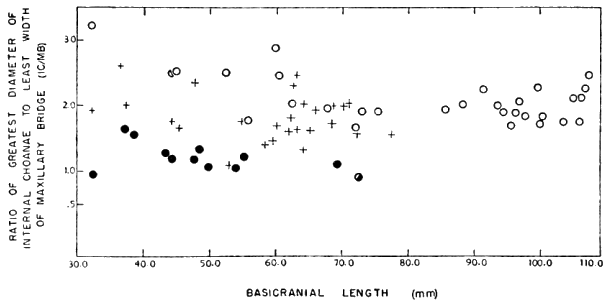
Fig. 20. Basicranial length and ratio of greatest diameter of internal choanae to least width of maxillary bridge (IC/MB) on 30 skulls of T. ferox (open circles), 26 of T. spinifer (crosses), and 12 of the agassizi-form (solid circles; half shaded circle represents holotype of agassizi). Skulls of the agassizi-form tend to have slightly smaller internal choanae than those of spinifer or ferox.
Occasional specimens have only one definite dark line paralleling the rear margin of the carapace. Schwartz (1956:16) reported that Charleston Museum No. 55.159.26 has only one solid line at the margin of the carapace, and I received an adult male (KU 47120) reported to have come from the Pearl River that is aberrant in not having more than one dark marginal line. USNM 95191, a large stuffed female from the Pearl River is mentioned by Stejneger (1944:59, Pl. 17) as having marks that "assume the form of short lines parallel with the submarginal ring"; I examined this specimen and noted that it had only one dark marginal line. Stejneger (op. cit.:64) mentioned another from the Pearl River drainage, and Crenshaw and Hopkins (1955:20) wrote that some individuals from Georgia have only one dark marginal line. Presumably MCZ 1606 (now in the Albany Museum) recorded by Stejneger (op. cit.:52) as Amyda s. spinifer from Columbus, Georgia, is another specimen.
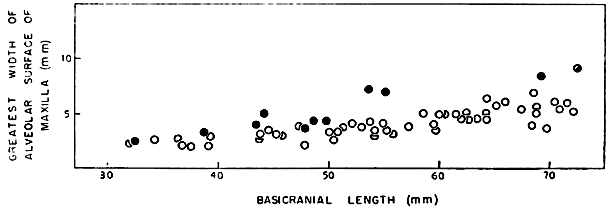
Fig. 21. Basicranial length and greatest width of alveolar surface of maxilla on 52 skulls of T. spinifer (open circles) and 11 of the agassizi-form (solid circles; half shaded circle represents holotype of agassizi). Most skulls of the agassizi-form that exceed 43 mm. in basicranial length have a more expanded, alveolar surface of the maxilla than skulls of spinifer of approximately the same size. All skulls exceeding 50 mm. are those of females.
Some skulls of soft-shelled turtles from streams of the Atlantic Coast drainage, including the skull of the holotype of Platypeltis (= Trionyx) agassizi Baur (MCZ 37172, Pl. 54), show at least two differences from other skulls of asper and from those of other subspecies of T. spinifer. Figure 20 shows that skulls of agassizi tend to have slightly smaller internal choanae (ratio IC/MB) than those of T. spinifer and T. ferox; there is seemingly little difference between skulls of ferox and spinifer, and little, if any, ontogenetic variation. Figure 21 shows that most skulls of the agassizi-form that exceed 43.0 millimeters have a more expanded, alveolar surface of the maxilla than skulls of spinifer of approximately the same size; most skulls exceeding a basicranial length of 43.0 millimeters, and certainly all skulls exceeding 50.0 millimeters are those of females. Stejneger (1944:Pl. 30) also has provided photographs of a skull of the agassizi-form. It is of interest that of the 12 agassizi-form skulls (MCZ 37172; USNM 8708, 029034, 51981, 66859, 71681, 91282, 91310-11, 92521, 92583-84) that I examined some resemble ferox (Neill, 1951:9) in having the alveolar surfaces of the jaws broadened, and the greatest width at the level of the quadratojugal (Table 3, Plate 54); also, the localities of all 12 skulls are within the geographic range of ferox. Skulls of ferox, however, have conspicuously broadened alveolar surfaces of the jaws only when they exceed in length the largest skulls of agassizi. The differences of skulls of the agassizi-form possibly reflect isolation in the Atlantic Coast drainage, and an adaptation in feeding habits. So far as I can ascertain, individuals occurring in rivers of the Atlantic Coast drainage in Georgia and South Carolina (referable to agassizi) do not differ consistently in external characters from individuals of T. s. asper that occur westward in the Apalachicola drainage.
Comparisons.—Trionyx s. asper can be distinguished from all other subspecies of T. spinifer by usually having more than one black line paralleling the rear margin of the carapace. This character and the frequent fusion of the postlabial and postocular stripes on the side of the head distinguish asper from spinifer and hartwegi. T. s. asper differs from pallidus, guadalupensis and emoryi in having blackish spots and ocelli on the carapace, and lacking whitish dots or tubercles. T. s. asper resembles spinifer, hartwegi and pallidus but differs from guadalupensis and emoryi in having conical tubercles along the anterior edge of the carapace in large females. For additional differences see accounts of other subspecies.
Of the subspecies of T. spinifer, asper has a proportionately wide head that is closely approached in the subspecies guadalupensis and emoryi; T. s. asper differs from guadalupensis and emoryi in having a wider carapace, and resembles hartwegi and spinifer, but differs from the other subspecies in having the carapace widest at a plane approximately one-half way back on the carapace. T. s. asper differs from the other subspecies in having the shortest plastron.
Remarks.—Stejneger (1944:72-74) has discussed the history of Baur's Platypeltis agassizi. Briefly, Agassiz's description of Platypeltis ferox wherein he (1857:402) states that "The young ferox [Pl. 6, fig. 3] has two or three concentric black lines separating the pale margin …," was applicable to T. s. asper. Agassiz mentioned also that the young of his Aspidonectes asper (op. cit.:406) "as in Platypeltis ferox, … has … two or three black lines separating the pale rim of the posterior margin, …"; however, A. asper was distinguished chiefly by the "… prominent warts of the bony plates (loc. cit.)." Because the description of the pattern of ferox resembled that of asper, the validity of asper was not agreed upon by all workers. Boulenger (1889:245, footnote 1) referred to asper as a species that required "… further investigation."
Baur (1888:1121) realized that Agassiz's description of ferox was not that of Testudo ferox Schneider, and regarded the description of Agassiz as applying to a new species, which he named Platypeltis agassizii; Baur (op. cit.:1122) also recognized asper, referring it to the genus Aspidonectes. Baur designated a specimen from Georgia (the only individual seen by him) as the type of agassizi (Stejneger, op. cit.:73, footnote); this specimen is now MCZ 37172. Five years later (1893:218), Baur discussed generic relationships of trionychids, seemingly only on the basis of skulls (holotype of agassizi not mentioned), and referred agassizi to the resurrected genus Pelodiscus Fitzinger, 1835, which was distinguished from the other two American genera that Baur recognized (Platypeltis and Amyda) by having the "Posterior nares reduced in size by the inner and posterior extension of the maxillaries." Baur also transferred asper to the genus Platypeltis, and restricted the type locality of that species to "Lake Concordia, La." (op. cit.:220); the type locality of agassizi was restricted to "Western Georgia" (loc. cit.).
The name-combination, Pelodiscus agassizi, was not generally accepted. Hay (1892:144) and Siebenrock (1924:188) referred agassizi to the genus Trionyx. Hay regarded agassizi as a full species (see discussion by Stejneger, 1944:73), whereas Siebenrock considered it a subspecies of spiniferus; both authors regarded asper as a synonym of agassizi. Neither asper nor agassizi was mentioned in the first three editions of the Check List of North American Amphibians and Reptiles (Stejneger and Barbour, 1917, 1923, 1933); the same authors in the fourth (1939:171, 172) and fifth editions (1943:212, 213) listed agassizi as a full species, and asper as a subspecies of spinifera. Stejneger (1944) used the same arrangement as set forth in the fourth and fifth editions of the Check List, and distinguished agassizi on the basis of cranial characters, namely, the small size of the internal choanae, the greater width of the alveolar surface of the lower jaw, and the position of the suture between the palatine and basisphenoid relative to the posterior edge of the temporal fossa. Neill (1951:9) regarded the peculiarities of the agassizi-type skull as inconstant, but recognized agassizi (and asper) as a subspecies of ferox. Crenshaw and Hopkins (1955) showed that asper did not intergrade with ferox. Schwartz showed that agassizi did not intergrade with ferox, and regarded agassizi as a synonym of T. s. asper (1956:17), but stated that agassizi possessed "wider crushing surfaces on the maxillae than does T. s. asper, even when skulls of the same size and sex are compared" (op. cit.:9).
The holotype of Platypeltis agassizi (MCZ 37172) is a dried adult female consisting of shell, skull and limb bones; the carapace is approximately 300 millimeters long (Schwartz, loc. cit.). I have examined only the skull of MCZ 37172 (Plate 54), and it is the largest of 12 agassizi-type skulls I have seen. The basicranial length is 72.5 millimeters, and the greatest width, which occurs at the level of the quadratojugals, is 52.9 millimeters. The agassizi-type skulls have been discussed under the subsection on variation.
The type locality of T. s. asper, Lake Concordia, Louisiana (lower Mississippi River drainage) as restricted by Baur (1893:220), is in an area of intergradation of three subspecies of Trionyx spinifer where most individuals are not typical of asper. The syntypes, the designation of MCZ 1597 as a lectotype, and Pearl River, Columbus, Marion County, Mississippi, as the type locality have been discussed elsewhere (Webb, 1960).
The range of T. s. asper overlaps that of T. ferox in Georgia and South Carolina. The two species remain distinct in the area of overlap of their geographic ranges (Crenshaw and Hopkins, 1955:16; Schwartz, op. cit.:5). Trionyx s. asper intergrades with T. s. hartwegi and T. s. spinifer in the lower Mississippi Valley (Conant and Goin, 1948:11).
However, there are few specimens available that indicate intergradation of asper with the spinifer-hartwegi complex in the lower Mississippi River drainage; this may be due to the fact that asper inhabits waterways that do not drain into the Mississippi River. Perhaps intergradation is more prevalent than the morphological basis that I have relied upon indicates; in any event, there are few specimens that have more than one dark marginal line (which is the only character that is unique for asper) from the lower Mississippi drainage. A young male (TU 11928.9) from Bayou Gauche between Paradis and Des Allemands, St. Charles Parish, Louisiana, has a pattern on the carapace resembling that of asper; several other small softshells (TU) are available from the same locality but none shows more than one dark marginal line. Another specimen (USNM 95192), a young female from a barrow pit of the Big Black River (Mississippi River drainage), Madison County, Mississippi, resembles asper in having more than one marginal ring. Of three large females from Moon Lake, an ox-bow of the Mississippi River in Coatopa County, Mississippi (AMNH 5285-86, 5289), only 5289 shows evidence of two marginal lines. USNM 73669 (Greenwood, LeFlore County, Mississippi) also indicates intergradation in that the spots tend to be linear just inside the dark marginal line, but the specimen more closely resembles the hartwegi-spinifer complex rather than asper.
There seems to be little adumbration of the dark marginal lines of asper in populations from the lower Mississippi River drainage. Blackish spots and ocelli vary in size and there are many kinds of pattern on the carapace. Soft-shelled turtles inhabiting the Mississippi River and its tributaries in Louisiana and Mississippi certainly represent an intergrading population of spinifer and hartwegi, and, to a lesser extent, of asper. Soft-shelled turtles inhabiting the Pearl River drainage and rivers that drain into Lake Pontchartrain immediately adjacent to the east are predominantly asper.
Specimens having localities from the Pearl River and Lake Pontchartrain drainages are listed under the account of asper and are referred to that subspecies on the distribution map; specimens from the Mississippi drainage in Mississippi are referred to spinifer.
One specimen (UMMZ 59198, Bradley County, Tennessee), from the Tennessee River drainage where T. s. spinifer occurs, deviates markedly from spinifer and suggests intergradation. UMMZ 59198, plastral length 4.8 centimeters, has ocelli in the center of the carapace only two millimeters in diameter, a distinct but interrupted, second marginal ring consisting of spots, and the pale postlabial and postocular stripes in contact on both sides of the head.
Specimens examined.—Total 110, as follows: Alabama: Barbour: UMMZ 113038, Chattahoochee River, Eufala. Cherokee: ANSP 24592, "near" center of Terrapin Creek. Conecuh: UMMZ 70736, Murder Creek, Castleberry. Escambia: TU 15823, Escambia River, 1 mi. N Sardine; UMMZ 70734, Escambia River at Flomaton. Henry: TU 15630, 3 mi. NW jct. Echo Farm Rd. and Rt. 136 on Echo Farm Rd. Lowndes: UMMZ 67759, Pintlalla Creek. Mobile: MCZ 1608 (2), 1608A, Mobile. Sumpter: USNM 83996, 3 mi. SE Coatopa. Tuscaloosa: TU 14673 (5), Black Warrior River, 17.5 mi. SSW Tuscaloosa; UA 52-1085, Cottondale. Walker: KU 50843, 50851, TU 17137, Mulberry Fork, Black Warrior River, 9 mi. E Jasper.
Florida: Calhoun: KU 50837-38, Chipola River, 4 mi. N Scott's Ferry; TU 16689 (4), Chipola River "near" Blountstown. Escambia: TU 13474, 15869 (3), 16584, Escambia River, 1.2 mi. E Century. Okaloosa: TU 15661, Blackwater River, 4.3 mi. NW Baker on Route 4. Santa Rosa: AMNH 44621, Blackwater River, Milton. Walton: UMMZ 110421, Pond Creek, 4 mi. SW Florala, Covington County, Alabama.
Georgia: Baker: TU 15889 (3), USNM 134243-48, Flint River "near" Newton; USNM 30822. Baldwin: USNM 8708, Milledgeville. Bryan: TU 15090, Canouche River, 2.3 mi. W Groveland. Chatham: USNM 51981, 92583-84, Savannah. Chattooga: UMMZ 113037, tributary of Chattooga River, Lyerly. Decatur: KU 50839-42, Flint River, 1.5 mi. S Bainbridge. Fulton: UMMZ 53037, Roswell. Lincoln: USNM 91282-83, above Price Island, Savannah River. Murray: UMMZ 59196, 9 mi. N Spring Place. Pulaski: TU 14882, Ocmulgee River, 4.3 mi. SE Hawkinsville. Richmond: USNM 66859, Augusta. Whitfield: UMMZ 74209, Cohulla Creek, Prater's Mill "near" Dalton. County unknown: MCZ 37172; UMMZ 109864, Flint River at mouth of Dry Creek; USNM 029034.
Louisiana: East Baton Rouge: LSU 11, 1643-44, City Park Lake in Baton Rouge; TU 17237, Amite River "near" Baton Rouge. St. Tammany: TU 6356, headwater creek of Bayou Lacombe; TU 16071, USNM 66147, mouth of Tchefuncta Creek in Lake Pontchartrain. Tangipahoa: TU 13623, 3.1 mi. W Hammond; USNM 68054, Robert. Washington: KU 50840, 50846, TU 17117, Pearl River at Varnado. Parish unknown (East Baton Rouge or Tangipahoa): UMMZ 95614, Manchac.
Mississippi: Chickasaw: USNM 115981, Chookatonkchie Creek. Clarke: USNM 79350-51, 1 mi. W Melvin, Choctaw County, Alabama; USNM 100805, Enterprise. Forrest: WEB 55-586, 1 mi. S Hattiesburg. Hancock: AMNH 46780; WEB 54-651, Hickory Creek "near" Kiln. Lauderdale: UMMZ 74681, 9 mi. W Meridian; UMMZ 90130, Lake Juanita, 15 mi. W Meridian. Lawrence: KU 47120, TU 17307.1, Pearl River, 9 mi. S Monticello; USNM 7653-54, Pearl River at Monticello. Lee: CM 31904, Verona; USNM 115979, Cower's Area near Guntown. Madison: USNM 95191, 95193-94, Pearl River. Marion: MCZ 1597, Pearl River at Columbus (designated type locality). Pearl River: CM 21100, Pearl River, 20 mi. W Poplarville; TU 14362, Hobolochito Creek, 1 mi. N Picayune. Perry: WEB 55-580, Beaver Dam Creek, 1 mi. N Richton. Walthall: KU 50844, Bogue Chitto River, Dillon.