ROUND ABOUT CLUN FOREST. TO KNIGHTON AND LUDLOW.
Reading edition
glance at the map at the end of this volume will reveal, down in the south-western extremity of the county, a remote outlying cantle of Shropshire wedged in, as it were, between the Welsh counties of Montgomery and Radnor. It is a wild, hilly, somewhat inaccessible district, even in these days; but in Leland's time the 'faire Forest of Clunne' was 'a great Forest of redde Dere and Roois,' extending over many thousand acres, with much timber growing upon it, and 'very faire and good Game' amongst its holts and hollows.
In and out through this sequestered region wind the clear waters of the Clun, rippling along past rustic crofts and breadths of gorse and fernbrake, and giving its name to a group of quiet villages and hamlets upon its banks:
'Clunton and Clunbury, Clungunford and Clun, Are the sleepiest places under the sun'—
as the saying goes, though one may vary the epithet ad lib., and substitute drunkenest, dirtiest, etc., as fancy dictates. Towards the south the country falls away to the broader valley of the Teme, which, flowing past Knighton and Coxwall Knoll, forms the southern boundary of the Forest, and parts England from Wales.
Camps, earthworks, etc., dotted plentifully throughout the locality, bear witness to the days when might was the only right, and every man's hand was against his neighbour. Tradition avers that Caractacus made his last stand against the Romans amidst the fastnesses of Clun Forest; and Offa's Dyke, the ancient boundary of Mercia, traverses the district from south to north on its way from Severn to Dee:
'There is a faymous thinge Calde Offa's Dyke, that reacheth farre in lengthe: All kinds of Ware people might thither bringe; It was free ground, and calde the Britain's strengthe.'
But it is time to be up and doing, for we must measure many a mile over hill and dale to-day. Old Sol is already abroad, and a light sou'westerly breeze is rustling the fresh young foliage as we fare forth upon our peregrinations; while the thirsty soil emits a grateful smell after the rain of yesternight.
Down the village street, then, we take our way, noticing the legend 'Ironmonger, Dahlia Grower and Poultry Breeder,' over an enterprising tradesman's door. Setting a course up the vale of Clun, we drop into a meadow path that, keeping company with a hollow, waterworn gipsy lane, affords glimpses of the ruined castle, and so brings us presently to Whitcot. Near Whitcot we notice an old grey maenhir, or standing-stone, eight feet high, nearly as broad, and only about six inches in thickness.
With the hills closing in upon either hand we push onwards along the valley, falling into a leisurely pace as the sun warms to his work. Another mile and we come to Offa's Dyke, a huge green mound overshadowed by beech trees, whose course can be easily traced as it crosses the valley and climbs the shaggy hill slope beyond. 'Aye, that's Awf's Ditch, right enough,' says an old fellow tilling the hedgerow, 'and now you be in Wales a'this side, like, but it's a cankersome country to live in, I can tell yer.'
At Newcastle we find ourselves in a scattered hamlet overshadowed by certain round green hills, whose topmost crests are scarped with ancient camps or earthworks, whereof the name is legion hereabouts. This part of the Forest, west of Offa's Dyke, was known in olden days as the Manor, or Honour, of Tempseter, a district of Shropshire won from the Welsh before Edward I. was King.
Presently we take leave of the Newtown road, and, crossing the infant Clun at a place called Dyffryn, march away through leafy lanes en route for Bettws-y-Crwyn. Our road goes from bad to worse as it straggles up the bank, degenerating at last into a downright Welsh byway, so that, like Agag of old, we have to 'walk delicately' amidst the ruts and rivulets which do duty as a thoroughfare.
Passing two or three outlying cottages where shock-headed children are playing around the doorways, we come in sight of Bettws-y-Crwyn church, a little lonely fane perched so high aloft on its hill-top as to look down, so to speak, upon every other church throughout the county; indeed with one or two exceptions it is, we believe, the most loftily situated church in England.
The name of this place affords an interesting clue to its history. For Bettws-y-Crwyn, being interpreted, signifies the Bede-house of the Skins; having been so called since, in ancient times, the shepherds who frequented these lonesome hills had a Bede-house or Chapel here, and paid their tribute of skins or hides to Chirbury Priory.
Up here in the churchyard we get a wonderful outlook over the hills and dales of south Shropshire, which are seen stretching away for many a league in picturesque gradation, with Brown Clee Hill bringing up the rear beyond the dark ridges of Wenlock Edge.
We now step inside the church, an ancient timeworn structure whose low grey stone walls, narrow windows and simple bell-cot, look thoroughly in keeping with the circumjacent landscape. The old font, once the pride of the church, was broken into pieces when the church was 'restored' about half a century ago, and used, it is said, to repair the churchyard walls!
Bettws-y-Crwyn
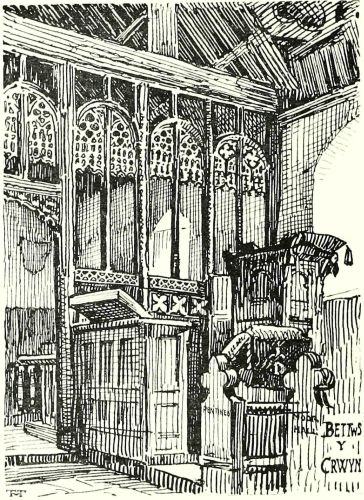
By some lucky chance, the ancient roodscreen has escaped the hand of the spoiler, and forms to-day the most notable feature of the little edifice. It is massively constructed of oak grown black with lapse of years, and its gothic arches are wrought into delicate tracery work.
This lofty screen rises to the tie-beam of the roof, whose curved principals, moulded brackets and quatrefoil panels are fashioned, as tradition tells, from Spanish-chestnut wood. Solid oaken benches of the most primitive construction occupy the nave; their ends displaying the names of various farmhouses, locally termed Halls, such as Hall-of-the-Forest, Moor Hall, Cow Hall, etc.
Chalice at Bettws y Crwyn
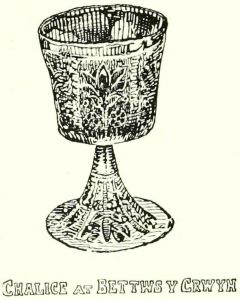
By favour of the Vicar, we are able to give a sketch of the Bettws Communion cup. It is of silver, bearing the London hall-mark and the date 1662, and is ornamented, as may be seen, with a repoussé flower pattern. Though inferior in design to vessels of an earlier period, such as the beautiful Bacton chalice, this little cup is a very fair example of the silversmith's art of the seventeenth century.
Our way now lies past the vicarage, a modern house standing 'four-square to all the winds of heaven,' and so loftily placed as to be a landmark for miles around. Thence we push on due northwards across the high, open moorlands of Clun Forest, a 'dizzy' country, as they say hereabouts, whose contours are revealed to our sight by shafts of sunlight radiating from the western sky. Patches of golden gorse interspersed amidst bracken and heather fill the air with their warm, rich scent, as we follow the devious trackway; and a shrewd, pungent whiff of peat-reek salutes our nostrils while passing a lonely cottage, for coal is a luxury unknown up here, seven long miles from any railway-station.
Old ways and antiquated customs linger yet in this 'back'ardly' neighbourhood, where education has much ado to make headway against ignorance and ancient prejudice. The time-honoured 'Wake' still holds its own in Bettws parish; and rushlights, it is said, are in use to this day in some of the isolated farmhouses towards the Welsh border.
The Cantlin Cross.
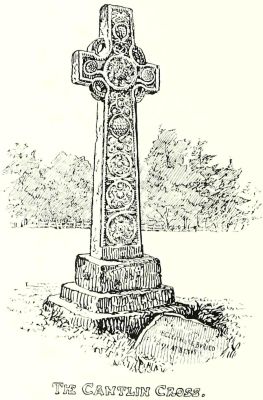
Following a bridle track, we descend into a secluded dell which holds the head waters of the Clun. Then, mounting up through a pine wood, we come out upon the open braeside over against the Cantlin Cross, or Cantlin Stone as it is sometimes called, whose counterfeit presentment appears in our sketch. The cross itself, though handsomely carved, has no particular claims to antiquity, having been erected, as we are informed, about forty years ago by the late Mr. Beriah Botfield, sometime M.P. for Ludlow. The design, however, is evidently an antique one; and on the ground in front of the cross stands a low, flat slab of grey limestone, rudely inscribed with the legend W . C: decsed . here : bvried . 1691 . at . Betvs:
The initials are those of a certain William Cantlin, who, travelling through the wilds of Clun Forest in the above mentioned year, met his death at this spot, and was buried at Bettws-y-Crwyn. It is said that upon one occasion the stone itself was produced in a court of law, in order to prove that the place where Cantlin died was situated in the parish of Bettws.
Upon passing through a gate in the adjacent coppice our eyes are gladdened by a vision of folding hills, green fertile vales, and distant cloud-capped mountains, the giants of Wild Wales—a glorious panorama!
Presently we hie away once more upon our travels, retracing our steps to the main road, and swinging along at a good round pace, favoured by the downward grade. Past Hall-of-the-Forest we go, not much of a place, despite its imposing name, though originally built by Anne, Lady Mautravers, some time in the sixteenth century, and hence formerly called Ladye's Hall.
At Newcastle we strike up the hills to the southwards, recrossing old Offa's Dyke and following the crest of the ridge. 'Weather's looking very brewin',' remarks a brother tramp; for storm-clouds, gathering in the west, hover grand and gloomily above the darkening ridges of Radnor Forest; so, putting the best foot foremost, we spin along the grass-grown bridle-path under the lee of the wind-tossed hedgerow. Out leaps the lightning, the thunder rolls, and the tempest swoops down in a whirl of seething rain-scuds; but what care we, for here in the nick of time is the Buffalo Inn at Clun, with a good meat-tea piping hot on the parlour table, and a cheery fire sparkling in the grate.
So while the elements work their will abroad, and the rain drops patter at the casement, we sit within bien and cosy, canopied like gods in clouds of tobacco-smoke; 'fighting our battles o'er again,' and discussing plans of campaign for future excursions amidst 'fresh woods and pastures new.'
The morrow, then, sees us early astir, and taking the road ere the city man has opened his morning paper. And before the first mile is left behind, we find reason to congratulate ourselves on having made an early start, for the way is parlous steep, and the sun already rejoicing like a giant to run his course. So at a leisurely pace we breast the ascent—'chi va piano va sano,' as the Italians say—with big, rounded hills rising upon either hand, one of them having a strange sort of quarry-like chasm, called the Rock of Woolberry, scored deep in its wooded flank. This collar-work continuing for a matter of two miles or more, brings us to a moorland crest about a thousand feet above sea-level, whence the eye ranges over leagues of broken country, with the play of shine and shadow chequering its varied surface.
At a place bearing the euphemistic title of New Invention, we quit the hard highroad and make a bee-line up the open hillside, until we find ourselves in the vast, prehistoric encampment, known as Gaer Ditches, or Caer Caradoc. The camp proves a fine example of an early British earthwork, being oval, or rather pear-shaped, in form, and protected upon its most vulnerable western flank by three concentric lines of entrenchment; while upon the east, where the natural declivity is more abrupt, there are but two, with traces of an entrance way in each of these faces.
Tradition has been busy about this interesting spot. We are to believe that once, in days remote, Caractacus stood here at bay against his enemies. Nay, is not the stream at the foot of the hill still called Redlake river, because for three whole days its waters ran red with the blood of the combatants? And down yonder in the vale is Lurkinghope, where tradition tells the vanquished Britons 'lurked in hope' of retrieving their fortunes, while lying in ambush near the defile at Garn Gap.
However that may have been, we now lay our course for Stow, a tiny hamlet nestling in a wild rocky cirque called Ragged Kingdom. Our route lies over Stow Hill, whose summit is marked by the blackened cairn of the 'Diamond Jubilee' bonfire.
But lusty appetites, begotten of fresh air and hours of steady tramping, now demand instant satisfaction. So down we sit, and, whilst feasting our eyes on the beauties of the landscape, we regale the inner man on more material fare: the pile of sandwiches becoming 'small by degrees, and beautifully less,' as the moments flit by. A drink of clear water under Holloway Rocks, and a pipe or two as we lie on the short, warm turf, and like giants refreshed we go our ways in search of new adventures.
Stowe. Shropshire.
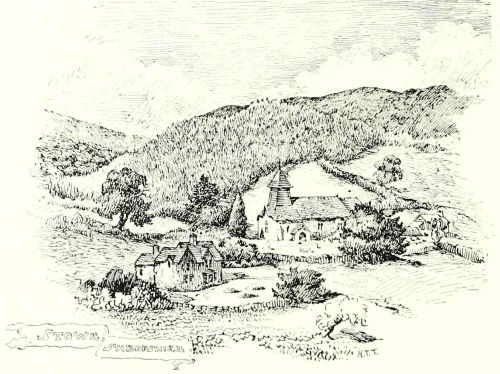
Coming anon to Stow, we borrow the key from the neighbouring vicarage, and armed with this 'open sesame' proceed forthwith to the church.
This diminutive house of prayer has one or two notable features. A good open-timbered roof spans the nave, traces of a rood-loft being visible overhead where it joins the chancel, though no approach to it can now be discovered. A massive oak communion table is about the only remnant of ancient fittings here. A small wooden bell-cot rises above the western gable, and the walls of the church, which are unusually thick, are pierced with modernized windows.
Bidding adieu to this lofty yet lowly hamlet, we traverse a narrow green lane where the hedgerows are a-tangle with dog-roses, briony and 'traveller's-joy,' besides many another familiar wayside wildling. In two miles we find ourselves at Knighton, a pleasant, busy townlet, just within the Radnorshire border.
Here we board the first up-train that comes along; the railway line hugging the frontier, and affording glimpses of the hill country amidst which we have recently wandered. Near Bucknall station we catch sight of Coxwall Knoll, an isolated tree-clad monticle surrounded by ancient entrenchments, where some authorities locate the scene of Caractacus's last tussle with Ostorius. Bucknall village is close at hand on the brink of the Redlake river, its grey church tower just peeping over the trees that clothe the hills in the background. There is a curious old font in Bucknall church with a sort of interlacing pattern carved around its bowl, the date whereof is uncertain.
Running past Bedstone, we alight at Hopton Heath station, shoulder sketching gear, etc., and trudge away to Heath House, which lies a short mile to the southward. Heath House, the residence of Chas. Seaton, Esq., is a large, substantial edifice, dating mainly from the latter part of the seventeenth century, and seated in a broad park-like demesne.
Staircase at Heath House, Clungunford.
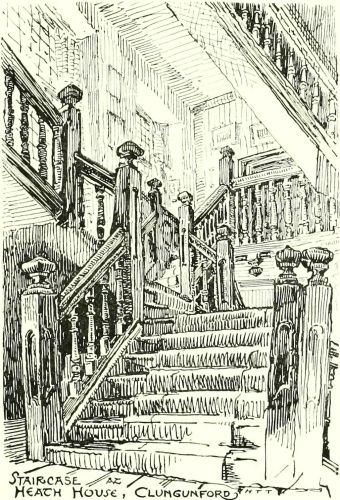
The interior of the mansion contains several handsome, panelled apartments, adorned with pictures and curios that reflect the artistic taste of their present proprietor. But the most notable feature of the house is an elaborate old staircase hung with ancient tapestry, which, as may be gathered from our sketch, is a marvel of massive construction. Its huge oaken handrails and newels, and even the twisted balusters, look as strong and simple as possible, and much of the work has the appearance of having been fashioned with the axe. The topmost flight of all, said to have been brought from Hopton Castle, is little better than a ladder in point of convenience.
Broadward Hall, the next-door neighbour to Heath House, is a plain stone building chiefly remarkable from the fact that it is built, so to say, around a curious circular staircase. In the grounds abutting upon the river Clun rises an artificial tump, surmounted by a group of lofty elm trees. Via Broadward Bridge we now make our way to Clungunford; diverging a little to take a look at Beckjay Mill, in bygone days a favourite haunt of David Cox, the artist.
Clungunford village, rambling beside the river Clun, has a well-restored church, flanked by a prehistoric tumulus. St. Cuthbert's church is well worth a visit, for its ancient features have been faithfully preserved, including one of those singular 'leper' windows that have so often proved a bone of contention to archæologists.
On a sunny bank overlooking the river Clun stands Clungunford House, the residence of J. C. L. Rocke, Esq., Lord of the Manor. Half a mile away upstream is Abcott Manor-house, a large old half-timbered structure now used as a farmhouse. A big, curiously moulded chimney stack, is a noticeable object as we draw near; and, being shewn within, we pass from one old dilapidated chamber to another, admiring its wainscoted walls and plastered ceilings, which, beautiful even in decay, still display queer heraldic monsters, lions, stags, unicorns, goats, parrots, etc., engaged amidst interlacing strapwork. One or two old lattice-paned windows here retain their original wrought-iron fastenings.
Abcott was for many generations the abode of the Princes, a family now extinct in this locality, though there are monuments in plenty to them in Clungunford church.
The Rocke Arms at the end of the village is a rustic inn of the homely, oldfashioned sort, quite equal to providing a pint and a chop, or finding, at a pinch, a night's lodging for the passing traveller. So here we call a halt awhile to refresh the inner man, before tackling the cross-country lanes that are to lead us to Hopton Castle. Pleasant it is, as one jogs along these rural byways, to see the country children curtseying to the stranger as he passes, a custom all too rapidly falling into desuetude in these 'independent' days, when young brains are crammed with undigested facts, while the character is left to make shift as best it may.
Hopton Castle. Salop.
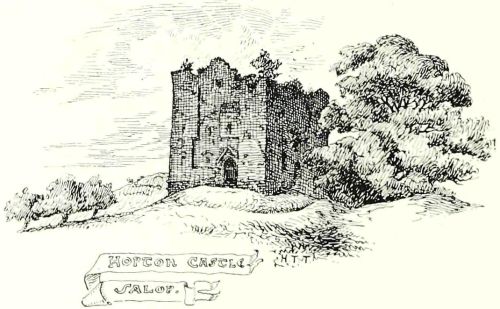
In a nook of the hills to the westward stands Hopton Castle, a grey old Norman keep-tower, seated in a curiously low exposed position near the banks of a stream. Traces of ruined outworks indicate that the place was much more extensive in former days, when it figured in some stirring episodes of March-land history. By Camden's account, Hopton was presented by Henry II., to Walter de Clifford, of Clifford Castle in Herefordshire; and towards the end of the thirteenth century we find Roger, Lord Mortimer, of Wigmore, in possession of the Castle. Passing later to the Corbets and the Wallops, Hopton Castle held out stubbornly for the King at the time of the Civil Wars, but in 1644 was captured and demolished by the Parliamentarians, its garrison put to the sword, and Samuel Moor the Governor marched off to prison at Ludlow Castle.
A curious old grant, by right of which the 'Heyres-mayle of ye Hoptons' held this Manor of William the Conqueror, runs to the following effect:
'I, Will, King, the third of my reign, Give to the Northern Hunter, To me that art both Luine and Deare, The Hoppe, and the Hoptoune, And all the bounds, up and downe, Under the Earth to Hell, Above the Earth to Heaven,' etc.
Returning by a different route direct to Hopton Heath station, we pass through Broome, 'change' upon arriving at Craven Arms, and run down past Stokesay Castle to Onibury, whose church has an ancient, possibly pre-Norman, chancel arch, and one or two other good features. On the outskirts of the village stands Stokesay Court, the handsome modern residence of H. J. Allcroft, Esq., Lord of the Manor, and owner of large estates in this locality.
Alighting at Bromfield station we make our way to the village, as picturesque a spot as one could wish to see, situated in a pleasant, fertile vale, close to the place where Onny and Teme unite. At the end of the village street we traverse an old, grey, many-arched bridge, spanning the lively Onny, near which rises a row of lofty, storm-rent poplars, still known as the 'Twelve Apostles,' though several veterans have succumbed to the gales in recent years.
A furlong further on we espy a picturesque old building pierced by a wide stone archway, and chequered with timber quarterings, over which a fine elm tree casts its dappled shadow. This was the Gatehouse of Bromfield Priory, a Benedictine monastery, whose history carries us very far back into the 'queer old crumpled-up past,' for the annals of Domesday Book shew that, even in the Conqueror's time, Bromfield was a place of some consequence.
Originally a college of secular canons, the monastery became later on an establishment of Canons regular of the Benedictine order; receiving benefits at the hands of King Henry II., in whose reign Bromfield Priory became affiliated to St. Peter's Abbey at Llanthony Secunda, near Gloucester.
Bromfield church, whether regarded as a prominent feature in a fair landscape, or examined in the details of its architecture, cannot but afford the visitor much pleasant matter for contemplation. Seated upon one of those waterside meads the monks of old so frequently selected, its broad, massive tower and weather-stained gables are seen mirrored in the stream that winds around the churchyard, and with the ancient Priory ruins, flanked by a group of dark firs rising clear against the sky, makes a charming study for the artists' brush.
Internally, too, the church has many points of interest. The chancel arch of the old Priory church may be discerned in the eastern wall, the chancel itself having been pulled down when the parish came into possession. A remarkably handsome modern triptych is a noticeable feature of the church, contrasting favourably with the plaster ceiling overhead, whose colour-decorations have been aptly described as 'the best specimen of the worst period of ecclesiastical art.'
Crossing the Teme by an old stone bridge, we enter Oakley Park, a glorious stretch of ferny glades and secluded woodland dingles, boasting such Druid oaks as it would be hard to match elsewhere. Right ahead rise the richly timbered slopes of Bringwood Chase, a picturesque range of hills, whose topmost crests are crowned by three conspicuous clumps of trees, landmarks for miles around. Oakley Hall, a red-brick Georgian mansion, lies off upon our left, and is chiefly remarkable for its uncommonly beautiful situation on the banks of the Teme, overlooking some of the choicest scenery in the district.
Away towards Downton lie certain parcels of land known to this day as 'Crawl Meadows,' and thereby hangs the following tale. Once upon a time, a certain fair maid having plighted her troth with a valiant but impecunious knight, the angry sire vowed her sole dower should be just so much land as his daughter could crawl over, on hands and knees, between sunset and dawn of day. Commencing her journey at Bromfield, the young lady travelled with such vigour that, by the time old Sol peeped over the hills again, she was well on her way to Downton, a good four miles, as the crow flies, from her starting-place at Bromfield.
But the waning daylight warns us to be astir, while the towers of Ludlow Castle, rising darkly against the eastward sky, tell we are within a measurable distance of our journey's end.
So betwixt fields and hedgerows we now hasten along, exchanging a 'good e'en' with the cottagers as we trudge through a wayside hamlet, and coming to a bridge over Teme, where the last of the daylight flickers upon the waters of a rushing weir. Then up a steep way through Dinham, passing a dusky old building, now a coach-house, but once a Gothic chapel, and rounding the outskirts of the castle: the homing rooks in the elms overhead announcing our arrival in their own vociferous fashion.
Thus through narrow, crowded, oldfashioned street, we come to our night's bivouac at Ludlow; promising ourselves a treat on the morrow in exploring the memory-haunted precincts of this historic border-town.
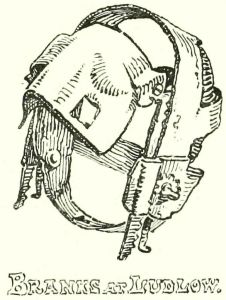
Branks at Ludlow.