FROM CRAVEN ARMS TO BISHOP'S CASTLE AND CLUN.
Reading edition
ur general objective to-day is the broken, picturesque country lying around the quiet market towns of Bishop's Castle and Clun; an out-of-the-way, rural district, less frequented, perhaps, than any other portion of Shropshire.
The Bishop's Castle railway, commencing at Craven Arms, affords the readiest means of approach to the locality. Away to the south as we jaunt leisurely along we get a glimpse of Cheney Longville, a pretty secluded hamlet hidden away amidst copses and pasture fields, with never a highroad near it. Some slight remains of the old fortified manor-house of Cheney Longville still exist, incorporated with an antiquated farmhouse containing much fine carved oak furniture.
The Cheney family, whence the place derives its name, is a very ancient clan. Roger Cheney was Seneschal to Edward, Earl of Arundel, Sheriff of Shropshire in 1316. A second Roger held 'Cheney Longfield' in 1341; while yet another of the same name received license from the King, 1395 a.d., to embattle his house at Cheney Longville.
After a while we join company with the little river Onny, as it meanders through a picturesquely wooded vale, getting delightful glimpses of the Longmynd as we draw near to our destination, his lower flanks dotted with old stunty oaks and ancient hawthorns, while gorse and heather brighten the foreground.
Coining to Plowden station, we shoulder the knapsacks and bear away to the southward.
Crossing the Onny beside a rushing weir, we get a direction for Plowden Hall from an old fellow in charge of a timber-waggon. 'You'm better tek up the rack acrass yon bonky piece, and goo through the wicket,' says our friend, 'you'll be apt to find it a gainer road than the one as goes through the 'ood.' So we breast the upland meadows, and meanwhile our gaze wanders over a goodly prospect; hill and vale, chequered by tilth and pasture-land, lying map-like at our feet, while shafts of sunlight, touching here and there, relieve the contours of a broken, wrinkled country, or bring into momentary prominence some rustic homestead surrounded by barns and haystacks.
Plowden Hall. Shropshire.
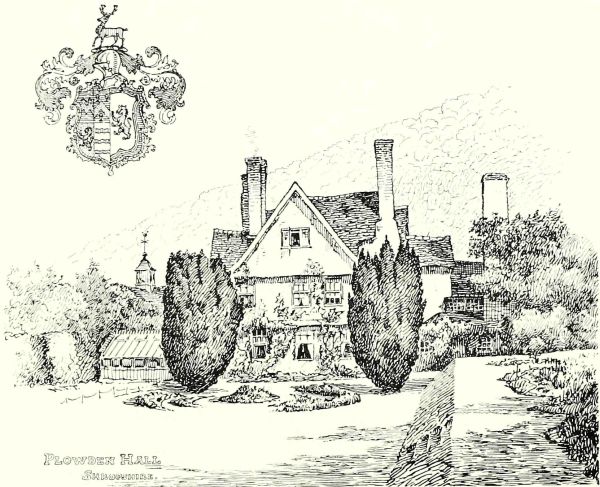
Plowden Hall lies perdu until we are close upon it, for the old mansion nestles in a nook of the hills amidst dark, umbrageous woodlands. Its broad, somewhat low entrance front is pleasantly quaint and simple, with nothing imposing about it, though the deep-browed portico and massive hall door beneath lend a touch of character. But a better view is obtained by passing to the back of the house, whence our sketch is taken.
From this point of view the ancient Manor-house rears its yellow weather-stained gables, slender chimneys and mossy roofs, against the rich dark foliage that clothes the rearward hill; while the close-cropped lawns, the trim yew hedges, and gay-coloured parterres of the oldfashioned garden in the foreground, form an appropriate setting for this beau-ideal of an old English homestead.
Within the mansion one finds a congeries of wainscoted and panelled chambers, whose walls are hung with ancient tapestry, and adorned by ancestral portraits of the Plowden family. Here is Edmund Plowden, the eminent lawyer, who was 'accounted the oracle of the law,' and with whose memory is associated the saying, 'The case is altered; no priest, no mass; no mass, no violation of the law'; a saying which in course of time passed into a common proverb. On the death of his father in 1557, Edmund Plowden succeeded to the estates, and began the building of the present Hall. He was treasurer of the Hon. Society of the Middle Temple, in whose church he lies buried; and might have been Lord Chancellor under Queen Elizabeth, had he chosen to renounce the ancient Faith of his fathers.
The hall, with its carved oak chimney-piece and quaint Dutch tiles, its panelled walls and oaken floors, has a sombre, dignified air about it. In one wing of the old house is the private chapel, dedicated to St. Francis of Assisi, with a portrait of the patron saint attributed to Michelangelo. Set into the wall of this chapel is a curious old brass, representing Humphrey Plowden and his seven daughters, which was brought hither years ago from Bishop's Castle church. In an adjacent corner a sliding panel gives access to a secret passage-way, by which in the Reformation days, the officiating priest might at a moment's notice effect his escape from the mansion. The whole place, indeed, is honeycombed from cellar to roof with hidie-holes, closets and secret passages, turning and twisting amidst hatchways and bulkheads, or terminating in breakneck ladders. One of these queer gangways is said to lead out to a lonely spot amidst the woods known as the Lady's Chair; and it goes without saying that the old house has earned the reputation of being haunted.
One would suppose the builders of Plowden Hall had had in their minds the Spaniards' proverb: 'The rat that has only one hole is easily caught.'
The Plowden family can trace, it is said, an unbroken lineage from Roger de Plowden, the Crusader, down to Edmund of that ilk, who died no longer ago than 1838, nearly 700 years. This Roger distinguished himself at the siege of Acre, in 1191; and, upon being taken prisoner by the enemy, made a vow that, if ever he returned in safety to his Shropshire home, he would build a chapel by way of thank-offering; and, as we shall see by-and-by at Lydbury North, the pious knight was as good as his word.
From Edmund Plowden the estate passed to his nephew William, whose son, W. F. Plowden, Esq., is the present owner of the property.
Farewell now to Plowden. Our onward way leads beneath a green avenue of oaks and beeches, whose branches, meeting overhead, cast a dappled shade athwart the lane, and afford a playground for squirrels, woodpeckers, and many another of Nature's children.
Turning our backs upon the low hill where Billing's Ring keeps ward over the ancient Portway, we skirt the shoulder of Oakeley Mynd, Walcot Park with its big red-brick mansion and hanging woods shewing right ahead, with a dark clump of trees cutting against the skyline. Yonder lie Bury Ditches, a fine old British camp whose lofty crest forms a conspicuous landmark for many a mile around.
Avoiding a lot of odd turnings we continue to hug the highroad, which, trending now in a due westerly direction, introduces us to a pleasant, open vale, with the tower of Lydbury church peeping out from a grove of trees in the middle of the village.
Lydbury North is an ancient place, claiming some consideration. In Norman days the episcopal manor of Lydbury formed an important appanage to the Bishopric of Hereford, and the martial prelates of that period had a great stronghold in the vicinity, which, though long since dismantled and demolished, has given its name to the neighbouring town of Bishop's Castle.
But Lydbury church, having remained virtually unaltered by restoration, is one of the most interesting edifices of its kind in all Shropshire. It has a nave and chancel, with north and south chapels, a timbered porch, and broad, massive tower at the western end.
The primitive old clock upon the tower vaguely points the time with a solitary hand, and the roofs of the church are still covered with their original stone slabs, greatly enhancing the picturesque appearance of the ancient building. The solid nail-studded porch door bears traces of bullet marks, and has a pair of fifteenth-century hinges.
The interior of the church wears an antiquated air, as of primæval repose, and appears to belong mainly to the twelfth and thirteenth centuries. Many of the high-backed Jacobean pews are rudely adorned with carving, as is also the oaken pulpit; while one or two of the former still have the link and staple, used in the 'good old times' when the worshippers were accustomed to lock themselves up in their pews, a habit that affords a curious insight into the everyday manners of a bygone generation.
The font looks very primitive and ancient. A good fifteenth-century oak roodscreen divides nave from chancel, and above it appears the Decalogue, finely written in old English lettering of the date 1615. The block of masonry projecting from an adjacent wall was probably a 'penance stone.'
Above the altar are seen two small stone brackets supporting a pair of gilded wooden candlesticks, which, according to local tradition, Archbishop Laud caused to be put there, in place of certain images that had stood upon them before.
A stone tablet upon the north wall of the chancel is interesting in that it records the services of the Rev. J. Ambler, who, after being ousted from this living by the Covenanters, was reinstated at the Restoration.
North and south of the nave open out two chapels, or short transepts, called respectively the Plowden Chapel, and the Walcot Chapel. The Walcots of Walcot are a family of very ancient descent, who have held estates in this locality from time immemorial. After their day, the manor of Walcot passed to the ancestors of Lord Powis, and eventually came into the possession of no less a personage than Robert Clive, Baron Plassey, K.B., founder of the British dominion in India, who died at Walcot Hall in 1774. His name may be seen inscribed in some prayer-books still preserved in this chapel. Upon the wall above the family pew hangs the Walcot escutcheon, with three black pawns, or rooks, amidst its quarterings.
This is explained by the following note in a pedigree of the Walcot family, compiled in 1643, referring to a certain John Walcot who lived in the early part of the fifteenth century. 'This John Walcote, plainge at the Chese with King Henry the fift, Kinge of England, gave hym the check-matte with the Rouke; whereupon the Kinge chainged hys coate of armes, which was the crosse with flower-de-luces, and gave hym the Rouke for a remembrance thereof, by which he and hys posteritie hath continued to this daye.'
The Plowden chapel is separated from the nave by a plain oak screen. As already mentioned, this chapel was built by an ancestor of the Plowdens, after returning in safety from captivity in Asia Minor. It is lighted by several well-proportioned windows of early character, and contains a much dilapidated stone altar of pre-Reformation date, with two brackets up above it, probably intended for images.
In one corner stands a curious sort of grille, or iron railed structure, bearing traces of colour, and surmounted at one end by a gilded iron cross. It was customary, we understand, to place this railing around a newly made grave, to protect it from evil disposed persons.
The tower walls are enormously thick, as though intended to withstand attack. The fine old panelled oak nave roof is now hidden from below by an ugly whitewashed ceiling. The bell-frame up in the belfry is something of a curiosity, being rudely but effectively carved with dragon-like monsters having foliated tails.
We now make for the village inn, with appetites sharp-set for such rustic fare as the place may haply afford. Half-an-hour later finds us climbing the ascent of Oakeley Mynd, with a fresh westerly breeze humming through the tree-tops, and the cloud shadows chasing one another athwart the genial landscape.
Instead of going direct to Bishop's Castle, we steer a due northerly course towards a place named Lea. By so doing we not only avoid a spell of hard highroad, but get into the bargain a rare outlook across a hilly-and-daley country, with a wisp of blue smoke trailing away upon the breeze far off on the shoulder of Longmynd. From the top of the bank, a thousand feet above sea-level, we look across a pleasant vale, where the brown roofs of Bishop's Castle are seen nestling beneath tumbled hills, outliers of Clun Forest.
Then away we go down a rough footpath, or 'rack,' as they call it hereabouts; making a bee-line for our destination, and skirting the head of a deep wooded dingle known as Narrow Dale. Guided by the cheerful barking of dogs, we presently come in sight of a lonely farmstead; and, upon stepping round to the rear, descry a group of buildings all jumbled up together in the manner shewn over page.
'The remains we see,' writes Mr. W. Phillips in 'Shropshire Notes and Queries,' 'are probably the walls of the old square keep. They are built of the Wenlock limestone found in the neighbourhood, and are so well constructed that the lime is harder than the stone, so that, when an attempt was made some years ago to utilize the material, it was found to be less trouble to obtain fresh stones from the quarry. We owe it to this fact that these ruins remain to awaken our curiosity.'
Lea Castle.
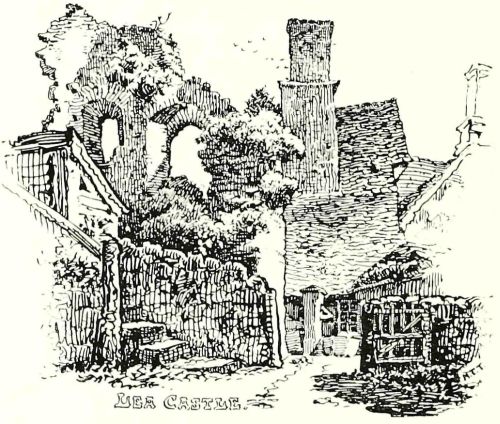
The walls of this old keep are extremely massive, and have several window and door openings in them of various dates from the fourteenth century onwards. So much has been destroyed that the original dimensions of the castle cannot now be ascertained; but the moat may still in part be traced, besides evidences of fishponds near the little rivulet that filled them.
The Manor of Lea formed, in early days, the largest feudal Lordship in Shropshire held by the Bishop of Hereford. Owing to the exigences of his position, and the turbulence of those remote times, the Bishop was often called upon to relinquish the crozier for the sword, and to lead his lieges against the wild Welshmen; for, in connexion with Bishop's Castle, Lea formed an important link in the cordon of border fortresses. The tenant of Lea, indeed, appears to have been under obligation of doing suit and service at Bishop's Castle, when called upon by the constable of the latter.
The old farmhouse alongside has evidently been added to and altered at various times in a very haphazard fashion. On its staircase is a piece of timber quartering ornamented with a rude shield on which appear the words anno. do. 1560, proving that the place can boast a respectable antiquity.
Amidst a chorus of 'come-back! come-back!' from the galeney-fowls in the farmyard, we set out once again upon our travels. Giving preference to the meadow paths, we presently happen upon a huge block of stone, as big as a good-sized cart, lying stranded in the middle of a grass field. How it came there is the puzzle, so we take counsel with an old fellow breaking stones by the wayside, a furlong farther on. 'Oh,' says he, in reply to our questions, 'they 'ud used to tell us, when we was childern, as the Devil fell lame one day a-walkin' by here, and throwed that there old stwun out of's shoe, and then fled away up to Stiperstones yander. But that was afore my time, like, and behappen there's never a one now as can tell the rights on it.' And the country folk have a saying that the Lea Stone, as it is called, turns itself around 'every time the clock strikes thirteen.'
Bishop's Castle. From an Old Print.
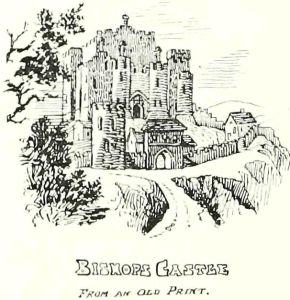
With the shadows lengthening around we draw near to Bishop's Castle, a place half town, half village, seated upon a southward sloping hill. It was always called Lydbury Castle in the olden days, on account of the castle of that name (built by the Bishops of Hereford to protect their episcopal manor of Lydbury), which stood in a commanding position at the top of the town.
When Henry II. mounted the throne, Bishop's Castle was held by Hugh de Mortimer of Wigmore, but was regained for the see by the energy of Bishop Gilbert Ffoliot. In the year 1263, the castle was stormed and its constable slain by the rebellious John FitzAlan and his followers. A visitation of Bishop Swinfield, about thirty years later, was long remembered in the locality, on account of the sumptuous style in which that prelate lived; indeed his Lordship and his retinue seem to have 'eaten the good people out of house and home,' as the saying goes.
BISHOPS CASTLE.
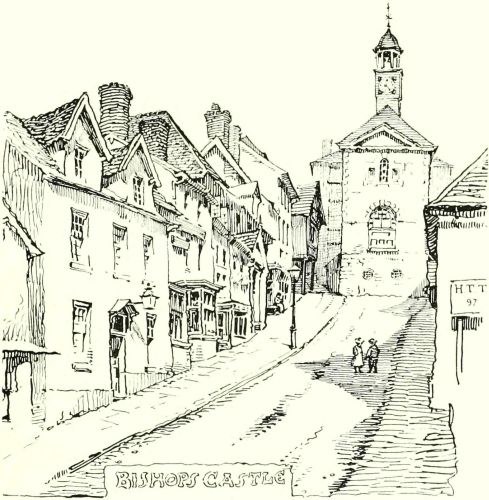
Bishop's Castle is nowadays but a drowsy little market town, yet proud withal of being the metropolis of an extensive agricultural district, and renowned for its great cattle fairs, frequented by breeders and 'men whose talk is of bullocks,' who are attracted hither by the fine race of cattle for which this locality is noted. Then, on May 1, has it not its 'Mop,' or Hiring Fair, when the farm hands and servant girls 'break the year,' as the phrase goes; and you may overhear one goodwife complaining to another, anent some errant handmaid, ''Er's broke 'er 'ear this marnin', I'm afeared 'er'll allus be a rollin' stwun as'll never gether no moss!'
In bygone times Bishop's Castle was (and for aught we know is still) ruled by a Mayor and Corporation, with fifteen Aldermen or Capital Burgesses, a Bailiff, and a Recorder. So early as 1572 the town received its first charter from the Sovereign, which was ratified by Charles I. in 1648.
At the very top of the town, where the old coach roads from Wales converge, stands the Castle Hotel, one of those large, roomy caravansarys, frequented by wayfaring men in the days before railways had come to rob the country roads of their cheerful tide of traffic. To the rear of this inn lies an oldfashioned bowling-green, whose area marks the site of the keep-tower of the erstwhile Castle of Lydbury, built to protect the episcopal demesne against the freebooters of the Welsh border.
In Leland's time the Castle was 'well maintenid, and set on a stronge Rokke, not very hi,' but seems to have been already reduced to ruins before the time of the Civil Wars.
Perched on a tall green mound, high above the old town, the position is certainly a commanding one, affording a fine prospect over the adjacent country, though now somewhat obscured by trees. Close at hand rises the old Market House, now the Powis Institute and Reading Room, with the borough arms carved upon its gable, and the date of its erection, 1781. Over the door of an adjacent shop we espy the curious surname of Gotobed, a clan which should be widely represented, one would suppose, in this Sleepy Hollow! Another old lintel retains some ancient lettering, with the figures 1685. Then, turning down the steep High Street, we get a backward view of the town; the prim façade of an eighteenth-century Town Hall, topped by a slender belfry, seeming to block up the roadway, and some oldfashioned shops and dwellings flanking the narrow footpath.
Presently we come to the church at the farther end of the town, though tradition avers that, once upon a time, the church stood in the very middle of it; not that the church has moved, but the town shrunk up into itself—but that is as it may be. An ancient ivy-clad tower is about the only relic of the older church which has survived, for, during the troubles of the Civil Wars, the sacred edifice fell a prey to the flames, and has only within the last forty years been rebuilt and renovated. There are some very ancient yews in the churchyard: and a tombstone near the belfry door bears the following inscription: 'A la mémoire de Louis Paces, Lieut.-Colonel de Chevaux legers, chevalier des ordres militaires des deux Siciles et d'Espayne. Mort à Bishop's Castle le 1re Mai 1814, age de 40 ans.' This must have been one of the French prisoners who, at the time of the Peninsular War, were billeted at Bishop's Castle.
Bishop's Castle forms a good starting-point for exploring a little-frequented, rural country. Northwards lie Lydham and More, Lydham church standing, as is so frequently the case in this border district, cheek-by-jowl with a prehistoric tumulus. More is the ancestral home of the ancient family of that ilk, whose forbears 'came over from Normandy with the Conqueror.'
Then there is Linley, with its stately avenues leading up towards hills which have been mined for lead ever since the Romans were there. Amongst these hills stands Hyssington, which we will take leave to visit, though it lies away outside our county, over the Welsh frontier.
Anent the church at Hyssington there is a curious tradition. Long, long ago, in the old Popish days, an enormous Bull made his appearance at Hyssington, and grew bigger and bigger every day, until the good people of the neighbourhood went in fear of their lives by reason of the dreaded monster. At last things came to such a pass that the parson made up his mind to try heroic measures. So with book, bell and candle, he sallied forth in quest of the Bull, and, by reading of appropriate texts, managed to reduce the uncanny beast to such dimensions as would admit of his being driven into the church. But alack! before the creature could be finally extinguished, parson's candle had burnt out; and ere morning came, when the reading could be resumed, the Bull had swelled out again, until his huge body cracked the church walls from top to bottom!
Such is the veracious legend; but whether this Bull hailed from the Emerald Isle, or belonged to that species known as Papal Bulls, history recordeth not; but the cracks in the church walls long remained to confound the incredulous.
Continuing our perambulation we come presently to Church-Stoke, a pleasant looking village of half-timbered houses seated on the river Camlad, one of them bearing upon its gable-end the inscription, what . is . here . by . man . erected : let . it . be . by . god . protected : iohn . middleton . gent . an . do . 1685 : ætatis . suæ . 27 . r . t . c :
Returning direct across the hills to Bishop's Castle, we pass through Broughton, where, it is believed, the Romans had a station. Offa's Dyke, crossing the hills to the westward, runs near to Mainstone, a village supposed to acquire its name from a large granite stone standing near the west gate of the churchyard. From time immemorial it has been the custom for the village youths to test their strength by heaving this stone aloft, and then casting it backwards over the left shoulder. The name of Mainstone, it may be observed, shews the tendency to reduplication in place-names, for Maen is the Welsh for stone. A still more curious instance is that of Dollymase-meadow, near Gloucester, each of the three syllables in this case having exactly the same signification.
The old road from Bishop's Castle to Clun traverses a rough, hilly country, with scarce a place big enough to be called a village all the way. On the outskirts of the town stands Blunden Hall, a timbered mansion, old, but much modernized. Anon our way lies up-hill, with the tree-crowned summit of Bury Ditches rising boldly ahead.
After surmounting a sort of col amidst the dimpled hills, we begin to drop downwards into the vale of Clun, and the little town, with its grey old guardian castle, is seen nestling at the foot of dark, heather-clad hills, where the drifting cloud shadows linger. By-and-bye, as we march past the castle and enter the town, the westward-looking houses are painted in crimson and gold by the glow from the setting sun, while we dusty wayfarers bear away for the Buffalo Inn, whose hospitable roof is to be our shelter to-night.
So taking up our quarters in the Blue Room, we will give the benefit of the doubt to the local legend, and hold that this is the chamber in which Sir Walter Scott once slept, and yonder table the very one upon which the 'Wizard of the North' wrote the first three chapters of 'The Betrothed'—there is nothing like being precise in matters such as these.
Seated upon the banks of the river Clun, on the outskirts of that wild, hilly district to which it gives its name, the quiet market town of Clun forms the chief rendezvous for such slender commerce as goes forward in this isolated part of our County, which time-out-of-mind has acquired the name of Clun Forest.
In early Norman days this remote inaccessible region became a sort of semi-independent Barony, called the 'Honour of Clun,' whose over-lords obtained the royal license to make conquest on the Welsh, and appear to have done pretty much as they liked with the goods and chattels of their unlucky vassals. Nay more, in those 'good old times,' the Lord of Clun claimed the right to inflict capital punishment, for we read of a certain William Kempe holding a messuage and croft on tenure of carrying to Shrewsbury the heads of felons, in order to prove that the right person had been executed.
Save for its ruined Castle and ancient saddle-backed bridge, the townlet is featureless enough; indeed its prim, grey, sober-fronted dwellings look as though they had stepped across from the other side the Welsh border. Yet in bygone times the town must have been a place of no little importance, for we read that, at a survey held in 1605, it was found that 'the town of Clun, through the whole time whereof the memory of man does not exist to the contrary, is an ancient Borough Incorporate, with two Bailiffs, and Burgesses; and the Lord of the town has two Leet Courts, with a View of Frankpledge, held annually by the Seneschal for the time being.'
Garde Doloreuse.
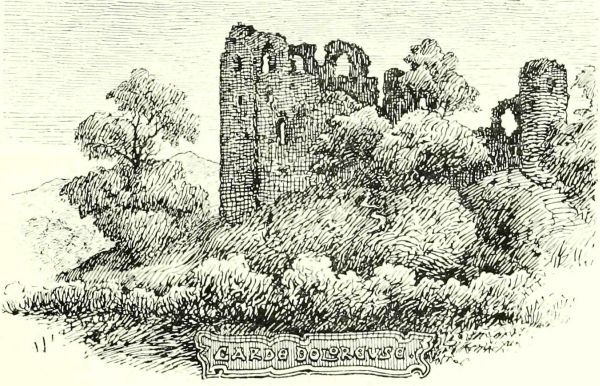
A bowshot distant from the town rise the ruins of Clun Castle, whose tall, grey, lichen-clad donjon looks out over a horseshoe bend of the river towards the dark Welsh hills to the westward; even as in the days when Raymond de Berenger, Knight of the Garde Doloreuse, entertained Gwenwyn Prince of Powys in this lonesome fortalice.
Here, at Clun, the FitzAlans lorded it for many a generation over the adjacent march-lands. After many changes and vicissitudes, the castle passed eventually to the present Duke of Norfolk, who from this place acquires his second title of Baron Clun.
With the exception of the keep-tower above mentioned, little remains of Clun Castle save two ruined circular bastions overlooking the river, and certain tall green mounds that give a clue to the original extent of the fortress. The outer bailey with its enclosing vallations is a broad, tree-shaded grassplot, where nowadays the townsfolk go a-pleasuring on high-days and holiday times.
Clun Castle formed a very important link in the chain of fortresses planted by the Normans along the Welsh frontier, to secure their hard-won territory and control the turbulent natives. Towards the close of the twelfth century Rhys, Prince of South Wales, swooped down from his mountain fastnesses, and after many a fierce onslaught stormed and set fire to the castle. At a later period the place fell a prey to that scourge of the Welsh Marches, 'the irregular and wild Glendower,' and was finally dismantled by the Parliamentarians during the Civil Wars. So early, indeed, as the reign of Henry VIII., when that ubiquitous antiquary John Leland journeyed this way, 'Clunne Castell' was 'sumewhat ruinus,' 'though it hath bene,' he adds, 'bothe Stronge and well builded.'
The following lines from 'The Betrothed' have been associated with the Castle of Clun: 'A place strong by nature, and well fortified by art, which the Welch prince had found it impossible to conquer, either by open force or stratagem; and which, remaining with a strong garrison in his rear, often chequed his invasions by rendering his retreat precarious. The river, whose stream washes on three sides the base of the proud eminence on which the castle is situated, curves away from the fortress and its corresponding village on the west, and the hill sinks downward to an extensive plain, so extremely level as to indicate its alluvial origin.
'The bridge, a high narrow combination of arches of unequal size, was about half a mile distant from the castle, in the very centre of the plain. The river itself ran in a deep, rocky channel, was often unfordable, and at all times difficult of passage, giving considerable advantage to the defenders of the Castle.'
Over the old bridge in question lies our way towards Clun church; and, as the local saw has it, 'Whoever crosses Clun Bridge comes back sharper than he went.' The bridge itself, with its five uneven arches and bold sparlings, is still a picturesque object, and in former days was a favourite subject with artists: though the old cordwainer and his ancient timber dwelling beside the bridge have long since passed away.
Old Lych Gate at Clun.
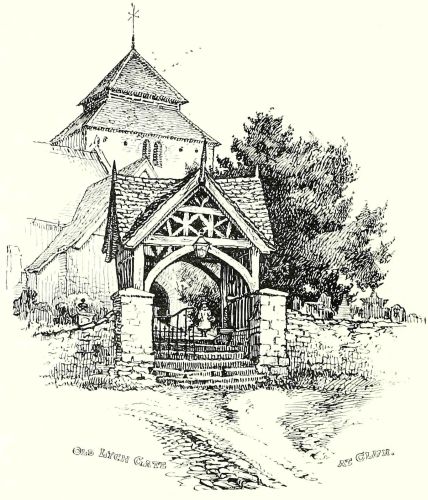
So we will push ahead to St. George's church, whose massive western tower and curious louvred steeple are already in sight, peering over an old lych-gate in the foreground. This lych-gate is a very charming bit of ancient carpentry, its solid substantial oak beams shewing excellent workmanship, with just a touch of ornamentation here and there; while the roof is covered with rough stone-shingles, overgrown with mosses and lichens.
Passing through the wicket, we traverse a rustic grass-grown God's-acre, beneath the shadow of one of those immemorial yews so common in our country churchyards. Why they were planted in such a situation has afforded no little matter for conjecture; whether they were intended as emblems of immortality, or to serve the more utilitarian purpose of supplying bows for the English archers who in bygone days formed the backbone of our fighting line:
'Oh the crooked stick and the grey goose's wing, But for which Old England were but a fling!'
The strong nail-studded west door of the church has its old iron hinges, and some names cut in bold Roman letters upon it. The roomy north porch by which we enter has a chamber, or parvise, over it, and stone benches against the walls upon either side. The interior is large and spacious, the fine oak roof being borne upon Norman pillars and arches, while clerestory windows admit light from the southward wall. A modern screen divides nave from chancel, and beside it rises a tall Jacobean pulpit with a sounding-board, all carved in the style peculiar to that period.
The chancel is lighted by well proportioned windows with Purbeck marble shafts. Suspended from the chancel roof hangs a curious fifteenth-century canopy, nicely constructed of oak fashioned into panels, and adorned with three small carved wooden angels. Its purpose is uncertain, but it bears some resemblance to the canopied structure called a baldacchino found in some continental churches.
In the vestry is a mural tablet to Sir Robert Howard: and the rough old staircase leading up into the tower is worth a moment's notice, for the rude simplicity of its construction. The Churchwarden's accounts here shew that, in the year 1741, the sum of ten shillings was paid 'for whipping the Doggs out of ye church, serviss time, and keeping people from sleeping in church During divine serviss.'
Hospital of the Holy & Undivided Trinity at Clunn.
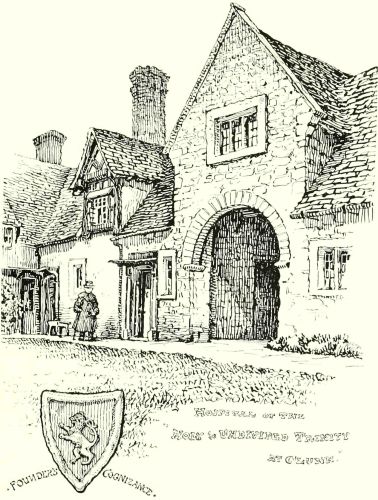
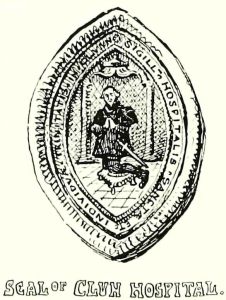
In a retired spot upon the eastern side of the town stands the 'Hospital of the Holy and Undivided Trinity at Clunn,' a refuge for decayed tradesmen founded by the Right Hon. the Earl of Northampton, in the year 1614. And truly their lines have fallen in pleasant places, these grey-headed old veterans; each lowly domicile giving upon a central plot of greensward, with benches set against the wall in sunny nooks, and an old wooden pump standing in one corner, with its bucket and chain for drawing water:
'The old oaken bucket, the iron-bound bucket, The moss-covered bucket which hung in the well.'
'Eh sure, sur,' exclaims an ancient derelict with whom we chance to pass the time of day, 'you'm makin' a purty picture of th'owd plaace, I'll warrand, but I canna see well wi'out my speck-tackles. I binna so young as I was, ye see, but there's several chaps 'ere as is older nor I be, and I'm turned eighty myself.'
A tablet upon the wall of a small chapel, dedicated to the inmates' use, bears a lengthy Latin inscription in memory of Henry Howard, Earl of Northampton, who established similar retreats at Greenwich and Castle Rising.
According to an ordinance duly advertised upon the wall of the dining hall, each poor man is entitled to receive yearly, on Founder's Day, 'a gown ready made of strong cloth or kersey, of a sad colour, to wear upon Week Days; and also every fourth year, upon Trinity Sunday, have delivered unto him to wear, such a livery gown of blue cloth lined with bayes, with the Founder's cognizance set on the sleeve, to wear upon Sundays and Festival Days.' In the dining hall, too, is preserved an ancient cross-bow, and a large two-handed double-edged sword about five feet in length.
Such, then, is the old Hospital at Clun; so now, after a moonlight stroll around the environs, we turn in for the night at the 'Buffalo'; and, far removed from the din of railroad shrieks, or bustle of passing traffic, sleep the sleep of the just until morning looks in at the casement.
SEAL of CLUN HOSPITAL.