Volume 2 — "What the Germans Say About Their Own Methods of Warfare"
Reading edition
By Joseph Bedier, Professor in the College de France
[From an article in the Revue de Paris for January, 1915.]
I purpose to show that the German armies cannot altogether escape the reproach of violating on occasion the law of nations. I shall establish this by French methods, through the use of documents of sound value.
My texts are genuine, well vouched for, and I have taken pains to subject them to a critical examination, as scrupulous and minute as heretofore in times of peace I expended in weighing the authority of some ancient chronicle, or in scrutinizing the authenticity of some charter. Perhaps this care was born of professional habit, or due to a natural craving for exactness, but in either case it is a voucher for the work, which is meant for all comers—for the passer-by, for the indifferent, and even for my country's foes. My wish is that the veriest looker-on, idly turning these pages, may be confronted only with documents whose authenticity will be self-evident, if he is willing to see, and whose ignominious tale will reach his heart, if ye have a heart.
I have, moreover, sought for documents not only incontestably genuine but of unquestioned authority. Accusation is easy, while proof is difficult. No belligerent has ever been troubled to find mountains of testimony, true or false, against his enemy; but were this evidence gathered by the most exalted magistrates, under the most solemn judicial sanction, it must unfortunately long remain useless; until the accused has full opportunity to controvert it, every one is free to treat it as false or, at the best, as controvertible. For this reason I shall avoid resting the case upon Belgian or French statements, though I know them to be true. My purpose has been to bring forward such testimony that no man living, be he even a German, should be privileged to cast a doubt upon it. German crimes will be established by German documents.
These will be taken mainly from the "War Diaries," which Article 75 of the German Army Regulations for Field Service enjoins upon soldiers to keep during their marches, and which were seized by the French upon the persons of their prisoners, as military papers, as authorized by Article 4 of The Hague Convention of 1907. The number of these is daily increasing, and I trust that some day, for the edification of all, the complete collection may be lodged in the Germanic section of manuscripts in the National Library. Meantime, the Marquis de Dampierre, paleographer and archivist, graduate of the Ecole des Chartes, is preparing, and will shortly publish, a volume in which the greater part of these notebooks will be minutely described, transcribed, and clarified. Personally, I have only examined about forty of them, but they will answer my purpose, by presenting relevant extracts, furnishing the name, rank, and regiment of the author, with indications of time and place. Classification is difficult, mainly because ten lines of a single text not infrequently furnish evidence of a variety of offenses. I must take them almost at random, grouping them under such analogies or association of ideas or images as they may offer.
I.
The first notebook at hand is that of a soldier of the Prussian Guard, the Gefreiter Paul Spielmann, (of Company I, First Brigade of the Infantry Guard.) He tells the story of an unexpected night alarm on the 1st of September in a village near Blamont. The bugle sounds, and the Guard, startled from sleep, begins the massacre, (Figs. 1 and 2:)
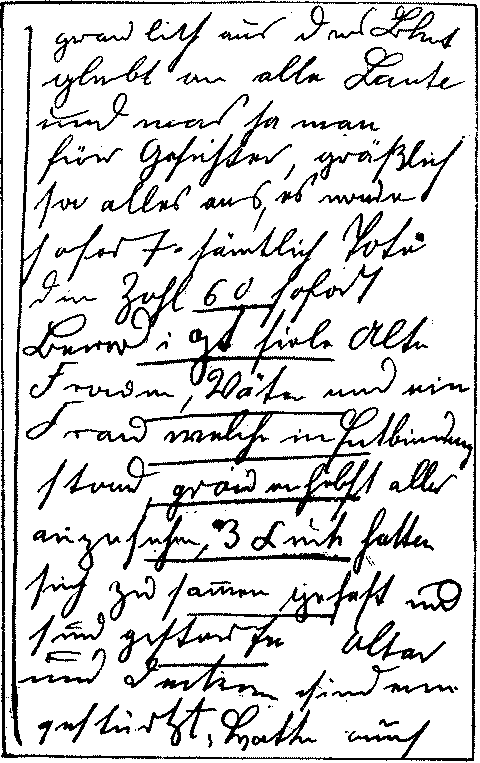
Figure 1.
The inhabitants fled through the village. It was horrible. The walls of houses are bespattered with blood and the faces of the dead are hideous to look upon. They were buried at once, some sixty of them. Among them many old women, old men, and one woman pregnant—the whole a dreadful sight. Three children huddled together—all dead. Altar and arches of the church shattered. Telephone communication with the enemy was found there. This morning, Sept. 2, all the survivors were driven out; I saw four little boys carrying on two poles a cradle with a child some five or six months old. The whole makes a fearful sight. Blow upon blow! Thunderbolt on thunderbolt! Everything given over to plunder. I saw a mother with her two little ones—one of them had a great wound in the head and an eye put out.
Deserved repression, remarks this soldier: "They had telephone communication with the enemy." And yet, we may recall that by Article 30 of The Hague Convention of 1907, signed on behalf of H.M. the Emperor of Germany, "no collective penalty, pecuniary or other, shall be proclaimed against a population, by reason of individual acts for which the population is not responsible in solido." What tribunal during that dreadful night took the pains to establish this joint participation?
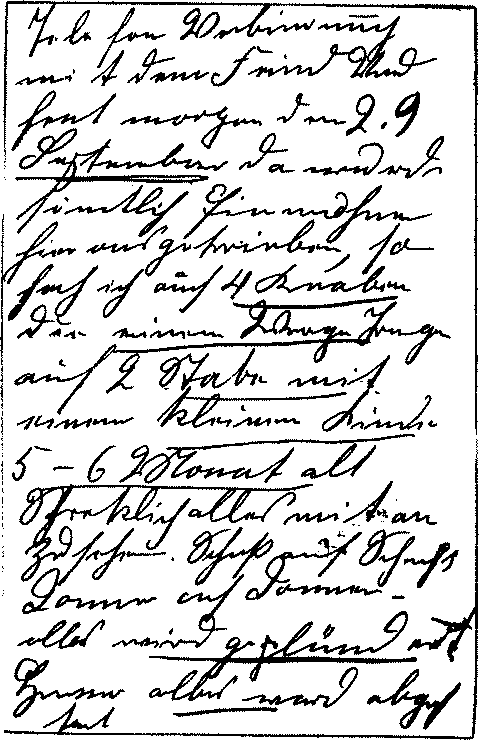
Figure 2.
II.
The unsigned notebook of a soldier of the Thirty-second Reserve Infantry (Fourth Reserve Corps) has this entry:
Creil, Sept. 3.—The iron bridge was blown up. For this we set the streets on fire, and shot the civilians.
Yet it must be obvious that only the regular troops of the French Engineer Corps could have blown up the iron bridge at Creil; the civilians had no hand in it. As an excuse for these massacres, when any excuse is offered, the notebooks usually note that "civilians" or "francs-tireurs" had fired on the troops. But the "scrap of paper" which Germany subscribed—the Convention of 1907—provides in its first article "the laws, the rights, and the duties are not applicable solely to the army, but also to militia and bodies of volunteers" under certain conditions, of which the main one is that they shall "openly bear arms;" while Article 2 stipulates that "the population of an unoccupied territory, which on the approach of the enemy spontaneously takes up arms to resist the invading forces, without having had time to organize as provided in Article I, shall be considered as a belligerent, if they bear arms openly and observe the laws and customs of war."
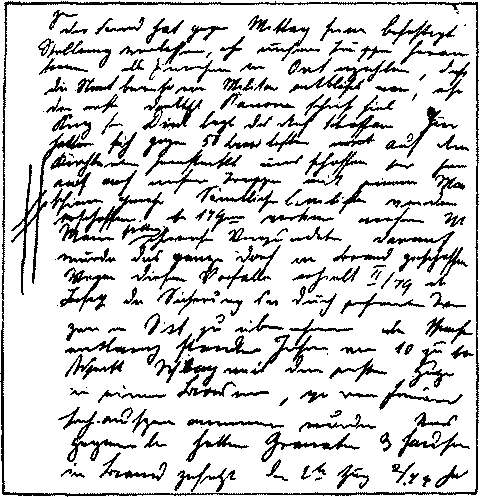
Figure 3.
In the light of this text, the bearing of the barbarous recitals which follow may be properly estimated:
(a) Notebook of Private Hassemer, (Eighth Corps, Sept. 3, 1914, at Sommepy, Marne.)—Dreadful butchery. Village burned to the ground; the French thrown into the burning houses, civilians and all burned together.
(b) Notebook of Lieut. Kietzmann, (Second Company, First Battalion, Forty-ninth Infantry,) under date of Aug. 18, 1914, (Fig. 3.)—A short distance above Diest is the village of Schaffen. About fifty civilians were concealed in the church tower, and from there fired on our troops with a mitrailleuse. All the civilians were shot.
[It may here be noted, for the sake of precision, that the First Report of the Belgian Commission of Inquiry, Antwerp, Aug. 28, Page 3, identifies some of the "civilians" killed at Schaffen on the 18th of August; among them, "the wife of François Luyckz, 45 years of age, with her daughter aged 12, who were discovered in a sewer and shot"; and "the daughter of Jean Ooyen, 9 years of age, who was shot"; and "André Willem, sacristain, who was bound to a tree and burned alive."]
(c) Notebook of a Saxon officer, unnamed, (178th Regiment, Twelfth Army Corps, First Saxon Corps,) Aug. 26.—The exquisite village of Gué-d'Hossus (Ardennes) was given to the flames, although to my mind it was guiltless. I am told that a cyclist fell from his machine, and in his fall his gun was discharged; at once the firing was begun in his direction, and thereupon all the male inhabitants were simply thrown into the flames. It is to be hoped that like atrocities will not be repeated.
This Saxon officer had, nevertheless, already witnessed like "atrocities." The preceding day, Aug. 25, at Villers-en-Fagne, (Belgian Ardennes,) "where we found grenadiers of the guard, killed and wounded," he had seen "the curé and other inhabitants shot"; and three days previous, Aug. 23, at the village of Bouvignes, north of Dinant, he had witnessed what he thus describes:
Through a breach made in the rear we get access into the residence of a well-to-do inhabitant and occupy the house. Passing through a number of apartments, we reach a door where we find the corpse of the owner. Further on in the interior our men have wrecked everything like vandals. Everything has been searched. Outside, throughout the country, the spectacle of the inhabitants who have been shot defies any description. They have been shot at such short range that they are almost decapitated. Every house has been ransacked to the furthest corners, and the inhabitants dragged from their hiding places. The men shot; the women and children locked into a convent, from which shots were fired. And, for this reason, the convent is about to be set fire to; it may, however be ransomed if it surrenders the guilty ones and pays a ransom of 15,000 francs.
We shall see as we proceed how these notebooks complement one another.
(d) Notebook of the Private Philipp, (from Kamenz, Saxony, First Company, First Battalion, 178th Regiment.) On the day indicated above—Aug. 23—a private of the same regiment was the witness of a scene similar to that just described; perhaps, the same scene, but the point of view is different.—At 10 o'clock in the evening the First Battalion of the 178th came down into the burning village to the north of Dinant—a saddening spectacle—to make one shiver. At the entrance to the village lay the bodies of some fifty citizens, shot for having fired upon our troops from ambush. In the course of the night many others were shot down in like manner, so that we counted more than two hundred. Women and children, holding their lamps, were compelled to assist at this horrible spectacle. We then sat down midst the corpses to eat our rice, as we had eaten nothing since morning. (Fig. 4.)
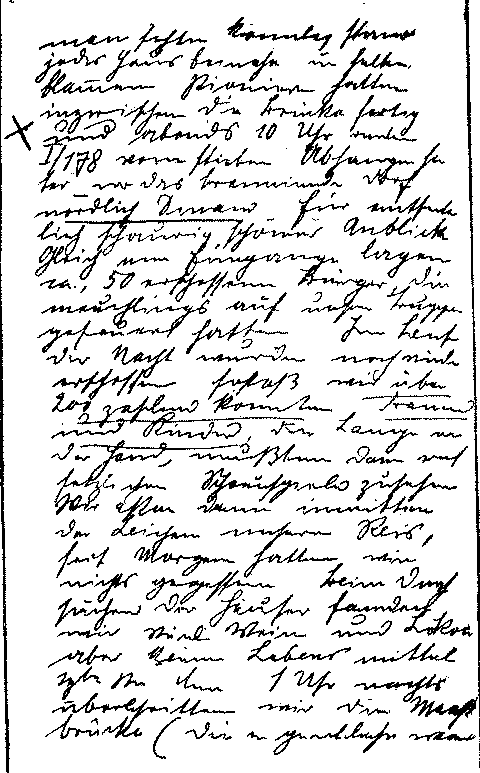
Figure 4.
Here is a military picture fully outlined, and worthy to compete in the Academy of Fine Arts of Dresden. But one passage of the text is somewhat obscure and might embarrass the artist—"Women and children, holding their lamps, were compelled to assist at this horrible spectacle." What spectacle?—the shooting, or the counting of the corpses? To get some certainty on this historic point, the artist should question that noble soldier—the Colonel of the 178th.
His work of that night, however, was in accord with the spirit of his companions in arms, and of his chiefs. We may assure ourselves of this by consulting the Sixth Report of the Belgian Commission of Inquiry upon, the violation of the rules of the law of nations (Havre, Nov. 10, 1914) and the ignoble proclamations placarded by the Germans throughout Belgium. I will content myself with three short extracts.
Extract from a proclamation of General von Bülow, placarded at Liège, Aug. 22, 1914:
The inhabitants of the city of Andenne, after having protested their peaceful intentions, were guilty of a treacherous surprise upon our troops. It was with my consent that the General in Chief set fire to the whole locality, and that about one hundred persons were shot.
(The Belgian report controverts the accusation against the inhabitants of Andenne of having taken hostile measures against the German troops, and adds: "As a matter of fact, more than two hundred persons were shot"—almost everything was ravaged. For a distance of at least three leagues the houses were destroyed by fire.)
Extract from a proclamation of Major Dieckmann, placarded at Grivegnée, Sept. 8, 1914:
Any one not responding instantly to the command "raise your arms" is subject to the penalty of death.
Extract from proclamation of Marshal Baron von der Goltz, placarded at Brussels, Oct. 5, 1914:
Hereafter the localities nearest the place where similar acts (destruction of railways or telegraphic lines) were done—whether or not they were accomplices in the act—will be punished without mercy. To this end hostages have been taken from all the localities adjacent to railways menaced by similar attacks, and upon the first attempt to destroy the railways, telegraphic or telephone lines, they will at once be shot.
III.
I copy from the first page of an unsigned notebook, (Fig. 5:)
Langeviller, Aug. 22.—Village destroyed by the Eleventh Battalion of Pioneers. Three women hanged to trees; the first dead I have seen.
Who can these three women be?—criminals undoubtedly—guilty of having fired upon German troops, unless, indeed, they may have been "in communication by telephone" with the enemy; and the Eleventh Pioneers unquestionably meted out to them just punishment. But, at all events, they expiated their guilt, and the Eleventh Pioneers has passed on. The crime these women committed is unknown to the troops which are to follow. Among these new troops will there be found no chief, no Christian, to order the ropes cut and allow these dangling bodies to rest on the earth?
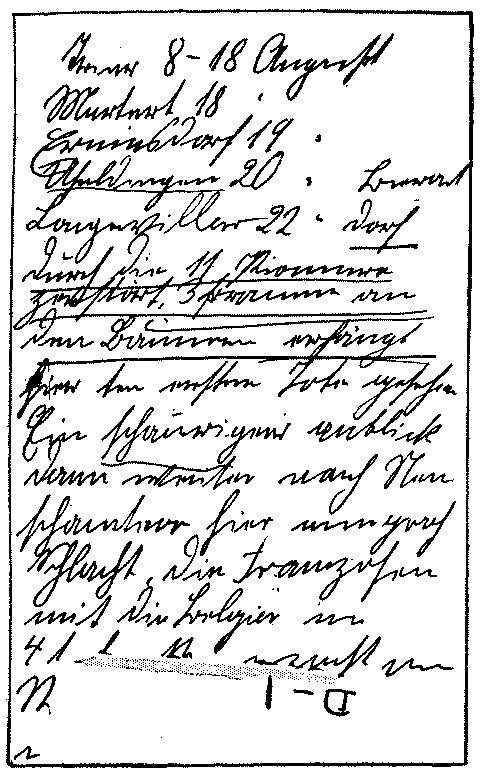
Figure 5.
No, the regiment passes under the gibbets and their flags brush against the hanging corpses; they pass on, Colonel and officers—gentlemen all—Kulturträger. And they do this knowingly; these corpses must hang there as an example, not for the other women of the village, for these doubtless already understand, but as an example to the regiment and to the other regiments that will follow, and who must be attuned to war, who must be taught their stern duty to kill women when occasion offers. The teaching will be effective, unquestionably. Shall we look for proof of it? The young soldier, who tells us above that these corpses were the first dead he had ever seen, adds a week later, on the tenth and last page of his notebook, the following, (Fig. 6:)
In this way we destroyed eight dwellings and their inhabitants. In one of the houses we bayoneted two men, with their wives and a young girl 18 years old. The young: one almost unmanned me, her look was so innocent! But we could not master the excited troop, for at such times they are no longer men—they are beasts.
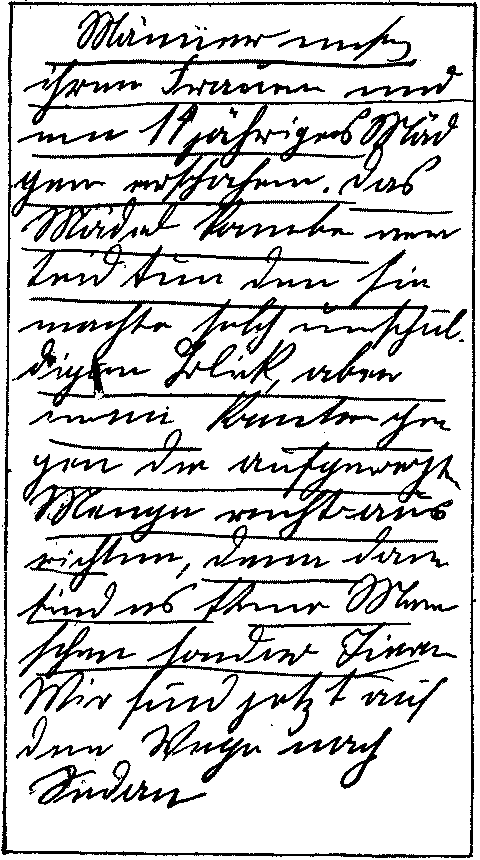
Figure 6.
Let me add a few texts which will attest that these assassinations of women and children are customary tasks set to German soldiers:
(a) The writer in a notebook, unsigned, reports that at Orchies (Nord) "a woman was shot for not having obeyed the command to halt!" whereupon he adds, "the whole locality was set on fire." (Fig. 7.)
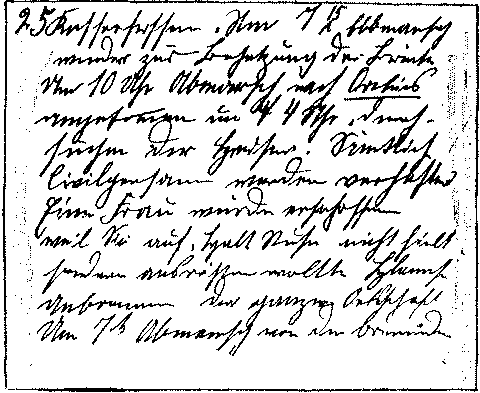
Figure 7.
(b) The officer of the 178th Saxon Regiment, mentioned above, reports that in the vicinity of Lisognes (Belgian Ardennes) "the Chasseur of Marburg, having placed three women in line, killed them all with one shot."
(c) A few lines more, taken from the notebook of the Reservist Schlauter (Third Battery, Fourth Regiment, Field Artillery of the Guard,) (Fig. 8:)
Aug. 25, (in Belgium.)—We shot 300 of the inhabitants of the town. Those that survived the salvo were requisitioned as grave diggers. You should have seen the women at that time! But it was impossible to do otherwise. In our march upon Wilot things went better; the inhabitants who wished to leave were allowed to do so. But whoever fired was shot. Upon our leaving Owele the rifles rang out, and with that, flames, women, and all the rest.
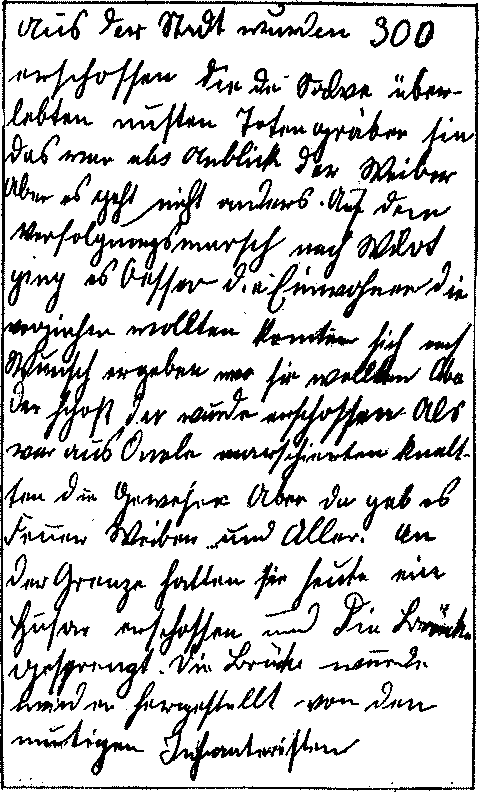
Figure 8.
IV.
Frequently when a German troop want to carry a position, they place before them civilians—men, women, and children—and find shelter behind these ramparts of living flesh. As such a stratagem is essentially playing upon the nobility of heart of the adversary, and saying to him "you won't fire upon these unfortunates, I know it, and I hold you at my mercy, unarmed, because you are not as craven as I am," as it implies a homage to the enemy and the self-degradation of the one employing it, it is almost inconceivable that soldiers should resort to it; it represents a new invention in the long story of human vileness, which even the dreadful Penitentiels of the Middle Ages had not discovered. In reading the stories from French, Belgian, and English sources, attributing such practices to the Germans, it has made me doubt, if not the truthfulness, at least the detailed exactness of the stories. It seemed to me that the tales must be of crimes by men who would be disavowed, individual lapses, which do not dishonor the nation, because the nation on ascertaining them would repudiate them. But how can we doubt that the German Nation has, on the contrary, accepted these acts as exploits worthy of herself, that in them she recognizes her own aptitudes, and finds pleasure in the contemplation; how, I ask, can we doubt this in reading the following narrative signed by a Bavarian officer, Lieut. A. Eberlein, spread out in the columns of one of the best known periodicals of Germany, the Münchner Neueste Nachrichten, in its issue of Wednesday, Oct. 7, 1914, Page 22, Lieut. Eberlein relates there the occupation of Saint-Dié at the end of August. He entered the town at the head of a column, and while waiting for reinforcements was compelled to barricade himself in a house, (Fig. 9:)
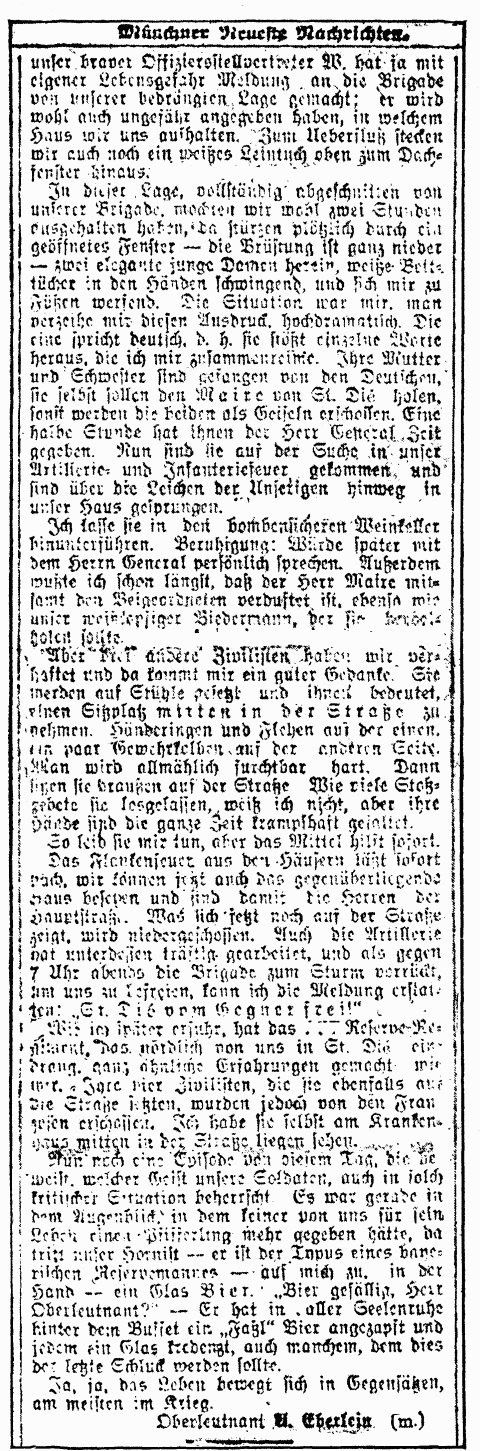
Figure 9.
We arrested three civilians, and a bright idea struck me. We furnished them with chairs and made them seat themselves in the middle of the street. There were supplications on one part, and some blows with the stocks of our guns on the other. One, little by little, gets terribly hardened. Finally, there they were sitting in the street. How many anguished prayers they may have muttered, I cannot say, but during the whole time their hands were joined in nervous contraction. I am sorry for them, but the stratagem was of immediate effect. The enfilading directed from the houses diminished at once; we were able then to take possession of the house opposite, and thus became masters of the principal street. From that moment every one that showed his face in the street was shot. And the artillery meanwhile kept up vigorous work, so that at about 7 o'clock in the evening, when the brigade advanced to rescue us, I could report "Saint-Dié has been emptied of all enemies."
As I learned later, the —— Regiment of Reserves, which came into Saint-Dié further north, had experiences entirely similar to our own. The four civilians whom they had placed on chairs in the middle of the street were killed by French bullets. I saw them myself stretched out in the street near the hospital.
V.
Article 28 of The Hague Convention of 1907, subscribed to by Germany, uses this language: "The sacking of any town or locality, even when taken by assault, is prohibited." And Article 47 runs: "[in occupied territory] pillage is forbidden."
We shall see how the German armies interpret these articles.
Private Handschuhmacher (Eleventh Battalion of Chasseurs Reserves) writes in his notebook:
Aug. 8, 1914, Gouvy, (Belgium.)—There, the Belgians having fired on some German soldiers, we started at once pillaging the merchandise warehouse. Several cases—eggs, shirts, and everything that could be eaten was carried off. The safe was forced and the gold distributed among the men. As to the securities, they were torn up.
This happened as early as the fourth day of the war, and it helps us to understand a technical article on the operations of the military treasury (Der Zahlmeister im Felde) in the Berliner Tageblatt of the 26th of November, 1914, in which an economic phenomenon of rather unusual import is recited as a simple incident: "Experience has demonstrated that very much more money is forwarded by postal orders from the theatre of operations to the interior of the country than vice versa."
As, in accordance with the continual practice of the German armies, pillaging is only a prelude to incendiarism, the sub-officer Hermann Levith (160th Regiment of Infantry, Eighth Corps) writes:
The enemy occupied the village of Bievre and the edge of the wood behind it. The Third Company advanced in first line. We carried the village, and then pillaged and burned almost all the houses.
And Private Schiller (133d Infantry, Nineteenth Corps) writes:
Our first fight was at Haybes (Belgium) on the 24th of August. The Second Battalion entered the village, ransacked the houses, pillaged them, and burned those from which shots had been fired.
And Private Sebastian Reishaupt (Third Bavarian Infantry, First Bavarian Corps) writes:
The first village we burned was Parux, (Meurthe-et-Moselle.) After this the dance began, throughout the villages, one after the other; over the fields and pastures we went on our bicycles up to the ditches at the edge of the road, and there sat down to eat our cherries.
They emulate each other in their thefts; they steal anything that comes to hand and keep records of the thefts—"Schnaps, Wein, Marmelade, Zigarren," writes this private soldier; and the elegant officer of the 178th Saxon Regiment, who was at first indignant at the "vandalismus" of his men, further on admits that he himself, on the 1st of September, at Rethel, stole "from a house near the Hôtel Moderne a superb waterproof and a photographic apparatus for Felix." All steal, without distinction or grade, or of arms, or of cause, and even in the ambulances the doctors steal. Take this example from the notebook of the soldier Johannes Thode (Fourth Reserve Regiment of Ersatz):
At Brussels, Oct. 5, 1914.—An automobile arrived at the hospital laden with war booty—one piano, two sewing machines, many albums, and all sorts of other things.
"Two sewing machines" as "war booty." From whom were these stolen? Beyond a doubt from two humble Belgian women. And for whom were they stolen?
VI.
I must admit that, out of the forty notebooks, or thereabout, that I have handled, there are six or seven that do not relate any exactions, either from hypocritical reticence or because there are some regiments which do not make war in this vile fashion. And there are as many as three notebooks whose writers, in relating these ignoble things, express astonishment, indignation, and sorrow. I will not give the names of these, because they deserve our regard, and I wish to spare them the risk of being some day blamed or punished by their own.
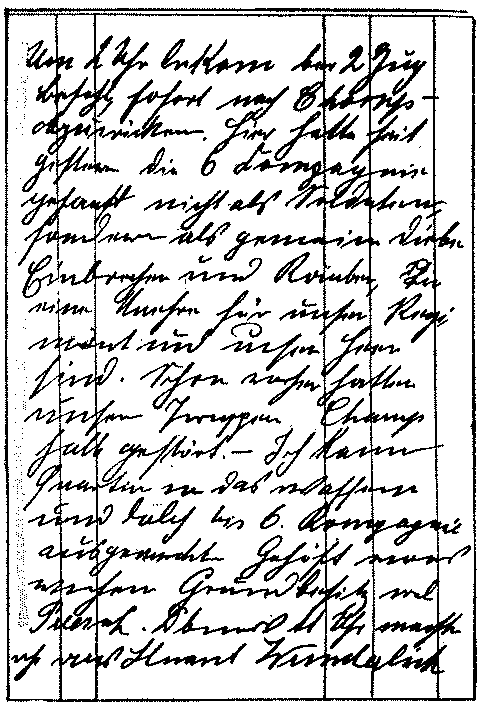
Figure 10.
The first, the Private X., who belongs to the Sixty-fifth Infantry, Regiment of Landwehr, says of certain of his companions in arms, (Fig. 10:)
They do not behave as soldiers, but rather as highwaymen, bandits, and brigands, and are a dishonor to our regiment and to our army.
Another, Lieut. Y., of the Seventy-seventh Infantry of Reserves, says:
No discipline, ... the Pioneers are well nigh worthless; as to the artillery, it is a band of robbers.
The third, Private Z., of the Twelfth Infantry of Reserves, First Corps, writes, (Fig. 11:)
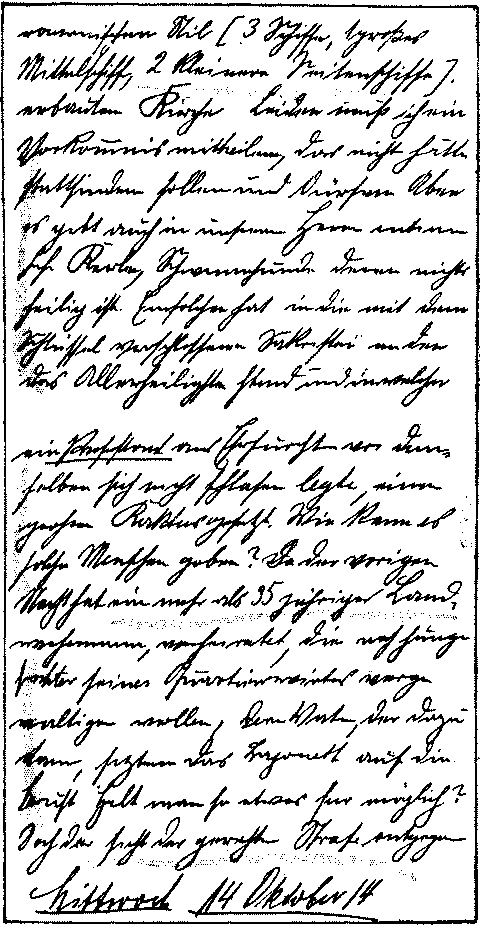
Figure 11.
Unfortunately, I am forced to make note of a fact which should not have occurred, but there are to be found, even in our own army, creatures who are no longer men, but hogs, to whom nothing is sacred. One of these broke into a sacristy; it was locked, and where the Blessed Sacrament was kept. A Protestant, out of respect, had refused to sleep there. This man used it as a deposit for his excrements. How is it possible there should be such creatures? Last night one of the men of the Landwehr, more than thirty-five years of age, married, tried to rape the daughter of the inhabitant where he had taken up his quarters—a mere girl—and when the father intervened he pressed his bayonet against his breast.
Beyond these three, who are still worthy of the name of soldiers, the other thirty are all alike, and the same soul (if we can talk of souls among such as these) animates them low and frantic. I say they are all about alike, but there are shades of difference. There are some who, like subtle jurists, make distinctions, blaming here and approving there—"Dort war ein Exempel am Platze." Others laugh and say "Krieg ist Krieg," or sometimes they add in French, to emphasize their derision, "Ja, Ja, c'est la guerre," and some among them, when their ugly business is done, turn to their book of canticles and sing psalms, such as the Saxon Lieut. Reislang, who relates how one day he left his drinking bout to assist at the "Gottesdienst", but having eaten too much and drunken too much, had to quit the holy place in haste; and the Private Moritz Grosse of the 177th Infantry, who, after depicting the sacking of Saint-Vieth, (Aug. 22,) the sacking of Dinant, (Aug. 23,) writes this phrase:
Throwing of incendiary grenades into the houses, and in the evening a military chorus—"Now let all give thanks to God." (Fig. 12.)
They're all of a like tenor. Now, if we consider that I could exchange the preceding texts with others quite similar, quite as cynical, and taken at random, for instance—from the notebook of the Reservist Lautenschlager of the First Battalion, Sixty-sixth Regiment of Infantry, or the notebook of the Private Eduard Holl of the Eighth Corps, or the notebook of the sub-officer Reinhold Koehn of the Second Battalion of Pomeranian Pioneers, or that of the sub-officer Otto Brandt of the Second Section of Reserve Ambulances, or of the Reservist Martin Müller of the 100th Saxon Reserve, or of Lieut. Karl Zimmer of the Fifty-fifth Infantry, or that of the Private Erich Pressler of the 100th Grenadiers, First Saxon Corps, &c., and if we will note that, among the exactions reported above, there are very few that are the work of isolated brutes, (such as, unfortunately, may be found even in the most noble armies,) but that, on the contrary, the crimes represented here are collective actions in obedience to service orders, and such as rest upon and dishonor not only the individual but the entire troop, the officers, and the nation; and if we will further note that these thirty notebooks taken at random—Bavarian, Saxon, Pomeranian, Brandeburger, or from the provinces of Baden and the Rhine—must of necessity represent hundreds and thousands of others quite similar, as we may judge from the frightful monotony of their recitals; if we consider all this, we must, I think, be forced to admit that these atrocities are nothing less than the practical application of a methodically organized system.
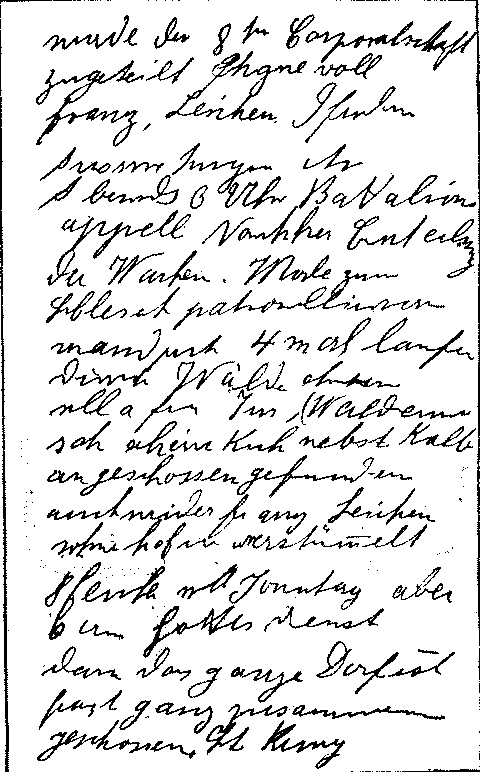
Figure 12.
VII.
H.M. the Emperor of Germany, by ratifying The Hague Convention of 1907, covenanted (Article 24) that "it is forbidden (c) to kill or wound an enemy who, having laid down his arms, or being without means of defense, has surrendered unconditionally. (d) To declare that no quarter shall be given."
Have the German armies respected these covenants? Throughout Belgian and French reports depositions such as the following abound. This is taken from a French Captain of the 288th Infantry:
On the 22d, in the evening, I learned that in the woods, about one hundred and fifty meters north of the square formed by the intersection of the great Calonne trench with the road from Vaux-les-Palameis to Saint-Rémy, there were corpses of French soldiers shot by the Germans. I went to the spot and found the bodies of about thirty soldiers within a small space, most of them prone, but several still kneeling, and all having a precisely similar wound—a bullet through the ear. One only, seriously wounded in his lower parts, could still speak, and told me that the Germans before leaving had ordered them to lie down and that then had them shot through the head; that he, already wounded had secured indulgence by stating that he was the father of three small children. The skulls of these unfortunates were scattered; the guns, broken at the stock, were scattered here and there; and the blood had besprinkled the bushes to such an extent that in coming out of the woods my cape was spattered with it; it was a veritable shambles.
I quote this testimony, not to base any accusations upon it, but simply to give precision to our indictment. I will not lay stress upon it as evidence, for I wish to keep to the rule which I have laid down—to have records of nothing but German sources of information.
I will quote here the text of an order of the day addressed by General Stenger, in command of the Fifty-eighth German Brigade, on the 26th of August, to the troops under his orders:
From this day forward no further prisoners will be taken. All prisoners will be massacred. The wounded, whether in arms or not in arms, shall be massacred. Even the prisoners already gathered in convoys will be massacred. No living enemy must remain behind us.
Signed—First Lieutenant in Command of the Company, Stoy; Colonel Commanding the Regiment, Neubauer; General in Command of the Brigade, Stenger.
About thirty soldiers of Stenger's Brigade (112th and 142d Regiments of Baden Infantry) were questioned. I have read their depositions, taken under oath and signed with their own names; all confirming the fact that this order of the day was given to them on the 26th of August. In one place by the Major Mosebach, in another by Lieut. Curtius, &c. Most of these witnesses said that they were ignorant whether the order was carried out, but three among them testified that it was carried out under their own eyes in the Forest of Thiaville, where ten or twelve wounded French, already made prisoners by a battalion, were done away with; two others of the witnesses saw the order carried out along the road of Thiaville, where several wounded, found in the ditches by the company as it marched past, were killed.
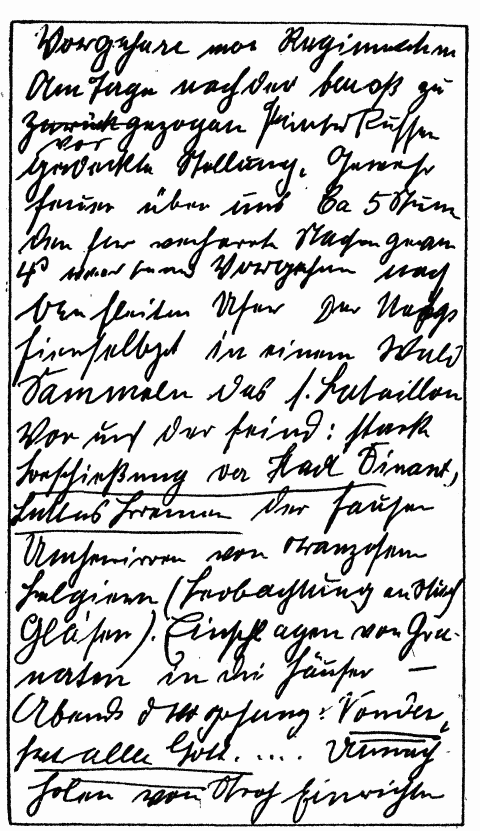
Figure 13.
Of course, I cannot here produce the original autograph of General Stenger, nor am I here called upon to furnish the names of the German prisoners who gave this testimony. But I shall have no trouble to establish entirely similar crimes on the faith of German autographs.
For instance, we find in the notebook of Private Albert Delfosse (111th Infantry of Reserves, Fourteenth Reserve Corps,) (Fig. 13:)
In the woods (near Saint-Rémy, 4th or 5th of September)—Found a very fine cow and a calf killed; and again the corpses of Frenchmen horribly mutilated.
Must we understand that these bodies were mutilated by loyal weapons, torn perhaps by shells? This may be, but it would be a charitable interpretation, which is belied by this newspaper heading, (Figs. 14 and 15:)
JAUERSCHES TAGEBLATT Amtlicher Anzeiger Für Stadt und Kreis Jauer Jauer, Sonntag, Den 18, Oktober, 1914. Nr. 245. 106, Jahrgang.
This is a heading of a newspaper picked up in a German trench. Jauer is a city of Silesia, about fifty kilometers west of Breslau, where two battalions of the 154th Regiment of Saxon Infantry are garrisoned. One Sunday morning, Oct. 18, doubtless at the hour when the inhabitants—women and children—were wending their way to church, there was distributed throughout the quiet little town, and through the hamlets and villages of the district, the issue of this local paper with the following inscription: "A day of honor for our regiment, Sept. 24, 1914," as the title of an article of some two hundred lines, sent from the front by a member of the regiment—the sub-officer Klemt of the First Company, 154th Infantry Regiment.
GENERAL VON KUSMANEK— Whose stubborn defense of Przemysl made it one of the most notable sieges of history.—(Photo from Underwood & Underwood.)
CAPT.-LIEUT. OTTO WEDDIGEN— Whose submarine exploits have done more damage to England's navy than all Germany's gunners.—(Photo from The Photo News.)
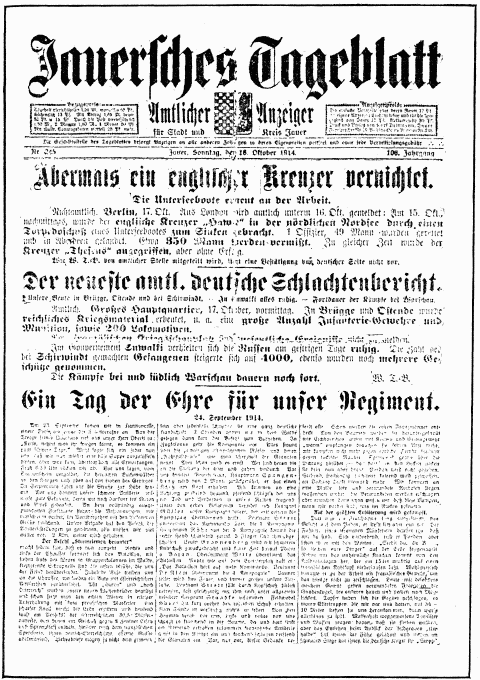
Figure 14.
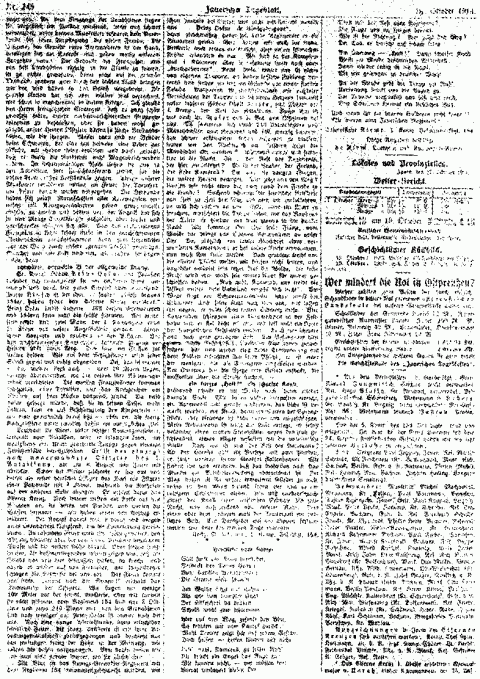
Figure 15.
The sub-officer Klemt relates how, on the 24th of September, his regiment having left Hannonville in the morning, accompanied by Austrian batteries, suddenly came up against a double fire of infantry and artillery. Their losses were terrible, and yet the enemy was still invisible. Finally, says this officer, it was found that the bullets came from above, from trees which the French soldiers had climbed. From this point let me quote verbatim, (Fig. 16:)
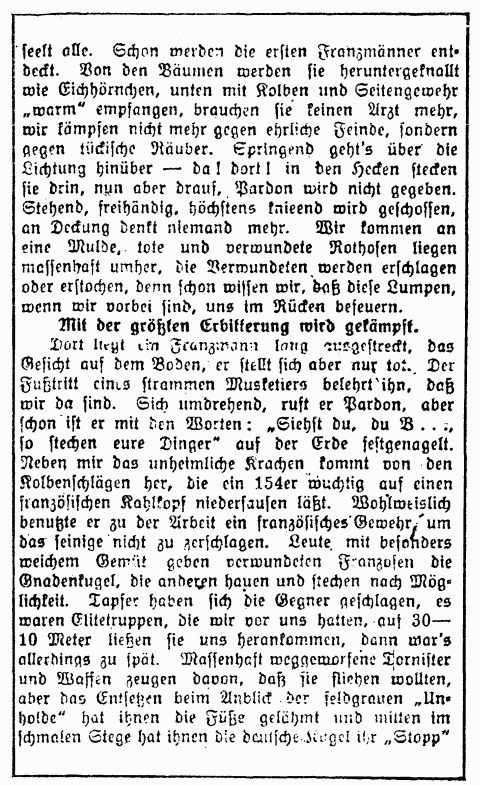
Figure 16.
They're brought down from the trees like squirrels, to get a hot reception with bayoneted stock; they'll need no more doctors' care. We are not fighting loyal enemies, but treacherous brigands. [Note—It is scarcely necessary to point out that it is no more "treacherous," but quite as lawful, to fire from the branches of a tree as from a window, or from a trench, and that, on the contrary, it is rather more venturesome and more courageous, as the sequel of this story will show.] We crossed the clearing at a bound. The foe is hidden here and there among the bushes, and now we are upon them. No quarter will be given. We fire standing, at will; very few fire kneeling; nobody dreams of shelter. We finally reach a slight depression in the ground, and there the red trousers are lying in masses, here and there—dead or wounded. We club or stab the wounded, for we know that these rascals, as soon as we are gone by, will fire from behind. We find one Frenchman lying at full length upon his face, but he is counterfeiting death. A kick from a robust fusilier gives him notice that we are there. Turning over he asks for quarter, but he gets the reply—"Oh! is that the way, blackguard, that your tools work?" and he is pinned to the ground. On one side of me I hear curious cracklings. They're the blows which a soldier of the 154th is vigorously showering upon the bald pate of a Frenchman with the stock of his gun; he very wisely chose for this work a French gun, for fear of breaking his own. Some men of particularly sensitive soul grant the French wounded the grace to finish them with a bullet, but others scatter here and there, wherever they can, their clubbings and stabbings. Our adversaries have fought bravely. They were élite troops that we had before us. They had allowed us to come within thirty, and even within ten, meters—too close. Their arms and knapsacks thrown down in heaps showed that they wanted to fly, but upon the appearance of our "gray phantoms" terror paralyzed them, and, on the narrow path in which they crowded, the German bullets brought them the order to halt! There they are at the very entrance of their leafy hiding places, lying down moaning and asking for quarter, but whether their wounds are light or grievous, the brave fusiliers saved their country the expensive care which would have to be given to such a number of enemies.
Now the recital continues very ornate, very literary, and the writer relates how his Imperial Highness Prince Oscar of Prussia, being advised of the exploits (perhaps, indeed, other exploits than these) of the 154th and of the Regiment of Grenadiers, which forms the Brigade with the 154th, declared them both worthy of the name of "King's Brigade," and the recital closes with this phrase: "When night came on, with a prayer of thankfulness on our lips we fell asleep to await the coming day." Then adding, by way of postscript, a little phrase "Heimkehr vom Kampf." He carries the notebook—prose and verse together—to his Lieutenant, who countersigns it: "Certified as correct, De Niem, Lieutenant Commanding the Company," and then he sends his paper to his town of Jauer, where he is quite confident that he will find some newspaper publisher to accept it, printers to set it up, and a whole population to enjoy it. Now, let me ask any reader—whatever be his country—if he can imagine it possible for such a tale to be spread abroad in any paper in his language, in his native town, for the edification of his wife and his children. In what other country than in Germany is such a thing conceivable? Not in France, at all events. Now, if my readers want another document to show how customary it is in the German Army to mutilate the wounded, well, I will borrow one from the notebook of Private Paul Glöde of the Ninth Battalion of Pioneers, Ninth Corps, (Figs. 17 and 18:)
Aug. 12, 1914, in Belgium.—One can get an idea of the fury of our soldiers in seeing the destroyed villages. Not one house left untouched. Everything eatable is requisitioned by the unofficered soldiers. Several heaps of men and women put to execution. Young pigs are running about looking for their mothers. Dogs chained, without food or drink. And the houses about them on fire. But the just anger of our soldiers is accompanied also by pure vandalism. In the villages, already emptied of their inhabitants, the houses are set on fire. I feel sorry for this population. If they have made use of disloyal weapons, after all, they are only defending their own country. The atrocities which these non-combatants are still committing are revenged after a savage fashion. Mutilations of the wounded are the order of the day.
This was written as early as the 12th of August—the tenth day after the invasion of innocent Belgium—and these wounded creatures that were tortured had done nothing more than defend their land against Germany—their native land—which Germany had sworn, not only to respect but, if need be, to defend. And yet, in many countries pharisees reading these lines will go forward tranquilly to their churches, or their temples, or their banking houses, or their foreign offices, saying: "In what do these things concern us?" "Ja, ja, this is war." Yes, it is war, but war such as was never made by the soldiers of Marceau, such as never will be made by the soldiers of Joffre, such as never has been made and never will be made by France—"Mother of Arts, of Arms, and of Laws." Yes, it is war, but war such as Attila would not have carried on if he had subscribed to certain stipulations; for, in subscribing them, he would have awakened to the notion, which alone distinguishes the civilized man from the barbarian, distinguishes a nation from a horde—respect for the word once given. Yes, it is war, but war the theory of which could only be made up by such pedant megalomaniacs as the Julius von Hartmanns, the Bernhardis, and the Treitschkes; the theory which accords to the elect people the right to uproot from the laws and customs of war what centuries of humanity, of Christianity, and chivalry have at great pains injected into it; the theory of systematic and organized ferocity; today exposed to public reprobation, not only as an odious thing, but no less silly and absurd. For have we not reached the ridiculous when the incendiaries of Louvain, and Malines, and Rheims, the assassins of women and children, and of the wounded, already find it necessary to repudiate their actions, at least in words, and to impose upon the servility of their ninety-three Kulturträger such denials as this: "It is not true that we are making war in contempt of the law of nations, nor that our soldiers are committing acts of cruelty, or of insubordination, or indiscipline.... We will carry this conflict through to the end as a civilized people, and we answer for this upon our good name and upon our honor!" Why this humble and pitiful repudiation? Perhaps because their theory of war rested upon the postulate of their invincibility, and that, in the first shiver of their defeat upon the Marne, it collapsed, and now their repudiation quickly follows—in dread of the lex talionis.
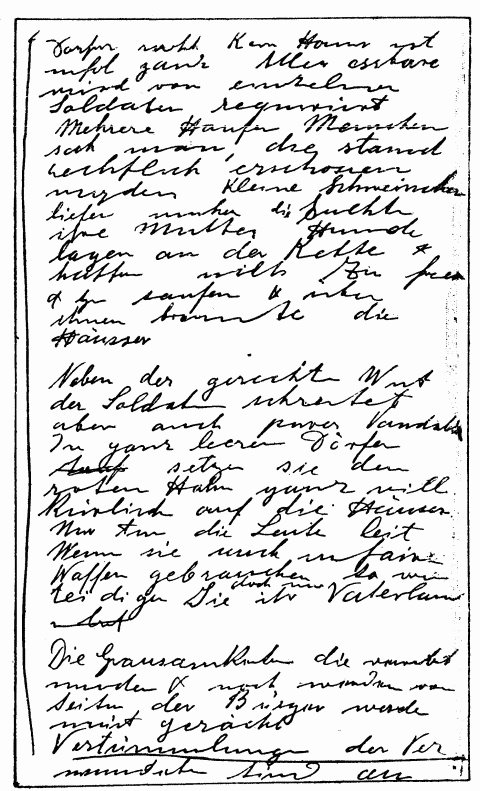
Figure 17.
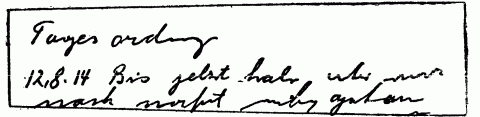
Figure 18. [Continuation of Figure 17.
I will stop here. I leave the conclusion to the allied armies, already in sight of victory.
NOTE.—General Stenger's order of the day, mentioned on page [Transcriber's Note: blank in original], was communicated orally by various officers in various units of the brigade. Consequently, the form in which we have received it may possibly be incomplete or altered. In face of any doubt, the French Government has ordered an inquiry to be made into the prisoners' camps. Not one of the prisoners to whom our magistrates presented the order of the day in the above-mentioned form found a word to alter. They one and all declared that this was the order of the day which had been orally given in the ranks, repeated from man to man; many added the names of the officers who had communicated the order to them; some related in what a vile way it had been carried out under their eyes. All the evidence of these German soldiers was collected in a legal manner, under the sanction of an oath, and it is after reading their depositions that I wrote the order of the day.
The text of all this evidence was transmitted to all the French Embassies and Legations in foreign countries on the 24th of October, 1914. Every neutral wishing to clear his conscience is at liberty to obtain it from the representatives of the French Republic, who will certainly respond willingly.