Volume 2 — Recording the Vision of "Oom Niklaas," the Boer Seer of Lichtenburg
Reading edition
[From THE NEW YORK TIMES, April 18, 1915.]
The South African "Blue Paper" is out. It is unique. However widely and however eagerly the official documents of the other countries involved in the present war may have been read, they could not be called romantic in any sense of the word.
The "Blue Paper" issued by the Union of South Africa presents a distinct contrast. In the third paragraph of the very first page of this weighty document, which deals with the recent rebellion, is the following unusual sentence:
It is not surprising, then, that in the ferment aroused by the gigantic struggle in Europe, which seemed to be shaking the world to its foundations, young men began to see visions and old men to dream dreams of what the outcome might be for South Africa.
And this is followed by a still stranger passage:
The times were not without their signs. There was a seer in Lichtenburg who had visions of strange import. Years ago and long before any one in this country had dreamed of war he beheld a great fight of bulls, six or seven of them, engaged in bloody combat; a gray bull had emerged victorious from the contest.
The bulls signified the great nations of Europe, and the gray bull was Germany. Thousands had discussed this strange vision and had remembered its prophetic character when, later, war actually broke out. The vision seemed ominous. Germany was predestined to triumph.
The seer is Niklaas van Rensburg, and he runs through this Government report like a scarlet thread through gray homespun. It is around his influence that the uprising of Sept. 15 is built. It is under his roof that all manner of lurid conspiracies are hatched. Not only do his words carry with the crowds that gather before his house to hear his prophecy, but his warnings shape the actions of some of the Transvaal Generals. The Government report will not go so far as to brand "Oom Niklaas" as a hoax. Says the preface:
It is desired to point out that the narrative of events has been compiled in as objective a manner as possible, and that it contains no statement which is not borne out by evidence in possession of the Government.
Evidently, to denounce visions of gray bulls as hocus-pocus would be to describe a puzzling situation much too subjectively, since the Government has apparently no evidence that these are not genuine prophecy. The best the Government can do is to call them "extraordinary and apparently quite authentic."
But the extraordinary part of it is that an illiterate old soothsayer should be considered important enough to be included in an official report.
His most famous and most influential prophecy, the one that will go down in the history of South Africa, was that which concerned General de la Rey and the fatal number 15.
The prophecy which came back to the minds of van Rensburg's followers when war broke out was one concerning General de la Rey, the intrepid soldier who had commanded the Lichtenburg burghers in the Boer war and since become President of the Western Transvaal Farmers' Association. Van Rensburg had always admired General de la Rey. He had frequently hinted to his circle that great things were in store for him. One of his visions had been well known to General de la Rey and his friends for some years. The report says:
The seer had beheld the number 15 on a dark cloud from which blood issued, and then General de la Rey returning home without his hat. Immediately afterward came a carriage covered with flowers.
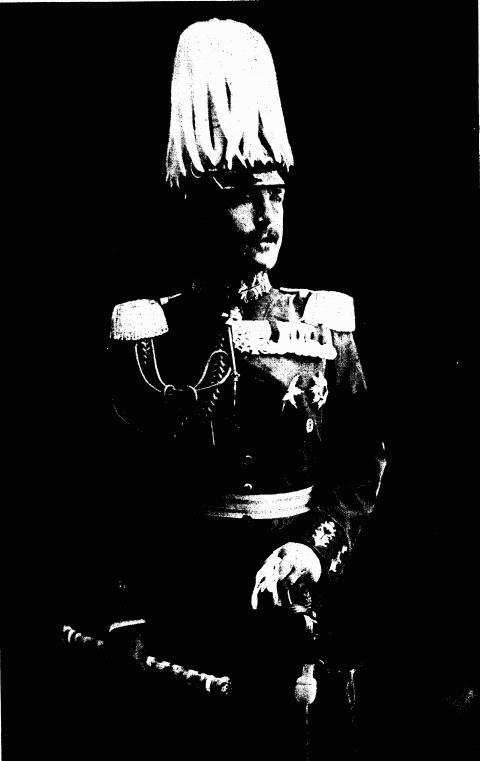
H.M. CONSTANTINE I.—King of Greece.— (Photo from P.S. Rogers.)
JOHN REDMOND—The great Irish leader, who says that Ireland has now taken her proper place in the British Empire.—(Photo from P.S. Rogers.)
This was several years ago. But the people did not forget the prophecy, and when war broke out in Europe the Western Transvaal—in the Lichtenburg-Wolmaransstad area, where van Rensburg's influence was strongest—was immediately aflame. The Government does not seek to minimize the importance of this influence:
When the war at last broke out, the effect in Lichtenburg was instantaneous. The prophecies of van Rensburg were eagerly recalled, and it was remembered that he had foretold a day on which the independence of the Transvaal would be restored.
Certain individuals could be seen daily cleaning their rifles and cartridges in order to be ready for the day. Within a week of the declaration of war between England and Germany the district was further profoundly stirred by the news (now become generally known) that a great meeting of local burghers was to be held at Treurfontein on the 15th of August, and that certain local officers were commandeering their burghers to come to this meeting armed and fully equipped for active service.
The outbreak of the war in Europe suddenly brought the Lichtenburger's prophecy down to earth and crystallized the dream. The commandants were evidently as convinced that independence was at hand as the crowd.
Careful inquiries by other local officers brought to light the following facts:
Veld Kornet, I.E. Claassen, and Commandant F.G.A. Wolmarans of Ward Onder Hartsrivier had been commandeering their own burghers as well as their political friends since the first week of August to come to the meeting which was to be held at Treurfontein on the 15th. The instructions given to these men were that they were to come with rifle, horse, saddle and bridle, and as much ammunitions and provisions as they could manage to bring.
The meeting was to be addressed by General de la Rey, and it was generally believed that the assembled burghers would march on Potchefstroom immediately after the meeting.
None doubted the truth of the seer's prophecy now. The Western Transvaal took it for its guide with implicit confidence.
The strange vision of the number 15, which had long been common knowledge, was now discussed with intense interest. The 15, it was said, signified the 15th of August, the day of the meeting. That would be the day which had been so long expected—the day of liberation.
Van Rensburg was now the oracle. His prophecies with regard to the great war had been signally fulfilled. Germany was at grips with England, and her triumph was looked upon as inevitable.
The day had arrived to strike a blow for their lost independence. Van Rensburg assured his following that the Union Government was "finished." Not a shot would be fired. The revolution would be complete and bloodless.
Between the 10th and the 15th the plotters in Lichtenburg were actively preparing for the day. There is evidence that German secret agents were working in concert with them. When doubters asked how they could be so certain that the 15 signified a day of the month—and of the month of August in particular—they were scornfully if illogically told that "in God's time a month sooner or later made no difference."
Of course, General de la Rey was the storm centre. He had been mentioned in the same vision with the number 15 and it was taken for granted that he would play the chief rôle in the Treurfontein meeting. De la Rey was the unquestioned ruler of the Western Transvaal. The report states:
He possessed an unrivaled influence and was looked up to as the uncrowned king of the West. His attitude at the meeting would sway the mass of his adherents and decide the question of peace or war.
Accordingly, General Louis Botha, Premier of the South African Union, summoned General de la Rey to Pretoria some days before the meeting, and persuaded him to use his best efforts to allay excitement.
On the 15th the meeting was held. The situation was a tense one. Not one of the burghers present doubted the outcome. Yet General de la Rey exhorted them to remain cool and calm. He urged them to await the turn of events in Europe. After his address a "strange and unusual silence" was observed, says the "Blue Paper."
A resolution was passed unanimously expressing complete confidence in the Government to act in the best interests of South Africa in the present world crisis. The burghers appeared to have taken their leader's advice to heart, as they dispersed quietly to their homes.
All danger of a rebellious movement had apparently been averted.
The only difficulty was that the prophecy of "Oom Niklaas" was still standing. The fact that the uprising had failed did not seem in the least to invalidate the vision. If the mysterious number did not mean Aug. 15, then perhaps it did mean Sept. 15.
Accordingly, preparations were laid for a rebellion for the latter date. The plot was engineered by Lieut. Colonel Solomon G. Maritz and General Christian Frederick Beyers. Maritz is a brilliant though unlettered Colonel who won distinction in the Boer war, while Beyers was the Commandant General of the South African Union forces. Beyers is dead now; Maritz and some of the prominent men associated in the conspiracy are in prison awaiting trial.
Beyers and Maritz did not trust entirely to the prophecy of the seer of Lichtenburg. Maritz had already obtained a guarantee from the authorities in German West Africa, with whom he had been in communication for some time, that in the event of Germany's victory the Free State and the Transvaal would be given their freedom. He had organized the back-veldt Boers into readiness to go over into German West Africa at a moment's notice. In the Free State, General de Wet was ready to aid the rebellion, and the Western Transvaal, already excited, could easily be swung into line.
The regiments of the west were to concentrate at Potchefstroom early in September for their annual training. At that time the members of the Government, among them General de la Rey, who is a member of the Legislative Assembly, would be in Cape Town for the session of the Parliament.
Everything made the 15th of September look like an auspicious date for the conspirators and those who believed in van Rensburg. But General de la Rey still remained the storm centre. He was the factor which upset all plans. He was the most difficult obstacle. A large personality, his influence could never be discounted. If he could be induced to join the conspiracy the cause was as good as won. Should he oppose the movement it was lost, for neither Beyers nor Major Kemp, a leader in his district in West Transvaal, could hope to do anything against General de la Rey in the west.
General de la Rey believed in the Lichtenburg prophet. A strong man, of extraordinary force and intelligence, the whole course of his plans might be altered by a new vision from van Rensburg. Beyers knew this, says the report, and saw the way by which he should win the General to the conspiracy.
There is evidence to prove that General Beyers set himself systematically to work in General de la Rey's mind in order to induce him to join the conspiracy.
General de la Rey was known to hold strong religious views, which colored his whole outlook. The seer, van Rensburg, who was always full of religious talk, had in this way acquired a considerable amount of influence over General de la Rey.
There is the best of evidence (General Beyers's own statement) for the belief that he himself did not scruple to work on General de la Rey's mind through his religious feelings.
Just how Beyers accomplished this has not yet been revealed, but there was material enough to his hand. The news from Europe was disquieting. The German drive to Paris seemed irresistible. It looked as if in a week or two Germany would have the Allies at her mercy.
The prophet saw visions in which 40,000 German soldiers were marching up and down the streets of London. He predicted significantly that the new South African State would have at its head "a man who feared God." The Government of Premier Botha and General Smuts, the Minister of Finance and Defense, was "finished." He had seen the English leaving the Transvaal and moving down toward Natal. When they had gone far away, a vulture flew from among them and returned to the Boers and settled down among them. That was Botha. As for Smuts, he would flee desperately to England and would never be seen in South Africa again. Through it all ran the strange number 15.
This was excellent material for the conspirators. But the problem was to get General de la Rey away from the Parliament session at Cape Town and into the Potchefstroom camp at the psychological moment. Beyers sent a series of urgent telegrams to Cape Town hinting at important business. He emphasized the need for General de la Rey's immediate presence in Potchefstroom. He had evidently not yet broached the conspiracy to the General, but hoped only to get him to the camp at the critical moment when his presence would prove the deciding factor.
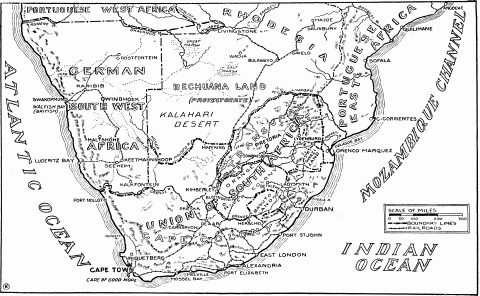
[map of South Africa]
Everything in Potchefstroom was in readiness. The Active Citizen Force concentrated here—about 1,600 men—was to start the uprising. The movement was to be promptly seconded throughout the Western Transvaal. The "Vierkleur" was to be hoisted, and a march made on Pretoria, men and horses being commandeered on the way. This was to take place on Tuesday, the 15th. There was an attempt to line up the prophet to add to the theatric effect, says the report.
On the night of the 14th the "Prophet" himself was specially sent for by motor car to be personally present on the 15th to witness the consummation of his prophecy. The conspirators hoped to profit by the impression he would undoubtedly make on those who still hesitated.
Unfortunately for them, however, the seer refused to leave his home, saying that "it was not yet clear to him that that was his path."
The signal for the revolt was to be the arrival of General Beyers and General de la Rey in the Potchefstroom camp. The latter was returning from Cape Town via Kimberley, and was due to arrive in Potchefstroom on the 15th. But for some reason he chose to come back through the Free State, and by the 15th was only at Johannesburg.
This upset plans. Beyers had to act quickly. He had his chauffeur overhaul his motor car, equip it with new tubes and covers, in readiness for "a long journey." In a short time the car was on its way to bring General de la Rey from Johannesburg to Pretoria, where Beyers would meet him.
There was no time to be lost. It was too late to stage the rebellion for the 15th, but Beyers arranged for it to be at 4 o'clock on the morning of Wednesday, the 16th.
General de la Rey arrived in Pretoria. General Beyers met him and asked him to go immediately with him to Potchefstroom.
The car came within sight of Johannesburg. A police cordon had been thrown around the town for the purpose of capturing three desperadoes, known as the "Foster gang," who were trying to escape in a motor car. The police were instructed to stop all motors and to examine in particular any car containing three men.
Beyers's car held three men. It was racing at high speed. It was, of course, challenged by the police and ordered to stop. But Beyers knew nothing of the "Foster gang" and the reason for the police cordon. Keyed up to the highest pitch of nervous tension, his immediate conclusion was that his plot had been discovered and that the police were after him. He believed he was trapped.
Meanwhile, Major Kemp at Potchefstroom grew more and more anxious as the hours slipped by. Midnight came, and no news of the two Generals. About 3 o'clock in the morning, says the report, an officer sharing the tent of a Lieutenant Colonel by the name of Kock, who was Kemp's confidant, was awakened by the entrance of a man. It proved to be Major Kemp. He leaned over Kock's bed and whispered something in his ear.
Kock, in a profoundly startled voice, exclaimed, "Oh, God!"
Kemp left immediately, and Kock then whispered to his friend: "General de la Rey is dood geskiet," (General de la Rey has been shot dead.)
The effect of this news on South Africa can be imagined. The whole country was aflame. This was what the number 15 meant. The General had indeed "returned home without his hat, followed by a carriage full of flowers."
Report ran through every town that General de la Rey had been deliberately assassinated by the Government. As a matter of fact, the report states that the shooting was purely accidental, done by the police under the belief that this motor car which would not halt at their command contained the "Foster gang." Beyers exhibited the motor-car everywhere, arousing sentiment to the highest pitch.
The rest was easy. The rank and file, at least, now believed firmly in the prophet. He had always said that General Botha would offer no resistance, that the revolution would be bloodless, and thousands went over to the cause led by Maritz and Beyers in this belief. But it was not until Oct. 12 that martial law was proclaimed in South Africa. The rebellion had begun.