Front matter
Reading edition

University of Kansas Publications Museum of Natural History

Volume 15, No. 8, pp. 351-468, pls. 19-22, 20 figs.
December 30, 1963
Natural History of the Racer Coluber constrictor
BY
HENRY S. FITCH
University of Kansas Lawrence 1963
University of Kansas Publications Museum of Natural History
Editors: E. Raymond Hall, Chairman, Henry S. Fitch, Theodore H. Eaton, Jr. Published December 30, 1963
University of Kansas Lawrence, Kansas PRINTED BY JEAN M. NEIBARGER, STATE PRINTER TOPEKA, KANSAS 1963

29-7864
Natural History of the Racer Coluber constrictor
BY
HENRY S. FITCH
CONTENTS
PAGE
Introduction 355
Acknowledgments 357
Methods and Materials 358
Description 362
Color pattern 362
Bodily proportions 365
Lepidosis 367
Dentition 369
Hemipenis 369
Relationships 370
Range 371
Geographic Variation 373
Habitat 375
Temperature Relationships 377
Home Range and Movements 385
Food Habits 394
Methods of obtaining prey 394
Composition of food 395
Kinds of prey 403
Reproduction 408
Sexual behavior 408
Cycle of the male 414
Eggs 416
Hatching 423
Growth 425
Mortality Factors and Adaptations for Survival 432
Defense and escape 432
Natural enemies 438
Disease 442
Parasites 442
Populations 445
Composition 445
Numbers 450
Summary 456
Literature Cited 461
Introduction
Throughout much of the United States the racer is abundant and is one of the snakes best known to man. Its active diurnal habits and its preference for a habitat in meadows, pastures, and hayfields rather than in remote wilderness areas, result in frequent encounters with humans. The racer is a predator on many kinds of small animals, both vertebrates and invertebrates; it takes as food chiefly animals that are agricultural pests but also destroys some beneficial kinds. Yet, in general, the attitudes of rural people toward the racer are little influenced by these economic and ecologic considerations, but rather, are dominated by an unreasonable fear, despite the racer's inoffensive disposition, and inability to inflict any harm on humans.
Although an extensive literature exists regarding the racer, no thorough study of the species' natural history has been made heretofore. Obviously such study is needed. Few species of vertebrates having comparable economic bearing have been similarly neglected. In 1948, undertaking a program of ecological research on the recently created University of Kansas Natural History Reservation, I included the racer among the many common species studied to gain insight into the functioning of the local ecosystem. Live-trapping of snakes on the area was begun in 1949, and these operations were greatly intensified in the years 1957 through 1962, with efforts concentrated on the study of the racer in the 1960, 1961 and 1962 seasons. Thus my study is based upon 14 consecutive years' records on the Reservation, the northeasternmost section in Douglas County, Kansas, six and one-half miles north northeast of the University of Kansas campus at Lawrence. After the acquisition in 1956 of the 160-acre Rockefeller Tract adjacent to the Reservation on the north in Jefferson County, field work was extended to this new area, which, because it was superior habitat, in the final years of the study produced more records than the Reservation. An important but relatively minor segment of the data originated from Harvey County Park, 13 miles west of Newton, Kansas, where lines of live-traps were maintained in 1959, 1960, 1961, 1962. Smaller collections of data were obtained from the Lalouette Ranch in the Flint Hills, three miles northeast of Florence, Marion County, Kansas, and from Cedar Bluff Reservoir, 23 miles west and seven miles south of Hays in Trego County, western Kansas, where live-trapping was carried on in 1959 and 1960. Additional data were obtained on numerous field trips to various collecting localities in northeastern Kansas. My first-hand knowledge of the species is also based, in part, on many years of field experience with the far western subspecies C. c. mormon in western Oregon and California, and on similar experience in 1947 and 1948 with the southern subspecies, C. c. anthicus in central Louisiana.
This varied field experience with the species at localities well scattered throughout its geographic range has added perspective to the study even though most of the records were collected within a radius of three quarters of a mile. No one locality can be regarded as entirely typical of a species' habitat over its range as a whole. According to my philosophy, the ecological niche of a species is subject to geographical variation analogous to the variation to be seen in the morphological characters of the animal itself. Different community associates, including different competitors, prey, and predators, and different physical factors enforce a somewhat different way of life on a species in geographically remote parts of its range. When analyzed these differences often turn out to have a genetic basis. Thus, limits of tolerance to heat, cold, and drought often vary geographically, and the population density, reproductive potential, seasonal cycle, and other properties of populations may be altered either by the direct effect of the environment, or through its effect on the genetic constitution, produced by natural selection.
The local population of racers studied was near the center of the species' geographic range, and is to some extent representative of the species as a whole, though differing in its ecology from other populations in proportion to their remoteness and the distinctness of their habitats. It has not been demonstrated that ecological traits of populations change in a discontinuous manner or correspond in their limits with those of named subspecies. More likely geographical variation is continuous and parallels morphological variation only in a general way. Certainly the boundaries of subspecies' ranges should not be accorded undue emphasis in an ecological study.
My investigation of the blue racer under natural conditions, combined with a compilation and analysis of published literature, has resulted in a fairly satisfactory understanding of some phases of the species' ecology and natural history, such as the food habits, the growth rate, the extent of home range and of seasonal movements. However, relatively little was learned concerning some phases of the life history. Unfortunately, the traps used did not catch young of the smaller sizes. Facts concerning egg-laying, incubation, and hatching therefore are known chiefly from snakes kept in confinement. Although first-year young were captured by hand from time to time they were obtained in relatively small numbers, and little was learned regarding their population density, movements, or mortality factors. Of course, such hiatuses are to be expected; even in man such enigmas as the disparate sex ratio still challenge the investigator.
For the subspecies of racer involved in my field study the widely used vernacular "blue racer" has been adopted in this report. In general I advocate conformity with the vernacular names published by the Committee on Herpetological Common Names (1956). However, in this list, the name blue racer was assigned to Coluber constrictor foxi, an invalid subspecies of the Prairie Peninsula that has been relegated (Auffenberg, 1955:92; Smith, 1961:196) to the synonymy of C. c. flaviventris. It therefore seems appropriate that the book name "yellow-bellied racer" applied to flaviventris by the Committee should be abandoned for this subspecies, and that the name blue racer be applied officially, as it is in actual practice by both laymen and herpetologists, to all populations of this subspecies.
Acknowledgments
Financial assistance from the National Science Foundation in 1957 through 1962 is acknowledged. Although none of the three separate grants involved was made specifically for the autecological study of the racer, all three contributed to the support of the extensive program of live-trapping for snakes, which yielded most of the records upon which this report is based. Student assistants who were employed on these projects include James W. Bee, William N. Berg, Donna M. Hardy, Robert M. Hedrick, Dale Hoyt, Robert M. Packard, Robert G. Webb, and Wayne Wiens, at the Reservation; Roy Henry, Dale Horst, Dwight R. Platt, and Howard L. Schrag at Harvey County Park, and Gilbert L. Adrian at Cedar Bluff Reservoir. Dr. Edwin P. Martin, formerly of Fort Hays, Kansas State College, was helpful in planning and carrying out the field work at Cedar Bluff Reservoir. Eric Shulenberger assisted with field work and processing of data in 1962 under the National Science Foundation program for Undergraduate Research Participation. Robert Miner assisted with the examination of specimens in 1960. Mr. August Lalouette of Florence, Kansas, permitted field work on his ranch and contributed information and materials to expedite this work. Mr. and Mrs. Harold Brune of Route 3, Lawrence, Kansas, kindly contributed several clutches of racer eggs found on their farm in Jefferson County, and also made available significant information accompanying them. Dr. William H. Stickel kindly made available at my request records of predation on racers from the food habits files of the U. S. Fish and Wildlife Service. Dr. William E. Duellman of the University of Kansas Museum of Natural History and Dr. Robert C. Stebbins of the University of California Museum of Vertebrate Zoology kindly permitted examination and dissection of specimens in the collections under their care. Dr. George W. Byers of the University of Kansas Department of Entomology identified numerous insects eaten by racers. My daughter, Alice V. Fitch, often assisted me with the field work and the processing of data. My wife, Virginia R. Fitch, read the manuscript critically, assisted me with the examination of museum specimens, and with typing, and helped in various other ways.
Methods and Materials
Table 1. Numbers and Distribution of Captures and Recaptures of Blue Racers on the Reservation and Rockefeller Tract
Span of years within which each individual was captured Number of separate years within which each individual was captured Number of times each individual was captured
Years Individuals Years Individuals Times captured Individuals
1 749 1 749 1 679
2 137 2 197 2 181
3 56 3 51 3 93
4 32 4 15 4 31
5 19 5 6 5 7
6 13 6 1 6 14
7 7 7 0 7 8
8 2 8 1 8 4
9 3 9 1
10 0 10 0
11 1 11 0
12 1 12 1
13 0
14 0
15 0
16 1
This investigation was based primarily on the capture in live-traps, marking, release, and recapture of blue racers in their natural habitat. On the combined area of the Reservation and the Rockefeller Experimental Tract, 1020 blue racers were recorded a total of 1688 times from August 30, 1948, to October 27, 1962. At Harvey County Park 361 blue racers were marked, and were captured a total of 467 times from May 6, 1959, to September 14, 1962, and at Cedar Bluff Reservoir 42 were captured from May 11, 1959, to June 30, 1960.
The traps used were cylinders of galvanized wire, "hardware cloth" (Fitch, 1951:77; 1960:77), having funnels opening into each end, or having a funnel at one end and a plug at the other. The traps, open at both ends, were used along hilltop rock ledges where an exposed vertical rock face provided a barrier along which a snake might travel and where it could be easily intercepted by the trap without any accessory equipment (see Pl. 21, Fig. 1). Where such natural barriers were lacking, as in level fields, barriers consisting of boards, screens or sheet metal were installed to guide the racer toward the trap and into a funnel entrance. Two such barriers at each end of a trap forming a V to guide the snake into the funnel were used in 1956 and 1957, when trapping at places away from the hibernation ledges was undertaken. Later it was found simpler and more effective to use a single barrier with a trap at each end. The barrier extended up into the funnel entrance, and usually the racer, following along the barrier on either side, would pass into the funnel and through its apex. However, it was possible for a racer to travel around the end of the barrier without entering the trap, and perhaps some did so.
The need for making the barrier and trap a tight unit impassable to the snake, was somewhat counterbalanced by the need for having the whole installation loosely constructed so that it could be easily altered, opened, adjusted, and cleaned. Since the traps were kept set in large numbers, and the task of checking them was time-consuming, speed of operation was more important than the perfect functioning of any one trap. Approximately 200 traps were kept set when operations were at their maximum. No record was kept of the number of "trap days" involved in the study, but the total was well over 100,000 for the Reservation and the Rockefeller Tract. When traps were set at both ends of a barrier, the outer end of each trap was closed with a plug. No bait was used in the traps. Occasionally small vertebrates and insects of kinds used as food by the racers may have gotten caught first and served to attract the snakes. Best catches of racers were made in the breeding season, since males were attracted by females already in the traps, and several males might be captured simultaneously with one female. Occasionally as a person approached or handled a trap, a racer darted out of it, displaying a perception, acuity of vision, and skill in avoiding the inward projecting wire prongs encircling the small funnel opening, that were exceptional among the several species of snakes trapped. Doubtless many other racers that were caught in traps escaped before they were discovered. If the funnel entrance of the trap was of the same diameter as the snake itself, or only a little larger, there was little likelihood of the trapped racer escaping. However, funnel openings were usually adjusted at a diameter of approximately 11/4 inches, allowing an ample margin for even the largest racers, though inadequately small to permit ingress of a few of the largest black rat snakes, bull snakes and timber rattlers occurring locally.
Ordinarily the snakes trapped were processed in the field and released immediately. The method of marking was essentially that of Blanchard and Finster (1933:334). Two subcaudals, one on the right side and one on the left, were clipped on each snake, and when these marks healed they left permanent scars. In the racer, as in most other colubrines, the subcaudals are divided into a double series, one on the left and one on the right. Scales of the left and right sides are placed alternately. At the base of the tail one or more undersized scales usually are present on each side, and there might be some question as to precisely where the count should begin. The rule followed was to exclude from the count any small basal scales on either side that did not extend medially to contact at least one scale of the opposite side. The scale designated as "one left" (or "one right") was the first to contact one of the opposite series, regardless of whether the former was of normal size or (as was usually the case) smaller and narrower than those following it. In marking, this "number one" scale was never clipped but was left as a point of reference since a base mark was needed from which to begin the count. The marks were read from left to right, for example U 5l 2r, the "U" referring to the subcaudals or "urosteges," the "5l" indicating the fifth on the left side, and "2r" indicating the second on the right. The subcaudals clipped were the first 19 following the basal scale. When the 361 possible combinations all had been used, ending with U 20l 20r, a new series was begun duplicating the first except that on each snake the first ventral (or "gastrostege") anterior to the anal plate was clipped on the left side (G1L) to distinguish these snakes from the series previously marked. Later, a third series, "G2R" was marked, and eventually a fourth series, "G3L" was started.
There were many borderline instances in which the basal scale barely contacted one of the opposite side. In such instances the formula was written U 5l ISB 2r, the subscript ISB signifying "including small basal." In other instances a basal subcaudal barely failed to contact a scale of the opposite side and this condition was indicated by the subscript NSB—"not including small basal." The condition might be so nearly equivocal that on successive occasions the same formula might be read U 5l ISB 2r and U 4l NSB 2r. Occasional misidentifications of individuals that resulted from such discrepancies were in most instances readily detected when the field records were transferred to individual file cards where the sex, size, and location of the snake at its previous captures were shown.
In some instances racers recaptured after periods of years retained conspicuous scars where scales had been clipped, but in other instances the marks had become obscure, and in fact the only trace of a mark might be a slight narrowing or notching of part of the scale originally clipped. Snakes caught and marked early in life probably retained more power of regeneration than those clipped after the attainment of maturity, but otherwise the basis for difference in extent of regeneration was not evident. In the same snake, three scales, all clipped on the same day, might show much different degrees of regeneration after the lapse of a year or more. In general, obscuring of marks by regeneration was a source of inconvenience rather than of error; only a negligible percentage of the recaptured racers had marks so obscure that their identities might have been seriously questioned, and it is doubtful that any marks were lost completely by regeneration.
Racers found in traps were removed, measured (snout-to-vent length, tail length), weighed in a cloth bag suspended from spring scales, and marked. The mouth was forced open and the snake was examined for flukes. Enamel paint of a bright color, red, green, yellow, blue or orange was smeared on the snake to gain information regarding the time of molt. The stomach was palpated for recently ingested food items, and any detected were forced up into the gullet to be identified, then were squeezed back into the stomach. The rear part of the body was palpated to detect undigested material in the gut, and if any was present, an attempt was made to squeeze out the fecal material, using only light pressure, with care not to injure the racer. The inside of the trap and the ground beneath it were inspected for fecal material that might have been voided while the snake was confined. Any scatological material obtained was wrapped in a paper towel, labelled and brought back to the laboratory where it was stored. Eventually each scat was soaked for a day or more in a detergent solution, rinsed in running water in a fine gauze bag, dried, and placed with its label in a cellophane envelope for subsequent microscopical study.
Various items concerning reproductive condition were also routinely recorded. In females the ventral surface was palpated at the rear end of the body to detect the genital bursa or vagina, which in sexually mature individuals has a much thickened wall, and can be felt as a distinct lump. Males were likewise tested for sexual maturity by pipetting a small amount of fluid from the cloaca into a vial and returning it to the laboratory where it was examined microscopically for motile sperm. Also, sperm samples were often taken from males at different times throughout the season of activity, and cloacal samples from females occasionally were checked for sperm as evidence of recent copulation.
In the summer of 1962 an outdoor enclosure of 100-foot circumference was constructed, of galvanized sheet iron, with wall three feet high, set on a concrete base extending to a depth of two feet. A two-foot-deep concrete basin inside the enclosure served as a water container. The enclosure was partly shaded by a large walnut tree and the area enclosed had lush vegetation, including brome grass, various shrubs, and young trees up to 15 feet high, thus including most features of the racers' habitat, and it was situated in an area frequented by the snakes. Throughout the summer several racers were kept in the enclosure, and frequent observations on them yielded much information concerning time of activity, temperature preferences, and social and sexual behavior that could not have been obtained readily either from racers confined in small cages or from those free under natural conditions.
Description
Color Pattern
Hatchling racers differ much in appearance from adults; whereas the latter are of dull uniform coloration dorsally, the hatchlings have a checkered pattern of alternating blotches in several rows, including a middorsal row, with blotches much larger than those of the other rows. This basic pattern is perhaps the most common one in all snakes, and is found in the young of various other genera (notably Elaphe) which lose or alter their markings during development. In these genera and in the racer, the juvenal checkered pattern may represent recapitulation of an ancestral condition. The adaptive significance of having a blotched, checkered pattern in the young, and uniform coloration in the adult is not evident. I have rarely seen the hatchlings under natural conditions except by finding them hiding beneath flat rocks. Their concealing pattern must be fully as effective as that of adults and the young themselves are more secretive than the adults.
A hatchling of 240 millimeters snout-vent length was described as follows on September 22, 1962: Ground color pale olive anteriorly, gradually darkening posteriorly, marked with chocolate blotches; middorsal blotches largest averaging about five scales long and seven or eight scales wide anteriorly; posteriorly, blotches become less distinct (tending to blend into progressively darkening ground color), and width-to-length ratio increases; gradual obscuring of blotches proceeds posteriorly, until on tail they can no longer be distinguished, and color is uniformly olive; on each side, row of lateral blotches alternates with that of middorsal blotches; lateral blotches average somewhat less than two scales long, and approximately two scales wide and are of irregular shape, sometimes subdivided; farther down on sides, lower row of lateral blotches alternates with upper lateral row; this lower lateral row, approximately same size as upper lateral row, and situated at level of first scale row, overlapping onto ventrals, where it pales to reddish brown; almost every ventral scute has one pair or more of dark reddish brown spots, tending toward semicircular shape, the arc of each projecting forward, but posteriorly on body these spots become increasingly obscure, and are indiscernible on posterior end of body and on tail; ventral surface white on chin and throat, gradually assuming suffusion of pale greenish gray posteriorly; eye dark with narrow yellowish margin around pupil; top of head grayish olive, mottled with faint and irregular dark markings; supralabials whitish, with chocolate markings, mostly wedge-shaped, in their posterior parts; rostral and internasals edged with dark posteriorly; posterior upper corner of loreal and adjacent corner of prefrontal dark; temporals having dark markings; chin almost immaculate, but with narrow black posterior edges on some of the infralabials (see Plate 19, Figs. 1 and 2, and Plate 20, Fig. 2).
The checkered pattern of the juvenile fades gradually as development proceeds. Persistence of the juvenal markings varies greatly in individuals and probably is subject to geographic variation also. By the time sexual maturity is attained the dorsal pattern often is indiscernible or represented only by faint traces. The ventral speckling is more persistent.
A female of 602 millimeters snout-vent length in mid-July 1962, at a probable age of 11 months, was described as follows: Overall dorsal color olive gray, but with remnants of juvenal pattern discernible; dark dorsal blotches have almost faded, but their edges, about one scale wide, are still distinct; low on sides, color fades to pale bluish gray, and to pale greenish blue on edges of ventrals; on anterior one-third of body midventral surface is lemon yellow; farther posteriorly it fades to ivory, almost white on tail; chin white, except for reddish brown posterior edges of last infralabials, and streak of same color on each antepenultimate infralabial; top of head olive gray with irregular scattered dark marks; preoculars pale centrally with olive brown edges; supralabials white with reddish brown triangular marks; postnasals white anteriorly, gray posteriorly; uppermost postocular brownish orange, paler centrally; two rows of semicircular spots on belly, distinct anteriorly, but fading posteriorly until indiscernible on posterior part of belly; numerous small black spots scattered irregularly over dorsal and lateral surfaces.
A male racer retained more of the juvenal pattern at an approximate age of 15 months, when he was described on November 30, 1961: Dorsal surface dark grayish brown, the large juvenal dorsal blotches (each about eight scales wide) easily discernible, but faint; top of head dark olive brown, mottled with black, paling in rostral region; supralabials white on their anterior and lower portions, marked with brown and blue-gray on their upper and posterior portions; chin white, but with rusty markings on last four infralabials; ventrals ivory-yellow with rusty spots of which the largest are approximately three-fourths of the ventrals' breadth; first row of scales bluish gray, or with greenish suffusion (in neck), most of scales having indistinct dark spots; second row of scales similarly colored but more suffused with dusky pigment, blending into the darker duller color of the dorsal surface.
A female of 720 millimeters snout-vent length, presumably about 20 months old, but not gravid, on June 13, 1962, was described as follows: Juvenal pattern no longer clearly discernible but scattered traces of it remain; dorsal color predominantly grayish olive, with occasional small black spots in streaks scattered irregularly over dorsal and lateral surfaces; at anterior end of body lateral scales have bluish green edges but this shading becomes less noticeable posteriorly; head mostly olive dorsally with marking obscure; parietals have a large faint blotch; supralabials retain faint dark, brownish markings on their upper parts; dark spot on median edge of each prefrontal; supraoculars slightly darker than adjacent scutes; chin mostly white, with yellowish suffusion at edges of scales; ventral surface predominantly yellow, but fading to grayish white posteriorly; remnants of juvenal ventral spots faintly discernible as tan or whitish areas on yellow ventrals.
Munro (1950b:124) mentioned a blue racer of 749 millimeters total length (hence probably having a snout-vent length of 600 millimeters, or a little less), which retained faint juvenal markings when caught on June 23, 1948, even though it was sexually mature, since it laid eggs on the night of July 4, 1948. During several weeks of captivity this snake's markings faded perceptibly.
In fully adult blue racers, those more than three years old, the juvenal markings have become completely obliterated. In those from the area of my study, the dorsal coloration is subject to much individual variation, typically olive brown, but ranging from pale bluish gray to dark brown, dark blue, or slaty. In most, the dorsal color is uniform, but in some there are streaks and isolated scales of black. The dark dorsal color extends down the sides onto the lateral corners of the ventrals and the subcaudals. The chin is white but the remainder of the ventral surface is ivory colored.
Bodily Proportions
The slender and streamlined bodily proportions of the racer are subject to change through allometric growth. The head, and especially the eyes, are relatively large in the hatchling, and become relatively smaller as growth proceeds. The relative tail length seemingly increases in the growing young and then decreases slightly in adults.
Snout-vent length and tail length were recorded in almost all the racers examined, but other measurements were recorded in relatively few. In many racers, especially the larger adults, tails had been damaged and lacked their terminal parts. Often only the tip was missing, but, of course, such individuals were not usable in the study of proportions of the tail. Table 2 summarizes information concerning relative tail length in 935 racers of both sexes and various sizes, from northeastern Kansas. Nearly all measurements are from the live snakes; a few are from recently killed individuals.
In hatchlings, the proportions of the tail are not noticeably different in males and females, but data indicate that the snakes' tails are approximately seven per cent longer in males than in females; as growth proceeds, the tails become relatively longer in proportion to the body, in both sexes. The ratio reaches its maximum in young adults, having increased from approximately 28 per cent of the snout-vent length in males and 26 per cent in females, to 31 per cent in males and a little more than 28 per cent in females. In the largest racers, of both sexes, these percentages are slightly reduced. Tail-length is subject to a fairly wide range of individual variation, which tends to obscure the trends determined by sex and size.
Table 2. Relative Tail Length in Male and Female Racers of Different Size Groups
Snout-Vent Length in Millimeters Males Females
Number of racers Mean ratio of tail-length to snout-vent length Number of racers Mean ratio of tail-length to snout-vent length
150-200 7 27.3 ± .833 2 26.3
201-250 24 27.8 ± .490 23 25.9 ± .479
251-300 9 28.8 ± .634 4 26.6
301-350 20 29.8 ± .246 11 25.0 ± 1.060
351-400 8 28.8 ± .530 12 27.5 ± .404
401-450 6 27.8 ± .775 5 26.3 ± .357
451-500 12 29.7 ± .434 6 26.8 ± .858
501-550 45 30.5 ± .283 15 27.6 ± .284
551-600 76 31.0 ± .218 35 27.1 ± .254
601-650 45 29.6 ± .313 64 27.8 ± .163
651-700 50 30.5 ± .241 36 27.1 ± .350
701-750 72 30.5 ± .177 45 27.6 ± .373
751-800 45 30.3 ± .373 38 27.8 ± .325
801-850 48 29.7 ± .274 50 27.5 ± .205
851-900 18 29.1 ± .519 35 28.6 ± .422
901-950 5 29.8 ± .672 31 26.7 ± .252
951-1000 1 29.5 19 26.9 ± .390
1001-1050 .... ..... 15 25.9 ± .413
1051-1100 .... ..... 6 26.4 ± .725
1101-1150 .... ..... 1 28.5
1151-1200 .... ..... 1 25.0
In 88 racers caught in the summer of 1962 the following measurements were recorded: Head length, from tip of snout to angle of jaw; maximum head width; greatest diameter of eye; circumference of neck; circumference at mid-body; circumference at posterior end of body; and circumference of tail-base. Because the measurements were small, and were made in the field on active, struggling snakes, a high degree of precision could not be attained, and the range of error was several per cent, with occasional relatively large errors. Nevertheless, ontogenetic trends are clearly indicated. Most of the racers measured were adults of small to medium size—in the range 500 to 799 millimeters, snout-vent length. Twelve females and seven males ranged from 800 to 1035 millimeters, and seven young (all females) were less than 500 millimeters. In measurements other than circumference of tail-base, significant differences could not be found between males and females of the same size group; therefore the sexes were combined to obtain larger series.
Table 3. Bodily Proportions (Expressed as Ratio of Snout-vent Length) in Racers of Different Sizes
Size Group Large (more than 800 millimeters) Medium (500 to 800 millimeters) Small (less than 500 millimeters)
Length of head 3.61 ± .036 3.82 ± .025 5.39
Width of head 1.93 ± .049 2.02 ± .023 2.53
Diameter of eye .56 ± .008 .63 ± .009 1.00
Circumference of neck 4.71 ± .082 5.05 ± .052 6.64
Circumference at mid-body 7.11 ± .238 7.66 ± .082 8.58
Circumference at posterior end of body 5.06 ± .113 5.03 ± .061 5.90
Table 3 shows that as compared with adults, the small young racers have stouter, stubbier bodies, relatively large heads, and, especially, large eyes. Allometric growth seems to continue throughout life and the changed proportions of the adults are accentuated in the largest and oldest individuals.
Lepidosis
Scalation that of typical colubrid (see Pl. 19); rostral large, extending back onto dorsal surface of snout, bluntly pointed behind; paired internasals considerably wider than long, convex anteriorly, almost straight-edged posteriorly, each extends laterally to naris; paired prefontals approximately twice size of internasals, and wider than long, extending laterally on each side to level of nostril; frontal convex anteriorly, concave on each side, bluntly pointed behind, nearly twice as wide anteriorly as posteriorly; parietals large; angle formed between them by frontal slightly more than 90 degrees; nostril large, situated between almost equal sized anterior nasal and posterior nasal plates; loreal slightly smaller than nasals, its anterior edge inclined forward superiorly; two rows of temporals on each side; in upper row, first one narrow and elongate, second much shortened, third intermediate in shape; in lower row all three approximately alike in size and shape; two postoculars, the lower larger; seven supralabials, first small and low, longer along upper edge than along lower, second slightly longer than high, third higher than long, contacting eye; fourth largest, contacting posterior part of eye, and lower postocular; fifth nearly as large, pointed above; sixth also large, pentagonal; seventh low and rectangular; on chin first pair of infralabials separate mental from anterior genials; second infralabial minute; third approximately twice its size; fourth much smaller, rhomboidal, fifth also large, pentagonal; sixth smaller, rhomboidal, bluntly pointed behind; seventh smaller, narrow behind; eighth small and elongate; second pair of genials longer and narrower than those of first pairs, separated from each other by smaller scales; genials in approximately five rows, but somewhat irregular in arrangement, mostly smaller and narrower than body scales; latter all smooth, arranged in 17 rows for about two-thirds of body length, then, by loss of third row on each side, reduced to 15; scales of neck region rounded and relatively small, one-third to one-fourth size of larger body scales; lowest scale row on each side largest with its scales much wider and less symmetrical than others; most of body scales of approximately hexagonal shape; on forebody they average approximately twice as long as wide, but farther posteriorly on body, width-length ratio gradually increases and some of scales, notably those of lowest row, approximately as wide as long; regularity of scale rows broken on sides just above vent by presence of many small additional scales; on tail scale rows drop out posteriorly in rapid succession, until on posterior third only four are present; ventrals strongly convex posteriorly, with free posterior edges, nearly half length of scales; anal plate divided, with diagonal suture; subcaudals in double series, those of right and left sides alternating; several minute subcaudal-like scales on each side of vent.
Dentition
In the racer the maxillary, palatine, pterygoid, and dentary bones bear teeth (Fig. 1). The teeth are all much alike in size and shape, small, sharp, and recurved, typically at an angle of approximately 50 degrees. The number of teeth present is variable. Because the teeth are small and loosely attached to the jaw bones, and often are broken off in the capture and ingestion of prey, each bone usually lacks part of its complement of teeth. Even the sockets vary somewhat in number between individuals, and between the left and right sides in some snakes. Most of the skulls that I examined were not thoroughly cleaned, and the adherent dried tissues made it difficult to obtain accurate counts of the sockets. In ten skulls from Kansas and Nebraska, most frequently occurring numbers of sockets for each of the dentigerous bones were: maxillary, 15; palatine, 11; pterygoid, 18; dentary, 18.
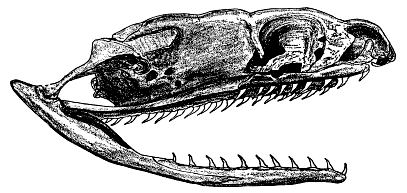
Fig. 1. Lateral view of right side of skull of adult female blue racer, × 4. University of Kansas Museum of Natural History no. 18305, from Greenwood County, Kansas.
Hemipenis
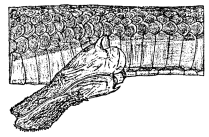
Fig. 2. Lateral view of injected and everted left hemipenis (slightly enlarged) of a blue racer from the Rockefeller Tract, Jefferson County, Kansas, showing heavy spines at base of organ, small spines of central zone and lamellae of terminal part. This hemipenis is not fully engorged.
Penial characters have proven to be useful in the classification of snakes, providing bases for separating subfamilies, genera, and species. In the racer even the subspecies have trenchant penial characters by which they may be separated in some instances. The hemipenis is roughly cylindrical, but widest at the base (Fig. 2). The sulcus spermaticus is unbranched. Approximately the basal one-third of the hemipenis has a smooth surface, broken only by the sulcus spermaticus and by three greatly enlarged spines, which form hooks—one anterior, one posterior, and one dorsal. The dorsal hook is the largest of the three. Distal to the smooth part is a zone of small spines, each recurved and mounted on a fleshy tubercle. The zone of spines is poorly developed on the anterior side and is interrupted on the posterior side in the vicinity of the sulcus spermaticus but is best developed on the posterior side a short distance above and below the sulcus spermaticus. The spines are arranged in several oblique rows. Those of the proximal row are best developed, and there is rapid diminution in the size of those situated farther distally. Approximately the distal two fifths of the hemipenis forms a third zone, lacking distinct spines, but having numerous deep longitudinal grooves, alternating with lamellae which have fimbriated edges, and which fuse with each other and divide to form a reticulated pattern.
Relationships
The large genus Coluber is much in need of revision. Its many species, perhaps more than a score in all, occur in North America from southern Canada south to Guatemala, in eastern and southwestern Asia, in southern Europe, and in North Africa. All are active, slender-bodied snakes having smooth scales in few rows, and having large eyes with well developed vision. The North American species fall into two natural groups, the typical racers, and the whip snakes, often assigned to a separate genus, Masticophis (Ortenburger, 1928). The whip snakes are more specialized than the typical racers in having the eyes more enlarged, and the body form more slender and attenuate, with number of scale rows more reduced. The racers of the Old World are more diverse. Inger and Clark (1943) suggested a partitioning of the genus Coluber on the basis of the pattern by which scale rows are reduced, from the maximum number on the forebody to the minimum number at the posterior end of the body, supplemented by certain characters of the hemipenis and of the cephalic scutellation. Besides Coluber and Masticophis these authors recognized within the group the genus Platyceps with several species in southern Europe and southwestern Asia; Zamenis with several species in the same region and in North Africa, and Haemorrhois, a monotypic genus of Spain, North Africa and several Mediterranean islands. Although apparently valid in principle, this arrangement has not been generally followed.
Exclusive of those species groups whose assignment to the genus Coluber are somewhat questionable, the remaining species in the genus are: C. constrictor occurring throughout most of the United States and south along a narrow Atlantic coastal strip of Mexico to Guatemala; C. oaxacae of southern Mexico; and C. spinalis of northern China. C. oaxacae is poorly known as only a few specimens have been collected, but seemingly it is a near relative and derivative of C. constrictor, especially of that species' southernmost population. C. spinalis is much more distinct, as might be expected from its geographical remoteness. It is a slender, active snake, of olive coloration dorsally with 17 scale rows and a bright yellow, black-edged dorsal stripe and yellow ventral surface. It is relatively small (up to 755 millimeters snout-vent length) and is partial to riparian habitats but is also found in forests and in dry and barren regions (Pope, 1935:224-226). It is known to feed upon lizards.
Range
The common racer has been recorded in each of the 48 states of the mainland of the United States, also in New Brunswick, Nova Scotia, southern British Columbia, and southward through Mexico where it is limited to a narrow strip of east coast lowlands but extends as far as Guatemala. C. c. constrictor occupies the northeastern states and extends south into the Appalachian and Piedmont. C. c. priapus with its associated races paludicola, helvigularis, and anthicus has an Austroriparian distribution, occupying the Atlantic Coastal plain and the Gulf Region, and extending north in the Mississippi Valley to southern Illinois and Indiana. C. c. paludicola is localized with two disjunct populations—in the Everglades and on Cape Canaveral, Florida. C. c. helvigularis is even more restricted in range and is known only from the Appalachicola region of the Florida Panhandle and the adjacent corners of Alabama and Georgia. C. c. anthicus occupies much of central and western Louisiana and adjacent Texas. C. c. flaviventris occurs throughout the Great Plains, east in the "Prairie Peninsula" through Michigan and northern Ohio and west to the Rocky Mountains. C. c. stejnegerianus occurs from Matagorda Bay in Texas southward through eastern Mexico, with a seemingly isolated population in the Sierra del Carmen region of northern Coahulia. C. c. mormon occurs in the Pacific Coast states and Great Basin.
Actually, the range limits and the continuity of distribution within the area outlined are still poorly known. The species has not been recorded from the northern parts of Maine, Vermont, New Hampshire, Michigan, Wisconsin, or Minnesota, nor from northeastern New York. It is generally absent from southwestern desert areas. Records are particularly scarce and scattered in the Rocky Mountain states, suggesting that the distribution in this area may be discontinuous. In a large area comprising all of New Mexico and Arizona, the western half of Colorado, and the southern halves of Utah and Nevada, records are so scarce as to indicate that the species is there represented by only a few well isolated relict colonies. The type locality of mormon is "Valley of the Great Salt Lake," and there are numerous records from the northern part of Utah east of Great Salt Lake (Woodbury, 1931:75), but a record from Moab is the only one known to me from the southern half of the state. The only records from western Colorado are from three miles east of Fruita and two miles west of Grand Junction, Mesa County (Maslin, 1959:56). Apparently the only valid record from Arizona is that of Shannon (1950:59) from Eagar, Apache County, in the east-central part. Shannon also recorded the racer from Boulder Dam in extreme southern Nevada. Brattstrom (1955:152) has recorded the species from the lower Pleistocene of southeastern Arizona (Curtis Ranch), bearing out the idea that the racer has partly withdrawn from a range formerly occupied in the Southwest at a time when cooler and moister climate prevailed. Other fossil occurrences are of late Pleistocene age—Vero Beach and Seminole, Florida (Brattstrom, 1953a:245) and, doubtfully, Rancho LaBrea, California (Brattstrom, 1953b:376). The range of mormon has been mapped (Wright and Wright, 1949:134) as extending east to south-central Montana on the basis of one specimen allocated on the basis of two characters. Otherwise the range of mormon seems to be entirely west of the Continental Divide, well separated from that of flaviventris by desert and mountain barriers. The conspecificity of mormon with the other subspecies needs to be more thoroughly investigated, and geographic variation within mormon also merits study.
Geographic Variation
The common racer and the several species of whip snakes (Masticophis) were revised by Ortenburger (1928). More recently with much larger series of specimens, Auffenberg (1955) again revised the classification of C. constrictor, but his study was concentrated in Florida and neighboring southeastern states with relatively little attention devoted to populations of the western and central United States. As the species occurs throughout most of the United States and south through the coastal lowlands of eastern Mexico to Guatemala, it is found over a wide range of environmental conditions. Various characters are subject to geographic variation, and some of them follow clines that are maintained over extensive areas. Such characters as the number of hemipenial spines, and the enlargement of one or more basal spines into hooks, the shape of the premaxillary bone, the number of maxillary teeth, the numbers of ventrals and caudals, color of eye, number of dorsal saddle-marks and of ventral spots in juveniles, and ratios of body proportions including tail length to total length have been used to characterize the subspecies.
Also important is the shade of coloration of adults. The subspecies constrictor, priapus and helvigularis that are characteristic of forested habitats in the eastern United States are black dorsally and have their ventral surfaces suffused to a large extent with dark or dusky coloring. Farther westward the ground color becomes progressively paler, greenish, grayish or light brown, and the ventral surface is yellow (white on the throat and neck). The same tendency appears in C. c. paludicola of the Everglades. The populations of arid climates in southern Texas and in the far western states are relatively pale colored. The species thus conforms to Gloger's Rule in changing from a pallid coloration in arid climates to a dark pattern with eumelanins predominating in a humid climate.
Perhaps the most important character that is subject to geographic variation in the racer, and certainly one of the most neglected, is body size. With information now available it is not possible to compare the sizes of different populations except in a general way. The best sources of information concerning size in several subspecies other than flaviventris, are the publications of Auffenberg (1949 and 1955). Comparison of these data with my own is not entirely satisfactory because Auffenberg did not indicate clearly differences in size between the sexes, nor indicate the boundary line between young and adults. Also, his measurements are of overall length. For the purpose of comparison I have subtracted 22.5 per cent, an approximation of ratio of average tail length, from Auffenberg's figures. He stated (1955:98) that the series of specimens on which measurements were based were those "with a uniform coloration," that is to say they had lost the juvenal pattern and were probably sexually mature. Whether the same statement applied to the large series of stejnegerianus in the same author's earlier paper (1949:55) is doubtful.
C. c. constrictor: 34 New York specimens averaged 806 millimeters (Auffenberg, 1955:96).
C. c. flaviventris: 100 Kansas specimens averaged 791 millimeters (males, 746; females, 836).
C. c. priapus: 171 Florida specimens averaged 713 millimeters (Auffenberg, 1955:96).
C. c. stejnegerianus: 291 Texas specimens averaged 664 millimeters (Auffenberg, 1949:54).
C. c. mormon: 94 West Coast specimens (Museum of Vertebrate Zoology) averaged 563 millimeters (males 515, females 600).
C. c. anthicus: 35 northern Louisiana specimens estimated to average 582 millimeters (Clark, 1949:249—the author did not present individual measurements, but indicated the numbers in several size groups in his sample).
The 100 flaviventris in the above list were recorded in June, July and August, a season when the young of the preceding year are still small, and these young were not included. In a fall sample 63 males averaged 729 millimeters and 65 females averaged 886 millimeters, but with the nearly grown young (44 males and 40 females) included, the averages were changed to 651 and 768 respectively. Maximum length perhaps express differences between the subspecies as well as, or even better than, the averages listed above. The following figures indicate some of the maximum overall length measurements in inches that have been published by various authors. These measurements pertain to females unless otherwise indicated.
C. c. constrictor: 743/4, 741/4, 73, 651/2 (Auffenberg, 1955:96).
C. c. flaviventris: 71 (Pope, 1944:172), 72 (Conant, 1958:147).
C. c. priapus: 521/2 (♂) (Auffenberg, 1955:98).
C. c. stejnegerianus: 37 (Auffenberg, 1949:54), 40 (Conant, 1958:148).
C. c. mormon: 511/2 (Museum of Vertebrate Zoology).
C. c. anthicus: 70 (Conant, 1958:149).
In my own study, the largest racers recorded from the Reservation and Rockefeller Tract had the following overall lengths: 59, 571/4, 551/2, 58 ♂ (projected from stub tail).
These sets of figures show that compared with the blue racer in Kansas, with which my own study was concerned, the black racer of the northeastern states reaches a larger size, while the racers of the Southeast and especially those of the far West and of southern Texas, are dwarfed. These size differences are almost certainly correlated with behavioral and ecological differences among the snakes involved. Adaptations to exploit certain types of prey and to utilize most efficiently certain habitats and types of cover, have led to divergent trends in different parts of the range.
Habitat
The racer dwells primarily in open situations, but as might be expected from its extensive geographic range, bringing it under the influence of diverse climates and habitats, its populations have diverged somewhat in adaptation to different environmental conditions. The eastern blacksnakes (subspecies constrictor and priapus) seem to prefer woodland and forest edge. In central Louisiana, anthicus occurs chiefly in an open type of woodland. The subspecies stejnegerianus is found chiefly in brushland and thorn forest. The western mormon is found in varied habitats, including moist streamside meadows, and chaparral. Published statements of herpetologists, based upon studies in limited areas, are briefly quoted below to show the trend of geographic change.
C. c. constrictor: This snake "occurs chiefly in fields" (Atkinson, 1901:148; Pennsylvania); "in more or less wooded regions and along hillsides and among bushes" (Surface, 1906:167, in Pennsylvania); "abundant, especially in wooded regions" (Hibbard, 1936:28, in Kentucky); "dry and more or less open places" (Conant, 1938:52, in Ohio); "old fields and areas about buildings" (King, 1939:572, in Tennessee).
C. c. priapus: In "drier parts of the [Okefinokee] swamp ... seems to prefer blueberries and saw palmettos" (Wright and Bishop, 1915:159 in Georgia); "common in grassy fields and in upland woods" (Allen, 1932:13, in Mississippi); "abundant along fence rows ... in dry pine-oak forest and in bottomland forest" (Trowbridge, 1937:296, in Oklahoma); "probably most abundant in open upland hammock or in old fields; limestone flatwoods" (Carr, 1950:80, in Florida); Oak and oak-hickory forest and small hill prairies in southern Illinois (Rossman, 1960:219).
C. c. paludicola: In "all parts of the freshwater Everglades, in cabbage palm hammocks, in salt marshes, and in mangrove swamps. On Key Largo ... in mesophytic hammock" (Duellman and Schwartz, 1958:296, in southern Florida).
C. c. anthicus: In "wooded areas in the vicinity of briar patches or other brushy undergrowth" (Clark, 1949:249, in northern Louisiana); "especially grassy uplands" (Fitch, 1949:88, in central Louisiana).
C. c. stejnegerianus: Of 291, 94 were in scattered brush, 92 in sparse brush, 41 in lightly wooded areas, 26 in grassy areas, 24 in heavy brush, eight in semi-arid places and six in heavily wooded situations (Auffenberg, 1949:55, in southern Texas).
C. c. mormon: In "thin brush skirting open prairie land" (Lord, 1866:304, British Columbia); cottonwood-willow and water margin habitats in prairie (Dice, 1916:310-312, in eastern Washington); "grass; amid water cress; bank of small ditch near meadow; barley field; sandy ground covered with rocks and driftwood; among sedges; in sagebrush; swimming in irrigation ditch" (Grinnell, Dixon and Linsdale, 1930:149, in northeastern California); low foothills, around the fields, and in the timber and brush along the canyon bottoms (Woodbury, 1931:75, in Utah); "open woods of Garry oak and poison oak, on grassy slopes, in chaparral, and in grain or hay fields" (Fitch, 1936:644, in southwestern Oregon); "low hot canyons where it was found to occupy areas having rather dry, rocky hills" (Ferguson, 1952:68, in northeastern Oregon).
C. c. flaviventris: Pastures, meadows, and fields (Hurter, 1911:170, in Missouri); "usually frequents dry open fields, although it is often found in bushes or cut-over land which has grown up into thickets" (Ortenburger, 1928:181); "pasture lands and on hill sides" (Peters, 1942:183, in Illinois); "along the levees in the salt marshes" (Liner, 1954:82, in southern Louisiana); "common in both prairie and woodland habitat" (Smith, 1947:34, in east-central Illinois); Flood plain, sand around sage-sumac brush, rocky slopes (Fouquette and Lindsay, 1955:411, in northwestern Texas).
Several observers have described the habitat in Kansas as follows: "grassy valleys and thinly wooded hillsides" (Burt, 1927:5); "moist and dry habitats, in wooded areas, and in prairies" (Smith, 1956:237); Oak-walnut hillside forest, cultivated field, buckbrush-sumac, prairie (Clarke, 1958:22).
Every part of the 590-acre Reservation is used to some extent by blue racers living on this area. Home ranges of most individuals are so large as to include a variety of habitats, both woodland and grassland. The habitat preferences vary according to season. In autumn some racers migrating to rock ledges to hibernate are found in mesic forest, but at that time of year leaves have begun to fall and the forest floor is less dark and humid than in summer. In spring also racers not yet back on their summer ranges are often seen either along the hilltop ledges, or moving downhill through woods toward bottomland meadows. However, in summer, the finding of a racer in mesic woodland is a rare event. Occasionally the snakes make trips across such blocks of woodland hundreds of feet wide, but they do not linger in the woodland. In decreasing order of preference the habitats used by racers on my study area may be classified as follows:
1. Tall-grass prairie, (Plate 22) either original or regenerated, dominated by native perennial grasses in stands three feet to seven feet high, including big blue-stem (Andropogon gerardi), little blue-stem (A. scoparius) Indian grass (Sorghastrum nutans), and switchgrass (Panicum virgatum).
2. Pastureland, with introduced brome grass (Bromus inermis) and associated weedy vegetation.
3. Brush, in ravines, at woodland edge, and in riparian thickets.
4. Weedy fields, dominated by such pioneer plants as ragweeds, sunflowers, horseweed, milkweed, wild lettuce, aster and goldenrod.
5. Open type of woodland dominated by such trees as honey locust and osage orange.
These habitat types are interspersed on the study area, and each racer has a wide choice of habitats without travelling beyond the limits of its own chosen area.
Grassland that has been closely grazed, mowed or burned does not provide entirely adequate food or shelter, and under such conditions clumps of brush or other dense vegetation may be of critical importance. Throughout the racer's extensive range, fields of grain and hay at times provide suitable habitat, and may support large populations, but in spring, before the young cultivated plants have made much growth, or later in the season, after they have been cut, the racer may need to depend on adjacent areas of pasture, thicket, or woodland edge and the availability of such refugia to a large extent determines the numbers of racers on cultivated areas.
Temperature Relationships
In the locality of my study racers spend approximately half the year in winter dormancy. Earliest spring records and latest fall records for 13 years are shown in Table 4. The spring records in nearly all instances pertain to snakes found in the open or beneath flat rocks warmed by sunshine, usually at or near the rock ledges where hibernation occurs. Juveniles are especially well represented in these earliest spring records, and it seems that they tend to emerge a little earlier, on the average, than the adults, either because they have hibernated in more superficial and less well insulated situations or because their lesser body mass permits more rapid warming to activity than can occur in the adults. The latest fall records all pertain to racers trapped along the rock outcrops, and none was a young of the year.
Table 4. Earliest and Latest Recorded Annual Dates When Blue Racers Were Active on the Reservation or Rockefeller Tract
Year Earliest spring record Latest fall record Year Earliest spring record Latest fall record
1950 April 16 November 4 1957 April 30 November 2
1951 April 19 November 13 1958 April 25 November 20
1952 April 23 November 12 1959 April 6 November 10
1953 April 8 November 12 1960 April 22 November 6
1954 April 20 November 12 1961 April 19 November 1
1955 April 15 November 2 1962 April 23 October 27
1956 May 11 November 14
Most of the population undoubtedly emerged somewhat later than the average date of April 16 indicated by the records in Table 4, and retired somewhat earlier than the average date of November 8. However, a small percentage of the population probably emerged even earlier each year than my records indicate, and retired into hibernation later than my records indicate. In a typical year, temperatures in April and early May are only occasionally above the level at which racers are able to become active, but are below this threshold most of the time. The same statement applies to an autumn period of late October and November. Most racers are dormant in their hibernacula during these transitional periods of spring and autumn, but some—those that have emerged early in spring, or those that have not yet retired (in fall)—retreat to temporary shelters and revert to a semi-torpid state when temperatures fall below the critical level.
Fig. 3 shows the relative extent of activity along the hilltop outcrops, as reflected by numbers of racers caught at different times during the autumn. Data from 14 years are combined, and the large composite sample indicates that in an average year there is relatively little activity along the hilltop outcrops in early September, but that activity rapidly increases to a peak in mid-October and then tapers off rapidly, usually ending in mid-November, but occasionally ending as early as late October or as late as late November.
The racers recorded in traps had, in many instances, been confined in them for from one to three days before they were found. For any one year records are not sufficiently numerous to show the trend as well as Fig. 3, but Fig. 4 shows year-to-year differences; 1958 was a fairly typical year, and also was the year in which the largest sample was obtained; in 1949 the largest catches were made earlier than usual, and the racers retired early into hibernation; in 1954 warm weather persisted until unusually late in autumn, and racers remained active beyond the time when they ordinarily would have been hibernating; in 1955 and 1961 the most concentrated activity along the outcrops, as reflected by day to day catches, came later than usual, but unseasonably cold weather ended all activity abruptly, earlier than usual.
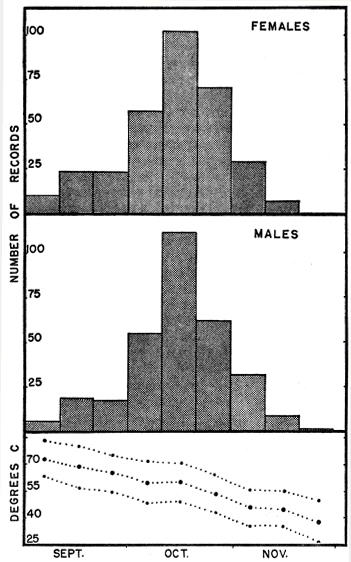
Fig. 3. Records of blue racers trapped along hilltop limestone outcrops in autumn, a composite sample of 14 years (1949 through 1962) from the Reservation and Rockefeller Tract, showing the catch grouped in ten-day intervals, beginning with September 1 to 10 and ending with November 20 to 29. Averages of the maxima, means, and minima of daily temperatures for each period are shown.
The racer's annual cycle of activity is, of course, controlled primarily by the weather, and is much delayed or accelerated in some years. But certain stabilizing factors cause the racer's annual cycle to be less variable than that of the weather. For example, in spring when persistently cool weather delays emergence from hibernation beyond the normal time, the increasing azimuth of the sun, and more intense sunshine cause the soil to warm, despite low air temperature, until emergence is finally triggered. Having once emerged, the racer is able to control its bodily temperature to a large extent by basking in sunshine to gain warmth, or by seeking shade or underground shelter to escape overheating. By such behavioral thermoregulation extremes of weather are neutralized, or at least buffered to some degree.
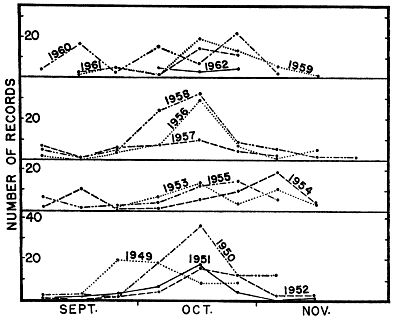
Fig. 4. Yearly variation in catch of blue racers along hilltop outcrop in autumn on the Reservation and Rockefeller Tract, grouped in same ten-day intervals indicated for Fig. 3.
In the course of my study no racers were found in their actual hibernacula. Insofar as known, these were always in deep crevices in strata of limestone near hilltops, and were inaccessible except by removal of the solid rock. The crevices where racers hibernate are known to be several feet deep in some instances, extending well below the frost line. Periodic temperature readings in two such crevices at depths of 12 inches and 30 inches, taken in the winter of 1954 (Fitch, 1956:471) showed that temperatures during dormancy are usually well within the range 0°C to 10°. Whether the racers congregate in hibernating masses in regular "dens" on the Reservation has not been definitely determined, but if so, most of the hibernating groups must be small, because those trapped along the ledges are well scattered, and, in fact, give the impression of being rather uniformly distributed along them. However, ledges of northward exposure are not used as hibernation sites, so far as known, and those of full southward exposure are perhaps preferred, especially where the hilltop has a southward projecting spur, and the exposed rock face is extensive, with many cracks and fissures. I have been unable to detect differences in types of hibernation sites preferred between the racer and the copperhead, which is somewhat more numerous on the same area.
Several authors have contributed to knowledge of hibernation in the racer. Boyer and Heinze in Missouri (1934:195) noted that blue racers often were associated with copperheads in the vicinity of places chosen for hibernation. Burt (1935:329) in Kansas found blue racers emerging from dens among rocks on a prairie hillside, associating with other snakes, Diadophis punctatus, Elaphe guttata, and Pituophis melanoleucus. In the Chicago region, Pope (1944:173) reported scores of blue racers aggregating in October on and around a sand dune with oak woodland. In Ohio, Conant (1938:55) found three blue racers hibernating together about three feet underground in a small hole. One found at another locality had apparently hibernated in company with a massasauga (Sistrurus catenatus). In Maryland Cohen (1939:137) saw racers (C. c. constrictor) in the act of emerging from an old vole burrow that was a communal hibernaculum, on April 6, 8, and 10. Air temperatures at the time of emergence were 12.5° and 18.5° Centigrade. In Illinois, Schroder (1950:1-2) found seven blue racers hibernating in masses, intertwined with each other and with bull snakes at depths of 36 inches and 42 inches in an abandoned mammal burrow in a sand dune area in early February.
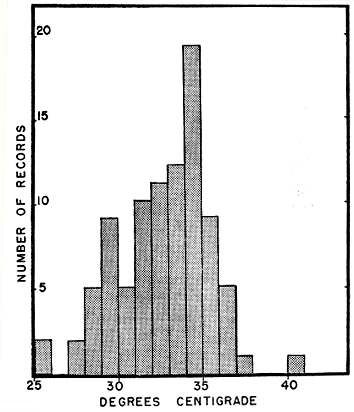
Fig. 5. Bodily temperatures of blue racers kept in a large outdoor enclosure and checked from time to time when they were active and the sun was shining, in June and July, 1962.
In the course of routine field work I often carried a Schultheis quick-reading thermometer, and from time to time I had opportunities to take the body temperatures of blue racers newly captured by hand. The trend of these records indicated the temperature range within which the snakes normally limit their activity, and the preferred temperature. In an earlier publication (Fitch, 1956:459-460) based on a few more than half the number of records of temperature now available, I discussed responses of the blue racer to temperature. The newer data bear out the trends previously revealed; of 60 records, 39 are within the six-degree range from 29° to 35°, and records are most concentrated in the one-degree range, 34° to 35°. Racers were found active at air temperatures between 15.5° and 32.4°, with the greatest concentration between 26° and 27°. Compared with most other kinds of North American snakes, the racer is remarkably tolerant of heat, and often is several degrees warmer than the level that those of other genera will normally tolerate. Racers have been seen crawling in the sunshine, or basking on days that were uncomfortably hot for humans. For example, on August 28, a large female racer released from a trap was followed and her behavior observed; after crawling some 50 feet through the grass she climbed from a ditch bank onto sunflower stalks and elm saplings, and came to rest among the stalks, in a spot strategically situated for catching grasshoppers. More than half her body was exposed to sunshine and air temperature was slightly above 34° Centigrade, yet the snake showed no sign of discomfort, and for the several minutes that she was kept under observation, did not attempt to withdraw into the shade.
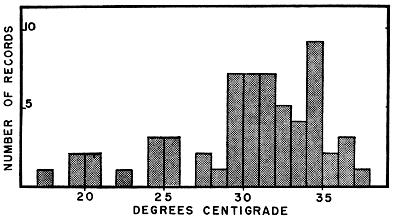
Fig. 6. Bodily temperatures of blue racers captured by hand in their natural surroundings. The preferred level is approximately the same as indicated by Fig. 5 (between 29° and 36° Centigrade), but some of the racers caught were not fully active and had lower temperatures. Some bias results from the fact that those having the lowest temperatures were the least active and hence were most easily caught.
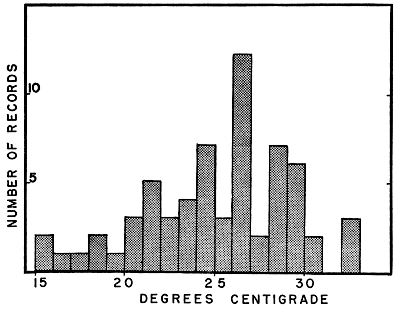
Fig. 7. Air temperatures recorded at captures of the racers whose records were used in Fig. 6. An active racer typically maintains, by basking, a bodily temperature several degrees warmer than the air.
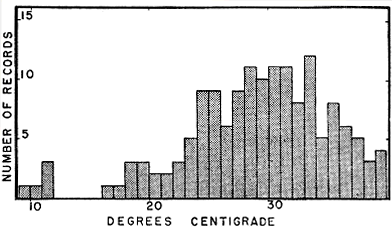
Fig. 8. Bodily temperatures of blue racers found in live-traps at Harvey County Park. Opportunity to regulate temperature by behavior was limited in these snakes in traps, which tended to match ambient temperatures.
At the Harvey County study area, bodily temperatures were recorded in many of the racers that were caught in traps. These records are much less significant than the records obtained from racers caught by hand and promptly checked for bodily temperatures. The temperatures of the trapped snakes may, to a large extent, reflect the temperatures of air and soil at the time. However, despite their confinement, the trapped racers probably were able to exercise some control over their temperatures by shifting from shade to sunshine, or from the top of the trap to its bottom, where they would be in contact with the substrate. In most of the racers removed from traps, as in those caught by hand, bodily temperatures were somewhat above air temperatures, but the difference was less in the former group of snakes. Figure 8 shows the bodily temperatures of these snakes removed from traps. Occasionally racers died in the traps from overheating. On July 2, 1960, each of two racers in traps had temperatures of 39.4°. One of these was especially vicious and frantic in its attempts to escape, but otherwise seemed unharmed. The second racer was dead, seemingly having succumbed just before it was found. Probably prolonged exposure to temperature in excess of 39° would always result in death of the snake. Racers and other snakes that had become overheated in the traps and were nearing exhaustion had a characteristic limp feel when they were handled. In June, 1960, heat tolerance of a halfgrown racer was compared with that of several other snakes including a copperhead, garter snakes, and ringneck snakes. Each snake in turn was enclosed in a plastic tube plugged with cotton at one end, the snake having a quick-reading thermometer taped in place for a rectal reading. The tube was then placed in sunshine. Over periods of minutes the enclosed snake passed through a characteristic cycle. Soon it would begin to register discomfort as its temperature rose rapidly. Its struggles would become increasingly violent, then would cease abruptly. The snake would suddenly collapse, its body mostly limp, but knotted in slow contortions, its mouth gaping widely. Within a few seconds all movements would cease, but in each instance the seemingly dead snake was soon revived by holding it in cold running water. The copperhead, garter snakes, and ring-necked snakes all collapsed at temperatures near 41°. At this same temperature the racer showed signs of acute discomfort, but did not collapse even after many minutes of exposure. Probably more protracted exposure at this level would have been fatal to the racer as well as to the other kinds tested.
Home Range and Movements
Blue racers that were recorded on more than one occasion were rarely caught again at the original location. For different individuals, distances between capture points ranged from zero up to a little more than three-fourths of a mile. The area of concentrated study was a mile and a half in greatest diameter; there was scant opportunity for capturing racers that moved greater distances. Even those that moved as far as a mile would have passed beyond the boundaries of the study area in most instances. Many of the marked racers that disappeared from my records probably moved beyond the limits of the study area. Nevertheless, in the great majority of instances, the distances between successive capture points for the same individual were relatively short, indicating that each racer tends to remain permanently in a restricted area.
Most captures were made in the type of grassland or brush that provides favorable habitat for the racer during the season of activity, but many other captures were made in woodland along the rock ledges where the snakes come to hibernate. Four different types of movement may be recognized: 1) those in the rock ledge area where hibernation occurs; 2) those between the area where the summer is spent and the hibernation ledge—an actual small scale seasonal migration which takes place in spring and autumn—3) those within a home range, which are part of the day-to-day activities of the racer, and, 4) wandering movements by which the racer shifts its activities, perhaps permanently, from one area to another. In the records of any one snake these different types of movements cannot always be sorted with certainty. Each type will be discussed separately.
Relatively few movements along the ledges were recorded. It seems that having migrated to a ledge, the racer promptly finds its hibernaculum and retires for the winter. In spring there is equally prompt scattering of the emerging racers, which no longer find the ledge attractive. Most recorded movements along the ledges were short. Of 76 movements, nine exceeded 1000 feet, and only four others exceeded 500 feet. Most of the shorter movements were recorded within an autumn season, but several were recorded after the lapse of one or more seasons of activity. The longer movements were as follows: 1250 feet after 8 seasons (male); 1300 feet after three seasons (female); 1600 feet after one season (female); 2000 feet after one season (female); 2280 feet after seven seasons (male); 2200 feet in same season (female); 2410, 2600, and 3200 feet, each after one season (all males). The trend of these records suggests that the tendency to return year after year to the same hibernaculum is not strong; after using one for a period of years, the racer may abandon the stretch of ledge and, starting out in the opposite direction from its summer range, find a new hibernaculum as much as half a mile from the old one. Records of distances between capture points on the ledges for individual racers are shown in Fig. 12.
A total of 124 movements between summer ranges and ledges were recorded, and the distances averaged 1309 feet—approximately a quarter mile. Some racers living in hilltop fields may have had home ranges that included rock ledges, or at least were adjacent to them. In such instances no seasonal migrations would have been necessary to reach hibernacula in the autumn and summer ranges in the spring. Several short movements—100 feet, 150 feet, and 200 feet—can be explained on the basis that home ranges and hibernation ledges overlapped or were near at hand, but most of the movements were longer. The longest movement was 4020 feet, after a lapse of four seasons. Twenty-four movements exceeding 2000 feet were recorded. For these the intervals between captures averaged more than double the time for the remaining movements, indicating that the longtime permanent shifts were involved in many instances.
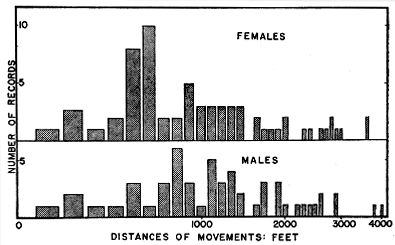
Fig. 9. Histogram of movements of blue racers between hilltop rock outcrops used for hibernation, and summer habitat on the Reservation and Rockefeller Tract. Movements of females tend to be somewhat shorter than those of males.
For all the racers living in bottomland, ranges were separated from ledges by areas of wooded hillsides averaging approximately 700 feet across. These relatively unfavorable areas had to be traversed in the course of the semi-annual migrations. Even some of the racers that lived in hilltop fields apparently crossed wooded slopes in order to reach distant hibernation ledges, or else each reached the ledge by a roundabout route although it could have found a ledge much nearer its summer range. For the 124 ledge-to-field and field-to-ledge movements, the median distance was 1030 feet. The sexes were almost equally represented in this sample but the average distance for the 55 males—1425 feet—notably exceeded that for the 69 females—1220 feet. These movements are shown in Fig. 9.
McCauley (1945:76) in Maryland described what seemed to be incipient territoriality in a large male racer that remained several hours in a small area, crawling about conspicuously with head raised, seemingly on patrol. When an even larger male racer intruded, the first one aggressively drove him away, but neither paid any attention to a king snake that was also on the area. Other authors have noted the attachment of a racer to a small familiar area. Conant (1938:53) wrote that many of the racers he saw sought shelter in definite retreats. One of these racers was seen resting on top of a brush pile four times in a single afternoon, and each time it followed the same route to the same inaccessible spot beneath the brush.
My own observations do not bear out the idea that racers maintain regular territories, since several males may be present within a small area, even in the breeding season. Hostile behavior between males has not been observed by me under natural conditions, and in confinement has been seen only in instances of self defense. Like the racer Conant observed on a brush pile, individuals may linger in the vicinity of a favored shelter or foraging area for periods of hours, but such associations are ephemeral, and soon the snake moves on. In a uniformly favorable habitat a racer may cruise about freely in tall grass or brush. Individuals that I have attempted to follow, after flushing them or releasing them from traps, often covered distances of 100 to 300 feet within periods of a few minutes before I lost them. In such instances I maintained sufficient distance between myself and the snake so that the latter was not actively escaping. Probably the snake was not aware of pursuit in most instances, although I was able to glimpse it through the stems of grass, weeds, or shrubs, or was informed of its course by the swaying tops of grass and other vegetation.
For many of the racers captured over periods of years it was possible to plot "minimum home ranges" in the areas that they occupied. One caught 12 times in five consecutive years will serve as a typical example. There were seven locations involved; three captures were made at one point and two captures at each of two others; the other five locations were each represented by a single capture. One of the seven locations was for a capture made at a rock ledge in October, and hence can be eliminated from considerations of home range. The other six locations are based upon captures made from late May to early August, and they form a rhomboid pattern, with three locations in alignment on one side and two others inside the quadrangular figure formed by the five outlying points. Obviously such a group of records gives some idea of the location and extent of the snake's activities but the information is far from complete. As shown by Odum and Kuenzler (1955), a much larger series of records, usually several dozen, with eight or more marginal locations, is necessary to illustrate even an approximation of the actual home range. Under the conditions of my study such a series of records was unattainable. Few if any of the racers recaptured had more complete series of records than the one mentioned above.
For 20 racers the records were sufficiently numerous and well distributed to permit plotting of minimum home ranges. One of these ranges was hexagonal, nine were pentagonal, eight were rhomboidal and three were triangles. In four instances the area encompassed was broken by woodland, indicating that the home range comprised two or three disjunct segments. In all instances the smaller segments were triangular. The 20 minimum home ranges averaged 6.6 acres (3.2 to 12.8). The 15 ranges of males averaged 7.3 acres, whereas the five ranges of females averaged only 4.5 acres, but the sample is too small to be relied upon for differences in the sexes.
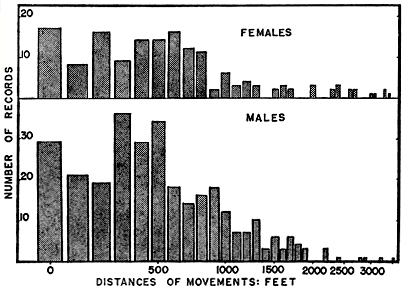
Fig. 10. Movements of blue racers within or between areas of summer habitat on the Reservation and Rockefeller Tract. The trends are much alike for males and females.
In an earlier publication (Fitch, 1958:73) I discussed an alternative method for determining size of home range in animals that move about freely within a chosen area, not having their movements restricted by attachment to a specific home base. Ordinarily any two records of the animal within its home range will be separated on the average by a distance equal to half the diameter of the area. Assuming that home ranges in general tend to have a circular shape, except as restricted by limiting environmental factors, the area can be easily computed from the average recorded movement—the home range radius. It is necessary, of course, to have a sufficiently large number of records of movements to obtain an average that is statistically reliable.
A major problem is that of recognizing movements that involve an extension of the original range or a shift away from it to a new area. A few exceptionally long movements were recorded. If these are included in the computations of home range, they greatly increase the average distance, probably introducing error. Also, the number of exceptionally short movements was greater than might have been expected if all locations of capture are at random to each other. In some instances a racer newly released may have blundered into the same trap again, or into the trap at the opposite end of its drift fence. In other instances traps may have been so strategically situated with respect to preferred travel routes that they caught the same snakes repeatedly. In still other instances, the range of an individual might have been mostly outside the study area, with only one end or corner overlapping the trap sites.
A total of 471 records for consecutive captures in field areas is available, 305 for males and 166 for females. In 20 instances successive sites of capture were the same and movement was recorded as zero. Of the 471 records, 207 involved a relatively long time span, including at least one hibernation period; the remaining 264 were based upon successive records within the same season of activity. The trends were much the same in the records involving a longer time span (up to four years) as in those records involving captures made in a single season, but for the longer periods there were some exceptionally long movements, and relatively few short movements of less than 100 feet.
Records of male racers and those of females were used for separate computations. For each series, the ten per cent of movements that were longest and the ten per cent that were shortest were eliminated from consideration in calculation of the average distance between points of capture. For the remaining 244 records of males an average movement of 595 feet was calculated, and for 132 records of females an average movement of 574 feet. These distances, if accepted as typical home range radii, would represent home ranges of 26.3 acres for males and 23.8 for females. In an earlier discussion of spatial relationships in the racer (Fitch, 1958:119), based upon relatively scanty data, I estimated the home range to be approximately 23 acres in males. But with only nine records for female racers I calculated the home range to be 9.7 acres.
The disparate figures obtained from plotting minimum home range and from calculating average home range radius are not irreconcilable, since a minimum home range based on only four or five points would ordinarily include only a fraction of the actual range. Distances up to 1500 feet are included in the calculation of home range. It seems that home ranges often have a diameter of this magnitude or a little larger, although the estimated average diameter is 1140 feet. Home ranges probably most often deviate from circular shape to form an ellipse, with one diameter markedly exceeding the other. Woodland, water, roads, buildings, or cultivated fields, or other areas that are unfavorable or uninhabitable often form the boundary of a home range and influence its shape.
Many of the longer movements constituted clear-cut shifts in range. In one exceptional instance a large adult female captured in the northeastern part of the Reservation on June 22, 1950, was released 21 days later at a point 3900 feet southwest of the place of capture. On May 27, 1960 she was caught within 600 feet of the original location, seemingly having made a homing movement. Among the nine racers recorded to have made longest movements (exclusive of those movements made to or from hibernacula) four were recorded also to have made later long movements in the reverse direction, probably returning, each to its original home range, although in every instance the return movement was somewhat less than the original. A female of two-year-old size when first captured on September 2, 1957, was recaptured 3100 feet southeast on May 10, 1958. On August 7, 1959, she was recaptured again 2400 feet from the second location in the direction of the original capture. Similarly, in a three-year-old female a shift of 2730 feet was recorded at the second capture after 21 months, and at the third capture 14 months after the second, a return trip of 2360 feet had been made. A second-year female made a trip of 2640 feet between May 17 and October 1, 1960; by May 1961 she had returned 2000 feet to the vicinity of her original capture. From one year to the next an adult male shifted 2450 feet; after another year he had moved back 1550 feet. Most of the longer movements recorded were those between home ranges in fields and hibernacula along ledges, but in this class of movements, distance was somewhat proportional to elapsed time. For 59 such movements exceeding 2000 feet the average was 3.1 years, whereas for 114 field-to-ledge movements of less than 2000 feet, average elapsed time was 1.6 years. This trend suggests that over periods of years a racer is likely to shift its range or its hibernaculum or both.
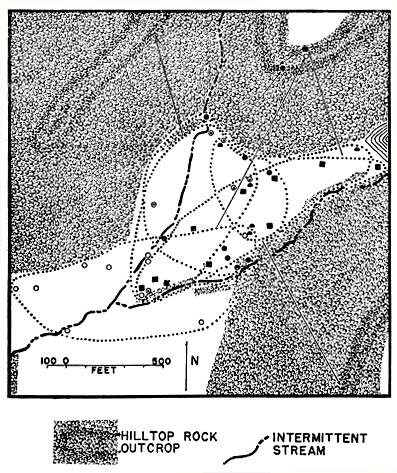
Fig. 11. Map showing home ranges of five blue racers, as indicated by numerous captures in successive summers, in small valley where Reservation headquarters are located, and spatial relations of their hibernacula, as represented by points of capture along hilltop limestone outcrops. In spring and autumn, traveling to and from hibernacula, the snakes migrate across wooded slopes. Each "minimum home range" is enclosed in a dotted line, and a distinctive symbol is used to show successive points of capture for each snake.
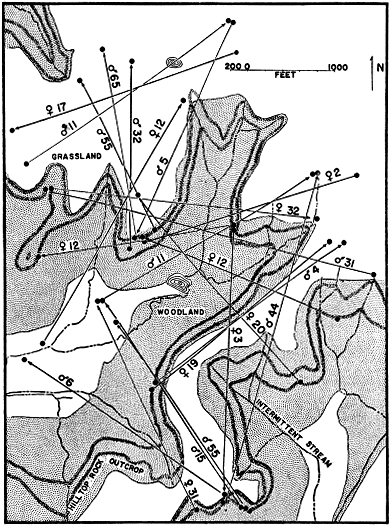
Fig. 12. Map of 600-acre area of Reservation and Rockefeller Tract, including parts where field study was most concentrated, showing movements of the 20 blue racers recorded to have shifted over the longest distances. The figure following the sex sign of each individual indicates number of months elapsed between the captures at the localities represented by the dots.
Average elapsed time between captures was 7.7 months. In the 471 field-to-field movements recorded, 53—slightly more than eleven per cent—exceeded 1500 feet and can reasonably be considered shifts of home range. The average elapsed time between captures for this group of snakes was 9.5 months. The evidence suggests that, even in an area of favorable habitat, somewhat more than ten per cent of the racers in a population annually shift their home ranges somewhat, but that many stay in the same home range for periods of years or perhaps throughout life.
Shifts in range were especially noticeable where availability of suitable habitat underwent seasonal change. Along the north edge of the Reservation, prairie adjoined cultivated fields where grain or hay was grown. Until late May, the cultivated crops made little growth and the fields were almost bare. They provided insufficient shelter for the racers, which tended to keep to the prairie, where old grass of the previous year's growth furnished them with ample cover. Later in the season, crops, of oats, wheat, and alfalfa constituted suitable cover for the racers, and many of them shifted their ranges to the cultivated fields, but corn and milo crops were much less adequate for their needs. After harvesting of crops, cover in the fields was again inadequate for the racers' needs, and they tended to retreat to edge situations, or to adjacent prairie.
Food Habits
Methods of Obtaining Prey
The racer hunts by stealth, but actively, obtaining its prey by keen eyesight and swift movements. Wright and Bishop (1915:160) wrote that because of its great speed it can catch anything that moves on the ground. As a racer moves stealthily through dense vegetation, its dull, uniform dorsal color blends well with the surface litter of dead plant material. In prowling, the snake glides along rapidly and alertly, in a jerky fashion, with frequent momentary pauses and changes of direction. Because of its inconspicuousness, it is not likely to be detected by the prey until it is close at hand. The snake is ready to dash in pursuit of any small animal that flies, jumps or runs to escape.
On August 27, 1955, my daughter observed a large racer hunting among tall weeds at the edge of the pond on the Reservation. Several times in the course of its movements, it flushed small frogs (Rana pipiens) and each time the snake darted in unsuccessful pursuit of the rapidly hopping frog. On several occasions I have been led to a blue racer by the distressed croaking of a frog that the snake had captured. In each instance, despite my cautious approach, the racer saw me before I detected it, and then darted away, abandoning its prey. On one occasion, while I was still a few yards from the racer, and before the latter had detected me, the frog broke free and hopped away rapidly through tall grass and weeds, and after several leaps, hid, concealed by dense screening vegetation. The racer darted in pursuit but could not find the frog. For several minutes the snake persisted in an active search; with forebody elevated and head held high, it would turn first in one direction and then in another, with nervous, jerky movements, obviously keyed up to a high pitch of excitement. Then it became aware of my presence, lowered its head, and glided away rapidly, abandoning the search.
Although the racer depends to a large extent on sight to find its prey, scent may play some part also, as indicated by the presence in the food of young mammals taken from nests, some probably found underground. Near Garnett, Kansas, on May 4, 1952, Richard B. Loomis found a racer attacking a collared lizard (Crotaphytus collaris) beneath a large flat rock. The lizard was retaliating by biting the snake's neck. The posterior part of the snake protruded into the open, and its thrashing had directed the attention of the observer to it. Whether the racer first found the lizard under the rock, or followed it there after flushing it in the open is unknown.
An encounter between a large blue racer and an adult Great Plains skink (Eumeces obsoletus) on August 30, 1948, was described as follows: "The skink, grasped by one flank, had twisted back and seized the skin of the snake's neck in a bulldog grip, and they lay interlocked, motionless except for their rapid panting, and occasional straining of the skink to bite harder or of the snake to shift its grip and work its jaws toward the skink's head. The racer broke the skink's grip, and began to swallow it head first. When only the hind legs and tail of the skink still protruded from the racer's mouth, I lunged forward in an attempt to catch both reptiles. With a sudden movement the snake disgorged the skink, which darted away into the grass and escaped" (Fitch, 1955:78).
Composition of Food
Many authors have contributed to knowledge of the racer's food habits. In most instances the records have been few or casual, but several intensive studies have been made, notably by Surface (1906) in Pennsylvania, Ortenburger (1928) for the species as a whole, Uhler, Cottam and Clark (1939) in Virginia, Clark (1949) in Louisiana, Auffenberg (1949) in southern Texas, Hamilton and Pollack (1956) in Georgia, and Klimstra (1959) in southern Illinois. However, the findings of different authors are not strictly comparable; some have made general statements concerning the food habits but have mentioned specific items only when these were considered unusual. Certain authors have listed individual prey animals eaten; others have indicated the percentages (in bulk or in frequency) that the different kinds of prey comprised. Some writers have identified food animals only in broad categories such as "insect," "beetle" or "snake" while others have undertaken specific determinations for all the prey or for certain taxonomic groupings that were subjects of special interest.
For the eastern black racer (C. c. constrictor) the following food items have been recorded: 1 robin (Turdus migratorius, Storer, 1839:226); 1 copperhead (Agkistrodon contortrix, Verrill, 1869:158); 1 weasel (Mustela sp.—presumably the diminutive M. rixosa—Atkinson, 1901:148); 3 undetermined mammals, 1 rabbit, 1 undetermined mouse, 7 voles (2 Microtus sp., 4 M. pennsylvanicus, 1 Clethrionomys gapperi), 1 undetermined bird, 2 robin eggs, 2 garter snakes (Thamnophis sirtalis), 1 water snake (Natrix sipedon), 1 grass snake (Opheodrys vernalis), 1 green frog (Rana clamitans), 1 wood frog (R. sylvatica), 1 grasshopper (Melanoplus femur-rubrum) 2 camel crickets (Ceuthophilus sp.), 5 moths (cecropia, regal, imperial), 4 beetles, 1 currant worm, 1 ichneumonid wasp (Nematus ribesii), 1 currant worm (Surface, 1906:170); 1 ribbon snake (Thamnophis sauritus, Ditmars, 1907:282); 3 snakes (1 Liopeltis vernalis, 1 Storeria occipitomaculata, 1 undetermined), 6 white-footed mice (1 Peromyscus leucopus, 5 P. nuttalli), 1 vole (Microtus pennsylvanicus), 16 crickets (9 Gryllus pennsylvanicus, 4 G. assimilis, 2 Miogryllus verticalis, 1 Nemobius fasciatus), 2 grasshoppers (Dissosteira sp.), 1 lepidopteran, 3 elaterid beetles (Ortenburger, 1928:200). Richmond and Goin (1938:310) recorded finding the stomach of a black racer crammed with June beetles (Phyllophaga). Conant (1938:53) recorded a black racer from Ohio that had a smaller individual of its own species in its stomach. The smaller snake contained a caterpillar. Uhler, Cottam and Clark (1939:34) found food in 16 of 34 black racers from Virginia. Mammals, including a shrew (Blarina brevicauda), a mole, a flying squirrel (Glaucomys volans), a microtine, and a mouse (Peromyscus sp.) made up 26 per cent, 2 worm snakes (Carphophis amoenus), 2 ring-necked snakes (Diadophis punctatus), and 1 water snake (Natrix sipedon) made up 25.6 per cent, 5 birds including a warbler and a sparrow, made up 17.75 per cent; 2 frogs (Rana sp.) made up 9.38 per cent, 1 fence lizard (Sceloporus undulatus) made up 6.25 per cent, and insects, including cicadas (Tibicen sp.) and larval lepidopterans, made up 15.09 per cent. In Indiana, Minton (1944:457) examined 11 food-containing stomachs; there were rodents in six, snakes in five, a tree frog in one, and insects (cicadas, large grasshoppers) in four, and another black racer was found swallowing a small box turtle (Terrapene carolina). In Maryland, McCauley (1945:75) examined eight digestive tracts and recorded a shrew (Blarina brevicauda) in one, an unidentified mammal in one, 2 small cicadas in one, 2 small chickens in one, a fence lizard (Sceloporus undulatus) in one, and frogs and toads (including Hyla crucifer) in one; a ninth snake had eaten a half grown rat. In Connecticut, Finneran (1948:124) observed a large black racer eating a 21-inch garter snake (Thamnophis sirtalis). Duellman (1951:338) recorded a black racer in Greene County, Ohio, swallowing a large garter snake (Thamnophis sirtalis). In Kentucky, Barbour (1950:104) recorded remains of an unidentified snake in one stomach.
Many authors likewise have recorded food of the southern black racer (C. c. priapus). In Georgia, Wright and Bishop (1915:160) recorded finding 2 racerunners (Cnemidophorus sexlineatus), a skink (Lygosoma laterale), 4 green tree frogs (Hyla cinerea) and 1 pine woods tree frog (H. femoralis) in stomachs. They also stated that the toad (Bufo lentiginosus [= terrestris]) was the most important article of food. Burt and Hoyle (1934:205) wrote that a racer from Rogers County, Oklahoma, had eaten an adult male collared lizard (Crotaphytus collaris). In Florida, Carr (1950:80) found one of these black racers eating a leopard frog (Rana pipiens). Hamilton and Pollack (1956:523) examined digestive tracts of 62 and found food in 57, comprising the following percentages by volume: Lygosoma laterale, 34.2; Eumeces fasciatus and E. egregius, 11.3; Cnemidophorus sexlineatus, 8.8; Sceloporus undulatus, 3.5; undetermined lizard, 3.5; Opheodrys aestivus, 6.6; Diadophis punctatus, 3.1; Storeria dekayi, 1.6; Coluber constrictor, 1.8; Heterodon platyrhinos, 1.8; Masticophis flagellum, 1.8; Rana sp., 5.3; Hyla cinerea, 1.8; Hyla versicolor, 1.8; Peromyscus, 1.8; undetermined rodent, 1.8; lepidopterous larva, 1.7.
In southern Illinois in an intergrading population of racers intermediate between C. c. priapus and C. c. flaviventris, Cagle (1942:188) examined several stomachs and found 1 chipmunk (Tamias striatus), 2 voles (Microtus sp.), 2 mice (Peromyscus sp.), 2 green snakes (Opheodrys sp.), 1 water snake (Natrix sipedon) and grasshoppers. From this same population Klimstra (1959:212) examined 137 digestive tracts of which 115 contained food as follows: 194 locustids, 118 gryllids, 17 undetermined beetles, 13 carabids, 6 scarabaeids, 10 lepidopterans, 9 hemipterans, 1 hymenopteran, 2 homopterans, 1 dipteran, 17 undetermined insects, 73 Peromyscus sp., 19 Microtus ochrogaster, 9 M. pinetorum, 12 Sylvilagus floridanus, 3 Scalopus aquaticus, 3 Rattus norvegicus, 4 Mus musculus, 2 Tamias striatus, 2 Synaptomys cooperi, 16 Rana pipiens, 8 Acris crepitans, 2 Rana clamitans, 2 R. palustris, 1 R. catesbeiana, 4 Hyla crucifer, 3 Pseudacris nigrita, 4 Lampropeltis calligaster, 4 Sceloporus undulatus, 4 Chrysemys picta, 1 Heterodon platyrhinos, 1 unidentified reptile, 4 Sturnella magna, 1 Otocoris alpestris, 4 unidentified birds. Percentages by volume of the various categories in this sample were: insects, 39.1; mammals, 32.9; amphibians, 10.8; reptiles, 8.3; birds, 6.3; miscellaneous, 2.6.
Food of the "buttermilk snake" (C. c. anthicus) is known only through Clark's study (1949:249). In an unstated number of examinations he found "mice" in 25, "rats" in five, lizards (Sceloporus undulatus and perhaps others) in eight, frogs (Rana pipiens) in seven, and birds in three.
The food of C. c. stejnegerianus is known only from the work of Auffenberg (1949) but his sample was based on 206 racers that had food, among the total of 291 recorded. Unfortunately, he did not present actual numbers of the various prey animals, but divided the food into seven categories and listed these as percentages. He did not indicate whether the percentages represented volumes or numbers of individual occurrences, and evidently there was some error in computation since his combined percentages totalled 111. The categories and their percentages were as follows: grasshoppers, 42.5; crickets, 13.5; miscellaneous insects, .6; earless lizards (Holbrookia sp.), 40.1; scaly lizards (Sceloporus sp.) 2.1; frogs (Rana sp.) 10.0; rodents, 2.2. Auffenberg divided his sample of racers into five size classes, and showed that the smaller snakes fed chiefly on insects whereas vertebrates were increasingly prominent in the food of the larger snakes.
The food of C. c. mormon is known chiefly through the work of Ortenburger (1928:228) who cited instances of a skink (Eumeces skiltonianus) and a young garter snake (Thamnophis sirtalis) being eaten, and listed the following items from 24 stomachs that he examined: 7 decticids, 8 acridids, 5 oedipines, 1 tryxaline, 6 Melanoplus sp., 3 M. mexicanus, 2 M. devastator, 1 M. bivittatus, 2 Dissosteira carolina, 1 Chortophaga viridis, 3 Neduba carinata, 3 Trimerotropus sp., 7 Hippiscus sp., 2 Steiroxys sp., 3 Canoula pellucida, 2 Stenopelmatus fuscus, 2 S. pictus, 4 Gryllus assimilis, 4 Ceuthophilus sp., 1 Pristoceuthophilus pacificus, 6 Gammarotettix bilobatus and 2 cicada nymphs. Grinnell, Dixon and Linsdale (1930:149) found that one of these racers had eaten a cricket. Fitch (1936:644) found another in the act of swallowing an adult vole (Microtus californicus), and recorded (1935:18) that two alligator lizards (Gerrhonotus multicarinatus) were found in the stomach of still another. Woodbury (1931:75) recorded that a racer from Utah had a sagebrush scaly lizard (Sceloporus graciosus) in its stomach. Of the specimens examined in the University of California Museum of Vertebrate Zoology, no. 17256 from the Mad River, Trinity County, California, had eaten an alligator lizard (Gerrhonotus coeruleus), and no. 10120 from Yolla Bolly Mountain in the same county had eaten a bird (unidentified) and a Jerusalem cricket (Stenopelmatus sp.).