Front matter (continued 2)
Reading edition
Several authors have published specific information regarding the food of C. c. flaviventris. Hurter (1911:171) caught a blue racer in the act of swallowing a copperhead (Agkistrodon contortrix). Taylor (1892:331) recorded finding garter snakes in several large racers. Pope and Dickinson (1928:53) recorded instances of blue racers feeding on racerunners (Cnemidophorus sexlineatus). Ortenburger (1928:181) examined 22 stomachs and recorded: 1 large garter snake (Thamnophis sirtalis), 1 vole (Microtus pennsylvanicus), 1 frog (Rana sp.), 31 crickets (Gryllus assimilis), 4 decticines, 2 acridids, grasshoppers (1 Hippiscus, 2 Melanoplus sp., 1 M. confusus, 1 M. differentialis, 1 Dissosteira carolina, 1 Sphargemon collare, 1 Trimerotropus sp., 1 Orphulella sp., 1 Chloealtis conspersa, 1 Chortophaga viridifasciata, 1 Omaseus sp., 1 Pedocetes sp.), and 2 caterpillars (1 noctuid, 1 sphingid). Gloyd (1928:123) recorded a hatchling glass lizard (Ophisaurus attenuatus) in the stomach of a juvenal racer. Force (1930:31) found a racer eating eggs from the nest of a cardinal (Richmondena cardinalis) and another racer eating eggs of a red-wing (Agelaius phoeniceus). Gloyd (1932:403) recorded an observation of a racer overpowering and swallowing a copperhead. Anderson (1942:210) recorded remains of crickets and grasshoppers in feces. Hudson (1942:55) recorded a racerunner (Cnemidophorus sexlineatus) in the stomach of a juvenile and recorded an earless lizard (Holbrookia maculata) 3 lizard eggs, and 14 grasshoppers (Melanoplus differentialis and others) in the stomach of another. Marr (1944:484) found a harvest mouse (Reithrodontomys montanus) in one. Breckenridge (1944:118) recorded stomach contents including a garter snake (Thamnophis sirtalis), a frog (Rana pipiens), 3 crickets and 2 moths. Mossimann and Rabb (1952:27) recorded that a racer disgorged several grasshoppers. Fouquette and Lindsay (1955:411) recorded that a blue racer had eaten a harvest mouse (Reithrodontomys sp.). Carpenter (1958:114) recorded that one blue racer had eaten a green snake (Opheodrys aestivus) and another had eaten a grasshopper and a camel cricket.
Even though the sets of data cited above are not entirely comparable, certain trends are evident. The black racers of the eastern states (especially C. c. constrictor of more northern regions) take a high proportion of vertebrates in their prey. Among these vertebrates snakes especially are well represented and the black snake would seem to be of some importance as an ophiphagous predator. The birds and mammals taken include some that are bulky (robin, cottontail, and even a weasel—the most formidable prey eaten). Presumably the rabbits that were eaten were young. In samples from the eastern United States insects made up small to insignificant parts of the food; they were lacking entirely or at least were not mentioned in the samples examined by McCauley and Wright and Bishop. In the blue racer of the central states, insects (mostly grasshoppers and crickets) are much more prominent in the food and vertebrates correspondingly less prominent. The vertebrates eaten are largely lizards, small snakes and mice. C. c. stejnegerianus is much like flaviventris in the trend of its feeding. C. c. mormon is less known than these subspecies in its feeding, but indications are that it takes a higher proportion of orthopteran insects and smaller proportions of mammals and snakes than do any of the other subspecies.
In my own field study a total of 1357 food records were accumulated, one of the largest samples known for any kind of snake. Most of these records were from the small area where my population study was carried on, and studies of other kinds of animals, including those that were the racer's prey, were simultaneously in progress. Because large collections of reference materials were available, it was possible to identify to species many of the prey items found, even though they were incomplete and highly fragmented because most of them were recovered from fecal material.
The prey is, of course, swallowed entire, and the recently swallowed items squeezed from the stomachs provide the best material for the study of food habits. However, relatively few racers had detectable food items in their stomachs; digestion is rapid and often the snake was in a trap for a day or more before it was found. Therefore the greater number of records were obtained from scats. The residue in scats consisted entirely of hard and indigestible parts such as the chitin of insects' exoskeletons and the hair, feathers, scales, teeth and occasional bone fragments of the vertebrate prey. The insects eaten could usually be counted individually by sorting parts, such as heads or hind legs. With mammals, birds and reptiles the hair, feathers, or scales did not permit counting of individuals—each occurrence was assumed to represent one individual but in some instances two or more may have been present. Amphibians, lacking indigestible dermal structures were in most instances not represented at all in the scats, since their tissues were more or less completely dissolved by the digestion of the snakes. Soft-bodied larvae of insects and other invertebrates conceivably could be likewise completely digested, but such occurrences must be rare, as most of the invertebrates known to be eaten have the mouth parts, at least, heavily chitinized.
Admittedly the factors discussed above would cause some bias in the percentage composition of the food determined from scats, but I believe that the amount of error introduced was slight, because, judging from the records of items from stomachs, amphibians are not eaten frequently, and even mammals are not eaten frequently enough so that there is much chance of a snake taking two or more individuals at the same meal, unless it is robbing a nest containing a litter of young.
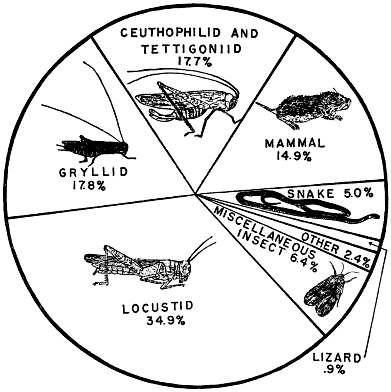
Fig. 13. Diagram showing percentage frequency of occurrence of various categories of prey in a sample of 1008 food items identified from scats and stomachs of blue racers from the Reservation and Rockefeller Tract. Insects, especially, orthopterans, made up the great majority of prey items taken.
The largest sample, based on 1008 food items, was obtained from 479 scats collected from the Reservation and Rockefeller Tract over the period 1949 through 1961. Items recorded were: 183 gryllid crickets (144 Gryllus assimilis, 36 Gryllus sp., 3 unspecified); 353 locustid grasshoppers (41 unspecified, 73 Arphia simplex, 67 Melanoplus femur-rubrum, 66 M. bivittatus, 39 M. differentialis, 17 Melanoplus sp., 15 Dissosteira carolina, 8 Chortophaga viridifasciata, 6 Syrbula admirabilis, 6 Sphargemon equale, 2 Melanoplus scudderi, 2 Schistocerca obscura, 1 S. americana); 94 camel crickets (Ceuthophilus sp.), 93 katydids (36 Neoconocephalus robustus, 15 Orchelimum vulgare, 15 O. nigripes, 6 Conocephalus sp., 4 Orchelimum sp., 2 Amblycorypha inasteca, 1 Neoconocephalus sp., 1 Daihinia brevipes); 7 cicadas (5 Tibicen sp., 1 T. pruinosa, 1 T. lyrica); 45 unidentified insects; 17 beetles (including 1 Phyllophaga, 1 Calosoma scrutator, and 2 other carabids); 2 noctuid moths (Mocis latipes) and 1 caterpillar; 2 homopterans, 1 bee, 1 ant, 1 spider; 69 voles (59 Microtus ochrogaster, 9 Microtus sp., 1 M. pinetorum); 31 white-footed mice (15 Peromyscus leucopus, 14 Peromyscus sp., 1 P. maniculatus); 36 miscellaneous small mammals (6 Cryptotis parva, 4 Sigmodon hispidus, 4 Reithrodontomys megalotis, 3 Blarina brevicauda, 2 each of Scalopus aquaticus, Sylvilagus floridanus, and 1 unspecified shrew); 50 snakes (16 Coluber constrictor, 15 Diadophis punctatus, 14 Thamnophis sirtalis, 4 Elaphe obsoleta, 1 Natrix sipedon); 7 lizards (5 Eumeces fasciatus, 1 E. obsoletus, 1 Cnemidophorus sexlineatus); 3 unspecified "reptiles"; 5 birds (none identified to genus); 3 bird eggs, 1 narrow-mouthed toad (Gastrophryne olivacea).
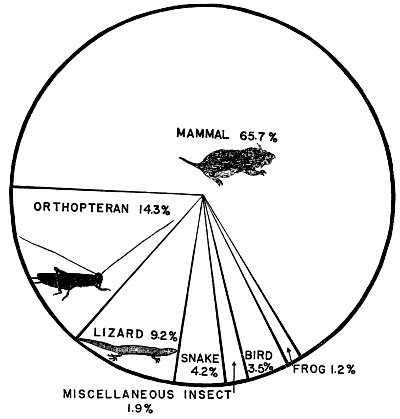
Fig. 14. Diagram showing estimated percentage by weight of various categories of prey in a sample of 1351 items, including all those represented in Fig. 13 and others from various parts of Kansas. Since the vertebrate items are on the average much bulkier than the insects eaten, vertebrates comprise most of the food, even though insects are eaten in much larger numbers.
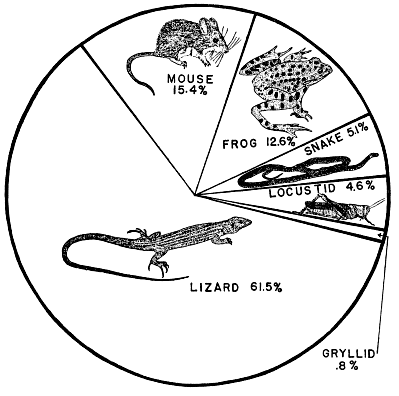
Fig. 15. Diagram showing estimated percentages by weight of various categories of prey in a sample of 69 food items squeezed out of stomachs of the blue racers captured at Harvey County Park. Most of the items were vertebrates, and lizards (Cnemidophorus) were especially prominent in the food at this locality. Samples of prey from scats (included in Figs. 13 and 14) and from stomachs show somewhat different trends, and neither is entirely representative of the actual feeding. Also, local differences in food sources are important.
Over the same period that the sample of scats was collected, a much smaller food sample of 73 prey items was collected by squeezing recently eaten food from the racers' stomachs, or by finding the snakes actually swallowing their prey. These items from stomachs are listed separately because they include relatively more vertebrates than do the items from scats. A grasshopper or cricket eaten by a large racer might have passed undetected, while a relatively large item such as a vole or lizard would have produced a conspicuous bulge in the snake that ate it, and would have excited the curiosity of the investigator. A second difference is that the items from stomachs included several frogs, whereas amphibians were absent from the much larger sample from scats. A third difference is that the many insects found in stomachs were all orthopterans with the exceptions of three noctuid moths and the larva of a moth. Miscellaneous insects, such as beetles, bees and ants recorded from scats were not found in stomachs. Amphibians eaten are digested so completely that no recognizable parts of them are to be found in scats, but remains of the insects previously eaten by amphibians are to be seen in racers' scats. If not recognized as secondary items, such remains might lead to erroneous conclusions regarding the racer's food.
The items from stomachs were as follows: 21 grasshoppers (5 oedipines, 4 tryxalines, 5 Melanoplus bivittatus, 3 M. differentialis, 1 M. femur-rubrum and one each of Chortophaga viridifasciata, Dissosteira carolina, and Sphargemon equale); 8 crickets (Gryllus sp.), 3 katydids, 3 camel crickets (Ceuthophilus sp.), 3 noctuid moths, 1 larva of a moth; 10 voles (Microtus ochrogaster), 6 white-footed mice (5 Peromyscus leucopus and 1 P. maniculatus), 4 harvest mice (Reithrodontomys megalotis); 1 shrew (Cryptotis parva); 4 snakes (3 Thamnophis sirtalis, 1 Storeria dekayi); 4 lizards (2 Eumeces obsoletus, 1 Cnemidophorus sexlineatus, 1 Ophisaurus attenuatus); 4 frogs (Rana pipiens), 1 tree-frog (Hyla versicolor).
Records from the Harvey County, Kansas study area include a series of 69 food items from 55 stomachs (of living snakes) and 210 food items from 113 scats. There is a relatively high proportion of vertebrates, including some frogs, in the stomachs, and with no frogs but more miscellaneous insect material in the scats. But, for the sake of brevity, the two categories of items are combined in the following list: 55 grasshoppers (12 unspecified, 1 "locustid," 31 "oedipines," 7 "tryxalines," 5 "locustines," 2 Melanoplus bivittatus and one each of M. femur-rubrum, M. scudderi, M. differentialis, and Arphia simplex); 48 crickets (31 Gryllus assimilis, 17 unspecified); 14 katydids (11 Daihinia brevipes, one each of rhadiphorine, conocephaline and Neoconocephalus sp.); 9 noctuid moths and 1 moth larva; 26 miscellaneous insects (including 13 "beetles," 1 elaterid, 1 curculionid, 1 lygaeid bug, 1 ant, 1 wasp); 1 spider, 7 mice (5 Peromyscus maniculatus, 2 unspecified), 4 unidentified mammals, 1 vole (Microtus ochrogaster), 1 shrew (Cryptotis parva), 84 lizards (77 Cnemidophorus sexlineatus, 6 Sceloporus undulatus, 1 unspecified), 6 snakes (4 "natricines," 1 Thamnophis sp., 1 Pituophis melanoleucus), 1 "reptile," 1 "bird," 9 frogs (4 unspecified, 1 Rana catesbeiana, 4 Rana pipiens, 1 Rana sp., 1 Pseudacris triseriata).
Kinds of Prey
Throughout the range of the racer small mammals make up an important portion of the food, and the bulk of those eaten are voles (Microtus sp.) and white-footed mice (Peromyscus sp.). The voles being diurnal, and having habitat preferences similar to those of the racer, are especially subject to attack, but only large adult racers are capable of swallowing a full grown vole. Probably most of the voles eaten are immature. Of the white-footed mice, P. maniculatus especially prefers a grassland habitat, and is usually found in situations frequented by the racer. Being mainly nocturnal and crepuscular, it is usually in hiding at times when the racer is prowling, but may be flushed from its nest in a shallow burrow or beneath a sheltering object, and overtaken by the snake. Other mammals that are important in the food are harvest mice and other mice, shrews, and young cottontails. The latter are small enough to be eaten by racers only in the early stages of their life in the nest before weaning. Rats (Rattus, Sigmodon), moles, sciurids, and weasels are less frequent prey, ordinarily too large to be eaten by racers and taken chiefly as defenseless juveniles.
Predation on birds is relatively uncommon, and in most instances it involves the eggs or nestlings, or fledglings still slow and clumsy and incapable of sustained flight, or, occasionally, injured adults. Nests that are vulnerable are chiefly those of ground nesting species, or of kinds that nest near the ground in grass or thickets. Many of the birds recorded have not been identified to species, but those identified have included a variety of small passerines and also domestic chicks.
Lizards figure prominently in most of the food samples, but only a few species, those that live on or near the ground in grassy places, have been recorded. Most of the records pertain to scaly lizards (Sceloporus undulatus and S. graciosus), earless lizards (mainly or entirely Holbrookia maculata), racerunners (Cnemidophorus sexlineatus) and skinks (Lygosoma laterale and Eumeces sp.).
Snakes are important in the racer's food in most parts of the range, but the large racers of the Northeast are those most inclined to ophiphagous habits. The common garter snake (Thamnophis sirtalis) is the species most commonly eaten. Probably this is a matter of availability rather than preference, since the garter snake is one of the commonest and most widely distributed of North American snakes, occurring throughout most of the racer's range. The green snakes (Opheodrys) also are represented frequently. The other snakes eaten are mostly medium-sized to small colubrids, of a variety of kinds. However, there are three records (from Connecticut, Missouri and Kansas) of the racer preying on the venomous copperhead. There are many records of the racer preying on smaller individuals of its own species. In my own records racer remains appeared 18 times, equalling in frequency those of the common garter snake and exceeding all other kinds. In four of these instances the scale remains were relatively few and the scales were relatively large, suggesting as an alternative to actual predation that a racer may have eaten part of its own sloughed skin, or that patches of shed skin may have adhered to the scat after its deposition in the trap. However, in the remaining 14 instances the remains of racer found in scats clearly indicated cannibalism, since the scales found were small and numerous and often were associated with bone. Cannibalism seems to occur frequently enough to be a significant factor in the reduction of the first year young. Liner (1949:230) described two instances of cannibalism in a litter of blue racers hatched in captivity. In one instance two young had seized the same lizard, and one having swallowed the lizard, continued to engulf the other snake, although it was of a size approximately equal to that of the first snake. Nevertheless, swallowing was completed, with the snake eaten pressed in a series of curves. A second instance of cannibalism occurred when one young racer attempting to catch a lizard struck another racer by mistake, then retained its hold and commenced swallowing. A similar instance was observed in a brood that I kept in 1962 after hatching had occurred in the laboratory.
Hatchling turtles of two kinds (Chrysemys picta, Terrapene carolina) have been reported in the racer's food. Probably other kinds are eaten also. However, the awkward shape and almost inflexible shell of the prey on the one hand, and the slender form of the racer, with limited distensibility of the gullet on the other, would limit this type of predation to occasional instances involving an unusually large racer and a small turtle.
There seem to be no records of the racer preying on salamanders. Many kinds of frogs are eaten, chiefly ranids and hylids, and the leopard frog (Rana pipiens) is the most frequent victim. Wright and Bishop (1915:160) stated that the toad (Bufo terrestris) occupied first place in the racer's food in the region of Okefinokee Swamp, Georgia, but they mentioned no specific instances of this species being eaten. Klimstra (loc. cit.) found only four toads in his large sample of digestive tracts from Illinois. Because of their virulent dermal secretions, bufonid toads are avoided by many kinds of snakes and predation on them by the racer probably is unusual.
Most authors who have written concerning the food habits of the racer have mentioned insects as part of the diet. Statements in the literature have often seemed to imply that the racer feeds on insects in general, according to their availability. However, the large number of records now available demonstrate that the racer is highly selective in choice of its insect food, that soft-bodied orthopterans, chiefly crickets, grasshoppers and katydids, are the usual insect prey, with occasional predation on moths and their larvae. Eating of other insects such as cicadas and June beetles, is a rarity, but on occasion a racer may be tempted to sample such prey when it finds the newly emerged imago before its exoskeleton has hardened. I am convinced that such rarely occurring items as carabid beetles, hemipterans, homopterans, diplopods and spiders are secondary prey items, eaten by frogs that later were eaten by the snakes, in most instances if not in all. It is noteworthy that several of the same genera of grasshoppers and crickets are prominent in the food samples collected in widely separated parts of the racer's range.
As might have been anticipated, different species of prey were not utilized by the racers to the same extent throughout the snakes' season of activity. Grasshoppers, for instance, fluctuated from a low of 25.3 per cent (frequency) in the May sample to a high of 41.4 per cent in the September sample. Availability of prey, rather than any change of preference on the part of the racer, explains this trend. Thus, the locust, Arphia simplex, which, unlike most local grasshoppers, overwinters in the adult stage, is most prominent in the food in May, represented by 15.7 per cent, but it decreases progressively to a low of 1.8 per cent in September. The common grasshoppers of the genus Melanoplus show just the opposite trend, increasing during the summer, from a low of 2.62 per cent in May (when all are nymphs and most are too small to constitute a meal worthy of a racer's attention) to a high of 31.5 per cent in September. Mammals are best represented in the food in May, when they collectively comprise nearly 30 per cent of the items taken, and they are progressively less well represented as the summer advances. Both Microtus and Peromyscus conform to this trend, but the relative numbers of Peromyscus rise again abruptly in October. The general trend may be explained by the fact that in May most small mammal populations have a high proportion of young of the year, and these young are especially vulnerable to predation by the snakes. Also, insects in general are less available in spring, and this may force the racers to utilize vertebrates to a greater extent than at other seasons. Actually, the seasonal changes in food sources are not especially striking, and it seems that each important prey species is utilized more or less throughout the season of the racer's activity.
Table 5. Distribution by Months of Various Categories of Prey Items Recorded From Blue Racers From Kansas, Chiefly From the Reservation and Rockefeller Tract
May June July Aug. Sept. Oct.
Cricket (233) .17 .37 .28 .01 .05 .12
Ceuthophilus (94) .01 .19 .30 .14 .13 .23
Katydid (96) .03 .06 .08 .25 .15 .43
Melanoplus (188) .03 .12 .27 .15 .19 .24
All grasshopper (388) .15 .17 .21 .16 .12 .19
Microtus (79) .45 .32 .13 .02 .07 .01
Peromyscus (39) .41 .18 .08 .08 .05 .20
All mammal (162) .41 .25 .14 .03 .05 .12
Lizard (70) .07 .46 .29 .15 .01 .02
Snake (61) .37 .18 .08 .13 .09 .15
Arphia (72) .50 .25 .12 .04 .03 .06
Table 6. Distribution of Various Common Prey Animals in a Sample of 625 Among Racers of Different Size Groups
Kinds of prey and their percentage frequencies in in samples Snout-Vent Length (mm.) of Racers in Sample
200 299 300 399 400 499 500 599 600 to 699 700 to 799 800 to 899 900 to 999 1000 to 1099
gryllid cricket .40 .39 .11 .25 .23 .15 .15 .12 .08
Melanoplus .09 .14 .14 .14 .15 .20 .27 .25
Ceuthophilus .20 .11 .13 .06 .07 .12 .09 .04
Orchelimum .04 .02 .01 .01 .01
tettigoniid .03 .02 .06 .03 .02 .05
"other grasshopper" and miscellaneous orthopteran .30 .25 .10 .09 .03 .12 .07 .09
Arphia simplex .03 .02 .05 .08 .08 .04 .09
miscellaneous insect .04 .04 .09 .07 .04 .08 .05 .04
lizard .20 .09 .18 .09 .07 .11 .01 .01
snake .20 .07 .06 .05 .04 .05 .08 .12
Microtus .04 .02 .08 .13 .09 .12 .25
Peromyscus .09 .02 .05 .06 .03 .05 .04
"other mammal" .01 .04 .10 .03 .03
bird .01 .01
Total prey items for size group 5 23 28 101 120 121 127 76 24
The wide disparity in size between young and adult racers also results in utilization of different food sources to some extent. In some kinds of snakes adults and young draw their food from entirely different sources, but in the racer there is broad overlap, as shown in Table 6. The samples from the largest and smallest size groups of racers are relatively small. Two important kinds of prey—voles and grasshoppers of the genus Melanoplus—were not found at all in the smallest size groups of snakes and comprised increasing percentages in the food of the larger size groups. A large adult vole is too large to be swallowed except by an unusually large racer, and a young vole old enough to leave its nest is far too large for a hatchling racer. Grasshoppers of the genus Melanoplus are relatively large and heavily armored, and so are relatively immune to attacks from the smaller snakes. Small soft-bodied orthopterans including Gryllus, Ceuthophilus and Orchelimum, and also lizards and snakes, are best represented in the food of the smaller racers. Other types of prey showed no definite correlation with size of the racer taking them.
Reproduction
Sexual Behavior
Many observers have published accounts of the courtship and/or mating of the racer, but all of these are, to some degree, incomplete. Because of the widely different circumstances, and the different viewpoints of the observers involved, the several accounts give much different impressions of sexual behavior in this species. Either singly or combined, the published accounts do not provide an adequate description of the process.
My own observations, made both under natural conditions and in large outdoor enclosures, are likewise somewhat incomplete, but indicate that the whole sequence of courtship and mating is divisible into the following well-defined stages: 1) the finding of a receptive female by the male; 2) the persistent following of the female by the male, who courts her by lying extended along her body and performing writhing movements, with periodic interruptions during which he momentarily leaves the female and courses rapidly through the grass around her; 3) the acceptance of the male by the female, signalled by the raising of her tail and the almost instantaneous intromission; 4) the dragging of the passive male by the female while he is firmly attached to her during the period of coitus; 5) separation of the pair and involution of the male's hemipenis.
Even in the breeding season, racers that were confined in enclosures usually were either indifferent to each other or responded with reactions of fear or hostility. In moving they tended to follow the edges, and often two moving in opposite directions would approach each other; when this occurred, one snake might strike at the other with a short jab that seemed to be mostly bluff, and then would dart away. The males, being smaller, were usually the more wary.
Sexual behavior was noticed on only a few occasions. Several large adult males were less wary than others and usually manifested curiosity or interest toward other racers. My most complete observations of sexual behavior were made on May 18, 1962, when a newly caught adult male was added to an enclosure of 100-foot circumference already containing several racers, two of which were large adult females. Within half an hour the male was found courting one of the females. She was lying in a loose coil, with the male extended along her. At my approach the female darted away in alarm for approximately three feet, and the male moved with her, so swiftly and adroitly that he maintained contact and was in approximately his original position with respect to the female when she stopped.
Spasmodic rippling movements passed down the body of the male as he lay in contact with the female. These movements lasted several seconds, increasing in intensity, alternating with longer periods of little or no movement. As each period of vigorous writhing reached its climax, the male's head jerked forward and backward several times in seeming excitement. The female's behavior was mostly passive. She seemed to be receptive, but from time to time, without any noticeable warning, she darted away for several feet as she had when the pair was first discovered. Each time the male darted forward with her, maintaining contact while she moved. These swift movements of the female seemed to be spontaneous, at least in most instances there was no evident cause for alarm. The female's movements seemed to stimulate the male's interest rather than to discourage him. In most instances the female moved only four to five feet, then stopped abruptly or turned back. She would stop in a loose resting coil, in thick grass, with the male lying over her. Often she coiled in such a way that the posterior end of her body was beneath her forebody, but this did not seem to deter the male from moving the posterior end of his body into position beside hers. After a sudden change in the female's position, the rear of the male's body would perform groping movements along that of the female until his cloacal region was approximately opposite hers. The male sometimes had his chin pressed against the female's back, especially when he was moving forward along her, but more often his head was raised, and frequently was as much as 18 inches from the female's head.
At intervals averaging approximately ten minutes, during a little more than an hour of observation, the male would suddenly dart away from the female, and with unusually rapid and animated movements, he would move around her in an irregular and devious course, sometimes as far as five feet away, but usually within 18 inches. Usually on each such expedition several or many circuits were made; then the male would return to the female and would glide rapidly along her until he attained the mating position. A period of especially vigorous courting movements would follow.
At 12:55 p. m. it was necessary for me to discontinue observations, and I left the female confined in a cloth bag. Returning at 1:20 p. m. I found that the male was not displaying interest in the female confined in the bag, nor in the other female loose in the enclosure. The first female was released from the bag, and was out of sight for approximately four minutes. When relocated she was again attended by the male, who was carrying on courtship even more vigorously than he had before. At 1:35 p. m. the male achieved intromission. Although the pair was under observation at the time intromission occurred, the actual eversion of the hemipenis was not seen because the snakes were partly concealed by dense vegetation. There was a sudden flurry of movement, the male's head waving and his body thrashing. In an instant these violent movements subsided, and after a few seconds the female began to crawl forward slowly. The male had relaxed, and relinquished his contact with the female anteriorly. As she moved away he was dragged after her tail-first. He made slight backward wriggling movements that perhaps aided in maintaining sexual contact. The female's restlessness increased, and in eight minutes she dragged the male in a circuitous course a distance estimated to be between 20 and 30 feet. At 1:40 p. m. the pair was ten feet from the point where copulation had begun. The female showed increasing inclination to climb, raising her head and forebody against the trunks of saplings, and finally reaching up one to a branch 20 inches above the ground, and climbing first along the branch and then farther up the main trunk. As she progressed the male was lifted from the ground, dangling limply suspended by his hemipenis and its base had become exposed. At 1:43 p. m. separation occurred and the male dropped into the grass. Semen dripped from the cloacae of both snakes. That from the female was tinged with blood. The individuals involved in this observation were kept in the enclosure subsequently but no further sexual behavior was noted.
Contrary to the popular belief that these racers have permanent mates, all available evidence indicates that they are promiscuous, and two or more males may simultaneously court the same female in the brief spring breeding season. On May 24, 1960, while I was walking in a hilltop field of brome grass, a sudden movement attracted my attention to three racers lying alongside each other. Only the posterior parts of their bodies and their tails were visible. Two were males and were performing the characteristic slow writhing movements against the body of the female from either side. Although the heads were not in view, the snakes may have been able to see me through the screening vegetation; after I had watched for approximately 20 seconds, all three suddenly took alarm, for no apparent cause, and scattered.
Further evidence of promiscuity is provided by the account of Ellicott (1880:207) who wrote regarding the eastern subspecies: "I noticed a ball of black snakes (Bascanion constrictor L) rolling slowly down a steep and stony hillside ... about two miles above Union Factory, Baltimore County, Md. ... kept together by procreative impulses." It was stated that this observation was made in early spring. "Snake balls" have often been observed, and described in the literature; usually the snakes involved were garter snakes (Thamnophis) or water snakes (Natrix). Seemingly, typical aggregations consist of a single adult female and several or many males attempting to mate with her. There is a distinct possibility that the snakes involved in Ellicott's observations were misidentified.
Sexual behavior of the racer is in most respects remarkably similar to that of the common garter snake, Thamnophis sirtalis, well known through the work of Blanchard and Blanchard (1942). In studying sexual behavior of racers, several observers have failed to differentiate between the different stages of the mating process, and have assumed that copulation was occurring when actually only the precopulatory behavior was observed. In an early description of courtship in this racer in Kansas, Brons (1882:365) stated that the female "at times, seems to toy with the male, indisposed to yield to his importunities, though pressed with ardor. To avoid his suit, at times, she will dart through grass, among stones, or enter a crevice. Should he be able to reach his mate while within a hole, he is not slow in bringing her to the surface, again to be repulsed. Upon an unbroken ground the sexual union is less prolonged. Here she is unable to free herself from his quick and effectively directed moves. In case she attempts to quit him, a coil is thrown about her body, and his head laid flat upon her neck, and replaced as promptly as dislodged, evidently in the endeavor to propitiate her."
Another account probably based on courtship rather than copulation is that of Wright and Wright (1957:135), who described the behavior of a pair of C. c. priapus on Billy Island, Okefinokee Swamp in southern Georgia, on May 8, 1921, as follows: "They were stretched out, more or less coiled ... the rear parts of the bodies from the vent were entwined. The female, or smaller one seemed to have its tail around that of the male. There were contortions or quiverings from time to time.... May 8, 1921: Jackson Lee saw black snakes entwined, the male seizing the female by the top of the neck."
Blanchard and Blanchard (op. cit.) have described the dragging of the male by the female during coitus in the garter snake, and the temporarily inseparable bond formed between members of a pair by the recurved spines of the engorged hemipenis, but it has not been generally recognized that the process is much the same in other colubrines. Cottam (1937:229) described and photographed mating in a pair of C. c. mormon in Utah. The copulating racers were shown in a loose coil lying alongside each other with tails intertwined. However, when disturbed by the observers, these racers made frantic efforts to escape, crawling in a spiral course, while remaining attached and intertwined, "with no evident attempt to separate" during approximately a quarter hour of observation.
The racer is notorious for its aggressive behavior and occasional alleged attacks on humans in the breeding season. The tendency has doubtless been much exaggerated, especially in the verbal second- or third-hand accounts based on the alleged observations of eye-witnesses. Nevertheless, the supposition that large adults will sometimes pursue or attack humans when disturbed is well substantiated. In most of the instances known to me, it is the large eastern subspecies, C. c. constrictor, involved in these incidents, and seemingly the smaller racers of the Middle West, far West and South are less inclined to behave aggressively. In May 1958 two pairs of large racers were confined in a semicircular wire enclosure thirty feet across and open on top, and with natural vegetation, at the Reservation headquarters. Often in approaching the cage I saw two or more racers in close association, but because of sheltering vegetation, and the snakes' timidity observation was difficult. On May 19 a pair were lying partly extended in loose coils, but immediately the female took alarm and darted away, breaking loose from the male; his hemipenis was exposed, and underwent involution and retraction in approximately 30 seconds. Unlike the female, the male on this occasion did not attempt to escape, but turned to face me with a show of aggressiveness. Probably copulation was in its final stages when the disturbance occurred.
Circling of the female racer by the male from time to time in the course of courtship has not been recognized by previous observers as a part of the mating pattern, but Pope (1944:171) described somewhat analogous behavior, probably modified by unnatural conditions of captivity and the crowding of many racers in one cage. Pope, citing earlier observations by Noble, wrote: "When sexually excited, the male blacksnakes dash wildly about before paying court to individual females. In captivity these dashes excite all specimens confined together. A male, after picking out a mate, moves his chin lightly along her back, while undulations run forward along his sides and he extends his tongue now and then. Later he throws the part of his body near his vent over the corresponding part of the female, the two tails sometimes becoming loosely intertwined."
Recorded dates of mating for the species are all in spring, but indicate a span of many weeks for the breeding season, and this spread results in part from geographical differences. Published records are as follows:
Subspecies constrictor
May 12, 1930, in Ohio (Conant, 1938:55)
Subspecies priapus
May 8, 1921, in Georgia (Wright and Wright, 1957:135)
May 9, 1921, in Georgia (Wright and Wright, 1957:135)
Subspecies flaviventris
May 3, 1931 (two pairs) in Missouri (Boyer and Heinze, 1934:195)
April 18, 1936, in Missouri (Anderson, 1942:210)
May 12, 1928, in Kansas (Gloyd, 1928:123)
Subspecies mormon
June 10, 1927, in Utah (Cottam, 1937:229)
July 7, 1938, in California (Cunningham, 1959:17)
In the course of my live-trapping, I occasionally found more than one racer in a trap. As might be expected from the low yield per trap, such double or multiple captures were relatively rare. Chance, and unusually strategic placement of certain traps were doubtless contributing factors. May and October, being the most productive months for trapping, yielded a high proportion of these combined captures. Some involved an adult and an immature snake, or two adults of the same sex. Eliminating all these, there remain 44 heterosexual captures of adults. These latter captures are significantly concentrated in their seasonal distribution and indicate a spring breeding season; 34 were in May, six were in June and four were in October. Eight of the May records and one June record each involved a trio of snakes—two males and a female in every instance. Distribution of the spring records, grouped in five-day intervals, was as follows:
May 11 to May 15: 14
May 16 to May 20: 5
May 21 to May 25: 8
May 26 to May 30: 13
May 31 to June 4: 1
June 5 to June 9: 0
June 10 to June 14: 2
June 15 to June 19: 2
June 20 to June 24: 0
June 25 to June 30: 1
Approximately 87 per cent of the records fell in the twenty-day interval, May 11 to 30, which is regarded as the main breeding season. Presumably males continue to be at the peak of breeding condition and continue to search for females after the latter have become unreceptive, partly explaining the scattering of records through most of June.
Several of the females found in traps with males in May had abundant active sperm in their cloacae and oviducts and probably had been inseminated within a few hours of the time they were checked. Others lacked sperm, but the cramped quarters inside the traps may have effectively prevented the consummation of courtship, especially when two males were confined with the same female. None of the females trapped with males in October was found to be inseminated, and it seems doubtful whether copulation ever occurs at that time of year, although males have motile sperm and seem to be in breeding condition then.
Cycle of the Male
Cloacal smears indicate that males mature sexually and first produce sperm in August and September when they are a little more than a year old. Insofar as could be determined, there was no sexual activity at this time of year, and actual breeding of the adolescent racers was postponed until the following May. By this time at an average age of 20 months, the snakes had made further growth.
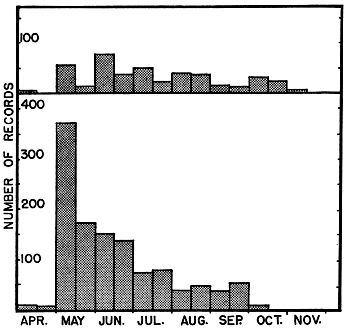
Fig. 16. Catches, in semi-monthly periods, of racers in their summer habitats, at Harvey County Park (upper) and at Reservation and Rockefeller Tract (lower). Intensive activity in spring (the breeding season), tapering off rapidly as the season advances, is well shown by the larger sample, but in the years of trapping at Harvey County Park operations usually were not fully underway until the latter part of May.
Mr. Dwight R. Platt studied the changes in the male reproductive organs during the annual cycle at Harvey County. In racers recently emerged from hibernation he found the seminiferous tubules filled with Sertoli syncytium, but containing few germ cells. Spermatogonia proliferate in May and June. During the first half of July primary spermatocytes are the dominant cells in the seminiferous tubules. By early August spermatids are dominant and the first free spermatozoa are present. In late October spermiogenesis is essentially complete and the tubules are relatively empty before the snakes hibernate. During the season of activity the seminiferous tubules increase to approximately double their minimum diameter, reaching the maximum in August. Cyclic changes in size and secretory activity of the ductus deferens, ductus epididymis, and sexual segment of the renal tubules occur, with maximum size and secretory activity coinciding with the time of movement and storage of the spermatozoa. The latter are stored in both ductus deferens and ductus epididymis. Despite the short breeding season, a male racer has active sperm at all seasons.
Eggs
In accounts of the racer in the humid southeastern United States, Brimley (1903:261), Wright and Bishop (1915:160) and Tinkle (1959:195) mentioned the ease with which the eggs might be found and the superficial situations in which they were sometimes deposited. Both Wright and Bishop, and Tinkle made field studies in swamps, where presumably the subsoil was saturated with moisture and too wet for the eggs. Tinkle mentioned finding one clutch beneath a discarded newspaper and another beneath a small, thin board. Surface (1906:167) stated that in Pennsylvania the eggs were to be found in loose soil, in sawdust piles, or in decaying wood of hollow logs or trees. Clark (1949:249) stated that in northern Louisiana the eggs are laid in soft, moist soil such as may be found beside decaying logs. Minton (1944:457) found two clutches under flat stones on hillsides in Indiana. In the more arid climates of the far western states the species' habits are much different in this regard. Through many years of familiarity with C. c. mormon, I have never seen its eggs. Presumably nests in this part of the range are deep underground, most often in old burrows of the pocket gopher (Thomomys), which are so abundant that in many areas the soil is riddled with them. Burrows of the ground squirrels (Spermophilus sp.) and other small digging mammals also provide potential insulated nest sites with the favorably moderate temperatures and high humidities that the eggs of snakes require.
On the morning of July 10, 1962, I was directed to the sites of two clutches recently plowed up, 11/2 miles north of the Reservation (Pl. 21, Fig. 2). The eggs were in a fallow field having a stand of sunflowers three to five feet high. The plow blades turned the soil at a depth of approximately seven inches. In each instance only a few eggs were visible. They were well scattered in the loose soil turned up by the plow; 21 were found in one clutch and 10 in the other. All the eggs were intact except two that had minute punctures from which liquid oozed. Seemingly the eggs in situ had been well above the level of the blade—at depths of four to five inches. No nest cavities were discernible where the eggs were found, but elsewhere in the field tunnels of moles (Scalopus aquaticus) and prairie voles (Microtus ochrogaster) were exposed by the plow. Presumably the eggs had been in such tunnels, which had disappeared as the loose soil crumbled. Another clutch was discovered in an adjoining field on July 16. The nine eggs were at depths ranging from 61/2 to nine inches, and only the two topmost eggs had been turned up by the plow. All three clutches were within a few feet of the edges of the fields.
On the Reservation and nearby areas I have seen remains of an estimated 20 clutches that have been destroyed by predators. The remains in every instance consisted of an excavation, and the strewn torn and empty eggshells. Nests were at depths of four to eight inches in old tunnels, which most often seemed to be those of moles but also included some of the prairie vole, and perhaps some of the pine vole (Microtus pinetorum). All these nests were in open sunny places in prairie or pasture habitat.
Table 7. Numbers and Sizes of Eggs in Clutches of the Blue Racer From Eastern Kansas
Number of Eggs Lengths (mm.) Widths (mm.) Weights (grams) Snout-vent length of female (mm.)
17 26.5(29-24) 17.0(19.0-16.5) 5.5(6.0-4.4) 892
8 33.3(39-31) 16.3(17.5-14.0) 6.0(6.7-5.6) 899
12 29.1(32-25.5) 17.1(18.5-16.0) 4.9(5.2-4.4) 773
14 26.9(30-24) 19.2(20-18) 5.2(6.2-4.4) 772
10 31.7(33-29) 16.5(18-15) 6.0(6.5-5.6) 807
11 29.7(33-27) 16.7(18-15) 5.4(5.8-5.0) 858
21 28.9(32-27) 18.4(19.5-18) 5.9(6.3-5.6) 1038
13 30.7(34-28) 19.3(20-18) 6.8(7.5-6.1) 907
18 29.0(30-26) 17.9(19-16) 4.9(5.5-4.3) 911
12 30.3(34-28) 17.8(19-15) 5.2(6.1-3.8) 843
14 30.9(36-29) 19.4(21-18) 6.8(7.6-6.2) 846
Many observers have described the eggs of the racer, which are white, elliptical, somewhat elongate, with tough, leathery, somewhat flexible, shells, and a granular surface. Like other snake eggs, those of the racer gradually absorb moisture during incubation. They become more turgid and increase in weight and dimensions, especially in breadth, and by the time of hatching are nearly twice their size at laying. Between different clutches and even within the same clutch there is notable variation in the size of the newly laid eggs. Munro (1948:199) noted that in a small adult racer kept by him, the eggs laid were larger but less numerous than those produced by a large adult. Munro noted also that shape of eggs in the two clutches differed; the smaller snake produced more elongate eggs of smaller diameter. The idea that eggs laid by the smaller females are more slender and elongate is not supported by my own data. For 11 clutches of eggs examined soon after laying, dimensions, weights, and the lengths of the females are shown in Table 7.
In a clutch of eggs beginning to hatch on September 3, 1958, dimensions and weights were as follows: length 31.8 (36-30), diameter 22.0 (24-21), weight 9.7 (10.3-9.3).
Gravid females that were kept in captivity in anticipation of their laying usually produced their clutches within a few days. The laying dates of such individuals are shown in the following list. Those with asterisks were from the Harvey County study area, others were from the Reservation and Rockefeller Tract.
June 19, 1961 June 21, 1959 June 23, 1961* June 26, 1959 June 29-30, 1962* July 1, 1961 July 4-5, 1962* July 6, 1955 July 7, 1959* July 7, 1959* July 12, 1961 July 15, 1961* July 18, 1961* July 20, 1961 August 8, 1960*
A further indication of the period when laying occurs was provided by the appearance of females gravid and progressively more swollen with eggs, then their abrupt disappearance and replacement by thin and wrinkled individuals that obviously were recently parturient. The following records show the course of these events on the Reservation in the years when summer trapping was done with sufficient consistency. These dates provide a rough approximation of the time when laying occurs locally. They indicate a laying season concentrated in a period of approximately three weeks in this locality. Records from published literature also indicate that laying occurs in late June and early July at the latitude of Kansas, but somewhat earlier in the southern United States.
Table 8. Dates When Parturient and Gravid Racers were Captured on Reservation and Rockefeller Tract in Several Years, Indicating Time of Oviposition
Year 1958 1959 1960 1961 1962
First parturient female June 18 June 17 June 22 June 20 June 13
Last gravid female July 8 July 11 July 5 July 12 July 16
Many authors have made statements regarding the size of the clutch in the racer, on the basis of those found in the field, those laid after capture, or those dissected from gravid females. Some of the statements were based upon small but unspecified samples, and are far from the mark. From records accumulated in the course of my own field work, and a summarization of those in published accounts a substantial sample is available showing the usual size of clutch in the area of my study, and the trends of geographic variation in some parts of the range.
C. constrictor (all combined) 151 clutches averaged 10.61 (2 to 31) eggs.
C. c. constrictor 14 clutches averaged 16.80 (7 to 31) eggs.
C. c. priapus 11 clutches averaged 12.60 (7 to 21) eggs.
C. c. mormon 43 clutches averaged 5.79 (2 to 13) eggs.
C. c. flaviventris 82 clutches averaged 11.78 (5 to 26) eggs.
C. c. stejnegerianus, one clutch contained 10 eggs.
In the foregoing list the sample of C. c. flaviventris may be divided as follows:
Reservation and vicinity: 36 clutches averaged 11.65 (6 to 21) eggs.
Harvey County study area: 21 clutches averaged 12.0 (5 to 18) eggs.
Museum specimens from Kansas: five clutches averaged 9.2 (6 to 14) eggs.
Published records (Kansas, Indiana, Iowa, Louisiana, Missouri, Oklahoma, Texas): 20 clutches averaged 12.5 (5 to 22) eggs.
Table 9. Published Records Indicating Dates of Laying in Different Populations of Coluber constrictor
Date of Laying Subspecies Area Authority
June 9, 1952 flaviventris SE Texas Guidry (1953:50)
July 1-2, 1920 flaviventris Texas Ortenburger (1928:183)
June 1, 1920 flaviventris Texas Ortenburger (1928:183)
June 9, 1926 flaviventris Oklahoma Force (1930:31)
June 24, 1926 flaviventris Oklahoma Force (1930:31)
July 19, 1928 flaviventris Oklahoma Force (1930:31)
July 16 flaviventris Oklahoma Carpenter (1958:114)
July 4-5, 1948 flaviventris Kansas Munro (1948:199)
July 4, 1948 flaviventris Kansas Munro (1948:199)
June 26, 1930 flaviventris Ohio Conant (1938:55)
July 3, 1961 mormon NW Oregon Van de Velde, Martan and Risley (1962:212)
June 7, 1957 priapus S Illinois Rossman (1960:219)
June 19, 1912 priapus S Georgia Wright and Bishop (1915:160)
July 10, 1940 priapus S Illinois Cagle (1942:187)
July 6 constrictor New York Ditmars (1907:284)
June 27-July 5, 1951 constrictor Virginia Werler and McCallion (1951:251)
June 5, 1947 stejnegerianus S Texas Auffenberg (1949:54)
Published records of clutches laid by racers, from which figures used in the foregoing account were obtained, include the following:
C. c. constrictor: 22 (Barbour, 1950:104); 21, 13 (Brimley, 1903:261); 25 (Conant, 1938:55); 8 (Ditmars, 1907:284); 7, 12, 14, 16, 19, 20, 31 (McCauley, 1945:76); 14 (Wright and Wright, 1957:136).
C. c. flaviventris: 7 (Anderson, 1942:210); 22 (Brumwell, 1951:205); 11 (Carpenter, 1958:114); 8, 9, 9 (Force, 1930:31); 10 (Guidry, 1953:50); 18 (Liner, 1949:230); 5, 8, 17 (Marr, 1944:484); 5, 14 (Munro, 1948:199); 13, 19 (Ortenburger, 1928:183); 6, 15 (Tinkle, 1959:195); 15, 19 (Wright and Wright, 1957:141).
C. c. priapus: 20, 21 (Cagle, 1942:187); 7 (Conant, 1938:55); 19 (Rossman, 1960:219); 5, 9, 11, 14 (Wright and Bishop, 1915:160); 16 (Wright and Wright, 1957:147).
C. c. mormon: 13, 9, 8, 5, 5, 5, 4, 4 (Cunningham, 1959:17); 5, 6 (Stebbins, 1954:374); 6 (Van de Velde, Martan and Risley, 1962:212); 3, 6 (Wright and Wright, 1957:144):
C. c. stejnegerianus: 10 (Auffenberg, 1949:54).
In general, the number of eggs in the clutch is proportional to the size of the female producing them. The larger and bulkier females produce more eggs. Geographic trends in number of eggs produced are perhaps controlled by differences in size between different populations; thus, the large eastern constrictor produces nearly three times as many eggs per clutch as does the small western mormon, whereas the centrally located flaviventris is somewhat intermediate in size and in numbers of eggs produced.
In most reptiles growth in length and bulk continues after attainment of sexual maturity. For many kinds including Eumeces fasciatus, Crotaphytus collaris, Cnemidophorus sexlineatus, Agkistrodon contortrix (Fitch, 1954:60; 1956:236; 1958:36; 1960:174), and Sceloporus olivaceus (Blair, 1960:94), it has been shown that the larger and older females in a population produce more offspring than do the smaller and younger individuals. This situation applies in the racer, as shown by the clutches of 52 females correlated with their sizes and presumed ages (Fig. 17, Table 10). The two-year-olds contribute a relatively small quota to the annual brood, partly because their clutches are small, but more especially because many of them fail to attain sexual maturity in time to breed. Many of the female racers that are more than two years old also fail to produce an annual clutch of eggs. The 24-day period May 28 to June 20 inclusive is judged to comprise the period when eggs have generally enlarged sufficiently to be detected in gravid females, but still have not been laid in most instances. In this period, in 1960, 1961 and 1962, ratios of gravid females to those not detectably gravid in several supposed age groups arbitrarily established on the basis of size, were as follows:
Two-year-olds 2 gravid, 13 apparently not gravid
Three-year-olds 5 gravid, 4 apparently not gravid
Four-year-olds 3 gravid, 2 apparently not gravid
Five-year-olds 4 gravid, 3 apparently not gravid
Six-year-olds (or older) 8 gravid, 2 apparently not gravid
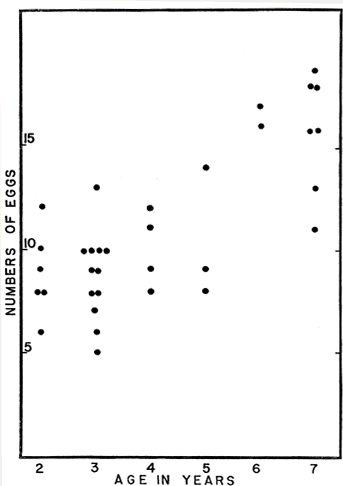
Fig. 17. Graph showing number of eggs per clutch, and correlation with supposed age (as deduced from length of body) in female blue racers from the Reservation, Rockefeller Tract, and Harvey County Park.
From the appearance of these snakes it is reasonably certain that none had already laid eggs when it was recorded, but there is some possibility that a few individuals not noticeably gravid at the times they were examined, produced eggs subsequently. However, these meager data do seem to indicate that most of the two-year-old females and a minority of older individuals fail to produce clutches in the annual breeding season.
Table 10. Fecundity of Female Racers in Various Age-size Classes, All From the Reservation and Rockefeller Tract
Most Probable Age in Years of Females (as indicated by size) Number of females in sample Snout-vent length of females; average and extremes Number of eggs in clutch
2 10 688 (589-748) 9.2 (6-12)
3 19 789 (756-840) 9.9 (5-14)
4 7 856 (850-861) 10.8 (8-12)
5 6 907 (892-933) 13.0 (8-17)
6 or more 10 1005 (955-1088) 15.7 (11-19)
Under unfavorable conditions eggs can be resorbed, but probably this can occur only if initiated before ovulation. A racer in which six small eggs were palped on June 28, 1960, was kept until July 23 but did not oviposit. It no longer appeared gravid and the ova could not be detected by palpation. Another female had 13 eggs on June 21, 1960, but by July 23 when the snake was released the eggs had not been laid and no longer could be detected. Both snakes refused to feed throughout their confinement.
Like other reptilian eggs, those of the racer are dependent upon the warmth of their surroundings for incubation. They are tolerant of a wide range of environmental temperatures, but the higher the temperature the more rapidly incubation proceeds. Under natural conditions there may be much difference in hatching time in two clutches laid at the same time and in the same locality. Site of the nest—deep and well insulated, or shallow; in a well shaded situation or one exposed to maximum amounts of sunshine—would largely control rates of development. Clark (1949:249) writing of the subspecies anthicus in north-central Louisiana, stated: "eggs are laid about the first of June.... young begin to make their appearance at about ... July 1." Even for the southern states these dates of laying and hatching seem somewhat too early to reconcile with the records published by other observers, and are in need of verification, especially since they seem to be based upon vaguely remembered observations rather than upon written records. At the other extreme Surface (1906:167) wrote of constrictor in Pennsylvania that hatching may occur as late as October, and that there is evidence some young may even remain in the egg over winter before hatching occurs. Several incubation periods are on record for clutches laid and hatched in captivity, as follows:
C. c. mormon, Oregon, 47 and 51 days (laid July 3, 1961, hatched August 19 and 23; Van de Velde, Martan and Risley, 1962:212).
C. c. stejnegerianus, Texas, 73 days (laid June 5, 1947, hatched August 17, Auffenberg, 1949:54).
C. c. priapus, S. Illinois, 58 and 59 days (laid July 10, 1940, hatched September 6 and 7, Cagle, 1942:187).
C. c. flaviventris, Kansas, 50 days (laid July 4 and 5, hatched August 23 and 24; Munro, 1950:124).
C. c. flaviventris, Texas, 43 days (laid June 9, 1952, hatched July 22; Guidry, 1953:50).
No incubation periods for eggs in natural nests have been recorded. In the course of my study, eggs obtained from 12 captive females were hatched in confinement, with an average incubation period of 51 days (43 to 63) as follows:
Laid July 6, 1955, hatched August 20. Laid July 3, 1958, hatched September 3 and 4. Laid June 21, 1959, hatched August 17. Laid June 26, 1959, hatched August 17. Laid July 7, 1959, hatched August 23 to 25.* Laid June 23, 1960, hatched August 20.* Laid June 30, 1961, hatched August 30. Laid July 15, 1961, hatched September 1 and 2.* Laid July 18, 1961, hatched September 2 and 3.* Laid July 4 and 5, 1962, hatched August 15 and 16.* Laid June 29 and 30, 1962, hatched August 14 and 15.* Laid July 6, 1962, hatched August 16 to 20.*
In the foregoing list those entries marked with asterisks were obtained from the Harvey County study area; all others were from the Reservation and Rockefeller Tract.
Hatching
Detailed observations on hatching were made on a clutch of eggs laid on June 29 and 30, 1962, by a female caught in Harvey County. The first egg in the clutch had already been laid in the trap when the female was found at 11:30 a. m., June 29. Two of the eggs were abnormal, with thin transparent shells, and were found to lack embryos when they were opened on July 7. Later, two other eggs were attacked by mold and the embryos died early in development. The clutch was kept in a can of slightly damp soil. At 2:30 p. m. on August 13, when the clutch was examined, egg no. 6 was found to have hatched. The young snake had made a 21-millimeter slit in the shell. At 12:50 a. m. on August 14, it was discovered that eggs 1, 4, 5 and 7 each had been slit. No. 4 had two parallel slits separated by a two-millimeter strip of shell, and the young racer could be seen inside. At 1:05 a. m. this young snake had changed position and was lying upside down in the egg, his snout protruding slightly through one of the slits. At 1:45 a. m. he was again right side up, still in the shell. At this time each of the slit eggs showed the protruding snout of a young snake. Occasionally the viscous liquid egg white would be blown into a large bubble on the surface of the shell as the young snake exhaled. A third slit, parallel to the others, had appeared in egg no. 4. A hatchling emerged from egg no. 1 between 2:20 and 3:20 a. m., and another from no. 7 between 7:00 and 9:00 a. m. The hatchling struck vigorously many times, and vibrated his tail when he was disturbed. Egg no. 3 was first slit between 7:00 and 9:00 a. m., and three more slits appeared in it between 9:15 and 10:15 a. m. At 12:45 p. m. a hatchling was found in the act of emerging from egg no. 4, and approximately the anterior one-fourth of its body protruded. Disturbed by the movements of the observer, the little snake drew back into its shell. This hatchling began to emerge again at 12:50 and his hatching was completed at 1:00 p. m. Between 5:40 and 6:20 p. m. a hatchling emerged from egg no. 3 (for several hours this hatchling had been lying on its back inside the egg, with only its snout protruding); two slits appeared in egg no. 2 and three slits appeared in egg no. 8. At 6:50 p. m. the hatchling in the latter thrust his snout through the slit in this eggshell. This hatchling was lying on its back at first but by 10:50 it had shifted to a normal position. It emerged from the shell between 2:35 and 2:50 a. m. Egg no. 2 was the last to hatch. At 7:05 p. m. the hatchling inside made two additional small slits in the shell, and at 7:30 p. m. thrust its snout through one of them, while lying on its back. At 1:45 a. m. it was right side up, but at 3:00 a. m. had reverted to its previous position. At 4:40 a. m. it was again right side up, and it emerged from the shell at 5:55 p. m.
On August 17, at 11:00 a. m., hatchlings no. 5 and no. 6 had lost their egg teeth. All others still had their egg teeth then, but by 10:00 p. m. that of no. 8 was missing, and that of no. 4 was loose and dropped out while the snake was being handled. On August 20 at 9:00 a. m., hatchling no. 7 had lost its egg tooth; nos. 2 and 3 retained theirs only in part, and no. 1 had its egg tooth intact. By noon on August 22 no trace of an egg tooth remained on any of the hatchlings.
In the same group of hatchlings sign of impending molt was first noticed on the morning of August 17, when no. 6 was noted to have its eyes clouded and milky in appearance. By evening no. 1 had attained the same stage and no. 7 was beginning to show it. On the morning of August 20, shedding had begun in no. 6, while no. 2 and no. 8 had milky eyes. The eyes had cleared in no. 1 and no. 7, and were still clear in the remaining hatchlings. On August 22 shedding had been completed by no. 1 and no. 8, and all others were in the process of shedding.
Another clutch of 14 eggs from a recently captured female was found freshly laid in a cage on July 6, 1962. Hatching of 13 occurred August 16 to 20, as shown in Table 11.
Table 11. Times of Hatching in a Clutch of Racer Eggs From Harvey County Park
Number of Egg Time at which shell was slit by hatchling Time that hatchling emerged
Day Hour Day Hour
1 Aug. 17 10:50 a. m. Aug. 18 3:00 to 6:00 p. m.
2 Aug. 17 12:15 to 12:50 p. m. Aug. 18 3:25 to 4:25 p. m.
3 Aug. 17 1:40 p. m. Aug. 17 10:45 p. m.
4 Aug. 18 3:00 to 6:00 p. m. Aug. 19 before 7:00 a. m.
5 Aug. 16 10:45 a. m. Aug. 17 6:30 to 7:55 a. m.
6 Aug. 17 9:00 a. m. Aug. 18 6:30 to 7:30 a. m.
7 Aug. 17 4:15 p. m. Aug. 20 1:00 to 7:00 a. m.
8 Aug. 17 3:40 p. m. Aug. 18 5:00 to 6:00 p. m.
9 Aug. 17 7:30 p. m. Aug. 18 6:30 to 7:30 a. m.
10 Aug. 16 10:48 a. m. Aug. 17 11:05 a. m.
12 ? no record Aug. 18 6:00 to 6:30 a. m.
13 Aug. 17 8:00 to 8:20 a. m. Aug. 17 5:30 to 5:50 p. m.
Growth
Hatching usually occurs in late August or early September, and the disparity in size between hatchlings and adults is greater than in some other kinds of snakes. In 76 young from ten clutches of eggs incubated in the laboratory, averages and extremes for measurements and weights were as follows: snout-vent length, 214.5 (186 to 244) millimeters; tail, 59.3 (44 to 73) millimeters; weight, 4.16 (2.4 to 5.8) grams. In each brood the size tended to be fairly uniform, except that there were usually one or more stunted individuals markedly smaller than the others. However, there were striking differences in size between the young of different broods. None of the young captured was as small as the average hatchling from the clutches incubated in captivity, but in the 14 years of my study only four young were captured in August. The hatchlings are relatively secretive and elusive, and the lush vegetation of late summer provides them with abundant hiding places. Nevertheless it is remarkable that the hatchlings are so seldom seem, when their probable abundance is taken into account.
Probably all of those captured had already made some growth after hatching. By early November or the last week of October, racers have almost or quite completed their season of activity, and are at the hilltop ledges, preparing to hibernate, if they have not already retired into dormancy. For 25 young of the year captured in this period at the end of the growing season, measurements and weights were as follows: snout-to-vent, 327 (273 to 418) millimeters; tail 93 (72 to 114) millimeters; weight, 12.3 (7 to 19) grams. In the ten-week period between hatching and hibernation these young had already passed through their period of most rapid growth, having added, on the average, more than 50 per cent to their original lengths, and almost tripled in weight. In these young about to enter their first hibernation, variation in size and weight is much greater than in the hatchlings; some have fared much better than others, and there are significant age differences. Within any one year the time of hatching is spread over several weeks because of differences in the time of laying, and differences in nest sites, with variation in heat received, which promotes or delays the rate of incubation. Year to year differences in the trend of weather increase the dispersion as the incubation time is shortened in hot, dry summers and lengthened in those that are relatively cool and moist.
Table 12. Growth of First-year Racers
Sex Original record Record(s) of recapture
Date Snout-vent length, millimeters Weight, grams Date Snout-vent length, millimeters Weight, grams
♂ Aug. 17, 1959 223 5.3 Sept. 12, 1960 503 42
♀ Oct. 26, 1959 278 10 Oct. 26, 1959 566 55
♀ Nov. 2, 1959 340 18 May 11, 1961 582 65
♀ Nov. 10, 1959 348 13.7 June 20, 1961 733 127
♀ Oct. 19, 1952 361 15.3 Oct. 9, 1953 620 68
♂ May 9, 1953 368 17 May 13, 1954 609 84
♀ April 16, 1950 328 142 Oct. 10, 1950 603 78.2
♀ May 17, 1956 358 15.2 Oct. 6, 1956 575 52
♂ Nov. 1, 1953 330 11 May 21, 1955 674 92
Though covering a wide size-range, the young of the year entering hibernation are still a distinct size group, not yet overlapping that of the next older group of young. Growth during the first year of life is best shown by the individuals in Table 12, all of which were marked either before their first hibernation or soon after emerging from it, and were recaptured either the following autumn, or in spring soon after emerging from a second hibernation.
These records indicate that the young racers at the time of their second hibernation have grown to a snout-vent length of well over 500 millimeters, but less than 700 millimeters, and a weight of more than 40 grams but less than 100 grams. Other racers marked in the first few weeks of life were recaptured after two or more seasons of growth, and indicate the sizes that may be expected in young adults from two to five years old, as shown in Table 13.
Table 13. Growth of Racers Marked at an Age of Less Than One Year and Recaptured in Their Second, Third or Fourth Years
Sex Original record Record(s) of recapture
Date Snout-vent length in mm. Weight in grams Probable age in months Date Snout-vent length mm. Weight in grams Probable age in months
♂ Nov. 12, 1952 342 .... 21/2 May 20, 1955 702 110 33
♂ Nov. 1, 1953 330 11 2 Aug. 16, 1956 780 162 351/2
♂ Nov. 12, 1953 293 .... 21/2 May 14, 1956 634 96 321/2
Oct. 13, 1956 689 110 371/2
♂ April 15, 1955 320 13 91/2 June 8, 1958 740 118 45
♂ Oct. 2, 1955 348 18 1 May 22, 1958 728 120 33
May 21, 1960 795 130 57
♂ June 25, 1959 378 10 10 June 30, 1960 590 60 22
June 7, 1961 705 123 33
♂ Nov. 1, 1953 330 11 2 Aug. 25, 1957 805 183 48
Unlike young of the year, racers in their second autumn were trapped in large numbers. By this time all were large enough to be caught in the traps of quarter-inch wire mesh, and they were the most abundant size group. Many that were marked at this stage were recaptured after intervals of months or years, showing the trend of growth. Some of these snakes in their second autumn already had overtaken the more retarded third-year individuals. The two age classes cannot be separated with certainty. Selected records of individuals that were almost certainly second-year young at the time they were marked are presented in Table 14.
Table 14. Growth of Young Racers That Were Marked Near the Time of Their Second Hibernation
Sex Original record Record(s) of recapture
Date Snout-vent length in mm. Weight in grams Probable age in months Date Snout-vent length in mm. Weight in grams Probable age in months
♂ Oct. 6, 1960 595 80 13 July 23, 1961 650 70 23
♂ Oct. 13, 1950 525 52.6 131/2 Oct. 2, 1951 675 105 25
♂ Nov. 2, 1950 545 55.6 14 Oct. 24, 1951 670 100 26
♂ Sept. 2, 1957 522 57 12 Oct. 14, 1958 690 103 251/2
♂ Oct. 17, 1953 558 47 131/2 May 10, 1955 718 .... 32
♂ Nov. 14, 1956 587 57 141/2 May 20, 1958 728 100 521/2
June 17, 1959 880 219 641/2
♂ Sept. 7, 1959 533 45 12 June 6, 1961 740 112 33
♂ Oct. 17, 1959 558 56 131/2 July 21, 1960 625 63 221/2
June 7, 1961 670 95 33
♂ Oct. 16, 1952 577 62.0 131/2 May 31, 1955 809 160 45
May 11, 1956 855 144.3 561/2
♂ Oct. 11, 1950 570 65.9 131/2 July 11, 1956 820 193.6 821/2
♂ Oct. 14, 1953 560 52 131/2 June 29, 1958 794 256 70
♂ Oct. 6, 1950 563 55.8 13 Sept. 28, 1958 907 243 109
♂ Oct. 14, 1953 523 44 131/2 May 19, 1959 818 190 801/2
May 17, 1960 850 211 921/2
♂ Oct. 13, 1953 521 50.1 131/2 May 13, 1958 814 166.4 441/2
June 3, 1959 826 165 47
♂ Nov. 5, 1953 512 34 14 May 22, 1958 847 135 69
♀ Aug. 11, 1953 534 39.2 111/2 Sept. 18, 1954 670 143 241/2
♀ Oct. 14, 1949 588 55.2 131/2 Oct. 11, 1950 713 114.0 251/2
♀ Oct. 6, 1950 570 60.4 13 Oct. 11, 1951 783 174 251/2
♀ Oct. 31, 1953 582 58 14 Oct. 5, 1954 860 195 25
♀ Oct. 21, 1959 588 63 131/2 May 7, 1961 730 120 32
♀ May 14, 1960 506 34 201/2 Oct. 26, 1960 690 90 26
♂ Oct. 22, 1960 527 45 131/2 Oct. 7, 1961 620 74 25
♂ May 3, 1960 530 48 20 May 16, 1961 700 110 321/2
♂ May 27, 1961 535 40 21 Oct. 25, 1961 672 98 26
From the records in Table 14 and many more like them, average and extreme sizes for progressively older age groups were estimated. Even racers that were already of adult size when they were marked were tentatively identified with one or another age group, and their records of subsequent growth were used. Most of the records show that the females grow more rapidly than the males, and are, on the average, larger at any given age.
Relatively few individual racers were recaptured after periods of several years. Each of the eight listed in Table 15 is among those that were captured in four or more different years, and their records are significant in revealing the trend of growth after sexual maturity has been attained. These snakes, one to three years old at the time they were marked, show well the persistent but decreasing growth, and the fluctuating weight that is characteristic of this and other species.
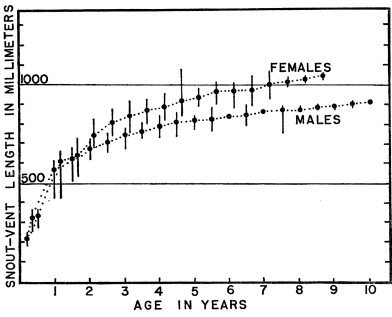
Fig. 18. Graph from records of blue racers marked early in life and recaptured, showing average and extreme snout-vent lengths for males and females of various ages. Growth is especially rapid in the first year, but continues, with gradual slowing, throughout life. In hatchlings, the sexes are of approximately equal size, but females grow to be markedly larger than males.
Some of the largest racers recorded had already reached unusually large size when they were first captured, so there was no opportunity to determine their ages. Several others, originally captured as small- or medium-sized adults, subsequently grew to a size approaching the maximum, and thus provided a basis for estimating the ages of large individuals. The records of nine such racers are listed in Table 16.
Table 15. Changes in Lengths and Weights in Eight Racers Recaptured Repeatedly Over Periods of Years
Date of Capture Snout-vent length in millimeters Tail length length in millimeters Weight in grams Probable age in months
No. 1, male
October 21, 1953 676 216 85 251/2
October 12, 1954 733 238 128 371/2
July 31, 1955 755 243 143 46
May 20, 1956 785 250 153 551/2
July 15, 1957 788 252 162 691/2
June 30, 1958 820 264 200 81
May 15, 1959 828 263 195 911/2
May 14, 1960 840 265 195 1031/2
No. 2, male
May 9, 1955 678 212 105 32
May 26, 1958 827 248 195 69
May 3, 1959 865 262 218 80
May 14, 1960 877 264 218 921/2
July 16, 1960 890 257 190 941/2
No. 3, male
May 26, 1955 565 171 53 21
August 28, 1957 798 245 155 48
May 13, 1958 814 249 137 561/2
May 4, 1959 848 252 180 68
June 12, 1961 896 262 198 931/2
No. 4, male
May 19, 1956 632 208 78 201/2
August 2, 1957 740 238 123 35
May 20, 1959 796 246 132 561/2
May 23, 1960 813 280 140 681/2
No. 5, male
June 30, 1956 594 188 73 22
October 12, 1956 658 200 80 271/2
July 14, 1957 690 220 102 341/2
June 23, 1958 749 226 136 46
July 24, 1959 751 239 133 59
May 27, 1960 765 235 130 69
No. 6, male
October 19, 1956 518 167 43 131/2
July 19, 1957 673 218 96 221/2
May 5, 1960 780 250 175 56
May 9, 1961 840 272 272 68
No. 7, female
May 12, 1957 790 238 175 321/2
September 3, 1957 810 243 208 36
October 1, 1958 883 259 206 49
July 11, 1959 915 247[A] 190 581/2
September 12, 1960 930 249[A] 238 721/2
September 14, 1961 1012 268[A] 332 841/2
No. 8, female
June 23, 1955 601 175 67 22
August 3, 1958 920 255 300[B] 60
July 23, 1959 955 281 211 71
May 18, 1960 962 262 260 81
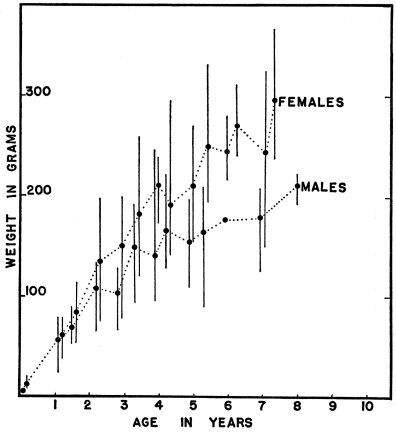
Fig. 19. Graph from records of blue racers marked early in life and recaptured, showing average and extreme weights in samples of different ages. Early in life the females outstrip males in growth and the size differential increases throughout life.
A few adult racers recaptured, including different individuals of small, medium, and large size, failed to make any measurable gain in length over periods of months, or even over several years. Most often the large individuals were those that failed to grow or made only slight gains. Some of the snakes that failed to increase in length suffered dramatic weight losses, perhaps as a result of injury, disease, or parasitism. However, other individuals that failed to gain appreciably in length did gain in weight. Doubtless both genetic and environmental factors were involved. A few racers gave the impression of being stunted by adversity. All records obtained of growth (or failure to grow), throughout the period of my study were used in compiling Table 17.
Table 16. Growth in Several Racers That Were Already Adult When Originally Captured and That Subsequently Attained Unusually Large Size
Sex Original record Record(s) of recapture
Date Snout-vent length in mm. Weight in grams Probable age in months Date Snout-vent length in mm. Weight in grams Probable age in months
♂ May 14, 1956 815 191 561/2 May 15, 1959 905 243 921/2
May 16, 1961 945 287 1041/2
♂ May 22, 1958 825 251 681/2 June 25, 1959 840 205 82
May 27, 1960 880 210 93
Oct. 14, 1961 900 223 1091/2
♂ May 19, 1959 705 105 321/2 May 28, 1960 828 ... 45
July 3, 1961 900 265 581/2
♀ Nov. 6, 1954 823 190 38 June 30, 1958 1030 350 82
♀ June 6, 1955 810 190 33 May 21, 1959 1087 345 801/2
♀ Aug. 29, 1957 885 265 48 Aug. 6, 1960 1041 235 83
♀ May 1, 1958 633 84 20 May 30, 1961 1088 320 57
♀ July 20, 1958 862 203 461/2 June 30, 1960 1020 238 70
♀ Oct. 18, 1956 845 185 371/2 May 20, 1958 905 240 561/2
Oct. 22, 1959 1085 375 74
Mortality Factors and Adaptations for Survival
Defense, and Escape
The behavior patterns that are associated with defense and escape in snakes are widespread. The common racer is typical of the more generalized snakes. Almost all elements of the racer's behavior are found in snakes of other genera and perhaps, of other families. The racer differs from these only in minor details of its behavior, in the circumstances under which various behavioral traits are elicited, and their relative importance. The common racer is one of the swiftest of North American snakes, and it usually depends upon speed to avoid enemies. Racers crossing roads may detect approaching automobiles at a distance, and thereby may be stimulated to accelerate their movements and so escape onto the shoulders rather than becoming traffic casualties as many individuals of most other kinds of snakes do under the same circumstances. The chances of such escape are of course much better on dirt roads that are relatively narrow and have a rough surface permitting efficient traction, than on wide smooth, paved highways. The snakes are somewhat reluctant to venture onto open expanses of pavement.
Table 17. Sizes of Racers of Different Age Groups in May and October
Age in Years Males
Snout-vent length in mm. Weight in grams
Average Typical range Observed range Average Observed range
1+ 539 432-609
2- 615 500-676 560-674 68.2 51-92
2+ 668 610-700 620-710 107.4 63-134
3- 706 677-730 648-755 102.1 65-129
3+ 740 701-754 667-780 147.0 93-216
4- 757 731-772 725-809 139 95-251
4+ 785 755-793 720-850 167.4 128-225
5- 805.5 773-810 743-855 152.4 110-198
5+ 810 801-831 773-858 163.9 89-211
6- 827 811-831 765-883 175.9 130-230
7- 845 832-850 788-900 181.2 125-210
8- 868 851-873 740-890 217.5 194-225
8+ 870 861-884
Females
1+ 581 415-658
2- 644 520-739 580-738 83.5 52-127
2+ 743 685-804 670-826 135.2 73-200
3- 810 740-829 730-880 149.4 98-219
3+ 836 804-869 736-915 181.2 120-268
4- 866 830-880 791-920 212.3 175-243
4+ 883 870-914 810-952 191.2 143-300
5- 914 880-929 833-1088 209.6 136-275
5+ 932 915-954 883-990 250.4 195-336
6- 965 930-961 892-1020 245.9 218-283
6+ 970 955-980 885-1003 271 243-336
7- 974 962-990 919-1050 251.3 150-330
7+ 1000 980-1015 930-1085 295.6 235-375
A racer suddenly startled by close approach of a human usually flees at high speed. The first part of its course, up to 20 feet or more, is marked by a violent lateral thrashing of the body and tail, which may help the snake to gain speed, but which seem chiefly designed to draw attention of a potential attacker to the spot that the snake is leaving. In any event, the mode of progression abruptly changes to a swifter and much smoother travel, and the snake may seem to vanish completely or as it glides rapidly away, its course may be marked by the slowly waving tops of tall grass. The trend of travel away from the site of disturbance is in an irregularly zig-zag course. The method of crawling, with lateral undulations of the body, supported against scattered pivot-points along the way, tends to prevent the snake from moving more than a short distance in a straight line.
In checking traps along hilltop rock ledges in October, I have often flushed racers that had come to the ledges searching for hibernation dens. In such an instance the startled racer would usually dart away down the steep slope at unusually high speed, and within a few seconds might have covered 100 feet or more, progressing with a minimum of lateral undulations, and seeming to flow or coast over the ground surface with scarcely any effort. Although coursing downhill in this manner provided an effective method of escape, racers startled at the ledges or on other sloping ground sometimes followed a course parallel to the ledge, or even turned uphill, with disastrous slowing. Often I have accomplished capture by hand, by the strategy of running downhill to get below the escaping snake, causing it to turn back up the slope, there to be slowed to the extent that it could be overtaken.
A racer that has been flushed, and has disappeared after creating a commotion by its violent thrashing, may, within a period of minutes, return surreptitiously to the vicinity, gliding back slowly and silently from the direction opposite that in which it departed. It may climb into a tree or bush where, lying stretched on outer twigs and concealed in dense foliage, it will sometimes permit close approach, rather than reveal its presence by moving. If too much disturbed however, such a snake will move away, higher, or to the opposite side of the clump, with a slow and stealthy gliding motion which is likely to escape detection. The sudden stops and abrupt changes in direction make it difficult to follow the course of a climbing racer, even though it is moving slowly. The tendency to climb to escape danger seems to be especially strong in the western subspecies, C. c. mormon. In my years of experience with the racers in the chaparral belt of western Oregon and California, I found that one of the most characteristic responses to danger was to climb into a bush or low tree and seek concealment in the thick foliage. In most instances the snake was from one to eight feet above the ground; usually it did not attempt to climb high in a tree even when there was opportunity to do so. The racer's prowess as a climber is limited. In thick brush where its weight is supported by numerous stiff twigs simultaneously, it is at home and can travel rapidly, but it cannot cling effectively to rough bark of a vertical tree trunk as can the rat snakes (Elaphe sp.) and others that are more specialized in their arboreal adaptations. Chaparral-type shrubs such as Ceanothus cuneatus and Arctostaphylos viscida were those in which western yellow-bellied racers were seen climbing most frequently. Crab-apple (Pyrus ioensis) and haw (Crataegus sp.) were the shrubs most frequently utilized by blue racers on the Reservation. Carr (1950:80) noted that Florida racers were much less given to tree-climbing than were those of more northern regions. C. c. stejnegerianus of southern Texas is reputed to have arboreal tendencies highly developed (Mulaik and Mulaik, 1942:14).
The racers kept in an outdoor enclosure in the summer of 1962 spent much of their time above the ground, climbing in several walnut saplings. Usually in the warmer part of the day three or four of the five racers in the pen were climbing. In the trees a racer usually lay extended or in a loose coil among foliage in the outer twigs, at a height of five to 12 feet. Such a snake might rest for hours in almost the same position. Racers do not ordinarily enter the water voluntarily, but they are swift and efficient swimmers when the need arises. On one occasion a large female, seen near the edge of the pond on the Reservation, and approached from the landward side, took to the water without hesitation and swam strongly to the opposite shore more than 100 feet away. Other observers have recorded similar incidents.
A racer that is suddenly startled at close range may make no attempt to escape, but instead may coil and perform slow writhing movements, with the head pressed to the ground and concealed beneath part of the body. Musk, exuding from the anus is spread over the body surface as the movements continue. Only a small percentage of the racers found free in their natural habitats reacted in the manner described. In each such instance, the circumstances were such that the racer was prevented from making its usual rapid getaway, either because temperature was unusually low for activity, or because the snake was away from suitable cover. After removal from a live-trap, with handling, and especially clipping of scales, racers were much more likely to behave in this passively defensive manner, which seemingly constitutes a second line of defense in snakes which have been prevented from escaping—either cornered, captured, or injured by a predator. The musk is creamlike in color and consistency, and is secreted from sausage-shaped glands in the base of the tail. Its odor is rather disagreeable, but less so than that of musks of various other genera. Also, it is less penetrating and lasting than many other musks. In handling the racers removed from traps I attempted to avoid being smeared with the musk by grasping the snake by the tail and neck and keeping its body stretched out. While the snake was being examined, and measured a droplet of musk would form at the anal orifice and would begin to flow down the snake's body. To avoid contact with the musk I would wipe away the droplet with a paper towel or leaf, but the musk droplet might be replaced several times within the few minutes that the snake was restrained.
A racer that is confronted with an object arousing its suspicion or indicating possible danger, may move away slowly with a characteristic "threat display." The forebody and neck are held rigid, well off the ground, and slightly arched, with the neck flattened in a vertical plane—causing this part of the snake to appear from lateral view larger than it actually is. The tongue is protruded frequently and waved slowly. A racer that has been disturbed and is trying to gain shelter in a direction that brings it closer to the danger usually will adopt this tense attitude, but a single threatening movement will cause it to abandon its circumspect pose, and panic in an attempt to reach the nearest shelter in the shortest possible time.
A common response to an alarm is to vibrate the tail. The tail being long and slender is vibrated much less rapidly than the short, muscular organ of a rattlesnake, or even the medium-short tail of a bull snake. The rapid twitching produces a characteristic sound in dry vegetation. A racer that vibrates its tail is fully active and aroused; the sound is heard as the snake pauses before it makes a dash for shelter. At times the sound probably functions as a decoy to distract the attention of potential predators, affording the racer an opportunity to escape.
A racer that is cornered or captured usually puts up a spirited struggle, striking vigorously and repeatedly at its tormentor. If only cornered, it will make slashing strokes at the enemy, jerking back to a coil from each stroke in a manner that causes the teeth to lacerate the enemy's skin in long scratches if the stroke finds its target. The rapid recoil often causes teeth to be jerked from their sockets and left embedded in the wound inflicted by the bite. On many occasions in sustaining a bite from a racer I have received such teeth which have remained undetected for a day or more until soreness and festering led to their discovery and removal. A racer that is grasped may deliver several bites within a few seconds, chewing vigorously to imbed its teeth to the maximum at each bite.
If grasped by the tail and held clear of the ground, the racer would swing its body with a rapid whirling and twisting motion, which in a few seconds would twist off the end of the tail, unless countermeasures were promptly taken. Many racers, especially the larger and older ones, have parts of the tail missing, as a result of such escapes, and perhaps also from freezing in hibernation or from certain injuries and infections. If grasped by the body, the racer struggles with a violent lateral thrashing to break the grip of its captor, at the same time striking to bite and discharging musk, urinary wastes and feces.
Many of the racers examined bore scars from wounds that were probably inflicted by predators. A few had survived severe skeletal injuries, involving deformation of the spinal column or extensive tearing of muscle and connective tissue layers of the body wall, altering the normal body shape. A more frequent type of injury involved chiefly the integument, which had been ripped open by the teeth, claws, or bills of adversaries, despite the fact that the skin is remarkably tough and leathery. Patches of scar tissue with scales in irregular sizes, shapes and patterns characterized such injuries. The most frequently observed type of injury involved loss of part of the tail. Usually only a small terminal part was missing, but occasional stub-tailed individuals had lost as much as three-fourths of the tail.
No consistent trend of difference between the sexes in incidence of injuries to the tail was noticeable, but there was definite correlation with age. In the entire sample from the Reservation and Rockefeller Tract the percentages in each supposed age group (actually size group) lacking part of the tail were as follows: hatchlings, 2.9 per cent; one-year-olds, 9.5 per cent; two-year-olds, 15.8 per cent; three-year-olds, 14.3 per cent; four-year-olds, 15.7 per cent; five-year-olds, 23.2 per cent; six-year-olds, 30.9 per cent; seven-year-olds, 28.9 per cent; those eight years old or older, 21.1 per cent. The seeming reversal of trend in the older racers is difficult to explain, but probably results from inadequate numbers in this part of the sample.
Although the racer's most characteristic response to any disturbance is to flee at high speed, certain individuals are inclined to behave aggressively under exceptional circumstances. Records of such aggressive behavior nearly all pertain to large individuals of the northeastern black racer (C. c. constrictor) in the breeding season. Cope (1900:794) wrote: "it is courageous and will sometimes attack, moving forward with the head raised from 1 to 2 feet above the ground." Ditmars (1944:13) wrote: "Occasional specimens in the breeding season ... will actually attack ... glide toward an intruder ... striking madly at one's feet or legs." Woods (1944:257) quoted a 13-year-old amateur herpetologist, Leon Gonthier, regarding the latter's encounter with an aggressive black racer on May 7, 1944, as follows: "When I ran toward the snake about 20 feet away, it turned and came for me. As I bent over to catch it, the snake grabbed me by the shirt and hung on ... held it off with a stick. It jumped twice more at me and came clear off the ground." Finneran (1948:124) describing the species' habits in Connecticut, stated: "A farmer ... constantly warned me away from Coon Ledge during the spring, saying the snakes were breeding and would 'chase you.' This very thing happened. In 1943 a blacksnake followed me for approximately ten feet, and, in 1946, a male aggressively attacked me for a period of three minutes. There was ample opportunity for escape."
Natural Enemies
Little has been published concerning the natural enemies of the common racer. The king snake (Lampropeltis getulus) is notorious for ophiphagy, and doubtless preys upon the racer at times. Wright and Bishop (1915:169) wrote of the king snake in Okefinokee Swamp, in Georgia, that "all the smaller snakes suffer, and of the larger species, the blacksnake [racer] and spreading adder are the commonest prey." However, Clark (1949:252) examined 301 stomachs of king snakes of this species in Louisiana and found no racers, although many other kinds of snakes were represented, and, collectively, made up the greater part of the food.
A rat snake (Elaphe obsoleta) found in Leon County, Florida, on June 10, 1924, had a racer in its stomach, according to the Patuxent food habits file of the U. S. Fish and Wildlife Service. A California garter snake (Thamnophis elegans terrestris) was found to have a juvenal racer in its stomach (Fitch, 1940:96). A large alligator lizard (Gerrhonotus multicarinatus) was found swallowing a small racer that had been confined with it in a bag (Fitch, 1935:12).
A few records of predation on blue racers by other reptiles on the Reservation and Rockefeller Tract were obtained. In 25 scats of the prairie king snake (Lampropeltis calligaster), there were 29 vertebrate prey items of which one was a blue racer. On September 15, 1962, an adult male prairie king snake 491/2 inches in length was found to have a 27-inch yearling racer in its stomach. In 254 scats of the slender glass lizard (Ophisaurus attenuatus) vertebrate remains were rare, but there were scales and bones of one hatchling blue racer. Among 21 vertebrate prey items in 14 scats of the timber rattlesnake (Crotalus horridus) there were remains of one blue racer. Among 589 prey items of copperheads there were two juvenal blue racers (Fitch, 1960:200). In contrast to these scarce records of racers in the prey of other snakes, there were more frequent records of the blue racer preying on its own young. The 1008 food items from 479 racer scats contained remains of 16 racers, small young in most instances.
Raptorial birds are known to be important predators on snakes. Breckenridge (1944:118) reported finding remains of a blue racer in the pellet of a marsh hawk (Circus cyaneus). Many pellets of the marsh hawk collected on the Reservation were all found during the colder half of the year, and they contained no remains of reptiles. The same seasonal restrictions applied to the many pellets of four species of owls that were collected, and these also lacked remains of reptiles. One of the predators whose food habits have been most thoroughly investigated on the area is the red-tailed hawk (Buteo jamaicensis). Over the period 1955 through 1962, 1131 pellets of these hawks were collected, many from the Reservation, but more from localities scattered throughout the eastern one-fourth of Kansas. The pellets were those of nestlings and fledglings, nearly all collected from beneath the nests, in late May, June, or early July. Some 49 different nests were represented, and remains of 43 blue racers were found. In one nest which yielded a total of 191 food items, racer remains occurred 13 times, but no other nest yielded records of more than three racers, and some other species of reptiles, notably the black rat snake (Elaphe obsoleta) comprised much more important components of the food. Since only one meal in 26 contained remains of racers, it seems that a red-tailed hawk would destroy only a few racers in the course of a year on its territory of perhaps half a square mile, and that its predation would not be a major factor in the racer's ecology.
That the red-tailed hawk is a natural enemy to be reckoned with throughout the racer's extensive range was demonstrated by the analysis of contents of 116 stomachs from localities well scattered over the United States and Canada. Among the 152 vertebrate prey items represented there were three racers: a juvenile C. c. constrictor from Stag Lake, New Jersey, October 16, 1927; a C. c. mormon from Weiser, Idaho, April 11, 1930, and a C. c. stejnegerianus from San Roman, Cameron County, Texas, in the spring of 1938. Because of the widely scattered geographical origin of these stomachs, a remarkably large number of species of prey were represented, and no one species predominated. Small mammals of the genera Sylvilagus, Spermophilus, and Thomomys comprised the most important component of the food; the only other reptile so well represented as the racer was the common garter snake (Thamnophis sirtalis) which likewise had three occurrences.