Front matter (continued 3)
Reading edition
In June and July, 1954, a nest of broad-winged hawks (Buteo platypterus) on the Reservation yielded 71 prey items of which seven were blue racers. At least 19 species of prey were represented, although specific determinations were not possible in some instances. The prairie vole with eight records was the most frequent prey, and the racer and cardinal (nestlings) each had seven, while all other species were represented by fewer occurrences. Six of the racers were first-year young but the remaining one was thought to be an undersized second-year individual. Although an adult racer, especially a large one, would probably be an adversary too powerful to be killed and eaten by a broad-winged hawk, this hawk is perhaps one of the more important natural enemies of the first-year young in the eastern United States.
Further records of predation on racers by raptors were obtained from the U. S. Fish and Wildlife Service files through the kindness of Dr. Wm. H. Stickel. There were three records of such predation by red-shouldered hawks (Buteo lineatus) from Lunenberg, Massachusetts, May 1, 1896; Portland, Maine, March 16, 1906; and 65 miles northeast of Sarasota, Florida, June 10, 1918. There were two records of predation by broad-winged hawks from Catlettsburg, Kentucky, July 26, 1910, and Portland, Connecticut, May 18, 1912. There were four records of predation by marsh hawks on racers—Peck's Island, Maine, September 18, 1903; Edgartown, Massachusetts, April 12, 1912; West [Tisbury?], Massachusetts, July 31, 1912; and Okanagan Landing, British Columbia, June 5, 1918. A sparrow hawk (Falco sparverius) from De Ranch, Wyoming, May 27, 1910, had eaten a racer, as had a barn owl (Tyto alba), from Franklin County, Kansas, November 16, 1922, and a crow (Corvus brachyrhynchos, nestling) from Onaga, Kansas, May 16, 1914.
Perhaps certain mammalian predators are even more important natural enemies than are raptorial birds, but records of predation on racers by mammals are few. Substantial samples of scats of opossums and coyotes from the Reservation have contained no remains of racers. The Fish and Wildlife Service files include a record of an opossum from Adrian, Michigan, on April 26, 1934, that had racer remains in its stomach. No racers were specifically recorded from a collection of 820 scats and 22 stomachs of raccoons (Procyon lotor) from Douglas County, Kansas, reported upon by Stains (1956:43), but occurrences of unidentified snake may have pertained in part to the racer. Skunks are probably more important natural enemies, but food habits data from the Reservation are lacking for the two kinds of skunks occurring there. Crabb (1941:356) in a study of the food habits of the spotted skunk (Spilogale putorius) in southeastern Iowa, did not report any reptiles among the many kinds of prey found in scats. Several times in many years of residence near Medford, Jackson County, Oregon, I saw remains of racers which appeared to be victims of striped skunks (Mephitis mephitis). Tracks and other sign of the skunks were often noticed along a little-used road on a hillside, passing between a pasture and a hay field, with an oak grove, high weeds, and brush, bordering the road. The racers sometimes found as victims along this road were small- or medium-sized individuals. In every instance the predator had begun eating on the tail end of the snake, and later had abandoned the remains leaving the head and part of the forebody still intact. Predation had occurred at night. Skunks foraging mostly in twilight or darkness, probably find racers inactive beneath flat rocks or in shallow burrows. The skunks would be too slow and clumsy to catch the snakes in the open when they were fully active.
The funnel traps used for catching the racers also caught many other kinds of animals. Often a racer and another kind of snake were caught together, but, ordinarily, in these instances no damage to either resulted, although racers, copperheads, king snakes, and garter snakes are all known to eat each other's young. At times, large predatory ground beetles (Calosoma scrutator and Pasimachus sp.) were so abundant that a dozen or more were caught together in a trap, and several times such groups attacked and killed and partly ate young racers caught in the same traps. White-footed mice (Peromyscus leucopus), deer mice (P. maniculatus), harvest mice (Reithrodontomys megalotis), short-tailed shrews (Blarina brevicauda), and least shrews (Cryptotis parva) all were caught rather frequently in the traps, and each, on one or more occasions, gnawed and killed or severely injured a racer trapped with it. The attacks probably were motivated by hunger in all instances, the snake in some instances failing to defend itself or escape because of low temperature. Occasionally such encounters might occur even under natural conditions, the mouse or shrew finding and attacking the snake while the latter was torpid and helpless in its hibernaculum or in a more superficial temporary shelter.
Disease
Relatively few of the racers examined showed signs of disease. The most common type of affliction was an infection of the skin causing cankerlike sores, chiefly on the ventral plates, sometimes on the head or tail. These were seen most often in snakes recently emerged from hibernation, but persisted later in the season in years of exceptionally wet weather. Some of the racers most severely afflicted appeared to be in debilitated condition. The causal organism was not determined, nor was it definitely determined whether this type of disease causes mortality.
Parasites
The ectoparasites of the racer are chiefly chiggers, the parasitic larvae of mites. Loomis (1956) in his study of the chigger mites of Kansas examined many of the racers captured in the early years of my field work. He checked a total of 130 racers, mostly from the Reservation, and found four different species of chiggers, all of the genus Trombicula: T. alfreddugèsi, T. lipovskyana, T. kansensis and T. sylvilagi. The common pest chigger, T. alfreddugèsi, parasitizes most of the species of reptiles, birds, and mammals occurring in Kansas, and it was by far the most common kind on the racers. The numbers per racer in different months were as follows: June, 81; July, 285; August, 432; September, 123; October, 15. Many of the racers were collected in the relatively cool and moist summers of 1950 and 1951. In a year of typical weather, heaviest infestations occur in early summer, June or the first half of July, and the numbers taper off rapidly in the hot but often dry weather of late July, August, September, and October. In hot, humid weather of early summer a racer may have several hundred chiggers attached to it, filling most of the areas of exposed skin between the scales. The chiggers are conspicuous because of their bright orange color. Like T. alfreddugèsi, T. lipovskyana was also found in large numbers on racers and is found on many kinds of hosts. Loomis (op. cit.:1281) recorded it from one kind of frog, one kind of toad, one kind of turtle, two of lizards, six of snakes, 19 of birds, and nine of mammals from eastern Kansas. Five larvae of T. sylvilagi were recorded from a racer captured in October. That kind of chigger is primarily a parasite of small mammals, and perhaps cannot develop successfully when it attaches to a snake. Unlike most other kinds of chiggers, this species is most in evidence in autumn and winter. A single larva of T. kansensis was found on a racer in October. This relatively rare kind of chigger has been found on several kinds of snakes and small mammals (including pocket gophers) and is known from hot and dry rocky places. Even the racers that were heavily loaded with chiggers showed no obvious ill effects, but the chiggers are potentially vectors of various diseases.
Of the many endoparasites found in racers, the lung fluke, Neorenifer lateriporus was the only one identified and frequently observed in my study (Stewart, 1959). This is a digenetic trematode of the subfamily Reniferinae. The racer is its specific host. The life history is still unknown, but in other members of the subfamily, all of which parasitize snakes, an aquatic snail and a frog are required as hosts at different stages of the life cycle. Presumably N. lateriporus has similar requirements. The two common local water snails, Heliosoma trivolvis and Physa anatina, are both potential hosts. By far the most probable frog host is the leopard frog. In wet weather of July the recently metamorphosed leopard frogs leave the water and disperse to all habitats, probably carrying with them the parasites acquired in the tadpole stage. The racers in turn probably acquire their flukes by eating the young frogs in summer. In any case, the adult racers are nearly all parasitized, but the flukes have not been found in those racers that were less than one year old. During their first few months, the racers are too small to swallow leopard frogs, even the young. The flukes have been seen in the live racers mostly in May, when most adults are infested with the flukes. Seemingly at this season the flukes migrate forward into the mouth of the host. Probably this is the time when the flukes breed and lay eggs; if so, the eggs would pass through the digestive tract of the snake and escape with its feces. The latter are usually left in terrestrial situations unfavorable for the development of an aquatic stage, but perhaps some of the eggs are washed into ponds by heavy summer rains. In late summer and fall the flukes are not to be found in the mouths of the live snakes.
Most complete records of the flukes present in racers were kept in 1959. The following table shows the numbers of racers examined and the percentage having flukes in that year.
Ortenburger (1928:182) recorded lung flukes (Renifer ellipticus) from blue racers. In Maryland, McCauley (1945:76) also recorded numerous lung flukes (Pseudorenifer sp.) in an immature racer 490 millimeters in total length. Parker (1941:34) recorded Neorenifer septicus from racers collected at Reelfoot Lake, Tennessee, Greensboro, Georgia, and Kissimmee, Florida; also he recorded N. georgianum from racers collected at Reelfoot Lake. N. septicus was recorded by the same author from the water moccasin (Agkistrodon piscivorus) and N. georgianum was also recorded from the king snake (Lampropeltis getulus).
Cloacal smears from the racers examined usually showed an abundance of ciliate protozoans, either parasites or commensals, and occasionally nematode worms. Harwood (1933:66) examined two racers from the vicinity of Houston, Texas, and found four kinds of helminths: Kalicephalus agkistrodontis, K. rectiphilus, Ophidascaris sp., and Polydelphis sp. Each parasite was found in only one of the two snakes. McCauley (loc. cit.) recorded nematodes (Physaloptera obtusissima) from black racers in Maryland, and Ortenburger (loc. cit.) recorded Physaloptera sp. from the blue racer.
Table 18. Seasonal Incidence of the Fluke Neorenifer lateriporus, in Mouths of Blue Racers on the Reservation and Rockefeller Tract
Apr. 15-30 May 1-15 May 15-31 June 1-15 June 15-30 July Aug. Sept. Oct.
Number of racers checked 1 28 25 24 17 30 5 9 2
Percentage of sample having flukes 100 79 72 50 18 0 0 0 0
Populations
Composition
Since there is a brief annual breeding season, any local population of racers consists of a series of discrete annual age groups. The population reaches its annual maximum in early September, after undergoing sudden increase by the addition of the annual crop of hatchlings. Throughout the remainder of the year numbers of racers undergo gradual reduction as a result of the many combined mortality factors that affect them. This mortality is distributed among all the age classes, but the heaviest losses, both percentage-wise and in actual numbers, are sustained by the first-year young. Being by far the most numerous group, these young suffer more mortality than all the other age classes combined. Presumably much of this mortality is concentrated in the early weeks of life, while the young are still near their minimum size; the rate of loss is gradually reduced as larger size is attained and some of the early hazards are outgrown. In the adult age classes also, the larger and older snakes live in greater security, and the rate of mortality is higher in the smaller and younger snakes. Even before hatching, the eggs are subject to heavy losses from predators, and probably from drying, flooding, and other unfavorable climatic factors. Unfortunately it was not possible to obtain definite figures on any of these losses since the eggs were never found under natural conditions and the hatchlings were seen only in relatively small numbers.
The records obtained from trapping racers in late spring and summer in fields provided a somewhat different picture of the population from the sample obtained along the ledges in autumn. In the former sample there were 400 males to 257 females, but in the latter sample there were 355 males to 379 females. I regard the summer sex ratio as a distorted one, brought about by the greater activity of the males in the breeding season. Racers are caught most easily in May, and the fact that two or more males often were trapped with the same female, while the reciprocal combinations did not occur, demonstrates the increased activity of the males in their search for mates at this season. In autumn there is no sexual activity; both sexes probably are equally active in seeking places to hibernate when they are trapped along the hilltop outcrops. The ratio of 51.6 per cent females in my sample of 734 may indicate that in the males greater activity at other seasons results in a somewhat higher mortality. This idea is borne out by the fact that for the supposed two-, three- and four-year-olds combined, females comprise 51.2 per cent, but they comprise 55.6 per cent of those more than four years old and 61.3 per cent of those more than five years old.
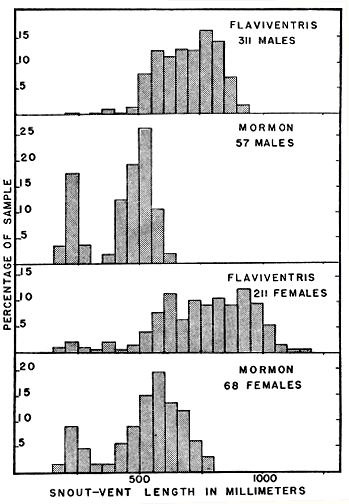
Fig. 20. Histograms comparing snout-vent length in random samples of Coluber c. flaviventris (those captured on the Reservation and Rockefeller Tract in 1960 and 1961) and C. c. mormon (specimens in the Museum of Vertebrate Zoology, University of California). In the museum sample, collected by conventional methods, the first-year young constitute a prominent and fairly distinct size group, whereas in the sample of racers from the Reservation and Rockefeller Tract, mostly caught in wire traps of quarter-inch mesh, relatively few young were secured. It is demonstrated that hatchlings are approximately the same length in both populations, but flaviventris grows much longer, and that the differences in length between the sexes is approximately the same in each population.
By assigning to each racer caught an arbitrary age, on the basis of size according to Table 17, I calculated the population (exclusive of those snakes in their first year of life) to have the composition shown in Table 19.
Table 19. Percentages of Adult Population of Blue Racers Comprised by Each Annual Age Group
Years of Age 2 3 4 5 6 7 8 9 10 11 or more
Percentage of population 41.5 17.8 12.6 9.5 6.1 4.3 2.7 2.4 1.2 1.9
Figures are completely lacking to show the relative numbers of juveniles, until, already approaching adult size, the young are about to enter their second hibernation. My combined fall samples include 303 of these latter young, as against 142 racers about to enter their third hibernation. Thus, after having nearly attained adult size, these adolescent snakes sustained a loss of 53 per cent in a year. Losses must occur at an even more rapid rate in the younger and smaller snakes. It may be speculated that of the approximately 300 eggs produced by a population of 100 adult racers, 150 are lost before or during the period of incubation which lasts nearly two months. Of the 150 hatchlings emerging in early September, at least one-third probably are eliminated by the following breeding season in late May, leaving 100. The 100 survivors at this stage are still small juveniles, but by autumn they have attained adolescent size. By this time, if they had undergone a further reduction by 53 per cent, only 47 would remain—approximately the number to be expected if the population were stable from year to year.
A notable difference between the fall sample and the spring sample that I obtained was the higher proportion of large and old racers in the former sample. This difference can be attributed to the year-to-year changes in the population during the 14 consecutive years spanned by my field work. The fall sample of 734 racers represented the combined catch of the years 1949 through 1962, rather evenly distributed, but the spring sample included few snakes from the years 1949 through 1957; most were from the years 1958 through 1961. In 1949 when the study was begun, the Reservation was being protected for the first time, and formerly overgrazed pastures or cultivated fields were acquiring a rank growth of grass and weedy vegetation, and thus becoming favorable habitat. The abundant new habitat promoted rapid increase in the population of racers until the newly available areas were filled to their "carrying capacity." Table 21 shows the changing trends of the different age groups. Although the separate annual samples are perhaps too small to show the composition of the population accurately, it is significant that in the fall of 1949 an unusually high proportion of the racers caught were one-year-olds, hatched in September, 1948.
Table 20 shows that in a typical group of 100 subadult and adult racers (second year and older) only a little more than one-fourth are productive females. The largest females, six years old and older, making up less than ten per cent of the adult population, contribute nearly half the total complement of eggs.
The calculated number of eggs pertains to a stage before oviposition, and subsequent losses through resorption under unfavorable conditions, through inviability of embryos and through deaths of some of the gravid females, are to be expected. In the weeks of incubation further losses are sustained. Although these losses cannot be measured, they must be severe as on numerous occasions scattered and torn eggshells representing entire clutches dug out and destroyed by predators, have been found. Probably other clutches are destroyed underground by such predators as moles and egg-eating snakes, and still others by insects. Tinkle (1959:195) wrote that in a clutch of 15 eggs found under a board, four were parasitized and had small perforations. Molds destroy a high percentage of all reptilian eggs that are incubated artificially and doubtless destroy many under natural conditions also. Excessive heat or moisture, or desiccation, resulting either from climatic extremes or from poor choice of a nest site by the female, would cause further loss. In four different years, Blair (1960:108) found that losses of eggs between laying and hatching in the Texas spiny lizard (Sceloporus olivaceus) ranged from 69 per cent to 86 per cent; no other comparable study of the extent of egg losses in a species of reptile is known to me. The racer is somewhat less prolific than the spiny lizard, and potentially longer lived; the racer's eggs are larger and thicker-shelled, and they are deposited in deeper burrows. It might be expected that losses during incubation would be somewhat less in the racer than in the spiny lizard.
Table 20. Calculated Productivity in a Hypothetical Group of 100 Subadult and Adult Blue Racers
Age-Group (years) Percentage of population in age-group Percentage of fecund females in age-group Percentage productive females in age-group Eggs per productive female Number of eggs produced
2 41.5 51.2 13 9.2 26
3 17.8 51.2 56 9.9 51
4 12.6 51.2 60 10.8 42
5 9.5 55.0 57 13.0 39
6 and over 18.6 61.3 80 15.7 143
Table 21. Percentages of Racers in Each Annual Age Group (Exclusive of Hatchlings) in Autumnal Samples at Different Stages of the Field Study, Showing Shift Toward Older Age-Groups in the Later Years
Years of Age Year or combination of years represented by each sample
1949 1950 1951 1952 1953 1954 1955 1956 1957 1958 1959 1960 1961 1962
1 54 44 39 39 41
2 14 24 21 19 19
3 18 11 23 16 13
4 4 10 10 11 9
5 6 6 3 8 8
6 2 1 3 1 3
7 2 4 4 2 3
8 ...... ...... ...... .5 2
9 ...... 1 .4 .5 2
10 ...... ...... .4 2 1
Older than 10 ...... ...... ...... .5 .....
Number in sample 49 126 117 194 242
Although figures for the youngest age groups—one-year-olds and hatchlings—are missing, approximations of them may be furnished by extrapolation, from the information available regarding the productivity of the population. Some factors involved in productivity are that the sex ratio deviates from parity, slightly in favor of the females in the adolescents but more markedly in favor of the females among the older age groups; that some adult females apparently fail to produce eggs in the breeding season, but the percentage decreases in the older snakes; and that number of eggs per clutch increases in proportion to the size and age of the female producing them. Too few figures are available concerning most of these factors to indicate more than the trends; nevertheless the available figures have been used in Table 20 in an attempt to estimate the productivity of a hypothetical population.
Numbers
Conant (1938:178, Pl. 7) published a photograph of 106 blue racers killed in February, 1932, by farmers near Bellville, Ohio, and Pope (1944:173) mentioned that scores of blue racers aggregated in October around an oak-covered dune near Chicago. In both these instances large hibernating aggregations were involved, and the areas represented by them are unknown; nothing has been recorded regarding population densities.
The records obtained through my fall trapping, along hilltop rock outcrops, yielded no information concerning population densities, but those obtained in fields in summer did provide significant information in this regard. Even after years of trapping on the same area, the catch still consisted largely of new individuals; the method was not sufficiently effective to catch all racers present at any one time, and the total catch for a season therefore provided only a crude index of the minimum number present.
The summer trapping was carried on in three separate areas. One of these was the area of bottomland pastures and formerly cultivated fields where the Reservation headquarters are located, a block of 39 acres bounded on three sides by woodland, and on the fourth by cultivated farm land. Effective trapping in this area was carried on through the years 1955 to 1961 inclusive. A second area, of 48 acres, was one of upland fields, mostly covered with re-established prairie grasses, in the northeastern part of the Reservation. A third area, of 137 acres, also upland, was that of the Rockefeller Tract, cultivated through 1956 and sown to prairie grasses the following year, and the adjacent northwestern hilltop portion of the Reservation. Effective trapping on these two latter areas was carried on in 1958 through 1962.
For the seven years of trapping in the House Field area, the catch was as follows: 30, 33, 38, 38, 34, 24, and 20. In four years of trapping, the northeast field area yielded 42, 28, 37, 59, and 19 blue racers, and the Rockefeller Tract yielded 52, 67, 67, 126, and 106. The actual catch was hence less than one per acre in nearly all instances, but the year-to-year differences in catch are believed to be caused chiefly by differences in numbers of traps used and in trapping effort, rather than by changes in the numbers of racers present.
Best index to the number of racers actually present is provided by the number of recaptures, and their ratio to first captures. The population of course, undergoes alteration from year to year, with many racers eliminated and replaced by others.
In 1955, 26 racers were caught in the May-June-July period, in the headquarters field area. In the August-September-October period of the same year five racers were caught of which only one was a member of the original 26. The five-to-one ratio indicates that the original 26 may have represented an actual population of 130, but of course the single recapture is much too small a sample to provide a reliable ratio. Some of the racers caught in May were recaptured in June, others in July, and still others not until late summer or early autumn. Somewhat different estimates can be obtained for the population depending on how the season's records are divided. For instance, in the headquarters field area in May 1955, eleven racers were caught; in the remainder of the season 20 were caught, of which two were members of the original group of eleven. The 20 to 2 ratio indicates that the 11 caught in May represented an actual population of 110. In the period May-June, 18 racers were caught, and in July-August-September-October, 15 were caught, including four of the original 18, hence indicating a population of 67. Although obviously the population underwent some change during the course of the season, the three sets of census figures apply essentially to the same population, and the divergence in them illustrates the wide range of error arising from insufficiently small samples.
Common sources of error in the censusing of natural populations of animals by the capture-recapture method ("Lincoln Index" or "Petersen Index") arise from the fact that the composition of a local population often changes between two sampling periods, or even within them. Some of the animals marked may move elsewhere, to be replaced by unmarked immigrants, or they may die and be replaced by unmarked maturing young. First-year racers that could pass through the quarter-inch mesh of the traps in spring and early summer became too large to escape in this way in the latter half of the summer, but these young were excluded from the census computations. There was doubtless some shifting of marked individuals away from the study areas and shifting of new individuals onto these areas in the periods of weeks between successive samplings. Jackson (1939) has explained a method of correcting census computations based on capture-recapture ratios when there is a consistent trend of diminishing recaptures with increase in elapsed time. However, in my records no such trend is discernible; furthermore it has been demonstrated that individual racers tend to stay within the same home range area throughout most of their season of activity. Therefore, I conclude that shifts of individuals away from the study areas or into them, in the intervals between samplings constitute only a minor source of error.
A combination of the figures from the three samples listed above provides an intermediate "smoothed" figure that can be accepted with somewhat more confidence than any one of the separate censuses because it is based on more records. The combined ratios indicate a total of 105 racers in the headquarters field area. The figures obtained in the different sampling periods, and the census figures derived from their ratios are shown in tables 22 and 23. Differences from year-to-year in the census figures for any one area show no consistent trends and their variation is similar to that shown in different samples for the same season. Probably populations were fairly stable throughout the periods involved. If such stability is assumed, the samples from different years may be combined, and the composite figures derived from them may be accepted with more confidence. For the headquarters field area, for instance, 419 records of racers were gathered in all the preliminary sampling periods of the seven seasons involved; the records totalled 263 for all the secondary sampling periods, with 70 recaptures in secondary periods of the snakes recorded in the corresponding preliminary periods. A population of 75 racers is indicated—1.9 per acre. Corresponding figures for the northeast field area are: preliminary samples 453, secondary samples 163, recaptures 39, calculated number 135 (2.82 per acre). For the Rockefeller Tract the figures are as follows: Preliminary samples 807, secondary samples 476, recaptures 126, the ratio indicating a population of 153, or 1.11 per acre.
These figures represent the number of adults present in early summer when the population is near its annual low point. The first-year young, excluded from this census because they cannot be caught in representative numbers, perhaps approximate the number of adults, in May, so the figures obtained would need to be approximately doubled to be representative of the entire population. By late summer the adults, and especially the yearlings, have undergone substantial reduction in numbers, but in late August and early September the hatching of a new crop of young increases the population to its annual maximum. The maximum numbers probably are about three times those obtained by censusing adults in early summer. The peak population of late summer or early autumn is estimated to consist of hatchlings, comprising somewhere near 50 per cent; adults, comprising a little more than 25 per cent; and yearlings comprising a little less than 25 per cent.
Table 22. Captures Recorded and Population Calculated From Them on Hilltop Grassland Areas of Rockefeller Experimental Tract and Adjacent Reservation in Four Different Years
1959 1960 1961 1962 Four-year average
First Census:
Early May 0 8 21 32 61
Late May 3 13 33 35 84
Recaptures 0 1 2 7 10
Estimated population 104 346 160 128
Second Census:
May 3 25 54 59 141
June 9 6 25 40 80
Recaptures 0 3 6 24 33
Estimated population 50 165 99 85
Third Census:
May-June-July 25 34 94 100 253
Sept.-Oct 8 13 20 13 54
Recaptures 1 3 5 4 13
Estimated population 200 182 376 324 263
Fourth Census:
May-June 31 30 73 76 210
July-Aug.-Sept.-Oct 24 15 34 35 108
Recaptures 3 2 14 12 31
Estimated population 104 225 177 222 183
Fifth Census:
May 3 25 54 60 142
June to October 23 20 67 40 150
Recaptures 0 5 14 20 39
Estimated population 100 258 120 162
Five Sets Combined:
Combined first samples 62 122 296 327 807
Combined second samples 67 67 179 163 476
Recaptures 4 14 41 67 126
Estimated population 208 117 258 159 153
Densities in early summer of one to three adult blue racers per acre probably are typical of the better types of habitat in the region of my study. The upland field area estimated to have 2.82 racers per acre was better habitat than the other two study areas. Prior to 1948 it had been cultivated and severely eroded. In 1949 most of it was sown to seeds of prairie grasses, and by 1958 different parts of it were dominated by different species of native perennial tall grasses interspersed with areas that supported a weedy type of vegetation, and other areas that supported dense thickets of sumac, dogwood, elm saplings, or other woody plants. The abundance and diversity of dense cover and of small animals made this area especially favorable habitat for the racer.
Table 23. Captures Recorded and Populations Estimated From Them in Headquarters Field Area of Reservation
1955 1956 1957 1958 1959 1960 1961 Seven-year average
First Census:
May 11 21 7 24 17 13 6 99
June-July-Aug. 20 11 25 20 22 12 14 124
Recaptures 2 1 4 5 5 2 0 19
Estimated population 110 231 44 96 75 78 ... 92
Second Census:
May-June 18 25 17 28 27 15 13 143
July-Aug.-Sept.-Oct 15 8 17 15 15 11 8 89
Recaptures 4 1 7 5 9 3 1 30
Estimated population 68 200 41 84 45 55 104 61
Third Census:
May-June-July 26 28 22 31 31 20 19 177
Aug.-Sept.-Oct 5 7 13 12 6 5 2 50
Recaptures 1 2 7 5 3 1 1 20
Estimated population 130 128 47 87 63 75 148 63
Three Sets Combined:
Combined first samples 55 74 46 83 75 48 38 419
Combined second samples 40 26 55 47 43 28 24 263
Combined recaptures 7 4 18 15 17 6 3 70
Estimated population 105 160 47 87 63 75 101 75
PLATE 19
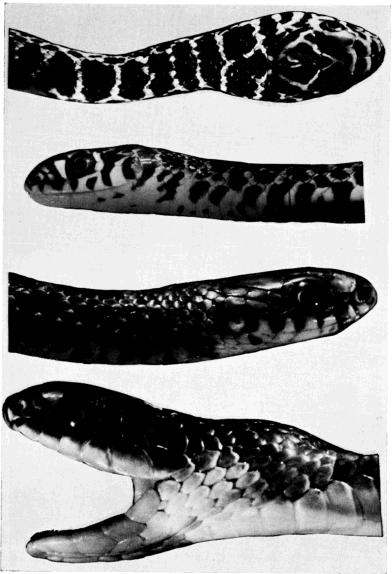
Fig. 1. Head of hatchling blue racer, dorsal view, September 1962, approximately × 3.
Fig. 2. Head of hatchling blue racer, lateral view, September 1962, approximately × 3.
Fig. 3. Head of yearling male blue racer, lateral view, August 1, 1961, a little less than twice natural size.
Fig. 4. Head of adult male blue racer, lateral view, July 16, 1961, approximately × 2. All three snakes from Rockefeller Experimental Tract, Jefferson County, Kansas.
PLATE 20
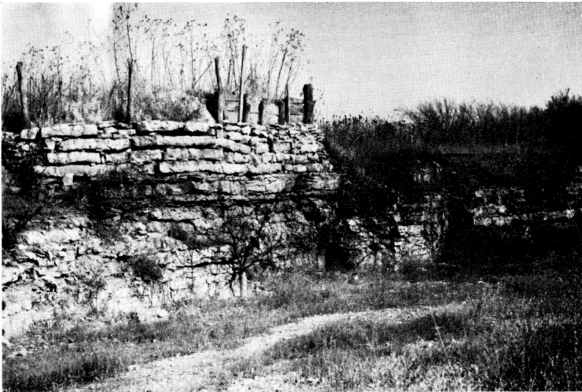
Fig. 1. Abandoned limestone quarry on a hilltop of southward exposure on The University of Kansas Natural History Reservation, in late autumn of 1951. The crevices along the base of the ledge provided favorite hibernating sites for blue racers.
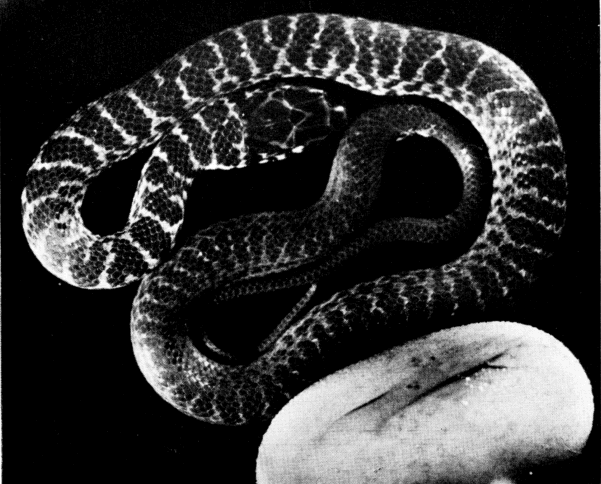
Fig. 2. Hatchling blue racer and eggshell from which it had recently emerged, in early September, 1962; × approximately 12/3.
PLATE 21
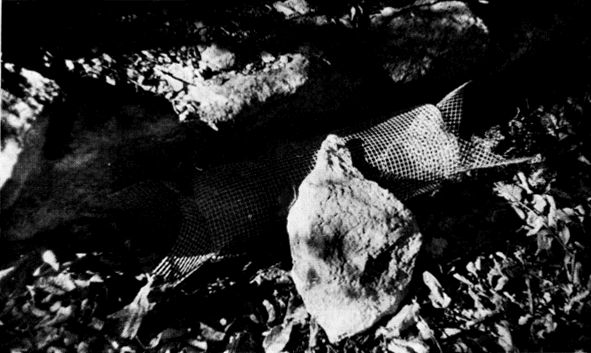
Fig. 1. Wire funnel trap set at base of hilltop limestone outcrop in a spot strategically located for interception of blue racers searching for deep crevices in which to hibernate, October 15, 1949.
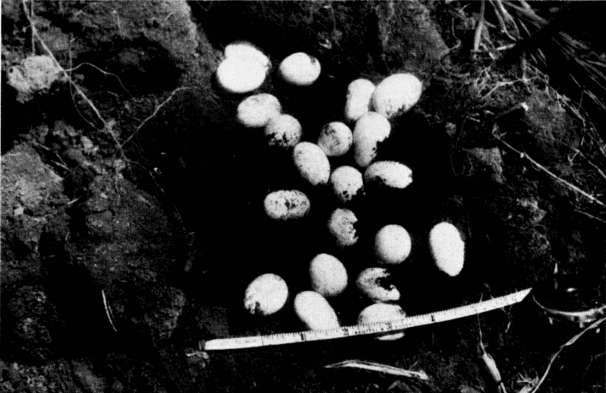
Fig. 2. Large clutch of 21 blue racer eggs, recently plowed out, at Harold Brune farm, Jefferson County, Kansas, July 10, 1962.
PLATE 22
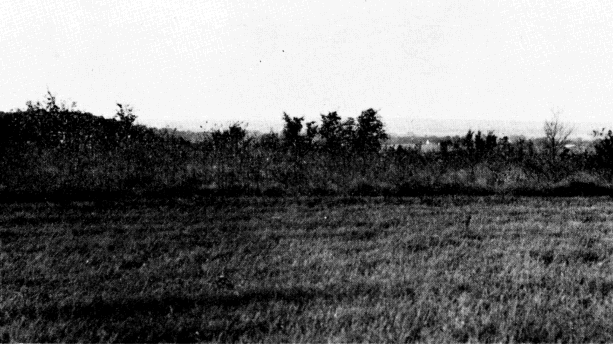
Fig. 1. Habitat of blue racer, blue-stem prairie on Botany Bluff at northwest corner of the University of Kansas Natural History Reservation, looking south. Trees and brush in background are along limestone outcrop at top of slope. Mowed area in foreground is southwest corner of Rockefeller Experimental Tract, a privately owned farm at the time this photograph was taken in the summer of 1951.
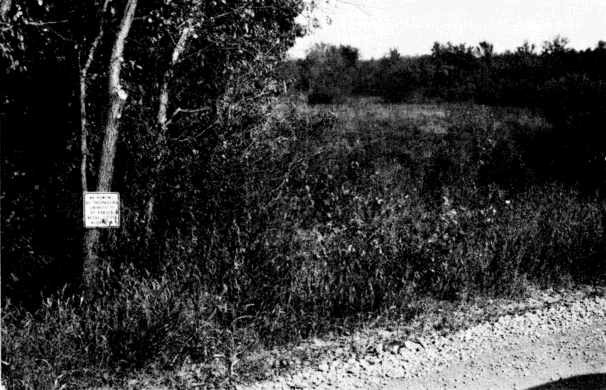
Fig. 2. Habitat of blue racer, blue-stem prairie on south slope of Botany Bluff, looking north along west edge of the Reservation, summer of 1951. By 1962, with exclusion of fire, and protection from mowing, prairie vegetation had largely disappeared from this slope, and had been replaced by trees and brush. As a result of these successional changes racers no longer found this slope a suitable habitat in summer, but they continued to resort to the hilltop rock outcrop to hibernate in autumn.
Some local areas probably support higher populations of racers than do areas where censuses were made, but under modern conditions, situations that offer near optimum habitat are not likely to be extensive or to persist long. On land that is capable of producing a good crop of vegetation, the crop is usually harvested either by grazing of livestock or by using the land for cultivation, with the result that the racers are, at least in some seasons, forced into marginal situations. More than 50 years ago in Missouri, Hurter (1911:170) wrote that the racer "was quite common 20 years ago in pastures, meadows and fields but as cultivation has advanced it is becoming quite rare." In 1962 the widespread and adaptable blue racer is still common in many parts of its range, including Missouri, but in most places its population densities probably are lower than formerly.
Reduction since 1911 has probably been far more drastic than the reduction that had occurred up to that time. Schmidt and Necker (1935:69), writing of the racer in the Chicago region, noted "the snakes which raise their heads and face mowing machinery tend to be exterminated in agricultural areas." They stated that in the Chicago region the racer had been exterminated by the advance of agriculture except in two extensive sand dune areas. In July 1962, Mr. V. B. Howell, a progressive farmer of the Great Bend area in central Kansas, told me that the kinds of snakes inhabiting cultivated land—blue racer, bull snakes, prairie king snakes, hog-nosed snakes, and others—had undergone great reduction in numbers during the period of his farming. He estimated that in a forty-year period the numbers had declined to perhaps five per cent of their level in the area most familiar to him, centering at his farm 11 miles northwest of Great Bend, Barton County. In accounting for this change in population density Howell pointed out the relative destructiveness to small animals of modern farm machinery as contrasted with horse-drawn equipment or that used with tractors of earlier models. Modern tractors move forward so rapidly that there is little opportunity for snakes or other small animals to avoid them, and the plows and disks cut wide swaths penetrating more deeply into the soil than did older types. On July 10, 1962, in searching the furrows of a freshly plowed small field on the Harold Brune farm, for turned-up nests of the snakes, I found two adult blue racers that had been struck and killed by the plow, possibly while they were underground. In fields that are plowed or cultivated between the times of egg-laying and hatching, the eggs are destroyed. Because of its rapid movements and alertness, the racer is more likely to escape farm machines than are most other kinds of snakes. Nevertheless, it is vulnerable and survives in cultivated areas only when they are interspersed with pastures, woodlots, or streamside thickets where at least part of the population may find refuge.
Summary
Field study of the blue racer was carried on in several localities in Kansas, but chiefly at the University of Kansas Natural History Reservation (the northeasternmost section of land in Douglas County), and the adjacent 160-acre Rockefeller Experimental Tract in Jefferson County. By October 26, 1962, after 14 years of field work, a total of 1423 racers had been captured some 2197 times.
The locale of the present study was near the geographic center of the blue racer's range. The range, chiefly in the Mississippi Valley and Great Plains region, is centrally situated with respect to the other seven subspecies. An extensive but scattered literature concerning the ecology of the species as a whole, and its several geographic races, has been reviewed and utilized for comparison with my own field data.
Blue racers were caught in wire funnel traps set in prairie and pastureland habitat in summer, and along hilltop limestone outcrops in woodland in autumn. The autumn trapping along rock outcrops was carried on each year from 1949 to 1962, but effective summer trapping was carried on only in the last six years of the study. Each racer caught was individually and permanently marked by scale clipping. More than half were caught only once, but many were recorded repeatedly, with a maximum of 16 captures.
The racer occurs throughout most of the United States, and its populations are subject to much geographic variation. The snakes are largest in the northeastern part of the range, with clines of decreasing size toward the southeastern, southern and western parts of the United States. There are somewhat parallel trends in coloration; the black racer of the northeastern states grades into paler, gray or light brown subspecies in southern Florida, Texas, and the far western states. Accompanying these changes in color and size are minor morphological changes and major ecological changes. The black racers of the eastern states often inhabit forest or forest-edge habitats while the paler and smaller snakes of more southern or western areas typically inhabit scrub, chaparral, or prairie. The large, dark-colored racers of the eastern and northeastern states are especially inclined to attack larger prey including small vertebrates, even weasels, rabbits, and chipmunks, whereas the smaller and paler racers of more southern and more western areas take a higher proportion of insects and rarely attack vertebrates other than small reptiles.
On the area where field work was carried on in northeastern Kansas, tall-grass prairie habitat is preferred, but fields of grain or alfalfa, grazed pasture, brush, woodland edge, groves or open woodland, and weedy fields are all utilized to some extent. The racer is strictly diurnal and largely terrestrial but it may climb through bushes or small trees in foraging or escaping.
The blue racer is a typical colubrine snake of slender build, with large eyes, and vision plays an important role in finding prey and detecting enemies. In the adult blue racer the dorsal color is variable, pale brown or gray, bluish, greenish or slaty. In the hatchling, however, there is a distinct pattern of a type widespread among colubrines and also among snakes of other groups—a series of middorsal blotches on an olive ground color, with alternating rows of smaller spots on each side. The ventral surface is pale, with dark speckling. The pattern is sharply defined on the anterior part of the body, but markings become progressively more obscure posteriorly and are scarcely discernible on the tail.
The juvenal pattern fades gradually as growth proceeds, and there is much individual variation in the rate of its loss. Some racers still retain the juvenal pattern faintly discernible after attainment of sexual maturity. There are also striking ontogenetic changes in the proportions of the head, body and tail. The diameter of the eye is approximately one per cent of the snout-vent length in hatchlings, but is only a little more than half that relative size in the largest adults. In the course of allometric growth other parts of the head also enlarge less rapidly than the body, but more rapidly than the eye. In hatchlings there is a slight average difference between the sexes in relative tail length, with males' tails the longer. Relative tail length increases slightly in both sexes up to the time of sexual maturity, and then decreases slightly with advancing age.
Racers in northeastern Kansas spend nearly half the year in hibernation, with average recorded emergence date April 16, and average date of retirement into hibernation November 8. Hibernacula are usually in crevices in hilltop limestone outcrops with south exposures. Winter temperatures within the hibernacula are usually well within the range 0 degrees to 10 degrees Centigrade. Spring emergence has been recorded at an air temperature of only 12.5 degrees Centigrade. Racers bask in sunshine frequently even in warm weather, and the temperature preferendum is several degrees higher than in most other kinds of snakes. Bodily temperatures obtained from blue racers that were fully active, either under natural conditions or in a large outdoor enclosure, were concentrated in the neighborhood of 34 and 35 degrees Centigrade. For short periods racers can survive temperatures up to 45 degrees without damage, but more prolonged exposure to temperatures of slightly less than 40 degrees can be fatal. In hibernation, racers can withstand temperatures slightly below freezing, but they cannot survive being frozen solid.
Blue racers tend to limit their activities to familiar areas or home ranges; some individuals may live out their entire lives within the same home range, but others shift from time to time. Average home ranges of approximately 26 acres for males and 24 acres for females were calculated. The racers' preference for hibernacula in a habitat different from that to which summer activities are confined necessitates spring and fall migrations between the limestone outcrops where hibernation occurs and the grasslands where the snakes stay in summer. The average spring or fall migration is approximately a quarter of a mile, but an individual racer does not consistently return to the same hibernaculum. Many racers were recorded to have made movements of 2000 to nearly 4000 feet, involving shifts in home range, but some later shifted back to their original areas. Some may have made even longer shifts but their movements would not have been recorded since they would have gotten beyond the limits of the study area.
Blue racers hunt by various methods, often by coursing through dense vegetation in active search in which vision is of primary importance in locating the prey. Almost any small animal that moves nearby may be overtaken and caught with a sudden dash. From analysis of scats and prey from stomachs, a total of 1357 food items of more than 50 species was compiled. Favorite prey species were the cricket (Gryllus assimilis), grasshoppers (Arphia simplex, Melanoplus femur-rubrum, M. bivittatus, M. differentialis), camel crickets (Ceuthophilus sp.), katydid (Neoconocephalus robustus), vole (Microtus ochrogaster), white-footed mouse (Peromyscus sp.), racerunner, (Cnemidophorus sexlineatus), and leopard frog (Rana pipiens). The insects taken greatly outnumbered the vertebrates, but the vertebrates made up most of the actual bulk of prey eaten. Crickets, grasshoppers, and katydids comprised most of the insect prey. Beetles, moths and cicadas were rarely taken. Vertebrate prey included miscellaneous small snakes (some of them juvenal racers), mammals, and birds. Seasonal change in the composition of the food is slight, but vertebrates figure more prominently in early summer, and insects comprise increasing percentages later in the season. Composition of the food differs according to size of the snake; gryllid and ceuthophilid crickets are best represented in the food of juveniles whereas small mammals, and grasshoppers of the genus Melanoplus are best represented in the food of large adults.
The breeding season is mainly in May. Mating is promiscuous and two or more males may court the same female simultaneously. A courting male lies on or alongside a receptive female, with spasmodic rippling abdominal movements, and with his vent adpressed to hers. At intervals in the courtship period the female moves swiftly for a few feet or a few yards shifting to a new spot, and during her activity the male strives to maintain contact with her. From time to time the male leaves the female briefly and courses rapidly around her in a devious route. Courtship is consummated when the female raises her tail in acceptance of the male and intromission is effected. During coitus, which lasts for periods of minutes, the female moves forward slowly, dragging the passive male, tail-first behind her.
Ovulation normally is in late May. Eggs from 29 to 39 millimeters in length and 14 to 21 millimeters in breadth are laid, from mid-June to early August, usually in tunnels of fossorial mammals such as voles or moles, at depths of five to 12 inches. Clutches of the blue racer average 11.8 eggs but the number is correlated with age and size of females; two-year-olds average only 9.2 eggs, whereas those females that are six years old or more average 15.7 eggs. Also, there is geographic variation in size of clutch, from only 5.8 eggs in C. c. mormon of the West Coast to 16.8 eggs in C. c. constrictor of the northeastern states. In each breeding season some females of adult size do not produce clutches. Only about 13 per cent of the two-year-olds in a small sample were fecund, but the ratio increased to 80 per cent in old adults. Incubation averages 51 (43 to 63) days.
Hatchlings usually make several longitudinal slits in the eggshell with the egg tooth before emerging, and often require a day or more to emerge after the first slit is made. Hatchlings average 103/4 inches and 4.16 grams. By late October when these young are ready to enter hibernation, they have grown to 163/4 inches and 12.3 grams. Typical October lengths (overall) in inches for males and females, respectively, after successive seasons of growth, are as follows: yearlings, 273/4 and 29; two-year-olds, 341/4 and 371/4; three-year-olds, 373/4 and 413/4; four-year-olds, 40 and 443/4; five-year-olds, 411/2 and 461/4; six-year-olds, 421/4 and 481/4; seven-year-olds, 433/4 and 50; eight-year-olds, 44 and 511/4.
Judging from trends in the small samples available, sex ratio in hatchlings is approximately 1:1. In the summer trapping of blue racers, males are caught in larger numbers than females, but seemingly this is because of their greater activity. In fall along the limestone outcrops where the racers hibernate females were caught in slightly greater numbers than males among the young adults, and made up a little more than 60 per cent of the old adults. Presumably the males are eliminated more rapidly, because of their greater activity, their smaller size, or a combination of both factors. The composition by age groups of the adult racers captured was as follows: two-year-olds, 41.5 per cent; three-year-olds, 17.8 per cent; four-year-olds, 12.6 per cent; five-year-olds, 9.5 per cent; six-year-olds, 6.1 per cent; seven-year-olds, 4.3 per cent; eight-year-olds, 2.7 per cent; nine-year-olds, 2.4 per cent; ten-year-olds, 1.2 per cent; more than ten years old, 1.9 per cent.
Attempts to census blue racers on the study plots, from the capture-recapture ratios, yielded highly variable figures for different areas and even for the same area at different times. Variability is believed to result mostly from the small sizes of the samples, none of which is large enough to yield a census figure that is statistically reliable. Combined samples yielded figures indicating populations of one to three adults per acre in early summer in areas of favorable habitat. To represent the entire population in late summer—the time of its annual maximum—these figures would need to be approximately tripled.
The blue racer depends mostly on speed to escape its enemies. In escaping it often takes advantage of a downhill slope to increase its speed. A racer startled at close range often sets out with a violent thrashing that attracts attention to a given spot, then glides away so silently and rapidly that its course is not detected. The snake may circle back and approach the scene of disturbance slowly and stealthily, from the direction opposite to that taken in departing. Often a racer seeks concealment by climbing into a bush or tree, and occasionally escape is effected by swimming. A racer that is caught or cornered usually makes a spirited defense by striking and biting. An alternative reaction, seen most typically when the snake is handicapped by injury or by low temperature, is to coil with the head concealed, and, with writhing movements, to smear the surface of the body with musk discharged from glands in the base of the tail.
Many natural enemies prey upon the racer, but in the present study the majority of records pertained to the red-tailed hawk. The broad-winged hawk, marsh hawk, red-shouldered hawk, sparrow hawk, and barn owl also are among the raptors that feed on this kind of snake. Among mammals the striped skunk is the only species definitely recorded to prey on the racer, feeding on the eggs as well as upon the young and adults. The common king snake, prairie king snake, timber rattlesnake, copperhead, and even the slender glass lizard have been recorded to prey on the blue racer, but probably all are of minor importance as natural enemies. Shrews (Blarina, Cryptotis) and mice (Peromyscus, Reithrodontomys) have sometimes killed and eaten racers confined in traps, and under natural conditions they possibly prey upon snakes that are immobilized when torpid from cold, in their hibernacula and temporary shelters. Chiggers are the most common ectoparasites of the racers. Four species of the chigger genus Trombicula have been recorded on racers from the Reservation. The racer is an important host of the common pest chigger, Trombicula alfreddugèsi, which often attacks humans. Most adult racers on the Reservation and nearby areas carry the fluke, Neorenifer lateriporus. In spring these flukes are conspicuous in the mouths of the racers, but in late summer they are not in evidence.
Literature Cited
Allen, M. J.
1932. A survey of the amphibians and reptiles of Harrison County, Mississippi. Amer. Mus. Novit., 542:11-12.
Anderson, P.
1942. Amphibians and reptiles of Jackson County, Missouri. Bull. Chicago Acad. Sci., 6:203-220.
Atkinson, D. A.
1951. The reptiles of Allegheny County, Pa. Ann. Carnegie Mus., 1:145-157.
Auffenberg, W.
1949. The racer, Coluber constrictor stejnegerianus in Texas. Herpetologica, 5:53-58.
1955. A reconsideration of the racer, Coluber constrictor, in eastern United States. Tulane Studies in Zool., 2(6):89-155.
Barbour, R. W.
1950. The reptiles of Big Black Mountain, Harlan County, Kentucky. Copeia, 1950:100-107.
Baxter, G. T.
1947. The amphibians and reptiles of Wyoming. Wyoming Wild Life, August and October 1947:1-8.
Blair, W. F.
1960. The rusty lizard. Univ. Texas Press, Austin, xvi + 185 pp.
Blanchard, F. N. and Blanchard, F. C.
1942. Mating of the garter snake, Thamnophis sirtalis sirtalis (Linnaeus). Papers Michigan Acad. Sci. Arts and Letters, 27:215-234.
Blanchard, F. N. and Finster, E. B.
1933. A method of marking living snakes for future recognition with a discussion of some problems and results. Ecology, 14:334-349.
Bogert, C. M. and Cowles, R. B.
1947. Moisture loss in relation to habitat selection in some Floridian reptiles. Results of the Archbold Expeditions, No. 58; Amer. Mus. Novit., 1358:1-34.
Bonn, E. W. and McCarley, W. H.
1953. The amphibians and reptiles of the Lake Texoma area. Texas Jour. Sci., 1953(4):465-471.
Boyer, D. A. and Heinze, A. A.
1934. An annotated list of the amphibians and reptiles of Jefferson County, Missouri. Trans. Acad. Sci. St. Louis, 28(4):183-200.
Branson, E. B.
1904. Snakes of Kansas. Univ. Kansas Sci. Bull., 12(13):353-430.
Brattstrom, B. H.
1953a. Records of Pleistocene reptiles and amphibians from Florida. Quart. Jour. Florida Acad. Sci., 16(4):243-248.
1953b. The amphibians and reptiles from Rancho La Brea. Trans. San Diego Soc. Nat. Hist., 11(14):365-392.
1955. Pliocene and Pleistocene amphibians and reptiles from southeastern Arizona. Jour. Paleontology, 29(1):150-154.
Breckenridge, W. J.
1944. Reptiles and amphibians of Minnesota. Univ. Minnesota Press, 202 pp.
Brimley, C. M.
1903. Notes on the reproduction of certain reptiles. Amer. Nat., 37:261-266.
Brons, H. A.
1882. Notes on the habits of some western snakes. Amer. Nat., 16:564-567.
Brumwell, M. J.
1951. An ecological survey of the Fort Leavenworth Military Reservation. Amer. Midl. Nat., 45(1):187-231.
Burt, C. E.
1927. An annotated list of the amphibians and reptiles of Riley County, Kansas. Occas. Papers Mus. Zool. Univ. Michigan, 189:1-9.
1933. Some distributional and ecological records of Kansas reptiles. Trans. Kansas Acad. Sci., 36:186-208.
1935. Further records of the ecology and distribution of amphibians and reptiles in the Middle West. Amer. Midl. Nat., 16(3):311-336.
Burt, C. E. and Hoyle, W. L.
1934. Additional records of the reptiles of the central prairie region of the United States. Trans. Kansas Acad. Sci., 37:193-216.
Cagle, F. R.
1942. Herpetological fauna of Jackson and Union counties, Illinois. Amer. Midl. Nat., 28(1):164-200.
Carpenter, C. C.
1958. Reproduction, young, eggs and food of Oklahoma snakes. Herpetologica, 14:113-115.
Carr, A. F. Jr.
1940. A contribution to the herpetology of Florida. Univ. Florida Publ. Biol. series, 3:iv + 118 pp.
Clark, R. F.
1949. Snakes of the hill parishes of Louisiana. Jour. Tennessee Acad. Sci., 24(4):244-261.
Clarke, R. F.
1958. An ecological study of reptiles and amphibians of Osage County, Kansas. Emporia State Research Studies, 7(1):1-52.
Cohen, E.
1948. Emergence of Coluber c. constrictor from hibernation. Copeia, 1948:137-138.
Committee on Herpetological Common Names
1956. Common names for North American amphibians and reptiles. Copeia, 1956(3):172-185.
Conant, R.
1938. The reptiles of Ohio. Amer. Midl. Nat., 20(1):1-200.
1958. A field guide to reptiles and amphibians of the United States and Canada east of the 100th Meridian. Houghton-Mifflin Co., Boston xviii + 366 pp., 40 pls., 62 figs., 248 maps.
Cope, E. D.
1900. The crocodilians, lizards and snakes of North America. Rept. U. S. Nat. Mus. for 1898, pp. 153-1270.
Crabb, W. D.
1941. Food habits of the prairie spotted skunk in southeastern Iowa. Jour. Mamm., 22(4):349-364.
Crow, H. E.
1913. Some trematodes of Kansas snakes. Univ. Kansas Sci. Bull., 7:123-134.
Cunningham, J. D.
1959. Reproduction and food of some California snakes. Herpetologica, 15(1):17-19.
Curtis, L.
1949. The snakes of Dallas County, Texas. Field & Laboratory, 17:5-13.
Dice, L. R.
1916. Distribution of the land vertebrates of southeastern Washington. Univ. California Publ. Zool., 16(17):293-348.
Ditmars, R. L.
1896. The snakes found within fifty miles of New York City. Abs. Proc. Linn. Soc. New York, 8:9-24.
1907. The reptile book. Doubleday, Page and Co., New York, pp. xx + 472.
1944. Serpents of the northeastern states. New York Zool. Soc., 34 pp., 21 pls.
Duellman, W. E.
1951. Notes on the amphibians and reptiles of Greene County, Ohio. Ohio Jour. Sci., 51(6):335-341.
Duellman, W. E. and Schwartz, A.
1958. Amphibians and reptiles of southern Florida. Bull. Florida State Mus. Biol. Sci., 3(5):181-324.
Ellicott, E. L.
1880. Bundles of snakes. Am. Nat., 14:206-207.
Etheridge, R. E.
1952. The southern range of the racer Coluber constrictor stejnegerianus (Cope), with remarks on the Guatemalan species Coluber ortenburgeri Stuart. Copeia, 1952:189-191.
Ferguson, D. E.
1952. The distribution of amphibians and reptiles of Wallowa County, Oregon. Herpetologica, 8:66-68.
Finneran, L. C.
1948. Reptiles at Branford, Connecticut. Herpetologica, 4:123-126.
Fitch, H. S.
1935. Natural history of the alligator lizards. Trans. Acad. Sci. St. Louis, 29(1):1-38.
1936. Amphibians and reptiles of the Rogue River Basin, Oregon. Amer. Midl. Nat., 17(3:634-652).
1940. A biogeographical study of the ordinoides artenkreis of garter snakes (genus Thamnophis). Univ. California Publ. Zool., 44(1):1-150.
1949. Road counts of snakes in western Louisiana. Herpetologica, 5:87-90.
1951. A simplified type of funnel trap for reptiles. Herpetologica, 7:77-80.
1954. Life history and ecology of the five-lined skink, Eumeces fasciatus. Univ. Kansas Publ. Mus. Nat. Hist., 8(1):1-156.
1955. Habits and adaptations of the Great Plains skink. Ecol. Monogr., 25(3):59-83.
1956. Temperature responses in free-living amphibians and reptiles of northeastern Kansas. Univ. Kansas Publ. Mus. Nat. Hist., 8(7):417-476.
1958. Home ranges, territories and seasonal movements in vertebrates of the Natural History Reservation. Univ. Kansas Publ. Mus. Nat. Hist. 11(3):63-326.
1960. Autecology of the copperhead. Univ. Kansas Publ. Mus. Nat. Hist., 13(4):85-288.
Fitch, H. S. and Packard, R. L.
1955. The coyote on a natural area in northeastern Kansas. Trans. Kansas Acad. Sci., 58:211-221.
Fitch, H. S. and Sandidge, L. L.
1953. Ecology of the opossum on a natural area in northeastern Kansas. Univ. Kansas Publ. Mus. Nat. Hist., 7(2):305-338.
Force, E. R.
1930. The amphibians and reptiles of Tulsa County, Oklahoma, and vicinity. Copeia, 1930(2):25-39.
Fouquette, M. J. and Lindsay, H. L., Jr.
1955. An ecological survey of reptiles in parts of northwestern Texas. The Texas Jour. Sci., 7(4):402-421.
Gloyd, H. K.
1928. The amphibians and reptiles of Franklin County, Kansas. Trans. Kansas Acad. Sci., 31:115-141.
1932. The herpetological fauna of the Pigeon Lake region, Miami County, Kansas. Papers Michigan Acad. Sci. Arts and Letters, 15:389-409.
1945. The problem of too many snakes. Chicago Nat., 7(4):87-97.
Grinnell, J., Dixon, J., and Linsdale, J. M.
1930. Vertebrate natural history of a section of northern California through the Lassen Peak region. Univ. Calif. Publ. Zool., 35: v + 594 pp., 181 figs.
Guidry, E. V.
1953. Herpetological notes from southeastern Texas. Herpetologica, 9:49-56.
Hamilton, W. J., Jr., and Pollack, J. A.
1956. The food of some colubrid snakes from Fort Benning, Georgia. Ecology, 37:519-526.
Harwood, P. D.
1933. The helminths parasitic in the Amphibia and Reptilia of Houston, Texas and vicinity. Proc. U. S. Nat. Mus., 81, 17:1-71.
Hay, O. P.
1893. On the breeding habits, eggs, and young of certain snakes. Proc. U. S. Nat. Mus., 15:385-397.
Hibbard, C. W.
1936. The amphibians and reptiles of Mammoth Cave National Park Proposed. Trans. Kansas Acad. Sci., 39:277-281.
Hudson, G. E.
1942. The amphibians and reptiles of Nebraska. Nebraska Conservation Bull. no. 24, 146 pp.
Hudson, R. G.
1949. A record length milk snake. Herpetologica, 5:47.
Hurter, J. H.
1911. Herpetology of Missouri. Trans. Acad. Sci. St. Louis, 20:59-274.
Inger, F. and Clark, P. J.
1943. Partition of the genus Coluber. Copeia, 1943(3):141-145.
Jackson, C. H. N.
1939. The analysis of an animal population. Jour. An. Ecology, 8:238-246.
King, W.
1939. A survey of the herpetology of Great Smoky Mountain National Park. Amer. Midl. Nat., 21(3):531-582.
Klimstra, W. D.
1959. Food of the racer, Coluber constrictor, in southern Illinois. Copeia, 1959(3):210-214.
Langbartel, D. A.
1947. Snakes collected at Camp Eastman, Hancock County, Illinois. Herpetologica, 4:27-28.
Liner, E. A.
1949. Notes on the young of the blue racer, Coluber constrictor flaviventris. Copeia, 1949(3):230.
1954. The herpetofauna of Lafayette, Terrebonne, and Vermilion parishes, Louisiana. Proc. Louisiana Acad. Sci., 17:65-85.
1955. A herpetological consideration of the Bayou Tortue region of Lafayette Parish, Louisiana. Proc. Louisiana Acad. Sci. 18:39-42.
Linsdale, J. M.
1927. Amphibians and reptiles of Doniphan County, Kansas. Copeia, no. 164:75-81.
Loewen, S. I.
1940. On some reptilian cestodes of the genus Oochoristica (Anoplocephalidae). Trans. Amer. Microscop. Soc., 59(4):511-518.
Logier, E. B. S.
1932. Some account of the amphibians and reptiles of British Columbia. Contr. Royal Ontario Mus., Trans. Royal Canadian Inst., 18(2):311-336.
Loomis, R. B.
1956. The chigger mites of Kansas (Acarina, Trombiculidae). Univ. Kansas Sci. Bull., 37, pt. 2(19):1195-1443.
Lord, J. K.
1866. The naturalist in Vancouver Island and British Columbia. Richard Bentley, London, 375 pp.
Marr, J. C.
1944. Notes on amphibians and reptiles from the central United States. Amer. Midl. Nat., 32:478-490.
Martin, E. P.
1956. A population study of the prairie vole (Microtus ochrogaster) in northeastern Kansas. Univ. Kansas Publ. Mus. Nat. Hist., 8(6):361-416.
Maslin, T. P.
1959. An annotated check list of the amphibians and reptiles of Colorado. Univ. Colorado Studies, Biol. Series, No. 6, 98 pp.
McCauley, R. H.
1945. The reptiles of Maryland and the District of Columbia. Published by the author, Hagerstown, Maryland, 194 pp.
Minton, S., Jr.
1944. Introduction to the study of reptiles in Indiana. Amer. Midl. Nat., 32:438-477.
1949. An ectopic egg in Coluber. Herpetologica, 5:96.
Mossiman, J. E. and Rabb, G. B.
1952. The herpetology of the Tiber River area, Montana. Copeia, 1952(1):23-27.
Mulaik, S. and Mulaik, D.
1942. A neglected species of Coluber. Copeia, 1942:13-15.
Munro, D. F.
1948. Comparative sizes of two female blue racers and their eggs. Herpetologica, 4:199-200.
1949. Eating habits of young Coluber constrictor flaviventris. Herpetologica, 5:72-73.
1950a. Incubation and hatching of eggs of Coluber c. flaviventris. Herpetologica, 6:122-124.
1950b. Juvenile pattern in a mature Coluber c. flaviventris. Herpetologica, 6:124.
Neill, W. T.
1948. Hibernation of amphibians and reptiles in Richmond County, Georgia. Herpetologica, 4:107-114.
Odum, E. P. and Kuenzler, E. J.
1955. Measurement of territory and home range size in birds. Auk, 72:128-137.
Ortenburger, A. I.
1928. The whip snakes and racers, genera Masticophis and Coluber. Mem. Univ. Michigan Mus., vol. 1, pp. xviii + 247.
Owens, V.
1949. An overwintering colony of Coluber c. constrictor (Say) and Elaphe o. obsoleta (Say). Herpetologica, 5:90.
Parker, M. V.
1941. The trematode parasites from a collection of amphibians and reptiles. Jour. Tennessee Acad. Sci., 16(1):27-45.
Peters, J. A.
1942. Reptiles and amphibians of Cumberland County, Illinois. Copeia, 1942(3):182-183.
Pope, C. H.
1935. The reptiles of China. Amer. Mus. Nat. Hist., Nat. Hist. Cent. Asia, v. 10, lii + 604 pp.
1944. Amphibians and reptiles of the Chicago area. Chicago Nat. Hist. Mus. Press, 275 pp., 12 pls.
Pope, T. E. B. and Dickinson, W. E.
1928. The amphibians and reptiles of Wisconsin. Bull. Pub. Mus. City of Milwaukee, 8(1):1-138.
Richmond, N. D. and Goin, C. J.
1938. Notes on a collection of amphibians and reptiles from New Kent County, Virginia. Ann. Carnegie Mus., 27:301-310.
Rossman, D. A.
1960. Herpetological survey of the pine hills area of southern Illinois. Quart. Jour. Florida Acad. Sci. (1959), 22(4):207-225.
Schmidt, K. P. and Necker, W. L.
1935. Amphibians and reptiles of the Chicago region. Bull. Chicago Acad. Sci., 5(4):57-77.
Schroder, R. C.
1950. Hibernation of blue racers and bull snakes in western Illinois. Nat. Hist. Misc., 75:1-2.
Shannon, F. A.
1950. Coluber constrictor mormon—a state record for Arizona. Herpetologica, 6:59.
Smith, H. M.
1956. Handbook of amphibians and reptiles of Kansas. Univ. Kansas Mus. Nat. Hist. Misc. Publ., 9:357 pp.
Smith, P. W.
1947. The reptiles and amphibians of east central Illinois. Bull. Chicago Acad. Sci., 8(2):21-40.
1961. The amphibians and reptiles of Illinois. Bull. Illinois Nat. Hist. Surv., 28(1):1-298.
Stains, H. J.
1956. The raccoon in Kansas. Univ. Kansas Mus. Nat. Hist. Misc. Publ., No. 10, pp. 1-76, pls. 1-4.
Stewart, P. L.
1959. Lung flukes of Thamnophis and Coluber in Kansas. Unpublished thesis University of Kansas Library, pp. 1-62.
Stickel, W. H. and Cope, J. B.
1947. The home ranges and wandering of snakes. Copeia, 1947:127-136.
Storer, D. H.
1839. Reports on the ichthyology and herpetology of Massachusetts. Comm. Zool. and Bot. Surv. Mass., Boston, 201-258.
Surface, H. A.
1906. The serpents of Pennsylvania. Pennsylvania State Dept. Agr. Monthly Bull., Div. Zool., 4(4 and 5):113-208.
Tinkle, D. W.
1959. Observations of reptiles and amphibians in a Louisiana swamp. Amer. Midl. Nat, 62 (11):189-205.
Trowbridge, A. H.
1937. Ecological observations on amphibians and reptiles collected in southeastern Oklahoma during the summer of 1934. Amer. Midl. Nat. 18(2):285-303.
Uhler, F. M., Cottam, C. and Clarke, T. E.
1939. Food of snakes of the George Washington National Forest, Virginia. Trans. 4th Amer. Wildlife Conf., Amer. Wildlife Inst., Washington, D. C., 1939:605-632.
Van Denburgh, J.
1923. The reptiles of western North America. Occas. Papers California Acad. Sci., 10:1-1028.
Van de Velde, R. L., Martan, J. and Risley, P. L.
1962. Eggs and hatchlings of the snake Coluber constrictor mormon from Oregon. Copeia (1):212-213.
Verrill, A. E.
1869. The biter bitten. Amer. Nat., 3:158-159.
Welter, W. A. and Carr, K.
1939. Amphibians and reptiles of northeastern Kentucky. Copeia (3):128-130.
Werler, J. E. and McCallion, J.
1951. Notes on a collection of reptiles and amphibians from Princess Anne County, Virginia. Amer. Midl. Nat., 45(1):245-252.
Woodbury, A. M.
1931. A descriptive catalog of the reptiles of Utah. Bull. Univ. Utah, 21 (no. 5):x + 129 pp.
Woods, G. T.
1944. Black snake attacks a boy. Copeia, 1944(4):257.
Wright, A. H. and Bishop, S. C.
1915. A biological reconnaissance of the Okefinokee Swamp in Georgia. II. Snakes. Proc. Acad. Nat. Sci. Philadelphia, 67:139-192.
Wright, A. H. and Wright, A. A.
1957. Handbook of snakes of the United States and Canada. Comstock Publ. Associates, Cornell Univ. Press, vol. I, xviii + 564 pp.
Transmitted June 3, 1963.

29-7864
UNIVERSITY OF KANSAS PUBLICATIONS MUSEUM OF NATURAL HISTORY
Institutional libraries interested in publications exchange may obtain this series by addressing the Exchange Librarian, University of Kansas Library, Lawrence, Kansas. Copies for individuals, persons working in a particular field of study, may be obtained by addressing instead the Museum of Natural History, University of Kansas, Lawrence, Kansas. There is no provision for sale of this series by the University Library, which meets institutional requests, or by the Museum of Natural History, which meets the requests of individuals. Nevertheless, when individuals request copies from the Museum, 25 cents should be included, for each separate number that is 100 pages or more in length, for the purpose of defraying the costs of wrapping and mailing.
* An asterisk designates those numbers of which the Museum's supply (not the Library's supply) is exhausted. Numbers published to date, in this series, are as follows:
Vol. 1.Nos. 1-26 and index. Pp. 1-638, 1946-1950.
*Vol. 2.(Complete) Mammals of Washington. By Walter W. Dalquest. Pp. 1-444, 140 figures in text. April 9, 1948.
Vol. 3.*1.The avifauna of Micronesia, its origin, evolution, and distribution. By Rollin H. Baker. Pp. 1-359, 16 figures in text. June 12, 1951.
*2.A quantitative study of the nocturnal migration of birds. By George H. Lowery, Jr. Pp. 361-472, 47 figures in text. June 29, 1951.
3.Phylogeny of the waxwings and allied birds. By M. Dale Arvey. Pp. 473-530, 49 figures in text, 13 tables. October 10, 1951.
*4.Birds from the state of Veracruz, Mexico. By George H. Lowery, Jr., and Walter W. Dalquest. Pp. 531-649, 7 figures in text, 2 tables. October 10, 1951.
Index. Pp. 651-681.
*Vol. 4.(Complete) American weasels. By E. Raymond Hall. Pp. 1-466, 41 plates, 31 figures in text. December 27, 1951.
Vol. 5.Nos. 1-37 and index. Pp. 1-676, 1951-1953.
*Vol. 6.(Complete) Mammals of Utah, taxonomy and distribution. By Stephen D. Durrant. Pp. 1-549, 91 figures in text, 30 tables. August 10, 1952.
Vol. 7.Nos. 1-15 and index. Pp. 1-651, 1952-1955.
Vol. 8.Nos. 1-10 and index. Pp. 1-675, 1954-1956.
Vol. 9.*1.Speciation of the wandering shrew. By James S. Findley. Pp. 1-68, 18 figures in text. December 10, 1955.
2.Additional records and extension of ranges of mammals from Utah. By Stephen D. Durrant, M. Raymond Lee, and Richard M. Hansen. Pp. 69-80. December 10, 1955.
3.A new long-eared myotis (Myotis evotis) from northeastern Mexico. By Rollin H. Baker and Howard J. Stains. Pp. 81-84. December 10, 1955.
4.Subspeciation in the meadow mouse, Microtus pennsylvanicus, in Wyoming. By Sydney Anderson. Pp. 85-104, 2 figures in text. May 10, 1956.
5.The condylarth genus Ellipsodon. By Robert W. Wilson. Pp. 105-116, 6 figures in text. May 19, 1956.
6.Additional remains of the multituberculate genus Eucosmodon. By Robert W. Wilson. Pp. 117-123, 10 figures in text. May 19, 1956.
7.Mammals of Coahulia, Mexico. By Rollin H. Baker. Pp. 125-335, 75 figures in text. June 15, 1956.
8.Comments on the taxonomic status of Apodemus peninsulae, with description of a new subspecies from North China. By J. Knox Jones, Jr. Pp. 337-346, 1 figure in text, 1 table. August 15, 1956.
9.Extensions of known ranges of Mexican bats. By Sydney Anderson. Pp. 347-351. August 15, 1956.
10.A new bat (Genus Leptonycteris) from Coahulia. By Howard J. Stains. Pp. 353-356. January 21, 1957.
11.A new species of pocket gopher (Genus Pappogeomys) from Jalisco, Mexico. By Robert J. Russell. Pp. 357-361. January 21, 1957.
12.Geographic variation in the pocket gopher, Thomomys bottae, in Colorado. By Phillip M. Youngman. Pp. 363-387, 7 figures in text. February 21, 1958.
13.New bog lemming (genus Synaptomys) from Nebraska. By J. Knox Jones, Jr. Pp. 385-388. May 12, 1958.
14.Pleistocene bats from San Josecito Cave, Nuevo León, México. By J. Knox Jones, Jr. Pp. 389-396. December 19, 1958.
15.New subspecies of the rodent Baiomys from Central America. By Robert L. Packard. Pp. 397-404. December 19, 1958.
16.Mammals of the Grand Mesa, Colorado. By Sydney Anderson. Pp. 405-414, 1 figure in text, May 20, 1959.
17.Distribution, variation, and relationships of the montane vole, Microtus montanus. By Sydney Anderson. Pp. 415-511, 12 figures in text, 2 tables. August 1, 1959.
18.Conspecificity of two pocket mice, Perognathus goldmani and P. artus. By E. Raymond Hall and Marilyn Bailey Ogilvie. Pp. 513-518, 1 map. January 14 1960.
19.Records of harvest mice, Reithrodontomys, from Central America, with description of a new subspecies from Nicaragua. By Sydney Anderson and J. Knox Jones, Jr. Pp. 519-529. January 14, 1960.
20.Small carnivores from San Josecito Cave (Pleistocene), Nuevo León, México. By E. Raymond Hall. Pp. 531-538, 1 figure in text. January 14, 1960.
21.Pleistocene pocket gophers from San Josecito Cave, Nuevo León, México. By Robert J. Russell. Pp. 539-548, 1 figure in text. January 14, 1960.
22.Review of the insectivores of Korea. By J. Knox Jones, Jr., and David H. Johnson. Pp. 549-578. February 23, 1960.
23.Speciation and evolution of the pygmy mice, genus Baimoys. By Robert L. Packard. Pp. 579-670, 4 plates, 12 figures in text. June 16, 1960.
Index. Pp. 671-690
Vol. 10.1.Studies of birds killed in nocturnal migration. By Harrison B. Tordoff and Robert M. Mengel. Pp. 1-44, 6 figures in text, 2 tables. September 12, 1956.
2.Comparative breeding behavior of Ammospiza caudacuta and A. maritima. By Glen E. Woolfenden. Pp. 45-75, 6 plates, 1 figure. December 20, 1956.
3.The forest habitat of the University of Kansas Natural History Reservation. By Henry S. Fitch and Ronald R. McGregor. Pp. 77-127, 2 plates, 7 figures in text, 4 tables. December 31, 1956.
4.Aspects of reproduction and development in the prairie vole (Microtus ochrogaster). By Henry S. Fitch. Pp. 129-161, 8 figures in text, 4 tables. December 19, 1957.
5.Birds found on the Arctic slope of northern Alaska. By James W. Bee. Pp. 163-211, plates 9-10, 1 figure in text. March 12, 1958.
*6.The wood rats of Colorado: distribution and ecology. By Robert B. Finley, Jr. Pp. 213-552, 34 plates, 8 figures in text, 35 tables. November 7, 1958.
7.Home ranges and movements of the eastern cottontail in Kansas. By Donald W. Janes. Pp. 553-572, 4 plates, 3 figures in text. May 4, 1959.
8.Natural history of the salamander, Aneides hardyi. By Richard F. Johnston and Gerhard A. Schad. Pp. 573-585. October 8, 1959.
9.A new subspecies of lizard, Cnemidophorus sacki, from Michoacán, México. By William E. Duellman. Pp. 587-598, 2 figures in text. May 2, 1960.
10.A taxonomic study of the middle American snake, Pituophis deppei. By William E. Duellman. Pp. 599-610, 1 plate, 1 figure in text. May 2, 1960.
Index. Pp. 611-626.
Vol. 11. Nos. 1-10 and index. Pp. 1-703, 1958-1960.
Vol. 12.1.Functional morphology of three bats: Sumops, Myotis, Macrotus. By Terry A. Vaughan. Pp. 1-153, 4 plates, 24 figures in text. July 8, 1959.
*2.The ancestry of modern Amphibia: a review of the evidence. By Theodore H. Eaton, Jr. Pp. 155-180, 10 figures in text. July 10, 1959.
3.The baculum in microtine rodents. By Sydney Anderson. Pp. 181-216, 49 figures in text. February 19, 1960.
*4.A new order of fishlike Amphibia from the Pennsylvanian of Kansas. By Theodore H. Eaton, Jr., and Peggy Lou Stewart. Pp. 217-240, 12 figures in text. May 2, 1960.
5.Natural history of the bell vireo. By Jon C. Barlow. Pp. 241-296, 6 figures in text. March 7, 1962.
6.Two new pelycosaurs from the lower Permian of Oklahoma. By Richard C. Fox. Pp. 297-307, 6 figures in text. May 21, 1962.
7.Vertebrates from the barrier island of Tamaulipas, México. By Robert K. Selander, Richard F. Johnston, B. J. Wilks, and Gerald G. Raun. Pp. 309-345, pls. 5-8. June 18, 1962.
8.Teeth of Edestid sharks. By Theodore H. Eaton, Jr. Pp. 347-362, 10 figures in text. October 1, 1962.
9.Variation in the muscles and nerves of the leg in two genera of grouse (Tympanuchus and Pedioecetes). By E. Bruce Holmes. Pp. 363-474, 20 figs. October 25, 1963.
10.A new genus of Pennsylvanian Fish (Crossopterygii, Coelacanthiformes) from Kansas. By Joan Echols. Pp. 475-501, 7 figures. October 25, 1963.
11.Observations on the Mississippi Kite in southwestern Kansas. By Henry S. Fitch. Pp. 503-519. October 25, 1963.
12.Jaw musculature of the Mourning and White-winged doves. By Robert L. Merz. Pp. 521-551, 22 figures. October 25, 1963.
More numbers will appear in volume 12.
Vol. 13.1.Five natural hybrid combinations in minnows (Cyprinidae). By Frank B. Cross and W. L. Minckley. Pp. 1-18. June 1, 1960.
2.A distributional study of the amphibians of the Isthmus of Tehuantepec, México. By William E. Duellman. Pp. 19-72, pls. 1-8, 3 figures in text. August 16, 1960.
3.A new subspecies of the slider tutdre (Pseudemys scripta) from Coahulia, México. By John M. Legler. Pp. 73-84, pls. 9-12, 3 figures in text. August 16, 1960.
4.Autecology of the copperhead. By Henry S. Fitch. Pp. 85-288, pls. 13-20, 26 figures in text. November 30, 1960.
5.Occurrence of the garter snake, Thamnophis sirtalis, in the Great Plains and Rocky Mountains. By Henry S. Fitch and T. Paul Maslin. Pp. 289-308, 4 figures in text. February 10, 1961.
6.Fishes of the Wakarusa river in Kansas. By James E. Deacon and Artie L. Metcalf. Pp. 309-322, 1 figure in text. February 10, 1961.
7.Geographic variation in the North American cyprinid fish, Hybopsis gracilis. By Leonard J. Olund and Frank B. Cross. Pp. 323-348, pls. 21-24, 2 figures in text. February 10, 1961.
8.Descriptions of two species of frogs, genus Ptychohyla; studies of American hylid frogs, V. By William E. Duellman. Pp. 349-357, pl. 25, 2 figures in text. April 27, 1961.
9.Fish populations, following a drought, in the Neosho and Marais des Cygnes rivers of Kansas. By James Everett Deacon. Pp. 359-427, pls. 26-30, 3 figs. August 11, 1961.
10.Recent soft-shelled tutdres of North America (family Trionychidae). By Robert G. Webb. Pp. 429-611, pls. 31-54, 24 figures in text, February 16, 1962.
Index. Pp. 613-624.
Vol. 14.1.Neotropical bats from western México. By Sydney Anderson. Pp. 1-8. October 24, 1960.
2.Geographic variation in the harvest mouse. Reithrodontomys megalotis, on the central Great Plains and in adjacent regions. By J. Knox Jones, Jr., and B. Mursaloglu. Pp. 9-27, 1 figure in text. July 24, 1961.
3.Mammals of Mesa Verde National Park, Colorado. By Sydney Anderson. Pp. 29-67, pls. 1 and 2, 3 figures in text. July 24, 1961.
4.A new subspecies of the black myotis (bat) from eastern Mexico. By E. Raymond Hall and Ticul Alvarez. Pp. 69-72, 1 figure in text. December 29, 1961.
5.North American yellow bats, "Dasypterus," and a list of the named kinds of the genus Lasiurus Gray. By E. Raymond Hall and J. Knox Jones, Jr. Pp. 73-98, 4 figures in text. December 29, 1961.
6.Natural history of the brush mouse (Peromyscus boylii) in Kansas with description of a new subspecies. By Charles A. Long. Pp. 99-111, 1 figure in text. December 29, 1961.
7.Taxonomic status of some mice of the Peromyscus boylii group in eastern Mexico, with description of a new subspecies. By Ticul Alvarez. Pp. 113-120, 1 figure in text. December 29, 1961.
8.A new subspecies of ground squirrel (Spermophilus spilosoma) from Tamaulipas, Mexico. By Ticul Alvarez. Pp. 121-124. March 7, 1962.
9.Taxonomic status of the free-tailed bat, Tadarida yucatanica Miller. By J. Knox Jones, Jr., and Ticul Alvarez. Pp. 125-133, 1 figure in text. March 7, 1962.
10.A new doglike carnivore, genus Cynaretus, from the Clarendonian Pliocene, of Texas. By E. Raymond Hall and Walter W. Dalquest. Pp. 135-138, 2 figures in text. April 30, 1962.
11.A new subspecies of wood rat (Neotoma) from northeastern Mexico. By Ticul Alvarez. Pp. 139-143. April 30, 1962.
12.Noteworthy mammals from Sinaloa, Mexico. By J. Knox Jones, Jr., Ticul Alvarez, and M. Raymond Lee. Pp. 145-159, 1 figure in text. May 18, 1962.
13.A new bat (Myotis) from Mexico. By E. Raymond Hall. Pp. 161-164, 1 figure in text. May 21, 1962.
14.The mammals of Veracruz. By E. Raymond Hall and Walter W. Dalquest. Pp. 165-362, 2 figures. May 20, 1963.
15.The recent mammals of Tamaulipas, México. By Ticul Alvarez. Pp. 363-473, 5 figures in text. May 20, 1963.
More numbers will appear in volume 14.
Vol. 15.1.The amphibians and reptiles of Michoacán, México. By William E. Duellman. Pp. 1-148, pls. 1-6, 11 figures in text. December 20, 1961.
2.Some reptiles and amphibians from Korea. By Robert G. Webb, J. Knox Jones, Jr., and George W. Byers. Pp. 149-173. January 31, 1962.
3.A new species of frog (Genus Tomodactylus) from western México. By Robert G. Webb. Pp. 175-181, 1 figure in text. March 7, 1962.
4.Type specimens of amphibians and reptiles in the Museum of Natural History, the University of Kansas. By William E. Duellman and Barbara Berg. Pp. 183-204. October 26, 1962.
5.Amphibians and Reptiles of the Rainforests of Southern El Petén, Guatemala. By William E. Duellman. Pp. 205-249, pls. 7-10, 6 figures in text. October 4, 1963.
6.A revision of snakes of the genus Conophis (Family Colubridae, from Middle America). By John Wellman. Pp. 251-295, 9 figures in text. October 4, 1963.
7.A review of the Middle American tree frogs of the genus Ptychohyla. By William E. Duellman. Pp. 297-349, pls. 11-18, 7 figures in text. October 18, 1963.
8.Natural history of the racer, Coluber constrictor. By Henry S. Fitch. Pp. 351-468, pls. 19-22, 20 figures. December 30, 1963.
More numbers will appear in volume 15.
Transcriber's Note
Where tables or images split them, the text was moved to rejoin paragraphs. The List of Publications before the article was moved down to rejoin the portion after the end of the article.
Table 6 re-arranged due to use of vertically printed text.
Page 451 may have a typo "...wide range of error arising from insufficiently small samples..." should probably have been "...large samples..." (emphasis added here). This was left as is.