REPRODUCTION
Reading edition
Courtship and Mating
A review of available literature indicates no records of courtship of the cottonmouth other than statements that breeding occurs in early spring. In a close relative, the copperhead (see Fitch, 1960:159-160), mating occurs almost any time in the season of activity but is mainly concentrated in the few weeks after spring emergence, at about the time when females are ovulating. Klauber (1956:692) concluded that along the southern border of the United States rattlesnakes normally mate in spring soon after coming out of their winter retreats; but farther north where broods are produced biennially, the mating times may be more widely dispersed, and summer and fall matings may even predominate.
The only record of copulation in the cottonmouth was reported by Allen and Swindell (1948:11), who observed a pair copulating for three hours on October 19, 1946, at the Ross Allen Reptile Institute. Davis (1936:267-268) stated that courtship in cottonmouths is violent and prolonged but did not note any nervous, jerky motions or nudging of the female along her back and sides as had been observed in other genera of snakes. Carr (1936:90) saw a male cottonmouth seize a female in his mouth and hold her, but no courtship followed.
Reproductive Cycles
Many persons have assumed that gestation periods in snakes are the intervals between mating and parturition, and that mating and ovulation occur at approximately the same time. However, retention of spermatozoa and delayed fertilization indicate that copulation is not a stimulus for ovulation.
A biennial reproductive cycle was found for the copperhead in Kansas (Fitch, 1960:162), the prairie rattler in Wyoming (Rahn, 1942:239) and in South Dakota (Klauber, 1956:688), the great basin rattler in Utah (Glissmeyer, 1951:24), and the western diamondback rattler in northwestern Texas (Tinkle, 1962:309). Klauber's (1956:687) belief that the reproductive cycle of rattlesnakes varies with climate, being biennial in the north and annual in the south, is supported by similar climatic variation in the reproductive cycle of the European viper which was discussed by Volsøe (1944:18, 149).
If data for a large number of females were arranged as are those in Table 8, they might reveal whether the breeding cycle is annual or biennial. The figures presented in Table 8 are misleading if viewed separately because of the small number of individuals included in some of the size classes.
The smallest reproductive female found measured 455 millimeters in snout-vent length. Conant (1933:43) reported that a female raised in captivity gave birth to two young at an age of two years and ten months. The size classes represented by gravid females found by Barbour (1956:38) in Kentucky indicate that breeding occurs at least by the third year.
The ovaries of female cottonmouths examined revealed ova in various stages of development. In individuals less than 300 millimeters in snout-vent length the ovaries are almost completely undeveloped; in immature individuals from 300 to 450 millimeters in length the follicles are from one to two millimeters in length; in post-post females follicles vary in size, the largest being about seven millimeters. Reproductive females also contain follicles of various sizes. One or two sets are less than three millimeters in length, and large ova that soon are to be ovulated are present. Ovarian ova found in April ranged in length from 23 to 35 millimeters. No embryonic development was observed in most individuals until June or later.
TABLE 8.—Percentage of Gravid Females of A. p. leucostoma in 50 Millimeter Size Classes.
Snout-vent length Number of gravid females Total number in size class Percentage gravid
450-499 3 14 21.4
500-549 7 17 41.2
550-599 8 17 47.1
600-649 5 7 71.4
650-699 2 9 22.2
700-749 2 3 66.7
750-799 1 1 100.0
850-899 1 1 100.0
Totals 29 69 42.0
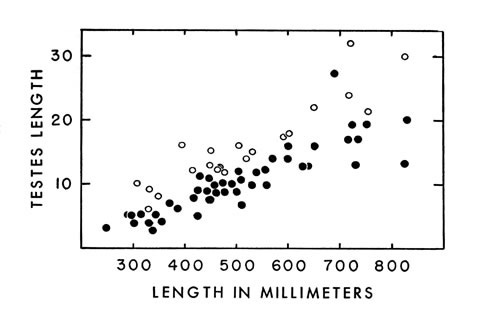
Increase in length of testes appears to be correlated with length of the individual rather than cyclic reproductive periods (Fig. 4).
Fig. 4. Length of testes in cottonmouths of various sizes ( ·—left; °—right ). The right testis is always longer than the left.
The reproductive cycle in cottonmouths resembles that illustrated by Rahn (op. cit.:237), in which the ovarian follicles of post-partum females begin to enlarge in late summer and autumn, with ovulation occurring the following spring. By means of retaining sperm successive broods possibly are produced after only one mating. In captivity, at least, some females may not follow this biennial cycle; Stanley Roth (M.S.), biology teacher in high school at Lawrence, Kansas, had a female of A. p. piscivorus, from Florida, that produced broods of 14 and 12 young in two consecutive years.
Embryonic Development
After ova are fertilized a three and one-half to four-month period of development begins which varies somewhat depending on the temperature. In almost every instance the ova in the right uterus outnumber those in the left. Embryos usually assume the serpentine form in the latter part of June and are coiled in a counterclockwise spiral with the head on the outside of the coil. At this time the head is relatively large and birdlike in appearance with conspicuous protruding eyes. Sex is easily noted because the hemipenes of males are everted. By late July scales are well developed and the embryo is more snakelike in appearance, but pigmentation is still absent. By mid-August the color and pattern are well developed, the egg tooth is present, the snake shows a considerable increase in size over that of the previous month, and much of the yolk has been consumed. Some females that contain well developed embryos also contain eggs that fail to develop. Sizes of ova vary irrespective of size of female and stage of embryonic development. Lengths of ova ranged from 22 to 51 millimeters in May to 35 to 49 millimeters in July and August. A two-yolked egg was found in one female.
Birth of Young
Accounts in the literature of 15 litters of cottonmouths fix the time of birth as August and September. Conant (1933:43) reported the birth of a litter in mid-July by a female that had been raised in captivity, and one female that I had kept in captivity for two months gave birth to a litter between October 19 and October 25. The conditions of captivity undoubtedly affected the time of birth in both instances.
Wharton (1960:125-126) reported the birth and behavior of a brood of seven cottonmouths in Florida. I was given notes of a similar nature by Richard S. Funk of Junction City, Kansas, on a brood of five cottonmouths. The mother of the brood was caught in June, 1962, in Tarrant County, Texas, by Richard E. Smith, and was 705 millimeters in snout-vent length. The first young was found dead in an extended position a few inches from the fetal membranes at 11:05 p.m. on August 22. The second young was born at 11:07 p.m. The intervals between the successive births were three, seven, and four minutes; and time until the sac was ruptured in each instance was six, five, eight, and 11 minutes. The time interval between the rupture of the sac and emergence of each individual was 41, 92, 154, and 34 minutes. The mother's actions in giving birth to the last four young were essentially as described by Wharton (loc. cit.), except that the intervals between successive births did not increase. Within one minute after rupturing the sac and while its head was protruding, each of the four living young opened its mouth widely from three to seven times, then took its first breath. Breaths for the first three hours were steady at three or four per minute but then decreased to two or three per minute. Pulse rate for the four averaged 38 per minute while at rest but increased to 44 per minute after voluntarily crawling.
Number of Young per Litter
Records of from one to 16 young per litter have been reported (Ditmars, 1945:330; Clark, 1949:259), but the average is probably between six or seven. Most accounts in the literature present information on number of ova or embryos per female rather than the number of young. Size and age of the mother (Table 9) influence the number of ova produced. Allen and Swindell (1948:11) recorded three to 12 embryos in 31 cottonmouths varying in total length from 26 to 44 inches. An average of 6.5 embryos per female was found.
TABLE 9.—Number of Ova Produced by Fecund Cottonmouths.
Snout-vent length in millimeters Number in sample Number of ova, average and extremes
450-549 10 4.1 (2 to 7)
550-649 11 4.9 (1 to 8)
650-749 4 6.3 (4 to 8)
750-849 1 5
850-949 1 14
Mortality at birth has been recorded for almost every litter born in captivity (see Allen and Swindell, loc. cit.; Conant, 1933:43; Wharton, 1960:125). A female that I kept in captivity gave birth to seven young. Three never ruptured their sacs, and another died soon after leaving the sac. The effects of captivity on females may result in higher rates of deformity and mortality in young than is common in nature. Klauber (1956:699-700) estimated that the defects brought about by conditions of captivity on rattlesnakes eliminate about three young per litter.
Population Composition
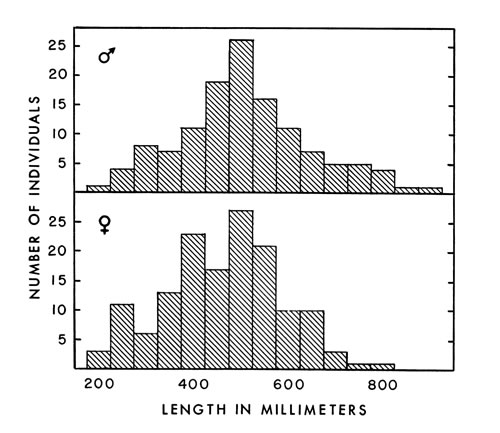
No investigator has yet analyzed the composition of a population of cottonmouths according to age, sex and snout-vent length. Barbour (1956:35) did sort 167 snakes into size classes, but did not determine sex ratio, size at sexual maturity, reproductive cycles, or snout-vent length. He recorded total lengths from which snout-vent lengths cannot be computed because of differential growth rates and different bodily proportions of the two sexes. I judge from my findings that he included immature individuals in his three smallest size classes (45.5 per cent of the population). I found at least 32.5 per cent immature individuals (Fig. 5) in my material, but it was not a natural population.
The sex ratios of several small collections from natural populations varied, and no conclusions could be drawn. Females comprised 53 per cent of the specimens included in Fig. 5 and in a group of 48 embryos which represented eight broods. That percentage may not be the percentage in a natural population but is used in making assumptions because I lack better information.
Reproductive Potential
If data in Fig. 5 are representative of a natural population and if 61 per cent of the females are sexually mature, the reproductive potential can be estimated as follows: assuming a cohort of 1000 cottonmouths contains 530 females, 61 per cent of the females (323 individuals) probably are adults. If 42 per cent of these females produce 6.5 young per female in any season (Tables 8 and 9), 136 females will produce 884 young. But if 50 per cent of the adult females are reproductive (as would be assumed if reproduction is biennial), 1050 young will be produced. Actually the number of young required per year to sustain a population is unknown, because mortality rates at any age are unknown.
Fig. 5. Composition of a group of cottonmouths examined in this study. Individuals less than 450 millimeters in snout-vent length are considered as immature. Specimens from 200 to 249 millimeters in length are included in the 200-millimeter class, etc.