DESCRIPTION
Reading edition
Color and Pattern
Color predominantly brown, ranging through pale reddish-brown or dark reddish-brown, brownish-green, to almost black; 10 to 17 irregular dark brown bands on paler brown ground color; young paler (some nearly salmon pink), retaining a vivid pattern throughout first year; pattern of most individuals nearly obliterated by third year; brilliance and dullness of predominant color correlated with molting cycle (skin especially bright and shiny immediately following shedding; tip of tail yellowish in juveniles; posterior part of venter and tail uniformly black in some adult individuals, especially females; secondary sexual differences in dorsal coloration, such as found in copperhead by Fitch (1960:102), not noted.
The eastern subspecies, A. p. piscivorus, has the more brilliant pattern in which the centers of the dark cross-bands are invaded by the ground color. The cross-bands are slightly constricted in the mid-line and may or may not be bilaterally symmetrical. One-half of the cross-band may be displaced anteriorly or posteriorly to a slight degree or may even be completely absent. From one to several dark spots may be present within the cross-bands.
The western subspecies, A. p. leucostoma, has a comparatively dull pattern in which the ground color does not invade the center of the cross-bands. In many instances the bands are outlined by white scales, as in the Mexican moccasin (this character is not so prominent in A. p. piscivorus because of the paler ground color). A large, dark blotch usually occurs at the base of the cross-band and may completely cross the ventral scales. The characteristic variations found in piscivorus are also present in leucostoma.
The number of bands is often difficult to count because of the dark color of some specimens. Gloyd and Conant (1943:168) reported averages of 12.5 (11 to 16) and 12.2 (10 to 16) in males and females, respectively, of leucostoma and ranges of 10 to 17 for males and 10 to 16 for females with averages of 13 in both sexes of piscivorus. On 20 specimens of leucostoma from Texas the average number of bands was 12.7 (11 to 15). If the number of bands differed on the two sides of an animal, the total number of the two sides was divided by two.
Scutellation
The scutellation of the cottonmouth closely resembles that of the other species of Agkistrodon. For example, the nine cephalic shields are characteristic of most species of Agkistrodon, as well as most other primitive crotalids and viperids, and most colubrids. Most individuals have an additional pair of large scales behind the parietals.
The numbers of postoculars, supralabials, and infralabials are variable. On either side the postoculars (three in most specimens) are reduced to two in some specimens. The supralabials (eight in most specimens) frequently vary (usually on one side only) from seven to nine. The number of infralabials is somewhat more variable than the number of supralabials, the usual number being 11, but 10 is also common; 8, 9, and 12 are more rare (Table 1). In 102 snakes in which these characters were examined, four different combinations of supralabials and seven combinations of infralabials were found. Both characters together yielded 16 combinations, considering only the actual number of scales and not taking into account the side of the head on which they occurred (Table 2). The combinations found in a brood of seven young from Houston, Texas, are shown in Table 3 to illustrate the variability of this character. Gloyd and Conant (1943:168) found a variation of 6 to 11 (8) and 7 to 9 (8) supralabials and 8 to 13 (11) and 8 to 12 (10.4) infralabials in samples of 301 leucostoma and 119 piscivorus, respectively (numbers in parentheses represent average). Also of interest is the variability of the scales themselves. In one instance a scale was found that had not completely divided. In another specimen the last supralabial and last infralabial were one scale that completely lined the angle of the jaw. Instances of one scale almost crowding out another were common. In still other instances one or two supralabials were divided horizontally into two scales. Individual variation rather than geographical variation occurs in these characters.
TABLE 1.—Frequency of Occurrence of Various Numbers of Supralabial and Infralabial Scales in 102 Cottonmouths.
Number of scales Specimens having number on both sides Specimens having number on one side Total Percentage
Supralabials
7 11 24 35 25.2
8 64 27 91 65.5
9 0 3 3 2.2
Infralabials
8 0 2 2 1.5
9 3 10 13 9.6
10 12 32 44 32.4
11 53 22 75 55.1
12 0 2 2 1.5
TABLE 2.—Numbers of Supralabials and Infralabials of 102 Cottonmouths.
Number of individuals Number of supralabials Number of infralabials
37 8 11
15 8 10-11
12 7-8 11
6 7-8 10-11
5 8 10
5 8 9-10
4 7 11
3 7 9-10
3 7-8 10
2 7 9
2 7 10
2 8 10-12
2 8-9 10
2 7-8 8-9
1 7-8 9
1 8-9 10-11
The dorsal scales of cottonmouths are strongly keeled except that those of the two lower scale-rows on each side are weakly keeled. Also they are slightly larger than the others. Two apical pits are present on each dorsal scale. The shape of the scales and number of scale rows vary depending upon the position on the body. Scales on the neck are considerably smaller than those elsewhere on the body and are arranged in two or three more rows than those at mid-body. The skin in the region of the throat, neck, and fore-body is especially elastic and allows the swallowing of large prey. Posteriorly from the mid-body the scales decrease in size and become more angular, those on the tail tending to be rhomboidal and wider than long. In the region of the anus the number of scale rows diminishes rapidly, leaving only 12 to 14 rows at the base of the tail and only three rows immediately ahead of the tail tip. The tail ends in a spine composed of two scales: one scale covers the bottom, lower parts of the sides, and tip of the spine; and a shorter dorsal scale covers the top and upper parts of the sides of the basal two-thirds of the spine. The spine of embryos and young cottonmouths is blunt, but is pointed in most adults.
TABLE 3.—Variation in Numbers of Supralabials and Infralabials in a Brood of Seven Cottonmouths.
Number of individuals Number of supralabials Number of infralabials
1 7 9
1 7 9-10
2 7-8 8-9
1 7-8 9
1 8 9-10
1 8-9 10
TABLE 4.—Analysis of Number of Scale Rows at Three Parts of the Body in 81 Cottonmouths.
Number of scales per row Neck Mid-body Anterior to anus
Number of individuals Percentage Number of individuals Percentage Number of individuals Percentage
29 1 1.2
28 3 3.7
27 52 64.2
26 16 18.0 2 2.5
25 8 9.9 67 82.7
24 1 1.2 4 4.9
23 8 9.9 4 4.9
22 4 4.9
21 68 84.0
20 5 6.2
The number of scale rows on the neck, at mid-body, and just anterior to the anus is relatively constant at 27-25-21, respectively; but some individual variation is evident (Table 4). Since the rows are diagonally arranged, it is necessary in counting scales to proceed either anteriorly or posteriorly across the back; or the row may be counted in either direction up to the center of the back and then reversed on the other side of the snake. In order to count the scale rows in a position where no scale reduction or addition was occurring and to avoid as much error as possible, I counted from anterior to center and back on the neck, in any direction at mid-body, and from posterior to center and back near the anus. Because females generally are the larger in circumference posteriorly, they could have more scale rows than males just anterior to the anus. The few snakes having more than 21 scale rows in the posterior region offer no conclusive evidence as to tendencies, but in both instances in which this occurred the females outnumbered the males three to one. An odd, rather than an even, number of scale rows occurs on most of the length of the snakes examined, because there is a mid-dorsal row and scale rows tend to be lost on both sides at about the same level. An example of scale reduction of one snake was as follows:
6 + 7 (13) 6 + 7 (96)
27 ————— 25 ————— 24 ————— 23 ————— 22 —————
5 + 6 (13) 5 + 6 (90) 7 + 8 (111) 7 + 8 (114)
6 + 7 (122) + 7, -5 (125)
23 ————— 22 ————— 23 ————— 21 ————— 22 —————
-6 (118) + 6 (119) 6 + 7 (121) + 6 (123)
-6 (126)
22 ————— 21 (130).
This scale reduction follows the method proposed by Dowling (1951b: 133) in which the numbers on the mid-line represent the number of scale rows, upper figures refer to the right side of the snake, and figures in parentheses indicate the number of the ventral scale (counted from the anterior end of the series), thus marking the position of the addition or reduction. Addition of a row is shown by a plus sign and the number of the row, whereas reductions are shown by a minus sign and the number of the row that is lost or by a plus sign between the number of two rows that join. According to Dowling, variation in number of dorsal scales characterizes the few genera and species of snakes in which it has been studied. The time and difficulty involved in ascertaining the number of scales explain why it has not been widely used in classification.
Fig. 2. Number of ventral scales in 48 female and 34 male A. p. leucostoma.
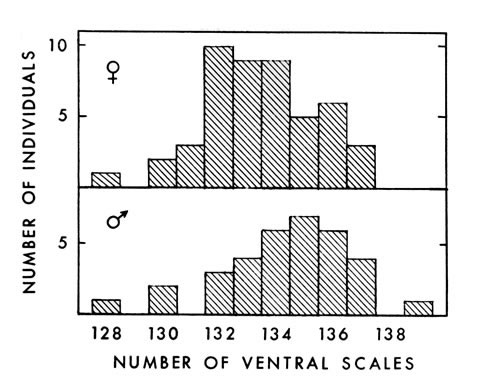
Ventral scales on 34 males averaged 134.4 (128 to 139), and on 48 females 133.5 (128 to 137) (Fig. 2.). Barbour (1956:34) found an average of 135.3 ventral scales on 64 males and 44 females, and Gloyd and Conant (loc. cit.) found an average of 134 for both males and females. The average for the eastern cottonmouth obtained by Gloyd and Conant, however, was 137 ventrals in both sexes. Some of my counts were made before I knew of the standard system of counting ventrals proposed by Dowling (1951a:97-99), in which the first ventral plate is defined as the most anterior one bordered on both sides by the first row of dorsals. Therefore, some inconsistencies may exist in my counts. Where differences occur, Dowling's method probably will indicate the presence of an additional scale, since it appears to begin farther anteriorly on the average, than I began counting.
Fig. 3. Number of caudal scales in 44 female and 34 male A. p. leucostoma.
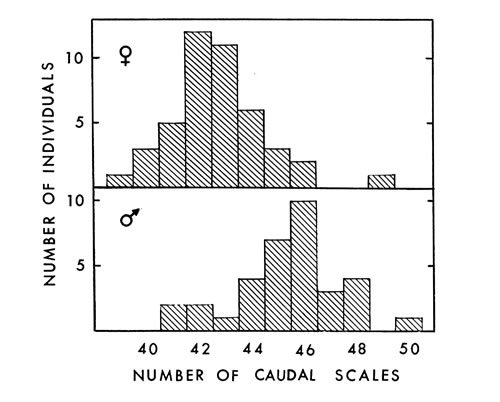
TABLE 5.—Caudal Scale Combinations in 95 Cottonmouths. U = Undivided; D = Divided.
Number of samples Number of scales
D U D U D U D U D U D U D U D U D
25 13-35 10-32
11 1-2 12-33 14-28
20 16-39 1-9 1-3 3-24
20 1-4 3-37 1-21 1-5 1-29
4 14-30 1-8 1-7 1-8 1-4 2-10
3 1 18-23 1-2 1-2 6-11 1-3 6-9
4 1-17 1 1-3 1-8 1-4 1-3 1-4 13-22
2 1-2 4-16 1 1-4 2 1 1-4 1 18-21
1 20 1 1 1 1 6 1 3 1 11
1 10 2 3 2 10 1 2 2 1 4 4
1 20 1 1 2 1 1 4 4 2 4 1 3
1 1 13 1 1 1 3 1 1 1 4 2 4 13
1 17 1 1 2 1 1 6 2 1 2 3 2 7
1 9 1 1 8 1 3 1 1 3 1 1 2 1 1 1 6
Analysis of caudal scales revealed sexual dimorphism. In the six specimens from Tennessee, Blanchard (1922:16) found the same thing. Caudals averaged 45.4 (41 to 50) on 34 males and 42.6 (39 to 49) on 44 females (Fig. 3). Barbour (loc. cit.) found an average of 45.7 (30 to 54) caudals in males and 43 (17 to 56) in females. Caudal scale counts by Gloyd and Conant (loc. cit.) averaged 44 (38 to 49) in males and 42 (37 to 48) in females of leucostoma; in piscivorus they averaged 48 (42 to 53) in males and 44 (41 to 49) in females. Another seldom-mentioned, unusual characteristic of the caudal scales of copperheads and cottonmouths is that some are single (usually those at the base of the tail) and others divided (Table 5). To my knowledge, all other species have either single or divided scales the entire length of the tail. See Klauber (1941:73) and Fox (1948:252) concerning correlation of few scales with warm environment.
Dentition
Cottonmouths, like other pit-vipers, have their teeth reduced in number and have enlarged, highly specialized fangs. Small teeth occur on the palatine and the pterygoid in the upper jaw and on the dentary in the lower jaw. The dentary bone bears 17 curved teeth that decrease in size posteriorly. The palatine bears five small, strongly curved teeth, and the pterygoid bears 16 to 18 strongly curved teeth decreasing in size posteriorly. The numbers of teeth mentioned above in each instance refer to the number of sockets rather than the actual number of teeth, because teeth are frequently shed, leaving some of the sockets empty at any one time.
The maxillary bone has two sockets side by side which bear the poison fangs, usually one at a time. During the period shortly before a fang is to be shed, however, its replacement becomes attached in the alternate socket; and both fangs may be functional for a short time. The old fang then becomes weakened at its base, eventually breaks off, and is swallowed. At any one time four or five replacement fangs in various stages of development are found in the gum behind the functional fang. These replacement fangs, which are arranged in alternate rows, gradually enlarge as they move forward in their development and, in juveniles, are generally slightly longer than the fangs that they replace.
In 1963 I examined the fangs of 14 cottonmouths at four- to seven-day intervals for a period of six weeks. The fang-shedding cycle was found to be highly irregular, with a double condition (on one or both sides) occurring one-third of the time. Approximately the same proportion of double fangs was found in preserved individuals. A replacement period of at least five days was observed in one snake. One-half the cycle (from replacement on one side to replacement on the other) varied from five to twenty days, indicating that the cycles for each fang are independent of one another. Bogert (1943:324) found that young rattlesnakes are born with functional fangs in the two inner sockets. Nonsynchronous use of the sockets on opposite sides of the head in rattlesnakes is a later development which results from accidents or other conditions leading to a longer retention of the fang on one side than on the other (Klauber, 1956:723). I found a double set of fangs in cottonmouths only twice in the six-week period. A complete cycle was recorded in ten instances in a period of 19 to 23 days and in two instances in 32 days. One cottonmouth was examined periodically over a 34-day period by Allen and Swindell (1948:12), but a complete fang-shedding cycle was not observed. Fitch (1960:110) reported a 33-day cycle in copperheads; Klauber (1956:726) estimated the normal active life of each fang of an adult rattlesnake to be from six to ten weeks, but he made no observations to confirm his estimation.
Fangs measured from the tip of the notch of the basal lumen to the end of the fang vary from about 1.3 per cent of the snout-vent length in juveniles to about 1.0 per cent in large adults (Table 6). The fangs are longer than those of copperheads (Fitch, 1960:111). Klauber's (1956:736) figures on fang-lengths in all species of rattlesnakes are percentages of total length rather than of the snout-vent length. The fangs of various species of rattlesnakes range from nearly the same proportionate length as those of cottonmouths to some much longer.
From patterns of bites of venomous snakes, Pope and Perkins (1944:333-335) attempted to correlate number, size, and patterns of tooth marks with size and generic identity of the snake responsible for the bite. Distance between fangs is relatively constant for snakes of a particular size (Table 6) regardless of genus, but the fangs of a cottonmouth are directed outward to variable degrees, and puncture wounds could easily resemble those of a much larger snake (Table 7). Also there is no direct relationship between size of snake and toxicity or amount of venom injected. Consequently information of this kind is of little or no value from a medical standpoint.
TABLE 6.—Correlation of Relative Fang-length and Distance Between Fangs at Base with Snout-vent Length of Cottonmouths.
Snout-vent length (millimeters) Number in sample Average ratio of fang-length to snout-vent length (percent) Number in sample Average ratio of distance between fangs to snout-vent length (percent)
200-299 3 1.33 3 2.57
300-399 7 1.30 5 2.48
400-499 13 1.21 9 2.21
500-599 12 1.22 8 2.19
600-699 7 1.17 1 2.10
700-799 5 1.07 4 1.65
800-899 1 1.00 1 2.00
TABLE 7.—Contrast in Measurements Between the Base of the Fangs and Between Fang Punctures of Nine Cottonmouths (in millimeters).
Distance between base of fangs Distance between fang punctures Snout-vent length
7.7 13.0 400
8.7 14.0 575
10.0 22.5 526
11.0 18.0-19.0 590
12.0 18.0 793
13.0 17.0, 20.0 558, 612
15.5 23.5 800
16.0 24.0 800