GROWTH AND DEVELOPMENT
Reading edition
Size at Birth and Early Growth
Size at birth depends on the health of the mother. According to Fitch (1960:182), many litters of copperheads born in captivity are stunted. Seven young cottonmouths (two males and five females) born in captivity were each 185 millimeters in snout-vent length and 40 millimeters in tail length. Weights of the three living young were 10.0, 10.1, and 11.1 grams. Another litter of five young measured by Richard S. Funk were larger, and differences in the proportions of the tail length and snout-vent length suggest the sexual dimorphism found in larger individuals. However, sex of these young snakes was not recorded. Snout-vent length and tail length in millimeters were 232, 41; 243, 47; 229, 40; 240, 48; and 225, 40 in the order of their birth. These snakes are considerably smaller than the nine young of A. p. piscivorus reported by Wharton (1960:127) that averaged 338 millimeters total length and 28.7 grams. The yolk of one young piscivorus was 11.7 per cent of the total weight. Yolk is used up in about two weeks if its rate of utilization resembles that of the copperhead as reported by Gloyd (1934:600).
Early rates of growth of three living young are shown in Table 10. On the 56th day after birth, each was fed one minnow less than two inches long. Between the 80th and 120th days three additional small minnows were fed to each snake. Young cottonmouths increase nearly 50 millimeters in length by the first spring if they inhabit warm areas and feed in autumn or winter.
Variation in size of newborn cottonmouths may be less in nature than in captivity. Average size at birth can be determined accurately by the size of young captured in early spring, at least in northern parts of the range where winter feeding and growth do not occur at all or are negligible. Total lengths of 19 juveniles thought by Barbour (1956:38) to be seven to eight months old do not differ markedly from lengths of the five newly-born young measured by Funk.
TABLE 10.—Rate of Growth of Three Young Cottonmouths.
Age in days Snout-vent length / tail length—weight in grams
Female No. 1 Female No. 2 Male
2 185/40—11.1 185/40—10.1 185/40—10.0
7 192/40— 190/40— 189/40—
22 195/40—10.3 200/41.5—10.6 197/40—
80 204/40—11.7 203/42—10.4 218/48—14.3
88 .... 204/44— ....
143 215/40.5—13.3 .... 225/48—15.1
The Umbilical Scar
The umbilical cord is broken at birth and the navel closes within a few days; but the scar, involving from two to four ventral scales, remains throughout life. Position of the scar was found by Edgren (1951:1) to be sexually dimorphic in the eastern hog-nose snake (Heterodon platyrhinos), but nothing has been published on this matter concerning the cottonmouth. Consequently, I counted the scales of several individuals from the anal plate, and there was no marked difference in the position of the scar in males and females; it varied in position from the 10th to the 18th scale. When counted from the anterior end, the scar ranged from ventral number 115 to 122 (average, 119) in 28 females and from number 117 to 126 (average, 121) in 14 males. The difference between male and female cottonmouths is not nearly so great as in Heterodon.
Later Growth and Bodily Proportions
The only records of growth increments in a natural population of cottonmouths are those in Table 11. The period of growth is mostly the period of activity, and differences are expected between northern and southern populations. As size increases, determination of growth rate becomes more difficult because age classes overlap in size. Growth of any individual depends not only on climate and food but also on disease and parasitism and the innate size potential. Stabler (1951:91) showed weight and length relationships in two cottonmouths for a period of six and one-half years.
TABLE 11.—Growth Increments in Cottonmouths (Barbour, 1956:38-39).
Number of individuals Total length in millimeters Estimated age in months Estimated growth from preceding year in millimeters
19 260-298 7-8 25
11 312-337 19-20 45
40 355-485 31-32 95±
83 500-1000 43-44+ ?
My study failed to reveal any secondary sexual difference in growth rate and maximum size. Of the 306 cottonmouths measured by me, 16 males and five females exceeded 700 millimeters in snout-vent length. Two males were more than 850 millimeters long. One cottonmouth lived in captivity for 18 years and 11 months (Perkins, 1955:262). The maximum total lengths were reported by Conant (1958:186-187) to be 74 inches (1876 mm.) in A. p. piscivorus and 54 inches (1370 mm.) in A. p. leucostoma.
Fig. 6. Head length ( ° ) and head width ( · ) expressed as a percentage of snout-vent length of living and preserved cottonmouths. Head length was measured from the tip of the snout to the posterior end of the mandible. Head width was measured across the supraocular scales, since accuracy was greater than if measured at the posterior edge of the jaw. No sexual dimorphism or geographical variation occurs in these characters.
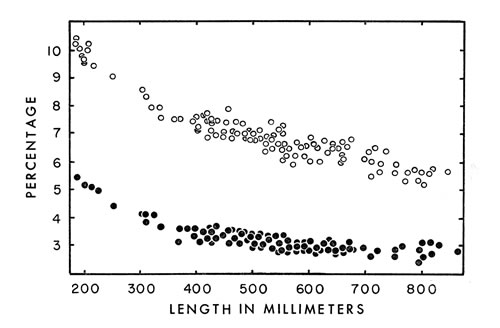
Proportions of various parts of the body vary considerably depending on age, size and, in some instances, sex. Heads are proportionately larger in young than in adults (Fig. 6), as is true of vertebrates in general. This larger head has survival value for the cottonmouth in permitting more venom to be produced and in permitting it to be injected deeper than would be the case if the proportions were the same as in adults. Relative to the remainder of the snake the head is considerably larger than in the copperhead (Fitch, 1960:108) and slightly larger than in the rattlesnake, Crotalus ruber (Klauber, 1956:152).
Fig. 7. Tail length expressed as a percentage of snout-vent length of living and preserved cottonmouths ( ·—males; °—females ).
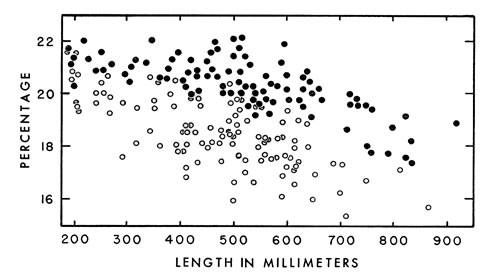
In general, tails are relatively longer in males than in females of the same size (Fig. 7), except that there is little or no difference at birth. Growth of the tail in males proceeds at a more rapid rate. In certain individuals sex cannot be recognized from length of the tail relative to snout-vent length because overlapping occurs, especially in medium-sized individuals. Similar changes of proportions with increase in age occur in copperheads (Fitch, 1960:106) and rattlesnakes (Klauber, 1956:158-159), but the tail of the cottonmouth is relatively much longer.