Chapter IX · : EGYPTIAN ART
Reading edition
The output of the great Egyptian masters of the graphic arts has virtually no counterpart, and, bold as this statement may appear at first sight, it will be found to withstand tolerably close scrutiny. Looking at some of the incomparable embroideries of bygone Persia, studying the divine porcelain of mediæval China, or turning over woodcuts by the great Japanese artists of the Ukiyoé school—men like Hokusai and Utamaro, Hiroshige, Yeizan and Toyokuni—we no doubt feel ourselves in touch with something different from European art, yet only partly different. Strange as these Eastern objects are, we find in them a certain familiarity, we find them expressive of emotions and sentiments not altogether unknown to us; and herein Egyptian things are different, for these seem to us entirely novel, they suggest some weird, enchanted world untrodden by the foot of man, perhaps a supernatural world. Nor is their strangeness, their almost sinister unfamiliarity so very hard to explain, it being due not only to the curious conventions which the Egyptian masters obeyed so implicitly century after century, but to the fact that the arts were indigenous to ancient Egypt. Japan derived her painting from China about the fourteenth century A.D.; Chinese work, in turn, frequently discloses affinities with that of ancient Greece; and the great Italian masters of the Renaissance owed much to the Græco-Roman school; while the old Spanish artists, again, were under obligations to the Moors and Arabs, and in England and in Scotland, in Germany and in France, painting did not grow up like a flower, but was rather an exotic imported chiefly from the Low Countries. In short, throughout bygone times, no less essentially than in modern periods, the arts in nearly every country owed something to those of other countries, a great interchange going forward perpetually; but the mighty works of Egypt were mostly wrought long before the advent of this interchange, and painting and sculpture, architecture and other domestic arts, would seem to have arisen of their own accord in the land of Isis, there to thrive and develop throughout æons of years a pure African product, uninfluenced in any way by the handiwork of other races.
It is always difficult to speak of the origin of anything, for even the oldest thing has its ancestry. And while it is possible to treat with some definiteness of the first great period of Egyptian art, the Thinite, which commenced about 5000 B.C., we have to remember that the output of this period was no exception to the rule aforesaid, but had its ancestry, this consisting in the work of the shadowy pre-dynastic time. Even at that far-off era crude images of living animals were made in Egypt, mud, of course, being the material commonly used; while a great deal of pottery, some of it incised with quaint patterns, was also produced; and if many of these vases and the like are no better than those of most primitive artists, others, again, manifest a distinct feeling for shapeliness and proportion. Nor did the Egyptians of this period eschew that immemorial practice, the decoration of themselves; for among the oldest relics of the country's art are numerous personal ornaments, some made of bone or of shell, some of stone or ivory, and some even of precious metals. Moreover, rude forms of architecture were early essayed, this in its turn begetting pristine efforts at mural embellishment.
In pre-dynastic Egypt the dead were usually interred in shallow graves with no embellishment, only one painted tomb of that early period being known. When, however, we pass to the study of the period which succeeded, it is the art of sepulchral decoration which first claims attention. Not even in Roman Catholic countries, not even in China, has the welfare of the dead ever been thought of so lovingly, so constantly and zealously, as in ancient Egypt. A very solid affair was the Egyptian tomb of this era, built commonly of limestone or sandstone, but occasionally of granite, or of breccia from the Arabian mountains; and in the case of a notable person the sides of his tomb were duly carved with pictures of his deeds while on earth, and more especially with pictures illustrating his prospective passage through the underworld. Generally, too, a statue glorified the outside of his tomb, this statue being wrought of alabaster, schist or serpentine, diorite or limestone, granite or sandstone; and the sculptor, be it noted, never aimed primarily at decoration, but invariably at a portrait of the defunct. Moreover, he would seem to have pondered very deeply on the question of durability, attaching his work firmly to its repoussoir, or, more often, making it a very part thereof; and to illustrate the Egyptian's predilection in this respect we may mention two works, both in the Cairo Museum, the one showing the Pharaoh Mycerinus seated, the other depicting a group of three people, likewise seated. In both cases the statuary have been hewn out of the great pieces of rock supporting them, and could not possibly be removed therefrom save by elaborate cutting with mallet and chisel.
A wealth of other statues belonging to the early dynastic era are still extant, many of them possessing rare artistic value. And if the same can hardly be said with reference to existing specimens of the relief-cutting of this period, when turning from these to early domestic art we are struck repeatedly by its infinite loveliness. Prominent among such things as merit this praise are numerous bracelets, while the Cairo Museum contains two fine carved ivory feet of a stool which express great vigour of artistic conception, and the same collection includes sundry tiny figures of monkeys, lions, and dogs, all of them manifestly the work of a master who had a keen sense for the curious beauty which lurks in the grotesque.
To an early period also, that of the Pyramid Kings, should be assigned those amazing monuments of the industry and ingenuity of bygone Egypt, the Pyramids and the Sphinx—works which have evoked nearly as much eloquence, alike in prose and verse, as the Monna Lisa of Leonardo da Vinci and the Elgin Marbles of Phidias. Usually supposed to have been wrought early in the era in question, their inception is, however, wrapped in mystery; but whatever the true solution of that enigma, this Memphite period was certainly one which witnessed considerable developments in Egyptian art. True, there is little opportunity of studying the architecture of the time, such relics as exist consisting in little more than heaps of stone or masses of sun-dried brick; yet in the field of sculpture, on the contrary, we are enabled to note and scrutinize progress. Heretofore sepulchral statues had been virtually a preserve of the rich and great, but now all sorts and conditions of tombs—or, at least, the tombs of many comparatively poor people—were garnished in this way; and as the defunct was often portrayed in an attitude indicating his career on earth, this statuary offers a valuable sidelight on Memphite Egyptian life. Thus we find, here a man engaged in brewing, there another seated at secretarial work, his posture practically that of the modern tailor; while we observe also that care for the welfare of a deceased magnate of any kind was being manifested on a more intricate scale than hitherto. That is to say, suppose his friends and relations should be anxious that he should be well fed in the hereafter, they would embellish his resting-place with statuary delineating a kitchen in being; while sometimes, with an analogous end in view, they would represent in the tomb-chapel a group of musicians, each depicted with his instrument in his hands.[1] And in all these works, as also in divers others of a different nature, we notice a more fluent handling than that characterizing the generality of those of pre-dynastic days, as witness what is possibly the very crown of the Pyramid age (Fourth Dynasty) sculpture, the full-length at Cairo of the 'Sheikh-el-Beled' (whose real name was Ka-aper), a figure wrought in a fashion vigorous and confident as anything from the hand of Rodin or Mestrovic. Furthermore, we mark again and again that artists were now beginning to express their respective individualities, they were showing themselves less prone to conform slavishly to a given régime; and it is significant that one of the Pyramid age sculptors, Ptah-Ankh, far from hiding his identity like all his predecessors, saw fit on one occasion to model a stone relief in which he himself figured as sitting in a boat.
The Materials of Painting
It should be noted at this juncture that these Egyptian bas-reliefs were not usually left in a monochromatic state as is customary in modern Europe; for the painter, on the contrary, was generally called to the sculptor's aid, while even portrait statues were frequently coloured also. And apart from work of this order, the craft of painting on sun-dried clay was carried to no mean height of excellence during Pyramid days, as also was that of painting on papyrus, while mummy cases were often decked with multitudinous hues. The colours in many of these old Egyptian works still possess great depth and brilliance, while, indeed, some of them have lasted far better than those in divers Italian frescoes of the Renaissance, and infinitely better than those in numerous pictures by Reynolds and Turner; and thus we naturally pause to ask the questions: What manner of pigments were commonly used in Egypt? and what, exactly, was the modus operandi of the country's painters? Well, an Egyptian artist usually kept his paints in the condition of powder, and on starting work he liquefied them with a mixture of water and gum tragacanth; while he next proceeded to apply this solution with a reed pen, or with brushes made of soft hair, few men being in the habit of using more than two brushes, a thick one and a thin. Then as to the colours themselves, the gold we sometimes see is, of course, easily accounted for; while black, it would seem, was obtained by burning the bones of animals, and white was made of gypsum mixed with honey or albumen. Red and yellow, again, were procured by more familiar processes, the former being derived from sulphuret of mercury, the latter simply from clay; while blue, a comparatively rare shade in natural objects other than the sea and sky, and therefore hard to obtain, was evolved from lapis-lazuli. The picture duly finished, some painters would cover it with a coat of transparent varnish, made from the gum of the acacia; but the men who did this were really few in number, and the colours in their works have not lasted well—not nearly so well as those in paintings by masters who left varnish severely alone.
Leaving these technical details and returning to the actual history of the arts in Egypt, we must speak now of the Middle Kingdom, which commenced with the Ninth Dynasty (c. 2445) and lasted to the Seventeenth Dynasty. During this time the craft of building developed apace, among the results being the obelisk of Heliopolis. And if these are works reflecting thaumaturgic mechanical ingenuity rather than great artistic taste, the latter is certainly manifest in two other vast structures of early Theban days, the temple of Kom-es-Sagha and the portico of Sa Renput I. Much fine domestic art was also made at this time, as witness the diadem and crown of Khnemit, both of which are now at Cairo. A more natural style became discernible, both as regards bas-reliefs and paintings. Indeed, many sketches and paintings of this period, especially those which delineate scenes of sport, war, and athletics, possess a spirit and dash which show that the race of Egyptian artists was becoming more skilled in the free use of the brush. One of the most remarkable paintings of this period is a picture at Beni Hassan, the subject of which is a series of wrestling bouts.
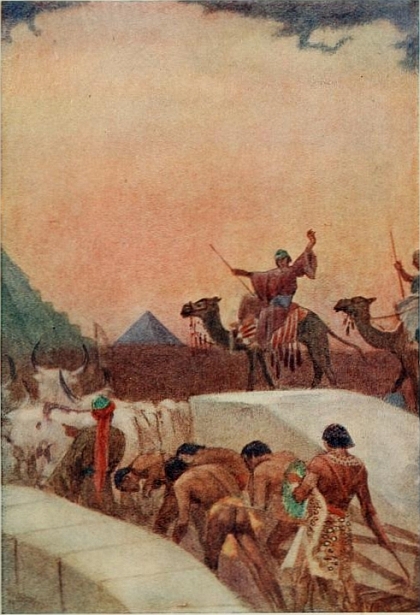
Hauling Blocks of Stone for the Pyramids—Evelyn Paul.
New Empire Art
In the period of the New Empire (Eighteenth to Thirty-first Dynasties) the student of Egyptian art is confronted with a veritable embarrassment of riches, chiefly architectural. It was this period which witnessed the completion of such imposing structures as the hypostyle hall at Karnak, the temple of Rameses III at Medinet-habû, and the great assemblage of ecclesiastical edifices at Dêr-el-Bahari. The finest and most imposing buildings at Luxor likewise belong to this era, as do the rock-cut temples at Bêt-el-Wálî and Abu-Simbel. The sculptors of the period also achieved lasting triumphs, especially in the two colossal figures of Memnon at Thebes, and the famous Avenue of Sphinxes at Karnak. The statue of Thothmes III, Amenophis, the son of Hapu, and Queen Tyi are also of great æsthetic interest. Turning to bas-relief, the likenesses of Seti I (Abydos), Septah Meneptah, and Queen Aahmes (a plaster cast in the temple at Dêr-el-Bahari) claim our attention, the last-named being among the loveliest of all Egyptian works of the kind. The delicacy and refinement of this masterpiece surpasses almost any relief executed in Egypt before it. In fact, a greater refinement begins to be apparent in the Egyptian art work of this period, even the domestic arts showing greater attention to delicacy. Lines of great subtlety appear chased on table utensils, while equal skill is apparent in numerous amulets and much of the jewellery of the period. Little boxes, handles of mirrors and spoons designed to hold cosmetics are in many cases the result of craftsmanship of a very high order. One of the spoons depicts a woman swimming behind a swan, and inevitably recalls the myth of Leda. Finally, much beautiful furniture was made during this period, perhaps the best existing specimen being a chair in the Cairo Museum, its arms adroitly carved in the form of stealthy-looking panthers.
During this period the use of wood as a medium for artistic representation seems to have been on the increase. Contemporaneously the craft of casting in metal was improved and then virtually perfected, a consummation which had an important influence upon sculpture. This, too, was the epoch at which the Egyptian artists in colour revolted against the conventionality which had in ancient times beset their craft. Until this time they had not attempted to colour realistically. Certain objects were tinted according to tradition as taught in their schools. Thus the flesh of a man was painted a reddish brown, that of a woman yellow, that of a priest blue, and so forth. And it was not until the period of the New Empire that artists began to revolt seriously against this system. One unknown master went so far as to indulge in rosy flesh-tints, and it is natural to inquire whether it was foreign influence which aroused this iconoclastic act. Be that as it may, there can be no doubt that Egyptian artists began to learn from those of other lands—the Assyrians, for instance—and this circumstance renders the study of Egyptian art during this period somewhat difficult and complex.
The last period of Egyptian art, the Saïte, commenced about 721 B.C. During this epoch the incursions of the Persians, Greeks, and finally of the Romans are seen acting materially on the country's productions, often to their detriment, for instead of working naturally, instead of employing their own national style, the Egyptian artists of the Saïte period were prone to imitate, uttering themselves haltingly in fashions borrowed from other races.
But it is a mistake to maintain, as is occasionally done, that this waning of lofty traditions began with the very advent of the Saïte age. It is a mistake to contend that no vital art was executed by the Egyptians thenceforward. Not till the eve of the advent of Christ did Egyptian jewellery and craftsmanship in general begin to decline; while as to architecture, Herodotus speaks in the most eulogistic terms of the great buildings at Saïs. Unfortunately most of these are demolished, and we have no chance of studying them at first hand. The Pharaohs of the Saïtic period lost the vast command of labour of their Theban and Memphite predecessors; nevertheless the dawn of the last period in Egyptian art saw the completion of many noble edifices. The pronaos of Komombos, the temple of Isis at Philæ, and the kiosk of Nectanebu at the same place, deserve citation, as also do the Mammisi and temple of Horus at Edfû. Yet everywhere are to be seen structures of this period influenced by Greek or Roman ideas, and others which are clearly the work of Egyptian masons acting under the instructions of alien masters.
The painting of this period embraces numerous works equal to any product of earlier times—for example, the vignette of the Judgment before Osiris contained in the papyrus of Queen Mat-ka-ré. But we also observe Egyptian artists forsaking their time-honoured colour-schemes and using such tints as green and mauve, probably copied from Hellenic decorations. In the bas-reliefs of the time, moreover, we find much which is sadly mechanical—so mechanical that we are persuaded that it was done to order from drawing supplied by foreigners. Nor is the history of Saïte statuary greatly different from that of those arts mentioned above, for while at first a wealth of splendid things were achieved—notably a study of Osiris recumbent and a portrait of Petubastis—the mechanical element crept into this domain as it had done into the others. Sculptors became mere artisans, slaving at the reproduction of prescribed patterns. Some actually kept in stock ready-made statues of the human body, the heads to be added as clients presented themselves.
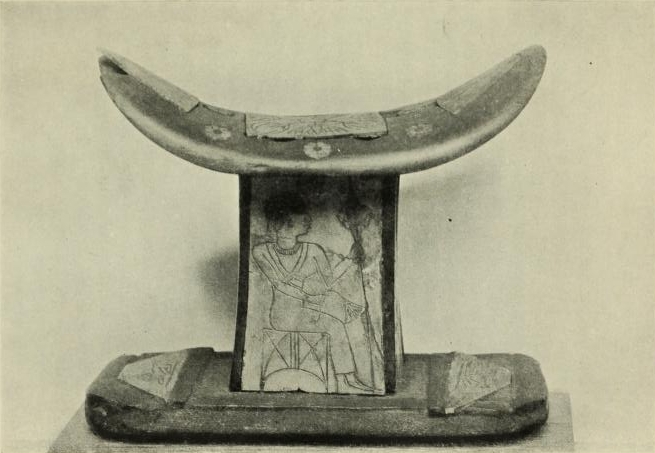
A Head-rest—British Museum.
Egyptian Art Influences
Still, the expression of a nation's soul does not entirely vanish, and if Egyptian artists were ultimately influenced by the conquering Romans, the Italian craftsmen came no less surely under the sway of the great Egyptian schools, and, as noted at the outset of this chapter, the Romans inspired much of the work of the Italian masters of the Renaissance, whose output was long regarded as the flower of European art. We find Egyptian influences strong in Spain, for the art of the Nile had cast its potent spell over the Arabs, who at a later date became almost the fathers of the domestic arts in the Iberian peninsula; and so it is with no surprise that, when looking at old Spanish ornaments, we frequently find them bearing a close resemblance to analogous articles made for the belles of Memphis and of Thebes. Nor was France without some more direct Egyptian influence than that which reached her indirectly through Italy. The characteristic art of the French Empire was directly descended from Egyptian art. Under Louis XIV French painting and craftsmanship were ornate and pompous in the extreme, but in the following reign luxury in all departments of life was at a discount. A new simplicity was demanded, and while craftsmen were casting about for patterns suited to this taste, the Comte de Caylus published his monumental work on the antiquities of Greece, Rome, and Egypt, its pages embellished throughout with illustrations from the author's own hand.[2] It speedily kindled inspiration in the minds of numerous artists, and we may place to its credit some of the most tasteful and beautiful furniture ever designed. The Egyptian expedition of Napoleon, too, led to the importation of Egyptian articles, and thenceforth until the eve of Waterloo scarcely a table, chair, or mirror of French manufacture with any claims to artistry but disclosed the influence of the Egyptian schools. Not only were actual shapes borrowed, but it was quite common to decorate furniture with pseudo-Egyptian statuettes and reliefs, or with brass plaques chased in imitation of parts of Egyptian pictures.
The pseudo-Egyptian craftsmanship of the Empire—so apt an expression of the temper of French thought at that time—may be studied well at Fontainebleau or at Marlborough House in London, while of course it is in evidence in the backgrounds of many Empire pictures, in particular those of Louis David. Indeed, that master himself, the most influential French painter of his day, owed something to the Egyptian school, while a similar debt is suggested by sundry works of the sculptors Chinard and Houdon; and a study of Empire buildings reveals that the architects of the period, mainly devoted though they were to ancient Greece and Rome, were not uninfluenced by the art of the land of the Pharaohs. Nor was this true only of the French architects, for that great Scottish artist in stone, Robert Adam, who died the year the French Republic was established, would seem to have shared the attraction. He often introduced Egyptian objects into his decorative schemes, while the large, imposing simplicity he frequently attained is rich in suggestion of notable Egyptian edifices. The same massive 'Egyptian' simplicity is to be seen in the statuary of the mighty Serb, Ivan Mestrovic, as also in that of the Swede, David Edström. Indeed, it would be wearisome to enumerate all the artists of different nationalities who have clearly been indebted to the genius of Egypt, but we must not conclude without some reference to the influence of the school on the Post-Impressionist painters.
The Post-Impressionists were not, as is commonly said, direct descendants of the Impressionist group, but rather seceders therefrom. Their watchword was simplicity, and in pursuance of this ideal they turned lovingly to study primitive art, especially that of the Egyptians, finding therein that simple element which they desired.
Artistic Remains
Returning to our main subject, we may ask, What is the actual æsthetic value of Egyptian art to our own generation?
Imagine a museum, some thousands of years hence, ostensibly representing the art of France from the beginning of the fifteenth century to the end of the nineteenth; and suppose this crammed with the off-scourings of the Salon school and the autotypes and bric-à-brac of the Rue de Rivoli, with only here and there a Clouet, a Boucher, or a Lancret, only here and there a Clodion, a Dalou, or a Rodin. Would not visitors to such a collection be certain to conclude that the French were anything but artistic? Conditions such as those indicated above obtain in nearly every Egyptian collection of the present day. The point of view of those in charge of museums and exhibits seems to be that anything of Egyptian origin should be treasured, however lacking it may be in artistic merit, and small wonder if the average visitor of taste has not the patience to search through such heterogeneous collections in which the few vital articles are buried. The great mass of Egyptian remains are far inferior to those of Greek origin, wrought in the time of Phidias and Apelles; the master works of Egypt, on the other hand, are equal to the artistic products of any age, and it is with these master works, and only with these, that we must concern ourselves here.
Egyptian Colour-harmonies
The Egyptian painter seldom or never sought to blend his different shades into each other, he seldom or never dealt in gradations; instead he painted in large patches, each patch clearly demarked from its neighbour. But with this system he achieved some of the grandest colour-harmonies, as witness the papyrus of Ani,[3] wherein the prominent notes are brown and yellow, green, white and black. Even more beautiful is the papyrus of Queen Mat-ka-ré, slightly higher in pitch than the last-named, and dominated by an exquisite reddish yellow; while, turning to polychromatic sculpture, surely there was never a lovelier piece of colouring than the statue of Princess Neferet, with its rich greens and reds, its browns and whites. Scarcely inferior to this is the coffin of Khnumu-Hotep, painted with gold, black, and brown, and with stripes of peacock-blue decorated with patterns in gold.
If the Egyptian was a divine colourist, he was still more surely a master of composition. The artist striving after harmony in design may arrange a host of figures upon a canvas, or he may take for his purpose only a very few objects. The former, the usual practice of the European school, is infinitely the easier of the two; but the Egyptian commonly chose the latter, and on his piece of papyrus or on his plaque of stone he placed his few objects so happily and in such perfect æsthetic relationship to each other that the whole space used appears to be decorated. His draughtsmanship, besides, is usually of high excellence; here, too, he faces a difficulty, giving a bold impression rather than a detailed drawing, yet so expressive are his lines that the work possesses abundantly the illusion of life.
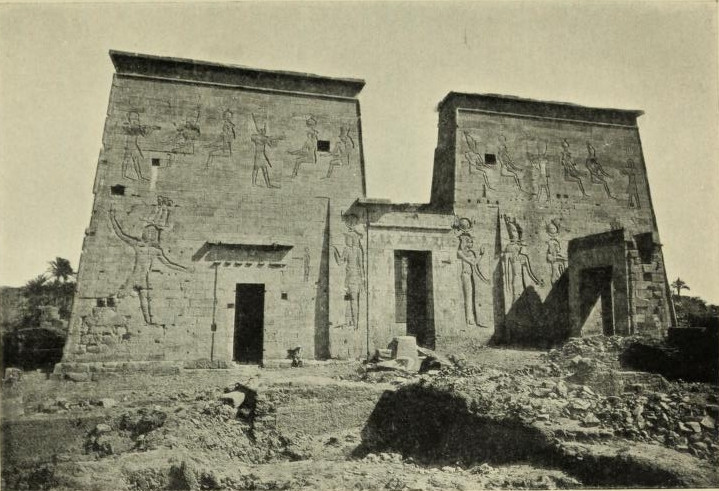
Temple of Isis at Philæ—Photo Bonfils.
The Great Simplicity of Egyptian Art
We have spoken of sundry Egyptian works as subtle, delicate, and refined; but these are not characteristic examples, they are not those which chiefly command homage. Subtlety, an exquisite quality, one of the ultimate qualities, is nevertheless closely allied to weakness, and the sustained effort to express it is apt to prove injurious to the artist. Whistler, for one, striving after the delicate, the refined and subtle, too often approximated effeminacy; and some of the greater Japanese painters, preoccupied with dreamy half-tints and febrile lines, came dangerously near producing the merely pretty. In the characteristic work of the Egyptians, however, we never detect a hint of this failing; for theirs is before all else a powerful, bold, simple art, often reflecting a grand, ruthless brutality like that in the great English dramatists. We have seen that it was their simplicity which engaged the Frenchmen of the Empire, eager to make something of a strenuous temper; we have seen that it was this element, too, which commanded homage from the Post-Impressionists, so intensely serious and aspirational a group. And may we not add that this simplicity is the loftiest factor discernible in Egyptian art? May we not add that the Egyptians achieved this merit with a triumph almost unrivalled by other races? And may we not say, finally, that simplicity is the noblest of all artistic qualities? The great poems, those which live from generation unto generation, are most assuredly those in which the subject is expressed with divine simplicity, the poet attaining the maximum of expression with the minimum of means, which is exactly what the great painters and sculptors of Egypt compassed.
But simplicity, like subtlety, has its concomitant danger, for what is very simple is apt to be deficient in mystery, so essential an item in a vital work of art. Yet here, again, we find the Egyptian victorious; he has adroitly evaded the peril of baldness. The Egyptian sculptor, producing a portrait, always adumbrates the character of his sitter, itself a mysterious quality, and there is in a host of Egyptian works of art a curious sense of infinity, a suggestion of the eternal riddle of the universe. They are the most mysterious works ever wrought by man, some seeming verily eloquent of silence; we feel in their presence a strange mood of awe, a feeling which has been thus happily expressed:
Tread lightly, O my dancing feet, Lest your untimely murmurs stir Dust of forgotten men who find death sweet, At rest within their sepulchre.
These lines, written by Lady Margaret Sackville while tarrying at Assuan, crystallize the reverential mood which often possesses us in the presence of Egyptian art; and yet, are these entombed men of whom the writer sings really forgotten?
Past ruined Ilion Helen lives,
eternal life vouchsafed to her by the song of Homer; surely bygone Egyptians have, in like fashion, won immortality through the genius of their mighty artists.
GLOSSARY AND INDEX
THE PRONUNCIATION OF EGYPTIAN
The correct pronunciation of Old, Middle, and Late Egyptian can only be gleaned by analogy from that of Coptic, which represents the popular language of Egypt from the third to the ninth century A.D. But this tongue was strongly reinforced by Greek loan-words, and as it was rendered in writing by the Greek alphabet it is difficult to say how much of the native linguistic element it really represents. But its orthography gives a clear idea of its pronunciation, and it is the mainstay of Egyptian philologists in restoring the word-forms of the ancient language, or at least Late Egyptian, between which and the Middle and Old dialects there is a wide linguistic gap. Indeed, the pronunciation of these archaic forms is probably for ever lost to modern scholarship. Speaking generally, Egyptian words and names are usually pronounced by scholars as they are spelt.
GLOSSARY AND INDEX
A AAH'MES, QUEEN. Wife of King of Egypt, 246; visited by Amen-Ra, 247; raised above the earth by Neith and Selk 247; the mother of Queen Hatshepsut, 248; likeness, of, 318 AAH-TE-HU'TI, or TE-HU'TI. Equivalent, Thoth, 106, 107 AA-RU. Underworld known as, 64 AAT-AB. Shrine of Heru-Behudeti at, 86 AB'TU. A pilot fish to Ra's barque, 131 ABU. Alternative, Elephantine, 152 ABU RO'ASH. Second pyramid built at, 25 AB-Y'DOS. Five priests comprised the staff at, 54; centre of worship of Osiris, 63; oracle of Bes at, 281, 310; likeness of Seti I at, 318 AB-YSS-IN'IA, 259 AB-YSS-IN'IANS, 34 ADAM, ROBERT, 322 AD-O'NIS. Similarity of myth to that of Osiris, 70; reference to, 160 Æ-GE'AN. Merchants of the, evolved their alphabet from Egyptian hieratic, 185 Æ'LI-AN, 284, 291 ÆSOP'S FABLES, 195 AF'A. Beings in heaven; characteristics of, unknown, 126 AF'RA. Variant of Ra-Osiris, 78; boat of, meets boats of Osiris in underworld, 117; as Afra, Osiris continues his journey through the Duat, 118; passes through body of monstrous serpent, and emerges as Khepera, 118 AFRICA-N. Origin of older religion of Egypt certainly, 3; Osiris, god of North-east, 64; origin, Osiris of, 64; origin, Anqet of, 156 AFRICA-N INFLUENCE. Semitic and, on Egyptian religious ideas, 280-282; deities, Bes the most important of, 281 AH. The moon-god; Ashtoreth and, 278 AH-U'RA. Wife of Neper-ka-Ptah, 268; her prophecy regarding Setne, 268; requests Setne not to remove her husband's book, 266 AÏ. The palace of, 42; hymn to Aten found in tomb of, 161 AI'NU OF JAPAN. God of the, 146 AK'ER. The lion-god; guarded the gate of the dawn, 291 AK'ER-BLAD. One who helped decipher Rosetta Stone, 187 AK'ER-TET. Celebration of mysteries of, 57 AK'HEN-AT-EN. See Amen-hetep IV. 1. King; Amen-hetep changes his name to, 158; religion of, 158; introduced cult of Aten into Egypt, 159; his reign, 160; reference to, 161. 2. Palace of, 42; new capital built by Amen-hetep, 158; social life in, 159 AL-AS'IA. Ounamounou drives into the country of, 236; Hatibi, the Princess of, 236 AL'CHE-MY, 269 ALEXANDER THE GREAT, 142 ALEXANDRIA. Wine made in Mareotis, 46; writings of Greeks of, 108; statue of Sarapis at, 307; Sarapis, principal deity in, 310 ALEXANDRINE-CONQUEST. The religion of Egypt and, 304 AL KHE-MEI'A, 269 AM-A'IT. The attendant of the Lord of Amenti, 209, 210 AM-AS'IS. An Egyptian monarch who died 526 B.C., 196, 197; Saïte King, 302; raised sarcophagi to the sacred bull, 302; Naukratis founded in time of, 303 AM'ELINEAU, 124 AMEMT. Monster, who attends the Judgment Scene, 294 AM'EN. Great wealth and power of the god, 52; alluded to in Book of the Dead, 119; associated with Ra; temple at Thebes, 131; Ra and Osiris, worship widespread Nile valley, 137; centre of worship and power, Thebes; all attributes of Ra attributed to him, 138, 139; national deity; fusion of Ra and Amen, 139, 140; 'king of the gods,' 140; his cult an attempt at monotheism, 141; in Egyptian pantheon was worshipped as Amen-Ra, 157; reference to, 144, 158, 159, 176; the god, Pharaoh Manakhphrê-Siamon, and, 213, 214; appellation, the Bull of Meroe, 214; invoked in connexion with spells, 264; Sebek represented with the plumes of, 291; shared in worship of Egypt during Libyan period, 300; priestesses in service of, 305; Zeus identified with, 305, 306 A'MEN-EM-HAT I. Wrote work on good government, 187; first king of Twelfth Dynasty, 190 AM'EN-EM-HAT III. Pyramid of, at Dahshur, 26 AM'EN-HET'EP III. Temple of Mut built by, 143; temples of Ra-Harmachis and Aten built by, 157; worship of Ashtoreth in the time of, 278; boasted to have shot one hundred and two lions, 292; son of Hāpu, 303; a hero-god who was thought to have seen and conversed with the gods, 303 AM'EN-HET'EP IV. Cult of Aten in reign of; regarded as abode of sun-god, 157, 58; built new capital dedicated to faith of Aten, 158; reference to, 161 AM'EN-RA. Political power of priests of, 140; all the attributes of the Egyptian pantheon lavished upon him, with the exception of those of Osiris, 141; one of his forms that of a goose, 141; dominion of, 142; Nut, female counterpart, 143; worshipped in Eighteenth Dynasty, 157; struggle for supremacy between votaries of, and those of Aten; name of, obliterated from inscriptions by order of king, 158; supremacy triumphantly restored on death of Akh-en-Aten, 160; beauty of, 176, 177; festival of, 177; Ounamounou, chief priest of, 232; gold of, 232; statue of, 233; sacred barque of, 233; Pharaoh Petoubastis swears by, 244; king of gods and maker of men, 246; Queen Hatshepsut daughter of, by Queen Aahames, 246-248; Prince Thoutii extols, 251; goose sacred to, 297 AM-EN'TET. A region of Field, or Place of Reeds, where dwelt souls living upon earth-offerings, 116; ruled over by Menuqet, 116; reference to, 124, 164 AM-EN'TI. Reference to, 208; a vision of, 209-211; the gods of, seen by Setne, 209-211; Amait, the attendant of the Lord of, 210 AMERICA. Tribes, and animal totems, 11; aborigines of, and soul, 31; myth of Nut common among aborigines of, 173 AMERICA-N, NORTH. Superstition among tribes of, re new name 259; parallel to practice of Egyptian gods found in the mythology of certain tribes of, 261; Indians; the orenda of the, 261; Indian; dreams and, 273 AMERICAN INDIAN. Reference to belief of the, 5; belief in resurrection by, 79 AM'HET. A portion of the underworld, 117 AM'SET. Equivalent, Mesti, 28; one of the four helpers of Horus, 96 AM'SU. Variant of Ptah-Seker, Asar, 146; Qetesh associated with, 279 AMULET-S. Use in Egypt, 263; some of more important ones—the Heart (the Scarab), the Pillow, the Collar of Gold, the Eye of Horus, etc., 263; efficaciousness of, 269 AN'AP-OU. Brother of Bitou, 224-228; kills his wife and mourns for Bitou, 225; rewarded by Pharaoh, 226; succeeds Bitou on throne of Egypt, 228 ANCIENT EMPIRE. Reference to, 137 AN'I. Papyrus of, 6; reference to, 57; instructions to his heir, 187; reference to the papyrus of, 324 ANIMAL-S. Spells in Thoth's Library of Magical Books capable of enchanting, 266; transformation, 270-273; Dr. Bridge and the idea of transformation of, 271; provision of spells in the Book of the Dead to enable the deceased to transform himself from a bird, serpent, etc., 270, 271; worship; Egyptians incurred merriment of the cultured Greek and the ridicule of early Christian writers, by, 271; worship; the attitude of primitive man and Egyptians, 271; transformation; origin of, 271; form; of Egyptian gods, question re totemic origin, 272; sacred, in Egypt, 282-297; worshipped in Egypt—the bull, 284-288; the crocodile, 289-291; the lion, 291-292; the cat, 293; the dog, 294; the hippopotamus, 294; the ibis, 295-297; other animals in Egyptian mythology—the ass, the pig, the hare, the shrew-mouse, the ichneumon, the bat, the tortoise, the serpent, the uræus, the scorpion (sacred to Isis), and the frog (symbol of generation, birth, and fecundity), 295; worship of, during the Late period, 302-304; worship of, during Hellenic period, 306; Strabo, and statues of sacred, 306; crude images of living, made of mud in Egypt during the Thinite period, 312 AN'IM-ISM. Ancient Egyptians passed through phase of, 4; the mother of Spiritism, 254, 255 ANKH-NET'ERU. A great serpent through whose body Af Ra is drawn in his boat by twelve gods, 118 AN-OUK-HOR'ON. The Prince of Tiome; breaks under the stress of the bonds of Sebennytos, 244; is overthrown by Petekhousou, 244 AN-PU. Equivalent, Anubis, 103 AN'QET. Isis, as goddess of fertile waters was called, 83; one of a triad of gods held in reverence at Elephantine, 152; female counterpart of Khnemu; local Nubian goddess, 153; sister-goddess of Satet; origin; worship centred at Sahal; shrine at Philæ, where she was identified with Nephthys, 156; personification, 156 ANT. A pilot fish to Ra's barque, 131 ANTH. See Anthat AN'THAT. Egyptian war-goddess, 276; her cult in Syria, 277; shrine at Thebes to, 277; Rameses II and, 277; name given by Rameses II to his daughter, 277; appellation, 'lady of heaven and mistress of the gods,' 277; Set and, 278 ANTIQUITY-IES. Service of, 38; of Egyptian magic, 254; reference to Comte de Caylus, 321 AN'TUF. Temple of, 151 AN'U, or AN'NU. College at, 54; the On or Heliopolis of the Greeks, 54, 113; alluded to in Book of the Dead, 119; worship of Ra centred in, 132 AN'U-BIS. Representation of, 11; mask of, 30; body of Osiris and, 79; son of Nephthys, 97, 98; son of Set, 99; alternative, An-pu; guide of the dead, 103; worshipped at Lycopolis, Abt, and elsewhere; part in the Book of the Dead; embalmed body of Osiris, 104; assisted by Up-uaut; personification of the summer solstice, 105; had votaries in Rome, 106; reference to, 109, 119; weighs hearts of the dead before Osiris, 119; Setne sees beside Osiris, 209; his judgment on the dead, 209; in the court of Amen-Ra, 246; mummy magic and, 274; the jackal sacred to, 294 APE-GODS. Songs to Osiris by the, 116 AP'EP, AP'EPI. Fiend of darkness, 13; Set takes his form, 100; obstructs Af Ra, 118; enemy of Ra, daily devours the sun; counterpart, the Assyrian monster, Tiamat, 131, 132; reference to, 161; slain at Heliopolis, ra174; the monster serpent; terrors of the Unknown personified in, ra295; slain by the solar cat, ra298; Set identified with, ra300 AP'EPI. Prince; leader of the Hyksos, ra194 APES. Kept in temples, ra294 AP'ET. Hippopotamus-goddess of Thebes; supposed mother of Osiris, ra174, ra175 APH'RO-D-I-TE. Hathor identified with, ra168 APH-ROD'IT-O-POL-IS. Hathor of, ra169 AP'IS. Slain by Ochus, ra103; sacred bull; Bitou assumes form of, ra226; worship of in Egypt, ra284; Herodotus describes, ra284; account of, by Diodorus, ra284, ra285; Manetho on cult of, ra284; Diodorus's account of the finding of the, ra284; funeral ceremonies of, ra285; installation of, ra284, ra285; transported to Memphis, ra285; cows presented to the, ra285; oracle in the temple of Ptah, ra286; Wiedemann on the oracles of the, ra286; Pliny on the prophecies in connexion with the, ra286; prophecies during the procession of the, ra286; sacrifices to the, ra287; burial of, ra287; votive statues and stelæ dedicated to the dead, ra287; at death, the dual god Osiris-Apis formed, ra287; attributes of Hades ascribed to, ra287; worship during the Late period, ra302; the Saïte King, Amasis, raised sarcophagi to the, ra302; Kambyses and the, ra304; worshipped by conquered and conquerors, ra306 A-POL'LIN-OP'OLIS MAG'NA. 'Lady of the chariot dweller in'—Egyptian appellation for Ashtoreth, ra278 AP-U'-AT. Equivalent, Up-uaut, ra105 AP'U-LEI-US. Speaks of Anubis as having a dog's head, ra106 ARABIA. Immigrations from, to Egypt, ra34 ARABIAN NIGHTS. Reference to, ra249 ARABS. Pyramid called a mastaba by, ra24; reference to, 182; Sennacherib, King of the Assyrians and, ra219, ra220 ARCHÆOLOGICAL SOCIETY, ra248 ARCHITECTURE. Rude forms of early, in Egypt, ra312 AR'IS-TE-AS. Soul of, ra6 AR-SIN'OË. TWO royal Ptolemies and an; figures of on stele, ra288 AR'THUR, KING. Reference to, ra87 ART-S. Influence of Bes, ra281; output of the great Egyptian masters, ra311; Egyptian, ra311-326; indigenous to ancient Egypt, ra311; Japan and China; the great Italian masters, ra311; the old Spanish artists, ra311; painting imported from the Low Countries, ra311; painting and other domestic, in the land of Isis, ra312; the Thinite, the first period of Egyptian, ra312; crude images made of mud, ra312; rude forms of architecture in Egypt, ra312; the materials of painting, ra315-317; New Empire, ra317-210; the Saïte, the last period of Egyptian, ra319, ra320; Egyptian artists of the Saïte period prone to imitate, ra319; decline of Egyptian jewellery, ra319; dawn of Saïte period saw completion of many noble edifices, ra319, ra320; structures and foreign ideas, ra320; paintings of period equal to earlier product, ra320; statuary of Saïte period, ra320; influences of Egyptian, ra320-323; Egyptian influences in Spain, ra321; Egyptian influence on French, ra321; reference to Comte de Caylus, ra321; reference to Napoleon's Egyptian expedition, ra321; reference to Ivan Mestrovic, ra322; reference to David Edström, ra322; Post-Impressionists and Impressionists, in Egyptian, ra322, ra323; artistic remains, ra323; the value of Egyptian, ra323; reference to the Salon School and the Rue de Rivoli—also to Clouet, Boucher, Lancret, Clodion, Dalou, and Rodin, ra323; the mass of Egyptian remains, far inferior to those of Greek origin, ra323; the Egyptian a divine colourist, ra324; Egyptian colour-harmonies, ra324; reference to Whistler, ra325; simplicity; in Egyptian, ra325; great simplicity of Egyptian, ra325, ra326; reference to Lady Margaret Sackville, ra326; genius of Egyptian artists, ra326 AS'AR-HA'PI. An aspect of Sarapis, ra306, ra308 A'S-ER. Tree of, ra7 ASH'EMU. Gods of heaven, attributes unknown, ra126 ASHMOLEAN MUSEUM. ra37 ASH'TAR-OTH. See Ashtoreth ASH'TOR-ETH. An Egyptian god borrowed from Semitic Asia, ra276; called by Egyptians 'mistress of horses, lady of the chariot, dweller in Apollinopolis Magna,' ra278; the terrible goddess of war, ra278; her worship brought into Egypt, ra278; mention of, in letter from Tushratta to Amen-hetep III, ra278; her worship in the Delta, ra278; a temple to, on the shores of the Serbonian lake, ra278; identified with the forms of Hathor, or Isis-Hathor, ra278; the national goddess of the Syrians, ra278; Rameses II named one of his sons after her (Mer-Astrot), ra279; depicted as lioness-headed, ra278; Qetesh considered, an aspect of, ra279 A'SO. Queen of Ethiopia; in league with Set for murder of Osiris, ra66 AS'SA. Pyramid of, called the Beautiful, ra26 ASS'UAN (pron. As-wān). Tombs and quarries of, ra43 ASSYRIAN-S. Reference to, monster Tiamat, counterpart of Apep, ra132; Sennacherib, King of the, ra219, ra220; Egyptian artists learn from the, ra319 AS-TAR'TE. Equivalent, Athenais, ra68; aids Isis, ra69; is shown battlefield by Horus, ra88 ASTROLOGICAL. Knowledge; of the Egyptians, ra272, ra273; calendars, ra273 AT'EF. Crown, the, worn by Thoth, ra106 AT'EN. Disk of the sun, ra156; cult of during reign of Amenhetep IV, ra157; regarded as abode of sun-god, ra157, ra158; king builds capital to faith of, ra158; king of the gods, the god, ra158; his cult a naturalistic one, ra159; signified both the sun-god and the solar-disk; in Book of the Dead, 160; words referring to, 161; his control of the Nile; titles given to, 161; cult of, was worship of sun-god, 162 AT'MU. Equivalent, Tem, 119; or Atum, 133; god, in the court of Amen-Ra, 246 AT'TIS. Similarity of myth to that of Osiris, 70; rites of, 72 AT'UM. Original local god of Heliopolis; united with Ra-Tem, 133; equivalents, Atmu, 119; Atum, or Tem, 136 AUDIENCE, HALL OF, 211-219; Se-Osiris and, 218 AUGUSTUS, EMPEROR. The Apis Oracle and, 286; Strabo's visits Egypt during reign of, 290; Strabo writes in time of, 306 AUSTRALIA-N. Societies; almost identical with those of Eleusis, 58; initiatory ceremonies, 122; aborigine; reluctance of, to reveal real name, 258, 259; superstition in, regarding new name, 259 AYLLU. Each localized tribe or, had its place of origin, 10 AZ'TEC-S. Belief of, 6; pantheon; Tezcatlipoca, head of, 82; reference to, 129 B BAAL. Egyptian god of war, 276; the Ramessides esteemed, 277; temple at Tanis to, 277; identified with Set, 277; name in texts of Edfû, 277 BABYLONIANS. A people cognate with the, 34 BACCHUS. Reference to, 102 BA'DÎL. The prince of Dora; Ounamounou and, 232, 233 BAK'HAU. The mountain of sunrise, 125 BANTH-AN'TH ('Daughter of Anth'). Name given by Rameses II to daughter, 277 BAS-RELIEF-S. Egyptian, 315; specimens of the New Empire period, 318 BAST. Worshipped first in shape of cat, 10; Mut identified with, 143; temple of, at Memphis, 147; typified mild heat of the sun; amalgamated with Sekhmet and Ra; mentioned in Pyramid Texts and Book of the Dead, 148; festival of, 148, 149; reference to, 150, 175; story in which monster cat represents goddess, 189; the cat that was cured and, 264; considered of Libyan origin, 276; the cat an incarnation of, 293; the goddess of Bubastis, 300, 302; identified with Artemis, 306 BAT'TAS. Of Sumatra; the soul and, 32 'BEAUTY OF RA.' Meaning of name given to wife of Rameses, 177 BE'BY. A frightful monster, 119 BE-EL'ZE'BUB. An example of the broken-down deity, 257 BE-HU'DET. Horus of, 94 BEKH'TEN. Prince of, vassal of King Rameses, 176; daughter of, 177-180 BE'LIN, SIR. Reference to, 87 BEN'I HASS'AN. Graves of, 27; a remarkable picture at, 317 BENT-RESHY. Little sister of Rameses' wife, 177-179 BE'O-WULF. Reference to, 87, 132 BER'E-NICE. Arabian immigrants' base at, 34 BERLIN, 37, 188, 197 BERLIN SCHOOL. Reference to, 35; dating of Egyptian history according to, 36 BES. Popularity of, 175, 308; the most important of African deities, 281; associated with birth, 281; a representation of, 281; appears in all 'Birth Houses' in Egyptian temples, 281; the god of the dance, etc., 282; identified with his ward Horus, 282; transformation of, 282; appellation, 'the Warrior,' 282; the oracle of, at Abydos, 310 BES'A. Appellation, Bes, derived from word, 281 BIBLE, THE. Reference to, 248 BIL-QUI'LA. Conception of the, 6; their belief, 32 BIRDS. Spell in Thoth's Library of Magical Books capable of enchanting, 266; worshipped by the Egyptians—the ibis, 295, 296; the bennu, the falcon, the swallow, the heron, the goose, the vulture, 297 BIRTH HOUSES.' Representations of Bes in, 281 BI'TOU. Greek god Bitys, and, 224; the hero in the tale of "Two Brothers," 224; Anapou brother of, 224-228; goes to Vale of the Acacia, 225; wife of, 225; the Seven Hathors, and, 226; the treachery of his wife, 226-228; Pharaoh entices wife of, 226; dies and is restored to life, 226; assumes the form of a sacred bull (Apis), 226; slain by Pharaoh, 227; assumes form of two trees, 227; born as Pharaoh's son, 228; succeeds Pharaoh, 228; slays his wife and makes Anapou his successor, 228 BITTER LAKES. Reference to, 191 BIT'YS. Greek god, perhaps identifiable with Bitou, 224 BLACKFELLOWS OF AUSTRALIA. Societies and celebrations of, 58; initiatory ceremonies of, 122 BLACK POWDER. Identified with Osiris, 270; the genesis of practical alchemy and, 270 BLESSED, THE. Heavenly beings; chanted praises of Ra; nourished upon sunlight, 127 BOHEMIA. Belief in, 6; soul conceived as a white bird in, 32 BOOK OF BREATHINGS. Believed to be work of Thoth, 108 BOOK OF GATES. Description of the Duat in, 116; Book of Him that is in the Duat and, 118 BOOK OF HIM THAT IS IN THE DUAT. See Book of Gates, 116, 118 BOOK OF SLAYING THE HIPPOPOTAMUS. Horus repeats formulæ in, 89 BOOK OF THE DEAD. Supplies Theban Recension, 2; revision of, 18; walls of tomb covered with texts from, 29; if memorized ensures blissful future, 51; reference to, 56, 63, 114, 143-145, 148, 152, 181, 187; quotation from, 57; society outlined in the, 58; Osiris-Ra in, 73; myth of Osiris in, 77; the authority upon Osiris, 79; helpers of Horus given positions in the, 95; Anubis in, 104, 106; a speech by Anubis in, 105; Thoth alluded to in the, 107; believed to be the work of Thoth, 108; Egyptian title, Pert em hru; compiled for use of the dead, 109; texts in, of great antiquity, 110, 111; revision of, 112; discoveries made by Maspero; three versions of, 113; all good men made study of the, 115; gods in the, 119; description of Osiris in, 119; book, an allegory, 120; analogy to the, in the Popol Vuh, 121; may preserve prehistoric ritual, 122; Egyptian faith in the, 124; states number of spirits in heaven, 127; pictures of ladders in, 128; Satet appears in, 156; Aten appears in, 160; deceased described in, as relying on Nut, 174; magic formulas and guardians pictured in, 262; provisions of spells in, 270, 271; Set symbolized in, 289; cat named in, 293 BOOK OF THE OPENING OF THE MOUTH, 30 BOOKS, LIBRARY OF MAGICAL. Equivalent, The Double House of Life; written by Thoth, 265-268; Setne's study in, 265 'BOOKS OF THOTH.' Number of, 108 BOOKS OF OVERTHROWING AP'EP. Gives spells and instructions, 131 BORNEANS. The soul and, 32 BOR'OS or BOR-O'ROS. Belief of, re the soul, 6, 32 BRAZIL. Boros of, 6, 32 BREASTED, PROFESSOR, 36 BRITAIN. Worship of Isis and, 84 BRITISH. Rosetta Stone in possession of, 37; suzerainty, 38 BRITISH COLUMBIA, 6, 32 BRITISH MUSEUM. Papyri in the, 12, 206, 224, 228; antiquities brought from Egypt to, 37; reference to, 121; Egyptian love-songs in, 206 BROTHERS. The story of the Two, 224-232 BRUGSCH. Osiris and, 64; statement by, 73; Set and, 100; Ptah and, 144; Khnemu and, 153 BU-BAS'TIS. Bast worshipped at, 148, 293, 300; Herodotus and, 149; cats buried at, 293, 302; Sheshonk's capital at, 300 BUDGE, DR. E. A. WALLIS. On divinities of ancient Egypt, 8; totemic theory and, 9; reference to, 10, 269; quotation from, 64; Osiris and, 64; compares Isis and Nephthys, 98; view of, regarding Anubis and Up-uaut, 105; Maāt and, 108, 109; on Book of the Dead, 110; Ptah, 146; on origin of I-em-hetep, 151, 152; on magic, 252, 258, 270; animal transformation and, 271 BULL OF MEROE, THE. One of Amen's appellations, 214 BULL, THE. Worship of, 284-288; Amasis and, 302 BU-SI'RIS. Inhabitants of, never use trumpets, 101; the port of, 260, 261 BU'TO. 1. Goddess; the shrew-mouse sacred to, 295. 2. City—Herodotus at, 296 BYB'LOS. Coffin of Osiris at, 6, 68, 69; death of child of King of, 81; Ounamounou and, prince of, 233 C CAB-I'RI. Mysteries of the, 122 CAI'RO, 38 CAI'RO MUSEUM. Museum at, 38; reference to, 132, 313, 314, 318 CALENDAR-S. Astrological, 273 CANO'PIC. Deities known as, 125; otherwise called Children of Horus, 125 CAR'MEL. Worshipped, 9; high place of deities, 10 CARTHAGE. Worship of Reshpu and, 280 CAS'TOR. Describes impress of the Sphragistæ, 103 CAT, THE. Worship of, 293; an incarnation of Bast, 293; Egyptian mythology and, 293; Book of the Dead, and, 293; Diodorus and, 293; penalty for killing, 293; Herodotus and, 293; ceremonies at death of, 293; buried in city of Bubastis, 293 CAU'AC A Deity of the ancient Maya; equivalent, Hozanek, 29 CENTRAL AMERICA-N. Teocalli of, 24; the Maya of, 29, 109; the Popol Vuh of, 58, 121; Mayas' belief in resurrection, 79, 121; the Kiches of, 133 CERES. Reference to, 102, 121 CHAMPOLLION. Rosetta Stone and, 38; expedition to Egypt, 38; allusion to his work, 187 CHARMS. Spells and, 262 CHE'OPS. First pyramid attributed to, 25; alternative, Khufu, 25; reference to, 112 CHEYENNE INDIANS, 10 CHI'LE. Superstition among tribes of, 259 CHINA. Japanese painting and, 311; care for the dead in, 313 CHINESE. Mythology, 132 CHRIST, 319 CHRISTIANITY. Egyptian religion and, 300, 309 CHRISTIAN-S. Egyptian realms of bliss compared with, 128; era, fable of lion and mouse dates within, 195; Egyptian, or Copts, 269 CLAUDIAN, EMPEROR, 206 'COMPANIES' OF THE GODS. In the Pyramid Texts, 16; alternative, Enneads, 16 COMTE DE CAY'LUS. Reference to, 321 CONSPIRACY. A magical, by Hui against Rameses III, 262, 263 CONVENT, THE NORTHERN. Temple erected to Queen Hatshepsut, 248 COP'TIC. The, idea of punishment in the Duat, 124; manuscripts 182; resemblances between Semitic and, 183; language, 184 COP'TITES. Reference to, 101 COP'TOS. One of the centres of Amen-Ra at, 142; Nefer-ka-Ptah, his wife and child, at, 266, 267 COP'TS. Equivalent for Christian Egyptians, 269 COURT OF THE THIRTY. Supreme tribunal of Egypt, 195 CREATION MYTHS. Reference to, 12 CRETAN. Myths; reference to, 77 COW-S, THE. Worship of, 284; the Apis presented with, 285; the most sacred of animals, 303 CROCODILE, THE. Worship of, 289-291; the incarnation of the god Sebek, 289; fear of 289; Ra, Osiris and, 289; hunting of, 290; a protector of Egypt, 290; Herodotus and, 290; held sacred, 290, 306; buried in the subterranean Labyrinth, 290; centre of worship, 290; cult of, 291; Strabo and, 290 CROWN, WHITE. Shown on Egyptian monuments, 278 CY'PRUS. Worship of Reshpu and, 280 D DAC-O'TAS. Belief of, re the moon, 74 DAD-EF-RA. Second pyramid credited to, 25 DAH'SHUR. Pyramid of Senusert at, 26 DANAË. Greek myth of, 205 DARWIN. Allusion to, 189 DAVIES. Monuments and temples recovered by, 160 DEAD, THE. The judgment of Anubis on, 209; Egyptian respect for, 238; a game of draughts with the, 267, 268; interred in shallow groves in pre-dynastic Egypt, 312; welfare of the, in Egypt, 313 DEATH. Destination of the soul after, 255, 256 DECREE OF CANOPU. Stelæ inscribed in hieroglyphic, Demotic, and Greek found, 186 DED'I. Hero of magical tale, 200-202 DEIR-EL-BA'HAR'I. Equivalent, 'the Northern Covent'; the name of the temple erected to Queen Hatshepsut, 248 DE IS'IDE ET OSI'RI-DE. Religious tales of Plutarch, 4; legend of Osiris as related in, 64; passage from, 101 DEITY. Beelzebub, example of the broken-down, 257 DEITIES. Native; control over, 253; of Egypt; evolved from animistic conceptions, 257; North American, 261; Egyptians free from bigotry for their native, 275; war and Egyptian, 276; Asiatic, 280; Bes, African, 281; the lion identified with solar, 291; lion-headed, in the underworld, 292 DE'LOS. Reference to, 56 DEL'TA, THE. Description of, 33; Isis in swamps of the, 95, 264; Libyan aggression in the, 140; Bast, goddess of, 148; reference to, 150, 191; war between Upper Egypt and, 240-245; worship of Ashtoreth in, 278; Reshpu's chief centre of worship in the, 280; home of the Egyptian lion, 291 DE'MET-ER. Figure in mysterious cult, 58; myth of, 77; story of, 121 DE'MON-S. Gods as, 102; equivalent, Genii, 102; cure of those possessed by, 268, 269 DEMON OF SILENCE. Tehuti-nekht and the, 222 DEM-OT'IC. Represents vulgar dialect of Saïte period, 183, 184, 186; papyrus, 188, 189, 195 DEN. Equivalents, Udy-mu or Hesepti, 63; fifth king of the First Dynasty, 63 DEN-DE'RAH. Tree of Osiris at, 72; temple of Hathor at, 165 DÊR-EL-BA'HAR'I. Edifices at, 317 DEVOURER OF THE WEST. A monster; protector of Osiris, 119 DI'ANA. Equivalent Bast or Bubastis, 149 DI'NO. Story related by, 103 DI-OD'OR-US. Tale related by, 11; on the Apis, 284; the crocodile and, 290; his statement re cats, 293 DI-ON-Y'SI-US. Soteles and, 307 DI-OS'PO-LIS, PARVA. Equivalent, How, 72, 73 'DIRECTOR OF THE SOLDIERS.' Priest's title at Mendes, 53 DIVINE SPEECH. Thoth was the personification of the, 106 DIVINE WIFE. Amen represented by a, 300 DIVINITIES. Of Egypt, 257; of Egypt, identified by Herodotus with those of Greece, 303; favourite, 310 DOG, THE. Worship of, 294; held in honour, 294; confusion of, with the jackal, 294 DO'RA. A city of Zakkala, 232 D'OR-BI'NEY, MME ELIZABETH, 224 D'ORBINEY PAPYRUS. Title, 224; translated repeatedly, 224; owner, Sety Merenptah (Sety II); more than three thousand years old; hero of the story is Bitou, 224 DRA'CO. Identified with Reret, 181 DRAUGHTS. Setne and Nefer-ka-ptah play a game of, 268 DREAMS. The gods and, 273 DU'A AND SEF. Alternatives, 292 DU'AT. Abode of the dead, 82; reference to, 104, 108, 151, 152, 161, 173; believed to be formed of body of Osiris, 114; description of, 116; Osiris journeys through the, 117, 118; the wicked and the, 122; gods presiding over the, 126; Ptah and the dead in the, 144 DU-AT'I. A god of the Duat, 115 DWELLER IN THE HENNU BOAT. Book of the Dead and the, 111 DYNASTY. Fifth, 17; Book of the Dead revised during First, 18; Fifth and Sixth, 19; Pharaoh buried during First, 22; pyramid during Third, 24; pyramidal architecture from Fourth to Twelfth, 24; art of mummification in Twenty-first, 27; custom of Eighteenth, 28, 29; date of Twelfth, 35; division of dynasties, 36; Eighteenth, 41; Third, 46; worship of Set in Twenty-second, 101; king of the Eleventh, 111; king of the First, 111; Twenty-sixth, 111; bas-relief of the Second, 112; fully formed Book of the Dead in Sixth, in vogue in Second, and probably First, 113; Theban Recension in vogue from Eighteenth to Twenty-second, 114; priests of Ra at Heliopolis during Fifth, 132; Sixth, 133; scarabs dating from Fourth, 137; Amen, deity of Egypt in Fifth, 137; temple built in honour of Amen, during Twelfth, 138; military successes of Eighteenth, 159; Second, 144; Twenty-second, 146; Third, 151, 154; Twelfth, 152; Anqet had temple built in Eighteenth, 156; Theban monarchy at beginning of Eighteenth, 157; papyrus of Eighteenth, 171; inscriptions belonging to First, Fourth, Fifth, Sixth, 182, 183; tales, letters, of the Twelfth, 183; papyri of the Eighteenth and Twenty-first, 183; Demotic dialect traced to Twenty-fifth, 184; Egyptian system of writing in Syria under the Eighteenth, 184; hieroglyphic character in inscriptions of First; practically unaltered from Fourth, 185, 186; Demotic form of script in Twenty-sixth, 186; king of Twelfth, 190; tale of Twelfth, 191; three sons of Rud-didet reigned during Fifth, 204, 205; tale of the Nineteenth, 224; story of the Eighteenth, 228; Prince of Joppa's rebellion in Eighteenth, 249; Baal known to the Egyptians under the Eighteenth, 277; Nineteenth, 277; Qetesh's title on inscriptions of the Eighteenth and Nineteenth, 279; cult of Apis traced to the Second, 284; the Middle Kingdom from Ninth to Seventeenth, 317; New Empire period from Eighteenth to Thirty-first, 317 E EARLY BURIALS. Preservation of body, 21 EARTH-GOD. Gab, the, 246 EAST. Dwelling-houses in the, 41; names of power common over all the, 259 EASTERN. Fable, makers of, 1 'EATER OF THE DEAD.' Anubis protects the dead man against, 105 ED'FÛ. Shrine of Heru at, 86; reference to, 88, 92, 93, 176; Horus in the text of, 92; name of Baal in texts of, 277; temple of Horus at, 320 ED'STRÖM, DAVID, 322 E'GYPT. Ancient, 1; Upper, 2; Lower, 2; religion, 2, 3, 4; gods of, 4; early dwellers in, 5; early graves in, 6; totemism in religion of, 8, 9, 11; totemic origin of divinities of, 8; standards of, 9; fable current in, 11; certain animals not eaten in, 11; animals worshipped in, 11; creation myth of, 15; divided into provinces, 17; religious thought in, 19; Pyramid Texts of, 24; architecture, 24; description of Nile valley in Upper, 33; origin of its people, 34; dynastic ancient history of, 35; dynasties, 35; traditions of, 37; expeditions sent to, 38, 39; sanitary conditions of, 41; Ai ascended throne of, 42; domestic life of, 43; explorations in, 43; pyramids and necropolis in Upper, 43; native monarchy, 43; invaders of, 44; horse and camel, importation into, 45; feudal system throughout, 45; commercial affairs, 45; corn, staple produce of, 45; tribute to, 45; Greek trade in, 46; theologians and philosophers in, 54; crypts of, 57; early Grecians influence from, 58; wood in, 60; under Osiris, 66; body of Osiris brought to, 69; tombs of Osiris in, 70; conception of resurrection in, 79; Isis, great corn-mother of, 81; her myth real to people of, 83; Thothmes king of, 85; promised to Thothmes by Harmachis, 86; the sun in early, 94; first historical king of, 110; victorious wars of, 112; sun-worship in, 130; cult of Ra in, 132; priestly subterfuges in, 133; worship of beetle in, 136; votaries of Amen powerful in, 137; goose sacred in, 141; dominion of Amen-Ra in, 142; vulture symbol on crowns of, 143; god of medicine in, 151; famine in, 154; sun-gods of, 156; State religion of, 157; Tell-el-Amarna in, 158; new cult introduced into, 159; cult of Aten supreme in, 161; pantheon of ancient, 163; temple of Hathor in Upper, 165; division into Higher and Lower 170; worship of Hapi in, 171; fair women in, 176; language of, 186; natives of, 190; lyric and folk poetry, 205; superiority of, in story, 207; the nobles of, 211; Horus goes to, 217; Anapou and Bitou, in, 224; Ounamounou visits, 232-236; civil war in, 240-245; Queen Hatshepsut designed to reign over, 246; Aahmes, wife of King of, 246; Thothmes III King of, 249; no equal of Thoutii in all, 249; amulets used in, 263; alchemy originated in, 269, 270; metal-working in, 270; animal transformation in, 270; Mena, first historical king of, 284; the crocodile a protector of, 290; worship of the cat in, 293; not rich in trees, 297; the arts were indigenous to ancient, 311 E-GYP'TIAN-S. Phases of religion, 1; faith of, 2; pantheon, 2, 19, 63, 130, 141, 157; mythology, 3, 156, 175; religion, 3, 4, 7, 14, 18, 21, 48, 159, 257, 304; literature, 4, 187, 190, 194, 196, 197; religious tales, 4; beliefs of, 5, 6; manuscripts, 7; fetishism in, 7; amulets, 7; animal-worship of, 9; standards, 10, 11; totemic nature of deities, 10; transformation of gods, 12; conception of the creation, 12; source of religious system, 14; theology, 17; idea of God, 18; Khnemu and Egyptian religion, 21; idea of preservation of human body, 21; funerary, 22; mummification, 27, 28; details of tomb furniture, 29; ka, the, 31; dignity conferred on the dead by the, 32; preparation for death, 32; race origin, 34, 35; priest; Manetho an, 35; divisions of history, 36; systems of dating, 36; earliest antiques, 37; description of ruins, 37; key to hieroglyphic writing, 37; preservation of antiquities, 38; contributions to archæology, 38; architects, 40; monuments, 40; mode of life, 44; domestic animals, 44; trade, 46; agriculture, 46; law was traditional, 47; religion paramount consideration, 48; inventive faculty, 48; peasants, 49, 50; fatalists, 49; character, 50; love of justice, 51; priesthood, 52; dutiful sons, 54; abilities of priests, 54; mysteries of priestcraft, 56: kings enlarged buildings of predecessors, 60; Osiris texts; complete legend of Osiris not found in, 64; Isis beloved by, 80; St. George an hero of, 87; Horus the child honoured by the, 95; myth re eclipses of the sun and moon, 96; Set in disrepute with the, 101; tombs; jackal-trails as guides to, 105; confusion of their deities' attributes, 107; texts dealing with welfare of the dead, 110; origin; mysteries of the Cabiri of, 122; everlasting punishment and the, 123, 124; idea of temporary punishment; scenery of infernal regions, 124; description of their heaven, 125, 126, 128; material mind of the, 135; Tem, one of first gods of; day divided into three parts by, 136; scarabs, 137; skill in manufacture of automata, 142; creative deities, 144; pre-dynastic, 152; the royal line, 157; art, 160, 311-326; Aten cult failed to appeal to the, 161; moon and the, 164, 168; Hathor and the, 168, 169; Hapi, as god of the Nile, in close relationship to the, 170; burial ceremonies, 174; goddesses; cow-horns worn by all, 174; minor gods of pantheon, 180; language, 182; language divides into progressive stages, Old, Middle, and Late; Coptic is latest form language took, 183, 184; ancient system of writing of native origin, 184, 185; by decipherment of Rosetta Stone alphabet of lost language discovered, 186; kelebi, the intoxicating beverage of the, 196; respect for the dead, by 238; Rhampsinites dupes the, 240; control over native deities aimed at by, 253; medicine, 268; word kemt; 'alchemy' and, 269; gods; question re the totemic origin of, 272; ghost; charm against, 272; astrological knowledge of, 272, 273; attitude of, toward 'other gods,' 275; new gods furnished to, 276; Asiatic gods borrowed by, 276-282; religious ideas, 280-282; transmigration of souls believed by, 302; Twilight of the gods, 310; art; the Thinite, the first great period of, 312; art, the Saïte, the last period of, 319, 320; artists of the Saïte period, 319; jewellery, decline of, 319; painting of Saïte period, 320; artists, influenced by Romans and Italian craftsmen, 320, 321 E-GYP-TOL'O-GIST-S. Works by, 3; on totemism, 3, 8; Dr. Wallis Budge, 8; hieroglyphic described by, 18; dynastic divisions and, 35; Isis as wind of heaven not believed in by, 81; Egyptian magic regarded as a degraded form of religion by, 252; tree-worship accepted as a fact by, 297 EIGHTEENTH DYNASTY. Reference to, 28, 29; house of official of, 41; kings of, 139; Anqet had temple built in, 156; Theban monarchy at beginning of the, 157; papyrus of, 171; hieratic papyri of the, 183; Egyptian system of writing under the, 184 EL-EPH-AN-TI'NÉ. City of; alternative, Abu, 152, 153, 154, 155, 156 EL-EU-SIN'I-AN. Mysteries, 58, 79 EL-EU'SIS. Celebrations connected with, 58; mysteries of, 121 ELEVENTH DYNASTY, 111, 114 EL-KAB. Paheri, prince of, 120 EL-O'HIM. Reference to, 133 EMBROIDERIES. Of bygone Persia, 311 EMPIRE, NEW. Equivalent, New Kingdom, 27; reference to, 36; temple-building and, 59; goddess Taurt and, 175 ENCHANTMENTS. The war of, 217-219 ENGLAND. Patron saint of, 87 EN'NE-ADS. Equivalent, 'Companies of the Gods,' 16 ER-MAN. Reference to, 55, 182 'ETERNITY AND EVERLASTINGNESS.' Title given to Osiris, 79 ETHIOPIA. Also, queen of, 66 E-THI-O'PI-AN-S. Religion in Egypt and the, 159; origin, Hathor of, 165; Pharaoh Ousimares sees a, 211-215; King of Nubia and, 213; the magic of the, 215; Horus in guise of Ethiopian, 218; Se-Osiris and the, 218 EU-DOX'US. Statement of, re Typho, 102 EU-DOX'US OF CNI'DUS. Astronomer; the Apis oracle and, 286 EU-PHRA'TES. Reference to, 177 EUR'OPE. Worship of Isis greatly in Western, 84; Hell of mediæval, 123 EUR'O-PE'AN-S. Egypt opened to, 37, 38; height of, 50 EVIL ONE, THE. Set as, 90, 92 EXPELLER OF DEMONS. Title given to god Khonsu, 178-180 'EYE OF RA.' Hathor as, 164, 279 F FAR'NELL. Hecate and, 175 FAY-ÛM, THE. Temple on the border of the, 55; Krokodilopolis in the, 290 FEN'RIS-WOLF, 132 FIELD OF REEDS. Equivalent, Sekhet Aaru, 115; seven halls of, 115; divided fifteen regions of, 116 FIELD OF THE GRAIN GODS. Osiris in the, 117 FIFTH DYNASTY. Period of the, 17; Egyptian pantheon and, 19; priests of Ra and, 132; Amen, deity of Egypt in, 137; inscriptions in language of, 183; three sons of Rud-didet reigned during, 204, 205 FIGURE-S. 1. Wax; employed by Hui in his conspiracy against Rameses III, 262; used by sorcerers in Middle Ages, 263. 2. Clay, one found in the Highlands, 263 FIR'MIC-US MAT-ER'NUS. Ceremony described by, 72 FIRST CATARACT. Reference to, 153, 156 FIRST DYNASTY. Reference to, 18; Pharaoh buried during, 22; fifth king of the, 63; centre of Osiris-worship existed at Abydos in the, 63; Book of the Dead in vogue in, 113; inscriptions belonging to, 182, 183; hieroglyphic character met with first in inscriptions of, 185, 186 'FIRST PROPHET OF AMEN.' Title of priest at Thebes, 53 FISHES. Enchantment of, 266 FLAME OF THE SUN. Addressed as an individual, 6 FOURTH DYNASTY. Pyramidal structure and, 24; scarabs dating from, found in Egyptian tombs, 137; inscriptions in language of, 183; reference to, 185, 205 FRANCE. Sends expedition to Egypt, 38 FRAZER, PROFESSOR. On myth of Osiris, 70; Osiris and, 73, 74, 78; the works of, 253 FRENCH. Art, 321 FUTURE LIFE, 270 G GAL'LA. Reference to, 34, 35 GAUL. Worship of Isis and false mystic of, 84 GAZELLE, LAKE OF THE. Pimonî and Kamenophis fight at, 242-245 GEB. Offspring of Shu and Tefnut, 14; one of the great gods at Heliopolis, 14; equivalent, Kronos, 65; father of Horus the Elder, 84; of Nephthys, 97; and of Set, 99; Seker and, 145; reference to, 153, 166, 173, 181; the earth-god, 246; mummy magic and, 274 GE-HEN'NA. Reference to, 123 GENESIS. Book of, 133 GEN'II. Gods looked upon as, 102; equivalent, Demons, 102 GERMANICUS. Apis oracle and, 286 GHOST. The Egyptian; charm against, 272 GI'ZEH. First pyramid situated at, 25; Khafra entombed in second pyramid of, 25; reference to, 197; the 'Sphinx' at, the, 292 GNOS'TICS. Reference to the, 152 GODS OF THE EGYPTIANS. Quotation from, 8 GODDESS-ES. Isis and Nephthys, twin, 246; Hathor, of love, 246; Nut, the sky-, 246; Tefnut, 246; Neith, goddess of Sais, 246; Selk the scorpion, 246 GOD-S. The, of Amenti, 209 the immutable law of, 211; the nine, and Bitou, 225; Amen-Ra's Court in the land of the, 246; Amen-Ra king of the, 246; Queen Aahmes, and the, 246, 247; return of, to the land of Punt, 247; coercion of the, 256; the secret of their names, 261; animal form of many of the, 272; presided over certain periods of time, 272; foreign, inclusion in Egyptian pantheon, 275; merchants sought those who ruled the sea, 276; Egyptians furnished with new, 276; borrowed—as Baal, Ashtaroth; Anthat, Reshpu, and the goddess Qetesh, 276; the greatest, Baal, 276; Semitic and African influence on ideas regarding Egyptian, 280-282; of Egypt identified by Herodotus with those of Greece, 303; Twilight of the, 310 GOLDEN ASS. Work by Apuleius, 106 'GOLDEN ONE, THE.' Hathor designated, 164; in the south, Lady of Teka, in the west Lady of Saïs, 164 GOODWIN. Reference to, 248 GRÆCO-ROMAN SCHOOL, 311 GREAT BEAR. Reference to, 181 GREAT GOD. See Zaalaêr GREAT RIVER. Reference to, 88 GREAT SEER. Signification; distinctive title of priest, 53 GRECIAN. Mysteries of priestcraft, 56 GREECE. History of, 37; trade with, 46; mysteries of ancient, 57; cult of Isis in, 80, 84 GREEK-S. Religious tales of Plutarch, 4; give name of nome to provinces of Egypt, 17; deities of the pantheon, 19; deities; earlier forms, 20; trade; Naucratis, centre of, 46; early travellers in Egypt, 54; Anu the Heliopolis of the 54; religious mysteries, 58; legend of Osiris as given by writers, 64; reference to myths of Demeter and Persephone, 77; myth of the Black Hog, 97; 'Book of Thoth' and Alexandrian, 108; ceremonies, initiatory, 121; oracle of Jupiter-Ammon, and, 142; identified Hathor with Aphrodite, 168; Khonsu compared with Heracles by, 176; pantheon, 180; language, 184, 185, 186; ideas, Egyptian story tinged with, 188; fable, 195; myth, 205; story in, 206 GRIFFITHS, MR. F. LL., 206 GUATEMALA. Reference to Kiche Indians of, 12 H HA'DES. 1. Place; gods of, 58; dogs dispatched with the deceased on the way to, 105; the Maya Hades, referred to in the Popol Vuh, 121; road to, 175; the rich man in, 210; those guilty of bad deeds in, 211. 2. Greek deity; attributes of, ascribed by Greeks to Sarapis (Osiris-Apis), 287 HAKT. Goddesses, 203 HALL OF AUDIENCE. Pharaoh Ousimares in, 211-219 HAM'ITES. Immigrants from Arabia thought to be, 34 HAM-IT'IC. Syntax, 34; dynastic Egyptians said to be, 35 HAN'NI-BAL. Oracle of Jupiter-Ammon, and, 142 HAP. A chosen bull, appointed to be a god, 284 HA'PÎ. The ape-headed, represented on canopic jars, 28; one of the four helpers of Horus, 96; god of the Nile, 153; in Egyptian pantheon; identified with Osiris, 169; crowned with papyrus and lotus plants, 169, 170; festival held in honour of, 170; female companions of; hymn to, 171 HĀPU. Amen-hetep, son of, 303 HAR-MAC-HIS. Greek name for Horus the Elder, 84-86 HAR-POC'RA-TES. Equivalent, Horus the Child, son of Osiris and Isis, 69 HARRIS PAPYRUS, THE. 228, 248; contains many spells and charms, 262 HA'THOR. Worship of, 18, 163, 169; in Pyramid Texts of Unas and Teta, 21; Mut identified with, 143; temple of, at Memphis, 147; reference to, 148, 173, 175; mythological significance, 162; general description of, 163, 164; patron deity of love, 165, 246; myth of Ra and, 166-168; intoxication festivals of, fall in month of Thoth, 168; identified with the star Sept and Aphrodite by the Greeks, 168, 169; personification of the female principle, 169; Ashtoreth identified with, 278; Qetesh identified with, 279; goddess Heqt identified with, 295; the Memphite, 298; sycamore sacred to, 298; Lady of the Underworld, a, 298; identified with Aphrodite, 306; Isis confused with, 308 HA'THORS. The Seven, 169, 226; the Doomed Prince and the, 228, 229 HAT-I'BI. The Princess of Alasia, 236 HATME'HIT. Female counterpart of the Ram, 288 HAT-SHEP-SUT. The story of the birth of, 245-248; daughter of Amen-Ra and Aahmes, 246, 247; body of, fashioned by Khnum, 247; Hekt imparts breath of life to, 248; birth of, 248; temple created to, 248; designed to rule over Egypt, etc., 246; Bes and, 281 HAU. Osiris grapples with the serpent, 117 HEALTH. One of Ra's appellations; 'God of Light and,' 269 HEBREW. Reference to the, 31, 133, 265; comparison of Egyptian literature with, 187 HE'CAT-E. Greek goddess; goddess of the lower world; goddess of fertility, 175, 176 HE'HU AND HE'HUT. Gods personifying fire, 12 HEK'ER. Night of, 57 HEKT. Frog-headed goddess, wife of Khnemu; a form of Hathor, 175; the goddess of birth; fills the body of Hatshepsut with the breath of life, 247 HEL-I-O'POL-IS. Names of great gods at, 14; characteristics of gods at, 16; gods recognized by priests of, 16; caste of priests ruling at, 17; chief local god of, 17; priest's title at, 53; equivalent, On, 54; Anubis fused with Horus, at, 105, 106; worship of Ra centred in, 132; priests of, 99, 133; original local god of, 133; temple re-built, 134; reference to, 136; one of the centres of Amen-Ra at, 142; Aten first worshipped in neighbourhood of, 157; Aten's last refuge, 160; Hathor of, 169; sacred tree of Nut at, 174; chamber in, called the Plan-room, 202; Ierharerou, the King-priest of, 240; record re the cuirass of Ierharerou in temple at, 245; stones as incorporations of the sun-god at, 280; worship of the bull Mnevis at, 288; lions kept in temple at, 291; the ancient tree in the 'Great Hall' of, 298; the obelisk of, 318 HEL-I-O-POL'ITAN RECENSION. A version of the Book of the Dead,, 113 HE'LI-OS. Rhea, wife of, 65; equivalent, Ra, 65 HELL. Reference to, 123 HEL-LEN'IC. Supremacy, period of, 35; Greek mysteries, pre-, 57; myth, 77 HEN-EN-NI-SUT. Peasant lays his case before the Lord Stewart Meruitensa at, 222-224 HEN-EN-SET-EN. Peasant of Salt Country trades with, 220 HENKH-IS-ES'UI. East wind called, 180 HEN-MEM'ET. Dwellers in heaven, 126 HEN'U. Seker-boat known as, 145 HEQT. Goddess, identified with Hathor, 295 HER'AC-LES. Reference to, 176 HER-AK-LE-OP'OL-IS. Hathor of, 169 HER'MES. Greek name for Thoth, 65, 108 HERMITAGE COLLECTION. At St. Petersburg, 191 HER-MON'THIS. Goddess Rat-Tauit worshipped at, 84; one of the centres of Amen-Ra at, 142 HER-MOP'OL-IS. Seat of worship of Thoth, 106; equivalent, Khemennu, 111; one of the centres of Amen-Ra at, Magna, 142; reference to, 176; worship of the Ram of Mendes in, 288; cult of the ibis at, 295, 296 HER-OD'OT-US, 54, 56, 57, 59, 148, 149, 237, 288, 293, 296, 302, 303 HERO-GODS. Deification of certain national heroes as, 303, 304 HER'U-BE-HUD'ETI. Equivalent, Horus, 84; waged war against Set, 86; principal shrines of, 86; represented force of good against that of evil, 87; festival of, 100; reference to, 130 HER'U-TA-TA-F. Son of Cheops, 112; reference to, 151; of great learning, 152; equivalent, Hordedef, 201 HES-EP'TI. Equivalents, Udy-mu or Den, fifth king of the First Dynasty, 63, 111 HET-BEN-BEN. Temple built to his god by Amen-hetep, 159 HET-RESHP. Reshpu's chief centre of worship at, 280 HI-ER-AC-ON'POL-IS. Mace-head of Narmer found at, 63 HIP-POC'RAT-ES. I-em-hetep a species of Egyptian, 152 HIP-POL'Y-TUS, 58 HIPPOPOTAMUS, THE. Book of Slaying, 89; worship of, in Egypt, 294; goddess, Ta-urt the, 294; the monster called Amemt, 294 HOB'NIL. A deity of the ancient Maya, 29; equivalent, Kan, 29 HOLY OF HOLIES, 53, 61 HOLY PLACE, 61 HOR-BE-HÛD'TI. Alternative, Horus 92; his worshippers alluded to him as Edfû, 93 HOR-DED'EF. Otherwise Her-tata-ef, a son of Khufu, 201, 202 HOROSCOPE-S. Casting of, by Egyptians, 272, 273 HORSE-S. Use of in war of, by Egyptians, 279 HOR'US. Sacred eye representative of, 7; depicted with head of hawk, 11; one of the great gods at Heliopolis, 14; nine gods of, 16; chief of company, 17; worshipped in six nomes, 18; manifestation of, 21; heads of the four sons of, on canopic jars, 28; hawk-worship of, 34; officiating priest represents, 54; Horus the Child, son of Isis, equivalent Harpocrates, 69; does battle with Set, 70; resurrection beliefs and, 79; stung by scorpion, 83; his beauty, 85; confused in the legend with Horus the Elder, 91, 93; originally a sun-god; his symbol, the winged disk, 92; Horus the Child represented the rising sun, 94; type of resurrection, 95; absorbed the attributes of all other Horus-gods, 96; eyes of, 97; reference to, 103; children of, 125; the son of Tririt (the sow), 214; the son of Tnahsit (the negress), 214, 217; the son of Triphît (the princess), 214; the King of Nubia and, 213, 214; King of the Negroes and, 216; in the court of Amen-Ra, 246; one of the more important amulets, the Eye of, 263, 264; Sebek, the helper and protector of child, 289; the lion identified with, 291; the falcon sacred to, 296; the boy, issues from the cup of a lotus, 299; identified with Apollo, 303, 306; the Child (the Greek Harpocrates) one of the best loved Egyptian gods, 308; Isis and, represented in a figure, 308; the temple of, at Edfû, 320 HOR'US THE ELDER. Worshipped in Egypt; equivalent, Heru; believed to be the son of Geb and Nut, 65; regarded as face of heaven; Harmachis of the Greeks, 84; one of the chief forms of the sun-god Ra; personalities; worship; monument to, 85; in form of Heru-Behudeti, waged war against Set, 86; wins great battles, 88, 89; continues to be victorious; at Thalû takes the form of fierce lion, 90; Horus the Child and, confused; different versions of the myth, 91, 93; followers of, 93; story of sun-worshippers amalgamated with legend of, 94; associated with Set, 99; combats Set, 100; reference to, 106, 107, 130, 155, 158, 159, 160, 162, 164, 174, 176; in Book of the Dead, 119; the eye of, 127; helps Osiris, 128; steersman, Ra's barque, 131; Saturn was called, 181; Mars identified with, 181 HOR'US THE YOUNGER. Called by the Greeks Harpocrates; son of a Horus-god and the goddess Rat-Tauit, 84 HOW. A sepulchre at, 72 HOW-A'RA. Pyramid of Amenemhat III at, 26 HOWITT. Reference to, 258, 259 HOZ'AN-EK. A deity of the ancient Maya, 29; equivalent, Cauac, 29 HU. God of taste, 181 HUBERT. The works of, 253 HU'I. Official at court of Rameses III, 262, 263 HU-NEF'ER. Papyrus of, 140 HU-ZAY'UI. West wind called, 180 HYK'SOS. Period of, 4; Set identified with their gods, 101; overran Egypt, 139; kings, 157; war against the, 194 I IB'IS, THE. Worship of, 295-297; details of, given by Herodotus, 296; last resting-place at Eshmunên in, 303 IDEAS. Fusion of Greek and Egyptian, 306 I-EM-HET'EP. Temple of, at Memphis, 147; son of Ptah; god of medicine, 150, 151; worship of, 151; of human origin, who became deified because of great medical skill, 152; reference to, 154, 207 I-ER-HA-RE'ROU. The king-priest of Heliopolis, 240; civil war between Kamenophis and Prince Pimonî, 240-245; cuirass of, 240; Minnemai, the son of, 245 IM-HO'TEP. Hero-god, 303, 304; worshipped under the name of Asklepios, 310 IMPRESSIONIST GROUP. See Art INDIAN-S. Bilquila, and the soul, 6; reference to writer, 10; Cheyenne tribe; claim of, 10; Kiche tribe, 12; Klamath, 74 I'SIS. Buckle sign of, 7; one of, the great gods at Heliopolis, 14; birth of, 65; wife of Osiris ruled in his absence, 66; grief at death of Osiris, 67; goes to Byblos, 68; procures coffin of Osiris, 69; sets up shrines, 70; temple of, 71, 73; hymn addressed to Osiris by, 75; myth of, 80-84; equivalent, Ast; worship of, 80; identified with Maāt, goddess of justice, 82; attributes, symbols and equivalents, 83; said to have cut off head of Set, 91; lays magic spells on her son's boat, 91; Plutarch and, 98; her sister Nephthys and, 99; reference to, 17, 79, 95, 101, 118, 136, 147, 148, 155, 156, 171, 174, 175, 203 I'SIS AND NEPH'THYS. Twin goddesses, 246; Isis and Ra's secret name, 259; Isis and Horus at one time hid in the swamps of the Delta, 264; in Egypt and Greece Sarapis regarded as the male counterpart of Isis, 287; the scorpion sacred to Isis, 295; the goose sacred to Isis, 297; Set, the dark brother of Isis, 300; Isis identified with Demeter, 303, 306; Isis a popular deity, 308; Isis the goddess of Alexandria, 308; confused with Hathor, 308; Isis and Horus postured in a figure, 308; reference to temple of Isis at Philæ, 320 ITALY, 224 I-U'AA. Father of Tyi, wife of Amen-hetep III, 157 IX. A deity of the ancient Maya, 29; equivalent, Zaczini, 29 J JACKAL, THE. Sacred to Anubis, 294; associated with the dead, in Egyptian mythology, 294 JAH'VEH. Reference to, 133; Jews reading sacred name pronounce it 'Adonai,' 259 JAPAN-ESE. God of the Ainu of, 146; her painting, 311, 325 JAVANESE. The soul and, 32 JOP'PA. A town of Palestine, 248-251 JOYCE, MR. T. ATHOL, 121 JUDGMENT SCENE, THE. Monster, Amemt, in, 294 JU'NO. Reference to, 102 JUPI-TER-AMMON. A great oracle known as, 142 JUPPI-TER. Dodecagon of, 102 K KA. Island of the, 194; the body of Queen Hatshepsut's, 247 KAG-EM'NI. Books of proverbs attributed to; of great age, 187 KA'HÛN. Poor houses at, 41 KAI-EK'HOS. A king of the Second Dynasty; Manetho traces the cult of Apis to, 284 KA'KU. One of the three children of Rud-didet, 203; real name of, 205 KAM-BY'SES. The Apis bull and, 304; Usa-hor-res-net, physician of, 304 KAM-EN'O-PHIS. Prince of Mendes; civil war between Prince Pimonî and, 240-245; cuirass of Ierharerou seized by, 240; his four nomes, 242 KAN. A deity of the ancient Maya; equivalent, Hobnil, 29 KAN-ZIC-NAL. A deity of the ancient Maya; equivalent, Muluc, 29 KAR'NAK. Assa mentioned in tablet at, 26; temple of, 61; Imhotep and Amenophis adored at, 303, 304; the hypostyle hall at, 317; the famous Avenue of Sphinxes at, 318 KEK'U-I AND KEK'U-IT. Gods, 12 KEMT. Word 'alchemy' derived from Egyptian word, 269 KERH AND KER'HET. Personified Night or Chaos, 12 KES'ET, Hathor of, 169 KH. Sign, the determinative of the name Set, 280 KHAF'RA. Entombed in second pyramid of Gizeh, 25; family, 25; tells tale of magic to his father, 198-199 KHAL'U. The country of, 229 KHAM'O-ÎS. The envoys of, 235 KHAR'TOUM, 38 KHEM-EN'NU. Equivalent, Hermopolis, 111 KHEM'I, 190 KHEN'SU. The Moon-god; a form of Amen, 141; son of Bast, 148; apes in temple of, 294 KHEP'ER-A. Deity; laid foundation in Maāt, 13; magical skill of, 13; tears of, 14; states he is Osiris, 14; Nu identified with him, 14; a form of the sun, 21; Harmachis refers to his identity with, 86; Af Ra transformed into, 118; in Book of the Dead, 119; Ra as, 136; type of resurrection, 137; reference to, 146 'KHE'RI-HEB.' Priests, 261 KHNEM'IT. The diadem and crown of, 317 KHNEM-NEF'ERT, QUEEN. Sarcophagus of, 111; reference to, 112 KHNEM'U. Worship of, 18, 152, 153; probably a totemic deity, 21; in Book of the Dead, 119; creation of universe and; fashioned the animals, 144; symbol of, 152, 153; female counterparts; attributes, 153; the Nile flood and, 154; King Tcheser and, 155; reference to, 156, 172; Hekt, wife of, 175; worship of the Ram of Mendes and, 288 KHNEM'U-RA. Power of, 154 KHNUM. Fashions the body of Queen Hatshepsut, 247, 248 KHNUM'U. God; and the priest Ra-user, 203 KHNU'MU-HO'TEP. Coffin of, 324 KHON'SU. Lunar deity, identified with Thoth, 176; Expeller of Demons, 178-180 KHON'SU IN THEBES NEF-ER-HET'EP. One of the forms of Khonsu, 178; gives protection to Expeller of Demons, 179, 180 KHORP HEM'TI-U. Distinctive title of priest, 53 KHU. The Spirit-souls, 117 KHU'FU. Equivalent, Cheops, 25; first pyramid and, 25; reference to, 152; magic story related to, 197-202 KHUT. Isis, called, 83; the serpent called, 130 KICHE-S. Tribe referred to, 12; all forms of worship fused in one by the, 133 KING ARTHUR. Reference to, 87 KINGDOM. The Old, the Middle, and the New, 36 KOM-ES-SAGHA. The temple of, 317 KOM-OM'BOS. The pronaos of, 320 KO-RE'. Figure in mysterious cult, 58; alternative, Persephone, 58; myth of, 77; reference to story of, 121 KRAM'AT. Of the Malays, 261 KROK'-O-DIL-O'-POL-IS. The crocodile, incarnation of the god Sebek, dwelt in lake near, 11; the centre of the worship of the crocodile, 290 KRO'NOS. Loved by Nut, 65; equivalent, Geb, 65 L LAB'Y-RINTH. Crocodiles buried in the subterranean, 290; Herodotus not allowed to enter, 290 'LADY OF THE SYCAMORE.' The Memphite Hathor was called, 298 LAKE MOERIS, 55 LAND OF PUNT, 193 LANE. Reference to, 261 LATE KINGDOMS. Reference to, 4 LATIN. Reference to supremacy, 35 LEF-É'BURE. Reference to, 259 LE-O-NAR'DO DA VIN'CI. Reference to, 314 LE-ON-TOP'O-LIS. City of, 291 LEP'SIUS. Researches into Egypt, &c., by, 38; theory of, re Osiris, 73; monuments recovered by, 160; animal stories and, 195 LET-OP'OL-IS. Canal of, 202 LETTER. Pharaoh Ousimares and the sealed, 211; read to Pharaoh Ousimares by Se-Osiris, 213-215 LEY'DEN, 37, 195 LIB'YA. Oracle of Jupiter-Ammon in, 142 LIB'YAN. Home of Osiris, 64; desert, 76; Isis of Libyan origin, 80, 82; aggression in the Delta, 140 LIB'YAN PERIOD, THE, 300 LIFE, DOUBLE HOUSE OF. Equivalent, Library of Magical Books; written by Thoth, 265-268 'LIGHT AND HEALTH.' One of Ra's appellations, 269 LION-S, THE. Worship of, 291, 292; identified the sun-god Horus, 291; the Delta the home of the Egyptian, 291; Leontopolis, the centre of the cult of, 291; kept in the temple at Heliopolis, 291; the ancient lion-god Aker, 291; Sef and Dua, two guardian, 292; statues of, familiar under Greek name of 'Sphinxes,' 292; Amen-hetep III and his boast re, 292; Rameses II and Rameses III both kept a tame, 292 LOCAL GODS. Confusion in consequence of, 2; distinctive marks of, 2 LOGIC Prehistoric, 255, 256 LONDON, 194 LOS'KI-EL. On resurrection, 79 LOTUS, THE. In Egyptian symbolism, 299; boy Horus issues from cup of, 299; the symbol of resurrection, 299 LOUIS XIV. Painting under, 321 LOUVRE, 37, 72, 206 LOVE. Hathor, the goddess of, 246 LUX'OR. Buildings at, 317 LY-COP'O-LIS. Inhabitants of, 101; worship of the Ram of Mendes in, 288; the wolf venerated at, 294 LY-SAN'DER. Consulted the oracle of Jupiter-Ammon, 142, 143 M MAA. God of sight, 181 MAĀ KHER'U ('Right speaking'). Etymological meaning, 261 MAĀT. Signifies law, &c., 53; goddess of justice, identified with Isis, 82; closely resembles Thoth; one of the original goddesses; symbolized by ostrich feather, 108; appellations, 109; path of Ra across the sky planned by, 131 MAC'BETH. Reference to, 143 MACH-I-A-VEL'LI. Reference to, 187 MAF'TET. Reference to the goddess, 16 MAGIC-AL. Chapter on, in tale of the Magicians, 132, 206; force in Egypt, 261; formulæ ('right speaking') in Egypt, 261; versus Magic; tale of, 215-219; cane, King Thothmes', 249, 250; Egypt the mother of, 252; Egyptian, is assumed to be a degraded form of religion, 252; Professor Maspero's statement re, 252; Dr. Budge's statement re, 252; the antiquity of Egyptian, 254, 255; Frazer, Marrett, Hubert and Mauss, on origin of, 253, 256; the savage of the Egyptian Stone Age and, 254; difference between other systems and Egyptian, 256; statement of Professor Maspero re, 257; names of power in connexion with Egyptian, 258; force, in Egypt, 261; its recognized representatives, 261; formulæ, Book of the Dead and, 262; conspiracy, of Hui, 262, 263; words of power, inscribed on amulets, 263; the gibberish of, 265; Books—the Double House of Life, or Library of, 265; medical, 268; powers, belief re, in Egypt, 270; mummy, 273, 274; Amenophis author of a book on, 303 MAGICIAN-S. Tale of the, 132, 152; none in Memphis equal to Se-Osiris, 211; Pharaoh Ousimares' chief, 215; war of enchantments between Horus and Pharaoh's chief, 217-219; coercion of the gods by, 256 MAH-Î-TOU'AS-KHÎT. Wife of Setne; prays to Imhetep for a son, 207, 212; her prayer is answered, 208 MALAY-S. Depict the soul in bird-shape, 32; magical force in Egypt and the kramat of the, 261 MALAYSIA. Belief occurring in, 6 MA'NA. Of the Melanesians, 261 MAN-AKH'PHRÊ-SI-AM'ON. See Pharaoh Manakhphrê-Siamon MAN-E'THO. Divided Egyptian history into dynasties, 35; chronology of, 35; cult of Apis traced by, to Kaiekhos, 284; the Sarapis statue and, 307 MANHOOD. Superstition regarding new name given at initiation rites conferring, 259 MAN'U. The mountain of sunset, 125 MAN'ZET. The barque, 131; model of the, in temple at Heliopolis, 134 MAR'DUK. Slew Assyrian monster Tiamat, 132 MAR-E-O'TIS. District of, 46 MA-RI-ETTE. Reference to, 38, 169, 287, 288 MARETT. The works of, and the origin of magic, 253 MARS. A war-god, 19; reference to, 102; identified with Horus, 181 MAS-A'I. Reference to, 34 MAS-PE'RO, SIR GASTON. Reference to companies of gods, 16; contributions to Egyptian archæology, 38; reference to, 41, 42, 64, 112, 113, 257; translated "True History of Setne and his Son, Se-Osiris," 206; his statement re Egyptian magic, 252 MĀ'TER. Governor of King Tcheser, 154, 155 MAT-KA-RÉ, QUEEN. Papyrus of, 320 MAUN-DE-VILLE, SIR JOHN. Allusion to writings of, 190 MAUSS. The works of, and the origin of magic, 253 MA'YA OR MA'YAS. Of Central America, 29; use of funerary jars by, 29; belief in resurrection, 79; abode of god of death and the, 101; ostrich feather and the, 109; description of their Hades, 121 MAYPOLE. Custom of bringing in the, reference to, 72 MEC'CA. Reference to, 2 MEDITERRANEAN. Civilizing stock on southern shores of, 34; theory re people of, 34 MEDICAL MAGIC. Egyptian medicine and, 268 MEDICINE. Secrets of, divulged to men by certain deities among North American tribes, 261; medical magic in the practice of Egyptian, 268 ME-DI'NET-HABÛ. Temple of Rameses III at, 317 ME-DUM. First pyramid structure at, 24 ME'HEM-ET ALI. Egypt opened to Europeans under, 37; preservation of ancient monuments undertaken by, 38 MEH-URT. Seven Wise Ones offspring of goddess Meh-urt, 147 MEL-AN-ES'IAN-S. Magician, sends forth his soul in form of eagle, 6; magical force in Egypt and the Mana of the, 261 MEL-CAR'THUS. King of Byblos, 68; elder son of, goes to Egypt with Isis, 69 MEM'NON. Colossal figures of, at Thebes, 318 MEM'PHIS. Walls still exist at, 40; one of the centres of Amen-Ra at, 142; Ptah, greatest of the gods, at, 144; Seker ruled over, 145; centre of worship of several gods, 147; reference to the triad of, 150; worship of I-em-hetep of ancient date in, 151; Ammen-hetep built temples at, 157; Se-Osiris leads Setne to unknown place in mountains of, 209; no scribe or magician in, equal to Se-Osiris, 211; Nefer-ka-Ptah's tomb at, 266, 267; a priest of, who served Ashtoreth with the moon-god Ah, 278; sacred bulls of, 287; Apis, the bull in the temple of Ptah in, 302 ME'NA. The first historical king of Egypt, 110; Apis and, 284 ME'NA'S CONQUEST. Reference to, 35 MEN'DES. 1. Kamenophis, Prince of, 240. 2. The great god; Kamenophis swears by, 241. 3. City of; high priest's title at, 53; centre of worship of Osiris, 63; one of the centres of Amen-Ra, 142; worship of the Ram of Mendes in the, 288; the god Pan worshipped with a goat at, 288; the stele of, found by Mariette, 288 MEN-KAU-HOR. Pyramid constructed by, 26 MEN-KAU-RA. Corpse of, placed in Upper pyramid, 25; revision of parts of Book of the Dead undertaken in his reign, 112 MEN-NI-US AG-RIP'PA. 195 MEN'TU. The god of war, 246 MEN'TU-HET'EP. A king of the Eleventh Dynasty, 111, 112 ME'NU. Festival of, 57 ME'NU'QET. Ruled over Field of Reeds, 116 MER-AST'ROT. One of sons of Rameses II, named after Ashtoreth, 279 MER'CU-RY. Reference to, 150; Set and, 181 MER-EN-PTAH. Anena, a scribe who executed the original d'Orbiney papyrus, lived in reign of, 224 MER-OE. The Bull of; one of Amen's appellations, 214 MERT, WESTERN WATERS OF. Horus overtakes allies of Set at the, 90 MER-U-IT-EN'SA. High Steward of Henenseten, 220-224 MES-EK-TET. Barque believed to contain evening sun, 131; model in temple at Heliopolis, 134; reference to, 146 MES'EN. Shrine of Heru at, 86 MESK-HENT. Goddesses, 203 MES-NET. A chamber behind the sanctuary at Edfû, 93 MES'NIU. Equivalent, Mesnitu; followers of Horus, 93 MES'-TI. The man-headed, represented on canopic jars, 28; one of the four helpers of Horus, 96 MES'TRO-VIC, I-VAN'. Reference to the statuary of, 315, 322 MEXICAN ARCHÆOLOGY. Mr. Joyce's book on, 121 MEXICAN-S. Teocalli, 24; practised mummification, 29; their belief in resurrection, 79; abode of god of death and the, 101; bird and serpent combined in their god, 130; goddess festival of a, 175 MEXICO. Dogs sacrificed in, 104; warriors of, and paradise of sun god, 135; unlucky days in, 174 MIDDLE KINGDOM. Reference to, 4; toward end of, usual to adorn walls of pyramids with texts, 23; practice of embalming in time of, 27; comprised Dynasties IX to XVIII, 36, 317; Aten, obscure local deity under the, 157; language of, 183; reference to, 186-188; story of Saneha dates from, 190; craft of building during, 317 MI'MIR. Odin and, 14 MIN. Symbol of, 7; reference to, 146; alternative for Amsu, 279 MIN-ER'VA. Reference to Temple of, 56 MIN'NEM-AI. Prince of the Eupuantine; son of Ierharerou, the King-priest of Heliopolis, 245; recaptures his father's cuirass, 245 MIT-AN'NI. Tushratta, king of the, 278 MNEV'IS. Worship of bull, at Heliopolis, 288 MOERIS, LAKE. College of priests at, 55; crocodiles held sacred at, 290 MOHAMMEDAN. Egyptian realms of bliss compared with, 128 MO-MEM'PHIS. Hathor of, 169 MOON-GOD. A form of Amen, known as Khensu, 141 MORAVIAN BRETHREN. Reference to Loskiel, one of the, 79 MOUNTAIN OF THE SUNRISE. Afra directs his course to the, 118 MOU-TOU-BAAL. A prince of Syria; Pakrourou meets, 243; overthrows the bands of Sebennytos, 244 MUL'UC. One of the four deities of the ancient Maya, 29; equivalent, Kanzicnal, 29 MUMMY MAGIC. 273, 274; oil used in connexion with, 274 MUT. Female counterpart of Amen-Ra; worship centred at Thebes; once mentioned in Book of the Dead,143; reference to, 176; the vulture the symbol of, 297 MY-KEN-Æ'AN. Wall-scenes, figures copied from Taurt on, 175 MYS'TÆ. Hall of the, 58 MYTH-OL'OGY. Reference to the wicked dead in Hindu, Burmese and Malay, 272; the, of Egyptian gods, 280-282; the cat found throughout Egyptian, 293; the jackal in Egyptian, 294; other animals in Egyptian—see Animals, 295 N NA-HAI-RA'NA. Homage to King Rameses at, 177; the Doomed Prince and the chief of, 229 NAME-S OF POWER. Use of, in connexion with Egyptian magic; 258; Professor Rhys and, 258; Howitt and, 258, 259; superstition re in many Australian tribes and in Abyssinia, Chile, Senegambia, and North America, 259; many Egyptians received two names, 259; common over all the East, 259; Jews reading sacred name, Jahveh, pronounce it Adonai, 259; legend re Isis, and Ra's secret name, 259; Osiris threatened to be named aloud, 260, 261; Lane on, 261; secret of name divulged by deities to men, 261 NAPOLEON. Military expedition of, into Egypt, 37, 321 NAR-MER. Mace-head of, 63 NATCH-URA. Female companion of Hapi, 171 NATIVITY. Tables of, found in later papyri, 272 NAU-CRAT'IS. Centre of Greek trade in Egypt, 46 NAVILLE, M. Opinion of, on chapter of Book of the Dead, 112 NEB'HAT. Goddess, 203 NEB'KA. Story regarding, 198, 199 NEB-KA-N-RA. King; Meuitensa, Lord Steward of, 224 NEB-SEN'I PAPYRUS. Book of the Dead, and, 111 NEBT-HET. Equivalent, Nephthys, 97 NEF-ERAKA-RA. Pyramid of, 26 NEF-ER'ET, PRINCESS. Reference to the statue of, 324 NEF-ER-KA-PTAH. Thoth's Library of Magical Books lodged in tomb of, 266; Ahura, wife of, 266; plays game of draughts with Setne, 268; Setne commanded by Pharaoh to return Thoth's book to, 268 NEF-ERT. Statue of, 50 NEF-ER-TEM. Reference to, 147; son of Ptah; symbolized by the lotus-flower; one of the triad of Morphis, 150; the lotus and, 299 NEGROES. Reference in sealed letter read by Se-Osiris to land of the, 214, 215, 216 NE'HA-HER. Serpent in underworld, 117 NEITH. Arrow of, 7; equivalent, Net, 21; reference to, 156; origin, 276 NEKH'BET OR NEKHEBET. Goddess; Horus and, 89, 90; Serpent, the symbol of, 93; reference to, 143; female companion of Hapi, 171; the vulture, the symbol of, 297 NE-O-LITH'IC. Origin; Egyptian mysteries of, 59; Nubians, 76; savages; Book of the Dead and, 122 NEPH'THYS. One of the great gods at Heliopolis, 14; reference to, 17; birth of, 65; sister-goddess to Isis, 77, 246; female counterpart of Set; daughter of Geb and Nut, and mother of Anubis; assists Isis, 97; Book of the Dead and, 97; equivalent, Nebt-het, 97; magical powers of, 98; protects Osiris, 98; personification of darkness, 98; prepares the funeral bed of Osiris and guards his corpse, 99; later representation, 99; reference to, 103, 147, 155, 174; Book of the Dead and, 156 NEP'RA. Mention of, in hymn to Hapi, 171 NES'ERT (Flame). Name of Sekhmet, 147 NEW EMPIRE. Equivalent New Kingdom, 27; reference to, 36; temple-building and advent of, 59 NEW EMPIRE ART. Described, 317-319; period witnessed the completion of the hypostyle hall at Karnak, the temple of Rameses III at Medinet-habû, and the great assembly of ecclesiastical edifices at Dér-el-Bahari, 317; buildings at Luxor, 317, 318; rock-cut temples at Bêt-el-Wálî and Abu-Simbel, 318; Memnon at Thebes and the Avenue of Sphinxes at Karnak, 318; the statues of Thothmes III; Amenophis, the son of Hapu, and Queen Tyi, 318; re bas-relief, the likenesses of Seti I (Abydos), Septah Meneptah, and Queen Aahmes, 318 NEW KINGDOM. Process of mummification during period of, 27; equivalent, New Empire, 36; wealth and power of gods in, 52; symbol of winged disk in, 92; language, 183 NILE. Dynastic Egyptians along the banks of the, 35; description of house on banks of the, 42; inundation of, 48, 83; dead carried across the, 62; country, shrines to Osiris in, 63; Osiris supposed god of the, 64; coffin of Osiris on the, 67; moon-god identified with the, 76; Ra, voyages on the, 88, 89; sacrifice thrown into, 103; belief of early dwellers by the, 128; gods of the, 153; flood of the, 154, 155; reference to the, 161, 168, 169, 194, 201, 205; source of all wealth and provender, 170; Bitou made Prince of the Upper, 228; temple to Queen Hatshepsut erected in the valley of the, 248; cows cast into the sacred waters of the, 284, 303; the Apis and the, 285 NILE VALLEY. Divinities worshipped in, 1; totemism non-existent in the, 3; practice of magic in, 7; funeral processions along, 30; belief in, regarding soul, 32; characteristics of, 33; inhabitants of, 34; language of, 34; religion of, 34; inhabitants of, little affected by time, 44; feudal system in, 45; nature of soil, 46; worship of Ra in, 132; worship of Amen in, 137, 141; Egyptian system of writing traced within the, 184; fables early popular in, 194 NORTH AMERICAN INDIANS. Pony totem worshipped by, 11; celebrations by, almost identical with that of Eleusis, 58; initiatory ceremonies of, 122; eagle a symbol of the sun among, 130 NORTH LAND. Promised to Thothmes by Harmachis, 86 NORTHERN MARSHES. Horus born in the, 85 NU. Deity of the firmament and the rain, 12; things created from out of, 13; children of, 13; eye of, 14; identified with Khepera, 14; alluded to in the Pyramid Texts, 21; primeval abyss of, 108; great mass of celestial waters called, 118; has place in Book of the Dead, 119; Pet, a contradistinction to word, 125; Mut, original female counterpart of, 143; reference to, 170, 173 NU'BI-A. Researches in, 38; explorations of, 43; monuments in, 43; battles between Horus and followers of Set, in, 90; power of Amen-Ra in, 142; Māter, ruler of, 154; cult of Anqet in Northern, 156; reference to, 194; reference to King of, in sealed letter read by Se-Osiris, 213; Queen Hatshepsut designed to reign over, 246 NUBIANS. Racial origin, 34; moon-god of the Neolithic, 76 NUN. The oldest of the gods; Ra seeks counsel of, 166 NUT. Deity of the firmament and the rain, 12; one of great gods at Heliopolis, 14; reference to, 17; equivalent, Rhea, 64; Thoth, 65; five children of, and, 65; frequently portrayed in a sycamore tree, 72; mother of Horus the Elder, 84; mother of Nephthys, 97, 172; mother of Set, 99; personification of the morning, 118; mother of Hathor, 165; follower of Ra, 166; daughter of Shu and Tefnut; wife of Geb, and mother of Osiris and Isis; personification of sky, 172; counterpart of Nu, 172; the spouse of Nu, and of Geb, 173; general appearance, 173; frequently represented in form of cow, 173; the sycamore sacred to, 174, 298; place of origin, Denderah, 174; office in the underworld, 174; portrait of, painted on coffins as a charm, 174; the sky-goddess; in the Court of Amen-Ra, 246 O OB'EL-ISK-S. Of Heliopolis, 317 OCH'US. Persian monarch reigning over Egyptians, and nicknamed the Ass, 103 OD'IN. Reference to eye of, 13 OLD KINGDOM. Alternative, the Pyramid Age, 22; comprised dynasties I to VIII, 36; domestic architecture of, 43; decapitation, a mode of death in, 47; language of, 183; monuments, &c., of a model for the New Empire, 301; reference to the priests of the, 305; statues in the, 315 OL-YM'PUS. Worship of, 9; the high place of deities, 10 ON. Equivalent for Heliopolis, 54, 113, 114; worship of Ra in, 132 'OPENER OF THE WAYS.' Equivalent for Up-uaut, 105 ORACLE-S. The Apis, in the temple of Ptah, 286; not of Egyptian origin, 303 'ORE, BLACK.' See Black powder, also Alchemy. ORENDA. Of the North American Indians; reference to, 261 ORIENT, ANCIENT. The peoples of, invoked evil beings equally with good, 258 ORIENTALS. Like Egyptians, fatalists, 49; like Egyptian labourers, sing while at work, 205 OR-I'ON. Stars of, 75 OS-I'RIS. Myth of, 6, 64; coffin of, 7; one of the great gods at Heliopolis, 14; account of creation according to worshippers of, 14; cause of primeval matter, 14; one of the first of the company of gods, 17; mummification arose out of the cult of, 22; sacredness of man's body taught by priests of, 26; Pharaohs identified with, 27; night journey of, 30; religion in Nile valley and, 34; dark realm of, 48; son of, 54; annual commemoration of sufferings and death of, 56; birthday of, 57; one of principal figures in Egyptian pantheon, 63; equivalent, As-ar, 63; god of the dead and the underworld, 63, 76, 77; origins extremely obscure, 63; centre of Osiris-worship at Abydos, 63; shrines to, 63; dwells peaceably in underworld, 64; usually figured as wrapped in mummy bandages, 64; African in origin, 64; son of Nut, 65; his birth, 65, 174; Pamyles proclaims birth of, 66; education by Pamyles, 66; prophecies concerning, 66; wife rules for, 66; Set invites banquet, 67; gets into fatal chest, 67; death of, 67; coffin enclosed in pillar at Byblos, 68; his many tombs, 70; promising to return to earth when his wrongs are avenged, 70; Sir G. Frazer on myth of, 70; use of corn and; cultivation of vine and; corn-spirit and tree-spirit, 71; myth of, as tree-spirit, 72-73; identified with sun-god, Ra, 73; lunar significance, 74-75; pigs sacrificed to, 75; hymn addressed by Isis to, 75; god of fertility, 77; personification of Ra, 78; typical of bodily resurrection, 79; Book of the Dead and, 79, 80; in his guise of the corn dies and is restored to life again by Isis, 81; reference to, 88, 90-93, 98, 99, 100, 103, 104, 107, 109, 110, 114-116, 122, 128, 137, 139, 141, 145-147, 153, 155, 156, 167, 208; represented 'yesterday,' 95; journey of, in the underworld, 116, 117; his journey as Af Ra through the Duat, 118; description of his rôle as judge of the dead, 119; Osirian paradise consisted of converse with, 134; struggle between priesthoods of Ra and, 135; worship of, 135; overshadows Ra; identified with Tem, 136; Hapi identified with, 169; identified with Venus, 181; seen in a vision by Setne, 209, 210; on right hand of Amen-Ra in the land of the gods, 246; threatened to be named aloud in the port of Busiris, 260, 261; invoked in connexion with spells over crocodiles, 264; black powders identified with the body possessed by, 270; mummy magic and the god, 274; the Apis and, 284-287; the spirit of, infused into the ox, 285; a dual god with the Apis, 287; worship of Ram of Mendes, and, 288; crocodiles, friend and foe of, 289; the falcon sacred to, 296; Set the dark brother of, 300; identified with Dionysos, by Herodotus, 303; identified with Pluto, 306; reference to the vignette of the Judgment before, 320; a study of, in Saïte statuary, 320 OUN-AM'OU-NOU. The chief priest of the temple of Amen-Ra; visits coasts of Egypt, 232-236; arrives at Tanis, 232; arrives at Dora, city of Zakkala, 232; Prince Badîl sends food to, 232; reaches Tyre, 233; sails in direction of Byblos, 233 OUS-I-MAR'ES, PHARAOH. Name of king in "History of Setne and his son Se-Osiris," 206, 207; see Pharaoh Ousimares. OUS-I-MAN'THOR. Son born to Setne, 219 OXFORD. Reference to museum at, 37 P PACH'ONS. Month of; sacrifices to Set during, 100 PA-HER'I. Prince of El Kab, 120 PAINTING. Of Japan, derived from China, 311; in England, Scotland, Germany, and France, imported chiefly from the Low Countries, 311; the materials of, 315-317; of Saïte period, 320; French, 321 PAK'ROU-ROU. Ally of Ierharerou, King-Priest of Heliopolis, 240; meets Moutoubaal, a prince of Syria, 243 PALÆOLITHIC MAN. Sleep a puzzle to, 255 PALERMO STONE. Inscription called the, 18 PALESTINE. Theory that stoneworking race immigrated to Egypt from, 34; researches into, 38; spoil of conquered, loaded temple of Amen, 139; reference, to, 191, 194; Joppa, a town in Thontii and, 248 PAL'LAS ATH-E'NÉ. Alluded to, 19 PAM-IL'I-A. Festival of, 66 PAM-Y'LES. Heard voices at birth of Osiris, 65; education of Osiris entrusted to, 66 PAN. Worshipped at Mendes, according to Herodotus, 288 PAN-OP'OL-IS. One of the centres of Amen-Ra at, 142 PANTHEON, EGYPTIAN. Foreign gods, inclusion in, 275; Sebek and the rites of all the other gods in the, 289; Ta-urt, the hippopotamus goddess, identified with every goddess in the, 294 PAP-Y'RI. Medical, containing formulæ to be employed against the demons of disease, 269 PAP-Y'RUS. Reference to, of Ani, 6, 57; the Nebseni, 111; the Turin, 111; of Setna, 184; the Harris, 248, 262; the d'Orbiney; in the British Museum, 224; story of "The Doomed Prince" in the Harris, 228-232; story of "How Thontii took the Town of Joppa," inscribed in the Harris, 248; A Tale of Setna, related in a, of the Ptolemaic period, 265-268; of Queen Mat-ka-ré, 320, 324 PAR'A-DISE. Material delights of, 127; animal transformations in, 129 PARIS. Cult of Isis carried on in, to-day, 80 PASSION-PLAY. Ceremony in hall of Mystæ, in the nature of a, 58 PAÜNI. Sacrifices during the month, 102 PÉ. City given to Horus by Ra, 97 PEASANT. The workman and the; story of, 220-224 PELUCE. A main approach into Egypt; Setuan and his army encamp there, 219, 220 PE'PI. Description of homage rendered to deity in text of, 15; material for the study of Egyptian pantheon in Pepi the First, 19; texts found in the tomb of, 113; the Pyramid of, 114 PERIOD-S. Religion of the Late, 299-303; the Ptolemaic, 304-306; the Decadent, 301; the Libyan, 299; the Hellenic, 306; the Thinite, the first great, of Egyptian art; the Memphite,314; the New Empire, 317-319; the Saïte, 319, 320 PER-SEPH'ON-E. Alternative, Kore, 58; mention of, 77 PERSIA-N. 1. History, intertwined with that of Egypt, 37; 2. Conquest, reference to, 35; currency unknown in Egypt until, 45. 3. Rule, religion under, 304 PERU. Place origins in, 10; condor typified orb of day in ancient, 130; creation legends of, 133; solar cult of, 134 PERUVIANS. Mummification practised by, 29; sacrificed dogs at burials, 104; forms of worship of, 133 PES'EDT. Company in nine deities designated as the, 16; strange gods absorbed in the leader of the, 16; no name given to the third, 17; entire, unified in Amen, 141 PET. Egyptian name for heaven, 125 PET-EK-HOU'SOU. Brothers of Pimonî; overthrow Anoukhoron, 244 PETRIE, PROFESSOR FLINDERS. Authority on Egyptology, 35; supports Manetha's chronology, 35; dating of Egyptian history according to, 36; scientific investigation under, 39; Egyptian tombs, and, 105; monuments and temples in honour of Aten, recovered by, 160 PETROGRAD. Egyptian tale preserved in Hermitage Collection at, 191 PET-U-BAS'TIS. A portrait of, in Saïte statuary, 320 PE'UN. Courtier; King Amasis, and, 197 PHAN-E'MOTH. Month, 75 PHA-OPH-I. Sacrifices during the month, 102 PHA'RAOH-S. Place of burial, 22; women, servants, and dogs slaughtered at grave of, 23; identified with Osiris, 27; head of feudal system, 45; attire of, 49; ecclesiastical party, and, 52; lotus and papyrus as emblem of union, on thrones of, 170; mention of a, 192, 193, 194, 200, 201, 202, 207; entices Bitou's wife, 226; slays Bitou in form of sacred bull (Apis), and in form of trees, 226, 227; unknowingly makes Bitou his successor, 228; sons of the, and the higher offices of the 'kheri-heb' priests, 261; gave lavishly to the cult of the Apis bull, 286; decline in the ancient faith of the, 299; the ancient faith of the, foreign religions penetrate the land of the, 309; Christianity triumphs in the land of the, 309 PHARAOH MANAKH'PHRÊ-SIAMON. Reference to, in sealed letter read by Se-Osiris, 213-219 PHARAOH MY-CER-I'NUS. Work in Cairo Museum shows, seated, 313 PHARAOH OUS-I-MAR'ES. The sealed letter and, 211; Se-Osiris reads sealed letter to, 213-215; Setne, son of, 212 PHAROAH PET-OU-BAS'TIS. Civil war in Egypt during reign of, 240-245 PHID'I-AS. Reference to the Elgin Marbles of, 314; Egyptian art remains inferior to those of Greek origin wrought in time of, 323 PHIL-A-DEL'PHUS. See Ptolemy II PHIL'AE. Temples of, 43; great temple of Isis at, 71, 73; shrine of Heru at, 86; temple of I-em-hetep at, 151; shrine of Anqet at, 156 PHŒNICIA. Reference to, 194 PHŒNICIAN-s. Egypt and the, 46; their alphabet taken from Egyptian hieratic, 185; Reshpu corresponds to god known by, 280 PHŒ'NIX, THE. The mythical bird; the bennu gave rise to, 296; fables of, recounted by Herodotus and Pliny, 296; rose from sacred tree in the 'Great Hall' of Heliopolis, 298 PHRA-HAR'MAKH-IS. God who intervenes between Anapou and Bitou, 225 PILOT-GODS. Craft of Osiris steered by, 116 PIM-O'NÎ, PRINCE. Alternative, 'Pimonî of the strong fist'; successor of Ierharerou, the King-Priest of Heliopolis, 240; Petekhousou brother of, 244 PLAN-ROOM. Chamber in Heliopolis; designs of House of Thoth, in, 202 PLINY. Statement of, re the soul of Aristeas, 6; the prophecies at the procession of the Apis, and, 286; fables of the phœnix recounted by, 296 PLUTARCH. Religious tales of, 4; principal authority for legend of Osiris, 64; quotation from his De Iside el Osiride, 64; gives particulars of grave of Osiris, 73; statement by, regarding Osiris, 74; quotation from, 74-75; throws light upon myth of Nephthys, 98; quotation from, regarding Set and the Ass, 101; statement on Anubis, 104; gives the astronomical significance of Anubis, 105; his allegation regarding the form in which Isis lamented death of Osiris, 297; the Legend of Sarapis and, 306, 307 PLUTO. One of the chief figures in the Eleusinian mystery, 58; husband of Persephone; god of grain and growth, 77; reference to, 102 POP'OL VUH. Story of creation recorded in the, 12; reference to, 58, 133; book of the Central Americans, resembling Book of the Dead, 121; story of wonderful crop of maize, in, 122 POL-Y-THE-IS'TIC WORSHIP. A national tendency, among Egyptians, 275 PORCELAIN. Of mediæval China, 311 POST-IMPRESSIONIST-S. See Art POWER, NAMES OF. See Names POW-HAT'ANS. Their belief re the souls of their chiefs at death, 5 PRAYER-S. Prescribed, in connexion with medical magic in Egypt, 269 PREDESTINED PRINCE. Alternative "The Doomed Prince," 228-232; Story of the, discovered by Goodwin, 248 PRIEST-S. The 'kheri-heb,' the recognized representations of magic in Egypt, 261; the higher offices filled by sons of the Pharaohs, 261; new order known as the 'priesthood of the beneficent gods,' 305; the Theban, regarded as sages, 305; reference to the, of the old kingdom, 305 PRIESTESSES. In Thebes, consecrated to the service of Amen, 305 PRINCE, THE. Work by Machiavelli, 187 PRINCE, THE DOOMED. The story of, 228-232; doomed, to three evil fates—to die by a crocodile, a serpent, and a dog, 231 PRO-CON-NES'US. Aristeas of, 6 PROPHECIES. The Apis Oracle, and, 286 PRUSSIA. Reference to expedition sent by, into Egypt, Nubia, Syria, and Palestine, 38 PSAM-MET'ICH-US I. Founded town of Naucratis, 46; story of the days of, 197 PTAH. A form of the sun-god, 21; temple of, 53; Book of the Dead, and, 119; greatest of the gods at Memphis; derivation of name, uncertain, 144; alluded to in Pyramid Texts, 144; a master architect and framer of everything in the universe, 144; partakes of the nature of Thoth, and also of Shu, 145; as Ptah-Seker represents union of creative power with that of chaos or darkness, 145; absorbs attributes of Seker; also connected with Tenen, 146; had variants which took attributes of Min, Amsu, and Khepera; described as, triune god of the resurrection, 146; centre of worship at Memphis, 147; female counterpart, Sekhmet, 147; Seven Wise Ones, and, 147; reference to, 150, 154, 171, 207; Pharaoh Manakhphrê-Siamon swears by, 215; the Apis oracle in temple of, 286; Apis, the bull of the temple of, 302 PTAH-ANKH. One of the Pyramid Age sculptors, 315 PTAH-HOT'EP. Books of proverbs or instructions attributed to, 187 PTAH OF ANKH'TAUI. Temple of, 198 PTAH-SEK'ER. One of the gods alluded to in Book of the Dead, 119; represents union of creative power with that of chaos or darkness, 145 PTAH-SEK'ER-AS'AR. Equivalent, Ptah-Seker-Osiris, 146 PTAH-SEK'ER-O-SIR'IS. See Ptah-Seker-Asar. PTOL-EM-Æ'US. Demise of King of foretold by oracle of Sebek, 291 PTOL-E-MA'IC. Period; travelling courts instituted in, 47; Saïte Recension employed to the end of the, period, 114; forms small figures of Amen-Ra made in, 141; period; references to, 152, 186, 196 PTOL'EM-IES. Reference to text of the, 151 PTOL'EM-Y II, PHIL-A-DEL'PHUS. Temple of Mendes rebuilt by, 288; Apis and Mnevis provided for, by, 305 PTOLEMY III. Decree of Canopu, belonging to, 186 PTOLEMY SO'TER. Identification of Sarapis with Pluto, assigned by tradition to reign of, 306 PUNT. Queen Hatshepsut designed to reign over, 246 PYRAMID AGE. Equivalent to the Old Kingdom, 22 PYRAMIDION, HOUSE OF THE. Temple built to his god by Amen-hetep, 159 PYRAMID-S. Ritual texts and spells inscribed in the, 183; the Sphinx and the; monuments of bygone Egypt, 314; the Monna Lisa of Leonardo da Vinci and the Elgin Marbles of Phidias, evoked by the, 314; age sculptors; Ptah-Ankh, one of the, 315; days; craft of painting on sun-dried clay, during, 316 PYRAMID TEXTS. Allusion to the, 12; mention of deities in the, 15, 19-21; a double group of eighteen gods mentioned in the, 16; inscriptions antedating the, 18; material for study of Egyptian pantheon found in the, 19; origin of, 24; Set alluded to in the, 99; reference to, 63, 110; Ptah alluded to in the, 144; Bast mentioned in, 148; Sebek referred to in the, 289; revival of the, 301 PYTHAGOREANS. Typho and the, 102 Q QEB. One of the first company of gods, 17 QEBH-SEN'NÛF. The falcon; represented on canopic jars, 28 QET'ESH. An Egyptian goddess borrowed from Semitic Asia, 276; in Syria, worshipped as a nature goddess, 279; in Egypt identified with one of the forms of Hathor, 279; considered by some authorities to be an aspect of Ashtoreth, 279; one other appellation, the 'eye of Ra,' &c., 279; prayed to for gifts of life and health, 279; associated as one of a trinity with Amsu or Min and the god Reshpu, 279 QU-EB'UI. North wind, called, 180 QU-ER'TI. Cavern from which flowed Nile flood, 154 QUET'ZAL-CO-ATL. Reference to the Mexican god, 130 R RA. Ferry-boat of, 6; representation of, 11; the creative faculty and, 13; darts of, 16; name joined to that of Tem, 17; a form of the sun-god, 21; night journey of, 30; comparison with Osiris, 63; equivalent, Helios, 65; pronounced curse upon Nut, 65; Thoth turns curse aside, 65; identified with Osiris, 73, 78; Horus the elder one of the chief forms of, 85; Harmachis refers to his identity with, 86; Horus assists, 88; shrine erected to Horus, by desire of, 89; prisoners of Horus brought before, 90; at one time identified with Horus, 92; Horus legends and, 93; grants request of Horus, 96; gives Horus the city of Pé, 97; reference to, 100, 101, 103; eyes of, 105; mental powers of, 106; reference to eye of, 107; boat of, 108; solar doctrine of, 114; alluded to in Book of the Dead, 119; dwells in heaven, 125; helps Osiris to climb into heaven, 128; position in Egyptian pantheon, 130; number of sun-cults became fused in that of, 130; bird and serpent associated in, 130; daily voyage of, 131; worship of, in Egypt, 132; how progeny of, first gained Egyptian throne, 132; worship of, supreme in Nile valley, 132; power of his priests, 133, 134; temple at Heliopolis dedicated to, 134; his sphere more spiritual than that of Osiris, 134; struggle between priesthoods of Osiris and, 135; cult of, foreign elements in, 135; overshadowed by Osiris, 136; reference to, 137, 138; fusion with Amen, 139, 140; temple of, at Memphis, 147; reference to, 148, 151, 153, 158, 160, 162, 164, 165, 171, 174, 176, 181, 202, 203, 205; Hathor and myths of, 166-168; Isis and the secret name of, 259; invoked in connexion with spells, 264; one of the spells in Thoth's Library of Magical Books enabled a man to see, 266; word 'recipe' said to be an invocation to the 'god,' 269; 'God of Light and Health,' one of the appellations of, 269; Qetesh termed the 'eye of,' &c., 279; worship of Ram of Mendes, and, 288; Sebek connected with, 289; the lion identified with, 291; the 'Sphinx' at Gizeh, the symbol of the sun-god, 292; the falcon sacred to, 296 RA-TEM. Blending of Ra and Atum, 133 RA-HAR-MACH-IS. Worship of, restored by Thothmes IV, 157; obelisk built by Amen-hetep IV, 158 RA-HER'U-AKH'TI. See Ra-Heru-Khuti RA-HER'U-KHU'TI. Ruled over a region of Field of Reeds, 116; equivalent, Ra-Heru-Akhti; Aten adopted the title of high-priest of, 157 RA-HOR-AKH'TI. The reign of, 88 RAM'ES-ES. Pyramid of, cannot be placed satisfactorily, 26; tale illustrating the healing power of Khonsu, located in the time of King, 176-180 RAM'E-SES II. Anena, a scribe who executed the original d'Orbiney papyrus, lived in reign of, 224; a temple to Baal existed at Tanis under, 277; named one of his sons Mer-Astrot, after Ashtoreth, 279; tame lion kept by, 292; the New Empire during time of, a model for the Late period, 301 RAM'-E-SES III. Power of god Amen in time of, 52; temple built for Khonsu at Thebes by, 176; the conspiracy of Hui against, by means of magical books, 262, 263; goddess Anthat honoured by, 277; tame lion kept by, 292; reference to temple of, at Medinet-habû, 317 RAMESSIDES. Baal especially esteemed by, 277 RAMESSID DYNASTY. High-priest of Amen-Ra raised to royal power at end of the, 140 RAM OF MENDES. The cult of; ascribed by Manetho to Kaiekhos, 288; worship of, in the Deltaic cities Hermopolis, Lycopolis, and Mendes, 288; Herodotus relates Pan was worshipped with the, 288; Ptolemy II Philadelphus rebuilds temple of, 288; appellation, Khnemu, 288; worshipped both by conquered and conquerors, 306 RAM, THE. Reference to, 288 RA-OSIRIS. The two gods blended in one, 78; equivalent, Afra, 78; punishment of the wicked mitigated in the Duat by appearance of, 122; enemies of, and the souls of the doomed, 123 RA-SEK-EN-EN. Nationalist prince portrayed in fable, 194 RAT. Female counterpart of Ra, 132 RAT-TAU'IT. Goddess worshipped at Hermonthis; mother of Horus the younger, 84 REALM OF SEK'ER A separate realm of the dead, 117 RECENSION. The Heliopolitan, Theban, and Saïte, of Book of the Dead, 113, 114 'RECIPE.' Word is said to be an invocation to Ra, whose symbol it is, 269 RED MAN. Reference to imaginings of the, 15 RED SEA. Crossed by immigrants from Arabia to Egypt, 34 RELIGION-S. Egyptologists regard Egyptian magic to be a degraded form of, 252; numerous strata in Egyptian, 257; Egyptian magic more in common with, than most other systems, 258; evolution of, on Egyptian soil, 258; Semitic and African influence on Egyptian, 280-282; Egyptian; symbolism of, mostly expressed by means of animals, 283, 284; of the Late period, 299-303; under Persian rule, 304; the Ptolemaic period, 304-306; under the Decadent period, 301; the Libyan period, 299; Egyptian, thrown into obscurity by the devotees of Christianity, 300; the Alexandrine conquest and Egyptian, 304; under Greek rule, 306; foreign, penetrate the land of the Pharaohs, the alien faith which finally triumphed was Christianity, 309 RENAISSANCE. An architectural, 308, 309; Italian masters of the, owed much to the Græco-Roman school, 311; colours in many old Egyptian works better than those in divers Italian frescoes of the, 316; the Romans and the Italian masters of the, 321 RER'ET. Goddess; evil influence of Set and, 101; a form of Isis, 101; equivalent, Taurt, 175; identified with Draco, 181 RESH'PU. An Egyptian god borrowed from Semitic Asia, 276; Syrian god, associated as one of a trinity with Qetesh, 279; his cult in Egypt, 280; chief centre of worship, Het-Reshp, 280; in Syria regarded as a god of war, 280; corresponds to the god known by Phœnicians and worshipped in Cyprus and Carthage, 280 RE-STAU. Hidden things in, 57; the other world of Seker, 57 RHAMP-SI-NI'TES. The story of, handed down to us by Herodotus, 237-240; Egyptians duped by, 240 RHAMP-SIN-I'TUS, KING. Reference to, 194; See Rhampsinites RHE'A. Equivalent, Nut, 64; reference to, 102 RHIND. Scottish archæologist, 38 RHYS (pron. Reece), PROFESSOR. The Celtic belief re the name being the 'soul,' and, 258 RIGHT SPEAKING (MAĀ KHERU). Term applied to a certain formula which a magician once found effective and which had to be always repeated exactly, 261 RO'DIN. Reference to the sculptor, 315, 323 RO'MAN-S. Pantheon; reference to deities in, 19, 20; oracle of Jupiter-Ammon consulted by, 142; Ptah identified with Vulcan by the, 144; plebeians; reference to, 195; cult of Sarapis extended under the, 287; period; cult of the crocodile lasted far into the, 291; Italian masters of the Renaissance, and the, 321 ROME. Professor Sergi of, 34; history of, traced through Egyptian history, 37; cult of Isis flourished in, 80; worship of Isis took an orgiastic character in, 84; the Theban priests much sought after by travellers from, 305 ROSELLINI. His expedition to Egypt, 38 ROS-ET'TA STONE. Came into British possession 1801, 37; decipherment of the, 38; progress not made in reading of hieroglyphic writing until discovery of the, 185; its lingual inscription consisted of fourteen lines of hieroglyphs, thirty-two lines of Demotic, and fifty-four lines of Greek; by comparison and decipherment, Egyptian alphabet discovered, and clue found to lost language, 186 RUD-DID'ET. Wife of a priest of Ra, 202, 204 S SAA. God of the sense of touch, appears in boat of Ra, 181; son of Geb; personification of intelligence, human and divine, 181 OTH. Archangel; mentioned with Osiris and the Greek gods, 309 SACKVILLE, LADY MARGARET. Reference to lines written by, 326 SAF'EKHT. The goddess of learning; the palm-leaf the symbol of, 298; the sacred tree in the 'Great Hall' of Heliopolis and, 298 SA'HAL. Island of, 154; worship of Anqet centred at, 156 SAHARA DESERT. Reference to, 33 SAH-RA. One of the three children of Ruddidet, 203; name of second King of Fifth Dynasty and, 205 SAÏS. Reference to, by Herodotus, 56; centre of Amen-Ra at, 142; Lady of, 164; Neith, goddess of, 246 SAÏTE. 1. Recension; chapter of Book of the Dead recited on special occasions, 57; reference to, 113; date of, 114. written upon coffins and papyri, 114. 2. Period, reference to, 152, 184; the last, of Egyptian art, 319, 320; incursions of the Persians, Greeks, and Romans during the, 319; Egyptian artists of, 319; edifices of—the pronaos of Komombos, the temple of Isis at Philæ, the kiosk of Nectanebu, the Mammisi and temple of Horus at Edfû, 319, 320; structures, influenced by foreign ideas, 320; paintings of, 320 SAK'HE-BU. Lord of, 202 SAK-KA-RA. Equivalent, Saqqara, 37; Maspero at, 113 SAL-CA-MAY'HUA. Indian writer; tribal origins and, 10 SAMOTHRACIAN. Mysteries; Hecate and, 175 SAN'E-HA. Story of, 190, 191 SAQ-QA-RA. Pyramidal building copied at, 24; pyramid of Menkauhor at, 26; Assa mentioned on tablet at, 26; equivalent, Sakkara, 37; Seker, god of death, at, 57 SAR'A-PIS. The Grecian equivalent, Osiris-Apis, 287; Greeks ascribed the attributes of Hades to, 287; in Egypt and Greece regarded as the male counterpart of Isis, 287; the cult of, in Britain, 287; known to the Egyptians as Asar-Hapi, 306; worshipped by Greeks and Egyptians, 306; to Greeks, deceased bull took form of, 306; Ptolemy, surnamed the Saviour, and the Legend of, 307; another version of the legend, 307, 308; Soteles and Dionysius sent to Alexandria to remove the statue, 307; the people of Sinope and the statue of, 307; statue brought to Egypt, 307; Pluto and statue of, 307 SA REN'PUT I. The portico of, 317 SAT'ET. God; reverenced at Elephantine, 152; female counterpart of Khnemu, 153; a form of the star Sept, 153; equivalent, Setet; goddess of the inundation, 155; as a form of Isis and counterpart of Osiris, appears in Book of the Dead, 156 SA'TI. As a force which sent forth Nile flood, Isis was called, 83 SA'TI-TEM'UI. The terrible serpent, 116; preys on the dead, 116 SAT'URN. Appellation, Horus (bull of heaven), 181 SCANDINAVIAN. Myth; reference to, 132 SCAR'ABS. Placed in coffin of deceased, 301 SCORPION-S. Selk the goddess of, 247; sacred to Isis, 295 SCOT. Character of the, compared with Egyptian, 50 SCULPTURE. The full-length at Cairo of the 'Sheikh-el-Beled' (real name Ka-aper), 315; during the New Empire period, 317; during the Saïte period, 320; reference to works of Chinard and Houdon, 322 SEB'EK. The crocodile, the incarnation of the god, 11, 289; alluded to in the Pyramid Texts, 21, 289; equivalent, Sobk,55; sight restored by, 289; helper of child Horus, 289; representation in religious art, 291 SECOND DYNASTY. Reference to bas-relief of, 112; Book of the Dead in vogue in, 113; reference to, 144 SEF AND DUA. Alternatives, 'Yesterday' and 'To-morrow'; two guardian lions, 292 SEK'ER. Sanctuary of, 57; realm of, 78, 117; antiquity of, 117; identified with Night-sun, 145; sometimes confounded with Sept and with Geb, 145; ruled portion of underworld, 145; attributes of, absorbed by Ptah, 146; temple of, at Memphis, 147; groups of Seven Hathors mentioned in Litanies of, 169 SEK'ER-BOAT. Ceremonies connected with, which typified revolution of the sun, 145; known as Henu; mentioned in Book of the Dead,145; description of; body of Osiris and, 146; probably form of Mesek-tet-boat, 146 SEK'ER-O-SI'RIS. Souls of dead among servitors of, 210 SEK'HET AA'RU. Equivalent, Field of Reeds; pleasant portion of the Duat, 115; centre of kingdom of Osiris, 116; souls here under rule of Ra-Heru-Khuti, 116 SEK'HET HET-E-PET. Delectable part of the Duat, 115 SEKH'MET-BAST-RA. Amalgamation of three gods, representation of, 148 SEKH'MET or SEK'MET. Temple of, at Memphis, 147; female counterpart of Ptah; identified with Hathor; personification of destroying heat of sun, 147; alternative, Nesert; attributes of Seven Wise Ones and, 147; Bast amalgamated with, 148; reference to, 150; named in myth of Ra and Hathor, 167 SEMITIC. Vocabulary, imposed on people in Nile valley, 34; dynastic Egyptians had some element of the proto-, 35; Egyptians related to, 182; resemblances between Coptic and, 183 SEMITIC ADONAI. The Greek Adonis; Aten and, 160 SEMITIC INFLUENCE. African and, on Egyptian religious ideas, 280-282 SEN'EF-ER-U. The cult of the dead in time of, 112; tale of magic of the days of King, 199, 200 SENEGAMBIA. Superstition among tribes of, re new name given at initiation ceremonies, 259 SEN-NACH'ER-IB. King of Assyria; defeated by Setnau, 219, 220 SEN-U-SERT. Pyramid of, 26; equivalent, Usertsen, 133, 190; story of Saneha and, 190, 191 SE-O-SI'RIS. The son of Setne; noted for his wisdom, 208; recites from the magical books to Setne, 209; leads Setne to unknown place in mountains of Memphis, 209; shows Setne a vision of the gods of Amenti, 209-211; no scribe or magician in Memphis his equal, 211; reads sealed letter to Pharaoh Ousimares, 212-219; his former identity as chief magician of Pharaoh Manakhphrê, 218; disappears as a shadow, 219 SEPT. Astronomical symbol of Isis, 83; Seker and, 145; goddess Bast entitled 'the lady of Sept,' 148; equivalent, Sothis, 148; reference to, 156; Hathor identified with, 168 SEP'TAH MEN-EP'TAH. Likeness of, example of bas-relief during Saïte period, 318 SER-A-PE'UM. The famous; discovered by Mariette, 287; votive statues and stelæ found in the chapels of, 287 SER-BON'IAN LAKE. Temple to Ashtoreth on shores of, 278 SER'GI, PROFESSOR. Reference to, 34 SERVICE OF ANTIQUITIES. Reference to, 38 SET. One of the great gods at Heliopolis, 14; birth of, 65; enemy to his brother, Osiris, 66; alternative, the Greek Typhon, 66; causes death of Osiris, 67; discovers coffin of Osiris, 69; Horus battles with, 70; as a prisoner is set at liberty by Isis, 70; pigs possibly symbolical of, 75; Isis imprisoned by, 82; represented face of heaven by night, 84; reference to Horus's war against, 86, 87, 88; schemes against Horus, 89, 96; Horus takes prisoner one whom he wrongly thinks to be Set, 90; end of, 91, 92; symbol of darkness, 92; reference to, 17, 95, 98, 103, 104, 106; assumes form of black hog, 96; causes temporary blindness to Horus, 97; Nephthys, sister and wife of, 97; cult of, 99; friend to the dead; assisted Osiris to reach heaven; mortal enemy of Horus the Elder, 99; derivation of name, 99; god of sin and evil; storms, earthquakes, eclipses, &c., attributed to, 100; animals regarded as children of, 100; the 'Great Bear' abode of, 101; goddess Reret and, 101; decline of worship of, 101; Plutarch the ass, 101; likens to; alluded to in Book of the Dead, 119; helps Osiris climb into heaven, 128; reference to birth of, 174; identified with Mercury, 181; Baal identified with, 277; name of Baal substituted for, in texts of Edfû, 277; Kh, the usual determinative of the name Set, 280; the evil one who preys upon every 'Osiris,' 289; revulsion of feeling against, 300; the brother of Isis and Osiris, 300; confused with the dragon Apep, 300; identified with Typhon by Herodotus, 303, 306 SET'EM. God of hearing, 181 SET'I I. Reference to bas-relief at Abydos giving likeness of, 318 SET-NAU. A priest of 'Vulcan,' 219; defeats the Assyrians under King Sennacherib, 219, 220 SET'NE. ancient story of him and his son, Se-Osiris, 206-208; Se-Osiris recites from the magical books to, 209; led by Se-Osiris to unknown place in mountains of Memphis, 209; Se-Osiris grants a vision of the gods of Amenti to, 209-211; son of Pharaoh Ousimares, 212; Mahîtouaskhît wife of, 212; Se-Osiris, son of, 212; Se-Osiris disappears as a shadow from, 219; Ousimanthor, son of, 219; a tale of, related in a papyrus of the Ptolemaic period, 265-268; his study in the manuscripts in the Library of Magical Books, 265; his offer to the king's wise men re book written by Thoth, 266; Ahura, wife of Nefer-ka-Ptah, and, 266; plays draughts with Nefer-ka-Ptah, 268; Ahura's prophecy regarding, 268; commanded by Pharaoh to return Thoth's magical book to Nefer-ka-Ptah, 268 "SET'NE AND HIS SON SE-OSIRIS." The true History of, 206-219 "SET'NE AND THE MUMMIES." Reference to story of, 206 SET'Y II. See Sety Merenptah, 224 SET'Y MER-EN'PTAH (SETY II). Owner of original d'Orbiney papyrus, 224 SEVEN HATHORS, THE. A selection of forms of the goddess Hathor, 169; Bitou's wife and, 226 SEVEN WISE ONES. Offspring of goddess Meh-urt; came forth from pupil of Ra, form of, seven hawks, 147; together with Thoth, presided over learning and letters, 147 SHAÏS. Battle by Horus at, 90 'SHEIKH-EL-BEL'ED' (KA-APER). See Sculpture SHEM'SHU-HER'U. Gods of heaven, followers of Horus, 126 SHEP'SES-KAF. Buried in pyramid called 'the Cool,' 25 SHESH'ONK. A Libyan governor; capital at Bubastis and Bast the goddess of locality, 300 SHOM'OU. Month of, 232 SHU. Child of Nu, 13; followed by eye of Nu, 14; gives birth to several gods, 14; represents daylight, 14; one of the first company of gods, 17; god of the atmosphere; Af Ra and, 118; alluded to in Book of the Dead, 119; reference to, 153, 155, 157, 166, 173, 176; god in the court of Amen-Ra, 246; mummy magic and the gods Geb and, 274 SILENE. The moon-goddess; her game with Thoth, 65 SILENCE. The Demon of; Tehuti-nekht threatens to send the sekhti to, 222 SI'NAI. Reference to Mount, 10 SINAI PENINSULA. Explorations in, 43 SINAITIC PENINSULA. Hathor of the, 169 SIN'OPE. People of, and the Sarapis statue, 307 SIR'IUS. Inundation of Nile marked by rising of the star, 48; equivalent, Sothis, 168 SI'UT. Staff of priests at, 54 SIXTH DYNASTY. Egyptian pantheon and, 19; Book of the Dead and, 113; power of priests of Ra at close of, 133; inscriptions in language of, 183 SKY-GODDESS. Nut, the, 246 SLEEP. The phenomenon of, a puzzle to the Palæolithic man, 255; Egyptian desiring illumination through dream and, 273 SMEN'DES. Prince; Ounamounou and, 234, 235 SMITH, DR. ELLIOT. Reference to, 50 SOBK OF THE ISLAND. Temple of, 55; equivalent, Sebek, 55; called by Greeks Soknopaios, 55 SOK-NO-PAI'OS. Greek name for temple of Sobk, 55 SOMALI. Branch of race peopling southern shores of Mediterranean, 34 SO'THIS. Equivalent, Sirius, 48; reference to, 148, 168 SOUL-S. Of the dead; delivered to Amait or Sekerosiris, 209, 210; prehistoric logic and the destination of the, 255, 256; Herodotus and transmigration of, 302 SOUTH LAND. Promised to Thothmes by Harmachis, 86; encounter between Horus and Set in the, 89 SO-TEL'ES. The Sarapis statue and, 307 SPANIARD. Character of, compared with Egyptian, 50 'SPEAKING, RIGHT' (Maā Kheru). See Maā Kheru SPELLS. Charms and; the Harris Papyrus contains many, 262; the use of, universal, 264; gods invoked in connexion with, as Ra, Amon, Osiris, Isis and Horus, &c., 264, 265; Nefer-ka-Ptah copies those in Thoth's Library of Magical Books, 267; provision of, in the Book of the Dead to enable the deceased to transform himself, 270, 271 SPHINX-ES. Reference to Harmachis, the, 85, 86; the Greek name for the statues of lions, 292; characteristics of Egyptian lion-statue different from Grecian, 292; that at Gizeh the symbol of the sun-god Ra, 292; the Pyramids and the, 314; the Monna Lisa of Leonardo da Vinci and the Elgin Marbles of Phidias evoked by the, 314; the famous Avenue of, at Karnak, 318 SPHRAG-IS'TÆ. An order of priests, 103 SPIRIT. The wandering, of man, during sleep, 255, 256 SPIR'IT-ISM. Animism, the mother of, 254, 255 SPIRIT-SOULS. The place of, in Field of Reeds, 116; equivalent, 'Khu,' 117 SQUIRE. Reference to his translation of Plutarch's De Iside et Osiride, 101 ST. GEORGE. Reference to, 87 STONE-S. Trees and, looked upon as incorporations of deity, 280 STORY, THE. Of the Shipwrecked Sailor; a Tale of the Twelfth Dynasty, 191; of the Two Brothers, 224-232; of Rhampsinites, 237-240 STRA'BO. Early Greek traveller in Egypt, 54; his account of the crocodile, 290; his assertion re the statues of sacred animals, 306 SUMATRA. The Battas of, and the soul, 32 SUN-GOD. Stones as incorporations of deity in Heliopolis, 280; lion identified with the, Horus, 291; Ra the; the 'Sphinx' at Gizeh the symbol of, 292; Ra; ass figures as a personification of the, 295 SUNRISE, MOUNTAIN OF THE. Af Ra directs his course to the, 118 SYRIA-N. Researches into, 38; explorations in, 43; spoil of conquered, loaded the temple of Amen, 139-142; Egyptian religion and, 159; Egyptian system of writing in, 184; Queen Hatshepsut designed to reign over, 246; Thoutii the prince of a town in, 248; origin; words and expressions of, in spells, 265; cult of Anthat in, 277 T TABLES OF NATIVITY. Found in later papyri, 272 TAK'HOS. Galley of; Minnemai recaptures his father's shield from the, 245 TAN-A-IT'IC. Mouth, of the Nile, where body of Osiris drifted to, 67 TAN'IS. Scientific system of investigation inaugurated at, 39; shrine of Heru at, 86; Ounamounou, chief priest of Amen-Ra arrives at, 232; under Rameses II, a temple to Baal existed at, 277; eastern quarters of, dedicated to Ashtoreth, 278 TAN-TAM-OU'NOU. Prince; Ounamounou and, 234, 235 TANT-NOU-IT. An Egyptian singer who cheers Ounamounou, 236 TAT'U. Pillar; erected at close of annual festival of Osiris, 72 TA-URT. Identified with Mut, 143; mother and nurse of the gods; counterpart in Apet, 174; known as Rert or Reret; identified with Isis, Hathor, Bast, 175; her image in faience, favourite amulet, 175; road to Hades and, 175; popularity during New Empire, 175; the hippopotamus-goddess, 294 TA-UT. Horus the child, the dead, and judges of the, 95 TCHA'BU. Mentioned in hymn to Hapi, 171 TCHES'ER. Third king of Third Dynasty; seeks help of Khnemu, 154, 155 TEF'NUT. Child of Nu, 13; followed by eye of Nu, 14; father of several gods, 14; represents moisture, 14; one of the first company of gods, 17; reference to, 166; goddess, in the Court of Amen-Ra, 246 TE-HU'TI-EM-HEB. Scribe sent to heal daughter of Prince of Bekhten, 178 TE-HU'TI-NEKHT. Son of Asri, serf to the High Steward Meruitensa, 220; story of peasant and, 220-224 TEK'A, LADY OF. Pseudonym for the sun when high in the south, 164 TELL-EL-AMAR'NA. System of water-supply found at, 41; remains of houses at, 42; Amenhetep IV built capital, dedicated to Aten, on the site of, 158 TEM. Chief of the first company of gods, 17; name joined to that of Ra, 17; Harmachis refers to his identity with, 86; alluded to in Book of the Dead, 119; equivalent, Atmu, 119; or Atem, 136; original local deity of Heliopolis, 136; one of the forms of Ra, 136; identified with Osiris, 136; god of the rising sun, 150; the lord of Heliopolis, the great god; Pimonî swears by, 241 TEMPLE-S. TO Queen Hatshepsut, 248; Egyptian desiring illumination, and, 273; Egyptian; representations of Bes in 'Birth Houses' in, 281; representations of Bes in Hatshepsut's, 281; apes kept in, 294; epoch of building, in Egypt, 305; of Dendereh, Edfû, Kom Ombo, Philæ, &c., 305; Ptolemy and, 305; re the, of Kom-es-Sagha, 317; of Isis at Philæ, 320 TEN'EN. Ptah and, 146; co-ordinated with Ptah, 147 TEN'U, UPPER. Allusion to, 191 TE'TA. Pyramid Texts of, 16, 19; various gods alluded to in Text of, 21; Maspero and Pyramid of, 113; original texts of Heliopolitan Recension in Pyramid of, 114; Ptah mentioned in Pyramid Text of, 144 TEZ-CAT-LI-PO'CA. Mexican deity; reference to, 82 THAL'Û. Horus does battle at, 90 THEBAN. Description of, house, 42; action of, priests, 140; establishment of, monarchy, 157 THEBAN RECENSION. Supplies names of deities, 2; equivalent, Book of the Dead, 2; reference to, 113, 143; written upon papyri and painted upon coffins in hieroglyphs, 114; particulars of Field of Reeds in, 115; god Saa mentioned in, 181 THEBES. Ruins of, 43; title of priest at, 53; college of priests at, 54; Pamyles and birth of Osiris at, 65; temple of Amen-Ra at, 131; reference to princes and priests of, 138; one of the centres of Amen-Ra at, 142; temple of Mut at, 143; Amen-hetep built temples at, 157; obelisk in honour of Ra-Harmachis of, 158; Hathor of, 169; Apet of, 175; temple of Khonsu at, 176; reference to, 178; Minnemai, Prince of the Eupuantine, son of Ierharerou, advances from, 245; shrine built to Anthat at, 277; devotees prayed to Qetesh for a good burial west of, 279; crocodile held sacred at, 290; ape of Khensu at, 294; priests of Amen's cult rulers at, 300; Amen represented at by a Divine Wife, 300; hero-gods Imhotep and Amenophis adored at, 303, 304; priestesses in, consecrated to service of Amen, 305; figures of Memnon at, 318 THI'NITE PERIOD, THE. See Period THIRD DYNASTY. Development of pyramid during, 24; trade opened with Egypt in, 46; reference to, 151; famine during, 154 THOTH. Representation of, 11, 106; festival of, 57; Nut calls to for help, 65; curse of Ra, and, 65; Greek equivalent, Hermes, 65; reference to, 75, 79, 105, 147, 150, 151, 181; Horus sought aid of, 88; watches conflict between Horus and allies of Set, 89; myth of; birth coeval with that of Ra; principal seat of worship Hermopolis, 106; equivalent, Tehuti, 106; originally, a moon-god, 107; recorder of souls, 107; secret of success in prayer and, 108; his formula to open gates of Duat, 108; believed to be author of Book of the Dead and Book of Breathings, 108; Goddess Maāt and Greek name, Trismegistos, or Hermes the Thrice Great, 108; Books of, forty-two in number, 108; alluded to in Book of Dead, 119; the scribe of the gods, 119; assisted Maāt in connexion with course of Ra, 131; intoxication festivals in month of, 168; Khonsu and, 176; Dedi and House of, 201, 202; Setne sees, seated on throne with Osiris and Anubis, 209; the judgment of Anubis and,209; guides Amen-Ra to chamber of Queen Aahmes, 246, 247; Library of Magical Books, written by, 265; dog-headed ape in Judgment Scene who reports weighing results to, 294; the ibis associated with, 295; the sacred tree of Heliopolis, and, 298 THOTH'MES. Legend of, and the Sphinx, 85; dreams that the Sphinx speaks, 86 THOTH'MES III. King of Egypt (Eighteenth Dynasty); the Prince of Joppa rebels against, 249; Thoutii offers to kill Prince of Joppa for, 249, 250; Anthat shrine and, 277; worship of Ashtoreth and, 278 THOTH'MES IV. Worship of Ra-Harmachis, and, 157 THOU'TII. An Egyptian officer, 248; story re the town of Joppa, 248-251; story of taking of Joppa is inscribed on the Harris Papyrus, 248; Joppa and the stratagem of, 248, 249; Arabian Nights and story of, 248, 249; story of, discovered by Goodwin, 248; slays the Prince of Joppa, 250, 251 THRACE. Greek Hecate an importation from, 175 THU'AU. Mother of Tyi, 157 TIA'MAT. Assyrian monster, counterpart of Apep; slain by Marduk, 132 TIME. Certain gods presided over certain periods of, 272 TIMES, THE. Reference to article in the, on the Popol Vuh, 133 TIMOTHEUS THE INTERPRETER. The Sarapis statue and, 307 TNAH'SIT. Mother of Horus, 214, 217 TOR'RENT, SIR, OF PORTUGAL. Old romance of, 205 TO'TEM-IC. Origin of many of Egyptian gods, 272 TO'TEM-ISM. Definition of, 8 TRANSFORMATION. Animal, 270-273; reference to Dr. Budge's Egyptian Magic, and, 271; provision of spells in the Book of the Dead to enable the deceased to undergo, 270, 271 TRANSMIGRATION. Of souls, Herodotus and, 302 TREE-S. Stones and, looked upon as incorporations of deity, 280; worship of sacred, in Egypt, 297-299; Wiedemann, and worship of, 297; the ancient sacred, in the 'Great Hall' of Heliopolis—place where Apep slain and from which the phœnix rose, 298; Thoth and the goddess Safekht and the sacred, 298; the palm-tree (symbol of Safekht), 298; the sycamore (sacred to Nut and Hathor), 298; the Memphite Hathos called the 'Lady of the Sycamore,' 298; the Nile acacia worshipped by twenty-four nomes, 298, 299; the Corda myxa; the Zizyphus Spina Christi; the Juniperus Phœnica; and the Tamarisk Nilotica, 299; every temple had its sacred, 299 TRIS-MEG-IS'TOS. Greek name for Thoth, 108 TRO-CHO-Ï-DES. Vault described by Herodotus, 56 TRUTH. Goddess of, 53 TUA-MUT'EF. The jackal, on canopic jars, 28; one of the four helpers of Horus, 96 TU'AT. Dark halls of the, 27 TURIN. Egyptian antiquities removed to, 37; papyrus of, 111; fable in museum at, 194, 195 TUSCANY. Government of, sends expedition to Egypt, 38 TUSH'RAT-TA. King of the Mitanni; mention of Ashtoreth in letter of, 278 TWELFTH DYNASTY. Pyramidal architecture ends with, 24; date of, 35; temple built in honour of Amen during, 138; Khnemu and inscriptions subsequent to, 152; tales, letters, &c., of the, 183; first king of, 190; tale of, in Hermitage Collection at St. Petersburg, 191 TWENTY-FIFTH DYNASTY. Contracts common during, 47; Demotic dialect traced back to, 184 TWENTY-FIRST DYNASTY. Mummification during, 27; the 'dynasty of priest-kings,' 140; hieratic papyri of the, 183 TWENTY-SECOND DYNASTY. Worship of Set in the, 101; reference to, 146 TWENTY-SIXTH DYNASTY. Period of the, 111; reference to, 114; Demotic form of script in use in, 186 TWILIGHT OF THE GODS. The obliteration of the Egyptian faith, 310 TY'I OR THI. Wife of Amenhetep III, 157 TY'PHON. Greek form for Set, 66; finds body of Osiris, 74; reference to, 98, 100; equivalent, Typho, 102; detestation of, 102; likened to the Ass, 103 TYRE. Ounamounou, chief priest of Amen-Ra, reaches, 233 U U'AG. Festival of, 57 U-AZ'ET. Horus attended by the goddess, 89, 90; representation, 93 UBA-AN'ER. Chief figure in magic story told by Khafra to his father Khufu, 198, 199 UD'Y-MU. Equivalents, Den and Hesepti; fifth king of the First Dynasty, 63 UK-I-YO'É SCHOOL, THE. Reference to the great Japanese artists of, 311 UN'AS. Names of gods of the Little company given in text of, 17; reference to, 19; Pyramid Texts of, 21; a text comprising the Book of the Dead as a whole in the reign of, 112; some texts identical with those of Teta, 113; the Pyramid of, contains original texts of Heliopolitan Recension, 114; reference to inscription of King, 152; first mention of the god, Hapi in Text of, 169 UNDERWORLD. Bes underwent a transformation in, 282; Osiris the great god of the, 287; lion-headed deities in the, 292; jackal associated with the, in Egyptian mythology, 294; a Hathor, Lady of the, 298; change in popular conception of the, 309; still the Duat, governed by Osiris or Sarapis, 309, 310 UNKNOWN, THE. Terrors of, personified in the monster serpent Apep, 295 UPPER EGYPT. Civil war between the Delta and, 240-245 UPPER DARLING. Natives of, 11 UPPER PYRAMID. Tenanted by corpse of Menkaura, 25 UP-U'AUT. Assists Anubis in guiding souls of the dead through underworld; personification of the winter solstice, 105; name signifies 'Opener of the Ways,' 105; equivalent, Ap-uat, 105 UR MA. Distinctive title of priest, 53 UR'NES. Second part of the Duat, 117 US'A-HOR-RES-NET. Kambuses' physician, 304 US'ER-KA-F. First king of Fifth Dynasty, high priest of the god Ra, 132 US'ER-REF. One of the three children of Ruddidet, 203; name of first king of Fifth Dynasty, and, 205 US'ERT. AS goddess of the fruitful earth, Isis named, 83 USH-AB'TI FIGURES. Buried with the deceased, 301 UT'CHATS. Eyes of Ra; their symbolization, 105 UT-EN-NU. Beings in heaven, 126 V VALE OF THE ACACIA. Bitou goes to the, 225 VAM'PIRE. The idea, of great antiquity; figured as a ghost, 272; charm against to-day in the Balkan peninsula, 272 VENUS. Reference to, 102; Osiris, god of, 181 VESTA. Reference to, 102 VIRGINIA. Powhatans of, 5 VISION. Se-Osiris grants to Setne a, of gods of Amenti, 209-211 VUL'CAN. Romans identified Ptah with, 144; Setnau, priest of, 219; temple of, 220 W WAITE, A. E. Reference to his Hidden Church of the Holy Grail, 270 WAR. Mentu, the god of, 246; between peoples, was war between their respective deities, 276; Baal, the terrible god of, 276; Ashtoreth, the terrible goddess of, 278; Reshpu regarded in Syria as a war god, 280 WERE'WOLF. Idea of, unknown in ancient Egypt, 272 WEST ASIATIC. Invader; story of, confused with legend of Horus, 94 WESTCAR. Papyrus, containing a tale of magic, 197-199 WESTERN WATERS OF MERT. Horus overtakes allies of Set at the, 90 WIE'DE-MANN. Quotation from, 12; Bes derived from Besa according to, 281; worship of sacred trees, and, 297 WINGED DISK. Symbol of the sun, 60; myth of, 88 WINGED SUN DISK. The legend, related in texts of Edfû, 277 WOLF, THE. Venerated at Lycopolis, 294 WORKMAN. The Peasant (Tehuti-nekht) and the; story of, 220-224; son of Asri, 220 WORSHIP. Egyptian animal—provoked merriment of cultured Greek and ridicule of early Christian writers, 271; polytheistic, a national tendency among Egyptians, 275; of sacred animals in Egypt—the bull, 284-288; the crocodile, 289-291; the lion, 291, 292; the cat, 293; the dog, 294; the hippopotamus, 294; the ibis, 295-297; of trees in Egypt, 297-299; of animals during the Late period, 302-304 X XPI'YA-COC AND XMU'CAN-E. Ancient serpents, 12 XQUIQ. (Pron. Shqueek), Daughter of lord in underworld, 122 Y YORK. Cult of Sarapis in, 287 YOUNG. Helped decipher Rosetta stone, 187 Z ZAAL-A'ÊR. The Great God Iphphon and, invoked in a magical spell, 265; the Hebrew appellation Ablanathanalb, Abrasilôa, 265 ZAC'ZI-NI. One of the four deities of the ancient Maya, 29; equivalent, Ix, 29 ZAK-KA-LA. Dora, city of; Badîl Prince of; Ounamounou arrives at, 232; vessels sent from to prevent Ounamounou from reaching Egypt, 236 ZAZ'A-MANKH. Chief reciter and scribe of the rolls of court of King Seneferu, 199, 200 ZEUS. Amen identified with, 305, 306 ZO'SER, KING. Imhotep, author and architect under, 303