Chapter VI · : EGYPTIAN LITERATURE (continued 2)
Reading edition
"I disembarked, carrying the naos containing the statue of Amen-Ra, having put therein the treasure. But the Prince of Byblos bade me begone. I said to him, 'Is this because the men of Zakkala have told you that I took their money? That money is my own, for in their port the gold of Amen-Ra was stolen. Besides, I come from Herihor to procure wood for the sacred barque of the god Amen-Ra.' I stayed in this port for nineteen days, and each day the Prince sent this message bidding me begone.
"Then one eve when the Prince of Byblos sacrificed to his gods, and one danced before them, he mocked me and bade me bring my god to life. That night I met a man whose vessel was bound for Egypt, and I charged him with all concerning me. I said to him that I would embark and depart unknown to any, and surely the gods I trust would watch over me. While so debating the commander of the port came to me, saying, 'Stay; it is the will of the Prince.' And I answered him, 'Are you not the one who brought me the message each day bidding me begone, and never bade me stay? Now why is it that you bid me rest?'
"He turned and left me and went to the Prince, who this time sent a message to the captain of the vessel bidding him wait till the morrow. The next morning he sent for me to be brought to the palace in which he lived beside the sea. I was taken to his chamber, and there he asked me how long it was I had been on this journey. I answered five months, but he doubted me, asking where were the edicts of Amen-Ra which ought to be in my hands, and where was the letter of the high-priest? I told him that I had given them to other princes. He was angered, and said that I came with no proofs, and what was there to hinder him ordering the captain of the vessel to kill me? Again I answered that I had come from Egypt for wood for the sacred barque. And then he told how formerly those from Egypt had come in state to visit his city. After a long altercation with the Prince, and when I had told him that if he executed the commands of Amen-Ra much good would be his, he still hesitated. Then I asked for a messenger to take a letter from me to the other Princes, Smendes and Tantamounou, and he would see how they would do my bidding and succour me.
"It seemed that the Prince had changed his mind, for after he had given my letter to his messenger he ordered a ship to be loaded with wood, seven pieces in all, and to be taken to Egypt.
"His messenger went to Egypt and returned to me in the first month of the winter. And soon the Princes Smendes and Tantamounou sent me ships laden with many gifts. Seeing this, the Prince was rejoiced, and soon he commanded much wood to be hewn for me. And when it was finished he came saying that he had done as his fathers had done before him, and giving orders that the wood should be loaded on a vessel. He also said that I had not been treated as were the envoys of Khamoîs, who had lived seventeen years in the country and died there. Turning to his courtier, he bade him show me their tomb. But I had no desire to see it, and said so. I also said, 'The envoys of Khamoîs were but men of his household; I came as the messenger of the great god Amen-Ra.'
"Then I bade him erect a stele and this inscription to be engraved thereon:
"'Amen-Ra, the great god of the gods, sent me a divine messenger, together with Ounamounou as his human ambassador, for the wood wherewith his sacred barque should be fashioned. I cut down trees for this and loaded them, furnishing the vessels by which it was carried into Egypt. I did this that I may obtain immortal life from the great god Amen.'
"'And,' I continued, 'a messenger shall come from the land of Egypt who shall read your name upon the stele, and you shall receive the water of Amenti even as the gods.'
"He said, 'This is a wonderful thing you tell me.' Then I told him that when I returned I should acquaint the high-priest of Amen of how he, the Prince, had done all as he was commanded, and that he should assuredly receive the gifts.
"When I went down to the shore where the wood was loaded I beheld eleven vessels sent from Zakkala to seize and imprison and prevent me from reaching Egypt. Then I was distressed and cried out, and a messenger from the Prince approached me, saying, 'What troubles you?'
"I explained to him what menaced me, and he went and told the Prince, who was much distressed. To cheer me he sent gifts of food and wine, and an Egyptian singer, Tantnouit, whose songs he thought might chase away my sorrow. His message was, 'Eat, drink, and be not troubled. You shall hear my plans in the morn.'
"And when the day was come the Prince called his men, and they set out and spoke to the men of Zakkala, asking them the object of their coming. They answered that they had come to seize the vessels and their rascally crews. He answered, 'I have not the power to take prisoner the messenger of Amen-Ra in my country. I shall let him go, and after you can do with him as you please.'
"I embarked and left the port, and the wind drove me into the country of Alasia. There the people of the town came to put me to death, dragging me to the presence of Hatibi, the Princess of the city. I looked at the men around, and asked was there not one who could understand Egyptian? One came forward saying that he understood it. I said that I had heard that if justice was to be found anywhere it was in Alasia, and yet here were they ready to work an injustice. The Princess inquired what I had said.
"Again I spoke, and pleaded that as the storm had driven me into their country they should not slay me, for in truth I was a messenger of the great god Amen-Ra. Then I pointed out that if harm came to me I would be avenged. In a little while the Princess called her people and caused them to relinquish their evil designs, saying to me, 'Be not troubled...."
Here the papyrus ends. It is tantalizing not to know how Ounamounou managed to return to Egypt, but we may be sure a person of such infinite resource and determination, not to say doggedness, accomplished all he desired.
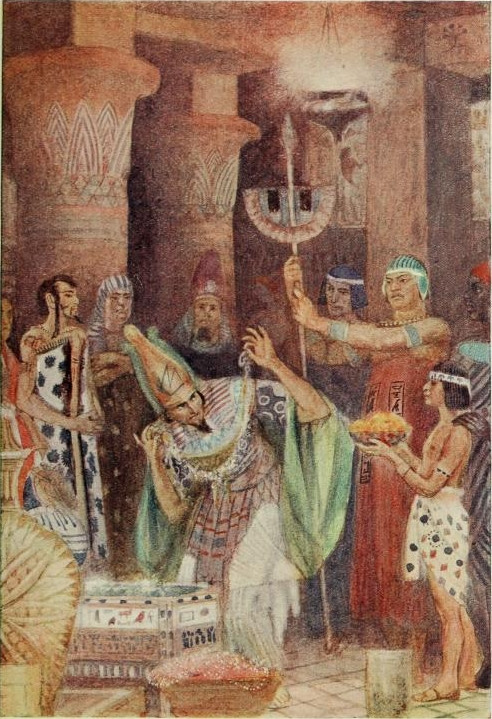
The Treasure-chamber of Rhampsinites—Evelyn Paul.
The Story of Rhampsinites
The oldest form of this legend has been handed down to us by Herodotus. It occurs in the ancient folklore of both Eastern and Western peoples and its origin has often been debated. If not really of Egyptian origin, it had certainly become Egyptianized when Herodotus found it. It relates how King Rhampsinites possessed so much treasure that none of his successors ever surpassed or even came near to having a like amount.
To ensure its safety he had a seemingly impregnable stone house built, in which he placed all his great wealth. By a clever trick, however, the architect contrived to provide access to the treasure. He made one of the stones in two parts, so that one part could be removed; but so skilfully were the two parts placed together that they presented a perfectly even surface, as of one single stone. Before he died he acquainted his two sons with the secret of the treasure-house, and after his death they did not delay in putting their knowledge into practice. They went by night, found the stone without any difficulty, withdrew it, stole a large sum of money, and replaced it in position.
When the king discovered that thieves were at work he had man-traps placed near the site of the treasure-house. One night the two brothers came as usual, and one of them was caught in a trap. Seeing his danger, he called his brother and said to him, "We shall both perish and the treasure be lost unless you cut off my head and take it away, so that no one will recognize us as the thieves." The brother did as he advised: he moved the stone back into position, cut off his brother's head and carried it home.
When the king found the headless body he was much disturbed, for there were no traces of entrance to or exit from the treasure-house, and he bethought himself of this expedient: he had the dead body exposed on the city wall and placed a guard round it with instructions to watch and report whoever manifested any sign of grief on seeing the body. This act was contrary to the practice of the Egyptians, who had usually too much respect for the dead to indulge in it. Even in the case of an executed criminal the remains were returned to the relatives to be embalmed. Nevertheless Rhampsinites considered himself justified in adopting this measure. The body was exposed, and the mother, although she did not betray any sign of grief, insisted on her other son bringing it to her; otherwise she threatened to divulge his secret to the king. Seeing that he dared not disobey, the son devised a stratagem. He saddled some asses and loaded them with goatskins full of wine—skins were used in Egypt for water only at most times, wine being held in short narrow vases—he drove the asses past the guard and, when passing, stealthily untied one or two of the skins, and as the wine ran down and flowed on the ground began to beat his head and make a great outcry. The guards ran for vessels to save the precious liquid, and over the catastrophe they became quite friendly with the thief and gave him meat, for which he offered in exchange one of his skins of wine. They all sat down to drink together, and as they became merry over the wine he offered them the remainder of his wine, which they took and drank until they were quite tipsy. The thief, needless to say, had taken care to remain tolerably sober. After the guards were in a drunken sleep, he waited till nightfall and then cut down his brother's body and took it home on the asses to his mother. Before quitting the guards he shaved off all the hair on one side of their faces.
When the king heard of the trick he was furious, and, determined by fair means or foul to discover its author, he hit upon the following plan. He ordered the princess, his daughter, to receive any man in the land, no matter whom, and to grant him whatever favour he might ask of her, but first she must make him tell her what was the cleverest and wickedest thing he had ever done. When the thief told her his trick she was to have him bound before he could escape. The princess was ready to do her father's bidding, but the thief, knowing well what the king had in his mind, resolved to circumvent him a third time. He cut off the arm of a newly dead man and, hiding it under his robe, obtained admission to the princess. On being asked the question that she put to all comers, he told her first about cutting off his brother's head in the trap, and then went on to tell how, having made the guards tipsy, he had cut down his brother's body. She at once called out and tried to seize him, but he placed in her hand that of the dead man, which she grasped firmly, believing it to be the thief's, and he escaped in the darkness of the room.
The king now owned himself beaten, and offered a free pardon and rich rewards to the man who had so boldly outwitted him. Trusting to his word, the thief presented himself before the king, and received not only what Rhampsinites had promised, but also the hand of the princess in marriage, for he held the thief to be the cleverest of men in that he had duped the Egyptians, who prided themselves on their astuteness.
Civil War in Egypt: The Theft of the Cuirass
In the reign of the Pharaoh Petoubastis the Delta and great part of Lower Egypt were divided into two rival factions, one part being headed by the chieftain Kamenophis, Prince of Mendes, and the other ruled by the king-priest of Heliopolis, Ierharerou, and his ally Pakrourou, the great chieftain of the east. Only four nomes in the middle of the Delta were subject to Kamenophis, whilst Ierharerou had succeeded in establishing either his children or relations in most of the other nomes. Ierharerou possessed a cuirass to which he attached great value and which was generally regarded as a talisman. At his death Kamenophis, taking advantage of the mourning and confusion in Heliopolis, seized the cuirass and placed it in one of his own strongholds. Prince Pimonî 'the little'—"Pimonî of the strong fist," as he is sometimes called in the narrative—the successor of Ierharerou, demanded its restoration. Kamenophis refused, and hence arose a quarrel in which all the provinces of Egypt were implicated.
Pimonî and Pakrourou both presented themselves before King Petoubastis, asking his permission to be revenged on Kamenophis; but Pharaoh, who knew that this would entail civil war, endeavoured to dissuade Pimonî from taking steps against Kamenophis and, indeed, forbade him to proceed with his intentions, promising as compensation a splendid funeral for Ierharerou. Unwillingly Pimonî submitted, but after the funeral ceremonies were over resentment still burned within him, and he and Pakrourou, "the great chieftain of the east," returned again to Petoubastis at his court in Tanis. He received them rather impatiently, asking them why they troubled him again and declaring that he would not allow civil war during his reign. They, however, would not be satisfied and said they could not go on with the celebration of the feast that was to follow the religious rites of Ierharerou's funeral until the shield or cuirass was restored to its rightful owner.
Pharaoh then sent for Kamenophis, and requested him urgently to return the shield, but in vain. Kamenophis declined to do so.
Then said Pimonî, "By Tem, the lord of Heliopolis, the great god, my god, were it not for Pharaoh's decree and that my respect for him protects you, I should kill you this very instant."
Kamenophis replied, "By the life of Mendes, the great god, the war which will break out in the nome, the battle which will break out in the city will stir up clan against clan, and man against man, before the cuirass shall be wrested from the stronghold where I have placed it."
The Horrors of War
Pakrourou then said before the king, "Is it right what Kamenophis has done, and the words he has just spoken are they not said to provoke us to anger that we may measure our strength against his? I will make Kamenophis and the nome of Mendes feel the shame of these words uttered to provoke civil war which Pharaoh has forbidden; I will glut them with war. I said nothing because I knew the king did not want war; but if the king remains neutral I shall be silent no longer, and the king shall see all the horrors of civil war."
Pharaoh said, "Be neither boastful nor timid, Pakrourou, great chieftain of the east, but now go each one of you to your nomes and your towns in peace, and give me but five days, and I swear by Amen-Ra that I shall cause the cuirass to be put back in the place from which it was taken."
Pimonî then said that if the cuirass were replaced nothing more should be said about it, and there should be no war; but if it were withheld, he would fight for it, against the whole of Egypt if necessary.
Kamenophis at this respectfully asked and obtained permission from Pharaoh to order all his men to arm themselves, and to go with him to the Lake of the Gazelle and prepare to fight.
Then Pimonî, encouraged by Pakrourou, sent messages of a similar import to all his nomes and cities. Pakrourou further advised him to hasten to the Lake of the Gazelle and be there before Kamenophis had assembled all his men, and Pimonî, with only one band of men, took his advice and was first in the field, intending to wait there till his brothers, at the head of their respective clans, should join him.
News of this was taken to Kamenophis, and he hastily assembled his four nomes, Tanis, Mendes, Tahait, and Sebennytos. Arrived at the lake, he at once challenged Pimonî, and Pimonî, though his other forces had not yet arrived, accepted the challenge.
Pimonî put on a shirt of byssus embroidered with silver and gold, and over that a second shirt of gold tissue; he also donned his copper corselet and carried two golden swords; he put on his helmet and sallied forth to meet Kamenophis.
While they were fighting, Zinonfi, Pimonî's young servant, ran off to watch for the forces that were to come to Pimonî's aid, and he soon descried a flotilla so large that the river could hardly carry all the barges. They were the people of Heliopolis coming to help their chief. As soon as they came within earshot Zinonfi called out to them to hurry, because Pimonî was being hard pressed by Kamenophis, which, indeed, was true, for his horse was slain under him.
Kamenophis redoubled his efforts when he saw the fresh forces arriving, and Petekhousou, Pimonî's brother, challenged Anoukhoron, the king's son, to single combat. When Pharaoh heard this he was very angry. He went in person to the field of battle and forbade the combatants to proceed, and also commanded a truce until all the forces should be assembled.
Petoubastis and all the chieftains occupied prominent positions so that they could watch what was going on, and the men were as numerous as the sands of the seashore and their rage against each other uncontrollable. The bands of the four nomes were ranged behind Kamenophis, and the bands of the nome of Heliopolis behind Pimonî the Little.
Then Petoubastis gave Pakrourou a signal and he armed himself and went down among the forces, stirring them all to deeds of valour; he pitted man against man, and great was the ardour he aroused in them.
Succour for Pakrourou
After Pakrourou had left the mêlée, he met a mighty man in armour leading forty galleys and eight thousand soldiers. This was Moutoubaal, a prince of Syria, who had been warned in a dream to repair to the Lake of the Gazelle to help to regain the stolen cuirass. Pakrourou gave him a place, though all the forces were now disposed; but he ordered him not to join in the fight until the opposite side—the men of Kamenophis—should attack their vessels. Moutoubaal, therefore, remained in his barque, and Pakrourou went back to his point of vantage to watch the progress of the battle. The two factions fought from four in the morning to nine in the evening. Finally Anoukhoron, the king's son, broke under the stress of the bands of Sebennytos and they rushed toward the boats. Then Moutoubaal took his opportunity and went against the bands of Sebennytos and overthrew them. He went on spreading destruction among the forces of Kamenophis till Pharaoh called a halt; then proceeded with Pakrourou to Moutoubaal and besought him to stay his hand, promising that he would see to it that the shield was restored. Moutoubaal accordingly quitted the lists after having wrought great havoc among the men of Kamenophis. Then Pharaoh and Pakrourou went with Moutoubaal to the place where Pimonî was found engaged in mortal combat with Kamenophis. Pimonî had got the upper hand and was about to slay his adversary, but they stopped him, and Pharaoh ordered Kamenophis to quit the lists.
After this Anoukhoron, the royal prince, was overthrown by Petekhousou, the brother of Pimonî, but Pharaoh interposed and persuaded Petekhousou to spare his son, so the young man was allowed to withdraw unhurt.
The king said, "By Amen-Ra, the sceptre has fallen from the hands of Kamenophis, prince of Mendes. Petekhousou has vanquished my son, and the bands of the four strongest nomes in Egypt have been overthrown."
The Shield Regained
Then Minnemai, Prince of the Eupuantine, the son of Ierharerou, the priest-king, to whom the shield had belonged, advanced from Thebes with all his forces. They assigned him a place next the ship of Takhos, the chief soldier of the nome of Mendes, and it happened that in the galley of Takhos lay the cuirass itself. And Minnemai called upon his gods to let him behold his father's cuirass that he might be the instrument of its recapture. He armed himself, went to the galley of Takhos, and met there nine thousand soldiers guarding the cuirass of Ierharerou, son of Osiris. Minnemai placed thirty-four guards on the footbridge of the galley to prevent anyone from getting off, and he fell upon the soldiers guarding the cuirass. Takhos fought well and killed fifty-four men, but finally gave in and retired to his vessel, where Minnemai followed him with his Ethiopian warriors. The children of Ierharerou supported him and they seized the cuirass of Ierharerou.
Thus was the armour recaptured and brought back to its former place. There was great joy among the children of Ierharerou and the troops of Heliopolis. They went before Pharaoh and said to him, "Great master, have the history of the war of the cuirass written, and the names of the warriors who waged it, that posterity may know what a war was made in Egypt on account of the cuirass, in the nomes and in the cities; then cause the history to be engraved on a stone stele in the temple of Heliopolis." And King Petoubastis did as they asked.
The Birth of Hatshepsut
The following story of the birth of Hatshepsut, the great queen, the beloved of the gods, mistress of all lands under the sun, is not a direct translation from the old papyrus which recounts it, but is told in the writer's own words:
In the land of the gods Amen-Ra held court. King of the gods was Amen-Ra, and the maker of men. On his right was Osiris, with the twin goddesses Isis and Nephthys, Hathor the goddess of love, and Horus and Anubis. On his left was Mentu, the god of war, with Geb, the earth-god, and Nut, the sky-goddess, the gods Atmu and Shu, and the goddess Tefnut. And to the assembled gods Amen-Ra spake thus:
"I will make a great queen, who shall rule over Egypt and Syria, Nubia and Punt, so that all lands may be united under her sway. Worthy must the maiden be of her great dominions, for she shall rule the whole world."
As he spoke the god Thoth entered, he who has the form of an ibis, that he may fly more swiftly than the swiftest arrow. In silence he listened to the words of Amen-Ra, the mightiest of the gods, the maker of men. Then he said:
"Behold, O Amen-Ra, there is in the land of Egypt a maiden of wondrous beauty. The sun in his circuit shines not on anything more fair. Surely it is fitting that she be the mother of the great queen of whom thou speakest."
"Thou sayest well," said Amen-Ra. "Where shall we seek this fair princess? What is her name?"
"Her name is Aahmes," answered Thoth; "she is wife to the King of Egypt, and dwelleth in his palace. I will lead thee to her."
"It is well," said Amen-Ra.
Then Thoth, in the shape of an ibis, flew toward the land of Egypt, and with him went Amen-Ra, in the form of the King of Egypt, and all the gods and goddesses, among them Neith, goddess of Sais, and the scorpion goddess, Selk, on whose head was a scorpion bearing in each claw the sign of life.
Silently the gods and goddesses entered the sleeping palace, and were conducted by Thoth to the chamber of Queen Aahmes. The queen lay asleep on a couch shaped like a lion, and as they gazed upon her they saw that Thoth had spoken truly, that she was indeed the fairest of mortal women, and they stood speechless with admiration for her beauty. But the fragrance which they had borne with them from the land of Punt awoke the maiden, who looked with astonishment on her supernatural visitors. Very magnificent was Amen-Ra, the king of the gods, the maker of men, as he stood before the queen. Jewels of gold and precious stones adorned his person, and his beauty was as the beauty of the sun, so that the maiden's heart was filled with delight. Amen-Ra placed in her hand the sign of life and the emblem of power, and the goddesses Neith and Selk raised her couch above the ground, so that she might be above the earth while she conversed with the gods.
At length the gods returned to the land of Punt, and Amen-Ra called for Khnum, the creator, the fashioner of the bodies of men.
"Fashion for me," said Amen-Ra, "the body of my daughter, and the body of her ka. A great queen shall I make of her, and honour and power shall be hers all the days of her life."
"O Amen-Ra," answered Khnum, the creator, "it shall be done as thou hast said. The beauty of thy daughter shall surpass that of the gods, and shall be worthy of her dignity and glory."
So Khnum fashioned the body of Amen-Ra's daughter and the body of her ka, the two forms exactly alike, and more beautiful than the daughters of men. He fashioned them of clay with the aid of his potter's wheel, and Hekt, goddess of birth, knelt by his side, holding the sign of life toward the clay that the bodies of Hatshepsut and her ka might be filled with the breath of life.
Then did the gods bring the bodies to the palace of the King of Egypt. Khnum, the creator, and Hekt, the goddess of birth, Isis, the great mother, and her twin sister Nephthys, Bes, the protector of children, and Meskhent and Ta-urt, all were present to hail the birth of Hatshepsut, the great queen, the daughter of Amen-Ra and Queen Aahmes.
Great were the rejoicings when the child was born, and loud the praises chanted in her honour. And in time she became ruler of all countries, rich and powerful and beloved of Amen-Ra, the great queen for whom she had been designed by the king of the gods.
In the valley of the Nile there was erected a temple to Queen Hatshepsut. The temple stands to this day, and is now known as Deir-el-Bahari, the Northern Convent.
How Thoutii took the Town of Joppa
The fragments of this story are inscribed on the Harris Papyrus. Like the story of the Predestined Prince, they were discovered in 1874 by Goodwin, who recognized in them the remnants of an historical narrative, and who informed the Archæological Society of his find. The beginning is lost. At the point where the narrative commences there are three characters: an Egyptian officer called Thoutii, the prince of a town in Syria, and his equerry. The tale deals with the recapture of Joppa (a town of Palestine mentioned in the Bible) by Thoutii's stratagem. The stratagem employed bears some resemblance to that related in the story of the robber-captain in the Arabian Nights.
In the reign of Thothmes III, King of Egypt (Eighteenth Dynasty), the Prince of Joppa rose in rebellion and murdered all the Egyptian soldiers that were quartered in the town. This news naturally excited Pharaoh's wrath, and he called together his nobles and generals and scribes to see what could be done. None of them, however, had any suggestion to make except Thoutii, a brilliant young infantry officer.
"Give me," he begged, "your magic cane, O my king, and a body of infantry and of charioteers, and I undertake to kill the Prince of Joppa and to take the town."
Pharaoh, who esteemed this officer highly and knew his worth, granted all that he asked—not exactly a modest request, for the cane was a talisman supposed to render invisible anyone into whose possession it fell.
Thoutii then marched to Palestine with his men. Having arrived there, he had a large skin bag made, big enough to hold a man, and he had irons made for feet and hands, one pair being especially large and strong; also shackles and yokes of wood, and four hundred jars. Then he sent to the Prince of Joppa the following message: "I am Thoutii, the Egyptian infantry general. King Thothmes was jealous of my bravery and sought to kill me; but I have escaped from him, and I have stolen his magic cane, which is hidden in my baggage; and, if you like, I will give it to you, and I will join forces with you, I and my men, the pick of the Egyptian army."
This message was very pleasant news to the Prince of Joppa, for he knew Thoutii's reputation, and knew that he had no equal in all Egypt. He sent to Thoutii, accepting his offer, and promising him a share of his territory. He then left Joppa, taking with him his equerry and the women and children, to greet the man whom he took to be a new and powerful ally. He welcomed him warmly, and invited him into his camp to dine with him. In course of conversation, as they were eating and drinking together, he asked Thoutii about the magic cane. Thoutii replied that it was concealed in the baggage with which his horses were laden, and requested that his men and horses should be brought into the camp to be refreshed and rested.
This was done: his horses were fed and tied up, the baggage was searched, and the magic cane found.
The Stratagem
Hearing this, the Prince of Joppa expressed his eager wish to behold the magic cane. Thoutii went and fetched it; then suddenly seizing the Prince by his clothes, he said, "Behold here King Thothmes' magic cane," and with that he raised his hand and struck the Prince on the forehead so that the latter fell down unconscious before him. Then he put him into the big leather sack he had with him and clapped the handcuffs on his wrists and the irons on his feet. The face of the dead man being invisible, Thoutii's stratagem was to pass off the corpse as his own. He had the two hundred soldiers put into an equal number of the four hundred jars he had brought with him and filled the remainder with the ropes and wooden shackles; then he sealed them, corded them, and gave them to as many strong soldiers, saying, "Go quickly and tell the Prince of Joppa's equerry that I am slain. Let him go and tell his mistress, the Princess of Joppa, that Thoutii is conquered, that she may open the city gates to receive the dead body of the vanquished and the jars of booty that have been taken from him." The equerry received this message and ran to tell the joyful news to his mistress. The gates of the town were opened, and Thoutii's men carried the jars containing the other soldiers into the town. Then they released their companions, and the Egyptian force fell upon the inhabitants of the city and took them and bound them.
After he had rested Thoutii sent a message to Pharaoh saying, "I have killed the Prince of Joppa and all the people of Joppa are prisoners. Let them be sent for and brought to Egypt, that your house may be filled with male and female slaves who will be yours for ever. Let Amen-Ra, thy father, the god of gods, be glorified."