Chapter IV · : THE CULT OF OSIRIS (continued 2)
Reading edition
The Place of Reeds
We learn from the Theban Recension that there were seven halls or mansions in the Field of Reeds, all of which had to be passed through by the soul before it was received by the god in person. Three gods guarded the door of each hall—the doorkeeper, watchman, and questioner. It was necessary for the new-comer to address each god by his name. There were also names for the doors which must be borne in mind. The name of each god was in reality a spell consisting of a number of words. The Place of Reeds was divided into fifteen regions, each of which was presided over by a god. The first of these was called Amentet, where dwelt those souls who lived upon earth-offerings; it was ruled over by Menuqet. The second was Sekhet Aaru, the Field of Reeds proper, the walls surrounding which were formed of the stuff of which the sky is made. Here dwelt the souls, who were nine cubits high, under the rule of Ra Heru-Khuti, and this place was the centre of the kingdom of Osiris. The third was the place of the spirit-souls, a region of fire. In the fourth dwelt the terrible serpent Sati-temui, which preyed on the dead who dwelt in the Duat. The fifth region was inhabited by spirits who fed upon the shadows of the weak and helpless souls. They appear to have been a description of vampire. The remaining regions were very similar to these.
The Journey of Osiris
We find other descriptions of the Duat in the Book of Gates and the Book of Him that is in the Duat, in which is outlined the journey that the sun-god makes through the otherworld after he has set upon the earth-world. Immediately after sinking he takes the form of Osiris, which in this instance is that of a ram with a man's head. Coming to the antechamber of the Duat in the west, his entrance is heralded by songs of praise, raised by the Ape-gods, while serpents blow fire from their mouths by the light of which his Pilot-gods steer his craft. All the doors are thrown open, and the dead, revived by the earthly air which Osiris carries with him, come to life again for a brief hour. All the creatures of this portion of the Duat are provided with meat and drink by command of the god. Such of the dead as dwell here are those who have failed to pass the various tests for entrance to his court, and all that they exist for is the material comfort provided for them by the brief diurnal passage of the deity. When the sun, who in this form is known as Af Ra, reaches the entrance to the second part of the Duat, which is called Urnes, the gods of the first section depart from him, and do not again behold his face until the following night. At this point the boat of Af Ra is met by the boats of Osiris and his attendant gods, and in this place also Osiris desires that the dead should receive food, light, and air. Here he grapples with the serpents Hau and Neha-her, as do most sun-gods during the time of darkness, and, having overcome them, is led into the Field of the Grain-gods, where he reposes for a while. When there he hearkens to the prayers of the living on behalf of the dead, and takes account of the offerings made by them. Continuing his journey, he traverses the twelve sections of the Duat. In some of these we see what were probably quite separate realms of the dead, such as the Realm of Seker, a god who is perhaps of greater antiquity than Osiris. In this place his boat is useless, as there is no river in the gloomy kingdom of Seker, which appears completely alien to Osiris. He therefore repeats words of awful power, which compel the gods of the place to lead him by subterranean passages from which he emerges into Amhet, where is situated a stream of boiling water. But he is not out of the kingdom of Seker until he reaches the sixth section, where dwell the dead kings of Egypt and the 'Khu' or Spirit-souls. It is at this point of his journey that Af Ra turns his face toward the east and directs his course to the Mountain of the Sunrise; previous to this he has been journeying from the south to the north. In the seventh section he is joined by Isis and other deities, and here his path is obstructed by the wicked serpent Apep, through whose body the attendant deities drive their daggers. A company of gods tow him through the eighth section, but his vessel sails itself through the ninth, and in the tenth and eleventh he seems to pass over a series of lakes, which may represent the lagoons of the eastern delta. In the latter section his progress is lighted by a disk of light, encircled by a serpent, which rests upon the prow of the boat. The twelfth section contains the great mass of celestial waters called Nu, and here dwells Nut, the personification of the morning. Before the boat looms the great serpent Ankh-neteru, and twelve of the gods, taking hold of the tow-line, enter this serpent at the tail and draw the god in his boat through the monstrous body, bringing Af Ra out at its mouth; but not as Af Ra, for during this passage he has been transformed into Khepera, in which shape he is towed into the sky by twelve goddesses, who lead him before Shu, the god of the atmosphere of the terrestrial world. Shu places him in the opening in the semicircular wall which forms the end of the twelfth section, and he now appears to mortal eyes as a disk of light, having discarded his mummified form, in which he traversed the Duat. His progress is followed by the acclamations of his company of gods, who fall upon and destroy his enemies and sing hymns of praise to him. The Duat, as described in the Book of Gates, differs considerably from that of the Book of Him that is in the Duat, but it also possesses twelve sections, and a similar journey is outlined in it.
The principal gods alluded to in the Book of the Dead are: Tem or Atmu, Nu, Ra, Khepra, Ptah, Ptah-Seker, Khnemu, Shu, Set, Horus, Thoth, Nephthys, Anubis, Amen, and Anu—in fact, the majority of the principal divinities of Egypt. Besides these there were many lesser gods and a great company of spirits, demons, and other supernatural beings. Many of these demons were very ancient forms of half-forgotten deities. It will be noticed that at practically every stage of his journey Osiris left behind him one or more of his divine companions, who henceforth were supposed to become the rulers or satraps of the regions in which he had quitted them. So might an earthly Pharaoh reward his courtiers for services rendered.
It was only during the Middle Kingdom that the conception of Osiris as judge of the dead took definite form and received general recognition. In one of the chapters of the Book of the Dead we find him seated in a large hall the roof of which is covered with fire and symbols of truth. Before him are the symbol of Anubis, the four sons of Horus, and the Devourer of the West, a monster who serves as his protector. In the rear sit the forty-two judges of the dead. The deceased makes his appearance before the god and his heart is placed in a great balance to be weighed by Anubis, Thoth, the scribe of the gods, standing by to note the result upon his tablets. Having communicated this to Osiris, the dead man, if found worthy, is presented to the deity, to whom he repeats a long prayer, in which he states that he has not committed any evil. Those who could not pass the test were hurried away, and so far as is known were in danger of being devoured by a frightful monster called Beby, which awaited them outside. The justified deceased took part in the life of Osiris and the other gods, which appears to have been very much the same as that of the Egyptian aristocracy. As has been said, the deceased might also transform himself into any animal form he cared. The life of the justified dead is well outlined in an inscription on the tomb of Paheri, prince of El Kab, which is as follows: "Thou goest in and out with a glad heart, and with the rewards of the gods.... Thou becomest a living soul; thou hast power over bread, water, and air. Thou changest thyself into a phœnix or a swallow, a sparrow-hawk or a heron, as thou desirest. Thou dost cross in the boat and art not hindered. Thou sailest upon the water when a flood ariseth. Thou livest anew and thy soul is not parted from thy body. Thy soul is a god together with the illuminated, and the excellent souls speak with thee. Thou art among them and (verily) receivest what is given upon earth; thou possessest water, possessest air, hast superabundance of that which thou desirest. Thine eyes are given to thee to see, and thine ears to hear speech, thy mouth speaketh, thy legs move, thy hands and arms bestir themselves for thee, thy flesh grows, thy veins are in health, and thou feelest thyself well in all thy limbs. Thou hast thine upright heart in thy possession, and thy earlier heart belongs to thee. Thou dost mount up to heaven, and art summoned each day to the libation table of Wennofre, thou receivest the good which has been offered to him and the gifts of the Lords of the necropolis."
The Book of the Dead is obviously an allegory of the passage of the sun through the underworld. The sinking of the sun at nightfall would naturally arouse in primitive man thoughts as to where the luminary dwelt during the hours of gloom, for the sun was to early man a living thing. He could watch its motion across the sky, and the light and other benefits which he received from it came to make him regard it as the source of all good. It appeared plain to him that its diurnal career was cut short by the attacks of some enemy, and the logical sequel of the belief in the solar deity as a beneficent power was of course that the force hostile to him must be of evil disposition. It came to be figured as a serpent or dragon which nightly battled with the luminary and for a season prevailed. The gods of many religions have to descend into the otherworld to do battle with the forces of death and hell. We may see an analogy to the Book of the Dead in the Central American Popol Vuh, in which two hero-gods, the sons and nephews of the sun and the moon, descend into the dark abyss of the Maya Hades, rout its forces, and return triumphant. It has been suggested that the Book of the Dead was nothing more or less than the ritual of a secret brotherhood, and that the various halls mentioned in it symbolized the several stages of initiation through which the members had to pass.
It is curious that in his recent interesting book on Mexican Archæology Mr. T. Athol Joyce, of the British Museum, has mentioned that the court of the Maya underworld, as alluded to in the Popol Vuh, "seems to have been conducted on the principle of a secret society with a definite form of initiation." It is practically certain that the mysteries of Eleusis, and similar Greek initiatory ceremonies, were concerned with the life of the underworld, especially with the story of Demeter and Kore, or Ceres, and that a theatric representation of the wanderings of the mother in search of her daughter in the underworld was given in the course of the ceremonial. These Greek deities, besides being gods of the dead, were gods of agriculture—corn-gods; but gods of the underworld often presided over the growth of the crops, as it was believed that the grain germinated underneath the earth by their influence. For example, we find in the Popol Vuh that Xquiq, daughter of one of the lords of the underworld, was able to reap a field of maize in a few minutes in a spot where before there had been none. All this would seem to point to the probability that if the Book of the Dead did not contain an early type of initiatory ceremonial, it may have powerfully influenced the ceremonial of mysteries when they arose. The mysteries of the Cabiri, for example, are supposed to be of Egyptian origin. On the other hand, it may be possible that the Book of the Dead represents the ceremonial of an older prehistoric mystery, which had been forgotten by the dynastic Egyptians. Savage races all over the world possess such mysteries. The Indians of North America and the Blackfellows of Australia possess most elaborate initiatory ceremonies; and it is quite possible that the Book of the Dead may preserve the ritual of Neolithic savages who practised it thousands of years prior to its connexion with the worship of Osiris.
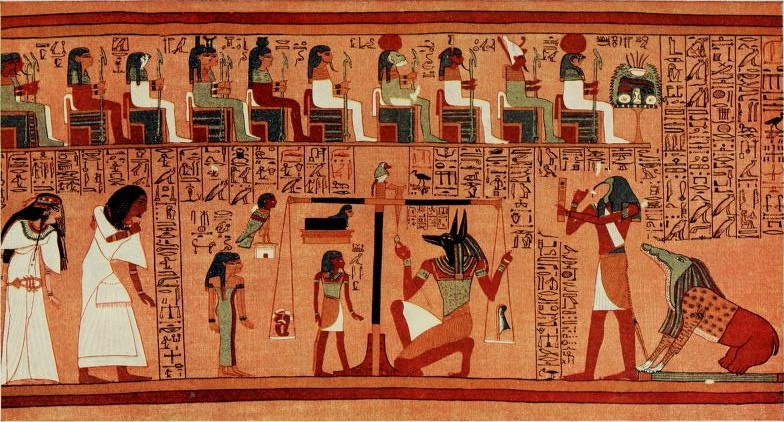
The Weighing of the Heart—From the Papyrus of Ani Reproduced from the Facsimile by Permission of the Director of the British Museum
The Place of Punishment
Although there does not appear to have been a portion of the Duat specially reserved for the wicked, they were sufficiently tormented in many ways to render their existence a punishment for any misdeeds committed during life. At one end of this region were pits of fire where grisly deities presided, superintending the destruction of the bodies of the deceased and hacking them to pieces before they were burned. Their punishment was, however, mitigated by the appearance of Ra-Osiris on his nightly journey, for as he advanced their torments ceased for the time being.
The deities who inflicted punishment upon the damned were the enemies of Ra-Osiris—personifications of darkness, night, fog, mist, vapour, tempest, wind, and so forth, and these were destroyed daily by the fiery beams of the luminary. These were pictured in human form, and the scenes of their destruction by fire have often been mistakenly supposed to represent the burning of the souls of the doomed. This evil host was renewed with every revolution of the sun, so that a fresh phalanx of enemies appeared to attack Ra each night and morning. It was during the interval between dawn and sunrise that they were discomfited and punished. The souls of the doomed were in no wise enabled to hinder the progress of Ra, but in later times these were in some measure identified with the enemies of Ra, with whom they dwelt and whom they assisted to attack the sun-god. In the strife which ensued they were pierced by the fiery sun-rays, symbolized as darts or spears, and the knives which hacked their bodies in pieces were typical of the flames of fire emanating from the body of Ra. The lakes and pits of fire in which they were submerged typified the appearance of the eastern heavens at sunrise.
There was nothing in the Egyptian creed to justify the belief in everlasting punishment, and such a view is unsupported by the material of the texts. There is, in fact, no parallel in the Egyptian religion to the Gehenna of the Hebrews, or the Purgatory and Hell of medieval Europe. The Egyptian idea of death did not include the conception of the resurrection of a second physical body in the underworld, but, should the physical body be destroyed, they considered that the ka or double, the shadow and spirit of man, might also perish. It is strange, all the same, to observe that the Egyptian idea of temporary punishment after death appears to have coloured the medieval Christian conception of that state through Coptic sources. Indeed, the Coptic Christians of Egypt appear to have borrowed the idea of punishment in the Duat almost entire from their pagan ancestors or contemporaries. Amélineau cites a Coptic work in which a dead Egyptian tells how at the hour of dissolution avenging angels collected around him with knives and other weapons, which they thrust through and through him. Other spirits tore his soul from his body and, securing it to the back of a black horse, galloped off with it to Amentet. On arrival there he was first tortured in a place filled with noisome reptiles, and was then thrust into outer darkness. He fell into another pit at least two hundred feet deep, in which were assembled reptiles of every description, each having seven heads, and here he was given over to a serpent which had teeth like iron stakes. From Monday to Friday of each week this monster gnawed and tore at the doomed wretch, who rested only from this torment on Saturday and Sunday. In the circumstance that it does not posit eternal punishment, the region of torment, if so it can be named, differs from similar ideas in other mythologies; but in the essence concerning the nature of the punishment meted out, the cutting with knives, stabbing with spears, burning with fire, and so forth, it is practically at one with the underworlds of other faiths. The scenery of the Egyptian infernal regions also closely resembles that of its equivalents in other mythologies. It was not to be supposed that the Egyptians, with their elaborate precautions against bodily attack after death, should believe in eternal punishment. They may have believed in punishment for each other, but it is highly improbable that any Egyptian who had devoted any time to the study of the Book of the Dead believed that he himself was doomed. His whole future, according to that book, hung upon his knowledge of the words of power written therein, and surely no one with such a comparatively easy means of escape could have been so foolish as to neglect it.
The Egyptian Heaven
As has been said, the exact position of heaven does not appear to have been located, but it may be said in a general sense that the Egyptians believed it to be placed somewhere above the sky. They called it Pet, which expression they used in contradistinction to the word Nu, meaning sky. The heavens and the sky they regarded as a slab, each end of which rested on a support formed of the two mountains Bakhau and Manu, the mountains of sunrise and sunset. In primitive times heaven was conceived as consisting of two portions, the east and the west; but later it was divided into four parts, each of which was placed under the sovereignty of a god. This region was supported by four pillars, each of which again was under the direction of a deity, and at a comparatively late period an extra pillar was added to support the middle. In one myth we find the heavens spoken of as representing a human head, the sun and moon forming the eyes, and the supports of heaven being formed by the hair. The gods of the four quarters who guarded the original pillars were those deities known as Canopic (see p. 28), or otherwise called the Children of Horus.
In heaven dwelt the great god Ra, who sat upon a metal throne, the sides of which were embossed with the faces of lions and the hoofs of bulls. His train or company surrounded him, and was in its turn encircled by the lesser companies of deities. Each of the gods who presided over the world and the Duat had also his own place in heaven. Beneath the lesser gods again came beings who might well be described as angelical. First among these were the Shemsu-heru, or followers of Horus, who waited upon the sun-god, and, if necessary, came to his protection. They were regarded as being essential to his welfare. Next came the Ashemu, the attributes of which are unknown, and after those the Henmemet, perhaps souls who were to become human beings, but their status is by no means clear. They were supposed to live upon grain and herbs. There were also beings called Utennu and Afa, regarding the characteristics of which absolutely nothing is known. Following these came an innumerable host of spirits, souls and so forth, chiefly of those who had once dwelt upon the earth, and who were known collectively as 'the living ones.' The Egyptians thought these might wander about the earth and return to heaven at certain fixed times, the idea arising probably because they wished to provide a future for the body as well as for the soul and spirit. As explained previously, the gods of heaven had their complements or doubles on earth, and man in some degree was supposed to partake of this dual nature. The Egyptian conception of heaven altered slowly throughout the centuries. An examination of the earliest records available shows that the idea of existence after death was a sort of shadowy extension of the life of this world. Such an idea is common to all primitive races. As they progressed, however, this conception became entirely changed and a more spiritual one took its place. The soul, ba, and the spirit, khu, which were usually represented as a hawk and a heron in the hieroglyphic texts, partook of heavenly food and became one with the gods, and in time became united with the glorified body or heavenly frame, so that the soul-spirit, power, shade, double, and name of the deceased were all collected in the one heavenly body known as sahu, which may be described as the spiritual body. It was considered to grow out of the dead body, and its existence became possible through the magic ceremonies performed and the words of power spoken by the priests during the burial service.
How the Blessed Lived
In the Book of the Dead it is stated that the spirits of heaven are in number 4,601,200. It has been suggested that this number was probably the Egyptian enumeration of all those human spirits who had died and had attained to heaven; but this is hardly probable, for obvious reasons. The manner in which these spirits employed their time is a little obscure. Some directed the revolutions of the heavenly bodies; others accompanied the great gods in their journey through the heavens; while still others superintended mundane affairs. They chanted eternal praises of Ra as supreme monarch of the gods, and their hymns described the wonders of his power and glory. They lived upon the rays of light which fell from the eye of Horus—that is, they were nourished upon sunlight, so that in time their bodies became wholly composed of light. According to one myth the gods themselves lived upon a species of plant called the 'plant of life,' which appears to have grown beside a great lake. But such a conception is in consonance with an almost separate theological idea to the effect that the deceased dwelt in a Paradise where luxuriant grain-fields were watered by numerous canals, and where material delights of every kind abounded. It was perhaps this place in which the 'bread of eternity' and the 'beer of eternity,' the celestial fig-tree, and other such conceptions were supposed to form the food of the dead. The blessed were supposed to be arrayed in garments similar to those which clothed the gods, but certain of them seem to have worn white linen apparel, with white sandals on their feet.
All this goes to show that the heaven of the primitive Egyptians was nothing more than an extension of terrestrial conditions, or perhaps it might be said an improvement upon them. So long as the Egyptian had the wherewithal to make bread and to brew beer, and had cleanly garments, and shelter under a homestead the ground round which was intersected with numerous canals, he considered that to be the best of all possible heavens. The crops, of course, would grow of themselves. The whole idea was quite a material one, if the life was simple but comfortable. There is nothing sophisticated about the Egyptian heaven like the Mohammedan or Christian realms of bliss; even the manner of reaching it was primitive, the early dwellers by the Nile imagining that they could reach it by climbing on to its metal floor by way of the mountains which supported it, and their later descendants believing that a ladder was necessary for the ascent. In many tombs models of these ladders were placed so that the dead people might make use of their astral counterparts to gain the celestial regions. Even Osiris required such a ladder, and was helped to ascend it by Ra and Horus, or by Horus and Set. Many pictures of such ladders are also found in various papyri of the Book of the Dead which were placed in tombs. Its length was regulated by the deceased himself according to the power of the magical words he pronounced over it. The deceased by words of power was further enabled to turn himself into many bird and animal shapes. It is difficult to understand the reason for these animal transformations in Paradise, but the conception has a parallel in the idea of the Aztec warriors that when they entered the domain of the sun-god they would accompany him in his course and would descend to earth during part of his daily journey in the shape of humming-birds.
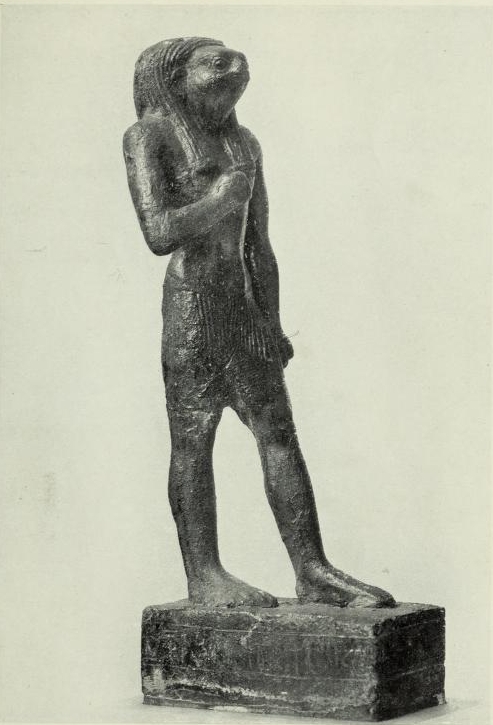
Ra