ENVOI (continued 4)
Reading edition
“Do you?” says Lady Peggy, mystified beyond everything. “Did she look as you expected her to?”
“Ah!” gasps Sir Robin, “she has not yet lifted her mask for me to behold her countenance, but 268when she returns, I shall beseech her for one glimpse!”
“Ah!” returns Peggy, now fully persuaded that some one has been making a jest of her companion, but none the less disquieted on her own score.
“Hark ye, Sir Robin,” says she, “you have ever found my counsels wise. Be advised by me now; leave Vauxhall at once. Lady Peggy Burgoyne is not safe, so long as you tarry here.”
The little Baronet, doughtily, although trembling, puts his hand to his hilt.
“Nay, Sir!” continues Peg, “your weapon would not avail for her preservation. She leaves town this very night for Kennaston. Do you the same, nor risk detection longer here.” Her Ladyship uses the word advisedly, and has the satisfaction of seeing Sir Robin shiver with terror, then steady again as he reflects that Her Ladyship’s fears can but be in connection with her own escapade; since, ’tis plain from all he can spy and eavesdrop, not a soul as yet has missed Sir Percy de Bohun from his accustomed haunts.
“But she swore me she’d be back in a few moments, Mr. Incognito, and ’sdeath! Sir!” perceiving 269Lady Biddy emerging from the box and advancing toward the lion alone, “there she is!”
Off and away Sir Robin McTart to join his Fair, while Lady Peggy, screened by the increasing shadows, for the dripping lamps are one by one, by this, dying down in their globes, beholds one—she devines not which—of Beau Brummell’s lady guests, courtesying and greeting the Baronet with her finger-tips.
Now My Lady’s heart’s a-thumping monstrous hard; she beholds, as well as Sir Robin and his supposed Peggy, two others—alas! she knows too well who they are, a-peeping out from the corner of the box-entrance whence Lady Biddy came just now, and watching her encounter with Sir Robin.
These are Lady Diana and Sir Percy.
Together? Aye and a-goin’ to be “together” for all their lives, she sadly thinks, both of them, quite forgetting, save perchance for a moment’s beguilement, her very existence. But it behooves her, if not for her own sake, of which she has come to the pass of recking but little, then for her father’s and mother’s, now to bid farewell forever to disguises, 270falsehoods, cheatings, man’s estate, and even the melancholy chance of seeing the countenance of Sir Percy. She will off presently, and reach home as best she may.
A few minutes, more or less, can make no odds, and ’tis but too true that Her Ladyship stood there in ambush of the branches in the vain hope that Percy might lift his mask, if but for an instant, and thus allow her parting gaze to rest upon his features.
It is quite true that mortals, although in never such haste to reach a desired crisis, still ofttimes halt at the threshhold of its attainment; so Her Ladyship, with now nothing to hinder her escape, still stood leaning against an oak, listless, but for the eager eyes fixed on the pair in the box entrance. These presently crossed into the throng and, joining others of the maskers, were lost to her view; but the Baronet and Lady Biddy had not been idle of their tongues this while.
Much simpering, angling for news, tittering, and a neat show of wit in the manner of plying a gentleman with questions on a matter about which 271he was quite ignorant, on the lady’s side; ardor, impatience, as much daring as his little spirit permitted, on the gentleman’s. Finally said he:
“Mr. Incognito says you start for Kennaston this very night, my dearest life, is’t so?”
“Tell me who is Mr. Incognito?” says she, “and I’ll answer you straight.”
“He’s your paid servant, sworn slave, and the bearer of all tender messages between us.—Now, go you to Kennaston to-night?”
“As sure as I’m Lady Peggy Burgoyne,” returns Biddy. “I start for home ere cock-crow!”
“I’ll follow you poste-haste, but,” cries Sir Robin, “loveliest of created beings, I beseech, I implore! one glimpse of your angelic countenance before we part—to meet only when I can claim you as my own!”
“No! No!” exclaims Biddy, restraining the Baronet’s hand which is laid upon the lutestring of her mask.
“But divine creature, I insist!” with one arm seizing the buxom Lady Biddy about the waist, while with the other he essays to untie the riband which hides her charms from view.
272Then Lady Biddy O’Toole, whose lungs were of the best, let such a bawl as rang far up and down the Thames, causing a score of red-stockinged boatmen to leave their wherries and dash up the Gardens; causing every tongue in Vauxhall to cease clacking, every glass to jingle to its table, every echo to resound; every other lady there to shriek; the musicians to stop; the waiters to drop their trays; each gentleman to draw sword; and a vast number of persons of both sexes to shout:
“Watch! Watch! Murder! Thieves! Highwaymen!” and whatever else beside.
While a concourse of people of every condition at once closed in around Sir Robin and Lady Biddy, at the outside rim of which, shivering betwixt terror and that lively curiosity which overrides even a desire for personal safety, gaped the now unmasked Vicar of Friskingdean, unable to find his natural protector and sometime pupil in all this hurly-burly.
273
XV
Wherein Sir Percy and Sir Robin come face
to face, to the unfeigned amazement of
each: and where My Lady takes
to her heels and a wherry.
When Lady Diana and Percy quitted the box, he, after conducting her to the care of Lady Brookwood, strode off into the Dark Alleys, taking with him, not Kennaston, for the hopeless youth, flouted still by Diana, had gone a-mooning by the river’s bank, but a company of valiant and merry gentlemen all raised a bit by the partaking of the famous Vauxhall punch; and to them he confided sufficient of his reasons and intentions, as made plain their course to them as his friends, to do aught and all in their several powers toward the promoting 274of a quarrel betwixt him and Sir Robin McTart; whom, he would presently point out to them, as they should stroll, seeming careless, the length of the walk.
Thus, arm in arm, Sir Percy, Sir Wyatt Lovell, His Grace of Escombe, and Mr. Jack Chalmers, across the path, swaggering with sticks and tassels hanging, hats at a cock, perfumed with Venus oil, and most jocund of demeanor; with Beau Brummell behind ’em spying, waving his little muff, and chatting with Lord Wootton and one or two more gay sparks, all disporting themselves carelessly, but hilts eased for the drawing.
Just as they were nearing the wooden lion of Sir Robin’s tryst, Lady Biddy’s shriek assailed their ears, and Sir Percy, thanking Providence for so opportune an occurrence, which, not to say that it was in any way premeditated, yet continued to ring out louder and louder, even after Sir Robin had ceased to pull at her mask-string and stood, held fast in Her Ladyship’s stout grasp, the very center of a blaze of light from footmen’s flambeaux,—they and the masses pushing every way, screaming and cursing.
275Into the thick of this mêlée dashed Sir Percy de Bohun, with his friends on either side of him.
But a moment sufficed for him to wrest the Lady from her assailant and to deliver her over to the care of Diana and the Duchess, who carried her swooning (whether with laughter or emotion ’twould be difficult to set down), to the Room.
In another second, taking his silver-fringed gloves from his pocket he threw them into the masked face of Sir Robin McTart.
The little Baronet, who had both temper and vanity, which brace now got the upperhand of his cowardice, and, believing that Lady Peggy’s eyes were upon him, that Sir Percy was at the bottom of the Thames, and with full foreknowledge that he could run away before the meeting could be arranged, caught the gloves as they struck and flung them back into their owner’s covered countenance.
“Take that! ’sdeath!” squeaked Sir Robin, now much the more valiant as he beheld the Vicar screwing his way toward him through the excited crowds.
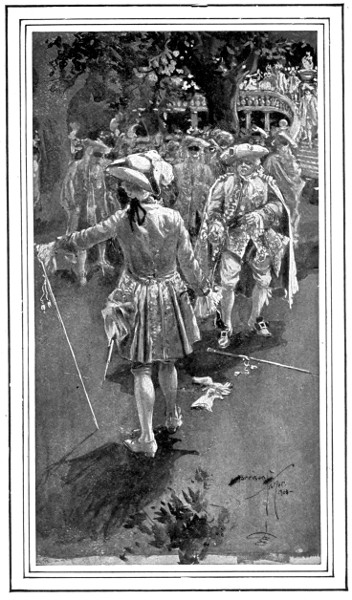
“Unmask, and show yourself for who you are!” 276cried Percy, every one of his companions echoing:
“Unmask! Unmask! Unmask, or we’ll run ye!”
“Willingly,” responded the trembling gentleman from Kent, tugging at the slip-knot in his mask-string.
“I am Sir Robin McTart! Who, the devil, are you?”
“I am Sir Percy de Bohun!” replied his opponent, as both masks came off at the same instant, and the two confronted one another, staring with four eyes that fairly popped in their sockets.
’Twould be hard to say which of these two was the more astounded, although Sir Percy’s amazement had quite a different flavor from the Baronet’s abject terror.
“You! Sir Percy de Bohun!” he quavered, turning ashy pale. “I’ll not believe it. ’Tis a lie!”
“You! Sir Robin McTart!” replied Percy, hotly. “Gentlemen,” turning to his friends, “I pray you bear me out in this, not to the exclusion of my challenge of this impostor, which holds good until one or t’other of us sheds blood, but for the preservation of the honor of a valiant gentleman, 277who is not far off of us now. That this weazen wretch may meet his dues, for not only does he masquerade his face, but seeks to usurp the character and name of one whom we all know to be both handsome, brave and courageous.”
Percy’s blood runs high as he speaks these generous words, while every soul about him stands breathless, staring, struck dumb with the singularity of the episode.
“But I am Sir Robin McTart,” cries the Baronet, brandishing his weapon with a will, since there is none to oppose him, and the Vicar, now, although well-nigh choked, not above ten yards distant from him.
“Tut, tut, Sir, whoever you are,” interposed Lord Escombe. “Your game’s up, and you’d better give your lies a rest.”
“Hold!” cries Sir Percy to Robin, “whoever you are, I challenge you to fight me ten minutes hence, yonder in the open, towards the river, and those ten minutes my friends and I’ll spend in calling the actual Sir Robin McTart into your presence, and confronting your impudence with his reality. Lend me your lungs, My Lords and 278Gentlemen; Sir Robin’s in call somewhere in the Gardens as we all know.”
And with one accord the shout went up, ringing up and down the river and far across to the highway, where it caused the horse-patrol to think that every highwayman in the kingdom had broken loose upon Vauxhall, and presently brought them rearing, plunging, swearing, firing, thumping cutlasses right and left, into the midst of the surging thousands, by this all shouting:
“Sir Robin McTart! Sir Robin McTart! Sir Robin! Sir Robin! Sir Robin McTart!” at the top of their voices.
But for all their bawling, no one answered, no one came, and but one of the vast throng went.
This was Lady Peggy, at a loss to know the meaning of the shouts, not having been near enough to the scene of the encounter to learn its purport, and only now realizing that ’twas herself was sought and meant by the concerted cry that rent the air. Scenting a new if unknown danger, she followed her woman’s instinct, and, in the waiting pause that succeeded the tumultuous call, Peggy fled to the landing, pressed a handful of 279shillings, almost her last, into the palm of the only boatman there, jumped into the wherry and bade him get her as swiftly as he could to Queenhithe Stairs; for determined was she, now more than ever, to leave no traces in her wake, and to return, at all risks, to Mr. Brummell’s house for her bundle of woman’s clothes.
For a long way down the Thames the renewed cry of the Vauxhall crush rang in her distracted ears:
“Sir Robin McTart! Sir Robin McTart! Sir Robin! Sir Robin! Where are you? Come forth! Show yourself!”
But none other came forth, and the Baronet, taking such courage as he might through his astonishment at Sir Percy’s being alive,—and not forgetting, even at this point, to reckon how much the lying assassins had mulcted him of, now, in the second breathless halt of the calling his own name, waved his weapon and answered it, saying again:
“I am Sir Robin McTart!”
“Prove it,” shouted Chalmers, with a derisive shrug.
280“Faith! and so he can by me!” exclaimed the panting Vicar, as, borne rather by the surging of the people than by his slender legs, the tenant of the cloth was pitched somewhat unceremoniously head-first into his pupil’s middle. Sputtering, but yet winning the attention which truth and the clergy usually and righteously obtain, the Vicar raised his right hand, and, laying his left on the Baronet’s shoulder, he spoke:
“This is Sir Robin McTart of Robinswold, Kent. I have known him from his birth; his father before him; he has been my pupil. Who dares use his name than himself is an impostor and a thief!”
“What!” and now comes forward Mr. Brummell with open hand. “And my old friend,” says he, “’sdeath, Mr. What’s-your-name, you were a curate when we met last, twenty years ago, but I remember you, Sir, at Robinswold. So this,” surveying the Baronet, “is my old friend’s son and heir? Of a truth he favors his sire more than the pretty young rapscallion that’s been a-fooling us all for now these four weeks past; for gentlemen,” adds the Beau, turning to Sir Percy, “’tis as well we confess ourselves to have been duped. Gad, 281Sir,” this sotto voce to Percy alone, “I always wondered where Sir Hector found that handsome lad, for he was as ugly a gentleman as ever was wedded to wife.”
After the storm there came that calm which is the inevitable successor, save that, in this case, while the noise subsided, the wonder grew. Every one of Mr. Brummell’s company and all of the rest of the world beside, was rehearsing his and her own surmise as to the identity of the young gentleman who had, for above a month, been the town toast, and who had now disappeared as suddenly as he came. Some believed him to be Tom Kidde himself; some, a Lord out of France; some, a Prince of the blood; some, the Devil; some, an astrologer; there was no lack of inventions as to Her Ladyship’s identity by the time the ten minutes of Sir Percy’s setting had come to an end.
He cast an eye about the place looking for Sir Robin, and his veins were fairly on fire to know the color of his rival’s blood and wring from his, he hoped, dying lips, a confession of where Lady Peggy was. Presently, not spying his opponent, he begged Escombe and Chalmers to have the 282goodness to seek him out; settle the spot; ask him to choose his seconds; call a surgeon (of whom there were always a score in attendance at Vauxhall, ready for just such affairs), while he himself swung down toward the river to look for Kennaston and give him one last word for Peggy, should Sir Robin run him through.
Peg’s twin lay on the turf sleeping. Such are the effects of being at once a poet and a lover, not yet twenty, and quite fagged with wide-awake nights and days and a fair lady’s cruel caprices. Sir Percy looked at him, smiled, and whispered as he knelt:
“Dear lad, thou that art My Lady’s twin, when next thou seest her, sure I know she’ll lay her dear lips on thy brow, and there she’ll find, this.” Percy kissed the boy as he spoke. “’Tis doubtless more than she’d care to discover, but, if death comes, ’twill ease the blow and charm the pain while I remember this message that I send her now.”
He turned away and left Peg’s brother lying there to waken at his leisure.
When he reached the Walk again, another clamor greeted him identical with its predecessor.
283“Sir Robin McTart! Sir Robin McTart! Sir Robin! Sir Robin! Come forth of your seclusion. The time is up. Sir Robin, I say-y-y-y!”
This Sir Robin McTart had vanished as mysteriously as the other one, and though the entire company made the welkin ring with the same cry over again:
“Sir Robin McTart! Sir Robin! Sir Robin! Sir Robin McTart!” no Sir Robin appeared or could be found, and they were fain be content, reinforced by the ladies now well out of their swoons and terrors, to finish up the night with punch and loo in the boxes, all brains much of a muddle with the strange adventures and miraculous disappearances incident upon Beau Brummell’s never-to-be-forgotten masquerade party at Vauxhall.
284
XVI
Which doth set forth how My Lady Peg, Sir
Percy and Sir Robin all put up at the
“Queen and Artichoke:” and what a
fine hurly-burly thereupon ensues.
The moment that the excitement of the Vicar’s identification had subsided, the Baronet, leading the worthy old man to the gates and there quitting him under pretext of fetching a hackney coach, skipped without, and, hiring one with a couple of the horse-patrol at a squeezing price, jumped in and made off for his inn at Pimlico, leaving his whilom preceptor to shift for himself.
Sir Robin had no mind at all for duels with any one, least of all with the resurrected Sir Percy de Bohun, whom his guilty conscience suspected to be 285fully cognizant of the author of his attempted assassination. Terrified with all this and, if possible, more so by the accounts he had listened to, right and left, of his valorous and most mysterious name-sake, the little gentleman at once made up his mind as to the course wisest for him to pursue, and forthwith pursued it.
Back to Pimlico, and into bed, shivering betwixt the linen and feathers; up for a toilet of the best and neatest; curling his wig thriftily himself by the fire; a good breakfast; a coach at noon with Kennaston Castle for goal; and himself and his ardent and blissful hopes and beliefs for freight and luggage.
For, not twelve hours since, had not My Lady Peggy’s own emissary, the delightful “Mr. Incognito,” told him that his mistress was leaving for home last night? Nay, had not Peggy herself, with her own lips, said that she started for Kennaston “ere cock-crow”? and whatever could such words mean but that he, the object of her tenderest solicitude, should follow her at once?
Lady Biddy’s bawl, ’tis true, echoed in the Baronet’s recollection, but ’twas, to his way of 286thinking merely an index of the liveliness of her disposition and the enchanting coyness of her moods.
He adjusted his wig with a beaming smile, snapped his crooked little fingers at the mere memory of Sir Percy de Bohun, the Vicar, his spurious name-sake, and all the rest of it, as he blithely set off on his amorous quest, at high noon, from the Puffled Hen in Pimlico.
That same morning toward dawn, Percy had ridden home alone, leaving Kennaston, cheered by a smile and a pressure of Lady Diana’s hand, to return to his chambers in Grub street, whither the young poet had removed some few days since from Lark Lane, at the instance of having had a piece of good fortune, in the way of a commendation from no less a personage than the great Doctor Johnson himself.
The reflections of Peggy’s adorer were various and most tormenting; his brain, as he tossed in his bed, was a labyrinth wherein he wandered, vainly endeavoring to solve such riddles as—
“Where was Lady Peggy? Was she indeed the bride of either of the Sir Robins? Who was the 287comely young gentlemanly rogue who had for weeks bewitched the fair and charmed the brave? Where had he disappeared? To whom, in reality, was he indebted for the saving of his own life at the Dove Pier; and whose were the St. Giles’s hirelings who had near made an end of him there?”
Bewildered and at wits’ end, he finally, as the sun was at meridian, sprang from his uneasy couch, rang and rapped thrice for Grigson, made a sorry pretense at conversing on politics with his uncle, whom he presently encountered in the hall; inwardly cursed the old gentleman; and at last, by three o’clock, got his will, which was, astride of the long roan, Grigson on the black, to cross to the Surrey side of the river, and ride as fast as ever he could to Kennaston Castle.
“By heavens!” cried he to himself, pounding Battersea Bridge. “It is time her father knew, and Her Lady mother too, that she is neither in Kent or anywhere else in their reckoning; and if it puts ’em both into their shrouds, they’ll hear the truth, and set about solving the riddle before sunrise to-morrow. 288I’m sailing on Thursday for the Colonies, but I go not until I am assured of her safety,—and her happiness.”
Thus it happened that not above three hours after Sir Robin had started from Pimlico with his destination Kennaston, Sir Percy quitted Charlotte Street with the same beacon in view; and each, the one in his coach, t’other in his saddle, brain full and heart bursting with but one thought, and that Lady Peggy Burgoyne.
Her Ladyship meantime, on landing from the wherry, fairly scampered her way to Mr. Brummell’s for fear of desperadoes and Mohocks. At one point wild cries of—
“Watch!” greeted her ears from the open window of a gaming-house; at another a bullet whizzed above her head, the outcome of a duel being fought in a narrow street she traversed. In and out she threaded her path, until presently the pink flush of the dawn pierced the fog into a silvery mist and she had gained the Beau’s threshhold. Passing the sleepy servants, Peggy ran up to her room and once again drew the bundle from its hiding 289place, tucked the long tail of her dark hair well inside, cast a glance of pitiable amusement about the chamber, and says she, going:
“God knows if I ever get leave to put on a lady’s garments again; but I’ll never come back here, that’s certain, since now am I no one, not even Sir Robin McTart!”
So, challenged merely by the still drowsy footman who asks: “Beg pardon, and with submission, Sir Robin, but will you be home for dinner, Sir, or not until supper?”
“For neither, to-day,” answers Her Ladyship, running out into Peter’s Court, and then coming to a dead halt.
She drew a long deep breath, as deep as the fog would let her, much as a dog does before he starts on the scent; she jingled the little money left in her purse, gave her hat the cock as she beheld a passer-by, and struck out for London Bridge, which, at this early hour of the day, she found easy enough to cross afoot, barring the filth and mud.
’Twas the first time she had been on it since the memorable afternoon when she and Chockey had 290first come up to town in the coach from the Kennaston Arms. Now stalking along with a will, and a swing to her bundle, My Lady had chance to note the tall gaunt houses lining the bridge at each side where the pin-makers dwelt and worked; the gigantic water-wheel under the arches which supplied the town with water; the increasing tide of wagons, carts, pedestrians, porters, whoever else (save the chairs or coaches of fine ladies and gentlemen of which, at this time of day, there were none). Arrived at Surrey side, Her Ladyship paused to consider and, wrapping herself well in her camlet cloak, the which she had used at the masquerade so lately, thereby hiding her blue velvet breeches, laced waistcoat, point ruffles, Mechlin lace cravat, rich coat, and jeweled hilt, soon obtained fare in the one-seated cart of a country clown who was off for Tooting.
Her Ladyship decided very quickly that ’twas but a necessary precaution for her to avoid highways, stage-coaches, and inns of reputation, since probably by this a full description of the supposed Sir Robin would be word of mouth from Westminster to Mile End, and a dozen miles out of 291town with the Lord knows but a price set upon his head!
Once arrived at Tooting, ’twas her intention to double on her tracks, return with some bumpkin’s load of vegetables to Garret Lane and thence to foot it across country or by penny’s-worth rides with village folk, reaching the neighborhood of Kennaston, perhaps late that night; or, if she should be compelled to sleep under some friendly farmer’s roof, at least by the next high noon.
But Her Ladyship reckoned, if not without her hosts, most decidedly without taking count of the weary beast that dragged her, nor yet of any possible fellow-guests she might encounter on arriving at the Queen and Artichoke at Tooting.
It was nightfall, when, limp and unnerved, possibly for the very first time in her life conscious of such physical conditions, the clown pulled her up before the inn in order to allow her to alight. Bundle under arm; feet and legs, up to calves, well bespattered with mud from the reek of her passage across London Bridge afoot; wig somewhat tangled for all that she had slipped her wig comb out of pocket and essayed to smooth it a bit; sleeves 292upturned, cloak dragging over her arm to heels,—a sorry, disheveled-appearing young personage jumped from among a pile of oat-bags, leathern aprons, chairs, unsold produce, wilted flowers, and under the askant eyes of ’ostler, boots, barmaid, mistress, and host, marched boldly into the parlor of the Queen and Artichoke.
“Was there a chamber to be had?” for Her Ladyship plainly saw she must lie at Tooting and not proceed on her homeward journey until the morrow.
There was a chamber; an admission hesitatingly made, even at this modest hostelry, to a young gentleman arriving without either servant, luggage, box, horse, coach, or dog, and by means of a vile rickety little cart. Yet, such was Her Ladyship’s swagger, notwithstanding a full splash of mud on the tip-end of her handsome little chin, she was presently conducted to a decent chamber, up-stairs, at the rear, it is true, yet overlooking the green, where a game of bowls was in progress, and with a fine trellis, thick with vines, beneath its small-paned window.
“Was there an ordinary?”
293Oh, the shame and humiliation of it! that the daughter of the Earl of Exham should be put to such an ebb, instead of ordering the best the house afforded sent at once to her room.
Aye, there was an ordinary of two dishes and a pastry at ten-pence, and it would be ready in the quarter hour.
“Ten-pence.”
Her Ladyship had just eleven pence ha’penny left in her purse.
Yet, thought she, refreshed by a good meal and the leaving of her weapon as a hostage for her lodging, she would better eat than faint to-night, whatever might betide on the morrow.
While she washed her hands, after hiding the bundle under the feather bed, Her Ladyship heard the ring of horses’ hoofs on the stone pave of the inn yard; and her quick ear even detected the fact that one of the steeds went lame.
She peered out of window and beheld Sir Percy astride of his own long roan, with Grigson just dismounting from the smoking black.
“This is cursed luck!” mutters the master, as 294he himself, out of saddle, stoops to examine the roan’s much swollen off hind-leg.
“It is, Sir Percy,” returns the man, “but, by your leave, Sir, it may be we can hire a mount here, although it don’t look too promisin’.”
“Unlikely,” says Sir Percy. “The best we can do is to lie in this hole for the night, and by a hot poultice and a bandage, the roan may be in condition by to-morrow forenoon.”
“Very well, Sir; it be a damn poor place of entertainment, Sir Percy, with an ordinary at ten-pence, Sir.” Grigson’s tone of derision is marked by the guest who draws close about her face the cotton curtain of the upper rear chamber window.
“Will you be pleased to be served in your room, Sir Percy, at once, and of whatever can be had? What wine, Sir?”
“Tut, tut, Grigson. I’ll into the ordinary; off with you to the stables with the roan, rub her down and medicine her, then to your own supper in the kitchen.”
“Host,” observes Mr. Grigson, loftily, as that worthy obsequiously appears in the yard with an attendant train, as is customary in welcoming persons 295of quality, “Sir Percy de Bohun has the condescension to say he will sup in the ordinary, and—”
Whatever Mr. Grigson’s further remark may have intended to result in, was, at this crisis, lost to posterity by such a clattering from up on the high road ’round the corner of the green lane, where nestled the Queen and Artichoke, that every eye was turned to behold such a cloud of dust as joyed the soul of Boniface, whose tuned intelligence foresaw a coach and four horses; in the light of which Sir Percy de Bohun’s reeking lame roan and ill-kempt aspect faded into almost as much insignificance as had, long since, the traveler who had arrived in the clown’s cart.
Boots alone was left to guide Sir Percy to his apartment, while the rest made a concerted dash for the yard entrance, just in time to make their most profound bows and courtesies before the spick little gentleman who thrust his inquiring little head out of window, keeping his door closed, as he beckoned the landlord to him with eager heavy eyes well under cover of his pulled-down hat.
296“What guests have you to-night?” asked the little gentleman.
At the very moment he was propounding his query, Sir Percy, now sunk to ignominy even in the eyes of Boots by announcing he would sup at ten-pence, was being ushered into an upper chamber adjoining the very one in which sat, dejected, robbed of even the prospect of food by his presence, Lady Peggy Burgoyne.
“Very few, My Lord,” answered the host glibly, “the very best chamber on the first floor with the sitting-room has been kept for Your Lordship,” applying hand to latch of coach-door, the which, however, is still firmly held by its occupant.
“Their names?” asks the little gentleman, while at the fleck of one of the postilion’s lashes his wheelers begin to prance and advance so far into the yard as that their racket brings Peggy a second time to her narrow pane, a-squinting up her eyes to see who this may be. For, in the midst of her distress, as befalls often enough to all of us, she takes unconscious note of minor happenings, the which, those who study such matters affirm to be proof of the two-sided condition of men’s minds.
297“Your guests’ names?” reiterates the small gentleman, as, followed by the cortège of dame, maid, man, dog, cat, and tame magpie, the coach comes to a halt within excellent range of Her Ladyship’s coign of vantage and earshot. “I must know them before I alight.”
“Well, My Lord, there’s Mr. Bigge, the Curate from Risley Commons, as stops over here on his way to Finchley every week; Mr. Blunt, the traveling tailor; His Grace the Duke of Courtleigh’s own man, off on his holiday; Mr. Townes and his new married wife a-goin’ to settle in the lodge at the Manor-house; a young spark drabbled with mud and havin’ no boxes and no servants, what arrived by means of a market cart just anon, and Sir Percy de Bohun, a fine gentleman what’s just ridden in the yard before Your Lordship’s coach, but”—
“Who?” The little gentleman turned green in his pallor, and shot back in his cushions with a gasp.
“Not much of any account, My Lord, I’m thinking, since Jenny here tells me he sups at the ordinary; of course Your Lordship’ll be served in your 298own sitting-room and dame and myself to humbly wait upon you.”
“Hold your tongue!” says the little man, gathering his scattered wits and pausing to think, while his steeds paw noisily on the cobble pavement.
Peggy, at the pane, almost laughs as she regards the shrinking weazened visage.
“Sir Robert McTart!” she says to herself, shaking her head at the little vixen. “’Tis indeed a merry fate that puts me and Percy and you all under one roof this night. That is, if his presence don’t fright you into a gallop!”
Sir Percy himself, also for a second standing moodily at his casement, could and did behold thence Sir Robin’s restive and hungry leaders, and had a passing wonder as to what the devil brought any gentleman to stop at such an inn, save as himself, by the misfortune of a nail in his animal’s foot.
Sir Robin, however, with that discretion and prudence, not to say cowardice, which distinguished him, had purposely chosen the Queen and Artichoke, for, upon second thought, he had determined to sleep in comfort.
299Sir Robin loved his feathers and quilts of a night far better than the jolt of ruts and ditches, and dreaded highwaymen more than even the pangs of delayed love-making.
By his choice he had hoped to escape the least chance of an encounter with Sir Percy, whom he believed to be in hot pursuit of him, and at this juncture his wise little pate quickly resolved that it were better for him to alight, gain his chamber, and harbor there in safety until such time as that Sir Percy should have unsuspectingly proceeded on his quest.
“If you can ensure me a perfect privacy; to go unseen to my rooms, a fair service, and dry linen, with quiet as to cocks and neighbors, I will remain here for the present,” says Sir Robin, almost taking in Lady Peggy by the squint of his uncontrollable left eye.
In a trice, Sir Robin is attended to his bower, and ere long the best in the larder is laid before him. Sir Percy partakes of the homely fare of the ordinary; and Her Ladyship sits, unheeding the tardy summons of the dame, supperless, hungry, fagged, in her tiny room where the warmth 300from the kitchen chimney reaches her, and where the goodly smells from Sir Robin’s fowls, sausages, eggs, and fruit-pie assail her senses.
Mr. Grigson, doctoring the roan, endeavored with much creditable tact to get wind of the name or title of the master of the coach, but Sir Robin’s men had had their lesson, and not a hint was to be got out of either of them by Mr. Grigson, or by the curious host of the Queen and Artichoke himself.
By eleven every candle was out in the house. All the guests, save two, slept the sleep of the presumably just.
301
XVII
Wherein Her Ladyship slips leash of all mankind,
runs for her life, and finds goal in
the arms of Sir Robin McTart.
These were Peggy and the little Baronet. Her Ladyship, mind made up to flee in the darkness, leaving six-pence on the table to pay for her lodgings, even now stood, latch in hand, bundle once more under arm, still a man, not having dared to change her garments.
Sir Robin lay ensconced betwixt the quilts; the realizing sense that his mortal enemy, one who sought his life, who coveted His Lady—from whom he was running away, to be veracious,—lay not many yards off him, seeming to banish that restful 302repose that had seldom hitherto forsaken this worthy and exemplary little person.
A mouse squeaked, and Sir Robin shivered; a beetle pattered across the hearth, his hair stood on end.
Surely a footstep sounded in the hallway; the boards creaked; something metallic struck against the panel of his door, and he sprang from his couch and chattered to his sword.
Lady Peggy’s blade had struck the woodwork as she made her way stealthily down in the darkness; while Sir Robin shook, she gained the lower end of the hall but, not being acquainted with its ways and turnings, above all, having forgot the two broad steps that cut the straight road to the entrance in two, Her Ladyship, with much clanking of her weapon on the brick flooring, fell sprawling; her bundle shooting off into the unseen, she up on hands and knees, hither, yon, seeking it; Sir Robin beating on his wainscot such a tattoo as was fit to wake the dead, shrieking, from the safe shelter of the muffling pillows where he huddled:
“Murder! Thieves! Ho there! Landlord! Tom! James! Ho there, I say! Help! Help!”
303Sir Percy, out of his four-post up-stairs in a flash, tinder struck, door flung open; in night-rail and cap, with rapier drawn, hanger uplifted, and—
“’Sdeath! What the devil is the matter!” cries he at top of lung. “Speak or I’ll fire!” and down the stair he plunges to Sir Robin’s very sill.
This one, having successfully summoned those more doughty than himself to cope with the supposed danger, now recognizing Sir Percy’s voice, shivers and sweats as he cowers and pulls the counterpane over his head, grasping his purse in his sharp little fingers; wisely never undoing of his door.
“Speak or I’ll fire,” repeats Sir Percy, whose candle has been blown out by the draught. He takes a few steps down the hallway where he hears the curious scratching noise Her Ladyship is making as she distractedly feels around for the bundle.
At last she grasps it and creeps up unwittingly to Sir Percy’s very side; de facto her arm grazes his as she now raises herself to a standing posture, exactly as her lover, no answer being vouchsafed him, pulls his trigger and the ball goes a-whizzing 304through Sir Robin’s door panel and finds lodgement in the chimney bricks.
Peggy, her customary composure being much the worse for hunger and the general excitement, jumps when the shot pops, and thus inadvertently now palpably touches Percy’s elbow. He turns upon her and seizes her wrists in a grip of steel; she, as tightly hugging the bundle under her armpit, utters no sound, but wriggles and twists to such a purpose that she is about to get free when her opponent renews his endeavors with an oath.
“Speak!” says he, “or I’ll brain you!” making to hold Peg’s two hands prisoner in one of his, the while he may seize his rapier and put a finish to the matter.
She does not speak, but to the scene jump now the heavy cumbrous country-folk, rattled out of their deep slumber by Sir Percy’s ball and no less by the piercing and prolonged shrieks of Sir Robin, each Colin Clout and Dowsabel of ’em, armed with whatever they could catch; yet, luckily for Her Ladyship, no one of them with sense enough to fetch a candle.
“A light! a light! you damnable idiots!” cried 305Sir Percy, while Her Ladyship makes a final twist to free herself, fruitless as before. She feels her ebbing strength at its last pinch and feels, too, the bundle loosening in her hold.
Then, as landlord stumbles to his tinder-box, amid an uproar from all the travelers, especially the new made bride and her spouse, Peggy finds herself let go, nay, almost thrust aside as her captor ejaculates testily:
“Zounds! girl, why did you not proclaim your sex, and not leave me to find it out by a long wisp of woman’s hair between my fingers? Lights! Lights! I say! and we’ll get the fellow yet! He must be in the house, for no one’s left it.”
Sir Percy has been for the moment meshed in his Lady’s long tresses, which, in the skirmish, have broke leash of the bundle and dangle out yard’s length.
For an instant she stands on the landing at bay. To unbolt the big door and make an open dash for freedom would mean certain death; to turn up therefrom and regain her chamber was her sole chance, and this must be done before a light could be struck.
306She wheeled around and rushed up the hall, up the stairs among the clustering folk, nudging she knew not whom, skipped along the narrow rear passage, and into her room before candle flames revealed to the amazed company that neither bolt, bar, or latch had been disturbed, nor anything in the house taken!
Even while they rummaged in the bar-room till, counted the forks and spoons—pewter though they were, Her Ladyship, tying the luckless bundle about her waist with a hastily cut bed-cord, cautiously opened the casement, crawled out on the trellis, which unsteadied a bit beneath her weight but did not break; clambered in and out the vines to the edge, and then, lightly, thanks to her twin’s training, swung herself to the ground clear, crept across the yard, leaped the stone wall, with a bound and over; flew the width of the meadow; struck the lane, up to the high road; by the moon, took a southerly course which she knew made for Kennaston, and paused not much for breath until she had left a matter of five miles betwixt her and the Queen and Artichoke.
It was coming three o’clock by this, and, all the 307little night winds hushed, all the earth and trees and grasses, flowers, shrubs and weeds expectant, vibrant of the nearing dawn, whose pink and beauteous herald now looked over the hill-tops at the east, and put the lingering stars to shame, and woke the little birds, and bade every drop of dew flash on cup and blade; and all the things that breathe to grow and pulsate; to thrill through all their veins with joy that still another day was born.
Her Ladyship too was glad, for, brave as she had been through all the brief ordeal of her manhood, this last adventure had broken her spirit a bit, and hunger and fatigue had sadly weakened her flesh. As the lark mounted, singing to the now risen sun, she struck in a bit from the road and began an endeavor to calculate how far she might be from Kennaston village, or from any place familiar to her. But it was vain to speculate. Peggy, in all her cross-country rides, could not place the spot in which she now found herself.
Food was what she needed most and she came out into the open, shading her eyes with her hand and looking everywhere about for a curl of smoke that might guide her to a cottage. But no friendly 308film greeted her, and her hand fell listless at her side.
Hark! The tinkle of a bell, the soft lowing of a cow; not far off either. She ran a piece up the road and presently descried the herd huddling at the pasture bars waiting for their milking, yet no maid nor man in sight, no milking-stool nor pail nor cup, only the soft inviting lowing of the kine. Her bundle still tied about her waist, Her Ladyship let down the top bars, edged through, off with her once splendid but now much tarnished hat, set it under the nearest cow, knelt, and presently had the cock full of as fine foaming milk as one might wish to see. She rose and drank thankfully, rubbing the cow’s nose in gratitude; then; amid the concerted cries of the herd, she made off, a little refreshed, still keeping her southerly course; still haphazarding her way, for no house came in sight.
After a matter of a dozen miles, and now reaching the edge of a woods, with the tower of a Castle just sticking up out of the horizon for her only beacon, Peggy halted and, the refreshment of the milk having been by this exhausted, the tears 309forced their way to her eyes and even ploughed two small furrows the length of her cheeks, cupping in the dimple of her chin, and splashing at last, on her much rumpled Mechlin lace cravat.
“Bah!” cried she. “I weep only because I am hungry. I am not afraid. Odzooks! She that has had the hemp about her neck to be strung up for a highwayman must not fear to encounter one of her own ilk,” and Her Ladyship essays to laugh as she plunges into the wood.
It proves a harmless, peaceful, if somewhat devious neighborhood, where an occasional rabbit scurries over the dry leaves of last autumn’s falling, and where a large company of rooks are holding a caucus, but ’tis interminable; and Peggy’s legs are not of steel, it seems, but of that lusty flesh and blood and bone which, when made to do duty fasting, now these twenty hours, begin to give out. Her head, too, spins, the knot of her cravat seems to choke her as she loosens it; the weight of the bundle appears like twenty stone at the least about her waist, and she cuts the bed-cord and lets it drop, just for a few moments’ ease, she tells herself, as, at last, the other side of the forest 310is gained and she beholds a wide stretch of downs and naught but the elusive tower of the distant Castle, appearing farther away even than at first.
What common can this be?
Once again she shades her blood-shot eyes and stares up at the sky. In crossing the woods, she must have struck mistakenly to the west. The sun is nearing the set, and Peggy now knows she has come to Farnham Heath where, report has it, some of the boldest cut-throats in the country rule the roost.
Shall she start to cross it? Kennaston Village lies only ten miles on t’other side of it. That will-o’-the-wisp tower? that castle yonder? yes ’tis home! and she such a dullard as not to have mistrusted it before!
She will push on. Why not? What has she, forsooth, to tempt any thief, unless he took her for ransom.
Well, let him, since Percy de Bohun at this very moment, in all liklihood, kneels at the feet of Lady Diana; if highwaymen want to bear her off, why should she complain? And just then the tinkle of the little brook at the wayside beckons in 311Her Ladyship’s ear, the Castle tower appears to he dancing up and down against the sky; the two stark trees, yonder on the heath, are surely turning somersaults; the bundle drags all forgotten at her heels, and presently lies in the tall grasses which she threaded on her way to the brook. Her head swam, ten thousand blunderbusses seemed to be firing off inside of it; she pulled off her wig and threw it far from her; she unbuttoned her coat and waistcoat, and drew her cloak in a twist about her; she staggered, caught at an elder; it swayed with her to the water, as she fell swooning with her thirsty lips just in touch of the sparkling bubbles; her wan face shining in the glint of sunshine, the whole round world and all the men and women in it quite forgot, even her sword, unbuckled with the bed-cord, now lay glinting its jewels in the sedges half a dozen rods away.
A pair of robins eyed her from the bushes, a bee swerved and swung above her mouth; the minnows darted next her cheek, but My Lady did not wake for any or all of these. She lay there motionless until the sun had gone down and all the sweet 312scents and drowsy sounds and whirrs and flutters of twilight had come up; until a fine coach with four horses and two postilions came prancing and pawing at a great rate of speed out of the wood to the heath. Until a little weazened fine gentleman, who had dozed in his bed until long past noon for fear of encountering a certain other gentleman, had risen leisurely, dined with relish, set out from the Queen and Artichoke only after being assured that the other gentleman had gone off on a ruined horse back to Garratt Lane in the hopes of obtaining a suitable mount, which same was not to be had short of the ten mile return; until the little gentleman, then, thrusting his face out of his coach window as the vehicle came to a sudden standstill, spoke:
“Is this the heath?” he asks with blinking eyes and a shiver.
“Yes, Sir Robin, Farnham Heath, Sir!” answers one of the postilions.
“Your pleasure, Sir Robin?” asks the second man respectfully, quieting his horses.
“Well,” returns the little Baronet, “if you think 313can gallop across faster than those devils could overtake us, I say, proceed. If not—” he glances back over his shoulder.
To tell the truth, the gentleman from Kent considered himself as betwixt two very impending fires, and, ’tis safe to say, he dreaded Sir Percy de Bohun’s possibility at his back as much, if not more, than he did the robbers in front of him.
“We’re in the best condition, Sir,” returned the man, “and fifty minutes ought to take us out of all chances of danger.”
“Unless,” replies the master, again casting an apprehensive eye to the rear, “they might close in on us from behind.”
“No fear, Sir,” cries the lackey, “our pistols are loaded and cocked; with your own rapier, pistols and the blunderbuss, Sir Robin, we should—”
“What’s that?” exclaims the second man, eyes bulging, as with the handle of his whip he points to the fallen figure by the brookside.
“Zounds!” cries the first, rising in his seat to peer.
“’Sdeath! Damnation!” squeaks Sir Robin, pulling down the coach-sash. “On with ye, you 314devils! On, I say!” thumping impatiently on the pane with his signet ring.
“No fear, Sir, no fear, Sir Robin!” exclaims the second man, jumping to the ground and inspecting Her Ladyship. “It’s only a corp.”
“Are you sure?” opening the door cautiously. “Sure?”
“Aye, Sir Robin, a quality corp, Sir. Mayhap shot down by them vagabones out of the heath. Had I best see if there’s any life left in the young gentleman, Sir?”
Sir Robin descends from his coach, a pistol in one hand, a drawn rapier in the other.
“Keep an eye on the lookout, James,” he whispers to the postilion who remains in his seat, and the Baronet minces in and out of the tall grasses, shaking the dew daintily from his sprawling feet, until he gains the spot, where his man kneels above the prostrate form.
“Ugh!” says he, turning aside his head in a species of disgust, “I never could abide the sight of the dead.”
’Twas the very first time in his life he’d ever had a chance to behold such!
315“He ain’t quite cold yet, Sir Robin,” says the postilion. “There’s a flicker to his eye-lids, Sir, look!”
The Baronet looks; out of his hands tumble rapier and pistol.
“’Slife!” he cries, down on his knees, feeling at Her Ladyship’s pulse, pulling his flask from his pocket and trying vainly to pour the liquor between the firmly shut lips.
As he tries, the little gentleman’s wits work nimbly, which they could do on occasions, and, not stopping even to wonder at his discovery, only to accept instantly as a fact that his Lady had been struck down while pursuing him, he is so overjoyed at the beauty, sentiment, and opportuneness of the adventure, as to be scarce able to restrain his elation, even in the face of a serious swoon.
“Into the coach at once, James,” he says, raising Her Ladyship’s head himself, “your gentlest endeavors and a guinea apiece to you,” nodding to the other, as between them they carry the limp form to the coach, “if you bring me to Kennaston Castle before curfew.”
“Never fear, Sir Robin; if the young gentleman 316only holds out for a single hour, I swear, Sir, in the teeth of all the highwaymen in the kingdom, we’ll have you there.”
“Tut, tut,” says Sir Robin, smiling, no longer restraining an expression of his happiness and triumph, as he makes ready the rugs and cushions within to receive the burden James, for the moment, bears alone.
“’Tis no young gentleman, you rogues, ’tis My Lady Peggy Burgoyne, my bride that is to be. Wait a moment, Thomas, while I spread this shawl; and James, look you sharp behind us, for there’s a gentleman in pursuit of this Lady would kill me on sight if he can.”
317
XVIII
In the which Sir Percy steals a coach and
four and the living contents thereof and
makes off therewith at breakneck
speed for life and death.
At this very moment, two horsemen, sorry mounted enough, especially the master, are rounding the turn of the woodland path and about to emerge upon the open next the heath. He who rides the lame roan has his eyes bent upon the ground, a thousand sad and conflicting thoughts crowding his brain, as ’tis impossible even to urge his hurt steed, and a jog-trot is all that can be got out of her ever again. Garratt Lane had sent him away only with his own again.
“Sir Percy, with submission, Sir,” exclaims 318Grigson, “this be Farnham Heath, Sir, and, ’pon my life, Sir!” jumping from his saddle and darting to the grassy side of the way, “a rapier, Sir Percy!” picking it up and dragging with it the straggling bed-cord and its appending bundle.
Percy leaped to the ground and seized the weapon.
“Grigson!” cried he, “there’s been foul work hereabouts. This is the sword of a gentleman I know, or my name’s not Percy de Bohun! He is a scurvy fellow, and my enemy, but if he has fallen among thieves, by the heaven above us! I’ll rescue him, even if ’tis to punish him later according to my own will. Take the rapier.”
As he hands it back to his man, the bed-cord from the Queen and Artichoke, being a full century old, gives entirely away and My Lady Peggy’s duds, long tail of dark hair, pins, needles, whatever else beside, fall, scatter, topsy-turvy to the ground, and at the very same moment Percy sees before him, as in a nest among the sedges and ferns of the marshy brookland, the wig that Her Ladyship had flung off, and a scrap of tumbled paper addressed to himself, flapping, spiked on a thistle-top 319near it! Thunderstruck, he is about to read it, when Grigson, who has gone on afoot a few steps, starts back, and, reckless of all things, seizes his master’s arm and drags him to the turn of the road.
“Sir Percy! Hist! For the love of God, Sir, look!”
Thrusting the bit of paper into his waistcoat, Percy gasps and gazes. He beholds Sir Robin and his man lifting a limp and slender form, ill-defined, ’tis true, in its swathe of camlet cloak, into the coach; he beholds a head of dark short hair, a face of ashen pallor, and, in two seconds more, before he can rush back and leap into his saddle, motioning Grigson to do the same, the coach containing Sir Robin and his prize is dashing as fast as whip, spur, sixteen thoroughbred legs, and a backing-up of wholesome terror can urge it, over the bleak and gruesome waste of Farnham Heath!
“’Slife! Grigson, man,” cries Percy, digging steel into the poor roan’s flanks till they spurt blood in a stream. “We must overtake ’em, unhorse ’em, spill out the wretch inside; I’ll into the 320coach then to protect the lady, you mount the leader and gallop us over the heath for your life!”
“Trust me, Sir Percy,” answers Grigson from a length behind his master. “God grant, Sir, that the roan drop not out of the race and leave us but one saddle betwixt you and me, Sir.”
“Poor beast,” says Percy, pricking her hard and striking her shoulder with the flat of his rapier. “She’ll die, and in a good cause if she gain me the goal.”
And all the while they’re speaking, flash and crack go the whips of Sir Robin’s postilions, and Sir Robin’s splendid beasts cover the ground with a swing and a will that keeps the coach rocking, but yet awakens not Lady Peggy, whose dark cropped head reposes on the crooked shoulder of Sir Robin, while her white eyelids remain sealed and no quiver of returning consciousness thrills about her drawn and bloodless lips.
“Gad!” exclaims Percy, as he beholds the vehicle swinging and spinning farther and farther from him, and as Grigson’s black now is up nose and nose with his own expiring mare. “Gad, girl,” bending his lips to the roan’s laid-back ear, “go 321on! help me to save her! to reach her; go on, I say, in God’s name!”
As if the faithful creature comprehended her master’s entreaty, with that not uncommon last flash of superhuman strength that inheres in man and beast alike, the roan raised her fine head in the air, pricked her ears, stretched out her neck, gathered herself up with a twitch of her nerves that thrilled to her rider’s heart, and off! as in her best days, when she could distance the fleetest mount in the county; off, with the whirl and whirr of those coach-wheels beckoning to her; off, with that pair of straining eyes, those parted lips, blessing her as she began to gain on Sir Robin,—began to? nay, ’twas all a matter of beginning and ending in a breath. Before the postilions, amid their own clatter and calling, had caught hint of the pursuit, the roan was up with the windows out of which the apprehensive little Baronet was peering; his scream of terror:
“Highwaymen! Faster! On! lads, on! A hundred pounds if we outrun ’em! On!” was their first advertisement of danger.
But while the two were drawing their hangers 322from their belts, Sir Percy, with a swerving dash, pulled the roan on her hind legs directly in front of the galloping leaders. ’Twas but an interposition of Providence (coupled with very excellent cool-headed horsemanship) that he was not then and there dispatched into the hereafter.
The leaders plunged, grinding the wheelers with their hind hoofs; the wheelers fell back of a heap, smashing in the fine front glass and cutting Sir Robin across the lip, but not so much as waking his burden from her deathlike sleep.
“Down with ye!” cries Sir Percy, a pistol in each hand, as Grigson rides up with another brace to reinforce his master, putting a hand as well to the quieting of the coach horses.
“Aye, aye, Sir! but spare our lives and we’ll do your bidding!” cry Sir Robin’s lackeys, leaping to the ground.
“We’ve not a groat betwixt us, Your Honor, on our life!”
“I want no groats, nor guineas either!” says Percy, now leaving his man to cover the steeds and the postilions, while he jumps off the roan’s back and springs to the side of the coach.
323To wrest the door from the feeble clutch of the shrieking little gentleman from Kent; to open it; seize him, stopping his frantic and craven cries with a thrust of a pocket napkin in his mouth; to haul him out and send him spinning over the turf with his gold and silver scattering from purse and pockets, is, with Sir Percy, the work of a very few seconds.
“Mercy! Mercy! Mr. Highwayman!” whimpers the Baronet, cringing on his knees, as Grigson lifts himself up on the off leader’s back and Percy props the swooning figure within the coach.
“’Slife, Sir, whoever you are! Raise your eyes! I am Sir Percy de Bohun, at your service any time three hours hence.”
Sir Robin glances up, his crooked little legs now bowing more into an arc than before, as he hears the dread name of his rival.
Clapping hand to hilt, however, he stands up.
“Sir,” says he, pushed into a valiance he has no smallest sympathy with, solely from fear that Lady Peggy may have open ears by this time. “Sir, that Lady is my affianced. I command you, quit her and leave us to pursue our journey in peace. 324D’ye hear, Sir?” Sir Robin brandishes his weapon, now reinforced by the approach of his servants. “I’ll stick you where you stand, Sir!” shouts McTart, prancing a bit nearer and actually touching Percy’s shoulder with the point of his weapon,—be it remembered de Bohun’s back was toward him as he leaned into the coach arranging the cushions.
“Will you!” says Sir Percy, coolly turning and seizing the little man’s blade and administering therewith to its owner a smart box on his out-flapping ears. “Had I time to waste,” adds Percy, now jumping into the coach, “I’d leave your carcass here. Put up your pistol, Sir,” says he, aiming his own straight at Sir Robin’s now un-wigged pate, “or, damn you! you’ll be cold inside a second. On with you, Grigson,” calls master to man. “Life and death are in this matter. If the four beasts, and you, too, drop at the finish, get us to Kennaston faster than the wind travels.”
Even while he speaks, he watches the still white face so near him with his finger on his trigger, Sir Robin discreetly backing away and rending the air with noisy and impotent curses; then a plunge, a 325long, resounding call from Grigson; the two lackeys agog at finding themselves alive, Sir Robin’s coach starts on as if the very devil himself were in its wake.
Percy does not draw Peggy to him; he lays her back among the pillows; he bathes her head and lips and hands with liquor from his flask; he holds the slender fingers in his palm, as, amid awful terror lest his Lady die, he is racked with consternation and wonder at the present outcome, and in his distraught mind endeavors to patch and piece out the strange network of the mystery now beginning to solve itself before his eyes.
As he prays God to spare her, if not for him, for some better man, a shrill, weird sound smites his ear.
Percy throws back his head and listens; ’tis the long roan neighing for the last time back on Farnham Heath, where Sir Robin, picking up his money, dejectedly shivering like an aspen (since he would rake hell with a nail to secure a ha’penny, and fairly weeps at the six-pences he can’t recover), presently and ruefully, one of his men behind him, pillion fashion, t’other running at his side, 326turns back to Tooting on top of Grigson’s black, his fox teeth chattering in his wide mouth as he congratulates himself on his second and miraculous escape from the famous Sir Percy de Bohun.
’Twas, in sooth, for this latter a bitterly sad hour which was spent in covering the distance between the heath and the Castle. Revived a bit, no doubt by the fumes of the liquor, Her Ladyship’s lids quivered, contracted, and finally opened, but it was with a distraught and unrecognizing stare that she surveyed her companion.
“’S death!” cries she aloud, her feeble right hand seeking her sword-side, “I tell ye, Chock, your mistress is now full-fledged a man! Hist, girl, an you love me, keep it close. Sir Percy’s wed to Lady Diana! Aye!” Peggy laughs with such a heart-break in her voice and such tears in her winkers as causes Percy a pang of cruelest misery.
“Tut, tut, Chock! What’s his marriage to me? Fetch the pack, Mr. Brummell; aye, I’m at your service, loo, crimp, or whist! I, Sir Robin McTart, ’ll lay you a thousand to nothing! Zounds! Sir, fetch coffee to stain my face with! and where, 327oh, where’s my precious bundle with my woman’s duds in’t, my patch-box that I burned, and the long tail of my hair I cut off when you, Chock, bought me the counterfeit of Sir Robin’s own wig at the perruquier’s in Lark Lane. Aye! So!—No! No! No!” and now a shiver and a lower tone, as Lady Peggy, with her wide wild eyes, shrank back in the far corner of the jolting coach.
“My Lady Mother,—I command you, Chock, tell her not of my escapades; and when Percy comes home with his bride, swear him, as will I, I was off pleasuring in Kent at my godmother’s. Mother! Mother!” cries she, piteously now, as Percy’s arms enfold her, and a thousand fond words jostle each other on his lips.
Then she sinks into the stupor again, and remains so until the great coach rolls through the park and up to the entrance of her home; until Percy, with few words, lays her in the stout arms of the faithful Chockey and sees her mother bending above her; her father distract in his night-rail and cap; cook wailing, being from Kerry and prompt at any sort of hubbub; Bickers’ toothless mouth agape with groans; sees his Lady carried 328up, limp, little hands down-hanging, to her chamber out of his sight.
Sir Percy leaves Peggy’s bundle, which he had gathered up as best he could and slung about his shoulders, on the table in the hall. The little scrap of paper he carries away with him and reads when he reaches home that night; ’tis Her Ladyship’s note to him, written on the fly-leaf of the prayer-book of the young Curate of Brook-Armsleigh Village. As he scans it, presses it to his lips, sits until dawn, remembering many things since he parted from his Lady long ago in the parlor at Kennaston, the most of the mystery is unraveled by light of the scrawl; and the delirium of his joy at knowing himself to have been in her heart almost equals the mad anxiety that consumes him now as to her life and well-being.
329
XIX
Which sets forth how My Lady Peggy recovers
of her illness—gets once more into
hoops and petticoats—and puts
a very fine and noble young
gentleman into an
earthly paradise.
Until midsummer he rides over to Kennaston twice each day, morning and night, to find out how it fares with her, and ’twas not until then that the Earl gave him hopes he might see her, perhaps within the se’ennight.
Notes there had been, daily, as soon as Chockey had let him know that her mistress was in her head once more, and the two surgeons, down from London, had pronounced Her Ladyship on the 330mend; notes, and flowers and fruits, and game and fish to tempt her appetite; a little dog from Pomerania; a Persian boy to wait upon her whims; a mare, as white as milk; sweetmeats from the Indies; damasks from China and France; shells and curious beadwork slippers from the American Colonies—whither, it is needless to say, a certain good ship had sailed, leaving a certain young gentleman behind—all these things, and many more besides, were offered up at Her Ladyship’s shrine, but never yet had she been able to bring herself to scribble one line to her suitor, or to send any message, save polite civilities by Chockey.
’Twas only after the buxom damsel (having the night previous heard from Grigson that his master was like to die of suspense, and having imparted the same to Her Ladyship), together with the Lady Mother and the Earl, had argued and preached into her the great and chivalrous devotion of Sir Percy, that Peggy at last had brought her mind into a condition of acquiescing in his coming up to her morning-room on the Thursday (being St. James’s Day) after the sixth Sunday after Trinity; which same she carefully marked in her 331prayer-book with a dab of the crimson her mother sent in to beautify her pale cheeks with, against Sir Percy’s advent.
“Oh, slitterkins! Madam,” cries the Abigail under her breath, “and asking Your Ladyship’s pardon, but how can I do up Your Ladyship’s hair an’ it no longer than the peltry of a meadow-mouse!”
“True enough, Jane Chockey,” replies her mistress, contemplating her countenance in the mirror. “Of a fact, I resemble nothing so much as one of those weazen little vermin; my nose is sharp, too, and my cheeks—”
“Stay, My Lady,” says Chock, taking up the rouge, and putting on layer after layer. “Who’ll say Your Ladyship ain’t handsome now? Lawk, Madam! You look like an angel! What a blessing of Providence the French is with their nostrums!”
Peggy regards herself.
“Now, My Lady,” cries Chockey, “would you but borrow your Lady Mother’s worked head, a cup of powder, and Her Ladyship’s pink feathers 332atop of it! What a sight would you be for Sir Percy to behold!”
Peggy shakes her head. The three feet of wire, wool, pommade, frizz and plumage the hand-maiden suggests, even causes her to laugh aloud as she figures it above her own face.
“Nay, Chock, none o’ that!” says she, “I’ll do as I am. Sir Percy has seen my cropped head; faith, he ’twas, you tell me, that fetched the tail of my locks to Kennaston in his saddle-pocket, or tied upon him somewhere?”
“Aye, My Lady, Mr. Grigson says never, since Adam and Eve began courtin’ under the fig-tree, has any young nobleman been seen in such a frenzy as Sir Percy about Your Ladyship. Lawk, Lady Peggy! When a young gentleman goes off his feed, ceases swearin’ and cursin’ his man, and stops down in the country nigh three months in the season, a-readin’ loud to his deaf aunt, there ain’t no sort of doubt as to the quality of his passion!”
Her Ladyship smiles as she spreads her train and glances at it over her shoulder.
“Chock,” says she, “look you, now, while I cross 333the room; does the paduasoy stand out well over my hoop?”
“Like the dish-clout, My Lady, when I spreads it to dry over one of the biggest hen-coops. ’Tis monstrous fine, finer, I should swear, than anything Lady Diana could have!” Chockey sighs, lost in admiration. “Though belike Lord Kennaston wouldn’t think so.”
“And, Chock, look again.” Her Ladyship crosses back to the divan. “’Tis thus the town ladies give the true quality sweep to their trains. Give me the trinket Sir Percy sent me last night.” Peggy takes a fan of most beautiful feathers from a mother-of-pearl box and waves it back and forth. “’Tis so, Chock, the London fine ladies flutter the fan, as ’tis called, and every wriggle hath a different meaning!”
“Oh!” Chockey is well-nigh speechless as she watches her mistress sidling, bridling, agitating the fan back, forth, hither, and yon. “Madam, ’tis amazin’ grand! A glass of port now, My Lady, as by the orders of the surgeons?”
“Nay,” says Peggy, “I ain’t in need of such.”
“A mug of ale? cider? milk?”
334“I’ll none of ’em, Chock,” returns Her Ladyship, seating herself on the divan, and spreading out the paduasoy as ’twere a tail and she the peacock owning it.
“Set my étui beside me on the stand; place that large chair far off yonder by the window for Sir Percy, that he may not disturb my furbelows, and—”
“Hark, Madam! Hoofs!”
“Lud!” cries Her Ladyship, “his new horse’s hoofs! I’ve learned the ring of ’em as well as I once knew that of the poor long roan.” Peggy sighs; she has heard much during her convalescence by way of Mr. Grigson and the Abigail.
“Go you down, Chock, and, after a suitable period of waiting,—I mean such decent few minutes,” cries she after the girl, “as may be occupied in dutiful greetings to Dad and Her Ladyship, you may send Sir Percy up to see me.”
She hears his voice in the hall greeting her father and mother; she glances over at the mirror, and, snatching her pocket-napkin from her bag, Peggy tips it to the top of the essence-bottle and rubs the red from her cheeks; she flings the fan 335down, draws in her splendid train to a crumpled heap about her, gives the hoop as smart a thrust as her feeble strength will permit, hears a footstep, and promptly buries her shamed face in the cushions of the divan.
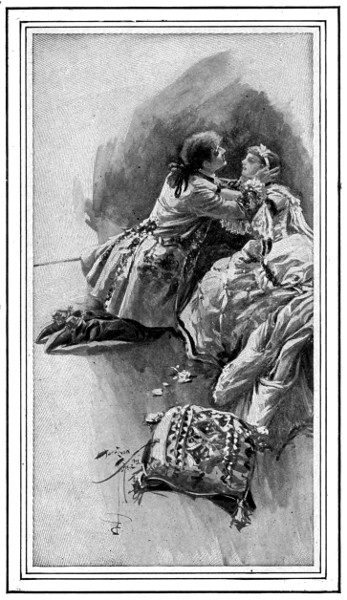
She does not answer the light rap on the half-open door, nor does her lover wait; he enters, and in a second, kneeling at her feet, his two arms about her, he raises her sweet face and lays his yearning lips on Her Ladyship’s own beautiful mouth.
“Ah, Peggy, my adored one,” says he, devouring her pale face with his happy eyes, stroking her cropped head with caressing fingers.
“Oh, Percy!” says she, with real roses blooming in her cheeks.
“I know a deal,” whispers he, “but one thing I must ask. You’ll tell me at once, will you?”
“What is’t?” says she, smiling, as she leaves her two hands in the hold of one of his.
“Why did you adventure so much? for what, for whom, whose sake? Wherefore?” The young man’s voice is feverish with anxiety.
She hangs her head; raises it proudly; wishes 336she had him at a distance, and so, leave to swing her train and use her fan indifferent.
“My beloved,” cries he, “answer me! ’Tis your own Percy, him that worships the ground you tread upon; who has never had a thought apart from you; to whom every other lady on God’s earth’s but a puppet—that asks—eh, Peg, for whom, who?” coaxes he with eyes, lips, hands, heart-beats.
“For your sake, Sir, and none other,” she answers. “’Twas because I knew I’d done wrong and sent you from me careless; I would not give in; but, you up in town, Ken writin’ me as he did—I could abide it no longer—and I went.”
“Now the God above us, bless you,” says he, taking her in his arms, and at the same instant pulling from his waistcoat pocket the scrap of a note she’d written him in the eye of the scaffold.
“Peg, Peg! I’m not worthy to mate with you, and when I learned of all your hairbreadth ’scapes, your twice saving of my life—when I read this, ’slife! My Lady, what’s a man like me to such as you!”
“I’ll tell you,” says she, laying her head on his shoulder, “he’s the man she loves.”
337“Will you marry me in a fortnight, Peggy?” asks he, rapturous.
“Nay!” answers she, laughing. “I’ve another suitor to consider, Sir.”
“And who is he?”
“Sir Robin McTart! He was over yesterday to ask my hand from Daddy.”
“The devil!”
“Nay, Sir, not enough courage for that!”
“Peggy, sweetlips, will you be mine the Tuesday after Transfiguration?”
“Lud! No, Sir Percy! that will I not!”
“When will you, then, love?”
“Next Christmas.”
“Split it,” cries he, imploringly, “make it the first quarter of the October moon?”
“Well,” she answers, looking up to where her father and mother stand in the doorway, “an Daddy and my Lady Mother consent, you shall have your way, Sir.”
The young man glances up, following Peggy’s eyes, springs to his feet, raises her from the old divan and leads her before them.
“My Lord and Your Ladyship,” says he, “will 338you consent, as Peggy has, to our being made man and wife on October the fifth? and will you give My Lady and my unworthy self your blessing?”
They kneel down and the Earl puts out his hands above their heads; the words stumble, for there are drops in his old eyes, as he looks and beholds about their faces that most splendid of all aureoles, the light of love and faith, honor with youth, and hope and wholesome minds to guide.
339A FEW OF
GROSSET & DUNLAP’S
Great Books at Little Prices
NEW, CLEVER, ENTERTAINING.
GRET: The Story of a Pagan. By Beatrice Mantle. Illustrated by C.M. Relyea.
The wild free life of an Oregon lumber camp furnishes the setting for this strong original story. Gret is the daughter of the camp and is utterly content with the wild life—until love comes. A fine book, unmarred by convention.
OLD CHESTER TALES. By Margaret Deland. Illustrated by Howard Pyle.
A vivid yet delicate portrayal of characters in an old New England town.
Dr. Lavendar’s fine, kindly wisdom is brought to bear upon the lives of all, permeating the whole volume like the pungent odor of pine, healthful and life giving. “Old Chester Tales” will surely be among the books that abide.
THE MEMOIRS OF A BABY. By Josephine Daskam. Illustrated by F.Y. Cory.
The dawning intelligence of the baby was grappled with by its great aunt, an elderly maiden, whose book knowledge of babies was something at which even the infant himself winked. A delicious bit of humor.
REBECCA MARY. By Annie Hamilton Donnell. Illustrated by Elizabeth Shippen Green.
The heart tragedies of this little girl with no one near to share them, are told with a delicate art, a keen appreciation of the needs of the childish heart and a humorous knowledge of the workings of the childish mind.
THE FLY ON THE WHEEL. By Katherine Cecil Thurston. Frontispiece by Harrison Fisher.
An Irish story of real power, perfect in development and showing a true conception of the spirited Hibernian character as displayed in the tragic as well as the tender phases of life.
THE MAN FROM BRODNEY’S. By George Barr McCutcheon. Illustrated by Harrison Fisher.
An island in the South Sea is the setting for this entertaining tale, and an all-conquering hero and a beautiful princess figure in a most complicated plot. One of Mr. McCutcheon’s best books.
TOLD BY UNCLE REMUS. By Joel Chandler Harris. Illustrated by A.B. Frost, J.M. Conde and Frank Verbeck.
Again Uncle Remus enters the fields of childhood, and leads another little boy to that non-locatable land called “Brer Rabbit’s Laughing Place,” and again the quaint animals spring into active life and play their parts, for the edification of a small but appreciative audience.
THE CLIMBER. By E.F. Benson. With frontispiece.
An unsparing analysis of an ambitious woman’s soul—a woman who believed that in social supremacy she would find happiness, and who finds instead the utter despair of one who has chosen the things that pass away.
LYNCH’S DAUGHTER. By Leonard Merrick. Illustrated by Geo. Brehm.
A story of to-day, telling how a rich girl acquires ideals of beautiful and simple living, and of men and love, quite apart from the teachings of her father, “Old Man Lynch” of Wall St. True to life, clever in treatment.
Grossett & Dunlap, 526 West 26th St., New York
340GROSSET & DUNLAP’S
DRAMATIZED NOVELS
A Few that are Making Theatrical History
MARY JANE’S PA. By Norman Way. Illustrated with scenes from the play.
Delightful, irresponsible “Mary Jane’s Pa” awakes one morning to find himself famous, and, genius being ill adapted to domestic joys, he wanders from home to work out his own unique destiny. One of the most humorous bits of recent fiction.
CHERUB DEVINE. By Sewell Ford.
“Cherub,” a good hearted but not over refined young man is brought in touch with the aristocracy. Of sprightly wit, he is sometimes a merciless analyst, but he proves in the end that manhood counts for more than ancient lineage by winning the love of the fairest girl in the flock.
A WOMAN’S WAY. By Charles Somerville. Illustrated with scenes from the play.
A story in which a woman’s wit and self-sacrificing love save her husband from the toils of an adventuress, and change an apparently tragic situation into one of delicious comedy.
THE CLIMAX. By George C. Jenks.
With ambition luring her on, a young choir soprano leaves the little village where she was born and the limited audience of St. Jude’s to train for the opera in New York. She leaves love behind her and meets love more ardent but not more sincere in her new environment. How she works, how she studies, how she suffers, are vividly portrayed.
A FOOL THERE WAS. By Porter Emerson Browne. Illustrated by Edmund Magrath and W.W. Fawcett.
A relentless portrayal of the career of a man who comes under the influence of a beautiful but evil woman; how she lures him on and on, how he struggles, falls and rises, only to fall again into her net, make a story of unflinching realism.
THE SQUAW MAN. By Julie Opp Faversham and Edwin Milton Royle. Illustrated with scenes from the play.
A glowing story, rapid in action, bright in dialogue with a fine courageous hero and a beautiful English heroine.
THE GIRL IN WAITING. By Archibald Eyre. Illustrated with scenes from the play.
A droll little comedy of misunderstandings, told with a light touch, a venturesome spirit and an eye for human oddities.
THE SCARLET PIMPERNEL. By Baroness Orczy. Illustrated with scenes from the play.
A realistic story of the days of the French Revolution, abounding in dramatic incident, with a young English soldier of fortune, daring, mysterious as the hero.
Grosset & Dunlap, 526 West 26th St., New York
341A FEW OF
GROSSET & DUNLAP’S
Great Books at Little Prices
CY WHITTAKER’S PLACE. By Joseph C. Lincoln. Illustrated by Wallace Morgan.
A Cape Cod story describing the amusing efforts of an elderly bachelor and his two cronies to rear and educate a little girl. Full of honest fun—a rural drama.
THE FORGE IN THE FOREST. By Charles G.D. Roberts. Illustrated by H. Sandham.
A story of the conflict in Acadia after its conquest by the British. A dramatic picture that lives and shines with the indefinable charm of poetic romance.
A SISTER TO EVANGELINE. By Charles G.D. Roberts. Illustrated by E. McConnell.
Being the story of Yvonne de Lamourie, and how she went into exile with the villagers of Grand Prè. Swift action, fresh atmosphere, wholesome purity, deep passion and searching analysis characterize this strong novel.
THE OPENED SHUTTERS. By Clara Louise Burnham. Frontispiece by Harrison Fisher.
A summer haunt on an island in Casco Bay is the background for this romance. A beautiful woman, at discord with life, is brought to realize, by her new friends, that she may open the shutters of her soul to the blessed sunlight of joy by casting aside vanity and self love. A delicately humorous work with a lofty motive underlying it all.
THE RIGHT PRINCESS. By Clara Louise Burnham.
An amusing story, opening at a fashionable Long Island resort, where a stately Englishwoman employs a forcible New England housekeeper to serve in her interesting home. How types so widely apart react on each others’ lives, all to ultimate good, makes a story both humorous and rich in sentiment.
THE LEAVEN OF LOVE. By Clara Louise Burnham. Frontispiece by Harrison Fisher.
At a Southern California resort a world-weary woman, young and beautiful but disillusioned, meets a girl who has learned the art of living—of tasting life in all its richness, opulence and joy. The story hinges upon the change wrought in the soul of the blasè woman by this glimpse into a cheery life.
Grosset & Dunlap, 526 West 26th St., New York
342A FEW OF
GROSSET & DUNLAP’S
Great Books at Little Prices
QUINCY ADAMS SAWYER. A Picture of New England Home Life. With illustrations by C.W. Reed, and Scenes Reproduced from the Play.
One of the best New England stories ever written. It is full of homely human interest * * * there is a wealth of New England village character, scenes and incidents * * * forcibly, vividly and truthfully drawn. Few books have enjoyed a greater sale and popularity. Dramatized, it made the greatest rural play of recent times.
THE FURTHER ADVENTURES OF QUINCY ADAMS SAWYER. By Charles Felton Pidgin. Illustrated by Henry Roth.
All who love honest sentiment, quaint and sunny humor, and homespun philosophy will find these “Further Adventures” a book after their own heart.
HALF A CHANCE. By Frederic S. Isham. Illustrated by Herman Pfeifer.
The thrill of excitement will keep the reader in a state of suspense, and he will become personally concerned from the start, as to the central character, a very real man who suffers, dares—and achieves!
VIRGINIA OF THE AIR LANES. By Herbert Quick. Illustrated by William R. Leigh.
The author has seized the romantic moment for the airship novel, and created the pretty story of “a lover and his lass” contending with an elderly relative for the monopoly of the skies. An exciting tale of adventure in midair.
THE GAME AND THE CANDLE. By Eleanor M. Ingram. Illustrated by P.D. Johnson.
The hero is a young American, who, to save his family from poverty, deliberately commits a felony. Then follow his capture and imprisonment, and his rescue by a Russian Grand Duke. A stirring story, rich in sentiment.
WHEN A MAN MARRIES. By Mary Roberts Rinehart. Illustrated by Harrison Fisher and Mayo Bunker.
A young artist, whose wife had recently divorced him, finds that a visit is due from his Aunt Selina, an elderly lady having ideas about things quite apart from the Bohemian set in which her nephew is a shining light. The way in which matters are temporarily adjusted forms the motif of the story.
A farcical extravaganza, dramatized under the title of “Seven Days”
THE FASHIONABLE ADVENTURES OF JOSHUA CRAIG. By David Graham Phillips. Illustrated.
A young westerner, uncouth and unconventional, appears in political and social life in Washington. He attains power in politics, and a young woman of the exclusive set becomes his wife, undertaking his education in social amenities.
“DOC.” GORDON. By Mary E. Wilkins-Freeman. Illustrated by Frank T. Merrill.
Against the familiar background of American town life, the author portrays a group of people strangely involved in a mystery. “Doc.” Gordon, the one physician of the place, Dr. Elliot, his assistant, a beautiful woman and her altogether charming daughter are all involved in the plot. A novel of great interest.
HOLY ORDERS. By Marie Corelli.
A dramatic story, in which is pictured a clergyman in touch with society people, stage favorites, simple village folk, powerful financiers and others, each presenting vital problems to this man “in holy orders”—problems that we are now struggling with in America.
KATRINE. By Elinor Macartney Lane. With frontispiece.
Katrine, the heroine of this story, is a lovely Irish girl, of lowly birth, but gifted with a beautiful voice.
The narrative is based on the facts of an actual singer’s career, and the viewpoint throughout is a most exalted one.
THE FORTUNES OF FIFI. By Molly Elliot Seawell. Illustrated by T. de Thulstrup.
A story of life in France at the time of the first Napoleon. Fifi, a glad, mad little actress of eighteen, is the star performer in a third rate Parisian theatre. A story as dainty as a Watteau painting.
SHE THAT HESITATES. By Harris Dickson. Illustrated by C.W. Relyea.
The scene of this dashing romance shifts from Dresden to St. Petersburg in the reign of Peter the Great, and then to New Orleans.
The hero is a French Soldier of Fortune, and the princess, who hesitates—but you must read the story to know how she that hesitates may be lost and yet saved.
343THE MUSIC MASTER. By Charles Klein. Illustrated by John Rae.
This marvelously vivid narrative turns upon the search of a German musician in New York for his little daughter. Mr. Klein has well portrayed his pathetic struggle with poverty, his varied experiences in endeavoring to meet the demands of a public not trained to an appreciation of the classic, and his final great hour when, in the rapidly shifting events of a big city, his little daughter, now a beautiful young woman, is brought to his very door. A superb bit of fiction, palpitating with the life of the great metropolis. The play in which David Warfield scored his highest success.
DR. LAVENDAR’S PEOPLE. By Margaret Deland.
Mrs. Deland won so many friends through Old Chester Tales that this volume needs no introduction beyond its title. The lovable doctor is more ripened in this later book, and the simple comedies and tragedies of the old village are told with dramatic charm.
OLD CHESTER TALES. By Margaret Deland. Illustrated by Howard Pyle.
Stories portraying with delightful humor and pathos a quaint people in a sleepy old town. Dr. Lavendar, a very human and lovable “preacher,” is the connecting link between these dramatic stories from life.
HE FELL IN LOVE WITH HIS WIFE. By E.P. Roe. With frontispiece.
The hero is a farmer—a man with honest, sincere views of life. Bereft of his wife, his home is cared for by a succession of domestics of varying degrees of inefficiency until, from a most unpromising source, comes a young woman who not only becomes his wife but commands his respect and eventually wins his love. A bright and delicate romance, revealing on both sides a love that surmounts all difficulties and survives the censure of friends as well as the bitterness of enemies.
THE YOKE. By Elizabeth Miller.
Against the historical background of the days when the children of Israel were delivered from the bondage of Egypt, the author has sketched a romance of compelling charm. A biblical novel as great as any since “Ben Hur.”
SAUL OF TARSUS. By Elizabeth Miller. Illustrated by André Castaigne.
The scenes of this story are laid in Jerusalem, Alexandria, Rome and Damascus. The Apostle Paul, the Martyr Stephen, Herod Agrippa and the Emperors Tiberius and Caligula are among the mighty figures that move through the pages. Wonderful descriptions, and a love story of the purest and noblest type mark this most remarkable religious romance.
Grosset & Dunlap, 526 West 26th St., New York
Transcriber’s Note
In several cases, the author (or printer) uses an apostrophe incorrectly; three times as the possessive pronoun, and once as 3rd person present (‘let’s’). Each has been corrected. Other minor lapses in punctuation have been corrected as well, without further mention.
p. 43 even than [it’s] forlorn neighbors
p. 85 hiding [it’s] tell-tale under the skirt of her coat
p. 251 links his arm in [her’s]
p. 266 and [let’s] out that I was not she at all