ENVOI (continued 3)
Reading edition
What is this curious stealthy stir, far-off, and creeping nearer in the wood?
And, hark! Peggy puts her hand to her ear to hear a subdued whistle, sweet, tuneful, underbreath, but patent to her sense, and too, to Sir Percy’s.
Before either can move, or, indeed, had as yet gathered the impulse of even self-defense, into the midst of Mr. Chalmers and the rest, with their chorus, dashes a company of riders in masks.
A shot, low-aimed, and merely intended as a slight warning of what may be expected, should occasion demand, strikes the ground at Her Ladyship’s right.
With remorse and reparation at his heart-strings—’tis the kind of man who could be but generous to his worst enemy—Sir Percy’s horse is flung betwixt the supposed Sir Robin and the band.
180“Good evening, My Lords and Gentlemen,” says the leader, in a voice like a lute. “I thank you heartily for coming my way! Purses and watches, merry Sirs, jewels, trinkets, snuff-boxes, if of gold, pins, fobs, seals, these are all the toll I demand, and shall be forced to collect, if you show any disposition to deny.”
It might he wisely argued that, while this speech was being made, any gentleman might have either run the highwayman through, or put an ounce of lead into his heart, but the fact of the matter was, each gentleman found himself face to face with another gentleman who held a blunderbuss up to within three inches of his nose.
My Lady’s first thought had been that Sir Robin’s men had not waited for the Sunday night to come, but presently she recognized the truth, and, stung by the fact that Sir Percy had put himself between her and danger, she was the only one of the whole company who stirred in her saddle other than to do the bidding of Tom Kidde.
While the rest were busily engaged in emptying their treasures, she, making feint to do the same, says very low and tauntingly to Sir Percy:
181“Had I but one to show fight with me, I’d ne’er give in to these scoundrels.”
“As soon done as said, Sir Robin,” whispers Percy. “No man can say I’m his lesser in courage!” with which he wrests his bridle from the blackguard whose hand’s upon it, whips out his sword with one hand, picks out his pistol with the other, grips his reins in his teeth, and strikes with steel and shot, both at once.
Peg’s his match, imitating him with such a will as sets every gentleman of ’em a-shooting, a-lunging and a-cursing with all the arms and breath he’s got; and sets the robbers for a second to their wits, for they are not used to any sort of encounter, save one that’s terror-stricken and submissive in the opponent.
’Tis a bit of a mêlée quite in the dark; slashing and pounding betwixt the branches: now a man unhorsed, anon up again; shots resounding, powder flashing, until in about ten minutes or less the chief makes a plunge for Sir Percy, crying out,
“So ’twas you said ‘fight,’ was’t! Have a care; no man can defy Tom Kidde and live to tell it!”
“Nay!” shouts Her Ladyship, with spurs all 182inches into the gray’s sides, making him rear as she puts herself between Percy and the highwayman, “’twas I said ‘fight’!”
Whizz! and a ball intended for Sir Percy strikes the gray dead under her.
Whizz! and her ball strikes Tom Kidde from his mount.
In less time than it takes to tell it, Peg was straight in the highwayman’s saddle; he was picked up by two of his men, bleeding, set before one of ’em, and off: My Lords and Gentlemen find themselves once more alone in the midst of Epstowe Forest, a-crawling about on their hands and knees a-gathering up their spilled guineas and trinkets by flash of tinder-box.
Sir Percy, trying to explain to them who had been the means of their recovering their valuables and of putting the desperadoes to flight, cries out:
“I tell you! we owe’t all to Sir Robin here! ’Slife, Gentlemen, I’d not have ventured to think of resistance had it not been for him. ’Twas he said, close in my ear, ‘fight,’ and by Gad! Sirs, he’s lost more’n any of us; the horse shot under him.”
183“The gray’s well lost teaching Tom Kidde he can’t terrify all the men in England,” answers the Beau from his sprawling search after his diamond snuff-box.
“Ho, Sir Robin! Sir Robin! Sir Robin!” Sir Wyatt shouts it out, and the rest of the company take it up with a long, mellow cadence that echoes for a mile.
“Answer man, for, by the faith, if we can’t pledge you here in anything but a lap of May-dew out of a primrose leaf, we’ll drink you such a bumper, an we reach the White Horse, as never was filled before! London’ll toast you at every dinner-table in Mayfair. Odzooks, Sir, were you the fashion yesterday, what will you be to-morrow!” This from Escombe.
“Where is Sir Robin?” asks Percy. “He was beside me not five seconds since, but now, by my tinder, nor yet by the coming dawn, can I descry him,” shading his eyes with his hand and peering about, for of a truth ’tis close to four o’clock, and, notwithstanding the heavy clouds, the east begins to thrill with the touch of day.
“Robin! Sir Robin! Ho, now! Think not to 184play a trick on us and presently spring from a greenwood tree,” says Wootton.
“Sir Robin,” exclaims Percy loudly, “I pray you answer and leave not your friends to imagine evil.”
“Tut, tut, ‘evil’,” puffs the Beau, rising from his knees. “Evil’ll never happen to him. Zounds! but my legs ache! He’s laughing in his sleeve now, hard by; Robin’s not one to court notice or praise—as modest a youth as I ever beheld.”
“Worthy of Lady Peggy Burgoyne even, I suppose?” says Mr. Chalmers mischievously, as he adjusts his recovered fob. “I could embrace him for the rendering of me back my watch, but I think him a fool to eschew good company and make home alone to town.”
“Jack,” says Percy, low, “I like not his quitting of us. ’Twas too sudden. I believe I’ll go a-hunting him,” pulling his rein as the cavalcade once more prepared to start.
“Where?” asks Jack. “Bah! be not such a ninny; belike he’s off to his Lady, to win kisses off her lips by the rehearsal of his prowess. An a man chooses to flee me, I let him: do you the same, Percy; ’tis a good advice, I promise you!”
185“But suppose those devils attack him again when alone?” says this one, not all reassured, as he and Jack linger a bit in the rear of their companions.
“Go to the devil!” remarks Mr. Chalmers, blithely. “I’m for breakfast at the White Horse, and for leavin’ the hero of the hour to eat his where he sees fit. He’s safe enough.”
“I’ve a misgiving,” answers de Bohun, “and he risked his life for mine to-night. I’ll strike off here to the west and join you when I find him.”
“Good luck to you for a fool!” laughs Jack, putting spurs and going on to tell this news to the others.
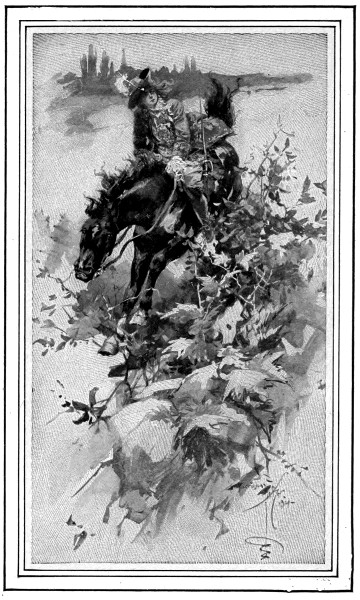
The instant that Lady Peggy felt herself in the highwayman’s saddle, she knew from long acquaintance with every colt Bickers had bred, raised, or broke, since she was six, that her wrists had met their match. Before she had time to utter a word, turn her head, or think, she felt the warm flesh under her quiver with that recovering impulse which horsemen know so well; that streak of untamed and untamable nature which lies, however deep-hidden, in every four-foot that 186breathes, and which never fails to spurt to the front when it gets exactly the right chance.
Peggy’s light, nay, by this, weak hand, now gave the big black its chance, and with a snort, a toss of its head, and a vicious swell of its sides, it laid back its ears, took the bit between its teeth as if it had been a mess of oats, and reared a length on its forelegs: when, finding its rider still on, it started on a run which Her Ladyship had not the slightest power to check. All she could do was to keep her seat.
Like a flash, out of the forest on to the width of the heath, plume waving, sword flapping, laces rippling, curls flying; the mare’s mane slapping in her face; legs and arms and will all at work to stop the beast or bring it into some sort of subjection. To no purpose. The black head now low, as if picking up a scent from the turf it tore; now up, as though snuffing its goal from afar, the mare skirted the heath, gained the meadows; over hedges where the birds rose in flocks behind its heels; ditches, where the muddy waters splashed over Her Ladyship’s satin clothes: here a bolt into 187an orchard, leaving a ribbon a-hanging on a limb; over the wall like a rocket, and, at breakneck gait, through a hamlet, rousing the people out of their beds to peep at pane, and wonder. Slap-dash into a pasture, scattering ewes and lambs like wool before the wind, taking a five-bar into a common, thence to highway; scampering a footbridge to leave it shivered behind them, and all Peg’s thought just a brave prayer to be kept alive, so that she might not fail of foiling Sir Robin’s men Sunday night!
Where she was going, she knew not. Where she was, she had no smallest idea when, as the sun looked over the long low line of horizon before her, she with a shudder beheld a gibbet outlined against the morning sky. The black gave a lunge that knocked her feet out of the stirrups (quick in again), reared, whinnied like a devil, and, nose to ground, now made her rider understand that up to the present she had done nothing much in the way of speed, or of efforts at emptying the saddle.
Yet Her Ladyship stuck on, with flying colors, too, and no loss of either wig, hat, weapon or will, and with grateful heart she now found herself 188being spun across a magnificent park, where the deer fled before her, it is true, but at the upper end of which she saw looming the turrets and towers of a fine castle.
189
XI
Wherein Lady Peggy is condemned to be
hanged, and sets forth, attended by the
clergy, for the gallows.
Although Sir Percy had cheerfully foretold for Kennaston the roseate picture of Lady Diana’s “Yes” crowning the young poet’s somewhat diffident suit with untold happiness, the fact was quite other. Her Ladyship, on the day of Mr. Brummell’s party to Ivy Dene, having overheard the Honorable Dolly Tarleton, in the library, laying six to four to Lady Biddy O’Toole, that their host’s daughter was “only waiting for the beautiful young poet’s asking, to jump into his arms immediately,” did, with such sudden change of 190demeanor from sweets to sours, languishing eyes to averted looks, smiles to pouts, corner chats to open flouts, put her lover into a state of mind, the like of which he presently described, as only he could, in a copy of verses, which the next night at White’s were pronounced to be, indeed, “the masterpiece of one whose heart pants, whose whole being’s but at the beck and call of her who wears a smocked petticoat, ogles with a witching eye, and should be vain that so much genius lays itself at her feet, to wit, Lady D——a W——n.”
For, taking immediate fright at his Lady’s coldness, Kennaston had ordered a post-chaise from the Brookwood Arms, and without a word of farewell to Lady Diana, save that embodied in an ode, “To Chloe When Unkind,” which her woman found pinned to Her Ladyship’s cloak when she was putting it on her shoulders the following morning, had gone to town, and just in time at the White Horse to be haled into Mr. Brummell’s party for breakfast, and to learn of the adventure with Tom Kidde, the valor of Sir Robin McTart, and the absence of that young gentleman, as also Sir Percy, from the board.
191When Lady Diana’s woman hooked her mistress’s cloak about her ’twas at five o’clock in the morning, and of the party at the Castle every lady’s woman was performing the same office, adding hood over curls and puffs, and sticking the finest of cambric pocket-napkins into their mistress’ hands by the half dozens; for ’twas easily seen that such early rising could be for no other cause than to go forth to bathe their Ladyships’ faces in the May-dew; the which, when gathered from little copses and shadowy nooks before the sun had yet shone upon’t, was warranted to enhance that beauty which was already evident, and to create those charms which, alas! are occasionally lacking.
Lady Diana spelled out her lover’s verses as best she could, tripping from door to door, and calling her young companions from their mirrors; sending a footman and a page to summon the gallants who were to accompany them in their expedition, and laughing heartily as she made out more from a footman than from Kennaston’s muse that he had betaken himself to town rather than longer incur her displeasure and her frowns.
“Bless me, but my suitor’s in a fine pickle! 192Lud! though, I’m not disposed to have these hussies a-laying six to four on my bein’ ready to jump at his offer; still, I’d rather he’d stopped over, or else that some one most amusin’ were here; for instance Sir Robin McTart, which is not to be!”
Then a-rapping at the doors, and laughter from girlish lips; pattering of heels down the hall and stair-case; out to meet the gentlemen, bowing and complimenting on the terrace; over the lawns, and through the flower-gardens, and past the offices and stables, where Lord Brookwood, even thus early, was sunning himself in the yard, and talking over county matters with Mr. Biggs, J.P.
“Where to? Where to?” sings out His Lordship cheerily with hat in hand, and Mr. Biggs down to the ground before so much beauty, fashion and rank.
“Off to the copse, father,” calls back Diana, “to gather the May-dew and wash our faces; when we come back you must tell us all how much more beautiful we are to-day than we were yesterday!”
With which lively sally Lady Diana and the rest 193of ’em are crossing the hill and laughing as they pass out of sight on their two miles’ away walk to Armsleigh Copse.
Lord Brookwood is about to resume his conversation with Biggs, while the half-dozen grinning stable boys, behind His Lordship’s back, are rubbing their fists in the wet turf of a paddock, and smearing their red faces with the dew, the head-groom touching them up with a lash; when a whinny, that sets every animal in the stalls and out of ’em a-replying, sets all the cocks crowing, hens cackling, chicks peeping, dogs barking, geese squawking, smites their startled ears, and yonder, hilly-o-ho! Sirs; in a cloud of upturned soil, in a shower of splash from the river, with a thud on the wooden bridge, a bound over the stone wall of the kitchen garden; comes a black with nigh every tooth in its mouth bared, foaming, smoking, bloody; rider bent double to saddle’s bow, clinging with legs and arms.
“Homing Nell and the highwayman! Tom Kidde! Tom Kidde!”
“Homing Nell!” the shout goes up from every 194throat there, from His Lordship to the ’ostlers and boys.
“Tom Kidde! Tom Kidde!”
“By Gad! Sir,” cries the Earl. “I knew Nell’d come back sooner or later! Surround him. Bag him!”
Peggy hears the shouts as the ungovernable steed lunges, lurches, rears beneath her spurs and still tightly gripped reins; she takes in the situation, but not to its full import, until she now hears the voice of Biggs uplifted.
“Lord Brookwood! Lord Brookwood! mind her heels, My Lord, mind her heels! Leave the takin’ of the damned cut-purse to me and the boys!”
At the word “Brookwood,” Her Ladyship realizes that she is on the domains of Lady Diana’s father! and being mistaken for a Knight of the Road!
The latter she felt she could easily abide, and as easily refute; but the former was more than even her spent spirit could stand. So, as Biggs, His Lordship, the grooms, the stable-boys and ’ostlers and helpers all formed into a ring with whips, canes, stones and halloos to take her prisoner, she 195plucked up courage from the depths, and, raising herself in her saddle and her head in the air, with one superhuman tug at the bridle and prick with the steels, she made to get off! and away! But Her Ladyship’s nerve was not the equal of Homing Nell’s, nor yet to be pitted with success against the waving arms and jumping legs of a dozen stout men. With the final crack of the head-groom’s lash about her heels, with the pop in the air above her hat of Mr. Biggs’s blunderbuss, caught from the hand of one of the lads, “Homing Nell” was brought to a quivering stand-still, and My Lady Peggy to bay in the stable-yard of Brookwood Castle!
“Ha!” cries the Earl, “my pretty fellow, you’re trapped at last! The night you stole the black mare from me I shouted after you, as well as the gag at my mouth would permit, that she’d bring you no luck, and that muscles of iron wouldn’t hold her the day she made up her mind to get home.”
Peggy, glad of the use of her lungs once more, and now nigh bursting with laughter at being so glibly mistook for one of the most reckless fellows 196in all England, took off her hat, bowed low, and said:
“My Lord Brookwood, ’tis, I believe, I have the honor of addressing?”
“Ho! ho! ho!” Mr. Biggs, from a survey of the saddle-bow now bursts out in triumphant joyfulness.
“’Od’s blood, My Lord! but here’s luck, here’s justice, here’s what comes of my bein’ here when I am!” and Mr. Biggs now holds aloft upon the point of his stick the black mask of Master Tom Kidde, which the rogue had dropped when he was hit, and which had caught and hung by its riband from that moment to this, unseen by Lady Peg.
“Highwayman! highwayman! highwayman!” yells every lung in the place, while the whole dozen, including His Lordship and the Justice, threaten Lady Peggy with their cudgels, lashes and stones.
“I pray ye, My Lord, Gentlemen, and good fellows!” cries she, remembering now the entire history of the animal she bestrides, as rehearsed some six hours earlier by Beau Brummell and Mr. Vane. “I am no highwayman.”
A groan of derision greets this announcement.
197“Nay, but the rather am I the victim of Tom Kidde, than he himself! Together with a party of my friends, being at mid-night last, on the return from a visit to Mr. Brummell’s seat, Ivy Dene, we were set upon by the rogues in the midst of Epstowe Forest; I had the luck, both good and bad, to put a ball into Tom, to get my horse shot under me, and to mount the scoundrel’s steed, the which has brought me to Your Lordship’s door, and the mare, herself, to where she belongs, it seems!”
“A damned fine story, ’fore George!” exclaims Biggs, laughing triumphantly, now holding up two watches, three rings, a diamond snuff-box, a seal, two magnificent pins, and a most splendid jeweled stomacher, high above his head in the tip of the sunshine.
“’Sdeath!” cried Lord Brookwood, seizing one of the trinkets and examining it with his spy-glass. “What’s this? ‘Percy de Bohun, Christmas from his aff. mother,’” reads His Lordship. Then another, “‘Wyatt Lovell souvenir of Italy!’ Gad, Biggs,” looking Her Ladyship over, where she still sits atop of the steaming black, “we’ve got the 198cursed blackguard this time! What else in his saddle pockets? aught?”
These Biggs, assisted by the head-groom, is energetically emptying of a miscellaneous collection of valuables, while Lady Peggy looks on in amazement as yet only flavored with amusement, and one more vain regret for her abandoned petticoats.
“Yes, My Lord, these thousands of pounds’ worth,” replied the Justice, holding aloft his treasure trove; “and it’ll be a short shrift for the devil, I can say that.”
“Hark ye,” now says Her Ladyship, as she recalls with a not unnatural tremor the death-warrant she had heard was lying to hand in Mr. Biggs’s pocket. “Lord Brookwood, I am no highwayman; my story is true; I am”—the words stuck in Peggy’s throat; she coughed, the stable boys tittered; then the head-groom tilted the saddle and spilled her out of it to the ground; at a word from Biggs, a couple of the men tied her, hand and foot, with a stout rope, and a pair of farming reins about her middle.
“Now who do you call yourself, my fine fellow?” says His Lordship.
199“Sir Robin McTart of Robinswold, Kent!” cries Peggy, glad to be able to answer without the lie direct. “And I demand instant freedom and immunity,” cries she, tortured and quivering beneath the rude hands and ruder gibes of the grooms and ’ostlers.
“Demand away! my pretty buck-skin, with your jeweled hilt!” returns Biggs, stripping the weapon from her thigh. “Your satin breeches and gold-laced waistcoat! ’Tain’t no use denyin’ you your speech, and your will to palaver on whatever matter you will, for before the clock strikes eight, you’ll be home with your father in hell.”
“Tut, tut, Mr. Biggs,” says His Lordship. “Call Mr. Frewen, the Curate, he’s at his studies in the library, we havin’ sat late over our cards last night; and let him have his prayer-book to hand, open at the page for malefactors after condemnation.”
“Go, you, Michael,” this to one of the now awestruck lads hanging, staring at Peg over the paddock paling. “Ask Mr. Frewen to come quickly.”
“But this is monstrous, Sir!” cries Her Ladyship, now thoroughly alarmed, and near to losing her wits betwixt her endeavors to keep up her man’s 200estate, her contempt of her own frowardness, her shame at being thus at the mercy of her rival’s parent, and her actual terror of her position.
“I do beseech you, I am an honest person, my tale is true. Is it not but the justice due to any subject of His Majesty’s, however humble, that he should not be condemned before he is tried, or even his identity proven?”
“I’ll be sworn, My Lord,” exclaims Biggs, “’tis a voice and air to wheedle fine ladies out of their stomachers and chains, but not to tempt the law. Sirrah!” he continues, addressing himself to Her Ladyship, who is by this firmly tied to a post like a colt about to be broken to harness. “’Tain’t no use for you to be imaginin’ as justice and His Majesty ain’t a-doing their best for you. Here have you been a terror to all God-fearing, law-abiding Englishmen any time these half-dozen of years. A-poundin’ every heath in England, Hornslow, Bagshott, and all the commons, Wimbledon, Wandsworth, Finchley; a-hulking in Epstowe with your mates, and making the lives of travelers a burden most horrible; ain’t you secreted uncountable pounds’ worth of plunder in your devilish 201caves and dens? Haven’t you left the earth strewed with corpses in your ugly path? Answer me, Sir!” and Mr. Biggs stamps his foot on the ground.
“No, Sir!” shouts Peg, “I ain’t and haven’t, and I’m not! ’Slife, My Lord Brookwood,” cries she in a terrible way, twisting her tied hands together. “For God’s sake, send up to town post-haste, and find out Mr. Brummell, Mr. Vane, Mr. Chalmers, Lord Escombe, Sir Lovell Wyatt!”
But His Lordship has turned up the path toward the Castle and met Mr. Frewen, to whom he is explaining the necessities of the situation.
’Tis such a fair May day, with bud and blossom, bough and bird; fowls, men, beasts, all free of tether, and My Lady is like to weep; cry out her sex, her very name and estate, as she feels the gall upon her wrists and ankles, and knows what fate awaits her.
She even, for one weak moment, thinks she will implore Lord Brookwood to send up to London for her rival, his own daughter, Lady Diana, and let her come down and tell him who is Sir Robin 202McTart—for Lady Peggy believes Lady Di to be in town and has no knowledge to the contrary.
Yet, there in the stable-yard, with imprisonment as she supposes, and even death dangling for her at no great loss of time, with her liberty gone; her word no better than a thief’s; with no earthly hand upraised to sustain her, My Lady Peggy’s stout heart does not flutter to dismay. For that one brief instant ’tis, without doubt, in her mind to confess and fling herself upon the mercy of the Earl and the Curate, who now draw nigh; but when she reflects upon the monstrous tissue of her deceits, and the unutterable shame of the exposure of the cause of them, ’tis then she is like to whimper, but for naught else.
Mr. Frewen approaches; ’tis a young man of a pale cadaverous countenance, whose first bow to a highwayman is indeed, though he find him in durance vile, a timid one.
The supposed Tom Kidde gives the man of the cloth eye for eye, so that this one quails and stumbles in his speech; and finally, leaving in the rear all his preconceived plans for a hasty reformation, 203he promptly remarks, opening his prayer-book to the riband:
“You know your doom, Mr. Kidde; shall I pray for you here?”
“Faith!” says Lady Peggy, plucking up heart, once her resolution is taken not to reveal her secret, come what may. “I do not know my doom, Sir! It seems sufficient ‘doom’ for an honest English gentleman, who has met with a mishap, to be brought to a nobleman’s threshold and get foul treatment rather than welcome. Pray for me, Sir, an you will, there’s none so much deserves or needs it. Pray on!”
“Frewen!” beckons His Lordship, as he watches the ’ostlers rubbing down the restored Homing Nell, and confers with Mr. Biggs as to the plunder and the meting out of justice. “Frewen, gain the wretch’s confidence an you can, the whereabouts of all the gold and jewels he has stolen; my watch. And also, if he have wife or child, it might not be amiss, eh, Biggs? to inquire if he have any message for them?”
“Aye, My Lord” puts in the pompous Biggs, 204up-looking from his perusal of a long, sealed, important-appearing parchment, unrolled before his eyes. “By ascertaining their whereabouts, we should perhaps get the clue to all the bloody rascal’s pelf.”
A combination of Christian charity and official shrewdness, which commended itself highly to His Lordship, as he sent the Curate back to the comforting of the malefactor across the yard.
“Hark ye, Mr. Kidde,” says Mr. Frewen, lowering his voice, and, for the credit of his soul, with gentleness at his heartstrings.
“I’m not Mr. Kidde, I tell you, I swear’t!” says Her Ladyship firmly.
“Well, well,” says the man of the Church, “mayhap that’s an assumed name; but surely, now, Sir, with not two hours of life left you, to me, me alone, Sir, it were wiser drop all disguises. Surely now you are not Sir Robin McTart?” in a soothing and sorrowful tone.
Peggy winces.
“Go seek and ask all the noblemen and gentlemen I’ve named, Sir, they’ll quickly set me to 205rights in your eyes, I pledge you. Oh, Sir, for the love of God!” cries she, whispering very low. “I speak the truth! I am no highwayman.”
“I am used to quibbles, Mr. Kidde; I know that now you are no robber, but merely a prisoner under sentence of death.”
“What!” cries she. “’Tis not possible that a man is taken, tried, disallowed to prove himself, and put out of the world, betwixt sunrise and breakfast, in the reign of His Majesty George the Third!”
“’Tis so,” answers the Curate, pulling the rope and leathers, and pushing Her Ladyship around a bit toward the east, as he points what he considers a salutary finger. “Yonder’s the gibbet, Mr. Kidde, and from it you must hang by eight. I implore of you now—”
Lady Peggy’s eyes are fastened upon the arms and cross-beams of the gallows, which are outlined clearly against the deep blue sky, and full in the shine of the spring sun.
“Well,” says she to herself, all in a flash, as thoughts can travel three abreast ofttimes, and twelve times quicker than the scrivener can set 206’em down—“I’ve been a very accursedly wicked girl; but, thank God! my pride ain’t all gone yet. I’ll hang! but I’ll never give up my secret! When I’m gone, if they find it out—I won’t be here to be a-hearin’ of the taunts and jeers and sympathies; and of my mother’s and father’s sorrows!” At this point Peggy is very near to tears, when the Curate says, interrupting their possible flow:
“Now, Mr. Kidde, if you have any message for—your wife—perhaps?” he ejaculates hesitatingly, and with good knowledge that the marriage ceremony was one usually omitted from the code of gentlemen of the road.
“I have no wife!” cries Her Ladyship, in a heat betwixt her remorse for her parents and the unconscious ridiculousness of Mr. Frewen’s question.
“Or it might be,” suggests this one with a sigh, “you have a little child, Mr. Kidde—?”
“No, Sir,” says My Lady very low and quick. “That I haven’t.”
“A dear friend and comrade?” pursues the Curate.
“Yes, I have,” answers she, for during all this 207hour just past, a thousand thoughts have come to Peggy about Sir Percy.
“Ah,” responds Frewen joyously. “Now tell me where he’s to be found, and entrust me with the message, and be assured all will be carried out to your wishes.”
“Thank you,” says Peggy. “Free my right hand if you will; give me something to write with, and the leaf out of your prayer-book, and I’ll ask you the favor.”
The Curate, under the strict superintendence of Biggs, who has all this while been dispatching boys on horses, hither and yon, to notify the quality and the country side both, that Tom Kidde’s been taken and will hang at eight from the gibbet a-top of Armsleigh Hill, loosens Her Ladyship’s arm of the thong, and gives her a leaf and a pencil with the top of the post for a support.
“To Sir Percy de Bohun, Charlotte Street, London,” writes she. “plese An you lov God And The Kinge goe not evar Again toe walke onne The dove peere at The Bottomme of littel Boye yarde Their isse onne swares Toe Kille you & you doe This isse writ bye onne now noe more.”
208Her Ladyship folds the scrap of paper over and over; hands back the pencil to Mr. Frewen; and then she says:
“Sir, will you promise me on that Book you’re holding in your hand, you’ll not look at this or send it until I’m dead?”
“I will,” answers the young man, more touched than he cares to admit, even to himself.
“And further,” says she, “will you pledge me your word it shall reach him it’s intended for before this time Sunday?”
“I will,” is the reply, “unless it be in the depths of Epstowe and inaccessible to my horse or myself.”
“’Tis in London, Sir, and quite accessible. ’Tis a warning for life and death, and I’ll count you fail me not, nor him whose life you’d be the means of saving.”
“I pledge my word, Mr. Kidde,” replies the Curate, backing away to make room for Justice Biggs, and with the very laudable sensation in his mind that he is to be the instrument of preserving some unknown from the clutches of the doubtless repentant outlaw’s own men.
209In less than five minutes after, Biggs had marshaled his cavalcade and rode forth of the stable-yard of Brookwood Castle; his white cob at the head, a-holding in his left hand the duly signed warrant for the execution of one Thomas Kidde. Following him, strode the hastily summoned Master William Lambe, the butcher, who was to do duty as hangman (sooth to say, hangings were rare in this county, and there was no one appointed by law to the office, it being thus left to the discretion of the Justice).
The Earl, mounted, rode next with a dozen of his servants, and in the midst of these My Lady Peggy, astride of the black once more, but with face to tail, hands tied together, and no hat to her head; Mr. Frewen at her side walking; a motley crowd growing and gathering at every step, about her, of gaping, wondering, jubilant and curious persons of all ages, sexes, and conditions.
Never a whimper out of My Lord, the Earl of Exham’s only daughter. A set rigid look about the drawn lips, and an unearthly pallor shining through all the dark stains Her Ladyship had been a-using of late.
210Not a word did she say, save to ask Mr. Frewen to read the Declaration of Absolution or Remission of Sins out of his prayer-book as they went; which he did under his breath, and much jolted by the rough highway, which now the procession had gained; and likewise laying much unction to his soul that, in so short a space of time, his comfortable ministrations had produced so seeming abundant godly results!
When he had finished Her Ladyship said, “Amen,” and thereafter held up her head with that courage which is born of one of two things, conscious innocence or a profound repentance for sins, which, while to others they may appear puerile, to the offender are worthy of the wrath of the Creator and the condemnation of man.
She noted the hawthorn in the hedges, the dew upon the turf; the tall mawkin swaying in the wind in the middle of a newly sown field; and, as her lids raised, the mustering crowds, all with steps bent, and greedy eyes fixed, yonder to the hill-top where the gibbet stood, and where the new rope dangled for her neck.
Yet she made no sign.
211Not even when she heard the rabble laying their groats and sixpences, that Kidde would, or wouldn’t “die game.”
212
XII
Rehearseth how, in the very nick o’ time,
Her Ladyship’s neck is saved from
the noose by Sir Percy.
As yet, in the depths of Armsleigh Copse, no news of the supposed highwayman’s capture had penetrated, although the Earl, with commendable foresight in behalf of the entertainment of his young daughter and her companions, had sent a messenger to impart the sight shortly to be had; the messenger, having a sweetheart in the other direction, must needs go apprise her first! So the gay Ladies and their cavaliers sat on fallen logs, strolled hither and yon, knelt to sop their bits of linen in the dewy hollows, laughed, chatted, dabbed their faces, now lacking any coat of crimson, save 213that which Nature might have vouchsafed, and made great show of a fine rural simplicity.
“La!” cried the Honorable Dolly. “Water hasn’t touched my face before since know I not when!” pecking at her cheeks with the corner of her pocket-napkin. “But it has a monstrous refreshing sensation!”
“Oh, Doll, ’tis not thus and so you must apply it, as ’twere some French essence worth its weight in guineas; but look!” cried Lady Diana, flopping down and burying her face in a bath of the dew-drops, and laughing as she looks up dripping.
“That’s the way, faith,” coincides Lady Biddy, scrubbing her own round cheeks with her wrung out linen, then both fists into her blue eyes to dry off the winkers.
“’Slife, Ladies!” exclaims one of the gentlemen, “but you almost tempt us to follow your example.”
“Hither, ye gossoon,” answers Lady Biddy, “an’ I’ll be afther makin’ your countenance shine. Hark! Hoofs!”
“Hoofs! Hoofs!” cry all these fair ones, a-darting this way and that, stuffing their napkins into their bodices, as a courteous voice, with a—
214“By your leave, Ladies and Sirs!” greets them, and none other than Sir Percy, self and horse spent in his fruitless search for the supposed Sir Robin, emerges from the bridle-path across the common, at the edge of the copse.
“The top of the morning to you, Sir Percy de Bohun,” laughs Lady Biddy.
“Percy!” exclaims Lady Diana, “prithee, what are you doing out of doors at this hour?”
“Seeking May-dew! mayhap,” suggests the Honorable Dolly.
“But nay, Your Ladyships,” returns he. “I am seeking Sir Robin McTart.”
And forthwith Sir Percy proceeds to give them a history of the adventures of the night, omitting no smallest detail of the prowess of Sir Robin. He has just concluded his recital amid a burst of tumultuous “Ohs! ahs! Luds!” and a vast deal of commiserating sympathy, and a monstrous collection of pretty oaths and curses for Tom Kidde, when into the center of this colloquy jumps Lord Brookwood’s messenger, nudging his sweetheart behind a tree, to tell as best he can his errand. To bid all the company at once to see the sight, it now 215not lacking more than the quarter to the hour when Mr. Lambe will adjust the noose, and send one of the boldest and most courtly young outlaws of his day a-swinging to his deserts.
This information, it may be imagined, was received with acclaim of all, and by Sir Percy with positive joy; his only regret, as, dismounting and leading his jaded horse, he walked at Lady Diana’s side, being that Sir Robin had so contrived to give them the slip, and not even to have the happiness of witnessing justice done the rogue who had so near deprived him of existence.
“Here’s to drive off the vapors an any one had ’em!” cried the lively Lady Biddy, swinging her hat by its ribands. “And sure’n it’s not believed I’ll be, when I get home to County Cork and tell ’em I saw a highwayman strung up!”
“Faith, Di,” says Sir Percy, “’twas a lucky chance for the whole country when the rascal made off with your father’s famous black!”
“That was it!” answered she. “The time always comes when no man’s muscle on earth can hold Homing Nell; and ’twas a fine fortune, by my life! when Tom Kidde essayed to ride her. ’Twas 216a wonder he didn’t jump and run for his life, though,” adds she thoughtfully.
“Zounds! there’s a sort of devil-may-care humor in the composition of those fellows that keeps ’em sticking in any saddle they leap into, until the beast’s bestridden that can throw them out of it. They’re so used to taking chances, I doubt if they ever dream of danger until it’s too late!”
“When’ll we see the gibbet?” asks the Honorable Dolly, panting with her quick pace.
“Soon,” answers Lady Di.
“Ochone, an’ I hope we’ll not be afther bein’ too late to see it all!” chimes in Lady Biddy short-breathed too.
“Percy,” says Diana, “up in your saddle and spy, for I’d not have us miss so fine a sight for a hundred pounds!”
“No sooner said than done!” answers Sir Percy de Bohun, from atop of his horse, where he shades his eyes with his hand and gazes off to the hill where the gibbet stands.
“Good God!” cries he, clapping spurs that send spurts of blood into the eyes of one of the gentlemen, and a shower of sand all over the whole 217party, and away with him! Tearing up the turf as he goes; into the midst of the strings of gaping, jostling, hurrying folk; scattering ’em right and left, leaving ’em in his wake dumfounded, picking each other up. Through the high street of Brook-Armsleigh Village, clatter! dash! plunge! with prick and urge, and goad of thigh and lash! and straining, starting eyes fixed on the face he sees outlined against the fair blue morning sky; the brave undaunted face, dark, under its yellow hair, bearing the strange likeness to His Lady—His Lady! nay, this is His Lady’s lord and love, for whom he rides,—and with noose about his neck now, and man-of-cloth and man-of-blood both at hand; this one with book, that one with cap, the sea of open faces seething breathless all around.
“On! on!” whispers Percy bending to the bow, and whispering hoarsely to the long roan, his very soul in tremor, his lips parched, his forehead and lip dripping sweat.
Into the midst of ’em; nearly throwing Lord Brookwood from his seat; off his beast like a thunderbolt, and with a long leap up on the 218boards beside Lambe, the butcher, and Biggs, the Justice, and Frewen, the Curate.
“By God! Sirs,” cries he, “what’s this ye’re doing? This gentleman’s Sir Robin McTart of Robinswold, Kent!” tearing the hemp from Her Ladyship’s throat, from her wrists; pushing away the three of ’em, and half lifting the supposed Baronet in his lusty arms, he drags, carries, swings Peg down to the ground, and up into his own saddle.
And then the explanations! the astonishments; the monstrous wonder of it. The humility, the subjection, the apologies; the supplications of all these Lords, Gentlemen, Ladies, worthies, worships, vagabonds and multitudes.
Woman-like, as she sits there for a few moments, dazed, so sudden fetched from death to life, she has but the thought that ’tis to him she loves she owes deliverance.
But none of their hospitality or amends will she have, or even listen to; no tarrying at Brookwood Castle; no smallest glance back for all the wheedles and coaxes of Lady Diana, Lady Biddy, the Honorable 219Dolly and the rest. All she asks, and gets, is her scrawl from Mr. Frewen.
Courtly acceptance of Lord Brookwood’s abject attempts at amends; gracious bows, hands, words, laughter at last; and My Lady in a hastily procured post-chaise bids the gibbet at Brook-Armsleigh Village farewell, and starts for London, where she swears she’s due and must not fail of being, for to-morrow, Sunday.
Sir Percy, too, affirms, he must up to town without delay, to have the honor and pleasure of himself rehearsing at Will’s the splendid courage of Sir Robin, and his almost miraculous escape from a horrible and ignominious death.
In truth Percy longed, after the excitements of the past four-and-twenty hours, to be alone; to seek, as was his wont of late, in some unfrequented, obscure part of the town, such as the desolate neighborhood of the Dove Pier, an opportunity to ponder upon Lady Peggy; to guess fruitlessly of her whereabouts; to curse himself, and Sir Robin who had, with a good cause, he generously allowed, so known how to win her from him; to marvel how, at ev’ry turn, this same Baronet appeared to 220become entangled in his own matters; to question if Peggy were indeed now the lawful wedded wife of this gentleman from Kent. In brief, to pester Fate with queries and surmises far too numerous and intricate to set down.
Thus upon reflection, he purposely absented himself, after his first visit to Will’s on reaching London, from either of the chocolate or coffee-houses, which he was accustomed to patronize, knowing full well that the most pressing and absorbing things he should hear would all have Sir Robin McTart for text. He did not even repair to Mr. Brummell’s house to give an account of the rescue of the Beau’s protégé from the hangman, feeling unwilling to recount his own part in the affair and but too certain that long since the whole matter would have traveled to Peter’s Court and into every other precinct of the town. Having, also, learned from Lady Diana that Kennaston had quitted Brookwood Castle in a dense of a melancholy humor, he did not either go to Lark Lane, (not finding Peg’s twin at the house in Charlotte Street), but moped the Sunday through, thankful that his uncle was gone down into the country; 221listening to the church-bells; thumbing a prayer-book Lady Peggy had given him one Easter-day, now five years since; finally flinging it from him; pacing up and down the hall; side-curls awry, waistcoat unbuttoned; ruffles tumbled; breeches wrinkled; mind distract, and altogether as valiant a young gentleman as ever made a wager or a toast, unsheathed a blade, or mounted a horse, rendered all of a-muddle by not knowing which way to turn to find the whereabouts and wherefores of a certain fair lady; which has been a state of affairs not uncommon to young gentlemen before this one’s day, and like to occur until the species is extinct.
Yet, ’tis quite true, too, that Sir Percy’s case was a bit out of the usual, inasmuch as the mystery of Lady Peggy’s present abiding place remained as deep to-day as ’twas a fortnight ago.
“Well, Grigson,” asked his master, as his man appeared unsummoned, “what is it?”
“Asking Your Honor’s pardon,” replies this one, “but I made bold during Your Honor’s absence from town to go down to Kennaston Castle.”
222“Well, well?” cries Sir Percy excitedly, “what news?”
“With submission, Sir,” replies the man, sadly. “None.”
“’Od’s blood! you fool!” exclaimed the master. “Why do you seek me with your ‘none’! Is Her Ladyship still from home?”
Grigson bows.
“And her mother still in York?”
Grigson bows.
“And the Earl still believing his daughter to be in that damned Kent with her godmother?”
Grigson bows for the third time.
“And that cursed Abigail still affirming that her mistress is up in London?”
Grigson bows for the fourth time.
“Asking your pardon, Sir Percy,” he adds, noting with a keen and generous sympathy, which not infrequently exists in the hearts of serving-men for their masters, the deepening pallor of the young gentleman’s countenance, and his most disheveled appearance.
“Asking your pardon, Sir, but whiles I might be doing your wig, which is most uncommon 223tousled, I’d make bold to tell you, Sir, that Mistress Jane Chockey, Lady Peggy’s own woman, Sir, is in an awful way, Sir!”
“My wig may go to the devil, you idiot!” cries Percy. “What’s the blabbing jade’s tantrums to me! Get out of my sight.”
“With submission, Sir Percy, but Chockey does nothing at all but cry out her eyes from morning till night, and went on her knees a-beseechin’ me to find Her Ladyship, which all I could coax out of her by my best endeavors at wheedlin’ the seck, Sir, was that she last saw Her Ladyship standin’—”
“Where! where?” gasps Sir Percy, seizing Mr. Grigson by the arm with a grip of steel.
“Before the door of Lord Kennaston’s lodgin’s, Sir, in Lark Lane—a—”
“Yes? yes? go on!” with glaring, gazing eyes fixed on his man’s ruddy visage.
“A-talkin’, Sir, to some one a-sittin’ inside of a most elegant chair!”
“Did she see the man’s face?” he asks tensely.
“No, Sir Percy; but Her Ladyship bade Chockey go home and not tarry for her, and make such excuse 224to His Lordship as you have learned before. And, asking your pardon humbly, Sir, Mistress Chockey is of the opinion that her young Lady got into that chair and was carried off, a willin’ wictim, Sir, to the h’altar, and married to the contents of the chair, Sir, afore that wery noon.”
“Damn Chockey and her opinions!” mutters Sir Percy, under his breath, picking up his hat from the table and rushing into the street, nigh to choking with his emotions and his despair.
He turned the corner, almost knocking over a couple of link-boys in his path, tossed them some pennies for their tumble, and into Piccadilly.
“Fare, Sir? fare, Your Honor? fare, Your Lordship?” cry a half-dozen of ’em, and he jumps into a hackney chaise purposeless.
“Where to, My Lord?” asks the man.
“To the devil!” replies the passenger, “or anywhere else, only drive fast and let me down within walk of the river.”
225
XIII
In the hereinunder Her Ladyship doth shoot
two varlets at one fire; and appointeth
a meeting with Sir Robin
at Vauxhall.
The man, who is shrewd, and has, in his time, fetched and carried many gentlemen of the first quality hither and yon, takes this one’s measure and sets off at a tearing pace down to the city, past the Tower, across the Bridge, into Southwark, back over Southwark, up to Westminster; to Pimlico,—past the very Puffled Hen where, at this very moment, Sir Robin McTart, himself, and not his soidisant, sits huddled in his upper room over a fire, cheering his small soul with dreams of murder and love. On to Chelsea, and a whirligig ’round 226again to that region which froths foully over to the Thames bank in Little Boy Yard, and the jutting, rotting, creaking old Dove Pier.
“This be’s a young nobleman,” soliloquized the cabman, “wot’s in love, or else is a-meditatin’ on a-takin’ ’is own life, or a-runnin’ away from the Jews, or from his gamin’ debts, or I’m not James Finney. An’ this here’s the spot for him to be dropped at; the river most ’andy, also deep, and h’if he’s bound to make an end of hisself, no man wot owns a hoss is as worthy of the reward wot’ll be published for the recovery of His Lordship’s corp, as me.” With which pious reflection the chaise is brought to a sharp standstill, causing Percy to start from his melancholy and look out of the pane.
“Where are we?” asks he, not at first, such is the depth of his suffering, recognizing a spot with which, as Sir Robin had been at pains and expense to have discovered for him, he was indeed of late most familiar.
“This be Dove Pier, My Lord,” answered Mr. James Finney, now descending from his box and standing respectfully at the kennel.
227“Ha! Yes, to be sure. I’ll get out.”
He does so and pays the fare with such a largess as makes Mr. Finney, through his tanned hide, almost blush to take it.
“Wot’s the odds, though?” remarks he to himself, “three sovereigns is better off in my pocket than actin’ as sinkers to a nobleman’s body.” To Sir Percy he says:
“I thought Your Lordship’d fancy this bit of the river; it’s lonesome and wery pleasant and wery deep. Good-night to Your Lordship, and good luck.”
“Good luck!” echoes Sir Percy, under his breath, as he strides down the length of the rotten pier, his gaze now fixed on the black and swiftly ebbing tide, now raised to meet a sky no whit the brighter than the sobbing waters beneath it. No stars, nor moon; only a sickly thin gleam shot out of the lamp that swings far up Little Boy Yard over the door of the tavern.
Dark, sad, despairing, the whole of it, with but the lap, lap of the Thames’s life beating against the old piles, as it swirls and swings on its hurrying way to fall once again into the sea.
228Percy de Bohun is no cowardly sort, even to think of ending his woes in a watery grave; he is merely a brave, sore-stricken young man, whose whole faith and heart have been pinned to one who has forsaken him forever (as he thinks); and, with the instincts of his kind, he is glad to be here, away from mankind or woman either, to get his grip once more on himself, to fight out for the last time, he swears, the wild, jealous covetousness which is tugging at his heartstrings, to quell the tumult in his soul, and then to get back home to his uncle’s house like a Christian; and, God helping him! to lead a decent life and a brave life, for King and country in the great new world across the seas.
All this and more traverses his brain, the “more” being mostly tantalizing visions of Lady Peggy in all the gamut of her humors, slipping in and out of every resolution he makes, every fond farewell he swears he’ll take of her most dear, most faithless memory forever!
His eyes are bent upon the ground. He neither sees nor hears, nor would heed if he did, aught about him.
229In truth there is not anything to hear, save the river on its journey.
But there is something to see.
Sir Robin’s two desperadoes, a-lurking yonder up in the close shadow of the timbered tenements, which line the precinct on the side where the oil-lamps shine.
Across the narrow street, where the huddling houses, with their broken chimneys, rag-stuffed windows, flapping strings of bird-cages, old clothes, and forlorn archways, are deeper in gloom even than their opposites, there’s ambushed another.
One who, arrived in town the night before, and set down at Mr. Brummell’s in Peter’s Court, made a change of garments and off again, since the master of the house was out, to a quiet inn in High Holborn; spent there a few hours; then out of doors and wandered as far as the Temple Church; back again to the inn, and, with rising excitement, and an almost frantic and curious impatience, awaited the fall of night; then a hackney coach to Westminster, alighting at Horseferry Road; dismissing the vehicle; thence afoot to the pier; hiring a boat; a pull alone down the river 230to Dove Pier; tying the skiff to a rusty hook; a quick run bent to ground; up, and across the yard to her present place of concealment.
’Twas indeed Lady Peggy, her heart in her mouth, her breath coming fiercely betwixt her tight-shut lips, the drops standing on her forehead, each hand grasping a pistol ready cocked, and her dark eyes pinned to the two crouching objects not three yards away from her; anon, following the jerks of these worthies’ thumbs as they indicate the tall figure with bent head still pacing the pier back and forth, she knows her lover and his doom are nearing each the other.
Will high Heaven help her?
Her Ladyship can not hear them, if indeed they speak at all, which is unlikely; the language of such gentry at such crises consisting usually of signs. Luckily for her, the glint from the Three Cups, meager though it be, falls athwart the cut-throats, who now move stealthily down the yard toward the pier, timing their pace so that they shall reach t’other side of the rickety float when their victim shall attain the hither. It falls out as they have designed, and now, not ten paces separate 231Sir Percy de Bohun from his end, when Peggy darts light-footed, having cast aside her shoes, down her side the kennel to the pier, bringing her exactly behind the murderers.
With the slow, precise tread of beings accustomed to such enterprises, not too hurried at the performance of a not unsavory task, they slip over into Sir Percy’s very wake, Peggy at their backs, noting now, with her pretty nose within twelve inches of their cat-like heels, the gleam of a dagger in the hand of each.
Before she had thought, the two scoundrels seized Percy from the rear, the one clapping his hairy hand over the game’s mouth for a gag, the other grasping the young man’s two hands which had been hanging idly clasped at his back. Not a word, a whisper, even a gasp—
But two shots! sounding like one, and striking Sir Robin McTart’s hirelings in their flanks, laying them on the ground, free Sir Percy de Bohun, stunned, bewildered, to yet catch merely a glimpse of a figure running to pier’s end, jumping into a boat; then the flash of quick oars fading into the silence and the blackness of the Thames.
232With drawn sword he gave himself a rap on the chest and believed he had been dreaming.
But no, for at his feet lay two prostrate forms, each bleeding a bit, and feigning, as such apt rogues will, to be stone dead.
Percy knelt, struck a tinder and essayed to look at their faces; they were unknown to him, and perceiving now their estate, he formed the conclusion that a couple of footpads had nearly made an end of him, and walked away.
But of his rescue? the manner of it? the mysterious flight of his preserver? the boat ready at the pier’s end? the twin shots just in the nick of time! What of all this?
Bah! Some bargeman with an honest heart a-passing by had seen the foul attempt, and paused to thwart it; some gentleman, maybe, on his way to rout or tryst, thinking to divert himself with a couple of pistols and so save a human life; some third desperado, envious of the chances of these two, making shift to rob them of their prey, since he was left out of their plot.
But no! None of these explanations bore the least resemblance to probabilities, in fact showed 233not an atom of reason in their suggestion, and Percy was feign return to his uncle’s house, thrice puzzled now, since he had not alone Lady Peggy’s oblivion to unravel, but the miraculous saving of his own life to match it!
Her Ladyship, once safe in the boat, pulled hard to the upper pier, paid the boatman, and back by devious ways to Peter’s Court and into her room; shut door and latched; down on her knees, wig thrown on the hearth, a-thanking God Percy was safe!
Tears? A shower of ’em, and trembling legs and arms, and heart beating to burst after the mad strain of the past eight-and-forty hours.
“Now,” said Her Ladyship to herself, “now I can go back to Kennaston and spend the remainder of my life making cheeses for the Vicar to munch o’ Sundays; brewing cider for daddy to accelerate the pace of his gout withal; breeding chicks as will win prizes, and pigs as will be the envy of all! and—” a sob occurred here—“presently a-reading in the London print of the grand marriage of Sir Percy de Bohun with Lady Diana Weston! And me without the chance of weddin’ even that little 234ape, Sir Robin McTart! But it’s all right as ’tis,” adds Her Ladyship. “Had I hung on Armsleigh Hill, ’twould not have been too bad for one reared as I have been in a God-fearing fashion, and who, for naught save jealousy, envy and all uncharitableness, did go and so unsex myself! Lud! Is’t I? Peggy Burgoyne, spinster, a-sittin’ here in breeches and waistcoat, a guest in Mr. Beau Brummell’s house, without any other lady to keep me in countenance! ’Tis said one gets broke in to anything; but ’tis false! false! I’m not broke in to bein’ a man, and I never should be! I detest, abhor, and can’t endure the bein’ one! I that had always figured to myself the happy day when I’d be taken up to town!”
Lady Peggy is now pacing the room, a trick, as has been set down earlier, that she’d borrowed from her twin.
“I’d thought to be of the ton, a most genteel young lady, monstrous fine, a lovely creature; a-taking a dish of tea at Ranelagh; a-ridin’ to Court in dad’s old coronet-coach and with all the feathers I could borrow on top of my frizzes and powder; and two sweet patches set just at the 235corner of my dimples! That’s what I’d dreamed of, with Percy a-staring at me, lost in admiration, and—love!” Her Ladyship stamps her foot. “But what ’tis, is this!” and she now picks up the wig from the hearth and flings it on the couch beside her coat and sword.
“’Taint no more in this world fine gentlemen sighin’ and dyin’ for me! no wedding favors and cake; no husband, no children; never! for there’s no marryin’ in heaven, an I ever get there! Nay, ‘Peggy Burgoyne’ ’ll be writ on my tombstone, and like as not the lines followin’ ’ll be ’a maker of most uncommon fine sweetmeats and cheeses’!”
Another flood of tears, and then My Lady Peggy, obeying that well-balanced head of hers, brushes them away and proceeds to plan out her homeward journey, and to administer a cunning retouch of the cosmetics she had erstwhile bought of the players’ apothecary in Drury Lane.
’Tis clear now, as it has been from the start, that she may not quit Mr. Brummell’s house in other than man’s attire, nor, so far as she can see, will it be possible for her to resume her own garments at any inn, or time, or place, before she reaches Kennaston, 236which she means to do ere night falls; and then the stableyard, where she knows Chockey will be milking, once gained, a cloak, the casting of Sir Robin’s wig, and Her Ladyship feels certain she can enter her father’s home unnoticed beneath the shelter of the faithful Chockey’s argus eye.
But, though neatly laid, Her Ladyship’s project was not quite yet to go into execution. Even as she was once more taking out the bundle from its hiding-place and tying up in it the long tail of her cut hair, she heard a hum of noises, voices below, inquiring if Sir Robin had as yet reached the house, and evidently obtaining an affirmative answer, for,—
“Where is the hero? Our hero! Our hero!”
“Where is our highwayman? Our highwayman!”
“Where is Tom Kidde, the gallant? The gallant of gallants!”
And a lot of such merry cries came echoing up the staircase and corridor toward her room.
Lady Peggy had utterly forgot the hanging.
The more recent matter of Percy and the assassins 237had put her own adventure completely out of her head. For the first time she realized that she had not seen either Mr. Brummell or any of his company since she had unwillingly been borne away from them by Homing Nell in the midst of Epstowe Forest.
’Twas a halt she had not counted on; but, clapping on wig and coat, she flung wide the door, and was presently raised on the shoulders of Sir Wyatt and His Grace of Escombe and borne triumphantly down to the dining-room and placed in a chair of honor at the supper-table, whence, what with toasts, songs, stories, acclaims, wonders, amazements, applause, Florence wine, cards, etc., etc., this gallant company did not arise (or some of them slip under) until seven on Monday morning.
Her Ladyship got up from the mahogany with but one-pound-ten in her pockets, and a surmise in her head as to how far this sum would take her on her homeward way.
But homeward way there could be none just yet, for before too many bumpers had been filled and drunk, Beau Brummell had made proposition of a 238most lively affair, which indeed he had already set afoot, for the celebrating of Sir Robin’s restoration to his friends by the timely arrival and prowess of Sir Percy. This was nothing else than going to Vauxhall by water on Tuesday night, and in masques. A score of ladies and gentlemen had been bidden to join, including the Ladies Diana and Biddy, the Honorable Dolly, the Misses Lovell, Lady Chelmsford, with Lady Brookwood to act as duenna for the unmarried fair.
In vain Lady Peggy protested, swore she could not, would not. These gentlemen would not take no for an answer, and once again Her Ladyship perceived, as she reluctantly acceded to the masquerade, how far more difficult ’twas to be out of breeches than into ’em.
Percy was to be there, at least he was invited; so much she knew from Mr. Brummell, and, as Lady Diana was positive to come up to town for such a novelty as a party in masquerade, of course her suitor was certain to attend her.
Very well! Why should she, whose whole life was to be passed in the compounding of cream-cheeses 239and the visiting of poor old women, not give to herself one more cause of vain regretting? one more glimpse of him she adored?
At that hour, when Mr. Brummell and his guests were doing honor to the supposed Sir Robin, the real Baronet was called upon to receive two most lamentable-looking blackguards who followed the Boots up to the gentleman’s room, unheeding both remonstrances and ugly words on the way thither.
At sight of Mr. Bloksey and his companion-in-arms, each lame, bound-up and wound-up of leg and back, with their bonnets pulled down over their brows, Sir Robin skipped from his easy-chair with a gasp, half terrified at the appearance, wholly eager to learn the outcome of the plot.
“Hist!” cries he, under his breath, and pointing to the door, finger on lip.
“Heh?” responds the villain. “There’s no fear here. We’s well enough known down in our own neighbor’ood, but up ’ere we passes for two pious beggars wot lives by h’alms from the parish church!”
A grim smile from his partner confirms this remark, 240and Sir Robin, thus reassured, says tremblingly:
“Well, ’tis done?”
“’Tis done,” both nodding in concert, “and,” adds Mr. Bloksey, “we’re both nigh done too! Wot with bullets apiece h’inside of us from the gentleman’s pistols, and wot with gettin’ our h’eyes knocked h’out of us, and most bein’ caught by the Watch when we was a-lowerin’ Lord Gower’s heir h’into the Thames, we’re ’ere, Sir Robin McTart, to ’umbly remind you that we wants more.”
The Baronet shakes his head, hands thrust in pockets, clutching purse and pence.
“Oh, no,” answers he, “the job was paid for in advance, my good men. Not another groat will you get.”
“Werry good,” murmurs Bloksey, turning on his slip-shod heel. “We’ll just go down to the round house, and if it turns out as Your Lordship gets h’admission to the Tower free, you needn’t be too much surprised. We doesn’t mind a-tellin’ ’ow we saw you a-prickin’ Sir Percy de Bohun last night! and a-weightin’ of his mangled corp, and a-throwin’ of the same h’into the river at the old 241Dove Pier!—Oh, no! we doesn’t!” This at the door-sill.
“What! what! you knaves! Here, come back! Come back, I say!” shrieks the terrified little gentleman, seizing a shoulder of each and forcing them into seats.
After which simple application of primary methods, Mr. Bloksey and his friend find no difficulties whatever in the way of wresting from their patron another hundred pounds, with which they make off, again and again rehearsing to him how great risks they had run in decently interring the body of his hated rival.
Once rid of them, Sir Robin rose, stretched himself, and yawned.
’Twas an abject soul, one of those creatures born of a good and honest stock on either side, which sometimes cumber the earth as if in ribald jest against the accepted laws of birth and breeding.
With no misgiving, save that of a possible detection, Sir Robin, now that this even had been disposed of at an expense of a hundred guineas, felt nothing if not jubilant, and on the morrow proceeded to order him a suit of satins in crimson, 242a hat of the latest fashion, ruffles, cravats, silk hose, a muff, and a lot of other fallals at Monsieur Jabot’s in Holborn. For the Baronet, freed, as he fancied, of his enemy, and feeling positive that Lady Peggy would soon, out of the overflow of her vast affection for him, contrive a message through her obliging Mr. Incognito, desired to be equipped in the latest mode for that summons to his Lady’s presence, which he believed must ultimately, and perhaps presently, arrive.
It is true, he expected that his entrance into the gay world of fashion, which, he promised himself by way of introduction, should be at Vauxhall, might be a bit hampered by the accounts he must hear of the sudden disappearance of Sir Percy de Bohun, but this seemed a trifle in the path of a gentleman for whose sake Lady Peggy Burgoyne had come up to town, remained invisible, employed an Incognito as Mercury, and of whose name, albeit falsely, the prints had made most marvelous mention.
Now, Sir Robin had not seen the tenth part of these last. No, not any of ’em, in truth, save the one he had shown to Her Ladyship the evening 243they had encountered each other at the Dove Pier. To be entirely candid, Sir Robin was an indifferent scholar; write he could not; to read was a plague which he willingly deputed, when it was necessary, to his former instructor—that patient, worthy man, the Vicar of Friskingdean, incumbent of the living next Robinswold.
This one was even now, so Sir Robin had got word, up in London to consult a great man for the benefit of his eyes, and ’twas presently agreed between ’em at the Bishop, where the Vicar stopped, that they should proceed together to Vauxhall on the Tuesday night.
“I have heard, my dear Robin,” observed the excellent old man, “that there is to be a rare sight in the gardens that evening, nothing less than a most curious novelty just come into vogue in the world of fashion.”
“Ha, and what’s that, Sir?” inquires the Baronet.
“A party of Beau Brummell’s to come by water to the pier, every soul of ’em in masks,—Lords, Ladies, and all persons of the first quality; some of the names I heard in the coffee-room. There’s 244to be Sir Wyatt Lovell, the Earl of Escombe, Lady Diana Weston, Lady Chelmsford, Lord Kennaston of Kennaston—”
“Hold, Sir!” cried the Baronet, jumping about the room, like one demented, the idea bouncing into his pate that if Kennaston is to be there, his twin-sister will also form one of the distinguished party. “What’s to prevent me buying a couple of masks and, with our cloaks set out by our swords, a-joining in this gay diversion?” The little gentleman’s eyes twinkle with sweet anticipation.
“But,” hesitates the Vicar, “would such levity be counted seemly for one of my years and profession?”
“Tut, tut, Sir,” cries Sir Robin, “I’ll not take a refusal. Hark ye, I have reasons,” adds he mysteriously. “There’s one of the Fair likely to be present who pines to see me, Sir, and whom I yearn to behold once more. There hath been an obstacle,” continues the cold-blooded monkey, “but Providence hath removed it. I pray of you accompany me, Sir, and t’will lead mayhap to banns bein’ read on Sunday se’ennight in the church at Friskingdean.”
245The Vicar, being carried away by two natural and one of ’em a most laudable emotion, at last consented. He was quite in fatherly sympathy with his old pupil’s ambition to settle in life, and he had that curious hankering after just a nibble at the edge of the flesh-pots of Egypt, which is not uncommon to gentlemen of even his sedate years and failing sight.
Sir Robin bought masks and cloaks of black and ordered them sent to the Bishop, where he had agreed to sup on Tuesday and go thence by land to Vauxhall. Indeed he had just now come out of the draper’s shop and turned down toward the Vicar’s inn, when he caught sight of Lady Peggy walking swiftly from him. She had been buying stains for her skin and eyebrows.
“Mr. Incognito!” cried he, scampering hither and yon, into the kennel, onto the path, jostling fair ladies’ chairs, running into a porter’s pack, thumping a horse in the nose with his ill-worn weapon, and, finally, gaining on the one he pursues, and dealing Her Ladyship’s shoulder no gentle blow.
“Ha, there!” cries she, turning, hand on hilt. 246Then, perceiving who ’tis, she almost shudders and draws up to her full height.
“Dear Mr. Incognito,” pants Sir Robin, “how fares My Lady? Tell me, I beseech you!”
“She fares but ill, Sir,” answers she, making to proceed.
“No, no, not so fast, I implore; oh, Sir, I die for her!”
“Very well, Sir, she is willing. I am pressed for time and must away.”
“One word. You say she’s willing I should die for her?”
“Oh, Sir Robin, importune me no further. I know not what she’s willing for!”
“Now, now,” soothes the Baronet. “We’re well met, Mr. Incognito, that I’m assured of; and that Lady Peggy’d far rather I’d live than die for her,” leers he, “since for the sake of communicating with me she’s at, no doubt, great expenses in maintaining you?”
At this Her Ladyship laughs, as many a lady may do any day, at the strange construction a man who is blessed with vanity contrives to put upon her actions.
247“’Tis so, I know’t!” exclaims he, grinning unctuously. “Now, Sir, tell me, goes she—” his voice sinks to a whisper as he applies his mouth nigh to Peg’s ear—“goes she to Vauxhall in Beau Brummell’s party, along with her brother, o’ Tuesday night?”
A thousand thoughts rush helter-skelter through Her Ladyship’s brain, pro and con the answering of this query.
Presently, sedately, at the corner of the street, says she, with no smallest notion of the import or the outcome of her words, merely uttered as a light and easy means of make-off:
“Go and see!” and she disappears from view.
“By jingo!” rattles the gentleman from Kent to himself, as he jumps into a hackney-coach and tools out to the Puffled Hen. “But she loves me! Curse me! but I believe she’s had that incognito rascal at upwards probably of ten shillings a day, just on purpose to watch for my appearance, and so to glean tidings of my welfare! Without a doubt ’tis by her commands he said that ‘go and see.’ Zounds! I’ll do’t, with the Vicar to bear me out,” adds this prudent lover, “should any disagreeable 248incident occur between me and any one of these coxcombs with their town ways. Damn ’em, tho’! with a secret affair going on betwixt me and Peggy, I can snap my fingers at His Gracious Majesty himself, should we encounter!”
Well pleased, therefore, with himself, Sir Robin descended at the Puffled Hen and bestowed upon the cabman out of that abundance of the heart which occasionally causes the pocket, as well as the heart, to speak—two-pence.
249
XIV
In this same Sir Robin believes he meets his
Fair: and Lady Biddy O’Toole is the
means of putting the whole Gardens
into a vast commotion.
After quitting Sir Robin, Her Ladyship, jingling the few shillings that now remained to her, since purchasing unguents and the mask and cloak necessary for the approaching festivity, suddenly made up her mind to escape at once, to leave the bundle of her clothes, her shorn tresses, and whatever else beside to tell what tale they might, and, here and now, to shake the dust of London from her feet forever. And to this end she was about to summon a chair to start her as far on her journey as her purse would permit, when out comes 250Mr. Brummell himself from the shop of Monsieur Jabot, and links his arm in hers with his accustomed pleasant familiarity and easy condescension.
“’Pon honor!” exclaims the Beau. “Well met, Sir! Since you were nigh hanged, Sir, I’ve not had too much of your agreeable company. I’d have you know I’m just from Monsieur Jabot’s back room, where, the whiles I took a dish of tea, I explained the riddles of your most amazin’ twist of the lace. Faith, Robin, ’twas a lucky hour for me, when, having left a pile of failures, so high! in the corner of my dressing-room, I beheld your cravat and bade my man knock you down!”
Lady Peggy laughs. The cool audacity of Beau Brummell is a relief after the mawkish sighs of the little scoundrel she has just parted from, and, hoping that Mr. Brummell will soon spy either one of the Fair or a Royal Highness, and so be diverted from her side, she bows and answers:
“Robin McTart must ever account that a lucky day for him, Sir!”
“Hark ye, my young buck,” proceeds the Beau. “Monsieur Jabot is so enchanted with your manner of the cravat that to-day, with my compliments, 251he introduces it at Court! And since I’ve been seen with it,” adds he pompously, “’tis sure, by this day week, to be the height of the mode!”
“Aye?” responds Her Ladyship, a-wondering how she can best get away.
“Aye!” echoes her companion in a monstrous amazement. “Rot me! Sir, but such a distinction’s not often conferred upon a young gentleman up in town for the first time. What’s the matter with you, boy?” cries he, turning to observe Her Ladyship’s somewhat absent-minded aspect.
“Naught, I swear!” cries she, recovering herself.
“’Sdeath! Robin, are ye in love?” asks the Beau, taking a pinch of snuff and tendering his box, as, attended by all eyes, the two make their way down Piccadilly, betwixt ogling ladies in their chairs and chariots, gallants, dowagers; each, all, mincing and la-la-ing as they go.
Her Ladyship inclines her head. She is well pleased to speak truth when she can.
“By Gad! Mr. Brummell, you’ve hit the mark,” says she.
“Sleep not o’ nights? fickle at your meat? wake sighing? dream of patches, smiles, and dainty 252fingers? mistrust yourself? easily affronted? believe the whole world’s pointing at you in raillery? take no pleasure in horse, man, gun or dog? loathe all the Fair, save one? love solitude?”
Her Ladyship’s feign to smile in the midst of the snuff, which she abhors, and has only taken because she had to. Sneezing, she nods as her companion continues:
“Hate company? are cursin’ me now for an addle-pated fool, and wishing I’d leave you to yourself, eh? Don’t answer. I know it, Robin, well; a thousand times, more or less, have I been where you stand to-day, and had just cause, I fancied, to damn the Prince himself, since that which I was then pleased to dub his foolish prattle served to distract my ruminations from whichever Lady ’twas at the moment claimed my fancy. I cursed him then, Sir, for clinging to my arm, but now I bless him, as you will me some future day—for, Robin, hark ye, there’s not one of the jades but deceives us, no, Sir! and I’m goin’ to hang on to you, Sir, for keepin’ of you out of the vapors. Zounds, Sir! I’ll not leave you to any such ill company as himself proves to a young man in your 253predicament. Come, Sir, come; we’ll up and into Will’s, and there, me stickin’ faster than a burr, we’ll home to Peter’s Court and with a merry lot of gentlemen make a pretty night of’t against to-morrow with its evening at Vauxhall.”
With which pleasant and most well-intentioned sally, Lady Peggy again finds herself constrained to put off that redemption of her true estate for which she so deeply yearns.
Mr. Brummell’s party went by water to Vauxhall, and ’twas indeed a heavenly night for such an expedition, with no large lady-moon a-staring, but the rather a thin slip of a silver damsel hanging in the vault, and millions of stars a-waiting on her, not any of these a-revealing too much or a-telling any tales if a gentleman’s hand chanced to come in contact with a lady’s amid the folds of brocade, or under the long cloth of the black, crimson or blue cloaks in which all these merry masqueraders were enveloped.
Sir Percy de Bohun was beside Lady Diana Weston; Peggy noted the same with jealous, despairing eyes; while at the left of Lord Brookwood’s daughter sat her own twin—only the second 254time she had seen him since the memorable night in Lark Lane; nor did she see him plainly now, for all the company had set forth in their masks, and only removed them between whiles to gain a breath of fresh air. ’Twas expected that the larger number of the party would meet them at the Gardens, and thereafter the sport and mystification would begin.
So it turned out; not only all the rest of Mr. Brummell’s friends in their cloaks and masks, with glimpse now and then of satins, taffetas, laces, ribands, jeweled stomachers, bodices ablaze, and so forth, but a vast assemblage of other folk also awaited the arrival of the Beau’s barge at the bottom of the Gardens.
Among these, two lurked in the shadow of the trees; they were Sir Robin and the Vicar. The former noted with deep joy that he had, by a happy chance, chosen a crimson color for his new suit, exactly corresponding to that of one of these gallants; that his cloak of sable hue was also quite the ton, and that he could thus, with ease, mingle with the party, and presently, no doubt, either discover Lady Peggy’s identity, or, more than likely, 255she herself would disclose the same to him, and at last reward his faithfulness and patience. No qualm visited the little gentleman’s conscience-pocket with regard to his supposed victim, although, it is true, he had given him a vicious thought as he had stood near the river’s bank waiting for Mr. Brummell’s barge to come in sight. So had Peggy, as she was being rowed past the old Dove Pier; into her mind and into Sir Percy’s had come the memory of the Sunday night, but he spoke of it no more than, certes, did she.
Sir Robin, his cup overflowing with pleasurable anticipation and the gratified sense that the one who had sworn to take his life lay, fish-food, at the bottom of the Thames, flitted hither and yon, dragging the bewildered Vicar of Friskingdean in his wake.
Wherever the company of Mr. Brummell wandered, there followed, hanging on to the fringe, as ’twere, these two, whom presently one-half the guests accepted as a matter of course to be of themselves.
First, always followed by an admiring and gaping crowd, ’twas up and down the formal Walks 256somewhat sedately, for the masquerade, as has been said before, was at that period but just coming into vogue, and fine ladies and gentlemen were, at the outset of an evening, not as easy in their disguises as they became after a promenade in the unaccustomed duds; then, they formed a circle of mysterious appearance around the orchestra; then, ’twas into the Room to stare at the pictures through the peepholes of their masks; then a rush to gaze at the Cascade, which the whole of them, save Lady Peggy, Sir Robin and the Vicar, had seen a hundred times before; later, ’twas up and down the Walks again; and here Sir Robin at last made bold, having long since joined himself and the somewhat reluctant Vicar to a group of the Beau’s company, to address a few words, as it chanced, to the lively Lady Biddy O’Toole!
It had seemed to him, after a careful survey of all, and having been able, by dint of his ears, to learn which was Kennaston, whose was the only personality so far in his possession, that Lady Biddy’s arch turn of the head was the most like to belong to the object of his passion. So up he springs, mincing, leaving the Vicar to huddle in 257the shade, and, pulling Her Ladyship’s mask-riband with a twitching finger and thumb, as he had seen others do just now, he said, very low, in her ear:
“I’m sure I know who Your Ladyship is!”
“Out with it,” says she, very low too.
“It’s she whose image is writ on my heart,” answers he.
“Sure,” answers she, “that’s a thing that can never be known until you’re dead, and maybe not as soon, since the surgeons don’t cut up everybody! Lud, Sir, give me your name, and we’ll talk of your heart anon.”
“I am Sir Robin McTart of Robinswold, Kent,” exclaims he, feeling positive that this saucy minx is none other than his adored, for be it remembered Lady Biddy spoke under her breath and with a disguised tone to her voice.
“’Od’s blood!” now whispers Her Ladyship, with an accent of mock terror, into Sir Robin’s ear. “You! the highwayman! the cut-throat! the robber! what, I’ve heard, sticks gentlemen in the back, or has your men do it for you, and profits by that same!” laughing fit to kill herself.
258But the little man does not laugh; the cold sweat stands out all over his sallow countenance, and he’s so terrified, recalling the threats of Mr. Bloksey, that he stands stock-still, and really can not move a leg.
They are nigh the Dark Walks as Sir Robin comes to his halt, and Lady Biddy, not pausing even to note his silence, goes merrily on with her most apt discourse.
“Oh,” proceeds she, “but you are the hero of the day, Sir Robin, and it’s myself that’s proud to be in your company, and faith! I’d like to have died running to see you hang on Saturday last!”
“Hang!” gasps he, getting back the use of his voice, but not of his shaking legs. “Saturday last!”
“Don’t be that bashful, Sir Robin, making as if you’d never heard of such before!” And Lady Biddy gives the Baronet’s cloak a playful tweak. “Lud, Sir! you and Sir Percy de Bohun’s the two most talked about, of all the bucks in town!”
“Sir Percy de Bohun!” repeats he, his knees knocking together.
“Sure’n didn’t he save you from the gibbet? 259Oh, go-along with you, Sir Robin, you can’t palaver Lady—”
“Lady who?” he contrives to ejaculate, struck nearly dumb at this mention of his rival, while Lady Biddy now bridles and is mute.
“You are Lady Peggy Burgoyne, are you not?” he goes on more softly, bending toward his companion, and concluding at last that the Lady’s words must have been the mere hap-hazards of a sparkling disposition.
Now Lady Biddy, in common with other ladies of fashion and moving in certain high circles of society, had heard a deal of the mysterious and all unseen Lady Peggy. She well knew the supposition that was rife as to Lady Peggy’s being secretly the wife of Sir Robin McTart. She knew from her bosom friend, Lady Diana Weston, who had the same most direct from her suitor, Lord Kennaston, Lady Peggy’s own twin-brother, that his sister was from home, unknown her whereabouts to father or mother, kith or kin, maid or man, save that she was “up in London”; that Sir Percy de Bohun was mad for love and loss of her; 260that her brother, had he not been in like case by means of Lady Diana, would long since have made public search, as he was indeed making such privately, for the discovery of the eloping Fair. She likewise was aware that Sir Robin frequented the gay world, was not adverse to ogling a lady, as she herself could testify; stopped at Mr. Brummell’s house; and, albeit ’twas said had fought a duel with Sir Percy because of Lady Peggy, still did not absent himself from any rout, ridotto, or ball, on her always absent account.
So, equipped with such a fund of knowledge and any amount of surmise, Her Ladyship replied coyly beneath her mask:
“Why do you think so, Sir Robin, and pray if I were Lady Peggy, what, now, would you be afther saying to me?”
“Zounds! ’tis she!” exclaims the Baronet, carried away by the fact that Lady Biddy’s hand beneath her cloak has more than half-way met his own moist and trembling fingers.
“Loveliest of women! Oh, ’twas indeed by your express directions, was’t not, that Mr. Incognito 261on Monday, watching for me in High Holborn nigh the shop of Mounseer Jabot, bid me come here to-night to meet you?”
Lady Biddy, although much averse to the clammy touch of her cavalier, gives his fingers an assuring pressure.
“Why, oh, why!” pursues Sir Robin, now as much elated by this tacit confession of her passion for him, as he was but lately overwhelmed by the mention of such strange words as “hanging, highwayman, Sir Percy de Bohun,” etc., etc., “why have you seen fit to keep me in such a length of suspense? Why have I not been allowed, before this, to behold you, and renew the days of our sojourn in Kent? Speak, my angel, speak!”
“La, Sir!” murmurs Lady Biddy, minx-like, ever anxious to get at the heart of this now much deepened enigma, “la, Sir, do you not know but too well the whys and wherefores of my secrecy?” Her Ladyship from Cork actually squeezes the little Baronet’s crooked little hand.
“That do I not! Mr. Incognito never would tell me aught, but thus and so; and bade me, from your adorable lips, keep myself in seclusion and safety,—nor 262ever,” continues he, his tone sinking to a mere breath, “endanger my precious self,” now stooping to imprint a chaste kiss on Her Ladyship’s hand, “in the meeting even once of Sir Percy de Bohun, for he had sworn to kill me on beholding me. Dearest life,” proceeds Sir Robin, withdrawing Lady Biddy a bit into the shade of the great trees, “I have obeyed your commands. I have never set eyes upon the scoundrel, but have kept myself close housed at my inn in Pimlico, awaiting your dear pleasure.”
“Have ye?” murmurs Lady Biddy, now more bewildered than she ever was before in her life, and seeing no clear way, either to read the puzzle or, truth to tell, to elude the gentleman. Yet the wits of a lady, especially if she happen to have been born in Ireland, may usually be trusted to extricate her from almost any dilemma; therefore, when Sir Robin has done swearing of his impatient probation passed at the Puffled Hen, says she, tweaking her hoop and making a courtesy:
“Lud! Robin,” (the hussy!) “but you are a killing creature! Nay, nay!” drawing out a few steps, he after her, from the shade of the trees 263and more in the flare of the twinkling globe lamps. “Nay, tarry here but a moment; there are the same reasons for your not accompanying me now that have prevailed upon me to keep our matters secret hitherto. I pray you, stir not from the neighborhood of this wooden lion—see?—until I return, which I will do presently.”
“Faith!” cries the Baronet, “I’ll not budge, my divine Peggy! until you are once more at my side!” and with a horrid leer through his peepholes, he essays to take Lady Biddy’s hand once more, but she’s off, balking him.
Quick as thought, she scampered across to the edge of the orchestra, where she discovered a group of masks and among ’em one, whom, by the rose pinned to her bloom-colored bodice, she knew to be Lady Diana, and she made certain that two of the three bloods near her, canes dangling at their button-holes, must be Sir Percy and Lord Kennaston.
“Hist!” exclaims Lady Biddy, panting partly from speed, partly from the fright a lady alone might experience in running the gauntlet of so many macaronis and fops, not to speak of thieves 264and pickpockets, as perforce was the case in progressing about Vauxhall.
“What is’t Biddy, for I know you by your silver heels,” answers Lady Di. “Mischief, I’ll dare be sworn, or it’s not you! Speak your mind; there’s none here but what can keep a secret, and the whole of us have been a-watching you with some one, fie! at the entrance to the Dark Alleys.”
“Is Sir Percy here? Is this he?” whispers Biddy.
Sir Percy bows, for he is there; while the other two gentlemen, inferring from her tone that she seeks a private ear, instantly withdraw to one of the boxes for a glass of Burgundy to refresh their spirits.
“I’ve news for you, of one you’re a-dyin’ for, of Lady Peggy Burgoyne!” exclaims she triumphantly.
“What! What!” comes simultaneously from behind each of the masks she addresses.
“Aye; I’m after learning from, whom, think you?”
“Proceed, for the love of God, Madam!” says Percy, very low.
265“From him that’s supposed to be her husband, Sir Robin McTart, that mistook me for her,” Biddy titters, “that she’s here to-night by an appointment with him, made by a trusted servant of hers, called 'Mr. Incognito’; sent to meet Sir Robin before the shop of Monsieur Jabot in Holborn; and he’s not seen Her Ladyship,—I mean Sir Robin’s not seen her since they were sojourning in Kent together! and there’s a mystery for you! And I made excuses and left him a-standin’ by the lion, for I could no longer contain the news, but must run back to him now to extract the rest of it. Pray heaven, Lady Peggy herself comes not by, and lets out that I was not she at all, at all!”
“Good God!” murmurs Percy under his breath, as Biddy rattles on. “Can this thing be? and what does it all mean?”
Restraining Lady Biddy, both he and Lady Diana endeavor to quiet her abounding spirits, and to gain from her the detailed account of her encounter with Sir Robin. Percy, in the midst of her voluble tongue and her giggling, striving to form some plan of action which shall this night bring matters to the touch between himself and 266the Baronet and leave one or t’other of ’em stiff and stark.
Meantime, Sir Robin, with greedy eyes fixed on Lady Biddy, so long as he can see her, and until she and her companions withdraw into a box, stands as if at one with the wooden lion; presently, however, his gaze is diverted hither and yon, not only by the playful and engaging remarks of various young ladies who challenge his mask in the most direct and obliging fashion, but by a certain Figure which he beholds moving about aimlessly, it would seem, and alone, beneath the dark shadows of the trees toward the river.
There is something in this Figure’s motions, although cloaked and masked,—therefore, the Baronet notes, one of Mr. Brummell’s party,—which strikes him as familiar, and when, presently, the unknown lifts mask and reveals the countenance behind it, Sir Robin sidles up, one eye on the wooden lion of his tryst, however, and plucking Lady Peggy by the arm, says:
“Ho! Mr. Incognito!”
Peggy turns, and betwixt disgust, dismay, horror, and amusement, remains silent.
267“’Tis I, Sir, Robin McTart,” lifting his own mask a trifle to assure his companion of his identity.
“Soh!” returns she, “I do perceive.”
“Oh, Mr. Incognito, what do I not owe to your being in My Lady’s employ! She is indeed here.”
Her Ladyship, taking this for a question, answers thus, with emphasis: “Yes, she’s here—indeed.”
“I have seen her,” sighs the little Baronet, leaning his head, just exactly the height of Her Ladyship’s own, down on Peggy’s shoulder in an excess of sensibility.
“Have you?” exclaims she, not daring to stir in the embarrassment of believing it possible that the scoundrel has discovered her identity.
“Oh, yes,” sighs Sir Robin, “I have received a pressure, nay two of ’em, from her hand. I’ve kissed her fingers; I await her return to meet me at the wooden lion yonder.”