ENVOI (continued 2)
Reading edition
91Which he did a-sitting in his bath, while Grigson dressed his wig.
The toilet, and the letter, and the poem, were all three finished at once, and, without more ado, Sir Percy dispatched his man with the missive to Lady Peggy.
“Come not back until you deliver it in person,” quoth the lover; “an you show yourself minus an answer, I’ll ship you to the Colonies by the next packet.”
After seeing him off the two young men repaired to the coffee-house they frequented, and there the first news that greeted them was an account, exaggerated to the last degree, as was the fashion of those times as well as these, of “Lady D—— W——’s adventure with footpads in Lark Lane, where her chair crossed en route to her mantua-maker’s; of how Sir R——n McT——t had rescued Her Ladyship and Her Ladyship’s Abigail from the clutches of these villains at the hazard of his own life; had, single-handed, put the whole gang to flight; and this, although suffering from a severe wound in the right wrist, the which this gallant young scion of a noble name had received in 92an affair of honor with Sir P——y de B——n only that very night previous.” In point of fact gossip cried, and print set forth, that “the town was ringing with the valor of Sir R——n McT——t, whose fame as a buck and man of fashion was no less than his expertness at the saving of Beauty in distress. For be it known that no other personage than the renowned Beau B——l had set his seal upon Sir R——n’s mould by begging from him the pattern of his cravat and the mode of his knot. That Sir R——n was now a guest at Mr. B——l’s home, and, being up in town for the season, let ladies fair beware and set their most adorable caps, for ’twas well understood so fine a young gentleman was nowhere else to be met with, nor one of such courage and skill at cards, saddle, or the dance.”
The which as he read it gave Sir Percy no great food for congratulation, but the rather caused him to sink into a kind of melancholy from which no effort of his companion could arouse him. Like a dullard he sat, staring at the print or the walls, the livelong day, and far into the night, waiting for Grigson’s return, and beside himself with a 93silent jealous fury as each new entrance to the coffee-room gave his own particular version of Sir Robin’s vogue.
The real little Sir Robin, meanwhile, on his journey down to Kennaston in search of My Lady Peggy, had got some three hours’ start of the faithful Grigson, and even now, he, for the first time in his life, stood in the long, bare drawing-room of Kennaston Castle, tip-toeing to the mirror, pulling his wig this way and that in instant expectation of beholding the object of his passion, and rewarding her for her devotion to him, so manifested in the person of the gentlemanly “Incognito” of his last night’s experience.
Hark! Yes, her footstep on the stair, the swish of female garments, a halt at the door. Sir Robin minced the length of the room and, reaching the entrance, found himself face to face with Chockey!
“Your mistress, bud, your mistress! Here!” thriftily pressing a shilling into Chock’s palm. “Go tell her I am consumed with impatience, and eaten up with desire for a glimpse of Her Ladyship’s form, and figure, and face. Go! Go!”
But Chockey does not budge.
94“What ails the wench? Deaf?” cries Sir Robin, pinching her arm, for which he gets back a smart slap on his cheek.
“Tut! tut! What manners is that, and you handsome enough to kiss,” adds the little Baronet diplomatically. “Come now, off and implore Lady Peggy to hasten.”
“Her Ladyship’s from home,” finally Chockey says.
“What! Not at Kennaston?” Sir Robin’s sharp eye can not help peering regretfully at the shilling Chockey twirls in her fingers.
“In Kent, doubtless, a-visiting her godmother, and a-hoping to see me there! eh, in Kent?”
“I don’t know, Sir,” replies the girl with a hint of tears in her voice.
“Don’t know! What do you mean?” exclaims Sir Robin suspiciously.
“I means, Sir,” fires up Chock, “that My Lady ain’t by way of telling me her matters. His Lordship, her father’s down with his leg; Her Ladyship’s mother is a-visitin’ the sick in York. As they supposes, Sir, Lady Peggy is in Kent, 95also, a-visitin’ the sick, Her Ladyship’s godmother.”
Chockey curtsies and turns to the door, out of which Sir Robin reluctantly goes, putting spurs to his horse, dining at the Mermaid and then chartering a post-chaise to take him, sans delay, to Kent.
He crossed but one traveler on his way from Kennaston Castle to the village inn; a man of stout and comely build on a steed that took even Sir Robin’s dull eye, so was its blood and lineage marked in its long splendid gait.
This horseman too pulled rein at Kennaston, sprang from his saddle, and, as Bickers hobbled up to take his beast, Mr. Grigson, for ’twas he, jumped up on the steps and caught Chockey’s apron-string just as it was fluttering in the closing door.
“Hey, missus!” cried he, twirling Chock about and chucking her under the chin, which was rewarded by as smart a slap as that which had erstwhile burned Sir Robin’s cheek.
“I must see Lady Peggy Burgoyne on the spot, without ceremony or a-waitin’ ’ere coolin’ my heels. 96I’ve a letter for Her Ladyship meanin’ life and death to my master, Sir Percy de Bohun.”
“Have you?” says Chock, looking with admiring eyes upon the smart livery of Mr. Grigson, dust and mud-stained though it was.
“Yes, straight from London town, where ’pon my life, there’s no sweeter mug than hers I sees before me now!”
“Lawk!” cries Chock, appeased. “But my mistress is from home.”
“Not here! where is she then? A-visiting in the neighborhood?” Mr. Grigson turns on his heel and chirrups for his mount.
“No,” returns Chockey. “She ain’t.”
“Well, whereabouts is she? For if it’s as far as the Injies, Grigson’s bound to find her and deliver this love-letter!”
“I don’t know where she is, Sir,” whimpers Chock.
“There, there! Don’t be a-cryin’ and a-sobbin’, Duckie, I ain’t gone, yet! Go ask His Lordship the address; bring me a mug of ale, and I’ll give you a kiss.”
“Drat you, Sir,” cries Chockey. “Don’t you be 97talkin’ like that!” Yet sidles she quite cozily in the encircling arm of the admirable Grigson.
“His Lordship, nor Her Ladyship, nor no one else knows where my mistress is.”
“What! eloped? Scuttled! Flown the nest! When? How? Where?” cries Sir Percy’s man thunder-struck. “She ain’t gone with Sir Percy! Can it be with Sir Robin McTart?”
Chockey shook her head vigorously.
“Look a-here,” says Mr. Grigson, now regarding the girl attentively. “Damme, but you knows where she is. Tell me and I’ll give you two kisses and ten pounds to boot.”
“Oh, Sir!” cries Chock, pushing away both kisses and pounds with one and the same hand. “I does know; leastways I knows my young lady’s up in London, but whereabouts in that pit of sin and willainy, I can’t say, nor who she’s with, nor how long she’s goin’ to stop; only she charged me make His Lordship and Her Lady mother believe she was gone to Kent, back again to see her godmother. There! I’ve been bursting to tell some one, and you’ll swear you’ll keep it secret, won’t you, Sir?”
98Grigson obligingly nods and caresses Chock’s arm.
“Thank the Lord it’s out o’ me!” adds she.
“Amen,” ejaculates Sir Percy’s man with fervor, at the same time fixing a contemplative and shrewd eye on his companion.
“Her Ladyship up in town,—where, with whom, you doesn’t know; her father and mother thinks she’s in Kent; and you’re cock-sure she ain’t runned away with Sir Robin McTart?”
“That I am!” cries the girl, warmly. “Little squint-eyed monster!”
“Eh?” exclaims Mr. Grigson, who had beheld the supposed Sir Robin at Kennaston’s rooms the night before last, and clearly recollected that no such description fitted the slim, elegant, handsome young buck who had got a prick in the wrist from his own master’s rapier.
“Monster! I said,” repeats the girl. “Hist, I’ll tell you more,” says she, drawing close, hand over mouth. “You’ve seen the puppy. He was here anon, a-askin’ and a-tearin’ as to where My Lady was!”
Grigson stares.
99“Aye, you must have met him on the road not ten rods off the Castle gates, for, as you galloped in, the undersized cockatrice cantered out. Lady Peggy wed with him, indeed!”
Grigson is now (recalling his having crossed a small squint-eyed gentleman as he came) morally certain that Chockey has been well drilled in her part, and that Lady Peggy has indeed run away up to London with Sir Robin McTart. So much for his thoughts; he says:
“I did. Fortunately I beheld the personage what you describes. Your humble servant, missus. I must be off and no time for love-makin’ to-day,” turning quickly on his heel and tossing sixpence to Bickers who holds his bridle at the stone.
“I ain’t ‘missus,’” remarks she plaintively.
“But you will be some day, lass, or my name ain’t James Grigson. Here’s to you and many thanks for putting me on the right track!”
“Tush, Sir! For the love of heaven and of anybody else you thinks a deal of, find my young lady!”
“Trust me,” flings Mr. Grigson from his saddle. 100“I’ll find her and him as holds her in durance wile!”
Kissing his fingers to Chockey, off puts Sir Percy’s own man to the Mermaid; stables his horse; hires a fresh one; claps spurs, and up to town as fast as four spavined bay legs can carry him, firmly convinced that he has solved the greater portion of the mystery, and that his master’s lady fair is indeed, beyond a doubt, the bride of the gallant Sir Robin, or mayhap his unwilling prisoner.
101
VII
In which is set down how My Lady is whisked
off to a rout, willy-nilly, at the home
of her hated rival.
Mr. Brummell was a most shrewd and an altogether kindly personage as well; he had easily, on alighting from his carriage and assisting Lady Peggy to do the same, espied the disreputable looking parcel which the supposed son of his dear old friend vainly tried to conceal; and the Beau was not long of putting two and two together, and of concluding that young Sir Robin had lost his all at play, and had even perhaps pawned his wardrobe,—saving the ill-looking bundle—for the price of his last few days’ food. Therefore it was, that, in the most obliging manner, he not only installed 102Sir Robin in an elegant and spacious apartment, but vowed he would at once send for both his tailor and perruquier to wait upon him, and ended by assuring his guest that his own man Tempers would be up presently to make the young gentleman’s toilet for him.
“Your pardon, Sir, Mr. Brummell,” quoth Peggy, while her maiden heart set off at such a race-horse flutter as it seemed must never quiet down. “But, pray you, remember I am country-bred, unused to town ways, have never had a man to wait upon me in my life” (the solemn truth!) “and should never know how to comport myself in such altered conditions.”
The Beau shrugged his shoulders in the French fashion, lifted his eyebrows, thought ’twas amazing strange that Sir Hector’s son should have been so ill educated; said:
“Your pleasure, Sir, whilst under my roof, shall be mine; nor can I misdoubt but that one who has had the genius to invent that tie is amply able to array and perfume himself, even to the dressing of his own wig.”
“You flatter, Sir, I protest!” answered the 103guest. “I await with impatience the moment when, in cleaner case, I may have the honor of instructing you in the intricacies of the knot you are good enough to admire.”
With any number of bows, the distinguished host closed the door, and My Lady Peggy was left to herself.
For a moment she stood quite still, her heart yet a-clapping madly in her bosom, her eyes wandering about the princely room in which she found herself, and at last resting on the mirror wherein was reflected her own slim figure, tricked out in Kennaston’s suit of gray velvets, and in the yellow wig, which was indeed the counterpart of the real Sir Robin’s pate. Her countenance?—sure none would recognize it since neither twin nor quondam suitor had—was dark with the coffee-stains; her eyes were ringed with sleeplessness and unaccustomed wine; her general aspect that of a young gentleman very much the worse for whatever his most recent experiences might have been.
Peg laughed, then she cried, then ran to the door and fastened it securely; then untied her bundle when out fell night-rail, green hood and 104kerchief, powder, patch-box, lavender, musk, pins, needles, red silken hose, Levantine gown, and veil of Brussels lace. She shook the skirt out of its wrinkles, laid off her wig and ’broidered waist-coat; unpinned her long plaited hair from its coil, and was stoutly making up her mind to brave all, get into her petticoats, and confess everything to Mr. Brummell. But, as she was about to wash the dark stains from her face, comes there a “rap-a-tap” at the door, and Peg, dropping the ewer, calls out fiercely:
“Who’s there?”
“An it please you, Sir Robin, Mr. Brummell bids me say to you that Mr. Chalk, the tailor, a person of the best fashion, will have the honor of waiting upon you for your measurements in a quarter of an hour, if you’ll be pleased to see him then, or later?”
Peg hesitated; there was a battle fought within her those sixty seconds wherein all that was noblest and best struggled and strove to know which was the right thing to do; nor could she determine, save that, at second thought of confiding her sex to Mr. Brummell, it appeared to her she could not.
105“I shall be ready to see Chalk, I thank you, in fifteen minutes, more or less,” humming a tune with elaborate carelessness, rolling up the Levantine, the hood, veil, and night-rail into a ball, and pitching them into the chest of drawers; disposing the powder and perfumes and pins on the dressing-table; throwing the needles and patches into the fire; untying the kerchief and taking out soap, scissors, brushes.
“’Tis clear as water, I’m to be a man yet awhile,” whispered she. “Heaven grant it may not be long! So!” seizing the scissors and shaking out the locks. “Snip! clip, and away with you! that I was once vain of, because a vile deceiver named Percy vowed he loved you!”
And off came Peg’s hair, the which for silly liking of she stuffed into the drawer beside the Levantine and let fall a tear or two. Then snip, clip again as she had often done for her twin; so that, in no time at all, her head, with its short curly locks brushed back at this side and that of her broad forehead, had all the aspect of a man’s.
“There,” cried she, sweeping the last litter of her black tresses into the flames. “An I be a gentleman, 106I’ll be a gallant one. I sighed once to taste the sweets of bein’ of t’other sex for only one-half an hour.—Zounds! as daddy’d say, would that I’d never quit my frocks. What hath it bettered me? To behold with mine own eyes the charms of her who’s routed me from his heart; to hear him a-pledgin’ me just to please my brother, and for the sake of spitin’ Sir Robin McTart; to get myself into a position that makes me burstin’ with shame and feelin’ sure I can never hold up my head again in this world. Me, that’s always loathed a hoyden! and even have I the muscle of a lad, and can I stride a horse, and jump any ditch was ever dug,—yet, yet,—oh! How did I ever bring myself to put on these?” And My Lady Peggy slaps her breeches with a whack, and promptly falls upon her knees a-praying for her father and mother, and brother, and Sir Percy, and Chock, and Bickers.
“And, Oh God, high up in Heaven, forgive me for all my wilfulness and jealousy and foolhardiness, and stealin’ my twin’s clothes; and deceit, the which has got me into this foul station, wherein I have told naught but lies—and I do 107despise lies,—they are most disgustin’ and utterly wicked. Forgive me for all the horrible sins I’ve committed—”
Footsteps now resound in the corridor and the voice of Mr. Brummell’s own man says blandly:
“This way, Mr. Chalk,” as he raps gently at the door.
“—And for all those I shall have to commit!” concludes Her Ladyship, as she springs to her feet and unfastens the door, admitting the tailor a la mode.
That night, the suit of grays well brushed, her wig re-curled, and her pocket-napkin richly perfumed, her mother’s Brussels veil stripped up and made into a cravat of so ravishing a device as caused her host almost a spasm when he beheld it, Sir Robin McTart sat at honor-place at dinner, and was, to make a long story short, the cynosure and toast of the occasion.
The duel with Sir Percy, the rescue of My Lady Diana, the invention of a cravat, the nimble wit, the handsome face, soon bespoke Peggy into a favor, that, considering all other things, was well-nigh incredible; and when, the following day; she 108appeared in one of the suits Mr. Chalk had made, with a dash of powder on her wig and a bronzed complexion due to surreptitious purchase at the players’ cosmetic shop in Drury Lane, of sundry brown, red, and black pastes while making feint of being a comedian, the satisfaction of her host was unbounded.
“Robin, my boy,” said this one, with a side-glance at his guest, “an you’re a bit short of money, I’ll put a few hundreds to your account at my banker’s. Young gentlemen will be wild and spendthrift at times; London’s new to you I fancy, and—”
“I thank you, Mr. Brummell, from my heart,” returned Peg, “but I’ve three hundred pounds now idle in my pocket. That will last me, I’m confident, until I reach home, and, by your leave, I’m thinking I’ll quit town this evening.”
But Mr. Brummell has no ears for any such scheme. The Beau’s erratic fancy has not been caught by a new object for the mere sake of losing it; his joy in the dash and buoyancy, the originality and naïvete of his latest discovery is genuine, 109and no argument, of the very few Lady Peggy can offer, but he breaks down at once.
“Zounds, Sir! Are you a fool, Sir? Your sire was not one before you. To have half London a-talkin’ about you; all the prints a-chronicling your movements; all the ladies a-dying for a glimpse of you, and you only up in town these few days; and a-proposing to go back and bury your talents for tying Brussels, in Kent! Fie upon you, Sir! I listen to no such whims. Here’s my basket loaded with invitations for you already. Lady Brookwood’s rout to-night!” with a sly glance at Peg’s really blushing face; “Lady Diana Weston’s mother, as you are doubtless aware? The Charity Bazaar at Selwyn’s to-morrow; dinner at Holland House; Almacks’s, and my own little plan for next Thursday which is an outing to my seat in Surrey a-horseback; dinner, bowls, a look over the stables, and home by the light o’ the moon. ‘Back to Kent,’ forsooth! No, Sir, not yet.”
A few hours later, as Lady Peggy got into her magnificent suit of crimson satin, gold embroidered; as she beheld her image in the glass and caught the hilt of her sword in her hand, the blood 110that surged over her face and throat was ruby-red; and, at her wits’ ends for what to do, the girl’s tears forced themselves to her eyes once again.
She was to be off soon to Lady Brookwood’s; here she should encounter not only Lady Diana, but doubtless Percy himself; mayhap Kennaston, if he had been able to get him a decent coat to wear in place of the gray velvets! Doubtless, too, all those others she had met in Lark Lane.
For the hundredth time she cast wildly about in her mind as to how she could, now at this present moment, rid herself of the hated disguise, get into her Levantine, get home to her mother’s arms, hide her head forever, and never, no never! look into face of man again!
But Peggy saw no road. Every path seemed barred, save those that would forever damn her in the eyes of foes and friends alike.
“Oh,” cried she in desperation. “How easy ’tis to get into breeches, a coat, a waist-coat, and a wig, but God ha’ mercy! will I ever be able to get out of ’em?”
It is to be put down to the credit of My Lady Peggy’s up-bringing in the country with most 111times only a lad for her playmate, that now she bore herself with not only a fine ease and grace, but also with as splendid a swagger and daring as any young macaroni that carried a sword.
“An I’m to be a man, I’ll be one!” cried she, “and if Lady Diana ogles, lud! I’ll give as good as she sends. Little him as I love’ll know, ’tis of his sometime Peggy he’ll be jealous!”
So it was with a prodigious fine flutter of her napkin and a mightily impudent twirl of her eye-glass (purchased not two hours since), that Her Ladyship made her bows and kissed the finger-tips of Lady Brookwood’s handsome daughter.
“I am your most grateful, Sir Robin!” cried this one, “and more pleased than I can express to welcome you. I only regret that Lord Brookwood is at Brookwood Hall, and not here to thank you for rescuing his daughter.” And so forth and on, with presentations to a dozen of fine ladies, dowagers and damsels, and a precious lot of fine gentlemen; and it seemed to Peggy, in her simplicity, as if the whole of Mayfair were a-bowing and scraping and making her out a hero,—which indeed was not far off the fact.
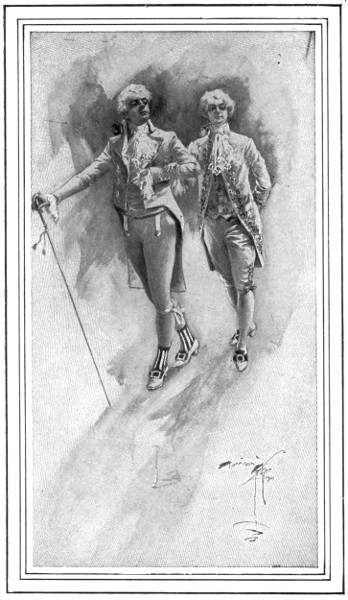
112Two watched her as she came in on Beau Brummell’s arm. These were Sir Percy and Kennaston; one green with anxiety for Grigson’s return from his errand, jumping at every sound; having left word both at Lark Lane, his coffee-house, as well as at home where he had gone, that Grigson should report to him at once he arrived; the other green with envy of Peggy and any other who neared his divinity, yet afraid and too diffident to approach her closer than with the devouring gaze of his eyes.
“That damned puppy again!” cries Percy, under his breath, as he surveys Peg in her satins. “By Gad, Sir, every lady in the room’s turning spite eyes on t’other, your incomparable Diana included, for fear he won’t stop and pay her a compliment.”
“Ah,” sighs the young poet. “Percy, an you loved like me ’twould be bliss to even gaze upon your fair. Think you I dare make bold now to cross and make my bow?”
“Why not?” returns the other gloomily. “Forgive my humor, Kennaston. Truth is, Sir, I’m mad, mad for Peg, and my ears are cracking and my brain splitting until that rascal, Grigson, gets 113back with answer to my letter. He’s been gone long enough to have made the journey four times over!”
“Oh, Percy,” returns Peg’s twin. “I love you as a brother, an could I but physic Your Lady into complaisance, I’d give my life for it. What owe I not to you?” adds the young man with deep feeling. “You’ve fed me, and zooks! Sir, to-night you’ve clothed me, for since the scurvy knaves that frightened Lady Di stole my suit of grays and my sword and hat, what had I left? Where would I be now, were’t not for you?”
“Tush, Ken, lad, I love you for yourself,—and ten thousand times more for her sake. Ken, I love her so that as I told her, if Sir Robin were a better man I’d cry off, an she said she loved him.”
“What said she?”
“Not that she loved him, but that she might,” he continues with sadness, as his eyes follow Peg on her almost royal progress about the drawing-rooms. “’Tis a proper fellow, enough, and I’d always heard he was a fright and a coward.”
Kennaston presently took heart of grace and 114crossed to pay his duty to Lady Diana, who, ’twas plain to be seen by every other than this bashful swain, was by no means the indifferent to him she would feign play off. Her color came and went as Kennaston, blushing to match his lady, ventured to spout his ode to her; and, leaving the pair to gallop on this pleasant path, Sir Percy at a distance unconsciously followed Lady Peggy, at least with his gaze.
Peggy meantime, denying right and left the story of her prowess, with quips and jests and ogles of the fair, still kept her eye on Percy. Not yet had she seen him approach Lady Diana; yet hold! even now, catching her own gaze fixed upon him, he turned and was presently bending over the little beauty’s fingers.
A pang shot through Peg’s heart, and the tears were like to force their way; she made an excuse and left the long drawing-room, taking refuge in a small apartment where the tables were ready for cards. She sank into a chair and buried her face in her hands. The candles were not yet lighted and she was totally unobserved. Dashing the salt drops from her lashes with her hand,—
115“What am I!” she cried in her bitterness, “that I can not abide to even see him a-bending over her hand! Ain’t you no spirit, Peg? No pride? He’s not thinking of you, my dear; didn’t he say plain, if Sir Robin was the better man he’d give up to him! What kind of a suitor’s that, Peg? Lud! I’d not give up him to any one, whether they were my betters or no!”
Could My Lady but have postponed her exit for a few brief moments she would have beheld Sir Percy, at a word in his ear from a footman, quit Lady Diana’s side with but the smallest ceremony, dash out into the vestibule, seize with a vice-like grip the man who stood there pale and trembling, and gasp out:
“At last! the letter, the letter?”
Grigson shook his head and got even whiter.
“No letter?” Percy says in a dazed way.
“Only your own, Sir Percy,” handing back the missive. “Her Ladyship was from home, Sir.”
“Well, what of that! you infernal, damned rascal, did I not command you seek her, if ’twere at the other end of the world!”
“Aye, Sir, and the quickest way of settin’ about 116findin’ Her Ladyship was for me to get back to town, Sir, as fast as the cursed beast I was cheated into hirin’, Sir, would fetch me.”
“Speak out, for God’s sake! Is Her Ladyship up in London?” asked Sir Percy, actually shaking with impatience and astonishment.
Grigson nods and without more ado proceeds to give an exact if somewhat rambling account of his entire experiences, from the moment he had quitted his master until the present.
’Twere idle to attempt to describe Sir Percy’s state of mind. Up to now there had ever lingered in his heart the hope, nay, one of those unconscious beliefs men have, that in the end Peggy would be his. This news that Grigson brought crushed every such thought from his brain, but put in its place such a hatred of the young man now tasting the sweets of hero-worship (in little), in the adjoining room, as caused his fingers to itch for his steel and t’other’s flesh to meet once more, and to the death.
He drew Grigson in from the vestibule and, unobserved in the crush, down the corridor to the 117darkness of the card-room where Peggy still sat disconsolate in her far-off corner.
She, for the moment, is even unconscious that any one has entered until the voices arrest her attention.
“By Gad!” Sir Percy cries in a low tone, falling into a seat and clapping his brow. “Up in London! The woman, vowing Sir Robin had crossed your entrance, inquiring for Her Ladyship! Your meeting, not Sir Robin, but an ill-conditioned little popinjay with squint eyes and of the height of the dwarf that waits upon my Lady Brookwood?”
“Aye, Sir Percy,” returns Grigson. “No more like Sir Robin, which, Sir, begging your honor’s parding, is a very pretty young nobleman, with a good eye and a proper height.”
Sir Percy nods.
“Then,” speaking as if to himself and motioning the man away, “since she’s up in town without her parents’ knowledge and with a cock-and-bull story stuck into her Abigail’s mouth, it must be she’s eloped with the scoundrel out of Kent!”
Grigson going, ventures to ask: “Any more 118h’orders, Sir Percy? Will I cover the town, all the inns and taverns, Sir?”
The young man shakes his head and the servant bows himself away.
119
VIII
Wherein Lady Peggy picks a very pretty quarrel
with her presumed rival: and is
later bid to Beau Brummell’s
levee in her night rail.
At this precise moment Lady Peggy, scarce able to contain herself longer and, reckless of every possible consequence, being about to cast herself upon her quondam lover’s protection, and to be rid forever of being a man, is stopped short of her purpose by the words that now fall slowly from the young man’s lips.
“To deceive! to lie! to scheme! and plot, and bring shame and trouble upon her father and mother! Gad’s life!” Sir Percy brings his clenched hand down with a thump upon the card-table. 120“I had never believed that of Peggy! I’d have felled him that had hinted she could even plan a lie, or run off to a secret marriage with the best man that lives.”
At which speech My Lady’s color burned as never before since she was born, and her choler rose at the double charge, both the one that was true as to her deceit, and the one that was not as to her secret nuptials.
Palpitating with rage and wounded sensibility, with remorse and wretchedness; brought to bay with a situation she could not endure, Peg now utterly forgot her breeches or her shame at these, and, stepping boldly forth into the small circle of light shed in at the doorway, from the candles in the corridor, she saluted Sir Percy and spoke:
“I bid you good-evening, Sir Percy de Bohun, and, having had either the good, or the ill fortune to unintentionally overhear your remarks concerning Lady Peggy Burgoyne, I feel it my duty and pleasure alike to defend her from the unjust and unworthy attack which you, Sir, have just been pleased to make.”
“Sir Robin McTart!” exclaims Percy, with a 121start and in a prodigious anger. “I deny your charges, Sir, and would remind you that eaves-droppers are ever the cumberers of dangerous ground.”
“Sir!” responds Lady Peggy, her temper rising the more at the sense of the injustice and falseness of her whole tenure. “You coupled just now the name of a lady with that of Sir Robin McTart. I demand how you dare to assume such a responsibility, Sir, until at least either the lady in question, or I, gives you our confidence, or our leave.”
“‘Our’ forsooth! ‘Our!’” comes fiercely from between Sir Percy’s clenched teeth, while his hand flies to his sword-hilt.
“Why the devil, Sir—an you’ve been so lucky as win the lady for your bride—make off with her i’ the dark, shut her up in some unfindable hole? cheat her parents, and go strutting like some vain peacock up and down other ladies’ drawing-rooms? Be a man, Sir, and publish your triumph broadcast, nor let the town presently go gossiping and countryside wagging with the scandal of an elopement! Zounds! Sir Robin McTart, that!” flipping a stray card from the table almost in Her Ladyship’s 122face, “for your gallantry and your honor!”
“What do you mean, Sir?” cries Peggy, struck with horror all a-heap, and with terror as well, yet keeping up a brave show with her drawn rapier and sparkling eyes.
“Whatever you damned please, Sir,” returns Percy, now white-heat too, and most reckless of time or place.
“I’ve too much regard for Lady Peggy, Sir, not to postpone the climax of this matter until our next meeting, let it be when you see fit!” cries Peg with woman’s wit and wisdom too.
“’Slife, Sir, I ask you as one gentleman to another, nay, I implore it of you,” cries Sir Percy, rent betwixt choler, love and apprehension, “most humbly, is Lady Peggy your wife?”
Her Ladyship was now like to laugh, so near akin are mirth and sorrow, but she replied very loftily:
“I decline to discuss the matter, Sir, and would remind you that report hath your attentions engaged in quite another direction.”
“You know where Lady Peggy Burgoyne is at 123this moment?” says Sir Percy hotly, determined to push his matter to its ending this very night, and almost crazed by his passion and its balking.
“That I do, Sir,” returns Her Ladyship with a covert smile.
“Tell me, or I’ll brain you where you stand.” Percy makes an ugly lunge at his opponent with his fist, but merely as a threat.
“That will I not,” says she firmly.
What might have further ensued is, at this crisis, put out of the question by the entrance of Kennaston, who, espying Percy the first, cries out joyfully:
“Percy, Percy, Lady Diana hath given me leave to tell you she consents—”
“Tush, Sir!” interrupts Percy, jerking his head toward the other occupant of the room. “Sir Robin McTart and I have come near to blows, and must fight of a surety, on the subject of your sister, Sir; and ’tis for you to know without more delay that Lady Peggy is up in London, unknown to her parents; that Sir Robin hath her whereabouts and absolutely refuses to reveal the same.” Percy 124crosses the room, strikes a tinder and lights the candles on the mantel-shelf.
“You are cursedly badly mistook, gentlemen, both of you,” says Kennaston, quietly enough. “I’ve got a letter which I found upon my table this very night, just come from my sister at Kennaston,” with which her twin pulls My Lady’s most ill-spelled and crumpled missive from his pocket and holds it up before the four astonished eyes that are staring at it.
Peggy in amaze recognizes the letter she had written to her brother the day long since in the buttery, and which she had taken up to town in her reticule and must have dropped when she had paid her ill-starred visit to Kennaston’s chambers in Lark Lane.
“Frowse, the charwoman’s daughter, vowed she’d found it a-lying in the entry under the water-tub. There’s an end of your dispute, Sirs, I trust,” glancing from one to the other. “Come, come, Sir Percy, and you, Sir Robin, whom indeed the letter you brought me from Lady Peggy the other night doth most highly commend to my good offices, must be friends,” taking a hand of each. “Nor let 125Dame Rumor split ye asunder with her lies about my little twin’s being up in town. Gadzooks, Sirs, the child’s not a notion of a difference betwixt Mayfair and—Drury Lane! I beg of you, Mr. Brummell,” as this one now comes mincing in together with Lord Escombe, Sir Wyatt, Mr. Jack Chalmers and others for their game, “for you’ve the graces I lack in such matters.—These two gallants have had a difference, and ’tis you, Mr. Brummell, can set ’em straight again.”
“Cards! cards! Spades, clubs, diamonds, hearts,” exclaims the Beau, touching the Queen of Hearts with the toe of his high-heeled shoe, as it lies on the floor where it was shot from Sir Percy’s hand.
“Split me! but ’tis them that are at the bottom of every quarrel, Sirs; whisk me, but if a spade, or a club, or a heart, provided it be a lady’s, or a diamond, which the Jews have a lien on, ain’t the only causes for disagreement in this world!”
“Correct as your own toilet, Sir!” cries Wyatt.
“Now, ’twas hearts of course, damn ’em, and the queen of ’em that’s roused both your tempers, but for God’s sake, gentlemen,” taking now the hand of each which has slipped clear of Kennaston’s 126fingers, “bethink you, if the lady, whose name I can’t even guess, whom you both adore, stood here, what would her pleasure be, Robin, my lad, answer me, for of brawling there can be none here and fighting no more. Speak, Sir!”
“Faith!” answered Lady Peggy, with splendid valor and a rise in her color and her heels, “to my certain knowledge the lady’d have her name put out of the matter wholly, and she’d sooner die, Sir, than have any fighting over her preferences, by either Sir Percy de Bohun or Sir Robin McTart.”
The which being taken to be, by all present, a most prodigious and amazing gentlemanlike and politic speech, Sir Percy was feign accept, mock-smile and bow, while all the rest blew their lungs hollow applauding and praising his still hated and still suspected rival.
Peace restored outwardly, whatever else raged in the breasts of the two opponents, the gallants sat to their tables, Kennaston managing to whisper to Sir Percy across the deal:
“As I was telling you when I entered, Percy, Lady Di permits me to let you know she consents to my dedicating the ode to her, and Lillie, at the 127corner of Beanford Buildings in the Strand, hath engaged to publish it at once!”
But this, Lady Peggy, at a distant table, engaged in picquet with His Grace of Escombe, hears not; there rings in her ears naught save the words Kennaston uttered when he came into the card-room—“Lady Diana hath given me leave to tell you she consents.”
“Consents!” To what else but his suit? Which, egged on by his noble uncle, has been pushing any time these ten years, since boy and girl Sir Percy and Lady Di had played, ridden, romped, quarreled as brother and sister together.
“Consents!”
It echoes and resounds in Her Ladyship’s head over and over again the night through, and ’tis quite of a piece with her mood that she seeks out Lady Diana when tea and cakes are passing, and, with sly looks, congratulates Her Ladyship on the happiness she has this night conferred on a very gallant gentleman not so many miles away!
And quite in Lady Diana’s line of reasoning, having heard from Kennaston that Sir Robin has come up to town highly commended to him by his 128sister, and that, although he had been sorely jealous and distraught at the said Sir Robin’s good fortune in the matter of the rescue of Her Ladyship, he still believed him to be head over heels in love with his twin, etc., etc., etc., and so, Her Ladyship argued, Kennaston had doubtless confided to the said Sir Robin such tokens of her favor as the said Lady Diana had that evening seen fit to manifest; never for a moment misdoubting that any other swain was in the supposed Robin’s mind any more than he was in her own!
“Consents!”
’Twas reverberating in Peg’s ears and a-knocking at her heart for the hundredth time, when, returned to the card-room, she learned that Mr. Brummell was inviting the company for the Thursday to his seat Ivy Dene. ’Twas to be a gentlemen’s party only; out on horseback, the twenty miles, leaving the White Horse at ten in the morning, with luncheon en route at the Merry Rabbit at Market Ossory; a look over the stables and paddocks on arriving at Ivy Dene,—a quiet game, maybe, and such a dinner as only, the Beau swore, 129his country cook could get up; with the ride back to town by the light of the near-full moon.
Lady Peggy was soon made aware that this festivity was solely in her honor, and succumbed to it as cheerfully as she might.
God keep her! All the while staring at the ribbon of her twin’s wig, a-longing to cast her arms about his neck and pray him cover her up in his wraprascal and fetch her home; vowing she’d run away from ’em all the next minute, but where? How? Which way could it be done so that capture, discovery, and humiliation would not follow? Peggy could contrive no method, and the girl was literally terrified both at the prospect before her and by the realization that easy as it had been to jump into man’s attire ’twas well-nigh impossible to get out of it again. Should she on returning to Peter’s Court lay off her satin suit, wig, and rapier, and resume her Levantine gown, hood, petticoats, patches, and reticule, how and of what hour of the day or night could she in safety leave the mansion and find her way unsuspected to the King’s Arms and the coach? ’Twould be out of the question; servants were up and about at all 130hours, and were a woman seen emerging from her room, what piece of scandal would not the next day ring from one end of the town to t’other.
With “consents” tattooing in her brain, My Lady recklessly put all the heart there was left in her into the present moment, lost a hundred pounds to Escombe with a fine grace; won five hundred with no more ado; laughed, drank a little wine, went home with her host at four in the morning, and fell heavily asleep.
At two of the afternoon the Beau usually held an informal levee attended by the more noted of the bucks and macaronis of the town; vastly entertaining half hours, wherein, while soundly abusing the newspapers for their being stuffed with lies, the company still eagerly devoured every scrap of gossip they contained; where the amount of frizz towering above Lady This’s brow was measured and scanned, the better appearance of Lady That in the new-fashioned gown discussed; and the horrid aspect of the Hon. Miss So and So’s toupee and her general resemblance to a malt-sack tied in the middle, talked over. This couplet and that comedy were torn to pieces by as many pretty wits as 131chanced to be present, while Tempers dressed his master’s wig in a corner and a footman and a negro page handed chocolate round in silver trays.
The Beau, himself, reclined on his great bedstead with its fine tester, a half dozen of pillows richly laced at his head; a flowered gown about his shoulders, his night-cap on, a coverlet embroidered by the Chinese over him, his snuff-box at hand, reading aloud from the damp and freshly arrived print whilst Sir Wyatt, Lord Escombe, Mr. Jack Chalmers, and a dozen more sat or stood, cup in fingers, ’twixt lip and saucer, hearkening, eager, to the news.
“’Tis by this on the tip of every tongue in town that there occurred last night at Lady B——d’s rout an encounter (the second within a se’ennight), betwixt Sir P——y de B——n and a certain young gentleman from Kent whose handsome face, genteel manners, and dashing behavior, have conspired to place him in so brief a time at the very height of favor in society, and more especially in the eyes of Lady D——a W——n. It had been supposed that the affair recounted in these pages as having taken place in the chambers of Lord K——n of 132K——n was on account solely of the above mentioned adorable young scion of a noble house. We are in a position to assure the world of fashion that such is not the case, and that both the unfortunate disputes betwixt these two gallants are to be laid to the door of Lady P——y B——e, sister to Lord K——n. Report hath it that Her Ladyship is in London; rumor contradicts report and avers that the fair one has not stirred from home. The issue is awaited with interest, as the verbatim account of an unsuspected elopement may be looked for at any moment. Safe to say the vivacious Lady P——y B——e, whom the town hath never had the pleasure of beholding, has succeeded in stirring Mayfair to its depths and has been the cause already of a very pretty pair of quarrels between two young gentlemen of the first quality.”
“’Slife!” cried Beau Brummell. “Who now the devil’s Lady P——y?”
“By the dragon, himself, I never heard that Kennaston had a sister!” said Lord Wootton and Mr. Vane at once.
“Yes!” exclaims Sir Wyatt, tapping his forehead, 133recollectively, “I do recall that Sir Robin McTart, the night we were at Kennaston’s chambers, entered with the presentation of a letter of introduction from ‘Lady Peggy Burgoyne to her brother,’ and ’sdeath! ’twas, I believe, she about whom they fought, too!”
“Ha! ’tis not only Lady Di, then, that’s at the bottom of their quarrel after all,” says Mr. Brummell, reflectively.
“Where is the fair one?” asks Escombe. “Who knows that?”
“Faith! no one. Stop! Sir Robin must know, since ’tis for her he unsheathes twice in a week,” cries the host.
“Where is he?”
“Bring him in!”
“Send for Sir Robin!” is the cry of the company.
“Zooks! Sirs, but our reputations as gallants are broken up, an we’ve not seen her of whom the prints speak thus!” says the Beau, adding at once:
“Tempers, my compliments to Sir Robin McTart, and beg of him to join us, for, at the least, a few moments. I know he’s averse to early rising, 134but pray inform him to skip across in his dressing-gown and slippers, and night-cap, we’ve no ladies here about to ogle him!”
The which message being conveyed to My Lady Peggy a-sitting by the pulled-out chest of drawers, mournfully contemplating her long shorn tresses with barred door, arouses in her such a fever of sorrow as well-nigh chokes her utterance.
“Say to Mr. Brummell I’m asleep, Tempers, and crave to know his pleasure, the answer to which I’ll send as faithfully as Morpheus will permit, by you for Mercury! Off with you!” and Her Ladyship softly stroked her locks, and for the thousandth time went planning her escape.
Peels of laughter, rattling of rapiers, click of heels, and now—
“Rat-a-tat-tat-tat-tat!” on the door.
“McTart! McTart! Up with you from betwixt coverlets and into your Persian quilt!”
“Out with ye, Sir Robin, or by Gad! Sir, we’ll in, the fifteen of us! and rout you up from Morpheus’s arms.”
“Come, Sir Robin, dally no longer with sweet sleep; up, Sir, and bethink you of Beauty spelled 135with a P-E-G-G-Y!” shouts Sir Wyatt, chorused by the rest.
At first clap of voices Peggy stuck her hair back into the drawer, jumped up, and stood, hand upon the dressing-table, her expression like nothing else so much as that of a fawn caught in a thicket.
“’Sdeath! Gentlemen, I pray of you, a few moments grace!” cries she, trembling from the knees down, for ’tis quite of the temper of the manners of the day that in a second more the whole company should batter down the mahogany and burst in.
“Three-and-thirty, an you like, Sir Robin!” says Escombe, who is soberer than the rest.
“Give us the whereabouts of Lady Peggy Burgoyne,” shouts Mr. Chalmers, “and we’ll trouble you no more ’til doomsday!”
“Lady Peggy Burgoyne!”
“Lady Peggy Burgoyne!”
“Where’s Lady Peggy Burgoyne?”
“Where’s Lady Peggy Burgoyne?”
“Where is the fair one for whom you and Sir Percy de Bohun have fought with blades and tongues, twice now, since this day last week?”
136“Lady Peggy Burgoyne!” cried they in hot concert, joined in most lustily by the Beau from his bed across the corridor, and accompanied by the pounding of fifteen rapier points on the parquet, and thirty fists on the woodwork, as well as the demoniacal screams of the Beau’s little negro and the parrot on his wrist.
“Tell us where she is!” came high staccato last from Sir Wyatt’s exhausted lips.
“My Lords and Gentlemen!” answers Her Ladyship, standing close to the door enveloped from top to toe in a sheet over her night-rail. “Would to God I could!”
There was a ring of heartfelt truth in the reply, and its utterance was succeeded by a second’s surprised pause.
The young bucks regarded each other with shrugs, pursed mouths, and interrogation points bristling in their eyes.
Mr. Chalmers, recovered of his surprise sooner than the others, says:
“Do you mean to say, Sir Robin, that the whereabouts of the lady with whose name the prints and the coffee-houses are ringing; for whose sake 137you came near to fighting Sir Percy only last night, and did fight him in Lark Lane o’ Thursday last, ain’t known to you?”
“Is she in London?” pipes the Beau, pinching the little black till he squeaks again.
“That I can not tell,” responds Her Ladyship. “I do know she’s not in Kent; and she’s not at Kennaston Castle. ’Slife! Sirs,” adds she, “I pray your consideration. Guess what you will; this matter of Lady Peggy sticks me closer than you dream, and I’d give my life to know her safe at home with her mother.”
Silence ensues; the disappointed fifteen get them back to the Beau’s bedside to talk over this latest development as to the mysterious Lady Peggy.
138
IX
In the which Lady Peg overhears a horrible
plot to murder; and wherein
Mr. Incognito encountereth
Sir Robin.
She herself falls into such an immediate flood of tears as shakes her well, and then up she rises from her depths, and with all the courage of her race and blood, she vows that, come another sunset she will quit Peter’s Court as if for a walk, and never return; that in small clothes, since it must be, she will journey back to Kennaston Castle, and risk all the discomfiture and disgrace her doing so may bring upon her.
In point of fact, My Lady Peggy was at that state of mind when it seemed to her no degradation 139or humiliation, no sorrow that could be visited upon her, would be too much punishment, or enough, for the sins without number she had committed since the luckless day she took the coach for town.
When she emerged from her room for dinner, ’twas to learn that Mr. Brummell had been summoned hastily to St. James’s on so important an affair as to initiate His Royal Highness into the mysteries of the new tie of Sir Robin’s own invention! and that he trusted in this audience to obtain permission to fetch Sir Robin to the Palace and present him within a few days to several august personages, etc., etc., etc.
Her Ladyship, therefore, dined alone, scantily too; food choked her, wine burned her throat, and to speak truth she was heartily glad not to have to drink it, for Her Ladyship was an abstemious young lady and believed milk, Bohea and Pekoe the beverages for her sex, to the exclusion of any stronger.
At twilight, having made her duds and her tresses up into a reputable enough parcel, Lady Peggy, in a suit of claret velvet, leaving all the 140rest of her man’s attire hanging in the presses, sauntered carelessly out of the house, declining the footman’s offer of a chair, or even a hackney chaise, or a page to carry her parcel, and set off at a swinging pace across the square and toward the river. It was her intention, by way of frustrating any attempts at tracing her which might be set afoot, the discovery of her flight once made, to so double on her own tracks, and to seek out such unimagined and unlikely streets to traverse, as must puzzle both bell-man, watch, and redbird alike, as well as her acquaintances.
She swaggered along toward St. Stephen’s where a coach containing quality was occasionally met even now; then down Horseferry Road, almost to the river’s bank; then along Jackanapes Row, with little idea of the cut-throat locality she was haunting; back again toward better neighborhoods; then a lurch to the Thames making into Farthing Alley and Little Boy Yard, at the end of which she found herself at the old Dove Pier.
Peg stood still, her heart beating both with her quick walk, and at the strangeness of all that surrounded her. She had no fear, because her arm 141was stout, her aim sure, pistols at her belt and a good sword at her side; and she was perfectly ignorant of any harm here to be found, greater than at the door of Beau Brummell’s house.
The dark dwellings of the yard frowned at one another, with not an ell of sky to share between ’em at their roofs; the sign of the “Three Cups” swung and creaked in the slow breeze; the river, black and gruesome, lapped at the foot of the stone pile against which she leaned. On the river the tired bargemen rested at their oars, and the dip of a water-bird was the only sound that struck upon her ear. Peggy was casting about in her mind whether to enter the inn and inquire her road to the King’s Arms in the Strand, and had just turned to do so, when in the cavernous doorway of one of the gaunt-looking tenements she beheld three figures. The faces of two were toward her, and by the light of the fish-oil lamp swinging at the next-door tavern, she beheld them, so sinister and forbidding as to cause her to halt for a space, and then, overcoming her dread, to pursue her path, but slowly and by crossing the yard.
As she did so, her weapon caught in her heel 142and as she bent to disengage it, a voice speaking in low muffled tones arrested her gait.
It was the voice of Sir Robin McTart saying:
“If I make it ten guineas apiece on the spot, you swear to leave him cold on the pier yonder, come Sunday night, or to tie a stone about his throat and throw him into the river?”
“Aye, aye,” grunts one of the two companions of this most valorous gentleman. “’E’s h’always ’ulkin ’ereabouts o’ Sunday nights.”
Lady Peggy, with such a pull-string of terror at her heart as she never had before, draws closer to the wall of the tenement before which she has halted, creeps nearer to the portal wherein these cavaliers are quartered.
“Let it be five guineas apiece to-night,” squeaks the Baronet, “and the remainder when the business is done?”
“The devil knock you into hell with your, ‘when the business is done!’” mutters the other. “We’s doin’ your job for you for little enough. Tain’t everyone as’d h’undertake the funeral of a h’Earl’s heir like Sir Percy de Bohun——”
Her Ladyship’s like now to fall in a swoon; but 143not she; only leans she a bit against the bricks, her bosom heaving, her eyes dilating, her lips bitten in until they are almost bleeding.
“Hush-h-h! no names, you varlets!” interrupts Sir Robin.
“Hey?” responds the other, “the walls ain’t got no h’ears, and if they ’ad wot I’m a-sayin’s the cussid truth, eh, Bloksey?”
Bloksey grunts.
“The town’ll be afire when it’s out that a gallant like ’im that’s heir to Lord Gower’s been done fer; and then, my fine gentleman, who’s to pay for’t, if we’s caught and if we ’appens to be seen by any one when we’re a doin’ of your job? No, money all down now, or Sir Percy lives as long as ’e likes, for us!”
Peg’s hand’s upon the hilt of her sword.
Shall she spring and run Sir Robin through?
Shall she hide and buy the rascals out at a higher price than he has paid?
But no sooner do these thoughts rush through her brain than the utter impossibility of compassing the one, or of performing the other, undetected, if even with her life, and she so at the mercy 144of these cut-throats, comes to steady her, and she realizes that her only part is to get away as fast as she may, and unseen if she can.
Meantime Sir Robin concludes his bargain with the two desperadoes, and as they withdraw into their haunt, and he turns on his heel, he espies Lady Peggy rounding the corner with her bundle under her arm. The little Baronet with a sidelong glance in at the hallway to make sure his men are out of sight, darts to the opposite side of the court on tiptoe, and then, putting hands to mouth, calls across softly, but clearly, in a tone half of joy, half anger.
“Mr. Incognito! Mr. Incognito! Ho! I say, Incognito!”
Peg stops short. ’Twere wiser perhaps to try to discover what had put Sir Robin McTart up to the murder.
“By Gad, Sir!” cries this one, making a dash now over to Peg’s side of the way. “Here have I scoured the town for you day and night, and no trace of you anywhere! ‘Incognito’ me no more, Sir! Who are you, Sir? Damme! I’ll stand no more such nonsense!” Sir Robin’s valor’s thoroughly 145based on the knowledge that, were blade to be unsheathed to his hurt, he could and would shout for his hirelings to the rescue.
’Twas the first and only time in his life that he was ever known to urge, or even hint, a quarrel in propria persona.
“I’ll ‘incognito’ you to the end of the chapter, Sir Robin McTart,” answers Lady Peggy, clapping hand to hilt.
“Very well, Sir, very well,” says the Baronet, reflecting that another corpse might cost him ten guineas more, ere he were done with it; and besides yearning for the news of His Lady which he thinks he may glean. “I’ve small stomach for fightin’ any man. Religion don’t teach us that lesson, but ’tis a devilish trick you’ve played me, Sir.”
“In what way, Sir? Out with it,” replies Peggy.
“You, Sir, sent me to Kennaston a-seeking Lady Peggy Burgoyne, Sir; she was from home, and not a word else could I buy or wring out of her servant’s cursed mouth. Then I hied to Kent, believing, from your fine messages to me from Her Ladyship, that she must be there at her godmother’s. 146No, Sir! she was not; nor could any one tell but that she was at Kennaston Castle for all they knew. Back in town post-haste, I seek Lark Lane, where her brother lodges, so I had heard, only to learn that he has gone to stop with Sir Percy de Bohun, in Charlotte Street.”
“Well, you sought him there?” inquires Peg quivering with suppressed excitement.
“I did not, Sir!” replies Sir Robin with emphasis.
“Thank heaven!” says his companion fervently, an exclamation which may do double duty, and is well taken by the little gentleman from Kent.
“No, Sir; you do not suppose, Sir, that I’m a-going to risk a life that’s dear to Lady Peggy, at the hands of a ripping brawler and sure-kill like Sir Percy, do you?”
“Ah, Sir Robin,” quoth Her Ladyship. “If you knew what a consolation it would be to Lady Peggy to hear of your unwillingness to hazard your precious person in such company, ’twould ease your mind and heart.”
“Look you!” whispers Sir Robin, plucking at Peg’s sleeve. “But tell me where she is? This 147mystery’s killing me! How fares she? Does she pine for me? and is this true?” With shaking hands Sir Robin takes from his pocket a copy of a print of the day previous, and unfolding, reads to the astonished Peg the following paragraphs.
“Town’s talk is all for the very pretty quarrel betwixt Sir P——y de B——n, and the gallant and handsome Sir R——n McT——t of Kent. ’Tis all over Mayfair, and far beyond, that the cause of the dispute’s the lovely but mysterious Lady P——y B——e.”
“’Slife!” interrupts Peg, catching at straws. “You now perceive, Sir Robin, why ’tis that Her Ladyship must keep her whereabouts a secret, even,” she adds with sentimental deflection, “from you. Trust me, Sir, as you would trust her, and be guided by my counsel!”
Sir Robin nods vigorously, fluttering his sheet with anxious fingers. “Listen, Sir, listen, to this further.” He reads on. “Sir P——y de B——n has sworn by all that’s sacred, so ’tis said, to stick Sir R——n McT——t to the death, and serious consequences are feared.”
“Ah!” cries Lady Peggy, overjoyed to hear anything 148that may serve to keep the little Baronet and Sir Percy from meeting. “’Tis a gentleman of his word, I promise you. Better get back at once to Robinswold, and let London and Sir Percy gallop to the devil, an they see fit!”
“Nay,” replies the one addressed. “Not I, Sir Incognito. It is not for a McTart to turn his back on danger, but the rather,” and here by the fish-oil gleam, the little gentleman’s squint eyes leer cunningly up into Her Ladyship’s face: “The rather,” continues he, glancing cautiously around, “take measures to protect myself.”
“Very commendable of you, Sir Robin, by my faith,” cries Peggy, although she shudders, now linking her arm in her companion’s, and assuming an air of easy confidence, by the which she hopes to ensnare him into a complete revelation of his plans.
“Since you go armed, and are, I doubt not, a master in the art of self-defense, what have you to fear from Sir Percy de Bohun?”
“True,” responds the Baronet, with a reservation to himself and no mind at all to proceed any further with his revelations. “Gad! Sir, a fellow 149like that,” clutching at the newspaper stuck among his ruffles, “ain’t to be trusted as long as he’s above the ground. I swear, Sir! I fear to walk abroad and hold myself housed at my inn in Pimlico, close, not daring to show my face. A ruffian that’s publicly printed as seekin’ life’d stick me in the back in the dark, an he got the chance.”
“Nay, nay, Sir Robin,” says Peg, up for her sweetheart, “he’s not that sort of a gentleman—but, look you, keep close, frequent neither club, coffee or chocolate-house, or rout or drum; eschew Vauxhall, Richmond and the play-house, or any likely place where bucks gather, for trust me, Sir, an you do meet Sir Percy, there’ll be the devil to pay, and his blade’s his obedient slave.”
Poor Peg! She has not only to protect Percy of his life, but, as before, to prevent any discovery of her usurpation of the little Baronet’s name.
“Curse him! I fear him not!” responds this one, his itching fingers twisting about the empty purse in his pocket.
“But of Her Ladyship, Sir Go-between?” adds 150he presently, as they emerge upon the broader and better lighted road. “’Pon my life, but to so find myself the hero of a romantic passion with the Lady secluded in a mystery, a nobleman thirsting for my blood, a nameless gentleman playin’ Mercury betwixt me and my fair, ’tis amazing, Sir! prodigious amazing!” Sir Robin struts and takes snuff very comfortably, since he has got out of a very dangerous environment.
Peg’s soul sickens within her as she listens to him.
“Tell me now, how fares she?”
“Not so well,” answers she.
“You’ve seen her?”
“Not I.”
“Are like to?”
“No, Sir.”
“You can convey messages to her by some fond way she’s planned to get her news of me, eh?”
“I can, Sir Robin.”
“Sir, whoever you are, for pity’s sake, tell me where is she?”
“Not far, Sir.”
“Gad, Sir, to touch her hand, her cheek! 151You’re in her sure confidence? She does favor me? She will not give me hopes, Sir, to turn around and break my heart by marryin’ of another?”
“Lady Peggy’ll never marry any man, Sir Robin, I’m of the opinion, so I’d not give that for your chances!” answers she.
“Think you she ever cared for Sir Percy?” asks he.
“Sir, who can fathom a woman’s heart? ’Tis deeper than the sea; so deep, methinks, ofttimes she herself holds not that plummet that can sound it. Sir Robin, I take my leave of you.”
“Hold! hold! Sir, not so fast. Where next may I encounter you?”
“That must be as Her Ladyship says,” answers Peggy. “Your inn’s in Pimlico?”
“Yes, the Puffled Hen, not far off Battersea Bridge.”
“Farewell, Sir, and look you keep close in-doors, and risk no quarrel with Sir Percy de Bohun.”
“Farewell, Sir,” watching Her Ladyship turn down the street as he turns up. “Gad’s life! ’twas well he happened when he did, and not earlier, 152to eavesdrop my bargain with the wharf-rats! ’Sdeath! Risk no quarrel with Sir Percy! Not so long as there’s guineas left to buy corpses with!” and the little gentleman trots over to Pimlico, tolerably well pleased with his evening’s work; there, however, to be greeted with the reading of more newspapers, including that one which had earlier in the day so entertained Beau Brummell and his familiars.
Not for a moment did the Baronet mistrust, or have a suspicion, other than that his fame had caused him to be made the subject of such a pack of pretty stories as was then the custom of the press, as now, regarding any gentleman of position and gallantry. Sir Robin’s vanity easily swallowed the dose, and he even slapped his thigh and laughed his little dice-rattle laugh, as he reflected how safe he really was with never a challenge or a brawl to his cowardly credit since he got his first flogging at Eton.
He actually mouthed over his prospective wooing, and assured winning of Lady Peggy, and felt a calm satisfaction in the knowledge that the one rival he feared would so soon be beyond the reach 153of ladies’ smiles or tears. No qualms came to disturb his genial enjoyment of purposed assassination. In those days to kill was nearer men’s tempers than it is to-day. ’Twas with blackguard and man of honor alike, the first redress for even the pettiest sort of a dispute; with the difference of method only, that the gallant blade fought out his quarrel on the open field, while the craven bought a hireling’s dagger to do it in the dark.
Meantime, My Lady, by as direct a route as she can fathom out of the labyrinth of her ignorance and her distracted state of mind, makes back to Peter’s Court with her parcel of duds still under her arm.
She enters, mounts the stair-case, seeks her room, closes the door, and sits down.
“’Tis now not to be doubted,” she says to herself, “but that the Devil’s at the helm of my ship—and that I am to be a man for the rest of my life. ’Sdeath! as dad says, I’ll stop over till Sunday night’s o’er past, and as surely as my name’s Peggy Burgoyne I’ll foil that little dastardly groat of a Baronet’s plot to murder him that I once l-loved. Bah!” cries she half aloud. “What’s the 154use of mincin’ matters that’s true? Him that I love! Even if he’s dyin’ for Lady Diana, and goin’ to be her husband instead of mine! ‘Consents!’” murmurs she, flinging herself on the bed in a flood of tempestuous tears.
In vain regretting, she now too fully realized that her own wilful words, her jealousy, her falsehoods, her deceits, were the sole causes for Sir Robin’s terror, and, therefore, for the abominable scheme which he had just concocted.
Presently she arose, tossed the bundle once more back into its hiding-place, and set to pacing up and down the floor as she’d seen her twin do at home when he was looking high and low for a rhyme.
’Twas weightier matters kept Peg moving for an hour or more, and quick-spinning as were her heart and temper, her brain bore a more even balance.
First she had thought to warn Percy by a letter unsigned; the which she knew he’d pitch into the fire and think no more about. Then, that she’d write one to Kennaston imploring him to keep Percy from the pier Sunday night or any other; 155this she soon recognized would have the fate of t’other. Then, ’twas to contrive some plan to fetch him to Richmond, Windsor, any place else for Sunday; but to this arose the objection that the blackguards cheated of one day, or place, would not fail to wait upon their prey some other. At the last, Her Ladyship’s shrewd common-sense and indomitable pluck plainly showed her there was but one safe plan out of the danger; and this must be to go herself to the river Sunday night, and there concealed, armed, await the coming of the cut-throats from their den, and from the rear, put a shot into each at one and the same moment.
Could she do it?
Her Ladyship had muscles of steel, no nerves, as the fine ladies of her day comprehended them; as brave and loyal a heart as ever beat in any breast; good faith in God, for all her frowardness; and that species of love burning within her for Sir Percy de Bohun, which has, not a few times in the world’s history, made frailest woman into man’s equal for courage.
To Lady Peggy there seemed a divine compensation in the fact that it had come to her, to save 156the very one whom, by her lies and wilfulness, she alone had been the means of endangering.
X
In this same Her Ladyship’s mount is shot
dead under her in Epstowe Forest, and
she makes off on Tom Kidde’s horse.
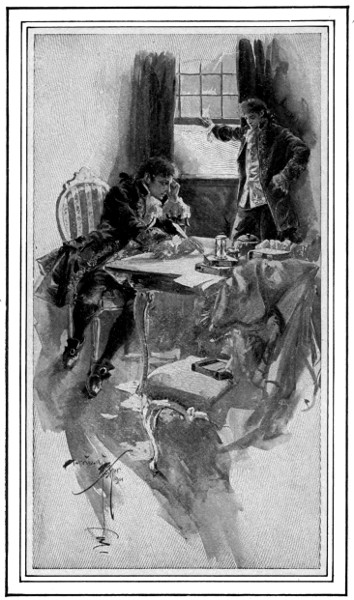
This young gentleman now stood looking from a window of his uncle’s house, upon all the dewy leafing beauty of the Park at May. His brow was knit, his lips tight shut, his hand amid his ruffles clenched.
At the table sat Kennaston, inky-fingered, scribbling; eyes now rolling to the ceiling, now roving hither and yon.
“Ah!” sighs this one. “If the critics do not find this canto to their taste, may I be damned!”
“You’re like to go to Court to the Devil, I’m 157thinking then, dear lad,” speaks de Bohun over his shoulder.
“Fame! Fame!” cries the young poet, pushing back in his chair, wig awry and quill poised in air. “I’ll hunt thee to my dying hour, and if thou escap’st me then, ’twill all be Lady Diana’s fault.”
“How’s that?” asks Percy, with, however, but small ring of interest in his voice.
“Oh!” exclaimed Peg’s twin, “the minx mocks me! ’Tis Monday, kindness and all smiles, to wake on Tuesday for indifference; pouts on Wednesday; lure-me-ons o’ Thursday; forgetfulness for Friday; radiance for Saturday, and all a-jumble, sweets-and-frowns! showers! sunshine! what you will!—and will not!—for my Sunday fare.”
Percy sighs and smiles.
“Percy, sometimes I think Diana does love you!”
“No, Sir, never. We’re like brother and sister, nothing else, save my uncle’s absurd, obstinate (now-cured) whim, since childhood, to match his heir with Brookwood’s heiress. Odzooks! Ken, 158you’re like every other swain that ever sighed, always looking for a rival to be jealous of! Lady Di cares for you; an you doubted it before, ’tis time to take up hope, since you are asked to Brookwood for a visit, and go popping off to-night, with me left home to think alone on Peggy.”
“Zounds! Sir, ’tis not you only that’s thinking of her!” cries the young man rising and crossing to the fire. “But, what would you! if I call out the bell-man, publish her disappearance in the newspapers; get word to my father and my mother; what comes of’t all, but scandal? and like as not dad an apoplexy, and My Lady mother a set of fits and a death-bed!”
“Ken, I’m a damned fool ever to stop inside of doors or to cease pacing streets, haunting inns, shadowing Sir Robin McTart, until I find her!”
“Fie, Sir, if she’s gone off with Sir Robin McTart, ’tis, I promise you, with a wedding-ring on her finger, and not else! An she loves him, what’s to be said or done, if he’s her lawful lord?”
“Naught. I myself went down to Kennaston yesterday. I said nothing to you, Ken,” he adds, 159noting the other’s surprised and reproachful start, with a hand upon his junior’s shoulder.
“I thought I’d not interrupt the epic and your frenzies about Lady Di, with my troubles.”
“Well, what news of Peg? Any?” asks her twin anxiously.
“None. I saw Chockey, and only got from her what Grigson had, the positive assurance that her mistress had gone up to London. ‘Of her own free will?’ I asked. ‘Yes, Sir Percy,’ said she. ‘Alone?’ I inquired. ‘No, Sir Percy,’ was her answer, nor could I force, frighten, or buy the baggage into any further confidence. She did beg of me, however, seek out Her Ladyship, if I could, and find how she fared.”
“Gad’s life, Sir! She has eloped. ’Tis clear as crystal!”
“One thing more, I asked Chock: Had Her Ladyship money in her purse? ‘Lawk, Sir Percy! cried she, ‘two hundred pounds I know of!’”
“‘Two hundred pounds!’” repeats Peg’s twin in vast amazement. “’Tis sure more’n she ever saw before in our whole lives put together. Oh, the girl’s safely wedded, Sir, beyond a doubt!”
160“Sir!” says Percy, sitting at the table, with his head low in his hands. “The blackguard’s won her from me!”
“I fear so, Sir.” The two men’s hands meet and grasp in the silent fashion of their sex: ofttimes more eloquent than any words e’er speeched.
“Would I had made a hole in his heart that night in Lark Lane!” cried Sir Percy next.
“Sir Robin’s nimble, Sir, and knows a trick or two with steel, as well as dice.”
“Aye: a gallant every inch; ’tis for that I hate him all the more; and yet, Ken, sometimes, lad, when I’ve been a-staring at him from afar, I’ve caught something in his countenance resembling Peg, and it’s that’s made me halt like a chit at provoking of him further.”
Kennaston nods. “Aye: I’ve remarked it; but held my peace, Percy, for ’tis said man and wife often grow to look alike, and I doubt not, sometimes begin after the same pattern.”
Sir Percy sighs again: turns up the room with drooped lids; in silence getting that grip upon his soul which noblest natures insist on with themselves, even in crises like his. ’Tis a bitter battle, 161closer fought and quicker, too, than any won or lost with swords and guns. The struggle’s writ upon his face as he goes; but when he comes his victory’s writ there too.
“Kennaston,” says he, very quiet and off-hand, “I’m thinking I’ll go to the Colonies, to Virginia.”
“What! no!” ejaculates the poet, placing a hand on either of his friend’s shoulders.
“Yes, Ken, dear lad, I could not live in England without her; perhaps yonder, over the sea, in the new land that’s growing up, I may learn to lead a new, better life, just for her sake that’s lost to me forever. At the least I can strive, at such a distance, to serve my country and my King like a man—until the end I’ll pray for comes.”
Kennaston turns off, with tears in his eyes.
“Mostly,” says he brokenly, “were not Peggy my twin, I’d be in a ripe mood for a-cursing of her! When, Percy?” asks he, after a pause.
“As soon as may be,” is the reply. “I’ve the promise of a commission by my uncle’s influence! Come, come, lad o’ my heart,” laughs he through his own misty eyes. “The wind’s not in my ship’s sails yet. I promised Mr. Brummell for his expedition 162to Ivy Dene for the morrow, and I’ll hardly be ready in all points to get under way before you’re back in town from your visit to Brookwood; whence I foresee you’ll fly with Diana’s ‘yes’ betwixt her kiss on your cheek.”
’Twas now Mr. Brummell’s famous and long-talked-about party to Ivy Dene this very next day that dawned.
Now, Her Ladyship had vowed to herself that, come what might, she would avoid this, even did Fate keep her in London. ’Twas no part of her program, although she could do it as well as any sporting squire, to make for her future any such memory as riding a horse astride for thirty miles out and back, in the company a half-score of gentlemen must furnish; yet, so is each of us rather the creature of circumstance than will, that the hour appointed found Peg mounted on a gray with blood in his veins, and a-pacing down Piccadilly to the White Horse beside Beau Brummell’s bay.
She could not, with Sir Robin’s murderous pact in her perpetual view, make up her mind to omit a company that should include Sir Percy.
163It seemed to her that any day spent by him out of her sight might prove fatal; that Sir Robin’s hirelings might conceive it better to their purpose to put an end to their intended victim before the Sunday. So, aching with an insane but not unnatural impulse to pull rein and confess all; burning with shame to remember ’twas of Lady Diana’s sweetheart she was thinking; mortified beyond belief every time her saddle grazed her breeches; intent lest an unsuspected sword should flash from the hedge-rows, the sheep-cotes, or the shadows of Epstowe Forest, which they traversed on their way; My Lady Peggy, wishing amidst all this that she had never come to town, yet contrived to display a very cheerful mien, to laugh as loud as she dared, keeping her high notes cautiously to herself, as she had in her speech ever since the night, as Sir Robin, she had made her first appearance in Lark Lane—to join in jest, quip, prank, such as a gay cavalcade of jovial gentlemen were then wont to indulge in.
Such are some of the strange vicissitudes incident to being that most amazingly delicious compound, a wilful and withal true-hearted woman.
164As Mr. Brummell had planned, they halted for refreshment at the Merry Rabbit at Market Ossory, and left, after a game of bowls on the green, to pursue their way. Percy lingered a bit in the rear: truth to tell, his reflections were none of the gayest, and the presence of the supposed Sir Robin McTart, and the conclusion, which, together with Ken, he had been forced to reach, that Lady Peggy had run off with the Baronet, did not by any means conspire to the lightening of his spirits. As he watched his presumed rival, heard the ringing laugh, the brilliant jest: noted the careless air, and thought of this cavalier as Lady Peggy’s lord, his choler knew no bounds, and it appeared to him that, come what might, he must invent cause of quarrel, and one or the other of ’em be left cold on the field.
“Why,” a thousand times he asked himself, “this mystery regarding her marriage? Why not have wedded Sir Robin from her father’s home, and with her father’s blessing, since,” Sir Percy reluctantly admitted, “no fault could be found with so fine a young gentleman; and his fortune, he knew to be considerable.”
165He was aware that Her Ladyship was romantic to a degree, and he could but decide that this predilection had caused her to elope and to preserve the matter in a wrapping of secrecy for a time; no doubt even now from her retirement looking forward to the hour when she should emerge as Lady McTart!
Sir Percy gritted his teeth together and struck his spurs so deep that his horse gave a plunge which brought him up, neck and neck, with the gray of the supposed Baronet, and the black of Mr. Chalmers.
“To the rescue, Sir Percy!” cried this one jocularly. “Your assistance I beg, and the loan of your wits in our argument.”
“With all my heart!” answers Percy, scenting a possible chance to worst his rival, even in a battle of words. “What’s the subject?”
“A truce to ’t!” exclaims the Beau, with an expressive shake of his head at Mr. Chalmers, who, however, seldom notes any obstacle to the pleasure of his present moment.
“No truce at all, Mr. Brummell!” answers he gaily. “’Tis—”
166“’Tis nothing whatever, Sir Percy,” interrupts Lord Escombe, putting his hand on Chalmers’s rein, and adding in an undertone: “Gadzooks! man, hold your peace. The matter’s like tow and tinder betwixt Percy and McTart.”
“’Pon my soul, Gentlemen!” now cries Percy, “I insist upon Jack’s being allowed to proceed with his remarks. If he wants my counsels, they’re his. Come, Sir, speak.”
“’Tis but this,” says Mr. Chalmers. “I say to Sir Robin that since the world’s busy with rumors of his secret marriage to Lady Peggy Burgoyne; since as I learn (by my man, who had it at the gate of the very best authority—Gad! Sirs, ’tis a fact, even if we don’t relish it, the gist of our gossip comes from below stairs, up!) that Lady Peggy is from home, her father believing her in Kent at her godmother’s!” Mr. Chalmers smiles, “her mother being in York, believing her safe at Kennaston, I say, My Lords and Gentlemen, it behooves Sir Robin confide the matter to his best friends, and give them chances to congratulate him and the Lady. Have I the right of’t, Percy, yes or no?”
167Percy is silent for a moment: it seems to him a desecration of the sweet, modest and womanly girl he has so long adored, thus to hear even her name, much less a discussion of her most private matters, made into mirthful subject on a morning’s ride.
His anger, too, is great that the man whose name is coupled with hers has not already put a stop to such a conversation, even were it at the point of the sword.
Shall he, here and now, so reply to Mr. Chalmers as shall breed an instant retort from Sir Robin, and a challenge on the spot? The wild thought even flashes through his brain that Sir Robin might, by the grace of God! be left dead on the ground, and that some time in the dim future he might win Peggy back to himself.
But, with a tightening rein, he checks himself, as well as his horse, as he answers.
“Mr. Chalmers, the Lady you name is one whom I honor most deeply, and it seems to me if she has seen fit to go into seclusion, or to marry secretly, that, while I may wish to God it had been in open church! I must continue to respect her preferences, until she elects to change them;” with 168which, breaking the little pause of silence which follows, Sir Percy gallops ahead, joining Mr. Brummell, who has put himself quickly out of the commotion he had foreseen as likely to arrive.
Meantime, it may be correctly imagined that Her Ladyship, with all her sex’s exquisite ingenuity at plaguing itself whenever it possibly can, had seized upon those words of Sir Percy’s most easily twisted into a means of self-torture.
“I wish to God it had been in open church!” instantly stuck itself in her thoughts beside “Consents;” the two forming just that species of flagellation which ladies so situated in mind are wont to inflict upon themselves.
The supposed Sir Robin, from this on, until the arrival of the party at Ivy Dene, became taciturn, even morose, and not a syllable could be got from him in answer to the wildest gibes.
Her eyes intent upon Sir Percy, who now kept to the fore with his host, My Lady Peggy, on the keen lookout for the possible assassin, and to the tune of “consents,” and its running-mate, “I would to God it had been in open church!” put in a very dolorous twenty miles; but, on dismounting 169at Mr. Brummell’s doorstep, she endeavored to infuse a little joyousness into her looks and speech.
Indeed, ’twas difficult; yet no more so to-day than any other since she had been coerced by circumstances into an acceptance of the Beau’s hospitality. Every mouthful of bread and meat Peggy ate well-nigh choked her, as she remembered ’twas meant for Sir Robin McTart. She felt herself a trickster, a villain of the deepest dye, and yet saw no way out of her usurped character with honor and repute; no way of keeping in it save by the deeper dyeing of her soul in sin, which she promised herself, and heaven, to expiate as soon as Percy should be safe from Sir Robin’s men.
The afternoon was spent as had been planned; the country cook’s dinner was voted a perfect success: Mr. Chalmers, slightly raised by wine, even going so far as to send her down, with his compliments, his favorite ruby heart-pin: when, on the spot, not a gentleman present but whipped out a jewel from ruffle, finger, pocket or fob, and Peggy herself tying ’em up in a pocket-napkin laced 170with Brussels and perfumed like the civet-cat, sent them down to the astonished lass in the kitchen.
A game of cards was in order after the repast: a tilt at politics: a wager on the question of tea in the Colonies; Lady Peggy and Sir Percy keeping, by the grace of each, well apart in all these encounters; and at twelve o’clock, just as the moon was rising behind a bank of splendid star-fringed clouds, Mr. Brummell and his guests set forth on their homeward road.
The beauty of the night was such as soothes and casts its own mantle of peace over even those unquiet spirits which may be abroad.
It reminded Lady Peggy, as she rode along, of just such another when she and Percy had wandered up and down together in the weedy gardens at Kennaston. Of that identical night Percy also was thinking, and of his wilful Lady’s bright sallies, quick smiles, frowns; yea, even of one little touch of her red lips, light as thistledown, which now he seemed to feel the ghost of, on his forehead.
The cavalcade had left the highway some distance 171behind; the moon was fast being overtaken by the clouds whence she had, an hour or more ago, emerged; the dews fell thick, and the scent of the hawthorn was sweet in the air as they plunged into Epstowe Forest.
“Ah, Gentlemen,” cried out Mr. Brummell, snapping his whip, “by Gad, Sirs, what a night for Tom Kidde and his merry men! the skies dark, the moon playin’ hide and seek, fifteen watches and purses, and as many rings, pins and seals between us as you left not at Ivy Dene with my cook Elizabeth!”
“Ha! ha! ha! No fears of Tom Kidde, an he knows our caliber, jumping out upon us!” laughs Lord Wootton.
“’Slife! Sir, he’s the sort of highwayman to jump out on the best mettle that strides horse-flesh or carries gold. The young devil’s afraid of nothing that breathes, and has been the terror of travelers now these three or four years gone,” says Vane.
“He’s not above one-and-twenty, smooth-faced as a girl, those say who’ve caught a glimpse of him under his mask; dresses like a macaroni, voiced 172like a choir-singer, and nimble as an Indian monkey!”
“Frequents he this neighborhood?” queries Lady Peggy, who at mention of the word “highwayman” has tightened her rein, clapped a hand on her holster, and felt her heart thump, as she involuntarily connects it with possible danger to Percy.
“That he does,” said Mr. Chalmers. “His den, or one of ’em’s somewhere in the depths of Epstowe; and no one can tell when or where he’s like to turn up next.”
“When did he turn up last?” says Sir Wyatt, laughing.
“I can tell you,” returns Vane. “’Twas about Candlemas. I was down at home on a visit from town, when the news came, almost frightening my mother out of her wits, and setting the maids a-shivering like so many poppies in a storm. Tom Kidde had pounced on Lord Brookwood not a mile from his own gates, lifted him off his mount in the politest fashion imaginable, rifled His Lordship’s pockets, appropriated his weapons, and ridden off on his victim’s horse, leaving His Lordship tied to a tree at the roadside, where he was found 173by Biggs, the J.P., the next morning, a-bellowin’ and a-cursin’ like a wild bull.”
A hearty laugh greets Mr. Vane’s description.
“Yes, but that ain’t all of’t, My Lords and Gentlemen,” continues he.
“By no means!” cries Beau Brummell, out of his fit of hilarity. “I recall now, that I rode over from Lauriston Castle, where I was visiting, that very morning, and heard the adventure from Brookwood himself. I fancy he had the laugh, or will have it some day, on Tom, or some of his men, for the stolen mare was none other than His Lordship’s famous ‘Homing Nell.’”
“Is it possible!” exclaims Sir Percy, “the mare that’s been taken off a hundred miles, let loose, and finds her way home again; the mare that’s been sold and ridden fifty miles away, and then, when she felt a hand at her mouth she could master, has taken the bit between her teeth, and the one in the saddle’s only sometimes been able to keep his seat, and let her take him straight back whence she came?”
“The very same ‘Homing Nell.’ Brookwood’s 174sure of her getting back sooner or later,” says the Beau.
“They’ll never catch Tom, though,” cries Escombe.
“If they do,” remarks Vane, “he’ll hang not two hours after he’s bagged; his death-warrant’s been lying signed in Mr. Biggs’s pocket-book any time this twelvemonth; and there’s still a gibbet standing on the hill above Brook-Armsleigh Village!”
“Zounds! Sirs!” exclaims Mr. Chalmers, “what a life ’t must be, tho’; sleep o’ days, wake o’ nights, prowling under the branches, harkening for game from dusk till dawn, all seasons the same, one’s heart in one’s mouth, till the hoof’s heard, and then a masking dash, a brawl, a thrift quick as the lightning’s flash; a corpse or two, and your purse the heavier by as many guineas as the game’s had under cover—and all to the tune of the owl’s cry, and I doubt not for some sweet Maid Marian’s sake!”
“’Slife! hear the boy!” cries Mr. Brummell. “One would think him sired by a Jack Sheppard rather than by the gentlest Sir that ever lived. 175For your froward tendencies, Sir, you shall pay a penalty.”
“Yea, yea! a penalty! a penalty!” cry they all.
“In what kind?” returns Jack, waving his hat over his head.
“A song! a song!” they answer.
“Which one?” asks he, nothing loath, for his lungs are lusty and his reputation for singing above the ordinary.
“What you will,” they answer.
“Well, then, what say you to ‘Lady Betty Takes the Air,’ since all can join me in the chorus?”
“Good!”
“Percy,” says Jack, “you’ve a pretty pipe in your throat; give me the key, will you? not too high, you rascal, I’m not vainglorious at my music. So, and, so—there,” as Percy does as he is asked.
When all the May is deck’d about
With hawthorn bud and blow;
When pinkly shows the heather’s tip,
And harebells nod a-row—
176Lady Betty takes the air,
Sing ah fa, la-la-la!
With a rush hat on her hair:
Sing ah fa, la-la-la!
When all the brown earth thrills to green,
When rivers laugh and sing;
When lark and thrush cajole and coax,
And all the wood’s a-wing—
Lady Betty takes the air, etc.
When Corydon most sad, forlorn,
With wrinkled hose, distraught,
All flouted by his worshiped Fair,
Walks forth as one that’s daft,
Lady Betty takes the air, etc.
When, at the turn-stile next the park,
The sad swain stops to sigh—
“No lady ever lived so dear
As she for whom I’d die!”
Lady Betty takes the air, etc.
When, as the sun walks up the glade,
And as the milkmaid hies
Across the paddock with her pails,
And as the lark doth rise—
Lady Betty takes the air, etc.
177Cries Betty, flaunting past, “Oh fie!
A gallant all unkempt,
Such ungenteel and woful sight
Kind fortune me exempt!”
Lady Betty takes the air, etc.
When speaking thus, the May-breeze blew
Her rush hat o’er the stile,
And Corydon caught quick the gaze,
And swift his sigh turned smile,
Lady Betty takes the air, etc.
Thus, when the May is deck’d about
With hawthorn bud and blow,
Sweet Betty ties her hat-strings fast,
A gallant in the bow!
Lady Betty takes the air, etc.
’Twas ever thus, dear maids and men,
Whene’er ye walk abroad—
’Tis e’er the little breeze that blows
Each lady to her lord!
Lady Betty takes the air, etc.
Every one joins in the chorus with a hearty good will; all save Her Ladyship. Peggy dares not lift her woman’s voice, lest Escombe at right, or Wootton at her left, shall hear its most unmannish 178lilt. She mouths the words, though, and listens, as she has many a time before, to Sir Percy’s tones, and wonders if the sentiment is making him think of the Lady Diana.
The Lady Diana, however, is very far from Sir Percy’s imagination. He has been moodily ruminating on the possibilities of Tom Kidde (the most renowned desperado in all England of that day) suddenly bursting upon the party, and leaving a corpse behind him—that of Sir Robin McTart! He has been picturing to himself the profound pleasure it would give him to assist in fetching Sir Robin to the nearest church for decent burial, and the almost hilarious joy that would be his in attending his rival’s body to the grave! These were, according to the strict code, most murderous thoughts, and yet how pleasant, if how altogether unprofitable they were also.
Mr. Chalmers is in the midst of his last verse, his voice echoing into, and back, from the depths of the great green wood; there is not a wisp of the moon visible by this, and no light, save the halo from her beauty which lines and rims the vast masses of clouds above them.
179Peggy is listening to the song; she hears it well: also the crunch of her horse’s hoofs on the narrow path; also, the crackle of the fresh twigs as they snap before the advance; and too, so sharp are her ears, the sleepy cheep of some disturbed bird in its nest, and, what else?