"My Dark Companions" (continued 4)
Reading edition
One day’s journey beyond Kyengi, I came to the thorn-fenced village of some Watusi shepherds, who, it seems, had suffered much from a pair of lion cubs, which were very fierce. The headman’s little boy was looking after some calves when the cubs came and quietly stalked him through the grass, and caught him. The headman took it so much to heart, that as soon as he heard the news he went straight back to his village and hanged himself to a rafter. The Watusi love their families very much, but it seems to be a custom with these herdsmen that if a man takes his own life, the body cannot be buried, and though he was a headman, they carried it to the jungle, and after leaving it for the vultures, they returned and set fire to his hut, and burnt it to the ground. When they had done that, the Watusi collected together and had a long hunt after the young lions, but as yet they have not been able to find them.
When the sun was half-way up the sky, I came from Kyengi to some peasants, who lived near a forest which is affected by the man-monkeys called nziké (gorilla?). I was told by them that the nziké know how to smoke and make fire just as we do. It is a custom among the natives, when they see smoke issuing through the trees, for them to say, “Behold, the nziké is cooking his food.” I asked them if it were true that the nziké carried off women to live with them, but they all told me that it was untrue, though the old men sometimes tell such stories to frighten the women, and keep them at home out of danger. Knowing that I was on the king’s business, they did not dare tell me their fables.
By asking them all sorts of questions, I was shown to a very old man with a white beard, with whom I obtained much amusement. It appears he is a great man at riddles, and he asked me a great many.
One was, “What is it that always goes straight ahead, and never looks back?”
I tried hard to answer him, but when finally he announced that it was a river, I felt very foolish.
He then asked me, “What is it that is bone outside and meat within?”
The people laughed, and mocked me. Then he said that it was an egg, which was very true.
Another question he gave me was, “What is it that looks both ways when you pass it?”
Some said one thing, and some said another, and at last he answered that it was grass.
Then he asked me, “What good thing was it which a man eats, and which he constantly fastens his eyes upon while he eats, and after eating, throws a half away?” I thought and considered, but I never knew what it was until he told me that it was a roasted ear of Indian corn.
That old man was a very wise one, and among some of his sayings was that “When people dream much, the old moon must be dying.”
He also said that “When the old moon is dying, the hunter need never leave home to seek game, because it is well known that he would meet nothing.”
And he further added, that at that time the potter need not try to bake any pots, because the clay would be sure to be rotten.
Some other things which he said made me think a little of their meaning.
He said, “When people have provisions in their huts, they do not say, Let us go into another man’s house and rob him.”
He also said, “When you see a crook-back, you do not ask him to stand straight, nor an old man to join the dance, nor the man who is in pain, to laugh.”
And what he said about the traveller is very true. The man who clings to his own hearth does not tickle our ears, like him who sees many lands, and hears new stories.
The next day I stopped at a village near the little lake of Kitesa’s called Mtukura. The chief in charge loved talking so much, that he soon made me as well acquainted with the affairs of his family as though he courted my sister. His people are accustomed to eat frogs and rats, and from the noise in the reeds, and the rustling and squealings in the roof of the hut I slept in, I think there is little fear of famine in that village. Nor are they averse, they tell me, to iguanas and those vile feeders, the hyenas.
It is a common belief in the country that it was Naraki, a wife of Uni, a sultan of Unyoro, who made that lake. While passing through, she was very thirsty, and cried out to her Muzimu (spirit), the Muzimu which attends the kings of Unyoro, and which is most potent. And all at once there was a hissing flight of firestones (meteorites) in the air, and immediately after, there was a fall of a monstrously large one, which struck the ground close to her, and made a great hole, out of which the water spurted and continued leaping up until a lake was formed, and buried the fountain out of sight, and the rising waters formed a river, which has run north from the lake ever since into the Kafu.
Close by this lake is a dark grove, sacred to Muzingeh, the king of the birds. It is said that he has only one eye, but once a year he visits the grove, and after building his house, he commands all the birds from the Nyanzas and the groves, to come and see him and pay their homage. For half a moon the birds, great and small, may be seen following him about along the shores of the lake, like so many guards around a king; and before night they are seen returning in the same manner to the grove. The parrots’ cries tell the natives when they come, and no one would care to miss the sight, and the glad excitement among the feathered tribe. But there is one bird, called the Kirurumu, that refuses to acknowledge the sovereignty of the Muzingeh. The other birds have tried often to induce him to associate with the Muzingeh; but Kirurumu always answers that a beautiful creature like himself, with gold and blue feathers, and such a pretty crest, was never meant to be seen in the company of an ugly bird that possesses only one eye.
On the other side of Lake Mtukura is a forest where Dungu, the king of the animals, lives. It is to Dungu that all the hunters pray when they set out to seek for game. He builds first a small hut, and after propitiating him with a small piece of flesh, he asks Dungu that he may be successful. Then Dungu enters into the hunter’s head, if he is pleased with the offering, and the cunning of the man becomes great; his nerves stiffen, and his bowels are strengthened, and the game is secured. When Dungu wishes a man to succeed in the hunt, it is useless for the buffalo to spurn the earth and moo, or for the leopard to cover himself with sand in his rage—the spear of the hunter drinks his blood. But the hunter must not forget to pay the tribute to the deity, lest he be killed on the way home.
The friendly chief insisted that I should become his blood-fellow, and stay with him a couple of days. The witch-doctor, a man of great influence in the country, was asked to unite us. He took a sharp little knife, and made a gash in the skin of my right leg, just above the knee, and did the same to the chief, and then rubbed his blood over my wound, and my blood over his, and we became brothers. Among his gifts was this beautiful shield, which I beg Mtesa, my Kabaka, to accept, because I have seen none so beautiful, and it is too good for a colonel whose only hope and wish is to serve his king.
I am glad that I rested there, because I saw a most wonderful sight towards evening. As we were seated under the bananas, we heard a big he-goat’s bleat, and by the sound of it we knew that it was neither for fun nor for love. It was a tone of anger and fear. Almost at the same time, one of the boys rushed up to us, and his face had really turned grey from fear, and he cried, “There is a lion in the goat-pen, and the big he-goat is fighting with him.” They had forgotten to tell me about this famous goat, which was called Kasuju, after some great man who had been renowned in war, and he certainly was worth speaking about, and Kasuju was well known round about for his wonderful strength and fighting qualities. When we got near the pen with our spears and shields, the he-goat was butting the lion—who was young, for he had no mane—as he might have butted a pert young nanny-goat, and baaing with as full a note as that of a buffalo calf. It appears that Kasuju saw the destroyer creeping towards one of his wives, and dashing at his flank knocked him down. As we looked on from the outside, we saw that Kasuju was holding his own very well, and we thought that we would not check the fight, but prepare ourselves to have a good cast at the lion as he attempted to leave. The lion was getting roused up, and we saw the spring he made: but Kasuju nimbly stepped aside and gave him such a stroke that it sounded like a drum. Then Kasuju trotted away in front of his trembling wives, and as the lion came up, we watched him draw his ears back as he raised himself on his hind feet like a warrior. The lion advanced to him, and he likewise rose as though he would wrestle with him, when Kasuju shot into his throat with so true and fair a stroke, that drove one of his horns deep into the throat. It was then the lion’s claws began to work, and with every scratch poor Kasuju’s hide was torn dreadfully, but he kept his horn in the wound, and pushed home, and made the wound large. Then the lion sprang free, and the blood spurted all over Kasuju. Blinded with his torn and hanging scalp, and weakened with his wounds, he staggered about, pounding blindly at his enemy, until the lion gave him one mighty stroke with its paw, and sent him headlong, and then seized him by the neck and shook him, and we heard the cruel crunch as the fangs met. But it was the last effort of the lion, for just as Kasuju was lifeless, the lion rolled over him, dead also. Had my friend told me this story, I should not have believed him, but as I saw it with my own eyes, I am bound to believe it. We buried Kasuju honourably in a grave, as we would bury a brave man; but the lion we skinned, and I have got his fur with the ragged hole in the throat.
The singular fight we had witnessed, furnished us all with much matter for talk about lions, and it brought into the mind of one of them a story of a crocodile and lion fight which had happened some time before in the night. Lake Mtukura swarms with crocodiles, and situated as it is in a region of game they must be fat with prey. One night a full-grown lion with a fine mane came to cool his dry throat in the lake, and was quaffing water, when he felt his nose seized by something that rose up from below.
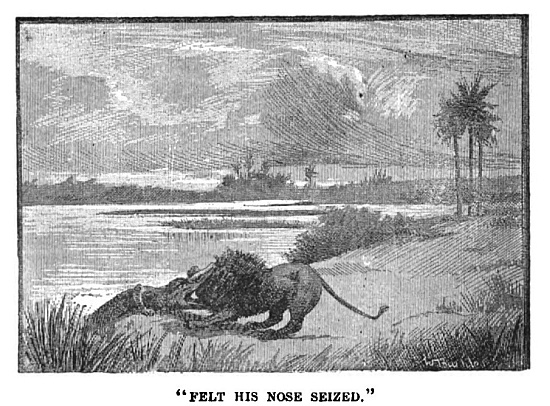
From the traces of the struggle by the water’s edge, it must have been a terrible one. The crocodile’s long claws had left deep marks, showing how he must have been lifted out of the water, and flung forcibly down; but in the morning both lion and crocodile were found dead, the crocodile’s throat wide open with a broad gash, but his teeth still fastened in the lion’s nose.
Saruti had not half finished his stories when he felt, by seeing Mtesa yawn, that though his adventures were very interesting, and he was quite ready to continue, yet it would be to his advantage to dock his tongue for the time being. So he said, “Kabaka, the wise old man whom I met, told me one thing I had nearly forgotten to say. He said, ‘I know you are a servant of the king, and if ever you want the king’s face to soften to you and his hand to open with gifts, compare yourself to the lid of a cooking-pot, which, though the pot may be full of fragrant stew, receives naught but the vapour, and the king who is wise will understand and will be pleased with his servant.’”
“Very well said indeed, Saruti,” cried Mtesa, laughing. “I understand. The lid must share with the pot this time. Steward,” he said, turning to Kauta, “see that six head of cattle be driven to Saruti’s cattle-pen;” and Saruti twiyanzied (thanked with prostrations) so often that his head swam.
Chapter Sixteen.
The Boy Kinneneh and the Gorilla.
It is in such stories as the Fable of the Rabbit, the Leopard and the Goat, the Dog and the little Chicken, the Leopard, the Sheep and the Dove, the Crane, the Leopard and the Sheep, the Rabbit and the Lion, the Cow and the Lion, the Lion and his mane, the Rabbit and the Leopard, and the boy Kinneneh and the Gorilla, that Kadu, our accomplished relator of legends, shone. It is not with a wish to be unkind to Kadu that I say he showed only too well that according to him cunning was to be preferred to strength. Perhaps he was right, though cunning is a word in much discredit with us nowadays, because we are accustomed to ally it with deception and fraud, but we will put the best possible construction on it out of admiration for and gratitude to Kadu, and claim that his cunning, which was the moral of most of his stories, was a kind of illegitimate wisdom, or a permissible artfulness. None of us, at least, but sympathised with Kadu’s dumb heroes when, by a little pleasant cheat or sly stratagem, the bullying buffalo got the worst of an encounter with the sharp-witted rabbit, or when the dog got the better of his sour mistress the leopardess, or when rabbit put to shame the surly elephant, or when Kibatti conquered the kings of the animal tribes. The legend of Kinneneh and the Gorilla was another story which evidently was meant by Kadu and the unknown ancient of Uganda who invented it to illustrate that cunning is mightier than strength. He told it in this wise:
In the early days of Uganda, there was a small village situate on the other side of the Katonga, in Buddu, and its people had planted bananas and plantains which in time grew to be quite a large grove, and produced abundant and very fine fruit. From a grove of bananas when its fruit is ripe there comes a very pleasant odour, and when a puff of wind blows over it, and bears the fragrance towards you, I know of nothing so well calculated to excite the appetite, unless it be the smell of roasted meat. Anyhow, such must have been the feeling of a mighty big gorilla, who one day, while roaming about alone in the woods searching for nuts to eat, stopped suddenly and stood up and sniffed for some time, with his nose well out in the direction of the village. After awhile he shook his head and fell on all fours again to resume his search for food. Again there came with a whiff of wind a strong smell of ripe bananas, and he stood on his feet once more, and with his nose shot out thus he drew in a greedy breath and then struck himself over the stomach, and said:
“I thought it was so. There are bananas that way, and I must get some.”
Down he fell on all fours, and put out his arms with long stretches, just as a fisherman draws in a heavy net, and is eager to prevent the escape of the fish.
In a little while he came to the edge of the grove, and stood and looked gloatingly on the beautiful fruit hanging in great bunches. Presently he saw something move. It was a woman bent double over a basket, and packing the fruit neatly in it, so that she could carry a large quantity at one journey.
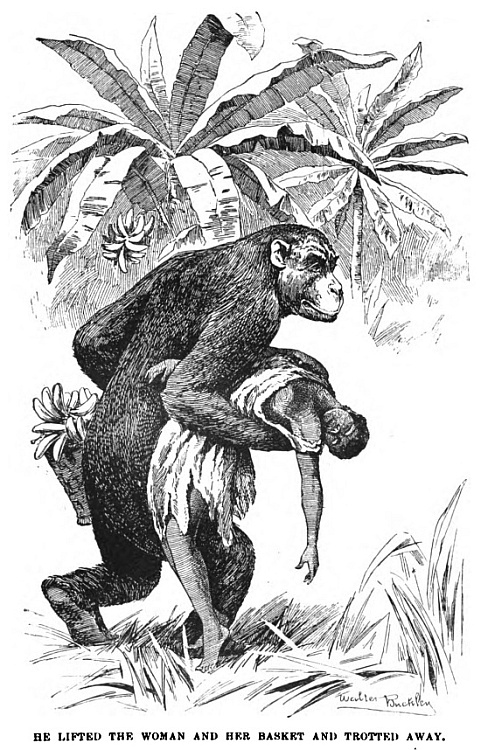
The gorilla did not stay long thinking, but crawled up secretly to her; and then with open arms rushed forward and seized her. Before the woman could utter her alarm he had lifted her and her basket and trotted away with them into the deepest bush. On reaching his den he flung the woman on the ground, as you would fling dead meat, and bringing the banana basket close to him, his two legs hugging it close to his round paunch, he began to gorge himself, muttering while he peeled the fruit strange sounds. By-and-by the woman came to her senses, but instead of keeping quiet, she screamed and tried to run away. If it were not for that movement and noise, she perhaps might have been able to creep away unseen, but animals of all kinds never like to be disturbed while eating, so Gorilla gave one roar of rage, and gave her such a squeeze that the breath was clean driven out of her. When she was still he fell to again, and tore the peeling off the bananas, and tossed one after another down his wide throat, until there was not one of the fruit left in the basket, and the big paunch was swollen to twice its first size. Then, after laying his paw on the body to see if there was any life left in it, he climbed up to his nest above, and curled himself into a ball for a sleep.
When he woke he shook himself and yawned, and looking below he saw the body of the woman, and her empty basket, and he remembered what had happened. He descended the tree, lifted the body and let it fall, then took up the basket, looked inside and outside of it, raked over the peelings of the bananas, but could not find anything left to eat.
He began to think, scratching the fur on his head, on his sides, and his paunch, picking up one thing and then another in an absent-minded way. And then he appeared to have made up a plan.
Whatever it was, this is what he did. It was still early morning, and as there was no sign of a sun, it was cold, and human beings must have been finishing their last sleep. He got up and went straight for the plantation. On the edge of the banana-grove he heard a cock crow; he stopped and listened to it; he became angry.
“Some one,” he said to himself, “is stealing my bananas,” and with that he marched in the direction where the cock was crowing.
He came to the open place in front of the village, and saw several tall houses much larger than his own nest; and while he was looking at them, the door of one of them was opened, and a man came out. He crept towards him, and before he could cry out the gorilla had squeezed him until his ribs had cracked, and he was dead; he flung him down, and entered into the hut. He there saw a woman, who was blowing a fire on the hearth, and he took hold of her and squeezed her until there was no life left in her body. There were three children inside, and a bed on the floor. He treated them also in the same way, and they were all dead. Then he went into another house, and slew all the people in it, one with a squeeze, another with a squeeze and a bite with his great teeth, and there was not one left alive. In this way he entered into five houses and killed all the people in them, but in the sixth house lived the boy Kinneneh and his old mother.
Kinneneh had fancied that he heard an unusual sound, and he had stood inside with his eyes close to a chink in the reed door for some time when he saw something that resembled what might be said to be half animal and half man. He walked like a man, but had the fur of a beast. His arms were long, and his body was twice the breadth and thickness of a full-grown man. He did not know what it was, and when he saw it go into his neighbours’ houses, and heard those strange sounds, he grew afraid, and turned and woke his mother, saying,
“Mother, wake up! there is a strange big beast in our village killing our people. So wake up quickly and follow me.”
“But whither shall we fly, my son?” she whispered anxiously.
“Up to the loft, and lie low in the darkest place,” replied Kinneneh, and he set her the example and assisted his mother.
Now those Uganda houses are not low-roofed like these of Congo-land, but are very high, as high as a tree, and they rise to a point, and near the top there is a loft where we stow our nets, and pots, and where our spear-shafts and bows are kept to season, and where our corn is kept to dry, and green bananas are stored to ripen. It was in this dark lofty place that Kinneneh hid himself and his mother, and waited in silence.
In a short time the gorilla put his head into their house and listened, and stepping inside he stood awhile, and looked searchingly around. He could see no one and heard nothing stir. He peered under the bed-grass, into the black pots and baskets, but there was no living being to be found.
“Ha, ha,” he cried, thumping his chest like a man when he has got the big head. “I am the boss of this place now, and the tallest of these human nests shall be my own, and I shall feast every day on ripe bananas and plantains, and there is no one who can molest me—ha, ha!”
“Ha, ha!” echoed a shrill, piping voice after his great bass.
The gorilla looked around once more, among the pots, and the baskets, but finding nothing walked out. Kinneneh, after awhile skipped down the ladder and watched between the open cane-work of the door, and saw him enter the banana-grove, and waited there until he returned with a mighty load of the fruit. He then saw him go out again into the grove, and bidding his mother lie still and patient, Kinneneh slipped out and ascended into the loft of the house chosen by the gorilla for his nest, where he hid himself and waited.
Presently the gorilla returned with another load of the fruit, and, squatting on his haunches, commenced to peel the fruit, and fill his throat and mouth with it, mumbling and chuckling, and saying,
“Ha, ha! This is grand! Plenty of bananas to eat, and all—all my own. None to say, ‘Give me some,’ but all my very own. Ho, ho! I shall feast every day. Ha, ha!”
“Ha, ha,” echoed the piping voice again.
The gorilla stopped eating and made an ugly frown as he listened. Then he said:
“That is the second time I have heard a thin voice saying, ‘Ha, ha!’ If I only knew who he was that cried ‘Ha, ha!’ I would squeeze him, and squeeze him until he cried, ‘Ugh, ugh!’”
“Ugh, ugh!” echoed the little voice again.
The gorilla leaped to his feet and rummaged around the pots and the baskets, took hold of the bodies one after another and dashed them against the floor, then went to every house and searched, but could not discover who it was that mocked him.
In a short time he returned and ate a pile of bananas that would have satisfied twenty men, and afterwards he went out, saying to himself that it would be a good thing to fill the nest with food, as it was a bore to leave the warm nest each time he felt a desire to eat.
No sooner had he departed than Kinneneh slipped down, and carried every bunch that had been left away to his own house, where they were stowed in the loft for his mother, and after enjoining his mother to remain still, he waited, peering through the chinks of the door.
He soon saw Gorilla bearing a pile of bunches that would have required ten men to carry, and after flinging them into the chief’s house, return to the plantation for another supply. While Gorilla was tearing down the plants and plucking at the bunches, Kinneneh was actively engaged in transferring what he brought into the loft by his mother’s side. Gorilla made many trips in this manner, and brought in great heaps, but somehow his stock appeared to be very small. At last his strength was exhausted, and feeling that he could do no more that day, he commenced to feed on what he had last brought, promising to himself that he would do better in the morning.
At dawn the gorilla hastened out to obtain a supply of fruit for his breakfast, and Kinneneh took advantage of his absence to hide himself overhead.
He was not long in his place before Gorilla came in with a huge lot of ripe fruit, and after making himself comfortable on his haunches with a great bunch before him he rocked himself to and fro, saying while he munched:
“Ha, ha! Now I have plenty again, and I shall eat it all myself. Ha, ha!”
“Ha, ha,” echoed a thin voice again, so close and clear it seemed to him, that leaping up he made sure to catch it. As there appeared to be no one in the house, he rushed out raging, champing his teeth, and searched the other houses, but meantime Kinneneh carried the bananas to the loft of the gorilla’s house, and covered them with bark-cloth.
In a short time Gorilla returned furious and disappointed, and sat down to finish the breakfast he had only begun, but on putting out his hands he found only the withered peelings of yesterday’s bananas. He looked and rummaged about, but there was positively nothing left to eat. He was now terribly hungry and angry, and he bounded out to obtain another supply, which he brought in and flung on the floor, saying,
“Ha, ha! I will now eat the whole at once—all to myself, and that other thing which says, ‘Ha, ha!’ after me, I will hunt and mash him like this,” and he seized a ripe banana and squeezed it with his paw with so much force that the pulp was squirted all over him. “Ha, ha!” he cried.
“Ha, ha!” mocked the shrill voice, so clear that it appeared to come from behind his ear.
This was too much to bear; Gorilla bounded up and vented a roar of rage. He tossed the pots, the baskets, the bodies, and bed-grass about—bellowing so loudly and funnily in his fury that Kinneneh, away up in the loft, could scarcely forbear imitating him. But the mocker could not be found, and Gorilla roared loudly in the open place before the village, and tore in and out of each house, looking for him.
Kinneneh descended swiftly from his hiding-place, and bore every banana into the loft as before.
Gorilla hastened to the plantation again, and so angry was he that he uprooted the banana-stalks by the root, and snapped off the clusters with one stroke of his great dog-teeth, and having got together a large stock, he bore it in his arms to the house.
“There,” said he, “ha, ha! Now I shall eat in comfort and have a long sleep afterwards, and if that fellow who mocks me comes near—ah! I would”—and he crushed a big bunch in his arms and cried, “ha, ha!”
“Ha, ha! Ha, ha!” cried the mocking voice; and again it seemed to be at the back of his head. Whereupon Gorilla flung his arms behind in the hope of catching him, but there was nothing but his own back, which sounded like a damp drum with the stroke.
“Ha, ha! Ha, ha!” repeated the voice, at which Gorilla shot out of the door, and raced round the house, thinking that the owner was flying before him, but he never could overtake the flyer. Then he went around outside of the other houses, and flew round and round the village, but he could discover naught. But meanwhile Kinneneh had borne all the stock of bananas up into the loft above, and when Gorilla returned there was not one banana of all the great pile he had brought left on the floor.
When, after he was certain that there was not a single bit of a banana left for him to eat, he scratched his sides and his legs, and putting his hand on the top of his head, he uttered a great cry just like a great, stupid child, but the crying did not fill his tummy. No, he must have bananas for that—and he rose up after awhile and went to procure some more fruit.
But when he had brought a great pile of it and had sat down with his nice-smelling bunch before him, he would exclaim, “Ha, ha! Now—now I shall eat and be satisfied. I shall fill myself with the sweet fruit, and then lie down and sleep. Ha, ha!”
Then instantly the mocking voice would cry out after him, “Ha, ha!” and sometimes it sounded close to his ears, and then behind his head, sometimes it appeared to come from under the bananas and sometimes from the doorway:—that Gorilla would roar in fury, and he would grind his teeth just like two grinding-stones, and chatter to himself, and race about the village, trying to discover whence the voice came, but in his absence the fruit would be swept away by his invisible enemy, and when he would come in to finish his meal, lo! there were only blackened and stained banana peelings—the refuse of his first feast.
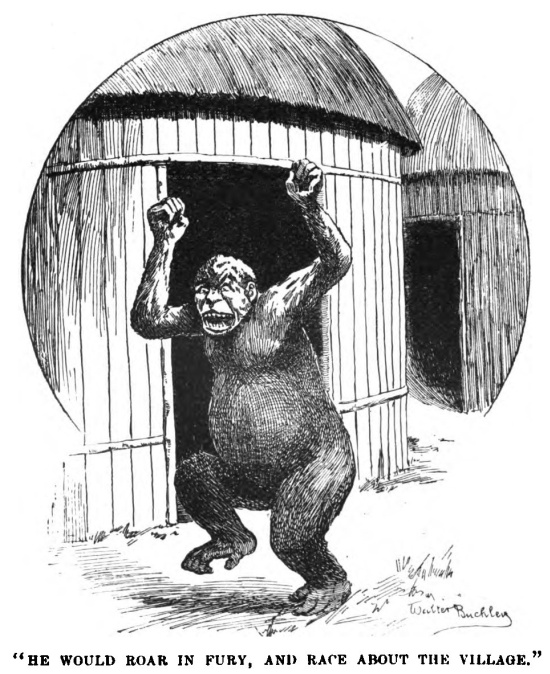
Gorilla would then cry like a whipped child, and would go again into the plantation, to bring some more fruit into the house, but when he returned with it he would always boast of what he was going to do, and cry out “Ha, ha!” and instantly his unseen enemy would mock him and cry “Ha, ha!” and he would start up raving and screaming in rage, and search for him, and in his absence his bananas would be whisked away. And Gorilla’s hunger grew on him, until his paunch became like an empty sack, and what with his hunger and grief and rage, and furious raving and racing about, his strength was at last quite exhausted, and the end of him was that on the fifth day he fell from weakness across the threshold of the chief’s house, which he had chosen to make his nest, and there died.
When the people of the next village heard of how Kinneneh, a little boy, had conquered the man-killing gorilla, they brought him and his mother away, and they gave him a fine new house and a plantation, and male and female slaves to tend it, and when their old king died, and the period of mourning for him was over, they elected wise Kinneneh to be king over them.
“Ah, friends,” said Safeni to his companions, after Kadu had concluded his story, “there is no doubt that the cunning of a son of man prevails over the strongest brute, and it is well for us, Mashallah! that it should be so; for if the elephant, or the lion, or the gorilla possessed but cunning equal to their strength, what would become of us!”
And each man retired to his hut, congratulating himself that he was born a man-child, and not a thick, muddle-headed beast.
Chapter Seventeen.
The City of the Elephants.
“Master,” said Kassim, one of the Basoko boys, “Baruti’s tales have brought back from among forgotten things a legend I once knew very well. Ah, I wish I could remember more, but little by little the stories that I used to hear in my childhood from my mother and the old woman who would come and sit with her, will perhaps return again into the mind. I should never have thought of this that I am about to repeat to you now had it not been that Baruti’s legends seem to recall as though they were but yesterday the days that came and went uncounted in our Basoko village. This legend is about the City of the Elephants that one of my countrymen and his wife came across in the far past time, in the manner that I shall tell you.”
A Bungandu man named Dudu, and his wife Salimba, were one day seeking in the forest a long way from the town for a proper redwood-tree, out of which they could make a wooden mortar wherein they could pound their manioc. They saw several trees of this kind as they proceeded, but after examining one, and then another, they would appear to be dissatisfied, and say, “Perhaps if we went a little further we might find a still better tree for our purpose.”
And so Dudu and Salimba proceeded further and further into the tall and thick woods, and ever before them there appeared to be still finer trees which would after all be unsuited for their purpose, being too soft, or too hard, or hollow, or too old, or of another kind than the useful redwood. They strayed in this manner very far. In the forest where there is no path or track, it is not easy to tell which direction one came from, and as they had walked round many trees, they were too confused to know which way they ought to turn homeward. When Dudu said he was sure that his course was the right one for home, Salimba was as sure that the opposite was the true way. They agreed to walk in the direction Dudu wished, and after a long time spent on it, they gave it up and tried another, but neither took them any nearer home.
The night overtook them and they slept at the foot of a tree. The next day they wandered still farther from their town, and they became anxious and hungry. As one cannot see many yards off on any side in the forest, an animal hears the coming step long before the hunter gets a chance to use his weapon. Therefore, though they heard the rustle of the flying antelope, or wild pig as it rushed away, it only served to make their anxiety greater. And the second day passed, and when night came upon them they were still hungrier.
Towards the middle of the third day, they came into an open place by a pool frequented by Kiboko (hippo), and there was a margin of grass round about it, and as they came in view of it, both, at the same time, sighted a grazing buffalo.
Dudu bade his wife stand behind a tree while he chose two of his best and sharpest arrows, and after a careful look at his bow-string, he crept up to the buffalo, and drove an arrow home as far as the guiding leaf, which nearly buried it in the body. While the beast looked around and started from the twinge within, Dudu shot his second arrow into his windpipe, and it fell to the ground quite choked. Now here was water to drink and food to eat, and after cutting a load of meat they chose a thick bush-clump a little distance from the pool, made a fire, and, after satisfying their hunger, slept in content. The fourth day they stopped and roasted a meat provision that would last many days, because they knew that luck is not constant in the woods.
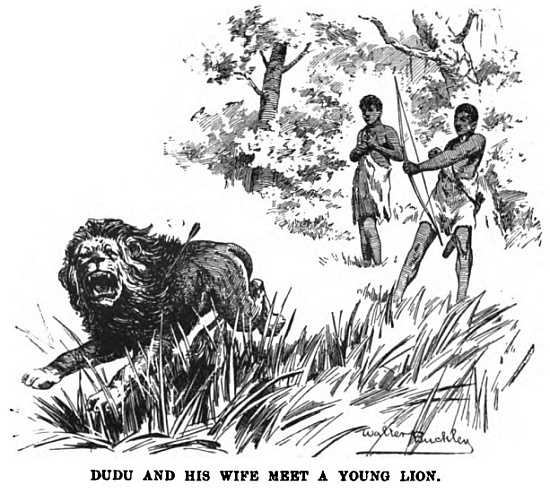
On the fifth they travelled, and for three days more they wandered. They then met a young lion who, at the sight of them, boldly advanced, but Dudu sighted his bow, and sent an arrow into his chest which sickened him of the fight, and he turned and fled.
A few days afterwards, Dudu saw an elephant standing close to them behind a high bush, and whispered to his wife:
“Ah, now, we have a chance to get meat enough for a month.”
“But,” said Salimba, “why should you wish to kill him, when we have enough meat still with us? Do not hurt him. Ah, what a fine back he has, and how strong he is. Perhaps he would carry us home.”
“How could an elephant understand our wishes?” asked Dudu.
“Talk to him anyhow, perhaps he will be clever enough to understand what we want.”
Dudu laughed at his wife’s simplicity, but to please her he said, “Elephant, we have lost our way; will you carry us and take us home, and we shall be your friends for ever.”
The Elephant ceased waving his trunk, and nodding to himself, and turning to them said—
“If you come near to me and take hold of my ears, you may get on my back, and I will carry you safely.”
When the Elephant spoke, Dudu fell back from surprise, and looked at him as though he had not heard aright, but Salimba advanced with all confidence, and laid hold of one of his ears, and pulled herself up on to his back. When she was seated, she cried out, “Come, Dudu, what are you looking at? Did you not hear him say he would carry you?”
Seeing his wife smiling and comfortable on the Elephant’s back, Dudu became a little braver and moved forward slowly, when the Elephant spoke again, “Come, Dudu, be not afraid. Follow your wife, and do as she did, and then I will travel home with you quickly.”
Dudu then put aside his fears, and his surprise, and seizing the Elephant’s ear, he ascended and seated himself by his wife on the Elephant’s back.
Without another word the Elephant moved on rapidly, and the motion seemed to Dudu and Salimba most delightful. Whenever any overhanging branch was in the way, the Elephant wrenched it off, or bent it and passed on. No creek, stream, gulley, or river, stopped him, he seemed to know exactly the way he should go, as if the road he was travelling was well known to him.
When it was getting dark he stopped and asked his friends if they would not like to rest for the night, and finding that they so wished it, he stopped at a nice place by the side of the river, and they slid to the ground, Dudu first, and Salimba last. He then broke dead branches for them, out of which they made a fire, and the Elephant stayed by them, as though he was their slave.
Hearing their talk, he understood that they would like to have something better than dried meat to eat, and he said to them, “I am glad to know your wishes, for I think I can help you. Bide here a little, and I will go and search.”
About the middle of the night he returned to them with something white in his trunk, and a young antelope in front of him. The white thing was a great manioc root, which he dropped into Salimba’s lap.
“There, Salimba,” he said, “there is food for you, eat your fill and sleep in peace, for I will watch over you.”
Dudu and Salimba had seen many strange things that day, but they were both still more astonished at the kindly and intelligent care which their friend the Elephant took of them. While they roasted their fresh meat over the flame, and the manioc root was baking under the heap of hot embers, the Elephant dug with his tusks for the juicy roots of his favourite trees round about their camp, and munched away contentedly.
The next morning, all three, after a bathe in the river, set out on their journey more familiar with one another, and in a happier mood.
About noon, while they were resting during the heat of the day, two lions came near to roar at them, but when Dudu was drawing his bow at one of them, the Elephant said:
“You leave them to me; I will make them run pretty quick,” saying which he tore off a great bough of a tree, and nourishing this with his trunk, he trotted on the double quick towards them, and used it so heartily that they both skurried away with their bellies to the ground, and their hides shrinking and quivering out of fear of the great rod.
In the afternoon the Elephant and his human friends set off again, and some time after they came to a wide and deep river. He begged his friends to descend while he tried to find out the shallowest part. It took him some time to do this; but, having discovered a ford where the water was not quite over his back, he returned to them, and urged them to mount him as he wished to reach home before dark.
As the Elephant was about to enter the river, he said to Dudu, “I see some hunters of your own kind creeping up towards us. Perhaps they are your kinsmen. Talk to them, and let us see whether they be friends or foes.”
Dudu hailed them, but they gave no answer, and, as they approached nearer, they were seen to prepare to cast their spears, so the Elephant said, “I see that they are not your friends; therefore, as I cross the river, do you look out for them, and keep them at a distance. If they come to the other side of the river, I shall know how to deal with them.”
They got to the opposite bank safely; but, as they were landing, Dudu and Salimba noticed that their pursuers had discovered a canoe, and that they were pulling hard after them. But the Elephant soon after landing came to a broad path smoothed by much travel, over which he took them at a quick pace, so fast, indeed, that the pursuers had to run to be able to keep up with them. Dudu, every now and then let fly an arrow at the hunters, which kept them at a safe distance.
Towards night they came to the City of the Elephants, which was very large and fit to shelter such a multitude as they now saw. Their elephant did not linger, however, but took his friends at the same quick pace until they came to a mighty elephant that was much larger than any other, and his ivories were gleaming white and curled up, and exceedingly long. Before him Dudu and Salimba were told by their friend to descend and salaam, and he told his lord how he had found them lost in the woods, and how for the sake of the kindly words of the woman he had befriended them, and assisted them to the city of his tribe. When the King Elephant heard all this he was much pleased, and said to Dudu and Salimba that they were welcome to his city, and how they should not want for anything, as long as they would be pleased to stay with them, but as for the hunters who had dared to chase them, he would give orders at once. Accordingly he gave a signal, and ten active young elephants dashed out of the city, and in a short time not one of the hunters was left alive, though one of them had leaped into the river, thinking that he could escape in that manner. But then you know that an elephant is as much at home in a river, as a Kiboko (a hippopotamus), so that the last man was soon caught and was drowned.
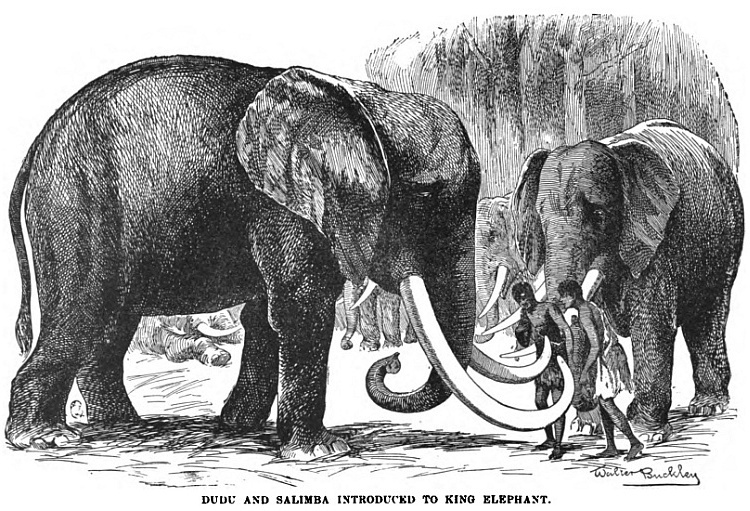
Dudu and Salimba, however, on account of Salimba’s kind heart in preventing her husband wounding the elephant, were made free of the place, and their friend took them with him to many families, and the big pa’s and ma’s told their little babies all about them and their habits, and said that, though most of the human kind were very stupid and wicked, Dudu and Salimba were very good, and putting their trunks into their ears they whispered that Salimba was the better of the two. Then the little elephants gathered about them and trotted by their side and around them and diverted them with their antics, their races, their wrestlings, and other trials of strength, but when they became familiar and somewhat rude in their rough play, their elephant friend would admonish them, and if that did not suffice, he would switch them soundly.
The City of the Elephants was a spacious and well-trodden glade in the midst of a thick forest, and as it was entered one saw how wisely the elephant families had arranged their manner of life. For without, the trees stood as thick as water-reeds, and the bush or underwood was like an old hedge of milkweed knitted together by thorny vines and snaky climbers into which the human hunter might not even poke his nose without hurt. Well, the burly elephants had, by much uprooting, created deep hollows, or recesses, wherein a family of two and more might snugly rest, and not even a dart of sunshine might reach them. Round about the great glade the dark leafy arches ran, and Dudu and his wife saw that the elephant families were numerous—for by one sweeping look they could tell that there were more elephants than there are human beings in a goodly village. In some of the recesses there was a row of six and more elephants; in another the parents stood head to head, and their children, big and little, clung close to their parents’ sides; in another a family stood with heads turned towards the entrance, and so on all around—while under a big tree in the middle there was quite a gathering of big fellows, as though they were holding a serious palaver; under another tree one seemed to be on the outlook; another paced slowly from side to side; another plucked at this branch or at that; another appeared to be heaving a tree, or sharpening a blunted ivory; others seemed appointed to uproot the sprouts, lest the glade might become choked with underwood. Near the entrance on both sides were a brave company of them, faces turned outward, swinging their trunks, napping their ears, rubbing against each other, or who with pate against pate seemed to be drowsily considering something. There was a continual coming in and a going out, singly, or in small companies. The roads that ran through the glade were like a network, clean and smooth, while that which went towards the king’s place was so wide that twenty men might walk abreast. At the far end the king stood under his own tree, with his family under the arches behind him.
This was the City of the Elephants as Dudu and Salimba saw it. I ought to say that the outlets of it were many. One went straight through the woods in a line up river, at the other end it ran in a line following the river downward; one went to a lakelet, where juicy plants and reeds throve like corn in a man’s fields, and where the elephants rejoiced in its cool water, and washed themselves and infants; another went to an ancient clearing where the plantain and manioc grew wild, and wherein more than two human tribes might find food for countless seasons.
Then said their friend to Dudu and Salimba—“Now that I have shown you our manner of life, it is for you to ease your longing for awhile and rest with us. When you yearn for home, go tell our king, and he will send you with credit to your kindred.”
Then Dudu and his wife resolved to stay, and eat, and they stayed a whole season, not only unhurt, but tenderly cared for, with never a hungry hour or uneasy night. But at last Salimba’s heart remembered her children, and kinfolk, and her own warm house and village pleasures, and on hinting of these memories to her husband, he said that after all there was no place like Bungandu. He remembered his long pipe, and the talk-house, the stool-making, shaft-polishing, bow-fitting, and the little tinkering jobs, the wine-trough, and the merry drinking bouts, and he wept softly as he thought of them.
They thus agreed that it was time for them to travel homeward, and together they sought the elephant king, and frankly told him of their state.
“My friends,” he replied, “be no longer sad, but haste to depart. With the morning’s dawn guides shall take you to Bungandu with such gifts as shall make you welcome to your folk. And when you come to them, say to them that the elephant king desires lasting peace and friendship with them. On our side we shall not injure their plantations, neither a plantain, nor a manioc root belonging to them; and on your side dig no pits for our unwary youngsters, nor hang the barbed iron aloft, nor plant the poisoned stake in the path, so we shall escape hurt and be unprovoked.” And Dudu put his hand on the king’s trunk as the pledge of good faith.
In the morning, four elephants, as bearers of the gifts from the king—bales of bark-cloth, and showy mats, and soft hides and other things—and two fighting elephants besides their old friend, stood by the entrance to the city, and when the king elephant came up he lifted Salimba first on the back of her old companion, and then placed Dudu by her side, and at a parting wave the company moved on.
In ten days they reached the edge of the plantation of Bungandu, and the leader halted. The bales were set down on the ground, and then their friend asked of Dudu and his wife—
“Know you where you are?”
“We do,” they answered.
“Is this Bungandu?” he asked.
“This is Bungandu,” they replied.
“Then here we part, that we may not alarm your friends. Go now your way, and we go our way. Go tell your folk how the elephants treat their friends, and let there be peace for ever between us.”
The elephants turned away, and Dudu and Salimba, after hiding their wealth in the underwood, went arm in arm into the village of Bungandu. When their friends saw them, they greeted them as we would greet our friends whom we have long believed to be dead, but who come back smiling and rejoicing to us. When the people heard their story they greatly wondered and doubted, but when Dudu and Salimba took them to the place of parting and showed them the hoof prints of seven elephants on the road, and the bales that they had hidden in the underwood, they believed their story. And they made it a rule from that day that no man of the tribe ever should lift a spear, or draw a bow, or dig a pit, or plant the poisoned stake in the path, or hang the barbed iron aloft, to do hurt to an elephant. And as a proof that I have but told the truth go ask the Bungandu, and they will say why none of their race will ever seek to hurt the elephant, and it will be the same as I have told you. That is my story.
Chapter Eighteen.
The Search for the Home of the Sun.
We had a man named Kanga with us in 1883, which name seems to have been bestowed on him by some Islamised resident of Nyangwé by reason of some fancied suggestion made by some of his facial marks to the spots on a guinea-fowl. Kanga had not spoken as yet by the evening fire, but had been an amused listener. When the other tale-tellers were seen sporting their gay robes on the Sunday, it may have inspired him to make an effort to gain one for himself; anyhow, he surprised us one night by saying that he knew of a tale which perhaps we would like to hear. As Kanga’s tribe was the Wasongora-Meno on the right bank of the Lualaba, between Nyangwé and Stanley Falls, the mere mention of a tale from that region was sufficient to kindle my interest.
After a few suitable compliments to Kanga, which were clearly much appreciated, he spoke as follows:
Master and friends. We have an old phrase among us which is very common. It is said that he who waits and waits for his turn, may wait too long, and lose his chance. My tongue is not nimble like some, and my words do not flow like the deep river. I am rather like the brook which is fretted by the stones in its bed, and I hope after this explanation you will not be too impatient with me.
My tale is about King Masama and his tribe, the Balira, who dwelt far in the inmost region, behind (east) us, who throng the banks of the great river. They were formerly very numerous, and many of them came to live among us, but one day King Masama and the rest of the tribe left their country and went eastward, and they have never been heard of since, but those who chose to stay with us explained their disappearance in this way.
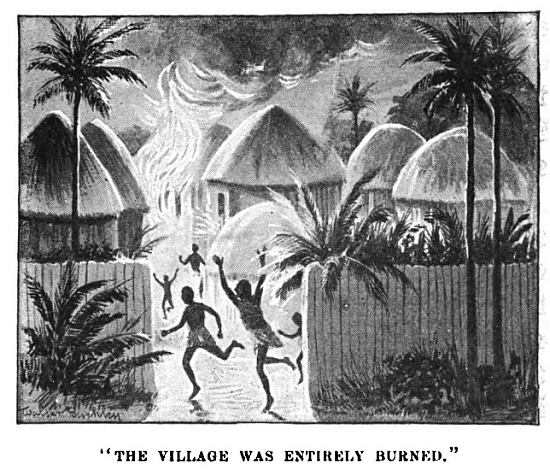
A woman, one cold night, after making up her fire on the hearth, went to sleep. In the middle of the night the fire had spread, and spread, and began to lick up the litter on the floor, and from the litter it crept to her bed of dry banana-leaves, and in a little time shot up into flames. When the woman and her husband were at last awakened by the heat, the flames had already mounted into the roof, and were burning furiously. Soon they broke through the top and leaped up into the night, and a gust of wind came and carried the long flames like a stream of fire towards the neighbouring huts, and in a short time the fire had caught hold of every house, and the village was entirely burned. It was soon known that besides burning up their houses and much property, several old people and infants had been destroyed by the fire, and the people were horror-struck and angry.
Then one voice said, “We all know in whose house the fire began, and the owner of it must make our losses good to us.”
The woman’s husband heard this, and was alarmed, and guiltily fled into the woods.
In the morning a council of the elders was held, and it was agreed that the man in whose house the fire commenced should be made to pay for his carelessness, and they forthwith searched for him. But when they sought for him he could not be found. Then all the young warriors who were cunning in wood-craft, girded and armed themselves, and searched for the trail, and when one of them had found it, he cried out, and the others gathered themselves about him and took it up, and when many eyes were set upon it, the trail could not be lost.
They soon came up to the man, for he was seated under a tree, bitterly weeping.
Without a word they took hold of him by the arms and bore him along with them, and brought him before the village fathers. He was not a common man by any means. He was known as one of Masama’s principal men, and one whose advice had been often followed.
“Oh,” said everybody, “he is a rich man, and well able to pay; yet, if he gives all he has got, it will not be equal to our loss.”
The fathers talked a long time over the matter, and at last decided that to save his forfeited life he should freely turn over to them all his property. And he did so. His plantation of bananas and plantains, his plots of beans, yams, manioc, potatoes, ground-nuts, his slaves, spears, shields, knives, paddles and canoes. When he had given up all, the hearts of the people became softened towards him, and they forgave him the rest.
After the elder’s property had been equally divided among the sufferers by the fire, the people gained new courage, and set about rebuilding their homes, and before long they had a new village, and they had made themselves as comfortable as ever.
Then King Masama made a law, a very severe law—to the effect that, in future, no fire should be lit in the houses during the day or night; and the people, who were now much alarmed about fire, with one heart agreed to keep the law. But it was soon felt that the cure for the evil was as cruel as the fire had been. For the houses had been thatched with green banana-leaves, the timbers were green and wet with their sap, the floor was damp and cold, the air was deadly, and the people began to suffer from joint aches, and their knees were stiff, and the pains travelled from one place to another through their bodies. The village was filled with groaning.
Masama suffered more than all, for he was old. He shivered night and day, and his teeth chattered sometimes so that he could not talk, and after that his head would burn, and the hot sweat would pour from him, so that he knew no rest.
Then the king gathered his chiefs and principal men together, and said:
“Oh, my people, this is unendurable, for life is with me now but one continuous ague. Let us leave this country, for it is bewitched, and if I stay longer there will be nothing left of me. Lo, my joints are stiffened with my disease, and my muscles are withering. The only time I feel a little ease is when I lie on the hot ashes without the house, but when the rains fall I must needs withdraw indoors, and there I find no comfort, for the mould spreads everywhere. Let us hence at once to seek a warmer clime. Behold whence the sun issues daily in the morning, hot and glowing; there, where his home is, must be warmth, and we shall need no fire. What say you?”
Masama’s words revived their drooping spirits. They looked towards the sun as they saw him mount the sky, and felt his cheering glow on their naked breasts and shoulders, and they cried with one accord: “Let us hence, and seek the place whence he comes.”
And the people got ready and piled their belongings in the canoes, and on a certain day they left their village and ascended their broad river, the Lira. Day after day they paddled up the stream, and we heard of them from the Bafanya as they passed by their country, and the Bafanya heard of them for a long distance up—from the next tribe—the Bamoru—and the Bamoru heard about them arriving near the Mountain Land beyond.
Not until a long time afterwards did we hear what became of Masama and his people.
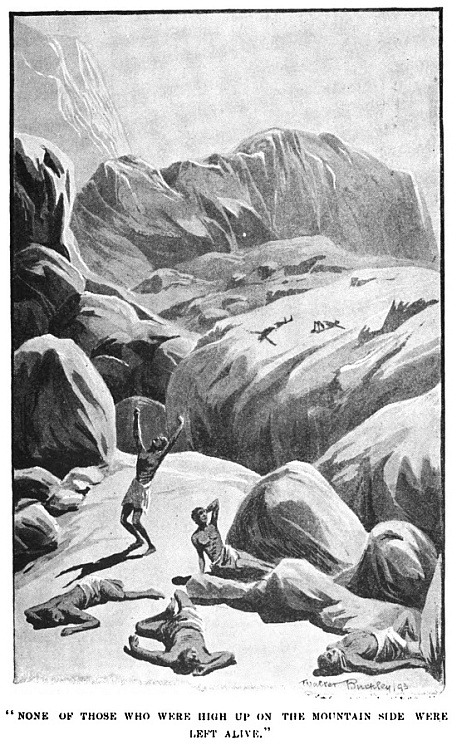
It was said that the Balira, when the river had become shallow and small, left their canoes and travelled by land among little hills, and after winding in and out amongst them they came to the foot of the tall mountain which stands like a grandsire amongst the smaller mountains. Up the sides of the big mountain they straggled, the stronger and more active of them ahead, and as the days passed, they saw that the world was cold and dark until the sun showed himself over the edge of the big mountain, when the day became more agreeable, for the heat pierced into their very marrows, and made their hearts rejoice. The greater the heat became, the more certain were they that they were drawing near the home of the sun. And so they pressed on and on, day after day, winding along one side of the mountain, and then turning to wind again still higher. Each day, as they advanced towards the top, the heat became greater and greater. Between them and the sun there was now not the smallest shrub or leaf, and it became so fiercely hot that finally not a drop of sweat was left in their bodies. One day, when not a cloud was in the sky, and the world was all below them—far down like a great buffalo hide—the sun came out over the rim of the mountain like a ball of fire, and the nearest of them to the top were dried like a leaf over a flame, and those who were behind were amazed at its burning force, and felt, as he sailed over their heads, that it was too late for them to escape. Their skins began to shrivel up and crackle, and fall off, and none of those who were high up on the mountain side were left alive. But a few of those who were nearest the bottom, and the forest belts, managed to take shelter, and remaining there until night, they took advantage of the darkness, when the sun sleeps, to fly from the home of the sun. Except a few poor old people and toddling children, there was none left of the once populous tribe of the Balira.
That is my story. We who live by the great river have taken the lesson, which the end of this tribe has been to us, close to our hearts, and it is this. Kings who insist that their wills should be followed, and never care to take counsel with their people, are as little to be heeded as children who babble of what they cannot know, and therefore in our villages we have many elders who take all matters from the chief and turn them over in their minds, and when they are agreed, they give the doing of them to the chief, who can act only as the elders decree.
Chapter Nineteen.
A Hospitable Gorilla.
“Sir,” said Baruti, after we had all gathered around the evening fire, and were waiting expectant for the usual story, “Kassim’s tale about the City of the Elephants and the peace that was entered into between the elephants and the Bungandu has reminded me of what happened between a tribe living on the banks of the little Black River above the Basoko, and a Gorilla.”
“Wallahi, but these Basoko boys beat everybody for telling stories,” exclaimed a Zanzibari. “I wonder, however, whether they invent them, or they really have heard them from their old folk, as they say they did.”
“We heard them, of course,” replied Baruti, with an indignant look; “for how could Kassim or I imagine such things? I heard something each day almost from the elders, or the old women of the tribe. My mother also told me some, and my big brother told me others. At our village talk-house, scarcely a day passed but we heard of some strange thing which had happened in old times. It is this custom of meeting around the master’s fire, and the legends that we hear, that reminds us of what we formerly heard, and by thinking and thinking over them the words come back anew to us.”
“But do you think these things of which you talk are true?” the Zanzibari asked.
“True!” he echoed. “Who am I that I should say, This thing is true, and that is false! I but repeat what my betters said. I do not speak of what I saw, but of what I heard, and the master’s words to us were: ‘Try and remember what was said to you in your villages by the ancients among your people, and if you will tell it to me properly, I will give you a nice cloth.’ Well, when our old men were in good-humour, and smoked their long pipes, and the pot of wine was by their side, and we asked them to tell us somewhat about the days when they were young, they would say, ‘Listen to this now,’ and they would tell us of what happened long ago. It is the things of long ago that we remember best, because they were so strange that they clung on the mind, and would not altogether be forgotten. If there is aught unpleasing in them, it is not our fault, for we but repeat the words that entered into our ears.”
“That will do, Baruti; go on with your story; and you, Baraka, let your tongue sleep,” cried Zaidi.
“I but asked a question. Ho! how impatient you fellows are!”
“Nay, this is but chatter—we shall never hear the story at this rate. Hyah! Barikallah! (Hurry on, in God’s name!) Baruti.”
Well (began Baruti), this tribe dwelt on the banks of the Black River just above Basoko town, and at that time of the far past the thick forest round about them was haunted by many monstrous animals; big apes, chimpanzees, gorillas and such creatures, which are not often seen nowadays. Not far from the village, in a darksome spot where the branches met overhead and formed a thick screen, and the lower wood hedged it closely round about so that a tortoise could scarcely penetrate it, there lived the Father of the Gorillas. He had housed himself in the fork of one of the tallest trees, and many men had seen the nest as they passed by, but none as yet had seen the owner.
But one day a fisherman in search of rattans to make his nets, wandered far into the woods, and in trying to recover the direction home struck the Black River high up. As he stood wondering whether this was the black stream that flowed past his village, he saw, a little to the right of him, an immense gorilla, who on account of the long dark fur on his chest appeared to be bigger than he really was. A cold sweat caused by his great fear began to come out of the man, and his knees trembled so that he could hardly stand, but when he perceived that the gorilla did not move, but continued eating his bananas, he became comforted a little, and his senses came back. He turned his head around, in order to see the clearest way for a run; but as he was about to start, he saw that the gorilla’s eyes were fixed on him. Then the gorilla broke out into speech and said:
“Come to me, and let me look at thee.”
The fisherman’s fear came back to him, but he did as he was told, and when he thought he was near enough, he stood still.
Then the gorilla said:
“If thou art kin to me, thou art safe from harm; if not, thou canst not pass. How many fingers hast thou?” he asked.
“Four,” the fisherman answered, and he held a hand up with its back towards the gorilla, and his thumb was folded in on the palm so that it could not be seen by the beast.
“Ay—true indeed. Why, thou must be a kinsman of ours, though thy fur is somewhat scanty. Sit down and take thy share of this food, and eat.”
The fisherman sat down, and broke off bananas from the stalk and ate heartily.
“Now mind,” said the gorilla, “thou hast eaten food with me. Shouldst thou ever meet in thy wanderings any of my brothers, thou must be kind to them in memory of this day. Our tribe has no quarrel with any of thine, and thy tribe must have none against any of mine. I live alone far down this river, and thy tribe lives further still. Mind our password, ‘Tu-wheli, Tu-wheli.’ By that we know who is friendly and who is against us.”
The fisherman departed, and speeding on his way reached his village safely; but he kept secret what he had seen and met that day.
Some little time after, the tribe resolved to have a grand hunt around their village, to scare the beasts of the forest away; for in some things they resemble us. If we leave a district undisturbed for a moon or so, the animals think that we have either departed the country or are afraid of them. The apes and the elephants are the worst in that respect, and always lead the way, pressing on our heels, and often sending their scouts ahead to report, or as a hint to us that we are lingering too long.
The people loaded themselves with their great nets, and first chose the district where the Gorilla Father lived. They set their nets around a wide space, and then the beaters were directed to make a large sweep and drive all the game towards the nets, and here and there where the netting was weak, the hunters stood behind a thick bush, their heavy spears ready for the fling.
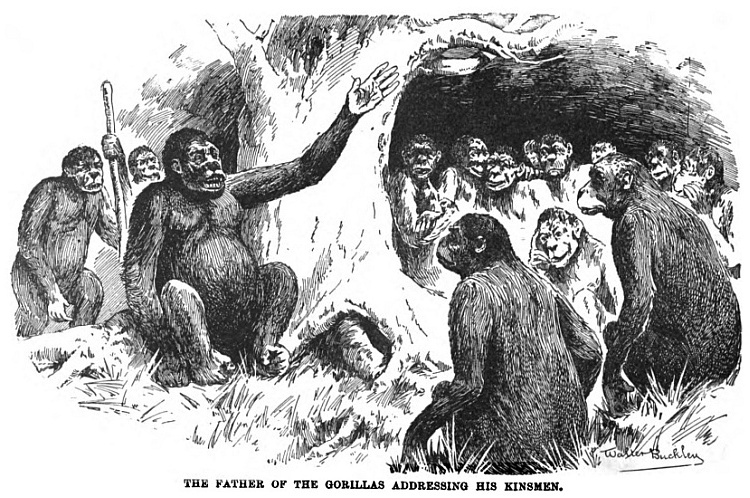
Well, it just happened that at that very time the Father of the Gorillas was holding forth to his kinsmen, and the first they knew of the hunt, and that a multitude of men were in the woods, was when they heard the horrid yells of the beaters, the sound of horns, the jingle of iron, and the all-round swish of bushes.
The fisherman, like the rest of his friends, was well armed, and he was as keen as the others for the hunt, but soon after he heard the cries of the beaters, he saw a large gorilla rushing out of the bushes, and knew him instantly for his friend, and he cried out “Tu-wheli! Tu-wheli!” At the sound of it the gorilla led his kinsmen towards him, and passed the word to those behind, saying, “Ah, this is our friend. Do not hurt him.”
The gorillas passed in a long line of mighty fellows, close by the fisherman, and as they heard the voice of their father, they only whispered to him, “Tu-wheli, Tu-wheli,” but the last of all was a big, sour-faced gorilla, who, when he saw that the pass was only guarded by one man, made a rush at him. His roar of rage was heard by the father, and turning back he knew that his human brother was in danger, and he cried out to those nearest to part them, “The man is our brother;” but as the fierce gorilla was deaf to words, the father loped back to them, and slew him, and then hastened away as the hunters were pressing up.
These, when they came up and observed that the fisherman’s spear was still in his hand, and not painted with blood, were furious, and they agreed together that he should not have a share of the meat, “For,” said they, “he must have been in a league against us.” Neither did he obtain any share of the spoil.
A few days after this the fisherman was proceeding through a part of the forest, and a gorilla met him in the path, and said:
“Stay, I seem to know thee. Art thou not our brother?”
“Tu-wheli, Tu-wheli!” he cried.
“Ah, it is true, follow me;” and they went together to the gorilla’s nesting-tree, where the fisherman was feasted on ripe bananas, berries, and nuts, and juicy roots, and he was shown which roots and berries were sweet, and which were bitter, and so great was the variety of food he saw, that he came to know that though lost in the forest a wise man need not starve.
When the fisherman returned to his village he called the elders together, and he laid the whole story of his adventures before his people, and when the elders heard that the berries and roots, nuts, and mushrooms in the forest, of which they had hitherto been afraid, were sweet and wholesome, they exclaimed with one voice, that the gorillas had proved themselves true friends, and had given them much useful knowledge; and it was agreed among them that in future the gorillas should be reckoned among those, against whom it would not be lawful to raise their spears.
Ever since the tribes on the Black River avoid harming the gorilla, and all his kind big and little; neither will any of the gorilla trespass on their plantations, or molest any of the people.
| Preface | | Chapter 1 | | Chapter 2 | | Chapter 3 | | Chapter 4 | | Chapter 5 | | Chapter 6 | | Chapter 7 | | Chapter 8 | | Chapter 9 | | Chapter 10 | | Chapter 11 | | Chapter 12 | | Chapter 13 | | Chapter 14 | | Chapter 15 | | Chapter 16 | | Chapter 17 | | Chapter 18 | | Chapter 19 |