"My Dark Companions" (continued 2)
Reading edition
When this had been done, she said, “Now, father, it is not meet that thy recovered daughter should soil her feet on the path to her father’s house. Thou must lay a grass-cloth along the ground all the way to my mother’s door.”
The king thereupon ordered a grass-cloth to be spread along the path towards the women’s quarters, but he did not mention to which doorway. His daughter then moved forward, the king by her side, until they came in view of all the king’s wives, and then Gumbi cried out to them—“One of you, I am told, is the mother of this girl. Look on her, and be not ashamed to own her, for she is as perfect as the egg. At the first sight of her I felt like a man filled with pleasantness, so let the mother come forward and claim her, and let her not destroy herself with a lie.”
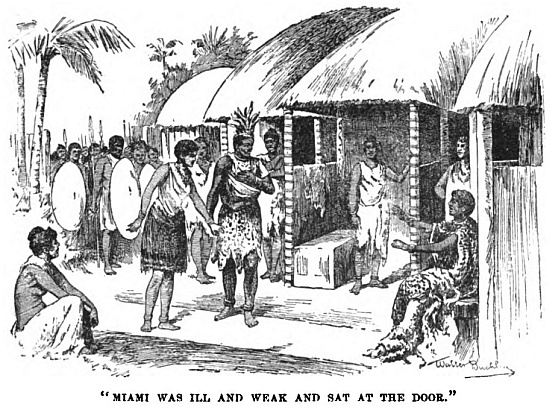
Now all the women bent forward and longed to say, “She is mine, she is mine!” but Miami, who was ill and weak, sat at the door, and said—
“Continue the matting to my doorway, for as I feel my heart is connected with her as by a cord, she must be the child whom the parrot carried to my mother with a banana stalk and two pieces of sugar-cane.”
“Yes, yes, thou must be my own mother,” cried the princess; and when the grass-cloth was laid even to the inside of the house, she ran forward, and folded her arms around her.
When Gumbi saw them together he said, “Truly, equals always come together. I see now by many things that the princess must be right. But she will not long remain with me, I fear, for a king’s daughter cannot remain many moons without suitors.”
Now though Gumbi considered it a trifle to destroy children whom he had never seen, it never entered into his mind to hurt Miami or the princess. On the contrary, he was filled with a gladness which he was never tired of talking about. He was even prouder of his daughter, whose lovely shape and limpid eyes so charmed him, than of all his tall sons. He proved this by the feasts he caused to be provided for all the people. Goats were roasted and stewed, the fishermen brought fish without number, the peasants came loaded with weighty bunches of bananas, and baskets of yams, and manioc, and pots full of beans, and vetches, and millet and corn, and honey and palm-oil, and as for the fowls—who could count them? The people also had plenty to drink of the juice of the palm, and thus they were made to rejoice with the king in the return of the princess.
It was soon spread throughout Manyema that no woman was like unto Gumbi’s daughter for beauty. Some said that she was of the colour of a ripe banana, others that she was like fossil gum, others like a reddish oil-nut, and others again that her face was more like the colour of the moon than anything else. The effect of this reputation was to bring nearly all the young chiefs in the land as suitors for her hand. Many of them would have been pleasing to the king, but the princess was averse to them, and she caused it to be made known that she would marry none save the young chief who could produce matako (brass rods) by polishing his teeth. The king was very much amused at this, but the chiefs stared in surprise as they heard it.
The king mustered the choicest young men of the land, and he told them it was useless for any one to hope to be married to the princess unless he could drop brass rods by rubbing his teeth. Though they held it to be impossible that any one could do such a thing, yet every one of them began to rub his teeth hard, and as they did so, lo! brass rods were seen to drop on the ground from the mouth of one of them, and the people gave a great shout for wonder at it.
The princess was then brought forward, and as the young chief rose to his feet he continued to rub his teeth, and the brass rods were heard to tinkle as they fell to the ground. The marriage was therefore duly proceeded with, and another round of feasts followed, for the king was rich in flocks of goats, and sheep, and in well-tilled fields and slaves.
But after the first moon had waned and gone, the husband said, “Come, now, let us depart, for Gumbi’s land is no home for me.”
And unknown to Gumbi they prepared for flight, and stowed their canoe with all things needful for a long journey, and one night soon after dark they embarked, and paddled down the river. One day the princess, while she was seated on her cushions, saw a curious nut floating near the canoe, upon which she sprang into the river to obtain it. It eluded her grasp. She swam after it, and the chief followed her as well as he was able, crying out to her to return to the canoe, as there were dangerous animals in the water. But she paid no heed to him, and continued to swim after the nut, until, when she had arrived opposite a village, the princess was hailed by an old woman, who cried, “Ho, princess, I have got what thou seekest. See.” And she held the nut up in her hand. Then the princess stepped on shore, and her husband made fast his canoe to the bank.
“Give it to me,” demanded the princess, holding out her hand.
“There is one thing thou must do for me before thou canst obtain it.”
“What is that?” she asked.
“Thou must lay thy hands upon my bosom to cure me of my disease. Only thus canst thou have it,” the old woman said.
The princess laid her hands upon her bosom, and as she did so the old woman was cured of her illness.
“Now thou mayest depart on thy journey, but remember what I tell thee. Thou and thy husband must cling close to this side of the river until thou comest abreast of an island which is in the middle of the entrance to a great lake. For the shore thou seekest is on this side. Once there thou wilt find peace and rest for many years. But if thou goest to the other side of the river thou wilt be lost, thou and thy husband.”
Then they re-embarked, and the river ran straight and smooth before them. After some days they discovered that the side they were on was uninhabited, and that their provisions were exhausted, but the other side was cultivated, and possessed many villages and plantations. Forgetting the advice of the old woman, they crossed the river to the opposite shore, and they admired the beauty of the land, and joyed in the odours that came from the gardens and the plantations, and they dreamily listened to the winds that crumpled and tossed the great fronds of banana, and fancied that they had seen no sky so blue. And while they thus dreamed, lo! the river current was bearing them both swiftly along, and they saw the island which was at the entrance to the great lake, and in an instant the beauty of the land which had charmed them had died away, and they now heard the thunderous booming of waters, and saw them surging upward in great sweeps, and one great wave curved underneath them, and they were lifted up, up, up, and dropped down into the roaring abyss, and neither chief nor princess was ever seen again. They were both swallowed up in the deep.
“Is that all?” asked Safeni, who had been listening breathlessly to the story.
“That is all,” replied Katembo.
“Why, what kind of a story is this, that finishes in that way?”
“It is not mine,” answered Katembo. “The telling of it has been according to the words I heard, and it is not good to alter a tale.”
“Then what is the object of such a story?” demanded Safeni, in an irritable tone.
“Why, to warn people from following their inclinations. Did not the girl find her father? Did not her father welcome her, and pardon the mother for very joy? Was not her own choice of a husband found for her? Was not the young chief fortunate in possessing such a beautiful wife? Why should they have become discontented? Why not have stayed at home instead of wandering into strange lands of which they knew nothing? Did not the old woman warn them of what would happen, and point to them how they might live in peace once again? But it was all to no purpose. We never know the value of anything until we have lost it. Ruin follows the wilful always. They left their home and took to the river, the river was not still, but moved on, and as their heads were already full of their own thoughts, they could not keep advice. But Katembo has ended.”
Chapter Six.
The Story of Maranda.
“Master,” said Baruti, “I have been trying hard to recall some of the other legends I used to hear when I was very small, and I now recollect one, which is not very long, about Maranda, a wife of one of the Basoko warriors, called Mafala.”
Maranda’s father was named Sukila, and he lived in the village of Chief Busandiya. Sukila owned a fine large canoe and many paddles, which he had carved with his own hand. He possessed also several long nets which he himself also made, besides spears, knives, a store of grass-cloths, and a few slaves. He was highly respected by his countrymen, and sat by the chief’s side in the council place.
As the girl grew to be fit for marriage, Mafala thought she would suit him as a wife, and went and spoke of it to Sukila, who demanded a slave girl, six long paddles ornamented with ivory caps, six goats, as many grass-cloths as he had fingers and toes, a new shield, two axes, and two field-hoes. Mafala tried to reduce the demand, and walked backwards and forwards many times to smoke pipes with Sukila, and get him to be less exacting. But the old man knew his daughter was worth the price he had put upon her, and that if he refused Mafala, she would not remain long without a suitor. For a girl like Maranda is not often seen among the Basokos. Her limbs were round and smooth, and ended in thin, small hands and feet. The young men often spoke about Maranda’s light, straight feet, and quick-lifting step. A boy’s arm could easily enclose the slim waist, and the manner in which she carried her head, and the supple neck and the clear look in her eyes belonged to Maranda only.
Mafala, on the other hand, was curiously unlike her. He always seemed set on something, and the lines between the eyebrows gave him a severe face, not pleasant to see, and you always caught something in his eyes that made you think of the glitter which is in a serpent’s eye.
Perhaps that was one reason why Sukila did not care to have him for his daughter’s husband. At any rate, he would not abate his price one grass-cloth, and at last it was paid, and Maranda passed over from her father’s house into that of her husband.
Soon after, the marriage Maranda was heard to cry out, and it was whispered that she had learned much about Mafala in a few days, and that blows as from a rod had been heard. Half a moon passed away, and then all the village knew that Maranda had fled to Busandiya’s house, because of her husband’s ill-treatment. Now the custom in such a case is that the father keeps his daughter’s dowry, and if it be true that a wife finds life with her husband too harsh to be borne, she may seek the chief’s protection, and the chief may give her to another husband who will treat her properly.
But before the chief had chosen the man to whom he would give her, Mafala went to a crocodile—for it turned out that he was a Mganga, a witch-man who had dealings with reptiles on land, as well as with the monsters of the river,—and he bargained with it to catch her as she came to the river to wash, and carry her up to a certain place on the river bank where there was a tall tree with a large hole in it.
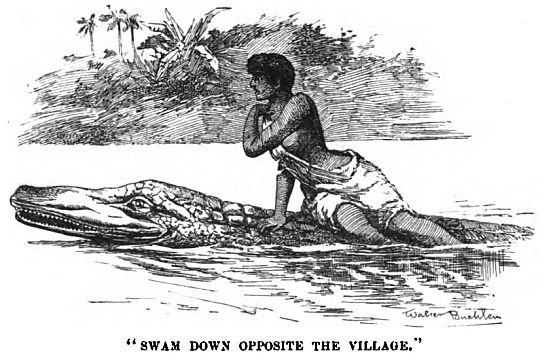
The crocodile bided his chance, and one morning, when Maranda visited the water, he seized her by the hand, and swept her onto his back, and carried her to the hiding-place in the hollow tree. He then left her there, and swam down opposite the village, and signalled to Mafala that he had performed his part of the bargain.
On the crocodile’s departure Maranda looked about the hole, and saw that she was in a kind of pit, but a long way up the hollow narrowed like the neck of a gourd, and she could see foliage and a bit of sky. She determined to climb up, and though she scratched herself very much, she finally managed to reach the very top, and to crawl outside into the air. The tree was very large and lofty, and the branches spread out far, and they were laden with the heavy fruit of which elephants are so fond (the jackfruit). At first she thought that she could not starve because of so many of these big fruit; then, as they were large and heavy, she conceived the idea that they might be useful to defend herself, and she collected a great number of them, and laid them in a heap over some sticks she had laid across the branches.
By-and-by Mafala came, and discovered her high up among the foliage, and after jeering at her, began to climb the tree. But when he was only half-way up, Maranda lifted one of the ponderous fruit and flung it on his head, and he fell to the ground with his senses all in a whirl and his back greatly bruised. When he recovered he begged the crocodile to help him, and he tried to climb up, but when he had ascended but a little way, Maranda dropped one of the elephant fruit fairly on his snout, which sent him falling backwards. Mafala then begged two great serpents to ascend and bring her down, but Maranda met them with the heavy fruit one after another, and they were glad to leave her alone. Then the man departed to seek a leopard, but while he was absent Maranda, from her tree, saw a canoe on the river with two young fishermen in it, and she screamed loudly for help. The fishermen paddled close ashore and found that it was Sukila’s daughter, the wife of Mafala, who was alone on a tall tree. They waited long enough to hear her story, and then returned to the village to obtain assistance.
Busandiya was much astonished to hear the fishermen’s news, and forthwith sent a war-canoe full of armed men, led by the father, Sukila, to rescue her. By means of rattan-climbers they contrived to reach her, and to bring her down safely. While some of the war-party set out to discover Mafala, the others watched for the crocodile and the two serpents. In a short time the cruel man was seen and caught, and he was brought to the river-side, bound with green withes. His legs and his arms were firmly tied together, and, after the Basoko had made Maranda repeat her story from the beginning, and Sukila had told the manner of the marriage, they searched for great stones, which they fastened to his neck; and, lifting him into the war-canoe, they paddled into the middle of the stream, where they sang a death-chant; after which they dropped Mafala overboard and he was never heard of more. That is all there is of the story of Maranda.
Chapter Seven.
The Story of Kitinda and her Wise Dog.
On another night Baruti, whose memory was freshened by the reward which followed a story worthy of being written in the Master’s book, told us about Kitinda and her wise dog, so well indeed that by common consent he was acclaimed one of the best among the story-tellers.
But it was not so well rehearsed to me while I had my pencil in hand as he had delivered it at the camp fire. It bothered him to be asked to dictate it a little slower to me, and he showed marked signs of inattention when told to repeat a sentence twice over. All I can flatter myself is that it contains the sense of what was said.
Kitinda, a woman of the Basoko, near the Aruwimi river, possessed a dog who was remarkable for his intelligence. It was said that he was so clever that strangers understood his motions as well as though he talked to them; and that Kitinda, familiar with his ways and the tones of his whines, his yelps, and his barks, could converse with him as easily as she could with her husband.
One market-day the mistress and her dog agreed to go together, and on the road she told him all she intended to do and say in disposing of her produce in exchange for other articles which she needed in her home. Her dog listened with sympathy, and then, in his own manner, he conveyed to her how great was his attachment to her, and how there never was such a friend as he could be; and he begged her that, if at any time she was in distress, she would tell him, and that he would serve her with all his might. “Only,” he said, “were it not that I am afraid of the effects of being too clever, I could have served you oftener and much more than I have done.”
“What do you mean?” said Kitinda.
“Well, you know, among the Basoko, it is supposed, if one is too clever, or too lucky, or too rich, that it has come about through dealings in witchcraft, and people are burned in consequence. I do not like the idea of being burned—and therefore I have refrained often from assisting you because I feared you could not contain your surprise, and would chat about it to the villagers. Then some day, after some really remarkable act of cleverness of mine, people would say, ‘Ha! this is not a dog. No dog could have done that! He must be a demon—or a witch in a dog’s hide!’ and of course they would take me and burn me.”
“Why, how very unkind of you to think such things of me! When have I chatted about you? Indeed I have too many things to do, my housework, my planting and marketing so occupy me, that I could not find time to gossip about my dog.”
“Well, it is already notorious that I am clever, and I often tremble when strangers look at and admire me for fear some muddle-headed fellow will fancy that he sees something else in me more than unusual intelligence. What would they say, however, if they really knew how very sagacious I am? The reputation that I possess has only come through your affection for me, but I assure you that I dread this excess of affection lest it should end fatally for you and for me.”
“But are you so much cleverer than you have already shown yourself? If I promise that I will never speak of you to any person again, will you help me more than you have done, if I am in distress?”
“You are a woman, and you could not prevent yourself talking if you tried ever so hard.”
“Now, look you here, my dog. I vow to you that no matter what you do that is strange, I wish I may die, and that the first animal I meet may kill me if I speak a word. You shall see now that Kitinda will be as good as her word.”
“Very well, I will take you at your word. I am to serve you every time you need help, and if you speak of my services to a soul, you are willing to lose your life by the first animal you may meet.”
Thus they made a solemn agreement as they travelled to market.
Kitinda sold her palm-oil and fowls to great advantage that day, and in exchange received sleeping-mats, a couple of carved stools, a bag of cassava flour, two large well-baked and polished crocks, a bunch of ripe bananas, a couple of good plantation hoes, and a big strong basket.
After the marketing was over she collected her purchases together and tried to put them into the basket, but the big crocks and carved stools were a sore trouble to her. She could put the flour and hoes and the bananas on top with the mats for a cover very well, but the stools and the crocks were a great difficulty.
Her dog in the meantime had been absent, and had succeeded in killing a young antelope, and had dragged it near her. He looked around and saw that the market was over, and that the people had returned to their own homes, while his mistress had been anxiously planning how to pack her property.
He heard her complain of her folly in buying such cumbersome and weighty things, and ask herself how she was to reach home with them.
Pitying her in her trouble, the dog galloped away and found a man empty-handed, before whom he fawned and whose hands he licked, and being patted he clung to his cloth with his teeth and pulled him gently along—wagging his tail and looking very amiable. He continued to do this until the man, seeing Kitinda fretting over her difficulty, understood what was wanted, and offered to carry the stools and crocks at each end of his long staff over his shoulders for a few of the ripe bananas and a lodging. His assistance was accepted with pleasure, and Kitinda was thus enabled to reach her home, and on the way was told by the man how it was that he had happened to return to the marketplace.
Kitinda was very much tempted there and then to dilate upon her dog’s well-known cleverness, but remembered in time her promise not to boast of him. When, however, she reached the village, and the housewives came out of their houses, burning to hear the news at the market, in her eagerness to tell this one and then the other all that had happened to her, and all that she had seen and heard, she forgot her vow of the morning, and forthwith commenced to relate the last wonderful trick of her dog in dragging a man back to the marketplace to help her when she thought that all her profit in trade would be lost, and when she was just about to smash her nice crocks in her rage.
The dog listened to her narrative, viewed the signs of wonder stealing over the women’s faces, heard them call out to their husbands, saw the men advancing eagerly towards them, saw them all look at him narrowly, heard one man exclaim, “That cannot be a dog! it is a demon within a dog’s hide. He—”
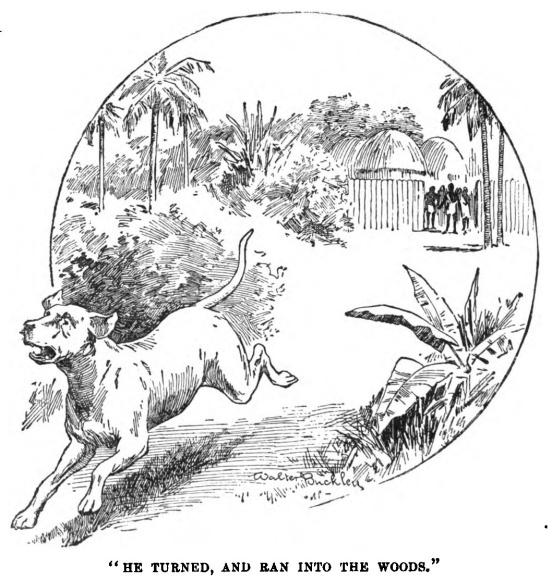
But the dog had heard enough. He turned, and ran into the woods, and was never more seen in that village.
The next market-day came round, and Kitinda took some more palm-oil and a few fowls, and left her home to dispose of them for some other domestic needs. When about half-way, her dog came out of the wood, and after accusing her of betraying him to her stupid countrymen, thus returning evil for good, he sprang upon her and tore her to pieces.
Chapter Eight.
The Story of the Prince who Insisted on Possessing the Moon.
“Sir,” said Baruti, one evening, “another story came to my mind to-day which was told to me a long time ago by an old man among the Basoko. I doubt whether you will like it, but since you wish to hear another legend of my country you shall have the story as it was told to me.”
The country now inhabited by the Basoko tribe was formerly known as Bandimba. A king called Bahanga was its sole rider. He possessed a houseful of wives, but all his children were unfortunately of the female sex, which he considered to be a great grievance, and of which he frequently complained. His subjects, on the other hand, were blessed with more sons than daughters, and this fact increased the king’s grief, and made him envy the meanest of his subjects. One day, however, he married Bamana, the youngest daughter of his principal chief, and finally he became the father of a male child, and was very happy, and his people rejoiced in his happiness.
The prince grew up to be a marvel of strength and beauty, and his father doted on him so much, that he shared his power with the boy in a curious manner. The king reserved authority over all the married people, while the prince’s subjects consisted of those not yet mated. It thus happened that the prince ruled over more people than his father, for the children were, of course, more numerous than the parents. But with all the honour conferred upon him the prince was not happy. The more he obtained, the more he wished to possess. His eyes had but to see a thing to make him desire its exclusive possession. Each day he preferred one or more requests to his father, and because of his great love for him, the king had not the heart to refuse anything to him. Indeed, he was persuaded to bestow so many gifts upon his son that he reserved scarcely anything for himself.
One day the prince was playing with the youth of his court, and after the sport retired to the shade of a tree to rest, and his companions sat down in a circle at a respectful distance from him. He then felt a gush of pride stealing over him as he thought of his great power, at the number and variety of his treasures, and he cried out boastfully that there never was a boy so great, so rich and so favoured by his father, as he had become. “My father,” said he, “can deny me nothing. I have only to ask, and it is given unto me.”
Then one little slender boy with a thin voice said, “It is true, prince. Your father has been very good to you. He is a mighty king, and he is as generous as he is great. Still, I know of one thing that he cannot give you—and it is certain that you will never possess it.”
“What thing is that which I may not call my own, when I see it—and what is it that is not in the king’s power to give me?” asked the prince, in a tone of annoyance.
“It is the moon,” answered the little boy; “and you must confess yourself that it is beyond the king’s power to give that to you.”
“Do you doubt it?” asked the prince. “I say to you that I shall possess it, and I will go now and claim it from my father. I will not give him any peace until he gives it to me.”
Now it so happens that such treasures as are already ours, we do not value so much as those which we have not yet got. So it was with this spoiled prince. The memory of the many gifts of his father faded from his mind, and their value was not to be compared with this new toy—the moon—which he had never thought of before and which he now so ardently coveted.
He found the king discussing important matters with the old men.
“Father,” said he, “just now, while I was with my companions I was taunted because I did not have the moon among my toys, and it was said that it was beyond your power to give it to me. Now, prove this boy a liar, and procure the moon for me, that I may be able to show it to them, and glory in your gift.”
“What is it you say, my son, you want the moon?” asked the astonished king.
“Yes. Do get it for me at once, won’t you?”
“But, my child, the moon is a long way up. How shall we be ever able to reach it?”
“I don’t know; but you have always been good to me, and you surely would not refuse me this favour, father?”
“I fear, my own, that we will not be able to give you the moon.”
“But, father, I must have it; my life will not be worth living without it. How may I dare to again face my companions after my proud boast before them of your might and goodness? There was but one thing that yonder pert boy said I might not have, and that was the moon. Now my soul is bent upon possessing this moon, and you must obtain it for me or I shall die.”
“Nay, my son, speak not of death. It is an ugly word, especially when connected with my prince and heir. Do you not know yet that I live only for your sake? Let your mind be at rest. I will collect all the wise men of the land together, and ask them to advise me. If they say that the moon can be reached and brought down to us, you shall have it.”
Accordingly the great state drum was sounded for the general palaver, and a score of criers went through the towns beating their little drums as they went, and the messengers hastened all the wise men and elders to the presence of the king.
When all were assembled, the king announced his desire to know how the moon could be reached, and whether it could be shifted from its place in the sky and brought down to the earth, in order that he might give it to his only son the prince. If there was any wise man present who could inform him how this could be done, and would undertake to bring it to him, he would give the choicest of his daughters in marriage to him and endow him with great riches.
When the wise men heard this strange proposal, they were speechless with astonishment, as no one in the Basoko Land had ever heard of anybody mounting into the air higher than a tree, and to suppose that a person could ascend as high as the moon was, they thought, simple madness. Respect for the king, however, held them mute, though what their glances meant was very clear.
But while each man was yet looking at his neighbour in wonder, one of the wise men, who appeared to be about the youngest present, rose to his feet and said:
“Long life to the prince and to his father, the king! We have heard the words of our king, Bahanga, and they are good. I—even I—his slave, am able to reach the moon, and to do the king’s pleasure, if the king’s authority will assist me.”
The confident air of the man, and the ring of assurance in his voice made the other wise men, who had been so ready to believe the king and prince mad, feel shame, and they turned their faces to him curiously, more than half willing to believe that after all the thing was possible. The king also lost his puzzled look, and appeared relieved.
“Say on. How may you be able to perform what you promise?”
“If it please the king,” answered the man, boldly, “I will ascend from the top of the high mountain near the Cataract of Panga. But I shall first build a high scaffold on it, the base of which shall be as broad as the mountain top, and on that scaffold I will build another, and on the second I shall build a third, and so on and so on until my shoulder touches the moon.”
“But is it possible to reach the moon in this manner?” asked the king doubtingly.
“Most certainly, if I were to erect a sufficient number of scaffolds, one above another, but it will require a vast quantity of timber, and a great army of workmen. If the king commands it, the work will be done.”
“Be it so, then,” said the king. “I place at your service every able-bodied man in the kingdom.”
“Ah, but all the men in your kingdom are not sufficient, O king. All the grown-up men will be wanted to fell the trees, square the timber and bear it to the works; and every grown-up woman will be required to prepare the food for the workmen; and every boy must carry water to satisfy their thirst, and bark rope for the binding of the timbers; and every girl, big and little, must be sent to till the fields to raise cassava for food. Only in this manner can the prince obtain the moon as his toy.”
“I say, then, let it be done as you think it ought to be done. All the men, women, and children in the kingdom I devote to this service, that my only son may enjoy what he desires.”
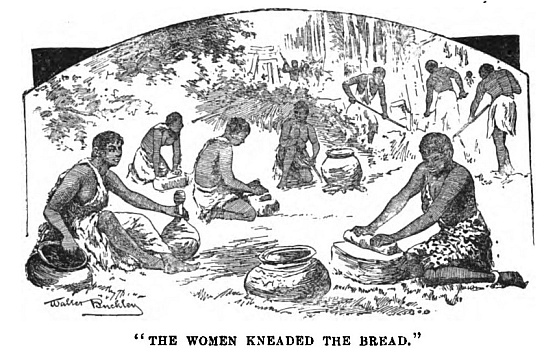
Then it was proclaimed throughout the wide lands of the Bandimba that all the people should be gathered together to proceed at once with the work of obtaining the moon for the king’s son. And the forest was cut down, and while some of the workmen squared the trees, others cut deep holes in the ground, to make a broad and sure base for the lower scaffold; and the boys made thousands of rope coils to lash the timbers together, out of bark, fibre of palm, and tough grass; and the girls, big and little, hoed up the ground and planted the cassava shrubs and cuttings from the banana and the plantain, and sowed the corn; and the women kneaded the bread and cooked the greens, and roasted green bananas for food for the workmen. And all the Bandimba people were made to slave hard every day in order that a spoiled boy might have the moon for his toy.
In a few days the first scaffolding stood up as high as the tallest trees, in a few weeks the structure had grown until it was many arrow-flights in height, in two months it was so lofty that the top could not be seen with the naked eye. The fame of the wonderful wooden tower that the Bandimba were building was carried far and wide; and the friendly nations round about sent messengers to see and report to them what mad thing the Bandimba were about, for rumour had spread so many contrary stories among people that strangers did not know what to believe. Some said it was true that all the Bandimba had become mad; but some of those who came to see with their own eyes, laughed, while others began to feel anxious. All, however, admired the bigness, and wondered at the height of the tower.
In the sixth month the top of the highest scaffold was so high that on the clearest day people could not see half-way up; and it was said to be so tall that the chief engineer could tell the day he would be able to touch the moon.
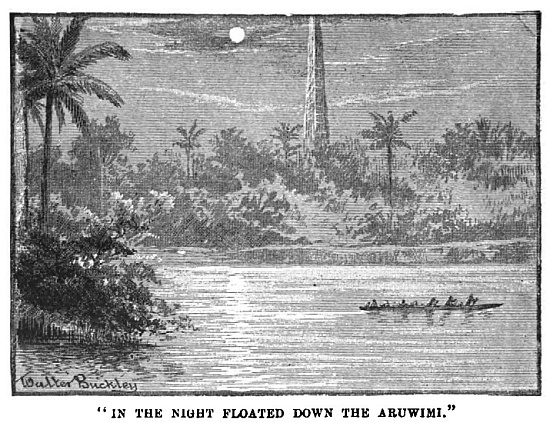
The work went on, and at last the engineer passed the word down that in a few days more it would be finished. Everybody believed him, and the nations round about sent more people to be present to witness the completion of the great tower, and to observe what would happen. In all the land, and the countries adjoining it, there was found only one wise man who foresaw, if the moon was shifted out of its place what damage would happen, and that probably all those foolish people in the vicinity of the tower would be destroyed. Fearing some terrible calamity, he proposed to depart from among the Bandimba before it should be too late. He then placed his family in a canoe, and, after storing it with sufficient provisions, he embarked, and in the night he floated down the river Aruwimi and into the big river, and continued his journey night and day as fast as the current would take him—far, far below any lands known to the Bandimba. A week later, after the flight of the wise man and his family, the chief engineer sent down word to the king that he was ready to take the moon down.
“It is well,” replied the king from below. “I will ascend, that I may see how you set about it.”
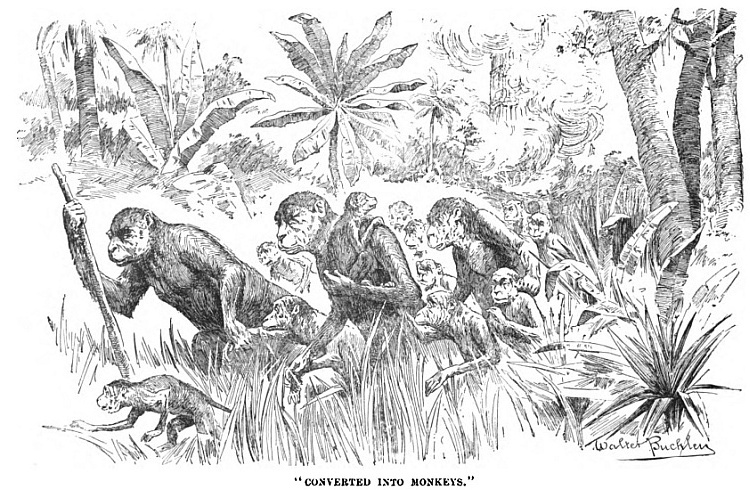
Within twenty days the king reached the summit of the tower, and, standing at last by the side of the engineer, he laid his hand upon the moon, and it felt exceedingly hot. Then he commanded the engineer to proceed to take it down. The man put a number of cool bark coils over his shoulder and tried to dislodge it; but, as it was firmly fixed, he used such a deal of force that he cracked it, and there was an explosion, the fire and sparks from which scorched him. The timber on which the king and his chiefs were standing began to burn, and many more bursting sounds were heard, and fire and melted rock ran down through the scaffolding in a steady stream, until all the woodwork was ablaze, and the flames soared upward among the uprights and trestles of the wood in one vast pile of fire; and every man, woman, and child was utterly consumed in a moment. And the heat was so great that it affected the moon, and a large portion of it tumbled to the earth, and its glowing hot materials ran over the ground like a great river of fire, so that most of the country of the Bandimba was burnt to ashes. On those who were not smothered by the smoke, nor burnt by the fire, and who fled from before the burning river, the effect was very wonderful. Such of them as were grown up, male and female, were converted into gorillas, and all the children into different kinds of long-tailed monkeys.
The old man who told me this story ended by saying to us, who listened with open mouth to his words:
“Friends, if you doubt the truth of what I have said, all you have to do is to look at the moon when it is full, and you may then see on a clear night a curious dark portion on its face, which often appears as though there were peaky mountains in it, and often the dark spots are like some kind of homed animals; and then again, you will often fancy that on the moon you see the outlines of a man’s face, but those dark spots are only the holes made in the moon by the man who forced his shoulders through it. By this you will know that I have not lied unto you. Now ever since that dreadful day when the moon burst and the Bandimba country was consumed, parents are not in the habit of granting children all they ask for, but only such things as their age and experience warn them are good for their little ones. And when little children will not be satisfied by such things, but fret and pester their parents to give them what they know will be harmful to them, then it is a custom with all wise people to take the rod to them, to drive out of their heads the wicked thoughts.”
“But, Baruti,” said a Zanzibari who believed the story, for had he not often viewed the dark spots on the moon, “what became of Bahanga and the little prince?”
“Why, after the engineer of the works, the first who died were the king and the prince whose folly had brought ruin on the land.”
Chapter Nine.
How Kimyera Became King of Uganda.
Kadu was a native lad of Uganda, who having made blood brotherhood with a young Zanzibari of his own age, asked permission to join our expedition of 1874-77. He survived the perils of the descent of the Congo, and in 1879 enlisted again, and served faithfully another term of three years in Africa. He afterwards joined Mr H.H. Johnston on his visit to Kilimanjaro, and proved himself as devoted to him as he had been for seven years to me. It was while road-making along the banks of the Congo, after becoming thoroughly conversant with the Zanzibari vernacular, that he entertained us with his remarkable legends. Next to his countryman Sabadu he was the most entertaining.
One of the first tales he related to us was about Kimyera, a king of Uganda, who by his exploits in hunting deserves to be called the Nimrod of that country. It ran as follows:—
Many ages ago Uni reigned as king over Unyoro, a great country which lies to the north and west of Uganda. One day he took to wife Wanyana, a woman of the neighbouring kingdom, who on the first night she had been taken into the inner harem manifested a violent aversion for his person. At that time a man named Kalimera, who was a dealer in cattle, was visiting the court, and had already resided some months there as an honoured guest of the king, on account of his agreeable manners, and his accomplishments on the flute. During his stay he had not failed to note the beauty of the young women who were permitted to crowd around him while he played; but it had long been observed that he had been specially attracted by the charms of Wanyana. It was whispered by a few of the more maliciously disposed among the women that a meeting had taken place, and that an opportunity had been found by them to inform each other of their mutual passion. However that may be, King Uni, surprised at the dislike which she manifested towards him, forbore pressing her for the time, trustfully believing that her sentiments would change for the better after a more intimate acquaintance with him. Meantime he built for her a separate apartment, and palisaded its court closely around with thick cane. His visits were paid to her on alternate days, and each time he brought some gift of bead or bark-cloth, or soft, furry hide, in the hope of winning her favour.
In time she discovered that she was pregnant, and, fearing King Uni’s wrath, she made a compact with him that if he would abstain from visiting her for one month she would repay his kindness with all affection. Uni gladly consented to this proposal, and confined his attentions to sending his pages with daily greetings and gifts. Meantime she endeavoured through her own servants to communicate with Kalimera, her lover, but, though no effort on her part was wanting, she could gain no news of him, except a report that soon after she had entered the harem of Uni, Kalimera had disappeared.
In a few days she was delivered of a fine male child, but as she would undoubtedly be slain by the king if the child was discovered, she departed by night with it, and laid it, clad in fur adorned with fine bead-work, at the bottom of a potter’s pit. She then hastened to a soothsayer in the neighbourhood, and bribed him to contrive in some way to receive and rear her child until he could be claimed. Satisfied with his assurance that the child would be safe, Wanyana returned to her residence at the court in the same secret manner that she had left it.
Next morning Mugema, the potter, was seen passing the soothsayer’s door, and was hailed by the great witch-finder.
“Mugema,” said he, “thy pots are now made of rotten clay. They are not at all what they used to be. They now crumble in the hand. Tell me why is this?”
“Ah, doctor, it is just that. I thought to bribe thee to tell me, only I did not wish to disturb thee.”
“It is well, Mugema; I will tell thee why. Thou hast an enemy who wishes evil to thee, but I will defeat his projects. Haste thou to thy pit, and whatever living thing thou findest there, keep it, and rear it kindly. While it lives thou art safe from all harm.”
Wondering at this news, Mugema departed from the soothsayer’s house, and proceeded to the pit where he obtained his clay. Peering softly over the edge of the pit, he saw a bundle of bark-cloth and fur. From its external appearance he could not guess what this bundle might contain, but, fearing to disturb it by any precipitate movement, he silently retreated from the pit, and sped away to tell his wife, as he was in duty bound, and obtain her advice and assistance, for the wife in all such matters is safer than the man. His wife on hearing this news cried out at him, saying:
“Why, what a fool thou art! Why didst thou not do as the soothsayer commanded thee? Come, I will go with thee at once, for my mind is troubled with a dream which I had last night, and this thing thou tellest me may have a weighty meaning for us both.”
Mugema and his wife hurried together towards the clay-pit, and as her husband insisted on it, she crept silently to its edge to look down. At that moment the child uttered a cry and moved the clothes which covered it.
“Why, it is a babe,” cried the woman; “just as I found it in my dream. Hurry, Mugema. Descend quickly, and bring it up to me; and take care not to hurt it.”
Mugema wondered so much at his wife’s words that he almost lost his wits, but being pushed into the pit he mechanically obeyed, and brought up the bundle and its living occupant, which he handed to his wife without uttering a word.
On opening the bundle there was discovered the form of a beautiful and remarkably lusty child, of such weight, size, and form, that the woman exclaimed:
“Oh! Mugema, was ever anybody’s luck like this of ours? My very heart sighed for a child that I could bring up to be our joy, and here the good spirits have given us the pick of all the world. Mugema, thy fortune is made.”
“But whose child is it?” asked Mugema, suspiciously.
“How can I tell thee that? Hadst thou not brought the news to me of it being in the pit, I should have been childless all my life. The soothsayer who directed thee hither is a wise man. He knows the secret, I warrant him. But come, Mugema, drop these silly thoughts. What sayest thou? shall we rear the child, or leave it here to perish?”
“All right, wife. If it prove of joy to thee, I shall live content.”
Thus it was that the child of Wanyana found foster-parents, and no woman in Unyoro could be prouder of her child than Mugema’s wife came to be of the foundling. The milk of woman, goat, and cow was given to him, and he throve prodigiously; and when Mugema asked the soothsayer what name would be fittest for him, the wise man said:
“Call him Kimyera—the mighty one.”
Some months after this, when Kimyera was about a year old, Wanyana came to the potter’s house to purchase pots for her household, and while she was seated in the porch selecting the soundest among them, she heard a child crying within.
“Ah, has thy wife had a child lately? I did not observe or hear when I last visited thee that she was likely to become a mother.”
“No, princess,” replied Mugema; “that is the cry of a child I discovered in the clay-pit about a year ago.”
Wanyana’s heart gave a great jump, and for a moment she lost all recollection of where she was. Recovering herself with a great effort, she bade Mugema tell her all about the incident: but while he related the story, she was busy thinking how she might assure herself of his secrecy if she declared herself to be the mother of the child.
Mugema, before concluding his story, did not fail to tell Wanyana how for a time he had suspected his wife of having played him falsely, and that though he had no grounds for the suspicion further than that the clay-pit was his own and the child had been found in it, he was not quite clear in his mind yet, and he would be willing to slave a long time for any person who could thoroughly disabuse his mind of the doubt, as, with that exception, his wife was the cleverest and best woman in Unyoro.
Wanyana, perceiving her opportunity, said:
“Well, much as I affected not to know about the child, I know whose child it is, and who placed it in the pit.”
“Thou, princess!” he cried.
“Yes, and, if thou wilt take an oath upon the great Muzimu to keep it secret, I will disclose the name of the mother.”
“Thou hast my assurance of secrecy upon the condition that the child is not proved to be my wife’s. Whosoever else’s it may be, matters not to me; the child was found, and is mine by right of the finder. Now name the mother, princess.”
“Wanyana!”
“Thine?”
“Even so. It is the offspring of fond love, and Kalimera of Uganda is his father. The young man belongs to one of the four royal clans of Uganda, called the Elephant clan. He is the youngest son of the late king of Uganda. To him, on his father’s death, fell his mother’s portion, a pastoral district rich in cattle not far from the frontier of Unyoro. It was while he drove fat herds here for sale to Uni that he saw and loved me, and I knew him as my lord. Dreading the king’s anger, he fled, and I was left loveless in the power of Uni. One night the child was born, and in the darkness I crept out of the king’s court, and bore the babe to thy pit. To the wise man I confided the secret of that birth. Thou knowest the rest.”
“Princess, my wife never appeared fairer to me than she does now, and I owe the clear eye to thee. Rest in peace. My wife loves the babe, let her nurse it until happier times, and I will guard it safe as though it were mine own. Ay, the babe, I feel assured, will pay me well when he is grown. The words of the wise man come home to me now, and I see whereby good luck shall come to all. If bone and muscle can make a king, Kimyera’s future is sure. But come in to see my wife, and to her discretion and wisdom confide thy tale frankly.”
Wanyana soon was hanging over her child, and, amid tears of joy, she made Mugema’s wife acquainted with his birth, and obtained from her earnest assurance that he would be tenderly cared for, and her best help in any service she could perform for Kimyera and his mother.
Great friendship sprang up between Princess Wanyana and the potter Mugema and his wife, and she found frequent excuses for visiting the fast-growing child.
Through the influence of the princess, the potter increased in riches, and his herds multiplied; and when Kimyera was grown tall and strong, he was entrusted by his foster-father with the care of the cattle, and he gave him a number of strong youths as assistants. With these Kimyera indulged in manly games, until he became wonderfully dexterous in casting the spear, and drawing the bow, and in wrestling. His swiftness exceeded that of the fleetest antelope; no animal of the plain could escape him when he gave chase. His courage, proved in the defence of his charge, became a proverb among all who knew him. If the cry of the herdsman warned him that a beast sought to prey upon the cattle, Kimyera never lost time to put himself in front, and, with spear and arrow, he often became victor.
With the pride becoming the possessor of so many admirable qualities, he would drive his herds right through the corn-fields of the villagers, and to all remonstrances he simply replied that the herds belonged to Wanyana, favourite wife of Uni. The people belonged to her also, as well as their corn, and who could object to Wanyana’s cattle eating Wanyana’s corn?
As his reputation for strength and courage was well known, the villagers then submissively permitted him to do as he listed.
As he grew up in might and valour, Uni’s regards cooled towards Wanyana, and, as she was not permitted that freedom formerly enjoyed by her, her visits to Kimyera ceased. Mugema sympathised with the mother, and contrived to send Kimyera with pots to sell to the people of the court, with strict charge to discover every piece of news relating to the Princess Wanyana. The mother’s heart dilated with pride every time she saw her son, and she contrived in various ways to lengthen the interview. And each time he returned to his home he carried away some gift from Wanyana, such as leopard-skins, strings of beast claws, beads, and crocodile-teeth, girdles of white monkey-skin, parcels of ground ochre, or camwood, or rare shells, to show Mugema and his wife. And often he used to say, “Wanyana bade me ask you to accept this gift from her as a token of her esteem,” showing them similar articles.
His mother’s presents to him in a short time enabled him to purchase two fine large dogs—one was black as charcoal, which was named by him Msigissa, or “Darkness,” the other was white as a cotton tuft, and called Sema-gimbi, or “Wood-burr.” You must know that it is because of the dog Darkness, that the Baboon clan of Uganda became so attached to black dogs, by which they perpetuate the memory of Kimyera.
When he had become the owner of Darkness and Wood-burr, he began to absent himself from home for longer periods, leaving the herds in charge of the herdsmen. With these he explored the plains, and hills, and woods to a great distance from his home. Sometimes he would be absent for weeks, causing great anxiety to his kind foster-parents. The further he went the more grew his passion to know what lay beyond the furthest ridge he saw, which, when discovered, he would be again tempted to explore another that loomed in the far distance before him. With every man he met he entered into conversation, and obtained a various knowledge of things of interest relating to the country, the people, and the chiefs. In this manner before many months he had a wide knowledge of every road and river, village and tribe, in the neighbouring lands.
On his return from these daring excursions, he would be strictly questioned by Mugema and his wife as to what he had been doing, but he evaded giving the entire truth by rehearsing the hunting incidents that attended his wanderings, so that they knew not the lands he had seen, nor the distances that he travelled. However, being uneasy in their minds they communicated to Wanyana all that was related to them and all they suspected. Wanyana then sought permission to pay a visit to the potter and his wife, and during the visit she asked Kimyera, “Pray tell me, my son, whither dost thou travel on these long journeys of thine to seek for game?”
“Oh! I travel far through woods, and over grassy hills and plains.”
“But is it in the direction of sunrise, or sunset, is it north or is it south of here?”
To which he replied: “I seek game generally in the direction whence the sun rises.”
“Ah!” said Wanyana. “In that way lies Ganda, where thy father lives, and whence he came in former days to exchange cattle for salt and hoes.”
“My father! What may be my father’s name, mother?”
“Kalimera.”
“And where did he live?”
“His village is called Willimera, and is near the town of Bakka.”
“Bakka! I know the town, for in some of my journeys I entered a long way into Uganda, and have chased the leopard in the woods that border the stream called Myanja, and over the plains beyond the river many an antelope has fallen a victim to my spear.”
“It is scarcely credible, my son.”
“Nay, but it is true, mother.”
“Then thou must have been near Willimera in that case, and it is a pity that thou shouldst not have seen thy father, and been received by him.”
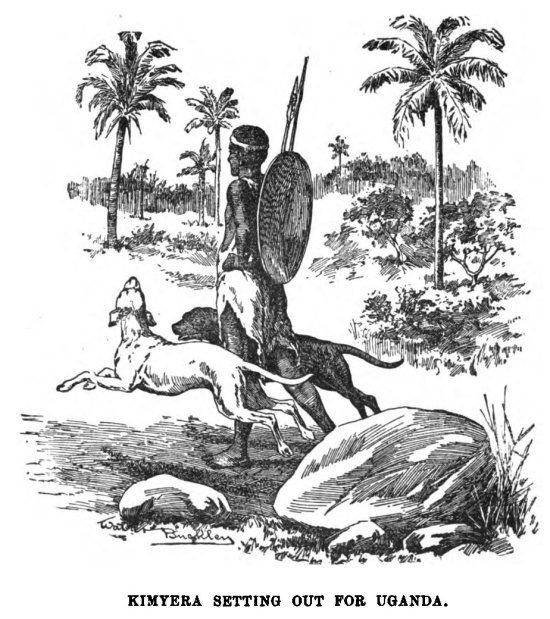
A few days later Kimyera slung his knitted haversack over his shoulder, and with shield, two spears, and his faithful dogs Darkness and Wood-burr, he strode out of the potter’s house, and set his face once more towards the Myanja river. At the first village across the stream he questioned the natives if they knew Willimera, and was told that it was but eight hours east. The next day he arrived, and travelled round the village, and rested that night at the house of one of the herdsmen of Kalimera. He made himself very agreeable to his host, and from him he received the fullest information of all matters relating to his father.
The next day he began his return to Unyoro, which he reached in two weeks. He told Mugema and his foster-mother of his success, and they sent a messenger to apprise Wanyana that Kimyera had returned home.
Wanyana, impatient to learn the news, arrived that night at Mugema’s house, and implored Kimyera to tell her all that he had heard and seen.
“In brief, it is this,” replied Kimyera. “I now know to a certainty where Kalimera lives. I have gone round the village, I know how many natives are in it, how many herds of cattle, and how many herdsmen and slaves he has. Kalimera is well. All these I learned from one of his chief herdsmen with whom I rested a night. I came here straight to let thee and my foster-parents know it.”
“It is very well, my son. Now, Mugema, it is time to move,” she said to the potter. “Uni daily becomes more intolerable to me. I never have yet mated with him as his wife, and I have been true to the one man who seemed to me to be the comeliest of his kind. Now that I know Kalimera lives, my heart has gone to him, though my body is here. Mugema, speak, my friend.”
“Wanyana, my wit is slow and my tongue is heavy. Thou knowest my circumstances. I have one wife, but many cattle. The two cows, Namala and Nakaombeh, thou gavest me first, I possess still. Their milk has always been abundant and sweet. Namala has sufficed to nourish Kimyera into perfect lustiness and strength; Nakaombeh gives more than will feed my wife and I. Let Kimyera take his flute, his dogs, Darkness and Wood-burr, his spears and shield; Sebarija, my cowherd, who taught Kimyera the flute, will also take his flute and staff, and drive Namala and Nakaombeh. My wife will carry a few furs, some of the spoils won by Kimyera’s prowess; and, lo! I and my family will follow Wanyana.”
“A true friend thou hast been to me and mine, Mugema! We will hence before dawn. In Willimera thou shalt receive tenfold what thou leavest here. The foundling of the clay-pit has grown tall and strong, and at last he has found the way to his father and his father’s kindred.”
And as Wanyana advised, the journey was undertaken that night, and before the sun arose Wanyana, Mugema and his wife, the slave Sebarija driving the two cows, Namala and Nakaombeh, were far on their way eastward, Kimyera and his two dogs, Darkness and Wood-burr, preceding the emigrants and guiding the way.
The food they took with them sustained them for two days; but on the third day they saw a lonely buffalo, and Kimyera, followed by Mugema and Sebarija, chased him. The buffalo was uncommonly wild, and led them a long chase, far out of sight of the two women. Then Mugema reflected that they had done wrong in thus leaving the two women alone, and called out to Sebarija to hurry back, and to look after the women and two cows. Not long after, Darkness fastened his fangs in the buffalo, until Wood-burr came up and assisted him to bring it to the ground, and there they held him until Kimyera gave him his death-stroke. The two men loaded themselves with the meat, and returned to the place where they had left, but alas! they found no traces of the two women, nor of Sebarija and the two cows.
Day after day Kimyera and Mugema hunted all around the country for news of the missing party, until, finally, to their great sorrow, they were obliged to abandon the search, and came to the conclusion that it was best for them to continue their journey and trust to chance for the knowledge they desired.
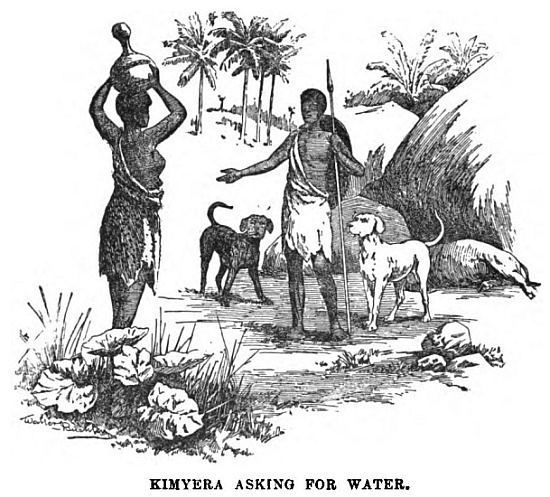
Near Ganda another buffalo was sighted by Kimyera, and, bidding Mugema remain at the first house he came to, he went after it with his dogs. The buffalo galloped far, and near noon he stood still under the shelter of a rock. Kimyera bounded to the top, and, exerting all his strength, he shot his spear clean through the back of the animal. That rock is still shown to strangers as the place where Kimyera killed the first game in Uganda, and even the place where he stood may be seen by the marks of his feet which were, impressed on it. While resting on the rock he saw a woman pass near by with a gourd of water. He called out to her, and begged for a drop to allay his thirst. She smilingly complied, as the stranger was comely and his manner pleasant. They entered into conversation, during which he learned that she belonged to Ganda, and served as maid to Queen Naku, wife of Sebwana, and that Naku was kind to strangers, and was famed for her hospitality to them.
“Dost thou think she will be kind to me?” asked Kimyera. “I am a native of Unyoro, and I am seeking a house where I may rest.”
To which the maid replied: “It is the custom of Naku, and, indeed, of all the princes of Ganda, to entertain the stranger since, in the far olden times, the first prince settled in this land in which he was a stranger. But what may that be which is secured in thy girdle?”
“That is a reed flute on which I imitate when alone the songs of such birds as sound sweetest to me.”
“And art thou clever at it?” asked the maid.
“Be thou judge,” he said; and forthwith blew on his flute until the maid marvelled greatly.
When he had ended, she clapped her hands gaily and said:
“Thou wilt be more than welcome to Naku and her people. Haste and follow me that I may show thee to her, for thy fortune is made.”
“Nay. I have a companion not far from here, and I must not lose him. But thou mayest say thou hast met a stranger who, when he has found his friend, will present himself before Queen Naku and Sebwana before sunset.”
The maid withdrew and Kimyera rose, and cutting a large portion of the meat he retraced his steps, and sought and found Mugema, to whom he told all his adventures.
After washing the stains of travel and refreshing themselves, they proceeded into the village to the residence of the queen and her consort Sebwana. Naku was prepared by the favourable reports of the maid to receive Kimyera kindly, but when she saw his noble proportions and handsome figure she became violently in love with him, and turning to Sebwana she said:
“See now, we have guests of worth and breeding. They must have travelled from a far land, for I have heard of no tribe which could boast of such a youth as this. Let us receive him and his old friend nobly. Let a house close by our own be made ready for his lodging, and let it be furnished with abundance of food, with wine (banana wine) and milk, bananas and yams, water and fuel, and let nothing be lacking to show our esteem for them.” Sebwana gave orders accordingly and proceeded to select a fit house as a lodging for the guests.
Then Naku said: “I hear that thou art skilled in music. If that is the instrument in thy girdle with which thou hast delighted my maid, I should be pleased to hear thee.”
“Yes, Queen Naku, it is my flute; and if my music will delight thee, my best efforts are at thy service.”
Then Kimyera, kneeling on the leopard-skins placed for the convenience of himself and Mugema, took out his flute, and after one or two flourishes, poured forth such melodious sounds that Naku, unable to keep her eyes open, closed them and lay down with panting breasts, while her senses were filled as it were with dreams of happier lands, and faces of brighter people than ever she knew in real life. As he varied the notes, so varied the gladsome visions of her mind. When the music gently vibrated on her ears, her body palpitated under the influence of the emotions which swayed her; when they became more enlivened she tossed her arms about, and laughed convulsively; and when the notes took a solemn tone, she sighed and wept as though all her friends had left her only their tender memory. Grieved that Naku should suffer, Kimyera woke the queen from her sorrowful condition with tones that soon started her to her feet, and lo, all at once, those who were present joined in the lively dance, and nothing but gay laughter was heard from them. Oh, it was wonderful what quick changes came over people as they heard the flute of Kimyera. When he ceased people began to look at one another in a foolish and confused way, as though something very strange had happened to them.
But Naku quickly recovered, and went to Kimyera, smiling and saying:
“It is for thee to command, O Kimyera. To resist thy flute would be impossible. Again welcome to Ganda, and we shall see if we cannot keep thee and thy flute amongst us.”
She conducted Kimyera and his foster-father Mugema to their house. She examined carefully the arrangements made by the slaves, and when she found anything amiss she corrected it with her own hands. Before she parted from them she called Mugema aside, and questioned him further respecting the youth, by which means she obtained many interesting particulars concerning him.
On arriving at her own house she called all the pages of the court to her, and gave orders that if Sebwana told them to convey such and such things to the strangers next day, that none of them should do so, but carry them to the rear court where only women were admitted.
In consequence of this command Mugema and Kimyera found themselves deserted next day, and not one person went near them. Mugema therefore sought an interview the day after with Queen Naku and said:
“The custom of this country seems strange to us, O Queen. On the first day we came thy favours showered abundance on us, but on the next not a single person showed his face to us. Had we been in a wilderness we could not have been more alone. It is possible that we may have offended thee unknown to ourselves. Pray acquaint us with our offence, or permit us to depart at once from Ganda.”
“Nay, Mugema, I must ask thee to be patient. Food ye shall have in abundance, through my women, and much more is in store for ye. But come, I will visit the young stranger, and thou shalt lead me to him.”
Kimyera had been deep in thought ever since he had parted from Naku, and he had not observed what Mugema had complained of; but on seeing Naku enter his house, he hasted and laid matting on the floor, and, covering it with leopard-skins, begged Naku to be seated on them. He brought fresh banana-leaves in his arms, and spread them near her, on which he arranged meat and salt, and bananas and clotted milk, and kneeled before her like a ready servitor.
Naku observed all his movements, her admiration for his person and graces of body becoming stronger every minute. She peeled a mellow banana and handed it to him, saying, “Let Kimyera taste and eat with me, and I will then know that I am in the house of a friend.”
Kimyera accepted the gift with thanks, and ate the banana as though he had never eaten anything so delicious in his life. Then he also peeled a beautiful and ripe banana, and, presenting it to her on a fragment of green leaf with both hands, said to her:
“Queen Naku, it is the custom of my country for the master of the house to wait upon his guests. Wherefore accept, O Queen, this banana as a token of friendship from the hands of Kimyera.”
The queen smiled, bent forward with her eyes fixed on his own, and took the yellow fruit, and ate it as though such sweetness was not known in the banana land of Ganda.
When she had eaten she said:
“List, Kimyera, and thou, Mugema, hearken well, for I am about to utter weighty words. In Ganda, since the death of my father, there has been no king. Sebwana is my consort by choice of the elders of the land, but in name only. He is really only my kate-kiro (Premier). But I am now old enough to choose a king for myself, and according to custom, I may do so. Wherefore I make known to thee, Mugema, that I have already chosen my lord and husband, and he by due right must occupy the chair of my father, the old king who is dead. I have said to myself since the day before yesterday that my lord and husband shall be Kimyera.”
Both Kimyera and Mugema prostrated themselves three times before Naku, and, after the youth had recovered from his confusion and surprise, he replied:
“But, Queen Naku, hast thou thought what the people will say to this? May it not be that they will ask, ‘who is this stranger that he should reign over us?’ and they will be wroth with me and try to slay me?”
“Nay. For thou art my father’s brother’s son, as Mugema told me, and my father having left no male heirs of his body, his daughter may, if she choose, ally herself with a son of his brother. Kalimera is a younger brother of my father. Thou seest, therefore, that thou, Kimyera, hast a right to the king’s chair, if I, Naku, will it to be so.”
“And how, Naku, dost thou propose to act? In thy cause my arm is ready to strike. Thou hast but to speak.”
“In this way. I will now leave thee, for I have some business for Sebwana. When he has gone I will then send for thee, and thou, when thou comest to me, must say, ‘Naku, I have come. What can Kimyera do for Queen Naku?’ And I will rise and say, ‘Kimyera, come and seat thyself in thy father’s brother’s chair.’ And thou wilt step forward, bow three times before me, then six times before the king’s chair, and, with thy best spear in hand and shield on arm, thou wilt, proceed to the king’s chair, and turning to the people who will be present, say in a loud voice thus: ‘Lo, people of Ganda, I am Kimyera, son of Kalimera, by Wanyana of Unyoro. I hereby declare that with her own free will I this day do take Naku, my father’s brother’s daughter, to wife, and seat myself in the king’s chair. Let all obey, on pain of death, the king’s word.’”
“It is well, Naku; be it according to thy wish,” replied Kimyera.
Naku departed and proceeded in search of Sebwana; and, when she found him, she affected great distress and indignation.
“How is this, Sebwana? I gave orders that our guests should be tenderly cared for and supplied with every needful thing. But I find, on inquiring this morning, that all through yesterday they were left alone to wonder at our sudden disregard for their wants. Haste, my friend, and make amends for thy neglect. Go to my fields and plantations, collect all that is choicest for our guests, lest, when they leave us, they will proclaim our unkindness.”
Sebwana was amazed at this charge of neglect, and in anger hastened to find out the pages. But the pages, through Naku’s good care, absented themselves, and could not be found; so that old Sebwana was obliged to depend upon a few unarmed slaves to drive the cattle and carry the choicest treasures of the queen’s fields and plantations for the use of the strangers.
Sebwana having at last left the town, Naku returned to Kimyera, whom she found with a sad and disconsolate aspect.
“Why, what ails thee, Kimyera?” she asked. “The chair is now vacant. Arm thyself and follow me to the audience court.”
“Ah, Naku! I but now remembered that as yet I know not whether my mother and good nurse are alive or dead. They may be waiting for me anxiously somewhere near the Myanja, or their bones may be bleaching on one of the great plains we traversed in coming hither.”
“Nay, Kimyera, my lord, this is not a time for mourning. Bethink thee of the present needs first. The chair of the king awaits thee. Rise, and occupy it, and to-morrow all Ganda is at thy service to find thy lost mother and nurse. Come, delay not, lest Sebwana return and take vengeance on us all.”
“Fear not, Naku, it was but a passing fit of grief which filled my mind. Sebwana must needs be strong and brave to dispossess me when Naku is on my side,” saying which Kimyera dressed himself in war-costume, with a crown of cock’s tail feathers on his head, a great leopard skin depending from his neck down his back, a girdle of white monkey-skin round his waist, his body and face brilliantly painted with vermilion and saffron. He then armed himself with two bright shining spears of great length, and bearing a shield of dried elephant hide, which no ordinary spear could penetrate, he strode after Queen Naku towards the audience court in the royal palace. Mugema, somewhat similarly armed, followed his foster-son.
As Kimyera strode proudly on, the great drum of Ganda sounded, and its deep tones were heard far and wide. Immediately the populace, who knew well that the summons of the great drum announced an important event, hastily armed themselves, and filled the great court. Naku, the queen, they found seated in a chair alongside of the king’s chair, which was now unfilled, and in front of her was a tall young stranger, who prostrated himself three times before the queen. He was then seen bowing six times before the empty king’s chair. Rising to his feet, he stepped towards it, and afterwards faced the multitude, who were looking on wonderingly.
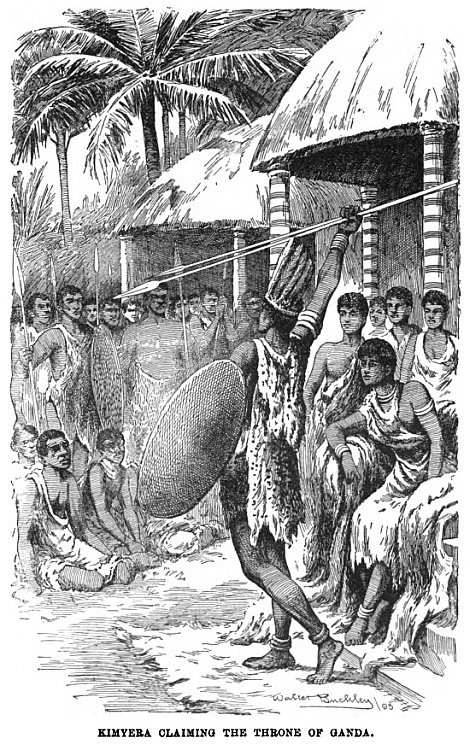
The young stranger, lifting his long spears and raising his shield in an attitude of defence, cried out aloud, so that all heard his voice:
“Lo, people of Ganda! I am Kimyera, son of Kalimera, by Wanyana of Unyoro. I hereby declare that with her own free will I this day do take Naku, my father’s brother’s daughter, to wife, and seat myself in the king’s chair. Let all obey, on pain of death, the king’s word.”
On concluding this address, he stepped back a pace, and gravely sat in the king’s chair. A loud murmur rose from the multitude, and the shafts of spears were seen rising up, when Naku rose to her feet, and said:
“People of Ganda, open your ears. I, Naku, the legitimate queen of Ganda, hereby declare that I have found my father’s brother’s son, and I, this day, of my own free will and great love for him, do take him for my lord and husband. By full right Kimyera fills the king’s chair. I charge you all henceforth to be loyal to him, and him only.”
As she ended her speech the people gave a great shout of welcome to the new king, and they waved their spears, and clashed them against their shields, thus signifying their willing allegiance to King Kimyera.
The next day great bodies of strong men were despatched in different directions for the king’s mother and his nurse, and for Sebarija and the two cows, Namala and Nakaombeh. If alive they were instructed to convey them with honour and care to Ganda, and if any fatal misadventure had happened to them, their remains were to be borne with all due respect to the king.
Sebwana, meanwhile, had started for the plantations, and hearing the thunder of the great drum, divined that Naku had deposed him in favour of the young stranger. To assure himself of the fact, he sent a confidential slave to discover the truth of the matter, while he sought a place where he could await, unobserved, the return of his messenger. When his slave came back to him he learned what great event had occurred during his short absence, and that his power had been given to another. Knowing the fate attending those thus deposed, he secretly retired to the district that had given him birth, where he lived obscure and safe until he died at a good old age.
After some days Sebarija and Mugema’s wife, and the two cows Namala and Nakaombeh, were found by the banks of Myanja, near a rocky hill which contained a cave, whither they had retired to seek a dwelling-place until news could be found of Mugema and Kimyera. But Wanyana, the king’s mother, while gathering fuel near the cave during the absence of Sebarija and the potter’s wife, had been fatally wounded by a leopard, before her cries brought Sebarija to her rescue. A short time after she had been taken into the cave she had died of her wounds, and her body had been folded in such furs and covering as her friends possessed, that Kimyera, on his return, might be satisfied of the manner of her death.
Kimyera, accompanied by his wife Naku and old Mugema, set out from Ganda with a great escort to receive the long-lost couple and the remains of Wanyana. Mugema rejoiced to see his old wife once more, though he deeply regretted the loss of his friend the princess. As for the king, his grief was excessive, but Naku, with her loving ways, assisted him to bear his great misfortune. A period of mourning, for an entire moon, was enjoined on all the people, after which a great mound was built at Kagoma over the remains of the unfortunate princess, and Sebarija was duly installed as keeper of the monument. Ever since that day it has become the custom to bury the queen-mothers near the grave of Wanyana, and to appoint keepers of the royal cemetery in memory of Sebarija, who first occupied that post.
While he lived Sebarija was honoured with a visit, on the first day of every alternate moon, from Kimyera, who always brought with him a young buffalo as a gift to the faithful cowherd. During these days the king and Sebarija were accustomed to play their flutes together as they did in the old time, and their seats were on mats placed on top of the mound, while the escort and servants of the king and queen sat all round the foot of it, and this was the manner in which Wanyana’s memory was honoured during her son’s life.
Kimyera finally settled with Queen Naku at Birra, where he built a large town. Mugema and his wife, with their two cows Namala and Nakaombeh, lived near the palace for many years, until they died.
Darkness and Wood-burr accompanied the king on many a hunt in the plains bordering the Myanja, in the woods of Ruwambo, and along the lakelands which look towards Bussi; and they in their turn died and were honourably interred with many folds of bark-cloth. Queen Naku, after giving birth to three sons, died during the birth of her fourth child, and was buried with great honour near Birra, and finally, after living to a great old age, the hunter king, Kimyera, died, mourned by all his people.
Chapter Ten.
The Legend of the Leopardess and her Two Servants, Dog and Jackal.
The following legend was also told by Kadu as we approached Isangila cataract.
Long ago, in the early age of Uganda, a leopardess, in want of a servant to do chores in her den, was solicited by a jackal to engage him to perform that duty. As Jackal had a very suspicious appearance, with his ears drawn back, and his furtive eyes, and a smile which always seemed to be a leer, the Leopardess consulted with Dog, whom she had lately hired as her steward, as to the propriety of trusting such a cunning-looking animal.
Dog trotted out to the entrance of the den to examine the stranger for himself, and, after close inspection of him, asked Jackal what work he could do. Jackal replied humbly and fawningly, and said that he could fetch water from the brook, collect fuel, sweep out the house, and was willing, if necessary, to cook now and then, as he was not a novice in the art of cooking; and, looking at Leopardess, “I am very fond of cubs, and am very clever in nursing them.” Mistress Leopardess, on hearing this, seemed to be impressed with the abilities of Jackal, and, without waiting for the advice of Dog, engaged him at once, and said:
“Jackal, you must understand that my custom is to feed my servants well. What is left from my table is so abundant that I have heard no complaints from any who have been with me. Therefore you need fear no starvation, but while you may depend upon being supplied with plenty of meat, the bones must not be touched. Dog shall be your companion, but neither he nor anyone else is permitted to touch the bones.”
“I shall be quite content, Mistress Leopardess. Meat is good enough for me, and for good meat you may depend upon it I shall give good work.”
The household of Mistress Leopardess was completed; she suffered no anxiety, and enjoyed herself in her own way. The chase was her great delight. The forest and plains were alive with game, and each morning at sunrise it was her custom to set out for the hunt, and scarcely a day passed but she returned with sufficient meat to fatten her household. Dog and Jackal expressed themselves delighted with the luscious repasts which they enjoyed, and a sleek roundness witnessed that they fared nobly. But as it frequently happens with people who have everything they desire, Dog, in a short while, became more nice and fastidious in his tastes. He hankered after the bones which were forbidden him, and was heard to sigh deeply whenever Mistress Leopardess collected the bones and stored them in the interior, and his eyes became filled with tears as he eyed the rich morsels stowed away. His feelings at last becoming intolerable, he resolved to appeal to his mistress one day, as she appeared to be in a more amiable mood than usual, and said:
“Mistress, thanks to you, the house is always well supplied with meat, and none of your servants have any reason to think that they will ever suffer the pangs of hunger; but, speaking for myself, mistress mine, I wish for one thing more, if you will be so good as to grant it.”
“And what may that be, greedy one?” asked Leopardess.
“Well, you see, mistress, I fear you do not understand the nature of dogs very well. You must know dogs delight in marrow, and often prefer it to meat. The latter by itself is good, but however plentiful and good it may be, without an occasional morsel of marrow it is apt to pall. Dogs also love to sharpen their teeth on bones and screw their tongues within the holes for the sake of the rich juice. By itself, marrow would not fatten my ribs; but meat with marrow is most delectable. Now, good mistress, seeing that I have been so faithful in your service, so docile and prompt to do your bidding, will you not be gracious enough to let me gnaw the bones and extract the marrow?”
“No,” roared Leopardess decisively, “that is positively forbidden; and let me warn you that the day you venture to do so, a strange event will happen suddenly, which shall have most serious consequences to you and to all in this house.
“And you, Jackal, bear what I say well in mind,” she continued, turning to that servile subordinate.
“Yes, mistress; I will, most certainly. Indeed, I do not care very greatly for bones,” said Jackal, “and I hope my friend and mate, Dog, will remember, good mistress, what you say.”
“I hear, mistress,” replied Dog, “and since it is your will, I must needs obey.”
The alarming words of Leopardess had the effect of compelling Dog and Jackal for awhile to desist from even thinking of marrow, and the entreaty of Dog appeared to be forgotten by Leopardess, though Jackal was well aware, by the sparkles in the covetous eyes of Dog when any large bone was near him, how difficult it was for him to resist the temptation. Day after day Leopardess sallied out from her den, and returned with kids, goats, sheep, antelopes, zebra, and often a young giraffe; and one day she brought a great buffalo to her household, and cubs and servants came running to greet her, and praise her successful hunting.
On this day Dog undertook to prepare the dinner. The buffalo-meat was cooked in exquisite fashion, and when it was turned out of the great pot, steaming and trickling over everywhere with juice, Dog caught sight of a thigh-bone and yellow marrow glistening within. The temptation to steal it was too great to resist. He contrived to drop the bone back again into the pot, furnished the tray quickly with the meat, and sent Jackal with it to Leopardess, saying that he would follow with the kabobs and stew. As soon as Jackal had gone out of the kitchen, Dog whipped the bone out of the pot and slyly hid it; then, loading stew and kabobs on a tray, he hurried after Jackal, and began officiously bustling about, fawning upon Leopardess, stroking the cubs as he placed them near their mamma around the smoking trays, scolding Jackal for his laziness, and bidding him hurry up with the steaks. All of which, of course, was due to his delight that he had a rare treat in store for himself snugly hidden away.
Leopardess was pleased to bestow a good many praises upon Dog’s cooking, and the cubs even condescended to smile their approval for the excellent way in which their wants were supplied.
Towards evening Mistress Leopardess went out again, but not before reminding Jackal of his duties towards the cubs, and bidding him, if it were late before she returned, on no account to leave them alone in the dark. Dog smilingly followed his mistress to the door, wishing her, in the most fawning manner, every success. When he thought that his mistress was far enough, and Jackal quite occupied with the cubs, Dog hastened to the kitchen, and, taking up his bone, stole out of the house, and carried it to a considerable distance off. When he thought he was safe from observation, he lay down, and, placing the bone between his paws, was about to indulge his craving for marrow, when lo! the bone was seen to fly away back to the den. Wondering at such a curious event, furious at his disappointment, and somewhat alarmed as he remembered Leopardess’s warning words, he rushed after it, crying:
“Jackal, Jackal! shut the door; the bone is coming. Jackal, please shut the door.”
Jackal fortunately was at the door, squatting on his haunches, having just arrived there from nursing the cubs, and saw the bone coming straight towards him, and Dog galloping and crying out to shut the door. Quickly perceiving that Dog had at last allowed his appetite to get the better of his duty, and having, truth to say, a fellow-feeling for his fellow-servant, Jackal closed the door just in time, for in about a second afterwards the bone struck the door with a tremendous force, dinting it deeply.
Then Jackal turned to Dog, on recovering from his astonishment, and angrily asked, “Oh, Dog, do you know what you are doing? Have you no sense? You came near being the death of me this time. I’ll tell you what, my friend, if Mistress Leopardess hears of this, your life is not worth a feather.”
“Now don’t, please, good Jackal—don’t say anything of it this time. The fright I have had is quite sufficient to keep me from touching a bone again.”
“Well, I am sure I don’t wish you any harm, but for your life’s sake do not be so dull as to forget the lesson you have learned.”
Soon after Leopardess returned with a small antelope for the morrow’s breakfast, and cried out to Jackal, as was usual with her on returning from the hunt:
“Now, my Jackal, bring the cubs hither; my dugs are so heavy. How are the little ones?”
“Ah, very well, ma’am: poor little dears, they have been in a sweet sleep ever since you went out.”
A few days later, Leopardess brought a fat young zebra, and Jackal displayed his best skill in preparing it for dinner. Dog also assisted with wise suggestions in the preparation of certain auxiliaries to the feast. When all was ready, Dog laid the table, and as fast as Jackal brought the various dishes, Dog arranged them in the most tempting manner on fresh banana-leaves, spread over the ample plateau. Just before sitting down to the meal, Leopardess heard a strange noise without, and bounded to the door, growling angrily at being disturbed. Dog instantly seized the opportunity of her absence to extract a great bone from one of the trays, and stowed it in a recess in the wall of the passage leading from the kitchen. Presently Leopardess came back, and when the cubs were brought the meal was proceeded with in silence. When they had all eaten enough, the good effect of it was followed by commendations upon the cooking, and the juicy flavour of the meat, and how well Jackal had prepared everything. Neither was Dog forgotten by the mistress and her young ones, and he was dismissed with the plenteous remnants of the feast for himself and mate, with the courteous hope that they would find enough and to spare.
In the afternoon Leopardess, having refreshed herself with a nap, sallied out once more, enjoining Jackal, as she was going out of the den, to be attentive to her little ones during her absence.
While his friend Jackal proceeded towards the cubs, Dog surreptitiously abstracted his bone from the cavity in the passage wall, and trotted out unobserved. When he had arrived at a secluded place, he lay down, and, seizing the bone between his paws, was about to give it a preliminary lick, when again, to his dismay and alarm, the bone flew up and away straight for the door. Dog loped after it as fast as his limbs could carry him, crying out:
“Oh, Jackal, Jackal, good Jackal! Shut the door. Hurry up. Shut the door, good Jackal.”
Again Jackal heard his friend’s cry, and sprang up to close the door, and the instant he had done so the bone struck it with dreadful force.
Turning to the crestfallen and panting Dog, Jackal said sternly: “You are a nice fellow, you are. I well see the end of you. Now listen, this is the last time that I shall help you, my friend. The next time you take a bone you will bear the consequences, so look out.”
“Come, Jackal, now don’t say any more; I will not look at a bone again, I make you a solemn promise.”
“Keep to that, and you will be safe,” replied Jackal.
Poor Dog, however, was by no means able to adhere to his promise, for a few days afterwards Leopardess brought a fat young eland, and he found an opportunity to abstract a fine marrowbone before serving his generous mistress. Late in the afternoon, after dinner and siesta, Leopardess, before going out, repeated her usual charge to Jackal, and while the faithful servant retired to his nursing duties, greedy Dog sought his bone, and stole out to the forest with it. This time he went further than usual. Jackal meanwhile finding the cubs indisposed for sleep, led them out to the door of the den, where they frisked and gambolled about with all the liveliness of cubhood. Jackal was sitting at a distance from the door when he heard the cries of Dog. “Oh, Jackal, Jackal, good Jackal! Shut the door quickly. Look out for the bone. It is coming. Shut the door quickly.”
“Ha, ha! friend Dog! At it again, eh?” said the Jackal. “It is too late, too late, Doggie dear, the cubs are in the doorway.” He looked up, however, saw the bone coming with terrific speed; he heard it whiz as it flew close over his head, and almost immediately after it struck one of the cubs, killing it instantly.
Jackal appeared to quickly realise the consequences of Dog’s act, and his own carelessness, and feeling that henceforth Leopardess’s den would be no home for him, he resolved to escape. Just then Dog came up, and when he saw the dead cub he set up a piteous howl.
“Ay,” said Jackal. “You fool, you begin to see what your greed has brought upon us all. Howl on, my friend, but you will howl differently when Mistress Leopardess discovers her dead cub. Bethink yourself how all this will end. Our mighty mistress, if she catches you, will make mincemeat of you. Neither may I stay longer here. My home must be a burrow in the wild wood, or in the rocky cave in future. What will you do?”