"My Dark Companions" (continued 3)
Reading edition
“I, Jackal? I know not yet. Go, if you will, and starve yourself. I trust to find a better home than a cramped burrow, or the cold shelter of a cave. I love warmth, and kitchen fires, and the smell of roast meats too well to trust myself to the chilly covert you propose to seek, and my coat is too fine for rough outdoor life.”
“Hark!” cried Jackal, “do you hear that? That is the mistress’s warning note! Fare you well, Doggie. I shall dream of you to-night lying stark under the paw of the Leopardess.”
Jackal waited to say no more, but fled from the scene, and from that day to this Jackal has been a vagabond. He loves the darkness, and the twilight. It is at such times you hear his yelp. He is very selfish and cowardly. He has not courage enough to kill anything for himself, but prefers to wait—licking his chops—until the lion or the leopard, who has struck the game, has gorged himself.
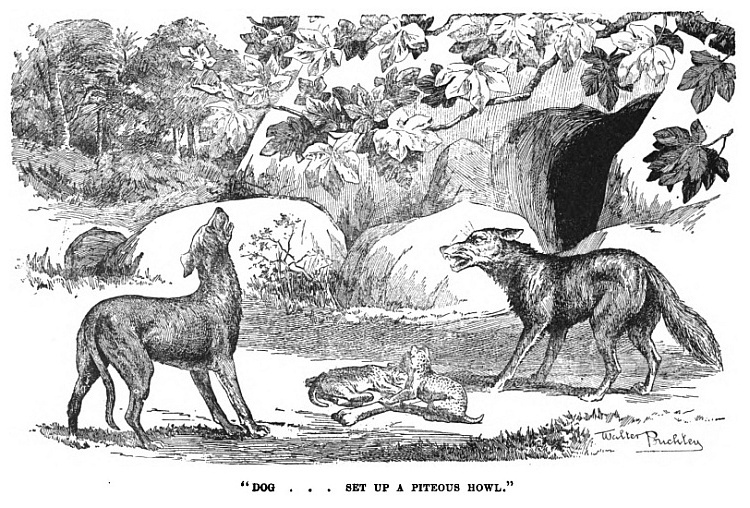
As for Dog he was sorely frightened, but after a little deliberation he resolved to face the matter out until he was certain of the danger. He conveyed the cubs, living and dead, quickly within, and then waited with well-dissembled anxiety the coming of his mistress.
Leopardess shortly arrived, and was met at the door by the obsequious Dog with fawning welcome.
“Where is Jackal?” asked Leopardess as she entered.
“I regret to say he has not returned yet from a visit which he said he was bound to pay his friends and family, whom he had not seen for so long,” replied Dog.
“Then you go and bring my little ones to me. Poor little dears, they must be hungry by this, and my milk troubles me,” commanded the mistress.
Dog departed readily, thinking to himself, “I am in for it now.” He soon returned, bearing one of the cubs, and laid it down.
“Bring the other one, quickly,” cried Leopardess.
“Yes, ma’am, immediately,” he said.
Dog took the same cub up again, but in a brief time returned with it. The cub, already satisfied, would not touch the teat.
“Go and bring the other one, stupid,” cried Leopardess, observing that it would not suck.
“This is the other one, mistress,” he replied.
“Then why does it not suck?” she asked.
“Perhaps it has not digested its dinner.”
“Where is Jackal? Has he not yet returned? Jackal!” she cried. “Where are you, Jackal?”
From the jungle out-doors Jackal shrilly yelped, “Here I am, mistress!”
“Come to me this instant,” commanded Leopardess.
“Coming, mistress, coming,” responded Jackal’s voice faintly, for at the sound of her call he had been alarmed and was trotting off.
“Why, what can be the matter with the brute, trifling with me in this manner? Here, Dog, take this cub to the crib.”
Dog hastened to obey, but Leopardess, whose suspicions had been aroused, quietly followed him as he entered the doorway leading into the inner recess of the house where the crib was placed. Having placed the living near the dead cub in the crib, Dog turned to leave, when he saw his dreaded mistress in the doorway, gazing with fierce distended eyes, and it flashed on him that she had discovered the truth, and fear adding speed to his limbs he darted like an arrow between her legs, and rushed out of the den. With a loud roar of fury Leopardess sprang after him, Dog running for dear life. His mistress was gaining upon him, when Dog turned aside, and ran round the trees. Again Leopardess was rapidly drawing near, when Dog shot straight away and increased the distance between them a little. Just as one would think Dog had no hope of escaping from his fierce mistress, he saw a wart-hog’s burrow, into which he instantly dived. Leopardess arrived at the hole in the ground as the tail of Dog disappeared from her sight. Being too large of body to enter, she tore up the entrance to the burrow, now and then extending her paw far within to feel for her victim. But the burrow was of great length, and ran deep downwards, and she was at last obliged to desist from her frantic attempts to reach the runaway.
Reflecting awhile, Leopardess looked around and saw Monkey near by, sitting gravely on a branch watching her.
“Come down, Monkey,” she imperatively commanded, “and sit by this burrow and watch the murdering slave who is within, while I procure materials to smoke him out.”
Monkey obeyed, and descending the tree, took his position at the mouth of the burrow. But it struck him that should Dog venture out, his strength would be unable to resist him. He therefore begged Leopardess to stay a moment, while he went to bring a rock with which he could block the hole securely. When this was done Leopardess said, “Now stay here, and do not stir until I return; I will not be long, and when I come I will fix him.”
Leopardess, leaving the burrow in charge of Monkey, commenced to collect a large quantity of dry grass, and then proceeded to her house to procure fire wherewith to light it, and suffocate Dog with the smoke.
Dog, soon after entering the burrow had turned himself round and faced the hole, to be ready for all emergencies. He had heard Leopardess give her orders to Monkey, had heard Monkey’s plans for blockading him, as well as the threat of Leopardess to smoke him out. There was not much hope for him if he stayed longer.
After a little while he crept close to the rock that blocked his exit, and whispered:
“Monkey, let me out, there’s a good fellow.”
“It may not be,” replied Monkey.
“Ah, Monkey, why are you so cruel? I have not done any harm to you. Why do you stand guard over me to prevent my escape?”
“I am simply obeying orders, Dog. Leopardess said, ‘Stay here and watch, and see that Dog does not escape;’ and I must do so or harm will come to me, as you know.”
Then said Dog, “Monkey, I see that you have a cruel heart, too, though I thought none but the Leopard kind could boast of that. May you feel some day the deep despair I feel in my heart. Let me say one word more to you before I die. Put your head close to me that you may hear it.”
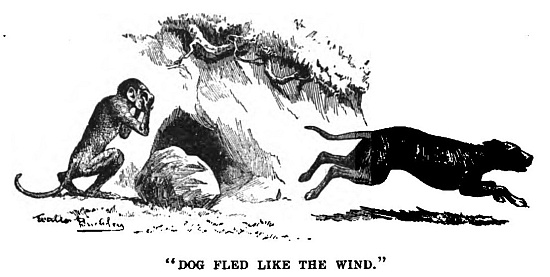
Monkey, curious to know what the last word could be about, put his face close between the rock and the earth and looked in, upon which Dog threw so much dust and sand into his cunning eyes as almost to blind him.
Monkey staggered back from the entrance, and while knuckling his eyes to nib the sand out, Dog put his fore-feet against the rock and soon rolled it away. Then, after a hasty view around, Dog fled like the wind from the dangerous spot.
Monkey, after clearing his eyes from the dirt thrown in them, and reviewing his position, began to be concerned as to his own fate. It was not long before his crafty mind conceived that it would be a good idea to place some soft nuts within the burrow, and roll back the stone into its place.
When Leopardess returned with the fire she was told that Dog was securely imprisoned within, upon which she piled the grass over the burrow and set fire to it.
Presently a crackling sound was heard within.
“What can that be?” demanded Leopardess.
“That must surely be one of Dog’s ears that you heard exploding,” replied Monkey.
After a short time another crackling sound was heard.
“And what is that?” asked Leopardess.
“Ah, that must be the other ear of course,” Monkey answered.
But as the fire grew hotter and the heat increased within there were a great many of these sounds heard, at which Monkey laughed gleefully and cried:
“Ah ha! do you hear? Dog is splitting to pieces now. Oh, he is burning up finely; every bone in his body is cracking. Ah, but it is a cruel death, though, is it not?”
“Let him die,” fiercely cried Leopardess. “He killed one of my young cubs—one of the loveliest little fellows you ever saw.”
Both Leopardess and Monkey remained at the burrow until the fire had completely died out, then the first said:
“Now, Monkey, bring me a long stick with a hook at the end of it, that I may rake Dog’s bones out and feast my eyes upon them.”
Monkey hastened to procure the stick, with which the embers were raked out, when Leopardess exclaimed:
“What a queer smell this is! It is not at all like what one would expect from a burnt dog.”
“Ah,” replied Monkey, “Dog must be completely burnt by this. Of that there can be no doubt. Did you ever burn a dog before that you know the smell of its burnt body so well?”
“No,” said the Leopardess; “but this is not like the smell of roast meat. Rake out all the ashes that I may see the bones and satisfy myself.”
Monkey, compelled to do as he was commanded, put in his stick, and drew out several half-baked nuts, the shells of which were cracked and gaping open. These Leopardess no sooner saw than she seized Monkey, and furiously cried:
“You wretch, you have deceived and trifled with me! You have permitted the murderer of my cub to escape, and your life shall now be the forfeit for his.”
“Pardon, mighty Leopardess, but let me ask how do you propose to slay me?”
“Why, miserable slave, how else should I kill you but with one scratch of my claws?”
“Nay, then, great Queen, my blood will fall on your head and smother you. It is better for yourself that you should toss me up above that thorny bough, so that when I fall upon it the thorns may penetrate my heart and kill me.”
No sooner had Monkey ended, than fierce Leopardess tossed Monkey upward as he had directed; but the latter seized the bough and sat up, and from this he sprang upward into another still higher, and thence from branch to branch and from tree to tree until he was safe from all possible pursuit.
Leopardess perceived that another of her intended victims had escaped, and was furious with rage.
“Come down this instant,” she cried to Monkey, hoping he would obey her.
“Nay, Leopardess. It has been told me, and the forest is full of the report, that your cruelty has driven from you Jackal and Dog, and that they will never serve you again. Cruel people never can reckon upon friends. I and my tribe, so long servants to you, will henceforth be strangers to you. Fare you well.”
A great rustling was heard in the trees overhead as Monkey and his tribe migrated away from the district of the cruel Leopardess who, devoured with rage, was obliged to depart with not one of her vengeful thoughts gratified.
As she was returning to her den, Leopardess bethought herself of the Oracle, who was her friend, who would no doubt, at her solicitations, reveal the hiding-places of Jackal and Dog. She directed her steps to the cave of the Oracle, who was a nondescript practising witchcraft in the wildest part of the district.
To this curious being she related the story of the murder of her cub by Jackal and Dog, and requested him to inform her by what means she could discover the criminals and wreak her vengeance on them.
The Oracle replied, “Jackal has gone into the wild wood, and he and his family henceforward will always remain there, to degenerate in time into a suspicious and cowardly race. Dog has fled to take his shelter in the home of man, to be his companion and friend, and to serve man against you and your kind. But lest you accuse me of ill-will to you, I will tell you how you may catch Dog if you are clever and do not allow your temper to exceed your caution. Not far off is a village belonging to one of the human tribes, near which there is a large ant-hill, where moths every morning flit about in the sunshine of the early day. About the same time Dog leaves the village to sport and gambol and chase the moths. If you can find a lurking-place not far from it, where you can lie silently in wait, Dog may be caught by you in an unwary moment while at his daily play. I have spoken.”
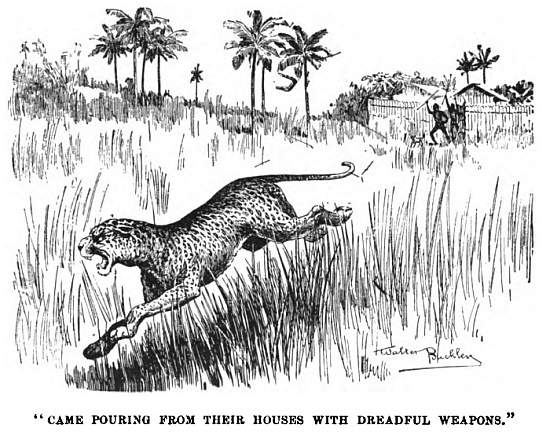
Leopardess thanked the Oracle and retired brooding over its advice. That night the moon was very clear and shining bright, and she stole out of her den, and proceeding due west as she was directed, in a few hours she discovered the village and the ant-hill described by the Oracle. Near the mound she also found a thick dense bush, which was made still more dense by the tall wild grass surrounding it. In the depths of this she crouched, waiting for morning. At dawn the village wherein men and women lived was astir, and at sunrise the gates were opened. A little later Dog signalled himself by his well-known barks as he came out to take his morning’s exercise. Unsuspicious of the presence of his late dread mistress he bounded up the hill and began to circle around, chasing the lively moths. Leopardess, urged by her anger, did not wait until Dog, tired with his sport, would of his own accord stray among the bushes, but uttering a loud roar sprang out from her hiding-place. Dog, warned by her voice, which he well knew, put his tail between his legs and rushed through the open gates and alarmed his new masters, who came pouring from their houses with dreadful weapons in their hands, who chased her, and would have slain her had she not bounded over the fence. Thus Leopardess lost her last chance of revenging the death of her cub; but as she was creeping homeward her mortification was so great that she vowed to teach her young eternal hostility towards Dog and all his tribe. Dog also, convinced that his late mistress was one who nourished an implacable resentment when offended, became more cautious, and a continued life with his new masters increased his attachment for them. When he finally married, and was blessed with a progeny, he taught his pups various arts by which they might ingratiate themselves more and more with the human race. He lived in comfort and affluence to a good old age, and had the satisfaction to see his family grow more and more in the estimation of their generous masters, until dogs and men became inseparable companions.
Leopardess and her cub removed far away from the house associated with her misfortune, but though Time healed the keen sore of her bereavement by blessing her annually with more cubs, her hate for Dog and his kind was lasting and continues to this day. And thus it was that the friendly fellowship which reigned between the forest animals during the golden age of Uganda was broken for ever.
For proof of the truth of what I have said consider the matter in your own minds. Regard the Ape who, upon the least alarm springs up the tree, and stays not until he has secured himself far from reach. Think of the Jackal in his cheerless solitude deep in the bowels of the earth, or in the farthest rocky recess that he can discover, ever on the watch against some foe, too full of distrust to have a friend, the most selfish and cowardly of the forest community. The Leopard is the enemy at all times, night and day, of every animal, unless it be the lion and the elephant. As for the Dog, where is the man who is not acquainted with his fidelity, his courage in time of danger, his watchful care of his interests by night, and his honest love for the family which feeds him? My story is here ended.
Chapter Eleven.
A Second Version of the Leopard and the Dog Story.
Sarboko, who was originally from Unyoro, a country which lies to the north of Uganda, and had been employed as a page by Mtesa, king of Uganda, protested that his version of how the dog became estranged from the leopard, his chum, was nearer the truth than that given by Kadu. Perceiving that he was inclined to contribute to our amusement, for a reason of his own, we ranged ourselves around the camp fire in the usual way and prepared to listen to another version of a legend which is popular among most of the tribes dwelling in the Lake Region.
How the Dog outwitted the Leopard.
In the early time there was a dog and a leopard dwelling together in a cave like chums. They shared and fared alike. Exact half of everything and equal effort were the terms upon which they lived. Many and many a famous raid among the flocks and fowls in the human villages they made. The leopard was by far the strongest and boldest, and was most successful in catching prey. Dog lived so well on the spoils brought home by his friend that he became at last fat and lazy, and he began to dislike going out at night in the rain and cold dew, and to hide this growing habit from Leopard he had to be very cunning. He always invented some excuse or another to explain why he brought nothing to the common larder, and finally he hit upon a new plan of saving himself from the toil and danger.
Just before dusk one day, Leopard and Dog were sociably chatting together, when Leopard said that he intended that night to catch a fine fat black goat which he had observed in the nearest village to their den. He had watched him getting fatter every day, and he was bent upon bringing him home.
“Black is it?” cried Dog. “That is strange, for that is also the colour of the one I purposed to catch to-night.”
The two friends slept until most of the night was gone, but when there were signs that morning was not far off they silently loped away to their work.
They parted at the village which Leopard had selected to rob, Dog whispering “Good luck” to him. Dog trotted off a little way and sneaked back to watch his friend.
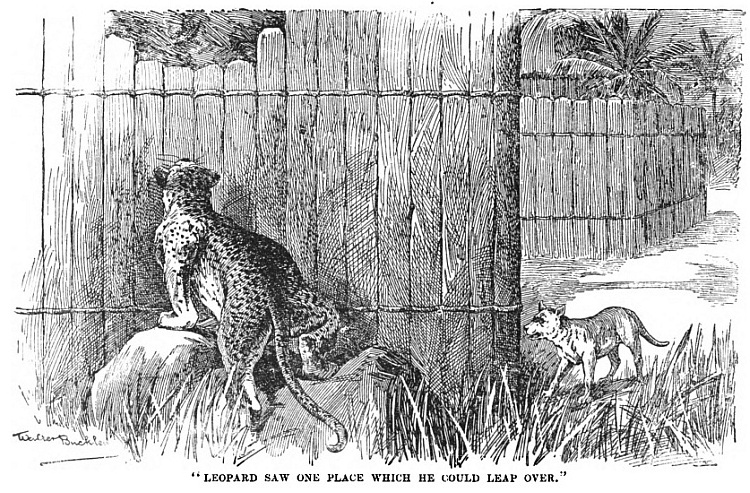
Leopard stealthily surveying the tall fence, saw one place which he could leap over, and at one spring was inside the village. Snuffing about, he discovered the goat-pen, forced an entrance, and seizing his prize by the neck, drew it out. He then flung it over his shoulders, and with a mighty leap landed outside the fence.
Dog, who had watched his chance, now cried out in an affected voice, “Hi, hi—wake up! Leopard has killed the goat. There he is. Ah, ah! Kill him, kill him!”
Alarmed at the noise made, and hearing a rustle in the grass near him, Leopard was obliged to abandon his prize, and to save his own life, dropped the goat and fled.
Dog, chuckling loudly at the success of his ruse, picked the dead goat up, and trotted home to the den with it.
“Oh, see, Leopard!” cried he, as he reached the entrance, “what a fat goat I’ve got at my village. Is it not a heavy one? But where is yours? Did you not succeed after all?”
“Oh! I was alarmed by the owners in the village, who pursued me and yelled out, ‘Kill him, kill him!’ and there was something rustling in the grass close by, and I thought that I was done for; but I dropped the goat and ran away. I dare say they have found the animal by this, and have eaten our meat. Never mind, though, better luck next time. I saw a fine fat white goat in the pen, which I am sure to catch to-morrow night.”
“Well, I am very sorry, but cheer your heart. You shall have an equal share with me of this. Let us bestir ourselves to cook it.”
They gathered sticks and made a fire, and began to roast it. When it was nearly ready Dog went outside, and took a stick and beat the ground, and whined out:
“Oh! please, I did not do it. It was Leopard that killed the goat. Oh! don’t kill me. It was Leopard who stole it.”
Leopard, hearing these cries and the blows of the stick, thought to himself: “Ah! the men have followed us to our den, and are killing Dog; then they will come and kill me if I do not run.” He therefore ran out and escaped.
Dog, on seeing him well away, coolly returned to the den and devoured the whole of the meat, leaving only the bones.
After a long time Leopard returned to the den, and found Dog moaning piteously. “What is the matter, my friend?” he asked.
“Ah! oh! don’t touch me; don’t touch me, I beg of you. I am so bruised and sore all over! Ah! my bones! They have half killed me,” moaned Dog.
“Poor fellow! Well, lie still and rest. There is nothing like rest for a bruised body. I will get that white goat the next time I try.”
After waiting two or three days, Leopard departed to obtain the white goat. Dog sneaked after him, and served his friend in the same way, bringing the white goat himself, and bragging how he had succeeded, while pretending to pity Leopard for his bad luck.
Three times running Dog served him with the same trick, and Leopard was much mortified at his own failure. Then Leopard thought of the Muzimu—the oracle who knows all things, and gives such good advice to those who are unfortunate and ask for his help—and he resolved, in his distress, to seek him.
In the heart of the tall, dark woods, where the bush is most dense, where vines clamber over the clumps, and fold themselves round and round the trees, and hang in long coils by the side of a cool stream, the Muzimu resided.
Leopard softly drew near the sacred place and cried, “Oh! Muzimu, have pity on me. I am almost dying with hunger. I used to be bold and strong, and successful, but now, of late, though I catch my prey as of old, something always happens to scare me away, and I lose the meat I have taken. Help me, O Muzimu, and tell how my good luck may return.”
After a while the Muzimu answered in a deep voice, “Leopard, your ill-luck comes from your own folly. You know how to catch prey, but it takes a dog to know how to eat it. Go; watch your friend, and your ill-luck will fly away.”
Leopard was never very wise, though he had good eyes, and was swift and brave, and he thought over what the Muzimu said. He could not understand in what way his good luck would return by watching his friend, but he resolved to follow the advice of the Muzimu.
The next night Leopard gave out that he was going to seize a dun-coloured goat, and Dog said, “Ah! that is what I mean to do too. I think a dun-coated goat so sweet.”
The village was reached, a low place was found in the palings, and Leopard, as quick as you could wink, was over and among the goats. With one stroke he struck his victim dead, threw it over his shoulders, and, with a flying leap, carried it outside. Dog, who was hiding near the place, in a strange voice cried, “Ah! here he is—the thief of a Leopard! Kill him! kill him!”
Leopard turning his head around, saw him in the grass and heard him yelp, “Awu-ou-ou! Awu-ou-ou! Kill him! kill him!” dropped the goat for an instant and said, “Ah, it is you, my false friend, is it? Wait a bit, and I will teach you how you may steal once too often.” With eyes like balls of fire, he rushed at him, and would have torn him into pieces, but Dog’s instinct told him that the game he had been playing was up, and burying his tail between his hind legs, he turned and fled for dear life. Round and round the village he ran, darting this way and that, until, finding his strength was oozing out of him, he dashed finally through a gap in the fence, straight into a man’s house and under the bed, where he lay gasping and panting. Seeing that the man, who had been scared by his sudden entry, was about to take his spear to kill him, he crawled from under the bed to the man’s feet, and licked them, and turned on his back imploring mercy. The man took pity on him, tied him up, and made a pet of him. Ever since Dog and Man have been firm friends, but a mortal hatred has existed between Dog and Leopard. Dog’s back always bristles straight up when his enemy is about, and there is no truer warning of the Leopard’s presence than that given by Dog—while Leopard would rather eat a dog than a goat any day. That is the way—as I heard it in Unyoro—that the chumship between Leopard and Dog was broken up.
Chapter Twelve.
The Legend of the Cunning Terrapin and the Crane.
The following story of the cunning Terrapin and the Crane established Kadu’s reputation among us, and the Zanzibaris were never so amused as on this evening.
“Master,” began Kadu, after we had made ourselves comfortable before a bright and crackling fire, “some men say that animals do not reason, and cannot express themselves, but I should like to know how it is that we perceive that there is great cunning in their actions, as though they calculated beforehand how to act, and what would be the result. We Waganda think animals are very clever. We observe the cock in the yard, and the hen with her chickens; the leopard, as he is about to pounce on his prey; the lion, as he is about to attack; the crocodile, as he prepares for his rush; the buffalo in the shade, as he awaits the hunter; the elephant, as he stands at attention; and we say to ourselves, how intelligent they are! Our legends are all founded on these things, and we interpret the actions of animals from having seen their methods; and I think men placed in the same circumstances could not have acted much better. It may appear to you, as though we were telling you mere idle tales to raise a laugh. Well, it may be very amusing to hear and talk about them, but it is still more amusing to watch the tricks of animals and insects, and our old men are fond of quoting the actions of animals to teach us, while we are children, what we ought to do. Indeed, there is scarcely a saying but what is founded upon something that an animal was seen to do at one time or another.
“Now the story that I am about to relate, is a very old one in Uganda. I heard it when a child, and from the fact that a Terrapin was said to be so cunning, I have never liked to ill-treat a Terrapin, and every time I see one, the story comes to my mind in all its freshness.”
A Terrapin and a Crane were one time travelling together very sociably. They began their conversation by the Terrapin asking:
“How is your family to-day, Miss Crane?”
“Oh, very well. Mamma, who is getting old, complains now and then, that’s all.”
“But do you know that it strikes me that she is very fat?” said Terrapin. “Now a thought has just entered my head, which I beg to propose to you. My mother, too, is ailing, and I am rather tired of hearing her complaints day after day; but she is exceedingly lean and tough, though there is plenty of her. I wonder what you will say to my plan? We are both hungry. So let us go and kill your mother, and eat her; and to-morrow, you will come to me, and we will kill my mother. We thus shall be supplied with meat for some days.”
Replied the Crane, “I like the idea greatly, and agree to it. Let us go about it at once, for hunger is an exacting mistress, and the days of fasting are more frequent than those of fulness.”
The matricides turned upon their tracks, and, arriving at the house of Mrs Crane, the two cruel creatures seized upon Mamma Crane, and put her to death. They then plucked her clean, and placed her body in the stew-pot, and both Terrapin and Crane feasted.
Terrapin then crawled home, leaving Crane to sleep, and the process of digestion. But, alas! Crane soon became very ill. Whether some qualms of conscience disturbed digestion or not, I cannot say, but she passed a troublesome night, and for several days afterwards she did not stir from her house.
Terrapin, on reaching the house of its mamma, which was in the hollow of a tree, cried out:
“Tu-no-no-no!” upon which Mrs Terrapin said, “Oh, that is my child,” and she let down a cord, to which young Terrapin made himself fast, and was assisted to the nest where the parent had already prepared a nice supper for him.
Several days later, Terrapin was proceeding through the woods to the pool where he was accustomed to bathe, when at the water-side he met Miss Crane apparently quite spruce and strong again.
She hailed Terrapin and said, “Oh, here you are, at last. I have been waiting to see you for some time.”
“Yes,” replied Terrapin, “here I am, and you—how do you feel now? My neighbours told me you were very ill.”
“I am all right again,” said Miss Crane, “but I think my old ma disagreed with me, and I was quite poorly for some days; but I am now anxious to know when you are going to keep your part of the bargain which we made.”
“What—you mean about the disposing of my old ma?”
“Yes, to be sure,” answered Crane, “I feel quite hungry.”
“Well, well. Bargains should always be kept, for if the blood-oath be broken misfortune follows. Your mother’s death rests on my head, and I mean to return your hospitality with interest, otherwise, may my shell be soon empty of its tenant. Stay here awhile and I will bring her.”
So saying, Terrapin departed, and crept to where he had secretly stowed a quantity of india-rubber, in readiness for the occasion. After taking out quite a mass of it, he returned to the pond, where Miss Crane stood on one leg, expectant and winking pleasantly.
“I fear, sister Crane,” said Terrapin, as he laid his burden down, “that you will find my old ma tough. She turned out to be much leaner than I anticipated. There is no more fat on her bones, than there is on my back. But now, fall to, and welcome. There is plenty there. I am not hungry myself, as I have just finished my dinner.”
Miss Crane, with her empty stomach, was not fastidious, and stepped out eagerly to the feast so faithfully provided, and began to tear away at what Terrapin had brought. The rubber, however, stretched by the greedy Crane, suddenly flew from her foot, and rebounding, struck her in the face a smart blow.
“Oh! oh!” cried Crane, confused with the blow. “Your old ma is most tough.”
“Yes, she is. I suspected she would prove a little tough,” answered Terrapin, with a chuckle. “But don’t be bashful. Eat away, and welcome.”
Again Miss Crane tugged at the rubber to tear it, but the more it was stretched, the more severe were the shocks she received, and her left eye was almost blinded.
“Well, I never,” exclaimed Miss Crane. “She is too tough altogether.”
“Try again,” cried Terrapin. “Try again; little by little, it is said, a fly eats a cow’s tail. You will get a rare and tender bit in time.”
Miss Crane thus pressed, did so, and seizing a piece lay back, and drew on it so hard that when the rubber at last slipped, it bounded back with such force, that she was sent sprawling to the ground.
“Why, what is the matter?” asked Terrapin, pretending to be astonished. “She is tough, I admit; but loh! our family are famous for toughness. However, the tougher it is, the longer it lasts on the stomach. Try again, sister Crane; I warrant you will manage it next time.”
“Oh, bother your old ma. Eat her yourself. I have had enough of that kind of meat.”
“You give it up, do you?” cried Terrapin. “Well, well, it is a pity to throw good meat away. Maybe, if I keep it longer it will get tenderer by and by.”
They thus parted, Terrapin bearing his share of rubber away in one direction, and Miss Crane sadly disgusted, striding grandly off in another, but looking keenly about for something to satisfy her hunger.
When she had gone a great distance a parrot flew across her path, and perching on a branch near her, cried out, “Oh, royal bird, say since when has rubber become the food of the bird-king’s family?”
“What do you mean, Parrot?” she asked.
“Well, I saw you tearing at a piece of rubber just now, and when you marched off Terrapin carried it away, and I heard him say—because he has a habit of speaking his thoughts aloud—Oh, how stupid my sister Crane is! She thinks my ma is dead. Ho, ho, ho! what a stupid! And all the way he chuckled and laughed as though he was filled with plantain wine.”
“Is his ma not dead then?” asked Miss Crane.
“Dead! Not a bit of it,” replied Parrot. “I saw old Ma Terrapin but a moment ago as I flew by her tree, waiting for her son, and the cord is ready for his cry of ‘Tu-no-no-no. Ano-no-no. We-no-no-no!’”
“Ah, Parrot, your words are good. When we know what another is saying behind our backs, we discover the workings of his heart. The words of Terrapin are like the bush that covers the trap. Good-by, Parrot. When we next meet, we shall have another story to tell.”
On the next day, Terrapin observed Miss Crane approaching his house, and he advanced a little way to meet her.
“Well, sister Crane, I hope you are all right this morning?” he asked.
“Oh yes, so so, brother Terrapin. But you must excuse me just now; I’ve heard bad news from my family. A brother and sister of mine are suddenly taken ill, and I am bound to go and visit them,” answered Crane.
“Ah, Miss Crane, that reminds me of my own brother and sister, who are much younger than I am, but very soft and tender. What do you say now to making another bargain?” asked Terrapin with a wink.
“You are very good, Terrapin. I will think of it as I go along. I shall be back before noon to-morrow, and we will talk of a trade then.” They were very civil to one another as they parted. Terrapin went for his usual walk to the pond, Miss Crane proceeded to visit her family, but muttered:
“Ha, ha, Terrapin, you are great at a trade; but you will not make another with me in a hurry till our first one is squared.”
After she had gone a little way she turned suddenly round and came back to the foot of Terrapin’s tree, and cried,
“Tu-no-no-no. Ano-no-no-no. We-no-no-no!”
“Ah, that is my child’s voice,” said Ma Terrapin to herself, and let down the cord.
Miss Crane caught hold and climbed up towards the nest. Ma Terrapin craned her neck out far to welcome her child, but before she could discover by what means little Terrapin had changed its dress, Miss Crane struck Ma Terrapin with her long sharp bill in the place where the neck joins the shoulder, and in a short time Ma Terrapin was as dead as Miss Crane’s own mother.
The body was rolled from the nest, and it went falling down, and Miss Crane slid quickly after it.
In a quiet place screened by thick bushes Miss Crane made a great fire, with which Ma Terrapin’s thick shell was cracked. She then scooped out the flesh, and carried it to her own home, and stowed it in a big black pot.
On the next day as Miss Crane was standing on one leg by the pond, with her head half buried in her feathers, who should come along but Terrapin, crying bitterly, and saying, “Ah, my ma is dead. My old ma has been killed. Who will assist me now?”
Miss Crane affected to be asleep, but heard every word. When, however, Terrapin was near, she woke up suddenly and said, cheerfully,
“Ah! it is Terrapin, my little brother Terrapin. How do you do to-day?”
Now as Terrapin had already slain his mother, according to his own confession, it struck him that it would not do to accuse Miss Crane of the murder, because by doing so he would expose his breach of faith with her, but the scent of the roasted flesh of Ma Terrapin came strong just then, and he knew that it was Crane who, discovering his trick, had killed her.
He managed, however, to reply briskly:
“Sissy, dear, I am but tolerable. But how is your family to-day?”
“My brother and sister are much improved, Terrapin. They are both as fat as tallow. By-the-bye, what about that trade you proposed to me?”
“I am ready, Miss Crane, for a trade any day. When shall it be?”
“No time so good as the present, and if you jog along to the other end of the pond, I will fix my house here, and soon catch up with you.”
Terrapin professed great delight, and toddled along; but when he had gone a little way his bad habit of thinking aloud came on him, and he was heard to say:—
“My poor ma! my poor ma is dead! O you wicked Crane! I know by the scent of the meat that you have killed my ma. What can I do now?”
Miss Crane knew then that she had been discovered, and she began to think that it was time to remove to another district, for Terrapin had many friends in the woods, such as rabbits, jackals, lions, and serpents, and if Terrapin moaned so loud, all the people of the woods would know what she had done, and many would no doubt assist him to punish her. Casting about in her mind for the best place, she remembered an extremely tall tree which was not far from Terrapin’s house, a very lofty clean-shafted tree, on the top of which she would be safe from surprise.
Thither she hastily removed her belongings, and soon established herself comfortably. She had also provided herself with a store of strong sticks to be used as weapons in case of necessity.
Terrapin meanwhile crawled along, moaning loudly his lamentations. Suddenly Rabbit popped out of the woods, and stood in his path. He soon was made aware of Terrapin’s bereavement, and strongly sympathised with him. Terrapin related the story in such a way that made Miss Crane appear to be a murderess, against whom the people of the woods should take vengeance.
“Then,” said Rabbit, “that must be Miss Crane, who is building her house on the very top of that tall tree near your place.”
“Is she?” asked Terrapin. “I did not know that. She was to have met me here; but I see she knows that she is detected, and is already taking measures to protect herself. But, Rabbit, you who are always wise, tell me how I may avenge myself?”
“There is only one way that I know of,” answered Rabbit, dubiously. “Go to the Soko (Gorilla?), but he is a hard dealer who will make you pay handsomely for his help. Soko is the king of the ape kind. If you pay him well, he will fasten a cord to Crane’s nest, up which you can climb when she is absent. Once there, lie quietly, and when she alights seize her.”
The plan pleased Terrapin immensely, and possessing a comfortable property upon the loss of his mother, he thought he had sufficient to purchase Soko’s assistance.
Through the good offices of Rabbit negotiations were entered into with Soko, who agreed for a potful of good nuts, ten bunches of ripe bananas, one hundred eggs, and sundry other trifles, to hang a stout rattan climber to Crane’s nest, long enough to reach the ground.
The royal bird was soon informed of the conspiracy against her by the Parrot, who loves to carry tales, and Miss Crane resolved to be absent from home while Soko was fastening the climber, but commissioned her friend the Parrot to observe the proceedings, and to report to her when Soko had completed his task.
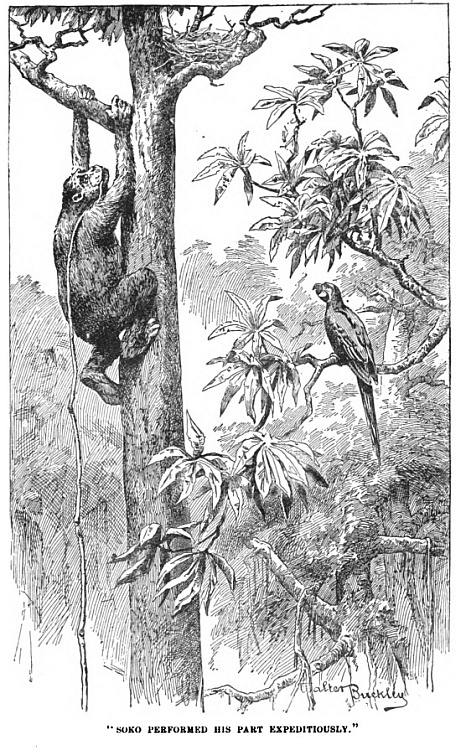
Soko performed his part expeditiously. Terrapin tested the strength of the rattan, and had to confess that Soko had earned his pay, and Rabbit accompanied Terrapin and Soko to Terrapin’s house to see the Soko receive his commission.
As they departed Parrot flew to inform Miss Crane, who immediately returned to her house to await her enemy.
Not long after Terrapin came to the foot of Crane’s tree and commenced to climb up. He had nearly reached the top when Miss Crane stood up and delivered such a thwacking blow on Terrapin’s back that it caused him to loose his hold and fall to the ground. When Terrapin recovered his senses, he heard Miss Crane cry out—
“Ha! brother Terrapin, that was a nasty fall. You remember the rubber, don’t you? There is nothing like the advice you gave me. Try again, Terrapin, my brother. Try again.”
“You killed my ma, did you not?” asked Terrapin.
“I thought you told me that you had killed her according to agreement. Then how can you say that I killed her?” asked Miss Crane.
“That was not my ma I gave you. It was only a lump of rubber.”
“Ho, ho! You confess it then? Well, we are now quits. You induced me to kill my ma, and as you could not keep your part of the bargain, I saved you the trouble. My ma was as much to me as your ma was to you. We have both lost our ma’s now. So let us call it even, and be friends again.”
Terrapin hesitated, but the memory of his ma’s loss soon produced the old bitterness, and he became as unforgiving as ever. Miss Crane must, however, be persuaded that the matter was forgiven, otherwise he would never have the opportunity to avenge his ma’s death.
“All right, Crane,” he answered; “but let me come up, and embrace you over it, or do you descend and let us shake hands.”
“Come up, by all means, Terrapin. I am always at home to friends,” said Miss Crane.
Terrapin upon this began to climb, but as he was ascending he foolishly began to think aloud again, and he was heard saying—
“Oh, yes, sister Crane. Just wait a little, and you will see. He, he, he!”
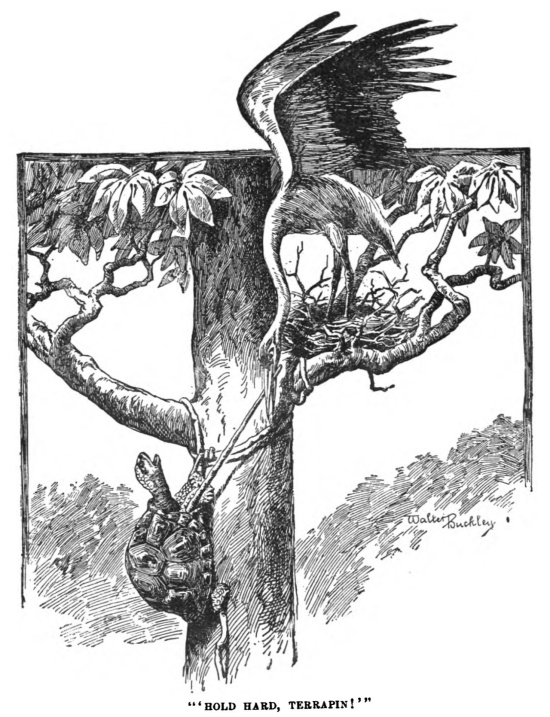
Miss Crane, who was quietly listening, heard Terrapin’s chuckle and muttering, and prepared to receive him properly. When he was within reach, she cried, “Hold hard, Terrapin,” and at once proceeded to shower mighty blows on his back, then laid the stick on his feet so sharply that, to protect them, he had to withdraw them into his shell, in doing which he lost his hold and fell to the ground with such force that to anything but a terrapin the great fall would have been instantly fatal.
“Try again, Terrapin; try again, my brother. Another time and you will succeed,” cried Miss Crane, mockingly.
Terrapin slowly recovered his faculties from the second fall, and exclaimed, “Ah, Crane, Crane. If I heed you a second time, call me fool. Yesterday and to-day you triumphed, to-morrow will be my turn.”
“Kwa-le, kwa-le,” Miss Crane shrilly cried. “My tree will stand to-morrow where it stood to-day. You know the way to it; if not, your hate will find it.”
Terrapin toddled away upon this to seek the Lion, to whom, when he had found him, he pleaded so powerfully that the Lion pitied him greatly, and answered, “I may not help you in this matter, for I was not made to climb trees. Go you, and tell Jackal your story, and he will be able to advise you.”
Acting on the friendly advice, Terrapin sought out the Jackal, to whom he repeated his lamentable tale. The Jackal rewarded him with a sympathetic sigh, and said, “Friend Terrapin, my teeth are sharp and my feet are swift, but, though I am so happily endowed, I have no wings to fly. Go and seek Elephant. His strength is so great that perhaps he will be able to pull the tree down for you.”
Terrapin proceeded on his way to search out the Elephant, and, after much patient travel, discovered him brooding under a thick shade. To him at once Terrapin unburdened his breast of its load of grief, and appealed piteously for his assistance.
“Little Terrapin,” replied the kindly Elephant, “your tale is dour. But though I am strong, there are some things that I cannot do. Miss Crane’s house is built on one of the biggest trees of the forest, and it would require two score of elephants to drag it down. It is wisdom, and not strength, that you need. Go you and seek Serpent, and he will assist you.”
Thence Terrapin went to seek Serpent, and, after long seeking, found him coiled, in many shining folds, in the fork of a sturdy tree.
“Ah, Serpent,” he cried, “you are a kinsman of mine, and I have long sought you. I am in dire distress, my friend,” and he proceeded to inveigh against Miss Crane passionately, and concluded by invoking his assistance.
“Help me this day,” cried Terrapin, “and you shall be my father and my mother, and all my nearest relations in one.”
“It is well,” replied the Serpent, in his slow, deliberate manner. “Miss Crane shall die, and here I make a pact with you. There shall be no enmity for all future time between your family and mine. Go now, and rest in peace, for the fate of Crane is fixed.”
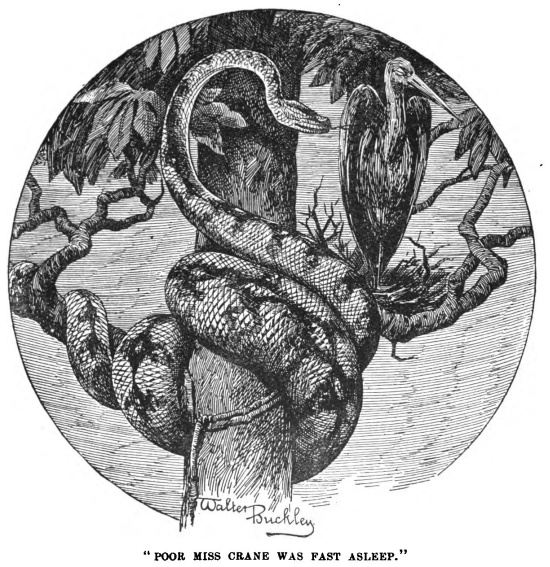
In the darkness of the night Serpent roused himself from his sleep and, uncoiling himself, descended the tree and glided noiselessly along the ground towards Miss Crane’s tree. The tall clean shaft could not arrest those spiring movements, and the Serpent steadily ascended until he gained the fork. Thence, by an almost imperceptible motion, he advanced towards the nest. Poor Miss Crane was fast asleep, dreaming of the fall of Terrapin, while the Serpent folded his extremity around a stout branch and stood up prepared to strike. Quick as one could wink the Serpent flung himself upon the bird-queen, and in a moment she lay crushed and mangled. Then, seizing her body with his jaws, the Serpent slid down the shaft of the tree and sought Terrapin’s house, and laid her remains before him. Terrapin was overjoyed, and invited Serpent to share with him the dainty feast which the body of Miss Crane supplied.
From that day to this Serpent and Terrapin have remained close friends, and neither has ever been known to break the solemn agreement that was made between them on that day that Terrapin solicited the help of Serpent against the bird-queen.
Chapter Thirteen.
The Legend of Kibatti the Little who Conquered all the Great Animals.
I have done my very best to translate this story as closely as possible in order to give the faithful sense of what was said, yet I despair of rendering the little touches and flourishes which Kadu knew so well how to give with voice, gesture, and mobile face.
“Friends and freemen,” he said, when we were all in listening attitude, “if a son of man knows how to show anger, I need not tell you who are experienced in travel and in the nature of beasts, that the animals of the wilds also know how to show their spite and their passions.” The legend of Kibatti runs upon this.
On a day ages ago the great animals of the world, consisting of the elephant, the rhinoceros, the buffalo, the lion, the leopard, and hyena, assembled in council in the midst of a forest not far from a village on the frontier of Uganda. The elephant being acknowledged by general consent as the strongest, presided on the occasion.
Waving his trunk, and trumpeting to enjoin silence, he said: “Friends, we are gathered together to-day to consider how we may repay in some measure the injuries daily done to us and our kin by the sons of men. Not far from here is situated a village, whence the vicious two-footed animals issue out to make war upon all of us, who possess double the number of feet they have. Without warning of hostility or publishing of cause, they deliberately leave their conical nests, day by day, with fellest intent against any of us whom they may happen to meet during the shining of the sun. Wherefore we are met upon common grounds to devise how we may retaliate upon them the wanton outrages they daily perpetrate upon our unfortunate kind. Personally, I have many injuries to the elephants of my tribe to remember, and which I am not likely to forget. It was only a week ago that a promising child of my sister fell into a deep pit, and was impaled on a short stake set in the bottom of it; and but a few days before my youngest brother fell head-foremost into a horribly deep excavation that was dug, and which was artfully concealed by leaves and grass, whereby none but those, like myself, experienced in their guileful arts, could have escaped. Ye have all, I daresay, been similarly persecuted, and have deep injuries to revenge. I wait to hear what ye propose. Brother Rhinoceros, thou art the next to me in bigness and strength, speak.”
“Well, brother Elephant and friends, the words we have heard are true. The son of man is, of all creatures that I know, the most wanton in offence against us of the four-footed tribes. Not a day passes but I hear moan and plaint from some sufferer. Not long ago, a cousin, walking quietly through a wood not far from here, caught his foot in a vine that lay across the path, and almost immediately after a hardened and pointed stake was precipitated from above deep into the jointure of the neck with the spine, which killed him instantly, of course. I have, by wonderful good luck, escaped thus far, but it may be my fate to fall to-morrow through some foul practice. Wherefore, I think it were well that we set about doing what we decide to do instanter. I propose that early in the morning, before a glint of sunshine be seen, we set upon the piratical nest and utterly destroy it. I am so loaded with hate of them, that I could dispose of the half of the rascals myself, before they could recover their wits. But if any of ye here has a better plan, I lend my ears to the hearing of it, my heart to the approval of it, and my strength and fury to the doing of it, without further speech. I have spoken.”
“Now, friend Lion,” said the Elephant, turning solemnly to him, “it is thy turn, and say freely what thy wit conceives in this matter. Thy courage we all know, and none of us doubt that thy mind is equal to it.”
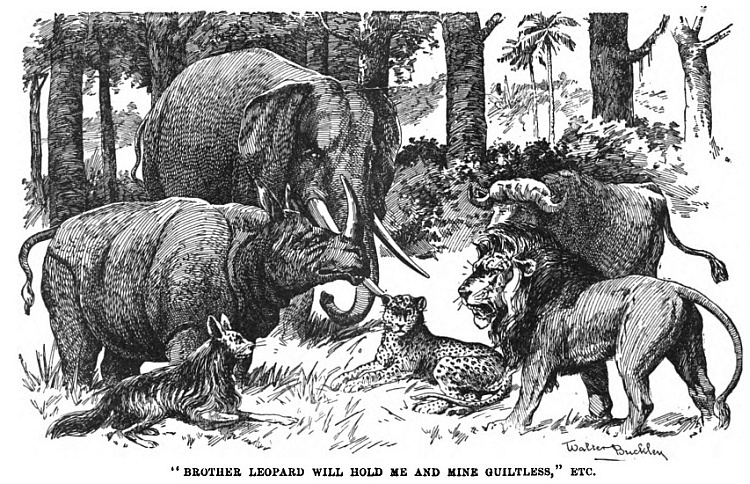
“Truly, friend Elephant, and ye others, the business we are met to consider is pressing. The sons of men are crafty, and their guile is beyond measure. The four-footed tribes have much cause of grievance against me and mine. However, none can accuse me or my family of having taken undue advantage of those whom we meditate striking. We always give loud warning, as you all know, and afterwards strike; for if we did not do this, few of even the strongest would escape our vengeance. But these pestilent, two-footed beasts—by net, trap, falling stake, pit, or noose—are unceasing in their secret malice, and there is no safety in the plain, bush, or rock-fastness against their wiles. For what I and my kin do there is good motive—that of providing meat for ourselves and young; but it passes my wit to discover what the son of man can want with all he destroys. Even our bones—as, for instance, thy long teeth, O Elephant—they carry away with them, and even mine. I have seen the younglings of mankind dangle the teeth of my sister round their necks, and my hide appears to be so precious that the king of the village wears it over his dirty black loins. Thy tribe, O Elephant, have not much cause of complaint against me, and thou, Rhinoceros, it would tax thy memory to accuse me of aught against thy family. Brother Leopard will hold me and mine guiltless of harm to him; so also must my cousin Hyena. Friend Buffalo and our family have sometimes a sharp quarrel, but there is no malice in it, I swear. Whereas the son of man, friends, is the common enemy of us all—it is either our flesh, or our fur, or our hide, or our teeth that he is wanting, and his whole thought is bent upon destruction pure and simple. If ye would follow me, I would glory in leading ye even now against the community, and I give ye my word that few would escape my paw and claw. However, as our object is to destroy all, that none may escape, I agree with my friend Rhinoceros that night-time at its blackest is safest. Wherefore believe me that I am so sharp set for revenge, and I feel so hollow, that nothing but the half of all of them will satisfy my thirst for their blood. I have ended my say.”
“Now, friend Leopard, thou hadst better follow thy cousin, and we will feel obliged to thee for the benefit of thy advice,” said the Elephant.
Leopard gave his tail a quick twirl, and licked his chops and spoke:
“All that ye, my friends and cousin, have said, I heartily agree and bear witness to. The spite of the son of man towards us is limitless. It is remarkable, too, for its cold-bloodedness and lack of passion. We have our own quarrels in the woods—as ye all know—and they are sharp and quick while they last, but there is no premeditation or malignity in what we do to one another; but Man, to whom we would rather give a wide berth, if possible, pursues each of us as if his existence depended upon the mere slaying, though I observe that he has abundance of fruit, which ought to satisfy any reasonable being of the ape tribe. Wherefore, as I have many sharp reasons for retaliation on him for his countless offences against me and my kin, I gladly attended this council, and I will go as far as any of ye, and further if I can, to return some of this spite on him and his tribe. I propose that night at its darkest is best for our plan. While the human folk are indulging in dreams of slaughter of us, I vote that we turn their dreams into action against themselves. The elephant, and rhinoceros, and buffalo are strong; let each lead his tribe to attack, overturn, and trample down their nests. We, with our families, will range round and slaughter every one that escapes them. Those are my words.”
“Now, friend Buffalo, what sayest thou?” demanded the Elephant. “Thou art a staunch friend and stout foe. We cannot but listen with respect to such an one as thyself.”
“Ah, friend Elephant, and ye chiefs of tribes, every sentiment of hostility against the vile and spiteful sons of man that ye have expressed finds an echo in my inwards. If wrong has been done to any here, magnify that wrong tenfold in order that ye may understand the intensity of the hate I bear the remorseless destroyers of my kith and kin. Ask me not how I would slay them, my fury is so great that I am unfit to devise. Do ye the devising, and give the method to me. All I can think of now is the pleasure I shall feel when my horns are warmed in the bodies of the base and treacherous creatures who have murdered wife, brother, sister, and child of mine, besides a countless number of my kindred by lance and line, spear and snare, sword and stake, trick and trap. I will lead my herd into the midst of the vicious community with a joy that only my hate can match. That is all I have to say.”
“Now, my good friend Hyena. Thou art the only one left whose sentiments are as yet unknown. Speak, and let us hear wisdom from thee in this matter.”
The Hyena uttered a mocking laugh, and said: “My kind friends and cousins: The night suits me well, for I am in my element then. I may say that I have a large family which is always hungry. It will be a laughing matter to them indeed to hear of your good purpose. It has been long delayed, this signal measure of just vengeance upon those who have outdone in cold cruelty all that generations of the four-footed tribe of the fiercest kind have done. Bird and beast, from the smallest to the greatest, have fallen victims to man’s lust for destruction. True, my kind are often indebted to man for bones and refuse, but what we have eaten has been sorely against his good will; and we therefore owe him no gratitude. The young of the human community will be juicy morsels for my tribe, when the signal is given for the attack. With all my heart I say let it be to-night. I have said my say.”
The Elephant then said: “Friends, chiefs of the most powerful tribes of the forest, let it be to-night, as ye say. Let each go and muster his forces, and let the attack be in the following manner. Half-way betwixt dawn and midnight I will lead my troop from the Uganda side. The Rhinoceros will lead his from the Katonga side. The Buffalo will range his tribe along that side facing Unyoro. Behind my troop the Hyena and his families shall follow to finish those who may be but bruised by our heavy hoofs. Let Leopard place his fellows and kin in rear of the Rhinoceros troop. Lion and his great tribe are needed in rear of Buffalo’s forces, for they are apt in their fury to overlook the crafty bipeds. Our object is to make a complete job of it. The sooner we part now, the fitter each will be for the perfect consummation of his long-deferred revenge.”
It was well past midnight when the four-footed forces were gathered around the doomed village, and, at the shrill trumpet-note of the King Elephant, the several chiefs led their respective troops at the charge. The elephants tore on resistlessly, trampling down the doomed cages of the human folk flat and level with the ground. The rhinoceros and his host pushed on with noses low down, and tossed the human nests as we would kick an empty egg-basket; the buffaloes bellowed in unison, and, closing their eyes, threw themselves upon the huts, and gored everything within reach of their horns. Then the fierce carnivora, all excitement at the prospect of the bloody feast, roared, snarled, and laughed as they tore the mangled victims piecemeal. Ah, poor village, and poor people! In a short time the dreaming souls dreamed no more, but were gone past recall into the regions where dreams are unknown—all excepting one clever boy named Kibatti, and his parents, who survived the calamity. These happened to live in a tiny hut close hidden by a grove of bananas on the edge of the forest, and Kibatti about midnight had been disturbed in his sleep by a pressure on his stomach which woke him, and denied him further sleep. He therefore sat sorrowing over the red embers of his fire, when he heard the hollow tramp of large animals, and pricking his ears, he heard trampling in another direction; whereupon his suspicions that something unusual was about to happen grew on him, so that he woke his parents, and bade them listen to the rumbling sounds that could be heard by such experienced hunters all around them.
“Father, come, delay not! make mother rise at once. This night my sleep has been broken as a warning to me that mischief is brewing. Let us ascend the big tree near by and observe.”
“Child, you are right,” said his father, after listening a moment; “the demons of the wilderness are gathered against the village, for human enemies make no such stir as this. We will ascend the great tree at once.”
Thereupon he drew his wife out.
Kibatti wriggled himself through the burrow under the milkweed hedge into the banana-grove, and having gained its deep shadows, raced for the great tree, closely followed by his parents. A large vine hung pendant, and up this vine Kibatti climbed, his mother after him, the old man last. Not a moment too soon, for just then the trumpet-note of the King Elephant was heard, and afterwards such a concert of noises that neither Kibatti nor his aged father had ever heard the like before. In the starlight they saw the huge forms of all kinds of furious animals pass and repass below them; but clinging closely to the shelter of the giant limbs of the tree, they, from their safe perch, witnessed the dreadful ending of their friends and relatives.
When he fully realised the catastrophe and its completeness, Kibatti suggested to his parents that they should ascend to the very highest fork, lest they should be observed in the morning, and on climbing up they found a snug hiding-place far above, hidden all round by the thick, fleshy leaves of the tree. There they remained quiet until morning, when the boy’s restless curiosity became so strong that he resolved to gratify it. Grasping close a great limb of the tree, he descended as far as the lower fork and looked down. He saw all the huts smashed, and the bones of his tribe white and gleaming, scattered about. The fences were all levelled, but the elephants, under their leader, were re-setting the poles round about. The lions were pacing watchfully around, the rhinoceroses and buffaloes were herded separately, gazing upon the elephants, the leopards were lying down under the trees in scattered groups, the hyenas were crunching bones, for these last never know when they have eaten enough.
Kibatti kept his post all day. By night the poles fenced the village round about as before, and in the dusk he saw the gathering together of all the creatures in a circle round the King Elephant, to hear his rumbling voice delivering an harangue to the motley allies. When it was ended the lions roared, the rhinoceroses snorted, the buffaloes bellowed, the hyenas laughed, and the shrill trumpetings of the elephants announced that the meeting was over. What occurred after, Kibatti did not stay to learn, but climbed aloft to give the news to his anxious parents.
Said he, “It appears to me, father, that they are going to build the village up again, for they have already fenced it around even better, as I think, than it was before. Those animals have clever leaders, that is certain, but I am not a man-son if Kibatti does not get the better of some of them.”
“Oh, you are clever, my child, that is true,” said the old man. “Whatever you undertake to do, done it is. I have found out that long ago. If wit will get us out of this place of danger, I have a conviction it will be by yours, and not by mine, or by my old woman’s.”
“I do not purpose to leave the tree just yet, father,” replied Kibatti. “If we keep quiet, we could not find a safer place than here. The tree is so tall that they cannot hear us talk unless they set their ears to listen at the foot of it, and against all that may happen we must provide ourselves.”
“Give your confidence to me, boy, and let me judge of your plan,” said the father.
“Well, my idea is this. To-night they will all start off, some to catch the lesser prey, others to graze and feed. The leaders, of course, will remain behind. I propose, after getting three or four winks of sleep, to go down to the gate and discover how things are. If possible, I will try and get my net-ropes. They will be useful for my purpose. We may trap some game, you know.”
“I see, I see, my boy. That is a good idea. Shall I help you?”
“Not to-night, father, except you keep watch until yonder bright star stands overhead.”
The old man agreed to keep watch until the star approached the zenith. A little after midnight Kibatti was waked, and having given his father injunctions to go to sleep, he descended. He proceeded straight to his house, and among the wreckage he found his strong nets and their ropes, and his sharp hunting-knife, besides his father’s five spears and his own quiver. These weapons he conveyed directly to the tree, and bore them up to the lower fork. This done, he re-descended the tree and crawled away to a bit of marsh-land not far off, where there was a crane’s nest which contained some eggs. He took these in his hand, and went around through the bushes to the Unyoro Road. All this had been done very quickly, because, being a hunter, he knew the neighbourhood well, and while watching the animals in the village, his mind had been busy forming his plans. Now when he came to the Unyoro Road, he stood straight up and strode rapidly in the direction of the village which had been that of his tribe. Arriving near it he crawled up to the gate and looked in, then traced the fence all around until he came back to the same gate.
Kibatti now stood up and hailed the animals, crying loud,
“Hullo, hullo there! Are ye all asleep? Will ye not let a poor benighted stranger in? The night is cold, and I am hungry.”
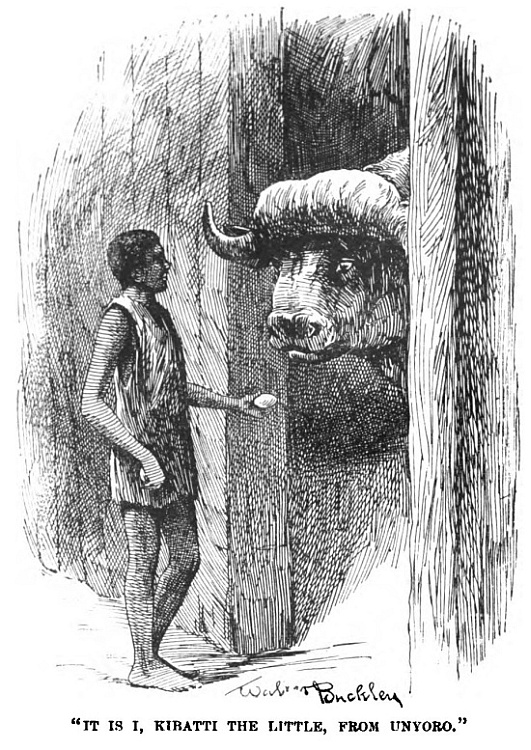
King Buffalo, who was on guard, trotted up to the gate, and looking out saw a small boy who was naked, except for a scant robe which depended from his shoulders.
“Who art thou?” demanded the buffalo in his gruffest voice.
Kibatti answered in the thin voice of a fatherless and starving orphan.
“It is I, Kibatti the Little, from Unyoro.”
“What dost thou want?”
“Only a little fire to roast my eggs, and a place to sleep. I am a forest-boy, and live alone in Unyoro. My parents are both dead, and I have no home. If you will give me work I will stay with you; for then I shall have plenty to eat. If not, let me sleep here to-night, and in the morning I will go.”
“What work canst thou do?”
“Not much, but I can fetch water and fuel.”
“Wait a minute, I will see if our people will let thee in.”
The buffalo moved away and woke up the rhinoceros, the elephant, the lion, the leopard, and hyena, and told them that there was a little forest-boy seeking a night’s lodging. At first the general belief was, that he belonged to the tribe which had owned the village, but the buffalo denied that this boy could have known of the country, as he had come boldly up to the gate from the Unyoro road; besides, was it likely that a small boy, knowing what had happened, would ever have come back when those who had destroyed the village were in possession of it? This last remark settled the matter. King Elephant said,
“As thou wilt, Buffalo. Even if the matter were otherwise, a small boy can do no harm. Let him in. We will give him plenty of work.”
King Buffalo opened the gate and allowed Kibatti to enter, and introduced him to his friends, King Elephant and the rest, all of whom smiled as they saw his slender and small form, the only human amongst them. Buffalo took very kindly to his protégé and showed him around, while Kibatti amused him with his innocent unsophisticated prattle, which convinced the kingly bovine that little Kibatti was indeed a wild-wood waif.
“And where do you all sleep?” asked Kibatti of Buffalo.
“I sleep here, near the gate, King Elephant rests near that big tree. King Lion prefers lying near that great log there, Brother Rhinoceros throws himself down on the edge of the banana-grove, Leopard curls himself near the fence, and Hyena snores stupidly near his pile of bones.”
After a little while Buffalo lay down near the gate for a little rest. Kibatti stretched himself near him, but not to sleep. His eyes were quite open, and he soon saw Buffalo’s nose rest upon the ground and his head sway from side to side. Kibatti then untied a cord, and stealthily passing it round the four legs of the buffalo, drew the other end round the neck in a slip noose without waking him. He then crawled off towards the elephant, and tied his four legs together, gently tightening the slip noose, and fastening the rope three or four times running round, and brought them all together. To the rhinoceros he did the same. He then went out of the gate and brought his bundle of nets. He took one up, fastened one end to the fence, and drawing it lightly like a curtain over the form of the sleeping lion, just hung it on splinters and projections of the fence. In like manner he secured a net over the leopard, and another over the hyena. All this did clever little Kibatti without waking any of them. He then stole out of the gate a second time, and made his way to the tree where his parents were sleeping.
“Come, father,” he said, “the kings of the herds are trapped and netted. Bring down mother to the lower fork, and come, do you hasten with me with a bundle of spears, two bows, and quivers full of arrows, for we must finish the game before morning.”
Completely armed with spears and arrows, Kibatti led his father to the gate, and stealthily entered the fenced enclosure, and they stood over the still-sleeping buffalo. Kibatti gave his father a sharp-pointed spear, and gently laying his finger on the vital spot, between neck and head, showed him where to strike. The father lifted his right arm high up, and with one stroke severed the spinal cord. A shiver passed through King Buffalo’s body, and he rolled over stone dead.
Then Kibatti and his father approached King Lion, who lay lengthways near the log by the fence, with his side exposed. Kibatti pointed to his own left side behind the shoulder-blade, and father and son drew their bows and drove two arrows into Lion’s heart, who sprang up and threw himself like a ball into the net, which closed round him taut, and he presently lay still and lifeless. In the same manner father and son despatched Leopard and Hyena. There then only remained Rhinoceros and Elephant.
They chose to attack the first-named beast, who was still lying down on his side, unconscious of the tragic fate of his confederates.
Kibatti pointed to the enemy’s fore-shoulder and touched his father with his finger two inches below the shoulder-blade. His father understood, and launched his spear straight into the body with such force that the blade was buried. King Rhinoceros, feeling the iron in his vitals, snorted and struggled to stand, but in doing so tightened the cords, and fell back rolling half over. Kibatti drew his bow and buried an arrow close to his father’s buried spear. Meantime, King Elephant had taken the alarm, and, struggling with his bonds, had capsized himself on the ground.
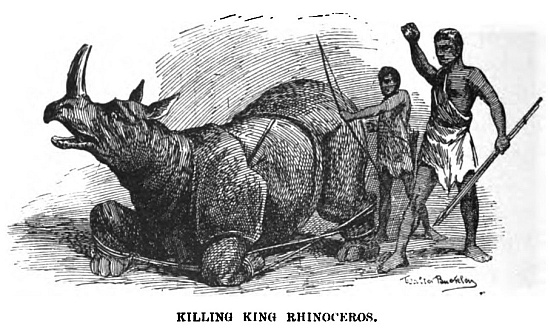
Kibatti gave vent to a war whoop and cried:
“Never mind, father, let the rhinoceros die. Let us away to the elephant while he is helpless.”
They sprang to the prostrate beast, and they shot their arrows first to every vital point exposed, and then launched their spears with such good effect that before long the last of the kings of the beasts had ended his life.
Kibatti and his father then flew to where the old woman crouched in the fork of the tree, and taking her with them, they left the ruined village, and sought a home in another district, where, because of the terrible revenge they had taken on the forest lords, they were held by their fellow-creatures all their lives in great esteem.
Chapter Fourteen.
The Partnership of Rabbit and Elephant, and what came of it.
In 1876, while we were travelling towards the Albert Edward Nyanza, Sabadu and Bujomba and others of our Waganda escort would join us at our evening fire, and when they found what entertainment was to be had, they readily yielded to the invitation to contribute their share to it. Besides, Sabadu was unequalled in the art of story-telling: he was fluent and humorous, while his mimicry of the characters he described kept everybody’s interest on the alert. To the Rabbit of course he gave a wee thin voice, to the Elephant he gave a deep bass, to the Buffalo a hollow mooing. When he attempted the Lion, the veins of his temple and neck were dreadfully distended as he made the effort; but when he mimicked the Dog, one almost expected a little terrier-like dog to trot up to the fire, so perfect was his yaup-yaup.
Every one agreed as Sabadu began his story that his manner, even his style of sitting and smoothing his face, the pose of his head, betrayed the man of practice. The following is his story:—
In Willimesi, Uganda, a Rabbit and an Elephant, coming from different directions, met on a road one day, and being old friends, stopped to greet one another, and chat about the weather and the crops, and to exchange opinions on the state of trade. Finally the Rabbit proposed that the Elephant should join him in a partnership to make a little trading expedition to the Watusi shepherds, “because,” said he, “I hear there are some good chances to make profit among them. Cloth, I am told, is very scarce there, and I think we might find a good bargain awaiting us.” The Elephant was nothing loth, and closed with the offer of his little friend, and a couple of bales of assorted goods were prepared for the journey.
They set out on particularly good terms with each other, and Rabbit, who had a good store of experiences, amused the Elephant greatly. By-and-by the pair of friends arrived at a river, and the Elephant, to whom the water was agreeable, stepped in to cross it, but halted on hearing Rabbit exclaim:
“Why, Elephant, you surely are not going to cross without me? Are we not partners?”
“Of course we are partners, but I did not agree to carry you or your pack. Why don’t you step right in? The water is not deep, it scarcely covers my feet.”
“But, you stupid fellow, can you not see that what will scarcely cover your feet is more than enough to drown me, and I can’t swim a bit; and, besides, if I get my fur wet I shall catch the ague, and how ever am I to carry my pack across?”
“Well, I cannot help that. It was you who proposed to take the journey, and I thought a wise fellow like you would have known that there were rivers running across the road, and that you knew what to do. If you cannot travel, then good-bye. I cannot stop here all day,” and the Elephant walked on across to the other side.
“Surly rascal,” muttered Rabbit. “All right, my big friend, I will pay you for it some time.”
Not far off, however, Rabbit found a log, and after placing his pack on it, he paddled himself over, and reached the other bank safely; but to his grief he discovered that his bale had been wetted and damaged.
Rabbit wiped the water up as much as possible, and resumed the journey with the Elephant, who had looked carelessly on the efforts of his friend to cross the river.
Fortunately for Rabbit, the latter part of the journey did not present such difficulties, and they arrived in due time among the Watusi shepherds.
Now at a trade Elephant was not to be compared with Rabbit, for he could not talk so pleasantly as Rabbit, and he was not at all sociable. Rabbit went among the women, and laughed and joked with them, and said so many funny things, that they were delighted with him, and when at last the trade question was cautiously touched upon, a chief’s wife was so kind to him, that she gave a mighty fine cow in exchange for his little bale of cloth. Elephant, on the other hand, went among the men, and simply told them that he had come to buy cattle with cloth. The Watusi shepherds, not liking his appearance or his manner, said they had no cattle to sell, but if he cared to have it, they would give a year-old heifer for his bale. Though Elephant’s bale was a most weighty one, and many times more valuable than Rabbit’s, yet as he was so gruff and ugly, he was at last obliged to be satisfied with the little heifer.
Just as they had left the Watusi to begin their return journey, Elephant said to Rabbit, “Now mind, should we meet anyone on the road, and we are asked whose cattle these are, I wish you to oblige me by saying that they are mine, because I should not like people to believe that I am not as good a trader us yourself. They will also be afraid to touch them if they know they belong to me; whereas, if they hear that they belong to you, every fellow will think he has as good a right to them as yourself, and you dare not defend your property.”
“Very well,” replied Rabbit, “I quite understand.”
In a little while, as Rabbit and Elephant drove their cattle along, they met many people coming from market who stopped and admired them, and said, “Ah, what a fine cow is that! to whom does it belong?”
“It belongs to me,” answered the thin voice of Rabbit. “The little one belongs to Elephant.”
“Very fine indeed. A good cow that,” replied the people, and passed on.
Vexed and annoyed, Elephant cried angrily to Rabbit, “Why did you not answer as I told you? Now mind, do as I tell you at the next meeting with strangers.”
“Very well,” answered Rabbit, “I will try and remember.”
By-and-by they met another party going home with fowls and palm wine, who, when they came up, said, “Ah that is a fine beast, and in prime order. Whose is it?”
“It is mine,” quickly replied Rabbit, “and the little scabby heifer belongs to Elephant.”
This answer enraged Elephant, who said, “What an obstinate little fool you are. Did you not hear me ask you to say it was mine? Now, remember, you are to say so next time, or I leave you to find your own way home, because I know you are a horrible little coward.”
“Very well, I’ll do it next time,” replied Rabbit in a meek voice.
In a short time they met another crowd, which stopped when opposite to them, and the people said, “Really, that is an exceedingly fine cow. To which of you does it belong?”
“It is mine. I bought it from the Watusi,” replied Rabbit.
The Elephant was so angry this time, that he broke away from Rabbit, and drove his little heifer by another road, and to Lion, and Hyena, and Buffalo, and Leopard, whom he met, he said what a fine fat cow was being driven by cowardly little Rabbit along the other road. He did this out of mere spite, hoping that some one of them would be tempted to take it by force from Rabbit.
But Rabbit was wise, and had seen the spite in Elephant’s face as he went off, and was sure that he would play him some unkind trick; and, as night was falling and his home was far, and he knew that there were many vagabonds lying in wait to rob poor travellers, he reflected that if his wit failed to save him he would be in great danger.
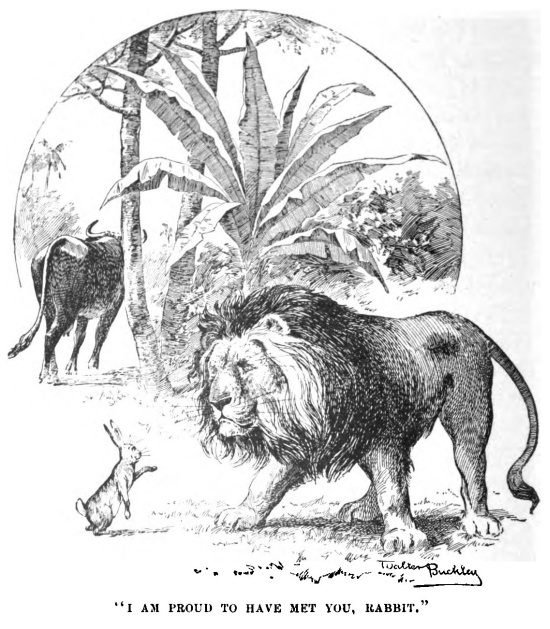
True enough, it was not long before a big blustering lion rose from the side of the road, and cried out, “Hello, you there. Where are you going with that cow? Come, speak out.”
“Ah, is that you, Lion? I am taking it to Mugassa (the deity), who is about to give a feast to all his friends, and he told me particularly to invite you to share it, if I should meet you.”
“Eh? What? To Mugassa? Oh, well, I am proud to have met you, Rabbit. As I am not otherwise engaged I will accompany you, because everyone considers it an honour to wait upon Mugassa.”
They proceeded a little further, and a bouncing buffalo came up and bellowed fiercely. “You, Rabbit, stop,” said he. “Where are you taking that cow to?”
“I am taking it to Mugassa, don’t you know. How would a little fellow like me have the courage to go so far from home if it were not that I am on service for Mugassa? I am charged also to tell you, Buffalo, that if you like to join in the feast Mugassa is about to give, he will be glad to have you as a guest.”
“Oh, well, that is good news indeed. I will come along now, Rabbit, and am very glad to have met you. How do you do, Lion?”
A short distance off the party met a huge rogue elephant, who stood in the middle of the road, and demanded to know where the cow was being taken, in a tone which required a quick answer.
“Now, Elephant, get out of the way. This cow is being taken to Mugassa, who will be angry with you if I am delayed. Have you not heard of the feast he is about to give? By the bye, as you are one of the guests, you might as well help me to drive this cow, and let me get on your back, for I am dreadfully tired.”
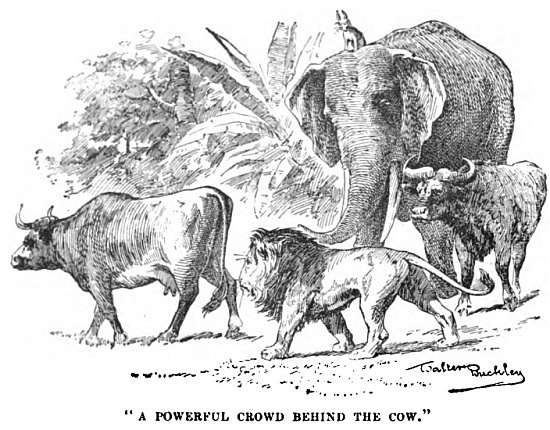
“Why, that’s grand,” said the Elephant, “I shall be delighted to feast with Mugassa, and—come get on my back. I will carry you with pleasure. And, Rabbit,” whispered Elephant, as he lifted him by his trunk, “don’t forget to speak a good word for me to Mugassa.”
Soon a leopard and then a hyena were met, but seeing such a powerful crowd behind the cow, they affected great civility, and were invited to accompany Rabbit’s party to Mugassa’s feast.
It was quite dark by the time they arrived at Rabbit’s village. At the gate stood two dogs, who were Rabbit’s chums, and they barked furiously; but hearing their friend’s voice, they came up and welcomed Rabbit.
The party halted, and Rabbit, after reaching the ground, whispered to Dogs how affairs stood, and Dogs wagged their tails approvingly, and yauped with fun as they heard of Rabbit’s wit. It did not take long for Dogs to understand what was required of them, and one of them bounded off to the village, and after a short time returned with a pretended message from the great Mugassa.
“Well, my friends, do you hear what Mugassa says?” cried Rabbit, with a voice of importance.
“Dogs are to lay mats inside the village by the gate, and the cow is to be killed, and the meat prepared nicely and laid on the mats. And when that is done, Mugassa himself will come and give each his portion. He says that you are all very welcome.
“Now listen to me before I go in to Mugassa, and I will show you how you can all help to hurry the feast, for I am sure you are all anxious to begin.
“You, Hyena, you must kill the cow, and dress the meat, and Dogs will carry it in and lay it on the mats; but remember, if a bit is touched before Mugassa commands, we are all ruined.
“You, Elephant, you take this brass hatchet of Mugassa’s, and split wood nicely for the hearth.
“Buffalo, you go and find a wood with a smooth bark and which burns well, and bring it to Elephant.
“Leopard, you go to the banana plantation, and watch for the falling leaf and catch it with your eyelids, in order that we may have proper plates.
“Lion, my friend, do you go and fill this pot from the spring, and bring water that Mugassa may wash his hands.”
Having issued his instructions, Rabbit went strutting into the village; but after he had gone a little way he darted aside, and passing through a side door, went out and came creeping up towards an ant-hill. On the top was a tuft of grass, and from his hiding-place he commanded a view of the gate, and of all who might come near it.
Now Buffalo could only find one log with smooth bark, and Dogs shouted out to Buffalo that one log was not enough to roast or to boil the meat, and he returned to hunt up some more.
Elephant struck the log with his brass hatchet, which was broken at the first blow, and there was nothing else with which to cut the wood.
Leopard watched and watched for falling leaves, but failed to see any.
Lion’s pot had a hole in the bottom, and he could never keep it full, though he tried ever so many times.
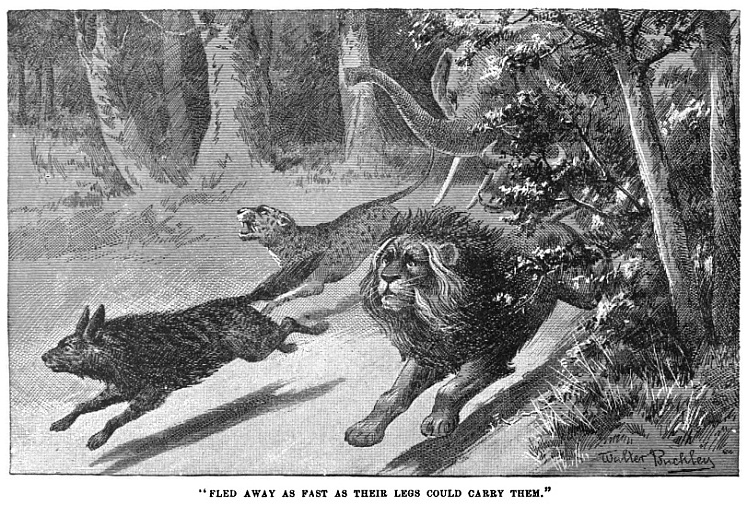
Meanwhile Hyena having killed the cow and dressed the meat beautifully, said to Dogs, “Now, my friends, the meat is ready. What shall I do?”
“You can help us carry the meat in, and lay it on the mats, if you like, for Mugassa must see it before anybody can touch it.”
“Ah, but I feel extremely hungry, and my mouth waters so that I am sick with longing. May we not go shares and eat a little bit? It looks very nice and fat,” whined the Hyena.
“Ah, no, we should not dare do such a thing. We have long ago left the woods, and its habits, and are unfit for anything but human society; but if you were allowed to eat any, you could fly into the woods, and we should have all the blame. No, no, come, help us carry it inside. You will not have to wait long.”
The Hyena was obliged to obey, but contrived to hide in the grass some of the tripe. Rabbit, from behind his tuft of grass, saw it all, and winked in the dark.
When the meat was in, Dogs said, “It is all right now. Just stay outside until the other fellows arrive.”
Hyena retired, and when he was outside of the gate searched for his tripe, and lay down quietly to enjoy it, but as he was about to bite it, Rabbit screamed, “Ah, you thief, Hyena. You thief, I see you. Stop thief, Mugassa is coming.”
These cries so alarmed Hyena that he dropped his tripe, and fled away as fast as his legs could carry him, and the others, Buffalo, Elephant, Lion, and Leopard, tired out with waiting, and hearing these alarming cries, also ran away, leaving Rabbit and his dog friends in quiet possession. They carried the tripe into the village, and closed the gate and barred it, after which they laughed loud and long, Rabbit rolling on the ground over and over with the fun of it all.
My friends, Rabbit was the smallest of all, but by his wisdom he was more than a match for two Elephants, Buffalo, Leopard, Lion, Hyena, and all. And even his friends, the Dogs, had to confess that Rabbit’s wit could not be matched. That is my tale.
Chapter Fifteen.
The Adventures of Saruti.
“I have a poor memory for legends,” said Bujomba, one night, while we were in camp at Benga: “but I remember what a young Mtongolè (colonel) named Saruti related to Mtesa after his return from an expedition to the frontier of Unyoro. What a head that man had, and such eyes! Mtesa was ever fond of a good story, and loved to question those whom he sent to distant countries, until you might say that there was nothing left in a man worth hearing after he had done with him. But Saruti did not need any questioning. He talked on and on without stopping, until Mtesa could not sit up longer for sheer weariness. These are among the things he said that he had witnessed on his journey. You must not ask me if I believe all that he said. All I can say is that they might have happened, or been seen by many men, but I never could quite understand how it was that Saruti alone was so lucky as to see all the things he talked about. Anyhow, he was very amusing, and Mtesa laughed heartily many times as he listened to him.”
Kabaka, I think my charms which my father suspended round my neck must be very powerful. I am always in luck. I hear good stones on my journey, I see strange things which no one else seems to have come across. Now on this last journey, by the time I reached Singo, I came to a little village, and as I was drinking banana wine with the chief, he told me that there were two lions near his village who had a band of hyenas to serve as soldiers under them. They used to send them out in pairs, sometimes to one district, and sometimes to another, to purvey food for them. If the peasants showed fight, they went back and reported to their masters, and the lions brought all their soldiers with them, who bothered them so that they were glad to leave a fat bullock tied to a tree as tribute. Then the lions would take the bullock and give orders that the peasant who paid his tribute should be left in peace. The chief declared this to be a fact, having had repeated proof of it.
At the next place, which is Mbagwè, the man Buvaiya, who is in charge, told me that when he went a short time before to pay his respects to the Muzimu (the oracle) of the district, he met about thirty kokorwa on the road, hunting close together for snakes, and that as soon as they saw him, they charged at him, and would have killed him had he not run up a tree. He tells me that though they are not much bigger than rabbits, they are very savage, and make travelling alone very dangerous. I think they must be some kind of small dogs. Perhaps the old men of the court may be better able to tell you what they are.
At the next village of Ngondo a smart boy named Rutuana was brought to me, who was said to have been lately playing with a young friend of the same age at long stick and little stick (tip-cat?). His friend hit the little stick, and sent it a great way, and Rutuana had to fetch it from the long grass. While searching for it, one of those big serpents which swallow goats and calves caught him, and coiled itself around him. Though he screamed out for help, Rutuana laid his stick across his chest, and clutching hold of each end with a hand, held fast to it until help came. His friend ran up a tree, and only helped him by screaming. As the serpent could not break the boy’s hold of the stick, he was unable to crush his ribs, because his outstretched arms protected them; but when he was nearly exhausted the villagers came out with spears and shields. These fellows, however, were so stupid that they did not know how to kill the serpent until Rutuana shouted to them: “Quick! draw your bows and shoot him through the neck.” A man stepped forward then, and when close to him pierced his throat with the arrow, and as the serpent uncoiled himself to attack the men, Rutuana fell down. The serpent was soon speared, and the boy was carried home. I think that boy will become a great warrior.
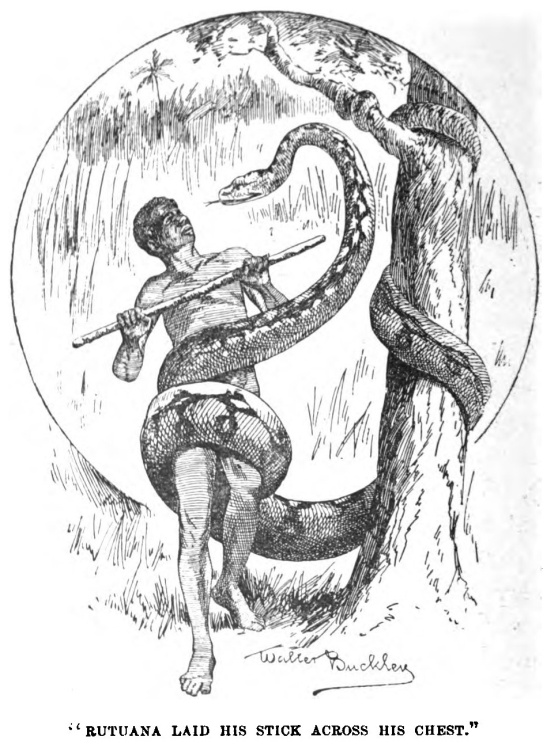
At the next village the peasants were much disturbed by a multitude of snakes which had collected there for some reason. They had seen several long black snakes which had taken lodging in the anthills. These had already killed five cows, and lately had taken to attacking the travellers along the road that leads by the anthills, when an Arab, named Massoudi, hearing of their trouble, undertook to kill them. He had some slaves with him, and he clothed their legs with buffalo hide, and placed cooking-pots on their heads, and told them to go among the anthills. When the snakes came out of their holes he shot them one by one. Among the reptiles he killed were three kinds of serpents which possessed horns. The peasants skinned them, and made bags of them to preserve their charms. One kind of horned snake, very thick and short, is said to lay eggs as large as those of fowls. The mubarasassa, which is of a greyish colour, is also said to be able to kill elephants.
I then went to Kyengi, beyond Singo, and the peasants, on coming to gossip with me, rather upset me with terrible stories of the mischief done by a big black leopard. It seems that he had first killed a woman, and had carried the body into the bush; and another time had killed two men while they were setting their nets for some small ground game. Then a native hunter, under promise of reward from the chief, set out with two spears to kill him. He did not succeed, but he said that he saw a strange sight. As he was following the track of the leopard, he suddenly came to a little jungle, with an open space in the middle. A large wild sow, followed by her litter of little pigs, was rooting about, and grunting as pigs do, when he saw the monstrous black leopard crawl towards one of the pigs. Then there was a shrill squeal from a piggie, and the mother, looking up, discovered its danger, at which it furiously charged the leopard, clashing her tusks and foaming at the mouth. The leopard turned sharp round, and sprang up a tree. The sow tried to jump up after it, but being unable to reach her enemy in that way, she set about working hard at the roots. While she was busy about it the peasant ran back to obtain a net and assistants, and to get his hunting-dog. When he returned, the sow was still digging away at the bottom of the tree, and had made a great hole all round it. The pigs, frightened at seeing so many men, trotted away into the bush, and the hunter and his friends prepared to catch the leopard. They pegged the net all about the tree, then let loose the dog, and urged him towards the net. As he touched the net, the hunters made a great noise, and shouted, at which the leopard bounded from the tree, and with one scratch of his paw ripped the dog open, sprang over the net, tapped one of the men on the shoulder, and was running away, when he received a wound in the shoulder, and stopped to bite the spear. The hunters continued to worry him, until at last, covered with blood, he lay down and died.