V. ELIZABETH TAYLOR GREENFIELD,
Reading edition
THE FAMOUS SONGSTRESS;
OFTEN CALLED
THE “BLACK SWAN.”
"A damsel with a dulcimer In a vision once I saw: It was an Abyssinian maid; And on her dulcimer she played, Singing of Mount Abora." Coleridge.
"Hovering swans.... Carol sounds harmonious." Callimachus' Hymn to Apollo.
IN giving a brief sketch of the life of the celebrated cantatrice, Miss Greenfield, the writer is somewhat embarrassed by the amount and richness of the materials at his command. For it would require far too much space to give all, or even a considerable portion, of the many press notices, criticisms, incidents, and the various items of interest, that are connected with her remarkable career; while to judiciously select from among the same a few, so that, while justice is done the subject, the interest of the reader may not be lessened, is far from being an easy task, albeit it is a pleasant one. I find, indeed, that the pages of the public journals fairly teemed with praises of the great prima donna, as she was frequently called by them. The musical world was startled, intensely delighted, electrified, by her notes of sweetest melody. Her magnificent voice, in its great range in both the upper and lower registers, was regarded as nothing short of wonderful. Those who at first were incredulous soon became convinced of this, and were fairly taken captive; while the always friendly ones, especially those with whom Miss Greenfield was most closely identified, felt the keenest pleasure and most unbounded pride in her great triumphs.
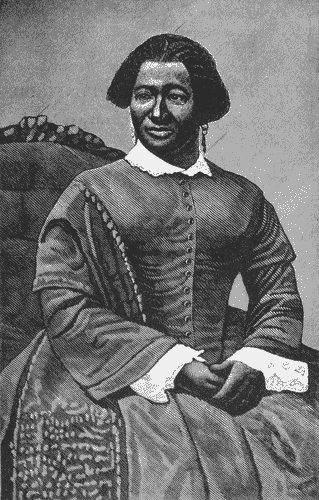
ELIZABETH TAYLOR GREENFIELD.
All this was chronicled by the press, and formed the theme of constant conversation and correspondence. Many testimonials from persons in this country skilled in music and of fine general culture, as well as others from the Queen of England and several of the English nobility, were among her rich possessions, and were so great in number and so flattering in character as to have made hers almost, if indeed not altogether, an exceptional case.
These strong evidences of approval did not, however, make Miss Greenfield vain. The natural simplicity of her character remained unchanged. All the many exhibitions of great public and private admiration, and the praises that her performances constantly evoked, while of course affording her much pleasure, served mainly as impulses to newer and higher efforts in her chosen and beloved profession. Nor was her disposition less tried by the many difficulties that often formed in her pathway. Of these I need not speak here. But amidst them all this noble lady and artist was ever brave, patient, hopeful, ambitious in a certain sense, yet modest.
Fully aware of the magnificent quality of her voice, and of its phenomenal character; singing a higher and a lower note than either of her great contemporaries,—Parodi, Kate Hayes, and Jenny Lind,—she yet did not rest content, as most persons under the same circumstances would have done, with the enthusiastic plaudits elicited by her performances, but diligently applied herself to a scientific cultivation of a voice in natural power well-nigh marvellous, as well as to acquiring a scholarly knowledge of the principles of general music. In this commendable course she met with remarkable success, considering the circumstances by which she was surrounded.
And now, quoting at times largely from her "Biography," I proceed to give the following sketch of the career of this remarkable queen of song.
Elizabeth Taylor Greenfield, better known perhaps by her musical sobriquet, the "Black Swan," was born in Natchez, Miss., in the year 1809. When but a year old she was brought to Philadelphia by an exemplary Quaker lady, by whom she was carefully reared. Between these two persons there ever existed the warm affection that is felt by mother and daughter. In the year 1844 this good lady died. In her will the subject of this sketch was remembered by a substantial legacy. The will, however, formed the subject of a long legal contest; and I believe Miss Greenfield never received the bequest.
Her family name was Taylor; but, in honor of her guardian, she took the latter's name,—Greenfield.
"Previous to the death of this lady, Elizabeth had become distinguished in the limited circle in which she was known for her remarkable powers of voice. Its tender, thrilling tones often lightened the weight of age in one who was by her beloved as a mother.
"By indomitable perseverance she surmounted difficulties almost invincible. At first she taught herself crude accompaniments to her songs, and, intuitively perceiving the agreement or disagreement of them, improvised and repeated, until there was heard floating upon the air a very 'lovely song of one that had a pleasant voice, and could play well upon a guitar.'
"There dwelt in the neighborhood of Mrs. Greenfield a physician, humane and courteous; capable, too, of distinguishing and appreciating merit and genius, under whatever prejudices and disadvantages they were presented. His daughter, herself an amateur in the science of harmonious sounds, heard of Elizabeth's peculiar structure of mind. Miss Price invited her to her house. She listened with delighted surprise to her songs. She offered to accompany her upon the guitar. This was a concurrence of circumstances which formed the era of her life. Her pulses quickened as she stood and watched the fair Anglo-Saxon fingers of her young patroness run over the keyboard of a full-toned piano-forte, eliciting sweet, sad, sacred, solemn sounds. Emotion well-nigh overcame her; but the gentle encouragement of her fair young friend dissipated her fears, and increased her confidence. She sang; and before she had finished she was surrounded by the astonished inmates of the house, who, attracted by the remarkable compass and sweetness of her voice, stealthily entered the room, and now unperceived stood gathered behind her. The applause which followed the first trial before this small but intelligent audience gratified as much as it embarrassed her, from the unexpected and sudden surprise. She not only received an invitation to repeat her visit, but Miss Price, for a reasonable compensation, undertook her instruction in the first rudiments of music. The progress of genius is not like that of common minds. It is needless to say that her improvement was very rapid."
But the lessons above mentioned were taken quite privately, and without, at first, the knowledge of her guardian. Elizabeth was rapidly acquiring an acquaintance with music, when some one maliciously informed Mrs. Greenfield, with the expectation of seeing an injunction laid upon the pupil's efforts. The old lady sent for Elizabeth, who came tremblingly into her presence, expecting to be reprimanded for her pursuit of an art forbidden by the Friends' discipline. "Elizabeth," said she, "is it true that thee is learning music, and can play upon the guitar?"—"It is true," was her reply. "Go get thy guitar, and let me hear thee sing." Elizabeth did so; and, when she had concluded her song, she was astonished to hear the kind lady say, "Elizabeth, whatever thee wants thee shall have." From that time her guardian was the patroness of her earnest efforts for skill and knowledge in musical science.
She began to receive invitations to entertain private parties by the exhibition of the gift which the God of nature had bestowed.
"Upon the death of her patroness, in consequence of the contested will she found herself thrown upon her own resources for a maintenance. Remembering some friends in the western part of New York, she resolved to visit them. While crossing Lake Seneca, en route to Buffalo, there came sweetly stealing upon the senses of the passengers of the steamer her rich, full, round, clear voice, unmarred by any flaw. The lady passengers, especially the noble Mrs. Gen. P., feeling that the power and sweetness of her voice deserved attention, urged her to sing again, and were not satisfied until five or six more songs were given to them. Before reaching their destined port she had made many friends. The philanthropic Mrs. Gen. P. became her friend and patroness. She at once invited Elizabeth to her splendid mansion in Buffalo, and, learning her simple story, promptly advised her to devote herself entirely to the science of music. During her visit a private party was given by this lady, to which all the élite of the city were invited. Elizabeth acquitted herself so admirably, that, two days later, a card of invitation came to her through the public press, signed by the prominent gentlemen of Buffalo, requesting her to give a series of concerts.
"In October, 1851, she sang before the Buffalo Musical Association; and her performances were received with marks of approbation from the best musical talent in the city, that established her reputation as a songstress. 'Give the "Black Swan,"' said they, 'the cultivation and experience of the fair Swede or Mlle. Parodi, and she will rank favorably with those popular singers who have carried the nation into captivity by their rare musical abilities. Her voice has a full, round sound, and is of immense compass and depth. She strikes every note in a clear and well-defined manner, and reaches the highest capacity of the human voice with wonderful ease, and apparently an entire want of exertion. Beginning with G in the bass clef, she runs up the scale to E in the treble clef, and gives each note its full power and tone. She commences at the highest note, and runs down the scale with the same ease that she strikes any other lower note. The fact that she accomplishes this with no apparent exertion is surprising, and fixes at once the marvellous strength of her vocal organs. Her voice is wholly natural, and, as might be expected, lacks the training and exquisite cultivation that belong to the skilful Italian singer. But the voice is there; and, as a famous maestro once said, "it takes a hundred things to make a complete singer, of which a good voice is ninety-nine." If this be so, Miss Greenfield is on the verge of excellence; and it remains for the public to decide whether she shall have the means to pursue her studies.'"
To several gentlemen in Buffalo belongs the credit of having first brought out Miss Greenfield in the concert-room. The Buffalo papers took the matter in hand, and assured the public they had much to expect from a concert from this vocalist. The deep interest her first public efforts elicited from them gave occasion to the following certificate:—
Buffalo, Oct. 30, 1851.
Mr. H.E. Howard.
Dear Sir,—At your suggestion, for the purpose of enabling Miss Elizabeth T. Greenfield to show to her Philadelphia friends the popularity she has acquired in this city, I cheerfully certify as follows:—
The concert got up for her was unsolicited on her part, and entirely the result of admiration of her vocal powers by a number of our most respectable citizens, who had heard her at the residence of Gen. Potter, with whose family she had become somewhat familiar. The concert was attended by an audience not second in point of numbers to any given here before, except by Jenny Lind; and not second to any in point of respectability and fashion. The performance of Miss Greenfield was received with great applause; and the expression since, among our citizens generally, is a strong desire to hear her again.
Respectfully yours, &c.,
G. Reed Wilson.
Rochester next extended an invitation for her to visit that city. We copy the invitation:—
"The undersigned, having heard of the musical ability of Miss Elizabeth T. Greenfield of the city of Buffalo, and being desirous of having her sing in Rochester, request that she will give a public concert in this city at an early day, and feel confident that it will afford a satisfactory entertainment to our citizens." (Signed by a large number of the most respected citizens of Rochester.)
Rochester, Dec. 6, 1851.
This evening, in Corinthian Hall, the anticipated entertainment is to be presented to our music-loving citizens. Curiosity will lead many to attend, to whom the performance of a colored prima donna is a phenomenon at once wonderful and rare. Miss Greenfield has received from all who have heard her the name of being a vocalist of extraordinary power.
Speaking of her concert in Buffalo, "The Express" says,—
"On Monday, Parodi in all her splendor, sustained by Patti and Strakosch, sang at Corinthian Hall to half a house. Last night Miss Greenfield sang at the same place to a crowded house of the respectable, cultivated, and fashionable people of the city. Jenny Lind has never drawn a better house, as to character, than that which listened with evident satisfaction to this unheralded and almost unknown African nightingale. Curiosity did something for her, but not all. She has merit, very great merit; and with cultivation (instruction) she will rank among the very first vocalists of the age. She has a voice of great sweetness and power, with a wider range from the lowest to the highest notes than we have ever listened to: flexibility is not wanting, and her control of it is beyond example for a new and untaught vocalist. Her performance was received with marked approbation and applause from those who knew what to applaud."
Another city paper says,—
"Much has been said and written of this personage since she was introduced to the public as a musical prodigy. All sorts of surmises and conjectures have been indulged in respecting the claim put forth of her merit; and generally the impression seemed to prevail, that the novelty of 'color' and idle curiosity accounted more for the excitement raised than her musical powers. Well, she has visited our place, and given our citizens an opportunity of judging for themselves. We are ignorant of music, and unqualified to criticise. But a large audience was in attendance at Ringueberg Hall last evening: among those present were our musical amateurs; and we heard but one expression in regard to the new vocalist, and that was wonder and astonishment at the extraordinary power and compass of her voice; and the ease with which she passed from the highest to the lowest notes seemed without an effort. Her first notes of 'Where are now the hopes?' startled the whole audience; and the interchange of glances, succeeded by thunders of applause at the end of the first verse, showed that her success was complete. She was loudly encored, and in response sang the baritone, 'When stars are in the quiet sky,' which took down the whole house.
"We have neither time nor space to follow her through her different pieces. Suffice it to say, that there never was a concert given in this town which appeared to give more general satisfaction; and every person we met on leaving the hall expressed their entire approbation of her performance. No higher compliment could be paid to the 'Swan' than the enthusiastic applause which successfully greeted her appearance, and the encore which followed her several pieces.
"There was a very general expression among the audience that the sable vocalist should give another concert; and, at the earnest solicitation of several of our citizens, Col. Wood, her gentlemanly manager, has consented to give another entertainment to-morrow evening, when the 'Black Swan' will give a new programme, consisting of some of Jenny Lind's most popular songs.
"The concert on Thursday evening was what in other cases would have been called a triumph. The house was full, the audience a fashionable one, the applause decided, and the impression made by the singer highly favorable.
"We can safely say that Miss Greenfield possesses a voice of remarkable qualities; singular for its power, softness, and depth. She has applied herself with praiseworthy perseverance and assiduity to the cultivation of her extraordinary powers, and has attained great proficiency in the art which is evidently the bent of her genius. By her own energy, and unassisted, she has made herself mistress of the harp, guitar, and piano. We are informed that the proceeds of the entertainment this evening are to be wholly appropriated to the completion of her musical education in Paris under the world-famed Garcia. We predict for Miss Greenfield a successful and brilliant future."
"The Rochester American" says,—
"Corinthian Hall contained a large and fashionable audience on the occasion of the concert by this new candidate for popular favor on Thursday evening. We have never seen an audience more curiously expectant than this was for the début of this new vocalist. Hardly had her first note fallen upon their ears, however, before their wonder and astonishment were manifest in an interchange of glances and words of approval; and the hearty applause that responded to the first verse she sang was good evidence of the satisfaction she afforded. The aria, 'O native scenes!' was loudly encored; and in response she gave the pretty ballad, 'When stars are in the quiet sky.'"
The Buffalo "Commercial Advertiser" says,—
"Miss Greenfield is about twenty-five years of age, and has received what musical education she has in the city of Philadelphia: she is, however, eminently self-taught, possessing fine taste and a nice appreciation, with a voice of wonderful compass, clearness, and flexibility. She renders the compositions of some of the best masters in a style which would be perfectly satisfactory to the authors themselves. Her low, or properly bass notes, are wonderful, especially for a female voice; and in these she far excels any singing we have ever heard.
"We learn that this singer (soon to become celebrated, we opine) will give a concert in this city on Thursday next. There is no doubt that the novelty of hearing a colored woman perform the most difficult music with extraordinary ability will give éclat to the concert. All representations unite in ascribing to Miss Greenfield the most extraordinary talents, and a power and sweetness of vocalization that are really unsurpassed."
"The Daily State Register," Albany, Jan. 19, 1852, said,—
"The 'Black Swan's' Concert.—Miss Greenfield made her début in this city on Saturday evening, before a large and brilliant audience, in the lecture-room of the Young Men's Association. The concert was a complete triumph for her; won, too, from a discriminating auditory not likely to be caught with chaff, and none too willing to suffer admiration to get the better of prejudice. Her singing more than met the expectations of her hearers, and elicited the heartiest applause and frequent encores. She possesses a truly wonderful voice; and, considering the poverty of her advantages, she uses it with surprising taste and effect. In sweetness, power, compass, and flexibility, it nearly equals any of the foreign vocalists who have visited our country; and it needs only the training and education theirs have received to outstrip them all.
"The compass of her marvellous voice embraces twenty-seven notes, reaching from the sonorous bass of a baritone to a few notes above even Jenny Lind's highest. The defects which the critic cannot fail to detect in her singing are not from want of voice, or power of lung, but want of training alone. If her present tour proves successful, as it now bids fair to, she will put herself under the charge of the best masters of singing in Europe; and with her enthusiasm and perseverance, which belong to genius, she cannot fail to ultimately triumph over all obstacles, and even conquer the prejudice of color,—perhaps the most formidable one in her path.
"She plays with ability upon the piano, harp, and guitar. In her deportment she bears herself well, and, we are told, converses with much intelligence. We noticed among the audience Gov. Hunt and his family, both Houses of the Legislature, State officers, and a large number of our leading citizens. All came away astonished and delighted."
A New-York paper says,—
"Miss Greenfield's Singing.—We yesterday had the pleasure of hearing the singer who is advertised in our columns as the 'Black Swan.' She is a person of ladylike manners, elegant form, and not unpleasing, though decidedly African features. Of her marvellous powers, she owes none to any tincture of European blood. Her voice is truly wonderful, both in its compass and truth. A more correct intonation, so far as our ear can decide, there could not be. She strikes every note on the exact centre, with unhesitating decision.... She is a nondescript, an original. We cannot think any common destiny awaits her."
"The Evening Transcript," Boston, Feb. 4, 1852, said,—
"Miss Greenfield, the 'Black Swan,' made her début before a Boston audience last evening at the Melodeon. In consequence of the price of the tickets being put at a dollar, the house was not over two-thirds full. She was well received, and most vociferously applauded and encored in every piece. She sings with great ease, and apparently without any effort. Her pronunciation is very correct, and her intonation excellent. Her voice has a wonderful compass, and in many notes is remarkably sweet in tone."
From "The Daily Capital City Fact," Columbus, O., March 3, 1852:—
"Last evening proved that the 'Black Swan' was all that the journals say of her; and Miss Greenfield stands confessedly before the Columbus world a swan of excellence. She is indeed a remarkable swan. Although colored as dark as Ethiopia, she utters notes as pure as if uttered in the words of the Adriatic."
From "The Milwaukee Sentinel," April, 1852:—
"What shall we say? That we were delighted and surprised? All who were present know that, from their own feelings. We can only say, that we have never heard a voice like hers,—one that with such ease, and with such absence of all effort, could range from the highest to the lowest notes."
Said a Rochester (N.Y.) paper of May 6, 1852,—
... "The magnificent quality of her voice, its great power, flexibility, and compass, her self-taught genius, energy, and perseverance, combine to render Miss Greenfield an object of uncommon interest to musicians.
"We have been spell-bound by the ravishing tones of Patti, Sontag, Malibran, and Grisi; we have heard the wondrous warblings of 'the Nightingale;' and we have listened with delight to the sweet melodies of the fair daughter of Erin: but we hesitate not to assert, that, with one year's tuition from the world-famed Emanuel Garcia, Miss Greenfield would not only compare favorably with any of the distinguished artists above named, but incomparably excel them all."
"The Globe," Toronto, May 12-15, 1852, said,—
"Any one who went to the concert of Miss Greenfield on Thursday last, expecting to find that he had been deceived by the puffs of the American newspapers, must have found himself most agreeably disappointed....
"After he [the pianist] had retired, there was a general hush of expectation to see the entrance of the vocalist of the evening; and presently there appeared a lady of a decidedly dark color, rather inclined to an embonpoint, and with African formation of face. She advanced calmly to the front of the platform, and courtesied very gracefully to the audience. There was a moment of pause, and the assembly anxiously listened for the first notes. They were quite sufficient. The amazing power of the voice, the flexibility, and the ease of execution, took the hearers by surprise; and the singer was hardly allowed to finish the verse, ere she was greeted with the most enthusiastic plaudits, which continued for some time. The higher passages of the air were given with clearness and fulness, indicating a soprano voice of great power. The song was encored; and Miss Greenfield came back, took her seat at the piano, and began, to the astonishment of the audience, a different air in a deep and very clear bass or baritone voice, which she maintained throughout, without any very great appearance of effort, or without any breaking. She can, in fact, go as low as Lablache, and as high as Jenny Lind,—a power of voice perfectly astonishing. It is said she can strike thirty-one full, clear notes; and we could readily believe it."
From a Brattleborough (Vt.) paper, June 23, 1852:—
"The 'Black Swan,' or Miss Elizabeth Greenfield, sang in Mr. Fisk's beautiful new hall on Wednesday evening last to a large and intelligent audience.
"We had seen frequent notices in our exchanges, and were already prepossessed in favor of the abilities and life purposes of our sable sister; but, after all, we must say that our expectations of her success are greater than before we had heard her sing, and conversed with her in her own private room. She is not pretty, but plain: ... still she is gifted with a beauty of soul which makes her countenance agreeable in conversation; and in singing, especially when her social nature is called into activity, there is a grace and beauty in her manner which soon make those unaccustomed to her race forget all but the melody....
"Nature has done more for Miss Greenfield than any musical prodigy we have met, and art has marred her execution less."
But the limits of this book are such as to preclude my giving all or even a hundredth part of the testimonials and criticisms touching the singing of this remarkable performer, that filled the public journals during her career in the United States. I believe, however, that I have given quite enough to show that her noble gifts of voice, and beauty of execution, were of the rarest excellence, while in some notable respects they had never been equalled. Let it suffice to say also, in regard to the excerpts given, that they are but fair samples and reflections of the opinions entertained and expressed by the press, and by music-loving, cultured people, everywhere Miss Greenfield appeared.
After singing in nearly all the free States, she resolved to carry out her long-entertained purpose of visiting Europe, in order to perfect herself in the technique of her art. Learning of her intentions, the citizens of Buffalo, N.Y., united in tendering her a grand testimonial and benefit concert. The invitation was couched in terms most flattering, and signed by many of the most distinguished residents.
The concert took place on March 7, 1853, and was in all respects a grand success.
Leaving Buffalo, she went to New York, where, after singing before an audience of four thousand persons, she received the following complimentary note:—
New York, April 2, 1853.
Miss Elizabeth T. Greenfield.
Madam,—By the suggestion of many enthusiastic admirers of your talents, I have been induced to address you on the subject of another and second concert, prior to your departure for Europe.
Your advent musical in "Gotham" has not been idly heralded among the true lovers of song, and admirers of exalted genius, of which your unprecedented success on Wednesday evening must have sufficiently convinced you; while all are eloquent in the commendation of your superior powers and engaging method.
Confiding, madam, in your reported magnanimity and generosity to oblige, I will divest myself of tedious circumlocution, and fervently exhort you to make a second exhibition of your skill; which, there can be no doubt, will be highly successful to you, and as interesting to your admirers.
The Public.
"Miss Greenfield embarked from New York in a British steamer for England, April 6, 1853; and arrived in Liverpool the 16th of April, 1853; rested over the sabbath, and proceeded Monday morning to London, in which metropolis she became safely domiciled on the evening of the same day.
"But painful trials awaited her from a quarter the most unexpected. The individual with whom she had drawn up the contract for this musical tour was unfaithful to his promises; and she found herself abandoned, without money and without friends, in a strange country.
"She had been told Lord Shaftesbury was one of the great good men of England; and she resolved to call upon him in person, and entreat an interview. His lordship immediately granted her request, listened patiently to her history, and directly gave her a letter of introduction to his lawyer.
"It may perhaps be considered a providential concurrence that Mrs. Harriet Beecher Stowe was in London this same time with Miss Greenfield. We notice in her 'Sunny Memories,' under the date of May 6, the following remarks: 'A good many calls this morning. Among others came Miss Greenfield, the (so-called) "Black Swan." She appears to be a gentle, amiable, and interesting young person. She has a most astonishing voice. C. sat down to the piano, and played while she sang. Her voice runs through a compass of three octaves and a fourth. This is four notes more than Malibran's. She sings a most magnificent tenor, with such a breadth and volume of sound, that, with your back turned, you could not imagine it to be a woman. While she was there, Mrs. S.C. Hall, of the "Irish Sketches," was announced. I told her of Miss Greenfield; and she took great interest in her, and requested her to sing something for her. C. played the accompaniment, and she sang "Old Folks at Home," first in a soprano voice, and then in a tenor, or baritone. Mrs. Hall was amazed and delighted, and entered at once into her cause. She said she would call with me, and present her to Sir George Smart, who is at the head of the Queen's musical establishment, and, of course, the acknowledged leader of London musical judgment.
"'In the course of the day I had a note from Mrs. Hall, saying, that, as Sir George Smart was about leaving town, she had not waited for me, but had taken Miss Greenfield to him herself. She writes that he was really astonished and charmed at the wonderful weight, compass, and power of her voice. He was also as well pleased with the mind in her singing, and her quickness in doing and catching all that he told her. Should she have a public opportunity to perform, he offered to hear her rehearse beforehand. Mrs. Hall says, "This is a great deal for him, whose hours are all marked with gold."'
"Again Mrs. Stowe says, 'To-day the Duchess of Sutherland called with the Duchess of Argyle. Miss Greenfield happened to be present; and I begged leave to present her, giving a slight sketch of her history. I was pleased with the kind and easy affability with which the Duchess of Sutherland conversed with her, betraying by no inflection of voice, and nothing in her air or manner, the great lady talking with the poor girl. She asked all her questions with as much delicacy, and made her request to hear her sing with as much consideration and politeness, as if she had been addressing any one in her own circle. She seemed much pleased with her singing, and remarked that she should be happy to give her an opportunity of performing in Stafford House, as soon as she should be a little relieved of a heavy cold which seemed to oppress her at present. This, of course, will be decisive of her favor in London. The duchess is to let us know when the arrangement is completed.
"'I never so fully realized,' continues Mrs. Stowe, 'that there really is no natural prejudice against color in the human mind. Miss Greenfield is a dark mulattress, of a pleasing and gentle face, though by no means handsome. She is short and thick-set, with a chest of great amplitude, as one would think on hearing her tenor. I have never seen, in any of the persons to whom I have presented her, the least indications of suppressed surprise or disgust, any more than we should exhibit on the reception of a dark-complexioned Spaniard or Portuguese.
"'Miss Greenfield bears her success with much quietness and good sense.'
"Her Grace the Duchess of Sutherland afterward became her ever-unfailing supporter and adviser.
"The piano-forte which previously had been furnished Miss Greenfield to practise upon was taken from her. The Duchess of Sutherland, upon learning the fact, immediately directed her to select one from Broadwood's.
"We cannot refrain from quoting Mrs. Stowe's description of the concert after dinner at the Stafford House:—
"'The concert-room was the brilliant and picturesque hall I have before described to you. It looked more picture-like and dreamy than ever. The piano was on the flat stairway just below the broad central landing. It was a grand piano, standing end outward, and perfectly banked up among hot-house flowers, so that only its gilded top was visible. Sir George Smart presided. The choicest of the élite were there,—ladies in demi-toilet and bonneted. Miss Greenfield stood among the singers on the staircase, and excited a pathetic murmur among the audience. She is not handsome, but looked very well. She has a pleasing dark face, wore a black velvet head-dress and white carnelian ear-rings, a black moire-antique silk made high in the neck, with white lace falling sleeves and white gloves. A certain gentleness of manner and self-possession, the result of the universal kindness shown her, sat well upon her. Chevalier Bunsen, the Prussian ambassador, sat by me. He looked at her with much interest. "Are the race often as good-looking?" he said. I said, "She is not handsome compared with many, though I confess she looks uncommonly well to-day." The singing was beautiful. Six of the most cultivated glee-singers of London sang, among other things, "Spring's Delights are now returning," and "Where the Bee sucks, there lurk I." The duchess said, "These glees are peculiarly English." Miss Greenfield's turn for singing now came, and there was profound attention. Her voice, with its keen, searching fire, its penetrating vibrant quality, its timbre as the French have it, cut its way like a Damascus blade to the heart. She sang the ballad, "Old Folks at Home," giving one verse in the soprano, and another in the tenor voice. As she stood partially concealed by the piano, Chevalier Bunsen thought that the tenor part was performed by one of the gentlemen. He was perfectly astonished when he discovered that it was by her. This was rapturously encored. Between the parts, Sir George took her to the piano, and tried her voice by skips, striking notes here and there at random, without connection, from D in alto to A first space in bass clef. She followed with unerring precision, striking the sound nearly at the same instant his finger touched the key. This brought out a burst of applause.
"'Lord Shaftesbury was there. He came and spoke to us after the concert. Speaking of Miss Greenfield, he said, "I consider the use of these halls for the encouragement of an outcast race a consecration. This is the true use of wealth and splendor, when they are employed to raise up and encourage the despised and forgotten."'
"Tuesday, May 31, 1853.
"Miss Greenfield's first public morning concert took place at the Queen's Concert Rooms, Hanover Square. She came out under the immediate patronage of her Grace the Duchess of Sutherland, her Grace the Duchess of Norfolk, and the Earl and Countess of Shaftesbury. It commenced at three o'clock, and terminated at five."
"The London Morning Post" says,—
"A large assemblage of fashionable and distinguished personages assembled by invitation at Stafford House to hear and decide upon the merits of a phenomenon in the musical world,—Miss Elizabeth Greenfield, better known in America as the 'Black Swan;' under which sobriquet she is also about to be presented to the British public. This lady is said to possess a voice embracing the extraordinary compass of nearly three octaves; and her performances on this occasion elicited the unmistakable evidence of gratification."
"The London Times" said,—
"Miss Greenfield sings 'I know that my Redeemer liveth' with as much pathos, power, and effect as does the 'Swedish Nightingale,' Jenny Lind."
Again: "The London Observer" remarks,—
"Her voice was at once declared to be one of extraordinary compass. Both her high and low notes were heard with wonder by the assembled amateurs, and her ear was pronounced to be excellent."
"The London Advertiser" of June 16 contained the following comments:—
"A concert was given at Exeter Hall last evening by Miss Greenfield, the American vocalist, better known in this country under the sobriquet of the 'Black Swan.' Apart from the natural gifts with which this lady is endowed, the great musical skill which she has acquired, both as a singer and an instrumentalist, is a convincing argument against the assertion so often made, that the negro race is incapable of intellectual culture of a high standard.... Her voice is a contralto, of great clearness and mellow tone in the upper register, and full, resonant, and powerful in the lower, though slightly masculine in its timbre. It is peculiarly effective in ballad-songs of the pathetic cast, several of which Miss Greenfield sang last night in a very expressive manner. She was encored in two,—'The Cradle-Song,' a simple melody by Wallace, and 'Home, Sweet Home,' which she gave in an exceedingly pleasing manner. The programme of the concert was bountifully drawn up; for, in addition to the attractions of the 'Black Swan,' there was a host of first-rate artists. Herr Brandt, a German artist with a remarkably sweet voice, sang Professor Longfellow's 'Slave's Dream,' set to very beautiful music by Hatton, in a way that elicited warm applause. Miss Rosina Bentley played a fantasia by Lutz very brilliantly, and afterward, assisted by Miss Kate Loder (who, however, must now be known as Mrs. Henry Thompson), in a grand duet for two piano-fortes by Osborne. M. Valadares executed a curious Indian air, 'Hilli Milli Puniah,' on the violin; and Mr. Henry Distin a solo on the sax tuba. The band was admirable, and performed a couple of overtures in the best manner. Altogether, the concert, which we understand was made under the distinguished patronage of the Duchess of Sutherland, was highly successful, and went off to the perfect gratification of a numerous and fashionable audience."
"In July she gave two grand concerts in the Town Hall in Brighton, under the patronage of her Grace the Duchess of Sutherland, her Grace the Duchess of Norfolk, her Grace the Duchess of Beaufort, her Grace the Duchess of Argyle, the Most Noble the Marchioness of Ailesbury, the Most Noble the Marchioness of Kildare, the Most Noble the Marquis of Lansdowne, the Earl and Countess of Shaftesbury, the Earl of Carlisle, the Countess of Jersey, the Countess of Granville, the Countess of Wilton, the Viscountess Palmerston, the Lady Constance Grosvenor, and Mrs. Harriet Beecher Stowe.
"Vocalists.—Miss E.T. Greenfield (the 'Black Swan'), Madame Taccani, Countess Tasca, Mr. Emanuel Roberts (Queen's concerts).
"Instrumentalists.—Piano-forte soloist, Miss Rosina Bently (pupil of Miss Kate Loder); violin, M. de Valadares (pupil of the Conservatoire, Paris); accompanist, Mons. Edouard Henri; conductor, Mr. F. Theseus Stevens.
"She gave a series of concerts at the Rotunda in Dublin, Ireland."
"Extract from programme of Miss Greenfield's benefit concert, Aug. 17, 1853:—
"Vocalists.—Miss Louisa Pyne, Miss Pyne, and Mr. W. Harrison; pianist, Miss Rosina Bently; violinist, M. de Valadares from the East Indies; accompanist, Mr. R. Thomas."
"In October, 1853, we find her again at the Beaumont Institution, Beaumont Square, Mile End, London, at Mr. Cotton's concert, supported by Miss Poole, the Misses M'Alpine, Miss Alleyne, Mr. Augustus Braham, Mr. Suchet Champion, Mr. Charles Cotton, the German Glee Union, and the East-Indian violinist M. de Valadares; conductor, Herr Ganz."
"Nov. 3, 1853, at Albion Hall, Hammersmith, she made her appearance under the patronage of her Grace the Duchess of Sutherland, her Grace the Duchess of Norfolk, her Grace the Duchess of Beaufort, her Grace the Duchess of Argyll, the Most Noble the Marchioness of Aylesbury, the Most Noble the Marchioness of Kildare, the Most Noble the Marquis of Lansdowne, Earl and Countess of Shaftesbury, Earl of Carlisle, Countess of Jersey, Countess of Granville, Countess of Wilton, Viscountess Palmerston, the Lady Constance Grosvenor, and Mrs. Harriet Beecher Stowe.
"Artists.—Miss E.T. Greenfield, Miss J. Brougham, Miss E. Brougham, Mr. Charles Cotton, Mr. Augustus Braham the eminent tenor; piano-forte, Miss Eliza Ward."
"At the Theatre Royal, Lincoln, Dec. 23, 1853, under the same distinguished patronage as at Hammersmith.
"Artists.—Mrs. Alexander Newton (of her Majesty's Grand National Concerts), Miss Ward, Miss E.T. Greenfield, Mr. Augustus Braham, Mr. Charles Cotton (from Milan), Mr. Distin."
"Again: to verify the fact of her having received the attention of very distinguished personages, the following certificates are laid before the reader:—
"'Sir George Smart has the pleasure to state that her Majesty Queen Victoria commanded Miss Greenfield to attend at Buckingham Palace on May the 10th, 1854, when she had the honor of singing several songs, which he accompanied on the piano-forte.
"'To Miss Greenfield, from Sir George Smart, Kt., "'Organist and Composer to her Majesty's Chapel Royal. "'June 24, 1854. No. 91, Gr. Portland St., London.'
"'This is to certify that Miss Greenfield had the honor of singing before her Majesty the Queen at Buckingham Palace. By her Majesty's command,
"'C.B. Phipps.
"'Buckingham Palace, July 22, 1854, London.'"
"In May, 1854, she received an invitation through the Rev. Mr. Geary to sing at a concert, but declined, being advised not to sing at public concerts until her return to the United States. She therefore sang only at private parties until July, 1854, when that same noble benefactress, the Duchess of Sutherland, secured for her two places in 'The Indiana' steam-packet for New York.
"With a warm invitation to revisit England at some future period, she embarked at Southampton to return to America."
The trip to London and its attendant circumstances resulted in much benefit to Miss Greenfield in an intrinsic, artistic sense, adding decided éclat to her professional reputation. "The New-York Herald," a journal which in those days was generally quite averse to bestowing even well-merited praise upon persons of her race, was, however, so much moved upon by her exhibition of an increased technical knowledge of the lyric art as to speak of Miss Greenfield as follows: "'The Swan' sings now in true artistic style, and the wonderful powers of her voice have been developed by good training." This was but echoing the general verdict.
During the years that intervened between Miss Greenfield's return from England and her death,—the latter event occurring at Philadelphia in the month of April, 1876,—she was engaged in singing occasionally at concerts, and in giving lessons in vocal music.
Remembering her own hard contests as she ascended the hill of fame, Miss Greenfield ever held out a helping hand to all whom she found struggling to obtain a knowledge of the noble art of music. Possessing, on account of her great vocal abilities, the high esteem of the general public, from a rare amiability of disposition enjoying the warm love of many friends in those private circles where she was always an ornament and a blessing, this wonderfully gifted lady at the age of sixty-eight years died, deeply mourned by all. Of her brilliant career, of her life, which, in many important respects, was so grandly useful, as well as of her peaceful death, nothing more need here be added, further than to place her name in the honorable list of those of whom Milton so eloquently says,—
"Nothing is here for tears; nothing to wail, Or knock the breast; no weakness, no contempt, Dispraise, or blame; nothing but well and fair, And what may quiet us in a death so noble."