XVII. JOSEPH WHITE,
Reading edition
THE EMINENT VIOLINIST AND COMPOSER.
"Across my hands thou liest mute and still: Thou wilt not breathe to me thy secret fine; Thy matchless tones the eager air shall thrill To no entreaty or command of mine. But comes thy master: lo! thou yieldest all,— Passion and pathos, rapture and despair: To the soul's needs thy searching voice doth call In language exquisite beyond compare." "The Violin:" Harper's Magazine.
MR. JOSEPH WHITE[14] is a child of the New World. He was born in Matanzas, Cuba. His first steps in art were made in his native town.
His father, an amateur in music, thought he had recognized from the early infancy of the great artist a more than ordinary taste for art. When the child heard the tones of a violin, he used to leave off play, and run in the direction where the instrument was singing, his eyes never losing sight of the virtuoso. Indeed, by his actions at such times, he seemed not to belong to this world.
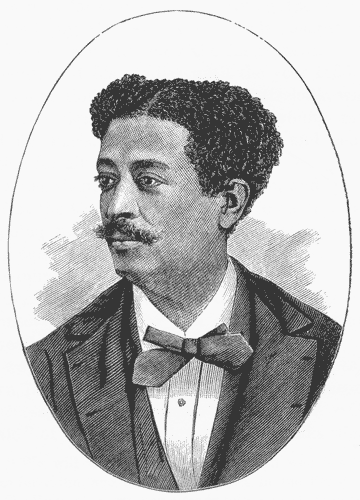
JOSEPH WHITE.
As soon as his hands were large enough to hold a violin, they gave him one; and were much astonished, when, at the end of a few months, he presented himself before a large audience, striking the same with amazement by the manner, entirely magisterial, in which he so early attacked the instrument.
He continued his studies until the year 1855, when, at the suggestion of the famous Gottschalk, who had noticed the signs of genius in the young man, he started for Paris, the city of wonders, and centre of attraction for all aspirations.
He came then, this young virtuoso, and presented himself at the Conservatoire, asking to enter as a pupil. After going through a brilliant examination, and after fighting against more than sixty rivals, he was received with unanimity.
In July, 1856, one year from the time of his entering the Conservatoire, White won all the "approbations," and wreaths and laurels were given him.
But we will let the newspapers of the time speak; for our own pen will be powerless to give an account of the successes of the eminent artist. The "Gazette Musicale" of the 3d of August, 1856, speaks thus:—
... "We will say as much of the pupil who has won the first prize for violin, and who came the last in the list of concurrents. The Viotti Concerto had already been played nineteen times; and, notwithstanding the great beauties of this classic work, the jury began to listen to it with but a dreamy ear. Mr. White appeared the twentieth. He belongs to a race whose complexion is more of a copper-color, with black and frizzled hair. He carries the head high, and his look is proud and intrepid. He approaches the eternal concerto, and it instantly becomes an entirely new creation.
"The jury listened to it with as much pleasure as if they heard it for the first time; and scarcely had Mr. White finished this piece when the jury retired to vote, proclaiming him the victor.
"Mr. White is eighteen years and a few months old. Since a year ago he has been in the Conservatoire, and studies in Alard's class.
"But where has he taken his first lessons? How did this son of America become the equal of the greatest violinists known in Europe? That is what we do not know, and what we ask to know for the honor of the American school, of which Mr. White is a splendid example."
The paper, "Le Pays," of the 5th of August, 1856, expresses itself in terms none the less flattering:—
"The concourse of violinists has presented this year a beautiful sight. The fight has been one of the most brilliant. The first prize has been awarded to Mr. White, pupil of Mr. Alard.
... "As for Mr. White, he showed himself so much superior, that there ought to have been (so we think) created in his favor an exceptional prize. He has played with an extraordinary animation, not like a pupil, but like a master,—like a great artist who commands his auditory. The jury itself was electrified. In order to compete with that young man, there ought to have been masters there."
It was at this brilliant concourse that Rossini, the great composer, remarked of White, "Since the day he took an interest in him, and protected the young artist, there was no festivity at the maestro's without the violinist playing on his melodious instrument." Besides, this letter from Rossini, addressed to White at the time of his father's sickness, shows how much the master loved him:—
To Mr. White. Sir,—Allow me to express to you all the pleasure that I felt Sunday last at my friend Mr. David's. The warmth of your execution, the feeling, the elegance, the brilliancy of the school to which you belong, show qualities in you as an artist of which the French school may be proud. May it be, sir, that through my sympathetic wishes I may bring you good fortune by finding again in good health the one for whom you fear to-day! Accept my blessings. Sir, I wish you a happy journey, and a speedy return.
G. Rossini.
In November, 1858, Mr. White was obliged to return to Havana, called back to his dying father. He then left France; accounts of his success in which, carried to the dying man, were a sweet consolation and happiness,—thus to see, before dying, his son who was called to such a brilliant career. After the death of his father, he started for France again; not, however, without having first obtained great success in different cities of Cuba, where he was received in triumph. Gottschalk, the celebrated pianist, who was one of the first who had advised White's family to send him to Paris, said that in all his life he had never seen such a beautiful success, and such a deserved one.
After his return to Paris, White gave a great concert. "L'Illustration" of the 4th of May, 1861, gives an account of that evening's entertainment in the following terms:—
"Mr. White, whom America sent to us a year ago, I think, through a courageous work, developed the talent which had caused him to receive the first prize at the Conservatoire. He played with equal success the concerto by Mendelssohn, and Paganini's fantasias: which is to say, that he is ready to play every thing you may wish; for there is a place for every thing between these two extremes. He played even his own music; and played at his concert a composition for violin and orchestra, very well instrumentated, full of happy melodies, and where the principal part contained features of a character as ingenious as piquant. He possesses an extreme dexterity in the use of the bow, and makes the staccato with as much audacity as perfection. He has the tone agreeable, the style elegant, and the expression just, and not affected. Here he is, then, placed in the first rank in that glorious phalanx of violinists which Europe envies us."
After having given a splendid description of this concert (which want of space forces us not to publish here), the "Patrie" of the 30th of April, 1861, speaks thus:—
"We have seen Mr. White begin. We have been present at the concourse at the Conservatoire, where he won successively all the prizes. Then it was but a scholar who gave brilliant hopes: it is a master that we congratulate to-day in him."
Some time after, he left for Spain, where he played at Mme. the Comtesse de Montijo's (mother of the Empress of France), and before the Queen of Spain. Her Spanish Majesty presented him, the brilliant virtuoso, with a magnificent set of diamond studs, and created him chevalier of the order of Isabella the Catholic. We reproduce some lines from "La France Musicale" of the 22d of November, 1863:—
"White, the violinist, has had the honor to be received on the 12th of this month by the Queen of Spain. Her Majesty has accepted the dedication of a piece composed by this eminent artist, and has told him that she would try and find an occasion for hearing him play it; and, in fact, our violinist played at the queen's on the 22d of December."[15]
After his return to France, he played at the Tuileries before their Majesties Napoleon the Third and the Empress Eugénie. These sovereigns congratulated the artist most fully. We reproduce an extract from the "Constitutionale:"—
"In the concert given at the Palace of the Tuileries on the 1st of March, Mr. White, violinist, and very distinguished, executed a fantasie on Nabucco by Mr. Alard, in which he displayed all the qualities of a virtuoso. He knows how to make his instrument sing; and, when a difficulty presents itself, he carries it with a fascinating majesty. He is an artist who has succeeded in taking place among the best violinists of France and Italy."
This was going on in the year 1864.
This same year, Alard, White's old professor, was obliged to be absent, and leave his class in the care of others. After considering into whose care he should leave his class, Mr. Alard thought that White was more able to help him than any other,—White, his old first prize. Since that day, it was he, who, during the absence of the master, has had the directing of his class at the Conservatoire. In order to thank him for his services so well given, Alard presented White with a magnificent bow ornamented with gold and with tortoise-shells.
One reads in the "France Musicale" of the 24th of December, 1864, the following lines:—
"Our celebrated violinist Alard, who has been on a short tour in the country, has just returned to Paris. During his absence, one of his pupils, Mr. White the violinist, took the management of his class at the Conservatoire."
The "Art Musicale" of the 15th of January says,—
"Our celebrated violinist Alard is now in Nice, where he expects to spend a month. It is the violinist, Mr. White, who is charged with the direction of his class at the Conservatoire."
The "Presse Théâtrale" of the 26th of January, 1865, says,—
"In leaving Paris for a journey, the length of which is not fixed, Mr. Alard has confided the care of his violin class at the Conservatoire to Mr. White. This choice, there is no need to say, has been approved by the ministry of the emperor's house, and that of the Beautiful Arts. We need not say how much this honors the young artist who is the object of it."
After this new victory, our eminent violinist was heard at the Société de Concerts of the Conservatoire of Paris, where he was admitted as a member. He played the piece in F by Beethoven; and, when a second time they encored the artist, he distinguished himself in a classic work—the concerto by Mendelssohn—which masters alone dare to confront. The success was complete. One could have heard the buzzing of a fly in the hall. All eyes and hearts were in complete subjection to the bow of the young virtuoso.
Here is how the eminent musical critic of the paper "Le Siècle," Mr. Commettant, expresses himself on the date of the 13th May, 1872:—
"At the last concert of the Société de Concerts, Mr. White, violinist of our beautiful French school, a composer learned and inspired, executed the concerto by Mendelssohn, one of the most melodious and the best proportioned of this illustrious master. The virtuoso showed himself the worthy interpreter of the composer; and through his playing, full, correct, warm, and well-moderated, Mr. White has obtained a success which is akin to enthusiasm. They unanimously called back the artist; and he came to bow to the public, and then calmly went back to his place in the orchestra, from which he had just stepped forth. These are things which are only to be seen in this celebrated musical company of the Conservatoire, which, in spite of everything, remains the first orchestra of the whole world."
The "Ménestrel" of the 12th of May, 1872, says,—
"Let us recognize the great success won last Sunday at the Conservatoire by the violinist White, in the concerto by Mendelssohn. He is an artist now complete, this young rival of the Sivoris and of Vieuxtemps. He is not only a virtuoso, but also a composer of note, having published several very remarkable pieces for the violin. We shall notice his six brilliant 'Studies for the Conservatoire.' He has composed one concerto with large orchestral accompaniment, a quatuor for strings, 'Songs without Words,' several fantasies, and several pieces for one and two violins."
His concerto brought forth the following lines in the "France Musicale" of the 3d of March, 1867:—
"Mr. Joseph White is one of the most distinguished violinists of the French school. While yet very young, he jumped with one bound to the first rank; and since then he has each day strengthened his reputation through new and incontestable successes. He has always distinguished himself as well by the manner, grand and magisterial, with which he renders the masters' works, as by his style, together elegant and sober, when he interprets music of our time. In order to be more than a virtuoso of note, there was only one thing wanting in him; and that was to cause himself to be appreciated as a composer.
"If virtuosity is acquired through obstinate work, guided by good studies, and helped by that indispensable element, natural aptitude, genius is a gift from Heaven, which neither treatise on harmony, nor the works on counterpoint, nor a given song, shall ever procure to those who have no sacred fire.
"Last Tuesday Mr. White gave a concert in the Herz Hall; and here he has had the good fortune to receive, from the delighted audience that surrounded him, a double wreath, given together to the violinist and to the composer. The concerto he played, and whose author he is, is one of the best modern conceptions we ever heard of the kind.
"The style of a concerto must be, at the same time, serious in thoughts and in their developments, graceful and brilliant, in order to bring forth the talent of execution of the virtuoso. Here is a double reef to avoid, and here many artists have been wrecked. Vieuxtemps and Leonard are the modern masters who have been the most successful in this difficult style; but how many have been less happy!
"Mr. White's concerto is very temperate, of unnecessary length. The fabric of it is very well cared for; the mother-thoughts are well separated from the very commencement; the harmonies are unmistakably elegant and fine; and the orchestration is written with a firm and sure hand, without fumblings or failings. The three episodes are naturally united by the tuttis; the third movement, 'rondo à la turca,' is charming in cut and manner, its rhythms original and frank, and has won all approbations, and brought forth several times unanimous bravos from the whole assembly. This composition of a high value has been, in one word, the object of a true ovation for Mr. White, who was both author and composer."
The "Art Musicale" speaks thus of this concerto:—
"From the first measures one feels himself in presence of a nature strong and individual, and not in the presence of a proletaire of the large tribe of virtuoso composers.
"Not a single note in the composition has been given to virtuosité, though the difficulties of execution be enormous. 'With every true artist there is an eternally vibrating chord, which goes to the heart,' says Boileau; and that is why Mr. White asks only that his own emotion shall excite emotion, and, to the astonishment of charlatanry, renounces at once those means of success employed by coarse musicians."
Then follows an analysis of the work, which want of space prevents us from giving. No need to say that it is favorable to our violinist-composer.
We will mention only some of the papers which have spoken of the evening in question,—"La France," "La Liberté," "La Revue et Gazette des Théâtres," "La Presse Théâtrale," "La Ménestrel," "La Semaine Musicale," &c.
On the subject of the "Quatuor for Stringed Instruments" we will cite the article of the "Gazette Musicale" of the 12th of March, 1872:—
"The old Schumann Society, all concerts of which are consecrated to the liberation of the territory, is not as exclusive in the composition of its programmes as its title would make you suppose.
"Thus is it that one has there very vivaciously applauded, Saturday, a 'Quatuor for Stringed Instruments,' by Mr. White. We signal this beautiful composition to the amateur's attention. This young master shows in it the most serious qualities united to a perfect clearness and purity of melody, with execution very remarkable, and which received one of the warmest receptions."
Here is the document we have before mentioned:—
IMPERIAL CONSERVATOIRE OF MUSIC AND DECLAMATION.
(Extract of the Document of the Seating of the Committee on Musical Studies, 16th December, 1868.)
The Committee on Musical Studies for Violin, of the Conservatoire, has read with interest the work which Mr. White has presented for its approbation.
The work is composed of six studies for violin, where the principal difficulties of execution which that instrument presents are confronted.
One remarks in these pages ingenious combinations proper to develop the mechanism of the left hand.
The committee approves these six studies, called to fortify the talent of a violinist.
(Signed)
Auber,
Director of Conservatoire, and Pres. of Committee.
Then follow ten signatures of members of the committee.
As a token of his artistic value, four great masters have presented White with their likenesses, with the following dedications:—
"Remembrance, admiration, and thankfulness are offered to my young friend White, a violinist very distinguished.
"(Signed)
"G. Rossini."
"To Mr. White, whose talent is an honor to the Conservatoire.
"Auber."
"To Mr. White. Friendly remembrance.
"Ambrose Thomas."
"To my young friend White.
"Gounod."
The numerous medals sent to him by the musical societies are homages rendered to his merit.
What remains to say after all these proofs of an incontestable talent?
There is nothing we might wish for Mr. White in what touches his art: in it he unites every thing. He is certainly one of the most toasted and most appreciated professors of Paris, the soloist beloved by the public.
We repeat it, we can say nothing more, but that we wish to hear him as much as possible.
And here his biographer, after thus expressing, in terms the most affectionate and flattering, his inability to say more that would add to a fame so great, so nobly and so rapidly won throughout Cuba, France, and Spain,—here he closes the record.
With all these brilliant and remarkable achievements, with all these rare honors so enthusiastically awarded him by the most distinguished, the very élite, of the musical profession, both singly and combinedly, and by the sovereigns of France and Italy, White might well have rested, indulging himself in no further acquisitions.
But men of such transcendent powers, men within whose souls the fire of musical genius so brightly burns, cannot stop; for the essence, the very soul, of music, is the predominating, the all-absorbing quality that forms their natures; and therefore it is that their ever new, their ever charmingly beautiful revelations in divine harmony, cease only when the sacred flame is extinguished by death itself. Thus, then, it was with the subject of our sketch, who was to gain new laurels in still another country. To speak of the same briefly is the cause of this continuance of his history.
Although born so near the United States (in Cuba), White had never until the year 1876 visited this country. In that year, however, he came to New York. In keeping with that modesty of demeanor, which, despite the many and rare honors he had won in Europe, had ever characterized him, he came to our shores unpreceded by that blowing of trumpets (usually paid for) which generally heralds the approach of the foreign artist; and quietly, unostentatiously addressing himself to the duties that belonged to his beloved art, little was heard of him by the general public for some time. But such almost marvellous power as this artist, this master, possessed, could not long remain unrevealed. People of musical culture were ere long electrified by the sweet tones of wondrous melody which with perfect ease he drew from his violin. That terrible barrier so often, even at the present time, erected in this country, that shameful obstruction, color prejudice, could not long withstand the attacks of this quiet yet courageous musical genius; and people, at first indifferent because of his complexion, were won anon to his favor, not alone by his exceptional skill as a performer, but also by the polish, the ease and dignity, of his manners, so refreshingly free from ostentatious affectation on the one hand, or hesitating timidity on the other. They found that he was indeed the true, the conscientious artist, who loved music for its own sake, and was imbued with a spirit of truthful enthusiasm, in such pleasing contrast with the characteristics exhibited by many of the foreign artists who had preceded him, as to render the same decidedly charming. The possession of these rare traits of character served, of course, to add to the attractiveness of a form which was one of most pleasing symmetry.
A knowledge of his great abilities as a soloist spreading among musicians in New York, he was induced to appear in public. It is needless to say that his success was unequivocal. Of the impression he made in New York, a city that has so often been the scene of the success or failure of the foreign artist, I shall call another person—a purely disinterested and competent art critic—to testify in the following, written from New York to "The Musician and Artist" of Boston of March, 1876:—
"Joseph White is in some respects the best violinist who has visited this country within my remembrance, not excepting Wieniawski. He and his companion Ignasio Cervantes, pianist, made their appearance in this city some few months since, very modestly advertised, and unheralded by any sensational newspaper paragraphs, and at their very first concert insured themselves undoubted future success. This success has been due entirely to White; for, although Cervantes is quite a nice pianist, he is nothing wonderful. But White was a revelation. His first New-York introduction to a large general audience was at a philharmonic concert (the date of which I cannot now recall), when he played the Mendelssohn concerto and the Bach chaconne. The Mendelssohn concerto was excellently played, especially the last movement; but it was in the Bach chaconne that he proved how really good he was. I have heard this composition by every violinist of eminence (except Vieuxtemps) who has visited our city; but I never heard so satisfactory a playing of it. The three voices flowed on so smoothly and evenly, never seeming to be in each other's way: there always seemed to be plenty of bow, and just in the right place for each individual voice to receive exactly its due prominence. The vociferous recall that followed this worthy performance was well earned. White is a Cuban mulatto, fine-looking, and extremely gentlemanly in appearance and conversation. A Brooklyn writer speaks of him as follows: 'His style is perfection itself; his bowing is superb, and his tone exquisite. His execution is better than Ole Bull's; he possesses more feeling than Wieniawski; the volume of his tone is greater than that of Vieuxtemps.' All of which I indorse."
On March 12, 1876, he appeared in New York as soloist at a grand concert given by that justly celebrated and almost perfect body of musicians, the Theodore Thomas orchestra. His performances on this and several previous occasions elicited the most enthusiastic and unbounded praise from the critical "Arcadian" and the other New-York papers, nearly all of whom placed him beside the three or four great violin-artists of the world.
On the 26th of March, 1876, White appeared at a grand concert given in the Boston Theatre, in company with Levy the renowned cornetist. I shall long and delightfully remember the emotions of thrilling pleasure produced in my own breast by this virtuoso's magnetic execution, and the feelings of joyful pride that I experienced when witnessing, on this occasion, his great triumph. After he had played the first few bars of the "Ballade et Polonaise" by Vieuxtemps, the audience felt that he was a master; and his reception readily became a grand ovation. He received a double encore after the performance of each regular number on the programme. But of his grand success on this occasion I shall let the journals of Boston of March 27, 1876, speak.
"Daily Globe:"—
"The concert at the Boston Theatre last evening attracted one of the largest audiences of the season; and it is seldom that any artist receives such an ovation as that which was given to Señor Joseph White, the Cuban violinist, who made his first appearance before a Boston audience. The numbers on the programme assigned to this gifted artist were a 'Ballade et Polonaise' by Vieuxtemps, and 'Chaconne' by J.S. Bach; but a double encore to each of these was responded to by other selections, including the 'Carnival of Venice,' and a gavotte by Bach: all of which were rendered with a perfection rarely heard in violin performances, and recalled the best efforts of Ole Bull."
"Boston Journal:"—
"The chief feature of the concert at the Boston Theatre last evening was the appearance of a new violinist, Señor Joseph White, a Cuban, who has lately created quite a sensation. Rarely has any artist created so great a furore in a single hearing as Señor White. His really wonderful playing took the audience captive at once. His tone is remarkably true, pure, and firm, and his execution at all times clear and perfect. In short, he seems to have perfect command of the instrument."
"Herald:"—
"He handles the king of instruments with the utmost ease and confidence. He has no useless flourish in his manner, and none of the 'hifalutin' in his style. He draws and pushes his bow, and the instrument responds with delightful sweetness and passionate eloquence. He is probably entitled to a place in the catalogue of first-class violinists. Certainly those who heard him last night accorded him praises which would have perhaps ruined a less vain man."
"Daily Advertiser:"—
"But the success of the evening may be awarded to Joseph White. He plays in a style together firm and strong, and delicate and refined. His masterly rendition of Vieuxtemps' well-known 'Ballade et Polonaise' at once captivated the audience, and he was enthusiastically encored; and, the audience still calling for more, he played 'The Carnival of Venice.' This second selection was played without accompaniment; and he again was triply encored, the last time giving an air from 'Sonnambula.'"
I have reserved for the last a very excellent critical analysis of our artist's performances. It is taken from "The Daily Evening Transcript."
"The Sunday-night concert at the Boston Theatre last evening was made memorable by the introduction to the Boston public of Señor Joseph White, the Cuban violinist.... The musical fraternity, however, was very fully represented, the musicians knowing something of what was in store for the evening. But not even they were prepared for the wonderful and delightful playing of Señor White.... The first of his work last night was something of a disappointment. There appeared to be a deficiency of tone, owing, as it seemed, to the use of an instrument not loud enough for so large an auditorium. But it was soon evident that the selection of such an instrument was in accordance with the style and taste of the artist. Possessing the most perfect ease and freedom in his command of the resources of the violin, with a fine breadth of style, and an evidently strong and quick sensibility, yet he did not aim to produce his effects on a large scale of tone. He seemed to desire to confine his exhibition of the violin to the range where its fineness and sweetness, rather than its power, may be illustrated, and to check himself inside of the limit where a coarse, scratchy body of tone is obtained at the expense of purity and delicacy. His bow, though 'dividing the strings with fire,' seemed never to touch them. The direction or the position of its stroke, whether up or down, at the beginning or at the end of it, could never be told from any changes in the quality of the sound extracted. The tone flowed as though after the keen incisions of a knife-blade, not as if scraped out by the friction of horse-hair upon catgut. When to this delicious quality of tone was added an exhibition of the most perfect technique, the triumph of the virtuoso was complete. The mysterious flowing softness and smoothness of tone was carried with unflagging facility through the most rapid and difficult chord and harmonic playing; and this, with other wonderful feats of bowing, added new and bewitching charms to the diablerie of violin variations. The reception of the artist was cordial at the outset; but at the close of the first performance, a 'Ballade et Polonaise' by Vieuxtemps, the enthusiasm was overwhelming. In response to the encore, Señor White played a 'Styrienne' of his own arrangement; and this was followed by two more stormy recalls, the audience refusing to be quieted until he had again gratified them, this time with the 'Carnival of Venice,' arranged by himself in an elegant transcription of the familiar commonplace variations. At the conclusion of his second number, Bach's 'Chaconne,' a famous and difficult violin solo, which was played, and interpreted as well, in a most masterly manner, the applause was again equally enthusiastic, notwithstanding the character of the selection; and for an encore the scholarly artist responded with a finely intelligent and daintily clean-cut rendering of a gavotte by Bach. The tumultuous recalls that followed this would be satisfied with nothing less than another performance; and Señor White gave a rich and pleasing arrangement of his own upon a popular air from 'Sonnambula.' With these two 'double encores,' amid such excitement as is rarely witnessed at a concert, Señor White may well add Boston to the other American cities that have 'adopted' him."
And here, for the present, we will take leave of our great violinist.
It is not probable that he obtained, while in this country, a very great pecuniary success; and, from what has been heretofore stated in regard to his characteristics, this will not seem strange. White was not a showman. He has ever been too purely, too entirely devoted to his chosen art to admit of his using the means generally employed by the mere money-seeking musician,—means which seem so out of keeping with those finer aspirations which a contemplation and practice of the noble art of music are expected to promote, and the use of which, detracting as it does from his dignity, lessens the respect, the admiration, which people of culture would fain feel for the gifted performer.
A few months ago our artist sailed for Paris, the scene of his earliest triumphs. He has gone from our shores with his brow laden with new laurels, all honestly won; and he leaves behind an admiring multitude of musical people who will ever watch with deepest interest his future career, and fondly wish for his speedy return. Therefore we do not say to him "Adieu!" but "Au revoir!"