XI. THOMAS GREENE BETHUNE,
Reading edition
OTHERWISE KNOWN AS
“BLIND TOM,” THE WONDERFUL PIANIST
"Who ran Through each mode of the lyre, and was master Of all." Moore.
"Bright gem instinct with music." Wordsworth.
HE is unquestionably and conspicuously the most wonderful musician the world has ever known. No one has ever equalled him in quickness and depth of musical insight and feeling, nor in the constancy with which he bears within himself, in all its fulness, that mysterious power which can be called by no truer name than musical inspiration. He is an absolute master in the comprehension and retention of all sound (and in all sound he finds music); a being in whose sympathetic soul lies the ready, the perfect correlative of every note of melody in nature or in art that is caught by his marvellously sensitive ear. We often speak of those who have an "ear for music." Here is a musician who surpasses all others in all the world in the possession of this quality; for his is a perfect ear. You may sit down to the piano-forte, and strike any note or chord or discord, or a great number of them; and he will at once give their proper names, and, taking your place, reproduce them. Complete master of the piano-forte keyboard, he calls to his melodious uses, with most consummate ease, all of its resources that are known to skilful performers, as well as constantly discovers and applies those that are new. Under his magnetic touch, this instrument may become, at his will, a music-box, a hand-organ, a harp or a bagpipe, a "Scotch fiddle," a church-organ, a guitar, or a banjo: it may imitate the "stump speaker" as he delivers his glowing harangue; or, being brought back to its legitimate tones, it may be made to sing two melodies at once, while the performer with his voice delivers a third, all three in different time and keys, all in perfect tune and time, and each one easily distinguishable from the other! It would be vain to call such performances as these mere tricks. They are far, far more; since they show a musical intuition, and an orderly disposition and marshalling of the stores of the mind, quite beyond the powers of the performer of mere musical tricks. But, even were they such, this wonderful musician would not need to depend upon their performance for the greatness of his fame; for there is no work of the great masters too difficult for his easy comprehension and perfect rendering.
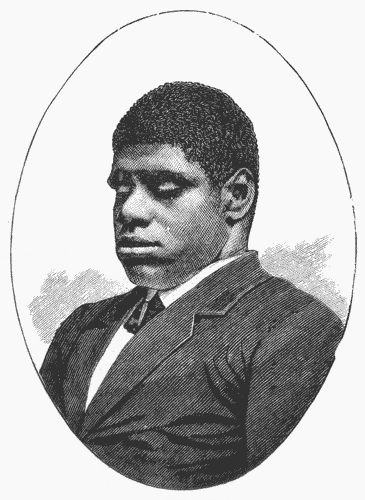
THOMAS GREENE BETHUNE.
He remembers and plays full seven thousand pieces. In short, he plays every piece that he has ever heard. How almost godlike (it cannot be brought to human comparison) is this retentive, this perfect memory, as relating to all that is musical, or even unmusical, in sound!
Nor does he need to depend upon the music composed by others. His own soul is full of harmony, endless in variety, and most ravishing. Take from him, were it possible, all remembrance of the music written by others, and he would still be an object of delight and amazement on account of his matchless power in improvisation. Listen to his own "Rain Storm," and you shall hear, first, the thunder's reverberating peal, and anon the gentle patter of the rain-drops on the roof: soon they fall thick and fast, coming with a rushing sound. Again is heard the thunder's awful roar, while the angry winds mingle in the tempestuous fray,—all causing you to feel that a veritable storm rages without. After a while, the tempest gradually ceases; all is calmness; and you look with wonder upon this musical magician, and marvel that the piano-forte can be made to so closely imitate the sounds made by the angry elements.
No one lives, or, as far as we know, has ever lived, that can at all be compared with him. Only the musical heroes of mythology remind us of him; for he is
"As sweet and musical As bright Apollo's lute strung with his hair:"
And Ariel, Shakspeare's child of fancy, who on Prospero's island constantly gave forth melodies of ever-varied, ever-enchanting sweetness, filling all the air with delicious harmony,—that musical spirit was but an anticipation of the coming of this actual wonder in music. Of him an eloquent writer has beautifully said, "There is music in all things; but 'Blind Tom' is the temple wherein music dwells. He is a sort of door-keeper besides; and, when he opens the portals, music seems to issue forth to wake the soul to ecstasy." The skilful metaphysician or the psychologist pauses before him, completely balked: they cannot classify this mind, human-like indeed in some respects, yet in many others surpassing all humanity, and closely approximating that which is godlike.
Some persons, it is true, judging from certain manifestations of his, or from certain lack of manifestations, have had the temerity to say that "Blind Tom" is an idiot. Out with the idea! Who ever heard of an idiot possessing such power of memory, such fineness of musical sensibility, such order, such method, as he displays? Let us call him the embodiment, the soul, of music, and there rest our investigations; for all else is futility, all else is vain speculation.
Thus have I alluded in a general way to the characteristics of this most wonderful pianist. A more particular but brief sketch of his life from infancy to manhood cannot but be interesting, not only to the student in music, but to all classes of readers.
"Thomas Greene Bethune" (I am quoting from his biography), "better known to the public as 'Blind Tom,' was born within a few miles of the city of Columbus, Ga., on the twenty-fifth day of May, 1849. He is of pure negro blood, and was born blind. His first manifestation of interest in any thing was his fondness for sounds; the first indication of capacity, his power for imitating them. Musical sounds exerted a controlling interest over him; but all sounds, from the soft breathings of the flute to the harsh grating of the corn-sheller, appeared to afford him exquisite enjoyment. His power of judging of the lapse of time was as remarkable as his power of remembering and imitating sounds. Those who are familiar with clocks that strike the hours, have observed, that, a few minutes before the clock strikes, there is a sharp sound different from and louder than the regular ticking. There was a clock in the house; and every hour in the day, just precisely when that sound was produced, Tom was certain to be there, and remain until the hour was struck.
"He exhibited his wonderful musical powers before he was two years old. When the young misses of the family sat on the steps of an evening, and sang, Tom would come around and sing with them. One of them one evening said to her father,—
"'Pa, Tom sings beautifully; and he don't have to learn any tunes: he knows them all; for, as soon as we begin to sing, he sings right along with us.'
"Very soon she said,—
"'He sings fine seconds to any thing we sing.'
"His voice was then strong, soft, and melodious. Just before he had completed his second year he had the whooping-cough, from the effects of which his voice underwent an entire change; it became and continued for years exceedingly rough and harsh, though it did not affect the taste or correctness of his singing.
"He was a little less than four years of age when a piano was brought to the house. The first note that was sounded, of course, brought him up. He was permitted to indulge his curiosity by running his fingers over and smelling the keys, and was then taken out of the parlor. As long as any one was playing, he was contented to stay in the yard, and dance and caper to the music; but the moment it ceased, having discovered whence the sounds proceeded, and how they were produced, he was anxious to get to the instrument to continue them. One night the parlor and the piano had been left open: his mother had neglected to fasten her door, and he had escaped without her knowledge. Before day the young ladies awoke, and, to their astonishment, heard Tom playing one of their pieces. He continued to play until the family at the usual time arose, and gathered around him to witness and wonder at his performance, which, though necessarily very imperfect, was marvellously strange; for, notwithstanding this was his first known effort at a tune, he played with both hands, and used the black as well as the white keys.
"After a while he was allowed free access to the piano, and commenced playing every thing he heard. He soon mastered all of that, and commenced composing for himself. He would sit at the piano for hours, playing over the pieces he had heard; then go out, and run and jump about the yard a little while, and come back and play something of his own. Asked what it was, he replied, 'It is what the wind said to me;' or, 'What the birds said to me;' or, 'What the trees said to me;' or what something else said to him. No doubt what he was playing was connected in his mind with some sound, or combination of sounds, proceeding from those things; and not unfrequently the representation was so good as to render the similarity clear to others.
"There was but one thing which seemed to give Tom as much pleasure as the sound of the piano. Between a wing and the body of the dwelling there is a hall, on the roof of which the rain falls from the roof of the dwelling, and runs thence down a gutter. There is, in the combination of sounds produced by the falling and running water, something so enchanting to Tom, that from his early childhood to the time he left home, whenever it rained, whether by day or night, he would go into that passage, and remain as long as the rain continued. When he was less than five years of age, having been there during a severe thunder-storm, he went to the piano and played what is now known as his 'Rain Storm,' and said it was what the rain, the wind, and the thunder said to him. The perfection of the representation can be fully appreciated by those only who have heard the sounds by the falling of the water upon the roofs, and its running off through the gutters.
"There was in the city of Columbus a German music-teacher who kept pianos and music for sale. The boys about the city, having heard much of Tom, sometimes asked the boys of the family to take him to town, that they might hear him. Upon these occasions they asked permission of this man to use one of his pianos; and, though he would grant the permission, he would not hear him. If he was engaged, he would send them to the back part of the store, which was a very deep one; if he had nothing to do, he would walk out into the street. When Tom was about eight years of age, a gentleman, having obtained permission to exhibit him, hired a piano of this man, and invited him to visit his concert. He indignantly rejected the invitation.
"The man, however, succeeded in awakening the curiosity of the wife of the musician sufficiently to induce her to attend; and she gave her husband such accounts, that he went the next night. After the performance was over, he approached the man, and said,—
"'Sir, I give it up: the world has never seen such a thing as that little blind negro, and will never see such another.'
"Encouraged by this, the exhibiter the next day applied to him to undertake to teach Tom. His reply then was,—
"'No, sir; I can't teach him any thing: he knows more of music than we know, or can learn. We can learn all that great genius can reduce to rule and put in tangible form: he knows more than that. I do not even know what it is; but I see and feel it is something beyond my comprehension. All that can be done for him will be to let him hear fine playing: he will work it all out by himself after a while; but he will do it sooner by hearing fine music.'
"It has been stated that Tom was born blind. In his infancy and for years the pupils of his eyes were as white and apparently as inanimate as those of a dead fish. But nature pointed out to him a remedy which gradually relieved him from total darkness, and in process of time conferred upon him, to a limited extent, the blessings of vision.
"When he was three or four years of age, it was observed that he passed most of his time with his face upturned to the sun, as if gazing intently upon it, occasionally passing his hand back and forth with a rapid motion before his eyes. That was soon followed by thrusting his fingers into his eyes with a force which appeared to be almost sufficient to expel the eyeballs from their sockets. From this he proceeded to digging into one of them with sticks, until the blood would run down his face. All this must have been pleasant to him, or he would not have done it; and there is no doubt that he is indebted to the stimulus thus applied to his eyes for the measure of sight he now enjoys. When five or six years of age, a small, comparatively clear speck appeared in one of his eyes; and it was discovered that within a very small space he could see any bright object. That eye has continued to clear, until he is now able to see luminous bodies at a distance, and can distinguish small bodies by bringing them close to his eye. Persons that he knows well he can distinguish at the distance of a few feet; and it is hoped that in process of time his sight will so far improve as to relieve him from many of the difficulties to which he is subject.
"The mere technicalities of music Tom learns without difficulty. Its substance he seems to comprehend intuitively. To teach him the notes, it was necessary only to sound them, and tell him their names. With the elements and principles of music he seemed to be familiar long before he knew any of the names by which they were indicated; as a man going into a strange country may be perfectly acquainted with the appearance and nature of the material objects which meet his view, without knowing the names applied to them by the people.
"Considering that in early life he learned nothing, and later but little from sight, that he is possessed by an overmastering passion, which so pervades his whole nature as to leave little room for interest in any thing else, and the gratification of which has been indulged to the largest extent, it is not surprising that to the outside world he should exhibit but few manifestations of intellect as applicable to any of the ordinary affairs of life, or that those who see him only under its influence should conclude that he is idiotic.
"The elegance, taste, and power of his performances, his wonderful power of imitation, his extraordinary memory,—not only of music, but of names, dates, and events,—his strict adherence to what he believes to be right, his uniform politeness, and his nice sense of propriety, afford, to those who know him well, ample refutation of this opinion.
"Tom sometimes indulges in some strange gymnastics upon the stage, which are considered by many a part of his stage training. So far from this being the case, it is but a slight outcropping of his usual exercises. If those who see him upon the stage could witness his performances in his room, and the enjoyment they afford him, they would perhaps regret the necessity of his restraint in public. He never engaged in the plays of children, or manifested any interest in them. His amusements were all his own. With a physical organization of great power and vigor, and an exuberance of animal spirits, he naturally sought physical exercise. Compelled by want of sight to limit himself to a small space, he put himself in almost every conceivable posture, and resorted to those exercises which required the most violent physical exertion. They are now necessary certainly to his enjoyment, perhaps to his health.
"Tom has been seen probably by more people than any one living being. He has played in almost every important city in the United States and in a great many of the smaller towns, in Paris, and in most of the principal cities of England and Scotland.... Those who have observed him most closely, and attempted to investigate him, pronounce him a 'living miracle,' unparalleled, incomprehensible, such as has not been seen before, and probably will never be seen again."
I find, in reading his biography, that in Philadelphia and Pittsburgh, in England and Scotland, scientists were asked to give an opinion as to "Blind Tom's" musical genius. I select only one from these opinions. The others (from Charles Halle, I. Moscheles, and Professor H.S. Oakley, all very eminent musicians) agree with this one, and need not be given.
Philadelphia, Sept. 16, 1865.
Dear Sir,—The undersigned desire to express to you their thanks for the opportunity afforded to them of hearing and seeing the wonderful performances of your protégé, the blind boy pianist, Tom. They find it impossible to account for these immense results upon any hypothesis growing out of the known laws of art and science.
In the numerous tests to which Tom was subjected in our presence, or by us, he invariably came off triumphant. Whether in deciding the pitch or component parts of chords the most difficult and dissonant; whether in repeating with correctness and precision any pieces, written or impromptu, played to him for the first and only time; whether in his improvisations, or performances of compositions by Thalberg, Gottschalk, Verdi, and others; in fact, under every form of musical examination,—and the experiments are too numerous to mention or enumerate,—he showed a power and capacity ranking him among the most wonderful phenomena recorded in musical history.
Accept, dear sir, the regards of your humble servants,
B.C. Cross, James M. Beck, G. Blandner, J.A. Stern, J.H. Rednor, Carl Roese, C. Blancgaur, J.A. Getza, And several others.
Here are some clippings from American and English newspapers.
From "The Public Ledger," Philadelphia, Sept. 27, 1865:—
"Many professors of music of great eminence have been ready, after listening to him, to declare that they would never touch the piano again. What he has done in public in the way of playing the most difficult pieces after hearing them but once, and with a perfection that years of practice could not usually apply, is known to all the lovers of music in this city.
"The secret of this wonderful power is the most perfect ear for the harmonies of sound ever observed,—'only this, and nothing more.' To him every thing is music. Discords do not seem to disturb him; but his ear catches every harmony, and his whole being seems entranced and controlled by it. Let him stand with his back to a piano, and any number of chords be struck, and he will instantly tell every note sounded, showing that he has been able to discriminate, and his memory to retain distinctly and perfectly, each sound. The phrenologists say that memory is in proportion to clearness and strength of the impression produced at first; and this must be the case with him. From two years old this remarkable power of sound over him has been noticed. He has been blind from birth; and it would seem here, as often observed before, that, by a compensative law of our being, in proportion as one sense is defective, the expenditure of vital energy thus saved is absorbed by some other sense. Probably all our sensations are the result of vibrations; and the pulsations of light that usually enter and give all their exquisite pleasure through the eye-ball are in his case compensated for by the pulsations of sound, which strike on an ear possessed of nerves of double delicacy and vital energy from the absorption and concentration of two senses in one.
"'Blind Tom' is not, however, the senseless being that most imagine him, but rather like one completely guided and governed by this one sense alone. As a lad, the song of a bird would lead him to wander off into the woods; and then the sound of the flute would bring him to those who went in search of him....
"Perhaps a proper study of the case of this lad might show to what extent all (though in less degree) might be educated through music. It is certainly this alone that can be most easily developed. Probably the highest and best emotions might be thus permanently excited within him; while the desire for those pleasures leads him to put forth intellectual efforts that nothing else can.... But his performances in music show how the highest results of art and study are most easily reached by this lad in his one-sided culture and development,—that of the ear alone. It is with him a sort of inspiration. The science of music he will probably never be able to master; but we must remember that the art of it preceded the science in Egypt, in Palestine, in Greece, and in Rome, by long ages. Indeed, it was the music of the Hebrews, and then of the Christian Church, that gave birth to scientific music, and alone developed it, until that of the opera gave rise to a distinct branch of the culture. This re-acted powerfully on sacred music itself. 'Blind Tom' at present likes operatic music best."
"The Albany (N.Y.) Argus" of January, 1866, said,—
"Now test the power of analysis. Three pianos are opened: at two of them persons present hammer away, with the design of producing the most perfect discord imaginable; at the third piano, the professor makes a run of twenty notes. The confusion ceases, and Tom repeats in a moment each of the twenty notes sounded. Still another test. Tom takes the stool himself. With his right hand he plays 'Yankee Doodle' in B flat. With his left hand he performs 'Fisher's Hornpipe' in C. At the same time he sings 'Tramp, tramp,' in another key,—maintaining three distinct processes in that discord, and apparently without any effort whatever. 'Most marvellous!' you say; 'but can he express as well as he perceives?' The gentlemanly director will let you see. He asks Tom to render 'Home, Sweet Home,' by Thalberg. You know, that, of all productions in the current repertoire, there are none which have finer or more difficult shades than this. 'Blind Tom' proceeds; and, were you to close your eyes, you could not tell but Thalberg himself was at the instrument, so perfect and so exquisite is the conception and the touch. Then you have renderings in imitation from Chopin, from Gottschalk, from Vieuxtemps, from anybody you will mention who has been deemed a master of the art; and you turn away convinced, surfeited with marvels, satisfied that you have witnessed one of the most incomprehensible facts of the time."
From "The Manchester (Eng.) Courier," Sept. 26:—
"'Prodigies' of all kinds are presented ever and anon to the public nowadays; but we have had nothing yet produced so truly marvellous as the negro phenomenon known as 'Blind Tom,' who appeared for the first time in Manchester, at the Theatre Royal, last night. In order to test 'Blind Tom's' powers of memory, Mr. Joule gave a short impromptu, avoiding any marked rhythm or subject, but which was imitated very cleverly. To test his powers of analyzing chords, Mr. Joule played him the following discordant combinations: the chord of B flat in the left hand, with the chord of A with the flat fifth and sharp sixth in right hand; the chord of E in the left hand, and the chord of D, two sharps, in the right; the chord of A, three flats, in the left hand, with that of A, three sharps, in the right. All these chords were at once correctly named by enumerating each note in succession from the lowest. Mr. Seymour subsequently was called upon, and gave a subject, which he reproduced upon the piano-forte with great success."
From "The Glasgow (Scotland) Daily Herald," Jan. 2, 1867:—
"'Blind Tom,' the wonderful negro-boy pianist, made his début in Glasgow yesterday, when he gave three of his entertainments, or rather musical exhibitions, in the Merchants' Hall,—two during the day, and one in the evening. He is, without doubt, an extraordinary lad; born blind, though he is now able to distinguish light from darkness; and having a defect in some of his mental faculties, though what that defect is it is very difficult to say. Nature seems to have made up for these deficiencies by endowing him with a marvellously acute ear and a retentive memory. It is not uncommon to find blind people with their other senses much more highly developed, and much more susceptible of impression, than in people possessing all their faculties; but in no case have we ever heard or known of one with auditory nerves so fine, or with memory so powerful, as 'Blind Tom.' Mozart, when a mere child, was noted for the delicacy of his ear, and for his ability to produce music on a first hearing; but Burney, in his 'History of Music,' records no instance at all coming up to this negro boy for his attainments in phonetics, and his power of retention and reproduction of sound.... He plays first a number of difficult passages from the best composers; and then any one is invited to come forward and perform any piece he likes, the more difficult the more acceptable, and, if original, still more preferable. Tom immediately sits down at the piano, and produces verbatim et literatim the whole of what he has just heard. To show that it is not at all necessary that he should be acquainted with any piece beforehand to reproduce it, he invites any one to strike a number of notes simultaneously with the hand, or with both hands; and immediately, as we heard him do yesterday, he repeats at length, and without the slightest hesitation, the whole of the letters, with all their inflections, representing the notes. Nor are his wondrous powers confined to the piano, on which he can produce imitations of various instruments, and play two different tunes—one in common time, and a second in triple—while he sings a third; but he can with the voice produce, with the utmost accuracy, any note which his audience may suggest. Yesterday afternoon, for instance, he was asked to sing B flat, F sharp, and the upper A,—a very difficult combination; and, beginning with the latter, he at once satisfied his auditors of his success. One very funny feat he executed, which, as much as any thing else, showed what he could do. When at Aberdeen, as Dr. Howard explained, Tom heard, in a large ante-room adjoining the hall where he was, a teacher of dancing tuning his fiddle, the strings of which apparently had been rather difficult to get tightened up to proper tune. Tom had but to listen, and he retained every sound which the dancing-master produced. Tom's imitation on the piano—first of the striking of the violin-strings with the fingers for some time, after the manner of violinists, then seeing if they chorded well, again touching up the strings, anon giving a little bit of a polka, and once more adjusting the strings, and so on, all exactly as he heard it—was as amusing as it was astonishing. No one with an ear for music should miss the opportunity of going to hear him ere he leaves."
From "The Edinburgh Scotsman:"—
"'Blind Tom.'—Last night this negro boy, of whose remarkable performances so much has been said and written of late, made his first appearance here in the Operetta House. There was a crowded audience, among whom were a number of the musical cognoscenti of Edinburgh, whose curiosity had been excited by the reputation he had gained in America, as well as by the favorable notices of the press in this country, and the testimony of such men as Moscheles and Halle.... It is only when he sits down to the instrument, that he becomes, as it were, inspired. He played several pieces on this occasion from memory, and displayed great execution, and a greater amount of feeling and expression than we were prepared to expect. One of the best of these was the fantasia on the Hundredth Psalm, which was brilliantly executed. One of his most extraordinary feats is the reproduction of any piece once played over to him. On this occasion, Mr. Laurie, who was present, at the invitation of the manager ascended the platform, and played a composition by R. Muller, which occupied nearly five minutes. He no sooner left the instrument than 'Blind Tom' took his seat, and gave a correct imitation. His ability to name any combination of notes, no matter how disconnected and puzzling the intervals, was fully proved. The professional gentleman we have named struck simultaneously no less than twenty notes on the piano; and these 'Blind Tom' named without a single mistake."
From "The Dundee Advertiser:"—
"'Blind Tom.'—This extraordinary musical prodigy gave two performances in Dundee yesterday, and on each occasion the powers displayed by him were so marvellous as to verge upon the miraculous. Our readers must not suppose that his proficiency is merely of an ordinary kind, or that his notoriety is another species of Barnumism. The letter we published yesterday from a private friend, in whose opinions we place the greatest confidence, shows that it is not so; and we believe the opinions of all who yesterday heard him will be found to be those of astonishment and admiration. History affords no parallel to 'Blind Tom.' His ability would be marvellous, even if he had his eyesight; but, as we have before remarked, when it is considered that he is blind, it is beyond measure strange. Unless one sees or hears him play, he is unable properly to understand the extent of his ability. Test him how you may, he never fails. His memory is as miraculous as his musical powers; and he plays over a piece he has never heard before with almost infallible exactitude. Yesterday several gentlemen went to the platform, and played over pieces; and, during the time they were so occupied, it was amusing to witness Tom's contortions of his body, and his movements generally. He swayed himself about, his eyeballs rolled, his fingers twitched involuntarily, and he seemed like one possessed; and, on being allowed to seat himself at the piano, he repeated from memory the various pieces which had been played to him. In the evening, Mr. Hirst played over a number of pieces of the most difficult character, all of which Tom produced with fidelity.
"On inquiry, we find that his proficiency is a natural gift. From his earliest infancy he betrayed the utmost interest in musical sounds of every kind,—the cries of animals, the moaning of the wind, the rushing of waters, and the like; and when he was allowed to go out in the fields, if he heard a bird sing, he rushed off towards it with frantic delight. We publish a letter we received the other day from an intimate friend in another town,—a gentleman of great musical taste, and no little executive ability,—who is well qualified to give an opinion on such matters. He says,—
"'I presume you have not heard "Blind Tom" play. If not, you never heard a better performer. Like most people, of course, I was inclined to regard this wonderful prodigy as a wonderful humbug; but I assure you, that so far from this being the case, or any thing like it, Tom is as genuine an artist, and possesses as much (and, for any thing I can tell, a great deal more) musical talent or power, either as regards the execution of the compositions of others or of his own, as either Thalberg, Halle, Madame Goddard, or anybody else you ever listened to. I write merely to disabuse your mind of the common impression which we are all apt to form of these singular geniuses; and very strongly recommend you not only to hear him play, but privately test him (as I have done) in any way you like. Improvise to him as difficult or elaborate or out-of-the-way piece as you please, and he will instantly reproduce it. Now, this is no common gift; and therefore you and I, and all who know any thing of music, should use our best efforts to let the public know, that, so far from there being any thing in the nature of clap-trap about Tom, he is, in fact, a musical gem of the first water. Of course I have nothing to do with him; but I have been so highly pleased with his performances, that I thought it might be as well to let you know beforehand (in case you have not already heard him) what my own real impression is of him.'
"He not only repeats every piece he hears from memory, but he improvises and composes; and he last night sang a song of his own composition,—'Mother, dear mother, I still think of thee,'—of great merit for its simple sweetness and pathos. As he cannot possibly remain longer in Dundee than to-night, we would earnestly urge upon all who can afford it the absolute duty of seeing and hearing this wonderful blind negro boy. He is only seventeen; but no man of any age could surpass him for executive ability, as his testimonials from such men as Moscheles, Halle, &c., prove. He performs two or three different melodies at the same time, and plays with his back to the piano with apparently as much ability as in the ordinary position. We would especially recommend all who are interested in anthropology, phrenology, and psychology, to see and hear him for themselves. His ability is a singular confutation of the theories of Hunt and Blake about the inferiority of the negro; for we may challenge any white man to compete with him, in perfect safety. His parallel is not to be found the world over, nor in any time of which the records are known."
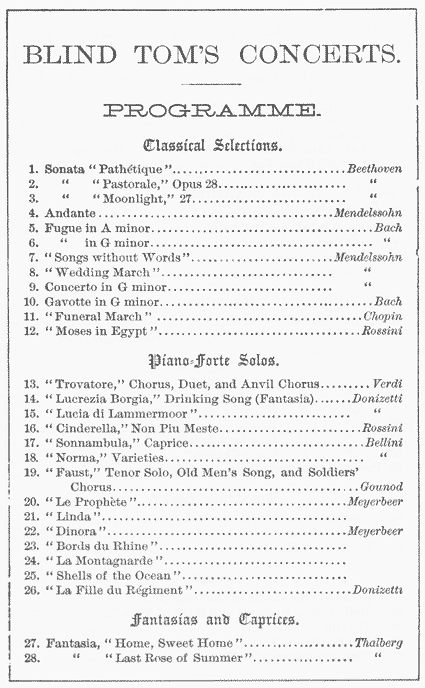
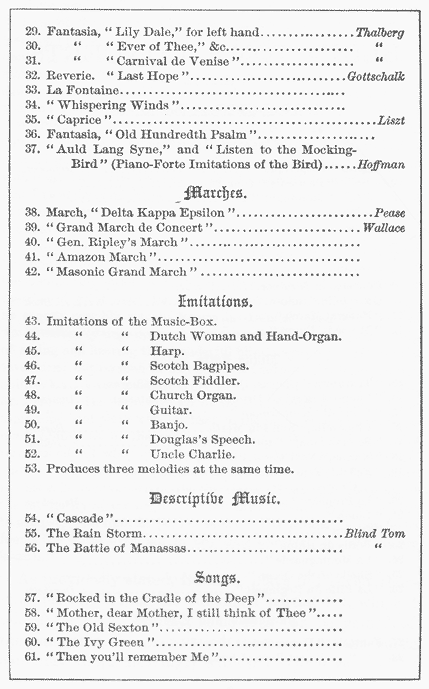
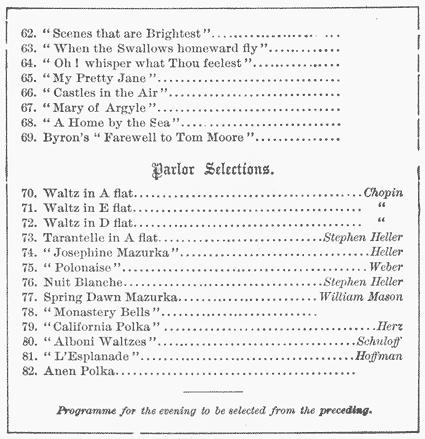
As previously stated, Bethune plays full seven thousand pieces. From the subjoined partial list, which I take from his biography, some idea can be gained of the character, the ever-varied character, of the music contained in his amazingly extensive repertoire.