The Press-mans Trade.
Reading edition
PREFACE.
The Printing-Press that a Press-man works at, is a Machine invented upon mature consideration of Mechanick Powers, deducted from Geometrick Principles; and therefore a Press-man indowed with a competency of the Inventers Genius, will not only find great satisfaction in the contemplation of the harmonious design and Make of a Press, but as often as any Member, or part of it is out of order, he will know how to remedy any deficiency in it. This alone will intitle him to be an Understanding Press-man: But his care and serious industry in the Physical and Manual performance of his Task, must give him the Reputation of a good and curious Work-man.
§. 24. ¶. 1. Of the Press-mans Trade.
An understanding Press-man therefore knows not only how to direct a Printers Joyner to Set up and Fasten a Press when it is made, but also how to give a strange Joyner and Smith instructions how to make a Press, and all its parts, in a Symetrical proportion to any unwonted size, if in a strange place he shall have occasion to use it.
I have already at large insisted upon the dimensions of every particular Member of an ordinary siz’d Press in § 10, 11. But in those Sections did omit shewing you how the Press is Set up and Fastned; yet promised to do it when I came to the Press-mans Trade: It being not only a care incumbent upon him, but a Curiosity he would assume to himself to direct and see the Joyner set and fasten it in a Steddy and practical position. We will suppose a strange Joyner, and not a Printers Joyner (as here in London he may be furnisht with) who generally by their constant conversation in Printers work, do or ought to know as much of Setting up a Press as the Press-man himself.
The Joyner therefore having set together the Frame, viz. the Cheeks, Feet, Cap, Head, Till, Winter, Hind-Posts, Ribs, Carriage, &c. The Press-man directs, and sees him perform as follows by and by. For I should have told you that before the Head is put into its place, the Press-man besmears the whole Tennanted ends and Tennants well with Soap or Grease, and also the Mortesses the Head slides in, and so much of the Cheeks as the ends of the Head work against, that the Head may the easier work up and down.
He also before the Carriage is laid on the Ribs, besmears the two edges of the Plank and the under side of the Coffin well with Soap or Grease; and the like he does by the inside of the Wooden Ribs, that they may slide the easier beside each other.
Now to return to the Joyner. The Press-man, I say, directs and sees him perform as follows.
1. To place the Feet upon an Horizontal Level Floor, as I shewed in the First Volume, Numb. 7. § 7. when I spoke of the Level that Carpenters use.
2. To erect the Cheeks perpendicularly upright, as I shewed Vol. 1. Numb. 7. § 8. when I treated of the Plumb-line.
3. To place the Stays or Braces so as the Press may be kept in the most Steddy and Stable position, as well to give a check to the force of the hardest Pull he makes, as to the hardest Knock the Bar shall make against the farther Cheek, if by chance (as sometimes it does) it slip out of the Press-mans Hand.
This consideration may direct him to place one Brace against the end of the Cap that hangs over the hither Cheek, and in a range parallel with the fore and hind side of the Cap: For the more a Brace stands aslope to the two parrallel sides, the less it resists a force offered to the end of them, viz. the hither end of the Cap, which is one main Stay to the whole Press.
If he place another Brace against the hinder corner of the farther end of the Cap, it will resist the Spring of the Bar, if it slip out of the Press-mans Hand.
And if he places two other Braces, one against the hither corner of the hind-side of the Cap, and the other against the farther corner of the fore-side of the Cap, the Press will be sufficiently Braced-up, if the Room will afford convenience to place the farther end of the Braces against.
By convenience I mean a firm solidity to place the end of the Braces against, be it either a Stone-wall, Brick-wall, or some principal Post, or a Girder, &c. that will not start or tremble at the force of a Pull.
The Braces ought to be straight, and of Substance strong enough proportionable to their Length: And if convenience will allow it to be fixed in such a position that they stand in the same straight Line with the upper Surface of the Cap, viz. that the farther end of the Brace neither dips lower or mounts higher than the upper side of the Cap. Neither ought the Brace, though thus posited, to stand aslope or askew, viz. make unequal angles with the side of the Cap it is fastned to, but it ought to stand Square, and make right angles with the respective side of the Cap; because in those Positions the Braces best resists the force of continued Pulls.
But though this be by the Rules of Architecture, the strongest, firmest, and most concise method for Bracing-up a Press, yet will not the Room the Press is to stand in always admit of convenience to place the Braces thus: Therefore the Press-man ought to consider the conveniences of the Room, both for the places to fit the Braces to, and the positions to set the Braces in; placing his Braces as correspondent as he can to these Rules.
If he doubt the crazy make of the Winter, he will cause two Battens of three or four Inches broad, and a full Inch thick, to be nailed close to the outer sides of the Feet of the Press, which will both strengthen the Winter, and keep the lower part of the Cheeks from flying out, and also hinder the Press from working into a twisting Position.
And though I am loath to name the Under-laying of the Feet, because at the best it is but a Botch, and Subjects the whole Press to an unstable position yet because by accident it may happen, the aforesaid Battens will also keep these Underlays from working out.
Joyners that Work to Printers have got a Custom to place a strong Piece of Timber between the middle of the Cap and the Ceiling or Roof of the Room, which can do no service there, unless they intend to support the Roof: For the weight of the Press alone will keep it close to the Floor, and the strength of Stuff between the Mortesses in the Cheeks and the ends of them, are intended to be made strong enough to resist the Rising of the Head: For should that strength of Stuff start, neither their strong Piece of Timber, nor the strength of the Roof, would resist the Rising of the Head: but Head and Cap, and Timber and Roof too, would all start together, as by experience I have seen. For indeed the strength of Stuff between the Mortesses that the Tennants of the Head works in, and the upper ends of the Cheeks, and the Strength of Stuff between the Mortesses that the Tennants of the Winter lyes in, and the lower ends of the Cheeks resist the whole strength of the working of the Spindle out of its Nut. So that the Cap suffers no pressure upwards or the Feet downwards, unless the force of the Spindle break the strength of Stuff between the Head and the upper ends of the Cheeks, or the strength of Stuff between the Winter and the lower ends of the Cheeks.
The Press being thus far fastned, the Carriage is laid on; and if the Joyner performed his Work well in making the Wooden-work, it will at first lye exactly Horizontal; if not, it must be mended where it is amiss before the Press-man can Lay the Stone; and before the Stay of the Carriage can be fitted under the end of the Ribs.
¶ 2. Of Laying or Bedding the Stone.
We will suppose the Wooden Ribs to lye on the Winter exactly, flat and Horizontal, therefore the Press-man now Lays the Stone: If the Stone be a good thick Marble Stone, and all the way of an equal thickness between the Face and the Bottom, he may Bed or Lay it upon so many large Sheets of Brown Paper as will raise the Face about a Brevier above the Superficies of the Coffin, and the Stone will do good service.
Or he may Bed or Lay it on Bran; which indeed the Press-man most commonly does, if the Stone be qualified as aforesaid.
The manner how he lays it on Bran is thus,
He grasps an handful of Bran and lays it down at the hither corner of the Coffin on his Left Hand, and it will form it self into a small Hillock; then he takes another handful of Bran, and lays that down in the same manner near the first, towards the further side, and so a third, &c. towards the further side, till he have filled the whole breadth of the Coffin. Then he in like manner lays another row of Hillocks, beginning at the hither side of the Coffin; and so a third and fourth row, &c. till the length of the Coffin is filled as well as the breadth: Then with a Riglet he drives the tops of these Hillocks into the Valleys between them, to spread the Bran into an equal thickness in the whole Coffin. Which done, he lays the Stone upon it.
But in this case he considers to lay so much Bran thus into the Coffin as may make the Face of the Stone rise about a Great Primer higher than the Superficies of the Coffin: For else he must take all his Bran out again, and new-lay his Hillocks, making them bigger or less, till he have fitted the Face of the Stone, to lye about a Great Primer, as aforesaid, higher than the Superficies of the Coffin.
But if it be a thin Stone, or a Purbeck or Portland Stone, it is great odds if it be thus Laid, but it breaks with the first Pull: Therefore these Stones are generally Laid or Bedded with Plaister of Paris, which before it hardens, will of it self run into an Horizontal position.
This Plaister of Paris is tempered with fair Water to the consistence of Batter for Pancakes, or somewhat thicker, and such a quantity is put into the Coffin as may raise the Face of the Stone about a Scaboard higher than the Superficies of the Coffin.
The different matter the Stone is Laid on is the reason why the Face is Laid of different heights above the Superficies of the Coffin: For by the force of a Pull about a dozen Sheets of Brown Paper may be squeez’d closer by a Brevier Body, which brings the Face of the Stone into the same Level with the Superficies of the Coffin. And Bran squeezes much more. But Plaister of Paris not at all.
When he Lays the Stone on Bran, or on Plaister of Paris, he and his Companions slings the Stone in two strong Packthreds, placing one towards either end of the Stone; and each of them taking an end of each String in each of their Hands, with the Face of the Stone upwards, and brought as near as they can into an Horizontal Position, they with great care and caution let it into the Coffin, and as near as they can, so as the whole bottom of the Stone touch the Bedding all at once; lest by raking the Bedding with any part of the bottom of the Stone first, the Horizontal form of the Bedding be broken.
Having laid the Stone down, they draw the Packthred from under it: And by squeezing a little Water out of a Spunge upon about the middle of the Face of the Stone, try whether the Stone lye truly Horizontal, which they know by the standing of the Water: For if the Water delate it self equally about the middle of the Stone, the Stone lies Horizontal: But if it have a propensitude to one side more than another, the declivety is on that side, and the Stone must be new Laid.
Having laid it Horizontal, they Justifie it up with the Justifiers I mentioned in § 11. ¶ 17.
¶ 3. Of Setting the Rounce.
The Rounce being well Set does not only ease a Press-man in his Labour, but contributes much to Riddance in a train of Work.
In the old-fashioned Presses used here in England, the Press-man finds often great trouble and loss of Time in Setting the Rounce: Because the Girts being nailed to the Carriage-board behind, and to the Frame of the Coffin before, he cannot alter the position of the Rounce without un-nailing and nailing the Girts again, both before and behind. Nay, and sometimes though he thinks he has been very careful in Winding the Girts off or on the Barrel of the Rounce, as he finds occasion requires; Yet by straining either of the Girts too hard, or not hard enough, or by an accidental slip of either of the Girts, or by stirring the Rounce out of a Set position, when he thinks he has Set the Rounce, he has it to do again. Besides, The Carriage-board, Frame of the Coffin, and the Rounce-barrel, all suffer tearing to pieces by often drawing out and driving in o Nails.
But in these new-fashioned Presses all these inconveniences are avoided, for the Press-man, without nailing or un-nailing, Sets the Rounce to what Position he will, only by lifting up the Iron Clicker that stops the wheel: For then Winding off so much Girt, and Winding up so much Girt at the opposite end of the Carriage, his Rounce is Set, without hope or Hazzard.
He Sets the Rounce to such a position, that when the fore-end of the Tympan will just lye down and rise free, without touching the fore-edge of the Plattin, then a line drawn or imagined from the Axis of the Handle of the Rounce, to a Perpedicular or Plumb-line, let fall from the Axis of the Spindle of the Rounce, these two lines shall make an angle of about 45 degrees, which is half the Elevation between an Horizontal line, or Line of Level, and a Perpendicular, or Plumb-line.
¶ 4. Of Hanging the Plattin.
When the Press-man Hangs the Plattin, he lays a Form upon the Press, and about a Quire of Paper doubled upon it (this Quire of Paper thus doubled is called the Cards) then layes the Plattin upon the Cards, and so Runs the Carriage and Plattin in, till the middle of the Plattin lye just under the Toe of the Spindle: Then he puts the Pan of the Plattin in its place, and in part Justifies the Head, as shall be shewed in the next ¶. And he un-screws the Hose-screws, till the Spuares at the ends of the Hose come down to about a quarter of an Inch of the Square of the Socket they are fitted into in the ends of the Garter, and when the Toe of the Spindle is fitted into the Nut in the Pan of the Plattin, he examines by straining a Pack-thred against the two foresides of the Cheeks of the Press, whether the fore-edge of the Plattin is set in a parallel Range with the fore-sides of the Cheeks: If it be not, he twists the ends till the edge of the Plattin stands parallel with the Pack-thred, and consequently with the Cheeks.
Then with the Bar he Pulls the Spindle hard down upon the Plattin, and Sets the edges of a Paper-board between the Bar and the farther Cheek of the Press, to keep the Bar from starting back.
And having provided fine Whip-cord, he knots a Noose on one end and puts it over one of the Hooks of the Plattin, lashing the Whip-cord also upon the farthermost Notch of the Hose-hook, and again upon the Plattin-hook, and again upon the Hose-hook, and again upon the Plattin-hook: So that here is now three Lashes of whip-cord upon the Plattin-hook, and upon the farthermost Notch of the Hose-hook. Wherefore he Lashes his fourth Lashing of whip-cord now upon the second Notch, viz. the middlemost Notch of the Hose-hook, reiterating these Lashes on the middlemost Notch and Plattin-hook also three times. And thus in like manner Lashes also three Lashes upon the third and last Notch of the Hose-hook and also of the Plattin-hook, observing to draw every Lashing of an equal strength.
Then he begins to whip about these Lashings to draw them close together: He begins, I say, at at the bottom of the Lashings, viz. close above the Plattin-hook, and draws his whippings very tight and hard, and contiguous above one another, till he have whipt so near the top of the Lashings, viz. near the Hose-hooks that he finds the Lashings (which now spread wide asunder because the Notches of the Hose-hooks stands far asunder) will yield no longer to to his whiping and pulling: So that now he fastens his whip-cord with two or three hard knots, and cuts it from the Coyl.
In like manner he begins at the opposite diagonal corner of the Plattin, and lashes and whips that: And also the two other corners of the Plattin as he did the first, carefully observing to draw all his lashings and whippings of an equal strength, lest any corner of the Plattin either mount or dip.
If he finds he strained the whip-cord not hard enough; or (when he is in his train of work) that the Plattin-cords with long working work loose; or that the Toe of the Spindle and the Nut it works in, have worn one another; he by turning the Screws at the upper ends of the Hose, draws up the Nut of the Plattin closer to the Toe of the Spindle, and by consequence strains the Plattin-cords tighter up; which is also a great convenience in these new-fashioned Presses: For, for any of these aforesaid accidents the Press-man that works at our English-Presses must new Hang his Plattin: When (as aforesaid) in these new Presses he only turns about a Screw.
¶ 5. Of Justifying the Head.
Justifying the Head is to put into the Mortesses in the Cheeks between the upper sides of the Tennants of the Head, and the upper sides of the Mortesses in the Cheeks, an equal and convenient thickness of (either) square pieces of Felt, Pastboards, or Scaboards (some or all of them) that when the Press-man Pulls, the Tennants of the Head shall have an equal Horizontal level Check.
In Justifying the Head, the Pull is to be made Longer or Shorter.
If the Press-man be tall and strong and his work be Light, that is, a small Form and great Letter, which needs not so strong a Pull as a Large Form and small Letter, he covets to have a Short-pull; that is, that the Spindle shall give an Impression by that time the Bar comes but about half way to the hither Cheek (in Printers Language Down.)
But if the Press-man be low, and not very strong, he will require a Longer Pull, especially if the work be Heavy, viz. a Large Form and small Letter: Because the heighth of the Bar is generally made to lye at the command of a reasonable Tall man, and therefore a Low man cannot Pull the Handle of the Bar at so great a force at Arms-end as a Tall man; but will require the swinging of his whole Body backwards to add force to the Pull: So that if the Pull be not Longer, he cannot fall enough backwards to get the Handle of the Bar within his command and force. And therefore a Low man and Heavy Work requires a long and Soaking Pull.
A long or a Soaking or Easie Pull, is when the Form feels the force of the Spindle by degrees, till the Bar comes almost to the hither Cheek of the Press, and this is also call’d a Soft Pull; because it comes Soft and Soakingly and easily down: And for the contrary reason the Short Pull is call’d an Hard Pull, because it is suddenly perform’d.
That which makes a Hard Pull, is putting into the Mortesses in the Cheeks solid Blocks of Wood, which will scarce Squeeze by the Strength of a Pull: And that which causes a Soft Pull is putting in pieces of Felt or Pastboard (as aforesaid) which being Soft will Squeeze and retain their Spring for a considerable time, yet will at length grow hard with Working, and then the Pull grows Longer; which the Press-man mends, by putting in another Felt or Pastboard into each Mortess.
The Head cannot be conveniently and well Justifyed soon after the laying of the Stone, if it be Laid on Bran, because though the Force of the Spindle will at the immediate time of the Pull Squeeze the Bran in the Coffin close, yet so soon as the force of the Spindle is off the Bran, all its dry parts, by their several irregular positions, will like so many Springs, at the same moment of time endeavour to recover their Natural tendency, and heaves the Stone upwards again: So that generally for a day or two Working the Stone will not lye Solid, though at length through the often and constant Squeezing the Bran it will. But if the Stone be Laid on Brown Paper, or Plaister of Paris, it quickly finds a Solid Foundation.
When the Press-man Justifies the Head, he unscrews the Female Screws of the Head Screws, that the weight of the Head may draw it down, to make room to put the Justifyers into the Mortesses in the Cheeks; and when he has put in so many as he thinks convenient, he Screws up the Head again as hard as he can. Then lays the Cards on the Form, on the Press, and Runs in the Carriage under the Plattin, and Pulls hard upon it, while his Companion Screws up the Head as hard and tight as he can, that the Carriage, Tympan, &c. may Run the freelier under the Plattin.
¶ 6. Of Oyling the Iron Work of the Press.
The Ribs, the Tympan Joynts, the Frisket Joynts, the Garters, both ends of the Rounce-Spindle, the Nut and Spindle, and the Toe of the Spindle, are all to be well Oyl’d; that they may all perform their several offices the easier, lightlier and nimbler; both Upper and Under hand.
All but the Nut and Spindle, and Toe of the Spindle, are Oyl’d with a Feather dipt in a spoonful, or little Pot, or Oyster-shell, &c. of Sallad Oyl; and that feather dabb’d upon so much of the Ribs as he can come at, at either end of the Press: For then by Running the Carriage three or four times quick Out and In, it desperses the Oyl equally the whole length of the Ribs, and at the same time Oyls the Cramp-Irons.
And for Oyling the Joynts, he commonly takes out the Pins and Oyls them, and puts them in again; and with the edge of a Feather dabs a little Oyl between the Crevices of the Joynts.
He thrusts the Feather in between the Spindle of the Rounce and its Collers.
To Oyl the Nut and Spindle, he pours a good quantity of Oyl in at the Hole in the Head, and with a Cork stops the hole again to keep out dust and filth: Then drawing the Bar quick to and fro about half a score times, he works the Oyl equally about the Nut and Spindle.
To Oyl the Toe of the Spindle, he pours about a Spoonful of Oyl into the Plattin-pan.
¶ 7. Of Making Register, and Making Ready a Form.
A curious Press-man will take care that against the Compositer brings a Form to the Press his Press-stone be wip’d very clean; for if any (though small) hard extuberant matter lye on it, the Letter that lyes on that extuberant matter will, with Pulling, quickly Rise, and not only Print harder than the rest of the Form, but bear the force of the Plattin off of the Letters adjacent to it. And therefore many times a Press-man will receive the Form from the Compositer when he has only Set the Form on the side of its Chase upon the Press-stone, that he may be the Surer the Face of the Stone is clean when he layes the Form down; as also that he may carefully examine that the backside of the Form is clean before he goes about to make Register, or otherwise make ready his Form.
Making Register is to Quoin up a Form and otherwise alter Whites (if need be) between the Crosses and Pages: So as that when a second Form of the same Volumne, Measure and Whites, is plac’d in the same position, all the Sides of each Page shall fall exactly upon all the Sides of the Pages of the first Form.
The first process a Press-man makes towards this Operation, is the chusing and placing of his Points: For to large Paper he chuses Short Shanked Points, and to small Paper Long Shanked Points, and proportionable to intermediate sizes of Paper: For his Points ought to be placed so as that when he is in his Train of work, they prick the Point-holes within the grasp of the hollow between his hand, Thumb, and Fore-finger; because when he shall Work the Reteration he may the better manage and Command the sheet he lays on the Tympan and Points.
Nor will he place his Points too near the edge of the Paper, because when he Works the Reteration, he would be forc’d to carry his furthermost Point-hole the further from him, which in a long train of Work loses Time: For the Laying Sheets quickly on their Point-holes adds much to riddance. So also the less distance between the further and hither Point-hole makes more riddance than if they are far distant; because he must draw his Body so much the further back to place that Hole on its Point. Therefore he places the hither Point farther into the Paper than the farther Point, if it be Folio, Quarto or Octavo, but to Twelves equally distant from both edges of the Paper.
By placing the Points unequally from the edges of the Paper, as in Folio’s, Quarto’s and Octavo’s (as aforesaid) he also secures himself the more from a Turn’d Heap when he works the Reteration; because without very much altering the Quoins, he shall not be able to make Register: And Press-men (especially if they Work upon the same sort of Work) seldom or never remove the Quoins on the further side the Carriage, nor on the right hand end of the Carriage, but let them lye as gages for the next Form: For thrusting the Chase close against these Quoins, the Register is almost (if not quite) made: The Compositer having before, according to his Task, chosen the Chases exactly of an equal size, and made strait and equal Whites between the Crosses, &c.
Having chosen his Points, he places them so that they may both stand in a straight line parallel with the top and bottom sides of the Tympan; which to know, he strains a Packthred cross the whole Tympan, laying it at once upon the middle of the Heads of both the Point-Screws, (for we will suppose the Joyner hath made the Mortesses into which the Point Screws are Let, parrallel with both the ends of the Tympan) then if both the Points stand in that straight line they are parrallel, if not, he moves one or both of them upwards or downwards till they do, and then Screws them fast.
Then he layes the Tympan down upon the Form, holding the Frisket-end of it in his Left-hand, about an Inch or an Inch and a half above the Face of the Letter, and Sinks his Body downwards till he can see between the Form and Tympan, and with the Ball of the middle finger of his Right-hand presses a little gently upon the Tympan just over the Point-ends of each Point successively, to see if the Points fall in or near the middle of the Slits in the Short-Cross. If they fall exactly in the middle of those Slits, the Form lyes right between the middle of both the ends: If they fall not exactly in the middle of both these Slits, he moves the Form between the ends of the Carriage, till they do, and then Quoins up the two ends of the Chase.
Then laying the Tympan flat down upon the Form, he layes the Blankets in it: (They are call’d the Blankets though generally it is but one Blanket doubled:) Then he puts the Iron-Pins, fastned through the hither side of the Inner Tympan into the Holes made through the hither side of the outer Tympan for Gages: And turning about the Tongues of the Iron-Buttons, that are fitted into the outer Side of the outer Tympan over the upper Side of the Inner-Tympan, he Screws the Button fast down. He also Screws down the Iron-Button at the end of the Tympan. These Buttons thus Screwed down are to keep the Inner-Tympan fast in, that it Spring not upwards.
Then he Folds a sheet of the Paper he is to Work long-ways, and broad-ways, and lays the long Crease of it upon the middle of the Long-Cross; and the Short Crease over the middle of the Gutters of the Short-Cross, if the Short-Cross lye in the middle of the Form, (for in Twelves it does not, but then he guesses at the middle;) then wetting his Tympan (as shall in proper place be shewed) he turns it down upon the Paper, and Running in the Carriage, Pulls that Sheet, which with the force of the Pull now the Tympan is wet, will stick to the Tympan; and turning up the Tympan again sees how well the Sheet was laid; that is, how even it was Laid: For if it was laid even on the Form, the Margin about the out sides of all the outer Pages will be equal; But if the Sheet be not laid even, he lifts it up Side by Side till he have loosen’d it from the Tympan, and removes it by his discretion till it be laid even: And then Pulls again upon it to fasten it to the Tympan. This Sheet is call’d the Tympan-sheet.
Then he lays another Sheet even upon the Tympan-sheet, for a Register Sheet, and a Waste Sheet over that to keep it clean from any filth the Face of the Letter may have contracted and imprint upon it, and Pulls these two Sheets. Then he Runs out the Carriage, and takes up the Tympan, and takes off the two Sheets, laying the waste Sheet by: But turns the other Side of the Register-Sheet the proper way his Volumne requires, viz. end-ways if it be Octavo or Folio; or Side-ways if Twelves or Quarto, &c. as at large you see in the Section of Imposing. And laying the Point-holes in the Register-Sheet over the Points, lays his waste Sheet on again, Runs-in the Carriage, and Pulls upon that the Second side of the Register-sheet, to try how well the Impression of the Sides of all the Pages agree, and lye upon the Impression in the first Pull’d Side. If he finds they agree perfectly well, Register is made. But if the Impression of the last Pull’d Side of the Register-sheet stand be-hither the Impression of the first Pull’d side, either the whole length of the Sheet or part, he observes how much it stands be-hither: If the thickness of a Scaboard, a Nomparell, a Long-Primmer, &c. he loosens the Quoin or Quoins on the farther side of the Carriage, and opens one or both of them, viz. removes them backwards till they stand a Scaboard, a Nomparell, a Long Primmer, &c. off the sides of their respective Corners: Then Knocks up one or both the opposite Quoins, till he have removed the Chase, and the Chase by consequence has forc’d the opened Quoin or Quoins close against their Corners. Or if the Impression of the last Pulled Side, stands within the Impression of the first Pulled Side; he observes how much also; and Loosning the hither Quoin or Quoins, and Knocking up the opposite as before, makes Register, for the Sides of the Sheet.
Then he observes how the Register of the Head and Foot agrees. And if he finds it agrees on both sides the Short Cross, he has good Register; supposing the Compositer has performed his Office, viz. made all his Pages of an equal Length, &c.
If the Impression of the Last Pulled Sheet, lye without the Impression of the first Pulled Sheet, towards the upper or lower end of the Tympan, he opens the Quoins at the respective end, and Knocks-up the opposite till he have made Register: Which to try he Pulls another clean Register-sheet as before. And if he finds Register agree on all the Sides of the Form the Task is performed: If not, he mends as aforesaid till it do.
But it sometimes happens that the Compositer has not made an exact equal White between all the sides of the Crosses: In this case, altering the Quoins will not make good Register; wherefore the Press-man observes which side has too much or too little White; and unlocking the Form takes out or puts in such a number of Scaboards as he thinks will make good Register: which he tryes by Pulling a Sheet, and if need be, mending as before, till he have Pull’d a Sheet with good Register.
Although the Press-man have made Register, yet he must further Make Ready the Form before he can go to Work upon it. Under this phrase of Making Ready the Form is comprehended many Considerations, leading to several various Operations; For first, The Frisket must be Cut: which to perform, the Press-man fits the Match-Joynts of the Frisket into the Match-Joynts of the Tympan, and pins them in with the Frisket-pins: And having Beaten the Form, turns down the Frisket and Tympan on the Form. And having also Rubbed the Blankets to soften them, lays them smooth and even in the Outer-Tympan, and Pins the Inner Tympan in upon them, as was shewed in the beginning of this ¶, and Pulls as before, and as shall farther be shewed in ¶ 15. upon the bare Frisket.
Then he Runs out the Carriage, and takes up the Tympan and Frisket together off the Form and lays them on the Gallows; Then takes the Frisket-pins out again, and takes off the Frisket: And laying it flat on a Paper-board, with the point of a Pen-knife cuts through the Frisket about all the Sides of each Page, allowing to each Page he thus cuts out of the Friket about a Nomparil Margin on all the sides of the cut cut Pages: Then he puts and pins his Frisket again on the Tympan, as before.
2dly, He takes care that the Tympan be well Wet; which he does by squeezing Water out of a Spunge on the backside of it, till it be well Wet all over, and well soak’d and limber.
3dly, That the Form be well and fast Lock’d up.
4thly, That no Letters or Spaces lye in the White-lines of the Form; which may happen if the Compositer have Corrected any thing since the Form was laid on the Press, and the Compositer through oversight pickt them not all up.
5thly, If any Wooden Letters or other Cuts be in the Form, that they be exactly Letter-high: If not, (for it seldom happens they are) he must make them so; If they are too Low, (as they generally be) he Under-lays them: But first He examines how much they are too Low, by laying one Card or one Scaboard or two Scaboards, or a Scaboard and a Card, &c. upon the Face of the Wooden Cut, and gently feeling with the Balls of the Fingers of his right Hand if the intended Under-lay, viz. the Scaboard, Card, &c. lye exactly even with the Face of the Letter, If it do not, he tries thicker or thinner Under-lays till he have evened the Under-lay with the Face of the Letter: For then the Balls of his Fingers will go smoothly and equally over the Under-lay and the Face of the Letter, as if they were one and the same Superficies.
Having evened his Under-lay, he Unlocks that Quarter it is in, and takes the Wooden Cut out of the Form, and cutting a Scaboard or Card or what it wants a little smaller than the bottom of his Wooden Cut, he lays it into the place he took the Wooden Cut out of, or else he Pasts the Under-lay on the bottom of the Wooden Cut, and puts the Wooden Cut into its place again upon the Under-lay. But yet he trusts not to his Judgment altogether for the thickness of the Underlay: But Locking up the Form again, Pulls the Cards upon it to sink it as low as it will go, and Beats and Pulls a Sheet to see how it pleases him. If it be too low, which he finds by the Pale Printing of it, he Underlays it a little more, and again trys by Printing till it pleases him. But by no means he lets the Cut stand too high, though but a small matter, For then it will Print too Hard and too Black, and deface the beauty and fairness of the Cut; So that it may better stand about half a Card too low, than in the least too high.
If the Wooden Cut be too high, he causes a Joyner to Plain off some at the bottom.
6thly, If a White Page or Pages happen in a Form, and he uses a New-drawn Frisket, then he does not Cut out that Page: But if he Work with an Old Frisket, and that Page is already Cut out, he Sews, or sometimes Pastes on a Scaboard, if the Page be not too broad, or a strong Pasteboard to the Sides and Crosses, to cover the White-page in the Form, that it Print not Black.
If the sides of the Pages adjacent to the White-page Print Hard, as most commonly they do, because the White-page is generally lower than Letter high, so that the force of the Spindle squeezes the yielding Paper, Tympan and Blankets below the Plain of the Face of the Letter; and besides the force of the Spindle falling upon the center of the Plattin, and the Plain of the Plattin not finding resistance to entertain it equally, presses lower down upon the low White-page, than upon the Face of the Letter; so that the Press-man either Underlays the White-page, as he does Wooden Cuts, or else he fits a Bearer on the Frisket.
The Bearer is a Riglet of a convenient thickness: and this convenient thickness the Press-man finds as I shewed you how he found the thickness of his Under-lays for Wooden Cuts; only with this difference, that as then he made his Wooden Cut exactly Letter-high, so now he maks his Bearer and the Furniture his Bearer bears on Letter-high: Wherefore he Pasts one side of his Bearer, and lays it as he would have it on the Furniture, with the Pasted side upwards; and laying his Tympan and Frisket down upon the Form, with his Fingers presses on the outside the Inner-Tympan Frisket and all, upon the place where the Beares lies; So that with the Paste the Bearer sticks to the side of the Frisket, which he takes up again: and if he thinks the Paste not strong enough to hold it till the Form is wrought off, he sews it to the Frisket by pricking his Needle on both sides the Bearer, and lashing the Thred over it so often till he thinks it fast enough sew’d on.
7thly, He examines whether the Frisket Bites not: That is, whether no part of it Print upon any of the sides of any of the Pages: if they do he cuts away so much and about a Nomparel more off the Frisket where it Bites.
8thly. He examines if the Beards of the Letter Print at the Feet of the Pages: If they do, He considers whether the too short or too far Running in of the Carriage causes it. Or whether it be only the Beard of a short Page that Prints; If it be the Beard of a short Page that Prints, he remedies it with an Under-lay as I shewed he did in the White Page.
If the Carriage be Run in too short, and the Feet of the Pages stand towards the Plattin, the Hind-side of the Plattin will press strong upon the Feet of those Pages: And if the Carriage be Run in too far, the Feet of the Pages that stand towards the hinder Rail of the Tympan will most feell the force of Plattin, and according to a greater or less proportion of that force, and to the softness or yielding of the Paper, Tympan, and Blankets, and all other Springs in the Press, mentioned in §. 11. ¶ 1. of this Volumne, the Feet of the Pages and Beard of the Letter will more or less Print Hard.
Wherefore in this case he Runs the Carriage under the Plattin, till the farther Edge of the Plattin just cover the Feet of those Pages, and with a piece of Chalk makes a White stroke over the Board of the hither side of the Carriage behind, and the upper side of the Rail of the Ribs: Then he Runs in the Carriage again, till the Foreside of the Plattin just cover the Feet of the Pages next the Hind Rail of the Tympan, and makes another mark with Chalk on the Rail of the Ribs to joyn with the mark he first made on the Board of the Carriage. Then he Runs out the Carriage, and lays the Tympan down on the Form; and Runs in the Carriage again till he joyn the mark or line he made first on the Carriage-board and Rail of the Ribs, and makes a mark with Chalk on the farther Rail of the Tympan just range with the Foreside of the Plattin. This mark on the Tympan shews him how far he must Run the Carriage in against the Fore-edge of the Plattin for the First Pull. Then he Runs in the Carriage farther, till he joyn the same Mark or Line on the Carriage-board to the second Mark he made on the Rail of the Ribs, and makes another Mark on the further Rail of the Tympan just range with the Fore-side of the Plattin, for the Mark he is no Run the Carriage in to against the Fore-edge of the Plattin, for his Second Pull.
9thly, He Examines if the Catch of the Bar will hold the Bar when the Spindle makes a small Spring, viz. When the Bar flies but a little way back from the pressure of the Form: If it will not, he knocks up the Catch a little higher till it will, and then Screws the Screw on the Shank, and consequently the Catch close and firm against the Cheek of the Press.
But if the Catch stand too high, so that it will not without a great Spring, (viz. when the Bar is Pull’d hard from the farther Cheek) fly up; He then knocks upon the top of the Catch to sink it lower; And when it is well fitted Screws it up again, as before.
If the Catch of the Bar stand too Low, it will not hold the Bar; But it will Come down again of it self when he is in his train of Work: For if, as it often happens, he lets the Bar fly harder than ordinary back, or if it slip out of his Hand, it will knock hard against the Cheek, and Spring back again.
If the Catch of the Bar stand but a little too High, the Violence of the Bars flying back to make it stick on the Catch will soon Loosen the Square of the Bar in the Eye of the Spindle; and indeed subject the whole Press to an unstable condition.
This is another ease and convenience these New-fashioned Presses gives the Press-man: For in the Old make of the Press, when the Catch of the Bar holds too hard, or too soft, he is troubled to Raise or Sink the Catch with the thickness of Scaboards, which being indevisable, does not without trouble or luck justen it to an exact Heighth. And besides, These Under-lays being but put under the Catch upon the Wooden Bearer without any Fastning, are very subject to work out by the constant disturbance the motion of the several Parts of the Press (when at work) gives it: Or else (which is worse) he many times is forced to batter the Cheek of the Press, with drawing and driving of Nails out and in it, to fit on another Catch bigger or lesser, whereas here with a softer or an harder knock of the Hammer (as aforesaid) he Raises or Sinks the Catch, and afterwards Screws it firmly up.
10thly, He considers whether the Stay of the Frisket stands neither too forwards or too backwards. The Stay may stand too forwards, though when it is leisurely turn’d up it stays the Frisket: Because, when the Press-man is in a Train of Work, though he generally throws the Frisket quick up with an accustomed, and as he intends, equal strength; yet if his guess at strength in throwing it up varies, and it comes (though but a little) harder up, the Batten fastned on the Cap, and the Perpendicular Batten fastned to the aforesaid Batten (as is described in §. 11. ¶ 21. of this Volumne) will by their shaking cause a Spring, which will throw the Frisket back again upon the Tympan: Nay, though (as sometimes it happens) a solid Wall serves to do the Office of a Stay for the Frisket; yet with a little too hard throwing it up, the Frisket it self will so shake and tremble (its Frame being made of thin Iron) from end to end, that e’re it recover rest, its own Motion will by the quick running of a Spring through it beat it back again.
If the Stay stand too backward, then after he has given the Frisket a Touch to bring it down, it will be too long e’re it come down, and so hinder his Riddance.
Therefore he places the Stay so, that the Frisket may stand but a little beyond a Perpendicular backwards, that with a near-guess’d strength in the tossing it up it may just Stand, and not come back; For then with a small Touch behind, it will again quickly come down upon the Tympan.
11thly, He considers the Scituation of the Foot-step, and that he places so as may best suit with his own Stature; For a Tall man may allow the Foot-step to stand farther off and lower than a Short, because his Legs reach farther under the Carriage, and can tread hard to add strength to his Pull; when a Short man must strain his Legs to feel the Foot-step, and consequently diminish the force of his Pull.
12thly, He fits the Gallows, so that the Tympan may stand as much towards an upright as he can: Because it is the sooner clapt down upon the Form and lifted up again. But yet he will not place it so upright, but that the White Sheets of Paper he lays on it may lye securely from sliding downwards: And for Reteration Sheets their lying upon the Points secures them.
In these New-fashioned Presses there is no trouble to place the Gallows, so as it may mount the Tympan to any Position: For sliding the Male-duftails made on the Feet of the Gallows through the Female Duftails fastned on the Planck of the Carriage, performs this great trouble that in our English Presses requires Un-nailing the Studs of the Gallows and Nailing them again; and many times tearing them and the Carriage-Planck to pieces: And that so oft as the fancy of the Press-man alters, or another Work-man comes to Work at that Press.
13thly, Few Press-men will Set the range of the Paper Bench to stand at right angles with the Plank of the Carriage: But draws the farther end of the Paper Bench so as the hither side may make an Angle of about 75 Degrees (more or less) with the hither side of the Carriage: The reason is, if the hither side of the Paper Bench stand at right Angles with the hither side of the Carriage, he must carry his Hand farther when he Lays out Sheets which would hinder riddance: Besides his Companion has a nearer access to it, to look over the Heap; which he frequently does, to see the constant Complexion of the Work.
14thly, The Press-man brings his Heap and Sets it on the hither end of the Paper Bench as near the Tympan as he can, yet not to touch it, lest it stop the Tympan in a train of Work: and he places an end of the Heap towards him. Then taking off the Paper-board that cover’d it when it was Prest, he lays the long sides of it parallel to the sides of the Paper Bench: Then he takes the uppermost Sheet (which as you may Remember is a Waste-sheet) and lays it on the empty Paper-board; And taking Three or Four or Five Quires off his Heap in both his Hands, he lifts it a pretty height above his Head, and claps it as hard as he can down upon the rest of the Heap, to loosen the Sheets that with Pressing stick close together: And not thinking them yet loose enough, he thrusts them long-ways and side-ways, heaving and huffing them till he think he has pretty well loosen’d or hollow’d that quantity of Paper.
Then with the nail of his Right Hand Thumb, sloaping from his Thumbward, he draws or slides forwards the upper Sheet, and two or three more commonly follows gradually with it, over the hither edge the Heap, to prepare those Sheets ready for him to snatch off the Heap.
15thly, He considers if the Face of the Tympan be moist enough, for a Tympan-sheet to stick to, for though he Wet the back-side of it before to supple it, yet if the Tympan be strong, the Water will not soak quite through to moisten the Face, So that he wets the Spunge in fair Water, and besprinkles the upper side or Face of the Tympan all over: And squeezing the Water that is left in the Spunge well out again, rubs it quickly and gently all over the Face of the Tympan, to drink up or lick off the body of Water that he besprinkles on, and only leaves moisture on the Face of the Tympan to hold the Sheet.
Here accrews now a benefit by the make of these New-fashioned Presses to the Master Printer: For these Presses having a Gutter fastned to the Hind-rail of the Carriage (as was described in § 10. ¶ 9. of this Volumne) to receive the Water that falls from the Tympan, and to convey it beyond the farther side of the Press, secures the Blank of the Carriage from Wet and moisture, and consequently from that cause of Rotting.
Then he takes a Sheet of Paper off the Heap for a Tympan-sheet, and Folds it exactly into four quarters, and lays the Creases of the Sheet exactly upon the middle of the Short and Long Crosses, if the Volumn of the Form allows them both to be in their respective middles of the Chase; if not, he lays the Creases exactly against the Notches in the Chase that are made for them respectively: And if his Frisket be Blackt with former Work, he lays a Sheet of Waste-Paper upon the Creast-sheet: Then lays the Tympan down on the Form, and Pulls on these two Sheets, and takes up his Tympan again, and lays by the Waste-Sheet; but the Creast-Sheet he lays on the Tympan. But first presses the Tympan downwards, from under the Shank of each Point successively, puts the two opposite sides of the Sheet under the Shancks of the Points, and the Holes the Points prickt with Pulling exactly under the bottom Revits of the Points: Then taking a little Paste on the Ball of one of his fingers, a little besmears the under corners of that Sheet, and claps them down close on the Tympan, that the Sheet may stick: But the bottom corner of that side the Sheet that is next to him, he besmears within the Matter of the Sheet, viz. within the Impression the Form made. For when he has fastned that corner down, he tears off the Margin, (by guess) in a straight line athwart the very corner, that it may not lye in his way to catch at as he Takes off Sheets, when he is in his train of Work.
This Sheet is called the Tympan-sheet; and is only as a standing mark to lay all the other Sheets exactly even upon, while he Works upon White-paper.
The Press-man does now suppose he has Made Ready: Yet for assurance he will try his Register once more, lest some of the Quoins should have slipt. How he made Register I shewed you before, wherefore if his Register be not good, he mends it as I there shewed. But we will suppose it now good, wherefore he gently Knocks up all the Quoins in the corners, with an equal force to fasten them.
Though I have in Numerical order set down these Operations, Circumstances and Confederations in this ¶: yet does not the Press-man oblige himself to observe them in this or any other orderly succession: Because it often happens that some of these Operations may more readily be performed out of this or any other prescribed Order.
¶ 8. Of Drawing the Tympans and Frisket.
Drawing the Tympans or Frisket is the Covering and Pasting on of Vellom, Forrels or Parchment upon the Frames. To each Tympan and Frisket is chose a Skin large enough to cover and lap about the Frames.
These Skins the Press-man rumples up together, and puts them into a Pail of fair Water to soak; and if he thinks they do not soak fast enough, he takes them and rubs them between his Hands, as Women wash Cloaths, to supple them, that the Water may Soak the faster in. And being throughly Soakt he wrings the Water as well out as he can.
Then the Boy having provided a Brush and about a Pint of Paste, made of fine Wheaten Flower, well boiled in fair Water to the consistency of Hasty-pudding, he spreads the Skin flat upon a Table; and first Pastes the under Side of the Tympan; then lays it on the middle of the Skin, and rearing each side successively up, Pastes the Skin also from the insides the Tympan to the outer edges of the Skin, and lays the Tympan down flat again: Then he Pastes all the other sides of the Tympan, and wraps the Skin about the two long Sides first, Cutting the Sides of the Skin away so much, till he leaves only enough to reach almost quite through the under-sides of the Tympan again: Then drawing and straining the Skin tighter, he drives in the points of two-penny or three-penny Nails about six Inches distant from one another, to keep the Skin from starting as it Dries.
Having thus Drawn the sides, he with the Point of a Pen-knife cuts square holes in the Skin, just where the Iron-Joynts fall, for the Joynts to fall into, and Draws and Strains the ends of the Tympan as he did the Sides; wrapping the ends of the Skin under the under-sides of the Tympan, and where Wood is, drives in the points of Nails, as before.
Then setting it by to dry; when it is dry, he draws the Nails.
As he Drew this Tympan, so he Draws the other: and the Frisket also: only, because he cannot drive in Nails, (the Frisket being all made of Iron) he doubles the Skin over the sides of the Frisket, and being well Pasted, as aforesaid; he Sews the sides that Lap over down upon the whole Skin, to keep it from starting while it drys: And he Pastes a Sheet or two Thick of Paper all over the inside of it; as well to strengthen as to thicken it.
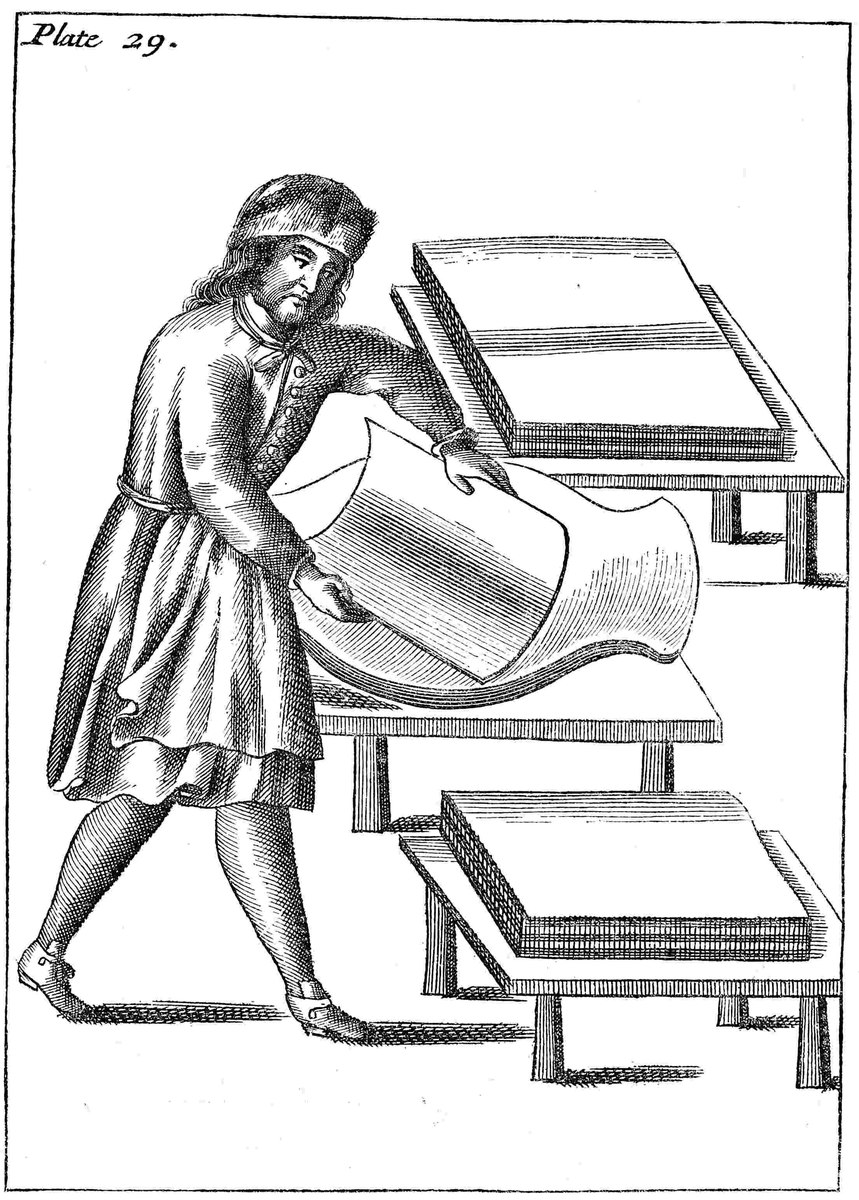
Plate 29.
¶ 9. Of Wetting Paper.
Paper is commonly Wet in a Tray full of fair Water. The Press-man places the length of the Tray before him; his dry Heap on the Left Hand the Tray, and a Paper-Board with its Breadth before him on his Right Hand of the Tray: He lays first a Waste Sheet of Paper on the Paper-board, lest the Board might Soyl or foul the first Sheet of the Heap. Then he takes up the first Token, and lays it in such a position that the backs of the Quires lye towards his Right Hand, that he may the readier catch at the Back of each Quire with his Right Hand, when he is to Wet it: And he lays that Token athwart, or somewhat Crossing the rest of the Heap, that he may the easier know when he has Wet that Token.
Then taking the first Quire of the Heap with the back of it in his Right Hand, and edge of the Quire in his Left, he lays the Quire down upon the Waste Sheet, so, as that the back of the Quire lye upon the middle crease of the Waste Sheet, and consequently one half of the Quire already laid even down upon one half of the Waste Sheet. If the Paper be Strong, he opens about half the Quire, and turns it over dry upon the other half of the Waste Sheet: But if the Paper be Weak and Spungy, he opens the whole Quire, and lays that down Dry.
The reason why he lays the first Laying-down Dry, is, because it lying under the rest of the Heap will sufficiently imbibe the moisture that Soaks from it: And the reason why he leaves but half a Quire Dry for strong Paper, and an whole for Spungy, is, Because Spungy Paper Soaks in moisture faster than Strong.
Having laid down his Dry Laying, he takes another Quire off the Dry Heap, with the back of the Quire in his Right Hand, and the edge of the Quire in his Left, (as before,) and closing his Hand a little, that the Quire may bow a little downwards between his Hands, he Dips the back of the Quire into his Left Hand side of the Tray of Water: And discharging his Left Hand of the Quire, Draws the Quire through the Water with his Right; but as the Quire comes out at the Right Hand side of the Tray, he nimbly catches the edge of the Quire again in his Left Hand, and brings it to the Heap, but by lifting up his Left Hand bears the under side of the Quire off the Dry Paper, laid down before, lest the Dry Sheet should stick to the Wet, before he have plac’d the Quire in an even position, and so perhaps wrinkles a Sheet or two, or else put a Dry Sheet or two out of their even position, on the sides or ends.
But this Drawing the Quire through the Water he performs either nimbly or slowly: If the Paper be Weak and Spungy, he performs it quickly; if Strong and Stubborn, slowly.
To place this Quire in an even position, he lays the back of the Quire exactly upon the opening crease of the former Quire, and then lets the side of the Quire in his Left Hand fall flat down upon the Heap; and discharging his Right Hand, brings it to the edge of the Quire; and with the assistance of his Left Hand Thumb (still in its first position) opens or divides either a third or half of the whole Quire, according to the quality of the Paper, (as was said before,) and spreading the Fingers of his Right Hand as much as he can through the length of the Quire, turns over his opened division of the Quire upon his Right Hand side of the Heap.
The reason why he spreads the Fingers of his Right Hand as much as he can through the Length of the Quire; is, because the outside Half Sheet is Wet, and consequently quickly Limber, so that if the Paper be Weak, it would fall Down before the rest of his Opening, and double into wrinkles, which thus spreading his Fingers prevents.
In the same manner he Wets all the Quires of his Dry Heap. See Plate 29.
But having Wet his first Token, he doubles down a great corner of the upper Sheet of it on his Right Hand, so as the farther corner may lye a little towards the Left Hand of the crease in the middle of the Heap, and so as the hither corner may Hang out on the hither side of the Heap about an Inch and an half: This Sheet is called the Token-Sheet, as being a mark for the Press-man when he is at Work to know how many Tokens of that Heap is Wrought-off, and consequently to know how many is to Work.
When he has Wet the first Token, he removes the next uppermost Dry Token askew on the Dry Heap, and successively all the rest, as I shewed in the beginning of this ¶.
Having Wet the whole Heap, he lays a Waste Sheet of Paper upon it, that the Paper-Board to be laid on, Soyl not the last Sheet of the Heap: Then three or four times takes up as much Water as he can in the hollow of his Hand, and throws and sprinkles it all over the Waste-sheet that it may moisten and Soak downwards into the un-wet upper part of the last Division of the Quire.
The Paper being thus Wet, he takes up the whole Heap upon the Paper-board, and sets it by in a convenient place of the Room, and lays another Paper-board upon it: And upon the middle of the Paper-board, sets about Half an Hundred Weight, and lets it stand by to press, commonly till next Morning: For Press-men generally Wet their Paper after they have left Work at Night.
The manner how Paper is Set out, shall be shewed when I come to the Office of the Warehouse-keeper.
¶ 10. Of Knocking up the Balls.
Ball Leathers (as I said before in § 11. ¶ 21.) are either Pelts or Sheep-skins: If Pelts, they are chosen such as have a strong Grain, and the Grease well Wrought out of them: They are either Wet or Dry before they come to the Press-mans use: If Wet, he having before-hand provided a round Board, of about Nine inches and an half Diameter: Supposing the Ball-stocks to be six Inches diameter, lays the Round Board upon the whole Pelt, and cuts by the out-side of the Board so many round pieces as he can out of the Pelt, reserving two for his present Use.
And hanging the rest up (commonly upon the Braces of the Press) to dry, that they may not Stink or Mould before he have occasion to use them.
But if his Pelts are Dry, he lays them to Soak (by choice in Chamber-ly) but I never heard, or by my experience could find why it is preferred before Fair Water: For the purpose of Soaking them is only to supple them.
If he Work with Leather, It is chosen with a Strong and close grain: Wherefore by experience it is found that the Neck-piece, and indeed all along the back of the Skin is best; but it is commonly subject to be greasie, which gives the Press-man sometimes a great deal of trouble, to make his Balls Take. He also lays the Ball Leathers in Soak to supple them.
When they (either Pelts or Leathers) are well Soaked, he Rubs them well with both his Hands, and then twists and wrings them (as Women do Cloaths) to get the Water out again.
When they are well wrung, he Sits down upon a Seat about fourteen or fifteen Inches high, commonly a Heap of White Paper, if it stand conveniently for him; but not upon a Printed Heap, least his Weight pressing it cause the un-dryed Inck to Set-off: He sits down, I say, and lays the Ball-stock upon his a little opened Thighs near his Knees, that with closing his Thighs he may hold it in a Steddy position, and with the Handle of the Ball-stock towards his Belly. Then taking the Ball-Leather, he laps or Folds about three quarters of an Inch of one part of it over so much of it towards his Left Hand into a Plaight, and laying the edges of that Plaight towards him, an Inch above the edge of the Ball-stock, he with the Head of the Sheeps-foot drives a Ball-nail into the middle of the Plaight, a little more than half an Inch above the the edge of the Ball-stock: But he Drives the Ball-nail not quite up to the Head, but leaves about almost a quarter of an Inch of the Nail out; that with the Claw of the Sheeps-foot he may Draw the Nail again when occasion serves.
Having driven the first Nail, he turns about the Ball-stock, till the opposite side, and as near as he can guess, point of the edge of the Ball-stock lyes directly upwards between his Thighs, (as before,) and then taking as near as he can guess the opposite edge of the Ball-leather between his Fore-fingers and Thumb of his Left Hand, he holds the edge of the Ball-leather upright, and having his Wooll or Hair Teized, lying by him on his right Hand on the Floor, he grasps at once as near as he can guess, so much as may just serve to fill his Ball-leather and the hollow of the Ball stock; which bringing to the hollow of the Ball-stock, he draws the Ball-leather over it; and lapping the edges of the Ball-leather over, as before, makes another Plaight, and Drives another Nail, as before: So that here is now the two opposite Sides of the Leather Nailed on. Then he takes up the Ball by the Handle in his Left Hand, and observes whether the Wooll tend more to one than the other open half: If it do, he thrusts it with the ends of his Fingers of his Right Hand into the middle, or else over to the other Half, till the Wooll lyes equally on both the Halfs.
If he have put too much or too little Wooll into the Ball, he either takes some out, or adds more to, as the respective Half may require. Then lays it down again between his Thighs, as before, and lays another Plaight in the middle of the Ball-leather on one of the open Halves, and as near as he can guess, between the middle of the two opposite Nails; and Nails that Plaight down to the Ball-stock, as before.
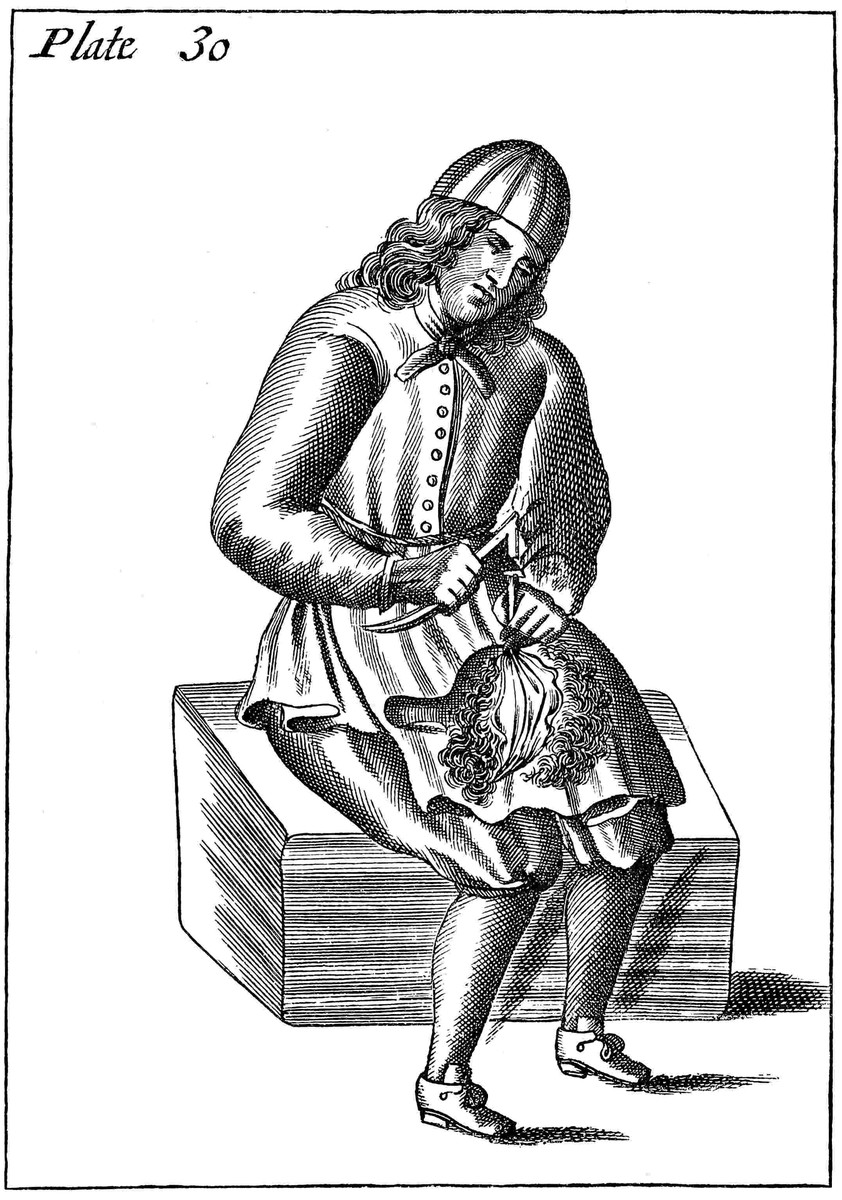
Plate 30
In the like manner he Nails down the other open sides, (now Quarters,) and then again takes a View how the Wooll is disposed into the middle of the Ball; and where he finds it tend most to any of the open Quarters, he Drives the Wooll with the ends of his fingers, as before, or sometimes when the Balls have been Wrought with, and blackt with Inck, with the Head of the Sheeps-foot into the middle, and then Nails down as before all the open Quarters as near as he can guess; between the middle of his former driven Nails, and then again, takes another View as before, to see how the whole Ball pleases him.
If he finds any of the Plaights laid too near one another, he draws that Nail, and alters that Plaight, to lay it as near as he can by guess, in the middle between the next two Plaights.
Then he considers if his Ball be round: If it be not, he thrusts the Wooll from the bunching-out side, towards the wanting side, either with the ends of his Fingers, or the Balls of one of his Hands; while the Wooll is yet loose in the Ball-stock: For when the Ball has been Wrought withal, it will grow so hard, that the Wooll will not move out of its place.
Having Knockt up one Ball well, he Knocks up the other, as the first.
The Balls are well Knockt up, when the Wooll is equally dispersed about all the Sides, and the middle smoothly covered with the Leather, viz. not rising in Hillocks, or falling into Dales, not having too much Wooll in them, for that will subject them to soon hardning, and quickly be uneasie for the Press-man to Work with; or too little, for that will make the Leathers, as the Wooll settles with Working soon flap, and wrap over it self into Wrinkles. So that he cannot so well destribute his Balls: But the Balls ought to be indifferently plump, to feel like an Hard stuft Bed-pillow, or a strong Spunge a little moistned with Water.
Having Knockt up the Balls, and Rub’d out the Inck, as shall be shewed in the next ¶, he trys if his Balls will Take, that is, he Dabs the top of one of them three or four times lightly upon the hither part of the Inck-block; If he finds the Inck sticks to it equally all about, and that so much as has toucht the Inck-block is Black, it Takes: But if scarce any of the Leather is Black, or that it be Black and White in Splotches, then the Balls does not Take: Wherefore he considers whether his Ball be too Wet, or else Greasie, for each of these inconveniences will hinder the Taking of the Ball.
If it be too Wet, he burns half a Sheet or an whole Sheet of Waste Paper, and waves his Ball to and fro over the flame of it; but so quick and cautiously that he neither shrinks the Leather or Dryes it too much: In Winter time when a fire is at Hand, he dryes it gently by the fire.
If it be Greasie, he with the edge of the Ball-knife scrapes off the thick Oyl, that Works down out of the Nut and Spindle of the Press, or else with the point of his Knife takes a convenient quaintity of Oyl out of the Plattin-pan, or for want of either takes fresh Sallad Oyl and smears and spreads it well all over the whole Ball-leather; and then holding the Ball-knife in his Right Hand, with its edge a little sloping downwards that it cut not the Ball-leather, and the handle of the Ball-Stock in his Left Hand, he joyns the bottom of the Ball-leather, viz. as near the outer edge of the Leather as he can, for the Ball Nails to the edge of the Ball-knife, and turning the Ball about by its Handle, presses it hard against the sloapt edge of the Ball-knife, and at once drives the laid on Oyl and Grease too before the sloapt edge of the Ball-knife; but he keeps the Handle of the Ball-Stock, and consequently the whole Ball too, constantly turning, that the whole circumference of the Ball may be Scraped: And as the Ball has performed a Revolution against the sloapt edge of the Ball-knife, he draws gradually his Left Hand a little backish, that the sloapt edge of the Ball-knife may by several Spiral revolutions of the Ball, scrape up to the very top of the Ball, and carries before it the Oyl and Grease thither: Which having there, he gathers up upon the Blade of his Ball-knife and disposes of it, as of so much Dirt and Filth.
After a due process of either of these Operations respectively, his Ball will Take, and he again dabs gently the top of his Ball three or four times on the Inck-block (as before) and finding it Take, he takes the Handle of it into the clutched Fingers of his Left Hand, holding the Ball-stock just a little above the circle of his Fore-finger and Thumb, and grasps the Handle of the other Ball-stock into his Right Hand, with the circle of his Finger and Thumb upwards, and the now bottom of his Right Hand downwards, but not resting upon the Ball-stock; and trys if that Ball will Take, by dabbing the Leather of it three or four times upon the other Ball; If it do not Take with dabbing, he twists the Balls in either Hand close and hard, contrary to one another, to besmear the upper with the under Ball. If after this, the upper Ball do not Take, he considers the cause, and remedies it, as he did the first Ball.
¶ 11. Of Rubbing out Inck.
Before the Press-man goes to Work, he Rubs out his Inck.
If the Inck have lain long on the Inck-block since it was Rubbed out, the Superficies of it generally is dryed and hardened into a Film or Skin, wherefore the Press-man carefully takes this Film quite off with the Slice before he disturb the Body of the Inck: For should any, though never so little of it, mingle into the Inck, when the Ball happens to take up that little particle of Filin, and delivers it again upon the Face of the Letter, it will be a Pick, and Print black, and deface the Work: And if it get between the Face of two or more Letters, or the Hollows of them, it will obliterate all it covers. And if it be Pull’d upon, and the Press-man not careful to over-look his Work, it may run through the whole Heap.
Wherefore having carefully skinned off the Film with the edge of the Slice, he scrapes his Slice clean with the Ball-knife, lest some small parts of the Film should yet stick to, or remain on the Slice: And then with the Slice brings the body of Inck into the middle of the Plain of the Inck-block, and searches the sides of the Inck-block, by thrusting the edge of the Slice forwards along them and all the angles of the Inck-block, and so scrapes off all the Inck as clean as he can, and gathers it to the whole mass of Inck: Then with the Slice he turns the whole mass about half a score times over and over to mingle it well together, lest some part of it should be more consolidated than the rest: And to mingle it yet better, he then falls to Rubbing it with the Brayer, grasping the Handle of it in his Right Hand, he begins to Rub with all his strength at the hithermost side-boundings of the Body of Inck, and keeping Rubbing through the almost whole length of the Inck-block, he gradually proceeds to the farther side of the Body of Inck. In this manner of Rubbing he bears hardest upon the farther edge of the Brayer, because the hither sides of the Inck-block are not fenced in with Rails about them; and should he Rub with the bottom of the Brayer flat upon the Inck-block, he might draw too great a body of Inck to the unfenced sides; so that the Inck would be subject to run off: This Rubbing is only to spread the Inck pretty equally over the superfices of the Inck-block: Wherefore he now begins a circular Rubbing, observing in the circulation of the Brayer that he always a little mounts the part of the edge of the bottom, which in its progress is ready to approach a prominent body of Inck, that it may somewhat slide over it, that the Inck be not lickt up high on the sides of the Brayer.
Then with the Handle of the Slice in his Left Hand and the Handle of the Brayer in his Right, he joyns the bottom edge of the Slice to the side of the Brayer, holding the flat of the Slice Horizontal, and the bottom of the Brayer perpendicular both over the Inck-block, and keeping his Brayer and Slice in this position, by turning the Handle of the Brayer in his Right Hand, held pretty stiff against the edge of the Slice, he scrapes off all the Inck that the side of the Brayer has lickt up: And setting down his Brayer, he takes the Slice in his Right Hand and lays what Inck he scrapes off the side of the Brayer again upon the Inck-Block, and Slices the whole mass of Inck into the farthermost corner of the Inck-block.
This Rubbing of the Inck may serve when the Inck-block had Inck on it before.
But if no Inck were on the Inck-block before, then he lays new Inck on the Inck-block: Wherefore he considers what Work he Works on: whether it be small or great Letter: If it be small Letter, or curious Work, the Inck must be Strong he Works with: But if it be great Letter or sleight Work, he makes Soft Inck serve, or at least mingles but a little Hard Inck with it.
If the Inck be too Hard, as sometimes in very frosty Weather it will be, then, though his Work be curious, yet he must Rub in a little Soft Inck to soften it; because it will not else Destribute well upon the Balls; especially if the Leathers be a little too Wet, or a little Greasie: Besides, it may and many times does pull and tear the Grain off the Skin; which not only spoils the Skin, but fills the Form full of Picks.
Sometimes when he finds the Inck too pale, he Rubs in Blacking, but he first joults the bottom of the Blacking Tub three or four times against the ground, that if by chance any dirt or filth have gotten into it, it may sink to the bottom of the Tub.
But when he either mingles Strong and Weak Inck together, or else puts in Blacking, he applies himself again first to Rubbing with the Brayer, the length-way of the Inck-block, as before, and then to a circular Rubbing, as before; and to cleansing his Brayer, as before; and this long-ways Rubbing, circular Rubbing, and cleansing his Brayer, he reiterates so oft, till he judge the whole mass of Inck sufficiently Rubbed and mingled, and the Blacking perfectly imbibed by the Inck: And then he Slices the whole mass of Inck to the farthermost corner of the Inck-block, as before.
¶ 12. Of Destributing the Balls.
I shewed you in ¶ 10 of this § how he dabb’d the Ball on the Inck-block, to try if it would Take: And I shewed you in what Posture he handled the Balls when he tryed if the other Ball would Take: Therefore for Taking Inck and Handling the Balls I (to avoid tautology) refer you to that ¶.
Having now Taken Inck, and gotten the Balls in his Hands, in that posture, he Works them side-ways upon one another to and from him, and with a craft (acquired by use) in the Handling of the Balls, all the while keeps the Handles, and consequently the whole Ball-stocks (both) turning round in his Hands and in a motion contrary to each other, viz. His under Ball moving from the Left Hand to the Right, and his upper Ball moving from his Right Hand to to the Left; and by and by in a second motion contrary to the first, viz. his under Ball moving from the Right Hand to the Left, and his upper Ball moving from the Left Hand to the Right.
And these motions and Operations he continues so long till he judges, and in part perceives the Inck is equally Destributed all over the whole Ball-Leathers.
The first way of turning the Ball Handles, while the Balls are moved to and from him, is made by pressing the ends or Balls of the fingers of both his Hands upon the Ball-handles from-wards his Hands: And the second way of turning them contrary to the first, is made by gathering in the ends or Balls of of his fingers while they are in their circular to and fro motion. But because in gathering in his fingers, he does somewhat dis-ingage his grasp of the Ball-Handles, therefore he lightly and almost insensibly, tosses the Ball-stocks a little up, that when they are dis-ingaged from a close grasp, his fingers ends may the easier draw the Handles towards him. This is a Hand-craft, which by continued use and practice, becomes familiar to his Hands.
¶ 13. Of Beating.
The Press-man imagines, or by his eye judges the length of his Form (be it what Volumne it will) devided into four equal parts or Rows, which four Rows for distinction sake, I shall number from the Left Hand to the right, with first Row, second Row, third Row, fourth Row, just as an Octavo Form is exactly devided by four Rows of Pages.
He places his Left Hand Ball at the hither end of the first Row, so that though the Ball be round, yet the square encompassed within that round shall sufficiently cover so much of the square of the hither end of that Row as it is well capable to cover; and his Right Hand Ball he sets upon the hither end of the third Row: He sets his Balls close upon the Face of the Letter, with the Handles of the Ball-stocks a little bending towards him: But as he presses them upon the Face of the Letter, he mounts them perpendicular; and lifting at once both the Balls lightly just clear off the Face of the Letter, he removes them about the fifth part of the breadth of the Form upwards, viz. towards the farther side of the Form, and again sets them close down upon the Face of the Letter, with the Handles of the Ball-stocks again bending a little towards him, as before: and as he presses them upon the Face of the Letter, mounts them perpendicular, as before: Thus in about four or five or six such motions, or rather removes of the Balls, according to the breadth of the Form, he Beats over the first and third Rows. Thus Beating from the hither towards the farther side, is in Press-mens phrase called Going up the Form.
The reason why he bends the Handles of the Ball-stocks a little towards him, is, that the Ball-leathers drag not upon the Face of the Letter; for then the edges of the hollows between the Lines or Words, or the edges of the cavities below the Face would scrape Inck off the Balls to stop up or choak the Form. And the reason why (before he removes them) he mounts the Handles of the Ball-stocks a little perpendicular, is, that the Balls may touch in their greatest capacity upon the Face of the Letter.
To Come down the Form, he skips his Balls both at once from the first and third Row to the second and fourth Row, and brings them down as he carried them up; only, as before, he bended the Handles of the Ball-stocks a little towards him, so now he bends them a little from him: That the Ball-leathers (now Coming down) drag not, as aforesaid. Then in like manner he again skips the Balls from the second and fourth Row to the first and third Row, and again Goes up the Form with the Balls, as he did before. And then again skips, as before, and Comes down the Form again with the Balls.
Having thus gone twice upwards and twice downwards with the Balls, the Form is sufficiently Beaten in a train of Work, when the Face of the Letter Takes well.
But if he Beats the first Sheet of a fresh Form, or after a Form is Washed, or he makes a Proof, he Goes three four or five times Upwards and Downwards: Least the Face of the Letter should happen to be Wet or moist, and consequently un-apt to take Inck, without reiterated Beatings.
¶ 15. Of Pulling.
We will suppose now two Press-men going in the Morning to their train of Work: The one they distinguish by the name of First, the other his Second, these call one another Companions: The First is he that has wrought longest at that Press, except an Apprentice, for he must allow any Journey-man though new-come that stile: Generally the Master Printer reposes the greatest trust upon his care and curiosity for good Work; although both are equally liable to perform it.
All the priviledge that the First has above the Second is, that the First takes his choice to Pull or Beat the agreed stint first: And that the Second Knocks up the Balls, Washes the Forms, Teizes Wooll, and does the other more servile Work, while the First is imploid about making Register, ordering the Tympan, Frisket, and Points, &c. or otherwise Making Ready the Form, &c.
The First now takes his spell at Pulling: For the First and Second take their spell of Pulling and Beating an agreed number of Tokens: Sometimes they agree to change every three Tokens, which is three Hours work, and sometimes every six Tokens; that they may both Pull and Beat a like number of Tokens in one day.
Under the general notion of Pulling and Beating is comprised all the operations that is in a train of work performed by the Puller and the Beater: For though the Puller Lays on Sheets, Lays down the Frisket, Lays down the Tympans and Frisket, Runs in the Carriage, Runs out the Carriage, takes up the Tympans, Takes up the Frisket, Picks the Form, Takes off the Sheet, and Lays it on the Heap, yet all these Operations are in the general mingled and lost in the name of Pulling. And as in Pulling, so in Beating; for though the Beater Rubs out his Inck, Slices it up, Destribute the Balls, peruses the Heap, &c. yet all these Operations are lost in the general name of Beating. Thus they say the First or the Second is Pulling; or, the First or the Second is Beating; though they are performing the different Operations aforesaid: unless upon particular occasions the respective Operations are particularly nam’d.
As there are many Operations conjunct to Pulling, and Beating, so the Press-man performs them with various Set and Formal Postures and Gestures of the Body. For,
To take a Sheet off the Heap, He places his Body almost straight before the hither side of the Tympan: I say almost straight, Because it is more straight before the side of the Tympan than it is before the angle made by the Paper-bench and the side of the Tympan: But he nimbly twists the upper part of his Body a little backwards towards the Heap, the better to see he takes but one Sheet off, which he loosens from the rest of the Heap (as I have shewed before) by drawing the back-side of the Nail of his right Thumb on his Right Hand nimbly over almost the whole length of the Heap, and receiving the hither end of the Sheet with the inside of his Left Hand fingers and Thumb catches with his Right Hand about two inches within the farther edge of the Sheet near the upper corner, and about the length of his Thumb below the hither edge of the Sheet, and brings it nimbly to the Tympan: And at the same time twists his Body again straight before the Tympan, only a very little moving his right Foot from its first Station a little forwards under the Carriage Plank: And as the Sheet is coming to the Tympan (we suppose now he Works upon White Paper) he nimbly disposes the fingers of his Right Hand under the farther edge of the Sheet near the upper corner; and having the Sheet thus in both his Hands, lays the farther side and two extream corners of the Sheet down even upon the farther side and extream farther corners of the Tympan-sheet, but he is careful the upper corner of the Sheet be first laid even, upon the upper corner of the Tympan-sheet; that he may the sooner disingage his Right Hand: And if by the nimble casting his eye, he perceive the sides of the Sheet lye un-even upon the Tympan-sheet, he with his Left Hand at the bottom corner of the Sheet, either draws it backwards, or pulls it forwards, as the Sheet may lye higher or lower on the hither corners of the Tympan-sheet, while his Right Hand being disingaged, as aforesaid, is removed to the backside the Ear of the Frisket, and with it gives it a light touch to double it down upon the Tympan. And by this time his Left Hand is also disingaged, and slipt to the hither under corner of the Frisket, to receive it, that it fall neither too hard or too quick down upon the Tympan: For hard falling may shake the loose Sheet on the Tympan out of its place; and so may the quick pressure of the Air between the Tympan and Frisket, after the Sheet is well laid: and while his Left Hand receives the Frisket his right is disingaged from the Ear of the Frisket, and removed to the middle of the back-side the Tympan; which he grasps between the Balls of his Fingers and Thumb, to lift it off the Gallows, and double it and the Frisket together on the Form. And while the Tympan is coming, he slips his Left Hand Fingers from under the Frisket to the hither outer corner of it, as well to keep the Sheet close to the Tympan in its position, as to avoid the jobbing of the lower side of the Frisket against any small square shoulder, either of the Furniture, Quoins, Chase, or the corners that may stand higher than their common Plain.
Then nimbly slipping his Left Hand, he with it grasps the Rounce, and with a moderate strength, nimbly gives its Winch about one Turn round; I say about, because the first Pull will generally fall out to be made about the middle of the Carriage; (as was shewed in § 11. ¶ 16.) but perhaps not just in the middle: yet to regulate his Runing in, he made a mark before on the farther Rail of the Tympan, (as I shewed in ¶ 3. of this §) to which mark he Runs the Carriage in, till he bring the mark in a Range with the fore-edge of the Plattin; and as it is coming, skips his Hand to within an Inch or two of the end of the Bar, and then at once gently leans his Body back, that his Arm as he Pulls the Bar towards him may keep a straight posture; because in a Pull it has then the greatest strength. And he also slips his right Foot upon the Foot-step, while his Left Hand holds fast by the Rounce; as well to rest on the Foot-step and Rounce, as to enable his Body to make a stronger Pull; which will prove Longer or Shorter, according to the strength put to it, and also the Hard or Soft Justifying of the Head, (as was shewed in ¶ 5. of this §.)
Then disingaging his Right Hand again from the Handle of the Bar, he slips it to the Bow of the Bar, before the Handle fly quite back to the Cheek of the Press: For should the Bar by its forcible Spring knock hard against the Cheek of the Press, it might not only shake some of its Parts or circumstantial appurtenances out of order, but subject the whole Machine with oft reiteration to an unstable position. Besides, the farther the Bar flyes back, the more he hinders quick riddance in recovering it again. But yet he must let the Bar fly so far back as that the Tympan may just rise clear off the Plattin; lest when he Runs in his Second Pull, the Face of the Plattin rub upon the Tympan, and shoves the Sheet upon the Face of the Letter, and sometimes Slurs, and sometimes Doubles it upon the Face of the Letter.
Having Pull’d the First Pull, and having the Rounce still in his Left Hand, He turns the Rounce about again, till the Carriage Runs in so far, as that the second mark on the Rail of the Tympan comes into a Range with the hither edge of the Plattin, as before the first mark did; and then Pulls his second Pull, as he did his first; and slips his Right Hand again off the Handle of the Bar to the Bow, (as before) and guides the Bar up to its Catch leisurely, that coming now near the Cheek it knock not against it: and just as he has Pulled his Second Pull, he gives a pretty quick and strong pressure upon the Rounce, to turn it back, and the Carriage out again: And so soon as he has given that one pressure, (as aforesaid) he desingages his Left Hand from the Rounce, and claps the fingers of it under the middle of the Tympan, and on the Ear of the Frisket: and while this is doing, removes his Right Hand to the now upper, but immediately it will be the under-side of the Tympan Rail, within four or five Inches of the upper end of it, to receive the Tympan, as it is lifted up off the Form by his Left Hand. And having thus received it, lets it descend gently down on the Gallows. And as it is descending, slips his Left Hand fingers under the hither lower corner of the Frisket, and gives the Frisket a toss up; while by this time his Right Hand being disingaged from the Tympan, is ready to catch the Frisket by the Ear, and convey it quick and gently to its Stay: And while the Frisket is going up; he slips the end of the middle finger of his Left Hand, or sometimes the ends of his two middle fingers with their Balls upwards, under the hither lower corner of the Pulled off Sheet, and at the instant he has got them under, he nimbly bows his Joynts upwards, to throw up the corner of the Sheet, to make it mount a little, for him to gather about two Inches hold of it between the Balls of his Thumb and fore-finger. And heaving the whole Sheet by this corner a little upwards, He at the same time lifts it off the Points, and draws it somewhat towards him; and as it comes, catches it near the upper corner of the same side of the Sheet, between the foremost Joynts of his fore-fingers and Ball of the Thumb of his Right Hand, and nimbly twisting about his Body towards the Paper-bench carries the Sheet over the Heap of White-paper to a Paper-board, which before he placed beyond that Heap on his Right Hand, (as aforesaid in ¶ 14.) and lays it down upon a Waste-sheet laid for that purpose on that Paper-board; but while it is coming over the White-paper Heap, though he have the Sheet between both his fore-fingers and Thumbs, yet he holds the Sheet so loosly that it may move between them as on two Centers, as his Body twists about (as aforesaid) from the side of the Tympan towards the side of the Paper-bench.