The Press-mans Trade. (continued 2)
Reading edition
Thus you see both the Press-mans Hands at the same time alternatively ingaged in different Operations: For while his Right Hand is imployed in one Action his left is busie about another, and these exercises so suddenly varied, that they seem to slide into one another; one Posture beginning when the former is but half performed.
Having thus Pulled one Sheet, and laid it down: He turns his Body towards the Tympan again, and as he is turning gives the next Sheet on the White-paper Heap a Touch with the backside of the Nail of his Right Thumb, as before, to draw it a little over the hither edge of the Heap, and lays it on the Tympan, &c. as he did the first; and so successively every Sheet till the whole Heap of White-paper be Wrought off.
As he comes to a Token-sheet, he un-doubles that, and smooths out the Crease with the back-side of the Nails of his Right Hand, that the Face of the Letter may Print upon smooth Paper. And being Printed off, he folds it again, as before, for a Token-sheet when he works the Reiteration.
Having Wrought off the White-paper, he turns the Heap thus:
He takes the Paper-board that his White-paper lay on, and sets it down on the ground: Then removes the Heap to his Left Hand; then takes up the Paper-board, and lays it on his Right Hand: And if it be Twelves, or any Form Imposed like Twelves, as Twenty fours, &c. he turns it from one long side of the Paper to the other, that is, the long side of the Paper that stands on his Right Hand when the Printed side lies upwards, he turns over to his Left Hand, and lays the un-printed side upwards. In performing this, he grasps off of the Wrought off Heap so much at once between both his Hands as he can well govern, without disordering the eveness of the sides of the Heap, viz. a Token, or more, and lays that upon the Paper-board; then takes another grasp in like manner, and lays that on the first grasp, and so successively, till he have turned the whole Heap, grasp by grasp. Then removes the Heap near the Tympan, and lays the other Paper-board beyond it, as the first Paper-board stood before; always remembring to lay a Waste-sheet first on the Paper-board.
Having now turned the Heap, and made Register on the Reteration Form (as was shewed in ¶ 7. of this §) he Works off the Reteration: But he somewhat varies his posture in the Laying on his Sheets: For as before, when he wrought White Paper, he catcht the Sheet by the upper farther corner with his Right Hand, he now having heaved up the Sheet (as aforesaid) catches it as near the farther side of the farther Point-hole as he can, with the Ball of his Right Hand Thumb above the Sheet, and the Ball of his fore-finger under the Sheet, the readier to lay the Point-hole over its respective Point: which having done, he slips his Body a little backwards, and both his Hands with it, his Right Hand towards the hither Point-hole, with the back-sides of the Nails of his fingers to draw or stroak it over the Point: and the fingers of his Left Hand, as they come from the farther corner, nimbly slipping along the bottom edge of the Sheet, till they come to the hither corner; and then with his fore-finger and Thumb, layes hold of it, to help guide the Point-hole on that Point also: Then Pulls that Sheet, as before, as he did the White Paper, and so successively all the rest of the Reteration. Only, the Token-sheets, as he meets with them, he Folds not down again, as he did the White Paper.
If a Press-man have no Companion, but works alone; he has a little oblong Square Form or Bench made to stand so high as the Face of the Letter upon the Press-stone, and so long as to contain the Balls when set upon the Ball-leathers.
This Form or Bench some Work-men will place on the hither side the hither Cheek, within about half an Inch of the foreside of the Cheek: And other Work-men will place it on the farther side of the Carriage; each sort of Work-men supposing that in the place he sets it, the Balls stand most commodious for his quick taking up and setting down: I shall not plead the convenience of either, but in short speak to the inconveniences of both.
The inconvenience of placing it on the hither side the hither Cheek, is, that the Press-man must twist his Body somewhat about to take up the Balls. And the inconvenience of placing it on the further side the Carriage, is, that the Press-man must thrust his Body over the Form to take up the Balls: both ways strain the Body, and hinder riddance.
Those that place it on the hither side the Cheek, begin and end their Beating as has already been shewed, viz. on the hither side the Form: But those that place it on the farther side the Carriage, begin and end their Beating on the Rows on the farther side the Form.
One Press-man in his train of Work will Beat so soon as he has laid the Tympan on the Gallows after Pulling: Another will not Beat till he has laid his Sheet on the Tympan, and doubled the Frisket down on it: both sorts fancying their own way most quick and commodious: For these conveniences are the purposes they both drive at.
¶ 16. Of Printing Red, or other Colours with Black.
When Red and Black are to be Printed upon the same Sheet, the Press-man first Makes Register, as was shewed ¶ 7. and Makes Ready his Form as was shewed ¶ 14. of this §. Then having a new Frisket Drawn, as was shewed ¶ 8. He Prints upon his new Frisket with Black. And having before a Proof-sheet Printed Black, with the Words to be Printed Red under-lined on that Proof-sheet; He takes off his Frisket, and lays it flat on a Paper-board, and with a sharp-pointed Pen-knife neatly cuts out those words on the Frisket, and about half a Scaboard Margin round about the words, that he finds under-lined on the Proof-sheet: Then sets the Frisket by till he has wrought off his Heap with Black, and puts his common Frisket on the Joynts of the Tympan again.
While the Press-man is Cutting the Frisket, the Compositer takes those Words out of the Form that are Under-lin’d on the Proof-sheet, and in their place puts Quadrats, m-Quadrats, Spaces, &c. to Justifie the Lines up again.
Then Locking up the Form, the Press-man Works off the Heap Black, as was shewed in the last ¶.
Having wrought off his Heap Black, he takes off the common Frisket, and puts on his new cut Frisket: Then taking a piece of thick Scaboard he cuts it into so many small slips as there are Whites in the Form to be Printed with Red; These small slips he cuts exactly to the length of the Quadrats, &c. the Compositer put in, and to the breadth of the Body; but rather a small matter less than bigger, lest they bind at the bottom of the Shank of the Letter: for when the Compositer takes out the Quadrats, &c. he put in before the Form was Wrought off Black, these slips of Scaboards the Press-man pricks on the Point of a Bodkin and puts them into their respective holes: And being loosen’d off the Point of the Bodkin with the blunt Point of another Bodkin, are laid down flat on the Press-stone; These slips are called Underlays, and are described in ¶ 14. of this §. Upon these Underlays the Compositer puts in again the Words or Letters he took out before the Form was Wrought off Black: So that these Words now stand higher than the other Matter of the Form, and therefore will Print when the other Matter will not. But yet for the more assurance that the other Matter Print not, the New-cut Frisket was prepar’d, which hinders any thing to Print but what Prints through the Holes cut in it; which Holes these Underlaid Words fall exactly through.
Having mingled the Red, or any other intended Colour with Varnish, as shall be shew’d in the next ¶, he Beats the Form as with Black; and Pulls it very lightly, lest these Underlaid Words standing higher than the rest of the Matter, Print too Hard.
¶ 17. Of mixing and Grinding Colours with Varnish.
Varnish is the common Menstruum for all Colours that are to be used in Printing.
Red is the chief Colour that is used with Black in Book-Printing: of Reds there are two sorts in general use, viz. Vermillion and Red-Lead; Vermillion is the deepest and purest Red, and always used to Books of Price. Red-Lead is much more faint and foul, and though more used than Vermillion, yet used only to Books of Vulgar Sale and Low price, as Almanacks, &c.
Yet may other Colours also be used to Print withal; yea, any Colours that are used in Oyl-Painting, as Lake and Russet, which are Reds deeper than Vermillion; Virditur Indico and Bice for Blews; Orpment, Pinck, Yellow Oaker, for Yellow: Virdigreace, and Green Virditur, for Greens: or what other Colours may be fancied.
But all Colours for Printing must be Ground with Soft Varnish; especially those Colours that are of themselves Dryers; as Red-Lead, Vermillion, Orpment, Verdigrease; For should they be Ground with Hard Varnish the Colour’d Inck would dry and harden so quick and fast upon the Form, that it would soon be choaked up, and consequently want Washing e’re the Form be Wrought off; which would be very troublesome to the Press-man, because he must expect to have all his Underlays to new fit to their places: And besides, it will so Dry and Harden upon the Balls, that the Grain of the Leathers would quickly tear off, and fill the Form full of Picks.
The fittest Colours therefore for Printing, are such as are of the lightest Body and Brightest Colour.
They are to be Ground with a Mullar on a smooth Marble Stone, so long that the Colour becomes impalpable, and is throughly mingled with the Varnish.
¶ 18. Of Printing with Gold and Silver.
This Operation is seldom used but for Printing Names; and therefore rarely drest in a Form to the Press; but is usually Printed in the Stick: And then the Compositer Justifies his Stick very Hard, as well that the Letters fall not out when the Back of the Stick is turned upwards, as that the strength of the Hard Varnish the Face of the Letter is Beat with, pulls not the Letter out of the Stick.
Therefore the Press-man makes two little Balls, by tying about an Handful of Wooll in new clean Leather, and dabs one of his Balls upon the Hardest Varnish he has, and with the other destributes his Varnish to a convenient Fatness, as he did his Balls in ¶ 12. With one of these Balls he Beats the Name; and having his Paper Wet, he lays a single Blanket on the Correcting-stone, and his Paper on the Blanket; and with a Riglet fitted to the Stick, he presses the Letter to keep it straight in Line: Then places the Face of the Letter exactly flat down upon the Paper, and with the force of both his Hands presses the Letter hard and even down upon the Paper, to receive an Impression: But he takes care not to wriggle the Letter in the Stick backwards or forwards, lest either the Beard Print, or the sides of the Letter be more or less besmeared with the Varnish: Because the Gold or Silver will stick to the least Sully that the Varnish may chance to make.
Then cutting his Gold or Silver to a size full big enough to cover the Printed Name or Matter, he lays his Gold or Silver on what was Printed, and with a little White Cotton gently presses the Gold or Silver upon the Printed Matter, and lets the Paper lye by a while; as well that it may dry, as the Varnish Harden, (which will quickly be) he with his Handkerchief gently wipes over the Printed Matter. So shall all the Gold or Silver that was toucht by the Varnish, stick to the Varnish on the Paper, and the other will wipe away.
If he lifts to Polish it, he uses a Tooth or the Ivory Handle of a Knife.
¶ 19. Rules observed; and Remedies to the Inconveniences the Press-man may meet with in a Train of Work.
1. The Press-man is to make a Proof so oft as occasion requires: If he takes off his Form to make a Proof, he Un-locks and lays the Quoins, as shall be shewed when I come to Washing of the Form: but many Printing-houses have an empty Press stands by to make Proves on.
The Compositer having brought the Form to the Press, lays it down on the Press-stone, and the Press-man places it even under the Plattin, that the Plattin Bear not harder on the hither or farther side of the Form: Then he Pulls the Cards upon the Form, to press it into a flat position: Then Beats the Form four or five times over, that he may be sure it Take: Then he lays the Proof-sheet on the Form, so as by his Judgement it shall have an equal Margin on all its opposite sides, and a double Blanket on the Proof-sheet; and Running in the Carriage, Pulls the Proof-sheet: Having Pull’d it, he Runs-out the Carriage again, and takes the Proof-sheet off the Form. Then with the Ly-brush dipt in Ly, he Rubs over the Face of the Letter three or four times, to Wash off what Inck may remain on it, and carries the Form again to the Correcting-stone and lays it down: And the Proof he carries to the Compositers Case.
2. If the Form he Works on be Small-letter, or Old Letter, he uses Strong Inck; and Beats Lean: For Weak Inck and Fat Beating, will quickly Choak up the Face of the Letter. But to fetch off Hard Inck thin Beat on the Face of the Letter, he Pulls Hard. But if the Form be great Letter or Black English Letter, it will allow Fatter Beating.
3. He keeps a constant and methodical posture and gesture in every action of Pulling and Beating, which in a train of Work becomes habitual to him, and eases his Body, by not running into unnecessary divertions of Postures or Gestures in his Labour, and it eases his mind from much of its care, for the same causes have constantly the same effects. And a Pull of the same strength upon the same Form, with the same Beating, and with the same Blankets, &c. will give the same Colour and Impression.
4. That every two Sheets, if the Form be small Letter (rarely three, unless Great Letter) he Takes Inck; and so soon as he comes off the Form, viz. has Beat it, he falls to Destributing his Balls. And that Sheet which he Takes not Inck he steps to the Heap to overlook the Colour, viz. whether he has Taken too much or too little Inck; and to see if no accidents have befallen the Form, viz. that no Letters, Quadrats or Furniture, &c. Rise, that no Letters are Batter’d; That Bearers fail not, viz. grow so thin with long Pulling on, as not to perform the office of Bearers; that the Register keep good; that no Pick be got into the Form, or any other accident that may deface the beauty of the Work, but all this while still keeps his Balls Destributing.
If he have taken too much Inck, which sometimes may happen (but seldom for want of carelessness) he will not Take Inck again, till he have wrought his Balls to a good and moderate Colour. But if the Sheet already Pull’d, be so Black that it may not tolerably pass, he Doubles or Folds it in the middle and lays it cross the Heap, that the Gatherer may take or leave it, in case the Heap falls Short. If he foresee the next Sheet will also be too Black, he takes a Dry Sheet of Waste Paper between his Balls and Destributes upon that Dry Sheet, that it may take off the Inck.
If in doing this, the strength of the Inck have Pull’d the Paper to pieces, so that small rowl’d-up bits may stick upon the Ball-leathers, if they be but a few he picks them off with his Fore-finger and Thumb, but if there be many he makes his Balls clean by Scraping them (as I shewed in ¶ 10. of this §) for else these small rowl’d-up bits of Paper will be apt to fill the Form full of Picks.
If Letters, Quadrats or Furniture Rise, he puts them down, the Letters and Quadrats with his Bodkin, and the Furniture with his Hammer, and Locks the Quarter they are in, a little Harder.
If any Letters are Batter’d, he Unlocks the Quarter they are in, and desires the Compositer to put in others in their room.
If Bearers Fail, that is, Squeeze thinner with long Pulling on, he takes those Bearers off, if they are on the Frisket, and puts on thicker: But if the Furniture, were Under-laid (as I shewed in ¶ 7. of this §) he Unlocks the Quarter they are in, and Underlays them according to his Judgement.
If Register be Out, which sometimes happens by the starting of the Quoins, he mends it, as I shewed in ¶ 7. of this §.
If a few Picks are got into the Form, that is, little bits of Paper, Skin or Film of Inck, Grease or other filth which may stick to the Face, or get into the hollows of the Letter, he with the point of a Needle picks them out: But if many be gotten in, he takes off the Form and Washes it, as shall hereafter be shewed.
And though he every other Sheet overlook the Heap (as was said before) yet his Companion that Pulls, by an habitual use casts his eye upon every single Sheet; Yet rarely hinders his riddance by it, for while he is taking the Sheet off the Tympan, he gives a quick spreading glance upon it, and lays it down, as was shewed ¶ 15. of this §, unless he perceive somewhat to mend: For then he lets it lye on the Tympan till he has mended what was amiss.
And that he may Take Inck more equally, to keep the Balls of an equal Fatness, he keeps the Rubb’d out Inck on the Inck-block of an equal Fatness; which to do, he with the under-edge of the bottom of the Brayer, draws often from the mass of Inck a small, (and as near as he can guess) an equal quantity of Inck, viz. about the quantity of a Pea, and with the Brayer Rubs and disperses that Inck of an equal thickness, all over the hither corner of the Inck-block. While this is doing he holds the Balls upright on one another in his Left Hand, leaning the Handle of the uppermost Ball-stock against his Breast.
The equal and often Taking of Inck in a small quantity, and constant Destributing of the Balls, is the onliest means to keep the Heap throughout of an equal Colour, and to avoid Beating of Fryers.
5. If he meets with naughty Sheets in his Work; as torn, or stain’d, &c. he Prints them not, but throws them under the Paper-bench; and if any crease or wrinkles be in any Sheet, he laying the backs of his four Left Hand fingers upon a smooth place in the Sheet, rubs with the backs of the Nails of his Right Hand Fingers from-wards him upon the wrinckles, till he have smoothened them.
6. And though his constant care is to Lay every particular Sheet even upon the Heap, yet it often happens either through White Pages that may come in the Form, which because not Printed lye solid on one another, the unequal pressing of one side or end of the Paper, or the unequal Bearing of the Plattin on one side or end of the Form; I say it often happens by these accidents, that the Heap, as it grows higher is on one part of the Sheet raised above, and on another part sunk below an Horizontal level: It is raised higher on that side or end of the Heap most prest in the Tympan, and by consequence makes the Paper there more Huffie; Because deep pressure of the Letter into the Paper below the common level of the Sheet bears the Paper off from the Heap, on the underside the Sheet; and the greater the number of Sheets are thus Printed off and laid on the Heap, the more that side or end of the Heap shall Rise: And by the Rule of Contraries, when White Pages come in the Form, the greater number of Sheets laid on the Heap, shall where those White Pages lye, make the Heap lower in that place, because they clap solider together, for want of Printing the Paper through the backside level of each Sheet: So that the small un-level lying of every Sheet, though unperceptable, in a small number of Sheets, makes each Sheet incline to the lowest side of the Heap, and as the Heap accumulates heighth, throws the Heap more or less towards the dripping side, or end over the bottom of the Heap.
To remedy which, he claps the insides of both his Hands against both the ends of the Heap, but more forcibly against the Hanging over end towards the other end, till he has drove the Heap into an upright position.
If either of the sides hang over, he with the inside of his Left Hand commonly against the farther side of the Heap, and the outside of his Right Hand fingers on the hither side the Heap, either draws the hanging over side towards him with his Left Hand, or thrusts it from him with his Right Hand fingers, as aforesaid, while his opposite Hand does the office of a stop, that it be not drawn too forward, or thrust too much backward. Then where the Heap rises above the Level, he with the inside flats of one or both of his Hands presses it down into an Horizontal Plain.
7. If it be a Reteration he Works, and a great Number is laid on, he uses a Tympan-cloath instead of a Tympan-sheet: This Tympan-cloath is a Fine and even Linnen Cloath, about an Inch or two larger on every side than the Paper he Works on: He Wets this Cloath and wrings the Water out again, so that it remains only moist: Then lays his Cloath instead of his Tympan-sheet, and Pastes the corners of the under side of it to the Tympan, and Works upon it as on a Tympan-sheet.
One reason why he uses a Cloath to Work the Reteration on rather than a Sheet of Paper, is, because a Sheet of Paper quickly wears out, which a Cloath will not do. Another reason is, that when the Inck that wrought off the White Paper Sets off upon the Tympan Cloath, it may in clean Ly be washt clean again: For a good Press-man will not Work on a foul Tympan Cloath or (if he use no Cloath) on a foul Tympan-sheet, because as the Inck of the White-paper aforesaid, set off on the Tympan Cloath, so the more the Tympan Cloath has gathered Inck from the White-Paper, the more it will Return or give back again, towards the besmearing of every Sheet that is Printed on it.
The reason why the Press-man does not use a Cloath to Work the White Paper with, is, because in Working the White-Paper, the use of the Tympan-Sheet is principally to lay all the Sheets of the Heap even by, as being of the exact size with all the rest of the Heap, which a Tympan-Cloath is not, nor could it, without great trouble, be reduced to that size by the Press-man, or if reduced to that size, without much difficulty be laid even or square on the Tympan: Because the Cloath when Wet, will be hard to be kept straight and square, but every side will naturally run into irregularities, which a Sheet of White Paper will not do.
8. Sometimes, through the loose Hanging of the Plattin on its Cords, or through the much wearing of the Hose, or the Garter, or the Worms in the Nut and Spindle, or the irregular wearing of the Toe of the Spindle in its Nut, or too much play of the Tennants of the Head in their Mortesses, or the irregular dryness of the Tympan, or through irregular Runing in of the Carriage, It will happen that the Letter will Double upon the Sheets, that is, Print double.
If the loose Hanging of the Plattin be the cause, it is easily mended by turning about the Female Screws fitted to the tops of the Hose, as was shewed ¶ 4. of this §.
If the Hose be worn, or the square holes the Hose Works in, it may for the present be botcht up by putting Scaboards between the Hose and the square holes of the Till; but to mend it perfectly either another Till must be made, or a new Hose, or both.
If the Garter be worn too wide; the Smith must either mend the Old, or make a new one.
If the Worms of the Nut or Spindle be worn, the Spindle must be examin’d by the Smith, and made true, and have a new Nut Cast on it.
If the Toe of the Spindle and its Nut, or either of them be worn irregularly, it is Smiths Work to mend.
If the Tennants in the Head have too much Play in their Mortesses; which though it seldom happens, yet if the Head were not made of well seasoned Stuff, the Tennants may be subject to shrink, and so have too much play. There is no substantial remedying this fault, but by making a new Head.
If an unproper temperature of the Tympan be the cause; that is, when it is dry in one place and moist in another, the dryed place may by its spring force the Paper against the Face of the Letter, and in part Print it before it come to feel the force of the Plattin; (but this is rather slurring than Doubling) and when the force of the Plattin does come, the spring in the dryed part will again remove the Paper, and the force of the Plattin gives its full Impression where the Paper is thus removed, but when it is real Doubling, it happens generally on the whole Sheet.
This Doubling or Slurring is mended, by reducing the dryest part of the Tympan to an equal moist temperature with the moistest.
Doubling often happens in the middle of the Form, and the reason is, because the foreside of the Plattin Prints beyond the middle of the Form at the first Pull, and the hindside of the Plattin by the Second Pull reprints part of the First Pull: So that a Spring in the Tympan removes the Paper in this interval of Time.
This fault is mended by exact observing the Runing in of the Carriage.
Doubling may also happen by the too loose and flapping straining of the Tympan, when it was first Drawn.
This cannot be mended without taking the Tympan off, and Drawing on a new one.
A Press-man having Pull’d a Sheet, may by some accident (either of Object or Discourse) let it ly on the Form after he has Run-out the Carriage, and afterwards forget it was Pull’d, yet may perhaps lift the Tympan a little off the Form, which lifting off (if the Joynts are not very good) will remove the Sheet, if then he Pull it again, it will Double.
This fault because it is but an accident I shall pass by, and only say,
If the Joynts are so faulty (as sometimes Old Joynts are) that the Press-man cannot keep Register with them, the Smith must make new or mend the Old.
9. When the Press-man leaves Work at Noon, he draws half the Nails out of the Balls, and takes the Wooll out: Then doubles the loose half of the Leather over the remaining Nail’d-on half, with the Incky sides of each half next each other, and Rowls up the Leathers close, and laies them in a Bowl or Pan of Water to Soak till he has Din’d.
He also covers the Form with the Tympan, to keep it from dust or filth that may fall on it: And takes out the Blankets and lays them on the Heaps: And with a Spunge Wet in Water besprinkles the backside of the Tympan, to Soak it whiles he is at Dinner.
Coming again to his Work afternoon, he takes the Handles of the Ball-stocks between his Thighs, (being seated as before, when he knockt up the Balls, ¶ 10.) to hold them fast, and he takes the turn’d down backsides of the Ball-leathers in both his hands, (for the other side being all over Black, would black his Hands) and rubs them between his Fingers very well, to supple them. Then squeezes and Wrings the Water well out again; and Teizes his Wooll, by opening all the hard and almost matted knots he finds in it: but he does not pull the Wooll or hardned knots in it assunder from the whole mass of Wooll: But endeavours to keep the Wooll of each Ball intirely connected in the same mass, and only opened, to Loosen and Soften it: For pulling the knots to pieces, would tear the Wooll, and soon make it unfit for use. Having Teazed the Wooll he Knocks up his Balls again, as I shewed in ¶ 10.
Then he goes to the Tympan, and squeezing his Spunge as dry as he can, he rubs it over the backside of the Tympan, to Suck up the Water, that may lye on it.
Then taking the Blankets, he rubs them between both his Hands to soften them; for we must suppose that the Mornings Pulling on them has compacted and hardned them: being well Rub’d, he lays them in the Tympan again, as was shewed before in ¶ 7. and falls again to his Afternoons train of Work.
Having wrought all day, though his Form be not Wrought off, it may yet be Foul, so that he must Wash it: Nay, in small Letter a good Press-man will Wash his Form twice a day: Wherefore he calls to the Boy to Heat the Ly, somewhat before he is ready for it, about a Heating time: And having a Shooting-stick lying by him on the Till or some other convenient place, drives every Quoin between the Furniture and the Chase fast up; least they may have somewhat shrunk, or else started back: Then with a piece of Chalk he makes a score on the two farthermost Corners of the Carriage; and through the Quoins droven against them, and upon the two Corners of the Carriage of the Tympan and their Quoins, and lets the Quoins ly; but he Unlocks all the opposite Quoins, and takes them out of their places; laying those Quoins that he takes from between the fore-end of the Carriage and the Chase on the hithermost upper long side of the Plattin, the hithermost Quoin on the hithermost side of the Plattin, and the farthermost Quoin on the farthermost side of the Plattin; with their small ends towards him, and fromwards him as they lay on the Carriage. The Quoins that he takes from the hither side of the Carriage, he lays on the hithermost Return side or end of the Plattin; that on his Left Hand on the Carriage, towards the farther Corner of the Plattin, and that Quoin on the Right Hand on the Carriage, towards the hither corner of the Plattin, with their small ends towards the Hand they lay on, on the Carriage.
Having taken out and placed these four Quoins, he tryes if the Form will Rise, as was shewed § 22. ¶ 7. then takes up the Form, and carries it to the Ly-Trough, and lays it in it, even as the Compositer brought the Form to the Press, and laid it on the Press-stone. § 22. ¶ 7. and taking the Ly Kettle, or Chafer, in his Left Hand pours the Ly Scalding hot place by place over the whole Form: And then with the ends of the Hair of the Ly Brush rubs gently over the whole Form: And as he thus Rubs with his Right Hand Rocks the Ly-Trough a little on its Axis, that the Body of Ly may accompany the Ly-Brush in its progress from the hither to the farther side of the Form: And thus he Washes the Form still on, till he perceive the Face of the Letter purely clean.
Then he lets the Ly out again into the Ly-Kettle at the Hole and Pipe in the Left Hand hither corner of the Ly-Trough: and stopping the hole again, sets by the Ly-Kettle. Then with a Dish or two of fair Water he Rinces off the Laver of the Ly that may ly on the Face of the Letter, and rears up the Form and throws a Dishful or two of fair Water on the backside of it, to Rince it also. Then takes the Form out of the Ly-Trough, and sets it by, shelving with its Face against the Wall, to Dry.
If the Heap be Wrought off, he lets the Compositer know it, to take Charge of it.
Having Wrought off his Heap, he takes it off the Paper-bench, and sets it by on the floor, covering it with a Waste-sheet: And gives notice to the Boy, or to the Ware-house-keeper, to fetch it away and Hang it up to Dry.
Then he draws the Balls, and takes the Blankets out of the Tympan (as at Noon:) And if he have Paper to Wet, Wets it as was shewed ¶ 9. of this §.
§ 25. The Office of the Warehouse-keeper.
¶ 1. Of Hanging up Paper.
The Warehouse-keeper takes the Heap out of the Press-room, and carries it into the Warehouse, or other Drying-place, and setting it upon a Form or Bench of convenient heighth, with an end of the Heap from him, he takes the Handle of the Peel in his Left Hand, and lays the Board flat down upon the Heap, with the Left Hand side of the Board towards the Left Hand side of the Heap, and so as its upper edge may reach to almost three quarters of the length of the Sheet, and that the Right Hand end of the Peel may ly on the middle of the Heap: Then with his Right Hand he doubles over so much of the Heap as he thinks good, perhaps about a Quire, or half a Quire, or about seventeen Sheets, more or less, either as he can allow them time to Dry, or have room on his Racks to Hang them on. Having thus doubled his first Doubling on the Heap, he removes the Left Hand half of the Peel almost off the Heap, viz. to about two Inches within the Left Hand side of the Heap, and doubles, as before, a second Doubling to hang over the first Doubling, towards the Left Hand about two Inches, as aforesaid, on the Peel, and as near as he can guess, the same number of Sheets. And having these two Doublings on his Peel, he takes the Peel off the Heap, and holding the Handle a little aslope, that the Shorter Folding-over of the Sheets may open from the Peel, he lifts it up, and places it at one end of his first Rack, and lets it hang on it, by drawing the Peel from under the Paper. In like manner he Loads and unloads his Peel again successively, till he have Hung up the whole Heap. See Plate 31.
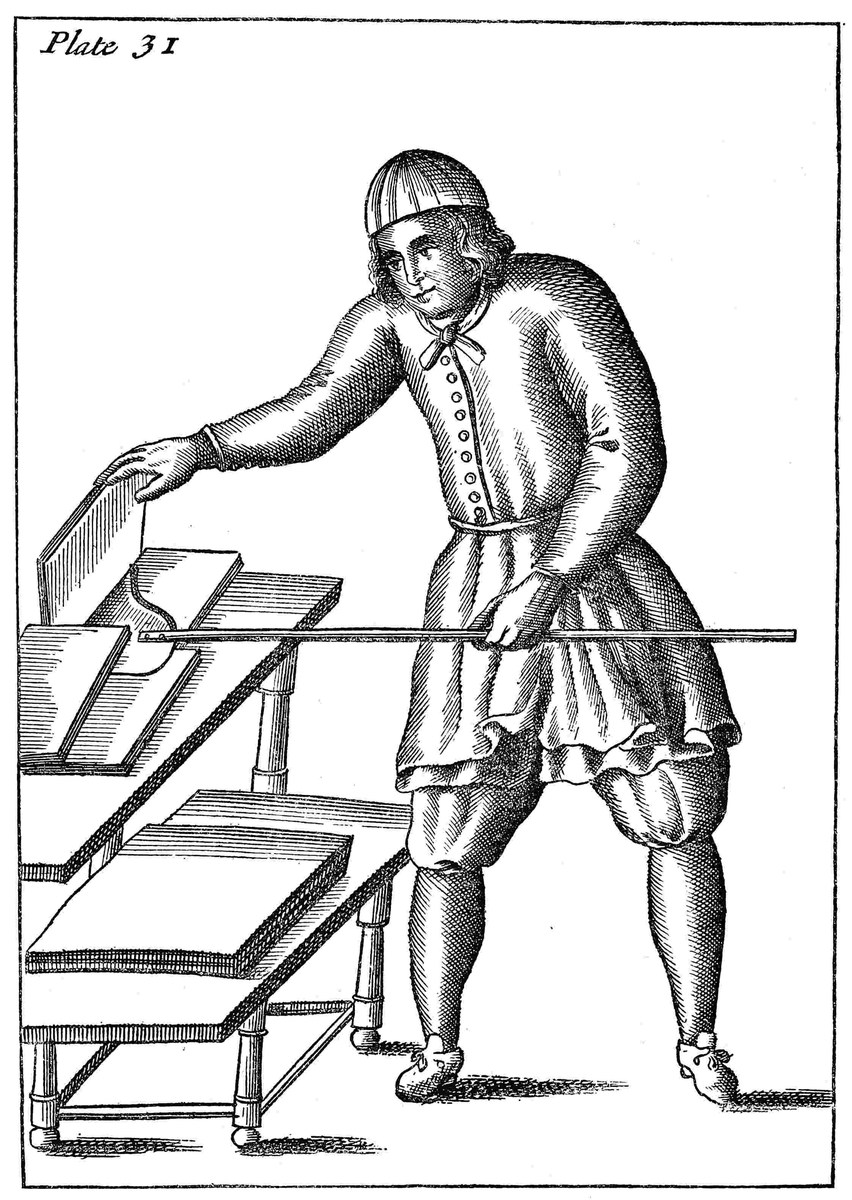
Plate 31
Note, that the sides of the Sheets do not hang against one another, but lap over one another, as you may see by Plate 31. Nor are they Hung up to Hang with their edges against the side of the former Hanging-up, but to lap over, so as every Right Hand Doubling may lap about two Inches over the Left Hand Doubling; that when the Books are taken down, the Warehouse-keeper clapping the flat side of his Peel against the Right Hand edge of the Paper, slides several Doublings over one another (perhaps three or four:) And putting the Peel under them, takes them off the Racks, and lays them on the Heap again, on a clean Waste Paper, and sets the Heap orderly by, till it comes to be Gather’d.
The Warehouse-keeper is also very careful to lay all the Sheets, so as the respective Signatures of every Sheet may ly exactly over the respective Signature of the first Sheet, lest when the Books come to be Gathered, some Sheets may be Turned, which will give him a great deal of trouble to Turn them right when he Colations the Books.
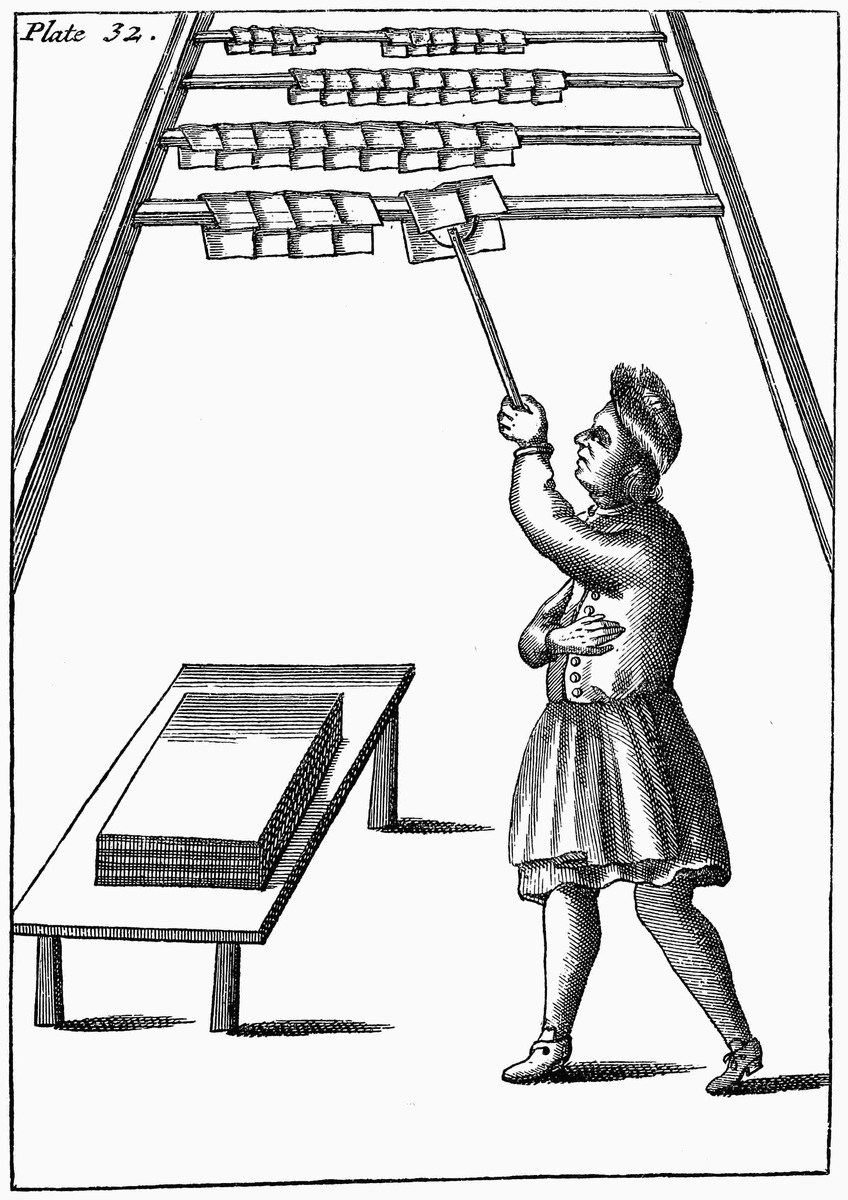
Plate 32.
¶ 2. Of Laying the Heaps.
Laying the Heaps is to place them on Benches or Forms of a convenient Heighth, in an orderly Signatural Succession. By an orderly Signatural succession, I mean the first Signature, which most commonly is A (and therefore shall be so accepted) be placed on the Left Hand of the Bench, with either the Side or Foot of the Page, as the Volumn requires, that hath the single Signature A at the bottom of it upwards, and towards the hither side of the Bench. On the Right Hand side of the Heap A is B, and next it C, in like order D E F, &c.
¶ 3. Of Gathering of Books.
Gathering of Books is to take one Sheet off every Heap, beginning at the last Heap first, viz. at the Left Hand end of the Range. The Gatherer takes it off with his Right Hand, and disposes the hither end of the Sheet into his Left Hand, clapping his Left Hand Thumb upon the middle of the Sheet, to hold it fast. Then he takes a second Sheet off the second Heap from the Left Hand, viz. towards the Right; and lays the second Sheet on the first, and so successively a third, a fourth, a fifth, &c. till he has Gathered the last Sheet on his Right Hand; still observing to lay the middle of each Sheet under his Thumb, and all the single Signatures on each Sheet orderly and successively on one another.
Thus he Gathers on, till one of all the Heaps Comes off; which when it does, he Doubles or Quires up all the other Heaps, and lays them by till he can Bundle and Tye them up; which when he has also done, he writes upon them Imperfections of (the Title of the Book) and Writes on it the Signature of the Sheet that is Wanting, and sets it by in a convenient place of the Warehouse, that he may have recourse to it on any occasion.
Though I shewed how he Gathered the Books, yet shewed not how he Knocks them up and Folds them: Wherefore,
Having thus Gathered one Book, he Knocks it up, that is, he carries it to a Table provided on purpose near him; and taking the ends of the Book between the two Bows of the Thumb and Fore-finger of each Hand, he grasps the ends loosly between them, and placing the hither long side or edge of the Book on the plain of the Table, he lifts the whole Book a little above the plain of the Table, (about an Inch or two, more or less) and while the whole Book is held loosly by its ends, lets it fall gently down on the Table, that the edges of such Sheets as may stand out, or lower than the rest, may be drove even with the rest of the edges of the Book, and also that the edges of such Sheets as may lye above the edges of the Book may be joulted downwards, and lye even in the same Range with the rest of the edges.
And as he is Knocking up the lower edge of the Book, he at the same time evens the two ends of the Book, by thrusting the Bows of his Thumbs and Fingers against the ends of the Book, which being loosely grasp’d, and the Bows of his Thumbs and Fingers bearing pretty stiff towards each other; will drive in the ends of such Sheets as may stick out at either end; and so even the ends of the Book at the same time.
Having thus even’d all the edges, he lays the Book flat down on the Table, and holding one end of it stiff and tight in his Left Hand, he rubs the whole flat of his Right Hand hard upon the upper Sheet, to press it and all the other Sheets as close together as he can; then takes it up, and gives the edges another or two gentle Knocks, as before; and then Folds up, or Doubles the Book, according to its respective Volumn.
If it be Folio, Quarto, Octavo or Sixteens, he Folds it in the Short Cross; but if it be Twelves, Eighteens, Twenty-fours, he Folds it in the Long Cross.
But most times before he Folds the Books he will Colation them: (as shall be shewed by and by:) therefore having Gathered the Book, he lays it by on a Sheet of Waste Paper, and Gathers a second Book as he did the first, and lays that flat open on the first, then Gathers a third, fourth, fifth Book, &c. as before, and lays them successively on each other, till he have raised an Heap of Books so high, that he grows cautious of laying more on, lest its heighth should exceed his management. Then Gathers on, and raises another Heap or Heaps till one of the Signatures comes off.
¶ 4. Of Colationing Books.
The Colationing of Books, is,
First, To examine whether the whole number of Sheets that belong to a Book are Gathered in the Book.
Secondly, To examine that two Sheets of one sort are not Gathered.
Thirdly, To examine whether the proper Signature of every Sheet lye on its proper corner of the Gathered Book.
To do this, The Colationer provides himself with a Bodkin; which is nothing else than a pretty thick Sowing Needle, (most commonly broken-eyed,) having its thick end thrust fast into a round piece of Wood, about the thickness of a Tobacco-Pipe, and about three or four Inches long.
Now having the Heap of Gathered Books before him, with the single Signature A lying upwards on his Right Hand, and his Left Arm cross the Heap, and his Hand near the Signature corner, with his Bodkin in his Right Hand, he pricks up the corner of the first Sheet A, and at the same moment he pricks it up, slips the Balls of his two Fore-fingers of his Left Hand, and secures it from falling back again on the Gathered Heap of Books between his Thumb and hinder Joynt of his Fore-finger, and immediately pricks into the Sheet B, casting his Eye upon the Signature, as well to see that it is B, as to see that it is singly B, and not B 2, B 3, &c. For if the single Signature lye not on the same corner of the Heap, the Sheet must be turned till it do. In like manner he picks up and receives C D, &c. still casting his Eye that it be the right Letter, and single Signature, as aforesaid.
If he finds two Sheets of the same Signature, he takes one out and lays it by, or else on the Heap, if they be not all Gathered.
If he finds one Sheet wanting, he fetches that Sheet from the Heap; or if he want it at the Heap the Book is laid by as Unperfect till he have Colationed the whole Impression of Books, to see if he can make it Perfect with some other Book, that may have two of the same Sheets Gathered in it.
Having examined that his Book is Perfect, he Knocks and Folds it up, as was shewed in the last ¶.
Having Gathered, Colationed and Folded these Books, he Tells them, to see how the Impression Holds out; and as he Tells them, he lays a set number of Books (if the Books be Thick, five, if Thinner, Ten, if very Thin, twenty five or fifty) with the Folded Side or Back one way, and the same Number of Books, with the Folded or Back-side the other way, viz. the edges of the latter number of Books upon the Backs of the former Number: As well to distinguish and Count the Number of Books readily, as to keep the Bundle in a flat and Horizontal position. For if the Backs of the Quired Books in a Bundle, should lye all one way, the Fold of the Back being more or less hollow in the middle of each Book, will in a Number of Books, by springing upwards, mount the Backs; and consequently the edges of the Books in the Bundle will be depressed, so that in a great Bundle the Books will be subject to slide off one another.
These Books being thus Counted, he sets them by on Waste Paper in convenient Piles, viz. Piles of about three or four Reams high (according as the Paper may be thicker or thinner) he sets them by (I say) in Piles of equal Numbers, Range by Range, till the whole Impression is set by.
And before he Tyes them up, he puts them into the Standing Press, placing in it so many Books as the Press will hold, both in width and Heighth; observing to set in every Pile he puts Range by Range into the Press, an equal number of Books, that each Pile may equally feel the force of the Screw.
Then with a strong Iron Bar he turns about the Spindle as oft he can, with his main Strength to Squeeze and Press the Books as close and tight as he can together: and so lets them stand in Press about a Day and a Night. Then takes them out, and in like manner puts in more Books, till the whole Impression is Prest. See Plate 32.
As he takes each number of Books, he Tyes them up with Packthred, lays a Waste Paper under and upon each Bundle; and if the Master-Printer Printed the Impression for Himself, he writes the Title of the Book, and number of the Books on the uppermost Waste Paper, and sets them by square and orderly on the Shelves in the Warehouse, to deliver them out according to the Master-Printers order. But if the Impression were Printed for an Author, or a Book-seller, he sends them to the Authors or Book-sellers, without writing on the uppermost Waste Paper.
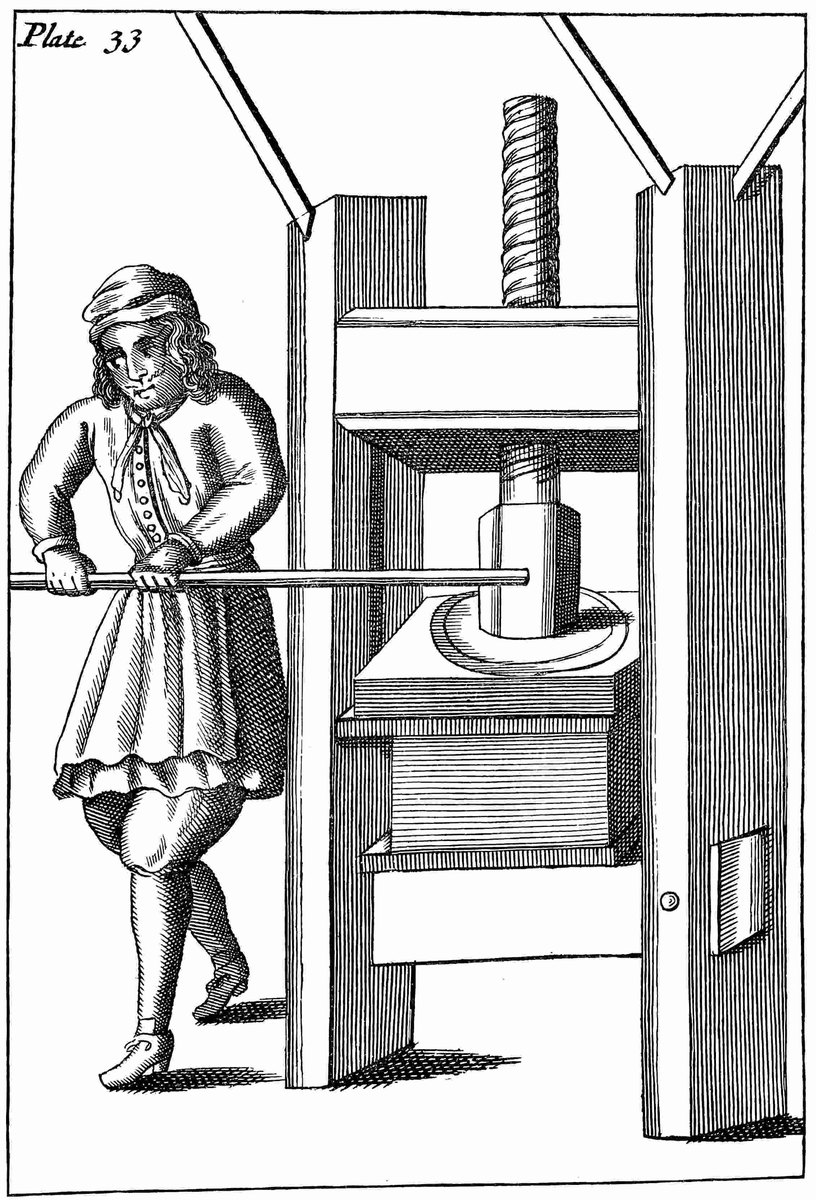
Plate 33
¶ 5. Of Setting out Paper, and Culling the Cording Quires.
Each Ream of Paper contains twenty Quires: These twenty Quires are by the Paper-makers so disposed that the Back or Doubling of each Quire lyes upon the opening or edges of the next Quire: For reasons given in the last ¶.
Two of the twenty Quires in a Ream are called Cording Quires, viz. the two Out-side Quires; because the whole Ream is Corded or Tyed up between them. They are also called Cassie Quires, because they serve for Cases to the Ream. These Quires are by the Paper-maker made up of torn, wrinckled, stained, and otherwise naughty Sheets; yet does not perhaps the whole Quire consist of such Sheets, but commonly some good Sheets are in Culling found among them, as shall be farther shewed by and by.
The Warehouse-keeper therefore when he Sets out Paper, lays by the uppermost Cording Quire, and then nimbly snatches with his Right Hand at the back of the next Quire, and if the back lys towards him, draws it into his Left Hand with the edges of the Quire towards his Fingers; but if the back lye from him, nimbly turns it while it is coming to his Left Hand, and so again nimbly snatches at the back of the succeeding Quires, placing their backs all one way on the First Quire in his Left Hand, till he have Counted or taken off of the Ream a Token; which Token, if it be set out for Half a Press, viz. a Single Press-man, is generally but five Quires, and is indeed often called Half a Token: But if it be for an Whole Press, it contains Ten Quires. This Token he lays by near him, upon a Waste Sheet of Paper, and again applies himself to Set out the next Token in the same manner, but lays the next Token with the backs of the Quires over the edges of the former Token, and thus Sets out so many Tokens as his Heap requires, yet always considers how his Paper Holds out, whether five and twenties, or but four and twenties: If it Holds out five and twenties, he Sets out in every Fourth, Fifth, or Sixth Token Eleven Quires, to secure the Impression to Hold out. If but four and twenties, he Sets out Eleven Quires, in every second Token, and at last a Quire more to the whole Heap to make good the wanting Sheets of every Quire, and to make Proves, Revises, Register-Sheets, Tympan-Sheets, and to supply other accidents that may happen at the Press, either by naughty Sheets, or Faults committed in Beating, Pulling, Bad Register, &c. for all or any of these accidents that happens to a Sheet, the Press-man doubles it, and lays by in the Heap as Waste, as I shewed § 24. ¶ 18. (4) and still he remembers, as aforesaid to lay by the two out-side Quires of every Ream; and at last lays on the Heap another Waste Sheet of Paper, and so brings it to the Press to be Wet.
The Culling the Cording Quires, is, to examine every Sheet one by one. To do it, he lays the Cording Quires, or many Cording Quires open before him against the Light, and takes up every Sheet successively and observes the goodness of it: Such Sheets as he finds good, he lays on his Right Hand, and the Bad on his Left. If a Sheet have but a little corner torn off, viz. so much as he judges the Book-binder would take off with his Plow, to make the Leaf square with other Leaves, he accounts that a good Sheet: But if more be torn off, he lays it by for Bad; and so he does Wrinckled and stain’d Sheets.
Having thus Cull’d all the Cording Quires, he tells out the good Paper into Quires, allowing five and twenty to the Quire, if the Quires of the Ream hold out five and twenty; or else but into four and twenty. And the good Paper thus Cull’d, he tells into an Heap or Heaps, as far as it will go.
But yet the careful Warehouse-keeper will not give the Press-man this Culd Paper to Print at the begining or end of a Book, but disposes that Heap or Heaps so as they may be used about the middle of the Book: For though we call’d it good Paper, yet it very rarely happens to be so beautiful as the Inside Quires.
The Bad Paper he also Tells out into Quires, but allows no more than four and twenty Sheets to the Quire, because it is commonly set by in the Warehouse to be sold.
It is also the Office of the Warehouse-keeper to keep a Day Book, and in it to set down what Books he Sells, and for how much, and to whom, and whom by order of the Master-Printer he Trusts with Books, and for how long Time; that so the Master-Printer may as oft as he pleases have an account how the Impression, or part of it, is disposed of.