Chapter XI · FEZ.
Caroline Tilton translation
We had not advanced half a mile toward the city when we were surrounded by a throng of Moors and Arabs come from Fez and from the country round, on foot and on horseback, on mules and on donkeys, two and two like the ancient Numidians, so eager to see us that the soldiers of our escort are obliged to make use of the butt end of their muskets to keep them from pressing upon us. The ground being low, the city, whose castellated walls we had seen from the camp, remains for some time hidden. Then all at once it reappears, and between us and the walls we can see an immense white and crimson mass, like a myriad of lilies and roses trembling in the breeze. The city vanishes again, and again appears, but much nearer this time; and between us and it, the people, the army, the court, and a pomp and splendor and oddity that are beyond my powers of description.
A company of officers on horseback came galloping to meet us, and dividing in the middle, pass to the rear and join themselves to our escort. Behind 193them comes a troop of horsemen splendidly attired and mounted on superb horses, preceded by a Moor of tall stature, with a white turban and a rose-colored caftan. He is the grand chamberlain, Hadji Mohammed Ben-Aissa, accompanied by his suite, who, having welcomed the Ambassador in the Sultan’s name, joins the escort.
We advance between two rows of infantry soldiers, who with difficulty keep back the crowd. What soldiers they are! There are old men and mature men, and boys of fifteen, twelve, and even nine years of age, dressed in scarlet, with bare legs and yellow slippers, ranged along in single file without regard to height, with their captains in front. Each one presents in his own fashion his rusty musket and his crooked bayonet. Some stand with one foot foremost, some with legs apart, some with their heads on their shoulders, some with their chins on their breasts. Some have put their red jackets on their heads to shelter them from the sun. Here and there is a tambourine, a trumpet, five or six banners, one beside the other—red, yellow, green, orange,—carried as crosses are carried in a procession. There seems to be no division into squadrons or companies. They look like paper soldiers stuck up in a row by boys. There are blacks, mulattoes, whites, and faces of an indefinable color; men of gigantic stature beside boys who are scarcely old enough to hold a gun; bent old men with long white beards, leaning on their neighbors; savage 194faces, making the effect, in that uniform, of dressed-up monkeys. They all look at us with open eyes and mouth, and their line stretches farther than we can see.
A second troop of horsemen advances on the left. It is the old governor, Gilali Ben-Amù, followed by eighteen chiefs of inferior degree and by the flower of the aristocracy of Fez, all dressed in white from head to foot, like a company of priests—austere visages, black beards, silken caics, gilded housings. Saluting us, they circle round, and join our cortege.
We go forward, still between two lines of soldiers, behind whom presses a white and hooded crowd who devour us with their eyes. They are always the same soldiers, for the most part boys, wearing the fez, with red jackets and bare legs. They have blue, white, or green drawers. Some are in their shirt sleeves; some hold their muskets on their shoulder, some rest them on the ground; some press forward, some hang back. The officers are dressed according to their fancy—zouaves, Turcos, Greeks, Albanians, Turks—with arabesque embroidery of gold and silver, with scimitars, swords, curved poniards, horse pistols. Some wear the boots of a groom, and some yellow boots without heels; some are all in crimson, some all in white; some in green, and looking like masquerade devils. Here and there among them may be seen a European face, looking at us sadly and with sympathy. 195As many as ten banners are ranged in a row together. The trumpets sound as we pass. A woman’s arm protrudes itself between the soldiers’ heads, and threatens us with clenched fist. The walls of the city seem to recede before us, and the two lines of soldiers to extend interminably.
Another troop of cavaliers, more splendid than the first, comes to meet us. It is the aged Minister of War, Sid-Abd-Alla Ben-Hamed, black, mounted on a white horse with sky-blue trappings; and with him are the military governors of provinces, the commandant of the garrison, and a numerous staff of officers crowned with snowy turbans, and wearing caftans of every known color.
It is now more than half an hour that we have been proceeding between the two lines of soldiers, and some one has counted more than four thousand. On one side is drawn out the cavalry; on the other a nameless and heterogeneous mass of men and boys, dressed in divers uniforms, or rather fragments of uniforms, some with arms and some without, cloaked and uncloaked, with uncovered heads, or heads bound with a shapeless rag, shirtless for the most part; faces from the desert, from the coast, from the mountains; shaven heads, and heads ornamented with long braids; giants and dwarfs—people gathered from heaven knows where, to make a show and inspire terror. And behind them on the rising ground that borders the way, an innumerable throng of veiled women, screaming and 196gesticulating, in wonder, anger, or pleasure, and holding up their children to see us.
We approach the walls at a point where there is a venerable gate crowned with battlements. A band bursts into music, and at the same moment all the drums and trumpets rend the air with a mighty crash. Then our ranks are broken up, and there is a general rush and confusion of magistrates, courtiers, ministers, generals, officials, and slaves; our escort is scattered, our servants dispersed, and we ourselves divided from each other. There is a torrent of turbans and horses rolling and twisting about us with irresistible impetus; a confusion of colors, a phantasmagoria of faces, a noise of harsh voices, a grandeur and savagery that at once delight and bewilder. Passing in at the gate, we expect to see the houses of the city, but are still between castellated walls and towers; to the left is a tomb, or cuba, with a green dome shaded by two palms; people about the cuba, upon the walls, everywhere. We pass another gate, and find ourselves at last in a street with houses on each side.
My memory here becomes confused, for I had as much as I could do to save my neck, going as we were over great stones, in the midst of a crowd of plunging horses; it would have been all up with any one who had fallen. We passed, I remember, through some deserted streets bordered by tall houses, suffocated by dust, and deafened by the noise of the horses’ hoofs; and in about half an hour, 197after threading a labyrinth of steep and narrow alleys, where we were obliged to go in single file, we reached a little door, where some scarlet soldiers presented arms, and we entered our own house. It was a delicious sensation.
The house was a princely mansion in the purely Moorish style, with a small garden shaded by parallel rows of orange and lemon trees. From the garden you entered the interior court by a low door, and thence into a corridor large enough only for one person to pass. Around the court were twelve white pilasters, joined by as many arches of a horse-shoe form, which supported an arched gallery furnished with a wooden balustrade. The pavement of the court, gallery, and chambers was one splendid mosaic of little squares of enamel of brilliant colors; the arches were painted in arabesque; the balustrade carved in delicate open work; the whole building designed with a grace and harmony worthy of the architects of the Alhambra. In the middle of the court there was a fountain; and another one, with three jets of water, was in a carved and ornamented niche in the wall. A large Moorish lantern depended from every arch. One wing of the edifice extended along one side of the garden, and had a graceful façade of three arches, painted in arabesque, in front of which a third fountain sparkled. There were other little courts, and corridors, and chambers, and the innumerable recesses of an Oriental house. Some iron beds, without sheets or coverlets, a few 198clocks, one mirror in the court, two chairs and a table for the Ambassador, and half a dozen basins and jugs, completed the furniture of the house. In the principal rooms the walls were hung with gold-embroidered carpets, and some white mattresses lay on the floors, and, except in the Ambassador’s room, there was neither chair, nor table, nor wardrobe. We had to send to the camp for some furniture. But, by way of compensation, there was everywhere coolness, shade, the gurgle of water, fragrance, and something deliciously soft and voluptuous in the lines of the building, in the air, in the light. The whole edifice was encircled by a lofty wall, and surrounded by a labyrinth of deserted alleys.
We had scarcely arrived in the court-yard when there began a coming and going of ministers and other high personages, each one of whom had a few minutes’ conversation with the Ambassador. The Minister of Finance was the one who attracted my attention most. He was a Moor of about fifty years of age, of a severe aspect, beardless, and dressed all in white, with an immense turban. An interpreter told me that he was very clever, and adduced as proof of the same, that he one day had brought to him one of those little arithmetical machines, and both he and the machine had done the same sum in the same time, and with the same results. It was worth while to see the expression of sacred respect with which Selim, Ali, Civo, and the rest, regarded those personages, who, after the Sultan, represented 199in their eyes the highest grade of science, power, and glory which could be attained on this earth.
Those visits over, we took possession of our abode. The two painters, the doctor, and myself occupied the rooms looking on the garden; the rest, those opening on the court. Interpreters, cooks, sailors, servants, soldiers, all found their place, and in a few hours the aspect of the house was changed.
The first to go out and visit the city were Ussi and Biseo, the two artists; and then the commandant and the captain. I preferred to wait until the following morning. They went out in couples, each encircled, like malefactors, by an infantry guard armed with muskets and sticks. After an hour they returned, covered with dust, and all dripping from the heat; and their first words were, “Great city—great crowd—immense mosques—naked saints—curses—sticks—wonderful things!” But Ussi had had the most interesting adventure. In one of the most frequented streets, in spite of the soldiers, a girl of fifteen or thereabouts had sprung upon his shoulders like a fury, and had inflicted a vigorous pummeling, crying out, “Accursed Christians! There is not a corner in Morocco where they do not push themselves!” Such was the first welcome given to Italian art within the walls of Fez.
Late in the night I made a tour through the house. On all the landing-places of the stairs, before the chamber doors, in the garden, were soldiers lying wrapped in their mantles, and sound asleep. Before 200the little door of the court-yard, the faithful Hamed Ben-Kasen, with his sabre by his side, snored in the open air. The dim light of the lanterns, touching the mosaic pavements here and there, made them look as if set with pearls, and gave an air of mysterious splendor to the place. The sky was thickly set with stars, and a light breeze moved the branches of the orange trees in the garden. The murmur of the Pearl River could be distinctly heard; the gurgle of the fountains, the ticking of the clocks, and now and then the shrill voices of the sentinels answering one another at the outer doors of the palace with their chanted prayer.
In the morning we went out, four or five of us together, accompanied by an interpreter, and escorted by ten foot-soldiers, one of whom wore buttons with the effigy of Queen Victoria—for many of these red coats are bought at Gibraltar from soldiers of the English army. Two of these placed themselves in front, two behind, and three on each side of us—the first armed with muskets, the others with sticks and knotted cords. They were such a rascally-looking set, that when I think of them I bless the ship that brought me back to Europe.
The interpreter asked what we wished to see. “All Fez” was the answer.
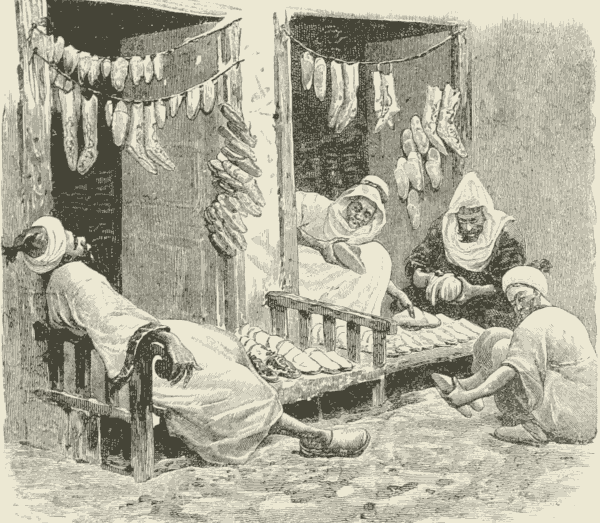
Shoe Shop, Fez.
We directed our steps first toward the centre of the city. Here I ought to exclaim, “Chi mi darà la voce e le parole!”[5] How shall I express the wonder, 201the pity, the sadness that overcame me at that grand and dismal spectacle? The first impression is that of an immense city fallen into decrepitude and slowly decaying. Tall houses, which seemed formed of houses piled one upon the other, all falling to pieces, cracked from roof to base, propped up on every side, with no opening save some loophole in the shape of a cross; long stretches of street, flanked by two high bare walls like the walls of a fortress; streets running up hill and down, encumbered with stones and the ruins of fallen buildings, twisting and turning at every thirty paces; every now and then a long covered passage, dark as a cellar, where you have to feel your way; blind alleys, recesses, dens full of bones, dead animals, and heaps of putrid matter—the whole steeped in a dim and melancholy twilight. In some places the ground is so broken, the dust so thick, the smell so horrible, the flies are so numerous, that we have to stop to take breath. In half an hour we have made so many turns that if our road could be drawn it would form an arabesque as intricate as any in the Alhambra. Here and there we hear the noise of a mill, a murmur of water, the click of a weaver’s loom, a chanting of nasal voices, which we are told come from a school of children; but we see nothing and no one anywhere. We approach the centre of the city; people become more numerous; the men stop to let us pass, and stare astonished; the women turn back, or hide themselves; the children scream and 202run; the larger boys growl and shake their fists at a distance, mindful of the soldiers and their sticks. We see fountains richly ornamented with mosaics, arabesque doors, arched courts, some few remains of Arab architecture in decay. Every moment we find ourselves in darkness, entering one of the many covered passages. We come to one of the principal streets, about six feet wide, and full of people, who crowd about us. The soldiers shout, and push, and strike in vain, and at last make a sort of bulwark of their bodies by forming a circle around us and clasping hands, face outward. There are a thousand eyes upon us; we can scarcely breathe in the press and heat, and move slowly on, stopping every moment to give passage to a Moor on horseback, or a veiled lady on a camel, or an ass with a load of bleeding sheep’s heads. To the right and left are crowded bazaars; inn court-yards encumbered with merchandise; doors of mosques, through which we catch glimpses of arcades in perspective, and figures prostrate in prayer. All along the street there is nothing to be seen but silent forms in white hoods, moving like spectres. The air is impregnated with an acute and mingled odor of aloes, spices, incense, and kif; we seem to be walking in an immense drug-shop. Groups of boys go by with scarred and scabby heads; horrible old women, perfectly bald and with naked breasts, making their way by dint of furious imprecations against us; naked, or almost naked, madmen, crowned with flowers and feathers, bearing a 203branch in their hands, laughing and singing and cutting capers before the soldiers, who drive them away with blows. Turning into another street, we meet a saint, an enormously fat old fellow, as naked as he was born, leaning upon a lance bound with strips of red cloth. He squints at us, and mutters something as we pass. Further on come four soldiers dragging along some poor unfortunate, all bleeding and torn, who has been taken in the act of thieving; and after them come a troop of boys calling out, “Cut off his hand! cut off his hand!” Next come two men carrying an uncovered bier, upon which is stretched a corpse, dry as a mummy, wrapped in a white linen sack tied round the neck, waist, and knees. I ask myself where I am, and whether I am awake or asleep, and whether Fez and Paris are in the same planet! We go into the bazaar. The crowd is everywhere. The shops, as in Tangiers, are mere dens opened in the wall. The money-changers are seated on the ground, with heaps of black coin before them. We cross, jostled by the crowd, the cloth-bazaar, that of slippers, that of earthenware, that of metal ornaments, which all together form a labyrinth of alleys roofed with canes and branches of trees. Passing through a vegetable market, thronged with women who lift their arms and scream curses at us, we come out into the centre of the city. There it is the same experience as before, and we finally get out at a gate, and take a turn outside the walls.
204The city stands in the form of a monstrous figure of eight between two hills, upon which still tower the ruins of two ancient fortifications. Beyond the hills there is a chain of mountains. The Pearl River divides the town in two—modern Fez on the left bank, ancient Fez on the right—and a girdle of old castellated walls and towers, dark and falling into ruin, binds the whole together. From the heights the eye takes in the whole city—a myriad of white, flat-roofed houses, among which rise tall minarets ornamented with mosaics, gigantic palm-trees, tufts of verdure, green domes, and castellated towers. The grandeur of the ancient city can be divined from what is left, though it is but a skeleton. Near the gates, and upon the hills for a long distance, the country is covered with monuments and ruins, tombs and houses of saints, arches of aqueducts, sepulchres, zanie, and foundations that seem like the remains of a city destroyed by cannon and devoured by flames. Between the wall and the highest of the two hills that flank the city it is all one garden, a thick and intricate grove of mulberry-trees, olives, palms, fruit-trees, and tall poplars, clothed with ivy and grape-vines; little streams run through it, fountains gush and sparkle, and canals intersect it between high green banks. The opposite bank is crowned with aloes twice the height of a man. Along the walls are great fissures and deep ditches filled with vegetation, rude remains of bastions and broken towers,—a grand and 205severe disorder of ruin and greenery, recalling the more picturesque parts of the walls of Constantinople. We passed by the Gate of Ghisa, the Iron Gate, the Gate of the Padre delle Cuoia, the New Gate, the Burned Gate, the Gate that Opens, the Gate of Lions, the Gate of Sidi Busida, the Gate of the Father of Utility, and re-entered new Fez by the Gate of the Niche of Butter. Here are large gardens, vast open spaces, large squares, surrounded by battlemented walls, beyond which can be seen other squares and other walls, arched gate-ways and towers, and beautiful prospects of hills and mountains. Some of the doors are very lofty, and are covered with iron plates studded with large nails. Approaching the Pearl River, we come upon the decaying carcase of a horse, lying in the middle of the street. Along the wall about a hundred Arabs are washing and jumping upon the linen piled upon the shore. We meet patrols of soldiers, personages of the court on horseback, small caravans of camels, groups of women from the country with their children tied on their backs, who cover their faces at our approach. And at last we see some faces that smile upon us. We enter the Mella, the Hebrew quarter,—truly a triumphal entrance. They run to their windows and terraces, down into the street, calling to one another. The men, with long hair covered by a handkerchief tied under the chin like women, bow with ceremonious smiles. The women, comely and plump, dressed in red and green 206garments embroidered and braided with gold, wish us buenos dias, and say a thousand charming things with their brilliant dark eyes. Some of the children come and kiss our hands. To escape from this ovation, and from the filth of the streets, we take a cross street, and passing through the Jewish cemetery, get back at last to the palace of the embassy, tired out and with bewildered minds.
“O Fez!” says an Arabian historian, “all the beauty of the earth is concentrated in thee!” He adds that Fez has always been the seat of wisdom, science, peace, and religion; the mother and the queen of all the cities of the Magreb; that its inhabitants have a finer and deeper intelligence than that of the other inhabitants of Morocco; that all that is in it and around it is blessed of God, even to the waters of the Pearl River, which cure the stone, soften the skin, perfume the clothes, destroy insects, render sweeter (if drunk fasting) the pleasures of the senses, and contain precious stones of inestimable value. Not less poetically is related by the Arabian writers the story of the foundation of Fez. When the Abassidi, toward the end of the eighth century, were divided into two factions, one of the princes of the vanquished faction, Edris-ebn-Abdallah, took refuge in the Magreb, a short distance from the place where Fez now stands; and here he lived in solitude, in prayer and meditation, until, by reason of his illustrious origin, as well as because of his holy life, having acquired great fame among the 207Berbers of that region, they elected him their chief. Gradually, by his arms, and by his high authority as a descendant of Ali and Fatima, he extended his sovereignty over a large extent of country, converting by force to Islamism idolaters, Christians, and Hebrews; and reached such a height of power that the Caliph of the East, Haroun-el-Reschid, jealous of his fame, caused him to be poisoned by a pretended physician, in order to destroy with him his growing empire. But the Berbers gave solemn sepulture to Edris, and recognized as Caliph his posthumous son, Edris-ebn-Edris, who ascended the throne at twelve years of age, consolidated and extended his father’s work, and may be said to have been the true founder of the empire of Morocco, which remained until the end of the tenth century in the hands of his dynasty. It was this same Edris who laid the foundation of Fez, on the 3d of February of the year 808, “in a valley placed between two high hills covered with rich groves, and irrigated by a thousand streams, on the right bank of the River of Pearls.”
Tradition explains in several ways the origin of the name. In digging for the foundations, they found in the earth a great hatchet (called in Arabic Fez), which weighed sixty pounds, and this gave its name to the city.
Edris himself, says another legend, worked at the foundations among his laborers, who, in gratitude, offered him a hatchet made of gold and silver; and 208he chose to perpetuate, in the name of the city, the memory of their homage. According to another account, the secretary of Edris had asked one day of his lord what name he meant to give the city. “The name,” answered the prince, “of the first person we shall meet.” A man passed by, who, being questioned, said his name was Farés; but he stammered and pronounced it Fez. Another account says that there was an ancient city called Zef, on the Pearl River, which existed eighteen hundred years, and was destroyed before Islam shone upon the world; and Edris imposed upon his metropolis the name of the old city reversed. However it may be, the new city grew rapidly, and already at the beginning of the tenth century rivalled Bagdad in splendor; held within its walls the mosque of El-Caruin and that of Edris, still existant, one the largest and the other the most venerated in Africa; and was called the Mecca of the West. Toward the middle of the eleventh century Gregory IX established there a bishopric. Under the dynasty of the Almoadi it had thirty suburbs, eight hundred mosques, ninety thousand houses, ten thousand shops, eighty-six gates, vast hospitals, magnificent baths, a great and rich library of precious manuscripts in Greek and Latin; also schools of philosophy, of physics, of astronomy, and languages, to which came all the learned and lettered men of Europe and the Levant. It was called the Athens of Africa, and was at one time the seat of a perpetual 209fair, into which flowed the products of three continents; and European commerce had there its bazaar and its inns; and there—between Moors, Arabs, Berbers, Jews, Negroes, Turks, Christians, and renegades—five hundred thousand people lived and prospered. And now, what a change! Almost all traces of gardens have vanished; the greater part of the mosques are in ruins; of the great library, only a few worm-eaten volumes remain; the schools are dead; commerce languishes; its edifices are falling into ruin; and the population is reduced to less than a fifth of the former number. Fez is no more than an enormous carcase of a metropolis abandoned in the midst of the vast cemetery called Morocco.
Our greatest desire, after our first walk about Fez, was to visit the two famous mosques of El-Caruin and Muley-Edris; but as Christians are not permitted to put a foot in them, we were obliged to content ourselves with what we could see from the street: the Mosaic doors, the arched courts, the long low aisles, divided by a forest of columns, and lighted by a dim, mysterious light. It must not be imagined, however, that these mosques are now what they were in the time of their fame; since, already in the fifteenth century, the celebrated historian Abd-er-Rhaman-ebn-Kaldun, describing that of El-Caruin (may God exalt it more and more, as he says), speaks of various ornaments that were no longer in existence in his time. The first foundations 210of this enormous mosque were laid on the first Saturday of Ramadan, in the year 859 of Jesus Christ, at the expense of a pious woman of Kairuan. It was at the beginning a small mosque of four naves; but, little by little, governors, emirs, and sultans embellished and enlarged it. Upon the point of the minaret built by the Imaum Ahmed ben Aby-Beker glittered a golden ball studded with pearls and precious stones, on which was represented the sword of Edris-ebn-Edris, the founder of Fez. On the interior walls were suspended talismans which protected the mosque against rats, scorpions, and serpents, The Mirab, or niche turned toward Mecca, was so splendid that the Imaum had it painted white, that it might no longer distract the faithful from their prayers. There was a pulpit of ebony, inlaid with ivory and gems. There were two hundred and seventy columns, forming sixteen naves of twenty-one arches in each, fifteen great doors of entrance for the men, and two small ones for the women, and seventeen hundred hanging lamps, which, in the season of Ramadan, consumed three quintals and a half of oil. All which particulars the historian Kaldun relates with exclamations of wonder and delight, adding that the mosque could contain twenty-two thousand and seven hundred persons, and that the court alone had in its pavement fifty-two thousand bricks. “Glory to Allah, Lord of the world, immensely merciful, and king of the day of the last judgment!”
211Expecting that the Sultan would fix a day for the solemn reception of the embassy, we took several turns about the city, in one of which I had an entirely new sensation. We were approaching the Burned Gate, Bab-el-Maroc, to re-enter the city, when the vice-consul made an exclamation—“Two heads!” Lifting my eyes far enough along the wall to see two long streams of blood, my courage failed me to see more. But I was told that the two heads were suspended by the hair over the gate; one appeared to be that of a boy of not more than fifteen, and the other a man of twenty-five or thirty; both Moors. We learned afterward that they were heads of rebels from the confines of Algeria, which had been brought to Fez the day before; but the fresh blood made it probable that they had been cut off in the city, perhaps before that very gate. However that may be, we were informed on this same occasion that heads of rebels are always brought and presented to the Sultan; after which the imperial soldiers catch the first Jew whom they happen to encounter, and make him take out the brain, fill the skull with tow and salt, and hang it over one of the city gates. It is removed from one gate to another, and from one town to another, until it is destroyed. It does not appear, however, that this was done with the two heads of Bab-el-Maroc, for a day or two after, asking an Arab servant what had become of them, he answered with a gesture, “Buried,” and then hastened to add, by way of consolation, “But there are plenty more coming.”
212Two days before the solemn reception, we were invited to breakfast by Sid-Moussa.
Sid-Moussa has no title; he is simply called Sid-Moussa; he was born a slave, and emancipated by the Sultan, who can to-morrow despoil him of all his property, cast him into prison, or hang his head over the gate of Fez, without being called to account for it. But he is the minister of ministers, the soul of the government, the mind which embraces and moves all things all over the empire, and, after the Sultan, the most famous man in Morocco. Our curiosity may be imagined, therefore, on the morning when, surrounded as usual by an armed guard, accompanied by the caid and interpreters, and followed by a tail of people, we went to his house in new Fez.
We were received at the door by a crowd of Arabs and blacks, and entered a garden enclosed by high walls, at the end of which, under a little portico, stood Sid-Moussa, dressed all in white, and surrounded by his officials.
The famous minister gave both hands with much heartiness to the Ambassador, bowed smilingly to us, and preceded us into a small room on the ground-floor, where we sat down.
What a strange figure! A man of about sixty, a dark mulatto, of middle height, with an immense oblong head, two fiery eyes of a most astute expression, a great flat nose, a monstrous mouth, two rows of big teeth, and an immeasurable chin; yet in spite 213of these hideous features, an affable smile, an expression of benignity, and voice and manners of the utmost courtesy. But there are no people more deceptive in their aspect than the Moors. Not into the soul, but into the brain of that man would I have liked to peep! Certainly I should have found no great erudition. Perhaps no more than a few pages of the Koran, some periods of the imperial history, some vague geographical notions of the first States of Europe, some idea of astronomy, some rules of arithmetic. But instead, what profound knowledge of the human heart, what quickness of perception, what subtlety of craft, what intricate plottings and contrivings far from our own habits of mind, what curious secrets of government, and who knows what strange medley of memories of loves, and sufferings, and intrigues, and vicissitudes! The chamber, for a Moorish room, was sumptuously furnished, for it contained a small sofa, a table, a mirror, and a few chairs. The walls were hung with red and green carpets, the ceiling painted, the pavement in mosaic. Nothing extraordinary, however, for the house of a rich personage like Sid-Moussa.
After an exchange of the usual compliments, we were conducted into the dining-room, which was on the other side of the garden.
Sid-Moussa, according to custom, did not come with us. The dining-room was hung, like the other, with red and green carpets. In one corner was an armoire, with its two old bunches of artificial 214flowers under glass shades; and near it one of those little mirrors with a frame painted with flowers that are found in every village inn. On the table there were about twenty dishes containing big white sugar-plums in the form of balls and carobs; the silver and china very elegant; numerous bottles of water; and not a drop of wine. We seated ourselves, and were served at once. Twenty-eight dishes, without counting the sweets! Twenty-eight enormous dishes, every one of which would have been enough for twenty people, of all forms, odors, and flavors; monstrous pieces of mutton on the spit, chickens (with pomatum), game (with cold cream), fish (with cosmetics), livers, puddings, vegetables, eggs, salads, all with the same dreadful combinations suggestive of the barber’s shop; sweet-meats, every mouthful of which was enough to purge a man of any crime he had ever committed; and with all this, large glasses of water, into which we squeezed lemons that we had brought in our pockets; then a cup of tea sweetened to syrup; and finally an irruption of servants, who deluged the table, the walls, and ourselves with rose-water. Such was the breakfast of Sid-Moussa.
When we rose from table, there entered an official to announce to the Ambassador that Sid-Moussa was at prayers, and that as soon as he had finished he would have great pleasure in conferring with him. Immediately after there came in a tottering old man, supported between two Moors, who 215seized the Ambassador’s hands and pressed them with great energy, exclaiming with emotion, “Welcome! welcome! Welcome to the Ambassador of the King of Italy! Welcome among us! It is a great day for us!”
He was the grand Scherif Bacalì, one of the most powerful personages of the court, and one of the richest proprietors of the empire, confidant of the Sultan, possessor of many wives, and a two years’ invalid from dyspepsia. We were told that he relieved the ennui of his lord with witty words and comic action; a thing which would certainly never have been guessed from his ferocious face and impetuous gesture. After him appeared the two sons of Sid-Moussa, one of whom made his obeisance and vanished immediately; the other was an extremely handsome young man of twenty-five, private secretary to the Sultan: with the face of a woman, and two large brown eyes of indescribable softness; gay, graceful, and nervous, continually pulling with his hand at the folds of his ample orange-colored caftan.
Bacalì and the Ambassador having gone out, we remained, with some officials seated on the floor, and the Sultan’s secretary on a chair, in honor of us.
He immediately began a conversation through Mohammed Ducali. Fixing his eyes on Ussi, he asked who he was.
“It is Signor Ussi,” answered Ducali; “a distinguished painter.”
216“Does he paint with the machine?” asked the young man. He meant the photographic instrument.
“No, Signore,” replied the interpreter; “he paints with his hand.”
He seemed to say to himself, “What a pity!” and remained a moment thoughtful. Then he said, “I asked, because with the machine the work is more precise.”
The commandant begged Ducali to ask him whereabouts in Fez was the fountain called Ghalù, after a robber whom Edris, the founder of the city, had caused to be nailed to a tree near by. The young secretary was excessively astonished that the commandant should know this particular story, and asked how he came to know it.
“I read it in Kaldun’s history,” answered the commandant.
“In Kaldun’s history!” exclaimed the other. “Have you read Kaldun? Then you understand Arabic? And where did you find Kaldun’s history?”
The commandant replied that the book was to be found in all our cities; that it was perfectly well known in Europe, and that it had been translated into English, French, and German.
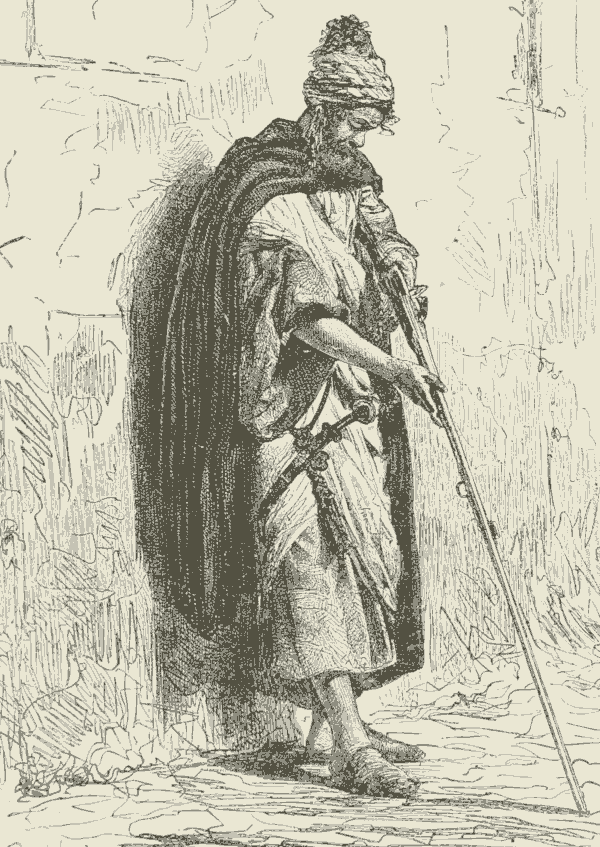
Moor Of Fez.
“Really!” exclaimed the ingenuous young fellow. “You have all read it! and you know all these things! I never should have imagined it!”
Gradually the conversation became general, the 217officials also joining in it, and we heard some singular things. The English Ambassador had presented to the Sultan two telegraphic machines, and had taught some of the court people how to use them; and they were used, not publicly, because the sight of those mysterious wires in the city would cause disturbance, but in the interior of the palace; and words could not express the astonishment they excited. Not, however, to the point that we might suppose, because, from what they had first heard, they all, including the Sultan, had conceived a much more wonderful idea of it; for they believed that the transmission of the thought was not effected by means of letters and words, but at once, instantaneously, so that a touch was sufficient to express and transmit any speech. They recognized, however, that the instrument was ingenious and might be very useful in our countries where there were many people and much traffic, and where every thing had to be done in a hurry. All of which signified in plain words: what should we do with a telegraph? And to what would the policy of our government be reduced if to the demands of the representatives of European States we were obliged to reply at once and in few words, and renounce the great excuse of delays, and the eternal pretext of lost letters, thanks to which we can protract for two months, questions that could be answered in two days? We learned also, or rather we were given to understand, that the Sultan is a man of a 218mild disposition and a kind heart, who lives austerely, who loves one woman only, who eats without a fork, like all his subjects, and seated on the floor, but with the dishes placed upon a little gilded table about a foot high; that before coming to the throne he drilled with the soldiers, and was one of the most active among them; that he likes to work, and often does himself what ought to be done by his servants, even to packing his own things when he goes away; and that the people love him, but also fear him, because they know that should a great revolt break out, he would be the first to spring on horseback and draw his sabre against the rebels.
But with what grace they told us all these things! with what smiles and elegant gestures! What a pity not to be able to understand their language, all color and imagery, and read and search at will in the ingenuous ignorance of their minds!
In about two hours’ time the Ambassador came back, with Sid-Moussa, the grand Scherif, and the officials; and there was such an interchange of hand-pressings, and smiles, and bows, and salutations, that we seemed to be engaged in some dance of ceremony; and finally we departed between two long rows of astonished servants. As we went out we saw at a large grated window on the ground-floor about ten faces of women, black, white, and mulatto, all be-jewelled and be-diademed; who, beholding us, instantly vanished with a great noise of flapping slippers and trailing skirts.
219From the first day of our journey, the Sultan, Muley-el-Hassan, was, as may be imagined, the principal object of our curiosity. It was, then, a festival for us all when at last the Ambassador announced the reception for the following morning. I never in my life unfolded my dress-coat, or touched the spring of my gibus, with more profound complacency than on this occasion.
This great curiosity was produced, in part, by the history of his dynasty. There was the wish to look in the face of one of that terrible family of the Scherifs Fileli, to whom history assigns pre-eminence in fanaticism, ferocity, and crime, over all the dynasties that have ever reigned in Morocco. At the beginning of the seventeenth century some inhabitants of Tafilet, a province of the empire on the confines of the desert, the Scherifs of which take the name of Fileli, brought from Mecca into their country a Scherif named Ali, a native of Jambo, and a descendant of Mahomet, by Hassen, the second son of Ali and Fatima. The climate of the province of Tafilet, a little after his arrival, resumed a mildness that it had for some time lost; dates grew in great abundance; the merit was attributed to Ali; Ali was elected king under the name of Muley-Scherif; his descendants gradually, by their arms, extended the kingdom of their ancestor; they took possession of Morocco and Fez, drove out the dynasty of the Saadini Scherifs, and have reigned up to our day over the whole country 220comprised between the Muluia, the desert, and the sea. Sidi-Mohammed, son of Muley-Scherif, reigned with wise clemency; but after him the throne was steeped in blood. El Reschid governed by terror, usurped the office of executioner, and lacerated with his own hands the breasts of women, in order to force them to reveal the hiding-places of their husbands’ treasure. Muley-Ismail, the luxurious prince, the lover of eight thousand women, and father of twelve hundred sons, the founder of the famous corps of black guards, the gallant Sultan who asked in marriage of Louis XIV the daughter of the Duchess de la Vallière, and stuck ten thousand heads over the battlements of Morocco and Fez. Muley Ahmed el Dehebi, avaricious and a debauchee, stole the jewels of his father’s women, stupefied himself with wine, pulled out the teeth of his own wives, and cut off the head of a slave who had pressed the tobacco too much down into his pipe. Muley-Abdallah, vanquished by the Berbers, cut the throats of the inhabitants of Mechinez to satisfy his rage, aided the executioner in decapitating the officers of his brave but vanquished army, and invented the horrible torture of cooking a man alive inside a disembowelled bull, that the two might putrify together. The best of the race appears to have been Sidi-Mohammed, his son who surrounded himself with renegade Christians, tried to live at peace, and brought Morocco nearer to Europe. Then came Muley-Yezid, a cruel and violent 221fanatic, who, in order to pay his soldiers, gave them leave to sack and pillage the Hebrew quarters in all the cities of the empire; Muley-Hescham, who, after a reign of a few days, went into sanctuary to die; Muley-Soliman, who destroyed piracy, and made a show of friendship to Europe, but with artful cunning separated Morocco from all civilized states, and caused to be brought to the foot of his throne the heads of all renegade Jews from whom had escaped a word of regret for their forced abjuration; Abd-er-Raman, the conqueror of Isly, who built up conspirators alive into the walls of Fez; and, finally, Sidi-Mohammed, the victor of Tetuan, who, in order to inculcate respect and devotion in his people, sent the heads of his enemies to the duars and cities, stuck upon his soldiers’ muskets. Nor are these the worst calamities that afflicted the empire under the fatal dynasty of the Fileli. There are wars with Spain, Portugal, Holland, England, France, and the Turks of Algiers; ferocious insurrections of Berbers, disastrous expeditions into the Soudan, revolts of fanatical tribes, mutinies of the black guard, persecutions of the Christians; furious wars of succession between father and son, uncle and nephew, brother and brother; the empire by turns dismembered and rejoined; sultans five times discrowned and five times reinstated; unnatural vengeance of princes of the same blood, jealousies and horrid crimes and monstrous suffering, and precipitate decline into antique barbarism; and at all times 222one principle is triumphant: that not being able to admit European civilization unless upon the ruins of the entire political and religious edifice of the Prophet, ignorance is the best bulwark of the empire, and barbarism an element necessary to its life.
With these recollections surrounding him, the Sultan became an object of special interest, and we were impatient to appear before him.
At eight o’clock in the morning, the Ambassador, the vice-consul, Signor Morteo, the commandant, and the captain, dressed in their best uniforms, were assembled in the court-yard, with a throng of soldiers, among whom the caid appeared in great pomp. We—that is to say, the two artists, the doctor, and myself, all four appeared in dress-coats, gibus hats, and white cravats—dared not issue from our rooms in the fear that our strange costume, perhaps never before seen in Fez, might draw upon us the laughter of the public. “You go first.”—“No, you.”—“No, you,”—thus for a quarter of an hour, one trying to push the other out at the door. Finally, after a sage observation from the doctor that union made strength, we all came out together in a group, with our heads down and hats pulled over our eyes. Our appearance in the court-yard produced amazement among the soldiers and servants of the palace, some of whom hid themselves behind the pillars to laugh at their ease. But it was another thing in the city. We mounted our 223horses, and proceeded toward the gate of the Nicchia del Burro, with a company of the red division of infantry leading the way, followed by all the soldiers of the Legation, and flanked by officials, interpreters, masters of ceremony, and horsemen of the escort of Ben-Kasen-Buhammei. It was a fine spectacle, that mingling of tall hats and white turbans, diplomatic uniforms and red caftans, gold-mounted swords and barbaric sabres, yellow gloves and black hands, gilded pantaloons and bare legs; and the figure that we four made, in evening dress, mounted on mules, upon scarlet saddles as high as thrones, covered with dust and perspiration, may be left to the imagination. The streets were full of people; at our appearance they all stopped and formed into two lines. They looked at the plumed hat of the Ambassador, the gold cord of the captain, the medals of the commandant, and gave no sign of wonder; but when we four passed by, who were the last, there was an opening of eyes and an exhilaration of countenance that was truly trying. Mohammed-Ducali rode near us, and we begged him to translate for us some of the observations which he caught in passing. A Moor standing with a number of others said something to which the rest seemed to assent. Ducali laughed, and told us they took us for executioners. Some—perhaps because black is odious to the Moors—looked at us almost with anger and disdain; others shook their heads with a look of commiseration.
224“Signori,” said the doctor, “if we do not make ourselves respected it is our own fault. We have arms; let us use them. I will set the example.”
Thus speaking, he took off his gibus hat, shut down the spring, and passing before a group of smiling Moors, suddenly sprung it at them. The wonder and agitation of them at the sight cannot be expressed. Three or four sprang backward, and threw a glance of profound suspicion upon the diabolical hat. The artists and I, encouraged by the example, imitated him; and thus, by dint of our gibus, we arrived, respected and feared, at the city walls.
Outside the gate of the Nicchia del Burro were ranged two rows of infantry soldiers, in great part boys, who presented arms in their usual fashion, one after the other, and when we had passed, put their uniforms over their heads to shelter them from the sun. We crossed the Pearl River by a small bridge, and found ourselves in the place destined for the reception, where we all dismounted.
It was a vast square, closed on three sides by high battlemented walls with large towers. On the fourth side ran the River of Pearls. In the corner furthest from us opened a narrow road bordered by white walls, which led to the gardens and houses of the Sultan, completely concealed by bastions.
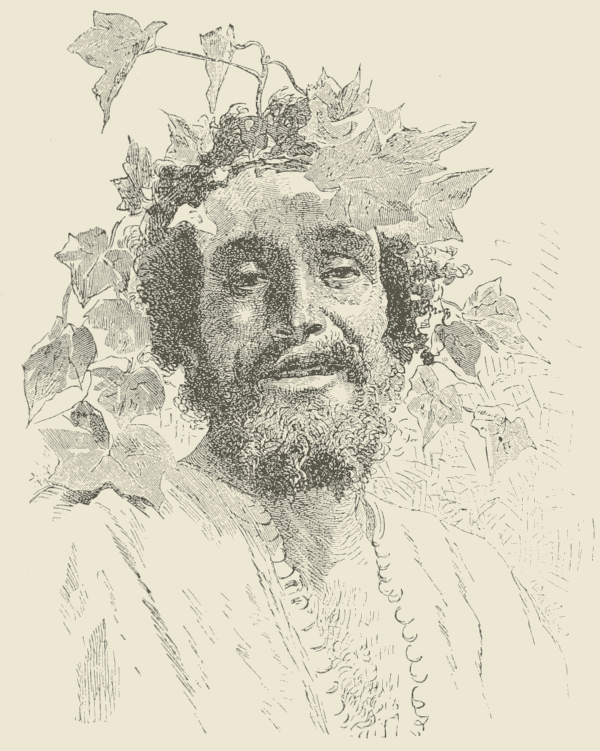
A Saint. Fez.
The square when we arrived presented an admirable coup-d’œil In the middle a throng of generals, masters of ceremonies, magistrates, nobles, officials, 225and slaves, Arab and black, all dressed in white, were divided into two great ranks, opposite each other, and distant about thirty paces. Behind one of these ranks, toward the river, were disposed in files all the Sultan’s horses, large and beautiful creatures, with trappings of velvet embroidered with gold; each one held by an armed groom. At the end of the files of horses stood a small gilded carriage, which the Queen of England had given to the Sultan, who always displays it at every reception. Behind the horses, and behind the other rank of court personages, were drawn up in interminable lines the imperial guard, dressed in white.
All around the square, at the foot of the wall and along the river bank, three thousand foot-soldiers looked like four long lines of flaming red; and on the other bank of the river was an immense crowd of people all in white. In the middle of the place were arranged the cases containing the presents from the King of Italy—a portrait of the king himself, mirrors, pictures in mosaic, candelabra, and arm-chairs.
We placed ourselves near to the two ranks of personages, so as to form with them a square open toward that part of the place where the Sultan was to come. Behind us were the cases; behind the cases, all the soldiers of the embassy. On one side Mohammed Ducali, the commandant of the escort, Solomon Affalo, and the sailors in uniform.
A master of ceremonies, with a very crabbed expression 226of countenance, and armed with a knotty stick, placed us in two rows,—in front, the commandant, the captain, and the vice-consul; behind, the doctor, the two painters, and myself. The Ambassador stood five or six paces in advance of us, with Signor Morteo, who was to interpret.
At one moment we seven advanced a few paces unconsciously. The master of ceremonies before mentioned made us all go back, and pointed out with his stick the exact place where we were to remain. This proceeding made a great impression on us, the more that we fancied we saw the gleam of an astute smile in his eye. At the same moment a great buzz and murmur arose from above. We looked up, and saw at a certain height beyond the bastions four or five windows, closed with green curtains, behind which a quantity of heads seemed to be in movement. They were women’s heads—the buzz came from them; the windows belonged to a kind of balcony, which communicated by a long corridor with the Sultan’s harem; and the master of ceremonies had made us stand in that position by express order of the Sultan himself, who had promised his ladies that they should see the Christians. What a pity that we were not near enough to hear their observations upon our high hats and our swallow-tailed coats!
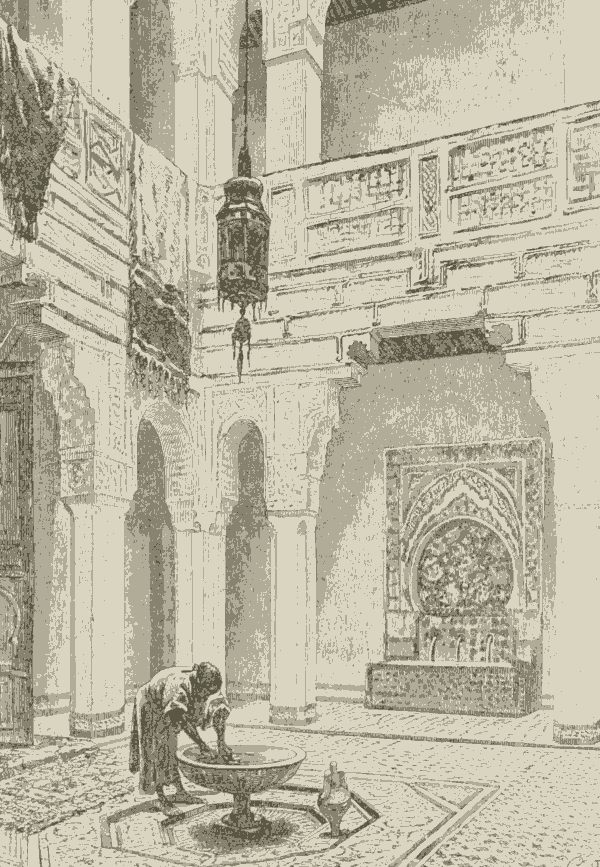
Inner Court of Our House at Fez.
The sun was burning hot; a profound silence reigned in the vast square; every eye was turned toward the same point. We waited for about ten 227minutes. Suddenly a shiver seemed to run through the soldiers; there was a burst of music, the trumpets sounded; the court personages bowed profoundly; the guards, grooms, and soldiers put one knee to the ground; and from every mouth came one prolonged and thundering shout—“God protect the Sultan!”
He was on horseback, followed by a throng of courtiers on foot, one of whom held over his head an immense parasol. At a few paces from the Ambassador he stopped his horse, a portion of his suite closed the square, the rest grouped themselves about him.
The master of ceremonies with the knotty stick shouted in a loud voice:—“The Ambassador from Italy!”
The Ambassador, accompanied by his interpreter, advanced with uncovered head. The Sultan said in Arabic, “Welcome! welcome! welcome!” Then he asked if he had had a good journey, and if he were content with the service of the escort, and with the reception of the governors. But of all this we heard nothing. We were fascinated. The Sultan, whom our imagination had represented to us under the aspect of a cruel and savage despot, was the handsomest and most charming young fellow that had ever excited the fancy of an odalisque. He is tall and slender, with large soft eyes, a fine aquiline nose, and his dark visage is of a perfect oval, encircled by a short black beard; a noble 228face, full of sadness and gentleness. A mantle of snowy whiteness fell from his head to his feet; his turban was covered by a tall hood; his feet were bare, except for yellow slippers; his horse was large and white, with trappings of green and gold, and golden stirrups. All this whiteness and amplitude of his garments gave him a priestly air, which, with a certain majestic grace and affability, corresponded admirably with the expression of his face. The parasol, sign of command, which a courtier held a little inclined behind him—a great round parasol, three metres in height, lined with blue silk embroidered with gold, and covered on the outside with amaranth, topped by a great golden ball, added to the dignity of his appearance. His graceful action, his smiling and pensive expression, his low voice, sweet and monotonous as the murmur of a stream; his whole person and manners had something ingenuous and feminine, and at the same time solemn, that inspired irresistible sympathy and profound respect. He looked about thirty-two or thirty-three years of age.
“I am rejoiced,” he said, “that the King of Italy has sent an Ambassador to draw more tightly the bands of our ancient friendship. The House of Savoy has never made war on Morocco. I love the House of Savoy, and have followed with pleasure and admiration the events which have succeeded each other under its auspices in Italy. In the time of ancient Rome Italy was the most powerful 229country in the world. Then it was divided into seven states. My ancestors were friendly to all the seven states. And I, now that all are reunited into one, have concentrated upon it all the friendship that my ancestors had for the seven.”
He spoke these words slowly, with pauses, as if he had studied them first, and was trying to remember them.
Among other things the Ambassador told him that the King of Italy had sent him his portrait.
“It is a precious gift,” he replied, “and I will have it placed in the room where I sleep, opposite a mirror, so that it shall be the first object on which my eyes fall when I wake; and so every morning I shall see the image of the King of Italy reflected, and will think of him.” A little while afterward, he added: “I am content, and I hope that you will stay long in Fez, and that it will be a pleasant memory when you shall have returned to your beautiful country.”
While he spoke he kept his eyes fixed almost constantly upon his horse’s head. At times he seemed about to smile; but immediately bent his brows and resumed the gravity proper to the Imperial countenance. He was curious—it was evident—to see what sort of beings were these seven ranged at ten paces from his horse; but not wishing to look directly at us, he turned his eyes little by little, and then with one rapid glance took in the whole seven together, and at that moment there 230was in his eye a certain indefinable expression of childish amusement, that made a pleasant contrast with the majesty of his person. The numerous suite that were gathered behind and about him appeared to be petrified. All eyes were fixed upon him; not a breath could be heard, and nothing was seen but immovable faces and attitudes of profound veneration. Two Moors with trembling hands drove away the flies from his feet; another from time to time passed his hand over the skirt of his white mantle as if to purify it from contact with the air; a fourth, with an action of sacred respect, caressed the crupper of the horse; the one who held the parasol stood with downcast eyes, motionless as a statue, almost as if he were confused and bewildered by the solemnity of his office. All things about him expressed his enormous power,—the immense distance that separated him from everybody, a measureless submission, a fanatic devotion, a savage, passionate affection that seemed to offer its blood for proof. He seemed not a monarch, but a god.
The Ambassador presented his credentials, and then introduced the commandant, the captain, and the vice-consul, who advanced one after the other, and stood for a moment bowing low. The Sultan looked with particular attention at the commandant’s decorations.
“The physician”—then said the Ambassador, pointing us out—“and three scienzati” (men of science).
231My eyes encountered the eyes of the god, and all the periods, already conceived, of this description confounded themselves in my mind.
The Sultan asked with curiosity which was the physician. “He to the right,” answered the interpreter.
He looked attentively at the doctor. Then accompanying his words with a graceful wave of his right hand, he said, “Peace be with you! Peace be with you! Peace be with you!” and turned his horse.
The band burst out, the trumpets sounded, the courtiers bent to the ground, guards, soldiers, and servants knelt on one knee, and once more the loud and prolonged shout arose:—“God protect our Sultan!”
The Sultan gone, the two ranks of high personages met and mingled, and there came toward us Sid-Moussa, with his sons, his officers, the Minister of War, the Minister of Finance, the Grand Scherif Bacali, the Grand Master of Ceremonies, all the great ones of the court, smiling, talking, and waving their hands in sign of festivity. A little later, Sid-Moussa having invited the Ambassador to rest in a garden of the Sultan’s, we mounted, crossed the square to the mysterious little road, and entered the august precincts of the Imperial residence.
Alleys bordered by high walls, small squares, courts, ruined houses and houses in course of construction, arched doors, corridors, little gardens, 232little mosques, a labyrinth to make one lose one’s way, and everywhere busy workmen, lines of servants, armed sentinels, and some faces of slave women behind the grated windows or at the openings in the doors: this was all. Not a single handsome edifice, nor any thing, beyond the guard, to indicate the residence of the sovereign. We entered a vast uncultivated garden, with shaded walks crossing each other at right angles, and shut in by high walls like the garden of a convent, and from thence, after a short rest, returned home, spreading by the way—the doctor, the painters, and myself—hilarity with our swallow-tails and terror with our gibus.
All that day we talked of nothing but the Sultan. We were all in love with him. Ussi tried a hundred times to sketch his face, and threw away his pencil in despair. We proclaimed him the handsomest and the most amiable of Mohammedan monarchs; and in order that the proclamation might be truly a national one, we sought the suffrages of the cook and the two sailors.
The cook, from whom all the spectacles seen between Tangiers and Fez had never drawn any thing but a smile of commiseration, showed himself generous to the Sultan:—
“He is a fine man—there is no doubt about that—a handsome man; but he ought to travel, where he can get some instruction.”
This naturally meant Turin. Luigi, the sailor, though a Neapolitan, was more laconic. Being 233asked what he had remarked in the Sultan, he thought a moment and answered, smiling, “I remarked that in this country even the kings do not wear stockings.”
The most comical of all was Ranni. “How did the Sultan strike you?” asked the commandant.
“It struck me,” he answered, frankly and with perfect gravity, “that he was afraid.”
“Afraid!” exclaimed the commandant. “Of whom?”
“Of us. Did you not see how pale he grew, and he spoke as if he had lost his breath?”
“You are crazy! Do you think that he, in the midst of his army, and surrounded by his guard, could be afraid of us?”
“It seemed so to me,” said Ranni, imperturbably.
The commandant looked fixedly at him, and then took his head in both hands, like a profoundly discouraged man.
That same evening there came to the palace, conducted by Selim, two Moors, who, having heard marvels of our gibus, desired to see them. I went and got mine and opened it under their noses. Both of them looked into it with great curiosity, and appeared much astonished. They probably expected to find some complicated mechanism of wheels and springs, and seeing nothing were confirmed in the belief that exists among the Moorish vulgar, that in all Christian objects there is something diabolical.
234“Why, there is nothing!” they exclaimed with one voice.
“But it is precisely in that,” I answered through Selim, “that the wonder of these supernatural hats appears; that they do what they do without any wheels or springs!”
Selim laughed, suspecting the trick, and I then tried to explain the mechanism of the thing to them; but they seemed to understand but little.
They asked also, as they took leave, whether Christians put such things in their hats “for amusement.”
“And you,” I said to Selim, “what is your opinion of these contrivances?”
“My opinion is,” he answered with haughty contempt, placing his finger on the offending hat, “that if I had to live a hundred years in your country, perhaps, little by little, I might adopt your manner of dressing—your shoes, your cravats, and even the hideous colors that please you; but that horrible black thing—ah! God is my witness, that I would rather die!”
At this point I begin my journal at Fez, which embraces all the time that transpired between our reception by the Sultan, and our departure for Mechinez:—
May 20th.
To-day the chief custodian of the palace gave me secretly the key of the terrace, warmly recommending us to observe prudence. It appears that he had 235received orders not to refuse the keys, but to give them only if urgently asked for; and this because the terraces at Fez, as in other cities of Morocco, belong to the women, and are considered almost as appendages of the harem. We went up to the terrace, which is very spacious, and completely surrounded by a wall higher than a man, having a few loop-holes for windows. The palace being very high, and built on a height, hundreds of white terraces could be seen from thence, as well as the hills which surround the city, and the distant mountains; and below, another small garden, from the midst of which rose a palm-tree so tall as to overtop the building by almost one third of its own stature. Looking through those loop-hole windows, we seemed to see into another world. Upon the terraces far and near were many women, the greater part of them, judging by their dress, in easy circumstances,—ladies, if that title can be given to Moorish women. A few were seated upon the parapets, some walking about, some jumping with the agility of squirrels from one terrace to the other, hiding, re-appearing, and throwing water in each other’s faces, laughing merrily. There were old women and young, little girls of eight or ten, all dressed in the strangest garments, and of the most brilliant colors. Most of them had their hair falling over their shoulders, a red or green silk handkerchief tied round the head in a band; a sort of caftan of different colors, with wide sleeves, bound round the 236waist with a blue or crimson sash; a velvet jacket open at the breast; wide trousers, yellow slippers, and large silver rings above the ankle. The slaves and children had nothing on but a chemise. One only of these ladies was near enough for us to see her features. She was a woman of about thirty, dressed in gala dress, and standing on a terrace a cat’s jump below our own. She was looking down into a garden, leaning her head upon her hand. We looked at her with a glass. Heavens, what a picture! Eyes darkened with antimony, cheeks painted red, throat painted white, nails stained with henna: she was a perfect painter’s palette; but handsome, despite her thirty years, with a full face, and almond-shaped eyes, languid, and veiled by long black lashes; the nose a little turned up; a small round mouth, as the Moorish poet says, like a ring; and a sylph-like figure, whose soft and curving lines were shown by the thin texture of her dress. She seemed sad. Perhaps some fourth bride of fourteen had lately entered the harem and stolen her husband’s caresses. From time to time she glanced at her hand, her arm, a tress of hair that fell over her bosom, and sighed. The sound of our voices suddenly roused her; she looked up, saw that we were observing her, jumped over the parapet of the terrace with the dexterity of an acrobat, and vanished. To see better, we sent for a chair, and drew lots which should mount it first. The lot falling to me, I placed the chair against the wall, 237and succeeded in raising my head and shoulders above it. It was like the apparition of a new star in the sky of Fez, if I may be excused the audacity of the simile. I was seen at once from the nearer houses, the occupants of which at once took to flight, then turned to look, and announced the event to those on the more distant terraces. In a few minutes the news had spread from terrace to terrace over half the city; curious eyes appeared everywhere, and I found myself in a sort of pillory. But the beauty of the spectacle held me to my post. There were hundreds of women and children, on the parapets, on the little towers, on the outer staircases, all turned toward me, all in flaming colors, from those nearer ones whose features I could discern, to those more distant, who were mere white, green, or vermilion points to my eye; some of the terraces were so full that they seemed like baskets of flowers; and everywhere there was a buzz, and hurry, and gesticulation, as if they were all looking on at some celestial phenomenon. Not to put the entire city in commotion, I set, or rather descended from my chair, and for a moment no one went up. Then Biseo rose, and he also was the mark for thousands of eyes, when, suddenly, upon a distant terrace, all the women turned the other way, and ran to look in the opposite direction, and, in a moment, those on the other houses did the same. We could not at first imagine what had happened, until the vice-consul made a happy guess. “A great 238event,” he said; “the commandant and the captain are passing through the streets of Fez”; and in fact, after a little time, we saw the red uniforms of the escort appear upon the heights that overlook the city, and with the glass could recognize the commandant and captain on horseback. Another sudden turn about of the women on some of the terraces gave notice of the passage of another Italian party; and in about ten minutes we beheld upon the opposite hills the white Egyptian head-dress of Ussi, and Morteo’s English hat. After this the universal attention was once more turned to us, and we stayed a moment to enjoy it; but upon a neighboring terrace there appeared five or six brats of slave-girls, of about thirteen or fourteen years of age, who looked at us and giggled in such an insolent manner, that we were constrained, in Christian decorum, to deprive the metropolitan fair sex of our shining presence.
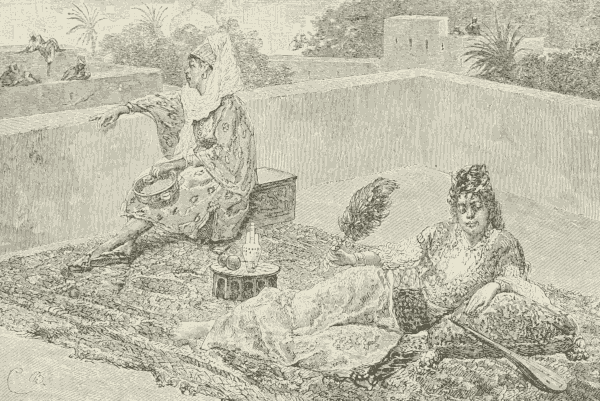
On The Terraces, Fez.
Yesterday we dined with the Grand Vizier, Taib Ben-Jamani, surnamed Boascherin, which signifies, according to some, victor at the game of ball, and according to others, father of twenty children;—Grand Vizier, however, by courtesy only, his father having filled that office under the late Sultan. The messenger bearing the invitation was received by the Ambassador in our presence.
“The Grand Vizier, Taib Ben-Jamani Boascherin,” said he, with much gravity, “prays the Ambassador of Italy and his suite to dine to-day at his house.”
239The Ambassador expressed his thanks.
“The Grand Vizier, Taib Ben-Jamani Boascherin,” he continued, with the same gravity, “prays the Ambassador and his suite to bring with them their knives and forks, and also their servants to wait on them at table.”
We went toward evening, in dress-coats and white cravats, mounted, and with an armed guard as before. I do not remember in what part of the city the house was situated, so many were the turns and twists we made, the ups and downs, through covered ways gloomy and sinister, holding up the mules from slipping, and stooping our heads not to strike them against the low damp vaults of those interminable galleries. We dismounted in a dark passage, and entered a square court, paved in mosaic, and surrounded by tall white pilasters, which upheld little arches painted green and ornamented with arabesques in stucco—a strange Moorish-Babylonian sort of architecture, both pleasing and peculiar. In the middle of the court seven jets of water shot up from as many vases of white marble, making a noise as of a heavy rain. All around were little half-closed doors and double windows. At the two shorter sides two great doors stood open, giving access to two halls. On the threshold of one of these doors was the Grand Vizier, standing; behind him two old Moors, relations of his; to the right and left, two wings of male and female slaves.
240After the usual salutations, the Grand Vizier seated himself upon a divan which ran along the wall, crossed his legs, hugged to his stomach, with both his hands, a large round cushion—his habitual and peculiar attitude—and never moved again for the rest of the evening.
He was a man of about forty-five years of age, vigorous, and with regular features, but with a certain false light shining in his eyes. He wore a white turban and caftan. He spoke with much vivacity, and laughed loud and long at his own words and those of others, throwing back his head while he did so, and keeping his mouth open long after he had done laughing.
On the walls hung some small pictures with inscriptions from the Koran in gold letters; in the middle of the room there were a common wooden table and some rustic chairs; all about lay white mattresses, on which we threw our hats.
Sidi-Ben-Jamani began a vivacious conversation with the Ambassador, asking if he were married, and why he did not marry. He said that if he had been married he might have brought his wife to dinner; that the English Ambassador had brought his daughter, and that she had been much diverted by what she saw there; that all the ambassadors ought to marry, expressly to conduct their wives to Fez, and dine with him; together with other talk of the same kind, all of it interspersed with loud laughter.
241Whilst the Grand Vizier was talking, the two painters and I, seated in the doorway, were looking out of the corners of our eyes at the slave women, who, little by little, and encouraged by our air of benign curiosity, had drawn near, unseen by the Grand Vizier, so that they could almost touch us; and there they stood, looking and being looked at, with a certain complacency. There were eight of them, fine girls of from fifteen to twenty years of age, some mulatto, some black, with large eyes, dilated nostrils, and full bosoms; all dressed in white, with very broad embroidered girdles, arms and feet bare, bracelets on their wrists, great silver rings in their ears, thick silver anklets. It seemed as if they would not scruple very much to have their cheeks pinched by a Christian hand. Ussi pointed out to Biseo the beautiful foot of one of them; she noticed it, and began to examine her own foot with much curiosity. All the others did the same, comparing their own feet with hers. Ussi “fired off” his gibus hat; they drew back, then smiled, and came near again. The Grand Vizier’s voice, ordering the table to be prepared, sent them flying.
The table was laid by our own soldiers. A servant of the house placed upon it, in the middle, three thick waxen torches of different colors. The china-ware belonged to the Grand Vizier, and there were not two plates alike; but they were big and little, white and colored, fine and common, plenty and to spare. The napkins also belonged to the 242house, and consisted of sundry square pieces of cotton cloth, of different sizes, unhemmed, and evidently just cut off in a hurry for the occasion.
It was night when we sat down. The Grand Vizier sat on his mattress, hugging his cushion, and talking and laughing with his two relatives.
I will not describe the dinner, I do not wish to recall painful memories. Enough to say that there were thirty dishes, or rather thirty unpleasant things, without counting the smaller annoyances of the sweets.
At the fifteenth dish, it becoming impossible to continue the struggle without the aid of wine, the Ambassador begged Morteo to ask the Grand Vizier if it would be displeasing to him to have some champagne sent for.
Morteo whispered to Selam, and Selam repeated the request in the ear of his Excellency. His Excellency made a long reply in a low voice, and we anxiously watched his face out of the corners of our eyes. But we found small hope there.
Selam rose with a mortified air, and repeated the answer into the ear of the intendant, who gave us the coup de grâce in the following words:
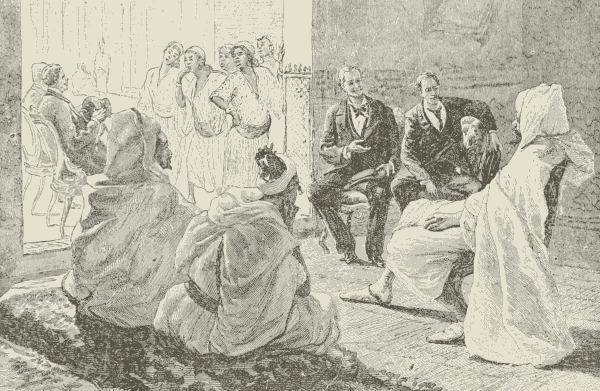
An Interview With The Grand Vizier.
“The Grand Vizier says that there would be no difficulty, that he would consent willingly, but that it would be an impropriety, and the glasses would be soiled, and perhaps the table; and that in any case the sight, the odor, and then the novelty of the thing”——
243“I understand,” answered the Ambassador; “we will say no more about it.”
Our complexions all assumed a slight shade of green.
The dinner over, the Ambassador remained in conversation with the Grand Vizier, and the rest of us issued forth into the rain and darkness of the court. In the room at the other end of it, lighted by a torch, and seated on the ground, our caid, his officers, and the secretaries of our host were dining. At all the little windows in the walls, lighted from within, women’s and children’s heads could be seen, their dark outlines showing against the light. A half-open door showed a splendidly illuminated hall, where seated, lounging in a circle, and gorgeously arrayed, were the wives and concubines of the Grand Vizier, dimly seen through the smoke of burning perfumes that rose from tripods at their feet. Slave-women and servants came and went continually; there must have been at least fifty persons moving about, but there was no sound of voice, or step, or rustle of garment. It was like a phantasmagoria, at which we gazed for a long time, silent, and hidden in the darkness.
As we were going away we saw, attached to a pillar in the court, a thick leathern thong with knots in it. The interpreter asked one of the men what it was for. “To beat us with,” he answered.
We mounted and turned our faces homeward, accompanied by a troop of the Grand Vizier’s servants 244carrying lanterns. It was very dark and raining heavily. The strange effect of that long cavalcade cannot be imagined, with the lanterns, the crowd of armed and hooded figures, the deafening noise of the horses’ feet, the sound of savage exclamations, in that labyrinth of narrow streets and covered passages, in the midst of the silence of the sleeping city. It seemed like a funeral procession winding along under ground, or a party of soldiers advancing through subterranean ways to surprise a fortress. Suddenly the procession halted; there was a sepulchral silence, broken by a voice saying angrily in Arabic, “The road is closed!” A moment after there was a great noise of blows. The soldiers of the escort were trying to beat down with the butts of their muskets one of the thousand gates that during the night prevent circulation through the streets of Fez. The work took some time; it thundered and lightened, and the rain poured in torrents; the soldiers and servants ran about with lanterns, throwing their long shadows on the walls; the caid, standing in his stirrups, threatened the invisible inhabitants of the surrounding houses; and we enjoyed the fine Rembrandt picture with infinite delight. Finally the door came down with a great noise, and we passed on. A little before we reached our house, under an arched passage, six foot-soldiers presented arms with one hand, the other holding a lighted taper; and this was the last scene of the fantastic drama, entitled, “A Dinner with the 245Grand Vizier.” But, no; the last scene of all was when we, hardly in our own court-yard, precipitated ourselves upon sardines of Nantes, and bottles of Bordeaux, and Ussi, lifting his glass above our heads, exclaimed in solemn accents, “To Sidi Ben-Jamani, Grand Vizier of Morocco, our most gracious host, I, Stefano Ussi, with Christian forgiveness, consecrate this cup!”
The Sultan has received the Ambassador in private audience. The reception-hall is as big, as bare, and as white as a prison. There are no other ornaments but a great number of clocks of all forms and dimensions, of which some are on the floor, ranged along the walls, and some are huddled together on the table in the middle of the room. Clocks, it may be remembered, are very great objects of admiration and amusement among the Moors. The Sultan was seated cross-legged, in a little alcove, upon a wooden platform about a yard high. He wore, at his public reception, a white mantle, with a hood over his head; his feet were bare, his yellow slippers in a corner, and a green cord crossed his breast, to which a poniard was probably suspended. In this way the emperors of Morocco have always received ambassadors. Their throne, as Sultan Abd-er-Rhaman said, is the horse, and their pavilion the sky. The Ambassador, having first made known his wish to Sid-Moussa, found before the imperial platform a modest chair, upon which, at a sign from the Sultan, he seated 246himself; Signor Morteo, the interpreter, remained standing. His Majesty, Muley-el-Hassan, spoke for a long time, without ever raising his hands from beneath his mantle, without making a movement with his head, without altering by a single accent the habitual monotony of his soft, deep voice. He spoke of the needs of his empire, of commerce, of industry, of treaties; going into minute particulars, with much order and method, and great simplicity of language. He asked many questions, listening to the answers with great attention, and concluded by saying, with a slight expression of sadness: “It is true; but we are constrained to proceed slowly”—strange and admirable words on the lips of an emperor of Morocco. Seeing that he gave no sign, even in the intervals of silence, to break off the interview, the Ambassador thought it his duty to rise.
“Stay yet a while,” said the Sultan, with a certain expression of ingenuousness; “it gives me pleasure to converse with you.” When the Ambassador took leave, bowing for the last time on the threshold of the door, he slightly bent his head, and remained motionless, like an idol in his deserted temple.
A company of Hebrew women have been here presenting I know not what petition to the Ambassador. No one could shelter his hands from the shower of their kisses. They were the wives, daughters, and relations of two rich merchants; beautiful women, with brilliant black eyes, fair skins, 247scarlet lips, and very small hands. The two mothers, already old, had not a single white hair, and the fire of youth still burned in their eyes. Their dress was splendid and picturesque—a handkerchief of gorgeous colors bound about the forehead; a jacket of red cloth, trimmed with heavy gold braid; a sort of waistcoat all of gold embroidery; a short, narrow petticoat of green cloth, also bordered with gold; and a sash of red or blue silk around the waist. They looked like so many Asiatic princesses, and their splendor of attire contrasted oddly with their servile and obsequious manners. They all spoke Spanish. It was not until after some minutes that we observed that they had bare feet, and carried their yellow slippers under their arms.
“Why do you not wear your shoes?” I asked of one of the old women.
“What!” she said, in astonishment. “Do you not know that we Israelites must not wear shoes except in the Mellà, and that when we enter a Moorish city we must go barefoot?”
Reassured by the Ambassador, they all put on their slippers. Such is the fact. They are not absolutely obliged to go always with bare feet; but as they must take off their shoes in passing through certain streets, before certain mosques, near certain cube, it becomes the same thing in the end. And this is not the only vexation to which they are subjected, nor the most humiliating one. They cannot bear witness before a judge, and must prostrate 248themselves on the ground before any tribunal; they cannot possess lands or houses outside of their own quarter; they must not raise their hands against a Mussulman, even in self-defence, except in the case of being assaulted under their own roof; they can only wear dark colors[6]; they must carry their dead to the cemetery at a run; they must ask the Sultan’s leave to marry; they must be within their own quarter at sunset; they must pay the Moorish guard who stands sentinel at the gates of the Mellà; and they must present rich gifts to the Sultan on the four great festivals of Islamism, and on every occasion of birth or matrimony in the imperial family. Their condition was still worse before the time of Sultan Abd-er-Rhaman, who at least prevented their blood from being shed. Even if they would, the sultans could not much ameliorate their condition, without exposing this unfortunate people to an even worse fate than the horrible slavery they now endure, so fanatical and ferocious is the hatred of the Moors against them. Thus, Sultan Soliman having decreed that they might wear their shoes, so many of them were killed in open day in the streets of Fez that they themselves petitioned the revocation of the decree. Nevertheless, they remain in the country, and being willing to run the risks, they serve as intermediaries between the commerce of Europe and that of Africa; and the government, aware of their importance to the prosperity of the 249state, opposes an almost insurmountable barrier to emigration, prohibiting the departure of any Jewish woman from Morocco. They serve, they tremble, and grovel in the dust; but they would not give, to acquire the dignity of men and the liberty of citizens, the heaps of gold which they keep hidden in their gloomy habitations.
There are about eight thousand of them living in Fez, divided into synagogues, and directed by rabbis who enjoy high authority.
These poor women showed us a number of large bracelets of chased silver, some rings set with jewels, and some gold ear-rings, which they kept hidden in their bosoms. We asked why they concealed them.
“Nos espantamos de los Moros.” “We are afraid of the Moors,” they said, in a low voice, looking timidly about them. They were suspicious, too, of the soldiers of the Legation.
Among them there were several children, dressed with the same splendor as the women. One of them stood close to her mother, seeming more timid than the rest. The Ambassador asked how old she was. “Twelve years old,” the mother said.
“She will soon be married,” remarked the Ambassador.
“Che!” exclaimed the mother; “she is too old to marry.”
We all thought she was joking. But she repeated, almost astonished at our incredulity, “I 250speak the truth; look here at this one”—and she pointed to a smaller child. “She will be ten years old in six months, and she has already been married one year.”
The child held down her head. We were still incredulous.
“What can I say?” continued the woman. “If you will not believe my word, do me the honor to come to my house on Saturday, so that we may receive you worthily, and you will see the husband and the witnesses of the marriage.”
“And how old is the husband?” I asked.
“Ten years old, Signore.”
Seeing that we still doubted, the other women all asserted the same, adding that it was quite rare for a girl to marry after twelve years of age; that the greater part of them are married at ten, many at eight, and some even at seven, to boys of about their own age; and that, naturally, while they are so young, they live with their parents, who continue to treat them like children, feed, clothe, and correct them, without the least regard to their marital dignity; but they are always together, and the wife is submissive to the husband.
To us all this seemed news from another world than ours, and we listened with open mouths, divided between a desire to laugh, pity, and anger.
A breakfast at the house of the Minister of War.
We were received in a narrow court, enclosed by 251four high walls, and as dark as a well. On one side there was a door about three feet in height, on the other a great doorway without doors, and a bare room, with a mattress on the floor, and some sheets of paper strung on a string and hanging on one of the walls: the daily correspondence, I imagine, of his Excellency.
He is called Sid-Abd-Alla Ben Hamed, is the elder brother of Sid-Moussa, is about sixty years old, black, small, lean, infirm on his legs, trembling and decrepit. He speaks little, shuts his eyes often, and smiles courteously, bowing his head, which is almost concealed in an immense turban. Nevertheless, his appearance and manners are agreeable.
After the exchange of a few words, we were invited into the dining-hall. The Ambassador first, and then all the others one by one, stooping almost to a right angle, passed the little low door, and came out into another court, spacious, surrounded by an elegant arcade, and covered with splendid and various ornaments in mosaic. It is a palace which was presented to Sid-Abd-Alla by the Sultan. He himself gives us this information, bowing his head and closing his eyes with an air of religious veneration.
In one corner of the court there was a group of officials in white turbans and robes; on the other side a troop of servants, among whom towered a very handsome young giant, dressed all in blue, with a long pistol at his belt. At all the little doors and windows in the four walls heads of women and 252children of various shades of complexion appeared and disappeared, and on every side was heard the voice of infancy.
We sat down around a small table, in a little room encumbered by two enormous beds. The Minister placed himself next to, but a little behind, the Ambassador, and sat there all the time of the breakfast, vigorously rubbing his bare black foot, which he had planted on his knee; so that the ministerial toes appeared just above the edge of the table, at a few inches from the commandant’s plate. The soldiers of the Legation waited at table. Close to it stood the young blue giant, with his hand on his pistol.
Sid-Abd-Alla was very polite to the Ambassador.
“I like you very much,” he said, without preamble, through the interpreter.
The Ambassador replied that he experienced the same sentiment toward him.
“I had scarcely seen you,” continued the Minister, “when my heart was all yours.”
The Ambassador returned the compliment.
“The heart,” concluded Sid-Abd-Alla, “cannot be resisted; and when it commands you to love a person, even without knowing the reason, you must obey.”
The Ambassador gave him his hand, which be pressed to his breast.
Eighteen dishes were served. I speak not of them. Enough to say that I hope that my partaking 253of them will some day be counted in my favor. By way of variety the water was flavored with musk, the table-cloth of many colors, and the chairs tottering on their legs. But these little calamities, instead of putting us into an ill humor, only excited our comic vein, so that seldom were we so full of mischievous frolic as on that occasion. If Sid-Abd-Alla could only have heard us! But Sid-Abd-Alla was entirely absorbed in the Ambassador. Signor Morteo alarmed us for an instant by whispering to us that the blue giant, who was from Tunis, might possibly understand a few words of Italian. But observing him attentively when certain jokes were made, and seeing him always impassible as a statue, we were reassured, and went on without minding him. How many apt and unexpected similes did we find, and with what clamorously comic effect, but unfortunately not to be repeated, for those ragoûts and sauces!
The breakfast over, we all went out into the court, where the Minister presented to the Ambassador one of the highest officers of the army. He was the commander-in-chief of the artillery: a little old man, dry, and bent like the letter C, with an enormous hooked nose and two round eyes; the face of a bird of prey; overwhelmed, rather than covered, by an immeasurable yellow turban of a spherical form, and dressed in a sort of Zouave dress, all blue, with a white mantle on his shoulders. He wore at his side a long sabre, and had a silver 254poniard in his belt. The Ambassador inquired to what rank in a European army his own corresponded. He seemed embarrassed by the question. He hesitated a moment, and then answered, stammering, “General”; then he thought again, and said, “No; colonel,” and was confused. He said he was a native of Algeria. I had a suspicion that he was a renegade. Who knows by what strange vicissitudes he has come to be colonel in Morocco?
The other officers, meantime, were breakfasting in a room opening on the court, all sitting in a circle on the floor, with the dishes in the midst. Seeing them eat, I understood how it was that the Moors could do without knives and forks. The neatness and dexterity, the precision with which they pulled chickens, mutton, game, and fish to pieces cannot be described. With a few rapid movements of the hands, without the least discomposure, each one took his exact portion. They seemed to have nails as sharp as razors. They dipped their fingers in the saucers, made balls of the cùscùssù, ate salad by the handful, and not a morsel or crumb fell from the dish; and when they rose, we saw that their caftans were immaculate. Every now and then a servant carried round a basin and a towel; they gave themselves a wash, and then all together plunged their paws into the next dish. No one spoke, no one raised his eyes, no one seemed to notice that we were looking on.
255What officers they were, whether of the staff, or adjutants, or chiefs of division, or what, it is impossible to know in Morocco. The army is the most mysterious of all their mysteries. They say, for example, that in case of a holy war, when the Djehad law shall be proclaimed, which calls every man under arms who is capable of bearing them, the Sultan can raise two hundred thousand soldiers; but if they do not know even approximately the number of the population of the empire, on what do they base their calculations? And the standing army, who knows how large it is? And how can any thing be known, not only of the numbers, but of the regulations, if, except the chiefs, no one knows any thing, and these latter either will not answer, or do not tell the truth, and cannot make themselves understood?
Sid-Abd-Alla, the most courteous of hosts, made us write all our names in his pocket-book, and took leave of us, pressing our hands one by one to his heart.
At the door we were joined by the blue giant, who, looking at us with a cunning grin, said, in good Italian, though with a Moorish accent, “Signori, stiano bene!”
Our jesting talk at table flashed on our minds, and we were all struck dumb. Finally, “Ah, dog!” cried Ussi. But the dog had already vanished.
Our every movement out-of-doors is a military expedition; we must warn the caid, get together the 256escort, send for the interpreters, order horses and mules, and an hour at least is spent in preparation. Consequently we stay a great part of the day within. But the spectacle there largely rewards us for our imprisonment. There is a continual procession of red soldiers, black servants, messengers from the court, city traders, sick Moors in search of the doctor, Jewish rabbins coming to do homage to the Ambassador, other Jews with bunches of flowers, couriers with letters from Tangiers, porters bringing the muna. In the court are some workers in mosaic, working for Visconti Venosta; on the terrace, masons; in the kitchens, a coming and going of cooks; in the gardens are merchants spreading out their stuffs, and Signor Vincent his uniforms; the doctor is swinging in a hammock slung between two trees; the artists are painting before the door of their chamber; soldiers and servants are jumping and shouting in the neighboring alleys; all the fountains spout and trickle with a noise of heavy rain, and hundreds of birds are warbling among the orange and lemon-trees. The day passes between ball-playing and Kaldun’s history; the evening with chess, and singing directed by the commandant, first tenor of Fez. My nights would be better passed if it were not for the continual flitting to and fro, like so many phantoms, of Mohammed Ducali’s black servants, who are in a little room adjoining mine. The doctor also sleeps in my room, and between us we have a poor wretch of an Arab servant, who makes 257us die with laughter. They say that he belongs to a family who, if not rich, are in easy circumstances, and that he joined the caravan as a servant at Tangiers, in order to make a pleasure trip. We had hardly reached Fez, the half of his pleasure trip, when for some trifling fault he caught a beating. After that he did his service with furious zeal. He understands nothing, not even gestures; and always looks like one frightened to death; if we ask for the chess-board, he brings a spittoon; and yesterday when the doctor wanted bread, he brought him a crust that he had picked up in the garden. We may try our best to reassure him; he is afraid of us, tries to mollify us with all sorts of strange unnecessary services, such as changing the water in our basins three times before we rise in the morning. Moreover, in order to do a pleasing thing, he waits every morning erect in the middle of the room with a cup of coffee in his hand for the doctor or me to awake, and the first one that gives signs of life he precipitates himself upon, and thrusts the cup under his nose with the fury of one who is administering an antidote. Another delightful personage is the washerwoman, a big woman with a veiled face, a green petticoat, and red trousers, who comes to get our linen, destined, alas! to be trampled by Moors. It is superfluous to say that they iron nothing; in all Fez there does not exist a smoothing-iron, and we put on our linen exactly as it comes from under the hoofs of the washermen. “Perhaps,” said some 258one, “there might be an iron in the Mellà?” There might be, but the difficulty is to find it. There is a carriage, but it belongs to the Sultan. It is said that there is also a piano-forte; it was seen to come into the city some years ago, but it is not known who possesses it. It is amusing also to send to buy something in the shops. “A candle?”—“There are none,” is the answer; “but, we will make some presently.” “A yard of ribbon?”—“It will be ready by to-morrow evening.” “Cigars?”—“We have the tobacco, and will have them ready in an hour.” The vice-consul spent several days looking for an old Arabic book, and all the Moors he questioned looked at each other and said: “A book? Who has books in Fez? There were some once; if we are not mistaken, so and so had them; but he is dead, and we do not know who are his heirs.” “And Arabic journals, or other journals, could we have them?”—“One single journal, printed in Arabic in Algiers, arrives regularly at Fez, but it is addressed to the Sultan.”