Chapter I · TANGIERS. (continued 2)
Caroline Tilton translation
On the following day the chargé d’affaires went with the commander of the frigate and the captain to pay a visit to the representative of the imperial Government, Sidi-Bargas, who exercises what may be called the office of Minister of Foreign Affairs in Tangiers. I begged permission to accompany them, being very curious to see a Minister of Foreign Affairs who, if his salary has not been increased within the last twenty years (which is not probable), receives from his Government the sum of seventy-five francs, or fifteen dollars, a month, which includes the fund for the expenses of representation; a magnificent stipend, nevertheless, compared with that of the governors, who receive only fifty francs. And it is not to be said that their charge is a sinecure, and may be entrusted to the first comer. The famous Sultan Abd-er-Rahman, for instance, who reigned from 1822 to 1859, could find no man so well adapted for it as one Sidi-Mohammed el Khatïb, merchant in coffee and sugar, who continued while he was Minister to traffic regularly between Tangiers and Gibraltar. The instructions which this Minister received from his Government, although very simple, are such as to embarrass the most subtle of European diplomatists. A French consul 64has set them down for us with much precision—viz., to respond to all demands of the consuls with promises; to defer to the very latest moment the fulfilment of these promises; to gain time; to raise difficulties of every kind against complaint; to act in such a way that the complainants will get tired, and desist; to yield, if threatened, as little as possible; if cannon are introduced, to yield, but not until the latest moment. But it must be acknowledged that after the war with Spain, and especially under the reign of Muley-el-Hassan, things have very much changed.
We went up to the Casba where the Minister lives; a line of soldiers kept guard before the door. We crossed a garden and entered a spacious hall, where the Minister and the Governor of Tangiers came to meet us. At the bottom of the hall was a recess or alcove, with a sofa and some chairs; in one corner, a modest bed; under the bed, a coffee-service; the walls white and bare; the floor covered with matting. We seated ourselves in the alcove.
The two personages before us formed an admirable contrast. One, Sidi-Bargas, the Minister, was a handsome old man, with a white beard and a clear complexion, eyes of extraordinary vivacity, and a large smiling mouth, displaying two rows of ivory-white teeth; a countenance which revealed the finesse and marvellous flexibility demanded of him by the very nature of his office. His eye-glasses and snuff-box, together with certain ceremonious airs 65of head and hands, gave him something of the look of a European diplomatist. Plainly a man accustomed to deal with Christians; superior, perhaps, to many of the prejudices and superstitions of his people; a Mussulman of large views; a Moor varnished with civilization. The other, the Caid Misfiui, seemed the incarnation of Morocco. He was about fifty years of age, with black beard and bronze complexion, muscular, sombre, and taciturn; a face that looked as if it had never smiled. He held his head down, his eyes fixed on the ground, his brow bent; his expression was one of strong repugnance. Both men wore large muslin turbans and long ample robes of transparent stuff.
The chargé d’affaires presented to these two personages, through the interpreter, the commandant of the frigate and the captain. They were two officials, and their introduction required no comment. But when I was presented, a few words of explanation as to the office I filled was necessary; and the chargé d’affaires expressed himself in rather hyperbolical terms. Sidi-Bargas stood a moment silent, and then said a few words to the interpreter, who translated—
“His Excellency demands why you have such ability with your hand. Your lordship wears it covered; your lordship will please remove your glove that the hand may be seen.”
The compliment was so new to me that I was at a loss for a reply.
66“It is not necessary,” observed the chargé d’affaires, “because the faculty resides in his mind, and not in his hand.”
One would have thought this settled the question; but when a Moor gets hold of a metaphor, he does not leave it so easily.
“True,” replied his Excellency, through the interpreter; “but the hand being the instrument is also the symbol of the faculties of the mind.”
The discussion was prolonged for a few minutes. “It is a gift of Allah,” finally concluded Sidi-Bargas.
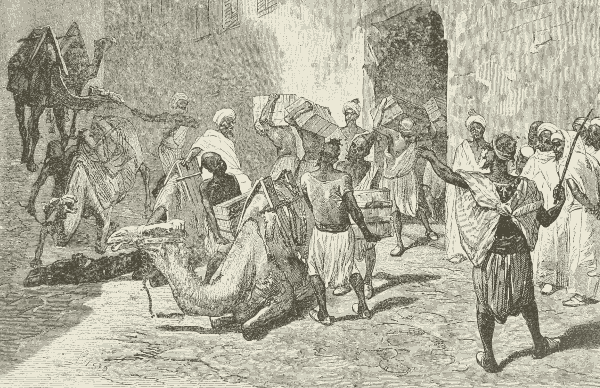
Loading The Camels.
The conversation continued for some time, and the journey was discussed. There was a long citation of names of governors, of provinces, of rivers, valleys, mountains, and plains, that we should find upon our route; names that resounded in my ear as so many promises of adventure, and set my fancy to work. What was the Red Mountain? What should we find on the banks of Pearl River? What sort of a man could that Governor be who was called “Son of the Mare?” Our chargé made numerous inquiries as to distances, water, and shade. Sidi-Bargas had it all at the points of his fingers, and in this direction was certainly greatly beyond Visconti Venosta, who could not for his life have given information to a foreign ambassador as to how many springs of water and how many groups of trees there were between Rome and Naples. Finally, he wished us a pleasant journey, with the following formula: “May peace be in your path!” and accompanying the ambassador to the entrance, 67shook hands with us all with an air of great cordiality. The Caid Misfiui, always mute, put out the tips of his fingers, without raising his eyes. “My hand—yes,” I thought, as I gave it, “but not my head!”
“Start on Monday!” called out Sidi-Bargas, as we took leave.
The ambassador asked why Monday rather than Sunday. “Because it is a day of good omen,” he answered, with gravity; and with another deep salutation, he left us.
I learned later that Caid-Misfiui is accounted a man of great learning among the Moors: he was tutor to the reigning Sultan, and is, as his face shows, a fanatical Mussulman. Sidi-Bargas enjoys the more amiable reputation of being a very fine chess-player.
Three days before our departure the street before the Legation was thronged with curious lookers-on. Ten tall camels, which were to carry to Fez, in advance of us, a part of our provision of wine, came one after the other, kneeled down to receive their load, and departed with their guard of soldiers and servants. Within the house all was bustle, and the servants who had come from Fez were added to those already on the spot. Provisions arrived at every hour in the day. It was feared, at one moment, that we should not be able to get off on the appointed day. But on the Sunday evening, 3d of May, every thing was ready, including the lofty mast of an immense tricolored flag which was to float in 68the midst of our encampment; and in the night the baggage mules were loaded so that they should start early on Monday morning, several hours before us, and arrive in the evening in time to have every thing ready for us at the encampment.
I shall always remember with a pleasant emotion those last moments passed in the court of the Legation just before our departure. We were all there. An old friend of the chargé d’affaires had arrived the evening before to join us, Signor Patot, formerly Minister from Spain to Tangiers, and also Signor Morteo, a Genoese, and consular agent for Italy to Mazagan. There was the doctor of the caravan, Miguerez, a native of Algiers; a rich Moor, Mohammed Ducali, an Italian subject, who accompanied the embassy in the quality of writer; the second dragoman of the Legation, Solomon Affalo; two Italian sailors, one orderly to Commander Cassone, and the other belonging to the Dora; the soldiers of the Legation in holiday dress; cooks, workmen, and servants, all persons unknown to me, whom two months of life in common in the interior of Morocco were to render familiar to me, and whom I prepared myself to study from that moment, one by one, and to make move and speak in a book that I had in my head. Every one of them had some peculiarity of dress, which gave the whole a singularly picturesque appearance. There were plumed caps, white mantles, gaiters, veils, wallets, and blankets of every color. There were enough pistols, 69barometers, quadrants, albums, and field-glasses to have set up a bazaar. We might have been setting off on an expedition to the Cape of Good Hope, and every one of us was quivering with impatience, curiosity, and pleasant anticipation. To crown all, the weather was exquisite, and a delightful sea-breeze was blowing. Mahomet was with Italy.
At five o’clock exactly the ambassador mounted his horse, and the flags on the terrace of the Legation rose in salute. Preoccupied as I was with my white mule, and in all the confusion and uproar of departure I remember but little of the crowd that encumbered the street, the handsome Jewish women peering from their terraces, and an Arab boy, who exclaimed with a strange accent, as we issued from the gate of the Soc-de-Barra, “Italia!”
At the Soc we were joined by the representatives of the other Legations, who were to accompany us, according to custom, a few miles beyond Tangiers; and we took the road to Fez, a numerous and noisy cavalcade, before which waved the green folds of the banner of the Prophet.
70