Chapter XI · FEZ. (continued 2)
Caroline Tilton translation
Yet, I have an idea that we are less than two hundred miles from Gibraltar, where probably this evening they are giving Lucia di Lammermoor, and that in eight days we could reach the Loggia deì Lanzi at Florence. But in spite of this conviction I feel a sentiment of immense remoteness. It is not miles but things and people that divide us most from our country. With what pleasure we tear off the bands of our journals, and break open our letters! 259Poor letters, that fly from the hands of the Carlists in Spain, pass through the midst of the brigands of the Sierra-Morena, overpass the peaks of the red mountain, swim, clasped in the hands of a Bedouin, the waters of the Kus, the Sebù, the Mechez, and the River of the Azure Fountain, and bring us a loving word in this land of reproaches and maledictions.
We pass many hours in watching the painters work. Ussi has made a fine sketch of the great reception, in which the figure of the Sultan is wonderfully well done; Biseo, an excellent painter of Oriental architecture, is copying the façade of the small house in the garden. It is worth while, for diversion, to hear the soldiers and shopkeepers of Fez who come to see that picture. They come on tiptoe behind the painter, and look over his shoulder, making a telescope of their hand, and then they all begin to laugh, as if they had discovered something very odd. The great oddity is that in the drawing the second arch of the façade is smaller than the first, and the third smaller than the second. Devoid as they are of any idea of perspective, they believe that this inequality is an error, and they say that the walls are crooked, that the house totters, that the door is out of place, and they are much astonished, and go away saying the artist is a donkey. Ussi is more esteemed, since it is known that he has been at Cairo, and that he has painted the departure of the caravan for Mecca by the order of the Viceroy, 260who paid him fifteen thousand scudi. They say, however, that the Viceroy was mad to pay such a sum for a work on which the artist had expended perhaps about a hundred francs for colors. A merchant asked Morteo if Ussi could paint furniture also. But the best story is about Biseo, who goes every morning in New Fez to paint a mosque. He goes, of course, escorted by five or six soldiers armed with sticks. Before he has set up his easel, he is surrounded by about three hundred people, and the soldiers are obliged to yell furiously and make play with their sticks to keep enough space open for him to see the mosque. At every stroke of the brush, a blow with a stick; but they let themselves be beaten, and do worse. Every little while a saint appears with threatening gestures, and the soldiers keep him off. There are also some progressive Moors, who come up with friendly aspect, look, approve, and retire with signs of encouragement. The greater part of these progressionists, however, admire a great deal more the structure of the easel and the portable seat, than they do the picture. One day a savage-looking Moor shook his fist at the painter, and then, turning to the crowd, made a long speech with excited voice and gestures. An interpreter explained that he was exciting the people against Biseo, saying that that dog had been sent by the king of his country to copy the finest mosques in Fez, so that when the Christian army came to bombard the place, they could recognize and attack them 261first. Yesterday (I was present), a ragged old Moor, a good-natured old rascal, accosted him, appearing to have a great deal to say, and, bringing out his words with much difficulty, he exclaimed, with emotion, “France! London! Madrid! Rome!” We were much astonished, as may be supposed, and asked him if he knew how to speak French, Italian, or Spanish. He made signs that he could. “Speak, then,” I said. He scratched his forehead, sighed, stamped his foot, and again exclaimed “France! London! Madrid! Rome!” and pointed toward the horizon. He wanted to tell us that he had seen those countries, and perhaps that once he knew how to make himself understood in our tongues; but he had forgotten them all. We put other questions to him, but could draw nothing from him but those four names. And he went away repeating “Madrid! Rome! France! London!” as long as we could see him, and saluting us affectionately with his hand.
“We find all sorts of people here,” said Biseo, provoked; “even originals who wish us well and like us, but not a single dog that will let me paint him.”
It is true that up to this moment the utmost efforts of the artists in that direction had failed. Even our faithful Selam refused.
“Are you afraid of the devil?” demanded Ussi.
“No,” he answered, with solemnity; “I am afraid of God.”
We have been up on the top of Mount Zalag—the 262commandant, Ussi, and I—guided by Captain de Boccard, a charming young fellow, equally admirable for the activity of his body, the strength of his soul, and the acumen of his intelligence. We were accompanied by an officer of the escort, three foot-soldiers, three cavalry soldiers, and three servants. At the foot of the mountain, which is about an hour and a half from the northeast of the city, we stopped to breakfast: after which the captain stuck an apple on a stick, put a scudo on the apple, and made the soldiers and servants fire at it with his revolver. The prize was tempting—they all fired with much care; but as it was the first time they had ever had a revolver in their hands, everybody missed, and the scudo was given to the officer to be divided between them. It was laughable to see the attitudes they took when taking aim. One threw his head back, one bent forward, one put his chin quite over the trigger, and one stood on guard as if fencing with a sabre. Accustomed as they were to terrible attitudes not one knew how to adapt himself to the quiet, easy position which the captain tried to teach them. A soldier came to ask if we would give something to a country-woman who had brought us some milk. We said, Yes, on condition that the woman came herself to get it. She came. She was a black, deformed creature, about thirty years of age, covered with rags, and in every way repulsive. She came toward us slowly, covering her face with one hand; and when about five paces from us, turned 263her back and extended the other hand. The commandant was disgusted. “Be easy,” he called out; “I am not in love. I shall not lose my head; I can still control myself. Good gracious, what frightful modesty!”
We put some money in her hand; she picked up her milk-jug, ran off toward her hut, and at the door smashed the profaned vessel against a stone.
We began the ascent on foot, accompanied by a part of the escort. The mountain is about one thousand feet above the level of the sea—steep, rocky, and without paths. In a few minutes the captain disappeared among the rocks; but for the commandant, Ussi, and I, it was one of the twelve labors of Hercules. We had each an Arab at our side, who told us where to place our feet; and at some points we were obliged to climb like cats, clinging to bushes and grass, slipping on the rocks, stumbling, and seizing the arms of our guides as drowning men seize a saving plank. Here and there we see a goat, seemingly suspended above our heads, so steep is the ascent; and the stones scarcely touched roll to the very bottom of the mountain. With God’s help, in an hour’s time we are on the top of the mountain, exhausted, but with whole bones. What a lovely view! At the bottom, the city, a little white spot in the form of an eight, surrounded by black walls, cemeteries, gardens, cube, towers, and all the verdant shell that holds them; on the left, a long, shining line, the Sebù; to the 264right the great plain of Fez, streaked with silver by the Pearl River and the River of the Azure Fountain; to the south, the blue peaks of the great Atlas chain; to the north, the mountains of the Rif; to the east, the vast undulating plain where is the fortress of Teza, which closes the pass between the basin of the Sebù and that of the Mulaia; below us, great waves of ground yellow with grain and barley, marked by innumerable paths and long files of gigantic aloes; a grandeur of lines, a magnificence of verdure, a limpidity of sky, a silence and peace that steeped the soul in paradise. Who would guess that in that terrestrial paradise dwelt and dosed a decrepit people, chained on a heap of ruins. The mountain that, seen from the city, appeared a cone, has an elongated form, and is rocky on the top. The captain mounted to the highest point; we three, more careful of our lives, scattered ourselves about among the rocks below, and went out of sight of each other. I had made but a few steps, when at the entrance of a little gorge I met an Arab. I stopped; he stopped also, and looked much amazed at my appearance and my being alone. He was a man of about fifty, of a truculent aspect, and armed with a big stick. For a moment I suspected that he might attack me and take my purse; but to my great astonishment, instead of assailing me, he saluted me, smiled, and taking hold of his own beard with one hand, pointed to mine with the other, and said something, repeating it two or three times. It 265sounded like a question, to which he desired an answer. Moved by curiosity, I called for the officer of the guard, who knew a little Spanish, and begged him to tell me what the man wanted. Who would ever have guessed it? He wanted to pay me a compliment, and had asked me ex abrupto why I did not let my beard grow, when it would be more beautiful than his own!
The soldiers of the escort were following us all three at about twenty paces’ distance, and as we frequently called to each other in a loud voice, and it was the first time that they had heard our names, they found them strange, laughing and repeating them with their Moorish accent in the oddest way: “Isi! Amigi!” At a certain point the officer said, abruptly, “Scut!” ( Silence!) and they all were silent. The sun was high, the rocks were scorching; even the captain, accustomed to the heats of Tunis felt the need of shade; we gave a last look at the peaks of Atlas, scrambled down the mountain, and hastily getting into our crimson saddles, took the way back to Fez, where we had an agreeable surprise. The gate of El Ghisa, where we were to enter the city, was closed! “Let us go in by another,” said the commandant. “They are all closed,” answered the officer of the guard; and seeing us open our eyes, he explained the mystery, saying that on all festivals (this was Friday), from twelve o’clock to one, which is the hour of prayer, all the city gates are closed, because it is a Mussulman 266belief that exactly at that hour, but no one knows in what year, the Christians will take possession of their country by a coup de main.
We had, then, to wait for the opening of the gates; and when at last we got in, we were received with a flowery compliment. An old woman shook her fist at us, and muttered something which the officer refused to translate; but we insisting, he finally consented, with a smile, and an assurance that she was an old fool, and her words could do us no harm. What she said was this: “The Jews to the hook (to be boiled), the Christians to the spit!”
The doctor has performed the operation for cataract, coram populo, in the garden of the palace. There was a crowd of relations and friends, soldiers and servants, part disposed in a circle around the patient, part ranged in a long file from the spot where the operation was being done to the gate of the street, where another crowd stood waiting. The patient was an old Moor who had been quite blind for three years. At the moment of taking his seat, he stopped as if frightened; then sat down with a resolute air, and gave no further sign of weakness. Whilst the doctor operated, the people stood as if petrified. The children clung to their mothers’ gowns, and the latter embraced each other in attitudes of terror, as if they were looking on at an execution. Not a breath could be heard. We also, on account of the “diplomatic” importance of the operation, were in great anxiety. All at once the 267patient gave a cry of joy, and threw himself on his knees. He had seen the first ray of light. All the people in the garden saluted the doctor with a yell, to which another yell responded from those in the street. The soldiers immediately made everybody, except the patient, go out from the precincts of the palace, and in a short time the news of the marvellous operation was all over Fez. Fortunate doctor! He had his reward that very evening, when he was called upon to visit the harem of the Grand Scherif Bacalì, where the loveliest ladies showed themselves to him with uncovered faces, and in all the pomp of their splendid attire, and talked languidly of their pains and aches....
From time to time some renegade Spaniards come to see Señor Patxot. There are said to be about three hundred of these unfortunate men in the empire. Most of them are Spaniards, condemned for some common crimes, fugitives from the galleys of the coast; others, partly French deserters, are fugitives from Algeria; and the rest are rascals from all parts of Europe. In other times they rose to high positions in the court and army, formed special military corps, and received large pay. But now their condition is much changed. When they arrive, they abjure the Christian religion, and embrace Islamism, without circumcision or other ceremony, merely pronouncing a formula. No one cares whether they fulfil their religious duties or not; the greater part of them never enter a mosque, and 268know no form of prayer. In order to bind them to the country, the Sultan exacts that they shall marry. He gives to whoever wants her one of his black women; the others can marry an Arab free woman or a Moor, and the Sultan pays the expenses of the wedding. They must all be enrolled in the army; but they can, at the same time, exercise a trade. They generally enter the artillery, and some belong to the bands of music, the head of which is a Spaniard. The soldiers receive five sous a day, and the officers twenty-five to thirty; if any one has a special talent, he can make as much as two francs a day. Lately, for instance, they were talking of a German renegade, endowed with a certain talent for mechanics, who had made for himself an enviable position. This man, for some reason unknown, had fled from Algeria in '73, and had gone to Tafilet, on the confines of the desert; there he stayed two years, learned Arabic, and came to Fez, entered the army, and in a few days, with some tools that he had, constructed a revolver. The event made a noise; the revolver passed from hand to hand, and reached the Minister of War; the Minister told the Sultan, who sent for the soldier, encouraged him, gave him ten francs, and raised his daily pay to forty sous. But such good fortune is rare. Almost all of them live wretched lives, and their state of mind is such, that although they are known to be stained with serious crimes, they inspire pity rather than horror. Yesterday two presented themselves, renegades 269since two years, with wives, and children born at Fez. One was thirty, the other fifty years old, both Spaniards, fugitives from Ceuta. The younger one did not speak. The elder said that he had been condemned to hard labor for life for having killed a man who was beating his son to death. He was pale, and spoke in a broken voice, tearing his handkerchief with trembling hands.
“If they would promise to keep me only ten years in the galleys,” he said, “I would go back. I am fifty, I should come out at sixty, and might still live a few years in my own country. But it is the thought of dying with the brand of the galleys upon me that frightens me. I would go back at any rate, if I were sure of dying a free man in Spain. This is not living, this existence that we have here. It is like being in a desert. It is frightful. Every one despises us. Our own family is not our own, because our children are taught to hate us. And then, we never forget the religion in which we were born, the church where our mothers used to take us to pray, the counsels they gave us; and those memories—we are renegades, we are galley-slaves, it is true, but still we are men—those memories tear our hearts!” and he wept as he spoke.
The rain which has been pouring down for three days has reduced Fez to an indescribable and incredible condition. It is no longer a city; it is a sewer. The streets are gutters; the crossings, lakes; the squares, seas; the people on foot sink 270into the mud up to their knees; the houses are plastered with it above the doors; men, horses, and mules look as if they had been rolling in mud; and as for the dogs, they were at the outset plastered in such a way that they have not a hair visible. Few people are to be seen, and those mostly on horseback; not an umbrella, or even a person hastening to escape the rain. Outside the quarters of the bazaars all is depressingly dark and deserted. Water is running and rushing everywhere, carrying with it every sort of putridity, and no voice or other human sound breaks the monotony of its deafening noise. It looks like a city abandoned by its inhabitants after an inundation. After an hour’s turn I came home in a most melancholy mood, and passed the time with my face pressed against the window-bars, watching the dripping trees, and thinking of the poor courier, who perhaps at that very moment was swimming a flooded river at the risk of his life carrying in his teeth the bag that contained my letters from home.
It is said, and denied, that there has been within a few days a capital execution before one of the gates of Fez. No head has appeared upon the walls, however, and I prefer to think the news is false. The description, which I once read, of an execution done at Tangiers, some years ago, deprived me of the barbarous curiosity that I formerly had to be present at one of these spectacles.
An Englishman, Mr. Drummond Hay, coming 271out one morning at one of the gates of Tangiers, saw a company of soldiers dragging along two prisoners with their arms bound to their sides. One was a mountaineer from the Rif, formerly gardener to a European resident at Tangiers; the other, a handsome young fellow, tall, and with an open and attractive countenance.
The Englishman asked the officer in command what crime these two unfortunate men had committed.
“The Sultan,” was the answer,—“may God prolong his days!—has ordered their heads to be cut off because they have been engaged in contraband trade, on the coast of the Rif, with infidel Spaniards.”
“It is a very severe punishment for such a fault,” observed the Englishman; “and if it is to serve as a warning and example to the inhabitants of Tangiers, why are they not allowed to be present at it?”
(The gates of the city had been closed, and Mr. Drummond Hay had caused one to be opened for him by giving some money to the guard.)
“Do not argue with me, Nazarene!” responded the officer; “I have received an order, and must obey.”
The decapitation was to take place in the Hebrew slaughter-house. A Moor of vulgar and hideous aspect, dressed like a butcher, was there awaiting the condemned. He had in his hand a small knife, about six inches long. He was a stranger in the city, and had offered himself as executioner, because 272the Mohammedan butchers of Tangiers, who usually fill that office, had all taken refuge in a mosque.
An altercation now broke out between the soldiers and the executioner about the reward promised for the decapitation of the two poor creatures, who stood by and listened to the dispute over the blood-money. The executioner insisted, declaring that he had been promised twenty francs a head, and must have forty for the two. The officer at last agreed, but with a very ill grace. Then the butcher seized one of the condemned men, already half dead with terror, threw him on the ground, kneeled on his chest, and put the knife to his throat. The Englishman turned away his face. He heard the sounds of a violent struggle. The executioner cried out: “Give me another knife; mine does not cut!” Another knife was brought, and the head separated from the body.
The soldiers cried, in a faint voice, “God prolong the life of our lord and master!” But many of them were stupefied with terror.
Then came the other victim: the handsome and amiable-looking young man. Again they wrangled over his blood. The officer, denying his promise, declared he would give but twenty francs for both heads. The butcher was forced to yield. The condemned man asked that his hands might be unbound. Being loosed, he took his cloak and gave it to the soldier who had unbound him, saying: “Accept this; we shall meet in a better world!” He 273threw his turban to another, who had been looking at him with compassion, and stepping to the place where lay the bloody corpse of his companion, he said, in a clear, firm voice, “There is no God but God, and Mahomet is His prophet!” Then taking off his belt he gave it to the executioner, saying: “Take it; but for the love of God cut my head off more quickly than you did my brother’s.” He stretched himself on the earth, in the blood, and the executioner kneeled upon his chest.
“A reprieve! Stop!” cried the Englishman. A horseman came galloping toward them. The executioner held his knife suspended.
“It is only the governor’s son,” said a soldier. “He is coming to see the execution. Wait for him.”
So it was, indeed. A few minutes after two bleeding heads were held up by the soldiers. Then the gates of the city were opened, and there came forth a crowd of boys, who pursued the executioner with stones for three miles, when he fell fainting to the ground, covered with wounds. The next day it was known that he had been shot by a relation of one of the victims, and buried where he fell. The authorities of Tangiers apparently did not trouble themselves about the matter, since the assassin came back into the city and remained unmolested.
After having been exposed three days, the heads were sent to the Sultan in order that his Imperial Majesty might recognize the promptitude with which 274his orders had been fulfilled. The soldiers who were carrying them met on their way a courier, bearing a pardon, who had been detained by the sudden flooding of a river.
I frequently find merchants of Fez who have been in Italy. Forty or fifty of them go there every year, and many have Moorish or Arab agents in our cities. They go particularly to Upper Italy, where they buy raw silks, damasks, corals, velvets, threads, porcelain, pearls, Venice glass, Genoa playing-cards, and Leghorn muslin. In exchange they carry nothing but wax and wool, for trade in Morocco is much restricted; and it may be said that stuffs, arms, hides, and earthen-ware or pottery are their only productions which attract a European’s attention. The stuffs are made chiefly in Fez and Morocco. There are caics for women, lordly turbans, sashes, foulards of silk delicately woven with gold and silver, generally in stripes of soft and harmonious colors, very pretty at first sight, but unequal when examined, full of gum, and not wearing well. The red caps, on the contrary, which take the name from Fez, are very fine and durable, and the carpets made at Rabat, Casa Bianca, Morocco, Sciadma, and Sciania are admirable for solidity and richness of color. From Tetuan come in great part the damascened muskets, inlaid with ivory and silver, carved, and set with precious stones, of light and elegant form; and Mechinez, and Fez, and the province of Sus make the swords and daggers which are sometimes of such admirable workmanship.
275Hides, the principal source of gain for the country, are well prepared in various provinces, and the scarlet leather of Fez, the yellow of Morocco, and the green of Tafilet, are still worthy of their ancient reputation. In Fez they boast particularly of their enamelled pottery, but it is rare to find the noble purity of form of the antique vase; and their chief merit is a brilliancy of color, and a certain barbaric originality of design which attract the eye but do not satisfy it. There are also in Fez a great number of jewellers and goldsmiths, who make some simple things in very good taste, but few, and of little variety, because the Amalechite rite proscribes the display of precious ornaments, as contrary to Mahometan austerity. More notable than the jewelery is the furniture which comes from Tetuan: book-shelves, clothes-pegs, and little polygonal tea-tables, arched, arabesqued, and painted in many colors; copper vessels also, chased in complicated designs and ornamented with green, red, and blue enamel; and, above all, the mosaics of the pavements and walls, composed in exquisite taste by clever workmen, who form the designs with marvellous precision.
There is no doubt that these people are endowed with admirable faculties, and that their industries would increase immensely, as also their agriculture, which was once so flourishing, if commerce could make them live; but commerce is hampered with a thousand prohibitions, restrictions, monopolies, excessive 276tariffs, continual modifications and the non-observance of treaties; and, although the European governments have obtained many privileges of late years, these are but small in comparison with what might be brought about, thanks to the wealth and geographical position of the country, under a civil government. The principal trade is that with England, after which come France and Spain, who give cereals, metals, sugar, tea, coffee, raw silk, woollen and cotton cloths, and take wool, hides, fruit, leeches, gum, wax, and a great part of the products of Central Africa. The trade which is carried on by Fez, Taza, and Udjda (and it is not of small importance, though less than that which the neighborhood of the two countries should produce) comprehends, besides carpets, the cloths, belts, thick cords, and all the parts of the Arab and Moorish dress, bracelets and anklets of silver and gold, vases from Fez, mosaics, perfumes, incense, antimony for the eyes, henna for the nails, and all the other cosmetics used by the fair sex of Africa. Of more importance, more ancient, and more regular, is the commerce with the interior of Africa, for which place every year great caravans go forth, carrying stuffs from Fez, English cloths, Venetian glass, Italian corals, powder, arms, tobacco, sugar, small mirrors from Germany, feathers from Holland, little boxes from the Tyrol, hardware from England and France, and salt, which they get on their way in the Sahara; and their journey is like a travelling fair, where their own merchandise 277is exchanged for black slaves, gold dust, ostrich feathers, white gum from Senegal, gold ornaments from Nigritia, which are afterward sent to Europe and the East; black stuffs which are worn on the heads of Moorish women; bezoar, which preserves the Arabs from poison and illness; and many drugs which have been abandoned in Europe, but preserve their ancient value in Africa. Here is, for Europe, the chief importance of Morocco: it is the principal gate of Nigritia; where, being open, the commerce of Europe and that of Central Africa will meet. Meanwhile, civilization and barbarism contend upon the threshold.
The Ambassador has frequent conferences with Sid-Moussa. His principal intent is to obtain from the government of the scherifs certain concessions in trade by which Italy shall be the gainer: more I may not say. These conferences last more than two hours; but the conversation turns but briefly upon the real question in discussion, because the Minister, following a custom which seems traditional in the policy of the government of Morocco, never comes to the point until he has wandered over a hundred extraneous subjects, and when he is dragged to it by force. “Let us talk a little about something entertaining,” he says, in almost a beseeching tone. The weather, health, the water of Fez, the properties of certain tissues, some historical anecdotes, some proverbs, what may be the population of certain states of Europe: all these are 278more agreeable subjects than the one which is the purpose of the interview. “What do you say of Fez?” he asked one day; and being answered that it was beautiful, he added: “And it has another merit; it is clean!” Another day he wished to know what was the population of Morocco. But at last, the business must come; and then there are long phrases, hesitations, reticences, silences, a putting forth of doubts when consent is already decided upon, a pretended denial of condescension, a slipping through the fingers, a constant dropping of the subject just as the knot is about to be tightened, and then the eternal expedient “to-morrow.”
The next day, recapitulation of things said the day before, new doubts, restrictions, recognition of equivocations, regrets for not having understood, and for not having been understood, and exhaustion of the interpreter charged with the duty of making things clear. And then it is necessary to wait for the return of the couriers from Tangiers and Tafilet, who have been sent to obtain information—information of little consequence, but which serves to put off the solution of the question for ten days longer. And in fine, three great obstacles to every thing: the fanaticism of the people, the obstinacy of the Ulemas, and the necessity of proceeding cautiously, not exciting attention, with a slowness that looks like immobility. Under these conditions, Job himself might be expected to cry out; but then come the warm pressures of the 279hand, the sweet smiles, the demonstrations of an irresistible sympathy, and an affection that will only end in death. The most difficult affair is that of the big Moor Schellal, and they say that the fate of his whole life depends upon it; consequently he is for ever at the palace, wrapped in his ample caic, anxious, thoughtful, sometimes with tears in his eyes, and he keeps them fixed upon the Ambassador with a supplicating look, like that of one condemned to death and begging for reprieve. Mohammed Ducali, on the contrary, whose sails are swelled by favoring gales, is gay and sprightly, perfumes himself, smokes, changes his caftan every day, and strews on all sides his soft words, and jests, and smiles. Ah! if it were not for Italian influence, how soon those smiles would be changed into tears of blood!
We are experiencing in these days the truth of what was told us at Tangiers with regard to the effects of the air of Fez. Are these effects produced by the air or by the water? or by the rascally oil; or by the infamous butter; or by all these things together; However it may be, it is a fact that we are all ill. Languor, loss of appetite, prostration of strength, and heaviness of head. And with all these ill-feelings there is a weariness, an irritability, a sort of horror, that in a few days has changed the face of the whole house. Every one longs for departure. We have reached that point, inevitable in all long journeys, at which curiosity is dulled; 280every thing seems faded: memories of home rise up in crowds; all the longings, kept down at first, are alive and in tumult; and our own country is ever before our eyes. We have had enough of turbans, and black faces, and mosques; we are tired of being stared at by a thousand eyes; bored by this immense masquerade in white at which we have been looking for two months. What would we not give to see pass by, even at a distance, a European lady! to hear the sound of a bell! to see on a wall a printed play-bill! Oh, sweetest memories!
I have discovered among the soldiers of the guard one who has lost his right ear, and am told that it was legally cut off, in presence of witnesses, by another soldier whose ear the first one had mutilated some time before. Such is the lex talionis as it exists in Morocco. Not only has any relation of a person killed the right to kill the assassin on the same day of the week, at the same hour and place where the victim fell, using the same weapon, and striking in the same part of the body; but whoever has been deprived of a limb has the right to deprive his assailant of the same limb. A fact of this nature, accompanied by very singular circumstances, happened some years ago at Mogador, and was related to me by a member of the French Consulate, who knew one of the victims. An English merchant of Mogador was returning to the city on the evening of a market-day, at the moment when the gate by which he was entering was encumbered 281with a crowd of country people driving camels and asses. Although the Englishman called out as loud as he could, “Bal-ak! bal-ak!” (Make way!) an old woman was struck by his horse and knocked down, falling with her face upon a stone. Ill fortune would have it that in the fall she broke the two last of her front teeth. She was stunned for an instant, and then rose convulsed with rage, and broke out into insults and ferocious maledictions, following the Englishman to his own door. She then went before the caid, and demanded that in virtue of the law of talion he should order the English merchant’s two front teeth to be broken. The caid tried to pacify her, and advised her to pardon the injury; but she would listen to nothing, and he sent her away with a promise that she should have justice, hoping that when her anger should be exhausted she would herself desist from her pursuit. But, three days having passed, the old woman came back more furious than ever, demanded justice, and insisted that a formal sentence should be pronounced against the Christian.
“Remember,” said she to the caid, “thou didst promise me!”
“Che!” responded the caid. “Dost thou take me for a Christian, that I should be the slave of my word?”
Every day for a month the old woman, athirst for vengeance, presented herself at the door of the citadel, and yelled, and cursed, and made such a noise, that the caid, to be rid of her, was obliged to 282consent. He sent for the merchant, explained the case, the right which the law gave the woman, the duty imposed upon himself, and begged him to put an end to the matter by allowing two of his teeth to be removed, any two, although in strict justice they should be two incisors. The Englishman refused absolutely to part with incisors, or eye-teeth, or molars; and the caid was constrained to send the old woman packing, ordering the guard not to let her put her foot in the Casba again.
“Very well,” said she; “since there are none but degenerate Mussulmans here, since justice is refused to a Mussulman woman, mother of scherifs, against an infidel dog, I will go to the Sultan, and we shall see whether the prince of the faithful will deny the law of the Prophet.”
True to her determination, she started on her journey alone, with an amulet in her bosom, a stick in her hand, and a bag around her neck, and made on foot the hundred leagues which separate Mogador from the sacred city of the empire. Arrived at Fez, she sought and obtained audience of the Sultan, laid her case before him, and demanded the right accorded by the Koran, the application of the law of retaliation. The Sultan exhorted her to forgive; she insisted. All the serious difficulties which opposed themselves to the satisfaction of her petition were laid before her; she remained inexorable. A sum of money was offered her, with which she could live in comfort for the rest of her days; she refused it.
283“What do I want with your money?” said she; “I am old, and accustomed to live in poverty; what I want is the two teeth of the Christian; I want them, I demand them in the name of the Koran; and the Sultan, prince of the faithful, head of Islamism, father of his subjects, cannot refuse justice to a true believer.”
Her obstinacy put the Sultan in a most embarrassing position; the law was formal, and her right incontestable; and the ferment of the populace, stirred up by the woman’s fanatical declamations, rendered refusal perilous. The Sultan, who was Abd-er-Rhaman, wrote to the English consul, asking as a favor that he would induce his countryman to allow two of his teeth to be broken. The merchant answered the consul that he would never consent. Then the Sultan wrote again, saying that if he would consent he would grant him, as a recompense, any commercial privilege that he chose to ask. This time, touched in his purse, the merchant yielded. The old woman left Fez, blessing the name of the pious Abd-er-Rhaman, and went back to Mogador, where, in the presence of many people, the two teeth of the Nazarene were broken. When she saw them fall to the ground she gave a yell of triumph, and picked them up with a fierce joy. The merchant, thanks to the privileges that had been accorded him, made in the two following years so handsome a fortune that he went back to England, toothless, but happy.
284
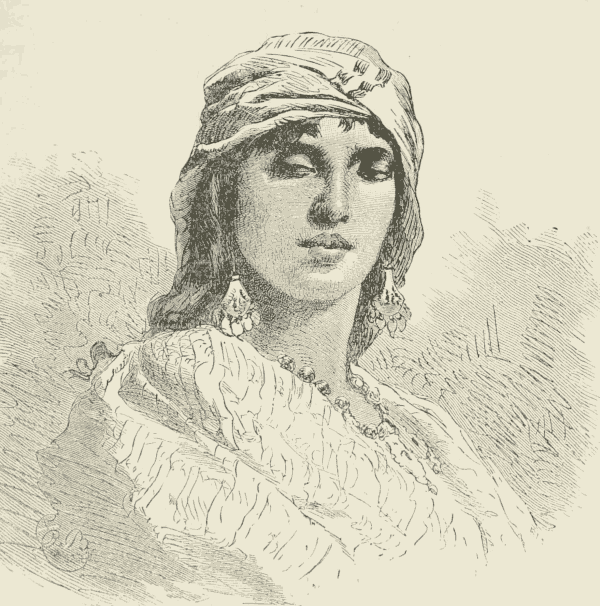
Negro Slave Of Fez.
The more I study these Moors, the more I am inclined to believe that the judgment unanimously passed upon them by travellers is not far from the truth, and that they are a race of vipers and foxes—false, pusillanimous, cringing to the powerful, insolent to the weak, gnawed by avarice, devoured by egotism, and burning with the basest passions of which the human heart is capable. How could they be otherwise? The nature of the government and the state of society permit them no manly ambition. They traffic and bargain, but they have no knowledge of the labor that begets fatigue of body and serenity of mind; they are completely ignorant of any pleasure that is derived from the exercise of the intelligence; they take no care for the education of their sons; they have no high aims in life; therefore they give themselves up, with all their souls, and for their whole lives, to the amassing of money; and the time that is left to them from this pursuit they divide between a sleepy indolence that enervates, and sensual pleasures that brutalize them. In this life of effeminacy they naturally become vain, small, malignant, tattling creatures; lacerating each other’s reputation with spiteful rage; lying by habit with an incredible impudence; affecting charitable and pious sentiments, and sacrificing a friend for a scudo; despising knowledge, and accepting the most puerile superstitions; bathing every day, and keeping masses of filth in the recesses of their houses; and adding to all this a satanic pride, concealed, 285when convenient, under a manner both dignified and humble, which seems the index of an honorable mind. They deceived me in this way at first; but now I am persuaded that the very least of them believes, in the bottom of his heart, that he is infinitely superior to us all. The nomadic Arab preserves at least the austere simplicity of his antique customs, and the Berber, savage as he is, has a warlike spirit, courage, and love of independence. Only these Moors have within them a combination of barbarism, depravity, and pride, and are the most powerful of the populations of the empire. From them come the merchants, the ulemas, the tholbas, the caids, the pashas; they possess the rich palaces, the great harems, beautiful women, and hidden treasures. They are recognizable by their fat, their fair complexions, their cunning eyes, their big turbans, their majestic walk, their arrogance, and their perfumes.
We have been to take tea at the house of the Moor Schellal. We entered by a narrow corridor into a small dark court, but beautiful—beautiful and filthy as the filthiest house in the ghetto of Alkazar. Except the mosaics of the pavement and pilasters, every thing was black, encrusted, sticky with dirt. There were two little dark rooms on the ground-floor; round the first-floor ran a light gallery, and on the top was the parapet of the terrace. The big Moor made us sit down before the door of his sleeping-room, gave us tea and sweetmeats, burned 286aloes, sprinkled us with rose-water, and presented his children to us—two pretty boys, who came to us white with terror, trembling like leaves under our caresses. On the opposite side of the court there was a black slave-girl of about fifteen, having on only a sort of chemise, which was open at the side as far up as the hip, and confined round the waist with a girdle, the slenderest, the most elegant, the most seductive female creature (I attest it on the head of Ussi) that I had seen in all Morocco. She was leaning against a pilaster with her arms crossed on her bosom, looking at us with an air of supreme indifference. Presently there came out of a small door another black woman, of about thirty years of age, tall in stature, of an austere countenance, and robust figure, straight as a palm-tree; who, as it seemed, must have been a favorite with her master, for she advanced familiarly, whispered some words in his ear, pulled out a small bit of straw that was stuck in his beard, and pressed her hand upon his lips with an action at once listless and caressing that made the Moor smile. Looking up, we saw the gallery on the first-floor and the parapet of the terrace fringed with women’s heads, which instantly disappeared. It was impossible for them all to belong to that house. The visit of the Christians had no doubt been announced in the neighborhood, and friends from other terraces had come over to Schellal’s terrace. Just as we were gazing upward, three ghost-like forms passed by us, their heads entirely 287concealed, and vanished through the small door. They were three friends, who, not being able to come by the terraces, had been forced to resign themselves to enter by the door; and a moment after, their heads appeared above the railing of the gallery. The house, in short, had been converted into a theatre, and we were the spectacle. The veiled spectators prattled, and with much low laughter, popped up their heads, and withdrew them again as if they had flown away. Each one of our movements produced a slight murmur; every time one of us raised his head there was a great tumult in the first row of boxes. It was evident that they were much entertained, that they were gathering material for a month’s conversation, and that they could scarcely contain themselves for delight at finding themselves so unexpectedly in the enjoyment of so strange and rare a spectacle! And we complacently obliged them for about an hour—silent, however, and much bored, an effect produced, after a time, by every Moorish house, however courteous its hospitality.
And then, after you have admired the beautiful mosaics, the handsome slaves, and pretty children, you look about instinctively for the person who is the incarnation of domestic life, who represents the courtesy and honorability of the house, who puts the seal on its hospitality, who gives its tone to the conversations, who represents to your mind the altar of the lares,—you seek, in short, the pearl for this shell; and seeing no one but women who have 288their master’s embraces without his affection, and children of unknown mothers, and the whole house personified in one being only, its hospitality becomes a mere empty ceremony; and in your host, instead of the sympathetic features of an honored friend, you see only the aspect of a sensual and odious egotist.
There is no doubt that these people, if they do not hate us absolutely, at least cannot endure us, and they are not without some good reasons. Being among the descendants of the Moors of Spain, many of them still preserve the keys of cities in Andalusia, and titles to the possession of lands and houses in Seville and Granada, and their aversion to Spaniards is peculiarly acrid, their fathers having been despoiled and driven out by them. All the others nourish a general hatred to all Christians, not only because this hatred is instilled into them in their schools and mosques from their earliest infancy, with the purpose of rendering any commerce with civilized races odious to them, commerce which, scattering ignorance and superstition, would undermine the foundations of the empire; but because they all have in the bottom of their souls a vague suspicion of an expansive, growing, threatening force in the states of Europe, by which, sooner or later, they will be crushed. They hear the rising murmur of the French upon their eastern frontier; they see the Spaniards fortified on their Mediterranean coast; Tangiers is occupied by an advanced guard of Christians; 289the cities of the west are guarded by a line of European merchants, stretching along the Atlantic coast like a chain of sentinels; ambassadors come into the country from different directions, apparently, to bring gifts to the Sultan, but, in reality, as they believe, to look, and scrutinize, and pry, and corrupt, and prepare the ground; they hear, in short, a perpetual threat of invasion, and imagine this invasion accompanied by all the horrors of hatred and revenge, persuaded as they are, that Christians nourish against Moors the same sentiments which the latter feel toward us. How can they change this aversion into sympathy when they see us, in our tight, immodest costume, dressed in gloomy colors, loaded with note-books, telescopes, mysterious instruments which we direct at every thing, noting all things, measuring all things, wishing to know all things; we, who are always laughing, and never pray; we, who are restless, chattering, drinking, smoking, full of pretentions and meanness, with only one wife, and never a slave in the whole country! And they form a dark idea of Europe, as of immense congeries of turbulent people, where there reigns a feverish life, full of ardent ambitions, unbridled vices, audacious enterprises, and tumult, a dizzy whirl, a confusion as of Babel, displeasing to God and man.
To-day great confusion in the palace, because of the first and unique attempt at amorous conquest made by a Christian among the lower personages of 290the Embassy. This excellent young man, upon whom, as it would seem, the diplomatic austerity of our lives for the last forty days had begun to weigh rather heavily, having seen, I know not whence, a lovely Moor walking in a garden, thought (we all have our weaknesses) that she would never be able to resist the attractions of his fine person; and without a thought of the danger, insinuated himself through some hole in the wall into the forbidden precincts. If, when arrived in the presence of his nymph, he made a declaration of love, or whether he attempted to suppress any preamble, whether the nymph lent a favorable ear, or fled shrieking from the spot, no one knows; for in this country all is mystery. It is known, however, that there suddenly issued from behind the bushes four Moors armed with daggers, two of whom sprang upon them on one side, and two on the other; and that the unfortunate young man would either never have issued from the garden, or would have done so with some holes in his person, if the Caid Hamed-Ben-Kasen Buhammei had not suddenly appeared upon the scene, and with an imperious gesture arrested the four assailants, and given the fugitive time to get back to the palace with a whole skin. The news of the event flew about: there was great excitement, and the culprit received a solemn admonition in the presence of us all, while the commandant, always witty, added on his own account a little sermon which produced a profound impression. “The wives 291of others,” said he, “and more especially the wives of Mussulmans, must be let alone; and when one is with a European Embassy in Morocco, one must make up one’s mind not to be a man. For, in Mahometan countries, these woman questions speedily become political questions. It would indeed be a fine responsibility, that of an honest young fellow, who, not having been able to resist an inconsiderate impulse, should drag his country into a war, the consequences of which could not be foreseen.” At this solemn discourse, the poor young man, who already saw the Italian fleet with a hundred thousand fighting men sailing toward Morocco because of him, showed himself so overwhelmed with the sense of his guilt that no further castigation was considered necessary.
I should much like to know what conception these people have of their own military power, and their own valor in war, with respect to the power and bravery of Europeans. But I dare not question them directly on the subject, because they are very ready to take offence, and I fear that my questions might be mistaken for irony or brag. I have succeeded, however, touching lightly and with caution, in picking up something. As to the superiority of our military power they have no doubts; for, if any doubts remained in their minds thirty years since, when they had not yet met with any severe reverses from European armies, the wars with France and Spain, and principally the two famous battles of 292Isly and Tetuan, would have dissipated them for ever. But with regard to bravery, it seems to me that they still think themselves much superior to Europeans, whose victories they attribute to their artillery, to discipline, and to what with them takes the place of strategy and tactics, namely, craft; but not at all to their valor. It appears that they do not consider victories gained by these means as real victories, nobly obtained. The common people also add to these the alliance with evil spirits, without which neither artillery nor craft would avail to conquer the Mussulman armies. Certain it is that to the pure-blooded Arabs and to the Berbers, who are the warlike majority in Morocco, bravery cannot be denied, or even the recognition of it restricted to that common and indeterminate courage which in Europe is considered, with chivalric reciprocity, the property of all armies. For even taking into account the nature of the ground and the secret aid of England, the army of Morocco, scattered, badly commanded, badly armed, badly provisioned, could not have confronted, as it did, for nearly a year, with a tenacity unexpected in Europe, the Spanish troops, highly disciplined, and furnished with all the newest offensive weapons, unless they had possessed great bravery in compensation for the military power that they lacked. We may deny the name of true courage to that fanaticism which sends one man against ten, seeking a death that shall open for him the gates of paradise; or to the savage 293fury which induces a soldier to dash his own brains out against a rock rather than fall into the enemy’s hands; or to the wild rage of a wounded man, who tears the bandages from his wounds and frees himself at once from life and a prison; or to the contempt of pain, the blind audacity, the brutal obstinacy, that seek death without any purpose to serve; but we must admit at least that these are elements of courage, and it is incontestable that this people gave many such tremendous examples to Spain. After two months of warfare the Spanish army had taken but two prisoners, an Arab from the province of Oran, and a lunatic who had presented himself at the outposts; and at the sanguinary battle of Castillejos five men only, and those five wounded, fell into the hands of the victors. Their traditional tactics are to advance en masse against the enemy, to extend themselves rapidly, rush in, fire, and retreat precipitately to reload. In great battles they dispose themselves in half-moon shape, artillery and infantry in the centre, and cavalry at the wings, which seeks to envelop the enemy and catch him between two fires. The supreme head gives a general order, but every inferior chief returns to the assault or retreats when he thinks fit, and the army easily escapes from the control of the head. Indefatigable horsemen, dexterous marksmen, unflinching at a defence, easily thrown into confusion in open ground, they glide like serpents, climb like squirrels, run like goats, pass rapidly from a bold 294assault to a precipitous flight, and give an exaltation of courage that seems like furious madness, to a confusion and disorder without name. There are still in Morocco men who went mad with terror at the battle of Isly; and it is known that when Marshall Bugeaud began his cannonade, Sultan Abd-er-Rhaman cried out, “My horse! my horse!” and leaping into the saddle fled precipitately, leaving in the camp his musicians, his necromancers, his hunting dogs, the sacred standard, the parasol, and his tea, which the French soldiers found still boiling hot.
I meet so many negroes in the streets of Fez that I sometimes seem to find myself in the city of the Sôudan, and feel vaguely between me and Europe the immensity of the desert of Sahara. From the Sôudan, in fact, the greater part of them come—a little less than three thousand in a year, many of whom are said to die in a short time from homesickness. They are generally brought at the age of eight or ten years. The merchants, before exposing them for sale, fatten them with balls of cùscùssù, try to cure them, with music, of their homesickness, and teach them a few Arabic words; which last augments their price, which is generally thirty francs for a boy, sixty for a girl, about four hundred for a young woman of seventeen or eighteen who is handsome, and knows how to speak, and has not yet had a child, and fifty or sixty for an old man. The emperor takes five per cent. on the imported 295material, and has a right to the first choice. The others are sold in the markets of Fez, Mogador, and Morocco, and separately, at auction, in the other cities. They all, without difficulty, embrace the Mohammedan religion, preserving, however, many of their own strange superstitions, and the queer festivals of their native country, consisting of grotesque balls, which last three days and three nights consecutively, accompanied by diabolical music. They serve generally in the houses, are treated with kindness, are for the most part freed in reward for their service, and the way is open for them to the highest offices of state. Here, as elsewhere, it is said that they are now feverishly industrious, now torpidly lazy, sensual as monkeys, astute as foxes, ferocious as tigers, but content with their condition, and in general faithful and grateful to their masters; which, it would seem, is not the case where slavery is harder, as at Cuba, and where the liberty that they enjoy is excessive, as in Europe. The Arab and Moorish women refuse to accept them, and it is rare that a negro marries another than one of his own color; but the men, especially the Moors, not only seek them eagerly as concubines, but marry them as frequently as white women; from which cause comes the great number of mulattoes of all shades who are seen in the streets of Morocco. What strange chances! The poor negro of ten years old, sold in the confines of the Sahara for a sack of sugar and a piece of cloth, 296may—and the case can be cited—discuss thirty years afterward, as Minister of Morocco, a treaty of commerce with the English Ambassador; and still more possibly, the black girl baby, born in a filthy den, and exchanged in the shade of an oasis for a skin of brandy, may come to be covered with gems, and fragrant with perfumes, and clasped in the arms of the Sultan.
For some days, walking about Fez, there presents itself to my mind with obstinate persistence, the image of a great American city, to which people from all parts of the world hasten; one of those cities which represent almost the type of that to which all new cities are slowly conforming themselves, and whose life is, perhaps, an example of that which, in another century, will be the life of all; a city whose image cannot present itself to any European side by side with that of Fez, without exciting a smile of pity, so enormous is the difference which separates them in the road of human progress; and yet, the more I fix my thoughts upon that city, the more I feel conscious of a doubt that saddens me. I see those broad, straight, endless streets, with their long perspectives of gigantic telegraph poles. “It is the hour for closing the workshops and warehouses. Torrents of workmen, workwomen, and children pass on foot, in omni-buses, in tramway cars, almost all following the same direction, toward a distant quarter of the town; and all have the same anxious, melancholy 297aspect, and seem worn out with fatigue. Dense clouds of coal smoke pour from the innumerable chimneys of the factories, descend into the streets, throw their black shadows over the splendid shop-windows, and the gilded lettering of the signs that cover the houses up to the roofs, and the crowd that, with bent heads and rapid step, swinging their arms, fly silently from the places where all day long they have labored. From time to time the sun parts the dismal veil which industry has spread over the capital of labor; but these sudden and fugitive beams, instead of making it more cheerful, only illuminate the sadness of the scene. All the faces have the same expression. Everybody is in haste to reach home in order to 'economize’ his few hours of repose, after having drawn the largest possible advantage from the long hours of work. Every one seems to suspect a rival in his neighbor. Every one bears the stamp of isolation. The moral atmosphere in which these people live is not charity, it is rivalry. A great number of families live in the hotels, a life which condemns the wife to solitude and idleness. All day long the husband attends to his business out of the house, coming in only at the hour for dinner, which he swallows with the avidity of a famished man. Then he returns to his galley. Boys, at the age of five or six years, are sent to school, they go and come alone, and pass the rest of their time as they please, in the enjoyment of perfect liberty. The paternal authority is almost 298nil. The sons receive no other education than that of the common school, arrive quickly at maturity, and from infancy are prepared for the fatigues and struggles of the over-excited, strained, and adventurous life which is before them. The existence of the man is merely one long and single campaign, an uninterrupted succession of combats, marches, and countermarches. The sweetness, the intimacy of the domestic hearth have but a small part in his feverish and militant life. Is he happy? Judging by his sad, wearied, anxious countenance, often delicate and unhealthy, it is to be doubted. The excess of continued work breaks down his strength, forbids him the pleasures of the intellect, and prevents him from communing with his own soul. And the woman suffers even more. She sees her husband but once a day, for half an hour at most, and in the evening, when he returns tired out, and goes to bed; and she cannot lighten the burden which he carries, nor participate in his labors, cares, and pains, because she does not know them; for there is no time for an interchange of thought and feeling between the couple.”
The city is Chicago, and the writer who describes it is the Baron de Hubner, a great admirer of America. Now my doubt is this: I do not know which of the two cities, Fez or Chicago, to compassionate most. I feel, however, that if I were a Moor of Fez, and a Christian should take me into one of these great civilized cities and ask me if I did not envy him, I should laugh in his face.
299This morning Selam told me, in his own fashion, the famous history of the bandit Arusi; one of the many tales that go about from mouth to mouth from the sea to the desert; founded, however, on a real and recent fact, many witnesses to which are still living.
A short time after the war with France, Sultan Abd-er-Rhaman sent an army to punish the inhabitants of the Rif, who had burned a French vessel. Among the various sheiks who were ordered to denounce the culprits was one named Sid-Mohammed Abd-el-Djebar, already advanced in years, who, being jealous of a certain Arusi, a bold and handsome youth, placed him, though innocent, in the hands of the general, who sent him to be incarcerated at Fez. But he only remained about a year in prison. After his release he went to Tangiers, remained there some time, and then suddenly disappeared, and for a while no one knew what had become of him. But shortly after his disappearance, there were rumors all over the province of Garb of a band of robbers and assassins which infested the country between Rabat and Laracce. Caravans were attacked, merchants robbed, caids maltreated, the Sultan’s soldiers poniarded; no one dared any more to cross that part of the country, and the few who had escaped alive from the hands of the bandits came back to the town stupefied with terror.
Things remained in this state for a good while, and no one had been able to discover who was the 300chief of the band, when a merchant from the Rif, attacked one night by moonlight, recognized among the robbers the young Arusi, and brought the news to Tangiers, whence it spread rapidly about the province. Arusi was the chief. Many others recognized him. He appeared in the duars and villages, by day as well as by night, dressed as a soldier, as a caid, as a Jew, as a Christian, as a woman, as a ulema, killing, robbing, vanishing, pursued from every quarter, but never taken, always unexpected in his approach, always under a new disguise, capricious, fierce, and indefatigable; and he never went very far away from the neighborhood of the citadel El Mamora; a fact which no one could understand. The reason was this: the caid of the citadel El Mamora was no other than the old sheik, Sid-Mohammed Abd-el-Djebar, who had placed Arusi in the hands of the Sultan’s general.
At that very time Sid-Mohammed had just given his daughter in marriage, a girl of marvellous beauty, named Rahmana, to the son of the pashà of Salè, who was called Sid-Ali, The nuptial feasts were celebrated with great pomp, in the presence of all the rich young men of the province, who came on horseback, armed, and dressed in their best, to the citadel El Mamora; and Sid-Ali was to conduct his bride to Salè, to his father’s house. The cortege issued from the citadel at night. It had to pass through a narrow defile formed by two chains of wooded hills and downs. First went an 301escort of thirty horsemen; behind these, Rahmana, on a mule, between her husband and her brother; behind her, her father, the caid, and a crowd of relations and friends.
They entered the defile. The night was serene, the bridegroom held Rahmana by the hand, the old caid smoothed his beard; all was cheerful and unsuspecting.
Suddenly there burst upon the stillness of the night a formidable voice, which cried:—
“Arusi salutes thee, O Sheik Sid-Mohammed Abd-el-Djebar!”
At the same moment, from the top of the hill, thirty muskets flashed, and thirty shots rang out. Horses, soldiers, friends and relations fell wounded or dead, or took to flight; and before the caid and Sid-Ali, who were untouched, could recover from their bewilderment, a man, a fury, a demon, Arusi himself, had seized Rahmana, placed her before him on his horse, and fled with the speed of the wind toward the forest of Mamora.
The caid and Sid-Ali, both resolute men, instead of giving way to a vain despair, took a solemn oath never to shave their heads until they had been fearfully avenged. They demanded and obtained soldiers from the Sultan, and began to give chase to Arusi, who had taken refuge with his band in the great forest of Mamora, It was a most fatiguing warfare, carried on by coups de main, ambuscades, nocturnal assaults, feints, and ferocious combats, and 302went on for more than a year, driving, little by little, the band of marauders into the centre of the forest. The circle grew closer and closer. Many of Arusi’s men were already dead with hunger, many had fled, many had been killed fighting. The caid and Sid-Ali, as their vengeance seemed to draw near, became more ferocious in its pursuit; they rested neither night nor day, they breathed only for revenge. But of Arusi and Rahmana they could learn nothing. Some said they were dead, some that they had fled, some that the bandit had first killed the woman and then himself. The caid and Sid-Ali began to despair, because the further they advanced into the forest, and the thicker the trees, higher and more intricate became the bushes, the vines, the brambles, and the junipers; so that the horses and dogs could no longer force a passage through them. At last one day, when the two were walking in the forest almost discouraged, an Arab came toward them and said that he had seen Arusi hidden in the reeds, on the river-bank at the extremity of the wood. The caid hastily called his men together, and dividing them into two companies, sent one to the right and the other to the left, toward the river. After some time, the caid was the first to see, rising from the midst of the reeds, a phantom, a man of tall stature and terrible aspect—Arusi. Everybody rushed toward that point, they searched in vain, Arusi was not there. “He has crossed the river!” shouted the caid. They threw 303themselves into the stream, and gained the opposite bank. There they found some footprints, and followed them, but after a little, they failed. Suddenly the horsemen broke into a gallop along the river brink. At the same moment the attention of the caid was drawn to three of his dogs, who had stopped, searching, near a clump of reeds. Sid-Ali was the first to run to the spot, and he found near the reeds a large ditch, at the bottom of which were some holes. Jumping into the ditch, he introduced his musket into one of the holes, felt it pushed back, and fired; then calling the caid and the soldiers, they searched here and there, and found a small round aperture in the steep bank just above the water. Arusi must have entered by that opening. “Dig!” shouted the caid. The soldiers ran for picks and shovels to a neighboring village, and digging, presently came upon a sort of arch in the earth, and under it a cave.
At the bottom of the cave was Arusi, erect, motionless, pale as death. They seized him; he made no resistance. They dragged him out; he had lost his left eye. He was bound, carried to a tent, laid on the ground, and as a first taste of vengeance, Sid-Ali cut off one by one all the toes of his feet, and threw them in his face. This done, six soldiers were set to guard him, and Sid-Ali and the caid withdrew to another tent, there to arrange what tortures they should inflict before cutting off his head. 304The discussion was prolonged; for each one tried to propose some more painful torture, and nothing seemed horrible enough; the evening came, and nothing was decided. The decision was put off until the next morning, and they separated.
An hour afterward the caid and Ali were asleep, each in his tent; the night was very dark, there was not a breath of wind, not a leaf moving; nothing was heard but the murmur of the river, and the breathing of the sleeping men. Suddenly a formidable voice broke the silence of the night:—
“Arusi salutes thee, O Sheik Sid-Mohammed Abd-el-Djebar!”
The old caid sprang to his feet and heard the rapid beat of a horse’s feet departing. He called his soldiers, who came in haste, and shouted, “My horse! my horse!” They sought his horse, the most superb animal in the whole of Garb; it was gone. They ran to the tent of Sid-Ali: he was stretched to the ground, dead, with a poniard stuck in his left eye. The caid burst into tears; the soldiers went off on the track of the fugitive. They saw him for an instant, like a shadow; then lost him; again saw him; but he sped like the lightning, and vanished not to be seen again. Nevertheless they continued to follow, all the night, until they reached a thick wood where they halted to await the dawn. When daylight appeared they saw far off the caid’s horse approaching, tired out and all bloody, filling the air with lamentable neighings. 305Thinking that Arusi must be in the wood, they loosed the dogs and advanced sword in hand. In a few minutes they discovered a dilapidated house half-hidden among the trees. The dogs stopped there. The soldiers came to the door, and levelling their muskets let them fall with a cry of amazement. Within the four ruined walls lay the corpse of Arusi, and beside it, a lovely woman, splendidly dressed, with her hair loose on her shoulders, was binding up his bleeding feet, sobbing, laughing, and murmuring words of despair and love. It was Rahmana. They took her to her father’s house, where she remained three days without speaking one word, and then disappeared. She was found some time afterward in the ruined house in the wood, scratching up the earth with her hands, and calling on Arusi. And there she stayed. “God,” said the Arabs, “had called her reason back to Himself, and she was a saint.” Whether she is still living or not, no one knows. She was certainly living twenty years ago, and was seen in her hermitage by M. Narcisse Cotte, attached to the Consulate of France at Tangiers, who told her story.
There is not now a corner of Fez that is unknown to us; and yet it seems as if we had only arrived yesterday, so varied is the aspect of the place, so much does every object revive in us the sense of our solitude, so little do we become habituated to the curiosity that we create. And this curiosity is 306in no wise lessened, although by this time we have been seen over and over again by every native of Fez. Timidity, on the other hand, is lessened, and antipathy, perhaps, a little; the children come nearer and touch our garments, to feel what they are made of; the women look at us with forbidding glances, but they no longer turn back when they see us coming; curses are more rare, the soldiers do not use their sticks so much, and the blows that Ussi received were, it is to be hoped, the first and last blows with a fist that I shall have to report in Italy. And although, in our walks through the city, we are followed and preceded by a crowd, I think we could now go out alone without danger of death. Already the people, according to the soldier’s testimony, have given each of us a name, according to Moorish custom: the doctor is “the man with the spectacles”; the vice-consul is “the man with the flat nose”; the captain is “the man with the black boots”; Ussi is “the man with the white handkerchief”; the commandant, “the man with the short legs”; Biseo, “the man with the red hair”; Morteo, “the velvet man,” because he is dressed in velvet; and myself, “the man with the broken shoe,” because a pain in my foot obliged me to make a cut in my boot. They comment much upon our doings, it appears, and say that we are all ugly, not one accepted, not even the cook, who received this intelligence with a laugh of scorn, and clapped his hand on a pocket in his vest, where he had a 307letter from his sweetheart. And it seems to me that they find us, or pretend to find us ridiculous, because, in the streets, they laugh with a certain ostentation every time that one of us slips, or hits his head against a branch of a tree, or loses his hat. Nevertheless, and despite the variety of the landscape, this population all of one color, and without apparent distinction of rank, this silence broken only by an eternal rustle of slippers and mantles, these veiled women, these blind, mute houses, this mysterious life,—all end by producing a dreadful tedium. We must be within doors at sunset, and may not go out again. With the daylight ceases all trade, every movement, every sign of life; Fez is no more than a vast necropolis, where if perchance a human voice is heard, it is the howl of a madman, or the shriek of one who is being murdered; and he who insists upon going about at any cost, must be accompanied by a patrol with loaded muskets, and a company of carpenters who at every three hundred paces must knock down a gate that stops the way. In the daytime the city supplies no news beyond some woman found in the street with a dagger in her heart, or the departure of a caravan, or the arrival of a governor or vice-governor of some province who has been thrown into prison, the bastinado administered to some dignitary, a festival in honor of some saint, or other things of the same character brought to us in general by Mohammed Ducali or Schellal, who are our two perambulating 308journals. And these events, with what I daily see, and the singular life I lead, give me at night such strangely intricate dreams of severed heads, and deserts, of harems, prisons, Fez, Timbuctoo, and Turin, that when I wake in the morning, it takes me some minutes to find out what world I am in.
How many beautiful, grotesque, horrible, absurd, and strange figures will live in my memory for ever! My head is full of them, and when I am alone I make them pass before me one by one, like the figures in a magic lantern, with inexpressible pleasure. There is Sid-Buker, the mysterious being who comes three times every day, wrapped in a great mantle, with head down, half-closed eyes, pale as death, stealthy as a spectre, to confer secretly with the Ambassador, and vanishes like a figure in a phantasmagoria, without any one observing him. There is the favorite Sid-Moussa, a handsome young mulatto, graceful as a girl, elegant as a prince, fresh and smiling, who goes leaping up and down the stairs, and salutes you with a sort of coquetry, bowing profoundly and extending his hand as if he were throwing kisses. There is a soldier of the guard, a Berber, born in the Atlas Mountains, a countenance that one cannot see without a shudder, and who fixes upon me a cold, perfidious, immovable glance, as if he meant to kill me; and the more I try to avoid him the more I meet him, and he seems to divine the dread with which he inspires me, and to take a satanic pleasure in it. There is a decrepit old 309woman, whom I saw in the door of a mosque, naked as she was born, except for a formless rag about her hips, with her head as bald as the palm of my hand, and a body so deformed that I made an exclamation of horror, and was disturbed for some time by the sight of her. There is the mischievous Moorish woman, who, entering her house as we were passing by, threw off in furious haste the caic that covered her, and giving us a glimpse of her handsome, straight, and well-made figure, and a sparkling glance, shut the door. There is the very old shopkeeper, with a face at once ridiculous and frightful, so bent over that when he stands in the back of his dark niche he seems almost to touch his toes with his chin; he keeps only one eye open, and that is hardly visible; and every time I pass his shop, and look in at him, that eye opens large and round, and shines with a sort of mocking smile that gives me a kind of anxious feeling. There is the beautiful little Moorish girl of ten years old, with her hair loose about her shoulders, dressed in a chemise bound round the waist with a green scarf, who, in attempting to jump from one terrace to another lower one, got caught by her chemise upon the corner of a brick, and was held dangling; and she, knowing that she was seen from the palace of the Embassy, and unable to get up or down, raised the most despairing shrieks, and all the women in the house came, shaking with laughter, to her assistance. There is the gigantic mulatto, a madman, who, pursued by the 310fixed idea that the Sultan’s soldiers are seeking him to cut his hand off, flies through the streets like some wild thing held in chase, convulsively shaking his right arm as if it were already mutilated, and giving the most frightful yells, which can be heard from one end of the city to the other. There are many, many more; but the one who rises oftenest before my memory is a negro, of about fifty years of age, a servant of the palace, a little more than a yard high, and a little less than a yard wide, a contented spirit, who is always smiling and twisting his mouth toward his right ear; the most grotesque, the most absurdly ridiculous figure that ever appeared under the vault of heaven; and it is of no use for me to bite my fingers, and tell myself that it is ignoble to laugh at human deformity, and shame myself in many ways, the laugh breaks out in spite of me—there must be in it some mysterious intention of Providence—it must break out. And—I really cannot help it—the idea presents itself, what a capital pipe-bowl he would make!
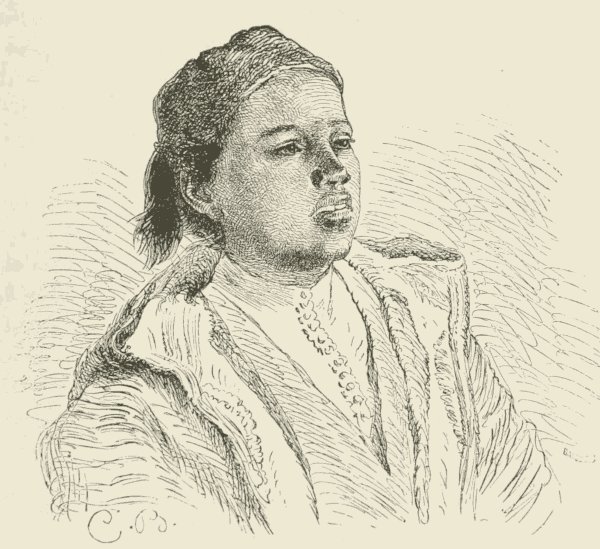
Slave Of The Sultan.
As the day of departure draws near, the merchants come in crowds to the palace, and buying goes on with fury. The rooms, the court, and the gallery have taken the aspect of a bazaar. Everywhere long rows of vases, embroidered slippers, cushions, carpets, caics. Every thing in Fez that is most gilded, most arabesqued, most dear in price, is passed before our eyes. And it is worth while to see how they sell, these people, without a word, 311without a flitting smile, only making the sign of yes or no with the head, and going away, having sold or not having sold, with the same automaton faces that they brought. Above all, the painters’ room is fine, converted into a great bric-à-brac shop, full of saddles, stirrups, guns, caftans, ragged scarfs, pottery, barbaric ornaments, old girdles of women, come from heaven knows where, that have perhaps felt the pressure of the Sultan’s arms, and next year will appear in some grand picture at Naples or New York. One kind of thing only is wanting, namely, antique objects, records of the various peoples who have conquered and colonized Morocco; and although it is known that such are often found underground and among the ruins, it is not possible to get them, because every object so found has to be carried to the authorities, and whoever finds one hides it; and the authorities, ignorant of their value, destroy or sell as useless material the little that finds its way to them. In this way, a few years ago, a bronze horse and some small bronze statues, which were found in a well near the remains of an aqueduct, were broken up and sold for old copper to a Jew dealer in second-hand goods.
To-day I had a warm discussion with a merchant of Fez, with the intention of finding out what opinion the Moors held of European civilization; and for that reason I did not trouble myself to refute his arguments, except when it was necessary to give him line. He is a handsome man of forty, of an 312honest and severe countenance, who has visited, in his commerce, the principal cities of Western Europe, and who lived a good while at Tangiers, where he learned some Spanish. I had exchanged a few words with him some days ago, à propos of a small piece of stuff woven of silk and gold, which he pretended to be worth ten marenghi. But to-day, attacking him upon the subject of his travels, a conversation ensued which his companions listened to with astonishment, although they could not understand it. I asked him then what impression the great cities of Europe had made upon him; not expecting, however, to hear any great expression of admiration, because I knew, as everybody knows, that of the four or five hundred merchants of Morocco who go every year to Europe the greater part return to their own country more stupidly fanatical than at first, when they do not return more rascally and vicious; and that if they were all amazed at the splendor of our cities, and at the marvels of our industries, not one of them would be touched in the soul, moved in the mind, spurred on to imitate, to attempt; not one persuaded of the complex inferiority of his own country; and certainly not one, even if he experienced such sentiments, who would be ready to express them, and still less to diffuse them, through the fear of calling down upon himself the accusation of being a renegade Mussulman and an enemy to his country.
“What have you to say,” I asked, “of our great cities?”
313He looked fixedly at me, and answered coldly: “Large streets, fine shops, handsome palaces, fine offices—and all clean.”
With this he appeared to think that he had said all that could be said in our honor.
“Did you see nothing else that was handsome and good?” I asked.
He looked at me as if to inquire what I supposed he was likely to have found.
“Is it possible” (I insisted) “that a reasonable man like yourself, who has seen countries so wonderfully different and superior to his own, does not speak of them at least with astonishment, at least with the vivacity with which a boy from a duar would speak of a pashà’s palace? What does astonish you then in the world? What kind of people are you? Who can comprehend you?”
“Perdóne Usted,” he answered, coldly; “in my turn I do not understand you. When I have told you every thing in which I think you superior to us, what do you wish more? Do you wish me to say what I do not think? I tell you that your streets are wider than ours, your shops finer, your palaces richer; it seems to me that I have said all. I will say one thing more: that you know more than we do, because you have books and read.”
I made a gesture of impatience.
“Do not be impatient, caballero,” he went on quietly; “you will acknowledge that the first duty of a man, the first thing which renders him estimable, 314and that in which it is of the utmost importance that a country should be superior to other countries, is honesty; will you not? Very well, in the matter of honesty I do not at all believe that you are superior to us. And that is one thing.”
“Gently. Explain first what you mean by honesty.”
“Honesty in trade, caballero. The Moors, for example, in trade sometimes deceive the Europeans, but you Europeans deceive us Moors much more often.”
“The cases are rare,” I answered, for the sake of saying something.
“Cases rare!” he exclaimed, warmly. “Cases of every-day occurrence” (and here I would like to report exactly his broken, concise, and childish language). “Proof! Proof! I at Marseilles. I am at Marseilles. I buy cotton. I choose the thread, thick like this. I say: this number, this stamp, this quantity, send. I pay, I depart, arrive at Morocco, receive cotton, open, look, same number, same stamp—thread three times smaller! good for nothing! loss, thousands of francs! I run to Consulate—nothing. Otro, another. Merchant of Fez orders blue cloth in Europe, so many pieces, so wide, so long, agreed, paid. Receives cloth, opens, measures: first pieces right; under, shorter; last, half a yard shorter! not good for cloaks, merchant ruined. Otro, otro. Merchant of Morocco orders in Europe, thousand yards gold galloon for officers, and sends 315money. Galloon comes, cut, sewed, worn—copper! Y otros, y otros, y otros!” With this he lifted his face to the sky, and then turning abruptly to me: “More honest you?”
I repeated that these could only be exceptional cases. He made no reply.
“More religious you?” he asked then, shortly. “No!” and after a moment: “No! Enough to go once into one of your mosques.”
“You say,” he went on, encouraged by my silence, “in your country there are fewer matamientos (murders)?” Here I should have been embarrassed to answer. What would he have said if I had confessed that in Italy alone there are committed three thousand homicides a year, and that there are ninety thousand prisoners on trial and condemned?
“I do not believe it,” he said, reading my answer in my eyes. Not feeling myself secure upon this ground, I attacked him with the usual arguments against polygamy.
He jumped as if I had burnt him.
“Always that!” he cried, turning red to his very ears. “Always that! as if you had one woman only! and you want to make us believe it! One wife is really yours, but there are those of los otros, and those who are de todos y de nadie, of everybody and nobody. Paris! London! Cafés full, streets full, theatres full. Verguenza! and you reproach the Moors!”
So saying, he pulled the beads of his rosary 316through his trembling fingers, and turned from time to time with a faint smile to make me understand that his anger was not against me, but against Europe.
Seeing that he took this question rather too much to heart, I changed the subject, and asked him if he did not recognize greater convenience in our manner of living. Here he was very comic. He had his arguments all ready.
“It is true,” he answered, with an ironical accent; “it is true. Sun? Parasol. Rain? Umbrella. Dust? Gloves. To walk? A stick. To look? An eye-glass. To take the air? A carriage. To sit down? Elastic cushions. To eat? Music. A scratch? The doctor. Death? A statue: Eh! how many things you have need of! What men, por Dios! What children!”
In short, he would not leave me any thing. He even laughed at our architecture.
“Che! che!” said he, when I talked of the comfort of our houses. “There are three hundred of you living in one house, all a-top of one another, and then you go up, and up, and up—and there is no air, and no light, and no garden!”
Then I spoke of laws, of government, of liberty, and the like; and as he was a man of intelligence, I think I succeeded, if not in making him understand all the differences in these respects between his country and ours, at least, in introducing some gleams of light into his mind. Seeing that he could 317not meet me on this ground, he suddenly changed the subject, and looking at me from head to foot, said, smiling, “Mal vestidos” (badly dressed).
I replied that dress was of small importance, and asked him if he did not recognize our superiority in this, that instead of sitting for hours idly, with our legs crossed on a mattress, we employed our time in many useful and amusing ways.
He gave me a more subtle answer than I had expected. He said that it did not appear to him a good sign to have need of so many ways of passing the time. Life alone, then, was for us a punishment that we could not rest an hour doing nothing, without amusement, without wearing ourselves out in the search for entertainment? Were we afraid of ourselves? Had we something in us which tormented us?
“But see,” I said, “what a dull spectacle your city presents, what solitude, what silence, what misery. You have been in Paris. Compare the streets of Paris with the streets of Fez.”
Here he was sublime. He sprang to his feet laughing, and, more in gesture than in words, gave a jesting description of the spectacle which is presented by our city streets: “Come, go, run; carts here, wheelbarrows there; a deafening noise; drunken men staggering along; gentlemen buttoning up their coats to save their purses; at every step a guard, who looks as if at every step he saw a thief; old people and children who are in constant 318danger of being crushed by the carriages of the rich; impudent women, and even girls, horror! who give provoking glances, and even nudge the young men with their elbows; everybody with a cigar in his mouth; on every side people going into shops, to eat, to drink, to have their hair dressed, to look in mirrors, to put on gloves; and dandies planted before the doors of the cafés to whisper in the ears of other people’s wives who are passing; and that ridiculous manner of saluting, and walking on the toes, and swinging and jumping about; and then, good heavens, what womanish curiosity!” And touching this point he grew warm, and told how one day, in an Italian city, having gone out in his Moorish dress, in a moment there had gathered a crowd, who ran before and behind him, shouting and laughing, and would scarcely let him walk, so that he had to go back to his hotel and change his dress. “And that is the way they act in your country!” he went on. “That they do so here is not surprising, for they never see a Christian; but in your country, where they know how we are dressed, because they have pictures of us, and send their painters here with machines to take our portraits; among you who know so much, do you think that such things ought to happen?”
After which he smiled courteously, as if to say, “All this is no reason why we should not be friends.”
Then the conversation turned upon European 319manufactures, railways, telegraphs, and great works of public utility; and of these he allowed me to talk without interruption, assenting from time to time with a nod.
When I had finished, however, he sighed and said, “After all, what are all these things worth if we must all die?”
“Finally,” I concluded, “you would not change your condition for ours?”
He stood a moment thoughtful, and replied: “No, because you are no longer-lived than we are, nor are you more healthy, nor better, nor more religious, nor more contented. Leave us, then, in peace. Do not insist that everybody should live as you do, and be happy according to your ideas. Let us all stay in the circle where Allah has placed us. For some good purpose Allah stretched the sea between Europe and Africa. Let us respect His decree.”
“And do you believe,” I demanded, “that you will always remain as you are; that little by little we shall not make you change?”
“I do not know,” he answered. “You have the strength, you will do what you please. All that is to happen is already written. But whatever happens Allah will not abandon His faithful people.”
With this he took my hand, pressed it to his heart, and went majestically away.
This morning at sunrise I went to see the review which the Sultan holds three times a week in the square where he received the Embassy.
320As I went out at the gate of the Nicchia del Burro, I had a first taste of the manœuvres of the artillery. A troop of soldiers, old, middle-aged, and boys, all dressed in red, were running behind a small cannon drawn by one mule. It was one of the twelve guns presented by the Spanish government to Sultan Sid-Mohammed after the war of 1860. Every now and then the mule slipped, or turned aside, or stopped, and the whole band began to yell and to strike at her, dancing and giggling, as if it was a carnival car they were conducting. In a distance of about a hundred paces they stopped ten times. Now the little bucket fell off, now the rammer, now something else; for every thing was hung on the carriage. The mule zig-zagged along at her own caprice, or rather wherever the cannon pushed her in coming down over the inequalities of the ground; everybody gave orders which no one obeyed; the big ones cuffed the small ones, the small ones cuffed the smaller ones, and they all cuffed each other; and the cannon remained pretty much in the same place. It was a scene to have thrown General La Marmora into a tertian fever.