ZOOLOGICAL SOCIETY.
Reading edition
The last Monthly Report of the proceedings of the Committee of Science of the Zoological Society, contains several facts of general interest.
The female Puma, in the Society’s Gardens, brought forth two young ones on the 2d of April. The ground-colour of these is of a paler fawn than that of either of the parents, and they are deeply spotted. The eyelids of one of them were partially unclosed on April 9. The mother, whose temper was always mild, has since become remarkably gentle, purring when the keeper goes into her den, and allowing her young ones to be handled and carried about without appearing 132to be annoyed by such treatment. The young, on the contrary, were, when first born, extremely fierce, hissing and scratching with all their might; they have, however, since become better tempered, though they are still spiteful. The manners of both the mother and the young are similar to those of the domestic cat and her kittens, the former carrying the latter about from place to place in her mouth. For a day or two previously to her littering she pulled the straw in her inner den into pieces and thus formed a nest.
Some curious experiments have been made as to the mode of feeding quadrupeds of prey, which is best adapted to bringing them into good condition, and which may therefore be considered the most suited to their natural habits. On January 11 two leopards were weighed. No. 1. weighed 91 lbs.: it was fed in the usual manner with 4 lbs. of beef daily in one meal given in the evening. No. 2. weighed 100½ lbs.: it was supplied with 2 lbs. of beef at eight o’clock in the morning, and with a like quantity at the same hour in the evening daily. On Feb. 16 (after an interval of five weeks) they were again weighed. No. 1. had gained in weight 1 lb.: No. 2. had diminished in weight ½ lb. No alteration was observed in the latter animal as regarded his daily exercise; but he became more ferocious than he had previously been, and was particularly violent.
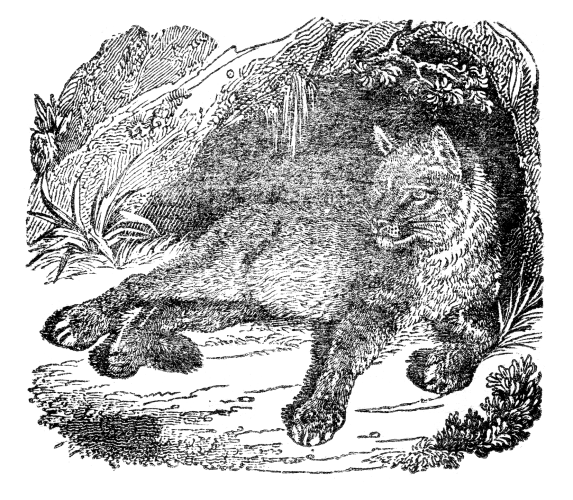
[The Puma.]
On December 23 two hyænas were weighed. No. 1. weighed 86 lbs.: it was fed as usual with 3 lbs. of beef daily at one meal in the evening. No. 2. weighed 93 lbs.: it was supplied with the same quantity of beef daily, divided into two equal portions, one of which was given in the morning and the other in the evening. On February 16 (after an interval of eight weeks) they were again weighed; and No. 1. was found to have increased in weight 1 lb., while No. 2. had diminished in weight 1 lb. The latter animal was observed to take less exercise than he had previously been accustomed to, and slept more than usual: his temper was not affected, and he did not exhibit unusual signs of hunger.
During the continuance of the experiment all the animals were fasted one day in each week in common with the other carnivorous species kept in the menagerie.
From these experiments it appears that carnivorous mammalia fed with two meals daily, do not continue in equally good condition with those which have the same quantity of flesh daily in one meal only. It further appears that in one instance (that of the leopard) the temper changed for the worse, and thus animals of the genus felis might become more dangerous in a menagerie from the ferocity they would acquire under such treatment; and that in another instance the habits were altered as regarded exercise, a diminution of which, in confined animals, must be injurious to health. The inference deduced is consequently in favour of the continuance of the accustomed mode of feeding the purely carnivorous animals with one meal daily.
The same results were produced by the same experiments upon two of a species less completely carnivorous—the Paradoxure gennet. It may be inferred from the circumstance, that quadrupeds of prey thrive best with long intervals between their meals, and that the difficulty which such animals experience in obtaining food is counterbalanced by their requiring it not so frequently as animals who feed on vegetables.