THE ABBEY OF ST. ALBAN’S.
Reading edition
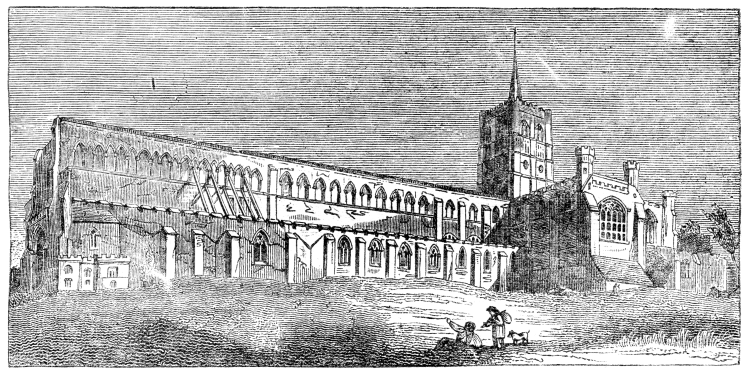
On the 3d of February last, a part of the wall of the upper battlement on the south-west side of the Abbey of St. Alban’s fell upon the roof below, in two masses, at an interval of five minutes between the fall of each fragment. The concussion was so great, that the inhabitants of the neighbouring houses describe it as resembling the loudest thunder; and the detached masses of the wall came down with such force that a large portion of the roof, consisting of lead and heavy timber, was driven into the aisle below. The abbey, generally, has been a good deal out of repair for several years; and it is now estimated that 15,000l. will be required to repair the damage, and to save this venerable fabric from further injury.
A public subscription has been opened for this laudable object; and when we consider the interest which the people of this country so properly attach to the monuments of our early civilization, we cannot doubt that the Abbey of St. Alban’s will be rescued, for several more generations, from the devouring grasp of time.
St. Alban’s is, in many respects, one of the towns of England most dignified by historical associations. It was one of the principal places of the ancient Britons before the Roman conquest; and, within twenty-one years after the invasion of the island, was raised, by the Romans, to the rank of a city, under the name of Verulam. Many considerable fragments of the Roman Verulam still exist, at a short distance from the present town, particularly a large piece of a wall, constructed of Roman tile, now called Gorhambury Block. Dr. Stukely, a celebrated antiquarian writer, has calculated that about a hundred acres were included within the Roman wall. The greater part of the city, first built by the Romans, was demolished by the Britons, under Queen Boadicea, in the 61st year after the birth of Christ; but it was soon rebuilt, and the inhabitants continued under the protection of the Romans for a long period. In the persecution of the Christians, under the Roman emperor Dioclesian, in the year 304, Alban, a native of Verulam, who had been a soldier at Rome, suffered martyrdom for his faith; and being the first Briton who had been put to death for his religious opinions, he is called England’s proto-martyr, or first martyr, as St. Stephen is called the proto-martyr of Christianity. In 795, Offa, King of the Mercians, founded an abbey at Holmhurst, close by the ancient Verulam, in honour of St. Alban, and the place was thenceforward called St. Alban’s. The abbey flourished for more than seven centuries. Its buildings, erected from time to time, resembled a town more than a religious house. It had magnificent apartments, in which the kings of the twelfth and thirteenth centuries were frequently entertained. The annual revenues, during its greatest prosperity, were valued at 2500l.—an enormous sum in those days.
Of this immense establishment, nothing is left but the present conventual church, a gate-house, and a few scattered walls. The church, which was principally erected in the reign of William Rufus, is in magnitude equal to our largest cathedrals. It measures 550 feet from east to west; if we include a chapel at one end, 606 feet. The extreme breadth, at the intersection of the transepts, is 217 feet. The exterior of this great pile is not very beautiful; but the spectator is struck with its vastness, its simplicity, and its appearance of extreme age. A large part of the original edifice is composed of materials taken from the ruins of the ancient Verulam, consisting chiefly of Roman tile. These portions of the interior are very rude, and form a striking contrast to other parts which were finished after the elegant Norman style was adopted in this country. In this manner it occurs that we see at St. Alban’s a mixture of the round and the pointed arch, in two sides of the same building, directly opposite each other. It is singular that as one side of the building fell into decay, the later style of architecture, that of the pointed arch, should have been used; while the more ancient round arch was suffered to remain on the opposite side. This want of uniformity greatly diminishes the beauty of the interior; but still many of its effects are remarkably striking, particularly that of the vast length of the church from east to west. Some parts of the edifice furnish, also, beautiful and perfect specimens of the most delicate workmanship.
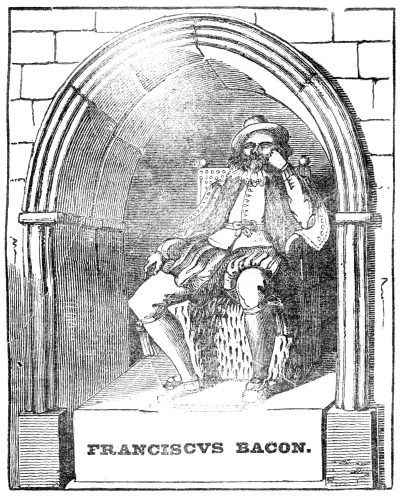
The Abbey-Church of St. Alban’s contains the monuments of several illustrious men, particularly that of Duke Humphrey of Gloucester, the brother of Henry V. But St. Alban’s possesses the much higher distinction of 130being the burial-place, as it was the abode, of the great Lord Bacon. The old Church of St. Michael, in this town, contains the remains of the immortal founder of the inductive philosophy, which delivered the human mind from the tyranny of opinions established by prescription and authority, and led the way for every man to think for himself, and to rely upon the truths of established facts alone as the materials for his conclusions. The following is a representation of Lord Bacon’s monument.