GLEANINGS IN NATURAL HISTORY.
Reading edition
We have occasionally selected a paragraph from a very pretty volume, by Mr. Jesse, published under the above title. The author lives in the neighbourhood of Kew; and, like Mr. White of Selborne, who made a small village in Hampshire one of the most interesting spots to the lover of nature, by his ample descriptions of the natural objects which he saw around him, Mr. Jesse has rendered his walks a vehicle for much instruction and amusement to himself and to others. He principally confines his attention to zoology—the most generally attractive of the departments of natural history; and he looks upon the animal world with so much practical wisdom, being disposed to be happy himself and to see every creature around him happy, that there are few persons who will not read his slight sketches with improvement to their hearts and understandings.
133We copy a passage descriptive of the manner of taking deer for hunting in the king’s parks:—
“In addition to the herd of fallow-deer, amounting to about one thousand six hundred, which are kept in Richmond Park, there is generally a stock of from forty to fifty red deer. Some stags from the latter are selected every year, and sent to Swinley, in order to be hunted by the king’s stag hounds. When a stag, which has been hunted for three or four seasons, is returned to the park, to end his days there, he is generally more fierce and dangerous than any of the others at a particular season of the year. At that time it is sometimes not safe to approach him; and the keepers informed me, that they have been obliged to fire at them with buck shot, when they have been attacked by them. They account for this ferocity, by the circumstance of the deer having been much handled, and consequently rendered more familiar with, and less afraid of, those whom they would naturally shun.
“Does are longer lived than bucks. One doe in Richmond Park lived to be twenty years old; and there are other instances of their having attained the same age.
“A curious circumstance lately occurred, respecting the red deer in the park in question. In the year 1825, not a single calf was dropped by any of the hinds, though they had bred freely the preceding, and did the same in the subsequent year. I find an event recorded in the ‘Journal of a Naturalist,’ as having happened in the same year in regard to cows. It is there stated that, for many miles round the residence of the author, scarcely any female calves were born. This diminution of the usual breed of deer, and the increase of sex in another animal, is not a little remarkable.
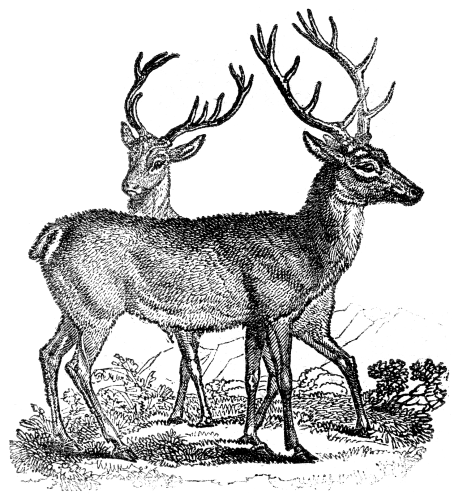
[Red Deer.]
“There is a fine breed of buck-hounds in Richmond Park, and their sagacity is very extraordinary. In taking the deer, according to annual custom, either for the royal hunt or for the fattening paddocks, a stag or a buck, which has been previously fixed upon, is ridden out of the herd by two or three of the keepers in succession, each of whom is closely followed by a hound, the young dogs only being kept in slips. As soon as the deer has been separated from his companions, the dogs have the requisite signal given to them, and they immediately follow in pursuit. The scene is then highly interesting. A strong deer will afford a very long chase, but when he comes to bay, the dogs generally seize him by the throat or ears; the keepers come up, take him by the horns, and after having strapped his hind and fore legs together, put him into a cart which follows for the purpose, and he is then disposed of as he may be wanted. I have seen an active young keeper throw himself from his horse upon a deer at bay, which he had come up to at full gallop, and hold his horns till assistance arrived. Some danger, however, attends this sport; as, when a deer has been hard pressed, I have seen him, in more than one instance, suddenly turn upon the horsemen and injure the horses, and in one case wound the leg of the horseman. The dogs are so well trained, and are so soon made aware which buck is intended to be caught, that they seldom make a mistake, even if the deer regains the herd after having been driven from it, but press him through it, till they have again separated him from it. It is well known that when a hard-pressed deer tries to rejoin his companions, they endeavour to avoid and get away from him as much as possible, or try to drive him away with their horns. So severe is the chase in Richmond Park in taking deer, especially when the ground is wet, that three or four good horses may be tired by a single horseman in one day’s deer-taking, if each deer is ridden out of the herd, and followed till he is taken. When dogs are in slips, the man who holds them merely rides as near as he can to the person who is endeavouring to single out the deer, and awaits his signal for slipping the dog. These dogs, who are a large, rough sort of greyhound and very powerful and sagacious, are soon taught not to injure the deer when they come to them. The cry of ‘hold them,’ made use of by the keepers in urging them forward, seems to be perfectly understood by the dogs.”