THE HALL OF ELTHAM PALACE.
Reading edition
Near the village of Eltham in Kent, about eight miles south east from London, stood anciently one of the most magnificent of the English royal palaces. The property is ascertained to have belonged to the Crown in the time of the Saxons. The Conqueror granted it to one of his Norman followers; but having again been forfeited to the Crown, it was given by Edward I. to one of the most powerful barons of those times—John de Vesci. Soon after this it came into the possession of Anthony Bec, the famous military Bishop of Durham, who is accused, however, of having made the acquisition by the most shameless violation of his trust, as guardian of the legal heir. Bec is the earliest proprietor of the manor who is recorded to have erected any buildings on the site of the palace—although there can be little doubt that there was a house there before his time. He built a large and splendid mansion, which appears to have been completed soon after the middle of the thirteenth century, King Henry III., accompanied by his queen and all the principal nobility, having kept his Christmas here in 1269. This was probably the warming of the house. On the death of the Bishop, which took place here in 1310, the manor of Eltham fell again to the crown, in the possession of which it has ever since remained. For the next two centuries the place was a favourite residence of our monarchs. Edward II.’s son John was born here in 1315, and was thence called John of Eltham. In the reign of Edward III. the Parliament was on several occasions assembled at Eltham; and here that prince, in 1365, entertained his captive, John, King of France, with sumptuous hospitality. The palace was almost entirely rebuilt by Edward IV., who, on the conclusion of the work in 1482 is recorded to have kept his Christmas in the Hall with great state and splendour. Large additions were afterwards made to the building by Henry VII., who, like his predecessors, generally lived here, and was wont to dine every day in the hall, surrounded by his barons. At this time the royal palace of Eltham consisted of four quadrangles enclosed within a high wall, beyond which was a moat of great width: the whole formed an irregular area, approaching to a square in shape, to which the principal entry was over a bridge and through a gateway in the north wall. There was also another bridge and gate at the opposite side of the inclosure. Of the buildings the most important part consisted of a high range which crossed the court from east to west, and included the hall, the chapel, and the state apartments. To the palace were attached a garden and three parks, comprehending together above 1300 acres, besides the demesne lands of 400 acres more. These parks were stocked with deer, and many fine old trees that still remain testify how richly wooded the place must have formerly been.
Of all this magnificence but little now remains; and many parts of the buildings can scarcely be traced even in their foundations. Henry VIII. deserted Eltham for the new palace of Greenwich, which, as being nearer to London, was probably found to be a more convenient residence. After this Eltham was only occasionally visited by the sovereign; which it sometimes was even in the time of James I. On the establishment of the Commonwealth the place was seized by the parliament and sold; and at the same time the parks were broken into, and the deer dispersed and killed by the soldiers and the common people. The work of devastation, thus begun, was continued until the greater part of the palace also was first reduced to a heap of ruins, and then swept away altogether; and although the property was recovered by the crown at the Restoration, no pains seem to have been taken to save the remnant of the pile from spoliation and destruction. On the contrary, the business of demolition was now carried on upon system: the old palace was turned into a quarry; and stone after stone was carried away as it was wanted for even the 264meanest purposes, until scarcely anything remained which it was thought worth while to remove. Fortunately, it was considered that the hall would make a good barn; and to this ignoble appropriation, which so well hit the economical humour of the times, we owe the preservation, in a state of comparative entireness, of this principal and most interesting portion of the noble old palace of Eltham.
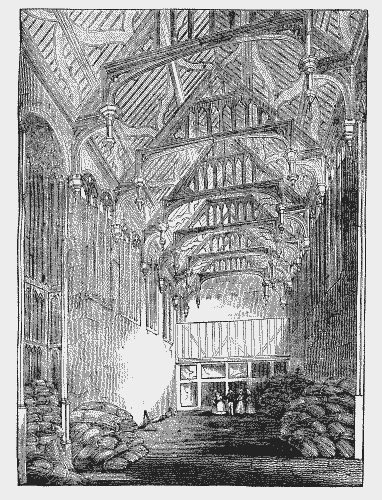
[Hall of Eltham Palace.]
According to Mr. Buckler, who published a valuable account of this palace a few years ago, the length of the hall in the inside is above 101 feet by about 36½ in width. “The interior,” says this writer, “is magnificent. The taste and talent of ages are concentrated in its design; and it is scarcely possible to imagine proportions more just and noble, a plan more perfect, ornaments more appropriate and beautiful; in a word, a whole more harmonious than this regal banquetting-room.” The windows, which, however, have been long built up, are ranged in couples along both sides; and each series is terminated by a bay window at the west or upper end of the hall. But the most conspicuous ornament of this fine room is its splendid roof. “The main beams of the roof,” says Mr. Buckler, “are full 17 inches square and 28 feet long, perfectly straight and sound throughout, and are the produce of trees of the most stately growth. A forest must have yielded its choicest timber for the supply of this building; and it is evident that the material has been wrought with incredible labour and admirable skill.”
This hall was undoubtedly the erection of Edward IV., whose well-known symbol, the expanded rose, is still to be seen on various parts of the building. About four years ago the public attention was called to the state of this beautiful remnant of our ancient architecture, which it was understood there was an intention of levelling with the ground, on the pretext that the roof in some parts showed signs of decay, and threatened to fall if not taken down. It had been resolved, it seems, to remove the roof to some new building at Windsor or else where, and then to demolish the rest of the hall. By the exertions, however, of some individuals of taste and influence a reconsideration of the subject was obtained; and eventually it was determined by the Government to advance a small sum, in order to effect such a partial repair of the hall as might at least secure its stability for the present. The work was committed to the superintendence of Mr. Smirke, by whom it was executed with much ability; and the roof is now once more restored, as far as was practicable, to its original strength and beauty. In other respects, however, the hall, we believe, still remains in the state in which it was previous to the repairs and continues to be used as a barn.
⁂ The Office of the Society for the Diffusion of Useful Knowledge is at 59, Lincoln’s Inn Fields.
LONDON:—CHARLES KNIGHT, PALL-MALL EAST.
Shopkeepers and Hawkers may be supplied Wholesale by the following Booksellers, of whom, also, any of the previous Numbers may be had:—
London, Groombridge, Panyer Alley.
Bath, Simms.
Birmingham, Drake.
Bristol, Westley and Co.
Carlisle, Thurnam; and Scott.
Derby, Wilkins and Son.
Devonport, Byers.
Doncaster, Brooke and Co.
Exeter, Balle.
Falmouth, Philip.
Hull, Stephenson.
Kendal, Hudson and Nicholson.
Leeds, Baines and Newsome.
Lincoln, Brooke and Sons.
Liverpool, Willmer and Smith.
Manchester, Robinson; and Webb and Simms.
Newcastle-upon-Tyne, Charnley.
Norwich, Jarrold and Son.
Nottingham, Wright.
Oxford, Slatter.
Plymouth, Nettleton.
Portsea, Horsey, Jun.
Sheffield, Ridge.
Staffordshire, Lane End, C. Watts.
Worcester, Deighton.
Dublin, Wakeman.
Edinburgh, Oliver and Boyd.
Glasgow, Atkinson and Co.
New York, Jackson.
Printed by William Clowes, Duke Street, Lambeth.
Transcriber’s Notes
New original cover art included with this eBook is granted to the public domain. Itemized changes from the original text:
p. 257: Replaced “succeeeded” with “succeeded” in phrase “The engineer having succeeded in filling and closing this hole.”
p. 258: Replaced single with double opening quotation mark before phrase “The smaller winter visiters, about five in number.”
p. 259: Added closing quotation mark after phrase “catching assiduously our English muskitoes.”
p. 259: Added opening square bracket before subheading “Hints on Emigration to Upper Canada.”
p. 260: Replaced comma with period after phrase “the Archbishops had a house here for at least a century before this time.”
p. 260: Replaced “Chichely” with “Chicheley” in phrase “It was erected by Archbishop Chicheley, in the early part of the fifteenth century.”
p. 262: Replaced comma with closing parentheses in phrase “The locomotive (or travelling) engines which are employed on the Liverpool railway.”
p. 264: Added period after phrase “restored, as far as was practicable, to its original strength and beauty.”